Showing posts with label spiral galaxy. Show all posts

Monday, September 28, 2026

A galaxy spinning out of sync

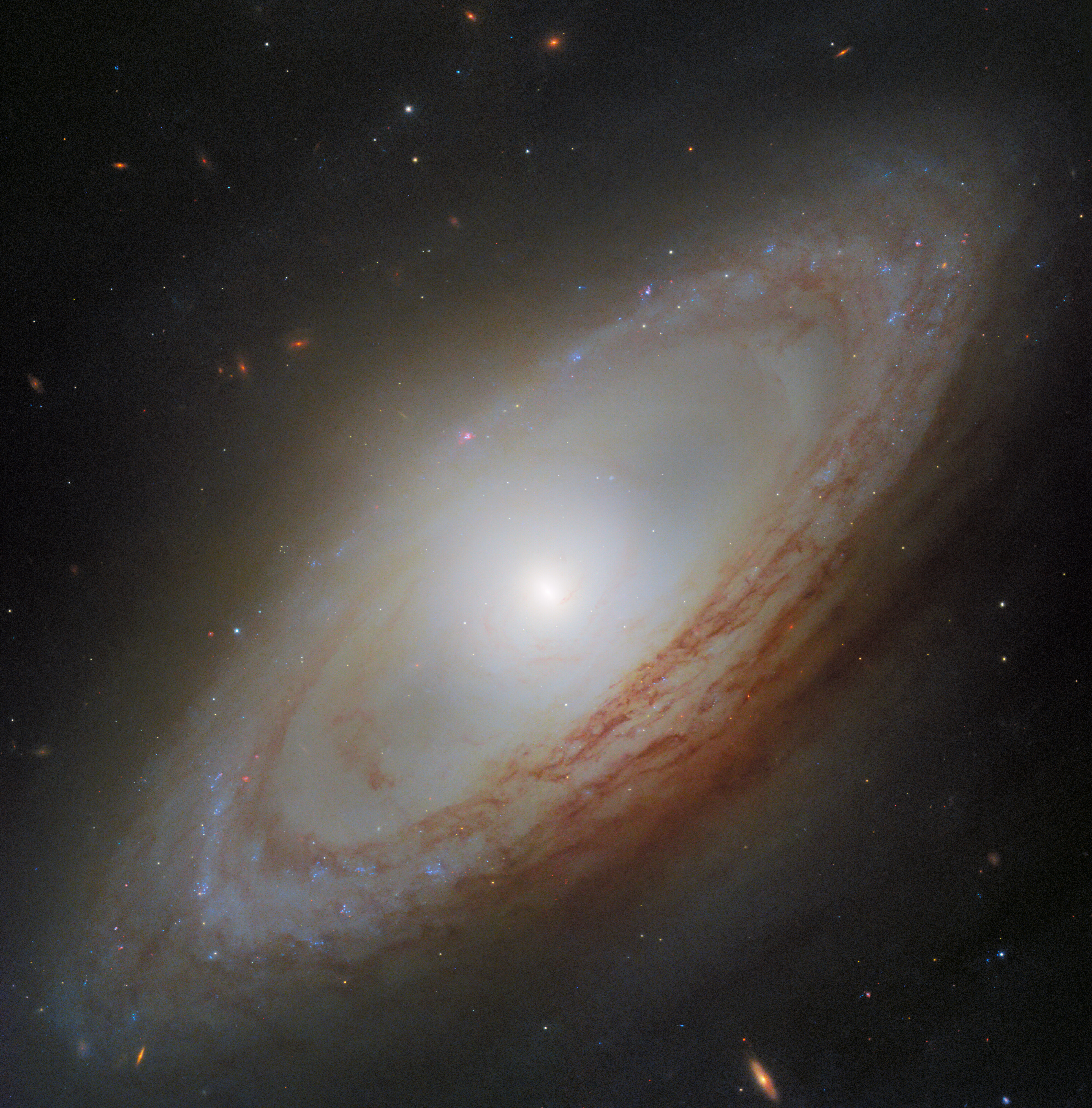
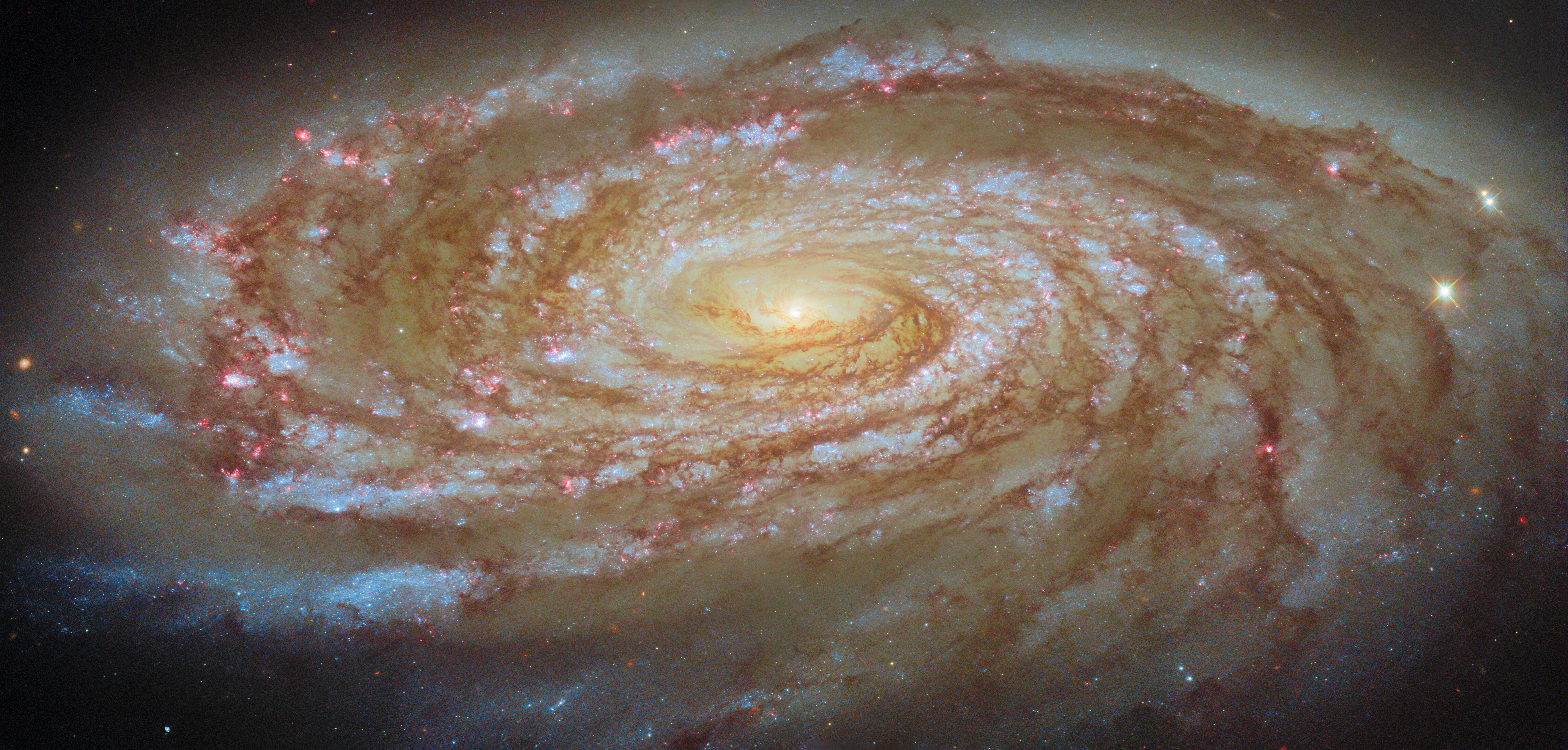
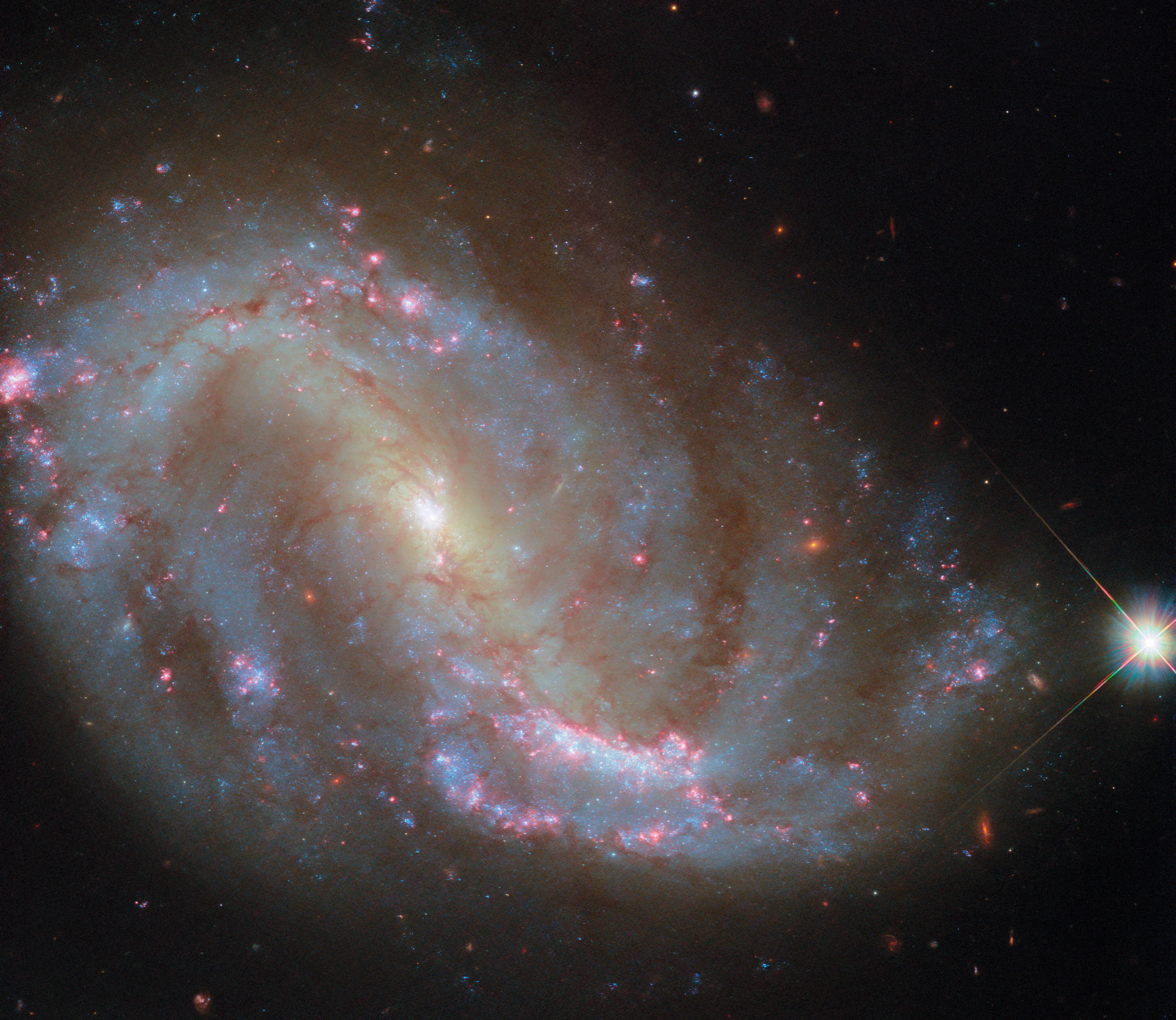
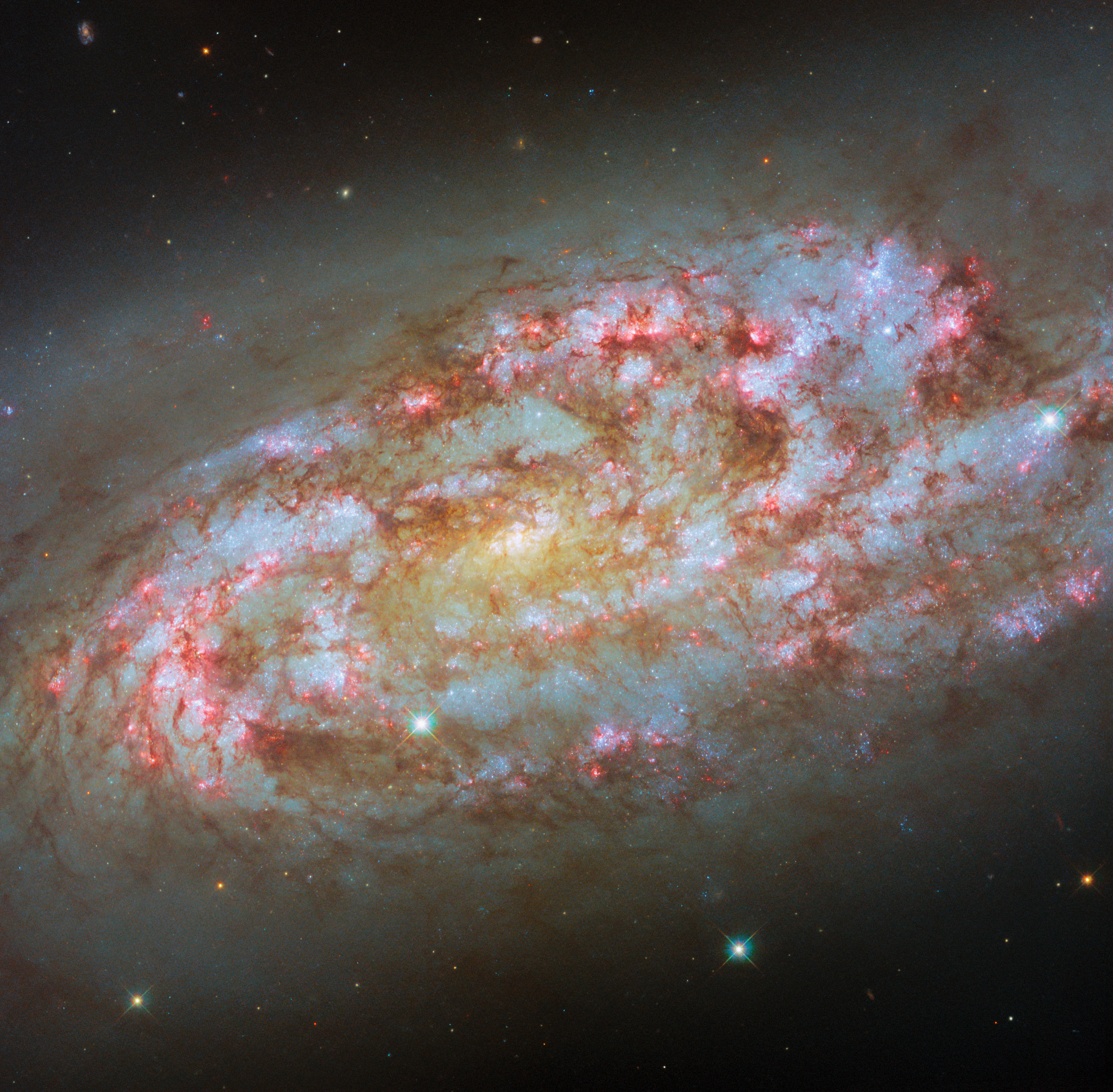
NGC 4698
Credit: ESA/Hubble & NASA, D. Thilker, the MAUVE-HST Team


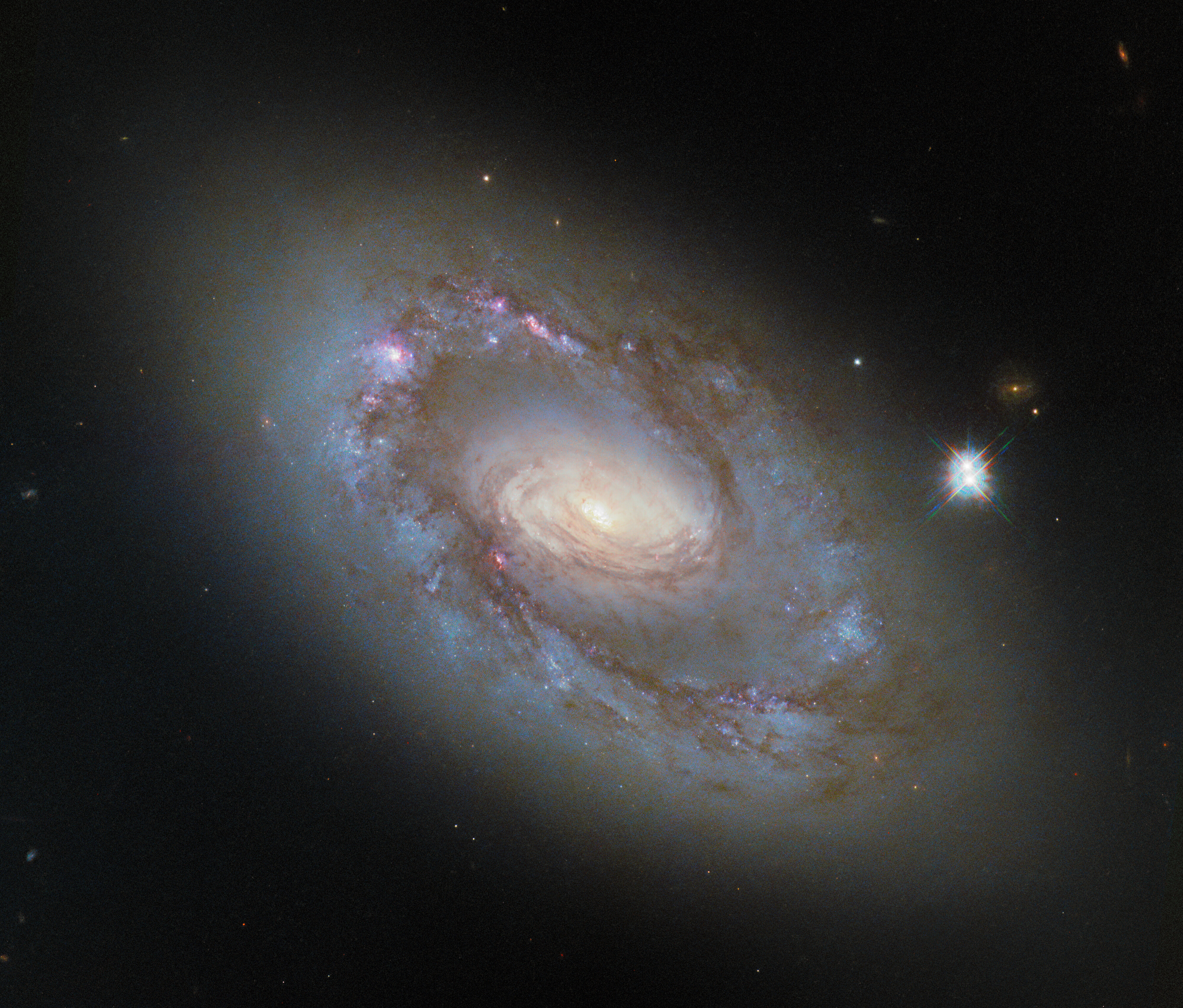
A spiral galaxy viewed at an angle, with a bright central bulge and winding spiral arms. The arms form a ring around the galaxy, without appearing to reach its centre. Prominent red-brown dust lanes weave through the arms, which are also dotted with bright blue and reddish regions of star formation. The galaxy is set against a dark background scattered with s,b.t,brars and faint distant galaxies.

Though the spiral galaxy in this ESA/Hubble Picture of the Month seems serene, it hides a chaotic secret. This galaxy is NGC 4698, and it lies about 55 million light-years away in the constellation Virgo. It’s one of over one thousand galaxies in the Virgo Cluster, the nearest large cluster of galaxies bound together by gravity.

As a spiral galaxy similar to our own Milky Way galaxy, NGC 4698 has spiral arms that curl around within a thin disc of stars, gas and dust. These arms are marked by opaque clumps of brown dust and dotted with small collections of bright blue stars. Unlike many other spiral galaxies, like this one recently photographed by Hubble, NGC 4698’s delicate spiral arms are only prominent in the outer reaches of the disc; spiral arms often wind down to the very centre of a galaxy, but NGC 4698’s spiral arms appear to shy away from its glowing centre. The arms instead hover in a ring-like structure around the perimeter of the galaxy.

NGC 4698’s centre is dominated by a galactic bulge. The diffuse off-white glow of the galaxy’s bulge comes from stars smaller, older, and cooler than the massive blue stars that dot the galaxy’s outer disc. These tightly packed stars orbit a supermassive black hole containing millions of times the Sun’s mass. Scientists have found signs that this black hole is actively growing, drawing gas inward with its gravitational pull.

With a flat, starry disc and diffusely glowing centre, NGC 4698 looks a lot like a typical spiral galaxy — but this galaxy is far from normal. NGC 4698 is one of only a few known spiral galaxies with a bulge that extends out from the disc at a right angle. The elongation is faintly visible in this Hubble image, which shows the ghostly glow of the starry bulge peeking above and below the dusty disc. What’s more, the stars and gas nearest the galaxy’s centre rotate perpendicular to the rest of the disc!

What could cause a galaxy to be so out of sync? Astronomers have found that the culprit likely lies outside the galaxy. If NGC 4698 funneled in gas from an outside source, the newly collected gas could have formed a disc of gas and stars in the galaxy’s centre, at an angle relative to the rest of the disc. Some observations suggest that this galaxy once experienced a minor galactic merger, as evidenced by a short ‘tail’ of hydrogen streaming from one side of the galaxy.

The data used to create this image come from an observing programme (#18103; PI: Thilker) focusing on galaxies in the Virgo Cluster. This programme zooms in on the details of these relatively nearby galaxies, such as individual star clusters and nebulae. At the same time, researchers will use these data to take stock of the larger picture, learning how a galaxy’s journey through a cluster affects the galaxy’s evolution and ability to. form new stars.


More information

Webb is the largest, most powerful telescope ever launched into space. Under an international collaboration agreement, ESA provided the telescope’s launch service, using the Ariane 5 launch vehicle. Working with partners, ESA was responsible for the development and qualification of Ariane 5 adaptations for the Webb mission and for the procurement of the launch service by Arianespace. ESA also provided the workhorse spectrograph NIRSpec and 50% of the mid-infrared instrument MIRI, which was designed and built by a consortium of nationally funded European Institutes (The MIRI European Consortium) in partnership with JPL and the University of Arizona.

Webb is an international partnership between NASA, ESA and the Canadian Space Agency (CSA).


Links


Contacts:

Bethany Downer
ESA/Hubble/Webb Chief Science Communications Officer
Email:
Bethany.Downer@esahubble.org

ESA Newsroom and Media Relations Office
Email:
media@esa.int


Monday, September 07, 2026

Hitchhiking PAHs Caught Catching a Ride on Galactic Winds

JWST's view of the spiral galaxy IC 5332. JWST's infrared instruments are sensitive to emission from molecules called polycyclic aromatic hydrocarbons.Credit: NASA, ESA, CSA, STScI, PHANGS Team, Janice Lee (STScI), Thomas Williams (Oxford), Rupali Chandar (UToledo)

Title: JWST Discovery of Warm Dust in the Circumgalactic Medium of the Makani Galaxy
Authors: Sylvain Veilleux et al.
First Author’s Institution: University of Maryland
Status: Published in ApJ


The Windy Galaxy

Billions of light-years away lies Makani, a record-breaking galaxy discovered in 2019 by researchers at the Keck Observatory atop Maunakea, Hawaiʻi. The galaxy shows evidence of a large merger event, where two galaxies collided to form a larger galaxy. This event triggered starburst activity, or several waves of intense star formation, that changed the makeup of not just Makani, but the region around it.

There are several processes that can create galactic winds. An active supermassive black hole at the center of the galaxy can slingshot particles out of the galaxy at close to the speed of light, or supernovae leftover from previous starburst activity can help to expel material from the galaxy. Makani, whose name in Hawaiian just so happens to mean “wind,” has both factors contributing to its galactic winds: massive amounts of star formation and a very active black hole in its center.

This contributes to some of the strongest galactic winds discovered to date, stretching approximately 100 kiloparsecs (330,000 light-years) beyond the galaxy, roughly ten times the extent of a typical galactic wind. These galactic winds remove gas from the galaxy and help to enrich the circumgalactic medium around the galaxy. There is still much to discover about how galactic winds change the makeup of such galaxies, and what exactly they take with them on their way out.

Figure 1: Makani’s spectrum overlaid on top of the JWST filters. The peaks in the spectrum are PAH features that neatly overlap with JWST’s observing bands. Credit: Veilleux et al. 2025

PAHs Gone Extragalactic

Using JWST, the authors scrutinized Makani for any signs of PAHs. They found that not only did PAHs exist within the galaxy, these molecules were found up to 30 kpc (~100,000 light-years) outside the galaxy. Makani’s strong galactic winds were ejecting the dust grains from the galaxy over an estimated timescale of a billion years.

Previously, astronomers had not expected to find high quantities of dust grains outside the protection of a galaxy. The journey across a galaxy is long and hot, with temperatures in the millions of degrees. A dust grain would likely not survive the trip, as it would be destroyed by high-energy photons. This suggests that the PAHs were somehow shielded from the hotter parts of the interstellar medium and circumgalactic medium in large enough volumes to make it beyond the edge of Makani.

This answered questions about how galaxies enrich the circumgalactic medium, but it also added several more. Since today’s authors were limited by the sensitivity and range of their instruments, they were unable to confirm if there were PAHs along Makani’s entire wind structure, or just the first 35 kpc (114,000 light-years) of it. They also would like to turn their sights towards the intergalactic medium to see if PAHs could make it even farther beyond the reach of their host galaxy.

Earth’s Favorite Carcinogen: Polycyclic Aromatic Hydrocarbons

Polycyclic aromatic hydrocarbons (PAHs, pronounced P-A-Hs or “paws”) are small flat dust grains scattered into every corner of the universe, from the atmosphere of Earth in the form of exhaust and wildfire smoke to the circumgalactic medium (the mostly empty space between galaxies). These PAHs contribute to regulating the temperature of the interstellar medium, but astronomers have long wondered how they migrate across galaxies.

Even though they are smaller than a human hair, PAHs are still easily observable even in very distant galaxies. These dust grains emit infrared light, and if there are enough PAHs in a region, they are bright enough to be observed with modern telescopes, such as JWST. By combining multiple observations across multiple filters, astronomers can calculate ratios that reveal information about the PAHs’ size, temperature, and charge, allowing reserachers to further discern properties about the regions in which these PAHs reside.

With redshifted galaxies like Makani, the light from PAHs is stretched beyond its usual wavelength, but fortunately for today’s authors, the light was stretched just enough to land known PAH features well within JWST filters, as seen in Figure 1. The authors were then able to use this information to track the distribution of these PAHs across Makani.

Original astrobite edited by Chloe Klare.


About the author, Natalie Price:

As a first-year master’s student at Wesleyan University, I study how stellar winds interact with the local interstellar medium. Outside of the observatory, you can find me dancing, with my nose in a book, or running at non-relativistic speeds.


Editor’s Note: Astrobites is a graduate-student-run organization that digests astrophysical literature for undergraduate students. As part of the partnership between the AAS and astrobites, we occasionally repost astrobites content here at AAS Nova. We hope you enjoy this post from astrobites; the original can be viewed at  astrobites.org.


Friday, August 28, 2026

One-sided spiral

A spiral galaxy. It has a prominent spiral arm on one side (lower left) and a wide, glowing core. Dark brown filaments of dust swirl through its disc, while blue clusters of stars are found mostly going out to its arm. On the opposite side to the arm (upper right), gas trails off from the disc, out of the view in this image. A matching spiral arm is not visible on this side. The galaxy lies on a dark background. Credit: ESA/Hubble & NASA, D. Thilker, J. Lee and the PHANGS-HST Team


The subject of this ESA/Hubble Picture of the Month is a spiral galaxy struggling against some of the titanic forces that appear on galactic scales in space. This is NGC 4654, an intermediate spiral galaxy in the constellation Virgo (the Maiden). “Intermediate” means that it lies between the spiral galaxies that have a bar across the centre and those that don’t, with a weak bar structure in its centre. It is situated 72 million light-years from Earth in the Virgo Cluster, a particularly massive and populous galaxy cluster.

NGC 4654 is particularly asymmetric, with a rounded and clearly-defined edge on one side and a long tail of gas stretching out from the opposite side — beyond Hubble’s view in this image. The cause of this gaseous tail is the same as for many of the other galaxies jostling in the crowded Virgo Cluster: namely, ram pressure stripping. NGC 4654 moves with such high velocity through space that it sweeps up and rams through the intracluster medium, the hot, rarefied gas filling the space between the Virgo Cluster’s galaxies. The intracluster medium in turn exerts a “ram pressure” on the galaxy, compressing the galaxy’s leading edge and tugging at its gas, creating the elongated tail.

It’s not just the galaxy’s gas that is unevenly distributed: its stars are too, and this is more unusual for a spiral galaxy. While the spiral arm on its leading edge is rich with stars and gas, the opposite arm noticeably lacks stars, influencing the galaxy’s lopsided spiral shape. It’s thought that ram pressure alone is unlikely to have had this effect. Rather, NGC 4654 has also been subjected to the gravitational force of the fellow Virgo Cluster galaxy NGC 4639. While the two galaxies are far apart now, it’s thought that a fly-by interaction between them around 500 million years ago ripped away NGC 4654’s gas along one side, limiting star formation there and creating the asymmetry in its shape.

Many galaxies that undergo ram pressure stripping suffer reduced star formation rates as the cold gas that collapses to form their stars is pulled away and lost. NGC 4654, however, is still forming nearly two Suns’ worth of stars every year, a rate comparable to other galaxies of similar size. The active star formation can be seen in the latest Hubble data used in this image, which picks up on a wavelength of red light that’s emitted by the clouds of energised gas where newborn stars lurk. The bright pink bubbles appear all across NGC 4654, from its forward spiral arm, to around its weak bar, and out to the edge of its disc.

The data used for this image come from two observing programmes (#15654, #17502) that have the aim of linking gas in galaxies with star formation. By observing many prominent galaxies in the vicinity of our own, researchers hope to better understand how gas moves around in galaxies, where and when it collapses to form stars and star clusters, and what effect those new stars have on the gas around them.


Links


Sunday, August 02, 2026

Active Galaxy M77


M77 (NGC 1068) is a spiral galaxy located relatively close to our Milky Way. At its center lies a supermassive black hole about 10 million times the mass of the Sun. As enormous amounts of energy are released around the black hole, M77 is known as an active galaxy.

Because of its proximity, M77 has been extensively studied across the electromagnetic spectrum, from X-rays to radio waves, using various telescopes, including the Subaru Telescope and ALMA. Recently, observations with the Subaru Telescope's Hyper Suprime-Cam (HSC) have revealed evidence that M77 experienced a previously hidden minor merger with a low-mass satellite galaxy billions of years ago. Credit: NAOJ/SDSS/David Hogg/Michael Blanton. Image Processing: Ichi Tanaka)

Distance from Earth: 48 million light-years
Instrument: Hyper Suprime-Cam (HSC)

Relevant Links


Tuesday, June 09, 2026

Journey to the centre of a galaxy cluster

A large spiral galaxy. It is seen tilted at an angle, so that it is foreshortened and appears very wide. Its tightly-wound, blue spiral arms swirl out from its glowing centre, spreading apart at the tips. They are followed by strands and clumps of dark red dust, and spotted with pink dots where stars are forming in clouds of gas. The galaxy is surrounded by a slight glow and lies on a dark background. Credit: ESA/Hubble & NASA, D. Thilker and the MAUVE-HST Team


The focus of today’s ESA/Hubble Picture of the Month is an active spiral galaxy on a journey lasting hundreds of millions of years. The galaxy Messier 88 (M88), which is also known as NGC 4501, is located about 63 million light-years away in the constellation Coma Berenices (Berenice’s Hair).

M88 is an active galaxy, which means that its centre harbours a supermassive black hole that is snacking on gas and dust. This black hole is estimated to be around 100 million times as massive as the Sun, and it appears to be powering outflows of gas from the galaxy’s centre.

Around this black hole is a population of old, reddish stars that give M88 its warmly glowing heart. Spreading out from the centre are several tightly wound, symmetrical spiral arms, each outlined by sparkling pink and blue star clusters and knotted clouds of dust. We see M88 from an angle so that it appears elongated, and its spiral arms delicately fan out before it.

M88 is a member of the Virgo Cluster, a collection of more than a thousand galaxies held together by gravity — and therefore linked by fate. As this massive group of galaxies moves through space, the galaxies themselves are in constant motion as they orbit the cluster’s centre of gravity. M88 itself is on a long and somewhat perilous cosmic journey that will bring it to the innermost reaches of the cluster.

As is the case with any epic journey, M88 will be fundamentally changed by its trek to the centre of the Virgo Cluster, about 2 million light-years from where it is today. In 200–300 million years, M88 will make its closest approach to Messier 87, the massive elliptical galaxy that anchors the entire cluster. As it draws close to this gravitational behemoth, M88 will experience intense ram pressure stripping. Ram pressure stripping is a process through which a galaxy’s gas is swept away as it pushes through the ever-present gas between the galaxies in a cluster.

Researchers have already seen this process at work in M88. The galaxy’s swirling disc of gas is truncated, and it appears to have been compressed on the leading edge of the galaxy, piling up like snow before a plough. In fact, M88 appears to have considerably less cold gas — the raw fuel for star formation — than expected for a galaxy of its size, especially in its outer regions. This is a clear sign that M88 will be altered by its journey, which will affect its ability to form stars and alter the course of its evolution.

Astronomers observed M88 with Hubble as part of an observing programme (#18103; PI: D. Thilker) dedicated to understanding the lives of spiral galaxies in crowded environments. This programme uses Hubble’s highly capable Wide Field Camera 3, which can finely resolve individual star clusters and nebulae in galaxies tens of millions of light-years away. By studying galaxies on these scales, astronomers can understand how a journey through a cluster impacts galaxies’ evolution and ability to form new stars.


Links


Sunday, June 07, 2026

Spiral Galaxy NGC 4045

NGC 4045
Credit: NAOJ; Image provided by Masayuki Tanaka


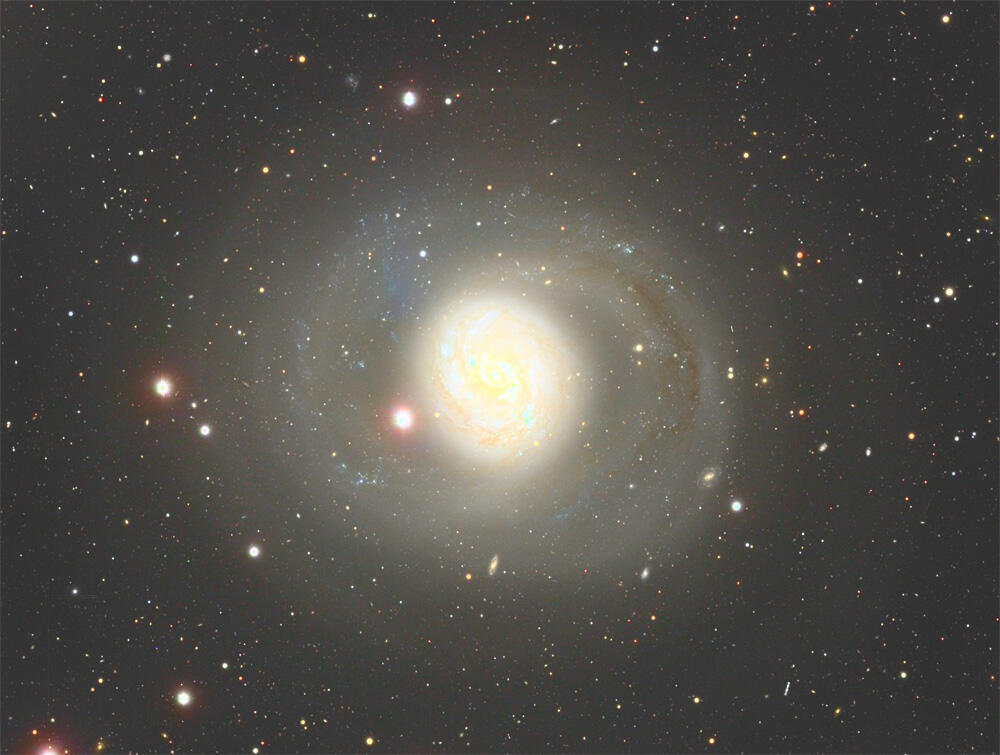
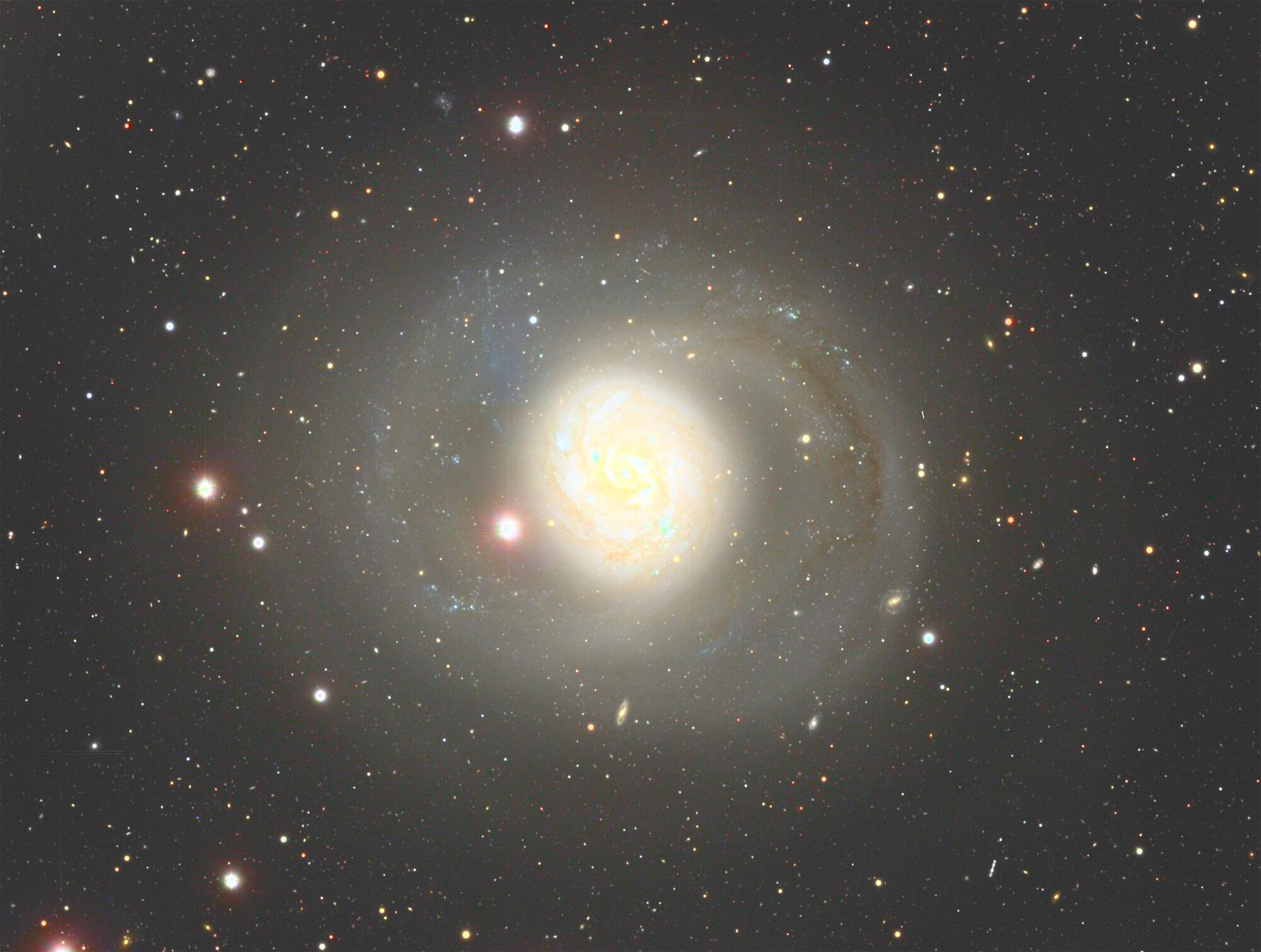
The spiral galaxy NGC 4045, located in the Virgo constellation, displays two distinct spiral arms extending from its bright central nucleus to its outer regions. A faint blue spiral arm stretches to the right, indicating that stars are actively forming in the outer regions of this galaxy.Below NGC 4045 lies another galaxy, NGC 4045 A. Although it appears close enough to be gravitationally interacting with NGC 4045, it is actually a far more distant galaxy aligned along the same line of sight from Earth, and the two galaxies are not physically associated.


Monday, December 22, 2025

Long-distance relationship

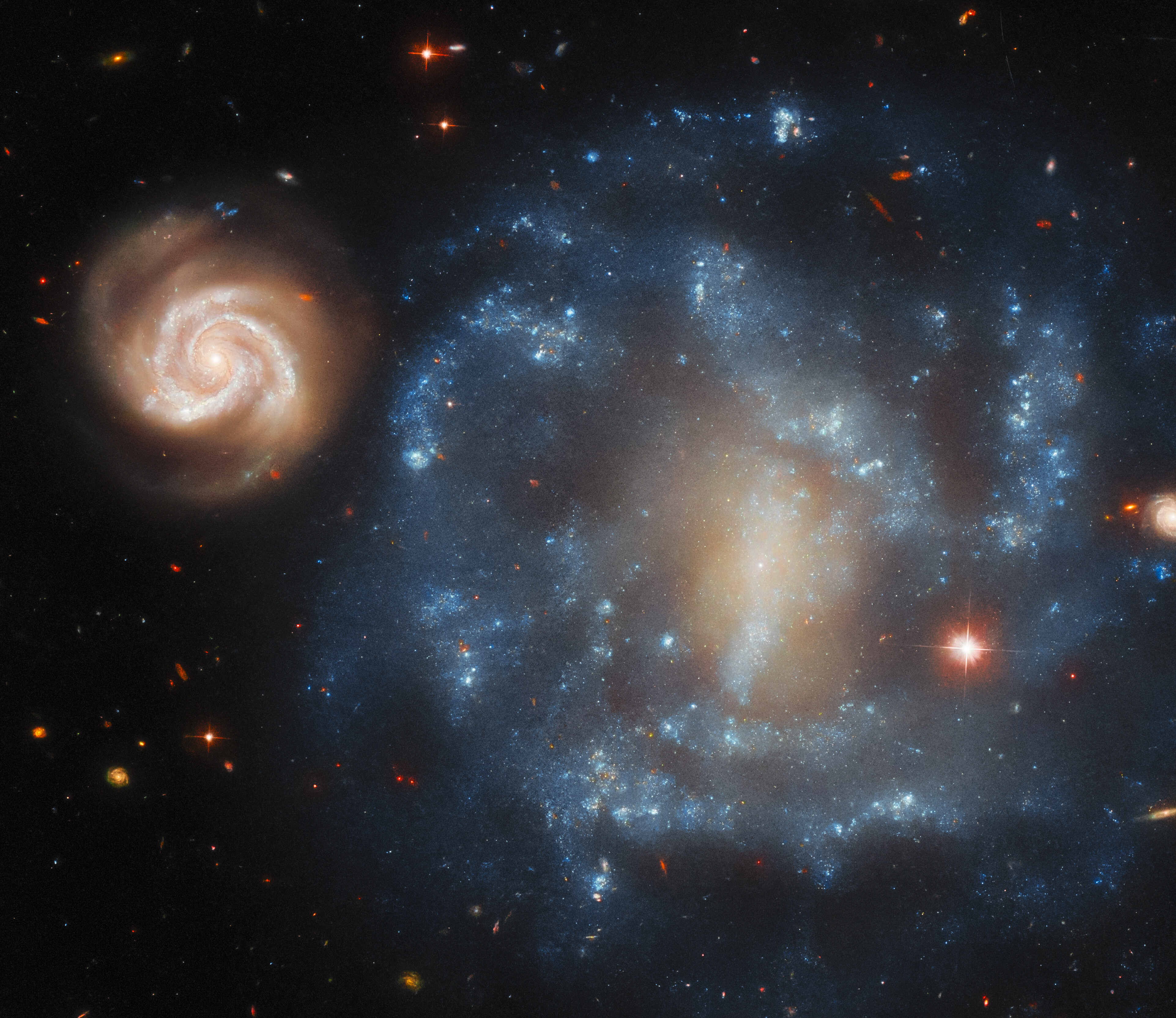
This image shows two galaxies side by side. The galaxy on the top left is smaller in size, and appears as a bright glowing spiral with clearly-defined arms. A larger blue galaxy dominates the full right field of the image. This galaxy is more irregularly shaped, with a glowing central bar, and varying regions of concentrated hues of blue. The background is black with various stars and galaxies in the distance. Credit: ESA/Hubble & NASA, J. Dalcanton, Dark Energy Survey/DOE/FNAL/DECam/CTIO/NOIRLab/NSF/AURA

These galaxies look to be close companions — a small, bright spiral galaxy flitting around the edge of a much larger spiral with a dark and disturbed countenance. But looks can be deceiving — how close are they really? The celestial pair featured in this week’s Hubble Picture of the Week is known by the name Arp 4, and lies in the constellation Cetus (the Whale).

The designation Arp 4 comes from the Atlas of Peculiar Galaxies, compiled in the 1960s by astronomer Halton Arp. “Unusual galaxies” were selected and photographed to provide examples of weird and non-standard shapes, the better to study how galaxies evolve into these forms. Throughout its mission the Hubble Space Telescope has revolutionised the study of galaxies and shown us some fantastically unusual examples from Arp’s atlas. In that catalogue, the first few galaxies like Arp 4 are “low surface brightness” galaxies, a type of galaxy that is unexpectedly faint and hard to detect. The large galaxy here — also catalogued as MCG-02-05-050 — fits this description well, with its fragmentary arms and dim disc. Its smaller companion, MCG-02-05-050a, is a much more bright and active spiral.

The trick is that these galaxies are not actually very close. The large blue galaxy MCG-02-05-050 is located 65 million light-years from Earth; its brighter smaller companion MCG-02-05-050a, at 675 million light-years away, is over ten times the distance! Owing to this, MCG-02-05-050a is likely the larger galaxy of the two, and MCG-02-05-050 comparatively small. Their pairing in this image is simply an unlikely visual coincidence. Despite this lack of a physical relation between them, our point of view on Earth allows us to enjoy the sight of Arp 4 as an odd couple in the sky.

Links


Tuesday, December 16, 2025

Galactic gas makes a getaway

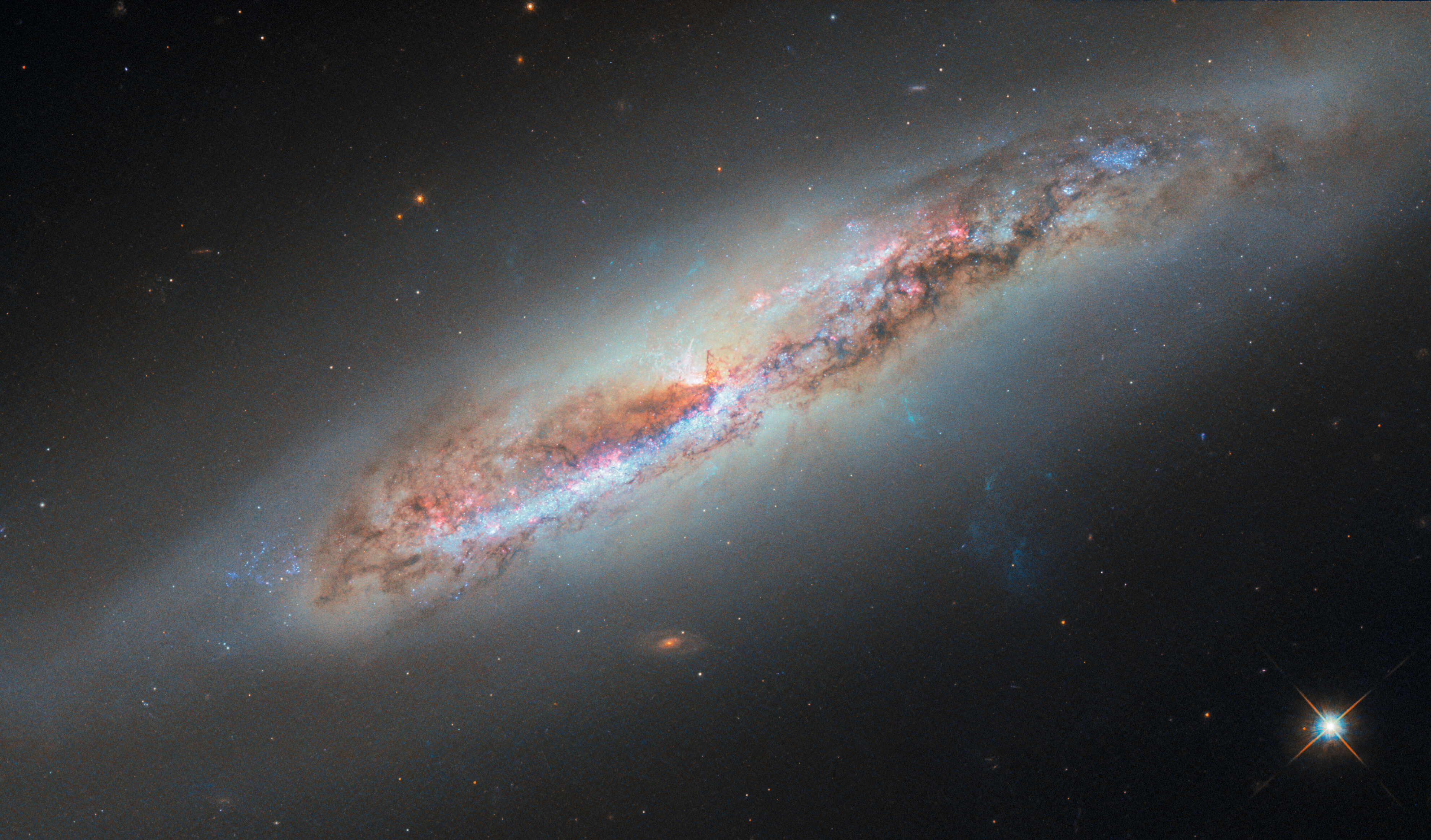
A spiral galaxy seen nearly edge-on. Its disk is filled with red and blue lights from star-forming nebulae and clusters of hot stars, respectively, as well as thick dark clouds of dust that block the strong white light from its centre. A faint, glowing halo of gas surrounds the disc, fading into the black background. A bluish plume of gas also extends from the galaxy’s core to the lower-right of the image. Credit: ESA/Hubble & NASA, S. Veilleux, J. Wang, J. Greene

A sideways spiral galaxy shines in today’s ESA/Hubble Picture of the Week. Located about 60 million light-years away in the constellation Virgo (The Maiden), NGC 4388 is a resident of the Virgo galaxy cluster. The Virgo cluster contains more than a thousand galaxies and is the nearest large galaxy cluster to the Milky Way.

NGC 4388 is tilted at an extreme angle relative to our point of view, giving us a nearly edge-on vantage point. This perspective reveals a curious feature that wasn’t visible in a previous Hubble image of this galaxy released in 2016: a plume of gas from the galaxy’s nucleus, here seen billowing out from the galaxy’s disc towards the lower-right corner of the image. But where did this outflow come from, and why does it glow?

The answer likely lies in vast stretches that separate the galaxies of the Virgo cluster. Though the space between the galaxies appears to be empty, this space is actually occupied by hot wisps of gas called the intracluster medium. As NGC 4388 journeys within the cluster, it plunges through the intracluster medium. The pressure from the hot intracluster gas whisks away the gas from within NGC 4388’s disc, causing it to trail behind as NGC 4388 moves.

The source of the energy that ionises this gas cloud and causes it to glow is more uncertain. Researchers suspect that some of the energy comes from the centre of the galaxy, where a supermassive black hole has spun the gas around it into a superheated disc. The blazing radiation from this disc might ionise the gas closest to the galaxy, while shock waves might be responsible for ionising the filaments of gas farther out.

This image incorporates new data including several additional wavelengths of light to bring the ionised gas cloud into view. The data used to create this image come from several observing programmes that aim to illuminate galaxies with active black holes at their centres.


Wednesday, December 03, 2025

A storm of new stars

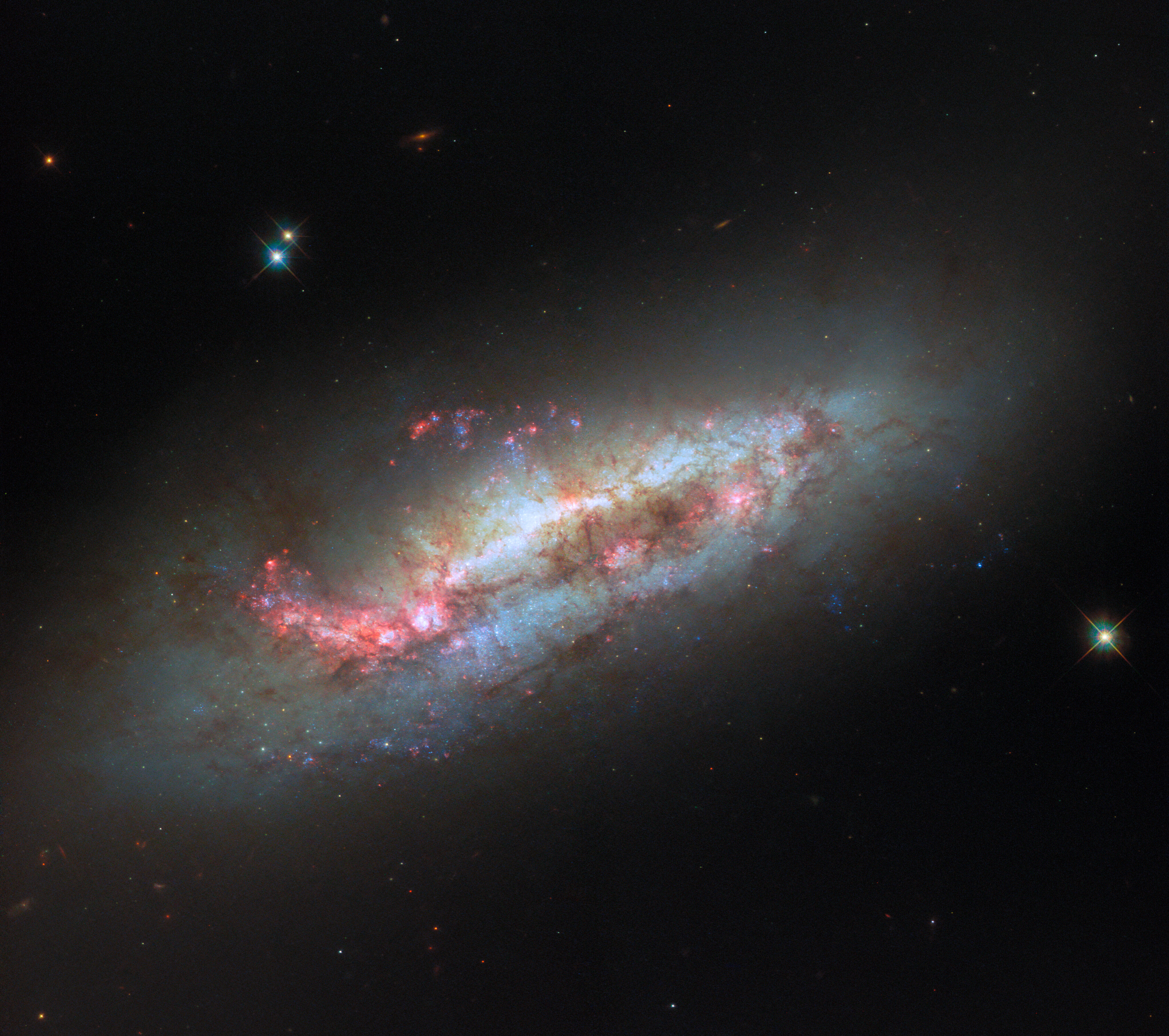
A spiral galaxy, seen partly from the side, with a messy, turbulent appearance. Its disc is made of multiple patchy arms that contain numerous sparkling blue and glowing red regions — star clusters and star-forming nebulae. Thick clumps of dark reddish dust swirl through the disc. The glow of the disc extends out into the dark background, where both distant and nearby stars can be seen. Credit: ESA/Hubble & NASA, D. Thilker, F. Belfiore, J. Lee and the PHANGS-HST Team

The subject of the latest Hubble Picture of the Week is a stormy and highly active spiral galaxy named NGC 1792. Located over 50 million light-years from Earth in the constellation Columba (the Dove), the bright glow of the galaxy’s centre is offset by the flocculent and sparkling spiral arms swirling around it.

NGC 1792 is just as fascinating to astronomers as its chaotic look might imply. Classified as a starburst galaxy, it is a powerhouse of star formation, with spiral arms rich in star-forming regions. In fact, it is surprisingly luminous for its mass. The galaxy is close to a larger neighbour, NGC 1808, and the strong gravitational interaction between the two is believed to be what has stirred up the reserves of gas in this galaxy. The result is a torrent of star formation, concentrated on the side where gravity has a stronger effect. It’s a perfect target for astronomers seeking to understand the complex interactions between gas, star clusters and supernovae in galaxies.

Hubble has shown off this galaxy before, in 2020. This week’s new image includes additional data collected throughout 2025, providing a deeper view of the tumultuous astrophysical activity taking place in the galaxy. Blossoming red lights in the arms mark out so-called H-alpha emission from dense clouds of hydrogen molecules. Stars form within these clouds and shine powerfully with ultraviolet radiation. They ionise the gas around them, causing the gas to emit a very particular red wavelength of light — a tell-tale sign of new stars.


Tuesday, November 18, 2025

Finding star clusters in the Lost Galaxy

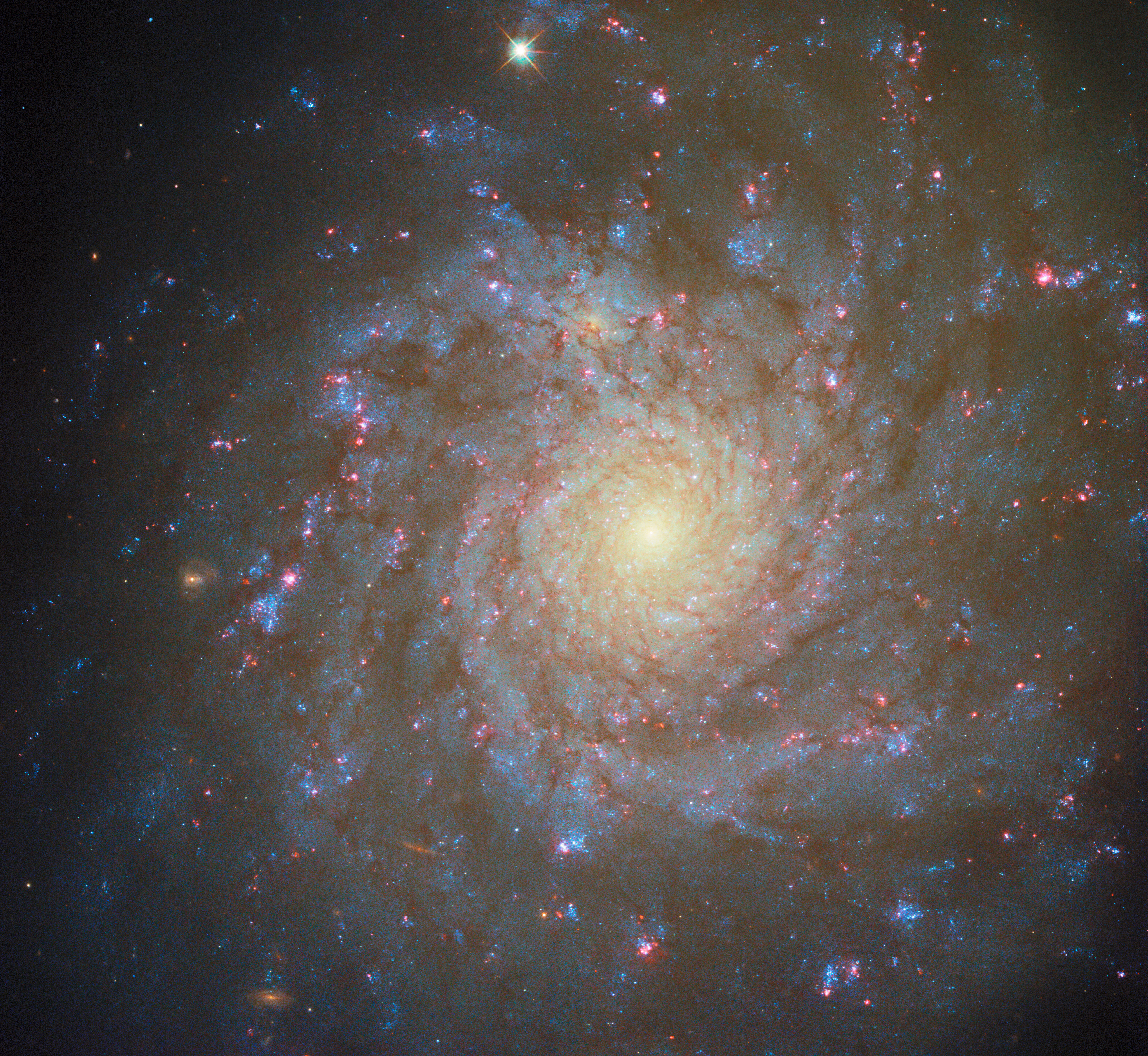
A close-in view of a spiral galaxy that faces the viewer. Brightly lit spiral arms swing outwards through the galaxy’s disc, starting from an elliptical region in the centre. Thick strands of dark reddish dust are spread across the disc, mostly following the spiral arms. The arms also contain many glowing pink-red spots where stars form. The galaxy is a bit fainter beyond the arms, but speckled with blue stars. Credit: ESA/Hubble & NASA, F. Belfiore, J. Lee and the PHANGS-HST Team

Today’s ESA/Hubble Picture of the Week features the spiral galaxy NGC 4535, which is situated about 50 million light-years away in the constellation Virgo (The Maiden). This galaxy has been nicknamed the ‘Lost Galaxy’ because it’s extremely faint when viewed through a small telescope. With a mirror spanning 2.4 metres across, Hubble is well equipped to observe dim galaxies like NGC 4535 and pick out features like its massive spiral arms and central bar of stars.

On full display in this Hubble image are NGC 4535’s young star clusters, which dot the galaxy’s spiral arms. Many of the groupings of bright blue stars are enclosed by glowing pink clouds. These clouds, called H II (‘H-two’) regions, are a sign that the galaxy is home to especially young, hot, and massive stars that are blazing with high-energy radiation. By heating the clouds in which they were born, shooting out powerful stellar winds, and eventually exploding as supernovae, massive stars certainly shake up their surroundings.

This Hubble image incorporates data from an observing programme that will catesa/alogue roughly 50 000 H II regions in nearby star-forming galaxies like NGC 4535. A previous image of NGC 4535 was released in 2021. Both the 2021 image and today’s image incorporate observations from the PHANGS programme, which seeks to understand the connections between young stars and cold gas. Today’s image adds a new dimension to our understanding of NGC 4535 by capturing the brilliant red glow of the nebulae that encircle massive stars in their first few million years of life.


Friday, November 14, 2025

Unique shape of star’s explosion revealed just a day after detection

PR Image eso2520a
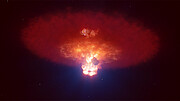
Artist’s impression of the initial shape of a supernova explosion

PR Image eso2520b
The supernova SN 2024ggi in the NGC 3621 galaxy

PR Image eso2520c
NGC 3621 in the constellation of Hydra

PR Image eso2520d
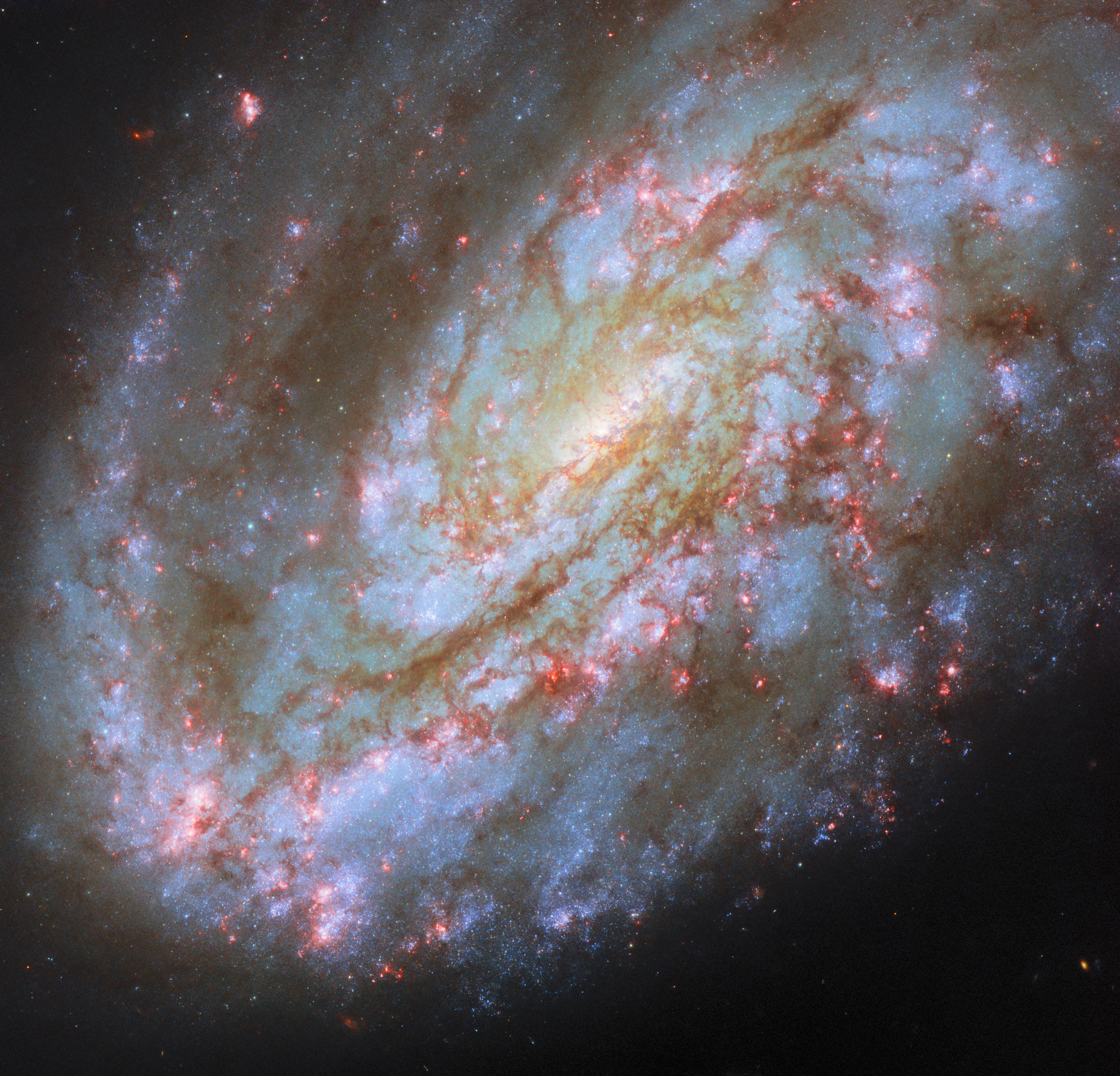
A galaxy full of surprises — the spiral galaxy NGC 3621


Videos

What’s the true shape of a supernova? | ESO News
PR Video eso2520a
What’s the true shape of a supernova? | ESO News

Artist’s animation of a supernova explosion
PR Video eso2520b
Artist’s animation of a supernova explosion


Swift observations with the European Southern Observatory’s Very Large Telescope (ESO’s VLT) have revealed the explosive death of a star just as the blast was breaking through the star’s surface. For the first time, astronomers unveiled the shape of the explosion at its earliest, fleeting stage. This brief initial phase wouldn’t have been observable a day later and helps address a whole set of questions about how massive stars go supernova.

When the supernova explosion SN 2024ggi was first detected on the night of 10 April 2024 local time, Yi Yang, an assistant professor at Tsinghua University in Beijing, China, and the lead author of the new study, had just landed in San Francisco after a long-haul flight. He knew he had to act quickly. Twelve hours later, he had sent an observing proposal to ESO, which, after a very quick approval process, pointed its VLT telescope in Chile at the supernova on 11 April, just 26 hours after the initial detection.

SN 2024ggi is located in the galaxy NGC 3621 in the direction of the constellation Hydra ‘only’ 22 million light-years away, close by in astronomical terms. With a large telescope and the right instrument, the international team knew they had a rare opportunity to unravel the shape of the explosion shortly after it happened. “The first VLT observations captured the phase during which matter accelerated by the explosion near the centre of the star shot through the star’s surface. For a few hours, the geometry of the star and its explosion could be, and were, observed together,” says Dietrich Baade, an ESO astronomer in Germany, and co-author of the study published today in Science Advances.

“The geometry of a supernova explosion provides fundamental information on stellar evolution and the physical processes leading to these cosmic fireworks,” Yang explains. The exact mechanisms behind supernova explosions of massive stars, those with more than eight times the mass of the Sun, are still debated and are one of the fundamental questions scientists want to address. This supernova’s progenitor was a red supergiant star, with a mass 12 to 15 times that of the Sun and a radius 500 times larger, making SN 2024ggi a classical example of a massive-star explosion.

We know that during its life a typical star keeps its spherical shape as a result of a very precise equilibrium of the gravitational force that wants to squeeze it and the pressure of its nuclear engine that wants to expand it. When it runs out of its last source of fuel, the nuclear engine starts sputtering. For massive stars this marks the beginning of a supernova: the core of the dying star collapses, the mass shells around fall onto it and bounce off. This rebound shock then propagates outward, disrupting the star.

Once the shock breaks through the surface, it unleashes immense amounts of energy — the supernova then brightens dramatically and becomes observable. During a short-lived phase, the supernova’s initial ‘breakout’ shape can be studied before the explosion interacts with the material surrounding the dying star.

This is what astronomers have now achieved for the very first time with ESO's VLT, using a technique called ‘spectropolarimetry’. “Spectropolarimetry delivers information about the geometry of the explosion that other types of observation cannot provide because the angular scales are too tiny,” says Lifan Wang, co-author and professor at the Texas A&M University in the US, who was a student at ESO at the start of his astronomy career. Even though the exploding star appears as a single point, the polarisation of its light carries hidden clues about its geometry, which the team were able to unravel. [1]

The only facility in the southern hemisphere capable of capturing the shape of a supernova through such a measurement is the FORS2 instrument installed on the VLT. With the FORS2 data, the astronomers found that the initial blast of material was shaped like an olive. As the explosion spread outwards and collided with the matter around the star, the shape flattened but the axis of symmetry of the ejecta remained the same. "These findings suggest a common physical mechanism that drives the explosion of many massive stars, which manifests a well-defined axial symmetry and acts on large scales,” according to Yang.

With this knowledge astronomers can already rule out some of the current supernova models and add new information to improve other ones, providing insights into the powerful deaths of massive stars. "This discovery not only reshapes our understanding of stellar explosions, but also demonstrates what can be achieved when science transcends borders,” says co-author and ESO astronomer Ferdinando Patat. “It’s a powerful reminder that curiosity, collaboration, and swift action can unlock profound insights into the physics shaping our Universe."


Notes

[1] Light particles (photons) have a property called polarisation. In a sphere, the shape of most stars, the polarisation of the individual photons cancels out so that the net polarisation of the object is zero. When astronomers measure a non-zero net polarisation, they can use that measurement to infer the shape of the object — a star or a supernova — emitting the observed light.


More information

This research was presented in a paper to appear in Science Advances (doi: 10.1126/sciadv.adx2925).

The team is composed of Y. Yang (Department of Physics, Tsinghua University, China [Tsinghua University]), X. Wen (School of Physics and Astronomy, Beijing Normal University, China [Beijing Normal University] and Tsinghua University), L. Wang (Department of Physics and Astronomy, Texas A&M University, USA [Texas A&M University] and George P. and Cynthia Woods Mitchell Institute for Fundamental Physics & Astronomy Texas A&M University, USA [IFPA Texas A&M University]), D. Baade (European Organisation for Astronomical Research in the Southern Hemisphere, Germany [ESO]), J. C. Wheeler (University of Texas at Austin, USA), A. V. Filippenko (Department of Astronomy, University of California, Berkeley, USA [UC Berkeley] and Hagler Institute for Advanced Study, Texas A&M University, USA), A. Gal-Yam (Department of Particle Physics and Astrophysics, Weizmann Institute of Science, Israel), J. Maund (Department of Physics, Royal Holloway, University of London, United Kingdom), S. Schulze (Center for Interdisciplinary Exploration and Research in Astrophysics, Northwestern University, USA), X. Wang (Tsinghua University), C. Ashall (Department of Physics, Virginia Tech, USA and Institute for Astronomy, University of Hawai’i at Manoa, USA), M. Bulla (Department of Physics and Earth Science, University of Ferrara, Italy and INFN, Sezione di Ferrara, Italy and INAF, Osservatorio Astronomico d’Abruzzo, Italy), A. Cikota (Gemini Observatory/NSF NOIRLab, Chile), H. Gao (Beijing Normal University and Institute for Frontier in Astronomy and Astrophysics, Beijing Normal University, China), P. Hoeflich (Department of Physics, Florida State University, USA), G. Li (Tsinghua University), D. Mishra (Texas A&M University and IFPA Texas A&M University), Ferdinando Patat (ESO), K. C. Patra (California and Department of Astronomy & Astrophysics, University of California, Santa Cruz, USA), S. S. Vasylyev (UC Berkeley), S. Yan (Tsinghua University).

The European Southern Observatory (ESO) enables scientists worldwide to discover the secrets of the Universe for the benefit of all. We design, build and operate world-class observatories on the ground — which astronomers use to tackle exciting questions and spread the fascination of astronomy — and promote international collaboration for astronomy. Established as an intergovernmental organisation in 1962, today ESO is supported by 16 Member States (Austria, Belgium, Czechia, Denmark, France, Finland, Germany, Ireland, Italy, the Netherlands, Poland, Portugal, Spain, Sweden, Switzerland and the United Kingdom), along with the host state of Chile and with Australia as a Strategic Partner. ESO’s headquarters and its visitor centre and planetarium, the ESO Supernova, are located close to Munich in Germany, while the Chilean Atacama Desert, a marvellous place with unique conditions to observe the sky, hosts our telescopes. ESO operates three observing sites: La Silla, Paranal and Chajnantor. At Paranal, ESO operates the Very Large Telescope and its Very Large Telescope Interferometer, as well as survey telescopes such as VISTA. Also at Paranal, ESO will host and operate the south array of the Cherenkov Telescope Array Observatory, the world’s largest and most sensitive gamma-ray observatory. Together with international partners, ESO operates ALMA on Chajnantor, a facility that observes the skies in the millimetre and submillimetre range. At Cerro Armazones, near Paranal, we are building “the world’s biggest eye on the sky” — ESO’s Extremely Large Telescope. From our offices in Santiago, Chile we support our operations in the country and engage with Chilean partners and society.


Links


Contacts:

Yi Yang
Department of Physics, Tsinghua University,
Beijing, China
Tel: +86 13581896137
Email:
yi_yang@mail.tsinghua.edu.cn, yiyangtamu@gmail.com

Dietrich Baade
European Southern Observatory
Garching bei München, Germany
Tel: +49 89 6096 295
Email:
dbaade@eso.org

Lifan Wang
Department of Physics & Astronomy, College of Arts & Sciences, Texas A&M University
College Station, Texas, United States
Email:
lifan@tamu.edu

Ferdinando Patat
European Southern Observatory
Garching bei München, Germany
Tel: +49 89 3200 6744
Email:
fpatat@eso.org

Bárbara Ferreira
ESO Media Manager
Garching bei München, Germany
Tel: +49 89 3200 6670
Cell: +49 151 241 664 00
Email
: press@eso.org


Tuesday, November 11, 2025

A disruptive neighbour

A spiral galaxy, tilted away so that it is seen mostly from the edge. The disc of the galaxy glows blue from its centre, due to younger stars in the spiral arms. There are large and small patches of gas, glowing in red and pink colours, where new stars are forming. Webs of dark dust are spread over the disc. The glow of the disc fades into a dark background, with a couple of stars. Credit: ESA/Hubble & NASA, D. Thilker
Though interesting to look at, NGC 1511 is one galaxy you might not want for a neighbour. Seen in this ESA/Hubble Picture of the Week, NGC 1511 is a peculiar spiral galaxy located roughly 50 million light-years away in the constellation Hydrus.

Like many galaxies, NGC 1511 doesn’t travel through space alone. Instead, it does so with a pair of small galactic companions called NGC 1511A and NGC 1511B, both of which lie outside the frame of this Hubble image. NGC 1511B is situated closest to NGC 1511, and the two galaxies have apparently clashed in the past; a narrow strand of hydrogen gas connects them, and NGC 1511B has been stretched and distorted by the encounter. Researchers have even found evidence that NGC 1511 once had another small companion galaxy that it has disrupted entirely!

These disruptions have an impact on NGC 1511, too. The galaxy is experiencing a burst of star formation, and its disc features strange loops and plumes that could point to past interactions with its neighbouring galaxies. Researchers will use Hubble’s keen observations of NGC 1511 to study star clusters embedded within its dusty gas, seeking to understand how matter is cycled from interstellar clouds to stars and back to clouds once again.


Tuesday, November 04, 2025

Revisiting an unusual spiral

A spiral galaxy. The inner region immediately around the bright centre is golden in colour. A gap separates this region from a bright ring, itself surrounded by a glowing halo. Strands of dark brown dust swirl around the centre and the outer ring, joined in one spot by a curved arm. Bright, blue and pink specks of light dot the ring, showing where stars are concentrated or have recently formed. Credit: ESA/Hubble & NASA, G. Fabbiano

>What lies at the heart of this unusual-looking spiral galaxy? The galaxy NGC 4102, featured in this ESA/Hubble Picture of the Week, is home to what astronomers call an active galactic nucleus. Active galactic nuclei are luminous galactic centres powered by supermassive black holes that contain millions to billion times the mass of our Sun. As these black holes ensnare gas from their surroundings and draw it close with their intense gravitational pull, the gas becomes so hot that it begins to glow and emits light from X-ray to radio wavelengths.

At a distance of just 56 million light-years away in the constellation Ursa Major (The Great Bear), NGC 4102 provides an ideal opportunity to study the ways in which active galactic nuclei interact with their home galaxies. Active galactic nuclei come in many different flavours, from extremely powerful types that consume massive amounts of matter and shoot out jets of charged particles, to calmer types that sip gas from their surroundings and glow more faintly.

NGC 4102 likely falls into the latter category. It’s classified as Compton-thick — a way of saying that its nucleus is obscured by a thick layer of gas — and a LINER, or low-ionisation nuclear emission-line region. LINER galaxies are identified by emission lines from certain weakly ionised elements, and they can be powered by a supermassive black hole that is lazily collecting gas from around it.

A previous image of this galaxy, made from data taken with Hubble’s Wide Field Planetary Camera 2 (WFPC2), was released in 2014. This new version presents an upgraded view of the galaxy, using data from the Wide Field Camera 3, which replaced WFPC2 in 2009 and improved upon its resolution and field of view. The new observations come from a programme that will combine visible-light images from Hubble with X-ray information from the Chandra X-ray Observatory to study the relationship between NGC 4102 and its active galactic nucleus.


Tuesday, October 28, 2025

Spiral Galaxy NGC 5301


NGC 5301 is a spiral galaxy located in the constellation Canes Venatici. This edge-on galaxy features prominent dust lanes that stretch across its entire galactic disk. The striking contrast between the reddish central region and the bluish spiral arms enhances its beauty. Compared to NGC 5211 , a face-on spiral galaxy, this image illustrates how the inclination of a galactic disk can significantly change a galaxy's appearance. Since we can only observe a single galaxy from one angle, observing and comparing multiple galaxies with different inclinations is essential for understanding galactic structure. (Credit: NAOJ; Image provided by Masayuki Tanaka)

Distance from Earth: 70 million light-years
Instrument: Hyper Suprime-Cam (HSC)


Spiralling star factory

A spiral galaxy, seen face-on, fills the view. Swirling, patchy and broken spiral arms surround a softly glowing centre. The arms are filled with blue, speckled patches showing star clusters, shining pink and red dots where young stars are lighting up gas clouds, and a web of thin, dark red dust lanes. The glow of the galaxy’s arms extends out into the dark background. Individual tiny stars appear throughout. Credit: ESA/Hubble & NASA, F. Belfiore, J. Lee and the PHANGS-HST Team

A star-studded spiral galaxy shines in this NASA/ESA Hubble Space Telescope Picture of the Week. This galaxy is called NGC 4571, and it’s situated about 60 million light-years away in the constellation Coma Berenices. NGC 4571 dominates the scene with its feathery spiral structure and sparkling star clusters.

The galaxy’s dusty spiral arms are dotted with brilliant pink nebulae that contain massive young stars. Though the star-forming clouds that are seen here are heated to roughly 10 000 degrees by searing ultraviolet light from the young stars at their cores, stars get their start in much chillier environments. The sites of star birth are giant molecular clouds tens to hundreds of light-years across, in which the temperature hovers just a few tens of degrees above absolute zero.

The dramatic transformation from freezing gas cloud to fiery young star happens thanks to the immense pull of gravity, which collects gas into dense clumps within a star-forming cloud. As these clumps yield to gravity’s pull and collapse inward, they eventually become hot and dense enough to spark nuclear fusion in their centres and begin to shine. The glowing clouds in this image surround particularly massive stars that are hot enough to ionise the gas of their birthplaces.

A Hubble image of NGC 4571 was previously released in 2022, using data from an observing programme the combines data from leading observatories like Hubble, the NASA/ESA/CSA James Webb Space Telescope, and the Atacama Large Millimeter/submillimeter Array to study star formation in nearby spiral galaxies like NGC 4571. The new image released today adds data from a programme that seeks to understand how dust affects our observations of young stars deeply embedded within their natal clouds.


Monday, October 13, 2025

A well-studied spiral

A spiral galaxy featuring a bright, glowing core that is crossed by a horizontal bar of yellowish light. Spiral arms emerge from each end of this bar and wrap around it, creating a disc that is stretched out to the right. Some areas, mostly along the arms, glow pink where stars are forming in nebulae. Webs of dark reddish dust also follow the arms. A star in our galaxy shines prominently, off to the right. Credit: ESA/Hubble & NASA, R. Chandar, J. Lee and the PHANGS-HST team

The celestial object that is displayed in this NASA/ESA Hubble Space Telescope Picture of the Week is NGC 7496, a galaxy located over 24 million light-years away in the constellation Grus (The Crane). NGC 7496 is a dusty spiral galaxy with a bar of stars stretching across its centre. Adding to its intrigue is an active galactic nucleus: a supermassive black hole that feasts on gas at the very heart of the galaxy. Astronomers have observed NGC 7496 at wavelengths from radio to ultraviolet in order to study the galaxy’s active galactic nucleus, dust clouds, and star formation. Hubble first observed this galaxy as part of the Physics at High Angular resolution in Nearby GalaxieS (PHANGS) programme. This programme has enlisted the abilities of several powerful astronomical observatories, including the Atacama Large Millimetre/submillimetre Array (ALMA), the Very Large Telescope, and the NASA/ESA/CSA James Webb Space Telescope, in addition to Hubble. NGC 7496 was the first galaxy in the PHANGS sample that Webb observed.

Each of these observatories offers a different perspective on this well-studied galaxy. With its unique ultraviolet capabilities and fine resolution, Hubble’s view reveals young star clusters bursting with high-energy radiation. Hubble’s observations of NGC 7496 help to reveal the ages and masses of these young stars, as well as the extent to which their starlight is blocked by dust.

A previous Hubble image of NGC 7496 was released in 2022. Today’s image incorporates new data that highlight the galaxy’s star clusters, which are surrounded by glowing red clouds of hydrogen gas. Astronomers collected these data in order to study nebulae like those that massive stars leave behind when they explode as supernovae and those from which newborn stars are made.


Wednesday, October 08, 2025

Starbursting centre

A spiral galaxy with large, open arms. A bar of yellow light, where old stars are gathered, crosses the middle of the disk. The very centre is a white point surrounded by a small, shining ring of star clusters. Thin lanes of dust swirl around this ring, reaching out to follow the spiral arms; also visible across the arms are red, glowing spots where stars are forming. To the right a star shines large and bright. Credit: ESA/Hubble & NASA, L. C. Ho, G. Brammer, A. Filippenko, C. Kilpatrick

The glittering galaxy in this NASA/ESA Hubble Space Telescope Picture of the Week is NGC 6951, which resides about 70 million light-years away in the constellation Cepheus.

As this Hubble image shows, NGC 6951 is a spiral galaxy with plenty of intriguing structures. Most eye-catching are its spiral arms, which are dotted with brilliant red nebulae, bright blue stars and filamentary dust clouds. The spiral arms loop around the galactic centre, which has a golden glow that comes from a population of older stars. The centre of the galaxy is also distinctly elongated, revealing the presence of a slowly rotating bar of stars.

NGC 6951’s bar may be responsible for another remarkable feature: a white-blue ring that encloses the very heart of the galaxy. This is called a circumnuclear starburst ring — essentially, a circle of enhanced star formation around the nucleus of a galaxy. The bar funnels gas toward the centre of the galaxy, where it collects in a ring about 3800 light-years across. Two dark dust lanes that run parallel to the bar mark the points where gas from the bar enters the ring.

The dense gas of a circumnuclear starburst ring is the perfect environment to churn out an impressive number of stars. Using data from Hubble, astronomers have identified more than 80 potential star clusters within NGC 6951’s ring. Many of the stars formed less than 100 million years ago, but the ring itself is longer-lived, potentially having existed for 1–1.5 billion years.

Astronomers have imaged NGC 6951 with Hubble for a wide variety of reasons, including mapping the dust in nearby galaxies, studying the centres of disc galaxies and keeping tabs on recent supernovae (of which NGC 6951 has hosted five or six).


Thursday, September 25, 2025

Spiral, elliptical or neither?

A galaxy seen face-on, with a slightly elliptical disc that appears to have a hole in the centre like a doughnut. In the hole, the core is a brightly glowing point that shines light out beyond the edge of the disc. Around the hole is an inner ring of dust, and at the galaxy’s edge is a thicker outer ring of dust, with a swirling web of dust strands in between. Blue stars and red nebulae are visible behind the dust. Credit: ESA/Hubble & NASA, F. Belfiore, J. Lee and the PHANGS-HST Team

Today’s NASA/ESA Hubble Space Telescope Picture of the Week features a galaxy that’s hard to categorise. The galaxy in question is NGC 2775, which lies 67 million light-years away in the constellation Cancer (The Crab). NGC 2775 sports a smooth, featureless centre that is devoid of gas, resembling an elliptical galaxy. It also has a dusty ring with patchy star clusters, like a spiral galaxy. Which is it, then: spiral or elliptical — or neither?

Because we can only view NGC 2775 from one angle, it’s difficult to say for sure. Some researchers have classified NGC 2775 as a spiral galaxy because of its feathery ring of stars and dust, while others have classified it as a lenticular galaxy. Lenticular galaxies have features common to both spiral and elliptical galaxies.

It’s not yet known exactly how lenticular galaxies come to be, and they might form in a variety of ways. Lenticular galaxies might be spiral galaxies that have merged with other galaxies, or that have mostly run out of star-forming gas and lost their prominent spiral arms. They also might have started out more similar to elliptical galaxies, then collected gas into a disk around them.

Some evidence suggests that NGC 2775 has merged with other galaxies in the past. Invisible in this Hubble image, NGC 2775 has a tail of hydrogen gas that stretches almost 100 000 light-years around the galaxy. This faint tail could be the remnant of one or more galaxies that wandered too close to NGC 2775 before being stretched apart and absorbed. If NGC 2775 merged with other galaxies in the past, it could explain the galaxy’s strange appearance today.

A Hubble image of NGC 2775 was previously released in 2020. The new version adds observations of a specific wavelength of red light that is emitted by clouds of hydrogen gas surrounding massive young stars.


Tuesday, September 02, 2025

A galaxy with lots to see

A spiral galaxy. It shines brightly at the centre, and most of its disc also glows in warm colours. Its two spiral arms, which wind outwards from the centre, are made up mostly of large patches of bright blue specks. They also contain thin, reddish clouds of dust, and bright pink bubbles of glowing gas, where stars are forming. Distant galaxies can be seen around the galaxy as small orange spots, on a dark background. Credit: ESA/Hubble & NASA, D. Thilker

While it may appear unassuming at first glance, just another spiral galaxy among thousands in the Universe, this subject of the ESA/Hubble Picture of the Week has plenty to study. NGC 7456 is its name, located over 51 million light-years away in the constellation Grus (the Crane).

In this image we see in fine detail the patchy spiral arms of this galaxy, followed by clumps of dark, obscuring dust. Blossoms of glowing pink are rich reservoirs of gas where new stars are forming, illuminating the clouds around them and causing the gas to emit this tell-tale red light. The Hubble programme which collected this data is focused on stellar activity just like this, tracking new stars, clouds of hydrogen and star clusters to learn how the galaxy has evolved through time.

Hubble, with its ability to capture visible, ultraviolet and some infrared light, is not the only observatory focused on NGC 7456. ESA’s XMM-Newton satellite has imaged X-rays from the galaxy on multiple occasions, discovering a number of so-called ultraluminous X-ray sources. These small, compact objects emit terrifically powerful X-rays, much more than would be expected for their size. Astronomers are still trying to pin down what powers these extreme objects, and NGC 7456 contributes a few more examples.

On top of that, the region around the galaxy’s supermassive black hole is spectacularly bright and energetic, making NGC 7456 an active galaxy. Whether looking at its core or its outskirts, at visible light or X-rays, this galaxy has something interesting to show!


Tuesday, August 26, 2025

Taking a third look

A spiral galaxy, tilted nearly face-on to us, with a slightly unusual shape. Its spiral arms form an oval-shaped ring around the galaxy’s disc, filled with blue light from stars, as well as pink glowing gas bubbles where new stars are forming. Threads of dark red dust swirl around the brightly glowing core, blocking some of its light. The dust lanes extend into and follow the spiral arms. Credit: ESA/Hubble & NASA, F. Belfiore, D. Calzetti

Today’s NASA/ESA Hubble Space Telescope Picture of the Week features a galaxy whose asymmetric appearance may be the result of a galactic tug of war.Located 35 million light-years away in the constellation Leo, the spiral galaxy Messier 96 is the brightest of the galaxies in its group. The gravitational pull of its galactic neighbours may be responsible for Messier 96’s uneven distribution of gas and dust, asymmetric spiral arms, and off-centre galactic core.

This asymmetric appearance is on full display in a new Hubble image, which incorporates observations made in ultraviolet and optical light. Hubble images of Messier 96 have been released previously in 2015 and 2018. Each successive image has added new data, building up a beautiful and scientifically valuable view of the galaxy.

This third version gives an entirely new perspective on Messier 96’s star formation. The bubbles of pink gas in this image surround hot, young, massive stars, illuminating a ring of star formation in the outskirts of the galaxy. These young stars are still embedded within the clouds of gas from which they were born. The new data included for the first time in this image will be used to study how stars are born within giant dusty gas clouds, how dust filters starlight, and how stars affect their environments.