Showing posts with label stellar winds. Show all posts

Thursday, October 08, 2026

NASA’s Webb Captures Commotion From Nebula’s Stellar Jets

NASA’s James Webb Space Telescope has revealed many protostars and stars within the glowing gases of  NGC 7129. Hot, atomic hydrogen gas is shown here in the golden region, while cooler, molecular hydrogen gas, shocked by embedded protostars, is represented in red. Credit Image: NASA, ESA, CSA, STScI; Image Processing: Alyssa Pagan (STScI)

NASA’s retired Spitzer Space Telescope observed the gas and dust within NGC 7129; however, NASA’s James Webb Space Telescope’s improved resolution shows more detailed gas and dust filaments, along with many background galaxies. Credit Image: NASA, ESA, CSA, STScI, NASA-JPL; Image Processing: Alyssa Pagan (STScI)


A cauldron of cosmic creation is being revealed in a new image from NASA’s James Webb Space Telescope. Webb has unveiled numerous stars formerly hidden by clouds of dust in a stellar nursery known as NGC 7129, which resides about 3,300 light-years from Earth.

Stars, the engines of elemental creation, have life cycles that begin with their birth in molecular clouds – cold, dense regions of dust and gas. Because of these dusty cocoons, young stars are often impossible to view by many telescopes, particularly those incapable of capturing infrared light. Webb, however, has a high degree of infrared sensitivity, allowing astronomers to peer through that dust and study the beginning of the star life cycle.

The stars from this cluster are in different stages of their development, as the more massive stars form and evolve the fastest. The most massive (and the most mature) is the region’s luminous central star, LkH(alpha) 234 (pronounced Lick-H-alpha). This star, which sports the image’s most prominent diffraction pattern, is a pre-main-sequence star weighing around 5 to 8 times the mass of our Sun. Pre-main-sequence stars like these have mostly finished gathering mass and are contracting under the force of gravity, causing their temperatures to rise. In time, this star will fuse its own hydrogen like our Sun.

The cavity to its left, which appears in gold and spans about 3.5 light-years, is the largest demonstration of the central star’s impact. Outflows from an earlier stage of the star’s life cycle carve into the dense molecular cloud of hydrogen. Both the outflows and the star’s light energize the gas, causing it to glow. While much of this hydrogen gas is blown away, a large amount is also compressed, creating the conditions for even more stars to form.

A few of these stars are visible within the cavity. Several of them are also pre-main-sequence and emit stellar winds. The nearby bow shocks, the curved compressed gas that appears near the stars, are created as those winds push into the energetic gas and create their own, smaller cavities.

Together, the central and embedded stars also create the sharp ridge seen at the top of the golden cavity. Their light generates a hot environment that pushes against the colder and denser molecular gas outside the cavity, and creates a boundary known as a photodissociation region. In this region, the molecules of hydrogen break down into atoms. By influencing the temperature and chemistry of the region, this collection of stars offers insight into how these molecular clouds will gradually erode over millions of years.

The region to the right of the central star narrates a different, but equally chaotic tale. This clumpy matter represented in red hides much younger objects than those on the left: protostars. The protostar stage is earlier than the pre-main-sequence stage and occurs after molecular clouds of gas and dust initially compress and fragment.

As the protostars accumulate matter and increase their mass, they eject outflows of superheated material. These outflows interact with the dense, gray, translucent matter the protostars are wrapped within, creating shocks that cause a textured appearance. The red glow is also the result of the interaction. Multiple outflows from multiple stars overlap from our point of view, leading to the scene’s chaotic look.

More of these protostellar outflows can be seen at the upper left of the image, near a blue-colored nebula. The center of this blue region hosts a protostar surrounded by a donut-shaped disk of material. This disk casts a shadow against the surrounding nebula, reminiscent of a similar structure known as the “Bat Shadow” that was observed by NASA’s Hubble Space Telescope.

Webb’s high spatial resolution reveals many rich structures in the region’s gas, building on research done previously by NASA’s retired Spitzer Space Telescope. Astronomers will continue to use this Webb data to study how the stars and protostars in this region influence the surrounding gas and dust.

The James Webb Space Telescope is the world’s premier space science observatory. Webb is solving mysteries in our solar system, looking beyond to distant worlds around other stars, and probing the mysterious structures and origins of our universe and our place in it. Webb is an international program led by NASA with its partners, ESA (European Space Agency) and CSA (Canadian Space Agency).


Details:

Last Updated: Oct 06, 2026
Location:
NASA Goddard Space Flight Center

Contact Media:

Laura Betz
NASA’s Goddard Space Flight Center
Greenbelt, Maryland

laura.e.betz@nasa.gov

Matthew Brown
Space Telescope Science Institute
Baltimore, Maryland


Hannah Braun
Space Telescope Science Institute
Baltimore, Maryland


Tuesday, November 25, 2025

Baby stars blowing bubbles

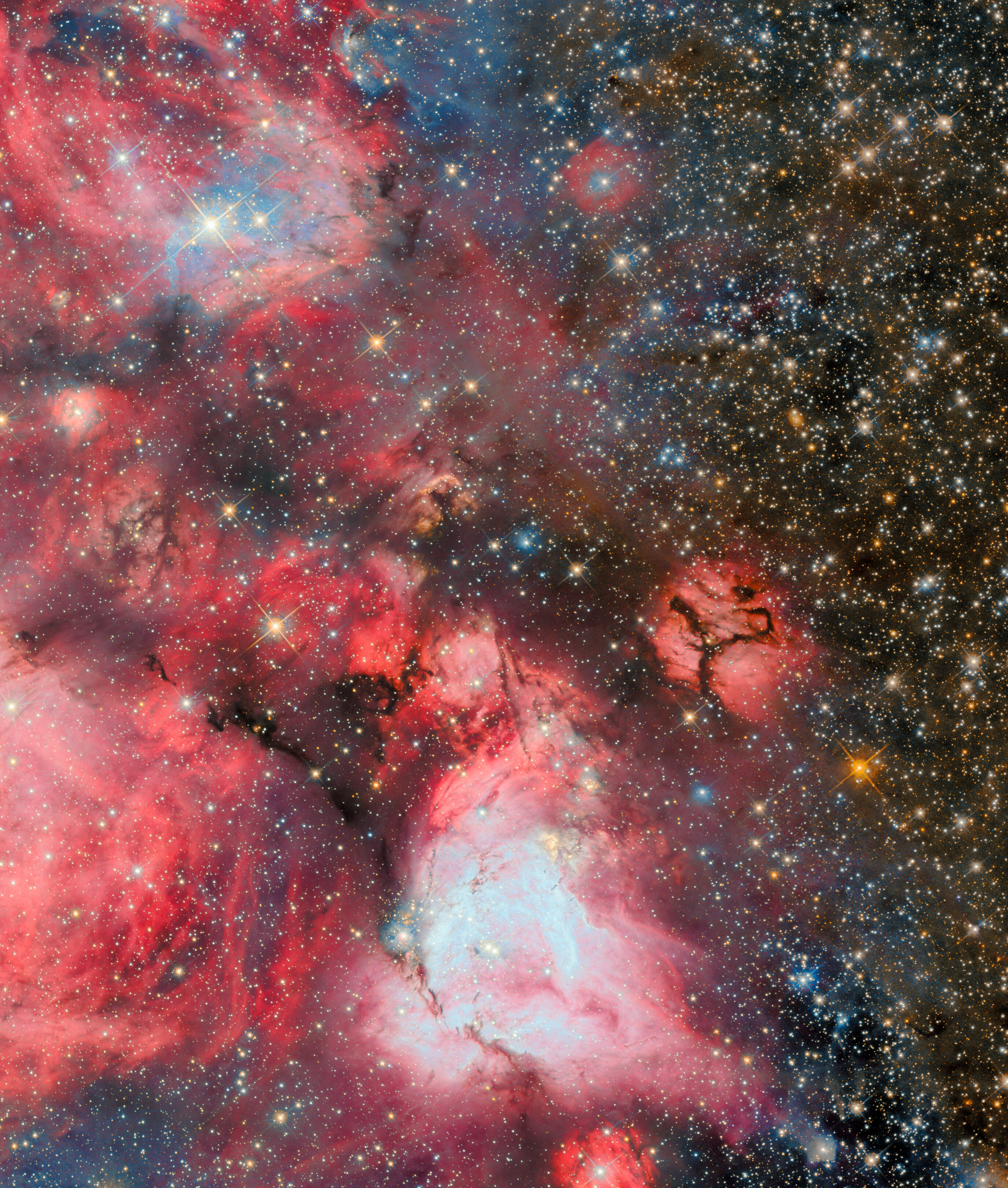
A field filled with stars and covered by clouds of gas and dust. The centre and left side are totally blanketed with billowing, bright red clouds. They are opaque some places — showing clusters of stars forming within — and transparent others. Small patches are dark black in colour, while a large cloud below the centre is mostly pale blue. The right side of the view, mostly gas-free, glitters with stars near and far. Credit: ESA/Hubble & NASA, R. Indebetouw

Today’s ESA/Hubble Picture of the Week brings a distant stellar birthplace into focus. This gigantic cloud of cold hydrogen gas is called N159, and it’s located about 160 000 light-years away in the constellation Dorado. N159 is one of the most massive star-forming clouds in the Large Magellanic Cloud, a dwarf galaxy that is the largest of the small galaxies that orbit the Milky Way.

This image shows just a portion of the N159 star-forming complex. The entire complex stretches over 150 light-years across. To put that into perspective, 150 light-years is nearly 10 million times the distance between Earth and the Sun!

In the subzero interior of this gas cloud, subjected to the crushing pressure of gravity, young stars begin to gleam in the darkness. Particularly hot and high-mass stars illuminate their birthplaces with red light. This red glow is characteristic of excited hydrogen atoms, to which Hubble is exquisitely sensitive.

Though some of the bright stars in the cloud appear to be blanketed with reddish gas, others seem to lie at the centre of a reddish bubble, through which the dark backdrop of space is visible. These bubbles are evidence of stellar feedback, in which young stars fry their habitats with high-energy radiation and blow bubbles with their intense stellar winds.

A previous Hubble image of the full N159 star-forming cloud was released in 2016. This version incorporates an additional wavelength of light to highlight the hot gas that surrounds newborn stars.


Tuesday, November 18, 2025

Finding star clusters in the Lost Galaxy

A close-in view of a spiral galaxy that faces the viewer. Brightly lit spiral arms swing outwards through the galaxy’s disc, starting from an elliptical region in the centre. Thick strands of dark reddish dust are spread across the disc, mostly following the spiral arms. The arms also contain many glowing pink-red spots where stars form. The galaxy is a bit fainter beyond the arms, but speckled with blue stars. Credit: ESA/Hubble & NASA, F. Belfiore, J. Lee and the PHANGS-HST Team

Today’s ESA/Hubble Picture of the Week features the spiral galaxy NGC 4535, which is situated about 50 million light-years away in the constellation Virgo (The Maiden). This galaxy has been nicknamed the ‘Lost Galaxy’ because it’s extremely faint when viewed through a small telescope. With a mirror spanning 2.4 metres across, Hubble is well equipped to observe dim galaxies like NGC 4535 and pick out features like its massive spiral arms and central bar of stars.

On full display in this Hubble image are NGC 4535’s young star clusters, which dot the galaxy’s spiral arms. Many of the groupings of bright blue stars are enclosed by glowing pink clouds. These clouds, called H II (‘H-two’) regions, are a sign that the galaxy is home to especially young, hot, and massive stars that are blazing with high-energy radiation. By heating the clouds in which they were born, shooting out powerful stellar winds, and eventually exploding as supernovae, massive stars certainly shake up their surroundings.

This Hubble image incorporates data from an observing programme that will catesa/alogue roughly 50 000 H II regions in nearby star-forming galaxies like NGC 4535. A previous image of NGC 4535 was released in 2021. Both the 2021 image and today’s image incorporate observations from the PHANGS programme, which seeks to understand the connections between young stars and cold gas. Today’s image adds a new dimension to our understanding of NGC 4535 by capturing the brilliant red glow of the nebulae that encircle massive stars in their first few million years of life.


Friday, June 04, 2021

Young Nebula Hints at Formation of Stars in Early Universe


Composite image of the nebula RCW 120. The ring-shaped clouds around the nebula were detected by the Spitzer Space Telescope. SOFIA measured the glowing gas shown in red and blue to study the nebula’s expansion speed and determine its age. The blue gas represents gas expanding in the direction toward Earth and the red away from Earth. The expansion is triggering the birth of stellar neighbors at breakneck speeds – and revealing the nebula is younger than previously believed. Credit: NASA/JPL-Caltech/SOFIA

Columbia, MD–June 4, 2021. Astronomers are still trying to understand how stars and galaxies formed in the early universe. Now, scientists, using the Stratospheric Observatory for Infrared Astronomy, (SOFIA), have new clues from a glowing nebula filled with clouds of hot gas and dust known as RCW 120. Data from SOFIA suggest that this nebula may be representative of how stars formed in the early universe.

Scientists using SOFIA, a joint project of NASA and the German Space Agency at DLR, found the stellar wind emanating from the nebula's central massive star is making the nebula expand rapidly. The expansion is triggering the birth of stellar neighbors at breakneck speeds – and revealing the nebula is younger than previously believed. The results are published in Science Advances.

Located in the southern Milky Way about 4,300 light years from Earth, in clouds near the constellation Scorpius, researchers discovered that the powerful stellar winds are expanding the nebula incredibly fast at 33,000 miles per hour (or 53,000 km per hour), which corresponds to 15 kilometers per second. The surrounding gas clouds are getting compressed as the nebula pushes into them — triggering the birth of new stars near the clouds’ edges. “

The expansion speed was also used to determine the nebula’s age. It turns out RCW 120 is much younger than previously believed, having formed less than 150,000 years ago.

“The nebula is giving us a window into what star formation may have been like in the early universe,” said Dr. Matteo Luisi, a postdoctoral fellow at West Virginia University in Morgantown, West Virginia. “We can’t go back to study the early universe, so we depend on observations like these to understand how the universe transformed from the Big Bang to the universe we see today.”

Astronomers call the effects stars have on their neighbors’ creation “feedback.” But exactly how feedback can help or hinder star formation is still somewhat of a mystery. SOFIA previously found that a stellar wind in the Orion Nebula is clearing a bubble free of material needed to form new stars. Now, in the nebula RCW 120, the energy from the original star is triggering the birth of new generations.

The nebula’s young age suggests that star formation triggered by an existing star’s feedback can happen very quickly and may have been responsible for the high rate of star formation in the universe’s earliest eras.

The observations were made while flying in the skies above Christchurch, New Zealand, in 2019. Using SOFIA’s instrument called the German Receiver for Astronomy at Terahertz Frequencies, or GREAT, researchers studied the chemical fingerprint of ionized carbon gas to measure the nebula's expansion speed. Unlike infrared images, this fingerprint measures how fast the gas is moving, which can be used to learn how existing stars are affecting future generations. These results are part of an international project to understand the effects of stellar feedback in a variety of star-forming regions.

Contact

Suraiya Farukhi, Ph.D.
Director, External Communications

sfarukhi@usra.edu
443-812-6945


About SOFIA

SOFIA is a joint project of NASA and the German Aerospace Center. NASA’s Ames Research Center in California’s Silicon Valley manages the SOFIA program, science, and mission operations in partnership with Universities Space Research Association, headquartered in Columbia, Maryland, and the German SOFIA Institute at the University of Stuttgart. The aircraft is maintained and operated by NASA’s Armstrong Flight Research Center, Building 703, in Palmdale, California.

About USRA

Founded in 1969, under the auspices of the National Academy of Sciences at the request of the U.S. Government, the Universities Space Research Association (USRA), is a nonprofit corporation chartered to advance space-related science, technology and engineering. USRA operates scientific institutes and facilities, and conducts other major research and educational programs, under Federal funding. USRA engages the university community and employs in-house scientific leadership, innovative research and development, and project management expertise. More information about USRA is available at www.usra.edu.


Friday, March 15, 2019

A Cosmic Bat in Flight

A Cosmic Bat in Flight
Around NGC 1788
The Cosmic Bat in the Constellation Orion


Videos

ESOcast 195 Light: A Cosmic Bat in Flight

ESOcast 196 Light: 20 Years of exploring the Universe

Zooming into the Cosmic Bat

Panning across the Cosmic Bat


ESO’s Cosmic Gems Programme captures the Cosmic Bat’s dusty clouds

Hidden in one of the darkest corners of the Orion constellation, this Cosmic Bat is spreading its hazy wings through interstellar space two thousand light-years away. It is illuminated by the young stars nestled in its core — despite being shrouded by opaque clouds of dust, their bright rays still illuminate the nebula. Too dim to be discerned by the naked eye, NGC 1788 reveals its soft colours to ESO's Very Large Telescope in this image — the most detailed to date.

ESO's Very Large Telescope (VLT) has caught a glimpse of an ethereal nebula hidden away in the darkest corners of the constellation of Orion (The Hunter) — NGC 1788, nicknamed the Cosmic Bat. This bat-shaped reflection nebula doesn’t emit light — instead it is illuminated by a cluster of young stars in its core, only dimly visible through the clouds of dust. Scientific instruments have come a long way since NGC 1788 was first described, and this image taken by the VLT is the most detailed portrait of this nebula ever taken.

Even though this ghostly nebula in Orion appears to be isolated from other cosmic objects, astronomers believe that it was shaped by powerful stellar winds from the massive stars beyond it. These streams of scorching plasma are thrown from a star’s upper atmosphere at incredible speeds, shaping the clouds secluding the Cosmic Bat’s nascent stars.

NGC 1788 was first described by the German–British astronomer William Herschel, who included it in a catalogue that later served as the basis for one of the most significant collections of deep-sky objects, the New General Catalogue (NGC) [1]. A nice image of this small and dim nebula had already been captured by the MPG/ESO 2.2-metre telescope at ESO's La Silla Observatory, but this newly observed scene leaves it in the proverbial dust. Frozen in flight, the minute details of this Cosmic Bat's dusty wings were imaged for the twentieth anniversary of one of ESO's most versatile instruments, the FOcal Reducer and low dispersion Spectrograph 2 (FORS2).

FORS2 is an instrument mounted on Antu, one of the VLT's 8.2-metre Unit Telescopes at the Paranal Observatory, and its ability to image large areas of the sky in exceptional detail has made it a coveted member of ESO's fleet of cutting-edge scientific instruments. Since its first light 20 years ago, FORS2 has become known as “the Swiss army knife of instruments”. This moniker originates from its uniquely broad set of functions [2]. FORS2’s versatility extends beyond purely scientific uses — its ability to capture beautiful high-quality images like this makes it a particularly useful tool for public outreach.

This image was taken as part of ESO’s Cosmic Gems programme, an outreach initiative that uses ESO telescopes to produce images of interesting, intriguing or visually attractive objects for the purposes of education and public outreach. The programme makes use of telescope time that cannot be used for science observations, and — with the help of FORS2 — produces breathtaking images of some of the most striking objects in the night sky, such as this intricate reflection nebula. In case the data collected could be useful for future scientific purposes, these observations are saved and made available to astronomers through the ESO Science Archive.


Notes

[1] In 1864 John Herschel published the General Catalogue of Nebulae and Clusters, which built on extensive catalogues and contained entries for more than five thousand intriguing deep-sky objects. Twenty-four years later, this catalogue was expanded by John Louis Emil Dreyer and published as the New General Catalogue of Nebulae and Clusters of Stars (NGC), a comprehensive collection of stunning deep-sky objects.

[2] In addition to being able to image large areas of the sky with precision, FORS2 can also measure the spectra of multiple objects in the night sky and analyse the polarisation of their light. Data from FORS2 are the basis of over 100 scientific studies published every year.


More Information

ESO is the foremost intergovernmental astronomy organisation in Europe and the world’s most productive ground-based astronomical observatory by far. It has 16 Member States: Austria, Belgium, the Czech Republic, Denmark, France, Finland, Germany, Ireland, Italy, the Netherlands, Poland, Portugal, Spain, Sweden, Switzerland and the United Kingdom, along with the host state of Chile and with Australia as a Strategic Partner. ESO carries out an ambitious programme focused on the design, construction and operation of powerful ground-based observing facilities enabling astronomers to make important scientific discoveries. ESO also plays a leading role in promoting and organising cooperation in astronomical research. ESO operates three unique world-class observing sites in Chile: La Silla, Paranal and Chajnantor. At Paranal, ESO operates the Very Large Telescope and its world-leading Very Large Telescope Interferometer as well as two survey telescopes, VISTA working in the infrared and the visible-light VLT Survey Telescope. Also at Paranal ESO will host and operate the Cherenkov Telescope Array South, the world’s largest and most sensitive gamma-ray observatory. ESO is also a major partner in two facilities on Chajnantor, APEX and ALMA, the largest astronomical project in existence. And on Cerro Armazones, close to Paranal, ESO is building the 39-metre Extremely Large Telescope, the ELT, which will become “the world’s biggest eye on the sky”.


Links


Contacts 

Calum Turner
ESO Public Information Officer
Garching bei München, Germany
Tel: +49 89 3200 6670
Email: pio@eso.org

Source: ESO/News


Monday, January 07, 2019

Lifting the Veil on Star Formation in the Orion Nebula

The powerful wind from the newly formed star at the heart of the Orion Nebula is creating the bubble (black) and preventing new stars from forming in its neighborhood. At the same time, the wind pushes molecular gas (color) to the edges, creating a dense shell around the bubble where future generations of stars can form. © NASA/SOFIA/Pabst et. al

SOFIA discovers that the stellar wind from a newborn star in the Orion Nebula is preventing more stars from forming nearby

The stellar wind from a newborn star in the Orion Nebula is preventing more new stars from forming nearby, according to new research using NASA’s Stratospheric Observatory for Infrared Astronomy, SOFIA. This is surprising because until now, scientists thought that other processes, such as exploding stars called supernovae, were largely responsible for regulating the formation of stars. But SOFIA’s observations suggest that infant stars generate stellar winds that can blow away the seed material required to form new stars, a process called “feedback.” The results are published as "Advanced Online Publication" (AOP) in "Nature".

The Orion Nebula is among the best observed and most photographed objects in the night sky. It is the closest stellar nursery to Earth, and helps scientists explore how stars form. A veil of gas and dust makes this nebula extremely beautiful, but also shrouds the entire process of star birth from view. Fortunately, infrared light can pierce through this cloudy veil, allowing specialized observatories like SOFIA to reveal many of the star-formation secrets that would otherwise remain hidden.

At the heart of the nebula lies a small grouping of young, massive and luminous stars. Observations from SOFIA’s instrument, the German Receiver for Astronomy at Terahertz Frequencies, known as GREAT, revealed, for the first time, that the strong stellar wind from the brightest of these baby stars, designated Theta1 Orionis C (θ1 Ori C), has swept up a large shell of material from the cloud where this star formed, like a snow plow clearing a street by pushing snow to the road’s edges.

“The wind is responsible for blowing an enormous bubble around the central stars,” explained Cornelia Pabst, a Ph.D. student at the University of Leiden in the Netherlands and the lead author on the paper. “It disrupts the natal cloud and prevents the birth of new stars.”

Researchers used the GREAT instrument on SOFIA to measure the spectral line – which is like a chemical fingerprint – of ionized carbon. Because of SOFIA’s airborne location, flying above 99 percent of the water vapor in the Earth's atmosphere that blocks infrared light, researchers were able to study the physical properties of the stellar wind.

“The large scale Orion C+ observation demonstrates that such scale mapping is possible with SOFIA/upGREAT. The multi-pixel SOFIA/upGREAT receiver allows us to map larger regions in a shorter time compared to previous instruments. It is about 80 times faster than the single pixel HIFI receiver onboard the ESA cornerstone mission Herschel”, says Ronan Higgins who led the investigation from the University of Cologne side.

Similarly, astronomers use the ionized carbon’s spectral signature to determine the speed of the gas at all positions across the nebula and study the interactions between massive stars and the clouds where they were born. The signal is so strong that it reveals critical details and nuances of the stellar nurseries that are otherwise hidden. But this signal can only be detected with specialized instruments — like GREAT— that can study far-infrared light.

At the center of the Orion Nebula, the stellar wind from θ1 Ori C forms a bubble and disrupts star birth in its neighborhood. At the same time, it pushes molecular gas to the edges of the bubble, creating new regions of dense material where future stars might form.

These feedback effects regulate the physical conditions of the nebula, influence the star formation activity, and ultimately drive the evolution of the interstellar medium, the space between stars filled with gas and dust. Understanding how star formation interacts with the interstellar medium is key to understanding the origins of the stars we see today, and those that may form in the future.


SOFIA is a Boeing 747SP jetliner modified to carry a 106-inch diameter telescope. It is a joint project of NASA and the German Aerospace Center, DLR. NASA’s Ames Research Center in California’s Silicon Valley manages the SOFIA program, science and mission operations in cooperation with the Universities Space Research Association headquartered in Columbia, Maryland, and the German SOFIA Institute (DSI) at the University of Stuttgart. The aircraft is maintained and operated from NASA’s Armstrong Flight Research Center Hangar 703, in Palmdale, California.

GREAT/upGREAT, the German Receiver for Astronomy at Terahertz Frequencies, was developed and built by a consortium of German research institutes (MPI for Radio Astronomy/MPIfR, Bonn and KOSMA/University of Cologne, in collaboration with the DLR Institute for Planetary Research, Berlin, and the MPI for Solar System Research, Göttingen). The GREAT Principal Investigator (PI) is Jürgen Stutzki from Cologne University, Deputy Principal Investigator (Co-PI) is Bernd Klein from MPIfR. The development of the instrument was financed by the participating institutes, Max Planck Society, the German Research Foundation (SFB 956) and the German Space Agency.

The research team comprises C. Pabst, R. Higgins, J.R. Goicoechea, D. Teyssier, O. Berne, E. Chambers, M. Wolfire, S. Suri, R. Güsten, J. Stutzki, U.U. Graf, C. Risacher and A.G.G.M. Tielens. Rolf Güsten and Christophe Risacher from the Max-Planck-Institut für Radioastronomie in Bonn/Germany are co-authors of the publication.


Local Contact

Prof. Dr. Jürgen Stutzki
Phone:+49 228 470-3494
Email: stutzki@ph1.uni-koeln.de
1. Physikalisches Institut der Universität zu Köln

Dr. Rolf Güstenv Phone:+49 228 525-383
Email: rguesten@mpifr-bonn.mpg.de
Max-Planck-Institut für Radioastronomie, Bonn

Dr. Norbert Junkes
Press and Public Outreach
Phone:+49 228 525-399
Email: njunkes@mpifr-bonn.mpg.de
Max-Planck-Institut für Radioastronomie, Bonn


Original Paper

Disruption of the Orion Molecular Core 1 by the stellar wind of the massive star θ1 Ori C

C. Pabst, R. Higgins, J.R. Goicoechea, D. Teyssier, O. Berne, E. Chambers, M. Wolfire, S. Suri, R. Güsten, J. Stutzki, U.U. Graf, C. Risacher and A.G.G.M. Tielens, Nature Advanced Online Publication (AOP), DOI 10.1038/s41586-018-0844-1.


Links

Stars & Planets from SOFIA, Spitzer & Citizen Scientists
Press conference at AAS meeting 233 (Seattle, 07 January 2019).

SFB 956
Collaborative Research Centre (CRC) 956

I. Physikalisches Institut
Cologne University

Leiden Observatory
Astrophysics at Leiden University/The Netherlands

NASA/SOFIA
SOFIA Mission

Deutsches SOFIA-Institut
DSI Website

GREAT at MPIfR
German Receiver at Terahertz Frequencies (GREAT)

SOFIA
DLR Website


Monday, March 26, 2018

Kepler Solves Mystery of Fast and Furious Explosions

Model for the Creation of a Fast-Evolving Luminous Transient
This illustration shows a proposed model for a mysterious astronomical event called a Fast-Evolving Luminous Transient (FELT). In the left panel, an aging red giant star loses mass via a stellar wind. This balloons into a huge gaseous shell around the star. In the center panel, the massive star’s core implodes to trigger a supernova explosion. In the right panel, the supernova shockwave plows into the outer shell, converting the kinetic energy from the explosion into a brilliant burst of light. The flash of radiation lasts for only a few days — one-tenth the duration of a typical supernova explosion.  Credit:  Illustration: NASA, ESA, and A. Feild (STScI) - Science: NASA, ESA, and A. Rest (STScI).  Release images


The universe is full of mysterious exploding phenomena that go boom in the dark. One particular type of ephemeral event, called a Fast-Evolving Luminous Transient (FELT), has bewildered astronomers for a decade because of its very brief duration.

Now, NASA’s Kepler Space Telescope — designed to go hunting for planets across our galaxy — has also been used to catch FELTs in the act and determine their nature. They appear to be a new kind of supernova that gets a brief turbo boost in brightness from its surroundings.

Kepler's ability to precisely sample sudden changes in starlight has allowed astronomers to quickly arrive at this model for explaining FELTs, and rule out alternative explanations.

Researchers conclude that the source of the flash is from a star after it collapses to explode as a supernova. The big difference is that the star is cocooned inside one or more shells of gas and dust. When the tsunami of explosive energy from the blast slams into the shell, most of the kinetic energy is immediately converted to light. The burst of radiation lasts for only a few days — one-tenth the duration of a typical supernova explosion.

Over the past decade several FELTs have been discovered with timescales and luminosities not easily explained by traditional supernova models. And, only a few FELTs have been seen in sky surveys because they are so brief. Unlike Kepler, which collects data on a patch of sky every 30 minutes, most other telescopes look every few days. Therefore they often slip through undetected or with only one or two measurements, making understanding the physics of these explosions tricky.

In the absence of more data, there have been a variety of theories to explain FELTs: the afterglow of a gamma-ray burst, a supernova boosted by a magnetar (neutron star with a powerful magnetic field), or a failed Type Ia supernova.

Then along came Kepler with its precise, continuous measurements that allowed astronomers to record more details of the FELT event. "We collected an awesome light curve," said Armin Rest of the Space Telescope Science Institute in Baltimore, Maryland. "We were able to constrain the mechanism and the properties of the blast. We could exclude alternate theories and arrive at the dense-shell model explanation. This is a new way for massive stars to die and distribute material back into space.

"With Kepler, we are now really able to connect the models with the data," he continued. "Kepler just makes all the difference here. When I first saw the Kepler data, and realized how short this transient is, my jaw dropped. I said, 'Oh wow!'"

"The fact that Kepler completely captured the rapid evolution really constrains the exotic ways in which stars die. The wealth of data allowed us to disentangle the physical properties of the phantom blast, such as how much material the star expelled at the end of its life and the hypersonic speed of the explosion. This is the first time that we can test FELT models to a high degree of accuracy and really connect theory to observations," said David Khatami of the University of California at Berkeley and Lawrence Berkeley National Laboratory.

This discovery is an unexpected spinoff of Kepler’s unique capability to sample changes in starlight continuously for several months. This capability is needed for Kepler to discover extrasolar planets that briefly pass in front of their host stars, temporarily dimming starlight by a small percent.

The Kepler observations indicate that the star ejected the shell less than a year before it went supernova. This gives insight into the poorly understood death throes of stars — the FELTs apparently come from stars that undergo "near-death experiences" just before dying, belching out shells of matter in mini-eruptions before exploding entirely.

The science team's study appears in the March 26, 2018 online issue of Nature Astronomy.

Rest says the next steps will be to find more of these objects in the ongoing K2 mission, or in the next mission of that kind, TESS. This will allow astronomers to start a follow-up campaign spanning different wavelength regimes, which constrains the nature and physics of this new kind of explosion.

NASA's Ames Research Center at Moffett Field, California, manages the Kepler and K2 missions for NASA's Science Mission Directorate. NASA's Jet Propulsion Laboratory in Pasadena, California, managed Kepler mission development. Ball Aerospace and Technologies Corp. operates the flight system with support from the Laboratory for Atmospheric and Space Physics at the University of Colorado in Boulder, Colorado. The Space Telescope Science Institute (STScI) in Baltimore, Maryland, archives, hosts, and distributes Kepler science data. STScI is operated for NASA by the Association of Universities for Research in Astronomy, in Washington, D.C.


Related Links

This site is not responsible for content found on external links


Contacts

Ray Villard

Space Telescope Science Institute, Baltimore, Maryland
410-338-4514
villard@stsci.edu

Armin Rest
Space Telescope Science Institute, Baltimore, Maryland
410-338-4358
arest@stsci.edu


Wednesday, December 13, 2017

Stellar Nursery Blooms into View

Stellar Nursery Blooms into View

The star formation region NGC 6559 in the constellation of Sagittarius

The rich surroundings of Sharpless 29


Videos

ESOcast 142 Light: Stellar Nursery Blooms into View (4K UHD)

Zooming in on the star-forming region Sharpless 29

Panning across the VST’s view of Sharpless 29


The OmegaCAM camera on ESO’s VLT Survey Telescope has captured this glittering view of the stellar nursery called Sharpless 29. Many astronomical phenomena can be seen in this giant image, including cosmic dust and gas clouds that reflect, absorb, and re-emit the light of hot young stars within the nebula.

The region of sky pictured is listed in the Sharpless catalogue of H II regions: interstellar clouds of ionised gas, rife with star formation. Also known as Sh 2-29, Sharpless 29 is located about 5500 light-years away in the constellation of Sagittarius (The Archer), next door to the larger Lagoon Nebula. It contains many astronomical wonders, including the highly active star formation site of NGC 6559, the nebula at the centre of the image.

This central nebula is Sharpless 29’s most striking feature. Though just a few light-years across, it showcases the havoc that stars can wreak when they form within an interstellar cloud. The hot young stars in this image are no more than two million years old and are blasting out streams of high-energy radiation. This energy heats up the surrounding dust and gas, while their stellar winds dramatically erode and sculpt their birthplace. In fact, the nebula contains a prominent cavity that was carved out by an energetic binary star system. This cavity is expanding, causing the interstellar material to pile up and create the reddish arc-shaped border.

When interstellar dust and gas are bombarded with ultraviolet light from hot young stars, the energy causes them to shine brilliantly. The diffuse red glow permeating this image comes from the emission of hydrogen gas, while the shimmering blue light is caused by reflection and scattering off small dust particles. As well as emission and reflection, absorption takes place in this region. Patches of dust block out the light as it travels towards us, preventing us from seeing the stars behind it, and smaller tendrils of dust create the dark filamentary structures within the clouds.

The rich and diverse environment of Sharpless 29 offers astronomers a smorgasbord of physical properties to study. The triggered formation of stars, the influence of the young stars upon dust and gas, and the disturbance of magnetic fields can all be observed and examined in this single area.
But young, massive stars live fast and die young. They will eventually explosively end their lives in a supernova, leaving behind rich debris of gas and dust. In tens of millions of years, this will be swept away and only an open cluster of stars will remain.

Sharpless 29 was observed with ESO’s OmegaCAM on the VLT Survey Telescope (VST) at Cerro Paranal in Chile. OmegaCAM produces images that cover an area of sky more than 300 times greater than the largest field of view imager of the NASA/ESA Hubble Space Telescope, and can observe over a wide range of wavelengths from the ultraviolet to the infrared. Its hallmark feature is its ability to capture the very red spectral line H-alpha, created when the electron inside a hydrogen atom loses energy, a prominent occurrence in a nebula like Sharpless 29.


More Information


ESO is the foremost intergovernmental astronomy organisation in Europe and the world’s most productive ground-based astronomical observatory by far. It is supported by 16 countries: Austria, Belgium, Brazil, the Czech Republic, Denmark, France, Finland, Germany, Italy, the Netherlands, Poland, Portugal, Spain, Sweden, Switzerland and the United Kingdom, along with the host state of Chile and by Australia as a strategic partner. ESO carries out an ambitious programme focused on the design, construction and operation of powerful ground-based observing facilities enabling astronomers to make important scientific discoveries. ESO also plays a leading role in promoting and organising cooperation in astronomical research. ESO operates three unique world-class observing sites in Chile: La Silla, Paranal and Chajnantor. At Paranal, ESO operates the Very Large Telescope, the world’s most advanced visible-light astronomical observatory and two survey telescopes. VISTA works in the infrared and is the world’s largest survey telescope and the VLT Survey Telescope is the largest telescope designed to exclusively survey the skies in visible light. ESO is a major partner in ALMA, the largest astronomical project in existence. And on Cerro Armazones, close to Paranal, ESO is building the 39-metre Extremely Large Telescope, the ELT, which will become “the world’s biggest eye on the sky”.


Links


Contacts

Richard Hook
ESO Public Information Officer
Garching bei München, Germany
Tel: +49 89 3200 6655
Cell: +49 151 1537 3591


Email: rhook@eso.org


Source: ESO

Friday, September 15, 2017

Starbursts in NGC 5398

Credit: ESA/Hubble & NASA


This NASA/ESA Hubble Space Telescope picture shows NGC 5398, a barred spiral galaxy located about 55 million light-years away

The galaxy is famous for containing an especially extensive HII region, a large cloud composed of ionised hydrogen (or HII, pronounced “H-two”, with H being the chemical symbol for hydrogen and the “II” indicating that the atoms have lost an electron to become ionised). NGC 5398’s cloud is named Tol 89 and sits at the lower left end of the galaxy’s central “bar” of stars, a structure that cuts through the galactic core and funnels material inwards to maintain the star formation occurring there.

Tol 86 is conspicuous in being the only large massive star forming complex in the entire galaxy, with an extension of roughly 5000 times 4000 light-years; it contains at least seven young and massive star clusters. The two brightest clumps within Tol 89, which astronomers have named simply “A” and “B”, appear to have undergone two bursts of star-forming activity — “starbursts” — roughly 4 million and less than 3 million years ago respectively. Tol 89-A is thought to contain a number of particularly bright and massive stars known as Wolf-Rayet stars, which are known for their high temperatures and extreme stellar winds.


Saturday, September 26, 2015

Radio Telescopes Could Spot Stars Hidden in the Galactic Center

In this infrared image from NASA's Spitzer Space Telescope, stellar winds flowing out from the fast-moving star Zeta Ophiuchi are creating a bow shock seen as glowing gossamer threads, which, for this star, are only seen in infrared light. A similar process in the galactic center could allow us to find stars we can't see any other way, according to new research.  High Resolution (jpg) - Low Resolution (jpg)


Cambridge, MA - The center of our Milky Way galaxy is a mysterious place. Not only is it thousands of light-years away, it's also cloaked in so much dust that most stars within are rendered invisible. Harvard researchers are proposing a new way to clear the fog and spot stars hiding there. They suggest looking for radio waves coming from supersonic stars.

"There's a lot we don’t know about the galactic center, and a lot we want to learn," says lead author Idan Ginsburg of the Harvard-Smithsonian Center for Astrophysics (CfA). "Using this technique, we think we can find stars that no one has seen before."

The long path from the center of our galaxy to Earth is so choked with dust that out of every trillion photons of visible light coming our way, only one photon will reach our telescopes. Radio waves, from a different part of the electromagnetic spectrum, have lower energies and longer wavelengths. They can pass through the dust unimpeded.

On their own, stars aren’t bright enough in the radio for us to detect them at such distances. However, if a star is traveling through gas faster than the speed of sound, the situation changes. Material blowing off of the star as a stellar wind can plow into the interstellar gases and create a shock wave. And through a process called synchrotron radiation, electrons accelerated by that shock wave produce radio emission that we could potentially detect.

"In a sense, we're looking for the cosmic equivalent of a sonic boom from an airplane," explains Ginsburg.

To create a shock wave, the star would have to be moving at a speed of thousands of miles per second. This is possible in the galactic center since the stars there are influenced by the strong gravity of a supermassive black hole. When an orbiting star reaches its closest approach to the black hole, it can easily acquire the required speed.

The researchers suggest looking for this effect from one already known star called S2. This star, which is hot and bright enough to be seen in the infrared despite all the dust, will make its closest approach to the Galactic center in late 2017 or early 2018. When it does, radio astronomers can target it to look for radio emission from its shock wave.

"S2 will be our litmus test. If it's seen in the radio, then potentially we can use this method to find smaller and fainter stars – stars that can’t be seen any other way," says co-author Avi Loeb of the CfA.

This work is reported in a paper authored by Idan Ginsburg, Xiawei Wang, Avi Loeb, and Ofer Cohen (CfA). It has been accepted for publication in the Monthly Notices of the Royal Astronomical Society.

Headquartered in Cambridge, Mass., the Harvard-Smithsonian Center for Astrophysics (CfA) is a joint collaboration between the Smithsonian Astrophysical Observatory and the Harvard College Observatory. CfA scientists, organized into six research divisions, study the origin, evolution and ultimate fate of the universe.

For more information, contact:

Christine Pulliam
Media Relations Manager
Harvard-Smithsonian Center for Astrophysics
617-495-7463
cpulliam@cfa.harvard.edu


Wednesday, July 01, 2015

Buried in the Heart of a Giant

The colourful star cluster NGC 2367
The star cluster NGC 2367 in the constellation of Canis Major
 
Wide-field view of the sky around the bright star cluster NGC 2367


Videos 

Zooming in on the star cluster NGC 2367

The colourful star cluster NGC 2367


This rich view of an array of colourful stars and gas was captured by the Wide Field Imager (WFI) camera, on the MPG/ESO 2.2-metre telescope at ESO’s La Silla Observatory in Chile. It shows a young open cluster of stars known as NGC 2367, an infant stellar grouping that lies at the centre of an immense and ancient structure on the margins of the Milky Way.

Discovered from England by the tireless observer Sir William Herschel on 20 November 1784, the bright star cluster NGC 2367 lies about 7000 light-years from Earth in the constellation Canis Major. Having only existed for about five million years, most of its stars are young and hot and shine with an intense blue light. This contrasts wonderfully in this new image with the silky-red glow from the surrounding hydrogen gas.

Open clusters like NGC 2367 are a common sight in spiral galaxies like the Milky Way, and tend to form in their host’s outer regions. On their travels about the galactic centre, they are affected by the gravity of other clusters, as well as by large clouds of gas that they pass close to. Because open clusters are only loosely bound by gravity to begin with, and because they constantly lose mass as some of their gas is pushed away by the radiation of the young hot stars, these disturbances occur often enough to cause the stars to wander off from their siblings, just as the Sun is believed to have done many years ago. An open cluster is generally expected to survive for a few hundred million years before it is completely dispersed.

In the meantime, clusters serve as excellent case studies for stellar evolution. All the constituent stars are born at roughly the same time from the same cloud of material, meaning they can be compared alongside one another with greater ease, allowing their ages to be readily determined and their evolution mapped.

Like many open clusters, NGC 2367 is embedded within an emission nebula, from which its stars were born. The remains show up as wisps and clouds of hydrogen gas, ionised by the ultraviolet radiation being emitted by the hottest stars. What is more unusual is that, as you begin to pan out from the cluster and its nebula, a far more expansive structure is revealed: NGC 2367 and the nebula containing it are thought to be the nucleus of a larger nebula, known as Brand 16, which in turn is only a small part of a huge supershell, known as GS234-02.

The GS234-02 supershell lies towards the outskirts of our galaxy, the Milky Way. It is a vast structure, spanning hundreds of light-years. It began its life when a group of particularly massive stars, producing strong stellar winds, created individual expanding bubbles of hot gas. These neighbouring bubbles eventually merged to form a superbubble, and the short life spans of the stars at its heart meant that they exploded as supernovae at similar times, expanding the superbubble even further, to the point that it merged with other superbubbles, which is when the supershell was formed. The resulting formation ranks as one of the largest possible structures within a galaxy.

This concentrically expanding system, as ancient as it is enormous, provides a wonderful example of the intricate, interrelated structures that are sculpted in galaxies by the lives and deaths of stars.


More Information

ESO is the foremost intergovernmental astronomy organisation in Europe and the world’s most productive ground-based astronomical observatory by far. It is supported by 16 countries: Austria, Belgium, Brazil, the Czech Republic, Denmark, France, Finland, Germany, Italy, the Netherlands, Poland, Portugal, Spain, Sweden, Switzerland and the United Kingdom, along with the host state of Chile. ESO carries out an ambitious programme focused on the design, construction and operation of powerful ground-based observing facilities enabling astronomers to make important scientific discoveries. ESO also plays a leading role in promoting and organising cooperation in astronomical research. ESO operates three unique world-class observing sites in Chile: La Silla, Paranal and Chajnantor. At Paranal, ESO operates the Very Large Telescope, the world’s most advanced visible-light astronomical observatory and two survey telescopes. VISTA works in the infrared and is the world’s largest survey telescope and the VLT Survey Telescope is the largest telescope designed to exclusively survey the skies in visible light. ESO is a major partner in ALMA, the largest astronomical project in existence. And on Cerro Armazones, close to Paranal, ESO is building the 39-metre European Extremely Large Telescope, the E-ELT, which will become “the world’s biggest eye on the sky”.


Links

Contacts

Richard Hook
ESO Public Information Officer
Garching bei München, Germany
Tel: +49 89 3200 6655
Cell: +49 151 1537 3591
Email:
rhook@eso.org 

Source: ESO

Tuesday, February 05, 2013

Massive stellar winds are made of tiny pieces

 New view of stellar winds
Artist’s impression comparing a smooth stellar wind (left) with a highly fragmented stellar wind (right) of a massive star like zeta Puppis. A decade’s-worth of observations with ESA’s XMM-Newton have revealed that the wind of zeta Puppis is fragmented into hundreds of thousands of individual hot (red) and cool (blue) clumps. Studying stellar winds is vital not only to understand mass loss from the star itself and thus its expected lifetime, but also how the winds inject material and energy into the surrounding environment and influence the birth and death of other stars. Copyright: ESA–C. Carreau/Nazé et al.  Hi-res image (4.71mb)

ESA’s XMM-Newton space observatory has completed the most detailed study ever of the fierce wind from a giant star, showing for the first time that it is not a uniform breeze but is fragmented into hundreds of thousands of pieces.

 Massive stars are relatively rare, but play a very important role in recycling materials in the Universe. They burn their nuclear fuel much more rapidly than stars like the Sun, living only for millions of years before exploding as a supernova and returning most of their matter to space.

 But even during their brief lives, they lose a significant fraction of their mass through fierce winds of gas driven off their surfaces by the intense light emitted from the star.

 The winds from massive stars are at least a hundred million times stronger than the solar wind emitted by our own Sun and can significantly shape their surrounding environment.

 They might trigger the collapse of surrounding clouds of gas and dust to form new stars or, conversely, blast the clouds away before they have the chance to get started.

 Despite their important role, however, the detailed structure of the winds from massive stars remains poorly understood. Are they steady and uniform, or broken up and gusty?

 Astronomers have now gained a detailed glimpse into this wind structure by taking observations with XMM-Newton spread over a decade to study variability in the X-ray emission from zeta Puppis. One of the nearest massive stars to Earth, it is bright enough to be seen with the naked eye in the constellation of Puppis, in the southern hemisphere.

 The X-rays arise from collisions between slow- and fast-moving clumps in the wind, which heats them to a few million degrees. As individual colliding clumps in the wind are heated and cooled, the strength and energy of the emitted X-rays vary.

 If only a small number of large fragments are present, variations in the combined emission could be large. Conversely, as the number of fragments grows, a change in the X-ray emission from any given fragment becomes less important, and the overall variability decreases.

 In zeta Puppis, the X-ray emission was found to be remarkably stable over short timescales of just a few hours, pointing to a very large number of fragments. There must still be clumps in the wind to make X-rays in the first place, but there must be many of them to yield such low variability.

 However, unexpected variation in the emission was seen on the order of several days, implying the presence of a few very large structures in the wind, possibly spiral-arm-like features superimposed on the highly fragmented wind co-rotating with the star.

 “Studies at other wavelengths had already hinted that the winds from massive stars are not simply a uniform breeze, and the new XMM-Newton data confirm this, but also reveal hundreds of thousands of individual hot and cool pieces,” says Yaël Nazé, Université de Liège, Belgium, who led the study’s analysis.

 “This is the first time constraints have been placed on the number of fragments in a stellar wind of an adult massive star, a number which far exceeds theoretical predictions.”

 To fully understand these observations, improved models of stellar winds will be needed, taking into account both the large-scale emission structures and the highly fragmented wind, in order to understand how they affect mass-loss in stellar giants. 

 “Zeta Puppis also goes by the name Naos, which in antiquity was the name given to the innermost sanctuary of a temple, accessible to only a few people; thanks to XMM-Newton, scientists have been able to unlock the secrets of this mysterious stellar object,” adds Dr Nazé.

 “This long-term XMM-Newton study of zeta Puppis has provided the first constraints on the number of fragments in a stellar wind from a massive star – there is no dataset with comparable sensitivity or time and or spectral coverage currently available for any other massive star,” says Norbert Schartel, ESA’s XMM-Newton project scientist.


Notes to Editors:
 
The study is based on a series of three papers:

 “A detailed X-ray investigation of zeta Pup I. The dataset and some preliminary results,” by Y. Nazé et al is published in Astronomy & Astrophysics 538, A22, 2012; arXiv:1112.0862 

 “A detailed X-ray investigation of zeta Pup II: The variability on short and long timescales”, by Y. Nazé et al is published in the Astrophysical Journal 763, 143, 2013; arXiv:1212.1554 

 “A detailed X-ray investigation of zeta Pup III. A spectroscopic analysis of the whole XMM-Newton RGS spectrum,” by A. Hervé et al, is accepted for publication in Astronomy & Astrophysics; arxiv.org/abs/1301.5090

  
For further information, please contact:
 
Markus Bauer 
ESA Science and Robotic Exploration Communication Officer 
Tel: +31 71 565 6799 
Mob: +31 61 594 3 954
Email:
markus.bauer@esa.int
Yaël Nazé 
Université de Liège, Belgium
Email:
naze@astro.ulg.ac.be
Norbert Schartel 
XMM-Newton Project Scientist 
Tel: +34 91 8131 184
Email:
Norbert.Schartel@sciops.esa.int