Showing posts with label Stars Clusters. Show all posts

Saturday, March 07, 2026

Astronomers Hate Them! This Star Formation Ingredient Makes Clusters Look 300 Million Years Older

This Hubble Space Telescope shows one of the most massive young star clusters in the Milky Way, nestled within the nebula NGC 3603. Credit: NASA, ESA, and the Hubble Heritage Team

Title: Characterizing The Star Cluster Populations in Stephan’s Quintet Using HST and JWST Observations
Authors: P. Aromal et al.
First Author’s Institution: University of Western Ontario
Status: Published in ApJ

This Hubble Space Telescope shows one of the most massive young star On 12 July 2022, the first images taken with JWST were released to the public. All of the astronomers in my department gathered together to watch the images be revealed in real time. It was exciting for everyone, from graduate students getting to see a glimpse into the future possibilities of their fields, to retired professors getting to see the fruits of their decades-long labor in advocating for the telescope to be built

One image that was showcased was of Stephan’s Quintet (Figure 1), an actively interacting galaxy group. We were all immediately impressed by the clarity of the star-forming regions in the dense gas between the galaxies in the image. Now, more than three years later, the authors of today’s article lay out a comprehensive study of the star clusters in those same regions, taking advantage of JWST’s multi-wavelength imaging capabilities.

Figure 1: The JWST imaging of Stephan’s Quintet with member galaxies labeled (including NGC 7320C, which is outside of the field of view). Gray arrows indicate the direction the associated galaxy is moving. The inlaid image shows the distribution of young star clusters in relation to the six main tidal features in the group. Inset image: Adapted from Aromal et al. 2025; Background image: NASA, ESA, CSA, STScI

HST + JWST = OMG!

While JWST’s depth and resolution are exciting for those studying high-redshift galaxies, for local-universe astronomers JWST really shines when used in combination with the Hubble Space Telescope (HST). The star clusters in Stephan’s Quintet were already cataloged in 2015 using HST, but the filters used in the imaging only captured optical and very-near-infrared wavelengths. If you want to get enough data to be able to accurately estimate the ages of these star clusters, especially accounting for reddening caused by surrounding dust, you need to push your imaging further into the infrared.

Unlike HST, JWST can take images in two wavelength filters at once, meaning you can get more data with roughly the same observing time. Here the authors imaged the same star clusters that HST looked at with five new JWST filters, all at longer infrared wavelengths than HST. Together, the authors had flux measurements at 10 different wavelengths across the optical and infrared spectrum for each star cluster, meaning they could perform spectral energy distribution fitting.

Go Ahead, Guess My Age

The best way to estimate an unresolved star cluster’s age is to get its full spectrum of light and fit spectroscopic models with varying ages to it until the model matches the observations. But, if you have individual brightness measurements at many different, spread-out wavelengths, you can still fit spectral models to the measurements and make a best guess despite the gaps in your full spectrum. Here the authors compare their multi-wavelength data to Code Investigating GALaxy Emission (CIGALE) spectral energy distribution models, allowing both the cluster ages and amount of dust extinction to vary.

This is where the long-wavelength JWST imaging is most necessary, because it is sometimes difficult to determine a cluster’s age with this method. For instance, is the light a cluster is giving off mostly red because its stars are very old, or is it because its stars are actually bluer and younger and the cluster just appears red due to foreground dust?

Infrared imaging can “see through” any dust and break this age–extinction degeneracy. For most of the clusters, the authors found that the original HST-only age estimates were accurate, but for 121 clusters in the sample (about 8% of the total), the JWST imaging made a significant change in the age estimates, shifting them to younger ages.

Where Do the Hip, Young Star Clusters Hang Out?

Once the authors had their updated ages for the clusters, they then mapped out where the clusters were located in Stephan’s Quintet and how hese clusters traced the known tidal structures in the group. Tidal structures are structures, usually consisting of gas, dust, and stars, that are formed from the tidal forces galaxies exert on one another as they interact and merge. The authors found that throughout all tidal regions of Stephan’s Quintet, there were many young, low-mass star clusters, all about 3–5 million years old. This timescale lines up with previous studies’ estimates of when NGC 7318B was thought to first fall into Stephan’s Quintet, compressing the gas in the group and creating tidal shocks that would trigger star formation.

Additionally, the authors’ star cluster age distribution for the group (see Figure 2) has a second, broader peak of higher-mass clusters with ages around 200 million years. This would correspond to when the most recent encounter between NGC 7320C (which has now passed through the group and is out of frame in Figure 1) and NGC 7319 is estimated to have occurred.

Figure 2: A histogram of the ages of all the star clusters in Stephan’s Quintet. The blue dashed line shows the estimates using only the HST data, and the orange solid line shows the estimates using both HST and JWST together. Notice how a lot of the clusters around 108 years old turned out to be less than 107 years old. Adapted from Aromal et al. 2025

Going even older, they found that the star clusters in the group that are more than 1 billion years old are also the most massive, and they are predominantly concentrated around NGC 7318A. This is the most massive elliptical galaxy in the group, and it’s the most likely to have a rich, old star cluster population, formed prior to any tidal interactions.

Taken together, the updated age measurements of the star clusters in Stephan’s Quintet provide not only a study of star formation history, but also of the galaxy–galaxy interaction history in the system!

Looking Ahead

While the authors have improved the age estimates of the clusters in Stephan’s Quintet, there are still limitations to their analysis. Their estimated star formation rate for the group is much lower than that estimated with other tracers, such as H-alpha emission, meaning this study may still be missing a fraction of very young star clusters. The most likely culprits are embedded clusters that haven’t had enough time to expel the surrounding gas from the massive clouds they formed within.

Future work will attempt to identify these embedded clusters using near-infrared JWST imaging, since in this study the authors focused only on the previously HST-identified clusters. In addition, combining their JWST data with high-resolution radio observations taken with the Atacama Large Millimeter/submillimeter Array will allow them to study the gas in the group more closely and understand how it influences the star formation.

This work highlights JWST’s excellent application to star cluster observations, building on the data we already have from decades of HST se, and it looks like we’re only just getting started!

Original astrobite edited by Skylar Grayson.


About the author, Veronika Dornan:

Veronika is a postdoctoral research associate at the University of Edinburgh. Her research is in observations of globular star clusters and how they can be used to study the evolution of their host galaxies.


Editor’s Note: Astrobites is a graduate-student-run organization that digests astrophysical literature for undergraduate students. As part of the partnership between the AAS and astrobites, we occasionally repost astrobites content here at AAS Nova. We hope you enjoy this post from astrobites; the original can be viewed at astrobites.org.


Monday, November 17, 2025

The Sun Left Home in a Hurry

An open star cluster named NGC 2002, as viewed by the Hubble Space Telescope. The Sun may have been born in a similar cluster. Credit:
NASA, ESA and G. Gilmore (University of Cambridge); Processing: Gladys Kober (NASA/Catholic University of America)

By simulating how the orbits of distant solar system objects were altered by close encounters with other stars early in the Sun’s life, astronomers have placed tight constraints on how long our home star stuck around its siblings after birth.

The Hubble Space Telescope’s view of a collection of young stars still embedded within their natal nebula. Credit:
NASA, ESA, G. Duchene (Universite de Grenoble I); Image Processing: Gladys Kober (NASA/Catholic University of America)

Born in Batches

Though our Sun currently travels on a solitary trajectory through the galaxy, its earliest childhood was not spent so lonely. Instead, the Sun was likely born as part of a litter of many other stars all collapsing out of the same cloud of precursor gas and dust. As a consequence, its early adolescence was spent in the company of dozens of other young stars, all zipping along on their own paths, destined to drift apart but initially packed close together.

Despite their kinship, these young stars were not kind to one another when they passed nearby. When two stars grow close, the intense gravity of the encounter can severely disrupt their proto-planetary systems, scattering the objects orbiting farthest from their stars and potentially even ejecting some objects altogether. These early years likely left scars on the edges of our solar system that persist even today, billions of years after the early tussles.

Recent research led by Amir Siraj, Princeton University, leverages these scars or their apparent absence to ask the question: given the structure we observe in the outer solar system today, what limits can we place on the number of stars born near the Sun and the amount of time the Sun spent in its birth cluster?

An illustration of the orbits for some of the distant sednoids considered in this study.
Credit: NAOJ

Distance is Power

Several authors have asked this question over the past several decades, but Siraj and collaborators added a new twist: instead of studying either the giant planets or the cold classical Kuiper Belt, they instead focused exclusively on the “distant sednoids.” This rarefied collection of only nine known objects includes only the most distant minor planets in our solar system: the sednoids never come within 40 au of the Sun, and they spend much of their orbits beyond 400 au. Interestingly, however, all of them orbit on planes that are fairly aligned with that of the planets, and none ever strays farther than 20° from the ecliptic.

Through a suite of numerical simulations, Siraj and collaborators demonstrate that this relatively tight distribution of inclinations implies that the Sun couldn’t have been too roughed up on its way out of the cluster. By simulating many different close flybys and their influence on the distant sednoids, the researchers constrained the product of the number of stars in the Sun’s birth cluster and the time the Sun spent there to be less than or equal to 5 billion years per cubic parsec. Assuming a typical cluster density of 100 stars per cubic parsec, this suggests that the Sun cleared out of the densest and most dangerous part of the cluster within just 50 million years.

The authors stress that this conclusion leans on the assumption that the distant sednoids arrived on their extreme orbits essentially immediately, though in fact astronomers aren’t sure exactly how and when these objects ended up on the outskirts of the solar system. If the sednoids were in fact implanted onto their orbits early on, this limit on how long it took the Sun to leave its siblings is by far the strongest to date. With the Vera C. Rubin Observatory poised to discover thousands of new distant solar system objects, it’s likely that the bound will grow even more stringent in the next few years.

By Ben Cassese

Citation

“Limits on Stellar Flybys in the Solar Birth Cluster,” Amir Siraj et al 2025 ApJL 993 L4. doi:10.3847/2041-8213/ae1025


Wednesday, October 08, 2025

Starbursting centre

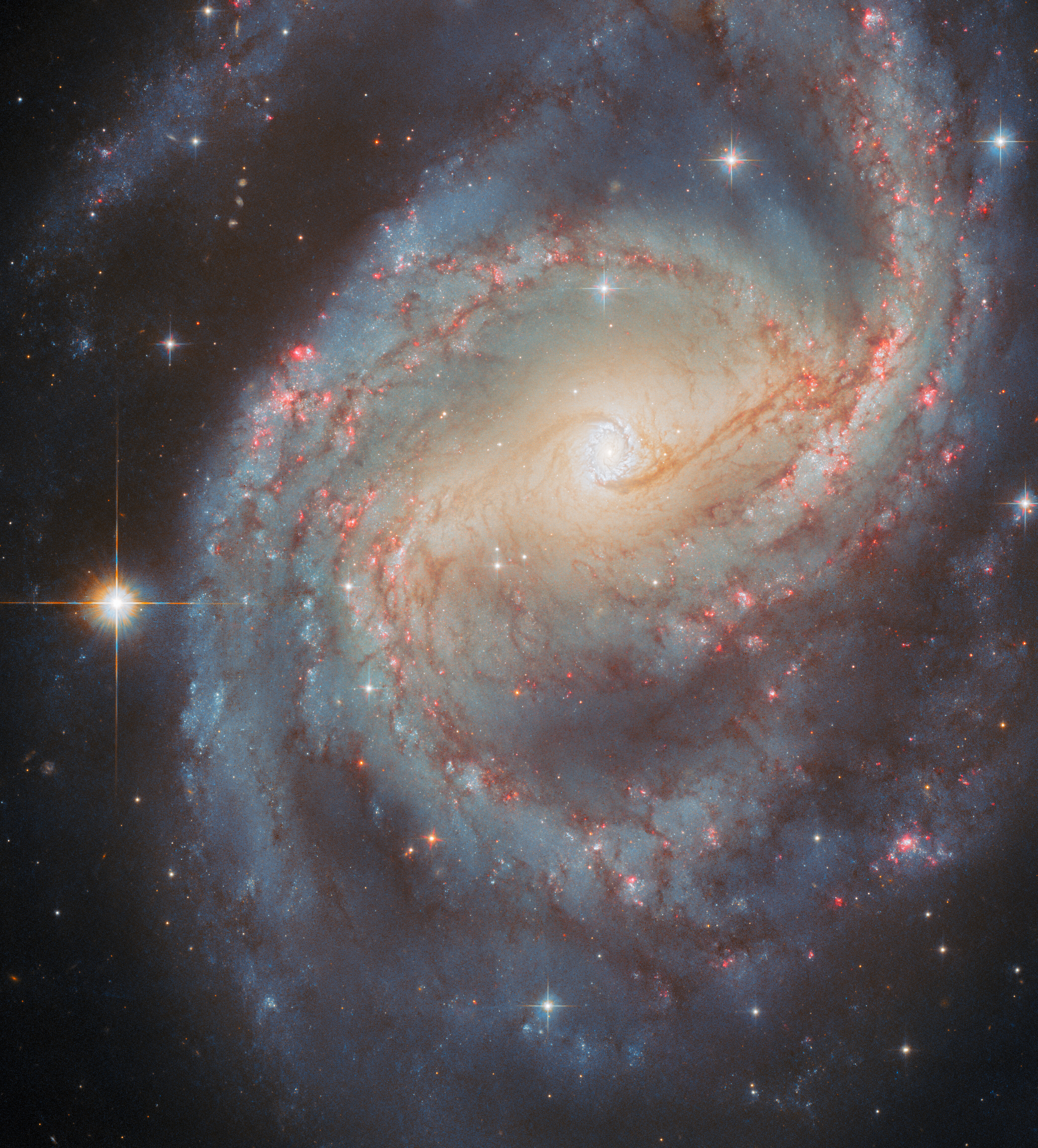
A spiral galaxy with large, open arms. A bar of yellow light, where old stars are gathered, crosses the middle of the disk. The very centre is a white point surrounded by a small, shining ring of star clusters. Thin lanes of dust swirl around this ring, reaching out to follow the spiral arms; also visible across the arms are red, glowing spots where stars are forming. To the right a star shines large and bright. Credit: ESA/Hubble & NASA, L. C. Ho, G. Brammer, A. Filippenko, C. Kilpatrick

The glittering galaxy in this NASA/ESA Hubble Space Telescope Picture of the Week is NGC 6951, which resides about 70 million light-years away in the constellation Cepheus.

As this Hubble image shows, NGC 6951 is a spiral galaxy with plenty of intriguing structures. Most eye-catching are its spiral arms, which are dotted with brilliant red nebulae, bright blue stars and filamentary dust clouds. The spiral arms loop around the galactic centre, which has a golden glow that comes from a population of older stars. The centre of the galaxy is also distinctly elongated, revealing the presence of a slowly rotating bar of stars.

NGC 6951’s bar may be responsible for another remarkable feature: a white-blue ring that encloses the very heart of the galaxy. This is called a circumnuclear starburst ring — essentially, a circle of enhanced star formation around the nucleus of a galaxy. The bar funnels gas toward the centre of the galaxy, where it collects in a ring about 3800 light-years across. Two dark dust lanes that run parallel to the bar mark the points where gas from the bar enters the ring.

The dense gas of a circumnuclear starburst ring is the perfect environment to churn out an impressive number of stars. Using data from Hubble, astronomers have identified more than 80 potential star clusters within NGC 6951’s ring. Many of the stars formed less than 100 million years ago, but the ring itself is longer-lived, potentially having existed for 1–1.5 billion years.

Astronomers have imaged NGC 6951 with Hubble for a wide variety of reasons, including mapping the dust in nearby galaxies, studying the centres of disc galaxies and keeping tabs on recent supernovae (of which NGC 6951 has hosted five or six).


Monday, September 08, 2025

Glittering Glimpse of Star Birth From NASA's Webb Telescope

Webb captured this sparkling scene of star birth in Pismis 24, a young star cluster about 5,500 light-years from Earth in the constellation Scorpius. This region is one of the best places to explore the properties of hot young stars and how they evolve. Read the full image description. Credits/Image: NASA, ESA, CSA, STScI. Image Processing: Alyssa Pagan (STScI)

This image of Pismis 24, also called NGC 6357, was captured by the James Webb Space Telescope’s NIRCam (Near-Infrared Camera). For reference, it shows compass arrows, scale bar, and color key. The north and east compass arrows show the orientation of the image on the sky. Note that the relationship between north and east on the sky (as seen from below) is flipped to the direction arrows on a map of the ground (as seen from above). The scale bar is labeled 1 light-year, which is the distance that light travels in one Earth-year. (One light-year is equal to about 5.88 trillion miles or 9.46 trillion kilometers.) This image shows invisible near-infrared wavelengths of light that have been translated into visible-light colors. The color key shows which NIRCam filters were used when collecting the light. The color of each filter name is the visible light color used to represent the infrared light that passes through that filter. Credits/Image: NASA, ESA, CSA, STScI. Image Processing: Alyssa Pagan (STScI)


Expedition to Star Cluster Pismis 24
Credits/Video: NASA, ESA, CSA, STScI, Leah Hustak (STScI), Christian Nieves (STScI)
Image Processing: Alyssa Pagan (STScI) - Script Writer: Frank Summers (STScI)
Narration: Frank Summers (STScI) - Music: Christian Nieves (STScI)
Audio: Danielle Kirshenblat (STScI) - Producer: Greg Bacon (STScI) - Acknowledgment: VISTA

 Credits/Video: NASA, ESA, CSA, STScI, Alyssa Pagan (STScI) - Narration: Frank Summers (STScI)
Script Writer: Frank Summers (STScI) - Music: Christian Nieves (STScI) - Audio: Danielle Kirshenblat (STScI)
Producer: Greg Bacon (STScI) - Acknowledgment: VISTA, Akira Fujii, DSS


This is a sparkling scene of star birth captured by NASA’s James Webb Space Telescope. What appears to be a craggy, starlit mountaintop kissed by wispy clouds is actually a cosmic dust-scape being eaten away by the blistering winds and radiation of nearby, massive, infant stars.

Called Pismis 24, this young star cluster resides in the core of the nearby Lobster Nebula, approximately 5,500 light-years from Earth in the constellation Scorpius. Home to a vibrant stellar nursery and one of the closest sites of massive star birth, Pismis 24 provides rare insight into large and massive stars. Its proximity makes this region one of the best places to explore the properties of hot young stars and how they evolve.

At the heart of this glittering cluster is the brilliant Pismis 24-1. It is at the center of a clump of stars above the jagged orange peaks, and the tallest spire is pointing directly toward it. Pismis 24-1 appears as a gigantic single star, and it was once thought to be the most massive known star. Scientists have since learned that it is composed of at least two stars, though they cannot be resolved in this image. At 74 and 66 solar masses, respectively, the two known stars are still among the most massive and luminous stars ever seen.

Captured in infrared light by Webb’s NIRCam (Near-Infrared Camera), this image reveals thousands of jewel-like stars of varying sizes and colors. The largest and most brilliant ones with the six-point diffraction spikes are the most massive stars in the cluster. Hundreds to thousands of smaller members of the cluster appear as white, yellow, and red, depending on their stellar type and the amount of dust enshrouding them. Webb also shows us tens of thousands of stars behind the cluster that are part of the Milky Way galaxy.

Super-hot, infant stars –some almost 8 times the temperature of the Sun – blast out scorching radiation and punishing winds that are sculpting a cavity into the wall of the star-forming nebula. That nebula extends far beyond NIRCam’s field of view. Only small portions of it are visible at the bottom and top right of the image. Streamers of hot, ionized gas flow off the ridges of the nebula, and wispy veils of gas and dust, illuminated by starlight, float around its towering peaks.

Dramatic spires jut from the glowing wall of gas, resisting the relentless radiation and winds. They are like fingers pointing toward the hot, young stars that have sculpted them. The fierce forces shaping and compressing these spires cause new stars to form within them. The tallest spire spans about 5.4 light-years from its tip to the bottom of the image. More than 200 of our solar systems out to Neptune’s orbit could fit into the width its tip, which is 0.14 lightyears.

In this image, the color cyan indicates hot or ionized hydrogen gas being heated up by the massive young stars. Dust molecules similar to smoke here on Earth are represented in orange. Red signifies cooler, denser molecular hydrogen. The darker the red, the denser the gas. Black denotes the densest gas, which is not emitting light. The wispy white features are dust and gas that are scattering starlight.

The James Webb Space Telescope is the world’s premier space science observatory. Webb is solving mysteries in our solar system, looking beyond to distant worlds around other stars, and probing the mysterious structures and origins of our universe and our place in it. Webb is an international program led by NASA with its partners, ESA (European Space Agency) and CSA (Canadian Space Agency).


About This Release

Credits:


Media Contact

Ann Jenkins
Space Telescope Science Institute, Baltimore

Christine Pulliam
Space Telescope Science Institute, Baltimore

Permissions: Content Use Policy

Contact Us: Direct inquiries to the News Team.


Friday, December 20, 2024

NASA's Webb Finds Planet-Forming Disks Lived Longer in Early Universe

Protoplanetary Disks in NGC 346 (NIRCam Image)
Credits/Image: NASA, ESA, CSA, STScI, Olivia C. Jones (UK ATC), Guido De Marchi (ESTEC), Margaret Meixner (USRA)

Protoplanetary Disks in NGC 346 Spectra (NIRSpec)
Credits/Illustration: NASA, ESA, CSA, Joseph Olmsted (STScI)

Credits/Image: NASA, ESA, CSA, STScI, Olivia C. Jones (UK ATC), Guido De Marchi (ESTEC), Margaret Meixner (USRA), Antonella Nota (ESA)


NASA’s James Webb Space Telescope just solved a conundrum by proving a controversial finding made with the agency’s Hubble Space Telescope more than 20 years ago.

In 2003, Hubble provided evidence of a massive planet around a very old star, almost as old as the universe. Such stars possess only small amounts of heavier elements that are the building blocks of planets. This implied that some planet formation happened when our universe was very young, and those planets had time to form and grow big inside their primordial disks, even bigger than Jupiter. But how? This was puzzling.

To answer this question, researchers used Webb to study stars in a nearby galaxy that, much like the early universe, lacks large amounts of heavy elements. They found that not only do some stars there have planet-forming disks, but that those disks are longer-lived than those seen around young stars in our Milky Way galaxy.

“With Webb, we have a really strong confirmation of what we saw with Hubble, and we must rethink how we model planet formation and early evolution in the young universe,” said study leader Guido De Marchi of the European Space Research and Technology Centre in Noordwijk, Netherlands.

A Different Environment in Early Times

In the early universe, stars formed from mostly hydrogen and helium, and very few heavier elements such as carbon and iron, which came later through supernova explosions.

“Current models predict that with so few heavier elements, the disks around stars have a short lifetime, so short in fact that planets cannot grow big,” said the Webb study’s co-investigator Elena Sabbi, chief scientist for Gemini Observatory at the National Science Foundation’s NOIRLab in Tucson. "But Hubble did see those planets, so what if the models were not correct and disks could live longer?"

To test this idea, scientists trained Webb on the Small Magellanic Cloud, a dwarf galaxy that is one of the Milky Way’s nearest neighbors. In particular, they examined the massive, star-forming cluster NGC 346, which also has a relative lack of heavier elements. The cluster served as a nearby proxy for studying stellar environments with similar conditions in the early, distant universe.

Hubble observations of NGC 346 from the mid 2000s revealed many stars about 20 to 30 million years old that seemed to still have planet-forming disks around them. This went against the conventional belief that such disks would dissipate after 2 or 3 million years.

“The Hubble findings were controversial, going against not only empirical evidence in our galaxy but also against the current models,” said De Marchi. “This was intriguing, but without a way to obtain spectra of those stars, we could not really establish whether we were witnessing genuine accretion and the presence of disks, or just some artificial effects.”

Now, thanks to Webb’s sensitivity and resolution, scientists have the first-ever spectra of forming, Sun-like stars and their immediate environments in a nearby galaxy.

“We see that these stars are indeed surrounded by disks and are still in the process of gobbling material, even at the relatively old age of 20 or 30 million years,” said De Marchi. “This also implies that planets have more time to form and grow around these stars than in nearby star-forming regions in our own galaxy.”

A New Way of Thinking

This finding refutes previous theoretical predictions that when there are very few heavier elements in the gas around the disk, the star would very quickly blow away the disk. So the disk’s life would be very short, even less than a million years. But if a disk doesn't stay around the star long enough for the dust grains to stick together and pebbles to form and become the core of a planet, how can planets form?

The researchers explained that there could be two distinct mechanisms, or even a combination, for planet-forming disks to persist in environments scarce in heavier elements.

First, to be able to blow away the disk, the star applies radiation pressure. For this pressure to be effective, elements heavier than hydrogen and helium would have to reside in the gas. But the massive star cluster NGC 346 only has about ten percent of the heavier elements that are present in the chemical composition of our Sun. Perhaps it simply takes longer for a star in this cluster to disperse its disk.

The second possibility is that, for a Sun-like star to form when there are few heavier elements, it would have to start from a larger cloud of gas. A bigger gas cloud will produce a bigger disk. So there is more mass in the disk and therefore it would take longer to blow the disk away, even if the radiation pressure were working in the same way.

“With more matter around the stars, the accretion lasts for a longer time,” said Sabbi. "The disks take ten times longer to disappear. This has implications for how you form a planet, and the type of system architecture that you can have in these different environments. This is so exciting.”

The science team’s paper appears in the Dec. 16 issue of The Astrophysical Journal.

The James Webb Space Telescope is the world's premier space science observatory. Webb is solving mysteries in our solar system, looking beyond to distant worlds around other stars, and probing the mysterious structures and origins of our universe and our place in it. Webb is an international program led by NASA with its partners, ESA (European Space Agency) and CSA (Canadian Space Agency).

The Hubble Space Telescope has been operating for over three decades and continues to make ground-breaking discoveries that shape our fundamental understanding of the universe. Hubble is a project of international cooperation between NASA and ESA (European Space Agency). NASA's Goddard Space Flight Center in Greenbelt manages the telescope and mission operations. Lockheed Martin Space, based in Denver also supports mission operations at Goddard. The Space Telescope Science Institute in Baltimore, which is operated by the Association of Universities for Research in Astronomy, conducts Hubble science operations for NASA.


About This Release

Credits:

Media Contact:

Ann Jenkins
Space Telescope Science Institute, Baltimore, Maryland

Christine Pulliam
Space Telescope Science Institute, Baltimore, Maryland

Permissions: Content Use Policy

Contact Us: Direct inquiries to the News Team.

Related Links and Documents


Saturday, November 09, 2024

Rapidly merging stars and black holes - the birth of supermassive black holes in dense star clusters in the early Universe

Fig 1: The complex formation channel of a supermassive black hole with 2200 solar masses. Six sub-clusters in the collapsing region contribute stars and black holes for the forming massive star cluster. Many stellar collisions (red and blue circles) rapidly form a 2025 solar mass black hole within only a few million years. Thereafter the black hole grows by mergers with other, smaller, black holes and by tidally disrupting stars. Some lower mass black holes are ejected by gravitational recoil kicks.

New observations by the James Webb Space Telescope (JWST) have revealed that supermassive black holes (SMBHs) of more than one million solar masses were already present only 450 million years after the Big Bang. How did these first SMBHs form? A team of researchers at MPA has used modern supercomputer simulations to show that progenitors of SMBHs (seeds) of a few thousand solar masses can form rapidly in dense and structured star clusters forming in the early Universe. They emerge from collisions of massive stars which form supermassive stars and then collapse directly into black holes, which can further grow by merging with other black holes. This new and more realistic model resembles JWST observations and can explain the formation of SMBH seeds which are massive enough to further grow into the earliest SMBHs observed. For this SMBH seed formation process, the researchers predict a unique gravitational wave fingerprint from black hole merger that can be directly tested with the next-generation gravitational wave observatories.

Supermassive black holes (SMBHs) with masses exceeding one million solar masses are found in all nearby massive galaxies including our own Milky Way. New observations by the James Webb Space Telescope (JWST) have revealed that SMBHs were already present only 450 million years after the Big Bang. The origin of these most massive black holes in the Universe is a major unsolved puzzle in modern astrophysics and an active area of research.

The very first stars in the Universe may have left behind black holes with masses up to a few hundred solar masses. However, models with such ‘light’ SMBH seeds struggle to explain the observed high redshift population of accreting SMBHs. The maximum sustainable SMBH gas accretion rate, the so-called Eddington rate, places limits on how fast SMBH seeds may grow after their formation. The light SMBH seeds simply do not have enough time to grow enough only in a few hundred million years. Therefore, more popular theoretical SMBH formation models assume that the SMBH seeds formed ‘heavy’ with masses exceeding a thousand solar masses. These heavy seeds black holes have a head start against the light seeds in their growth into the observed population of early accreting SMBHs. The major proposed heavy seed formation scenarios include runaway stellar collisions in dense star clusters, directly collapsing metal-free gas clouds in atomic cooling halos, and more exotic ‘new’ physics such as primordial black holes.

In dense star clusters, repeated stellar collisions may build up very massive and even supermassive stars. In early Universe which is still little enriched with heavy elements, stellar winds are typically weak and the stellar collision products will retain most of their mass. At the ends of their lives, these collisionally formed supermassive stars collapse and form the seeds for SMBHs.

Past simulations had focused on studying isolated, spherical star clusters. Both the JWST observations and state-of-the-art hydrodynamical galaxy formation simulations instead support the picture that massive star clusters form through a complex hierarchical assembly. This was the key motivation for the researchers at the MPA to re-explore the runaway collisional SMBH seed formation scenario in the more realistic clustered setup. Such a scenario is very different to the direct collapse gas cloud scenario which relies on avoiding cloud cooling and fragmentation into clusters of stars.

The researchers performed new simulations of massive star clusters with several million individual stars forming from the rapid assembly of several hundred proto-clusters. The newly developed direct N-body simulation code BIFROST used for the simulations runs on energy-efficient GPU hardware can follow stellar evolution, stellar mergers and accurately accounts for general relativistic effects during the interaction of black holes. In particular, the code computes the gravitational wave emission when two black holes merge. At the end of the merger anisotropic gravitational wave emission can kick the newly formed black holes up to speeds of several thousand km/s. These gravitational wave recoil kicks which can eject black hole merger remnants from their birth clusters are also modelled with the code.

Fig 2: Primary and secondary masses of black holes merging in early star clusters by the emission of gravitational waves from the simulation (black circles). Observed gravitational waves from black hole mergers are indicated by yellow crosses (Advanced LIGO and Advanced Virgo). The model predicts mergers of ~ 1000 solar mass black holes with several 10 to 100 solar mass black holes which can be detected with the next generation gravitational wave telescopes like the Einstein Telescope (https://en.wikipedia.org/wiki/Einstein_Telescope) or LISA (https://de.wikipedia.org/wiki/Laser_Interferometer_Space_Antenna)

The collision pathways massive stars and the formed SMBH seeds are illustrated in Fig. 1. Typically, only the most massive star in sub-clusters grows rapidly by collisions with other massive stars. Once the stars exceed the mass of several hundred solar masses, stellar evolution models predict that they directly collapse into black holes at the end of their lives. After their formation, the several SMBH seeds in the assembled massive star cluster experience a rich history of interactions and mergers by which the SMBH seeds can further grow. Several black holes are ejected from the cluster through strong Newtonian few-body interactions or relativistic gravitational wave recoil kicks. The hierarchical runaway scenario predicts a population of gravitational wave mergers at high redshifts in which the SMBH seeds merge with stellar mass black holes of several 10 to 100 solar masses (Fig. 2). Current gravitational wave observatories cannot detect black hole mergers above 500 solar masses or high redshifts very well. However, the scenario of the MPA researchers can be tested with the next-generation gravitational wave experiments such as LISA and the Einstein Telescope.
 

Antti Rantala, Thorsten Naab & Natalia Lahen


The authors thank Markus Rampp and Klaus Reuter of the Max Planck Computing and Data Facility (MPCDF) for performance optimization of the BIFROST GPU code. The simulations for the study were run using the MPCDF supercomputer Raven in Garching


Author:

Antti Rantala
Postdoc
tel:2253

anttiran@mpa-garching.mpg.de

Natalia Lahén
Postdoc
tel:2253

nlahen@mpa-garching.mpg.de

Thorsten Naab
Scientific Staff
tel:2295

tnaab@mpa-garching.mpg.de

Original Publication

https://ui.adsabs.harvard.edu/abs/2024MNRAS.531.3770R/abstract

https://ui.adsabs.harvard.edu/abs/2023MNRAS.522.5180R/abstract
BIFROST Code


Tuesday, February 13, 2024

NASA's Hubble Traces 'String of Pearls' Star Clusters in Galaxy Collisions


Galaxy AM 1054-325 has been distorted into an S-shape from a normal pancake-like spiral shape by the gravitational pull of a neighboring galaxy, seen in this Hubble Space Telescope image. A consequence of this is that newborn clusters of stars form along a stretched-out tidal tail for thousands of light-years, resembling a string of pearls. They form when knots of gas gravitationally collapse to create about 1 million newborn stars per cluster. Credits: Image; NASA, ESA, STScI, Jayanne English (University of Manitoba)


Contrary to what you might think, galaxy collisions do not destroy stars. In fact, the rough-and-tumble dynamics trigger new generations of stars, and presumably accompanying planets.

Now NASA's Hubble Space Telescope has homed in on 12 interacting galaxies that have long, tadpole-like tidal tails of gas, dust, and a plethora of stars. Hubble's exquisite sharpness and sensitivity to ultraviolet light have uncovered 425 clusters of newborn stars along these tails, looking like strings of holiday lights. Each cluster contains as many as 1 million blue, newborn stars.

Clusters in tidal tails have been known about for decades. When galaxies interact, gravitational tidal forces pull out long streamers of gas and dust. Two popular examples are the Antennae and Mice galaxies with their long, narrow, finger-like projections.

A team of astronomers used a combination of new observations and archival data to get ages and masses of tidal tail star clusters. They found that these clusters are very young — only 10 million years old. And they seem to be forming at the same rate along tails stretching for thousands of light-years.

"It's a surprise to see lots of the young objects in the tails. It tells us a lot about cluster formation efficiency," said lead author Michael Rodruck of Randolph-Macon College in Ashland, Virginia. "With tidal tails, you will build up new generations of stars that otherwise might not have existed."

The tails look like they are taking a galaxy's spiral arm and stretching it out into space. The exterior part of the arm gets pulled like taffy from the gravitational tug-of-war between a pair of interacting galaxies.

Before the mergers, the galaxies were rich in dusty clouds of molecular hydrogen that simply may have remained inert. But the clouds got jostled and bumped into each other during the encounters. This compressed the hydrogen to the point where it precipitated a firestorm of star birth.

The fate of these strung-out star clusters is uncertain. They may stay gravitationally intact and evolve into globular star clusters — like those that orbit outside the plane of our Milky Way galaxy. Or they may disperse to form a halo of stars around their host galaxy, or get cast off to become wandering intergalactic stars.

This string-of-pearls star formation may have been more common in the early universe when galaxies collided with each other more frequently. These nearby galaxies observed by Hubble are a proxy for what happened long ago, and therefore are laboratories for looking into the distant past.

The Hubble Space Telescope is a project of international cooperation between NASA and ESA. NASA's Goddard Space Flight Center in Greenbelt, Maryland, manages the telescope. The Space Telescope Science Institute (STScI) in Baltimore, Maryland, conducts Hubble and Webb science operations. STScI is operated for NASA by the Association of Universities for Research in Astronomy, in Washington, D.C.


About This Release

Credits:

Media Contact:

Ray Villard
Space Telescope Science Institute, Baltimore, Maryland

Science Contact:

Michael Rodruck
Randolph-Macon College, Ashland, Virginia

Permissions: Content Use Policy

Contact Us: Direct inquiries to the News Team.

Related Links and Documents


Thursday, October 12, 2023

NASA’s Webb Captures an Ethereal View of NGC 346

NGC 346 (MIRI Image)
Credits: Image: NASA, ESA, CSA, STScI, Nolan Habel (NASA-JPL)
Image Processing: Patrick Kavanagh (Maynooth University)


One of the greatest strengths of NASA’s James Webb Space Telescope is its ability to give astronomers detailed views of areas where new stars are being born. The latest example, showcased here in a new image from Webb’s Mid-Infrared Instrument (MIRI), is NGC 346 – the brightest and largest star-forming region in the Small Magellanic Cloud.

The Small Magellanic Cloud (SMC) is a satellite galaxy of the Milky Way, visible to the unaided eye in the southern constellation Tucana. This small companion galaxy is more primeval than the Milky Way in that it possesses fewer heavy elements, which are forged in stars through nuclear fusion and supernova explosions, compared to our own galaxy.

Since cosmic dust is formed from heavy elements like silicon and oxygen, scientists expected the SMC to lack significant amounts of dust. However the new MIRI image, as well as a previous image of NGC 346 from Webb’s Near-Infrared Camera released in January, show ample dust within this region.

In this representative-color image, blue tendrils trace emission from material that includes dusty silicates and sooty chemical molecules known as polycyclic aromatic hydrocarbons, or PAHs. More diffuse red emission shines from warm dust heated by the brightest and most massive stars in the heart of the region. An arc at the center left may be a reflection of light from the star near the arc’s center. (Similar, fainter arcs appear associated with stars at lower left and upper right.) Lastly, bright patches and filaments mark areas with abundant numbers of protostars. The research team looked for the reddest stars, and found 1,001 pinpoint sources of light, most of them young stars still embedded in their dusty cocoons.

By combining Webb data in both the near-infrared and mid-infrared, astronomers are able to take a fuller census of the stars and protostars within this dynamic region. The results have implications for our understanding of galaxies that existed billions of years ago, during an era in the universe known as “cosmic noon,” when star formation was at its peak and heavy element concentrations were lower, as seen in the SMC.

The James Webb Space Telescope is the world's premier space science observatory. Webb is solving mysteries in our solar system, looking beyond to distant worlds around other stars, and probing the mysterious structures and origins of our universe and our place in it. Webb is an international program led by NASA with its partners, ESA (European Space Agency) and the Canadian Space Agency.


About This Release

Credits:

Media Contact:

Christine Pulliam
Space Telescope Science Institute, Baltimore, Maryland

Permissions: Content Use Policy

Contact Us: Direct inquiries to the News Team.

Related Links and Documents


Friday, September 08, 2023

Hubble Sees a Glittering Globular Cluster Embedded Inside Our Milky Way

Terzam 12
Image: NASA, ESA, ESA/Hubble, Roger Cohen (RU)


This image shows a compact beehive-like structure of hundreds of thousands of stars crowded together. Because of scattering by interstellar dust, the stars on the left side of the image appear redder. The stars toward the right side of the image are bluish-white. The image is sprinkled with bright blue foreground stars. There is also a smattering of bright red giant stars across the image.

This colorful image of the globular star cluster Terzan 12 is a spectacular example of how dust in space affects starlight coming from background objects.

A globular star cluster is a conglomeration of stars, arranged in a spheroidal shape. Stars in globular clusters are bound together by gravity, with a higher concentration of stars towards the center. The Milky Way has about 150 ancient globular clusters at its outskirts. These clusters orbit around the galactic center, but far above and below the pancake-flat plane of our galaxy, like bees buzzing around a hive.

The location of this globular cluster, deep in the Milky Way in the constellation Sagittarius, means that it is shrouded in gas and dust which absorb and alter the starlight emanating from Terzan 12. The cluster is about 15,000 light-years from Earth. This location leaves a lot of room for intervening interstellar dust particles between us and the cluster to scatter blue light, causing only the redder wavelengths to come through to Earth. The interstellar dust clouds are mottled so that different parts of the cluster look redder than other parts along our line of sight.

The brightest red stars in the photo are bloated, aging giants, many times larger than our Sun. They lie between Earth and the cluster. Only a few may actually be members of the cluster. The very brightest hot, blue stars are also along the line of sight and not inside the cluster, which only contains aging stars.

Terzan 12 is one of 11 globular clusters discovered by the Turkish-Armenian astronomer Agop Terzan approximately a half-century ago. With its sharp vision, Hubble has revolutionized the study of globular clusters ever since its launch in 1990. Hubble observations have shed light on the relation between age and composition in the Milky Way galaxy's innermost globular clusters.

The Hubble Space Telescope is a project of international cooperation between NASA and ESA. NASA's Goddard Space Flight Center in Greenbelt, Maryland, manages the telescope. The Space Telescope Science Institute (STScI) in Baltimore, Maryland, conducts Hubble science operations. STScI is operated for NASA by the Association of Universities for Research in Astronomy, in Washington, D.C.


About This Release

Credits: Release: NASA, ESA, STScI

Media Contact:

Ray Villard
Space Telescope Science Institute, Baltimore, Maryland

Bethany Downer
ESA/Hubble.org

Permissions:
Content Use Policy

Contact Us: Direct inquiries to the News Team.

Related Links and Documents


Thursday, November 24, 2022

Planets May Have More Time to Form Than Previously Thought

Artist's impression of a young planetary system.
Credit: NASA

A recent study suggests that protoplanetary disks may tend to linger longer than we thought, meaning that planets likely have at least 5 million years to form before their building materials vanish.

One way that protoplanetary disks are dispersed is by radiation and winds from massive stars, as shown in this illustration. 

Disk Dispersal Deadlines
 
Planets arise from gaseous disks called protoplanetary disks. While the details of planet formation are hidden from view within these dusty disks, the big picture is clear: the timeline for planet formation is set by the lifetime of the disk — once the disk disperses, planet formation must come to a halt. Determining how long planets have to form should be a simple task, then: researchers can measure the ages of star clusters and determine whether the stars in those clusters have disks, thus establishing a cutoff point at which disks typically disperse.

In reality, however, this technique has produced a wide range of estimates for the lifetimes of protoplanetary disks, and thus widely varying constraints on how long planets have to form — and the shortest estimates, in the 1.0–3.5 million year range, set a tight deadline for models of planet formation to meet.


Fraction of stars with disks as a function of cluster age and distance. More distant clusters tend to have smaller disk fractions. Credit: Adapted fromPfalzner et al. 2022

Young, Massive, and Misleading?

In a recent publication, a team led by Susanne Pfalzner (Jülich Supercomputing Center and Max Planck Institute for Radio Astronomy, Germany) suggested that careful application of existing techniques can provide a little more wiggle room for modelers, lengthening the typical lifetime of a protoplanetary disk. Researchers often study disks around stars in clusters, since it’s more straightforward to determine their ages than stars outside of clusters. However, it’s easier to identify young, compact clusters than it is to find old, dispersed clusters, especially at large distances from Earth. Since bright, massive stars are easier to detect at large distances, studies biased toward younger clusters are also biased toward more massive stars — which are known to have shorter-lived disks.

As a demonstration of this effect, Pfalzner and coauthors examined how the results of previous studies varied with the properties of the clusters in each study’s sample. They found that samples containing mostly distant (>650 light-years away), young clusters resulted in short estimates for disk lifetimes, while samples containing nearby, old clusters were linked to long disk lifetimes.

The effect of stellar mass and initial disk fraction (IDF) on the median disk lifetime in star clusters.
Credit: Adapted from
Pfalzner et al. 2022

Modelers Everywhere Breathe a Sigh of Relief

To counteract this issue, the team constructed a new sample that is evenly balanced between young and old clusters that are located within 650 light-years of Earth. Analysis of this sample suggested a median disk lifetime of 6.5 million years, with a substantial fraction of disks enduring for 10–20 million years — meaning that in many star systems, planets have far longer to form than expected.

While this result provides much-needed leeway for our models of planet formation, there are still plenty of open questions to explore. For example, it’s important to pin down the fraction of stars that are born with disks; assuming that all stars are initially shrouded in disks implies typical disk lifetimes in the 5–6 million year range, while allowing for a small fraction of stars to be born diskless would allow planets 8–10 million years to form around low-mass stars and 4–5 million years to form around high-mass stars. Regardless of the exact timeframe, understanding how high-mass stars form planets under stricter timescales than low-mass stars will remain a challenging question to answer.

Citation

“Most Planets Might Have More than 5 Myr of Time to Form,” Susanne Pfalzner et al 2022 ApJL 939 L10.
doi:10.3847/2041-8213/ac9839

By Kerry Hensley


Tuesday, January 18, 2022

1,000-Light-Year wide bubble surrounding Earth is source of all nearby, young stars


Artist's illustration of the Local Bubble with star formation occurring on the bubble's surface. Scientists have now shown how a chain of events beginning 14 million years ago with a set of powerful supernovae led to the creation of the vast bubble, responsible for the formation of all young stars within 500 light-years of the Sun and Earth. Credits: Illustration: CfA, Leah Hustak (STScI)


The Earth sits in a 1,000-light-year-wide void surrounded by thousands of young stars — but how did those stars form?

In a paper appearing today in Nature, astronomers at the Center for Astrophysics | Harvard & Smithsonian (CfA) and the Space Telescope Science Institute (STScI) reconstruct the evolutionary history of our galactic neighborhood, showing how a chain of events beginning 14 million years ago led to the creation of a vast bubble that’s responsible for the formation of all nearby, young stars.

"This is really an origin story; for the first time we can explain how all nearby star formation began," said astronomer and data visualization expert Catherine Zucker, who completed the work during a fellowship at the CfA.

The paper's central figure, a 3D spacetime animation, reveals that all young stars and star-forming regions — within 500 light-years of Earth — sit on the surface of a giant bubble known as the Local Bubble. While astronomers have known of its existence for decades, scientists can now see and understand the Local Bubble's beginnings and its impact on the gas around it.

The Source of Our Stars: The Local Bubble

Using a trove of new data and data science techniques, the spacetime animation shows how a series of supernovae that first went off 14 million years ago pushed interstellar gas outwards, creating a bubble-like structure with a surface that's ripe for star formation.

Today, seven well-known star-forming regions or molecular clouds — dense regions in space where stars can form — sit on the surface of the bubble.

"We've calculated that about 15 supernovae have gone off over millions of years to form the Local Bubble that we see today," said Zucker who is now a NASA Hubble Fellow at STScI. The oddly-shaped bubble is not dormant and continues to slowly grow, the astronomers note.

"It's coasting along at about 4 miles per second," Zucker said. "It has lost most of its oomph though and has pretty much plateaued in terms of speed."

The expansion speed of the bubble, as well as the past and present trajectories of the young stars forming on its surface, were derived using data obtained by Gaia, a space-based observatory launched by the European Space Agency.

"This is an incredible detective story, driven by both data and theory," said Harvard professor and Center for Astrophysics astronomer Alyssa Goodman, a study co-author and founder of glue, data visualization software that enabled the discovery. "We can piece together the history of star formation around us using a wide variety of independent clues: supernova models, stellar motions and exquisite new 3D maps of the material surrounding the Local Bubble."

Bubbles Everywhere?

"When the first supernovae that created the Local Bubble went off, our Sun was far away from the action," said co-author João Alves, a professor at the University of Vienna. "But about five million years ago, the Sun's path through the galaxy took it right into the bubble, and now the Sun sits — just by luck — almost right in the bubble's center."

Today, as humans peer out into space from near the Sun, they have a front row seat to the process of star formation occurring all around on the bubble's surface.

Astronomers first theorized that superbubbles were pervasive in the Milky Way nearly 50 years ago. "Now, we have proof — and what are the chances that we are right smack in the middle of one of these things?" asks Goodman. Statistically, it is very unlikely that the Sun would be centered in a giant bubble if such bubbles were rare in our Milky Way Galaxy, she explained.

Goodman likens the discovery to a Milky Way that resembles very hole-y swiss cheese, where holes in the cheese are blasted out by supernovae, and new stars can form in the cheese around the holes created by dying stars.

Next the team, including co-author and Harvard doctoral student Michael Foley, plans to map out more interstellar bubbles to get a full 3D view of their locations, shapes and sizes. Charting out bubbles, and their relationship to each other, will ultimately allow astronomers to understand the role played by dying stars in giving birth to new ones, and in the structure and evolution of galaxies like the Milky Way.

Zucker wonders, "Where do these bubbles touch? How do they interact with each other? How do superbubbles drive the birth of stars like our Sun in the Milky Way?"

Additional co-authors on the paper are Douglas Finkbeiner and Diana Khimey of the CfA; Josefa Groβschedl and Cameren Swiggum of the University of Vienna; Shmuel Bialy of the University of Maryland; Joshua Speagle of the University of Toronto; and Andreas Burkert of the University Observatory Munich.

The articles, analyzed data (on the Harvard Dataverse) and interactive figures and videos are all freely available to everyone through a dedicated website.

The results were presented at a press conference of the American Astronomical Society (AAS) on Wednesday, January 12, 2022. The public can watch a recording of the conference here.

The Center for Astrophysics | Harvard & Smithsonian is a collaboration between Harvard and the Smithsonian designed to ask—and ultimately answer—humanity’s greatest unresolved questions about the nature of the universe. The Center for Astrophysics is headquartered in Cambridge, Massachusetts, with research facilities across the U.S. and around the world.

The Space Telescope Science Institute is expanding the frontiers of space astronomy by hosting the science operations center of the Hubble Space Telescope, the science and operations center for the James Webb Space Telescope, and the science operations center for the future Nancy Grace Roman Space Telescope. STScI also houses the Barbara A. Mikulski Archive for Space Telescopes (MAST) which is a NASA-funded project to support and provide to the astronomical community a variety of astronomical data archives, and is the data repository for the Hubble, Webb, Kepler, K2, TESS missions and more. STScI is operated by the Association of Universities for Research in Astronomy in Washington, D.C.

Credits:

Media Contact:

Christine Pulliam
Space Telescope Science Institute, Baltimore, Maryland

Nadia Whitehead
Center for Astrophysics | Harvard & Smithsonian, Cambridge, Massachusetts


Contact us: Direct inquiries to the
News Team.

Related links and documents: