Showing posts with label active galaxies. Show all posts

Sunday, August 02, 2026

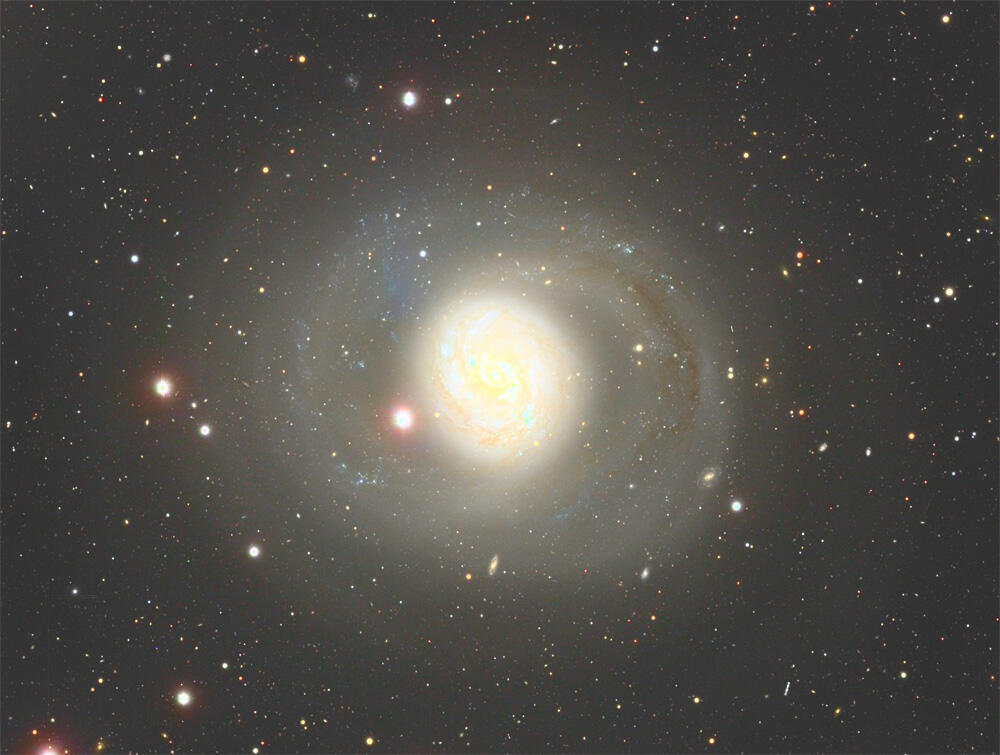
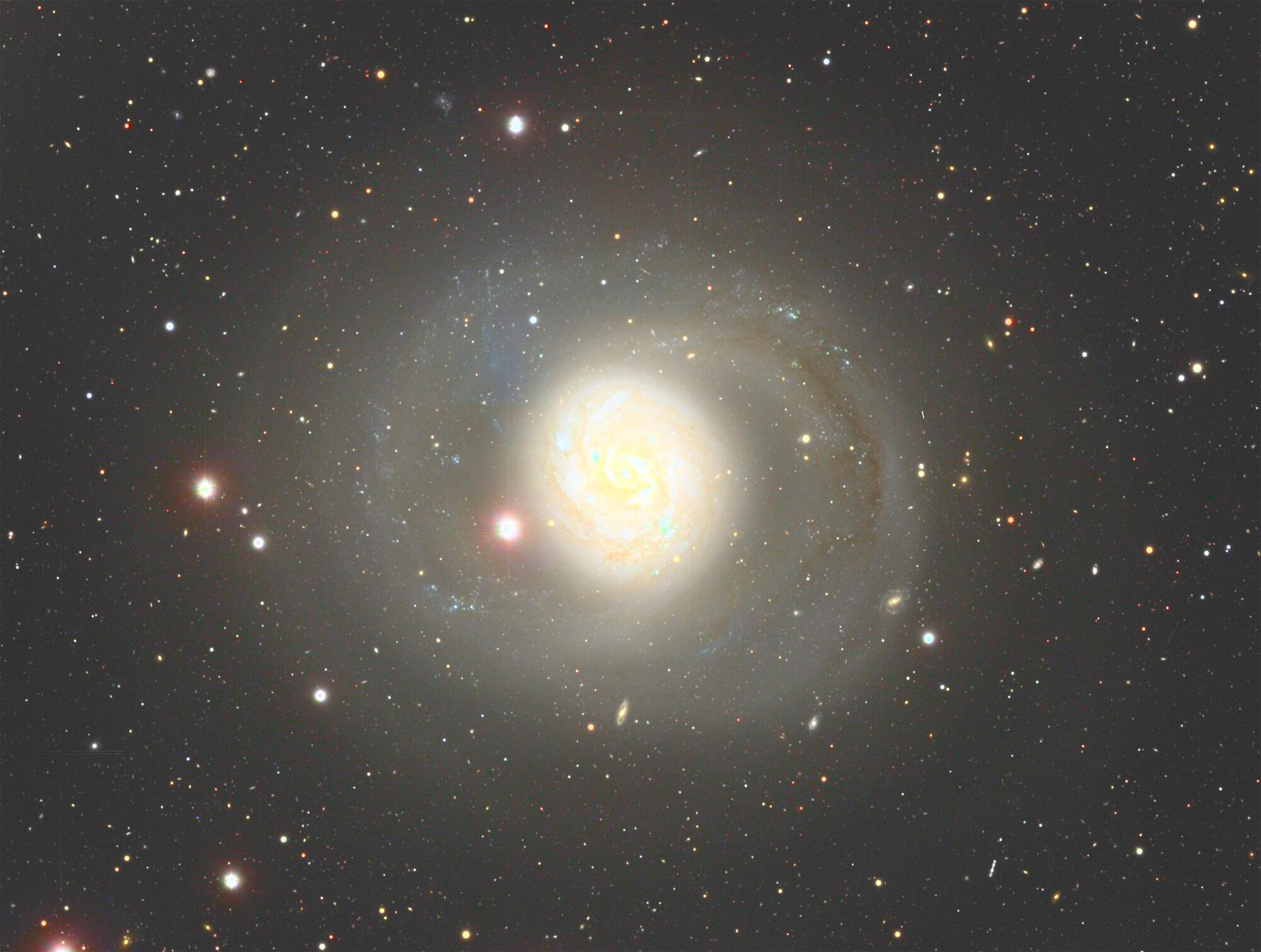
Active Galaxy M77


M77 (NGC 1068) is a spiral galaxy located relatively close to our Milky Way. At its center lies a supermassive black hole about 10 million times the mass of the Sun. As enormous amounts of energy are released around the black hole, M77 is known as an active galaxy.

Because of its proximity, M77 has been extensively studied across the electromagnetic spectrum, from X-rays to radio waves, using various telescopes, including the Subaru Telescope and ALMA. Recently, observations with the Subaru Telescope's Hyper Suprime-Cam (HSC) have revealed evidence that M77 experienced a previously hidden minor merger with a low-mass satellite galaxy billions of years ago. Credit: NAOJ/SDSS/David Hogg/Michael Blanton. Image Processing: Ichi Tanaka)

Distance from Earth: 48 million light-years
Instrument: Hyper Suprime-Cam (HSC)

Relevant Links


Friday, January 16, 2026

NASA’s Webb Delivers Unprecedented Look Into Heart of Circinus Galaxy

This artist’s concept depicts the central engine of the Circinus galaxy, visualizing the supermassive black hole fed by a thick, dusty torus that glows in infrared light. Credit Artwork: NASA, ESA, CSA, Ralf Crawford (STScI)

This image from NASA’s Hubble Space Telescope shows the Circinus galaxy. A close-up of its core from NASA’s James Webb Space Telescope shows the inner face of the hole of the donut-shaped disk of gas disk glowing in infrared light. The outer ring appears as dark spots. Credit Image: NASA, ESA, CSA, Enrique Lopez-Rodriguez (University of South Carolina), Deepashri Thatte (STScI); Image Processing: Alyssa Pagan (STScI); Acknowledgment: NSF's NOIRLab, CTIO

This image shows two views of the Circinus galaxy, one captured by the Hubble Space Telescope and the other by the James Webb Space Telescope’s NIRISS (Near-Infrared Imager and Slitless Spectrograph. It shows compass arrows, scale bar, and color key for reference. Credit Image: NASA, ESA, CSA, Enrique Lopez-Rodriguez (University of South Carolina), Deepashri Thatte (STScI); Image Processing: Alyssa Pagan (STScI); Acknowledgment: NSF's NOIRLab, CTIO

This zoom-in video shows the location of the Circinus galaxy on the sky. It begins with a ground-based photo of the constellation Circinus by the late astrophotographer Akira Fujii. The video closes in on the Circinus galaxy, using views from the Digitized Sky Survey and the Dark. Credit Video: NASA, ESA, CSA, Alyssa Pagan (STScI); Acknowledgment: CTIO, NSF's NOIRLab, DSS, Akira Fujii


The Circinus Galaxy, a galaxy about 13 million light-years away, contains an active supermassive black hole that continues to influence its evolution. The largest source of infrared light from the region closest to the black hole itself was thought to be outflows, or streams of superheated matter that fire outward.

Now, new observations by NASA’s James Webb Space Telescope, seen here with a new image from NASA’s Hubble Space Telescope, provide evidence that reverses this thinking, suggesting that most of the hot, dusty material is actually feeding the central black hole. The technique used to gather this data also has the potential to analyze the outflow and accretion components for other nearby black holes.

The research, which includes the sharpest image of a black hole’s surroundings ever taken by Webb, published Tuesday in Nature.

Outflow question

Supermassive black holes like those in Circinus remain active by consuming surrounding matter. Infalling gas and dust accumulates into a donut-shaped ring around the black hole, known as a torus. As supermassive black holes gather matter from the torus’ inner walls, they form an accretion disk, similar to a whirlpool of water swirling around a drain. This disk grows hotter through friction, eventually becoming hot enough to emit light.

This glowing matter can become so bright that resolving details within the galaxy’s center with ground-based telescopes is difficult. It’s made even harder due to the bright, concealing starlight within Circinus. Further, since the torus is incredibly dense, the inner region of the infalling material, heated by the black hole, is obscured from our point of view. For decades, astronomers contended with these difficulties, designing and improving models of Circinus with as much data as they could gather.

“In order to study the supermassive black hole, despite being unable to resolve it, they had to obtain the total intensity of the inner region of the galaxy over a large wavelength range and then feed that data into models,” said lead author Enrique Lopez-Rodriguez of the University of South Carolina.

Early models would fit the spectra from specific regions, such as the emissions from the torus, those of the accretion disk closest to the black hole, or those from the outflows, each detected at certain wavelengths of light. However, since the region could not be resolved in its entirety, these models left questions at several wavelengths. For example, some telescopes could detect an excess of infrared light, but lacked the resolution to determine where exactly it was coming from.

“Since the ‘90s, it has not been possible to explain excess infrared emissions that come from hot dust at the cores of active galaxies, meaning the models only take into account either the torus or the outflows, but cannot explain that excess,” said Lopez-Rodriguez.

Such models found that most of the emission (and, therefore, mass) close to the center came from outflows. To test this theory, then, astronomers needed two things: the ability to filter the starlight that previously prevented a deeper analysis, and the ability to distinguish the infrared emissions of the torus from those of the outflows. Webb, sensitive and technologically sophisticated enough to meet both challenges, was necessary to advance our understanding.

Webb’s innovative technique

To look into the center of Circinus, Webb needed the Aperture Masking Interferometer tool on its NIRISS (Near-Infrared Imager and Slitless Spectrograph) instrument.

On Earth, interferometers usually take the form of telescope arrays: mirrors or antennae that work together as if they were a single telescope. An interferometer does this by gathering and combining the light from whichever source it is pointed toward, causing the electromagnetic waves that make up light to “interfere” with each other (hence, “interfere-ometer”) and creating interference patterns. These patterns can be analyzed by astronomers to reconstruct the size, shape, and features of distant objects with much greater detail than non-interferometric techniques.

The Aperture Masking Interferometer allows Webb to become an array of smaller telescopes working together as an interferometer, creating these interference patterns by itself. It does this by utilizing a special aperture made of seven small, hexagonal holes, which, like in photography, controls the amount and direction of light that enters the telescope’s detectors.

“These holes in the mask are transformed into small collectors of light that guide the light toward the detector of the camera and create an interference pattern,” said Joel Sanchez-Bermudez, co-author based at the National University of Mexico.

With new data in hand, the research team was able to construct an image from the central region's interference patterns. To do so, they referenced data from previous observations to ensure their data from Webb was free of any artifacts. This resulted in the first extragalactic observation from an infrared interferometer in space.

"By using an advanced imaging mode of the camera, we can effectively double its resolution over a smaller area of the sky," Sanchez-Bermudez said. "This allows us to see images twice as sharp. Instead of Webb’s 6.5-meter diameter, it’s like we are observing this region with a 13-meter space telescope."

The data showed that contrary to the models predicting that the infrared excess comes from the outflows, around 87% of the infrared emissions from hot dust in Circinus come from the areas closest to the black hole, while less than 1% of emissions come from hot dusty outflows. The remaining 12% comes from distances farther away that could not previously be told apart.

“It is the first time a high-contrast mode of Webb has been used to look at an extragalactic source,” said Julien Girard, paper co-author and senior research scientist at the Space Telescope Science Institute. “We hope our work inspires other astronomers to use the Aperture Masking Interferometer mode to study faint, but relatively small, dusty structures in the vicinity of any bright object.”

Universe of black holes

While the mystery of Circinus’ excess emissions has been solved, there are billions of black holes in our universe. Those of different luminosities, the team notes, may have an influence on whether most of the emissions come from a black hole’s torus or their outflows.

“The intrinsic brightness of Circinus’ accretion disk is very moderate,” Lopez-Rodriguez said. “So it makes sense that the emissions are dominated by the torus. But maybe, for brighter black holes, the emissions are dominated by the outflow.”

With this research, astronomers now have a tested technique to investigate whichever black holes they want, so long as they are bright enough for the Aperture Masking Interferometer to be useful. Studying additional targets will be essential to building a catalog of emission data to figure out if Circinus’ results were unique or characteristic of a pattern.

“We need a statistical sample of black holes, perhaps a dozen or two dozen, to understand how mass in their accretion disks and their outflows relate to their power,” Lopez-Rodriguez said.

The James Webb Space Telescope is the world’s premier space science observatory. Webb is solving mysteries in our solar system, looking beyond to distant worlds around other stars, and probing the mysterious structures and origins of our universe and our place in it. Webb is an international program led by NASA with its partners, ESA (European Space Agency) and CSA (Canadian Space Agency).


Related Links

Read more: The Modes of Webb’s NIRISS

Explore more: Black Hole Resources from NASA’s Universe of Learning

Read more: Webb’s Scientific Instruments

Video: NASA Animation Sizes Up the Universe’s Biggest Black Holes

More Webb News

More Webb Images

Webb Science Themes

Webb Mission Page


Location: NASA Goddard Space Flight Center

Contact:

Media

Laura Betz
NASA’s Goddard Space Flight Center
Greenbelt, Maryland

laura.e.betz@nasa.gov

Matthew Brown
Space Telescope Science Institute
Baltimore, Maryland


Hannah Braun
Space Telescope Science Institute
Baltimore, Maryland


Related Links and Documents


Monday, June 23, 2025

Centre of activity

A spiral galaxy, seen at an angle that gives it an oval shape. It has two spiral arms that curl out from the centre. They start narrow but broaden out as they wrap around the galaxy before merging into a faint halo. The galaxy’s disc is golden in the centre with a bright core, and pale blue outside that. A swirl of dark dust strands and speckled blue star-forming regions follow the arms through the disc. Credit: ESA/Hubble & NASA, M. J. Koss, A. J. Barth

The light that the NASA/ESA Hubble Space Telescope collected to create this Picture of the Week reached the telescope after a journey of 250 million years. Its source was the spiral galaxy UGC 11397, which resides in the constellation Lyra (The Lyre). At first glance, UGC 11397 appears to be an average spiral galaxy: it sports two graceful spiral arms that are illuminated by stars and defined by dark, clumpy clouds of dust.

What sets UGC 11397 apart from a typical spiral lies at its centre, where a supermassive black hole containing 174 million times the mass of the Sun is growing. As a black hole ensnares gas, dust, and even entire stars from its vicinity, this doomed matter heats up and puts on a fantastic cosmic light show. Material trapped by the black hole emits light from gamma rays to radio waves and can brighten and fade without warning. But in some galaxies, including UGC 11397, thick clouds of dust hide much of this energetic activity from view in optical light.  Despite this, UGC 11397's actively growing black hole was revealed through its bright X-ray emission — high-energy light that can pierce the surrounding dust. This led astronomers to classify it as a Type 2 Seyfert galaxy, a category used for active galaxies whose central regions are hidden from view in visible light by a doughnut-shaped cloud of dust and gas.

Using Hubble, researchers will study hundreds of galaxies that, like UGC 11397, harbour a supermassive black hole that is gaining mass. The Hubble observations will help researchers weigh nearby supermassive black holes, understand how black holes grew early in the Universe’s history, and even study how stars form in the extreme environment found at the very centre of a galaxy.


Friday, April 15, 2022

Hubble Sheds Light on Origins of Supermassive Black Holes

Crop of the GNz7q in the Hubble GOODS-North field
An international team of astronomers using archival data from NASA's Hubble Space Telescope and other space- and ground-based observatories have discovered a unique object in the distant universe that is a crucial link between young star-forming galaxies and the earliest supermassive black holes. This object is the first of its kind to be discovered when the universe was only 750 million years old. It had been lurking unnoticed in one of the best-studied areas of the night sky. The object, which is referred to as GNz7q, is the red dot in the center of the image of the Hubble Great Observatories Origins Deep Survey-North (GOODS-North). Credits: Science: NASA, ESA, Garth Illingworth (UC Santa Cruz), Pascal Oesch (UC Santa Cruz, Yale), Rychard Bouwens (LEI), I. Labbe (LEI), Cosmic Dawn Center/Niels Bohr Institute/University of Copenhagen, Denmark

Artist's Illustration of GNz7q
This is an artist's illustration of a supermassive black hole that is inside the dust-shrouded core of a vigorously star-forming "starburst" galaxy. It will eventually become an extremely bright quasar once the dust is gone. The research team believes that the object, discovered in a Hubble deep-sky survey, could be the evolutionary "missing link" between quasars and starburst galaxies. The dusty black hole dates back to only 750 million years after the big bang. Credits: ARTWORK: NASA, ESA, N. Bartmann. Release Images


Astronomers have identified a rapidly growing black hole in the early universe that is considered a crucial "missing link" between young star-forming galaxies and the first supermassive black holes. They used data from NASA's Hubble Space Telescope to make this discovery.

Until now, the monster, nicknamed GNz7q, had been lurking unnoticed in one of the best-studied areas of the night sky, the Great Observatories Origins Deep Survey-North (GOODS-North) field.

Archival Hubble data from Hubble's Advanced Camera for Surveys helped the team determine that GNz7q existed just 750 million years after the big bang . The team obtained evidence that GNz7q is a newly formed black hole. Hubble found a compact source of ultraviolet (UV) and infrared light. This couldn't be caused by emission from galaxies, but is consistent with the radiation expected from materials that are falling onto a black hole.

Rapidly growing black holes in dusty, early star-forming galaxies are predicted by theories and computer simulations, but had not been observed until now.

"Our analysis suggests that GNz7q is the first example of a rapidly growing black hole in the dusty core of a starburst galaxy at an epoch close to the earliest supermassive black hole known in the universe," explained Seiji Fujimoto, an astronomer at the Niels Bohr Institute of the University of Copenhagen and lead author of the Nature paper describing this discovery. "The object's properties across the electromagnetic spectrum are in excellent agreement with predictions from theoretical simulations."

One of the outstanding mysteries in astronomy today is: How did supermassive black holes, weighing millions to billions of times the mass of the Sun, get to be so huge so fast?

Current theories predict that supermassive black holes begin their lives in the dust-shrouded cores of vigorously star-forming "starburst" galaxies before expelling the surrounding gas and dust and emerging as extremely luminous quasars. While extremely rare, both these dusty starburst galaxies and luminous quasars have been detected in the early universe.

The team believes that GNz7q could be a missing link between these two classes of objects. GNz7q has exactly both aspects of the dusty starburst galaxy and the quasar, where the quasar light shows the dust reddened color. Also, GNz7q lacks various features that are usually observed in typical, very luminous quasars (corresponding to the emission from the accretion disk of the supermassive black hole), which is most likely explained that the central black hole in GN7q is still in a young and less massive phase. These properties perfectly match with the young, transition phase quasar that has been predicted in simulations, but never identified at similarly high-redshift universe as the very luminous quasars so far identified up to a redshift of 7.6.

"GNz7q provides a direct connection between these two rare populations and provides a new avenue toward understanding the rapid growth of supermassive black holes in the early days of the universe," continued Fujimoto. "Our discovery provides an example of precursors to the supermassive black holes we observe at later epochs."

While other interpretations of the team's data cannot be completely ruled out, the observed properties of GNz7q are in strong agreement with theoretical predictions. GNz7q's host galaxy is forming stars at the rate of 1,600 solar masses per year, and GNz7q itself appears bright at UV wavelengths but very faint at X-ray wavelengths.

Generally, the accretion disk of a massive black hole should be very bright in both UV and X-ray light. But this time, although the team detected UV light with Hubble, X-ray light was invisible even with one of the deepest X-ray datasets. These results suggest that the core of the accretion disk, where X-rays originate, is still obscured; while the outer part of the accretion disk, where UV light originates, is becoming unobscured. This interpretation is that GNz7q is a rapidly growing black hole still obscured by the dusty core of its star-forming host galaxy. "GNz7q is a unique discovery that was found just at the center of a famous, well-studied sky field — it shows that big discoveries can often be hidden just in front of you," commented Gabriel Brammer, another astronomer from the Niels Bohr Institute of the University of Copenhagen and a member of the team behind this result. "It's unlikely that discovering GNz7q within the relatively small GOODS-North survey area was just 'dumb luck,' but rather that the prevalence of such sources may in fact be significantly higher than previously thought."

Finding GNz7q hiding in plain sight was only possible thanks to the uniquely detailed, multiwavelength datasets available for GOODS-North. Without this richness of data GNz7q would have been easy to overlook, as it lacks the distinguishing features usually used to identify quasars in the early universe. The team now hopes to systematically search for similar objects using dedicated high-resolution surveys and to take advantage of the NASA James Webb Space Telescope's spectroscopic instruments to study objects such as GNz7q in unprecedented detail.

"Fully characterizing these objects and probing their evolution and underlying physics in much greater detail will become possible with the James Webb Space Telescope," concluded Fujimoto. "Once in regular operation, Webb will have the power to decisively determine how common these rapidly growing black holes truly are."

The Hubble Space Telescope is a project of international cooperation between NASA and ESA (European Space Agency). NASA's Goddard Space Flight Center in Greenbelt, Maryland, manages the telescope. The Space Telescope Science Institute (STScI) in Baltimore, Maryland, conducts Hubble science operations. STScI is operated for NASA by the Association of Universities for Research in Astronomy, in Washington, D.C.


Credits:

Media Contact:

Ray Villard
Space Telescope Science Institute, Baltimore, Maryland

Bethany Downer

ESA/Hubble.org

Science Contact:

Seiji Fujimoto
Cosmic Dawn Center/Niels Bohr Institute/University of Copenhagen, Copenhagen, Denmark

Gabriel Brammer

Cosmic Dawn Center/Niels Bohr Institute/University of Copenhagen, Copenhagen, Denmark

Permissions: Content Use Policy

Contact Us: Direct inquiries to the News Team.

Related Links and Documents:


Wednesday, January 13, 2021

Mistaken identity: A presumed supernova is actually something much rarer

Screenshot of the NASA-produced animation showing a giant star being slowly devoured as it orbits the galaxy’s central black hole. Image is courtesy of NASA’s Goddard Space Flight Center.

Pasadena, CA—In a case of comic mistaken identity, an international team of astronomers revealed that what they once thought was a supernova is actually periodic flaring from a galaxy where a supermassive black hole gives off bursts of energy every 114 days as it tears off chunks of an orbiting star.

Six years after its initial discovery—reported in The Astronomer’s Telegram by Carnegie’s Thomas Holoien—the researchers, led by Anna Payne of University of Hawai’i at Mānoa, can now say that the phenomenon they observed, called ASASSN-14ko, is a periodically recurring flare from the center of a galaxy more than 570 million light-years away in the southern constellation Pictor.

Their findings—based on 20 instances of regular outbursts—will be published in The Astrophysical Journal and presented by Payne at the American Astronomical Society’s annual meeting.

Active galaxies, such as the host of ASASSN-14ko, have unusually bright and variable centers. These objects produce much more energy than the combined contribution of all their stars. Astrophysicists think this is due to gravitational and frictional forces heating up a swirling disk of gas and dust that accumulates around the central supermassive black hole. The black hole slowly consumes the material, which creates low-level, random changes in the light emitted by the disk.

This is the first unambiguous example of such clockwork behavior from an active galaxy. Periodically recurring flares, such as those from ASASSN-14ko, could be evidence of observationally elusive cosmic phenomena that have been previously predicted by theorists.

“Knowing the schedule of this extragalactic Old Faithful allows us to coordinate and study it in more detail,” Payne said.

ASASSN-14ko was first detected by the All-Sky Automated Survey for Supernovae (ASAS-SN), a global network of 20 robotic telescopes headquartered at The Ohio State University (OSU) in Columbus. When Payne examined all the ASAS-SN data on the phenomenon, she noticed a series of 17 regularly spaced flares.

Based on this discovery, the astronomers predicted that the galaxy would experience another burst on May 17 of last year and coordinated ground- and space-based facilities to make observations. They have since successfully predicted and witnessed flares on September 7 and December 26.

“ASAS-SN is designed to probe the physics of our universe by looking for transient and variable events.” Holoien said. “It’s exciting that the luminous object we originally thought was a violent supernova explosion—which would be interesting in its own right, but more commonplace—turned out to be a long-sought-after cosmic event.”

So, what causes the repeated flares? The team considered several possible explanations, but think the most likely is what’s called a partial tidal disruption event.

Tidal disruption events, or TDEs, occur when a star gets too close to a supermassive black hole, which tears it to shreds. Some of its material gets flung out into space and the rest falls back onto the black hole, forming a disk of hot, bright gas as it is consumed.

In this instance, instead of a star being obliterated by interaction with the black hole, it would be slowly stripped during each orbit.  The flares occur when the lost material—equal to three times the mass of Jupiter at each pass—falls in towards the black hole.

The astronomers are unsure how long the flares will persist. The star can’t lose mass forever, and while scientists can estimate the amount of mass it loses during each orbit, they don’t know how much it had originally.

“We plan to keep predicting and observing these bursts or as long as we can,” said second author Benjamin Shappee, also of UH Mānoa (and a Carnegie alumnus). “This rare find could reveal new details about black hole physics.”


Friday, August 28, 2020

Hubble Maps a Giant Halo Around the Andromeda Galaxy

This illustration shows the location of the 43 quasars scientists used to probe Andromeda’s gaseous halo. These quasars—the very distant, brilliant cores of active galaxies powered by black holes—are scattered far behind the halo, allowing scientists to probe multiple regions. Looking through the immense halo at the quasars’ light, the team observed how this light is absorbed by the halo and how that absorption changes in different regions. By tracing the absorption of light coming from the background quasars, scientists are able to probe the halo’s material. Credits:NASA,ESA, and E. Wheatley (STScI)

At a distance of 2.5 million light-years, the majestic spiral Andromeda galaxy it is so close to us that it appears as a cigar-shaped smudge of light high in the autumn sky. If its gaseous halo could be seen with the naked eye, it would be about three times the width of the Big Dipper—easily the biggest feature on the nighttime sky. Credits: NASA, ESA, J. DePasquale and E. Wheatley (STScI) and Z. Levay 

This diagram shows the light from a background quasar passing through the vast, gaseous halo around the neighboring Andromeda galaxy (c, as spectroscopically measured by the Hubble Space Telescope. The colored regions show absorption from two components that make up the halo. For ionized silicon, a significant absorption is shown in both plots. The more highly ionized carbon is absorbed by only one component. Astronomers can tell the two components apart because their line-of-sight motions, known as radial velocity, cause a Doppler shift that changes the wavelength of light being absorbed. Credits: NASA, ESA, and E. Wheatley (STScI) 

In a landmark study, scientists using NASA’s Hubble Space Telescope have mapped the immense envelope of gas, called a halo, surrounding the Andromeda galaxy, our nearest large galactic neighbor. Scientists were surprised to find that this tenuous, nearly invisible halo of diffuse plasma extends 1.3 million light-years from the galaxy—about halfway to our Milky Way—and as far as 2 million light-years in some directions. This means that Andromeda’s halo is already bumping into the halo of our own galaxy.

They also found that the halo has a layered structure, with two main nested and distinct shells of gas. This is the most comprehensive study of a halo surrounding a galaxy.

“Understanding the huge halos of gas surrounding galaxies is immensely important,” explained co-investigator Samantha Berek of Yale University in New Haven, Connecticut. “This reservoir of gas contains fuel for future star formation within the galaxy, as well as outflows from events such as supernovae. It’s full of clues regarding the past and future evolution of the galaxy, and we’re finally able to study it in great detail in our closest galactic neighbor.”

“We find the inner shell that extends to about a half million light-years is far more complex and dynamic,” explained study leader Nicolas Lehner of the University of Notre Dame in Indiana. “The outer shell is smoother and hotter. This difference is a likely result from the impact of supernova activity in the galaxy’s disk more directly affecting the inner halo.”

A signature of this activity is the team’s discovery of a large amount of heavy elements in the gaseous halo of Andromeda. Heavier elements are cooked up in the interiors of stars and then ejected into space—sometimes violently as a star dies. The halo is then contaminated with this material from stellar explosions.

The Andromeda galaxy, also known as M31, is a majestic spiral of perhaps as many as 1 trillion stars and comparable in size to our Milky Way. At a distance of 2.5 million light-years, it is so close to us that the galaxy appears as a cigar-shaped smudge of light high in the autumn sky. If its gaseous halo could be viewed with the naked eye, it would be about three times the width of the Big Dipper. This would easily be the biggest feature on the nighttime sky.

Through a program called Project AMIGA (Absorption Map of Ionized Gas in Andromeda), the study examined the light from 43 quasars—the very distant, brilliant cores of active galaxies powered by black holes—located far beyond Andromeda. The quasars are scattered behind the halo, allowing scientists to probe multiple regions. Looking through the halo at the quasars’ light, the team observed how this light is absorbed by the Andromeda halo and how that absorption changes in different regions. The immense Andromeda halo is made of very rarified and ionized gas that doesn’t emit radiation that is easily detectable. Therefore, tracing the absorption of light coming from a background source is a better way to probe this material.

The researchers used the unique capability of Hubble’s Cosmic Origins Spectrograph (COS) to study the ultraviolet light from the quasars. Ultraviolet light is absorbed by Earth’s atmosphere, which makes it impossible to observe with ground-based telescopes. The team used COS to detect ionized gas from carbon, silicon and oxygen. An atom becomes ionized when radiation strips one or more electrons from it.

Andromeda’s halo has been probed before by Lehner’s team. In 2015, they discovered that the Andromeda halo is large and massive. But there was little hint of its complexity; now, it’s mapped out in more detail, leading to its size and mass being far more accurately determined.

“Previously, there was very little information—only six quasars—within 1 million light-years of the galaxy. This new program provides much more information on this inner region of Andromeda’s halo,” explained co-investigator J. Christopher Howk, also of Notre Dame. “Probing gas within this radius is important, as it represents something of a gravitational sphere of influence for Andromeda.”

Because we live inside the Milky Way, scientists cannot easily interpret the signature of our own galaxy’s halo. However, they believe the halos of Andromeda and the Milky Way must be very similar since these two galaxies are quite similar. The two galaxies are on a collision course, and will merge to form a giant elliptical galaxy beginning about 4 billion years from now.

Scientists have studied gaseous halos of more distant galaxies, but those galaxies are much smaller on the sky, meaning the number of bright enough background quasars to probe their halo is usually only one per galaxy. Spatial information is therefore essentially lost. With its close proximity to Earth, the gaseous halo of Andromeda looms large on the sky, allowing for a far more extensive sampling.

“This is truly a unique experiment because only with Andromeda do we have information on its halo along not only one or two sightlines, but over 40,” explained Lehner. “This is groundbreaking for capturing the complexity of a galaxy halo beyond our own Milky Way.”

In fact, Andromeda is the only galaxy in the universe for which this experiment can be done now, and only with Hubble. Only with an ultraviolet-sensitive future space telescope will scientists be able to routinely undertake this type of experiment beyond the approximately 30 galaxies comprising the Local Group.

“So Project AMIGA has also given us a glimpse of the future,” said Lehner.

The team’s findings appear in the August 27 edition of The Astrophysical Journal.

The Hubble Space Telescope is a project of international cooperation between NASA and ESA (European Space Agency). NASA’s Goddard Space Flight Center in Greenbelt, Maryland, manages the telescope. The Space Telescope Science Institute (STScI) in Baltimore, Maryland, conducts Hubble science operations. STScI is operated for NASA by the Association of Universities for Research in Astronomy, in Washington, D.C.

Source: HubbleSite/News

Release Images

Contact

Ann Jenkins / Ray Villard
Space Telescope Science Institute, Baltimore, Maryland
410-338-4488 / 410-338-4514

jenkins@stsci.edu / villard@stsci.edu 

Nicolas Lehner
University of Notre Dame, Notre Dame, Indiana
574-631-5755

nlehner@nd.edu

Relatec Links

The science paper by N. Lehner et al.  

NASA's Hubble Portal

Hubble Finds Giant Halo Around the Andromeda Galaxy (STScI's News Release - May 7, 2015) 


Friday, January 10, 2020

Hubble Detects Smallest Known Dark Matter Clumps

Quasars' Multiple Images Shed Light on Tiny Dark Matter Clumps
Credits: NASA, ESA, A. Nierenberg (JPL) and T. Treu (UCLA)

Illustration of Strong Gravitational Lensing
Credits: NASA, ESA, and D. Player (STScI) 
Release Images


Using NASA's Hubble Space Telescope and a new observing technique, astronomers have found that dark matter forms much smaller clumps than previously known. This result confirms one of the fundamental predictions of the widely accepted "cold dark matter" theory.

All galaxies, according to this theory, form and are embedded within clouds of dark matter. Dark matter itself consists of slow-moving, or “cold,” particles that come together to form structures ranging from hundreds of thousands of times the mass of the Milky Way galaxy to clumps no more massive than the heft of a commercial airplane. (In this context, "cold" refers to the particles' speed.)
The Hubble observation yields new insights into the nature of dark matter and how it behaves. "We made a very compelling observational test for the cold dark matter model and it passes with flying colors," said Tommaso Treu of the University of California, Los Angeles (UCLA), a member of the observing team.

Dark matter is an invisible form of matter that makes up the bulk of the universe's mass and creates the scaffolding upon which galaxies are built. Although astronomers cannot see dark matter, they can detect its presence indirectly by measuring how its gravity affects stars and galaxies. Detecting the smallest dark matter formations by looking for embedded stars can be difficult or impossible, because they contain very few stars.

While dark matter concentrations have been detected around large- and medium-sized galaxies, much smaller clumps of dark matter have not been found until now. In the absence of observational evidence for such small-scale clumps, some researchers have developed alternative theories, including "warm dark matter." This idea suggests that dark matter particles are fast moving, zipping along too quickly to merge and form smaller concentrations. The new observations do not support this scenario, finding that dark matter is "colder" than it would have to be in the warm dark matter alternative theory.

"Dark matter is colder than we knew at smaller scales," said Anna Nierenberg of NASA's Jet Propulsion Laboratory in Pasadena, California, leader of the Hubble survey. "Astronomers have carried out other observational tests of dark matter theories before, but ours provides the strongest evidence yet for the presence of small clumps of cold dark matter. By combining the latest theoretical predictions, statistical tools, and new Hubble observations, we now have a much more robust result than was previously possible."

Hunting for dark matter concentrations devoid of stars has proved challenging. The Hubble research team, however, used a technique in which they did not need to look for the gravitational influence of stars as tracers of dark matter. The team targeted eight powerful and distant cosmic "streetlights," called quasars (regions around active black holes that emit enormous amounts of light). The astronomers measured how the light emitted by oxygen and neon gas orbiting each of the quasars' black holes is warped by the gravity of a massive foreground galaxy, which is acting as a magnifying lens.

Using this method, the team uncovered dark matter clumps along the telescope's line of sight to the quasars, as well as in and around the intervening lensing galaxies. The dark matter concentrations detected by Hubble are 1/10,000th to 1/100,000th times the mass of the Milky Way's dark matter halo. Many of these tiny groupings most likely do not contain even small galaxies, and therefore would have been impossible to detect by the traditional method of looking for embedded stars.

The eight quasars and galaxies were aligned so precisely that the warping effect, called gravitational lensing, produced four distorted images of each quasar. The effect is like looking at a funhouse mirror. Such quadruple images of quasars are rare because of the nearly exact alignment needed between the foreground galaxy and background quasar. However, the researchers needed the multiple images to conduct a more detailed analysis.

The presence of the dark matter clumps alters the apparent brightness and position of each distorted quasar image. Astronomers compared these measurements with predictions of how the quasar images would look without the influence of the dark matter. The researchers used the measurements to calculate the masses of the tiny dark matter concentrations. To analyze the data, the researchers also developed elaborate computing programs and intensive reconstruction techniques.

"Imagine that each one of these eight galaxies is a giant magnifying glass," explained team member Daniel Gilman of UCLA. "Small dark matter clumps act as small cracks on the magnifying glass, altering the brightness and position of the four quasar images compared to what you would expect to see if the glass were smooth."

The researchers used Hubble’s Wide Field Camera 3 to capture the near-infrared light from each quasar and disperse it into its component colors for study with spectroscopy. Unique emissions from the background quasars are best seen in infrared light. "Hubble's observations from space allow us to make these measurements in galaxy systems that would not be accessible with the lower resolution of ground-based telescopes—and Earth's atmosphere is opaque to the infrared light we needed to observe," explained team member Simon Birrer of UCLA.

Treu added: "It's incredible that after nearly 30 years of operation, Hubble is enabling cutting-edge views into fundamental physics and the nature of the universe that we didn't even dream of when the telescope was launched."

The gravitational lenses were discovered by sifting through ground-based surveys such as the Sloan Digital Sky Survey and Dark Energy Survey, which provide the most detailed three-dimensional maps of the universe ever made. The quasars are located roughly 10 billion light-years from Earth; the foreground galaxies, about 2 billion light-years.

The number of small structures detected in the study offers more clues about dark matter's nature. "The particle properties of dark matter affect how many clumps form," Nierenberg explained. "That means you can learn about the particle physics of dark matter by counting the number of small clumps."

However, the type of particle that makes up dark matter is still a mystery. "At present, there's no direct evidence in the lab that dark matter particles exist," Birrer said. "Particle physicists would not even talk about dark matter if the cosmologists didn’t say it's there, based on observations of its effects. When we cosmologists talk about dark matter, we're asking 'how does it govern the appearance of the universe, and on what scales?'"

Astronomers will be able to conduct follow-up studies of dark matter using future NASA space telescopes such as the James Webb Space Telescope and the Wide Field Infrared Survey Telescope (WFIRST), both infrared observatories. Webb will be capable of efficiently obtaining these measurements for all known quadruply lensed quasars. WFIRST's sharpness and large field of view will help astronomers make observations of the entire region of space affected by the immense gravitational field of massive galaxies and galaxy clusters. This will help researchers uncover many more of these rare systems.

The team will present its results at the 235th meeting of the American Astronomical Society in Honolulu, Hawaii.

The Hubble Space Telescope is a project of international cooperation between NASA and ESA (European Space Agency). NASA's Goddard Space Flight Center in Greenbelt, Maryland, manages the telescope. The Space Telescope Science Institute (STScI) in Baltimore, Maryland, conducts Hubble science operations. STScI is operated for NASA by the Association of Universities for Research in Astronomy in Washington, D.C.


Contact:  

Donna Weaver / Ray Villard
Space Telescope Science Institute, Baltimore, Maryland
410-338-4493 / 410-338-4514

dweaver@stsci.edu / villard@stsci.edu

Anna Nierenberg
Jet Propulsion Laboratory, Pasadena, California
818-393-5095

anna.m.nierenberg@jpl.nasa.gov

Tommaso Treu / Daniel Gilman
University of California, Los Angeles, California
310-206-5617 (office) / 757-814-5869 (cell)
tt@astro.ucla.edu / gilmana@ucla.edu


Related Links:


Friday, October 11, 2019

Milky Way Raids Intergalactic 'Bank Accounts,' Hubble Study Finds

Artist's Illustration: NASA, ESA, and D. Player (STScI )
Science: NASA, ESA, and A. Fox (STScI )

Audit of the Milky Way's gas flow rates reveals a mysterious surplus of inflowing gas.

Astronomers have discovered an unexplained surplus of gas flowing into our Milky Way after conducting a galaxy-wide audit of outflowing and inflowing gas. Rather than a gas equilibrium and "balanced books," 10 years of data from NASA's Hubble Space Telescope show there is more gas coming in than going out.

It is no secret that the Milky Way is frugal with its gas. The valuable raw material is recycled over billions of years—thrown out into the galactic halo via supernovas and violent stellar winds, and then used to form new generations of stars once it falls back to the galactic plane. The surplus of inflowing gas, however, was a surprise.

Hubble distinguished between outflowing and inflowing clouds using its sensitive Cosmic Origins Spectrograph (COS), which detects the movement of the invisible gas. As the gas moves away it appears redder, while gas falling back toward the Milky Way is bluer.

The source of the excess gas inflow remains a mystery. Astronomers theorize that the gas could be coming from the intergalactic medium, as well as the Milky Way raiding the gas "bank accounts" of its small satellite galaxies using its considerably greater gravitational pull.

Our Milky Way is a frugal galaxy. Supernovas and violent stellar winds blow gas out of the galactic disk, but that gas falls back onto the galaxy to form new generations of stars. In an ambitious effort to conduct a full accounting of this recycling process, astronomers were surprised to find a surplus of incoming gas.

"We expected to find the Milky Way's books balanced, with an equilibrium of gas inflow and outflow, but 10 years of Hubble ultraviolet data has shown there is more coming in than going out," said astronomer Andrew Fox of the Space Telescope Science Institute, Baltimore, Maryland, lead author of the study to be published in The Astrophysical Journal.

Fox said that, for now, the source of the excess inflowing gas remains a mystery.

One possible explanation is that new gas could be coming from the intergalactic medium. But Fox suspects the Milky Way is also raiding the gas "bank accounts" of its small satellite galaxies, using its considerably greater gravitational pull to siphon away their resources. Additionally, this survey, while galaxy-wide, looked only at cool gas, and hotter gas could play a role, too.

The new study reports the best measurements yet for how fast gas flows in and out of the Milky Way. Prior to this study, astronomers knew that the galactic gas reserves are replenished by inflow and depleted by outflow, but they did not know the relative amounts of gas coming in compared to going out. The balance between these two processes is important because it regulates the formation of new generations of stars and planets.

Astronomers accomplished this survey by collecting archival observations from Hubble’s Cosmic Origins Spectrograph (COS), which was installed on the telescope by astronauts in 2009 during its last servicing mission. Researchers combed through the Hubble archives, analyzing 200 past ultraviolet observations of the diffuse halo that surrounds the disk of our galaxy. The decade's worth of detailed ultraviolet data provided an unprecedented look at gas flow across the galaxy and allowed for the first galaxy-wide inventory. The gas clouds of the galactic halo are only detectable in ultraviolet light, and Hubble is specialized to collect detailed data about the ultraviolet universe.

"The original Hubble COS observations were taken to study the universe far beyond our galaxy, but we went back to them and analyzed the Milky Way gas in the foreground. It's a credit to the Hubble archive that we can use the same observations to study both the near and the more distant universe. Hubble's resolution allows us to simultaneously study local and remote celestial objects," noted Rongmon Bordoloi of North Carolina State University in Raleigh, North Carolina, a co-author on the paper.

Because the galaxy's gas clouds are invisible, Fox's team used light from background quasars to detect these clouds and their motion. Quasars, the cores of active galaxies powered by well-fed black holes, shine like brilliant beacons across billions of light-years. When the quasar's light reaches the Milky Way, it passes through the invisible clouds.

The gas in the clouds absorbs certain frequencies of light, leaving telltale fingerprints in the quasar light. Fox singled out the fingerprint of silicon and used it to trace the gas around the Milky Way. Outflowing and inflowing gas clouds were distinguished by the Doppler shift of the light passing through them—approaching clouds are bluer, and receding clouds are redder.

Currently, the Milky Way is the only galaxy for which we have enough data to provide such a full accounting of gas inflow and outflow.

"Studying our own galaxy in detail provides the basis for understanding galaxies across the universe, and we have realized that our galaxy is more complicated than we imagined," said Philipp Richter of the University of Potsdam in Germany, another co-author on the study.

Future studies will explore the source of the inflowing gas surplus, as well as whether other large galaxies behave similarly. Fox noted that there are now enough COS observations to conduct an audit of the Andromeda galaxy (M31), the closest large galaxy to the Milky Way.

The Hubble Space Telescope is a project of international cooperation between the European Space Agency (ESA) and NASA. NASA's Goddard Space Flight Center in Greenbelt, Maryland, manages the telescope. The Space Telescope Science Institute (STScI) in Baltimore, Maryland, conducts Hubble science operations. STScI is operated for NASA by the Association of Universities for Research in Astronomy in Washington, D.C.


Source: HubbleSites/News


Contact:

Leah Ramsay / Ray Villard
Space Telescope Science Institute, Baltimore, Maryland
667-218-6439 / 410-338-4514

Andrew Fox
Space Telescope Science Institute, Baltimore, Maryland
afox@stsci.edu


Related Links:


Thursday, July 25, 2019

How black holes shape galaxies

Outflows from a black hole
Credit: ESA/ATG medialab

Data from ESA's XMM-Newton X-ray observatory has revealed how supermassive black holes shape their host galaxies with powerful winds that sweep away interstellar matter.

In a new study, scientists analysed eight years of XMM-Newton observations of the black hole at the core of an active galaxy known as PG 1114+445, showing how ultrafast winds – outflows of gas emitted from the accretion disk very close to the black hole – interact with the interstellar matter in central parts of the galaxy. These outflows have been spotted before but the new study clearly identifies, for the first time, three phases of their interaction with the host galaxy.

"These winds might explain some surprising correlations that scientists have known about for years but couldn't explain," said lead author Roberto Serafinelli of the National Institute of Astrophysics in Milan, Italy, who conducted most of the work as part of his PhD at University of Rome Tor Vergata.

"For example, we see a correlation between the masses of supermassive black holes and the velocity dispersion of stars in the inner parts of their host galaxies. But there is no way this could be due to the gravitational effect of the black hole. Our study for the first time shows how these black hole winds impact the galaxy on a larger scale, possibly providing the missing link."

Astronomers have previously detected two types of outflows in the X-ray spectra emitted by the active galactic nuclei, the dense central regions of galaxies known to contain supermassive black holes. The so-called ultra-fast outflows (UFOs), made of highly ionised gas, travel at speeds up to 40 per cent the speed of light and are observable in the vicinity of the central black hole.

Slower outflows, referred to as warm absorbers, travel at much lower speeds of hundreds of km/s and have similar physical characteristics – such as particle density and ionisation – to the surrounding interstellar matter. These slower outflows are more likely to be detected at greater distances from the galaxy centres.

In the new study, the scientists describe a third type of outflow that combines characteristics of the previous two: the speed of a UFO and the physical properties of a warm absorber.

"We believe that this is the point when the UFO touches the interstellar matter and sweeps it away like a snowplough," said Serafinelli. "We call this an 'entrained ultra-fast outflow' because the UFO at this stage is penetrating the interstellar matter. It's similar to wind pushing boats in the sea."

This entraining happens at a distance of tens to hundreds light years away from the black hole. The UFO gradually pushes the interstellar matter away from the central parts of the galaxy, clearing it from gas and slowing down the accretion of matter around the supermassive black hole.

While models have predicted this type of interaction before, the current study is the first to present actual observations of the three phases.

"In the XMM-Newton data, we can see material at larger distances from the centre of the galaxy that hasn't been disturbed yet by the inner UFO," said co-author Francesco Tombesi of University of Rome Tor Vergata and NASA's Goddard Space Flight Center. "We can also see clouds closer to the black hole, near the core of the galaxy, where the UFO has started interacting with the interstellar matter."

This first interaction happens many years after the UFO has left the black hole. But the energy of the UFO enables the relatively small black hole to impact material far beyond the reach of its gravitational force.

According to the scientists, supermassive black holes transfer their energy into the surrounding environment through these outflows and gradually clear the central regions of the galaxy from gas, which could then halt star formation. In fact, galaxies today produce stars far less frequently than they used to in the early stages of their evolution.

"This is the sixth time these outflows have been detected," said Serafinelli. "It's all very new science. These phases of the outflow have previously been observed separately but the connection between them wasn't clear up until now."

XMM-Newton's unprecedented energy resolution was key to differentiating between the three types of features corresponding to the three types of outflows. In the future, with new and more powerful observatories such as ESA's Advanced Telescope for High ENergy Astrophysics, Athena, astronomers will be able to observe hundreds of thousands of supermassive black holes, detecting such outflows more easily. Athena, which will be more than 100 times more sensitive than XMM-Newton, is scheduled for launch in the early 2030s.

"Finding one source is great but knowing that this phenomenon is common in the Universe would be a real breakthrough," said Norbert Schartel, XMM-Newton project scientist at ESA. "Even with XMM-Newton, we might be able to find more such sources in the next decade."

More data in the future will help unravel the complex interactions between the supermassive black holes and their host galaxies in detail and explain the decrease in star formation that astronomers observe to have taken place over billions of years.


Notes for Editors

"Multiphase quasar-driven outflows in PG 1114+445 – I. Entrained ultra-fast outflows" by R. Serafinelli et al. is published in Astronomy & Astrophysics.


For more information, please contact:

Roberto Serafinelli
National Institute of Astrophysics
Osservatorio Astronomico di Brera, Milan, Italy
and University of Rome Tor Vergata, Italy
Email: roberto.serafinelli@inaf.it

Francesco Tombesi
University of Rome Tor Vergata, Italy
NASA's Goddard Space Flight Center
Greenbelt, MD, USA
INAF - Astronomical Observatory of Rome, Italy
University of Maryland, College Park, USA
Email: francesco.tombesi@roma2.infn.it

Norbert Schartel
XMM-Newton Project Scientist
European Space Agency
Email: norbert.schartel@esa.int


Tuesday, January 29, 2019

Active galaxies point to new physics of cosmic expansion

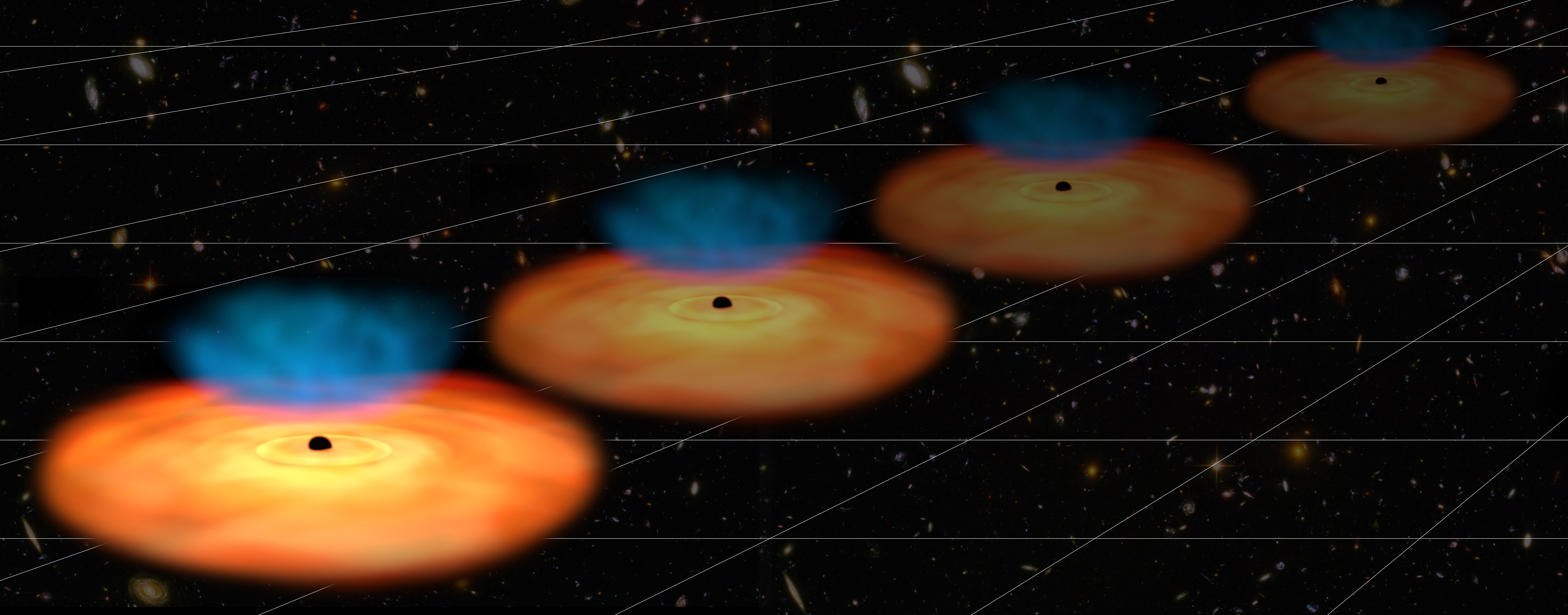
Active galaxies to measure cosmic expansion
Copyright ESA (artist's impression and composition); 
NASA/ESA/Hubble (background galaxies); CC BY-SA 3.0 IGO

Investigating the history of our cosmos with a large sample of distant ‘active’ galaxies observed by ESA’s XMM-Newton, a team of astronomers found there might be more to the early expansion of the Universe than predicted by the standard model of cosmology. 

According to the leading scenario, our Universe contains only a few percent of ordinary matter. One quarter of the cosmos is made of the elusive dark matter, which we can feel gravitationally but not observe, and the rest consists of the even more mysterious dark energy that is driving the current acceleration of the Universe’s expansion. 

This model is based on a multitude of data collected over the last couple of decades, from the cosmic microwave background, or CMB – the first light in the history of the cosmos, released only 380 000 years after the big bang and observed in unprecedented detail by ESA’s Planck mission – to more ‘local’ observations. The latter include supernova explosions, galaxy clusters and the gravitational distortion imprinted by dark matter on distant galaxies, and can be used to trace cosmic expansion in recent epochs of cosmic history – across the past nine billion years.  

A new study, led by Guido Risaliti of Università di Firenze, Italy, and Elisabeta Lusso of Durham University, UK, points to another type of cosmic tracer – quasars – that would fill part of the gap between these observations, measuring the expansion of the Universe up to 12 billion years ago.

Quasars are the cores of galaxies where an active supermassive black hole is pulling in matter from its surroundings at very intense rates, shining brightly across the electromagnetic spectrum. As material falls onto the black hole, it forms a swirling disc that radiates in visible and ultraviolet light; this light, in turn, heats up nearby electrons, generating X-rays. 

Supermassive black hole
Copyright ESA–C. Carreau

Three years ago, Guido and Elisabeta realised that a well-known relation between the ultraviolet and X-ray brightness of quasars could be used to estimate the distance to these sources – something that is notoriously tricky in astronomy – and, ultimately, to probe the expansion history of the Universe. 

Astronomical sources whose properties allow us to gauge their distances are referred to as ‘standard candles’.

The most notable class, known as ‘type-Ia’ supernova, consists of the spectacular demise of white dwarf stars after they have over-filled on material from a companion star, generating explosions of predictable brightness that allows astronomers to pinpoint the distance. Observations of these supernovas in the late 1990s revealed the Universe’s accelerated expansion over the last few billion years.

“Using quasars as standard candles has great potential, since we can observe them out to much greater distances from us than type-Ia supernovas, and so use them to probe much earlier epochs in the history of the cosmos,” explains Elisabeta.

With a sizeable sample of quasars at hand, the astronomers have now put their method into practice, and the results are intriguing.

XMM-Newton
Copyright ESA-C. Carreau

Digging into the XMM-Newton archive, they collected X-ray data for over 7000 quasars, combining them with ultraviolet observations from the ground-based Sloan Digital Sky Survey. They also used a new set of data, specially obtained with XMM-Newton in 2017 to look at very distant quasars, observing them as they were when the Universe was only about two billion years old. Finally, they complemented the data with a small number of even more distant quasars and with some relatively nearby ones, observed with NASA’s Chandra and Swift X-ray observatories, respectively.

“Such a large sample enabled us to scrutinise the relation between X-ray and ultraviolet emission of quasars in painstaking detail, which greatly refined our technique to estimate their distance,” says Guido.

The new XMM-Newton observations of distant quasars are so good that the team even identified two different groups: 70 percent of the sources shine brightly in low-energy X-rays, while the remaining 30 percent emit lower amounts of X-rays that are characterised by higher energies. For the further analysis, they only kept the earlier group of sources, in which the relation between X-ray and ultraviolet emission appears clearer.

“It is quite remarkable that we can discern such level of detail in sources so distant from us that their light has been travelling for more than ten billion years before reaching us,” says Norbert Schartel, XMM-Newton project scientist at ESA.

After skimming through the data and bringing the sample down to about 1600 quasars, the astronomers were left with the very best observations, leading to robust estimates of the distance to these sources that they could use to investigate the Universe’s expansion.


Supernova and quasar data
Investigating the expansion of the Universe with type-Ia supernovas and quasars
Copyright Courtesy of Elisabeta Lusso & Guido Risaliti (2019) Description 

“When we combine the quasar sample, which spans almost 12 billion years of cosmic history, with the more local sample of type-Ia supernovas, covering only the past eight billion years or so, we find similar results in the overlapping epochs,” says Elisabeta.

“However, in the earlier phases that we can only probe with quasars, we find a discrepancy between the observed evolution of the Universe and what we would predict based on the standard cosmological model.”

Looking into this previously poorly explored period of cosmic history with the help of quasars, the astronomers have revealed a possible tension in the standard model of cosmology, which might require the addition of extra parameters to reconcile the data with theory.

“One of the possible solutions would be to invoke an evolving dark energy, with a density that increases as time goes by,” says Guido.

Incidentally, this particular model would also alleviate another tension that has kept cosmologists busy lately, concerning the Hubble constant – the current rate of cosmic expansion. This discrepancy was found between estimates of the Hubble constant in the local Universe, based on supernova data – and, independently, on galaxy clusters – and those based on Planck’s observations of the cosmic microwave background in the early Universe.

“This model is quite interesting because it might solve two puzzles at once, but the jury is definitely not out yet and we’ll have to look at many more models in great detail before we can solve this cosmic conundrum,” adds Guido.

The team is looking forward to observing even more quasars in the future to further refine their results. Additional clues will also come from ESA’s Euclid mission, scheduled for a 2022 launch to explore the past ten billion years of cosmic expansion and investigate the nature of dark energy.

“These are interesting times to investigate the history of our Universe, and it’s exciting that XMM-Newton can contribute by looking at a cosmic epoch that had remained largely unexplored so far,” concludes Norbert.


Notes for Editors

“Cosmological constraints from the Hubble diagram of quasars at high redshifts” by G. Risaliti & E. Lusso is published in Nature Astronomy.


For further information, please contact:

Guido Risaliti
Università di Firenze
INAF – Osservatorio Astrofisico di Arcetri
Firenze, Italy
Email: risaliti@arcetri.inaf.it

Elisabeta Lusso
Centre for Extragalactic Astronomy
Durham University, UK
Email: elisabeta.lusso@durham.ac.uk

Norbert Schartel
XMM-Newton Project Scientist
European Space Agency
Email: norbert.schartel@sciops.esa.int

Markus Bauer


ESA Science Communication Officer


Tel: +31 71 565 6799


Mob: +31 61 594 3 954


Email: markus.bauer@esa.int