Showing posts with label black hole. Show all posts

Monday, September 28, 2026

A galaxy spinning out of sync

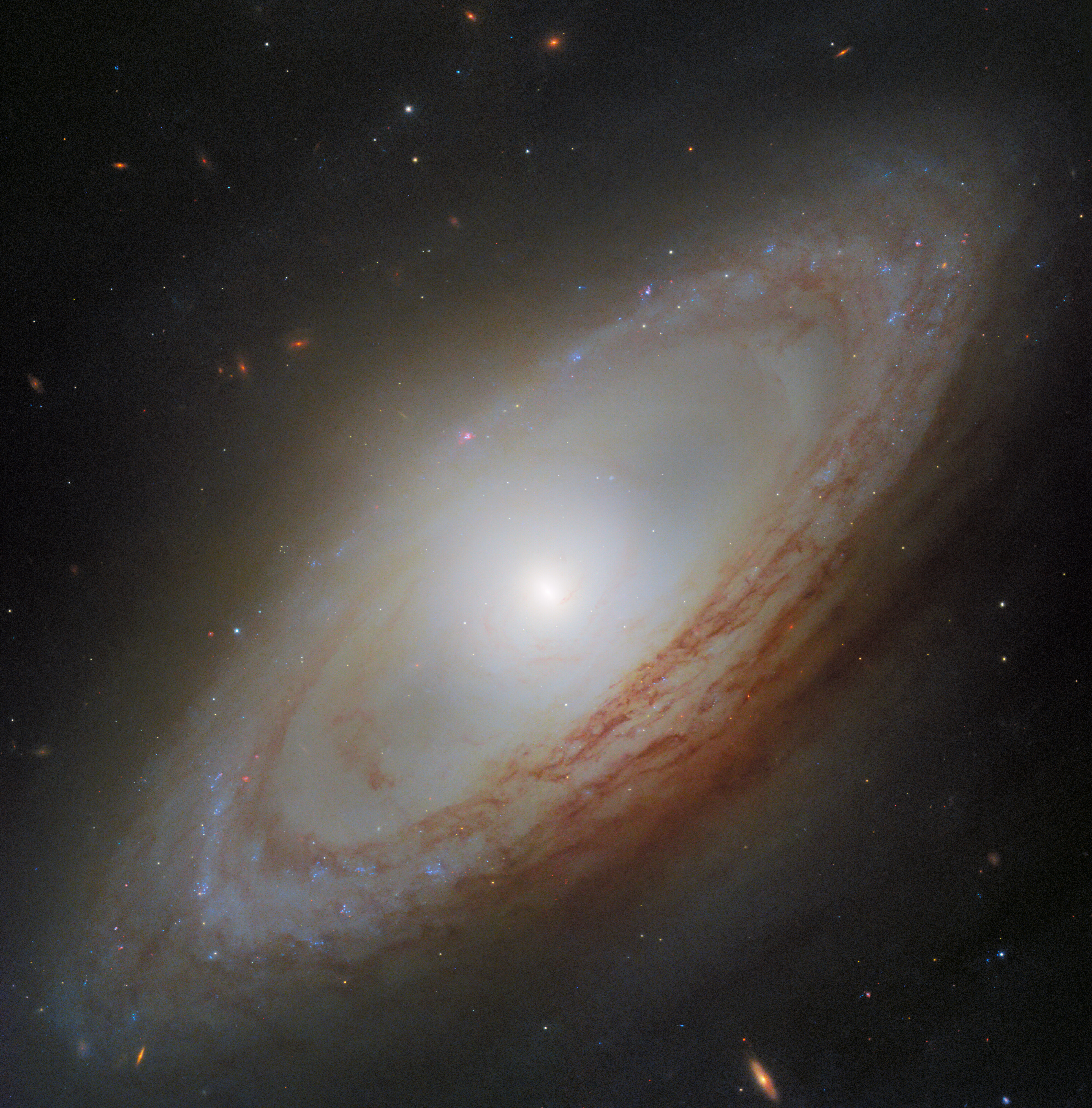
NGC 4698
Credit: ESA/Hubble & NASA, D. Thilker, the MAUVE-HST Team


A spiral galaxy viewed at an angle, with a bright central bulge and winding spiral arms. The arms form a ring around the galaxy, without appearing to reach its centre. Prominent red-brown dust lanes weave through the arms, which are also dotted with bright blue and reddish regions of star formation. The galaxy is set against a dark background scattered with s,b.t,brars and faint distant galaxies.

Though the spiral galaxy in this ESA/Hubble Picture of the Month seems serene, it hides a chaotic secret. This galaxy is NGC 4698, and it lies about 55 million light-years away in the constellation Virgo. It’s one of over one thousand galaxies in the Virgo Cluster, the nearest large cluster of galaxies bound together by gravity.

As a spiral galaxy similar to our own Milky Way galaxy, NGC 4698 has spiral arms that curl around within a thin disc of stars, gas and dust. These arms are marked by opaque clumps of brown dust and dotted with small collections of bright blue stars. Unlike many other spiral galaxies, like this one recently photographed by Hubble, NGC 4698’s delicate spiral arms are only prominent in the outer reaches of the disc; spiral arms often wind down to the very centre of a galaxy, but NGC 4698’s spiral arms appear to shy away from its glowing centre. The arms instead hover in a ring-like structure around the perimeter of the galaxy.

NGC 4698’s centre is dominated by a galactic bulge. The diffuse off-white glow of the galaxy’s bulge comes from stars smaller, older, and cooler than the massive blue stars that dot the galaxy’s outer disc. These tightly packed stars orbit a supermassive black hole containing millions of times the Sun’s mass. Scientists have found signs that this black hole is actively growing, drawing gas inward with its gravitational pull.

With a flat, starry disc and diffusely glowing centre, NGC 4698 looks a lot like a typical spiral galaxy — but this galaxy is far from normal. NGC 4698 is one of only a few known spiral galaxies with a bulge that extends out from the disc at a right angle. The elongation is faintly visible in this Hubble image, which shows the ghostly glow of the starry bulge peeking above and below the dusty disc. What’s more, the stars and gas nearest the galaxy’s centre rotate perpendicular to the rest of the disc!

What could cause a galaxy to be so out of sync? Astronomers have found that the culprit likely lies outside the galaxy. If NGC 4698 funneled in gas from an outside source, the newly collected gas could have formed a disc of gas and stars in the galaxy’s centre, at an angle relative to the rest of the disc. Some observations suggest that this galaxy once experienced a minor galactic merger, as evidenced by a short ‘tail’ of hydrogen streaming from one side of the galaxy.

The data used to create this image come from an observing programme (#18103; PI: Thilker) focusing on galaxies in the Virgo Cluster. This programme zooms in on the details of these relatively nearby galaxies, such as individual star clusters and nebulae. At the same time, researchers will use these data to take stock of the larger picture, learning how a galaxy’s journey through a cluster affects the galaxy’s evolution and ability to. form new stars.


More information

Webb is the largest, most powerful telescope ever launched into space. Under an international collaboration agreement, ESA provided the telescope’s launch service, using the Ariane 5 launch vehicle. Working with partners, ESA was responsible for the development and qualification of Ariane 5 adaptations for the Webb mission and for the procurement of the launch service by Arianespace. ESA also provided the workhorse spectrograph NIRSpec and 50% of the mid-infrared instrument MIRI, which was designed and built by a consortium of nationally funded European Institutes (The MIRI European Consortium) in partnership with JPL and the University of Arizona.

Webb is an international partnership between NASA, ESA and the Canadian Space Agency (CSA).


Links


Contacts:

Bethany Downer
ESA/Hubble/Webb Chief Science Communications Officer
Email:
Bethany.Downer@esahubble.org

ESA Newsroom and Media Relations Office
Email:
media@esa.int


Friday, February 13, 2026

Keck Observatory observations help constrain a long-predicted pathway for black hole formation

Birth of a black hole: These images and animation shows a shell of thick gas and dust (red) expelled from the outer layers of a star as its core collapsed into a black hole. The inner regions show a heated sphere of gas continuing to fall into the black hole that is hidden inside the hot gas. Credit: Keith Miller, Caltech/IPAC – SELab. Video


Maunakea, Hawaiʻi – Astronomers using W. M. Keck Observatory on Maunakea, Hawaiʻi Island contributed key observations to the identification of a rare stellar death in which a massive star appears to have collapsed directly into a black hole without first exploding as a supernova. The event occurred in the Andromeda galaxy and provides strong observational support for a long-theorized but rarely confirmed route to black hole formation.

The study, led by researchers at Columbia University, is published in today’s issue of the journal Science and combines archival space-based data with targeted ground-based follow-up observations from multiple observatories.

“This has probably been the most surprising discovery of my life,” said Kishalay De, professor of astronomy at Columbia University and lead author of the study. “The evidence of the disappearance of the star was lying in public archival data, and nobody noticed it for years until we picked it out.”

A quiet stellar death in Andromeda

The object, designated M31-2014-DS1, was a supergiant star located about 2.5 million light-years from Earth in the Andromeda galaxy. When it formed, the star was roughly 13 times the mass of the Sun. Over its lifetime, powerful stellar winds stripped away much of that mass, leaving it with about five times the mass of the Sun at the end of its life.

Archival observations from NASA’s NEOWISE mission revealed that the star gradually brightened in infrared light over several years before fading dramatically and disappearing from view. Unlike a typical supernova, the event showed no evidence of a powerful outward explosion. Instead, it left behind a shell of dust and a faint infrared glow.

“The dramatic and sustained fadig of this star is very unusual, and suggests a supernova failed to occur, leading to the collapse of the star’s core directly into a black hole,” De said.

Critical follow up from the ground

To better constrain the nature of the event, the team conducted follow-up observations using the Near-Infrared Echellette Spectrograph (NIRES) on the Keck II Telescope, with observing time awarded via the NASA-Keck partnership.

Prior to the Keck observations, there were no ground-based infrared spectra of the source at sufficient sensitivity to test whether the star had truly faded at infrared wavelengths.

NIRES is optimized for studying extremely faint infrared sources and isparticularly well suited to probing dusty stellar remnants. The data placed important limits on the temperature, composition, and evolution of the material left behind after the star disappeared, including faint emissio from material expelled by the star, helping rule out alternative explanations such as an unusual supernova or intrinsic stellar variability.

“It was only with Keck’s sensitivity in the near infrared that we could confirm the star had truly faded at all wavelengths,” De said. “Even with NIRES, the source was barely detected, which allowed us to rule out normal hints of stellar variability or dust obscuration and strengthened the case that the star had genuinely disappeared.”

The Keck observations were analyzed alongside data from space-based telescopes and other ground-based facilities as part of a coordinated, multi-wavelength campaign.

A Rare View into Direct Collapse

Astronomers have long known that black holes originate from massive stars, but direct observational evidence of that transformation has been scarce. While gravitational-wave detections have revealed black hole mergers across the universe, they do not show how those black holes initially formed.

Only one other candidate direct-collapse event has been reported previously, but it was significantly more distant and fainter, leaving its interpretation uncertain. The relative proximity of Andromeda and the quality of the available data make M31-2014-DS1 a particularly compelling case.

“We’ve known that black holes must come from stars,” said Morgan MacLeod, lecturer in astronomy at Harvard University and co-author of the study. “With events like this, we’re getting to watch it happen, and are learning a huge amount about how that process works along the way.”

Looking ahead

The findings suggest that direct collapse may be a more common outcome for massive stars than previously assumed. Future infrared surveys, combined with sensitive ground-based facilities like Keck Observatory, are expected to uncover additional examples and further clarify the physical conditions that determine how massive stars end their lives.


Related Links:


About NIRES

The Near-Infrared Echellette Spectrograph (NIRES) is a prism cross-dispersed near-infrared spectrograph built at the California Institute of Technology by a team led by Chief Instrument Scientist Keith Matthews and Prof. Tom Soifer. Commissioned in 2018, NIRES covers a large wavelength range at moderate spectral resolution for use on the Keck II telescope and observes extremely faint red objects found with the Spitzer and WISE infrared space telescopes, as well as brown dwarfs, high-redshift galaxies, and quasars. Support for this technology was generously provided by the Mt. Cuba Astronomical Foundation.

About W.M. Keck Observatory

The W. M. Keck Observatory telescopes are among the most scientifically productive on Earth. The two 10-meter optical/infrared telescopes atop Maunakea on the Island of Hawaiʻi feature a suite of advanced instruments including imagers, multi-object spectrographs, high-resolution spectrographs, integral-field spectrometers, and world-leading laser guide star adaptive optics systems. Some of the data presented herein were obtained at Keck Observatory, which is a private 501(c) 3 non-profit organization operated as a scientific partnership among the California Institute of Technology, the University of California, and the National Aeronautics and Space Administration. The Observatory was made possible by the generous financial support of the W. M. Keck Foundation. The authors wish to recognize and acknowledge the very significant cultural role and reverence that the summit of Maunakea has always had within the Native Hawaiian community. We are most fortunate to have the opportunity to conduct observations from this mountain. For more information, visit: www.keckobservatory.org

Saturday, November 01, 2025

LIGO-Virgo-KAGRA observe unlike twin signals

Artist’s impression of two coalescing black holes.
Image: Carl Knox, OzGrav, Swinburne University of Technology


To the point:

  • Unusual signals: Two exceptional gravitational-wave events from pairs of coalescing black holes stand out among the many other signal candidates observed by the LIGO-Virgo-KAGRA collaboration in fall 2024. While the two events, published in The Astrophysical Journal Letters today, have many similarities, they also exhibit notable differences.

  • Origin story: The unique blend of signal characteristics allowed the international research team to decipher a possible origin story of these unlike twins from earlier black hole coalescences.

  • Useful gravitational waves: Additionally, the signals enable rigorous tests of Einstein’s theory of relativity and a search for new, yet unknown elementary particles.


Unusual signals

Many binary black holes once were binary star systems. There, two stars, each more massive than our Sun, orbited each other, one after the other exploded as a supernova, and collapsed into black holes. This origin story would usually produce slowly rotating black holes with their equators aligned with the binary system’s orbital plane.

“These two new signals come from coalescing binary black holes unlike the ones we normally expect to find and the ones we’ve observed so far,” says Alessandra Buonanno, director at the Max Planck Institute for Gravitational Physics (Albert Einstein Institute; AEI) in Potsdam. “Both contain black holes that spin extremely fast around unusually oriented axes, suggesting a new black hole population.”

Since both pairs consist of two unequally massive black holes, the researchers could determine how fast each heavier black hole was spinning and in which direction its rotation axis was pointing. These new results were achieved using advanced waveform models, including three developed at AEI. These are mathematical recipes to calculate the gravitational waves emitted from a binary. The advanced models assume circular orbits, but can handle generic orientations of the black holes’ rotation axes.


Observing a nearby black hole coalescence and its unlike twin

The first of the twin signals, GW241011, was observed on 11 October 2024 by the LIGO detector in Hanford and the Virgo detector. The LIGO Livingston detector was undergoing temporary maintenance and not taking scientific measurement data at the time.

The binary black hole coalescence that caused the gravitational-wave signal occurred at a relatively close distance. At just about 700 million light-years away, it is likely the closest such event ever observed. Because it happened nearby, it was detected very clearly. Only two other signals observed to date are “louder”: the recently published GW230814 and GW250114.

The clearly observed gravitational waves encode information about the individual black holes. LVK data analysis revealed that the larger black hole weighs about 20 times as much as our Sun, while the smaller black hole weighs about 6 times as much as the Sun. This unequal mass distribution is what makes the pair special, as most binaries comprise nearly equal-mass black holes.

The second event, GW241110, was detected by both LIGO instruments and Virgo on 10 November 2024, almost exactly one month after the first event. It originated from a black hole coalescence three times farther away than the October signal. Coming from a distance of about 2.4 billion light-years, the signal was not quite as clear. However, its source is a similar pair of black holes with unequal masses of 17 and 8 times that of the Sun, respectively.

The unlike twins

“At first sight, these two pairs of black holes almost look like two peas in a pod. But a closer look reveals some striking differences, for example in how they spin,” says Frank Ohme, leader of an independent Max Planck research group at the AEI in Hannover.

In the pair of black holes that emitted GW241011, the LVK team found that the heavier black hole was one of fastest-rotating black holes observed to date, spinning at least at nearly 70% of the maximum possible value. What’s more, it spun around an axis tilted 20 to 40 degrees away from the axis around which the two black holes orbit.

“In other words, the equator of the heavier black hole in the binary system that produced GW241011 did not lie in the same plane as the orbit of the two black holes,” says Karsten Danzmann, director at the AEI in Hannover. “This is similar to the tilt of Earth’s or Mars’ rotational axis as they orbit the Sun, but somewhat unexpected for a black hole.”

The heavier black hole in the binary system that caused GW241110 is, once again, quite different. Its spin axis was tilted at least 90 degrees, and possibly up to 180 degrees, away from the axis around which the two black holes orbited. This means its spin axis lay in the binary system’s orbital plane, or even pointed downward. This is similar to the rotation axes of the planets Uranus and Venus, respectively, in our solar system.

Infographic about the two gravitational-wave events GW241011 and GW241110.
Credit: Shanika Galaudage / Northwestern University / Adler Planetarium

How did the unusual binaries form?

If the binary had formed from a binary star system, the black holes should slowly spinning and their equators should be aligned with the binary’s orbital plane. Although there are several known mechanisms that could tilt the rotation axes of black holes right before or after they form, all of them fail to explain why these black holes spin so rapidly.

A natural explanation for both the rapid rotation and the tilted rotation axes of the heavier black holes is that they are the result of an earlier coalescence of less massive black holes. These second-generation black holes are expected to rotate more rapidly than their first-generation counterparts. Additionally, since they were not formed in the same binary star system, their rotation axes can point in any direction. Finally, second-generation black holes should, of course, be heavier. The more massive black holes in the coalescences observed as GW241011 and GW241110 fulfill all three criteria and may have formed this way. These earlier collisions likely took place in crowded stellar environments, such as dense star clusters. There, the second-generation black holes could well encounter another black hole to orbit and coalesce with later in their existence, causing the gravitational-wave signals observed now.

An additional clue about the binary’s origin story can come from the shape of its orbit. “Black hole pairs that found each other later in their existence can have slightly more elliptical orbits than those formed from the same binary star,” explains Lorenzo Pompili, a former PhD student at the AEI in Potsdam, who analyzed the signals with the elliptic waveform model. “We’ve looked closely for, but did not find any sign of elliptical orbits.”

Researchers at the AEI in Potsdam have developed an accurate and efficient waveform model for binaries with elliptical orbits. “We have now used our new model to analyze GW241011 and GW241110,” says Aldo Javier Gamboa Castillo, a PhD student at AEI Potsdam, who developed the elliptic waveform model. “Having such waveform models is crucial because neglecting the shape of a binary orbit can result in systematic errors, and including it can help in identifying the binary origin.”

Probing the nature of black holes

Because GW241011 was detected so clearly, it can be compared to predictions from Einstein’s theory of general relativity and Roy Kerr’s solution for rotating black holes. The black hole’s rapid rotation slightly deforms it, leaving a characteristic fingerprint in the gravitational waves it emits. By analyzing GW241011, the LVK team found excellent agreement with Kerr’s solution and verified Einstein’s prediction with unprecedented accuracy. “GW241011 is the first gravitational-wave signal in which we’ve been able to confirm that black holes deform when they rotate rapidly,” says Elise Sänger, a PhD student at the AEI in Potsdam, who carried out the test of the Kerr solution. “We’ve observed the deformation of the heavier black hole due to its rotation with superb clarity and used it to carry out rigorous tests of the nature of black holes.”

Because the masses of the individual black holes differ significantly, the gravitational-wave signal contains the “hum” of higher harmonics – similar to the overtones of musical instruments, seen only for the third time ever in GW241011. One of these harmonics was observed with superb clarity and confirms a prediction from Einstein’s theory of general relativity. Searching for unknown elementary particles

Rapidly rotating black holes like the ones observed now have yet another application – in particle physics: Scientists can use them to test whether certain yet unknown light-weight elementary particles exist and how massive they are. These particles, called ultralight bosons, are predicted by some theories that go beyond the Standard Model of particle physics, which describes and classifies all known elementary particles. If ultralight bosons exist, they can extract rotational energy from black holes. How much energy is extracted and how much the rotation of the black holes slows down over time, depends on the mass of these particles, which is still unknown. The observation that the massive black hole in the binary system that emitted GW241011 continues to rotate rapidly even millions or billions of years after it formed rule out a wide range of ultralight boson masses.

It is currently unclear whether the unlike twins GW241011 and GW241110 are common members of our Universe’s black hole population or if they are the first specimens of a new subgroup of black holes. Only the first part of the LVK’s fourth joint observing run has been fully analyzed and published thus far. There may be more surprises to come.

The LIGO-Virgo-KAGRA Collaboration

LIGO is funded by the NSF, and operated by Caltech and MIT, which conceived and built the project. Financial support for the Advanced LIGO project was led by NSF with Germany (Max Planck Society), the U.K. (Science and Technology Facilities Council) and Australia (Australian Research Council) making significant commitments and contributions to the project. More than 1,600 scientists from around the world participate in the effort through the LIGO Scientific Collaboration, which includes the GEO Collaboration. Additional member institutions are listed at https://my.ligo.org/census.php.

The Virgo Collaboration is currently composed of approximately 880 members from 152 institutions in 17 different (mainly European) countries. The European Gravitational Observatory (EGO) hosts the Virgo detector near Pisa in Italy, and is funded by Centre National de la Recherche Scientifique (CNRS) in France, the Istituto Nazionale di Fisica Nucleare (INFN) in Italy, and the National Institute for Subatomic Physics (Nikhef) in the Netherlands. More information is available on the Virgo website at https://www.virgo-gw.eu.

KAGRA is the laser interferometer with a 3 km arm-length in Kamioka, Gifu, Japan. The host institute is Institute for Cosmic Ray Research (ICRR), the University of Tokyo, and the project is co-hosted by National Astronomical Observatory of Japan (NAOJ) and High Energy Accelerator Research Organization (KEK). KAGRA collaboration is composed of over 400 members from 128 institutes in 17 countries/regions. KAGRA’s information for general audiences is available at https://gwcenter.icrr.u-tokyo.ac.jp/en/. Resources for researchers are accessible from http://gwwiki.icrr.u-tokyo.ac.jp/JGWwiki/KAGRA.


Media contacts:

Dr. Benjamin Knispel
Press Officer AEI Hannover
Tel:
+49 511 762-19104
benjamin.knispel@aei.mpg.de

Dr. Elke Müller
Press Officer AEI Potsdam, Scientific Coordinator
Tel:
+49 331 567-7303
elke.mueller@aei.mpg.de

Science contacts

Prof. Dr. Alessandra Buonanno
Director | LSC Principal Investigator
Tel:
+49 331 567-7220
Fax: +49 331 567-7298
alessandra.buonanno@aei.mpg.de

Homepage of Alessandra Buonanno

Prof. Dr. Karsten Danzmann
Director | LSC Principal Investigator
Tel:
+49 511 762-2356
Fax: +49 511 762-5861
karsten.danzmann@aei.mpg.de
Homepage of Karsten Danzmann

Dr. Frank Ohme
Research Group Leader | LSC Principal Investigator
Tel:
+49 511 762-17171
Fax: +49 511 762-2784
frank.ohme@aei.mpg.de
Homepage of Frank Ohme

Dr. Lorenzo Pompili
Research Fellow
Lorenzo.Pompili@nottingham.ac.uk
University of Nottingham, School of Mathematical Sciences

Aldo Javier Gamboa Castillo
PhD Student
Tel:
+49 331 567-7248
aldo.gamboa@aei.mpg.de

Elise Sänger
PhD Student
elise.saenger@aei.mpg.de

Publication

The LIGO Scientific Collaboration; the Virgo Collaboration; the KAGRA Collaboration
GW241011 and GW241110: Exploring Binary Formation and Fundamental Physics with Asymmetric, High-spin Black Hole Coalescences
ApJL 993 L21 (2025)

Source | DOI


Wednesday, October 15, 2025

Black holes don’t suck, they get fed!

Circinus Galaxy
Credit: ALMA(ESO/NAOJ/NRAO)/ESO/W. Goesaert et al.

Today’s Picture of the Week gives us a closer look at how black holes in the centre of galaxies feast. As some of you already know, the common belief that black holes simply suck in anything that comes near them, is wrong. Material can only fall into a black hole when it’s slowed down somehow — so what's pumping the brakes?

To answer this question, a team of astronomers led by Wout Goesaert, now a PhD candidate at Leiden University, the Netherlands, mapped how molecular gas is distributed in the Circinus galaxy, about 13 million light-years away. The galaxy is shown in the top left corner in visible light. The two insets are images taken with the Atacama Large Millimeter/submillimeter Array (ALMA), in which ESO is a partner. Gas is streaming towards the black hole through two spiral arms that are embedded in the disc, seen in the innermost regions of the top-right picture. These arms feed the doughnut-shaped cloud around the black hole seen at the bottom.

The gravitational influence of the spiral arms perturbs the motion of the molecular gas, which falls right into the monster's mouth, the same way a satellite would fall onto Earth if its orbit was disturbed. The feeding process is very inefficient though: the team found that about 90% of the material does not end up in the black hole but is rather spat back out, like a massive toddler refusing to eat.

Links

Source: ESO/potw


Monday, July 14, 2025

Event Horizon Telescope reveals why M87’s black hole ring is not a perfect circle

This figure compares simulated (left) and observed (right) images of the black hole M87*. In simulations, the actual shadow of a spinning black hole (outlined in blue) appears less than 2% squished due to gravity alone. However, with the current resolution of the EHT, due to turbulent plasma near the black hole the ring can appear 2–20% distorted. The EHT observations (right) reveal the ring is squished by about 8%, with its major axis tilted 50° counterclockwise from north, roughly aligned with the brightest spot. This suggests the observed ellipticity is driven NOT by gravity or spin, but by turbulent matter swirling around the black hole. Credit: Rohan Dahale (IAA-CSIC), Ilje Cho (KASI/Yonsei University


Study co-led by the Instituto de Astrofísica de Andalucía (IAA-CSIC) reveals that the ellipticity of the M87* ring is due to plasma turbulence and not due to its spin.

The results, published in Astronomy & Astrophysics, bring the scientific community closer to isolating the gravitational signature of a black hole and directly measuring its spin.

The galaxy M87, located about 55 million light-years from Earth, hosts at its core the supermassive black hole M87*, whose image whose image went viral around the globe in 2019 thanks to the Event Horizon Telescope (EHT). That historic photograph revealed a luminous ring around M87* with a slightly elongated shape that raised many questions: why is it not perfectly circular? Today, the journal Astronomy & Astrophysics (A&A) publishes a study co-led by the Instituto de Astrofísica de Andalucía (IAA-CSIC) that sheds light on the issue.

“We have demonstrated that the slightly elongated shape of the ring is not caused by gravity or by the black hole’s spin, but by turbulent astrophysical processes in the surrounding plasma,” explains Rohan Dahale, researcher at the IAA-CSIC and co-lead author of the study.

Einstein’s general theory of relativity predicts that the “shadow” of a spinning black hole is slightly flattened, adopting an elliptical shape due to the distortion of spacetime caused by its spin. Quantifying this ellipticity provides a direct path to estimating the black hole’s spin—one of the two parameters, along with mass, that fully define its appearance and physical properties.

Beyond a perfect circle: What the shape of M87*reveals

To refine this measurement, the scientific team added the Greenland Telescope to the EHT network in 2018, increasing both the spatial resolution and the sensitivity of the collaboration, which tripled compared to previous campaigns. Using five independent image reconstruction algorithms based on aperture synthesis techniques, they consistently found that the ring deviates from a perfect circle by about 8%. They also discovered that the ellipse is tilted roughly 50° counterclockwise from North, roughly aligned with the brightest point on the ring.

To determine whether gravity alone could explain the elongated shape, the team compared the real images with a series of computer simulations exploring different physical scenarios, including various spin values for the black hole. Surprisingly, they found no clear relationship between spin and the elliptical shape in the simulated images. Instead, they discovered that the elongation of the ring was associated with what they call “non-ring emission”: a diffuse glow surrounding the main ring, more intense in models with very energetic electrons and a brighter jet.

“These results suggest that the ellipticity of M87* is mainly a footprint of the turbulent plasma swirling around the black hole, rather than a direct reflection of its gravitational strength or spin,” says Ilje Cho (KASI/Yonsei University), co-lead author of the study. “This allows us to better disentangle the role of gravity from that of astrophysical processes in shaping these remarkable images and brings us a step closer to understanding how matter behaves in the most extreme environments in the universe.”

Although measuring the spin of M87* in the presence of such turbulence remains a major challenge, the team proposes moving forward through two complementary approaches: first, by conducting sustained observations over the years to smooth out short-term fluctuations and reveal the subtle gravitational distortions currently obscured; second, by launching space-based telescopes that, through very long baseline interferometry (VLBI), would be capable of directly resolving the “photon ring”—the thin light shell orbiting the black hole that carries a purer gravitational signal, ideal for measuring spin.

“With the upgrades in the next-generation EHT (ngEHT) and space missions, we are getting closer to isolating the true gravitational signature of a black hole,” explains Rohan Dahale (IAA-CSIC). “And thus, the information contained in the images themselves will allow us to directly measure spin,” he concludes.

TCredit: Rohan Dahale (IAA-CSIC), Ilje Cho (KASI/Yonsei University)


About theEvent Horizon Telescope

The Event Horizon Telescope (EHT) is an international collaboration that has created a virtual Earth-sized telescope by computationally linking radio observatories around the globe. It is designed to image black holes and test fundamental physics in extreme gravitational environments.


Reference:

Origin of the ring ellipticity in the black hole images of M87*

https://www.aanda.org/10.1051/0004-6361/202555235

More info:

Rohan Dahale (Instituto de Astrofísica de Andalucía) -
rdahale@iaa.es
Dr. Ilje Cho (Korea Astronomy and Space Science Institute (KASI) / Yonsei University) - icho@kasi.re.kr

Contact:

Instituto de Astrofísica de Andalucía (IAA-CSIC)
Unidad de Divulgación y Comunicación
Amanda López –
alm@iaa.es
Emilio García – garcia@iaa.es - 649 407 445 (vía whatssap)
Celia Navas - navas@iaa.es
https://www.iaa.csic.es
https://divulgacion.iaa.csic.es


Monday, June 09, 2025

NASA’s Chandra Sees Surprisingly Strong Black Hole Jet at Cosmic “Noon”

A black hole has blasted out a surprisingly powerful jet in the distant universe, according to a study from NASA’s Chandra X-ray Observatory. X-ray: NASA/CXC/CfA/J. Maithil et al.; Illustration: NASA/CXC/SAO/M. Weiss; Image Processing: NASA/CXC/SAO/N. Wolk


black hole has blasted out a surprisingly powerful jet in the distant universe, according to a new study from NASA’s Chandra X-ray Observatory. This jet exists early enough in the cosmos that it is being illuminated by the leftover glow from the big bang itself.

Astronomers used Chandra and the Karl G. Jansky Very Large Array (VLA) to study this black hole and its jet at a period they call “cosmic noon,” which occurred about three billion years after the universe began. During this time most galaxies and supermassive black holes were growing faster than at any other time during the history of the universe.

The main graphic is an artist’s illustration showing material in a disk that is falling towards a supermassive black hole. A jet is blasting away from the black hole towards the upper right, as Chandra detected in the new study. The black hole is located 11.6 billion light-years from Earth when the cosmic microwave background (CMB), the leftover glow from the big bang, was much denser than it is now. As the electrons in the jets fly away from the black hole, they move through the sea of CMB radiation and collide with microwave photons. These collisions boost the energy of the photons up into the X-ray band (purple and white), allowing them to be detected by Chandra even at this great distance, which is shown in the inset.

Researchers, in fact, identified and then confirmed the existence of two different black holes with jets over 300,000 light-years long. The two black holes are 11.6 billion and 11.7 billion light-years away from Earth, respectively. Particles in one jet are moving at between 95% and 99% of the speed of light (called J1405+0415) and in the other at between 92% and 98% of the speed of light (J1610+1811). The jet from J1610+1811 is remarkably powerful, carrying roughly half as much energy as the intense light from hot gas orbiting the black hole.

The team was able to detect these jets despite their great distances and small separation from the bright, growing supermassive black holes — known as “quasars” — because of Chandra’s sharp X-ray vision, and because the CMB was much denser then than it is now, enhancing the energy boost described above.

When quasar jets approach the speed of light, Einstein’s theory of special relativity creates a dramatic brightening effect. Jets aimed toward Earth appear much brighter than those pointed away. The same brightness astronomers observe can come from vastly different combinations of speed and viewing angle. A jet racing at near-light speed but angled away from us can appear just as bright as a slower jet pointed directly at Earth.

The researchers developed a novel statistical method that finally cracked this challenge of separating effects of speed and of viewing angle. Their approach recognizes a fundamental bias: astronomers are more likely to discover jets pointed toward Earth simply because relativistic effects make them appear brightest. They incorporated this bias using a modified probability distribution, which accounts for how jets oriented at different angles are detected in surveys. Their method works by first using the physics of how jet particles scatter the CMB to determine the relationship between jet speed and viewing angle. Then, instead of assuming all angles are equally likely, they apply the relativistic selection effect: jets beamed toward us (smaller angles) are overrepresented in our catalogs. By running ten thousand simulations that match this biased distribution to their physical model, they could finally determine the most probable viewing angles: about 9 degrees for J1405+0415 and 11 degrees for J1610+1811.

These results were presented by Jaya Maithil (Center for Astrophysics | Harvard & Smithsonian) at the 246th meeting of the American Astronomical Society in Anchorage, AK, and are also being published in The Astrophysical Journal. A preprint is available here. NASA’s Marshall Space Flight Center in Huntsville, Alabama, manages the Chandra program. The Smithsonian Astrophysical Observatory’s Chandra X-ray Center controls science operations from Cambridge, Massachusetts, and flight operations from Burlington, Massachusetts.


Visual Description

This release is supported by an artist’s illustration of a jet blasting away from a supermassive black hole.

The black hole sits near the center of the illustration. It resembles a black marble with a fine yellow outline. Surrounding the black hole is a swirling disk, resembling a dinner plate tilted to face our upper right. This disk comprises concentric rings of fiery swirls, dark orange near the outer edge, and bright yellow near the core.

Shooting out of the black hole are two streaky beams of silver and pale violet. One bright beam shoots up toward our upper right, and a second somewhat dimmer beam shoots in the opposite direction, down toward our lower left. These beams are encircled by long, fine, corkscrewing lines that resemble stretched springs.

This black hole is located 11.6 billion light-years from Earth, much earlier in the history of the universe. Near this black hole, the leftover glow from the big bang, known as the cosmic microwave background or CMB, is much denser than it is now. As the electrons in the jets blast away from the black hole, they move through the sea of CMB radiation. The electrons boost the energies of the CMB light into the X-ray band, allowing the jets to be detected by Chandra, even at this great distance.

Inset at our upper righthand corner is an X-ray image depicting this interaction. Here, a bright white circle is ringed with a band of glowing purple energy. The jet is the faint purple line shooting off that ring, aimed toward our upper right, with a blob of purple energy at its tip
.


News Media Contact

Megan Watzke
Chandra X-ray Center
Cambridge, Mass.
617-496-7998

mwatzke@cfa.harvard.edu

Lane Figueroa
Marshall Space Flight Center, Huntsville, Alabama
256-544-0034

lane.e.figueroa@nasa.gov


Saturday, February 01, 2025

NSF VLA Contributes Crucial Puzzle Piece to ‘Peculiar’ High Energy Transient

Illustration of a tidal disruption event
Credit: ESA/C. Carreau

Hi-Res File

An artist's concept of the Einstein probe
Credit: NSF/AUI/NSF NRAO/J.Hellerman

Hi-Res File


Non-detection at radio wavelengths may prove to be the critical clue toward categorizing EP240408a as an entirely new phenomenon

High-energy transient signals are most often determined to be gamma-ray burst events, but the recently-launched Einstein Probe has expanded astronomers’ ability to quickly respond to similar signals occurring at X-ray wavelengths. Now, a multi-wavelength study of EP240408a concludes that while many of the signal’s characteristics might lead to the conclusion that it is a gamma-ray burst, the non-detection at radio wavelengths precludes that possibility. Instead, the international team of astronomers suggest that EP240408a is either a rare jetted tidal disruption event or, perhaps, an entirely new type of astronomical phenomenon. This was discovered in only the first two months of the commissioning phase.

Tidal disruption events (TDEs) occur when a star is shredded by a nearby black hole; these events are themselves rare, with fewer than 100 discovered so far. In even more rare cases, the black hole’s powerful tidal forces propel some of the shredded stellar material outward in high-velocity jets, which then interact with nearby clouds of dust and gas and shine brightly in X-ray and radio. Thus far, only four TDEs are known to have relativistic-velocity jets associated with them

An international team of astronomers led by Brendan O’Connor, an astronomer at Carnegie Mellon University, analyzed the signal from EP240408a across the span of wavelengths from radio to X-ray and concluded that this X-ray transient is—thus far—unique. “It ticks the boxes for a bunch of different kinds of phenomena, but it doesn’t tick all of the boxes for anything,” O’Connor summarizes. “And I think the radio non-detection is a massive box that we don’t know how to not tick.”

The team’s expansive follow-up campaign further characterized the X-ray emissions from EP240408a and identified a potential host galaxy in optical wavelengths. Crucially, however, O’Connor notes the non-detection in radio wavelengths as potentially the deciding factor in fully categorizing the source. Observations from the U.S. National Science Foundation Very Large Array (NSF VLA), operated by the U.S. National Science Foundation National Radio Astronomy Observatory (NSF NRAO), at 11 days, 158 days, and 258 days after EP240408a’s initial discovery indicated no radio emission from the source.

“I think where radio really fits in is that when we see something this bright, for this long, in X-rays, it usually has an extremely luminous radio counterpart. And here we see nothing, which is extremely peculiar,” O’Connor says.

After methodically eliminating a number of potential explanations including active galactic nuclei, fast blue optical transients, fast X-ray transients, and other variations of previously-characterized phenomena, O’Connor and his co-authors conclude that EP240408a is extragalactic in origin and is most likely a relativistically-jetted Tidal Disruption Event.

“Because of this new wide field view of the X-ray universe, there’s a diverse range of phenomena we can see that weren’t possible before. And it looks like this transient, EP 240408a, is new. It’s something that we don’t think we’ve seen before,” O’Connor says. “It’s falling in a range of energy, of wavelengths, that it can be detected at, and the time scales are so short, that it’s probably something that we’ve just missed before now.”

O’Connor emphasizes that the current lack of radio emissions is pivotal, but that follow-up observations in radio wavelengths will hopefully yield future detections as the material within the jets slows down to energies corresponding to radio—a process expected to occur on timescales of roughly 1000 days. Thus, follow-up radio observations with the NRAO VLA will be imperative.

Thus, EP240408a appears to be giving astronomers an in-between glimpse of a high-energy transient’s signal after its initial X-ray outburst but before its relativistic-speed jet flares in radio. “It seems to me that this is the most likely explanation for why we aren’t seeing radio emission. Hopefully, eventually, we will see a jet at radio wavelengths, either with the current setup of the VLA or the Next Generation VLA, and we can monitor it for years to come in order to learn even more about this explosion,” O’Connor muses;

“These results highlight the importance of multiwavelength observations in fully understanding the astronomical object,” says Joe Pesce, NSF Program Director for the NRAO. “The complete picture of what’s really happening requires a holistic study.”

An international team of astronomers were involved in the study, including Dheeraj Pasham at MIT, Igor Andreoni at the University of North Carolina Chapel Hill, Jeremy Hare at the Catholic University of America, Paz Beniamini at the Open University of Israel, and Eleonora Troja at the University of Rome Tor Vergata, among others. You can read the full scientific paper here.

The National Radio Astronomy Observatory (NRAO) is a facility of the U.S. National Science Foundation, operated under cooperative agreement by Associated Universities, Inc.


Thursday, January 30, 2025

Extreme Variability at the Edge of the Universe

An artist’s illustration of a close-up view of a black hole and its jet, like the one in CFHQS J1429+5447. Image credit: NASA/CXC/M. Weiss (CXC).
Download Image

Black holes are the most powerful and scary monsters in our universe, lurking at the centers of galaxies. Some, such as the black hole at the center of our own Milky Way Galaxy, have already finished their cosmic meals, with just occasional nibbles observed today. Others, however, are seen ravenously devouring delicious matter from their surroundings. At such times, black holes are noisy eaters, dominating all the activity in their host galaxy centers. As matter spirals in towards the bottomless maw, it collides, heats up, and becomes very bright from X-ray to infrared energies. The accretion disk around a supermassive black hole can easily outshine the billions of stars in a galaxy, and that incredible brightness can make them some of the most distant objects we can observe in both space and time. Black holes can also be messy eaters, spewing out material in cosmic jets that can reach thousands and even millions of light years from the black hole—material that can then go on to influence the universe around it.

Of the many mysteries that keep astronomers up all night observing and pondering these enigmatic beasts, one of the most perplexing is how black holes grow to such enormous sizes. We see supermassive black holes with masses hundreds of millions of times that of the Sun, observed when the universe was only a few hundred million years old. It’s like finding 7-foot basketball players or 300-pound football players with appetites to match in a Kindergarten classroom: just how were they able to grow so big so quickly?

Recent observations by NASA’s NuSTAR and Chandra X-ray observatories might offer some clues. In a paper recently published by the Astrophysical Journal, scientists led by Lea Marcotulli at Yale University and Thomas Connor at the Center for Astrophysics | Harvard & Smithsonian report on observations of the most X-ray luminous accreting black hole, or quasar, ever discovered in the first billion years of the universe. This quasar, called CFHQS J1429+5447, was initially found 15 years ago using data from a ground-based telescope that surveyed wide patches of the sky. Far more recently it was observed by Chandra, which was able to pick up X-rays from this incredibly distant source. Only four months afterwards, NuSTAR also observed it, finding that the quasar had doubled in X-ray brightness in that time.

Such a dramatic variation in such a short time for something this massive is evidence towards this quasar being a particularly messy eater, expelling a powerful jet of material at close to the speed of light. This jet is pointed straight at Earth—a chance alignment that boosts the amount of light making its way to us, allowing telescopes in Earth's orbit like NuSTAR and Chandra to see it at such a great distance.

"These results have significant implications for supermassive black holes and jet evolution theories," said Marcotulli. "The presence of a jet may be a necessity to grow such extreme black holes so early in the Universe."

Because the light observed from this quasar was emitted when the Universe was still very young, this lets us see into an era soon after the Big Bang called the Epoch of Reionization. This time period was when light began to be able to pass through the Universe unimpeded, which is what allows us to see stars and galaxies and distant quasars today. Exactly what kind of objects helped to clear the way for light to travel through space is a mystery that astronomers are still seeking to unravel, but the discovery of a cosmic jet like this one suggests that the Universe's biggest, messiest eaters might have been involved.


Friday, January 17, 2025

Webb Watches Carbon-Rich Dust Shells Form, Expand in Star System

Compare Observations of Wolf-Rayet 140 (MIRI Images)
Credits/Image: NASA, ESA, CSA, STScI
Science: Emma Lieb (University of Denver), Ryan Lau (NSF's NOIRLab), Jennifer Hoffman (University of Denver)


Wolf-Rayet 140 (MIRI Compass Image)
Credits/Image: NASA, ESA, CSA, STScI
Science: Emma Lieb (University of Denver), Ryan Lau (NSF's NOIRLab), Jennifer Hoffman (University of Denver)


Fade Between 2022 and 2023 Observations of Wolf-Rayet 140
Credits/Video: NASA, ESA, CSA, STScI, Joseph DePasquale (STScI)
Science: Emma Lieb (University of Denver), Ryan Lau (NSF's NOIRLab), Jennifer Hoffman (University of Denver)


Stars’ Orbits in Wolf-Rayet 140 (Visualization)
Credits/Animation: NASA, ESA, CSA, Joseph Olmsted (STScI)


Astronomers have long tried to track down how elements like carbon, which is essential for life, become widely distributed across the universe. Now, NASA’s James Webb Space Telescope has examined one ongoing source of carbon-rich dust in our own Milky Way galaxy in greater detail: Wolf-Rayet 140, a system of two massive stars that follow a tight, elongated orbit.
As they swing past one another (within the central white dot in the Webb images), the stellar winds from each star slam together, the material compresses, and carbon-rich dust forms. Webb’s latest observations show 17 dust shells shining in mid-infrared light that are expanding at regular intervals into the surrounding space.

“The telescope not only confirmed that these dust shells are real, its data also showed that the dust shells are moving outward at consistent velocities, revealing visible changes over incredibly short periods of time,” said Emma Lieb, the lead author of the new paper and a doctoral student at the University of Denver in Colorado.

Every shell is racing away from the stars at more than 1,600 miles per second (2,600 kilometers per second), almost 1% the speed of light. “We are used to thinking about events in space taking place slowly, over millions or billions of years,” added Jennifer Hoffman, a co-author and a professor at the University of Denver. “In this system, the observatory is showing that the dust shells are expanding from one year to the next.”

Like clockwork, the stars’ winds generate dust for several months every eight years, as the pair make their closest approach during a wide, elongated orbit. Webb also shows how dust formation varies — look for the darker region at top left in both images.

The telescope’s mid-infrared images detected shells that have persisted for more than 130 years. (Older shells have dissipated enough that they are now too dim to detect.) The researchers speculate that the stars will ultimately generate tens of thousands of dust shells over hundreds of thousands of years.

“Mid-infrared observations are absolutely crucial for this analysis, since the dust in this system is fairly cool. Near-infrared and visible light would only show the shells that are closest to the star,” explained Ryan Lau, a co-author and astronomer at NSF NOIRLab in Tuscon, Arizona, who led the initial research about this system. “With these incredible new details, the telescope is also allowing us to study exactly when the stars are forming dust — almost to the day.”

The dust’s distribution isn’t uniform. Though this isn’t obvious at first glance, zooming in on the shells in Webb’s images reveals that some of the dust has “piled up,” forming amorphous, delicate clouds that are as large as our entire solar system. Many other individual dust particles float freely. Every speck is as small as one-hundredth the width of a human hair. Clumpy or not, all of the dust moves at the same speed and is carbon rich.

The Future of This System

What will happen to these stars over millions or billions of years, after they are finished “spraying” their surroundings with dust? The Wolf-Rayet star in this system is 10 times more massive than the Sun and nearing the end of its life. In its final “act,” this star will either explode as a supernova — possibly blasting away some or all of the dust shells — or collapse into a black hole, which would leave the dust shells intact.

Though no one can predict with any certainty what will happen, researchers are rooting for the black hole scenario. “A major question in astronomy is, where does all the dust in the universe come from?” Lau said. “If carbon-rich dust like this survives, it could help us begin to answer that question.”

“We know carbon is necessary for the formation of rocky planets and solar systems like ours,” Hoffman added. “It’s exciting to get a glimpse into how binary star systems not only create carbon-rich dust, but also propel it into our galactic neighborhood.”

These results have been published in the Astrophysical Journal Letters and were presented in a press conference at the 245th meeting of the American Astronomical Society in National Harbor, Maryland.

The James Webb Space Telescope is the world’s premier space science observatory. Webb will solve mysteries in our solar system, look beyond to distant worlds around other stars, and probe the mysterious structures and origins of our universe and our place in it. Webb is an international program led by NASA with its partners, ESA (European Space Agency) and the Canadian Space Agency.


About This Release

Credits:

Media Contact:

Claire Blome
Space Telescope Science Institute, Baltimore, Maryland

Christine Pulliam
Space Telescope Science Institute, Baltimore, Maryland

Science: Emma Lieb (University of Denver)

Permissions: Content Use Policy

Contact Us: Direct inquiries to the News Team.

Related Links and Documents


Monday, November 11, 2024

NSF NOIRLab Astronomers Discover the Fastest-Feeding Black Hole in the Early Universe

PR Image noirlab2427a
Artist’s Impression of Fastest-feeding Black Hole in the Early Universe

PR Image noirlab2427b
Artist concept of JWST

PR Image noirlab2427c
Chandra X-Ray Observatory

PR Image noirlab2427d
Artist’s Impression of Black Hole LID-568

PR Image noirlab2427e
Artist’s Impression of Early-Universe Dwarf Galaxy


Videos

Cosmoview Episode 89: NSF NOIRLab Astronomers Discover the Fastest-Feeding Black Hole in the Early Universe
PR Video noirlab2427a
Cosmoview Episode 89: NSF NOIRLab Astronomers Discover the Fastest-Feeding Black Hole in the Early Universe

Cosmoview Episodio 88: Astrónomos de NOIRLab descubren el agujero negro más voraz del Universo primitivo
PR Video noirlab2427b
Cosmoview Episodio 88: Astrónomos de NOIRLab descubren el agujero negro más voraz del Universo primitivo


Observations from JWST and Chandra reveal a low-mass supermassive black hole that appears to be consuming matter at over 40 times the theoretical limit

Using data from NASA's JWST and Chandra X-ray Observatory, a team of U.S. National Science Foundation NOIRLab astronomers have discovered a supermassive black hole at the center of a galaxy just 1.5 billion years after the Big Bang that is consuming matter at a phenomenal rate — over 40 times the theoretical limit. While short lived, this black hole’s ‘feast’ could help astronomers explain how supermassive black holes grew so quickly in the early Universe.

Supermassive black holes exist at the center of most galaxies, and modern telescopes continue to observe them at surprisingly early times in the Universe’s evolution. It’s difficult to understand how these black holes were able to grow so big so rapidly. But with the discovery of a low-mass supermassive black hole feasting on material at an extreme rate, seen just 1.5 billion years after the Big Bang, astronomers now have valuable new insights into the mechanisms of rapidly growing black holes in the early Universe.

LID-568 was discovered by a cross-institutional team of astronomers led by International Gemini Observatory/NSF NOIRLab astronomer Hyewon Suh. They used the James Webb Space Telescope (JWST) to observe a sample of galaxies from the Chandra X-ray Observatory’s COSMOS legacy survey. This population of galaxies is very bright in the X-ray part of the spectrum, but are invisible in the optical and near-infrared. JWST’s unique infrared sensitivity allows it to detect these faint counterpart emissions.

LID-568 stood out within the sample for its intense X-ray emission, but its exact position could not be determined from the X-ray observations alone, raising concerns about properly centering the target in JWST’s field of view. So, rather than using traditional slit spectroscopy, JWST’s instrumentation support scientists suggested that Suh’s team use the integral field spectrograph on JWST’s NIRSpec. This instrument can get a spectrum for each pixel in the instrument’s field of view rather than being limited to a narrow slice.

“Owing to its faint nature, the detection of LID-568 would be impossible without JWST. Using the integral field spectrograph was innovative and necessary for getting our observation,” says Emanuele Farina, International Gemini Observatory/NSF NOIRLab astronomer and co-author of the paper appearing in Nature Astronomy.

JWST’s NIRSpec allowed the team to get a full view of their target and its surrounding region, leading to the unexpected discovery of powerful outflows of gas around the central black hole. The speed and size of these outflows led the team to infer that a substantial fraction of the mass growth of LID-568 may have occurred in a single episode of rapid accretion. “This serendipitous result added a new dimension to our understanding of the system and opened up exciting avenues for investigation,” says Suh.

In a stunning discovery, Suh and her team found that LID-568 appears to be feeding on matter at a rate 40 times its Eddington limit. This limit relates to the maximum luminosity that a black hole can achieve, as well as how fast it can absorb matter, such that its inward gravitational force and outward pressure generated from the heat of the compressed, infalling matter remain in balance. When LID-568’s luminosity was calculated to be so much higher than theoretically possible, the team knew they had something remarkable in their data.

“This black hole is having a feast,” says International Gemini Observatory/NSF NOIRLab astronomer and co-author Julia Scharwächter. “This extreme case shows that a fast-feeding mechanism above the Eddington limit is one of the possible explanations for why we see these very heavy black holes so early in the Universe.”

These results provide new insights into the formation of supermassive black holes from smaller black hole ‘seeds’, which current theories suggest arise either from the death of the Universe’s first stars (light seeds) or the direct collapse of gas clouds (heavy seeds). Until now, these theories lacked observational confirmation. “The discovery of a super-Eddington accreting black hole suggests that a significant portion of mass growth can occur during a single episode of rapid feeding, regardless of whether the black hole originated from a light or heavy seed,” says Suh.

The discovery of LID-568 also shows that it’s possible for a black hole to exceed its Eddington limit, and provides the first opportunity for astronomers to study how this happens. It’s possible that the powerful outflows observed in LID-568 may be acting as a release valve for the excess energy generated by the extreme accretion, preventing the system from becoming too unstable. To further investigate the mechanisms at play, the team is planning follow-up observations with JWST.


More information

This research was presented in a paper entitled “A super-Eddington-accreting black hole ~1.5 Gyr after the Big Bang observed with JWST” to appear in Nature Astronomy. DOI: 10.1038/s41550-024-02402-9

The team is composed of Hyewon Suh (International Gemini Observatory/NSF NOIRLab, USA), Julia Scharwächter (International Gemini Observatory/NSF NOIRLab, USA), Emanuele Paolo Farina (International Gemini Observatory/NSF NOIRLab, USA), Federica Loiacono (INAF – Astrophysics and Space Science Observatory, Italy), Giorgio Lanzuisi (INAF – Astrophysics and Space Science Observatory, Italy), Günther Hasinger (Institute of Nuclear and Particle Physics/DESY/German Center for Astrophysics, Germany), Stefano Marchesi (INAF-Astrophysics and Space Science Observatory, Italy), Mar Mezcua (Institute of Space Sciences/Institute of Spatial Studies of Catalonia, Spain), Roberto Decarli (INAF – Astrophysics and Space Science Observatory, Italy), Brian C. Lemaux (International Gemini Observatory/NSF NOIRLab, USA, Institute of Astrophysics, Italy), Marta Volonteri (Paris Institute of Astrophysics, France), Francesca Civano (NASA Goddard Space Flight Center, USA), Sukyoung K. Yi (Department of Astronomy and Yonsei University Observatory, Republic of Korea), San Han (Department of Astronomy and Yonsei University Observatory, Republic of Korea), Mark Rawlings (International Gemini Observatory/NSF NOIRLab, USA), Denise Hung (International Gemini Observatory/NSF NOIRLab, USA)


NSF NOIRLab (U.S. National Science Foundation National Optical-Infrared Astronomy Research Laboratory), the U.S. center for ground-based optical-infrared astronomy, operates the International Gemini Observatory (a facility of NSF, NRC–Canada, ANID–Chile, MCTIC–Brazil, MINCyT–Argentina, and KASI–Republic of Korea), Kitt Peak National Observatory (KPNO), Cerro Tololo Inter-American Observatory (CTIO), the Community Science and Data Center (CSDC), and Vera C. Rubin Observatory (operated in cooperation with the Department of Energy’s SLAC National Accelerator Laboratory). It is managed by the Association of Universities for Research in Astronomy (AURA) under a cooperative agreement with NSF and is headquartered in Tucson, Arizona. The astronomical community is honored to have the opportunity to conduct astronomical research on I’oligam Du’ag (Kitt Peak) in Arizona, on Maunakea in Hawai‘i, and on Cerro Tololo and Cerro Pachón in Chile. We recognize and acknowledge the very significant cultural role and reverence that these sites have to the Tohono O’odham Nation, to the Native Hawaiian community, and to the local communities in Chile, respectively.


Links


Contacts:

Hyewon Suh
Associate Scientist
International Gemini Observatory/NSF NOIRLab
Email:
hyewon.suh@noirlab.edu

Julia Scharwächter
Scientist
International Gemini Observatory/NSF NOIRLab
Email:
julia.scharwaechter@noirlab.edu

Josie Fenske
Jr. Public Information Officer
NSF NOIRLab
Email:
josie.fenske@noirlab.edu


Friday, November 08, 2024

Physicists discover first “black hole triple”

Depicted in this artist’s rendering is the central black hole, V404 Cygni (black dot), in the process of consuming a nearby star (orange body at left), while a second star (upper white flash) orbits at a much farther distance. Credits: Image: Jorge Lugo

System observed 8,000 light-years away may be the first direct evidence of “gentle” black hole formation.

Many black holes detected to date appear to be part of a pair. These binary systems comprise a black hole and a secondary object — such as a star, a much denser neutron star, or another black hole — that spiral around each other, drawn together by the black hole’s gravity to form a tight orbital pair.

Now a surprising discovery is expanding the picture of black holes, the objects they can host, and the way they form.

In a study appearing today in Nature, physicists at MIT and Caltech report that they have observed a “black hole triple” for the first time. The new system holds a central black hole in the act of consuming a small star that’s spiraling in very close to the black hole, every 6.5 days — a configuration similar to most binary systems. But surprisingly, a second star appears to also be circling the black hole, though at a much greater distance. The physicists estimate this far-off companion is orbiting the black hole every 70,000 years.

That the black hole seems to have a gravitational hold on an object so far away is raising questions about the origins of the black hole itself. Black holes are thought to form from the violent explosion of a dying star — a process known as a supernova, by which a star releases a huge amount of energy and light in a final burst before collapsing into an invisible black hole.

The team’s discovery, however, suggests that if the newly-observed black hole resulted from a typical supernova, the energy it would have released before it collapsed would have kicked away any loosely bound objects in its outskirts. The second, outer star, then, shouldn’t still be hanging around.

Instead, the team suspects the black hole formed through a more gentle process of “direct collapse,” in which a star simply caves in on itself, forming a black hole without a last dramatic flash. Such a gentle origin would hardly disturb any loosely bound, faraway objects.

Because the new triple system includes a very far-off star, this suggests the system’s black hole was born through a gentler, direct collapse. And while astronomers have observed more violent supernovae for centuries, the team says the new triple system could be the first evidence of a black hole that formed from this more gentle process.

“We think most black holes form from violent explosions of stars, but this discovery helps call that into question,” says study author Kevin Burdge, a Pappalardo Fellow in the MIT Department of Physics. “This system is super exciting for black hole evolution, and it also raises questions of whether there are more triples out there.”

The study’s co-authors at MIT are Erin Kara, Claude Canizares, Deepto Chakrabarty, Anna Frebel, Sarah Millholland, Saul Rappaport, Rob Simcoe, and Andrew Vanderburg, along with Kareem El-Badry at Caltech.

Tandem motion

The discovery of the black hole triple came about almost by chance. The physicists found it while looking through Aladin Lite, a repository of astronomical observations, aggregated from telescopes in space and all around the world. Astronomers can use the online tool to search for images of the same part of the sky, taken by different telescopes that are tuned to various wavelengths of energy and light.

The team had been looking within the Milky Way galaxy for signs of new black holes. Out of curiosity, Burdge reviewed an image of V404 Cygni — a black hole about 8,000 light years from Earth that was one of the very first objects ever to be confirmed as a black hole, in 1992. Since then, V404 Cygni has become one of the most well-studied black holes, and has been documented in over 1,300 scientific papers. However, none of those studies reported what Burdge and his colleagues observed.

As he looked at optical images of V404 Cygni, Burdge saw what appeared to be two blobs of light, surprisingly close to each other. The first blob was what others determined to be the black hole and an inner, closely orbiting star. The star is so close that it is shedding some of its material onto the black hole, and giving off the light that Burdge could see. The second blob of light, however, was something that scientists did not investigate closely, until now. That second light, Burdge determined, was most likely coming from a very far-off star.

“The fact that we can see two separate stars over this much distance actually means that the stars have to be really very far apart,” says Burdge, who calculated that the outer star is 3,500 astronomical units (AU) away from the black hole (1 AU is the distance between the Earth and sun). In other words, the outer star is 3,500 times father away from the black hole as the Earth is from the sun. This is also equal to 100 times the distance between Pluto and the sun.

The question that then came to mind was whether the outer star was linked to the black hole and its inner star. To answer this, the researchers looked to Gaia, a satellite that has precisely tracked the motions of all the stars in the galaxy since 2014. The team analyzed the motions of the inner and outer stars over the last 10 years of Gaia data and found that the stars moved exactly in tandem, compared to other neighboring stars. They calculated that the odds of this kind of tandem motion are about one in 10 million.

“It’s almost certainly not a coincidence or accident,” Burdge says. “We’re seeing two stars that are following each other because they’re attached by this weak string of gravity. So this has to be a triple system.”

Pulling strings

How, then, could the system have formed? If the black hole arose from a typical supernova, the violent explosion would have kicked away the outer star long ago.

“Imagine you’re pulling a kite, and instead of a strong string, you’re pulling with a spider web,” Burdge says. “If you tugged too hard, the web would break and you’d lose the kite. Gravity is like this barely bound string that’s really weak, and if you do anything dramatic to the inner binary, you’re going to lose the outer star.”

To really test this idea, however, Burdge carried out simulations to see how such a triple system could have evolved and retained the outer star.

At the start of each simulation, he introduced three stars (the third being the black hole, before it became a black hole). He then ran tens of thousands of simulations, each one with a slightly different scenario for how the third star could have become a black hole, and subsequently affected the motions of the other two stars. For instance, he simulated a supernova, varying the amount and direction of energy that it gave off. He also simulated scenarios of direct collapse, in which the third star simply caved in on itself to form a black hole, without giving off any energy.

“The vast majority of simulations show that the easiest way to make this triple work is through direct collapse,” Burdge says.

In addition to giving clues to the black hole’s origins, the outer star has also revealed the system’s age. The physicists observed that the outer star happens to be in the process of becoming a red giant — a phase that occurs at the end of a star’s life. Based on this stellar transition, the team determined that the outer star is about 4 billion years old. Given that neighboring stars are born around the same time, the team concludes that the black hole triple is also 4 billion years old.

“We’ve never been able to do this before for an old black hole,” Burdge says. “Now we know V404 Cygni is part of a triple, it could have formed from direct collapse, and it formed about 4 billion years ago, thanks to this discovery.”

This work was supported, in part, by the National Science Foundation.

Jennifer Chu | MIT News