Showing posts with label supernova explosion. Show all posts

Friday, November 14, 2025

Unique shape of star’s explosion revealed just a day after detection

PR Image eso2520a
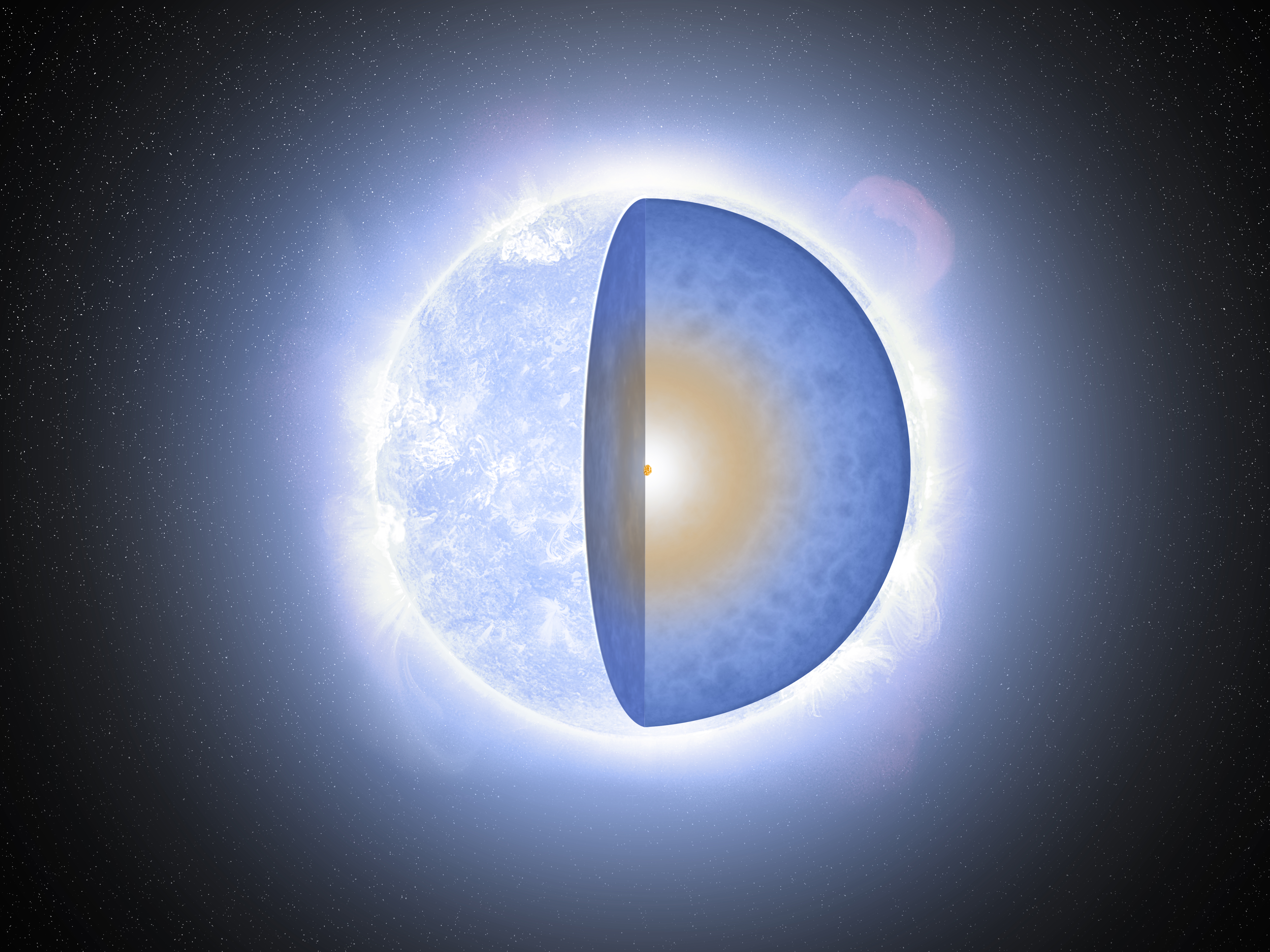
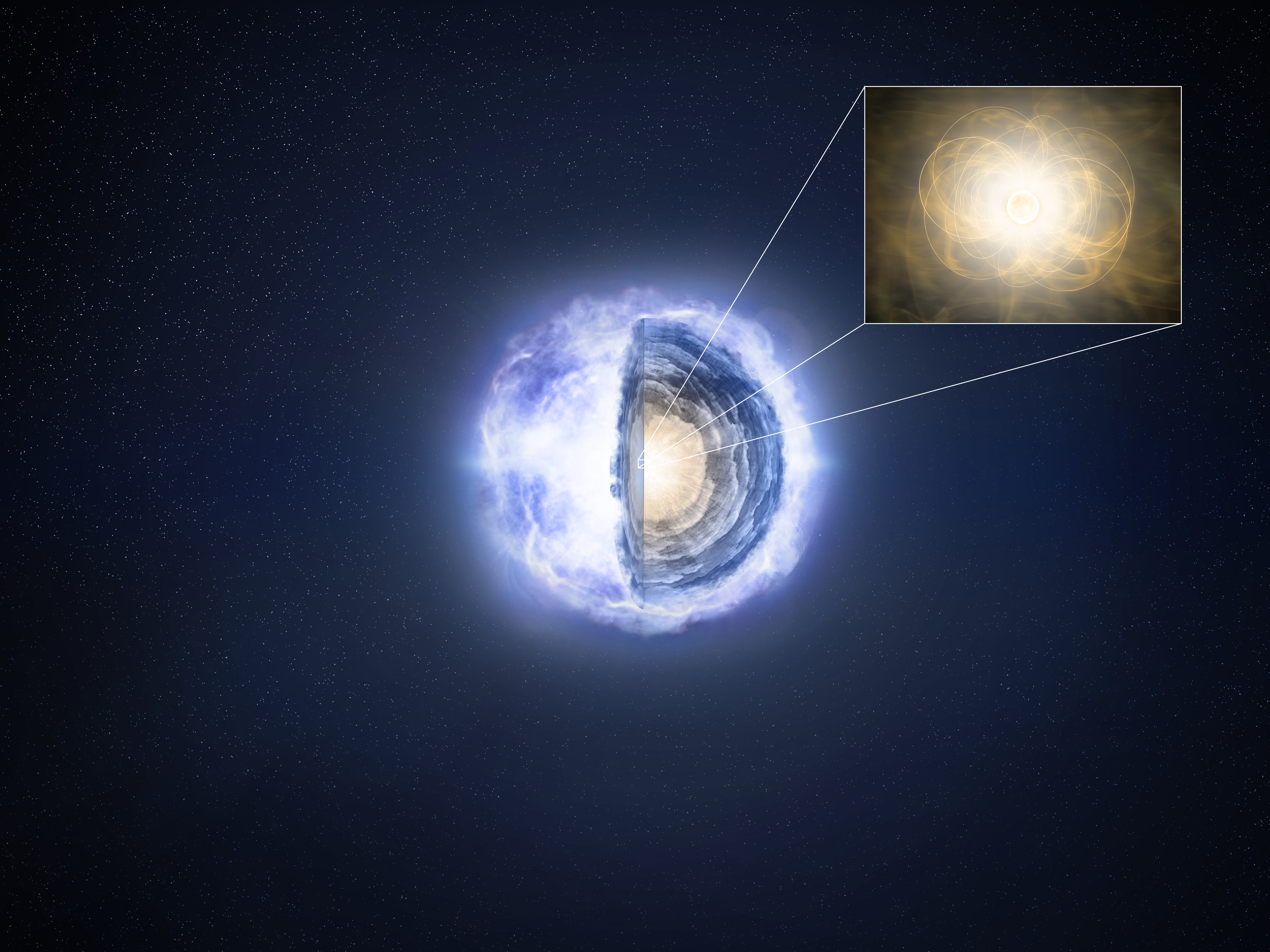
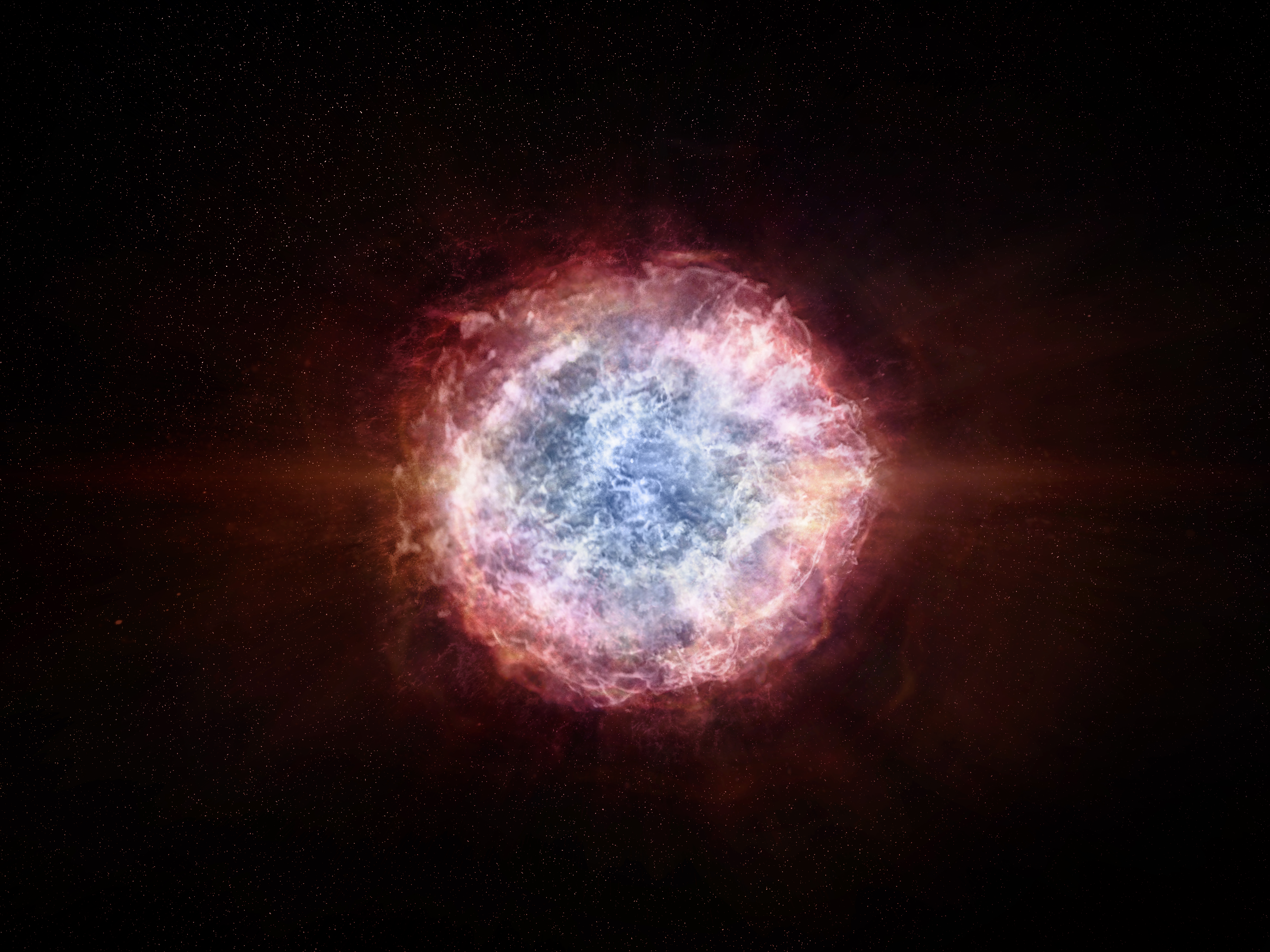
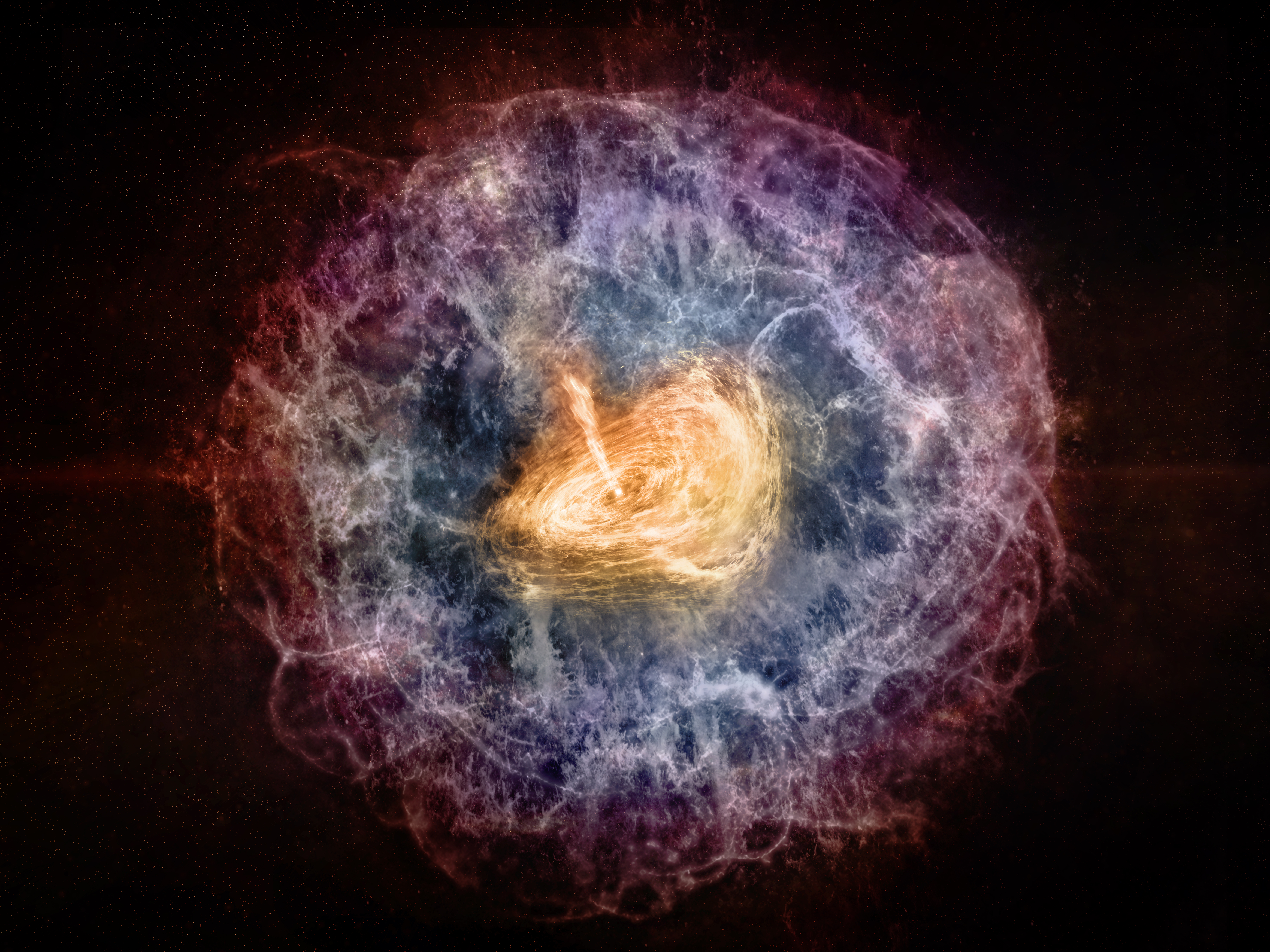
Artist’s impression of the initial shape of a supernova explosion

PR Image eso2520b
The supernova SN 2024ggi in the NGC 3621 galaxy

PR Image eso2520c
NGC 3621 in the constellation of Hydra

PR Image eso2520d
A galaxy full of surprises — the spiral galaxy NGC 3621


Videos

What’s the true shape of a supernova? | ESO News
PR Video eso2520a
What’s the true shape of a supernova? | ESO News

Artist’s animation of a supernova explosion
PR Video eso2520b
Artist’s animation of a supernova explosion


Swift observations with the European Southern Observatory’s Very Large Telescope (ESO’s VLT) have revealed the explosive death of a star just as the blast was breaking through the star’s surface. For the first time, astronomers unveiled the shape of the explosion at its earliest, fleeting stage. This brief initial phase wouldn’t have been observable a day later and helps address a whole set of questions about how massive stars go supernova.

When the supernova explosion SN 2024ggi was first detected on the night of 10 April 2024 local time, Yi Yang, an assistant professor at Tsinghua University in Beijing, China, and the lead author of the new study, had just landed in San Francisco after a long-haul flight. He knew he had to act quickly. Twelve hours later, he had sent an observing proposal to ESO, which, after a very quick approval process, pointed its VLT telescope in Chile at the supernova on 11 April, just 26 hours after the initial detection.

SN 2024ggi is located in the galaxy NGC 3621 in the direction of the constellation Hydra ‘only’ 22 million light-years away, close by in astronomical terms. With a large telescope and the right instrument, the international team knew they had a rare opportunity to unravel the shape of the explosion shortly after it happened. “The first VLT observations captured the phase during which matter accelerated by the explosion near the centre of the star shot through the star’s surface. For a few hours, the geometry of the star and its explosion could be, and were, observed together,” says Dietrich Baade, an ESO astronomer in Germany, and co-author of the study published today in Science Advances.

“The geometry of a supernova explosion provides fundamental information on stellar evolution and the physical processes leading to these cosmic fireworks,” Yang explains. The exact mechanisms behind supernova explosions of massive stars, those with more than eight times the mass of the Sun, are still debated and are one of the fundamental questions scientists want to address. This supernova’s progenitor was a red supergiant star, with a mass 12 to 15 times that of the Sun and a radius 500 times larger, making SN 2024ggi a classical example of a massive-star explosion.

We know that during its life a typical star keeps its spherical shape as a result of a very precise equilibrium of the gravitational force that wants to squeeze it and the pressure of its nuclear engine that wants to expand it. When it runs out of its last source of fuel, the nuclear engine starts sputtering. For massive stars this marks the beginning of a supernova: the core of the dying star collapses, the mass shells around fall onto it and bounce off. This rebound shock then propagates outward, disrupting the star.

Once the shock breaks through the surface, it unleashes immense amounts of energy — the supernova then brightens dramatically and becomes observable. During a short-lived phase, the supernova’s initial ‘breakout’ shape can be studied before the explosion interacts with the material surrounding the dying star.

This is what astronomers have now achieved for the very first time with ESO's VLT, using a technique called ‘spectropolarimetry’. “Spectropolarimetry delivers information about the geometry of the explosion that other types of observation cannot provide because the angular scales are too tiny,” says Lifan Wang, co-author and professor at the Texas A&M University in the US, who was a student at ESO at the start of his astronomy career. Even though the exploding star appears as a single point, the polarisation of its light carries hidden clues about its geometry, which the team were able to unravel. [1]

The only facility in the southern hemisphere capable of capturing the shape of a supernova through such a measurement is the FORS2 instrument installed on the VLT. With the FORS2 data, the astronomers found that the initial blast of material was shaped like an olive. As the explosion spread outwards and collided with the matter around the star, the shape flattened but the axis of symmetry of the ejecta remained the same. "These findings suggest a common physical mechanism that drives the explosion of many massive stars, which manifests a well-defined axial symmetry and acts on large scales,” according to Yang.

With this knowledge astronomers can already rule out some of the current supernova models and add new information to improve other ones, providing insights into the powerful deaths of massive stars. "This discovery not only reshapes our understanding of stellar explosions, but also demonstrates what can be achieved when science transcends borders,” says co-author and ESO astronomer Ferdinando Patat. “It’s a powerful reminder that curiosity, collaboration, and swift action can unlock profound insights into the physics shaping our Universe."


Notes

[1] Light particles (photons) have a property called polarisation. In a sphere, the shape of most stars, the polarisation of the individual photons cancels out so that the net polarisation of the object is zero. When astronomers measure a non-zero net polarisation, they can use that measurement to infer the shape of the object — a star or a supernova — emitting the observed light.


More information

This research was presented in a paper to appear in Science Advances (doi: 10.1126/sciadv.adx2925).

The team is composed of Y. Yang (Department of Physics, Tsinghua University, China [Tsinghua University]), X. Wen (School of Physics and Astronomy, Beijing Normal University, China [Beijing Normal University] and Tsinghua University), L. Wang (Department of Physics and Astronomy, Texas A&M University, USA [Texas A&M University] and George P. and Cynthia Woods Mitchell Institute for Fundamental Physics & Astronomy Texas A&M University, USA [IFPA Texas A&M University]), D. Baade (European Organisation for Astronomical Research in the Southern Hemisphere, Germany [ESO]), J. C. Wheeler (University of Texas at Austin, USA), A. V. Filippenko (Department of Astronomy, University of California, Berkeley, USA [UC Berkeley] and Hagler Institute for Advanced Study, Texas A&M University, USA), A. Gal-Yam (Department of Particle Physics and Astrophysics, Weizmann Institute of Science, Israel), J. Maund (Department of Physics, Royal Holloway, University of London, United Kingdom), S. Schulze (Center for Interdisciplinary Exploration and Research in Astrophysics, Northwestern University, USA), X. Wang (Tsinghua University), C. Ashall (Department of Physics, Virginia Tech, USA and Institute for Astronomy, University of Hawai’i at Manoa, USA), M. Bulla (Department of Physics and Earth Science, University of Ferrara, Italy and INFN, Sezione di Ferrara, Italy and INAF, Osservatorio Astronomico d’Abruzzo, Italy), A. Cikota (Gemini Observatory/NSF NOIRLab, Chile), H. Gao (Beijing Normal University and Institute for Frontier in Astronomy and Astrophysics, Beijing Normal University, China), P. Hoeflich (Department of Physics, Florida State University, USA), G. Li (Tsinghua University), D. Mishra (Texas A&M University and IFPA Texas A&M University), Ferdinando Patat (ESO), K. C. Patra (California and Department of Astronomy & Astrophysics, University of California, Santa Cruz, USA), S. S. Vasylyev (UC Berkeley), S. Yan (Tsinghua University).

The European Southern Observatory (ESO) enables scientists worldwide to discover the secrets of the Universe for the benefit of all. We design, build and operate world-class observatories on the ground — which astronomers use to tackle exciting questions and spread the fascination of astronomy — and promote international collaboration for astronomy. Established as an intergovernmental organisation in 1962, today ESO is supported by 16 Member States (Austria, Belgium, Czechia, Denmark, France, Finland, Germany, Ireland, Italy, the Netherlands, Poland, Portugal, Spain, Sweden, Switzerland and the United Kingdom), along with the host state of Chile and with Australia as a Strategic Partner. ESO’s headquarters and its visitor centre and planetarium, the ESO Supernova, are located close to Munich in Germany, while the Chilean Atacama Desert, a marvellous place with unique conditions to observe the sky, hosts our telescopes. ESO operates three observing sites: La Silla, Paranal and Chajnantor. At Paranal, ESO operates the Very Large Telescope and its Very Large Telescope Interferometer, as well as survey telescopes such as VISTA. Also at Paranal, ESO will host and operate the south array of the Cherenkov Telescope Array Observatory, the world’s largest and most sensitive gamma-ray observatory. Together with international partners, ESO operates ALMA on Chajnantor, a facility that observes the skies in the millimetre and submillimetre range. At Cerro Armazones, near Paranal, we are building “the world’s biggest eye on the sky” — ESO’s Extremely Large Telescope. From our offices in Santiago, Chile we support our operations in the country and engage with Chilean partners and society.


Links


Contacts:

Yi Yang
Department of Physics, Tsinghua University,
Beijing, China
Tel: +86 13581896137
Email:
yi_yang@mail.tsinghua.edu.cn, yiyangtamu@gmail.com

Dietrich Baade
European Southern Observatory
Garching bei München, Germany
Tel: +49 89 6096 295
Email:
dbaade@eso.org

Lifan Wang
Department of Physics & Astronomy, College of Arts & Sciences, Texas A&M University
College Station, Texas, United States
Email:
lifan@tamu.edu

Ferdinando Patat
European Southern Observatory
Garching bei München, Germany
Tel: +49 89 3200 6744
Email:
fpatat@eso.org

Bárbara Ferreira
ESO Media Manager
Garching bei München, Germany
Tel: +49 89 3200 6670
Cell: +49 151 241 664 00
Email
: press@eso.org


Friday, June 06, 2025

Star Quakes and Monster Shock Waves

Artist's concept of a black hole orbited by a cracked neutron star. Before a black hole consumes a neutron star, tidal forces from its immense gravity shears the star's surface, causing quakes and the opening of rifts. In this artwork, the gravity of both the black hole and neutron star can be seen bending our view of the background. The neutron star, though less massive than the black hole, has strong enough gravity to warp the view of the black hole as well. Credit: Caltech/R. Hurt (IPAC)

This snapshot from a simulation shows a magnetized outflow of plasma launched following the merger of a black hole and a magnetized neutron star. The light blue color maps show the strength of magnetic fields within this wind. The magnetized outflow is powered by the spin of the remnant black hole, like a rotating fan pushing air around. Credit: Yoonsoo Kim/Caltech

A side view from a simulation of a "black hole pulsar," a hypothetical object in which a black hole launches magnetized outflows that sweep around the black hole, like a lighthouse beacon, as it spins. The yellow lines show where magnetic fields that are pointing in different directions meet up. Electric currents flow along this interface and heat up plasma, which takes on a characteristic "ballerina's skirt" geometry. Credit: Yoonsoo Kim/Caltech

A series of three simulated images showing a black hole eat a neutron star. These three panels are taken from a supercomputer simulation of a merger between a black hole (large black circle) and a neutron star (colored blob). The images, which move forward in time from left to right, show how the intense gravity of the black hole stretches the neutron star, before the black hole ultimately consumes it. Credit: Elias Most/Caltech


Across the cosmos, many stars can be found in pairs, gracefully circling one another. Yet one of the most dramatic pairings occurs between two orbiting black holes, formed after their massive progenitor stars exploded in supernova blasts. If these black holes lie close enough together, they will ultimately collide and form an even more massive black hole. Sometimes a black hole is orbited by a neutron star—the dense corpse of a star also formed from a supernova explosion but which contains less mass than a black hole. When these two bodies finally merge, the black hole will typically swallow the neutron star whole.

To better understand the extreme physics underlying such a grisly demise, researchers at Caltech are using supercomputers to simulate black hole–neutron star collisions. In one study appearing in The Astrophysical Journal Letters, the team, led by Elias Most, a Caltech assistant professor of theoretical astrophysics, developed the most detailed simulation yet of the violent quakes that rupture a neutron star's surface roughly a second before the black hole consumes it.

"The neutron star's crust will crack open just like the ground in an earthquake," Most says. "The black hole's gravity first shears the surface, causing quakes in the star and the opening of rifts."

While cracks in the crust of a neutron star had been predicted before, the simulation is the first to demonstrate what kinds of light flares astronomers might see in the future when pointing telescopes in space and on the ground at such an event.

"This goes beyond educated models for the phenomenon—it is an actual simulation that includes all the relevant physics taking place when the neutron star breaks like an egg," says co-author Katerina Chatziioannou, assistant professor of physics at Caltech and a William H. Hurt Scholar.

In a second, more recent paper in The Astrophysical Journal Letters, published March 31 of this year, the team used a supercomputer to simulate what happens after the neutron star fractures—a brief milliseconds-long window when monster shock waves, the most powerful predicted shock waves in the universe, shoot outward from the star. These monster shock waves had only recently been predicted by co-author Andrei Beloborodov of Columbia University. Now, the simulation, along with another from a different study published by the team last year, are the first to show how they form.

What is more, the most recent simulation does not stop when the monster shock waves form—it proceeds to show the neutron star being swallowed, which then triggers the creation of an exotic object called a "black hole pulsar."

A classic pulsar is a highly magnetized neutron star that emits beams of radiation, which sweep around like a lighthouse beacon as the star spins on its axis. A black hole pulsar is a hypothetical object in which a black hole launches magnetic winds that would also sweep around it as it spins, mimicking the appearance of a pulsar. While black hole pulsars had been previously conjectured, the simulation is the first to show how such a rare object could actually form in nature from the collision of a neutron star and black hole.

"When the neutron star plunges into the black hole, the monster shock waves are launched," says Yoonsoo Kim (MS '24), a Caltech graduate student working with Most, and lead author of the study on monster shock waves and black hole pulsars. "After the star is sucked in, whipping winds are formed, creating the black hole pulsar. But the black hole cannot sustain its winds and will become quiet again within seconds."

This snippet from a supercomputer simulation shows the aftermath of a collision between a black hole and a neutron star. After the black hole consumes the magnetized neutron star, a hypothetical object called a "black hole pulsar" is formed, in which magnetic outflows sweep around the black hole as it spins. The thin yellow lines represent the interface where magnetic fields pointing in opposite directions meet. Electric currents form at this interface and heat up plasma, which can power bright gamma and X-ray emissions. This movie covers a period of about eight milliseconds.

Like the simulation depicting how a neutron star cracks, this one also predicts the characteristics of the resulting flares astronomers might see through telescopes. In the fleeting moments when monster shock waves rip outward and a black hole pulsar forms, telescopes may be able to catch outbursts of radio waves or a combination of X-rays and gamma rays. In short, the simulations performed by Most and colleagues provide a deeper understanding of the physics driving some of the most energetic events in the universe

Undulating Space and Time

When two black holes collide, they generate not only shock waves and flares of light but also another type of radiation known as gravitational waves. These ripples in the fabric of space and time itself were first predicted more than 100 years ago by Albert Einstein. The Caltech- and MIT-led LIGO (Laser Interferometer Gravitational-wave Observatory), which is funded by the National Science Foundation (NSF), famously made the first direct detection of gravitational waves, generated from the coalescence of two black holes, in 2015. The achievement would later earn three of the collaboration's leading teammates the 2017 Nobel Prize in Physics.

In 2017, LIGO and Virgo, its European sister observatory, observed a different kind of collision: that between two neutron stars. The fiery explosion, called a kilonova, unleashed a spray of metals, including the element gold. That event emitted both gravitational waves and light. LIGO–Virgo first caught the blast in gravitational waves and then notified astronomers around the world who followed up with telescopes in space and on the ground to detect a broad range of electromagnetic, or light, wavelengths, ranging from high-energy gamma rays to low-energy radio waves.

Whether a neutron star–black hole collision would also produce a similar light show is not clear, but so far none have been seen. Still, it is possible that the neutron star–black hole mergers, even if they fail to produce a cloud of glowing material, might flash with brief radio and/or other electromagnetic signals right before and during the collisions. Simulations like those from Most and his colleagues help astronomers know which electromagnetic signals to look for.

To aid in the hunt for these precursor signals, the LIGO team is working to detect mergers up to a minute before they occur, which would give astronomers more time to point their telescopes at the blasts and search for tell-tale signs of an impending crash.

LIGO can detect mergers before they happen because the pair of colliding objects emit gravitational waves in the frequency band that LIGO detects as they spiral closer and closer together," says Chatziioannou, who is part of the LIGO team. "Currently, we can detect the collisions just seconds before they occur, and we are working up to a full minute. The gravitational waves are one piece of the puzzle while the electromagnetic radiation is another. We want to put the puzzle pieces together."

The Most Advanced Computers

A major factor in the success of the team's recent neutron star–black hole simulations is the use of supercomputers containing GPUs (graphics processing units). For these recent studies, the team used the Perlmutter supercomputer located at the Lawrence Berkeley National Laboratory in Berkeley (named after astronomer Saul Perlmutter, who won the 2011 Nobel Prize in Physics with two other scientists for discovering that the universe is accelerating). GPUs provide processing power for video games and AI programs like ChatGPT; in this case, the massive parallel computing power of GPUs allowed the Perlmutter supercomputer to handle the codes needed to simulate the intricate interactions between a converging neutron star and black hole.

"When you simulate two black holes merging," Most says, "you need the equations of general relativity to describe the gr

avitational waves. But when you have a neutron star, there's a lot more physics taking place including the complex nuclear physics of the star and plasma dynamics around it."

The actual simulations take about four to five hours to run. Most and his team had been working on similar simulations for about two years using supercomputers without GPUs before they ran them on Perlmutter. "That's what unlocked the problem," Most says. "With GPUs, suddenly, everything worked and matched our expectations. We just did not have enough computing power before to numerically model these highly complex physical systems in a sufficient detail.

Simulation Secrets

The first cracking simulation reveals the drama of what unfolds as the neutron star gets close to its partner black hole. First, gravitational forces from the massive black hole shear the dead star's surface, causing it to shatter. Neutron stars are surrounded by an intense magnetic field, and when their surface shatters due to these so-called tidal forces, the magnetic field wiggles around. This leads to magnetic ripples called Alfvén waves, named after the Swedish physicist Hannes Alfvén who won the 1970 Nobel Prize in Physics for his work on magnetohydrodynamics, a theory that describes how electromagnetic fields behave in a plasma.

"The magnetic field can be thought of as strings attached to the neutron star," Most says. "The neutron star's quake violently shakes these strings like a whip, and then it makes a cracking sound."

The Alfvén waves eventually transform into a blast wave that produces a burst of radio waves about a second before the neutron star is swallowed. In the future, Caltech's planned Deep Synoptic Array-2000, or DSA-2000—an array of 2,000 radio dishes to be built in the Nevada desert—may be able to pick up these radio wave bursts, (called fast radio bursts or FRBs), indicating the death of the neutron star.

"Before this simulation, people thought you could crack a neutron star like an egg, but they never asked if you could hear the cracking," Most says. "Our work predicts that, yes, you could hear or detect it as a radio signal."

The team's second simulation reveals what happens further along in the neutron's star demise. When the dead star is slurped up by the black hole, some of the strongest shock waves in the universe are produced.

"It's like an ocean wave," Kim says. "The ocean is initially quiet, but as the waves come ashore, they steepen until they finally break. In our simulation, we can see the magnetic field waves break into a monster shock wave."

Those monster shock waves would convert into blast waves that are stronger than the ones generated by the neutron star's cracking, and they too would produce radio signals. That means astronomers observing a neutron star and black hole in the second before they collide might detect two radio signals, one after the other

"What this means is that a neutron star-black hole collision, while it might not erupt with material like a neutron star–neutron star collision, could power strong signals that telescopes can detect," Most says.

Brief Beacons

Finally, after the neutron star is gulped down by the black hole, the second simulation shows how a black hole pulsar is born.

"If the black hole eats up the neutron star, it's also eating up its magnetic field," Most explains. "And it needs to get rid of that. The black hole doesn't want the magnetic field; it repels it. What the simulation shows is that it actually does that in a way that forms a state that looks like a pulsar."

The black hole essentially drags the unwanted magnetic field around with it, and this creates magnetic winds that whip around the black hole, making it resemble a pulsar for a brief period lasting just under a second. The data show that such an event would emit a short burst of high-energy X-rays and/or higher-energy gamma rays.

In the future, the researchers hope to explore whether this same phenomenology extends to other types of binary systems. With the help of supercomputers, they aim to unravel the wondrous physics driving the universe's most cataclysmic events.

The neutron-star cracking study, titled "Nonlinear Alfvén-wave Dynamics and Premerger Emission from Crustal Oscillations in Neutron Star Mergers," was funded by NSF and the Simons Foundation. Other authors include Caltech graduate student Isaac Legred (MS '24).

The monster shock waves and black hole pulsar study, titled "Black Hole Pulsars and Monster Shocks as Outcomes of Black Hole–Neutron Star Mergers," was funded by the Sherman Fairchild Foundation, NSF, NASA, Natural Sciences & Engineering Research Council of Canada, the Canadian Space Agency, and the Simons Foundation. Other authors include Bart Ripperda from the Canadian Institute for Theoretical Astrophysics.

Written by Whitney Clavin

Source: Caltech/News


Tuesday, July 16, 2024

Posted on July 9, 2024 by Carolyn Collins Petersen Ancient People Saw a Kilonova Light up the Sky

A comparison between the observed XMM-Newton image of the kilonova 1181 with an IRAS-derived schematic of infrared contours (presumably of the dust ring) around the resulting white dwarf. This kilonova occurred when two white dwarfs collided and were observed in 1181. Courtesy Ko, et al, 2024.

What happens when aging white dwarf stars come together? Observers in feudal Japan in the year 1181 had a front-row view of the superpowerful kilonova created by such a merger. Their records show that a rare “guest star” flared up and then faded. It took until 2021 for astronomers to find the place in the sky where it occurred.

“There are many accounts of this temporary guest star in historical records from Japan, China, and Korea. At its peak, the star’s brightness was comparable to Saturn’s. It remained visible to the naked eye for about 180 days, until it gradually dimmed out of sight. The remnant of the SN 1181 explosion is now very old, so it is dark and difficult to find,” said Takatoshi Ko, a doctoral student from the Department of Astronomy at the University of Tokyo. Ko led a team that analyzed observations and did computer modeling to relocate this ancient stellar disaster.

This explosion site of the kilonova is still active some 1,800 years later. Astronomers now see a white dwarf embedded in a nebula in Cassiopeia. The star appears to have just started blowing high-speed winds from its surface in the past few decades.

Anatomy of a White Dwarf Kilonova

The original “guest star” is called SN 1181, surrounded by a remnant (SNR 1181) of the explosion. It formed when two very dense, Earth-sized white dwarfs collided. The result was a very rare type of supernova explosion, labeled Type 1ax. The explosion blew away rings of material from both stars. At the center of the merger remained a very bright, very hot, fast-rotating white dwarf called WD J00531. It’s surrounded by an infrared nebula called IRAS 00500+6713.

White dwarf star collision. Artist’s impression of two white dwarf stars merging and creating a Type Ia supernova. Type Ia supernovas are similar to type Iax supernovas, as they occur when two white dwarfs collide. However, they are brighter and the explosion completely destroys the stars. Type Iax supernovas, like SN 1181 where a remnant white dwarf is left behind after the kilonova, are more rare. © ESO/ L. Calçada

When a merger of white dwarfs takes place, astronomers expect that both should explode and disappear. Instead, this one created a new white dwarf. It’s pinning rapidly and blowing off a strong stellar wind at a velocity of 15,000 km/sec. It’s also experiencing a high mass-loss rate via that wind.

Usually, kilonova explosions occur when two neutron stars or a neutron star and a black hole collide. So, for one to occur between white dwarfs says a lot about the progenitors. Given those characteristics, astronomers think this one is a “super-” or “near-Chandrasekahr limit” white dwarf. To get that kind of weirdo stellar corpse, the progenitors had to be double-degenerate white dwarfs. In other words, they are at or above the Chandrasekhar limit. That’s the mass above which electron degeneracy pressure in the star’s core isn’t enough to balance its self-gravity. In this case, when these two oddball white dwarfs combined, they made a newer, weirder version.

Rings around the White Dwarf

SN 1181 lies about 10,100 light-years from Earth—so not close enough to affect us. Nonetheless, kilonovae can be pretty catastrophic. Experts estimate that if you were within a dozen or so light-years away from one, it could affect life as the gamma rays and other radiation slam into a planet.

The resulting remnant of the kilonova is itself somewhat weird. It contains two shock regions in addition to that superfast wind. The outer region is bright in X-rays and is the interface between material ejected from the merger and material in interstellar space. The inner one is a more recent creation. It appears to have begun blowing around 1990 and is dust-rich. “If the wind had started blowing immediately after SNR 1181’s formation, we couldn’t reproduce the observed size of the inner shock region,” said Ko.

“However, by treating the wind’s onset time as variable, we succeeded in explaining all of the observed features of SNR 1181 accurately and unraveling the mysterious properties of this high-speed wind. We were also able to simultaneously track the time evolution of each shock region, using numerical calculations.”

What’s Happening Now?

The team thinks the resulting white dwarf has started to burn again. That’s possibly due to matter thrown out by the kilonova explosion witnessed in 1181 falling back to its surface. When that happens, the density of the surface area and the temperature both increase enough to restart burning.

The team deduced this from computer models based on X-ray observations by the Chandra X-ray Observatory, XMM-Newton, and IRAS in the infrared. Now they’ll focus on further observations of SN 1181 using the Very Large Array radio telescope and the Subaru Telescope in Hawai’i. This should allow scientists to probe the history of this event more deeply.

The evolution of SNR 1181. This illustration charts the evolution of the SNR 1181 remnant, from its creation when a carbon-oxygen-based white dwarf and oxygen-neon white dwarf merged in a kilonova, to the formation of its two shock regions. © 2024 T. Ko

“The ability to determine the age of supernova remnants or the brightness at the time of their explosion through archaeological perspectives is a rare and invaluable asset to modern astronomy,” said Ko. “Such interdisciplinary research is both exciting and highlights the immense potential for combining diverse fields to uncover new dimensions of astronomical phenomena.”

For More Information

Fresh Wind Blows from Historical Supernova

by Carolyn Collins Petersen


Wednesday, April 10, 2024

SNR 1181: Stunning Echo of 800-year-old Explosion

SNR 1181 / Pa 30
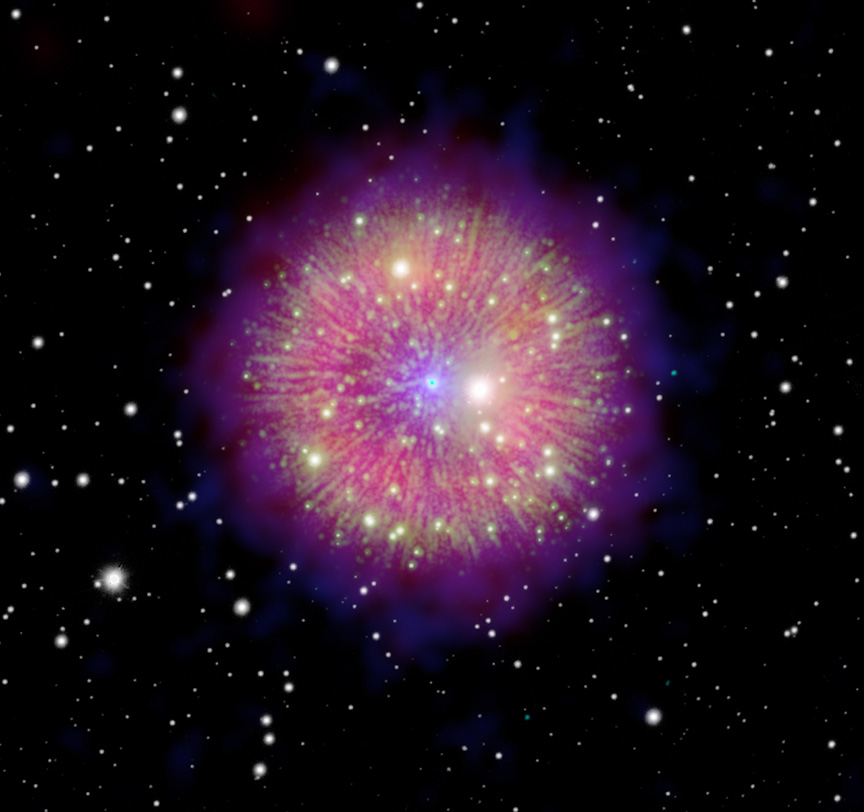
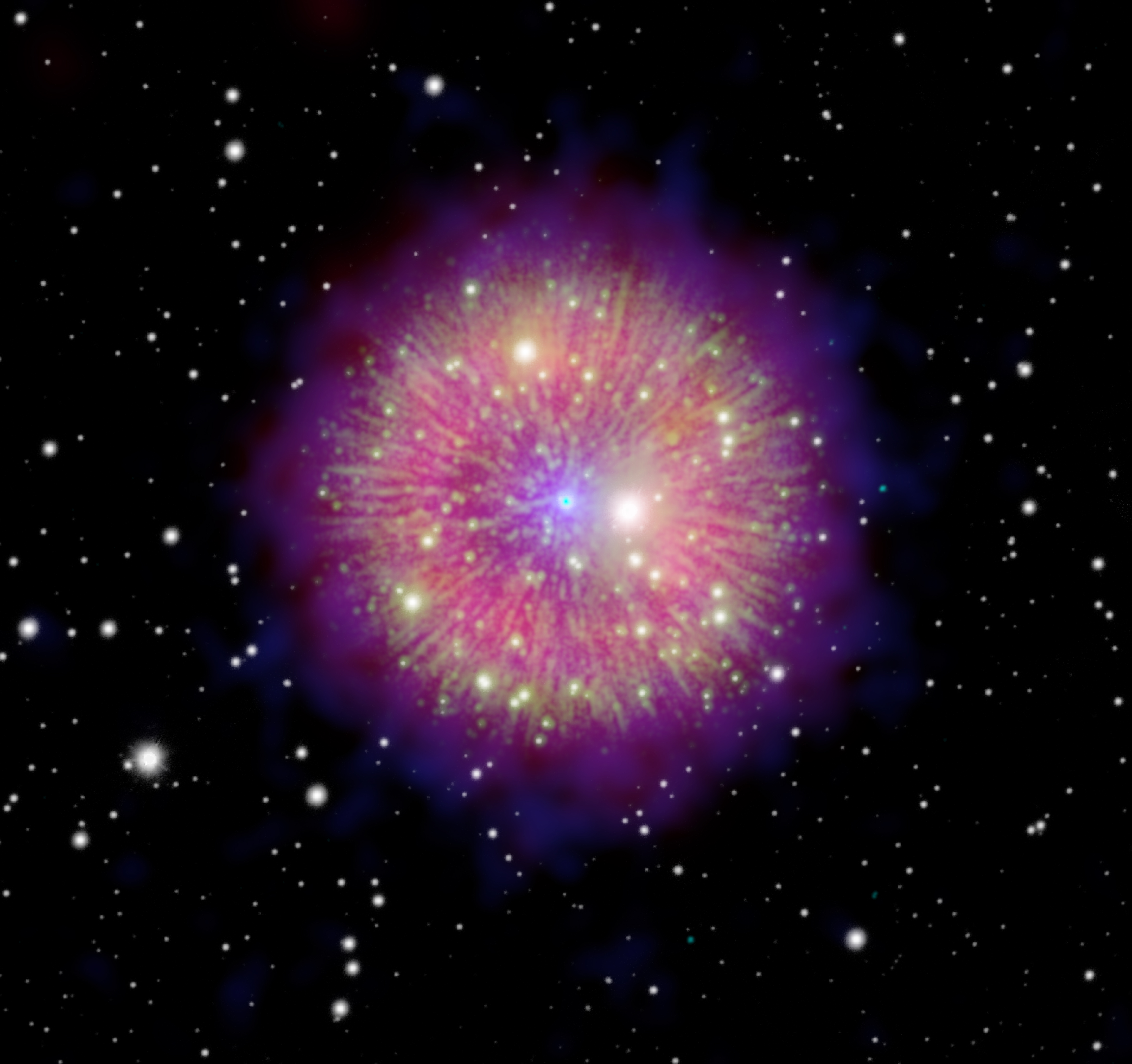
Credit: X-ray: (Chandra) NASA/CXC/U. Manitoba/C. Treyturik, (XMM-Newton) ESA/C. Treyturik; Optical: (Pan-STARRS) NOIRLab/MDM/Dartmouth/R. Fesen; Infrared: (WISE) NASA/JPL/Caltech/; Image Processing: Univ. of Manitoba/Gilles Ferrand and Jayanne English


In the year 1181 a rare supernova explosion appeared in the night sky, staying visible for 185 consecutive days. Historical records show that the supernova looked like a temporary ‘star’ in the constellation Cassiopeia shining as bright as Saturn.

Ever since, scientists have tried to find the supernova’s remnant. At first it was thought that this could be the nebula around the pulsar — the dense core of a collapse star — named 3C 58. However closer investigations revealed that the pulsar is older than supernova 1181.

In the last decade, another contender was discovered; Pa 30 is a nearly circular nebula with a central star in the constellation Cassiopeia. It is pictured here combining images from several telescopes. This composite image uses data across the electromagnetic spectrum and shows a spectacular new view of the supernova remnant. This allows us to marvel at the same object that appeared in our ancestors’ night sky more than 800 years ago.

X-ray observations by ESA’s XMM-Newton (blue) show the full extent of the nebula and NASA’s Chandra X-ray Observatory (cyan) pinpoints its central source. The nebula is barely visible in optical light but shines bright in infrared light, collected by NASA’s Wide-field Infrared Space Explorer (red and pink). Interestingly, the radial structure in the image consists of heated sulfur that glows in visible light, observed with the ground-based Hiltner 2.4 m telescope at the MDM Observatory (green) in Arizona, USA, as do the stars in the background by Pan-STARRS (white) in Hawaii, USA.

Studies of the composition of the different parts of the remnant have led scientists to believe that it was formed in a thermonuclear explosion, and more precisely a special kind of supernova called a sub-luminous Type Iax event. During this event two white dwarf stars merged, and typically no remnant is expected for this kind of explosion. But incomplete explosions can leave a kind of ‘zombie’ star, such as the massive white dwarf star in this system. This very hot star, one of the hottest stars in the Milky Way (about 200 000 degrees Celsius), has a fast stellar wind with speeds up to 16,000 km/s. The combination of the star and the nebula makes it a unique opportunity for studying such rare explosions.

The Smithsonian Astrophysical Observatory's Chandra X-ray Center controls science operations from Cambridge, Massachusetts, and flight operations from Burlington, Massachusetts.


Visual Description:

This is a composite image of SNR 1181, the remains of an explosion hundreds of years ago caused by the merger of two stars.

A bright, multi-colored, spherical nebula sits in the middle of the canvas surrounded by a field of stars that appear as white dots. In the center of the nebula is a small point of aqua-colored light. This is the hot white dwarf star that was left behind after the likely merger of two smaller white dwarfs caused an explosion. From this single point of aqua light, several spectacular rays expand outward, resembling a single firework bursting in celebration in the night sky.


Fast Facts for SNR 1181 / Pa 30:

Scale: Image is about 5.6 arcmin (16 light-years) across.
Category: Supernovas & Supernova Remnants
Coordinates (J2000): RA 00h 53m 11.2s | Dec +67° 30´ 02.4"
Constellation: Cassiopeia
Observation Dates: 6 observations from May 12, 2021 to Dec 15, 2021
Observation Time: 39 hours 55 minutes (1 day 15 hours 55 minutes)
Obs. ID: 23419, 24342-24345, 25045
Instrument: ACIS
Color Code: X-ray: blue (XMM) and cyan (Chandra); Optical: green (MDM), white (Pan-STARRS); Infrared: red and pink
Distance Estimate: About 10,100 light-years


Saturday, July 08, 2023

Serene Supernova Aftermath

Image Description: A spiral galaxy, a fuzzy oval tilted diagonally and partially towards the viewer. The centre glows in warm colours, and has two prominent spiral arms around it, with bright points of star formation. The galaxy appears centrally in a field of small stars and galaxies on a dark background. Credit: ESA/Hubble & NASA, A. Filippenko, J. D. Lyman

The spiral galaxy UGC 11860 seems to float serenely against a field of background galaxies in this image from the NASA/ESA Hubble Space Telescope. UGC 11860 lies around 184 million light-years away in the constellation Pegasus, and its untroubled appearance is deceiving; this galaxy recently played host to an almost unimaginably energetic stellar explosion.

A supernova explosion — the catastrophically violent end of a massive star’s life — was detected in UGC 11860 in 2014 by a robotic telescope dedicated to scouring the skies for transient astronomical phenomena — astronomical objects that are only visible for a short period of time. Two different teams of astronomers used Hubble’s Wide Field Camera 3 to search through the aftermath and unpick the lingering remnants of this vast cosmic explosion.

One team explored UGC 11860 to understand more about the progenitor star systems that eventually meet their demise in supernovae. The hugely energetic processes during supernova explosions are predominantly responsible for forging the elements between silicon and nickel on the periodic table. This means that understanding the influence of the masses and compositions of the progenitor star systems is vital to explaining how many of the chemical elements here on Earth originated.

The other group of astronomers used Hubble to follow up supernovae that were detected by robotic telescopes. These automated eyes on the sky function without human intervention, and capture transient events in the night sky. Robotic telescopes allow astronomers to detect everything from unexpected asteroids to rare, unpredictable supernovae, and can identify intriguing objects that can then be investigated in more detail by powerful telescopes such as Hubble.


Friday, March 24, 2023

Featured Image: A Neutron Star Collision


When a massive star ends its life in a supernova explosion, it can leave behind a tiny, dense remnant called a neutron star. Sometimes, two neutron stars end up locked in a gravitational embrace, emitting gravitational waves as they dance toward each other over millions of years. When the pair finally meets, their collision lights up the electromagnetic spectrum and creates heavy elements like gold and platinum. In a recent research article, Luciano Combi (Argentine Institute of Radio Astronomy, Perimeter Institute for Theoretical Physics, and University of Guelph) and Daniel Siegel (Perimeter Institute for Theoretical Physics, University of Guelph, and University of Greifswald) simulated the nuclear reactions and electromagnetic radiation produced after the merger of a pair of neutron stars. The image above illustrates four stages of their simulation, from the moment before the neutron stars meet, when their mutual gravity stretches them into teardrop shapes, to the merger aftermath, when an accretion disk feeds the sole remaining star. To learn more about the simulations described above, be sure to check out the full article linked below!

Citation

“GRMHD Simulations of Neutron-star Mergers with Weak Interactions: r-process Nucleosynthesis and Electromagnetic Signatures of Dynamical Ejecta,” Luciano Combi and Daniel M. Siegel 2023 ApJ 944 28. doi:10.3847/1538-4357/acac29

By Kerry Hensley


Wednesday, November 09, 2022

Hubble Captures 3 Faces of Evolving Supernova in Early Universe

Lensed Supernova in Abell 370
Credits: Science: NASA, ESA, STScI, Wenlei Chen (UMN), Patrick Kelly (UMN), Hubble Frontier Fields


Multiple Light Paths of Single, Lensed Supernova
Credits: Illustration: NASA, ESA, Alyssa Pagan (STScI)


Three different moments in a far-off supernova explosion were captured in a single snapshot by NASA's Hubble Space Telescope. The star exploded more than 11 billion years ago, when the universe was less than a fifth of its current age of 13.8 billion years.

This is the first detailed look at a supernova so early in the universe's history. The research could help scientists learn more about the formation of stars and galaxies in the early universe. The supernova images are also special because they show the early stages of a stellar explosion.

"It is quite rare that a supernova can be detected at a very early stage, because that stage is really short," explained Wenlei Chen, first author of the paper and a postdoctoral researcher in the University of Minnesota School of Physics and Astronomy. "It only lasts for hours to a few days, and it can be easily missed even for a nearby detection. In the same exposure, we are able to see a sequence of the images—like multiple faces of a supernova."

This was possible through a phenomenon called gravitational lensing, which was first predicted in Einstein's theory of general relativity. In this case, the immense gravity of the galaxy cluster Abell 370 acted as a cosmic lens, bending and magnifying the light from the more distant supernova located behind the cluster.

The warping also produced multiple images of the explosion over different time periods that all arrived at Earth at the same time and were caught in one Hubble image. That was possible only because the magnified images took different routes through the cluster due both to differences in the length of the pathways the supernova light followed, and to the slowing of time and curvature of space due to gravity.

The Hubble exposure also captured the fading supernova's rapid change of color, which indicates temperature change. The bluer the color means the hotter the supernova is. The earliest phase captured appears blue. As the supernova cooled its light turned redder.

"You see different colors in the three different images," said Patrick Kelly, study leader and an assistant professor in the University of Minnesota's School of Physics and Astronomy. "You've got the massive star, the core collapses, it produces a shock, it heats up, and then you're seeing it cool over a week. I think that's probably one of the most amazing things I've ever seen!"

This is also the first time astronomers were able to measure the size of a dying star in the early universe. This was based on the supernova's brightness and rate of cooling, both of which depend on the size of the progenitor star. Hubble observations show that the red supergiant whose supernova explosion the researchers discovered was about 500 times larger than the Sun.

Chen, Kelly, and an international team of astronomers found this supernova by sifting through the Hubble data archives, looking for transient events. Chen wrote machine-learning algorithms to find these events, but this was the only multiply imaged supernova identified.

Chen and Kelly both have time planned for NASA's James Webb Space Telescope to observe even more distant supernovae. They hope to contribute to a catalog of very far-off supernovae to help astronomers understand if the stars that existed many billions of years ago are different from those in the nearby universe.

The team's paper, entitled "Shock cooling of a red-supergiant supernova at redshift 3 in lensed images ," will be published in Nature on November 10.

The Hubble Space Telescope is a project of international cooperation between NASA and ESA. NASA's Goddard Space Flight Center in Greenbelt, Maryland, manages the telescope. The Space Telescope Science Institute (STScI) in Baltimore conducts Hubble science operations. STScI is operated for NASA by the Association of Universities for Research in Astronomy, in Washington, D.C.


About This Release:

Credits

Media Contact:

Ann Jenkins
Space Telescope Science Institute, Baltimore, Maryland

Ray Villard
Space Telescope Science Institute, Baltimore, Maryland

Science Contact:

Wenlei Chen
University of Minnesota, Minneapolis, Minnesota

Patrick Kelly
University of Minnesota, Minneapolis, Minnesota

Permissions: Content Use Policy

Contact Us: Direct inquiries to the News Team.

Related Links and Documentshttps:


Thursday, June 23, 2022

Astronomers Find Evidence for Most Powerful Pulsar in Distant Galaxy


Top Left:
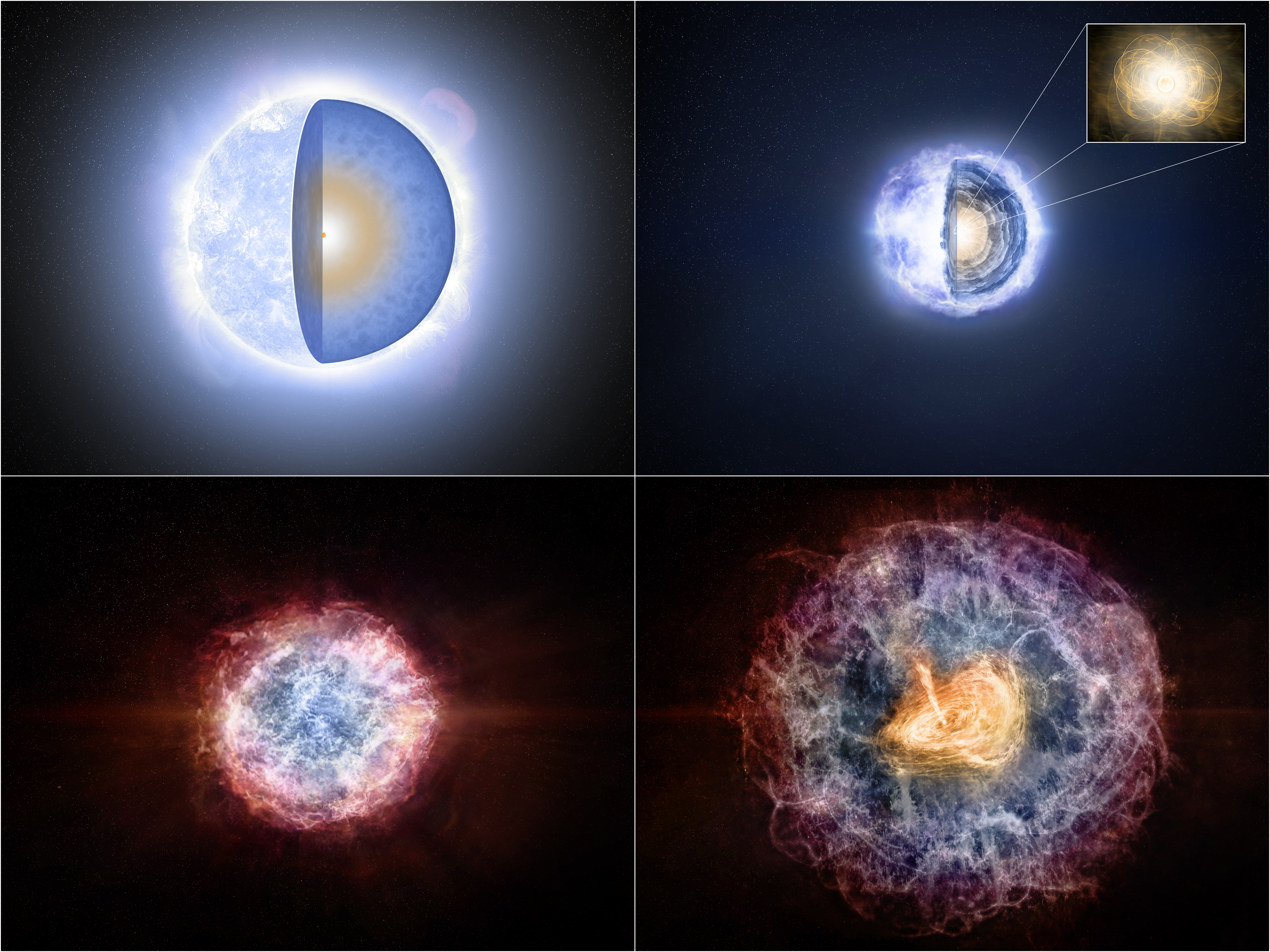
A giant blue star, much more massive than our Sun, has consumed, through nuclear fusion at its center, all its hydrogen, helium, and heavier elements up to iron. It now has a small iron core (red dot) at its center. Unlike the earlier stages of fusion, the fusion of iron atoms absorbs, rather than releases, energy. The fusion-released energy that has held up the star against its own weight now is gone, and the star will quickly collapse, triggering a supernova explosion. Top Right: The collapse has begun, producing a superdense neutron star with a strong magnetic field at its center (inset). The neutron star, though containing about 1.5 times the mass of the Sun, is only about the size of Manhattan. Bottom Left: The supernova explosion has ejected a fast-moving shell of debris outward into interstellar space. At this stage, the debris shell is dense enough to shroud from view any radio waves coming from the region of the neutron star. Bottom Right: As the shell of explosion debris expands over a few decades, it becomes less dense and eventually becomes thin enough that radio waves from inside can escape. This allowed observations by the VLA Sky Survey to detect bright radio emission created as the rapidly spinning neutron star's powerful magnetic field sweeps through the surrounding space, accelerating charged particles. This phenomenon is called a pulsar wind nebula.
Hi-Res File


Version Without Labels
-- Top Left: A giant blue star, much more massive than our Sun, has consumed, through nuclear fusion at its center, all its hydrogen, helium, and heavier elements up to iron. It now has a small iron core (red dot) at its center. Unlike the earlier stages of fusion, the fusion of iron atoms absorbs, rather than releases, energy. The fusion-released energy that has held up the star against its own weight now is gone, and the star will quickly collapse, triggering a supernova explosion. Top Right: The collapse has begun, producing a superdense neutron star with a strong magnetic field at its center (inset). The neutron star, though containing about 1.5 times the mass of the Sun, is only about the size of Manhattan. Bottom Left: The supernova explosion has ejected a fast-moving shell of debris outward into interstellar space. At this stage, the debris shell is dense enough to shroud from view any radio waves coming from the region of the neutron star. Bottom Right: As the shell of explosion debris expands over a few decades, it becomes less dense and eventually becomes thin enough that radio waves from inside can escape. This allowed observations by the VLA Sky Survey to detect bright radio emission created as the rapidly spinning neutron star's powerful magnetic field sweeps through the surrounding space, accelerating charged particles. This phenomenon is called a pulsar wind nebula. Credit: Melissa Weiss, NRAO/AUI/NSF.
Hi-Res File


A giant blue star, much more massive than our Sun, has consumed, through nuclear fusion at its center, all its hydrogen, helium, and heavier elements up to iron. It now has a small iron core (red dot) at its center. Unlike the earlier stages of fusion, the fusion of iron atoms absorbs, rather than releases, energy. The fusion-released energy that has held up the star against its own weight now is gone, and the star will quickly collapse, triggering a supernova explosion. Credit: Melissa Weiss, NRAO/AUI/NSF.
Hi-Res File


The star's collapse has begun, producing a superdense neutron star with a strong magnetic field at its center (inset). The neutron star, though containing about 1.5 times the mass of the Sun, is only about the size of Manhattan. Credit: Melissa Weiss, NRAO/AUI/NSF.
Hi-Res File


The supernova explosion has ejected a fast-moving shell of debris outward into interstellar space. At this stage, the debris shell is dense enough to shroud from view any radio waves coming from the region of the neutron star. Credit: Melissa Weiss, NRAO/AUI/NSF.
Hi-Res File


As the shell of explosion debris from the supernova expands over a few decades, it becomes less dense and eventually becomes thin enough that radio waves from inside can escape. This allowed observations by the VLA Sky Survey to detect bright radio emission created as the rapidly spinning neutron star's powerful magnetic field sweeps through the surrounding space, accelerating charged particles. This phenomenon is called a pulsar wind nebula. Credit: Melissa Weiss, NRAO/AUI/NSF
. Hi-Res File 
 

VLA images of the location of VT 1137-0337 in 1998, left, and 2018, right. The object became visible to the VLA sometime between these two dates. Credit: Dong & Hallinan, NRAO/AUI/NSF. 
Hi-Res File


Astronomers analyzing data from the VLA Sky Survey (VLASS) have discovered one of the youngest known neutron stars — the superdense remnant of a massive star that exploded as a supernova. Images from the National Science Foundation’s Karl G. Jansky Very Large Array (VLA) indicate that bright radio emission powered by the spinning pulsar’s magnetic field has only recently emerged from behind a dense shell of debris from the supernova explosion.

The object, called VT 1137-0337, is in a dwarf galaxy 395 million light-years from Earth. It first appeared in a VLASS image made in January of 2018. It did not appear in an image of the same region made by the VLA’s FIRST Survey in 1998. It continued to appear in later VLASS observations in 2018, 2019, 2020, and 2022.

“What we’re most likely seeing is a pulsar wind nebula,” said Dillon Dong, a Caltech graduate student who will begin a Jansky Postdoctoral Fellowship at the National Radio Astronomy Observatory (NRAO) later this year. A pulsar wind nebula is created when the powerful magnetic field of a rapidly spinning neutron star accelerates surrounding charged particles to nearly the speed of light.

“Based on its characteristics, this is a very young pulsar — possibly as young as only 14 years, but no older than 60 to 80 years,” said Gregg Hallinan, Dong’s Ph.D advisor at Caltech.

The scientists reported their findings at the American Astronomical Society’s meeting in Pasadena, California.

Dong and Hallinan discovered the object in data from VLASS, an NRAO project that began in 2017 to survey the entire sky visible from the VLA — about 80 percent of the sky. Over a period of seven years, VLASS is conducting a complete scan of the sky three times, with one of the objectives to find transient objects. The astronomers found VT 1137-0337 in the first VLASS scan from 2018.

Comparing that VLASS scan to data from an earlier VLA sky survey called FIRST revealed 20 particularly luminous transient objects that could be associated with known galaxies.

“This one stood out because its galaxy is experiencing a burst of star formation, and also because of the characteristics of its radio emission,” Dong said. The galaxy, called SDSS J113706.18-033737.1, is a dwarf galaxy containing about 100 million times the mass of the Sun.

In studying the characteristics of VT 1137-0337, the astronomers considered several possible explanations, including a supernova, gamma ray burst, or tidal disruption event in which a star is shredded by a supermassive black hole. They concluded that the best explanation is a pulsar wind nebula.

In this scenario, a star much more massive than the Sun exploded as a supernova, leaving behind a neutron star. Most of the original star’s mass was blown outward as a shell of debris. The neutron star spins rapidly, and as its powerful magnetic field sweeps through the surrounding space it accelerates charged particles, causing strong radio emission.

Initially, the radio emission was blocked from view by the shell of explosion debris. As that shell expanded, it became progressively less dense until eventually the radio waves from the pulsar wind nebula could pass through.

“This happened between the FIRST observation in 1998 and the VLASS observation in 2018,” Hallinan said.

Probably the most famous example of a pulsar wind nebula is the Crab Nebula in the constellation Taurus, the result of a supernova that shone brightly in the year 1054. The Crab is readily visible today in small telescopes.

“The object we have found appears to be approximately 10,000 times more energetic than the Crab, with a stronger magnetic field,” Dong said. “It likely is an emerging ‘super Crab’,” he added.

While Dong and Hallinan consider VT 1137-0337 to most likely be a pulsar wind nebula, it also is possible that its magnetic field may be strong enough for the neutron star to qualify as a magnetar — a class of super-magnetic objects. Magnetars are a leading candidate for the origin of the mysterious Fast Radio Bursts (FRBs) now under intense study.

“In that case, this would be the first magnetar caught in the act of appearing, and that, too, is extremely exciting,” Dong said.

Indeed some Fast Radio Bursts have been found to be associated with persistent radio sources, the nature of which also is a mystery. They bear a strong resemblance in their properties to VT 1137-0337, but have shown no evidence of strong variability.

“Our discovery of a very similar source switching on suggests that the radio sources associated with FRBs also may be luminous pulsar wind nebulae,” Dong said.

The astronomers plan to conduct further observations to learn more about the object and to monitor its behavior over time.

The National Radio Astronomy Observatory is a facility of the National Science Foundation, operated under cooperative agreement by Associated Universities, Inc.

Media Contact:

Dave Finley, Public Information Officer
(505) 241-9210

dfinley@nrao.edu


Friday, June 25, 2021

MSH 15-52: Cosmic Hand Hitting a Wall


MSH 15-52
Credit NASA/SAO/NCSU/Borkowski et al.


Tour: Cosmic Hand Hitting a Wall - More Animations


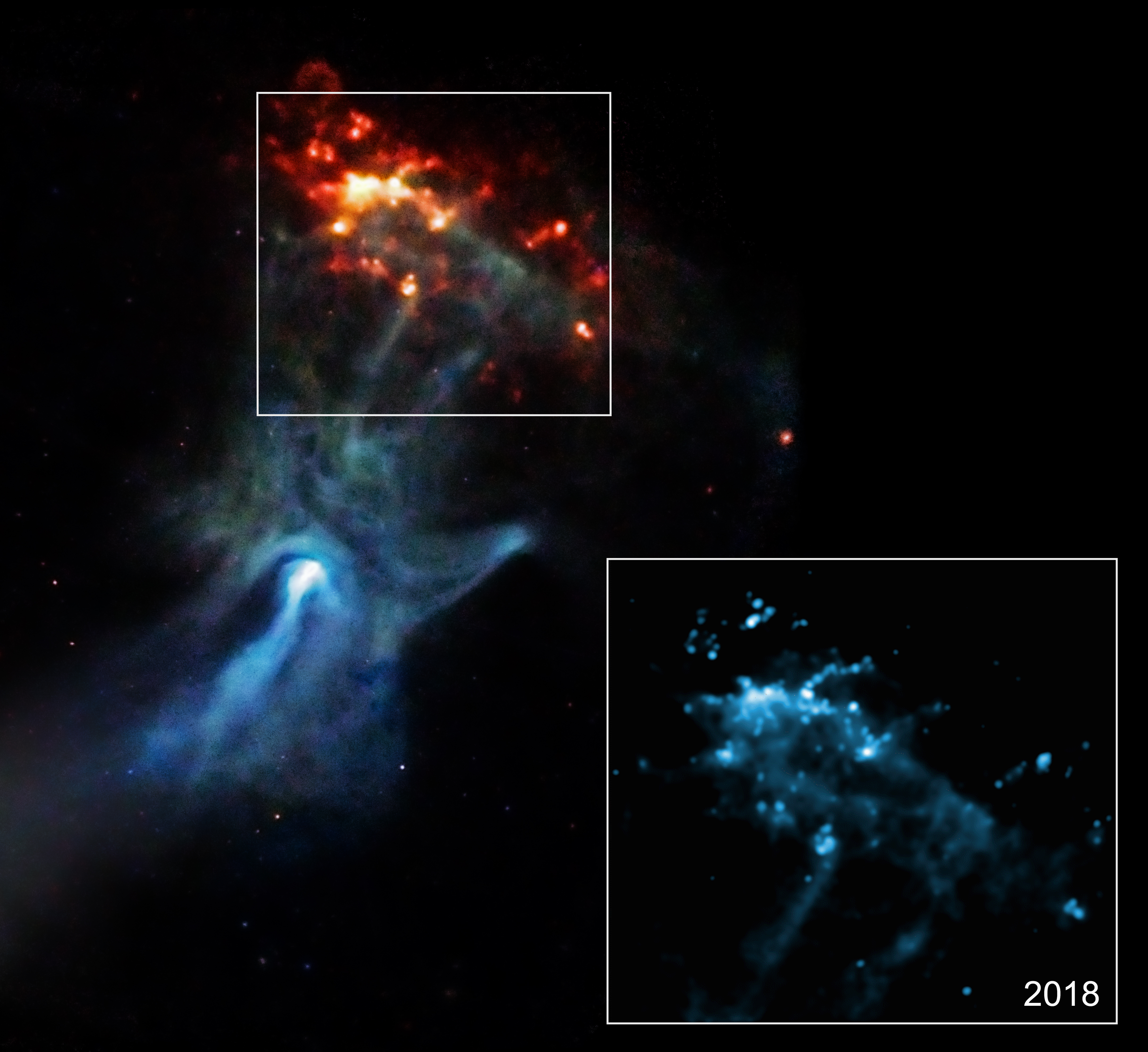
Motions of a remarkable cosmic structure have been measured for the first time, using NASA's Chandra X-ray Observatory. The blast wave and debris from an exploded star are seen moving away from the explosion site and colliding with a wall of surrounding gas.

Astronomers estimate that light from the supernova explosion reached Earth about 1,700 years ago, or when the Mayan empire was flourishing and the Jin dynasty ruled China. However, by cosmic standards the supernova remnant formed by the explosion, called MSH 15-52, is one of the youngest in the Milky Way galaxy. The explosion also created an ultra-dense, magnetized star called a pulsar, which then blew a bubble of energetic particles, an X-ray-emitting nebula.

Since the explosion the supernova remnant — made of debris from the shattered star, plus the explosion's blast wave — and the X-ray nebula have been changing as they expand outward into space. Notably, the supernova remnant and X-ray nebula now resemble the shape of fingers and a palm.

Previously, astronomers had released a full Chandra view of the "hand," as shown in the main graphic. A new study is now reporting how quickly the supernova remnant associated with the hand is moving, as it strikes a cloud of gas called RCW 89. The inner edge of this cloud forms a gas wall located about 35 light years from the center of the explosion.

To track the motion the team used Chandra data from 2004, 2008, and then a combined image from observations taken in late 2017 and early 2018. These three epochs are shown in the inset of the main graphic.

The rectangle (fixed in space) highlights the motion of the explosion's blast wave, which is located near one of the fingertips. This feature is moving at almost 9 million miles per hour. The fixed squares (seen in the images below) enclose clumps of magnesium and neon that likely formed in the star before it exploded and shot into space once the star blew up. Some of this explosion debris is moving at even faster speeds of more than 11 million miles per hour. A color version of the 2018 image shows the fingers in blue and green and the clumps of magnesium and neon in red and yellow.


Timelapse: 2004, 2008, 2018

The rectangle (fixed in space) highlights the motion of the explosion's blast wave, which is located near one of the fingertips. This feature is moving at almost 9 million miles per hour. The fixed squares (seen in the images below) enclose clumps of magnesium and neon that likely formed in the star before it exploded and shot into space once the star blew up. Some of this explosion debris is moving at even faster speeds of more than 11 million miles per hour. A color version of the 2018 image shows the fingers in blue and green and the clumps of magnesium and neon in red and yellow.


View by year - 2004, 2008 and 2018

While these are startling high speeds, they actually represent a slowing down of the remnant. Researchers estimate that to reach the farthest edge of RCW 89, material would have to travel on average at almost 30 million miles per hour. This estimate is based on the age of the supernova remnant and the distance between the center of the explosion and RCW 89. This difference in speed implies that the material has passed through a low-density cavity of gas and then been significantly decelerated by running into RCW 89.

The exploded star likely lost part or all of its outer layer of hydrogen gas in a wind, forming such a cavity, before exploding, as did the star that exploded to form the well-known supernova remnant Cassiopeia A (Cas A), which is much younger at an age of about 350 years. About 30% of massive stars that collapse to form supernovas are of this type. The clumps of debris seen in the 1,700-year-old supernova remnant could be older versions of those seen in Cas A at optical wavelengths in terms of their initial speeds and densities. This means that these two objects may have the same underlying source for their explosions, which is likely related to how stars with stripped hydrogen layers explode. However, astronomers do not understand the details of this yet and will continue to study this possibility.

A paper describing these results appeared in the June 1, 2020, issue of The Astrophysical Journal Letters, and a preprint is available online. The authors of the study are Kazimierz Borkowski, Stephen Reynolds, and William Miltich, all of North Carolina State University in Raleigh.

NASA's Marshall Space Flight Center manages the Chandra program. The Smithsonian Astrophysical Observatory's Chandra X-ray Center controls science from Cambridge Massachusetts and flight operations from Burlington, Massachusetts.


Quick Look: Cosmic Hand Hitting a Wall


Fast Facts for MSH 15-52:
 
Scale: Image is about 6.64 arcmin (33 light years) across.
Category: Supernovas & Supernova Remnants
Coordinates (J2000): RA 15h 13m 35.0s | Dec -59° 00´ 12"
Constellation:
Circinus
Observation Date: 7 observations from Dec 31, 2004 through April 8, 2018
Observation Time: 75 hours 26 minutes (64 days 19 hours and 26 minutes)
Obs. ID: 5562, 9138, 19299, 19300, 20910, 20932, 20933
Instrument:
ACIS
References: Borkowski, K, Reynolds, S, and Miltich, W, 2020, ApJL, 895, 32; arXiv:2005.07721
Color Code: Red: 0.2-2.0 keV; Yellow: 2.0-3.0 keV; Blue: 3.0-6.5 keVaa
Distance Estimate: About 17,000 light years


Wednesday, June 16, 2021

Mystery of Betelgeuse’s dip in brightness solved

Betelgeuse’s surface before and during its 2019–2020 Great Dimming
 
Betelgeuse’s surface before and during its 2019–2020 Great Dimming (with annotations)
 
Image of Betelgeuse’s surface taken in March 2020
 
Image of Betelgeuse’s surface taken in January 2020
 
Image of Betelgeuse’s surface taken in December 2019
 
Image of Betelgeuse’s surface taken in January 2019
 
Wide-field view of the region of the sky where Betelgeuse is located 
 
The star Betelgeuse in the constellation of Orion


Videos

Who Turned off the Lights on Betelgeuse? (ESOcast 238 Light)
 
How Betelgeuse changed in brightness in 2019–2020
 
Artist’s animation of Betelgeuse and its dusty veil
Artist’s animation of Betelgeuse and its dusty veil 
 
Zooming in on Betelgeuse


Mystery of Betelgeuse’s dip in brightness solved

When Betelgeuse, a bright orange star in the constellation of Orion, became visibly darker in late 2019 and early 2020, the astronomy community was puzzled. A team of astronomers have now published new images of the star’s surface, taken using the European Southern Observatory’s Very Large Telescope (ESO’s VLT), that clearly show how its brightness changed. The new research reveals that the star was partially concealed by a cloud of dust, a discovery that solves the mystery of the “Great Dimming” of Betelgeuse.

Betelgeuse’s dip in brightness — a change noticeable even to the naked eye — led Miguel Montargès and his team to point ESO’s VLT towards the star in late 2019. An image from December 2019, when compared to an earlier image taken in January of the same year, showed that the stellar surface was significantly darker, especially in the southern region. But the astronomers weren’t sure why.

The team continued observing the star during its Great Dimming, capturing two other never-before-seen images in January 2020 and March 2020. By April 2020, the star had returned to its normal brightness.

“For once, we were seeing the appearance of a star changing in real time on a scale of weeks,” says Montargès, from the Observatoire de Paris, France, and KU Leuven, Belgium. The images now published are the only ones we have that show Betelgeuse’s surface changing in brightness over time.

In their new study, published today in Nature, the team revealed that the mysterious dimming was caused by a dusty veil shading the star, which in turn was the result of a drop in temperature on Betelgeuse’s stellar surface.

Betelgeuse’s surface regularly changes as giant bubbles of gas move, shrink and swell within the star. The team concludes that some time before the Great Dimming, the star ejected a large gas bubble that moved away from it. When a patch of the surface cooled down shortly after, that temperature decrease was enough for the gas to condense into solid dust.

“We have directly witnessed the formation of so-called stardust,” says Montargès, whose study provides evidence that dust formation can occur very quickly and close to a star’s surface. “The dust expelled from cool evolved stars, such as the ejection we’ve just witnessed, could go on to become the building blocks of terrestrial planets and life,” adds Emily Cannon, from KU Leuven, who was also involved in the study.

Rather than just the result of a dusty outburst, there was some speculation online that Betelgeuse’s drop in brightness could signal its imminent death in a spectacular supernova explosion. A supernova hasn’t been observed in our galaxy since the 17th century, so present-day astronomers aren’t entirely sure what to expect from a star in the lead-up to such an event. However, this new research confirms that Betelgeuse's Great Dimming was not an early sign that the star was heading towards its dramatic fate.

Witnessing the dimming of such a recognisable star was exciting for professional and amateur astronomers alike, as summed up by Cannon: “Looking up at the stars at night, these tiny, twinkling dots of light seem perpetual. The dimming of Betelgeuse breaks this illusion.”

The team used the Spectro-Polarimetric High-contrast Exoplanet REsearch (SPHERE) instrument on ESO’s VLT to directly image the surface of Betelgeuse, alongside data from the GRAVITY instrument on ESO’s Very Large Telescope Interferometer (VLTI), to monitor the star throughout the dimming. The telescopes, located at ESO’s Paranal Observatory in Chile’s Atacama Desert, were a “vital diagnostic tool in uncovering the cause of this dimming event,” says Cannon. “We were able to observe the star not just as a point but could resolve the details of its surface and monitor it throughout the event,” Montargès adds.

Montargès and Cannon are looking forward to what the future of astronomy, in particular what ESO’s Extremely Large Telescope (ELT), will bring to their study of Betelgeuse, a red supergiant star. “With the ability to reach unparalleled spatial resolutions, the ELT will enable us to directly image Betelgeuse in remarkable detail,” says Cannon. “It will also significantly expand the sample of red supergiants for which we can resolve the surface through direct imaging, further helping us to unravel the mysteries behind the winds of these massive stars.”


More Information

This research was presented in the paper “A dusty veil shading Betelgeuse during its Great Dimming” (https://doi.org/10.1038/s41586-021-03546-8) to appear in Nature.

The team is composed of M. Montargès (LESIA, Observatoire de Paris, Université PSL, CNRS, Sorbonne Université, Université de Paris France [LESIA] and Institute of Astronomy, KU Leuven, Belgium [KU Leuven]), E. Cannon (KU Leuven), E. Lagadec (Université Côte d’Azur, Observatoire de la Côte d’Azur, CNRS, Laboratoire Lagrange, Nice, France [OCA]), A. de Koter (Anton Pannekoek Institute for Astronomy, University of Amsterdam, The Netherlands and KU Leuven), P. Kervella (LESIA), J. Sanchez-Bermudez (Max Planck Institute for Astronomy, Heidelberg, Germany [MPIA] and Instituto de Astronomía, Universidad Nacional Autónoma de México, Mexico City, Mexico), C. Paladini (European Southern Observatory, Santiago, Chile [ESO-Chile]), F. Cantalloube (MPIA), L. Decin (KU Leuven and School of Chemistry, University of Leeds, UK), P. Scicluna (ESO-Chile), K. Kravchenko (Max Planck Institute for Extraterrestrial Physics, Germany), A. K. Dupree (Center for Astrophysics | Harvard & Smithsonian, Cambridge, MA, USA), S. Ridgway (NSF’s NOIRLab, Tucson, AZ, USA), M. Wittkowski (European Southern Observatory, Garching bei Munchen, Germany [ESO-Garching]), N. Anugu (Steward Observatory, University of Arizona, Tucson, AZ, USA and School of Physics and Astronomy, University of Exeter, UK [Exeter]), R. Norris (Physics Department, New Mexico Institute of Mining and Technology, Socorro, USA), G. Rau (NASA Goddard Space Flight Center, Exoplanets & Stellar Astrophysics Laboratory, Greenbelt, MD, USA [NASA Goddard] and Department of Physics, Catholic University of America, Washington, DC USA), G. Perrin (LESIA), A. Chiavassa (OCA), S. Kraus (Exeter), J. D. Monnier (Department of Astronomy, University of Michigan, Ann Arbor, MI, USA [Michigan]), F. Millour (OCA), J.-B. Le Bouquin (Univ. Grenoble Alpes, CNRS, IPAG, Grenoble, France and Michigan), X. Haubois (ESO-Chile), B. Lopez (OCA), P. Stee (OCA), and W. Danchi (NASA Goddard).

ESO is the foremost intergovernmental astronomy organisation in Europe and the world’s most productive ground-based astronomical observatory by far. It has 16 Member States: Austria, Belgium, the Czech Republic, Denmark, France, Finland, Germany, Ireland, Italy, the Netherlands, Poland, Portugal, Spain, Sweden, Switzerland and the United Kingdom, along with the host state of Chile and with Australia as a Strategic Partner. ESO carries out an ambitious programme focused on the design, construction and operation of powerful ground-based observing facilities enabling astronomers to make important scientific discoveries. ESO also plays a leading role in promoting and organising cooperation in astronomical research. ESO operates three unique world-class observing sites in Chile: La Silla, Paranal and Chajnantor. At Paranal, ESO operates the Very Large Telescope and its world-leading Very Large Telescope Interferometer as well as two survey telescopes, VISTA working in the infrared and the visible-light VLT Survey Telescope. Also at Paranal ESO will host and operate the Cherenkov Telescope Array South, the world’s largest and most sensitive gamma-ray observatory. ESO is also a major partner in two facilities on Chajnantor, APEX and ALMA, the largest astronomical project in existence. And on Cerro Armazones, close to Paranal, ESO is building the 39-metre Extremely Large Telescope, the ELT, which will become “the world’s biggest eye on the sky”.


Links


Contacts

Miguel Montargès
LESIA, Observatoire de Paris, PSL University
Paris, France
Tel: +33 (0)1 45 07 76 95
Email:
miguel.montarges@observatoiredeparis.psl.eu

Emily Cannon
Institute of Astronomy, KU Leuven
Leuven, Belgium
Email:
emily.cannon@kuleuven.be

Bárbara Ferreira
ESO Media Manager
Garching bei München, Germany
Tel: +49 89 3200 6670
Cell: +49 151 241 664 00
Email:
press@eso.org

Source: ESO/News