Showing posts with label Constellation Virgo. Show all posts

Monday, May 18, 2026

Galaxy Cluster Relaxed Now, but was Wild in the Past

Abell 2029
Credit: X-ray: NASA/CXC/CfA/C. Watson et al.; Optical: PanSTARRS;
Image Processing: NASA/CXC/SAO/N. Wolk and P. Edmonds

JPEG (172.4 kb) - Large JPEG (2 MB) - Tiff (54.5 MB) - More Images

A Tour of Abell 2029 - More Videos


  • New data from NASA’s Chandra X-ray Observatory suggests an event-filled past for the galaxy cluster Abell 2029.

  • The X-rays reveal evidence for a collision with a smaller cluster about four billion years ago.

  • A sloshing spiral structure was formed when the smaller cluster made its first pass through Abell 2029, pulling its gas sideways.

  • Galaxy clusters are the largest structures in the Universe held together by gravity and are bellwethers for cosmic growth.


The galaxy cluster Abell 2029 is sometimes described as “the most relaxed cluster in the Universe.” This moniker does not arise from some sort of mellow vibe, but rather because of how calm and undisturbed the superheated gas that pervades the cluster appears to be.

New observations from NASA’s Chandra X-ray Observatory clearly show that Abell 2029 had a much more colorful history than its current disposition suggests. The latest study finds that Abell 2029 is still settling down after a raucous collision with another smaller cluster about four billion years ago.

Galaxy clusters are the largest structures in the Universe held together by gravity. They are made up of hundreds or even thousands of galaxies, unseen dark matter, and a huge amount of gas that fills in the space between the galaxies. This gas is typically heated to millions of degrees, which makes it glow in X-ray light.

A team led by astronomers from Boston University (BU) and the Center for Astrophysics | Harvard & Smithsonian (CfA) obtained the deepest X-ray observation ever made of this cluster using Chandra. The results are described in an Astrophysical Journal paper led by Courtney Watson from BU and CfA.

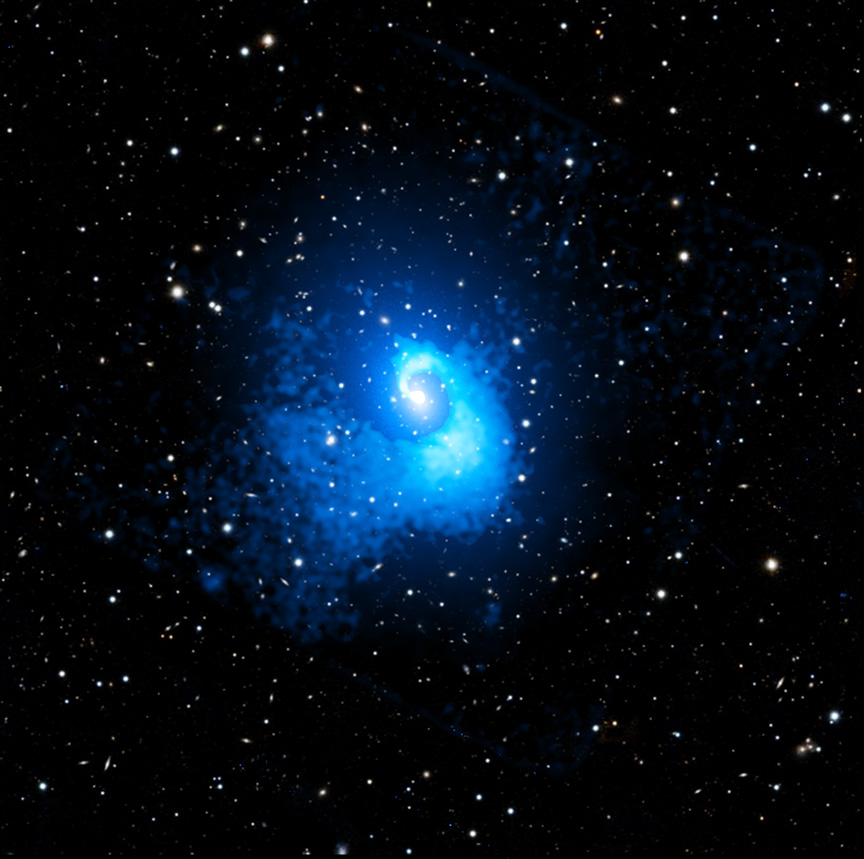
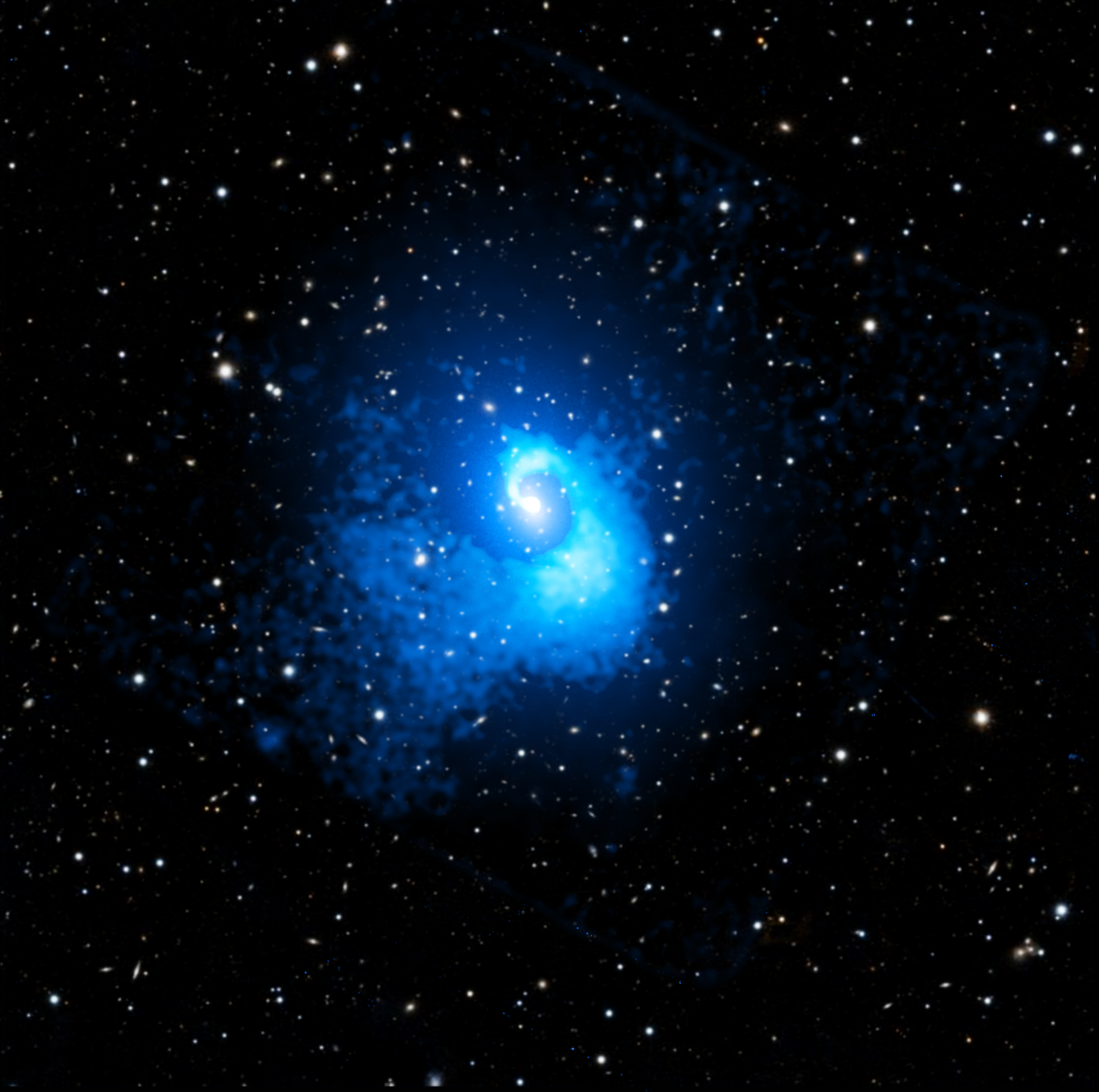
The Chandra data reveal clear signs that this cluster did not have a mundane history. This new composite image shows evidence for the cluster’s previous shenanigans in the nautilus-like shape in the Chandra data (blue). Optical light from stars and galaxies in the same field of view appears mainly white in an image from Pan-STARRS, a telescope in Hawaii.

The team think the spiral shape in the hot gas formed when gas in the cluster sloshed to the side because of the gravitational effects of the cluster collision — similar to how wine moves in a wine glass. The sloshing spiral in Abell 2029 is one of the longest ever seen, extending about two million light-years from the center of the cluster.

Abell 2029, "splash" and "bay" features labeled. Credit: X-ray: NASA/CXC/CfA/C. Watson et al.; Optical: PanSTARRS; Image Processing: NASA/CXC/SAO/N. Wolk and P. Edmonds


Computer simulations of the collision suggest that the smaller cluster was about ten times less massive than the larger cluster. The sloshing spiral formed when the smaller cluster made its first pass through the larger cluster, pulling its gas sideways. The gravity of the larger cluster then caused the other cluster to slow down and get pulled back in for a second collision. This drove a shock front and left behind a wake of material, forming the splash region.

To uncover these various features the authors used a special technique that examined how much the cluster’s hot gas deviates from a symmetrical shape. Most of the hot gas is symmetrical and is approximately shaped like an oval. The authors removed (“subtracted”) this symmetrical oval shape from the original X-ray image. The remaining X-ray emission in the “subtracted image” clearly shows the unusual features of the sloshing spiral, the bay and the splash area. The shock front is too faint to be seen in this image.

The new composite image combines both the original X-ray and the subtracted X-ray images of the deep Chandra observations of Abell 2029. The subtracted X-ray image (light blue) strikingly shows the sloshing spiral. Most of the original X-ray image is a darker blue color, apart from the center of the image, which is light blue. Two other features — the bay and the splash area — are labeled in an annotated version. The brightness of the original image has been reduced in this image to better show the subtracted image.

Courtney Watson conducted this work as a graduate student at BU and a predoctoral fellow at CfA. In addition to Watson, the authors of the paper are Elizabeth Blanton (Boston University), who was the Principal Investigator for the Chandra observations, Scott Randall (CfA), Tracy Clarke (Naval Research Laboratory), and John ZuHone (CfA).

NASA's Marshall Space Flight Center in Huntsville, Alabama, manages the Chandra program. The Smithsonian Astrophysical Observatory's Chandra X-ray Center controls science operations from Cambridge, Massachusetts, and flight operations from Burlington, Massachusetts.

There are several other key pieces of evidence for the past bash, never before seen together in a cluster, allowing the team to trace the collision history of the cluster in unprecedented detail. For example, the team sees hints of a wide “splash” of cooler gas created by the collision. There may also be a shock wave — akin to a sonic boom from a supersonic plane — in the superheated gas left over from the collision. Finally, there is a “bay” feature in the hot gas, which the researchers think might be caused by an overlap between the outer parts of the spiral and gas stripped away from the smaller cluster as it passed through the larger one. Though the authors think it is a relic from the collision, other explanations for this structure are also possible.


Visual Description:

This release features a composite image of a galaxy cluster with a unique spiral shape, giving it the appearance of a giant galactic seashell floating in the star-speckled blackness of space.

In this composite image, the surrounding stars and individual galaxies appear white, captured in optical light from Pan-STARRS, a telescope in Hawaii. But much of the spiraling cluster is rendered in neon blues, representing X-ray gas observed by Chandra. This super-heated gas fills the space between galaxies, giving the cluster its spiral shape when observed by scientists using an X-ray telescope.

Here, the blue spiral begins as a pale blue dot at the center of the cluster. The spiral stream of light and dark neon blue gas then widens as it moves away from the center of the cluster, gently corkscrewing one full rotation as it extends two-million lightyears into the distance.


Fast Facts for Abell 2029

Credit: X-ray: NASA/CXC/CfA/C. Watson et al.; Optical: PanSTARRS; Image Processing: NASA/CXC/SAO/N. Wolk and P. Edmonds
Release Date: May 12, 2026
Scale: Image is about 25 arcmin (7.2 million light-years) across.
Category:
Groups & Clusters of Galaxies
Coordinates (J2000): RA 15h 10m 56.1s | Dec +05° 44´ 40.0"
Constellation:
Virgo
Observation Dates: 24 observations from Apr 12, 2000 to Jun 6, 2023
Observation Time: 143 hours 3 minutes (5 days 23 hours 3 minutes)
Obs. ID: 891, 4977, 6101, 25496, 25814-25826, 26380, 26393, 26420, 26428, 27805, 27853, 27848
Instrument:
ACIS
References: Watson, C.B., et al., 2026, ApJ, 996, 106.
Color Code: X-ray: blue and white; Optical: red, green, and blue
Distance Estimate: About 1.0 billion light-years from Earth (z~0.0767)


Wednesday, April 01, 2026

Sombrero Galaxy: The Universe’s Dusty Brimmed Hat Revealed Like Never Before

PR Image noirlab2612a
Sombrero Galaxy: The Universe’s Dusty Brimmed Hat

PR Image noirlab2612b
Close-up of the central parts of the Sombrero Galaxy


Videos

Cosmoview Episode 107: The Sombrero Galaxy
PR Video noirlab2612a
Cosmoview Episode 107: The Sombrero Galaxy

Cosmoview Episodio 107: Galaxia del Sombrero

PR Video noirlab2612b
Cosmoview Episodio 107: Galaxia del Sombrero

Zooming into the Sombrero Galaxy
PR Video noirlab2612c
Zooming into the Sombrero Galaxy

Pan on the Sombrero Galaxy
PR Video noirlab2612d
Pan on the Sombrero Galaxy


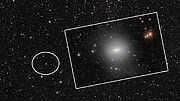
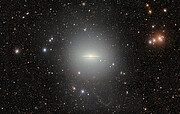
Dark Energy Camera spies the faint glowing features of Messier 104, known as the Sombrero Galaxy

Messier 104, nicknamed the Sombrero Galaxy, is a popular target for amateur observing and astronomical research. Its recognizable extended halo, as well as a faint stellar stream, are captured in exquisite detail in this image from the Department of Energy-fabricated Dark Energy Camera, mounted on the U.S. National Science Foundation Víctor M. Blanco 4-meter Telescope at Cerro Tololo Inter-American Observatory in Chile, a Program of NSF NOIRLab.

The Sombrero galaxy (Messier 104) is a galactic masterpiece that captivates scientists and astronomy enthusiasts alike. Its intricate system of globular star clusters lends insight into stellar populations, and astronomers are intrigued by the supermassive black hole at its center. Its distinctive visual features and relative brightness make it a favorite among amateur astronomers. The fascinating story of its discovery, involving three esteemed astronomers, has earned it a spot on one of the most important lists of deep sky objects. Today, it stands as one of the most iconic galaxies in the night sky.

Messier 104 resides approximately 30 million light-years from Earth in the constellation Virgo (see finder chart). Spanning an impressive 50,000 light-years across, it is among the largest objects of the Virgo Galaxy Cluster. Despite its grandeur, it appears relatively dim in the night sky — just below the threshold of naked-eye visibility, though it can be observed with a small telescope or binoculars.

This image was captured with the 570-megapixel Department of Energy-fabricated Dark Energy Camera (DECam) mounted on the U.S. National Science Foundation Víctor M. Blanco 4-meter Telescope at Cerro Tololo Inter-American Observatory (CTIO) in Chile, a Program of NSF NOIRLab.

The incredible resolution of DECam reveals the Sombrero Galaxy’s striking features. At its core is an intensely bright nucleus, which is surrounded by a swarm of around 2000 globular star clusters. A thin, dark band of cold dust and hydrogen gas traces the perimeter of the disk, where most of the galaxy’s star formation takes place. The moniker “Sombrero Galaxy” comes from its striking resemblance to a sombrero, with its pronounced central bulge and dark dust trail that resemble the lofty crown and expansive brim of the traditional Mexican hat.

Also visible in this image is the galaxy’s enormous glowing halo, which appears to stretch over three times the width of the Sombrero itself. This may be the first time the halo has been captured with this level of detail and at this large a scale. DECam’s incredible sensitivity also captured a sweeping stellar stream extending from the south side of the galaxy. The halo and the stellar stream are populated with stars that have been torn from their home galaxies, hinting at a past galactic merger between the Sombrero and a smaller satellite galaxy.

The story of Messier 104’s discovery is intertwined with the endeavors of several prominent astronomers. It was initially spotted by the French astronomer and comet hunter Pierre Méchain in 1781 when he was an associate of the renowned comet hunter Charles Messier. At that time, Messier was compiling a list of non-cometary celestial objects, now famously known as the Messier Catalogue, to aid other astronomers in distinguishing these objects from passing comets.

Interestingly, Messier 104 did not find its place in the original publication of Messier's list. However, it was later discovered that Messier added it by hand to his personal copy. Independently, in 1784, the well-known astronomer William Herschel also stumbled upon this remarkable galaxy and designated it as H I.43.

It wasn’t until French astronomer Camille Flammarion's subsequent confirmation that these two independent discoveries were the same object that Messier 104 officially earned its place in the Messier Catalogue in 1921. Thus, through the collaborative efforts of these astronomers across different eras, the Sombrero Galaxy has become a celebrated addition to our knowledge of deep sky objects.

Its alluring visual characteristics, coupled with its accessibility to amateur equipment, contribute to Messier 104’s popularity among stargazers. Amateur astronomers often enjoy observing and photographing the Sombrero Galaxy, making it a prime target for citizen science projects and public outreach efforts. It is an excellent subject for sharing the wonders of the Universe with the public and fostering engagement with astronomy and science.


More information

The Dark Energy Camera (DECam) was designed specifically for the Dark Energy Survey (DES). It was funded by the U.S. Department of Energy (DOE) and was built and tested at DOE's Fermilab. To provide new insights into the accelerating expansion of our Universe, the DECam records the motions and distances of galaxies in the distant past. While the full DES study ended in 2019, the camera continues to provide new insights to astronomers and astrophysicists.

NSF NOIRLab, the U.S. National Science Foundation center for ground-based optical-infrared astronomy, operates the International Gemini Observatory (a facility of NSF, NRC–Canada, ANID–Chile, MCTIC–Brazil, MINCyT–Argentina, and KASI–Republic of Korea), NSF Kitt Peak National Observatory (KPNO), NSF Cerro Tololo Inter-American Observatory (CTIO), the Community Science and Data Center (CSDC), and NSF–DOE Vera C. Rubin Observatory (in cooperation with DOE’s SLAC National Accelerator Laboratory). It is managed by the Association of Universities for Research in Astronomy (AURA) under a cooperative agreement with NSF and is headquartered in Tucson, Arizona.

The scientific community is honored to have the opportunity to conduct astronomical research on I’oligam Du’ag (Kitt Peak) in Arizona, on Maunakea in Hawai‘i, and on Cerro Tololo and Cerro Pachón in Chile. We recognize and acknowledge the very significant cultural role and reverence of I’oligam Du’ag (Kitt Peak) to the Tohono O’odham Nation, and Maunakea to the Kanaka Maoli (Native Hawaiians) community.


Links


Contacts:

Josie Fenske
Public Information Officer
NSF NOIRLab
Email:
josie.fenske@noirlab.edu


Tuesday, December 16, 2025

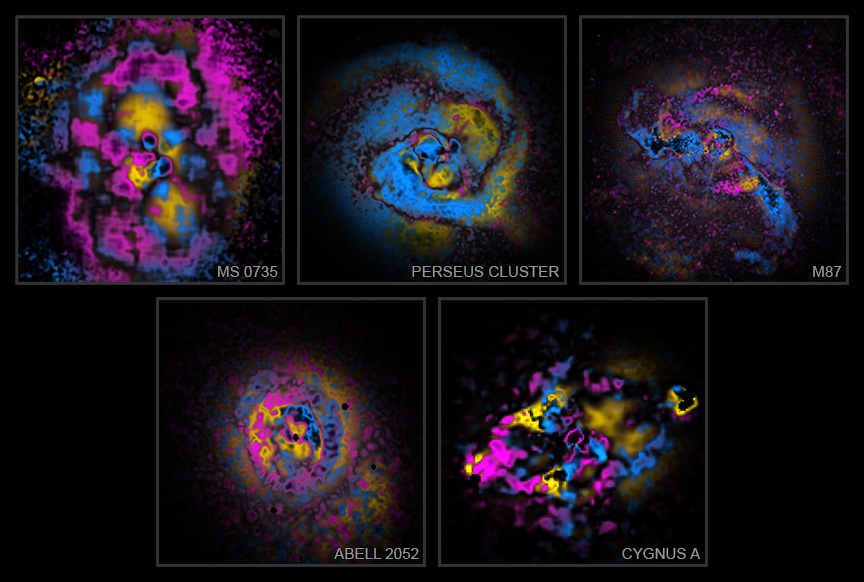
Painting Galaxy Clusters by Numbers (and Physics)

MS 0735.6+7421 - Perseus Cluster - M87 - Abell 2052 - Cygnus A
Credit: X-ray: NASA/CXC/Univ. of Chicago/H. McCall


JPEG (168.9 kb) - Large JPEG (10.5 MB) - Tiff (34.6 MB) - More Images

MS 0735.6+7421 - Perseus Cluster - M87 - Abell 2052 - Cygnus A
Astronomical Images of Objects Processed Using X-arithmetic Technique (Labeled) Credit: X-ray: NASA/CXC/Univ. of Chicago/H. McCall; Image processing: NASA/CXC/SAO/N. Wolk

A Tour of X-arithmetic - More Videos


Galaxy clusters are the most massive objects in the universe held together by gravity, containing up to several thousand individual galaxies and huge reservoirs of superheated, X-ray-emitting gas. The mass of this hot gas is typically about five times higher than the total mass of all the galaxies in galaxy clusters. In addition to these visible components, 80% of the mass of galaxy clusters is supplied by dark matter. These cosmic giants are bellwethers not only for the galaxies, stars and black holes within them, but also for the evolution and growth of the universe itself.

It is no surprise then that NASA’s Chandra X-ray Observatory has observed many galaxy clusters over the lifetime of the mission. Chandra’s X-ray vision allows it to see the enormous stockpiles of hot cluster gas, with temperatures as high as 100 million degrees, with exquisite clarity. This blazing gas tells stories about past and present activity within galaxy clusters.

Many of these galaxy clusters host supermassive black holes at their centers, which periodically erupt in powerful outbursts. These explosions generate jets that are visible in radio wavelengths, which inflate bubbles full of energetic particles; these bubbles carry energy out into the surrounding gas. Chandra’s images have revealed a wealth of other structures formed during these black hole outbursts, including hooks, rings, arcs, and wings. However, appearances alone don’t tell us what these structures are or how they formed.

To tackle this problem, a team of astronomers developed a novel image-processing technique to analyze X-ray data, allowing them to identify features in the gas of galaxy clusters like never before, classifying them by their nature rather than just their appearance. Prior to this technique, which they call “X-arithmetic,” scientists could only identify the nature of some of the features and in a much less efficient way, via studies of the amounts of X-ray energy dispersed at different wavelengths. The authors applied X-arithmetic to 15 galaxy clusters and galaxy groups (these are similar to galaxy clusters but with fewer member galaxies). By comparing the outcome from the X-arithmetic technique to computer simulations, researchers now have a new tool that will help in understanding the physical processes inside these important titans of the universe.

A new paper looks at how these structures appear in different parts of the X-ray spectrum. By splitting Chandra data into lower-energy and higher-energy X-rays and comparing the strengths of each structure in both, researchers can classify them into three distinct types, which they have colored differently. A pink color is given to sound waves and weak shock fronts, which arise from pressure disturbances traveling at close to the speed of sound, compressing the hot gas into thin layers. The bubbles inflated by jets are colored yellow, and cooling or slower-moving gas is blue. The resulting images, “painted” to reflect the nature of each structure, offer a new way to interpret the complex aftermath of black hole activity using only X-ray imaging data. This method works not only on Chandra (and other X-ray) observations, but also on simulations of galaxy clusters, providing a tool to bridge data and theory.

The images in this new collection show the central regions of five galaxy clusters in the sample: Abell 2052 and Cygnus A in the top row and MS 0735+7421, the Perseus Cluster, and M87 in the Virgo Cluster on the bottom row. All of these objects have been released to the public before by the Chandra X-ray Center, but this is the first time this special technique has been applied. The new treatment highlights important differences between the galaxy clusters and galaxy groups in the study.

The galaxy clusters in the study often have large regions of cooling or slow-moving gas near their centers, and only some show evidence for shock fronts. The galaxy groups, on the other hand, are different. They show multiple shock fronts in their central regions and smaller amounts of cooling and slow-moving gas compared to the sample of galaxy clusters.

This contrast between galaxy clusters and galaxy groups suggests that black hole feedback — that is, the interdependent relationship between outbursts from a black hole and its environment — appears stronger in galaxy groups. This may be because feedback is more violent in the groups than in the clusters, or because a galaxy group has weaker gravity holding the structure together than a galaxy cluster. The same outburst from a black hole, with the same power level, can therefore more easily affect a galaxy group than a galaxy cluster.

There are still many open questions about these black hole outbursts. For example, scientists would like to know how much energy they put into the gas around them and how often they occur. These violent events play a key role in regulating the cooling of the hot gas and controlling the formation of stars in clusters. By revealing the physics underlying the structures they leave behind, the X-arithmetic technique brings us closer to understanding the influence of black holes on the largest scales.

A paper describing this new technique and its results has been published in The Astrophysical Journal and is led by Hannah McCall from the University of Chicago. The other authors are Irina Zhuravleva (University of Chicago), Eugene Churazov (Max Planck Institute for Astrophysics, Germany), Congyao Zhang (University of Chicago), Bill Forman and Christine Jones (Center for Astrophysics | Harvard & Smithsonian), and Yuan Li (University of Massachusetts at Amherst).

NASA's Marshall Space Flight Center in Huntsville, Alabama, manages the Chandra program. The Smithsonian Astrophysical Observatory's Chandra X-ray Center controls science operations from Cambridge, Massachusetts, and flight operations from Burlington, Massachusetts.


Visual Description:

This release includes two sets of images featuring galaxy clusters. The first set of five images are traditional composite renderings. The second set of images features the same galaxy clusters rendered with a new image-processing technique called "X-arithmetic".

The traditional composite renderings share many visual similarities with digital photography; the images are relatively crisp, and feature cloud-like objects with blended colors, set against black backgrounds, dotted with distant specks of light. The X-arithmetic images are more visually similar to color MRI scans; they feature pixelated objects with distinct patches of vibrant color, set against neutral black backgrounds.

The first image in the two sets features the seemingly spherical galaxy cluster Abell 2052. In the composite rendering, the cluster resembles a pink rose in a cloud of powder blue haze. In the X-arithmetic rendering, interwoven pockets of hot pink, neon blue, and golden yellow appear brighter near the center, and somewhat muted near the outer edges.

The second image in the two sets features Cygnus A, a galaxy cluster with jets blasting in opposite directions out of a central black hole. In the composite image, the black hole appears as bright white light, the cluster resembles a neon blue cloud, and the jets exiting the cluster are surrounded by plumes resembling red smoke. In the X-arithmetic rendering, Cygnus A is depicted as a marbled ball of pixelated pockets in neon pink, blue, and golden yellow.

The third image in the sets features the galaxy cluster MS 0735. In the composite rendering, a vertical red cloud squiggle with a bright yellow dot in the center, is surrounded by a faint blue haze. In the X-arithmetic rendering, large pockets of yellow are surrounded by irregular hot pink shapes and dappled pockets of blue, which grow more granular near the outer edges.

The fourth pair of images feature the Perseus Cluster. The composite rendering resembles the view down a swirling cone of pink cotton candy, with a collection of dark blue filaments at the distant center. In the X-arithmetic rendering, the cluster resembles a corkscrew swirl of neon blue water, dotted with pink flecks, and blobs of golden yellow.

The fifth and final pair of images feature the galaxy cluster M87. In the composite rendering, the cluster is presented as ethereal overlapping clouds in purple, red, and white, with a golden orange embryonic shape at the core. The X-arithmetic rendering of the same cluster resembles a faint yellow cloud, digitally spattered with blue and pink pixels.


Fast Facts for MS 0735.6+7421:

Credit: X-ray: NASA/CXC/Univ. of Chicago/H. McCall
Release Date: December 9, 2025
Scale: Image is about 4.0 arcmin (2.8 million light-years) across.
Category: Groups and Clusters of Galaxies
Coordinates (J2000): RA 07h 41m 50.20s | Dec +74° 14´ 51.00"
Constellation: Camelopardalis
Observation Dates: 9 observations from Nov 2003 to Jan 2015
Observation Time: 149 hours 27 minute (6 days 5 hours 27 minutes)
Obs. ID: 4197, 10468-10471, 10822, 10918, 10922, 16275
Instrument:
ACIS
References: McCall, H. et al, 2025, ApJ, 989,159; DOI 10.3847/1538-4357/adea67
Color Code: X-ray: pink, yellow, blue
Distance Estimate: About 2.6 billion light-years from Earth


Fast Facts for Perseus Cluster:

Credit: X-ray: NASA/CXC/Univ. of Chicago/H. McCall
Release Date: December 9, 2025
Scale: Image is about 6 arcmin (410,000 light-years) across.
Category: Groups and Clusters of Galaxies
Coordinates (J2000): RA 3h 19m 47.60 | Dec +41° 30´ 37.00"
Constellation: Perseus
Observation Dates: 16 observations from Aug 2002 to Dec 2009
Observation Time: 330 hours 14 minutes (13 days 18 hours 14 minutes)
Obs. ID: 3209, 4289, 4946-4949, 6139, 4951-4953, 6139, 6145, 6146, 11713-11716
Instrument: ACIS
References: McCall, H. et al, 2025, ApJ, 989,159; DOI 10.3847/1538-4357/adea67
Color Code: X-ray: pink, yellow, blue
Distance Estimate: About 240 million light-years from Earth


Fast Facts for M87:

Credit: X-ray: NASA/CXC/Univ. of Chicago/H. McCall
Release Date: December 9, 2025v Scale: Image is about 15 arcmin (230,000 light-years) across.
Category: Groups and Clusters of Galaxies
Coordinates (J2000): RA 12h 30m 49.19s | Dec +12° 22´ 47.86"
Constellation: Virgo
Observation Dates: 10 observations from Jul 2003 to Apr 2010
Observation Time: 174 hours 26 minutes (7 days 6 hours 26 minutes)
Obs. ID: 2707, 3717, 5826-5828, 6186, 7210-7212, 11783
Instrument: ACIS
References: McCall, H. et al, 2025, ApJ, 989,159; DOI 10.3847/1538-4357/adea67
Color Code: X-ray: pink, yellow, blue
Distance Estimate: About 54 million light-years from Earth


Fast Facts for Abell 2052:

Credit: X-ray: NASA/CXC/Univ. of Chicago/H. McCall
Release Date: December 9, 2025
Scale: Image is about 4.4 arcmin (600,000 light-years) across.
Category: Groups and Clusters of Galaxies
Coordinates (J2000): RA 15h 16m 44.40s | Dec +07° 01´ 20.00"
Constellation: Serpens
Observation Dates: 10 observations from Mar, 2006 to Jun, 2009
Observation Time: 171 hours 28 minutes (7 days 3 hours 28 minutes)
Obs. ID: 5807, 10477-10480, 10879, 10914-10917
Instrument: ACIS
References: McCall, H. et al, 2025, ApJ, 989,159; DOI 10.3847/1538-4357/adea67
Color Code: X-ray: pink, yellow, blue
Distance Estimate: About 480 million light-years from Earth


Fast Facts for Cygnus A:

Credit: X-ray: NASA/CXC/Univ. of Chicago/H. McCall
Release Date: December 9, 2025
Scale: Image is about 3.4 arcmin (740,000 light-years) across.
Category: Groups and Clusters of Galaxies
Coordinates (J2000): RA 19h 59m 28.3s | Dec +44° 44´ 02"
Constellation: Cygnus
Observation Dates: 26 observations from Feb 2005 to May 2017
Observation Time: 221 hours 5 minutes (9 days 5 hours 5 minutes)
Obs. ID: 5830, 5831, 6225, 6226, 6228, 6229, 6250, 6252, 17133-17136, 17507-17514, 18688, 18871, 19989, 19996, 20077, 20079
Instrument: ACIS
References: McCall, H. et al, 2025, ApJ, 989,159; DOI 10.3847/1538-4357/adea67
Color Code: X-ray: pink, yellow, blue
Distance Estimate: About 760 million light-years from Earth

Tuesday, November 18, 2025

Finding star clusters in the Lost Galaxy

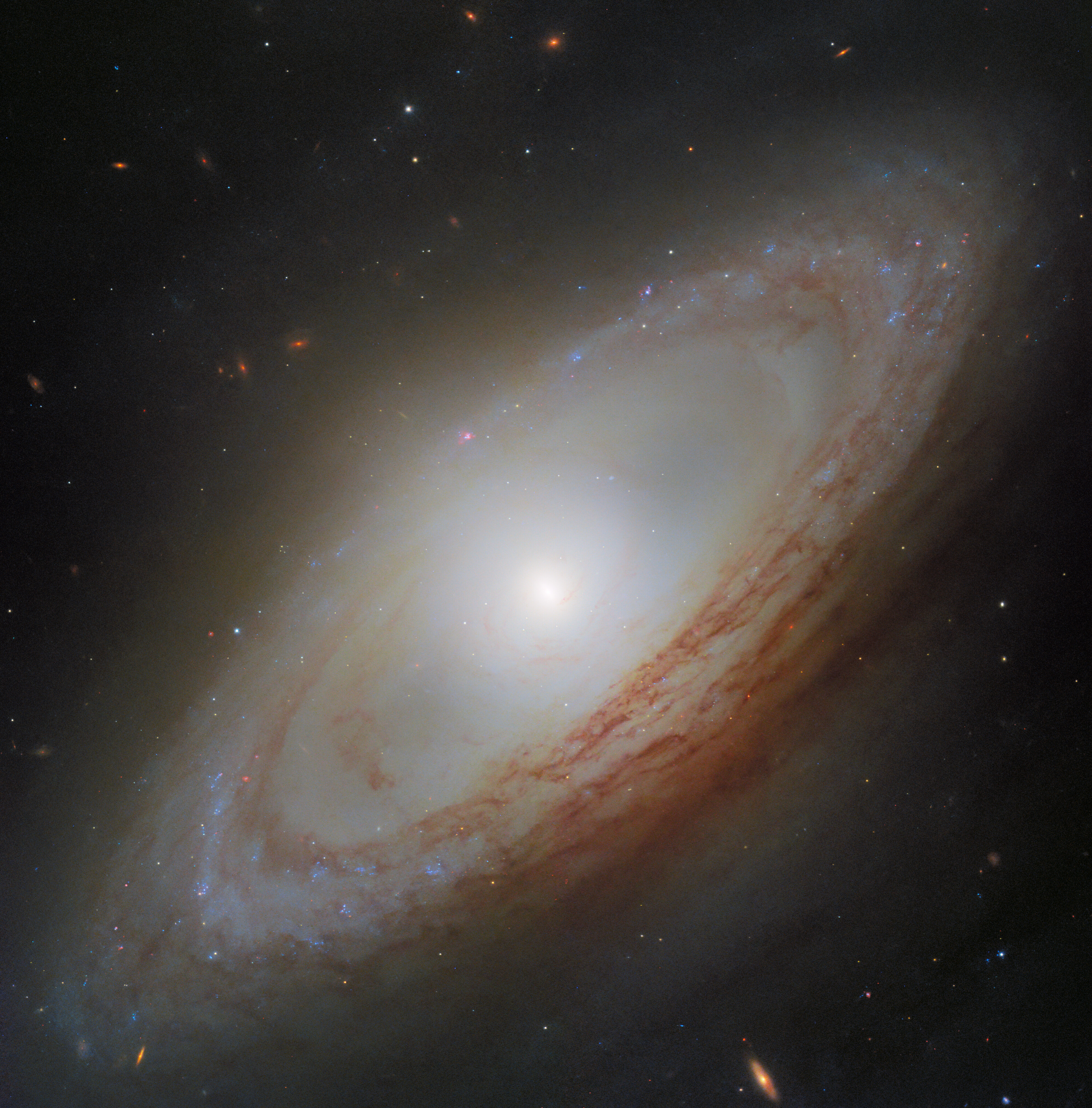
A close-in view of a spiral galaxy that faces the viewer. Brightly lit spiral arms swing outwards through the galaxy’s disc, starting from an elliptical region in the centre. Thick strands of dark reddish dust are spread across the disc, mostly following the spiral arms. The arms also contain many glowing pink-red spots where stars form. The galaxy is a bit fainter beyond the arms, but speckled with blue stars. Credit: ESA/Hubble & NASA, F. Belfiore, J. Lee and the PHANGS-HST Team

Today’s ESA/Hubble Picture of the Week features the spiral galaxy NGC 4535, which is situated about 50 million light-years away in the constellation Virgo (The Maiden). This galaxy has been nicknamed the ‘Lost Galaxy’ because it’s extremely faint when viewed through a small telescope. With a mirror spanning 2.4 metres across, Hubble is well equipped to observe dim galaxies like NGC 4535 and pick out features like its massive spiral arms and central bar of stars.

On full display in this Hubble image are NGC 4535’s young star clusters, which dot the galaxy’s spiral arms. Many of the groupings of bright blue stars are enclosed by glowing pink clouds. These clouds, called H II (‘H-two’) regions, are a sign that the galaxy is home to especially young, hot, and massive stars that are blazing with high-energy radiation. By heating the clouds in which they were born, shooting out powerful stellar winds, and eventually exploding as supernovae, massive stars certainly shake up their surroundings.

This Hubble image incorporates data from an observing programme that will catesa/alogue roughly 50 000 H II regions in nearby star-forming galaxies like NGC 4535. A previous image of NGC 4535 was released in 2021. Both the 2021 image and today’s image incorporate observations from the PHANGS programme, which seeks to understand the connections between young stars and cold gas. Today’s image adds a new dimension to our understanding of NGC 4535 by capturing the brilliant red glow of the nebulae that encircle massive stars in their first few million years of life.


Wednesday, April 02, 2025

A galaxy that gives great feedback

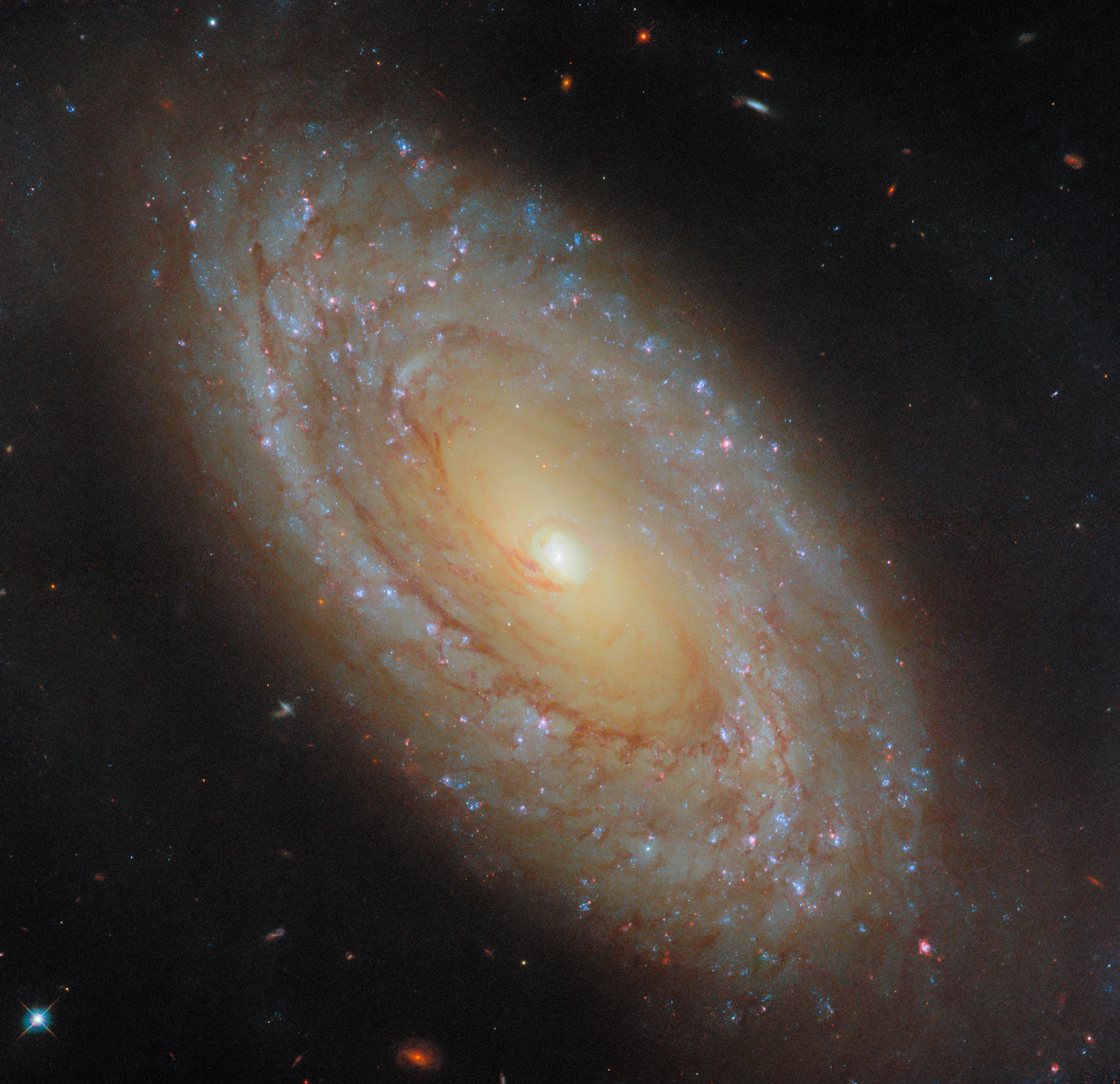
A spiral galaxy seen at a diagonal angle. Its very centre is a bright white glowing orb, surrounded by an inner disc of golden light. This is wrapped in a broad outer disc that glows more dimly, with patchy, broken spiral arms swirling around it, filled with small blue and pink star clusters. Dark reddish threads of dust also spiral through the disc, with some strands reaching into the core. Credit: ESA/Hubble & NASA, D. Thilker

This NASA/ESA Hubble Space Telescope Picture of the Week features the picturesque spiral galaxy NGC 4941, which lies about 67 million light-years from Earth in the constellation Virgo (The Maiden). Because this galaxy is nearby, cosmically speaking, Hubble’s keen instruments are able to pick out exquisite details such as individual star clusters and filamentary clouds of gas and dust.

The data used to construct this image were collected as part of an observing programme that investigates the star formation and stellar feedback cycle in nearby galaxies. As stars form in dense, cold clumps of gas, they begin to influence their surroundings. Stars heat and stir up the gas clouds in which they are born through winds, starlight, and — eventually, for massive stars — by exploding as supernovae. These processes are collectively called stellar feedback, and they impact the rate at which a galaxy can form new stars.

As it turns out, stars aren’t the only entities providing feedback in NGC 4941. At the heart of this galaxy lies an active galactic nucleus: a supermassive black hole feasting on gas. As the black hole amasses gas from its surroundings, the gas swirls into a superheated disc that glows brightly at wavelengths across the electromagnetic spectrum. Similar to stars — but on a much, much larger scale — active galactic nuclei shape their surroundings through winds, radiation, and powerful jets, altering not only star formation but also the evolution of the galaxy as a whole.


Tuesday, March 11, 2025

A spiral and a star

A spiral galaxy seen face-on. Broken spiral arms made of blue patches of stars and thin strands of dark dust swirl around the galaxy’s centre, forming a broad, circular disc. An extended circular halo surrounds the disc. The centre is a brightly-glowing, stubby bar-shaped area in a pale yellow colour. A bright star in our own galaxy, with long cross-shaped diffraction spikes, is visible atop the distant galaxy. Credit: ESA/Hubble & NASA, S. J. Smartt, C. Kilpatrick

This NASA/ESA Hubble Space Telescope Picture of the Week features a sparkling spiral galaxy paired with a prominent star, both in the constellation Virgo. While the galaxy and the star appear to be close to one another, even overlapping, they’re actually a great distance apart. The star, which is marked with four long diffraction spikes, is in our own galaxy. It’s just 7109 light-years away from Earth. The galaxy, which is named NGC 4900, lies about 45 million light-years from Earth.

This image combines data from two of Hubble’s instruments: the Advanced Camera for Surveys, which was installed in 2002 and is still in operation today, and the older Wide Field and Planetary Camera 2, which was in use from 1993 to 2009. The data used here were taken more than 20 years apart for two different observing programmes — a real testament to Hubble’s long scientific lifetime!

Both programmes aimed to understand the demise of massive stars. In one, researchers studied the sites of past supernovae, aiming to estimate the masses of the stars that exploded and investigate how supernovae interact with their surroundings. NGC 4900 was selected for study because it hosted a supernova named SN 1999br.

In the other programme, researchers laid the groundwork for studying future supernovae by collecting images of more than 150 nearby galaxies. After a supernova is detected in one of these galaxies, researchers can examine these images, searching for a star at the location of the supernova. Identifying a supernova progenitor star in pre-explosion images gives valuable information about how, when and why supernovae occur.


Sunday, October 13, 2024

Interacting Galaxies NGC 5366 & PGC 49574

Interacting Galaxies NGC 5366 & PGC 49574

Images: Low Res.(68.4 KB) / Mid Res(1.17 MB) / High Res.(9.94 MB)

Detail:A wide variety of galaxy interactions exist in the Universe. NGC 5366, the face-on galaxy at the top of the image, and PGC 49574, the edge-on galaxy at the bottom, are a rare pair of interacting galaxies located in the constellation Virgo. In addition to the difference in galactic disk inclination, the two galaxies show contrasting colors. In NGC 5366, star-forming regions appear blue, while in PGC 49574, the dark dust lane of the galactic disk looks reddish. The gravitational interaction between these galaxies has created the widely extended tail-like structures.

Distance from Earth: About 420 million light-years
Instrument: Hyper Suprime-Cam (HSC)


Wednesday, July 03, 2024

A maelstrom of matter and energy

A spiral galaxy, tilted diagonally. It has thick, cloudy spiral arms wrapping around the core. They are filled with pink patches marking new star formation, young blue stars, and dark wisps of dust that block light. The galaxy glows brightly from its core. It is on a dark background, with a few distant galaxies and unrelated stars around it. Credit: ESA/Hubble & NASA, D. Thilker, M. Zamani (ESA/Hubble)

This Picture of the Week from the NASA/ESA Hubble Space Telescope depicts the galaxy NGC 4951, a spiral galaxy that’s located 49 million light-years from Earth in the constellation Virgo.

The data used to make this image were captured by Hubble as part of a programme to examine how matter and energy travel in nearby galaxies. Galaxies continuously undergo a cycle of star formation whereby the gas in a galaxy forms molecular clouds, which collapse to create new stars, which then disperse the clouds they formed from with powerful radiation or stellar winds in a process called feedback. The remaining gas is left to form new clouds elsewhere. This cycle of moving matter and energy determines how fast a galaxy forms stars and how quickly it burns through its supplies of gas — that is, how it evolves over the course of its life. Understanding this evolution depends on the nebulae, stars and star clusters in the galaxy: when they formed and their past behaviour. Hubble has always excelled at measuring populations of stars, and the task of tracking gas and star formation in galaxies including NGC 4951 is no exception.

NGC 4951 is also a Seyfert galaxy, a type of galaxy that has a very bright and energetic nucleus called an active galactic nucleus. This image demonstrates well how energetic the galaxy is, and some of the dynamic galactic activity which transports matter and energy throughout it: a shining core surrounded by swirling arms, glowing pink star-forming regions, and thick dust.

Links

Saturday, May 04, 2024

On the hunt for X-rays

A spiral galaxy viewed tilted at a diagonal angle. The core and the disc of the galaxy are different colours, but are otherwise difficult to tell apart, with the disc having wispy, ragged edges and many arcs of glowing star-forming patches. A few distant galaxies can be seen in the background around the spiral galaxy, as well as several foreground stars. Credit: ESA/Hubble & NASA, M. Sun

Featured in this Hubble Picture of the Week this week is the dwarf galaxy IC 776. This swirling collection of stars new and old is located in the constellation Virgo — in fact, in the Virgo galaxy cluster — 100 million light-years from Earth. While a dwarf galaxy, it's also been classified as an SAB-type or ‘weakly barred’ spiral, one study naming it a “complex case” in morphology. This highly detailed view from Hubble demonstrates that complexity well. IC 776 has a ragged, disturbed disc that nevertheless looks to spiral around the core, and arcs of star-forming regions.

This image is from an observation programme dedicated to the study of dwarf galaxies in the Virgo cluster, searching for sources of X-rays in such galaxies. X-rays are often emitted by accretion discs, where material that is drawn into a compact object by gravity crashes together and forms a hot, glowing disc. The compact object can be a white dwarf or neutron star in a binary pair, stealing material from its companion star, or it can be the supermassive black hole at the heart of a galaxy, devouring all around it. Dwarf galaxies like IC 776, travelling through the Virgo cluster, experience a pressure from the intergalactic gas which can both stimulate star formation and feed the central black hole in a galaxy. That can create energetic accretion discs, hot enough to emit X-rays.

While Hubble is not able to see X-rays, it can coordinate with X-ray telescopes such as NASA’s Chandra, revealing the sources of this radiation in high resolution using visible light. Dwarf galaxies are thought to be very important for our understanding of cosmology and the evolution of galaxies. As with many areas of astronomy, the ability to examine these galaxies across the electromagnetic spectrum is critical to their study.

Link


Thursday, April 13, 2023

First Ever 3D Map of Messier 87 Galaxy Assembled

An image of the M87 galaxy captured with nasa's hubble space telescope.
Credit: NASA, ESA, Hubble Heritage Team (STScI/AURA); Acknowledgment: P. Cote (Herzberg Institute of Astrophysics), E. Baltz (Stanford University)

Maunakea, Hawaiʻi A UC Berkeley-led team of astronomers has for the first time measured the three-dimensional shape of Messier 87 (M87), one of the biggest and closest elliptical galaxies to us. New data from W. M. Keck Observatory on Maunakea in Hawaiʻi show M87 isn’t perfectly symmetrical after all, but rather triaxial – similar to the uneven shape of a potato.

The study is published in The Astrophysical Journal Letters.

Located about 55 million light-years away from Earth in the constellation Virgo, M87 is close enough to see using binoculars or a small telescope. As with most celestial objects viewed from our vantage point, M87 appears flat.
The galaxy’s true form revealed itself through the lens of Keck Observatory’s cutting-edge instrument called the Keck Cosmic Web Imager (KCWI), which captures 3D data as opposed to the traditional 2D image or spectrum from conventional instruments.

The researchers used KCWI along with star brightness measurements of M87 from NASA’s Hubble Space Telescope to assemble a 3D view of the motion of stars orbiting M87’s supermassive black hole, named Pōwehi by Larry Kimura, a Hawaiian language professor at the University of Hawaiʻi at Hilo. This provided fresh insight into the galaxy’s shape and allowed the team to calculate with higher precision Pōwehi’s mass, which came out to about 5.4 billion times the mass of the Sun. Previous measurements taken in 2017 when the Event Horizon Telescope (EHT) snapped a direct image of Pōwehi found its mass to be about 6.5 billion solar masses.

Pōwehi means ‘embellished dark source of unending creation’ in Hawaiian and is the world’s first black hole to have its picture taken using EHT’s network of telescopes around the planet, including two Maunakea Observatories – the James Clerk Maxwell Telescope and the Submillimeter Array.


A photo of the huge elliptical galaxy M87 [left] is compared to its three-dimensional shape as gleaned from meticulous observations made with the Hubble and Keck telescopes [right]. Because the galaxy is too far away for astronomers to employ stereoscopic vision, they instead followed the motion of stars around the center of M87, like bees around a hive. This created a three-dimensional view of how stars are distributed within the galaxy. Credit: NASA, ESA, Joseph Olmsted (STScI), Frank Summers (STScI), Chung-Pei Ma (UC Berkeley)

While KCWI was unable to resolve the individual stars due to M87’s great distance from Earth, it was able to obtain spectra that revealed the range of the stars’ velocities as they whizzed around Pōwehi.

“It’s sort of like looking at a swarm of 100 billion bees that are going around in their own happy orbits,” said Chung-Pei Ma, a UC Berkeley professor of astronomy and of physics who led the research team. “Though we are looking at them from a distance and can’t discern individual bees, we are getting very detailed information about their collective velocities. It’s really the superb sensitivity of this spectrograph that allowed us to map out M87 so comprehensively.”

Ma, UC Berkeley graduate student and lead author of the study Emily Liepold, and Jonelle Walsh at Texas A&M University pointed the Keck II telescope at 62 locations across the galaxy and captured KCWI spectra of stars covering a region spanning 70,000 light years across. Gravity in the central 3,000 light-years of this region is largely dominated by Pōwehi. This marked the first time KCWI has been used to reconstruct the geometry of a distant galaxy.

“The Keck data are so good that we can measure the intrinsic shape of M87 along with the black hole at the same time,” said Ma. “We made the first measurement of the actual 3D shape of the galaxy. And since we allowed the swarm of bees to have a more general shape than just a sphere or disk, we have a more robust dynamical measurement of the mass of the central black hole that is governing the bees’ orbiting velocities.”

Ma’s team was also able to measure M87’s rotation, which clocks in at a relatively sedate 25 kilometers per second.

The new findings pave the way for an exciting investigation into M87 that wasn’t possible before – determining Pōwehi’s spin.

“Now that we know the direction of the net rotation of stars in M87 and have an updated mass of the black hole, we can combine this information with the amazing data from the EHT team to constrain the spin,” said Ma. “This may point toward a certain direction and range of spin for the black hole, which would be remarkable.”


Learn more:


About KCWI

The Keck Cosmic Web Imager (KCWI) is designed to provide visible band, integral field spectroscopy with moderate to high spectral resolution formats and excellent sky-subtraction. The astronomical seeing and large aperture of the telescope enables studies of the connection between galaxies and the gas in their dark matter halos, stellar relics, star clusters, and lensed galaxies. Support for this project was provided by the National Science Foundation, Heising-Simons Foundation, and Mt. Cuba Astronomical Foundation.

About W. M. Keck Observatory

The W. M. Keck Observatory telescopes are among the most scientifically productive on Earth. The two 10-meter optical/infrared telescopes atop Maunakea on the Island of Hawaii feature a suite of advanced instruments including imagers, multi-object spectrographs, high-resolution spectrographs, integral-field spectrometers, and world-leading laser guide star adaptive optics systems. Some of the data presented herein were obtained at Keck Observatory, which is a private 501(c) 3 non-profit organization operated as a scientific partnership among the California Institute of Technology, the University of California, and the National Aeronautics and Space Administration. The Observatory was made possible by the generous financial support of the W. M. Keck Foundation. The authors wish to recognize and acknowledge the very significant cultural role and reverence that the summit of Maunakea has always had within the Native Hawaiian community. We are most fortunate to have the opportunity to conduct observations from this mountain.