Showing posts with label NGC 7496. Show all posts

Monday, October 13, 2025

A well-studied spiral

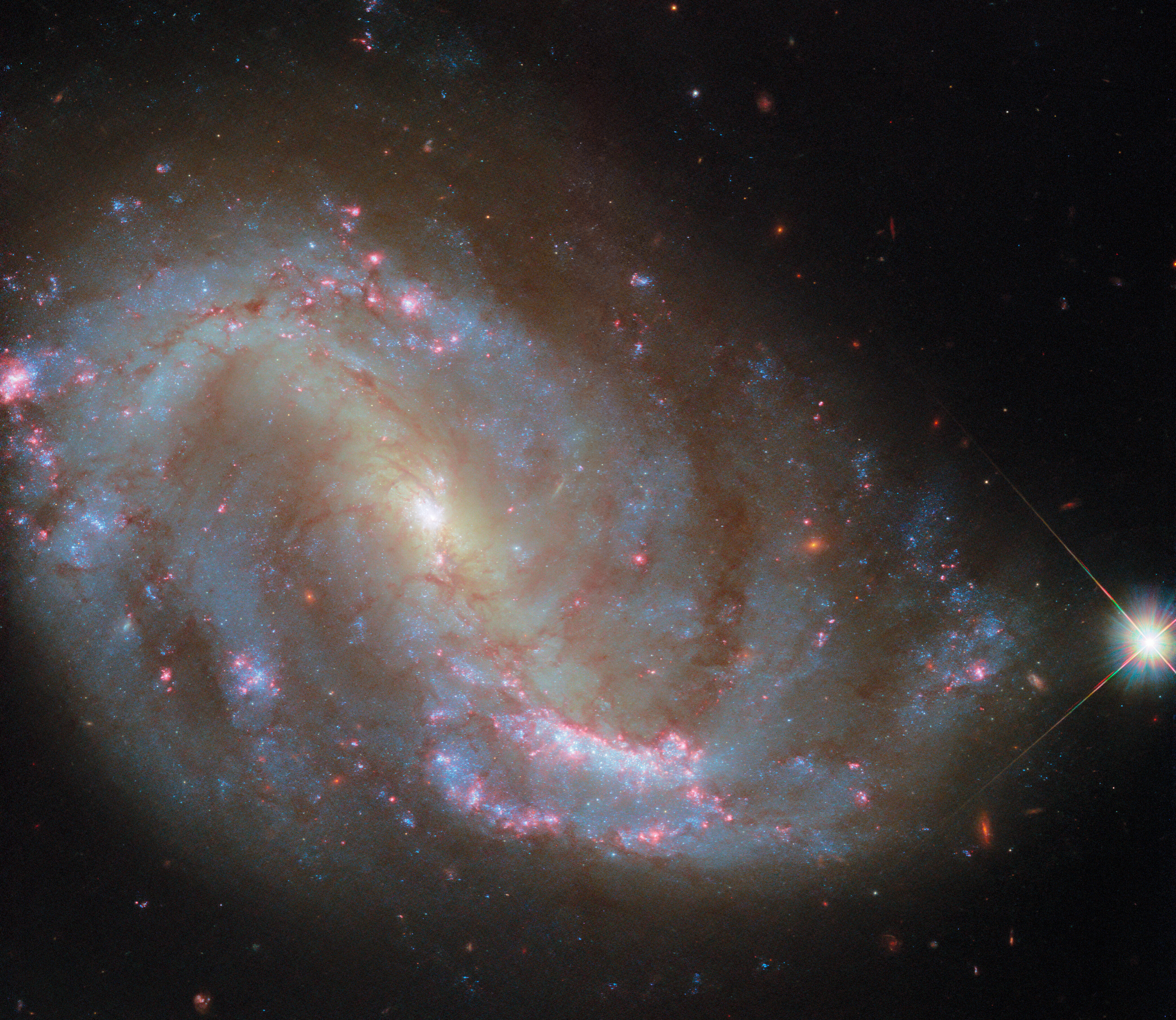
A spiral galaxy featuring a bright, glowing core that is crossed by a horizontal bar of yellowish light. Spiral arms emerge from each end of this bar and wrap around it, creating a disc that is stretched out to the right. Some areas, mostly along the arms, glow pink where stars are forming in nebulae. Webs of dark reddish dust also follow the arms. A star in our galaxy shines prominently, off to the right. Credit: ESA/Hubble & NASA, R. Chandar, J. Lee and the PHANGS-HST team

The celestial object that is displayed in this NASA/ESA Hubble Space Telescope Picture of the Week is NGC 7496, a galaxy located over 24 million light-years away in the constellation Grus (The Crane). NGC 7496 is a dusty spiral galaxy with a bar of stars stretching across its centre. Adding to its intrigue is an active galactic nucleus: a supermassive black hole that feasts on gas at the very heart of the galaxy. Astronomers have observed NGC 7496 at wavelengths from radio to ultraviolet in order to study the galaxy’s active galactic nucleus, dust clouds, and star formation. Hubble first observed this galaxy as part of the Physics at High Angular resolution in Nearby GalaxieS (PHANGS) programme. This programme has enlisted the abilities of several powerful astronomical observatories, including the Atacama Large Millimetre/submillimetre Array (ALMA), the Very Large Telescope, and the NASA/ESA/CSA James Webb Space Telescope, in addition to Hubble. NGC 7496 was the first galaxy in the PHANGS sample that Webb observed.

Each of these observatories offers a different perspective on this well-studied galaxy. With its unique ultraviolet capabilities and fine resolution, Hubble’s view reveals young star clusters bursting with high-energy radiation. Hubble’s observations of NGC 7496 help to reveal the ages and masses of these young stars, as well as the extent to which their starlight is blocked by dust.

A previous Hubble image of NGC 7496 was released in 2022. Today’s image incorporates new data that highlight the galaxy’s star clusters, which are surrounded by glowing red clouds of hydrogen gas. Astronomers collected these data in order to study nebulae like those that massive stars leave behind when they explode as supernovae and those from which newborn stars are made.


Thursday, February 16, 2023

NASA’s Webb Reveals Intricate Networks of Gas and Dust in Nearby Galaxies

NGC 1433 (MIRI Image)
Credits: Science: NASA, ESA, CSA, Janice Lee (NOIRLab)
Image Processing: Alyssa Pagan (STScI)

NGC 7496 (MIRI Image)
Science: NASA, ESA, CSA, Janice Lee (NOIRLab)
Image Processing: Joseph DePasquale (STScI)

NGC 1365 (MIRI Image)
Credits: Science: NASA, ESA, CSA, Janice Lee (NOIRLab)
Image Processing: Alyssa Pagan (STScI)


Researchers using NASA’s James Webb Space Telescope are getting their first look at star formation, gas, and dust in nearby galaxies with unprecedented resolution at infrared wavelengths. The data has enabled an initial collection of 21 research papers which provide new insight into how some of the smallest-scale processes in our universe – the beginnings of star formation – impact the evolution of the largest objects in our cosmos: galaxies.

The largest survey of nearby galaxies in Webb’s first year of science operations is being carried out by the Physics at High Angular resolution in Nearby Galaxies (PHANGS) collaboration, involving more than 100 researchers from around the globe. The Webb observations are led by Janice Lee, Gemini Observatory chief scientist at the National Science Foundation’s NOIRLab and affiliate astronomer at the University of Arizona in Tucson.

The team is studying a diverse sample of 19 spiral galaxies, and in Webb’s first few months of science operations, observations of five of those targets – M74, NGC 7496, IC 5332, NGC 1365, and NGC 1433 – have taken place. The results are already astounding astronomers.

“The clarity with which we are seeing the fine structure certainly caught us by surprise,” said team member David Thilker of Johns Hopkins University in Baltimore, Maryland.

“We are directly seeing how the energy from the formation of young stars affects the gas around them, and it’s just remarkable,” said team member Erik Rosolowsky of the University of Alberta, Canada.

The images from Webb’s Mid-Infrared Instrument (MIRI) reveal the presence of a network of highly structured features within these galaxies – glowing cavities of dust and huge cavernous bubbles of gas that line the spiral arms. In some regions of the nearby galaxies observed, this web of features appears built from both individual and overlapping shells and bubbles where young stars are releasing energy.

“Areas which are completely dark in Hubble imaging light up in exquisite detail in these new infrared images, allowing us to study how the dust in the interstellar medium has absorbed the light from forming stars and emitted it back out in the infrared, illuminating an intricate network of gas and dust,” said team member Karin Sandstrom of the University of California, San Diego.

The high-resolution imaging needed to study these structures has long evaded astronomers – until Webb came into the picture. “The PHANGS team has spent years observing these galaxies at optical, radio, and ultraviolent wavelengths using NASA’s Hubble Space Telescope, the Atacama Large Millimeter/Submillimeter Array, and the Very Large Telescope’s Multi Unit Spectroscopic Explorer,” added team member Adam Leroy of the Ohio State University. “But, the earliest stages of a star’s lifecycle have remained out of view because the process is enshrouded within gas and dust clouds.”

Webb’s powerful infrared capabilities can pierce through the dust to connect the missing puzzle pieces.

For example, specific wavelengths observable by MIRI (7.7 and 11.3 microns) and Webb’s Near-Infrared Camera (3.3 microns) are sensitive to emission from polycyclic aromatic hydrocarbons, which play a critical role in the formation of stars and planets. These molecules were detected by Webb in the first observations by the PHANGS program.

Studying these interactions at the finest scale can help provide insights into the larger picture of how galaxies have evolved over time.

“Because these observations are taken as part of what's called a treasury program, they are available to the public as they are observed and received on Earth,” said Eva Schinnerer of the Max Planck Institute for Astronomy in Heidelberg, Germany, and leader of the PHANGS collaboration.

The PHANGS team will work to create and release data sets that align Webb’s data to each of the complementary data sets obtained previously from the other observatories, to help accelerate discovery by the broader astronomical community.

“Thanks to the telescope's resolution, for the first time we can conduct a complete census of star formation, and take inventories of the interstellar medium bubble structures in nearby galaxies beyond the Local Group,” Lee said. “That census will help us understand how star formation and its feedback imprint themselves on the interstellar medium, then give rise to the next generation of stars, or how it actually impedes the next generation of stars from being formed.”

The research by the PHANGS team is being conducted as part of General Observer program 2107. The team’s initial findings, comprised of 21 individual studies, were recently published in a special focus issue of The Astrophysical Journal Letters.

The James Webb Space Telescope is the world's premier space science observatory. Webb will solve mysteries in our solar system, look beyond to distant worlds around other stars, and probe the mysterious structures and origins of our universe and our place in it. Webb is an international program led by NASA with its partners, ESA (European Space Agency), and CSA (Canadian Space Agency).


About This Release

Credits:

Media Contact:

Hannah Braun
Space Telescope Science Institute, Baltimore, Maryland

Christine Pulliam
Space Telescope Science Institute, Baltimore, Maryland

Science:

Janice Lee (NOIRLab), Eva Schinnerer

Permissions: Content Use Policy

Contact Us: Direct inquiries to the News Team.

Related Links and Documents: