Showing posts with label constellation Coma Berenices. Show all posts

Tuesday, June 09, 2026

Journey to the centre of a galaxy cluster

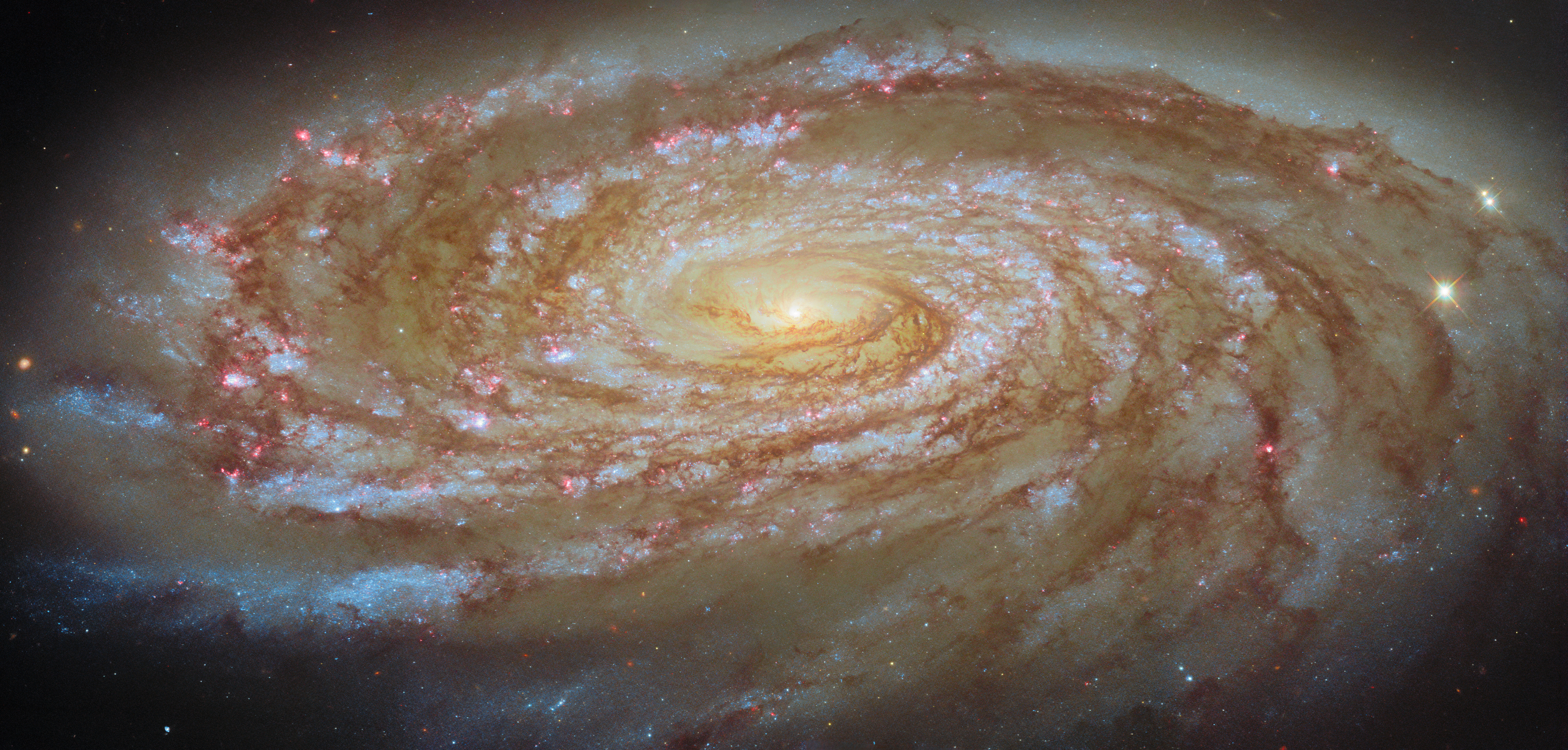
A large spiral galaxy. It is seen tilted at an angle, so that it is foreshortened and appears very wide. Its tightly-wound, blue spiral arms swirl out from its glowing centre, spreading apart at the tips. They are followed by strands and clumps of dark red dust, and spotted with pink dots where stars are forming in clouds of gas. The galaxy is surrounded by a slight glow and lies on a dark background. Credit: ESA/Hubble & NASA, D. Thilker and the MAUVE-HST Team


The focus of today’s ESA/Hubble Picture of the Month is an active spiral galaxy on a journey lasting hundreds of millions of years. The galaxy Messier 88 (M88), which is also known as NGC 4501, is located about 63 million light-years away in the constellation Coma Berenices (Berenice’s Hair).

M88 is an active galaxy, which means that its centre harbours a supermassive black hole that is snacking on gas and dust. This black hole is estimated to be around 100 million times as massive as the Sun, and it appears to be powering outflows of gas from the galaxy’s centre.

Around this black hole is a population of old, reddish stars that give M88 its warmly glowing heart. Spreading out from the centre are several tightly wound, symmetrical spiral arms, each outlined by sparkling pink and blue star clusters and knotted clouds of dust. We see M88 from an angle so that it appears elongated, and its spiral arms delicately fan out before it.

M88 is a member of the Virgo Cluster, a collection of more than a thousand galaxies held together by gravity — and therefore linked by fate. As this massive group of galaxies moves through space, the galaxies themselves are in constant motion as they orbit the cluster’s centre of gravity. M88 itself is on a long and somewhat perilous cosmic journey that will bring it to the innermost reaches of the cluster.

As is the case with any epic journey, M88 will be fundamentally changed by its trek to the centre of the Virgo Cluster, about 2 million light-years from where it is today. In 200–300 million years, M88 will make its closest approach to Messier 87, the massive elliptical galaxy that anchors the entire cluster. As it draws close to this gravitational behemoth, M88 will experience intense ram pressure stripping. Ram pressure stripping is a process through which a galaxy’s gas is swept away as it pushes through the ever-present gas between the galaxies in a cluster.

Researchers have already seen this process at work in M88. The galaxy’s swirling disc of gas is truncated, and it appears to have been compressed on the leading edge of the galaxy, piling up like snow before a plough. In fact, M88 appears to have considerably less cold gas — the raw fuel for star formation — than expected for a galaxy of its size, especially in its outer regions. This is a clear sign that M88 will be altered by its journey, which will affect its ability to form stars and alter the course of its evolution.

Astronomers observed M88 with Hubble as part of an observing programme (#18103; PI: D. Thilker) dedicated to understanding the lives of spiral galaxies in crowded environments. This programme uses Hubble’s highly capable Wide Field Camera 3, which can finely resolve individual star clusters and nebulae in galaxies tens of millions of light-years away. By studying galaxies on these scales, astronomers can understand how a journey through a cluster impacts galaxies’ evolution and ability to form new stars.


Links


Tuesday, October 28, 2025

Spiralling star factory

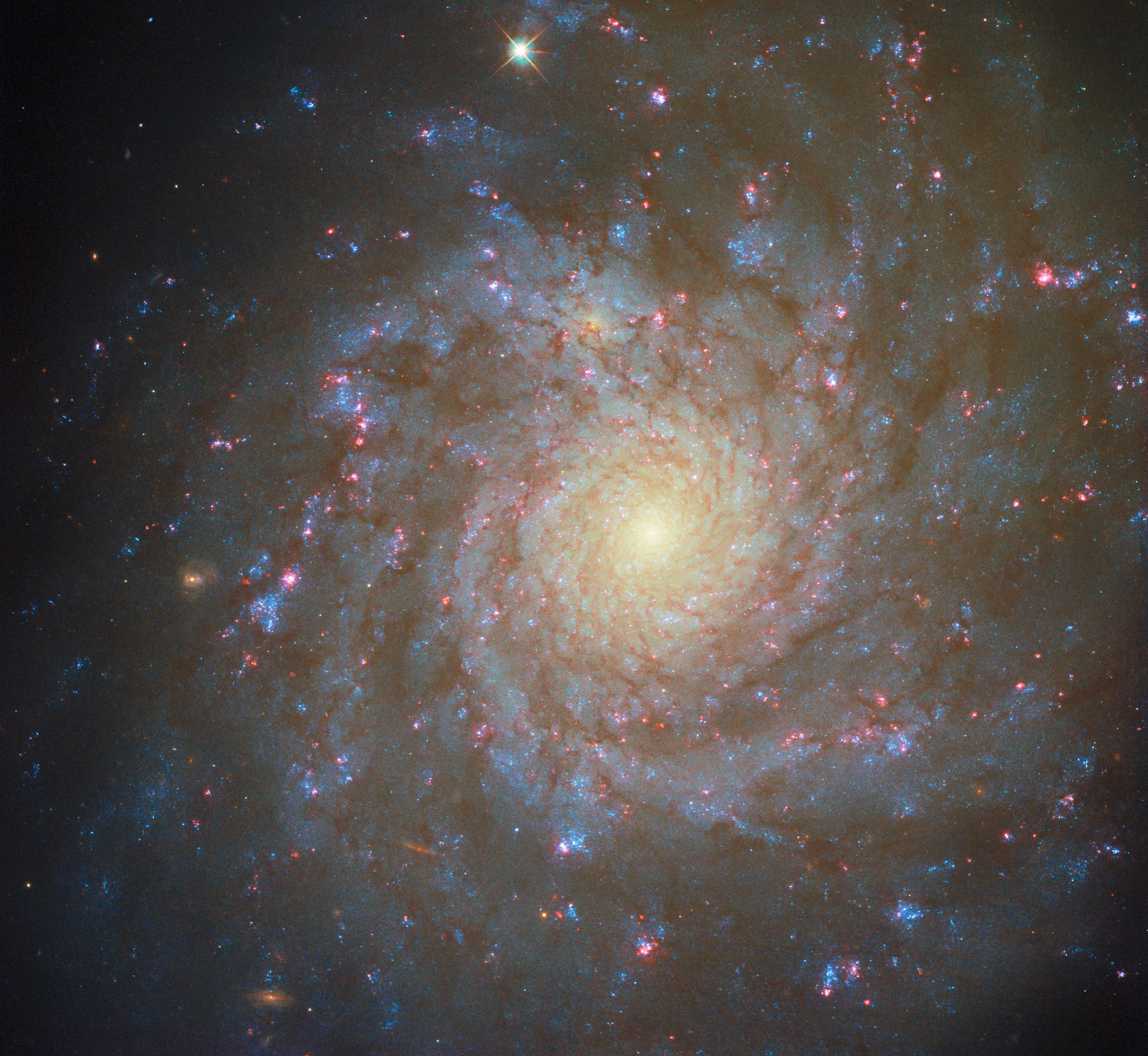
A spiral galaxy, seen face-on, fills the view. Swirling, patchy and broken spiral arms surround a softly glowing centre. The arms are filled with blue, speckled patches showing star clusters, shining pink and red dots where young stars are lighting up gas clouds, and a web of thin, dark red dust lanes. The glow of the galaxy’s arms extends out into the dark background. Individual tiny stars appear throughout. Credit: ESA/Hubble & NASA, F. Belfiore, J. Lee and the PHANGS-HST Team

A star-studded spiral galaxy shines in this NASA/ESA Hubble Space Telescope Picture of the Week. This galaxy is called NGC 4571, and it’s situated about 60 million light-years away in the constellation Coma Berenices. NGC 4571 dominates the scene with its feathery spiral structure and sparkling star clusters.

The galaxy’s dusty spiral arms are dotted with brilliant pink nebulae that contain massive young stars. Though the star-forming clouds that are seen here are heated to roughly 10 000 degrees by searing ultraviolet light from the young stars at their cores, stars get their start in much chillier environments. The sites of star birth are giant molecular clouds tens to hundreds of light-years across, in which the temperature hovers just a few tens of degrees above absolute zero.

The dramatic transformation from freezing gas cloud to fiery young star happens thanks to the immense pull of gravity, which collects gas into dense clumps within a star-forming cloud. As these clumps yield to gravity’s pull and collapse inward, they eventually become hot and dense enough to spark nuclear fusion in their centres and begin to shine. The glowing clouds in this image surround particularly massive stars that are hot enough to ionise the gas of their birthplaces.

A Hubble image of NGC 4571 was previously released in 2022, using data from an observing programme the combines data from leading observatories like Hubble, the NASA/ESA/CSA James Webb Space Telescope, and the Atacama Large Millimeter/submillimeter Array to study star formation in nearby spiral galaxies like NGC 4571. The new image released today adds data from a programme that seeks to understand how dust affects our observations of young stars deeply embedded within their natal clouds.


Wednesday, November 13, 2024

Tangled galaxies

In the centre is a large, oval-shaped galaxy, with a shining, ringed core. Left of its centre is a second, smaller galaxy with two spiral arms. The pair of galaxies are close enough that they appear to be merging: a tail of material with a few glowing spots connects from one of the smaller galaxy’s spiral arms to the larger galaxy. Both are surrounded in a faint halo. Several stars can be seen around the pair. Credit: ESA/Hubble & NASA, R. J. Foley (UC Santa Cruz)

Previously the Hubble Picture of the Week series has featured a jewel in the queen’s hair — a spiral galaxy in the constellation Coma Berenices, named for the hair of the historical Egyptian queen. However, that galaxy is only one of many known in this constellation. This week’s new image from the NASA/ESA Hubble Space Telescope depicts the cosmic tangle that is MCG+05-31-045, a pair of interacting galaxies located 390 million light-years away and a part of the so-called Coma galaxy cluster.

The Coma cluster is a particularly rich cluster and contains over a thousand known galaxies. Several can be easily seen with amateur telescopes. Most of them are elliptical galaxies, and that’s typical of a dense galaxy cluster like the Coma cluster: many elliptical galaxies are formed in close encounters between galaxies that stir them up, or even collisions that rip them apart. While the stars in the interacting galaxies can stay together, the gas in the galaxies is a different story — it’s twisted and compressed by gravitational forces, and rapidly used up to form new stars. When the hot, massive, blue stars die, there is little gas left to replace them with new generations of young stars. For interacting spiral galaxies, the regular orbits that produce their striking spiral arms are also disrupted. Whether through mergers or simple near misses, the result is a galaxy almost devoid of gas, with ageing stars orbiting in uncoordinated circles: an elliptical galaxy.

It’s very likely that a similar fate will befall MCG+05-31-045. As the smaller spiral galaxy is torn up and integrated into the larger galaxy, many new stars will form, and the hot, blue ones will quickly burn out, leaving cooler, redder stars behind in an elliptical galaxy much like the others in the Coma cluster. But this process won’t be complete for many millions of years — until then, Queen Berenice II will have to suffer the knots in her hair!


Friday, November 01, 2024

Revisiting an old beauty

A large spiral galaxy is seen tilted diagonally. The arms of the galaxy’s disc are speckled with glowing patches; some are blue in colour, others are pink, showing gas illuminated by new stars. A faint glow surrounds the galaxy, which lies on a dark, nearly empty background. The galaxy's centre glows in white.

This image from the NASA/ESA Hubble Space Telescope unbarred spiral galaxy roughly 51 million light-years away from Earth in the constellation Coma Berenices.

You can see an old image of NGC 4414 that features Hubble data from 1995 and 1999 here, which was captured as one of the telescope’s primary missions to determine the distance to galaxies. This was achieved as part of an ongoing research effort to study Cepheid variable stars. Cepheids are a special type of variable star with very stable and predictable brightness variations. The period of these variations depends on physical properties of the stars such as their mass and true brightness. This means that astronomers, just by looking at the variability of their light, can find out about the Cepheids' physical nature, which then can be used very effectively to determine their distance. For this reason cosmologists call Cepheids 'standard candles'.

Astronomers have used Hubble to observe Cepheids, like those that reside in NGC 4414, with extraordinary results. The Cepheids have then been used as stepping-stones to make distance measurements for supernovae, which have, in turn, given a measure for the scale of the Universe. Today we know the age of the Universe to a much higher precision than before Hubble: around 13.7 billion years.

Links

Monday, August 19, 2024

Queen Berenice II’s Hair Tied Together by Dark Matter


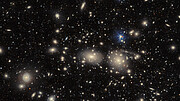
PR Image noirlab2420b
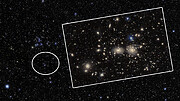
Coma Cluster (uncropped view)


Videos

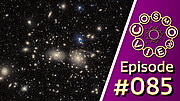
Cosmoview Episode 85: Queen Berenice II’s Hair Tied Together by Dark Matter
PR Video noirlab2420a
Cosmoview Episode 85: Queen Berenice II’s Hair Tied Together by Dark Matter

Zooming into the Coma Cluster
PR Video noirlab2420b
Zooming into the Coma Cluster

Pan on the Coma Cluster
PR Video noirlab2420c
Pan on the Coma Cluster

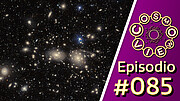
Cosmoview Episodio 85: Cerro Tololo captura deslumbrante cúmulo galáctico en Chile
PR Video noirlab2420d
Cosmoview Episodio 85: Cerro Tololo captura deslumbrante cúmulo galáctico en Chile


The Dark Energy Camera probes the Coma Cluster, a rich cluster of galaxies named for the hair of an ancient queen and an inspiration for the theory of dark matter

The Dark Energy Camera captures an image of the dazzling Coma Cluster, named after the hair of Queen Berenice II of Egypt. Not only significant in Greek mythology, this collection of galaxies was also fundamental to the discovery of the existence of dark matter. The theory emerged in 1937 when Swiss astronomer Fritz Zwicky noticed that the Coma Cluster galaxies behaved as if they were under the influence of vast amounts of unobservable ‘dark’ matter.

This densely populated image showcases an enormous cluster not of individual stars, but of entire galaxies, known as the Coma Cluster. The Coma Cluster is named for the constellation in which it lies, Coma Berenices. It is the only one of the 88 IAU constellations [1] to be named after a historical figure. Its namesake is Queen Berenice II of Egypt, or more precisely her hair, with ‘coma’ meaning ‘hair of the head’ in Latin.

Berenice famously cut her hair off and presented it as a votive offering to the gods when her husband returned safely from war. The hair was placed in a temple, but went missing soon after. The court astronomer, Conon of Samos, claimed to identify Berenice’s lost tresses in a rather unlikely spot — the night sky — suggesting that the goddess Aphrodites had catasterized (literally turned into a constellation) the queen’s locks. This all took place around 245 BCE, meaning that Berenice’s hair has enjoyed celestial recognition for an extraordinarily long time.

The data used to build this detailed picture were collected by the Department of Energy-fabricated Dark Energy Camera (DECam), which is mounted on the U.S. National Science Foundation Víctor M. Blanco 4-meter Telescope at Cerro Tololo Inter-American Observatory, a Program of NSF NOIRLab. The 570-megapixel camera was built to carry out the Dark Energy Survey (DES) — an amazing 758-night run of observations between 2013 and 2019. DES was conducted with the intention to better understand the nature of dark energy — the unknown entity that is causing the expansion of our Universe to accelerate.

The Coma Cluster is closely associated with dark energy’s equally mysterious counterpart: dark matter. Nearly a century ago, in 1937, Swiss astronomer Fritz Zwicky observed several galaxies within the Coma Cluster. He calculated an approximation of the cluster’s mass based on its luminous — in other words, observable — structures. But he encountered something strange: the cluster seemed to be missing mass. In fact, the galaxies within the cluster were behaving as though the cluster contained 400 times more mass than his estimates suggested.

Zwicky reached this conclusion by observing how fast the galaxies within the cluster were moving. To explain this further, it is helpful to briefly revisit a key point about the nature of gravity. Gravity is one of the four known fundamental interactions that exist between all entities with energy or mass. The more mass that an object has, the stronger the gravitational pull it will exert. Therefore, less massive objects that are within a certain distance to a more massive object will be pulled uncontrollably towards it.

However, there is an additional factor to consider: velocity. If an object is moving fast enough, it can escape the gravitational pull of other objects. It is this principle that enabled Zwicky to infer that the Coma Cluster appeared to be ‘missing’ matter. He found that the galaxies were moving so fast that they should be escaping the cluster if it were being held together only by the observable mass. This led him to postulate that the cluster must be held together by vast amounts of unobservable ‘dark’ matter, though this suggestion seemed far-fetched to much of the astronomical community.

It took until the 1980s for the majority of astronomers to be convinced of the existence of dark matter. The consensus moved as several studies came out reporting the same curious mass inconsistency that Zwicky observed, but on the scale of single galaxies rather than entire galaxy clusters. One such study was done in 1970 by U.S. astronomers Kent Ford and Vera C. Rubin, who found evidence of invisible matter in the Andromeda Galaxy. And in 1979, astronomers Sandra Faber and John Gallagher performed a robust analysis of the mass-to-light ratio for over 50 spiral and elliptical galaxies, which led them to conclude that, “the case for invisible mass in the Universe is very strong and getting stronger.”

The existence of dark matter and dark energy is now widely accepted, and understanding their elusive nature is a main focus of modern astrophysics. A deeper understanding may be on the horizon with the upcoming 10-year Legacy Survey of Space and Time, which will be conducted by NSF–DOE Vera C. Rubin Observatory, named after the inspirational female astronomer who helped show the world that there is so much more to the Universe than meets the eye.


Notes

[1] It is worth nothing that the 88 IAU constellations are just some of the imagined figures and shapes derived from the patterns of stars in the observable sky. Many more were invented by cultures throughout history.


More information

NSF NOIRLab (U.S. National Science Foundation National Optical-Infrared Astronomy Research Laboratory), the U.S. center for ground-based optical-infrared astronomy, operates the International Gemini Observatory (a facility of NSF, NRC–Canada, ANID–Chile, MCTIC–Brazil, MINCyT–Argentina, and KASI–Republic of Korea), Kitt Peak National Observatory (KPNO), Cerro Tololo Inter-American Observatory (CTIO), the Community Science and Data Center (CSDC), and NSF-DOE Vera C. Rubin Observatory (operated in cooperation with the Department of Energy’s SLAC National Accelerator Laboratory). It is managed by the Association of Universities for Research in Astronomy (AURA) under a cooperative agreement with NSF and is headquartered in Tucson, Arizona. The astronomical community is honored to have the opportunity to conduct astronomical research on I’oligam Du’ag (Kitt Peak) in Arizona, on Maunakea in Hawai‘i, and on Cerro Tololo and Cerro Pachón in Chile. We recognize and acknowledge the very significant cultural role and reverence that these sites have to the Tohono O’odham Nation, to the Native Hawaiian community, and to the local communities in Chile, respectively.


Links:


Contacts:

Josie Fenske
Jr. Public Information Officer
NSF NOIRLab
Email:
josie.fenske@noirlab.edu


Monday, May 20, 2024

A jewel in the queen’s hair

A spiral galaxy is viewed close up and fills most of the scene. It has a bright, glowing spot at the core, broad spiral arms that are covered by many dark threads of dust, and pink glowing spots across the disc that mark areas of star formation. The disc of the galaxy is surrounded by a faint halo that bleeds into the dark background. Credit: ESA/Hubble & NASA, D. Thilker, J. Lee and the PHANGS-HST Team

This Picture of the Week shows the jewel-bright spiral galaxy NGC 4689, which lies 54 million light-years from Earth in the constellation Coma Berenices. This constellation has the distinction of being the only one of the 88 constellations officially recognised by the International Astronomical Union (IAU) to be named after an historical figure, Queen Berenice II of Egypt. The latin word ‘coma’ references her hair, meaning that NGC 4689 can be said to be found in the hair of a queen. Some people of Berenice’s time would have meant this quite literally, as the story goes that her court astronomer thought that a missing lock of Berenice’s hair had been catasterised (a word meaning ‘placed amongst the stars’) by the gods: hence the name of the constellation, Coma Berenices.

NGC 4689 holds an interesting — albeit less royal — place in modern astronomy too. The Universe is so incredibly vast that at a distance of a mere 54 million light-years NGC 4689 is relatively nearby for a galaxy. This image has been made using data from two sets of observations, one made in 2019 and 2024, both of which were made as a part of programmes that observed multiple ‘nearby’ galaxies. The 2024 observing programme is an interesting example of how Hubble — a relatively old but extraordinarily productive telescope — can support the work of the technologically cutting-edge Webb telescope. Observations collected by Webb stand to transform our understanding of how galaxies transform and evolve over time, by providing data of an unprecedented level of detail and clarity. However, thanks to their complementary capabilities, new observations from Hubble — such as those used to create this image — can assist the work done using Webb. In this case, the Hubble data were collected in order to get a more accurate grasp of the stellar populations of nearby galaxies, which is crucial to understanding the evolution of galaxies. Thus, NGC 4689 is playing an important role in developing our understanding of how all galaxies evolve. In fact, it is observed enough that it has been the subject of a Hubble Picture of the Week before, in 2020.


Links


Monday, March 21, 2022

Hubble Spies a Stunning Spiral

NGC 4571
Credits: ESA/Hubble & NASA, J. Lee and the PHANGS-HST Team

This cosmic portrait — captured with the NASA/ESA Hubble Space Telescope’s Wide Field Camera 3 — shows a stunning view of the spiral galaxy NGC 4571, which lies approximately 60 million light-years from Earth in the constellation Coma Berenices. This constellation — whose name translates as Bernice’s Hair — was named after an Egyptian queen who lived more than 2200 years ago.

As majestic as spiral galaxies like NGC 4571 are, they are far from the largest structures known to astronomers. NGC 4571 is part of the Virgo cluster, which contains more than a thousand galaxies. This cluster is in turn part of the larger Virgo supercluster, which also encompasses the Local Group which contains our own galaxy, the Milky Way. Even larger than superclusters are galaxy filaments  — the largest known structures in the Universe.

This image comes from a large programme of observations designed to produce a treasure trove of combined observations from two great observatories: Hubble and ALMA. ALMA, The Atacama Large Millimeter/submillimeter Array, is a vast telescope consisting of 66 high-precision antennas high in the Chilean Andes, which together observe at wavelengths between infrared and radio waves. This allows ALMA to detect the clouds of cool interstellar dust which give rise to new stars. Hubble’s razor-sharp observations at ultraviolet wavelengths, meanwhile, allows astronomers to pinpoint the location of hot, luminous, newly formed stars. Together, the ALMA and Hubble observations provide a vital repository of data to astronomers studying star formation, as well as laying the groundwork for future science with the NASA/ESA/CSA James Webb Space Telescope.

Tuesday, December 07, 2021

Tails Tell the Tale of Galaxy Evolution


Figure: Conceptual image of the evolutionary path from a normal dwarf galaxy to an UDG/dE in a cluster. (a) An unperturbed galaxy falls near, but not directly through, the cluster. (b) Collision with intercluster gas triggers star formation and gas stripping, creating a “jellyfish” galaxy. (c) Star formation and stripping remove all of the gas, quenching further star formation. (d) The galaxy evolves into an UDG or dwarf elliptical (dE). (Credit: Kirill Grishin, Legacy Surveys / D. Lang (Perimeter Institute), NAOJ, CFHT, ESO )


An international team of astronomers has found tails of gas and/or stars trailing behind a sample of young galaxies without current star formation. Based on this result, the team concludes that about half of the ultra-diffuse galaxies in the Coma cluster are likely to have evolved through collisions with external gas. Ultra-diffuse galaxies together with similar dwarf elliptical galaxies account for about 80% of the members of galaxy clusters, so understanding their evolution is an important part of modeling the evolution of the Universe.

Extended galaxies sparely populated by stars and exhibiting little current star formation are commonly found in galaxy clusters. It is thought that these ultra-diffuse galaxies (UDG) started as more normal dwarf galaxies, but some event removed most of the gas from the galaxies, preventing them from forming new stars, and causing them to puff up in size. But precisely because these ultra-diffuse galaxies are faint and diffuse, they are difficult to study, so their evolution remains poorly understood.

To work around this problem, an international team of astronomers from Russia, the USA, Japan, France, and the UAE, used archive data from the 8.2 m Subaru Telescope and new observations with the 6.5 m MMT to study galaxies which are currently bright, but expected to evolve into UDGs. The sample includes 9 galaxies in the Coma cluster (320 million light-years away in the direction of the constellation Coma Berenices) and 2 galaxies in the Abell 2147 cluster (510 million light-years away in the direction of the constellation Hercules). The team found that every galaxy in the sample exhibits a tail of gas and/or stars, indicating that they have recently collided with outside gas.

The space between galaxies in a cluster is not a perfect vacuum; there is very hot, thin intracluster gas. When a small galaxy passes through it, the gas inside the galaxy collides with this intracluster gas. This triggers a burst of rapid star formation, and the pressure from the intracluster gas pushes the original gas out of the galaxy. During this phase, the galaxy exhibits a bright tail or tails of gas streaming behind it, earning it the nickname “jellyfish galaxy.” The loss of gas prevents further star formation and changes the dynamics of the galaxy, causing it to puff up in size. In this way, collision with intracluster gas provides an all-in-one explanation for the evolution of UDGs. From the number of galaxies studied in this sample, the team estimates that approximately half of the UDGs in the Coma cluster have experienced this kind of gas stripping.

These results appeared as Grishin et al. "Transforming gas-rich low-mass disky galaxies into ultra-diffuse galaxies by ram pressure" in Nature Astronomy on November 1, 2021.


About the Subaru Telescope

The Subaru Telescope is a large optical-infrared telescope operated by the National Astronomical Observatory of Japan, National Institutes of Natural Sciences with the support of the MEXT Project to Promote Large Scientific Frontiers. We are honored and grateful for the opportunity of observing the Universe from Maunakea, which has cultural, historical, and natural significance in Hawai`i.

Relevant Links