
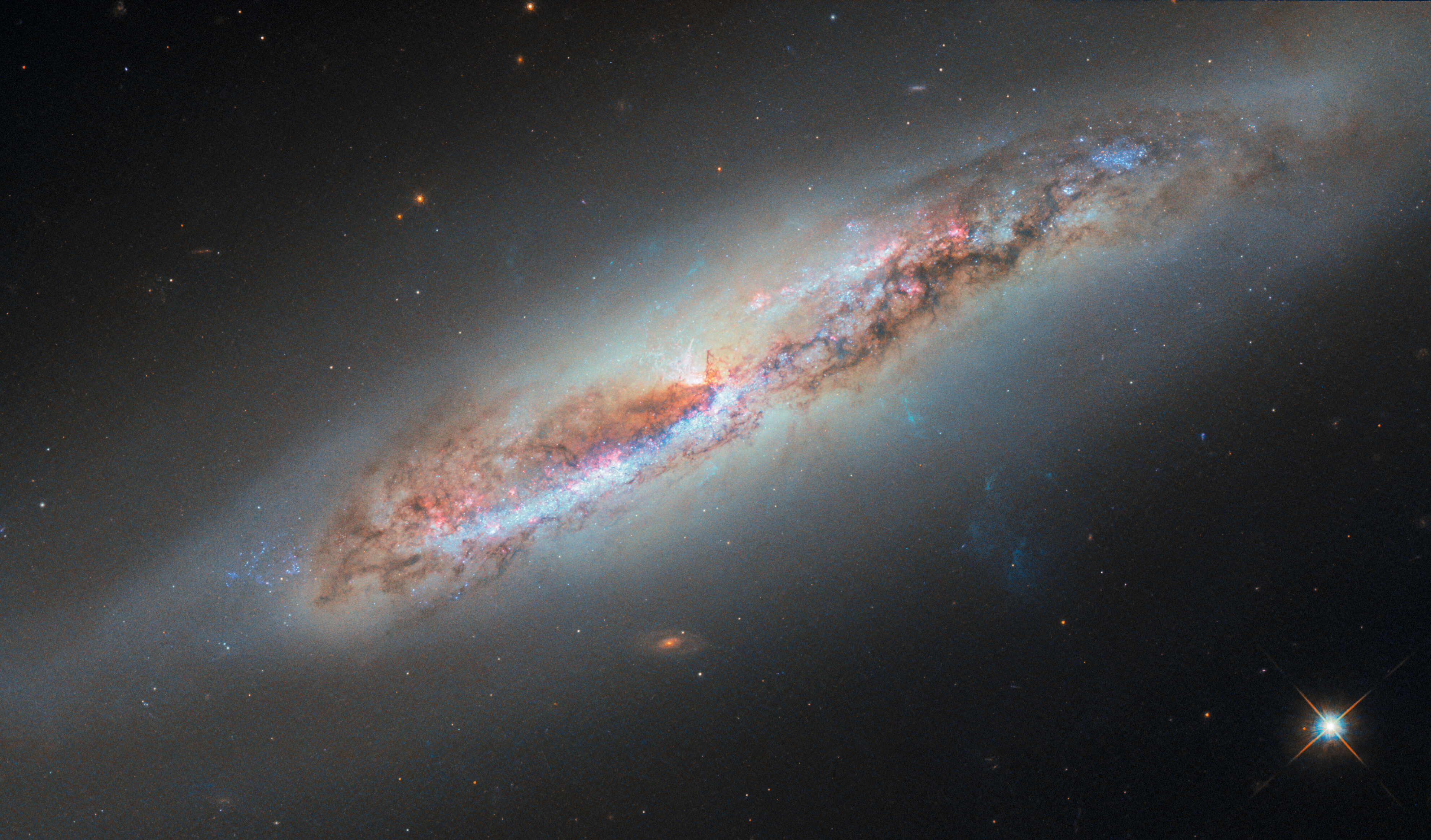
A sideways spiral galaxy shines in today’s ESA/Hubble Picture of the Week. Located about 60 million light-years away in the constellation Virgo (The Maiden), NGC 4388 is a resident of the Virgo galaxy cluster. The Virgo cluster contains more than a thousand galaxies and is the nearest large galaxy cluster to the Milky Way.
NGC 4388 is tilted at an extreme angle relative to our point of view, giving us a nearly edge-on vantage point. This perspective reveals a curious feature that wasn’t visible in a previous Hubble image of this galaxy released in 2016:
a plume of gas from the galaxy’s nucleus, here seen billowing out from the galaxy’s disc towards the lower-right corner of the image. But where did this outflow come from, and why does it glow?
The answer likely lies in vast stretches that separate the galaxies
of the Virgo cluster. Though the space between the galaxies appears to be empty, this space is actually occupied by hot wisps of gas called the intracluster medium. As NGC 4388 journeys within the cluster, it plunges through the intracluster medium. The pressure from the hot intracluster gas whisks away the gas from within NGC 4388’s disc, causing it to trail behind as NGC 4388 moves.
The source of the energy that ionises this gas cloud and causes it to glow is more uncertain. Researchers suspect that some of the energy comes from the centre of the galaxy, where a supermassive black hole
has spun the gas around it into a superheated disc. The blazing radiation from this disc might ionise the gas closest to the galaxy, while shock waves might be responsible for ionising the filaments of gas farther out.
This image incorporates new data including several additional wavelengths of light to bring the ionised gas cloud into view. The data used to create this image come from several observing programmes that aim to illuminate galaxies with active black holes at their centres.
Showing posts with label NGC 4388. Show all posts
Showing posts with label NGC 4388. Show all posts
Tuesday, December 16, 2025
Galactic gas makes a getaway
A spiral galaxy seen nearly edge-on. Its disk is filled with red and blue lights from star-forming nebulae and clusters of hot stars, respectively, as well as thick dark clouds of dust that block the strong white light from its centre. A faint, glowing halo of gas surrounds the disc, fading into the black background. A bluish plume of gas also extends from the galaxy’s core to the lower-right of the image. Credit: ESA/Hubble & NASA, S. Veilleux, J. Wang, J. Greene
Source: ESA/hubble/potw


Friday, December 09, 2016
A transformation in Virgo


Credit: ESA/Hubble & NASA
The constellation of Virgo
(The Virgin) is especially rich in galaxies, due in part to the
presence of a massive and gravitationally-bound collection of over 1300
galaxies called the Virgo Cluster.
One particular member of this cosmic community, NGC 4388, is captured
in this image, as seen by the NASA/ESA Hubble Space Telescope’s Wide Field Camera 3 (WFC3).
Located
some 60 million light-years away, NGC 4388 is experiencing some of the
less desirable effects that come with belonging to such a massive galaxy
cluster. It is undergoing a transformation, and has taken on a somewhat
confused identity.
While the galaxy’s outskirts appear smooth and featureless, a classic feature of an elliptical galaxy,
its centre displays remarkable dust lanes constrained within two
symmetric spiral arms, which emerge from the galaxy’s glowing core — one
of the obvious features of a spiral galaxy.
Within the arms, speckles of bright blue mark the locations of young
stars, indicating that NGC 4388 has hosted recent bursts of star
formation.
Despite the mixed messages, NGC 4388 is classified as a spiral galaxy.
Its unusual combination of features are thought to have been caused by
interactions between NGC 4388 and the Virgo Cluster.
Gravitational
interactions — from glancing blows to head-on collisions, tidal influencing, mergers, and galactic cannibalism — can be devastating to galaxies. While some may be lucky enough to simply suffer a distorted spiral arm or newly-triggered wave of star formation, others see their structure and contents completely and irrevocably altered.
Source: ESA/Hubble/images
Subscribe to:
Posts (Atom)