
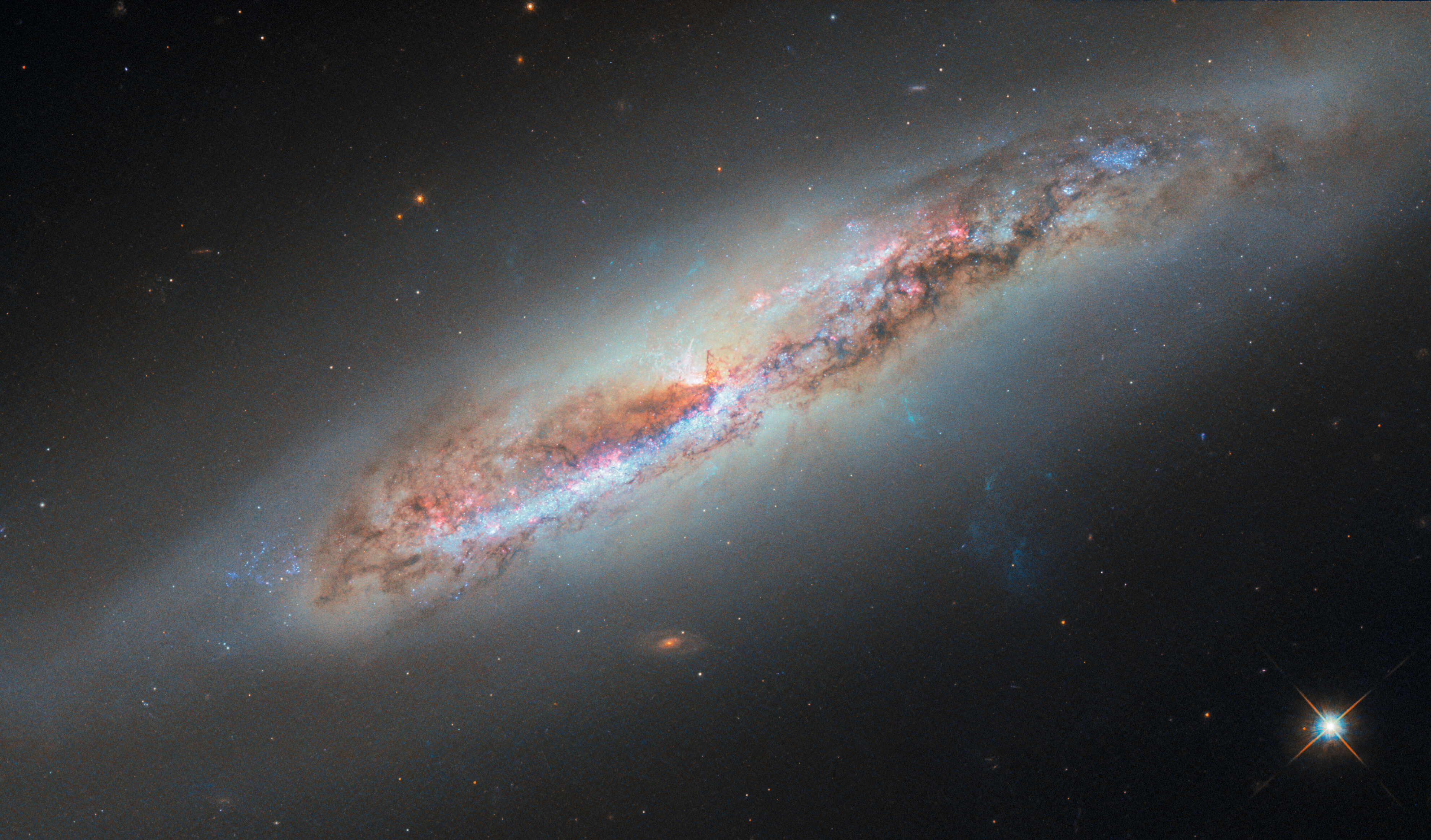
A sideways spiral galaxy shines in today’s ESA/Hubble Picture of the Week. Located about 60 million light-years away in the constellation Virgo (The Maiden), NGC 4388 is a resident of the Virgo galaxy cluster. The Virgo cluster contains more than a thousand galaxies and is the nearest large galaxy cluster to the Milky Way.
NGC 4388 is tilted at an extreme angle relative to our point of view, giving us a nearly edge-on vantage point. This perspective reveals a curious feature that wasn’t visible in a previous Hubble image of this galaxy released in 2016:
a plume of gas from the galaxy’s nucleus, here seen billowing out from the galaxy’s disc towards the lower-right corner of the image. But where did this outflow come from, and why does it glow?
The answer likely lies in vast stretches that separate the galaxies
of the Virgo cluster. Though the space between the galaxies appears to be empty, this space is actually occupied by hot wisps of gas called the intracluster medium. As NGC 4388 journeys within the cluster, it plunges through the intracluster medium. The pressure from the hot intracluster gas whisks away the gas from within NGC 4388’s disc, causing it to trail behind as NGC 4388 moves.
The source of the energy that ionises this gas cloud and causes it to glow is more uncertain. Researchers suspect that some of the energy comes from the centre of the galaxy, where a supermassive black hole
has spun the gas around it into a superheated disc. The blazing radiation from this disc might ionise the gas closest to the galaxy, while shock waves might be responsible for ionising the filaments of gas farther out.
This image incorporates new data including several additional wavelengths of light to bring the ionised gas cloud into view. The data used to create this image come from several observing programmes that aim to illuminate galaxies with active black holes at their centres.
Showing posts with label dark cloud. Show all posts
Showing posts with label dark cloud. Show all posts
Tuesday, December 16, 2025
Galactic gas makes a getaway
A spiral galaxy seen nearly edge-on. Its disk is filled with red and blue lights from star-forming nebulae and clusters of hot stars, respectively, as well as thick dark clouds of dust that block the strong white light from its centre. A faint, glowing halo of gas surrounds the disc, fading into the black background. A bluish plume of gas also extends from the galaxy’s core to the lower-right of the image. Credit: ESA/Hubble & NASA, S. Veilleux, J. Wang, J. Greene
Source: ESA/hubble/potw


Thursday, February 06, 2025
Webb investigates a dusty and dynamic disc

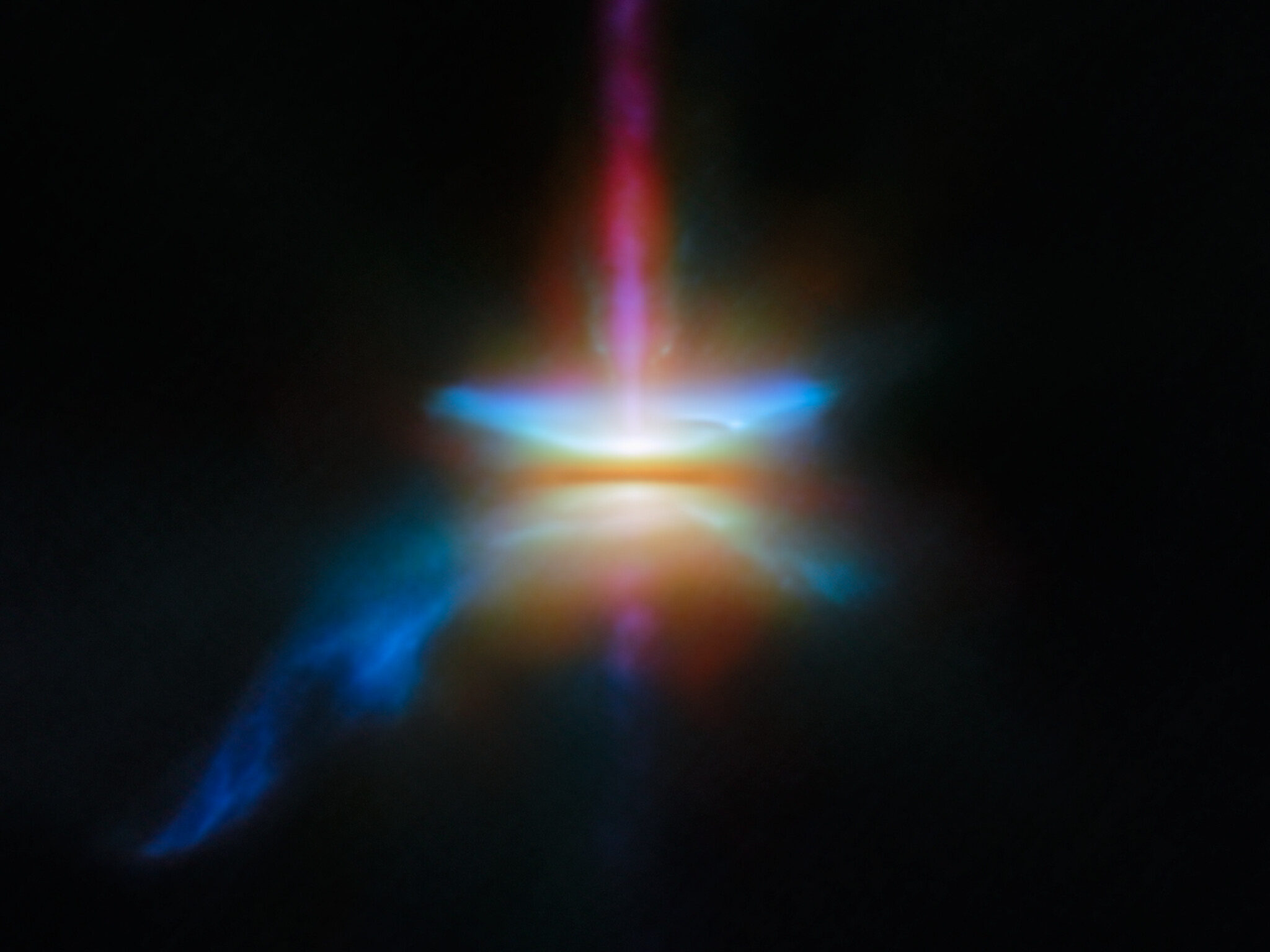
A close-in image of a protoplanetary disc around a newly formed star. Many different wavelengths of light are combined and represented by separate and various colours. A dark line across the centre is the disc, corresponding to the densest parts of the disc, made of opaque dust: the star is hidden in here and creates a strong glow in the centre. A band going straight up is a jet, while other outflows above and below the disc, and a tail coming off to one side. Credit: ESA/Webb, NASA & CSA, Tazaki et al.
This new NASA/ESA/CSA James Webb Space Telescope Picture of the Month
presents HH 30 in unprecedented resolution. This target is an edge-on
protoplanetary disc that is surrounded by jets and a disc wind, and is
located in the dark cloud LDN 1551 in the Taurus Molecular Cloud.
Herbig-Haro objects are small nebulae found in star formation regions, marking the locations where gas outflowing from young stars is heated into luminescence by shockwaves. HH 30 is an example of where this outflowing gas takes the form of a narrow jet. The source star is located on one end of the jet, hidden behind an edge-on protoplanetary disc that the star is illuminating.
HH 30 is of particular interest to astronomers. In fact, the HH 30 disc is considered the prototype of an edge-on disc, thanks to its early discovery with the NASA/ESA Hubble Space Telescope. Discs seen from this view are a unique laboratory to study the settling and drift of dust grains.
An international team of astronomers have used Webb to investigate the target in unprecedented detail. By combining Webb’s observations with those from the Hubble Space Telescope and the Atacama Large Millimeter/submillimeter Array (ALMA), the team was able to study the multiwavelength disc appearance of the system.
The long-wavelength data from ALMA trace the location of millimetre-sized dust grains, which are found in a narrow region in the central plane of the disc. The shorter-wavelength infrared data from Webb reveal the distribution of smaller dust grains. These grains are only one millionth of a metre across — about the size of a single bacterium. While the large dust grains are concentrated in the densest parts of the disc, the small grains are much more widespread.
These Webb observations were taken as part of the Webb GO programme #2562 (PI F. Ménard, K. Stapelfeldt), which aims to understand how dust evolves in edge-on discs like HH 30. Combined with the keen radio-wavelength eyes of ALMA, these observations show that large dust grains must migrate within the disc and settle in a thin layer. The creation of a narrow, dense layer of dust is an important stage in the process of planet formation. In this dense region, dust grains clump together to form pebbles and eventually planets themselves.
In addition to the behaviour of dust grains, the Webb, Hubble, and ALMA images reveal several distinct structures that are nested within one another. Emerging at a 90-degree angle from the narrow central disc is a high-velocity jet of gas. The narrow jet is surrounded by a wider, cone-shaped outflow. Enclosing the conical outflow is a wide nebula that reflects the light from the young star that is embedded within the disc. Together, these data reveal HH 30 to be a dynamic place, where tiny dust grains and massive jets alike play a role in the formation of new planets.
The annotated verision of this image can be seen here.
Source: ESA/Webb/potm
Links
- Science paper
- Hubble, Webb NIRCam and MIRI, and ALMA images of HH 30
- Annotated image of HH 30’s features
- Image on ESA website
Saturday, March 26, 2016
All Quiet in the Nursery?

Credit: ESO
The dark patch snaking across this spectacular image of a field of stars in the constellation of Ophiuchus (The Serpent-bearer) is not quite what it appears to be.
Although
it looks as if there are no stars here, they are hidden behind this
dense cloud of dust that blocks out their light. This particular dark cloud is known as LDN 1768.
Despite
their rather dull appearance, dark nebulae like LDN 1768 are of huge
interest to astronomers, as it is here that new stars form. Inside these
vast stellar nurseries there are protostars — stars at the earliest stage of their lives, still coalescing out of the gas and dust in the cloud.
Protostars
are relatively cold and have not yet begun to produce enough energy to
emit visible light. Instead, they emit radiation at submillimetre
wavelengths, which human eyes cannot see. Luckily, unlike visible light,
light at submillimetre wavelengths is not absorbed by the surrounding
dust. By using special telescopes that are sensitive to submillimetre
radiation, like the Atacama Large Millimeter/submillimeter Array (ALMA) observatory, we can see through the dust and find out more about the protostars within the cloud.
Eventually, the protostars will become dense and hot enough to start the nuclear reactions
that will produce visible light and they will start to shine. When this
happens, they will blow away the cocoon of dust surrounding them and
cause any remaining gas to emit light as well, creating the spectacular
light show known as an HII region.
Thursday, July 30, 2015
Stormy seas in Sagittarius


Wide-field view of the Lagoon Nebula (ground-based image)

Giant 'Twisters' in the Lagoon Nebula
Videos


Some of the most breathtaking views in
the Universe are created by nebulae — hot, glowing clouds of gas. This
new NASA/ESA Hubble Space Telescope image shows the centre of the Lagoon
Nebula, an object with a deceptively tranquil name. The region is
filled with intense winds from hot stars, churning funnels of gas, and
energetic star formation, all embedded within an intricate haze of gas
and pitch-dark dust.
Nebulae are often named based on their key characteristics — particularly beautiful examples include the Ring Nebula (heic1310), the Horsehead Nebula (heic1307) and the Butterfly Nebula (heic0910). This new NASA/ESA Hubble Space Telescope image shows the centre of the Lagoon Nebula, otherwise known as Messier 8, in the constellation of Sagittarius (The Archer).
The inspiration for this nebula’s name may not be immediately obvious
— this is because the image captures only the very heart of the nebula.
The Lagoon Nebula’s name becomes much clearer in a wider field view (opo0417i) when the broad, lagoon-shaped dust lane that crosses the glowing gas of the nebula can be made out.
Another clear difference between this new image and others is that this image combines both infrared and optical light rather than being purely optical(heic1015).
Infrared light cuts through thick, obscuring patches of dust and gas,
revealing the more intricate structures underneath and producing a
completely different landscape [1].
However, even in visible light, the tranquil name remains misleading as the region is packed full of violent phenomena.
The bright star embedded in dark clouds at the centre of this image is known as Herschel 36.
This star is responsible for sculpting the surrounding cloud, stripping
away material and influencing its shape. Herschel 36 is the main source
of ionising radiation [2] for this part of the Lagoon Nebula.
This central part of the Lagoon Nebula contains two main structures
of gas and dust connected by wispy twisters, visible in the middle third
of this image (opo9638).
These features are quite similar to their namesakes on Earth — they are
thought to be wrapped up into their funnel-like shapes by temperature
differences between the hot surface and cold interior of the clouds. The
nebula is also actively forming new stars, and energetic winds from
these newborns may contribute to creating the twisters.
This image combines images taken using optical and infrared light gathered by Hubble’s Wide Field Planetary Camera 2.
Notes
[1] Another particularly good example of this effect is shown in Hubble’s image of the Horsehead Nebula (heic1307).
[2] The ionising radiation here is
ultraviolet light. This light knocks electrons loose from within atoms
to create charged particles called ions.
Note for editors
The Hubble Space Telescope is a project of international cooperation between ESA and NASA.
More information
Image credit: NASA, ESA, J. Trauger (Jet Propulson Laboratory)
Links
Contacts
Mathias Jäger
ESA/Hubble, Public Information Officer
Garching bei München, Germany
Tel: +49 176 62397500
Email: mjaeger@partner.eso.org
Source: ESA/HUBBLE - Space Telescope
Wednesday, January 07, 2015
Where Did All the Stars Go?


Wide-field view of the sky around the dark nebula LDN 483
***********************************************************************
Videos


Dark cloud obscures hundreds of background stars
Some of the stars appear to be missing in
this intriguing new ESO image. But the black gap in this glitteringly
beautiful starfield is not really a gap, but rather a region of space
clogged with gas and dust. This dark cloud is called LDN 483 — for Lynds
Dark Nebula 483. Such clouds are the birthplaces of future stars. The
Wide Field Imager, an instrument mounted on the MPG/ESO 2.2-metre
telescope at ESO's La Silla Observatory in Chile, captured this image of
LDN 483 and its surroundings.
LDN 483 [1] is located about 700 light-years away in the constellation of Serpens (The
Serpent). The cloud contains enough dusty material to completely block
the visible light from background stars. Particularly dense molecular clouds, like LDN 483, qualify as dark nebulae
because of this obscuring property. The starless nature of LDN 483 and
its ilk would suggest that they are sites where stars cannot take root
and grow. But in fact the opposite is true: dark nebulae offer the most
fertile environments for eventual star formation.
Astronomers studying star formation in LDN 483 have discovered some
of the youngest observable kinds of baby stars buried in LDN 483’s
shrouded interior. These gestating stars can be thought of as still
being in the womb, having not yet been born as complete, albeit
immature, stars.
In this first stage of stellar development, the star-to-be is just a
ball of gas and dust contracting under the force of gravity within the
surrounding molecular cloud. The protostar is still quite cool — about
–250 degrees Celsius — and shines only in long-wavelength submillimetre
light [2]. Yet temperature and pressure are beginning to increase in the fledgling star’s core.
This earliest period of star growth lasts a mere thousands of years,
an astonishingly short amount of time in astronomical terms, given that
stars typically live for millions or billions of years. In the following
stages, over the course of several million years, the protostar will
grow warmer and denser. Its emission will increase in energy along the
way, graduating from mainly cold, far-infrared light to near-infrared
and finally to visible light. The once-dim protostar will have then
become a fully luminous star.
As more and more stars emerge from the inky depths of LDN 483, the
dark nebula will disperse further and lose its opacity. The missing
background stars that are currently hidden will then come into view —
but only after the passage of millions of years, and they will be
outshone by the bright young-born stars in the cloud [3].
Notes
[1] The Lynds Dark Nebula catalogue
was compiled by the American astronomer Beverly Turner Lynds, and
published in 1962. These dark nebulae were found from visual inspection
of the Palomar Sky Survey photographic plates.
[3] Such a young open star cluster can be seen here, and a more mature one here.
More Information
ESO is the foremost intergovernmental astronomy organisation in Europe
and the world’s most productive ground-based astronomical observatory by
far. It is supported by 15 countries: Austria, Belgium, Brazil, the
Czech Republic, Denmark, France, Finland, Germany, Italy, the
Netherlands, Portugal, Spain, Sweden, Switzerland and the United
Kingdom. ESO carries out an ambitious programme focused on the design,
construction and operation of powerful ground-based observing facilities
enabling astronomers to make important scientific discoveries. ESO also
plays a leading role in promoting and organising cooperation in
astronomical research. ESO operates three unique world-class observing
sites in Chile: La Silla, Paranal and Chajnantor. At Paranal, ESO
operates the Very Large Telescope, the world’s most advanced
visible-light astronomical observatory and two survey telescopes. VISTA
works in the infrared and is the world’s largest survey telescope and
the VLT Survey Telescope is the largest telescope designed to
exclusively survey the skies in visible light. ESO is the European
partner of a revolutionary astronomical telescope ALMA, the largest
astronomical project in existence. ESO is currently planning the
39-metre European Extremely Large optical/near-infrared Telescope, the
E-ELT, which will become “the world’s biggest eye on the sky”.
Links
- Photos of the MPG/ESO 2.2-metre telescope
- Other photos taken with the MPG/ESO 2.2-metre telescope
- Photos of La Silla
Contacts
Richard Hook
ESO education and Public Outreach Department
Garching bei München, Germany
Tel: +49 89 3200 6655
Email: rhook@eso.org
Source: ESO
Wednesday, September 03, 2014
Cosmic Forecast: Dark Clouds Will Give Way to Sunshine


The location of the Lupus 4 dark cloud in the constellation of Lupus

Wide-field view of the sky around the dark cloud Lupus 4
* * * * * * * * * * * * * * * * * * * * * * * * * * * * * * * *
Videos


Lupus 4, a spider-shaped blob of gas and
dust, blots out background stars like a dark cloud on a moonless night
in this intriguing new image. Although gloomy for now, dense pockets of
material within clouds such as Lupus 4 are where new stars form and
where they will later burst into radiant life. The Wide Field Imager on
the MPG/ESO 2.2-metre telescope at ESO’s La Silla Observatory in Chile
captured this new picture.
Lupus 4 is located about 400 light-years away from Earth,
straddling the constellations of Lupus (The Wolf) and Norma (The
Carpenter's Square). The cloud is one of several affiliated dark clouds
found in a loose star cluster called the Scorpius–Centaurus OB association. An OB association is a relatively young, yet widely dispersed grouping of stars [1]. The stars likely had a common origin in a gigantic cloud of material.
American astronomer Edward Emerson Barnard is credited with
the earliest descriptions of the Lupus dark clouds in the astronomical
literature, back in 1927. Lupus 3, neighbour to Lupus 4, is the best
studied, thanks to the presence of at least 40 fledgling stars formed
over the last three million years, and which are on the cusp of igniting
their fusion furnaces (eso1303).
The main energy source in these adolescent stars, known as T Tauri
stars, is the heat generated by their gravitational contraction. That is
in contrast to the fusion of hydrogen and other elements which powers
mature stars such as the Sun.
Observations of the cold darkness of Lupus 4 have turned up only a few T Tauri stars.
Yet promisingly for Lupus 4 in terms of future star formation is a
dense, starless core of material in the cloud. Given a few million
years, that core should develop into T Tauri stars. Comparing Lupus 3
and Lupus 4 in this way suggests that the former is older than the
latter, because its contents have had more time to develop into stars.
How many stars might eventually start to shine within Lupus 4? It is
hard to say, as mass estimates for Lupus 4 vary. Two studies agree on a
figure of around 250 times the mass of the Sun, though another, using a
different method, arrives at a figure of around 1600 solar masses.
Either way, the cloud contains ample material to give rise to plenty of
bright new stars. Rather as earthly clouds make way for sunshine, so,
too, shall this cosmic dark cloud eventually dissipate and give way to
brilliant starlight.
Notes
[1] The "OB" refers to the
hot, bright, short-lived stars of spectral types O and B that are still
shining brilliantly within the widely dispersed cluster as it travels
through the Milky Way galaxy.
More information
ESO is the foremost intergovernmental
astronomy organisation in Europe and the world’s most productive
ground-based astronomical observatory by far. It is supported by 15
countries: Austria, Belgium, Brazil, the Czech Republic, Denmark,
France, Finland, Germany, Italy, the Netherlands, Portugal, Spain,
Sweden, Switzerland and the United Kingdom. ESO carries out an ambitious
programme focused on the design, construction and operation of powerful
ground-based observing facilities enabling astronomers to make
important scientific discoveries. ESO also plays a leading role in
promoting and organising cooperation in astronomical research. ESO
operates three unique world-class observing sites in Chile: La Silla,
Paranal and Chajnantor. At Paranal, ESO operates the Very Large
Telescope, the world’s most advanced visible-light astronomical
observatory and two survey telescopes. VISTA works in the infrared and
is the world’s largest survey telescope and the VLT Survey Telescope is
the largest telescope designed to exclusively survey the skies in
visible light. ESO is the European partner of a revolutionary
astronomical telescope ALMA, the largest astronomical project in
existence. ESO is currently planning the 39-metre European Extremely
Large optical/near-infrared Telescope, the E-ELT, which will become “the
world’s biggest eye on the sky”.
Links
- Photos of the MPG/ESO 2.2-metre telescope
- Other photos taken with the MPG/ESO 2.2-metre telescope
- Photos of La Silla
Contacts
Richard Hook
ESO education and Public Outreach Department
Garching bei München, Germany
Tel: +49 89 3200 6655
Cell: +49 151 1537 3591
Email: rhook@eso.org
Wednesday, January 16, 2013
Light from the Darkness



The Lupus 3 dark cloud in the constellation of Scorpius

Wide-field view of the Lupus 3 dark cloud and associated hot young stars
Videos
Videos

Zooming in on the Lupus 3 dark cloud and associated hot young stars

Panning across the Lupus 3 dark cloud and associated hot young stars
An evocative new image from ESO shows a dark cloud where new stars are forming, along with a cluster of brilliant stars that have already emerged from their dusty stellar nursery. The new picture was taken with the MPG/ESO 2.2-metre telescope at the La Silla Observatory in Chile and is the best image ever taken in visible light of this little-known object.
On the left of this new image there is a dark column resembling a
cloud of smoke. To the right shines a small group of brilliant stars. At
first glance these two features could not be more different, but they
are in fact closely linked. The cloud contains huge amounts of cool
cosmic dust and is a nursery where new stars are being born. It is
likely that the Sun formed in a similar star formation region more than
four billion years ago.
This cloud is known as Lupus 3 and it lies about 600 light-years from
Earth in the constellation of Scorpius (The Scorpion). The section
shown here is about five light-years across.
As the denser parts of such clouds contract under the effects of
gravity they heat up and start to shine. At first this radiation is
blocked by the dusty clouds and can only be seen by telescopes observing
at longer wavelengths than visible light, such as the infrared. But as
the stars get hotter and brighter their intense radiation and stellar
winds gradually clear the clouds around them until they emerge in all
their glory.
The bright stars right of the centre of this new picture form a
perfect example of a small group of such hot young stars. Some of their
brilliant blue light is being scattered off the remaining dust around
them. The two brightest stars are bright enough to be seen easily with a
small telescope or binoculars. They are young stars that have not yet
started to shine by nuclear fusion in their cores and are still
surrounded by glowing gas [1]. They are probably less than one million years old.
Although they are less obvious at first glance than the bright blue
stars, surveys have found many other very young stellar objects in this
region, which is one of the closest such stellar nurseries to the Sun.
Star formation regions can be huge, such as the Tarantula Nebula (eso0650)
where hundreds of massive stars are being formed. However, most of the
stars in our and other galaxies are thought to have formed in much more
modest regions like the one shown here, where only two bright stars are
visible and no very heavy stars are formed. For this reason, the Lupus 3
region is both fascinating for astronomers and a beautiful illustration
of the early stages of the life of stars.
Notes
[1] These are known as Herbig Ae/Be
stars after the astronomer who first identified them. The A and B refer
to the spectral types of the stars, somewhat hotter than the Sun, and
the “e” indicates that emission lines are present in their spectra, due
to the glow from the gas around them. They shine by converting
gravitational potential energy into heat as they contract.
More information
ESO is the foremost intergovernmental
astronomy organisation in Europe and the world’s most productive
ground-based astronomical observatory by far. It is supported by 15
countries: Austria, Belgium, Brazil, the Czech Republic, Denmark,
France, Finland, Germany, Italy, the Netherlands, Portugal, Spain,
Sweden, Switzerland and the United Kingdom. ESO carries out an ambitious
programme focused on the design, construction and operation of powerful
ground-based observing facilities enabling astronomers to make
important scientific discoveries. ESO also plays a leading role in
promoting and organising cooperation in astronomical research. ESO
operates three unique world-class observing sites in Chile: La Silla,
Paranal and Chajnantor. At Paranal, ESO operates the Very Large
Telescope, the world’s most advanced visible-light astronomical
observatory and two survey telescopes. VISTA works in the infrared and
is the world’s largest survey telescope and the VLT Survey Telescope is
the largest telescope designed to exclusively survey the skies in
visible light. ESO is the European partner of a revolutionary
astronomical telescope ALMA, the largest astronomical project in
existence. ESO is currently planning the 39-metre European Extremely
Large optical/near-infrared Telescope, the E-ELT, which will become “the
world’s biggest eye on the sky”.
Links
- Research review paper
- Photos of the MPG/ESO 2.2-metre telescope
- Other photos taken with the MPG/ESO 2.2-metre telescope
- Photos of La Silla
Contacts
Fernando ComeronESO
Garching bei München, Germany
Email: fcomeron@eso.org
Richard Hook
ESO, La Silla, Paranal, E-ELT and Survey Telescopes Public Information Officer
Garching bei München, Germany
Tel: +49 89 3200 6655
Cell: +49 151 1537 3591
Email: rhook@eso.org
Subscribe to:
Posts (Atom)