Showing posts with label binary supermassive black holes. Show all posts

Tuesday, June 09, 2026

Journey to the centre of a galaxy cluster

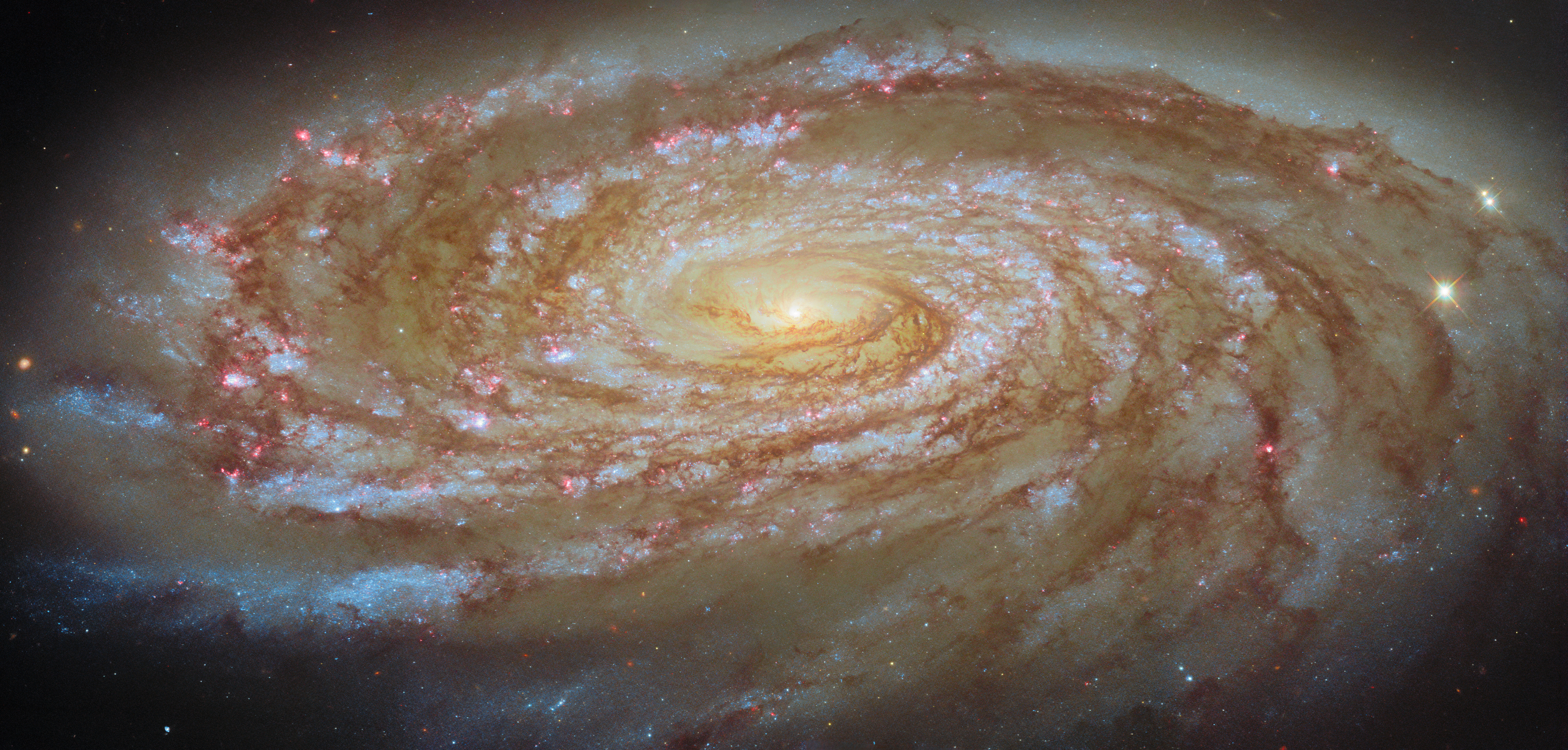
A large spiral galaxy. It is seen tilted at an angle, so that it is foreshortened and appears very wide. Its tightly-wound, blue spiral arms swirl out from its glowing centre, spreading apart at the tips. They are followed by strands and clumps of dark red dust, and spotted with pink dots where stars are forming in clouds of gas. The galaxy is surrounded by a slight glow and lies on a dark background. Credit: ESA/Hubble & NASA, D. Thilker and the MAUVE-HST Team


The focus of today’s ESA/Hubble Picture of the Month is an active spiral galaxy on a journey lasting hundreds of millions of years. The galaxy Messier 88 (M88), which is also known as NGC 4501, is located about 63 million light-years away in the constellation Coma Berenices (Berenice’s Hair).

M88 is an active galaxy, which means that its centre harbours a supermassive black hole that is snacking on gas and dust. This black hole is estimated to be around 100 million times as massive as the Sun, and it appears to be powering outflows of gas from the galaxy’s centre.

Around this black hole is a population of old, reddish stars that give M88 its warmly glowing heart. Spreading out from the centre are several tightly wound, symmetrical spiral arms, each outlined by sparkling pink and blue star clusters and knotted clouds of dust. We see M88 from an angle so that it appears elongated, and its spiral arms delicately fan out before it.

M88 is a member of the Virgo Cluster, a collection of more than a thousand galaxies held together by gravity — and therefore linked by fate. As this massive group of galaxies moves through space, the galaxies themselves are in constant motion as they orbit the cluster’s centre of gravity. M88 itself is on a long and somewhat perilous cosmic journey that will bring it to the innermost reaches of the cluster.

As is the case with any epic journey, M88 will be fundamentally changed by its trek to the centre of the Virgo Cluster, about 2 million light-years from where it is today. In 200–300 million years, M88 will make its closest approach to Messier 87, the massive elliptical galaxy that anchors the entire cluster. As it draws close to this gravitational behemoth, M88 will experience intense ram pressure stripping. Ram pressure stripping is a process through which a galaxy’s gas is swept away as it pushes through the ever-present gas between the galaxies in a cluster.

Researchers have already seen this process at work in M88. The galaxy’s swirling disc of gas is truncated, and it appears to have been compressed on the leading edge of the galaxy, piling up like snow before a plough. In fact, M88 appears to have considerably less cold gas — the raw fuel for star formation — than expected for a galaxy of its size, especially in its outer regions. This is a clear sign that M88 will be altered by its journey, which will affect its ability to form stars and alter the course of its evolution.

Astronomers observed M88 with Hubble as part of an observing programme (#18103; PI: D. Thilker) dedicated to understanding the lives of spiral galaxies in crowded environments. This programme uses Hubble’s highly capable Wide Field Camera 3, which can finely resolve individual star clusters and nebulae in galaxies tens of millions of light-years away. By studying galaxies on these scales, astronomers can understand how a journey through a cluster impacts galaxies’ evolution and ability to form new stars.


Links


Tuesday, September 17, 2024

NASA's Hubble, Chandra Find Supermassive Black Hole Duo

This is an artist's depiction of a pair of active black holes at the heart of two merging galaxies. They are both surrounded by an accretion disk of hot gas. Some of the material is ejected along the spin axis of each black hole. Confined by powerful magnetic fields, the jets blaze across space at nearly the speed of light as devastating beams of energy. Credits: Artwork: NASA, ESA, Joseph Olmsted (STScI)

A Hubble Space Telescope visible-light image of the galaxy MCG-03-34-064. Hubble's sharp view reveals three distinct bright spots embedded in a white ellipse at the galaxy's center (expanded in an inset image at upper right). Two of these bright spots are the source of strong X-ray emission, a telltale sign that they are supermassive black holes. The black holes shine brightly because they are converting infalling matter into energy, and blaze across space as active galactic nuclei. Their separation is about 300 light-years. The third spot is a blob of bright gas. The blue streak pointing to the 5 o'clock position may be a jet fired from one of the black holes. The black hole pair is a result of a merger between two galaxies that will eventually collide. Images


Like two Sumo wrestlers squaring off, the closest confirmed pair of supermassive black holes have been observed in tight proximity. These are located approximately 300 light-years apart and were detected using NASA's Hubble Space Telescope and the Chandra X-ray Observatory. These black holes, buried deep within a pair of colliding galaxies, are fueled by infalling gas and dust, causing them to shine brightly as active galactic nuclei (AGN).

This AGN pair is the closest one detected in the local universe using multiwavelength (visible and X-ray light) observations. While several dozen "dual" black holes have been found before, their separations are typically much greater than what was discovered in the gas-rich galaxy MCG-03-34-64. Astronomers using radio telescopes have observed one pair of binary black holes in even closer proximity than in MCG-03-34-64, but without confirmation in other wavelengths.

AGN binaries like this were likely more common in the early universe when galaxy mergers were more frequent. This discovery provides a unique close-up look at a nearby example, located about 800 million light-years away.

The discovery was serendipitous. Hubble's high-resolution imaging revealed three optical diffraction spikes nested inside the host galaxy, indicating a large concentration of glowing oxygen gas within a very small area. "We were not expecting to see something like this," said Anna Trindade Falcão of the Center for Astrophysics | Harvard & Smithsonian in Cambridge, Massachusetts, lead author of the paper published today in The Astrophysical Journal. "This view is not a common occurrence in the nearby universe, and told us there's something else going on inside the galaxy."

Diffraction spikes are imaging artifacts caused when light from a very small region in space bends around the mirror inside telescopes.

Falcão's team then examined the same galaxy in X-rays light using the Chandra observatory to drill into what's going on. "When we looked at MCG-03-34-64 in the X-ray band, we saw two separated, powerful sources of high-energy emission coincident with the bright optical points of light seen with Hubble. We put these pieces together and concluded that we were likely looking at two closely spaced supermassive black holes," said Falcão.

To support their interpretation, the researchers used archival radio data from the Karl G. Jansky Very Large Array near Socorro, New Mexico. The energetic black hole duo also emits powerful radio waves. "When you see bright light in optical, X-rays, and radio wavelengths, a lot of things can be ruled out, leaving the conclusion these can only be explained as close black holes. When you put all the pieces together it gives you the picture of the AGN duo," said Falcão.

The third source of bright light seen by Hubble is of unknown origin, and more data is needed to understand it. That might be gas that is shocked by energy from a jet of ultra high-speed plasma fired from one of the black holes, like a stream of water from a garden hose blasting into a pile of sand.

"We wouldn't be able to see all of these intricacies without Hubble's amazing resolution," said Falcão.

The two supermassive black holes were once at the core of their respective host galaxies. A merger between the galaxies brought the black holes into close proximity. They will continue to spiral closer together until they eventually merge – in perhaps 100 million years – rattling the fabric of space and time as gravitational waves.

The National Science Foundation's Laser Interferometer Gravitational-Wave Observatory (LIGO) has detected gravitational waves from dozens of mergers between stellar-mass black holes. But the longer wavelengths resulting from a supermassive black hole merger are beyond LIGO's capabilities. The next-generation gravitational wave detector, called the LISA (Laser Interferometer Space Antenna) mission, will consist of three detectors in space, separated by millions of miles, to capture these longer wavelength gravitational waves from deep space. ESA (European Space Agency) is leading this mission, partnering with NASA and other participating institutions, with a planned launch in the mid-2030s.

NASA's Marshall Space Flight Center manages the Chandra program. The Smithsonian Astrophysical Observatory’s Chandra X-ray Center controls science from Cambridge, Massachusetts and flight operations from Burlington, Massachusetts. Northrop Grumman Space Technologies in Redondo Beach, California was the prime contractor for the spacecraft.

The Hubble Space Telescope has been operating for over three decades and continues to make ground-breaking discoveries that shape our fundamental understanding of the universe. Hubble is a project of international cooperation between NASA and ESA (European Space Agency). NASA's Goddard Space Flight Center in Greenbelt, Maryland, manages the telescope and mission operations. Lockheed Martin Space, based in Denver, Colorado, also supports mission operations at Goddard. The Space Telescope Science Institute in Baltimore, Maryland, which is operated by the Association of Universities for Research in Astronomy, conducts Hubble science operations for NASA.


About This Release

Credits:

Media Contact:

Ray Villard
Space Telescope Science Institute, Baltimore, Maryland

Science Contact:

Anna Trindade Falcão
Center for Astrophysics | Harvard & Smithsonian, Cambridge, Massachusetts

Permissions: Content Use Policy

Contact Us: Direct inquiries to the News Team.

Related Links and Documents


Saturday, October 21, 2023

Three’s a Crowd for Stars Around Supermassive Black Hole Binaries

Simulation of the light from a supermassive black hole binary.

Credit: NASA's Goddard Space Flight Center/Scott Noble; simulation data, d'Ascoli et al. 2018

Title: Uncovering Hidden Massive Black Hole Companions with Tidal Disruption Events
Authors: Brenna Mockler et al.
First Author’s Institution: The Observatories of the Carnegie Institution for Science & Department of Physics and Astronomy at the University of California, Los Angeles
Status: Accepted to ApJ

Two Is Company

Today, astronomers believe that nearly every galaxy hosts a supermassive black hole at its center. In addition, galaxies are thought to grow through mergers, in a process known as hierarchical growth. Essentially, smaller galaxies smash together to form a larger galaxy, and this process repeats many times as the universe evolves. When two galaxies hosting supermassive black holes merge, the black holes should sink to the center of the new galaxy rather rapidly, where they could start orbiting each other as a supermassive black hole binary. These binaries are therefore a natural consequence of this picture of hierarchical galaxy evolution and should be a relatively common occurrence in the universe.

However, finding supermassive black hole binaries has been rather difficult with current instrumentation and technology. A supermassive black hole makes itself known when it accretes gas from its surroundings, becoming a luminous active galactic nucleus. As two accreting black holes get closer and closer together, our telescopes become incapable of resolving them as two individual active galactic nuclei. There are other ways to infer that a binary exists when the black holes are close together, but these methods can be tricky — either the signals could also be produced by some other astrophysical phenomenon, or they take decades to confirm. The next generation of gravitational wave detectors, like the Laser Interferometer Space Antenna, will surely help, but we’d still like to be able to look for supermassive black hole binaries in the next decade or more before these detectors are built!

Introducing the Star of the Show

One of the best ways to observe something we can’t see is by looking for its interactions with things we can see. Today’s authors study the interplay of a supermassive black hole binary with stars in the centers of galaxies, highlighting this as a potential way to uncover these binaries. To start, let’s consider just a single supermassive black hole and throw a star at it. Most of the time, this star will orbit the black hole, just like our planets orbit the Sun. However, in some cases, when the orbit is eccentric enough, the star can get just a bit too close to the supermassive black hole, leading to the star’s demise. This measure of “too close” is set by the distance at which the star’s self-gravity can no longer hold itself together against the tidal forces of the black hole, and the star gets ripped to shreds. We call this phenomenon a tidal disruption event, and these events release a huge amount of energy from a previously quiet black hole.

Okay, but how do we get stars onto these elliptical orbits so that they’re disrupted? And how often does this happen? Many research articles have investigated these questions (check out some of the many Astrobites written on tidal disruption events), both from a theoretical and observational perspective. It turns out that one way to get stars onto these highly elliptical orbits is to scatter them off of other stars (through a process called two-body relaxation). This process is relatively rare; both theory and observations agree that the rate for tidal disruption events around single black holes is somewhere around one every 104–105 years (per galaxy).

But what happens when we deposit these stars around a supermassive black hole binary? The authors of today’s article investigate this very question. In particular, they investigate the interaction of stars around the smaller of the two black holes (see Figure 1 for a schematic of this set up).


Figure 1: Cartoon schematic of the setup considered in today’s article. We have two supermassive black holes with masses m1 and m2, with m1 < m2. The authors investigate stellar orbits around the smaller black hole (m1). Credit: Mockler et al. 2023

And Now Three’s a Crowd

To explore the effects of a binary supermassive black holes on the rate of tidal disruption events, the authors perform dynamical simulations of the three-body problem we just set up above. They focus in particular on the effects of the eccentric Kozai–Lidov (EKL) mechanism, which is a dynamical effect in a three-body system that allows the eccentricity and inclination of the outer binary (i.e., the star and the lower-mass black hole) to oscillate. EKL oscillations can lead to extreme eccentricities, which is a great way to make tidal disruption events happen! To explore the effects of EKL on the system, the authors test different combinations of binary masses and stellar density profiles. There’s a large range of possible parameters in this problem, so they limit their tests to those in which the timescale for the EKL mechanism is the shortest dynamical timescale (which leads to EKL being the dominant mechanism driving the system’s evolution).

The simulations revealed that there should be a burst of tidal disruption events lasting 1–100 million years, depending on the exact simulation parameters. During this time period, the tidal disruption event rates greatly exceed that expected from two-body relaxation, which is what sets the rates of these events in single supermassive black hole systems. However, if the stars near the black hole are not replenished after this period, either from star formation near the galactic nucleus or some dynamical effects, then the rates of EKL-driven tidal disruption events drop to less than those of two-body relaxation. This is highlighted in Figure 2, which shows the EKL-driven tidal disruption event rate as a function of time in these dynamical simulations. So, our best hope for catching tidal disruption events around the smaller black hole in a binary pair is relatively quickly after it enters the binary.


Figure 2: Rate of tidal disruption events occurring around the smaller supermassive black hole as a function of time in the simulations. The shaded blue regions represent different masses of the smaller supermassive black hole, each of which is 10 times less massive than the larger supermassive black hole. The shaded grey region shows the observed rate of optically selected tidal disruption events, and the grey hashed region denotes the rate of tidal disruption events in “post-starburst” (PSB) galaxies (galaxies seen about a few millions of years after a recent burst of star formation, which is often driven by a merger). Finally, the dashed and dotted lines show the rates of tidal disruption events from two-body relaxation (i.e., ordinary tidal disruption events around a single supermassive black hole). The simulations show a burst of tidal disruption events relative to the two-body relaxation rate for the first 1–100 million years. Adapted from Mockler et al. 2023

Finding Supermassive Black Hole Binaries with Tidal Disruption Events

To end, the authors leave us with a potential way to search for supermassive black hole binaries using these tidal disruption events. This method relies upon the fact that the two black holes in the binary will dominate two different observable properties. On one hand, the gravitational potential of the galactic nucleus where these two black holes reside will be dominated by the larger of the two black holes, meaning that host galaxy properties that scale with the galaxy’s central black hole mass will be set by this larger black hole. On the other hand, the light curve from a given tidal disruption event is set by the mass of the black hole that the star is accreting onto, which in this case is the smaller black hole. This means that if we see a tidal disruption event that seems to be coming from a small black hole, but it’s actually happening in a galaxy that’s far too big to host such a black hole, then there’s strong evidence that this could be a supermassive black hole binary system! And so, while three may be a crowd, this unlucky star will actually shed some light on its black hole companions as it leaves the party.

Original astrobite edited by Mark Dodici.


About the author, Megan Masterson:

I’m a 3rd-year PhD student at MIT studying transient accretion events around supermassive black holes, including tidal disruption events and changing-look active galactic nuclei. I primarily use X-ray observations to observe the inner accretion flow of these transients, but I am also interested in multi-wavelength follow-up to get the full picture of these fascinating systems. In my free time, I enjoy hiking and watching soccer.


Editor’s Note: Astrobites is a graduate-student-run organization that digests astrophysical literature for undergraduate students. As part of the partnership between the AAS and astrobites, we occasionally repost astrobites content here at AAS Nova. We hope you enjoy this post from astrobites; the original can be viewed at astrobites.org.