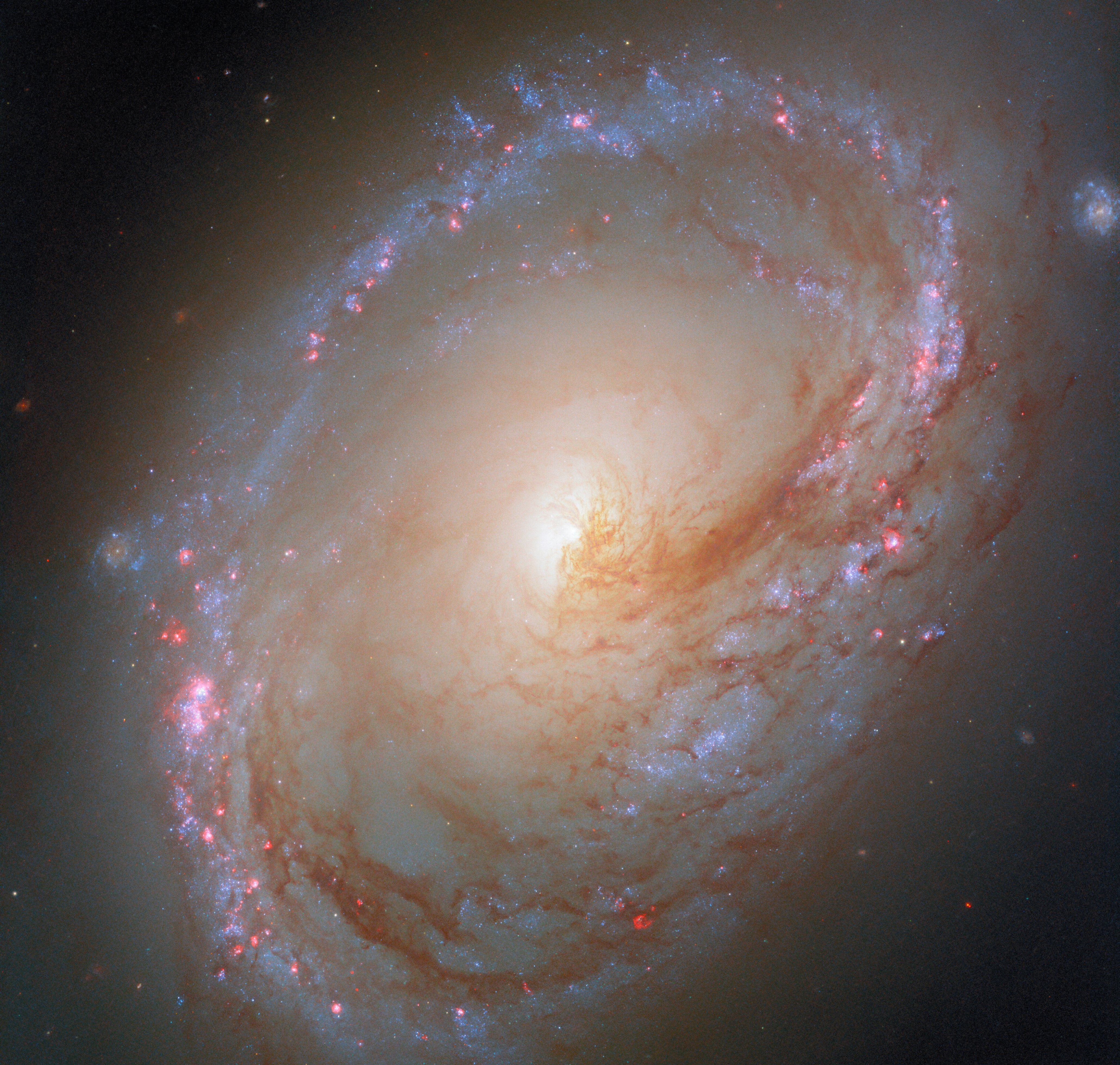
A spiral galaxy, tilted nearly face-on to us, with a slightly unusual shape. Its spiral arms form an oval-shaped ring around the galaxy’s disc, filled with blue light from stars, as well as pink glowing gas bubbles where new stars are forming. Threads of dark red dust swirl around the brightly glowing core, blocking some of its light. The dust lanes extend into and follow the spiral arms. Credit: ESA/Hubble & NASA, F. Belfiore, D. Calzetti
Today’s NASA/ESA Hubble Space Telescope Picture of the Week features a galaxy whose asymmetric appearance may be the result of a galactic tug of war.Located 35 million light-years away in the constellation Leo, the spiral galaxy Messier 96 is the brightest of the galaxies in its group. The gravitational pull of its galactic neighbours may be responsible for Messier 96’s uneven distribution of gas and dust, asymmetric spiral arms, and off-centre galactic core.
This asymmetric appearance is on full display in a new Hubble image, which incorporates observations made in ultraviolet and optical light. Hubble images of Messier 96 have been released previously in 2015 and 2018. Each successive image has added new data, building up a beautiful and scientifically valuable view of the galaxy.
This third version gives an entirely new perspective on Messier 96’s star formation. The bubbles of pink gas in this image surround hot, young, massive stars, illuminating a ring of star formation in the outskirts of the galaxy. These young stars are still embedded within the clouds of gas from which they were born. The new data included for the first time in this image will be used to study how stars are born within giant dusty gas clouds, how dust filters starlight, and how stars affect their environments.
Source: ESA/Hubble/potw