Showing posts with label constellation Cetus. Show all posts

Saturday, May 16, 2026

A beacon of light in swirls of dust

A spiral galaxy shown in mid-infrared light. The image is dominated by an extremely bright glow from the galaxy’s nucleus. Six large and two smaller rays of light emit from the centre, which are diffraction spikes created by the telescope’s optics. The galaxy’s spiral arms are visible by two lines of glowing orange bubbles which whirl out into the disc. Swirling blue clouds of dust make up the rest of the galaxy. Credit:ESA/Webb, NASA & CSA, A. Leroy


This latest Picture of the Month from the NASA/ESA/CSA James Webb Space Telescope features Messier 77 (M77), a barred spiral galaxy famous and appreciated among astronomers for its combination of relative proximity and spectacular features to study. It is located 45 million light-years away in the constellation Cetus (The Whale). This new image from Webb’s Mid-Infrared Instrument (MIRI) highlights its swirling spiral arms, the dust in its disc and its piercingly bright core like never before.

At the heart of M77 is a compact region filled with hot gas that handily outshines the rest of the galaxy put together, even overcoming the light-gathering capacity of Webb’s cameras. This is an active galactic nucleus (AGN), and it’s powered by M77’s central supermassive black hole, which is eight million times as massive as our Sun. Gas in the galaxy’s central regions is pulled by the strong gravity into a tight and rapid orbit around the black hole, where it crashes together and heats up, releasing tremendous amounts of radiation.

The bright orange lines appearing to radiate out from the centre of M77 are not actually a feature of the galaxy: they are a type of distortion that arises from the optical design of the telescope. Called diffraction spikes, they are created because the intense light from the unresolved AGN is bent (“diffracted”) very slightly at the edges of Webb’s hexagonal mirror panels and around one of the struts that hold up its secondary mirror. This distinctive six-plus-two-pointed pattern is the same for any image taken by Webb. For diffraction spikes to appear, the light source has to be very bright and very concentrated, so they’re most often seen on stars. But in some galaxies, as here, the nucleus is bright and compact enough to make diffraction spikes appear as well.

M77 is not just known for its easily visible AGN, but also as a prolific star-forming galaxy. The near-infrared image of M77 reveals a bar spanning across the central region, which doesn’t appear in visible-light images of the galaxy. The bar is enclosed by a bright ring, called a starburst ring, formed by the inner ends of M77’s two spiral arms. Starburst regions in galaxies are typified by extremely high star-formation rates. This ring is more than 6 000 light-years across and displays intense and widespread starbursts, visible in this image by the densely concentrated orange bubbles all around the ring. Since M77 is relatively close to Earth, this starburst ring is a very well-studied example of the phenomenon.

As an active spiral galaxy, M77’s disc is filled with gas and dust which is both a product of and fuel for future star formation. Webb’s MIRI fills out our view of the galaxy with the glow of interstellar dust grains emitted at longer wavelengths, shown here in blue. The dust forms a huge vortex of smoky, swirling filaments with cavities in between. The glowing orange bubbles carved out by newly formed star clusters are also prominently visible out along the galaxy’s arms.

Beyond Webb’s quite focused view, M77’s arms join into a faint extended ring of hydrogen gas thousands of light-years wide, where yet more star formation is taking place. Vast, tenuous filaments of hydrogen gas stretch across this ring and out into intergalactic space, forming an outermost layer around the galaxy. For the tentacle-like appearance of these filaments, M77 is also named the Squid Galaxy.

The data used to create this image are from an observing programme (#3707) that surveyed massive, nearby, star-forming galaxies to create a rich dataset useful for many scientific investigations. As can be seen here, the stunning resolution of Webb’s instruments reveals star clusters and rich reservoirs of gas, which can be used to explore the cycle of star formation, life and death in these and other galaxies.


Links


Saturday, April 04, 2026

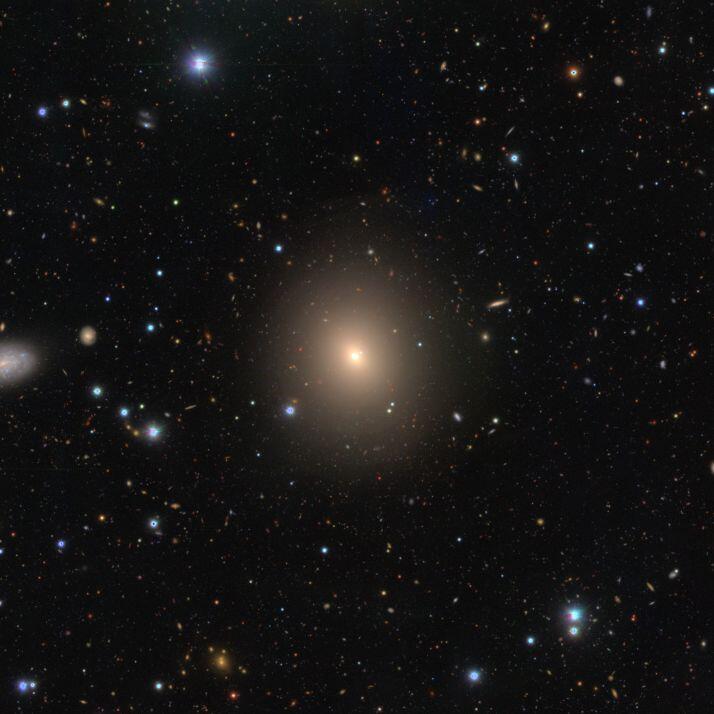
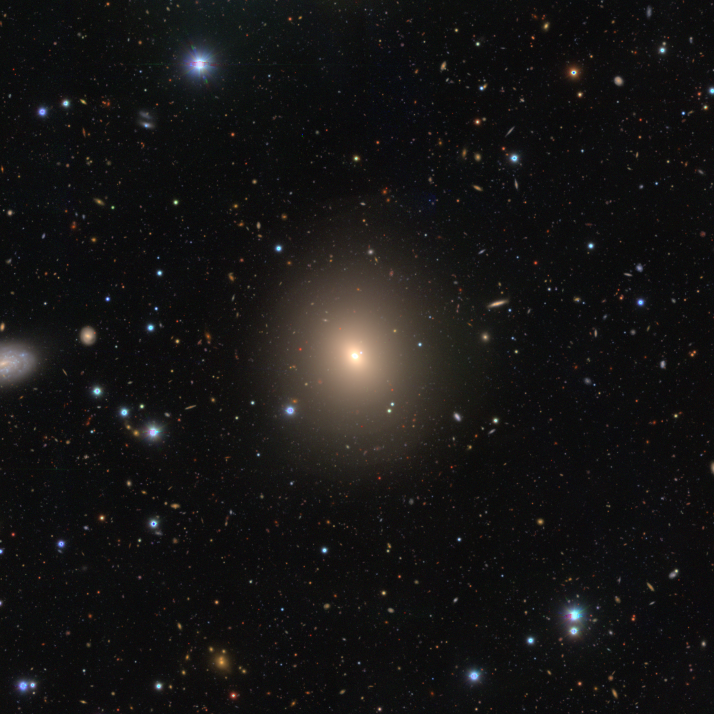
Elliptical Galaxy NGC 7458


NGC 7458 is a bright and well-defined elliptical galaxy located in the constellation Cetus. Elliptical galaxies are characterized by a strong concentration of light toward their centers that fades rapidly outward, and they lack the distinct structures seen in spiral galaxies. The overall reddish color of NGC 7458 indicates that it is composed predominantly of old stars. Elliptical galaxies in the present-day Universe are known to contain many very old stars, often more than 10 billion years old.

Distance from Earth: 240 million light-years
Instrument: Hyper Suprime-Cam (HSC)


Sunday, March 08, 2026

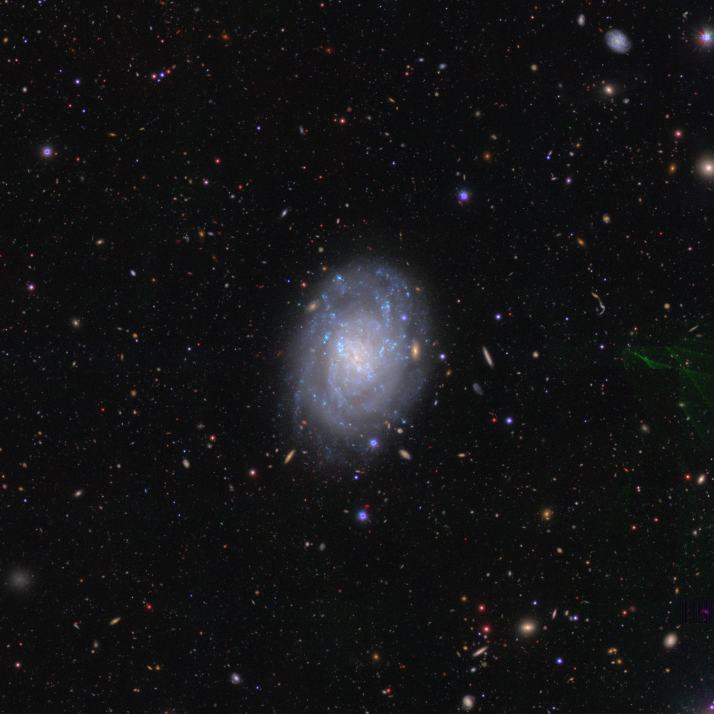
Intermediate Spiral Galaxy NGC 941


NGC 941 is located approximately 55 million light-years away in the constellation Cetus. This faint galaxy is classified as an intermediate spiral, exhibiting characteristics between a barred spiral with a central bar and an unbarred spiral. Overall, NGC 941 has a bluish appearance, and the presence of dust lanes in its central region indicates ongoing star formation. The small orange galaxies visible around it are actually much more distant background galaxies, seen through NGC 941 due to its low surface brightness. Credit: NAOJ; Image provided by Masayuki Tanaka


Monday, December 22, 2025

Long-distance relationship

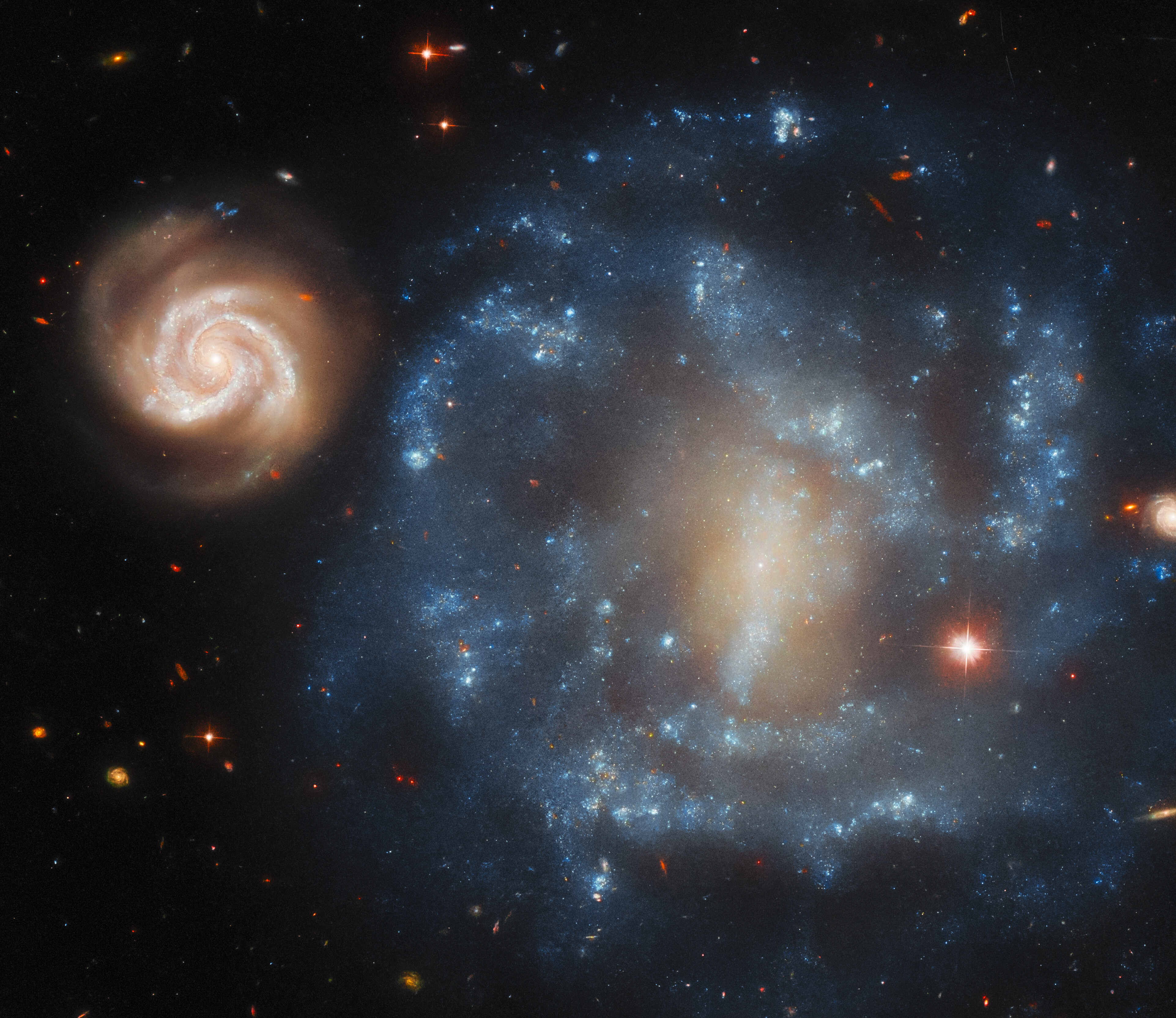
This image shows two galaxies side by side. The galaxy on the top left is smaller in size, and appears as a bright glowing spiral with clearly-defined arms. A larger blue galaxy dominates the full right field of the image. This galaxy is more irregularly shaped, with a glowing central bar, and varying regions of concentrated hues of blue. The background is black with various stars and galaxies in the distance. Credit: ESA/Hubble & NASA, J. Dalcanton, Dark Energy Survey/DOE/FNAL/DECam/CTIO/NOIRLab/NSF/AURA

These galaxies look to be close companions — a small, bright spiral galaxy flitting around the edge of a much larger spiral with a dark and disturbed countenance. But looks can be deceiving — how close are they really? The celestial pair featured in this week’s Hubble Picture of the Week is known by the name Arp 4, and lies in the constellation Cetus (the Whale).

The designation Arp 4 comes from the Atlas of Peculiar Galaxies, compiled in the 1960s by astronomer Halton Arp. “Unusual galaxies” were selected and photographed to provide examples of weird and non-standard shapes, the better to study how galaxies evolve into these forms. Throughout its mission the Hubble Space Telescope has revolutionised the study of galaxies and shown us some fantastically unusual examples from Arp’s atlas. In that catalogue, the first few galaxies like Arp 4 are “low surface brightness” galaxies, a type of galaxy that is unexpectedly faint and hard to detect. The large galaxy here — also catalogued as MCG-02-05-050 — fits this description well, with its fragmentary arms and dim disc. Its smaller companion, MCG-02-05-050a, is a much more bright and active spiral.

The trick is that these galaxies are not actually very close. The large blue galaxy MCG-02-05-050 is located 65 million light-years from Earth; its brighter smaller companion MCG-02-05-050a, at 675 million light-years away, is over ten times the distance! Owing to this, MCG-02-05-050a is likely the larger galaxy of the two, and MCG-02-05-050 comparatively small. Their pairing in this image is simply an unlikely visual coincidence. Despite this lack of a physical relation between them, our point of view on Earth allows us to enjoy the sight of Arp 4 as an odd couple in the sky.

Links


Wednesday, August 13, 2025

Low brightness, high interest

This Hubble image features a close-up view of the outer arms of the spiral galaxy NGC 45. These spiral arms are filled with tiny blue dots - stars - and glowing pink c louds - star-forming nebulae. This is shown against a dark background.Credit: ESA/Hubble & NASA, D. Calzetti, R. Chandar - Acknowledgement: M. H. Özsaraç

This NASA/ESA Hubble Space Telescope Picture of the Week zooms in on the feathery spiral arms of the galaxy NGC 45, which lies just 22 million light-years away in the constellation Cetus (The Whale).

The data used to create this portrait were drawn from two complementary observing programmes. The first took a broad view of 50 nearby galaxies, leveraging Hubble’s ability to observe light from the ultraviolet to the near-infrared in order to study star formation in these galaxies. The second programme examined many of the same nearby galaxies as the first, narrowing in on a particular wavelength of red light called H-alpha. Star-forming nebulae are powerful producers of H-alpha light, and several of these regions can be identified across NGC 45 by their bright pink-red colour.

These observing programmes aimed to study star formation in galaxies of different sizes, structures, and degrees of isolation — and NGC 45 makes for a particularly interesting target. Though it may appear to be a regular spiral galaxy, NGC 45 is actually a remarkable type called a low surface brightness galaxy.

Low surface brightness galaxies are fainter than the night sky itself, making them incredibly difficult to detect. They appear unexpectedly faint because they have relatively few stars for the amount of gas and dark matter they carry. In the decades since the first low surface brightness galaxy was serendipitously discovered in 1986, researchers have learned that 30–60% of all galaxies may fall into this category. Studying these hard-to-detect galaxies is key to understanding how galaxies form and evolve, and Hubble’s sensitive instruments are equal to the task.


Monday, July 07, 2025

Portrait of a galaxy cluster

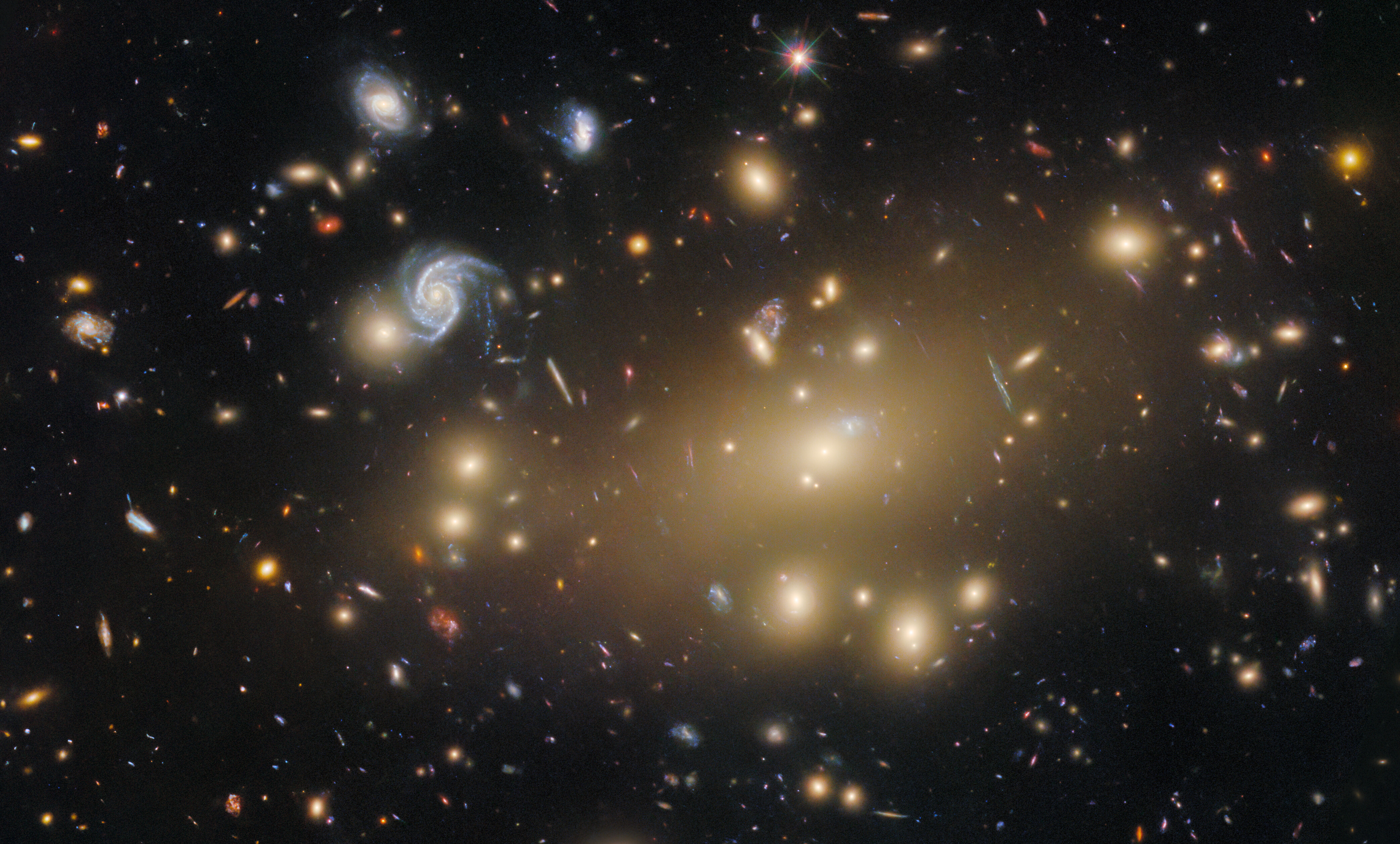
A cluster of distant, mainly elliptical galaxies. They appear as brightly shining points radiating golden light that each take the shape of a smooth, featureless oval. They crowd around one that is extremely large and bright. A few spiral galaxies of comparable size appear too, bluer in colour and with unique shapes. Of the other, more small and distant galaxies covering the scene, a few are warped into long lines. Credit: ESA/Hubble & NASA, M. Postman, P. Kelly

A massive, spacetime-warping cluster of galaxies is the setting of today’s NASA/ESA Hubble Space Telescope Picture of the Week. The galaxy cluster in question is Abell 209, which is located 2.8 billion light-years away in the constellation Cetus (The Whale).

This Hubble image of Abell 209 shows more than a hundred galaxies, but there’s more to this cluster than even Hubble’s discerning eye can see. Abell 209’s galaxies are separated by millions of light-years, and the seemingly empty space between the galaxies is actually filled with hot, diffuse gas that can be spotted only at X-ray wavelengths. An even more elusive occupant of this galaxy cluster is dark matter: a form of matter that does not interact with light. The Universe is understood to be comprised of 5% normal matter, 25% dark matter, and 70% dark energy

Hubble observations like the ones used to create this image can help astronomers answer fundamental questions about our Universe, including mysteries surrounding dark matter and dark energy. These investigations leverage the immense mass of a galaxy cluster, which can bend the fabric of spacetime itself and create warped and magnified images of background galaxies and stars in a process called gravitational lensing.

While this image lacks the dramatic rings that gravitational lensing can sometimes create, Abell 209 still shows subtle signs of lensing at work, in the form of streaky, slightly curved galaxies within the cluster’s golden glow. By measuring the distortion of these galaxies, astronomers can map the distribution of mass within the cluster, illuminating the underlying cloud of dark matter. This information, which Hubble’s fine resolution and sensitive instruments help to provide, is critical for testing theories of how our Universe has evolved.


Tuesday, June 03, 2025

Cosmic Himalayas Quasar Cluster Defies Explanation

The densest cluster of supermassive black holes identified in the Universe. The background image was taken by Hyper Suprime-Cam on the Subaru Telescope. The red and blue shadows represent the density of the supermassive black holes (quasars) and the surrounding hundreds of young, star-forming galaxies, respectively. The white squares frame the quasars, and the larger squares show close up images. (Credit: Subaru Telescope / SDSS, Liang et al.)

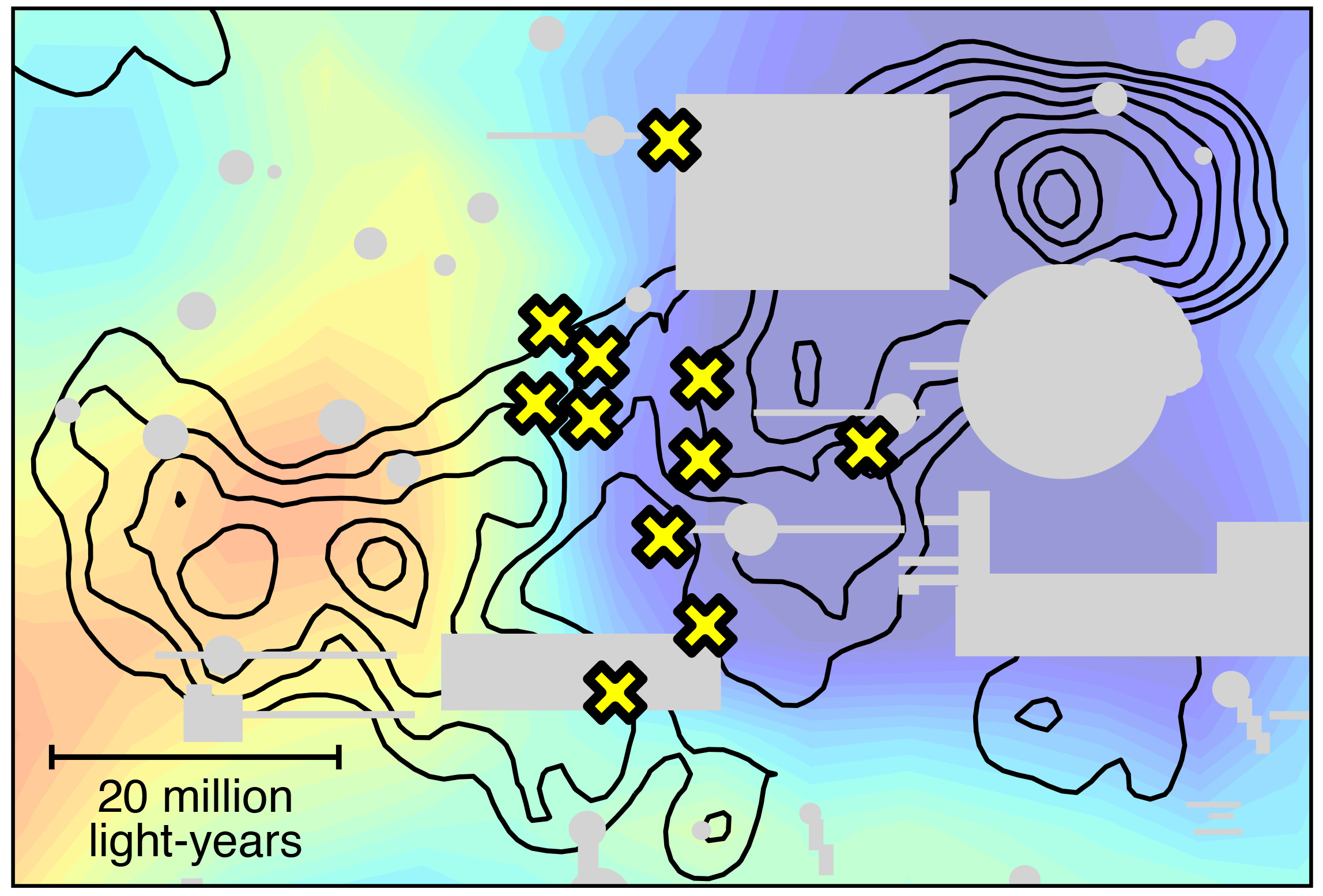
A newly discovered cluster of eleven quasars has shattered the previous record of five. Rather than being associated with a dense group of galaxies, these quasars sit on the boundary between two groups of galaxies. This structure, dubbed the “Cosmic Himalayas,” cannot be explained by conventional theories, forcing astronomers to rethink the formation scenarios for quasars.

Quasars are some of the brightest objects in the Universe. A quasar is powered by large amounts of matter falling into the supermassive black hole at the center of a galaxy. Collisions and mergers between galaxies can cause quasar activity by feeding addition matter into the center of a galaxy. Quasar activity peaked in the early Universe, but even then they were relatively rare. So an international research team led by Yongming Liang at the National Astronomical Observatory of Japan was surprised when they found a group of elven quasars in an area of space where you would normally expect to see maybe one, while analyzing data from the Sloan Digital Sky Survey. The previous record holder for quasar over-density had been five.

Follow-up observations with the Subaru Telescope revealed another mystery. The quasars do not coincide with a dense group of galaxies. Instead, they sit on the boundary between two groups. If galaxy collisions and mergers are responsible for quasar activity, then the densest groups of quasars should be found in the densest group of galaxies. A new formation scenario is needed to explain this group of quasars, which could change the way we think about the evolution of other structures in the Universe. The team hopes that new data from next-generation instruments like the Prime Focus Spectrograph on the Subaru Telescope will help to solve the mysteries of the Cosmic Himalayas.

The research team named this formation the Cosmic Himalayas in reference to how the towering Himalayas on Earth form a boundary between plains and plateaus. The Cosmic Himalayas date back 10.8 billion years. As seen from Earth, this cluster lies in the direction of the constellation Cetus.

The "Cosmic Himalayas": a towering cluster of energetic quasars shaping the cosmic landscape. Yellow X marks indicate the positions of quasars. The color scale represents the density of neutral hydrogen gas, with red indicating high density and blue indicating low density, or in other words, the blue region is rich in ionized gas. Therefore, the neutral gas concentrates in the left cluster of galaxies, while the ionized gas preferentially appears around the right galaxy clump. Black contour lines show the galaxy density. Gray regions are masked areas due to poor image mosaic or saturation near bright stars. (Credit: Subaru Telescope / SDSS, Liang et al.) Download image (626KB)


Detailed Article(s)

The Giant Supermassive Black Hole Cluster Discovered in the Distant Universe: New Puzzles in the Cosmic Matter Distribution
Subaru Telescope


Release Information

Researcher(s) Involved in this Release
Yongming Liang (National Astronomical Observatory of Japan)
Masami Ouchi (National Astoronomical Observatory of Japan / The University of Tokyo)

Coordinated Release Organization(s)
National Astronomical Observatory of Japan
Institute for Cosmic Ray Research, the University of Tokyo

Paper(s)
Liang et al. “Cosmic Himalayas: The Highest Quasar Density Peak Identified in a 10,000 deg2 Sky with Spatial Discrepancies between Galaxies, Quasars, and IGM HI”, in The Astrophysical Journal, DOI: 10.3847/1538-4357/adc1bb

Monday, December 30, 2024

Moving towards a close-up of a black hole and its jets

Fig. 1: How do black holes launch their powerful jets? Artist’s impression of the centre of galaxy NGC 1052, reached through layers of gas and dust to almost reveal the supermassive black hole. New measurements now show that the final close-up of the black hole – and the origin of its jets – are within the reach of the Event Horizon Telescope. © Chalmers University of Technology | 3dVision | Johan Bournonville | Anne-Kathrin Baczko

Fig. 2: The Global mm-VLBI Array (GMVA) is one of the two world-wide radio telescope networks utilized for the observations of galaxy NGC 1052 at 3.5 mm wavelength. The 100-m Effelsberg telescope plays an important role within the GMVA. Compilation: Helge Rottmann / MPIfR


Two networks of telescopes zoom in on galaxy NGC 1052

After taking the first images of black holes, the ground-breaking Event Horizon Telescope and the Global mm-VLBI Array poised to reveal how black holes launch powerful jets into space. Now, a research team led by scientists from the Onsala Space Observatory, the University Würzburg and the Max Planck Institute for Radio Astronomy has shown that the EHT will be able to make exciting images of a supermassive black hole and its jets in the galaxy NGC 1052. The measurements, made with interconnected radio telescopes, also confirm strong magnetic fields close to the black hole’s edge. The results are published in Astronomy & Astrophysics.

How do supermassive black holes launch galaxy-size streams of high-energy particles – known as jets – into space at almost light-speed? Scientists have now taken an important step towards being able to answer this question, with intricate measurements of the centre of the galaxy NGC 1052, at a distance of 60 million light years from Earth in the direction of the constellation Cetus (the whale).

The research team made coordinated measurements using several radio telescopes, providing new insights into the workings of a galaxy and its supermassive black hole in the centre. Included are arrays of radio telescopes defining the Event Horizon Telescope (EHT) at 1.3 mm wavelength and the Global mm-VLBI Array (GMVA) at 3.5 mm. The technique which connects these telescopes is called very-long-baseline interferometry (VLBI).

“The centre of this galaxy, NGC 1052, is a promising target for imaging with the Event Horizon Telescope, but it’s faint, complex and more challenging than all other sources we’ve attempted so far,” says Anne-Kathrin Baczko, the main author of the publication. She is an astronomer at Onsala Space Observatory, Chalmers, and also affiliated to the Max-Planck-Institut für Radioastronomie (MPIfR).

The publication is the culmination of more than eight years of work, originally conceived at the Julius-Maximilians-Universität Würzburg (JMU) by Matthias Kadler in collaboration with Eduardo Ros at MPIfR and then continued during the PhD thesis of Anne-Kathrin Baczko in Bonn under their joint supervision.

The galaxy NGC 1052 hosts a supermassive black hole of about 150 million solar masses that is the source of two powerful jets which stretch thousands of light years outwards through space.

“We want to study not only the black hole itself and its extreme environment, but also the origin of the twin jets emanating from it. We have used the opportunity provided by GMVA and EHT to target a particularly important and key object, in the crossroads of different types of active galaxy,” says Eduardo Ros from MPIfR, a member of the research team.

The team made measurements using just five of the telescopes in the EHT’s global network – including ALMA (the Atacama Large Millimeter/submillimeter Array) in Chile, in a configuration that would allow the best possible estimate of its potential for future observations, and supplemented with measurements from other telescopes including the GMVA.

“For such a faint and unknown target, we were not sure if we would get any data at all. But the strategy worked, thanks in particular to the sensitivity of ALMA and complementary data from many other telescopes,” says Anne-Kathrin Baczko.

The scientists are now certain that successful imaging will be possible in the future, thanks to two new key findings. "Our results show that the region around the black hole where the twin jets form is large enough to be imaged with mm-VLBI observations. And it emits at exactly the right frequency of radio waves to take advantage of the strengths of the next generation of VLBI networks," says Matthias Kadler from the JMU Würzburg.

From their measurements, the scientists have also estimated the strength of the magnetic field close to the black hole’s event horizon. The field strength, 2.6 tesla, is about 40 0001) times stronger than the Earth’s magnetic field. That’s consistent with previous estimates for this galaxy.

“This is such a powerful magnetic field that we think it can probably stop matter from falling into the black hole. That in turn can help to launch the galaxy’s two jets,” says Christian Fromm, also from JMU Würzburg, and affiliated to the MPIfR.

Even though the source is as challenging as this, the future looks bright as radio astronomers prepare for much enhanced telescope networks such as the forthcoming NRAO’s new-generation Very Large Array (ngVLA) and future 1.3 mm arrays, with new antennas and improved equipment.

The new measurements give a clearer idea of how the innermost centre of the galaxy shines at different wavelengths. Its spectrum is bright enough at millimetre wavelengths yielding the very sharpest images and is even brighter around wavelength 2.3 mm, which makes it a prime target for the next generation of radio telescopes.

“Thanks to instruments like the EHT and the GMVA, we are now making remarkable observations that show the great progress in radio astronomy through technological innovation and international collaboration. Measurements at NGC 1052, ranging from magnetic field strength to black hole environments, are providing valuable insights into the processes of jet formation and accretion,’ says Anton Zensus, founding chair of the EHT collaboration and director at MPIfR. ‘With new telescopes and the next generation of networks, we will further deepen our understanding of these fascinating cosmic phenomena.”


Additional Information

The EHT collaboration involves more than 400 researchers from Africa, Asia, Europe, North and South America, with around 270 participating in this paper. The international collaboration aims to capture the most detailed images of black holes using a virtual Earth-sized telescope. Supported by considerable international efforts, the EHT links existing telescopes using novel techniques to create a fundamentally new instrument with th highest angular resolving power that has yet been achieved.

The EHT consortium consists of 13 stakeholder institutes; the Academia Sinica Institute of‬ Astronomy and Astrophysics, the University of Arizona, the Center for Astrophysics | Harvard &‬ Smithsonian, the University of Chicago, the East Asian Observatory, the Goethe University‬ Frankfurt, the Institut de Radioastronomie Millimétrique, the Large Millimeter Telescope, the Max Planck‬ Institute for Radio Astronomy, the MIT Haystack Observatory, the National Astronomical Observatory of‬ Japan, the Perimeter Institute for Theoretical Physics, and the Radboud University.

The measurements of NGC 1052 were made by five telescopes in the EHT network: ALMA (the Atacama Large Millimeter/submillimeter Array) in Chile, the IRAM 30-metre telescope in Spain; the James Clerk Maxwell Telescope (JCMT) and the Submillimeter Array (SMA) in Hawaiʻi; and the South Pole Telescope (SPT) in Antarctica. These were supplemented with measurements from 14 other radio telescopes in the GMVA network (Global Millimetre VLBI Array), in Spain, Finland and Germany, including the 100-metre Effelsberg radio telescope, the 20-metre telescope at Onsala Space Observatory, Sweden, and the telescopes of the VLBA (Very Long Baseline Array) in the US.

Researchers affiliated with the Max Planck Institut für Radioastronomie, include Anne-Kathrin Baczko, the first author (main affiliation: Onsala Space Observatory, Chalmers University of Technology), and also Eduardo Ros, Christian M. Fromm, Maciek Wielgus, Thomas P. Krichbaum, Michael Janssen,Walter Alef, Rebecca Azulay, Uwe Bach, Silke Britzen, Gregory Desvignes, Sergio A. Dzib, Ralph Eatough, Ramesh Karuppusamy, Dong-Jin Kim, Joana A. Kramer, Michael Kramer, Jun Liu, Kuo Liu, Andrei P. Lobanov, Ru-sen Lu, Nicholas R. MacDonald, Nicola Marchili, Karl M. Menten, Cornelia Müller, Hendrik Müller, Aristeidis Noutsos, Gisela Ortiz-Leon, Georgios Filippos Paraschos, Felix Poetzl, Helge Rottmann, Alan L. Roy, Tuomas Savolainen, Lijing Shao, Pablo Torne, Efthalia Traianou, Jan Wagner, Robert Wharton, Gunther Witzel, J. Anton Zensus, and Guang-Yao Zhao.

1) The value for the comparison from an earlier version that was too small has been corrected.


Contact:

Dr. Anne-Kathrin Baczko

tel: +46 31 772-1347
anne-kathrin.baczko@chalmers.se
Onsala Space Observatory, Chalmers University of Technology

Prof. Dr. Eduardo Ros
tel: +49 228 525-125
ros@mpifr-bonn.mpg.de
Max-Planck-Institut für Radioastronomie, Bonn

Prof. Dr. Matthias Kadler
tel: +49 931 31-85138
matthias.kadler@uni-wuerzburg.de
Lehrstuhl für Astronomie, Universität Würzburg

Dr. Norbert Junkes
Press and Public Outreach

+49 228 525-399
njunkes@mpifr-bonn.mpg.de
Max-Planck-Institut für Radioastronomie, Bonn


Original Paper

The putative center in NGC 1052
Anne-Kathrin Baczko and 286 co-authors, in: Astronomy & Astrophysics, December 17, 2024 (DOI: 10.1051/0004-6361/202450898).


Animation

How do black holes launch their powerful jets? In this visualisation of the centre of galaxy NGC 1052, we zoom in through layers of gas and dust to almost reveal the supermassive black hole. New measurements now show that the final close-up of the black hole – and the origin of its jets – are within the reach of the Event Horizon Telescope. Credit: Chalmers University of Technology | 3dVision | Johan Bournonville | Anne-Kathrin Baczko


Links

Radio Astronomy / VLBI
Research Department at MPIfR

EHT
Event Horizon Telescope (EHT)

GMVA
Global mm-VLBI Array (GMVA)

OSO
Onsala Space Observatory (OSO)

Chalmers
Astronomy and Plasma Physics, Chalmers University of Technology

Univ. Würzburg
Lehrstuhl für Astronomie, Universität Würzburg


Parallel Press Releases

Event Horizon Telescope: Moving towards a close-up of a black hole and its jets
CTU Press Release, December 17, 2024

Closing-in on a Black Hole and its Jets
JMU Press Release, December 17, 2024

The Event Horizon Telescope can provide a close-up of a black hole and its jets
UV Press Release, December 17, 2024