Showing posts with label H-alpha emission. Show all posts

Wednesday, December 03, 2025

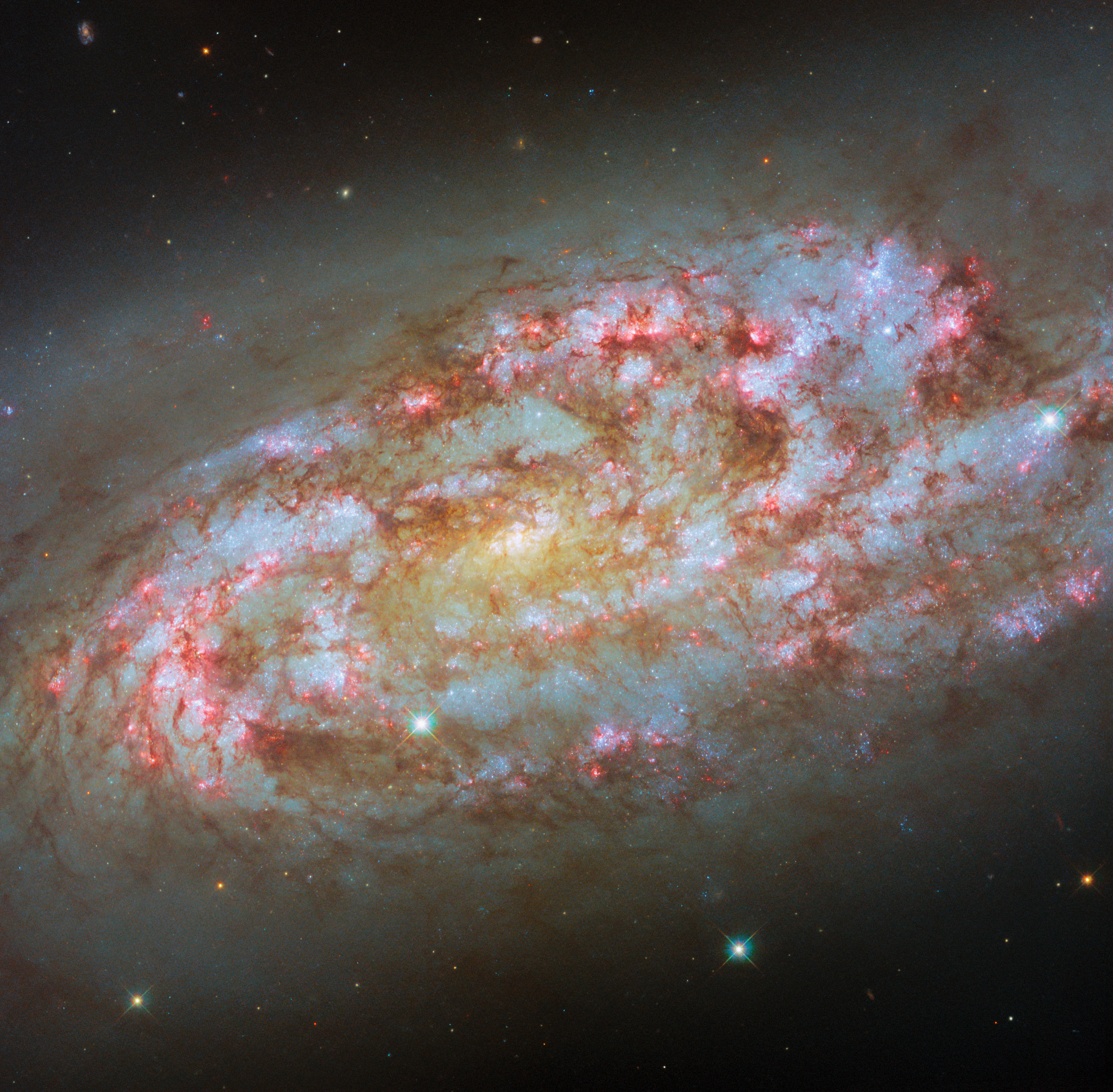
A storm of new stars

A spiral galaxy, seen partly from the side, with a messy, turbulent appearance. Its disc is made of multiple patchy arms that contain numerous sparkling blue and glowing red regions — star clusters and star-forming nebulae. Thick clumps of dark reddish dust swirl through the disc. The glow of the disc extends out into the dark background, where both distant and nearby stars can be seen. Credit: ESA/Hubble & NASA, D. Thilker, F. Belfiore, J. Lee and the PHANGS-HST Team

The subject of the latest Hubble Picture of the Week is a stormy and highly active spiral galaxy named NGC 1792. Located over 50 million light-years from Earth in the constellation Columba (the Dove), the bright glow of the galaxy’s centre is offset by the flocculent and sparkling spiral arms swirling around it.

NGC 1792 is just as fascinating to astronomers as its chaotic look might imply. Classified as a starburst galaxy, it is a powerhouse of star formation, with spiral arms rich in star-forming regions. In fact, it is surprisingly luminous for its mass. The galaxy is close to a larger neighbour, NGC 1808, and the strong gravitational interaction between the two is believed to be what has stirred up the reserves of gas in this galaxy. The result is a torrent of star formation, concentrated on the side where gravity has a stronger effect. It’s a perfect target for astronomers seeking to understand the complex interactions between gas, star clusters and supernovae in galaxies.

Hubble has shown off this galaxy before, in 2020. This week’s new image includes additional data collected throughout 2025, providing a deeper view of the tumultuous astrophysical activity taking place in the galaxy. Blossoming red lights in the arms mark out so-called H-alpha emission from dense clouds of hydrogen molecules. Stars form within these clouds and shine powerfully with ultraviolet radiation. They ionise the gas around them, causing the gas to emit a very particular red wavelength of light — a tell-tale sign of new stars.


Wednesday, September 18, 2024

The light of knowledge

A spiral galaxy, tilted at an angle, with irregularly-shaped arms. It appears large and close-up. The centre glows in a yellowish colour, while the disc around it is a bluer colour, due to light from older and newer stars. Dark reddish threads of dust cover the galaxy, and there are many large, shining pink spots in the disc, where stars are forming. Credit: ESA/Hubble & NASA, F. Belfiore, W. Yuan, J. Lee and the PHANGS-HST Team, A. Riess, K. Takáts, D. de Martin & M. Zamani (ESA/Hubble)

The magnificent galaxy featured in this Hubble Picture of the Week is NGC 1559. It is a barred spiral galaxy located in the constellation Reticulum near the Large Magellanic Cloud, but much more distant at approximately 35 million light-years from Earth. Hubble last visited this object in 2018. The brilliant light captured in this image offers a wealth of information, which thanks to Hubble can be put to use by both scientists and the public.

This picture is composed of a whopping ten different images taken by the Hubble Space Telescope, each filtered to collect light from a specific wavelength or range of wavelengths. It spans Hubble’s sensitivity to light, from ultraviolet around 275 nanometres through blue, green and red to near-infrared at 1600 nanometres. This allows information about many different astrophysical processes in the galaxy to be recorded: a notable example is the red 656-nanometre filter used here. Hydrogen atoms which get ionised can emit light at this particular wavelength, called H-alpha emission. New stars forming in a molecular cloud, made mostly of hydrogen gas, emit copious amounts of ultraviolet light which is absorbed by the cloud, but which ionises it and causes it to glow with this H-alpha light. Therefore, filtering to detect only this light provides a reliable means to detect areas of star formation (called H II regions), shown in this image by the bright red and pink colours of the blossoming patches filling NGC 1559’s spiral arms.

These ten images come from six different observing programmes with Hubble, running from 2009 all the way up to the present year. These programmes were led by teams of astronomers from around the world with a variety of scientific goals, ranging from studying ionised gas and star formation, to following up on a supernova, to tracking variable stars as a contribution to calculating the Hubble constant. The data from all of these observations live on in the Hubble archive, available for anyone to use — not only for new science, but also to create spectacular images like this one! This image of NGC 1559, then, is a reminder of the incredible opportunities that the Hubble Space Telescope has provided and continues to provide.

Besides Hubble’s observations, astronomers are using the NASA/ESA/CSA James Webb Space Telescope to research this galaxy in even greater depth. This Webb image from February showcases the galaxy in near- and mid-infrared light.


Tuesday, June 04, 2024

A broad and narrow galactic view

A spiral galaxy seen face-on, so that its many arms and its glowing, bar-shaped core can be easily seen. The arms are filled with bluish patches of older stars, pink patches where new stars are forming, and dark threads of dust. A few bright stars with cross-shaped diffraction spikes lie in the foreground. Credit: ESA/Hubble & NASA, D. Thilker

This Picture of the Week features the barred spiral galaxy NGC 3059, which lies about 57 million light-years from Earth. The data used to compose this image were collected by Hubble in May 2024, as part of an observing programme that studied a number of galaxies. All the observations were made using the same range of filters: partially transparent materials that allow only very specific wavelengths of light to pass through.

Filters are used extensively in observational astronomy, and can be calibrated to allow either extremely narrow or somewhat broader ranges of light through. Narrow-band filters are invaluable from a scientific perspective because certain light wavelengths are associated with specific physical and chemical processes. For example, under particular conditions, hydrogen atoms are known to emit red light with wavelength value of 656.46 nanometres. Red light at this wavelength is known as H-alpha emission, or the ‘H-alpha line’. It is very useful to astronomers because its presence acts as an indicator of certain physical processes and conditions; it is often a tell-tale sign of new stars being formed, for example.

Thus, narrow-band filters calibrated to allow H-alpha emission through can be used to identify regions of space where stars are forming.

Such a filter was used for this image, the narrow-band filter called F657N or the H-alpha filter. The F stands for filter, and the N stands for narrow. The numerical value refers to the peak wavelength (in nanometres) that the filter lets through. The eagle-eyed amongst you may have noticed that 657 is very close to the 656.46 H-alpha line’s wavelength. Data collected using five other filters contributed to this image as well, all of which were wide-band filters; meaning that they allow a wider range of light wavelengths through. This is less useful for identifying extremely specific lines (such as the H-alpha line) but still enables astronomers to explore relatively specific parts of the electromagnetic spectrum. In addition, collectively the information from multiple filters can be used to make beautiful images such as this one.