Showing posts with label constellation Hydra. Show all posts

Wednesday, June 24, 2026

NASA's Chandra Finds Unexpected Fireworks in Aftermath of Stellar Explosions


  • Astronomers have uncovered a population of supernova remnants in a nearby galaxy that are unexpectedly changing in X-ray brightness.

  • Using Chandra data spanning 14 years, researchers found 22 supernova remnants that brighten and dim dramatically in X-rays.

  • Typically, supernova remnants over a hundred years old just steadily decrease their X-ray output over time.

  • The researchers think this unusual behavior comes from stellar companions to the supernovas that survived the explosions.


This graphic shows two of the X-ray sources in a nearby galaxy that are changing their brightness in surprising ways as described in our latest press release. By analyzing data from NASA’s Chandra X-ray Observatory that span over 14 years, researchers found over 20 previously identified supernova remnants — remains from stars that exploded — that vary unexpectedly in X-ray brightness in Messier 83 (M83). These represent roughly half of the X-ray sources associated with supernova remnants in their sample in M83.

The panel on the left contains a composite image of M83 with X-rays from Chandra (red, green, and blue) and optical light data from NASA’s Hubble Space Telescope (red, green, and blue). The two varying Chandra sources are circled in the composite image and close-up timelapse images of these sources are shown in the panels on the right.

This collection of varying sources is surprising because astronomers expect that about a hundred years after the explosion that created them, supernova remnants do not change their brightness dramatically. Rather, they typically fade in X-rays slowly over time. It would be unusual for M83 to have so many explode less than a century ago.

The most likely explanation given by the research team is that they uncovered a population of stellar survivors — stars that lived through their partner's destruction in a supernova explosion. In this scenario, each variable X-ray source began as a pair of massive stars orbiting each other. The more massive star collapsed and exploded as a supernova, leaving behind a black hole or ultra-dense neutron star. Its companion survived.

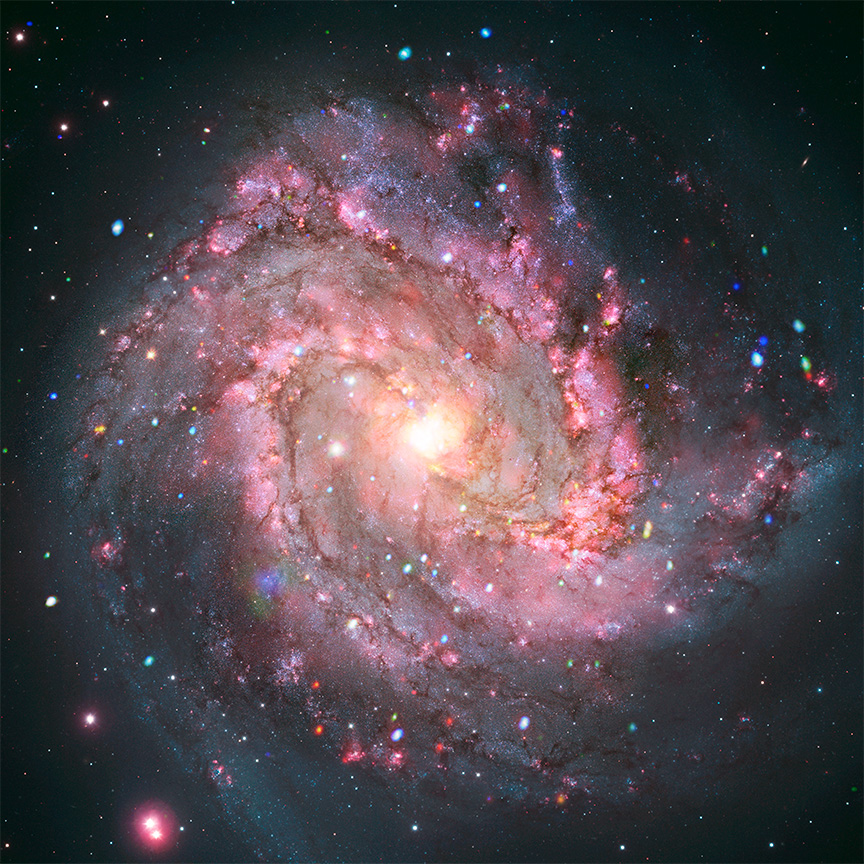
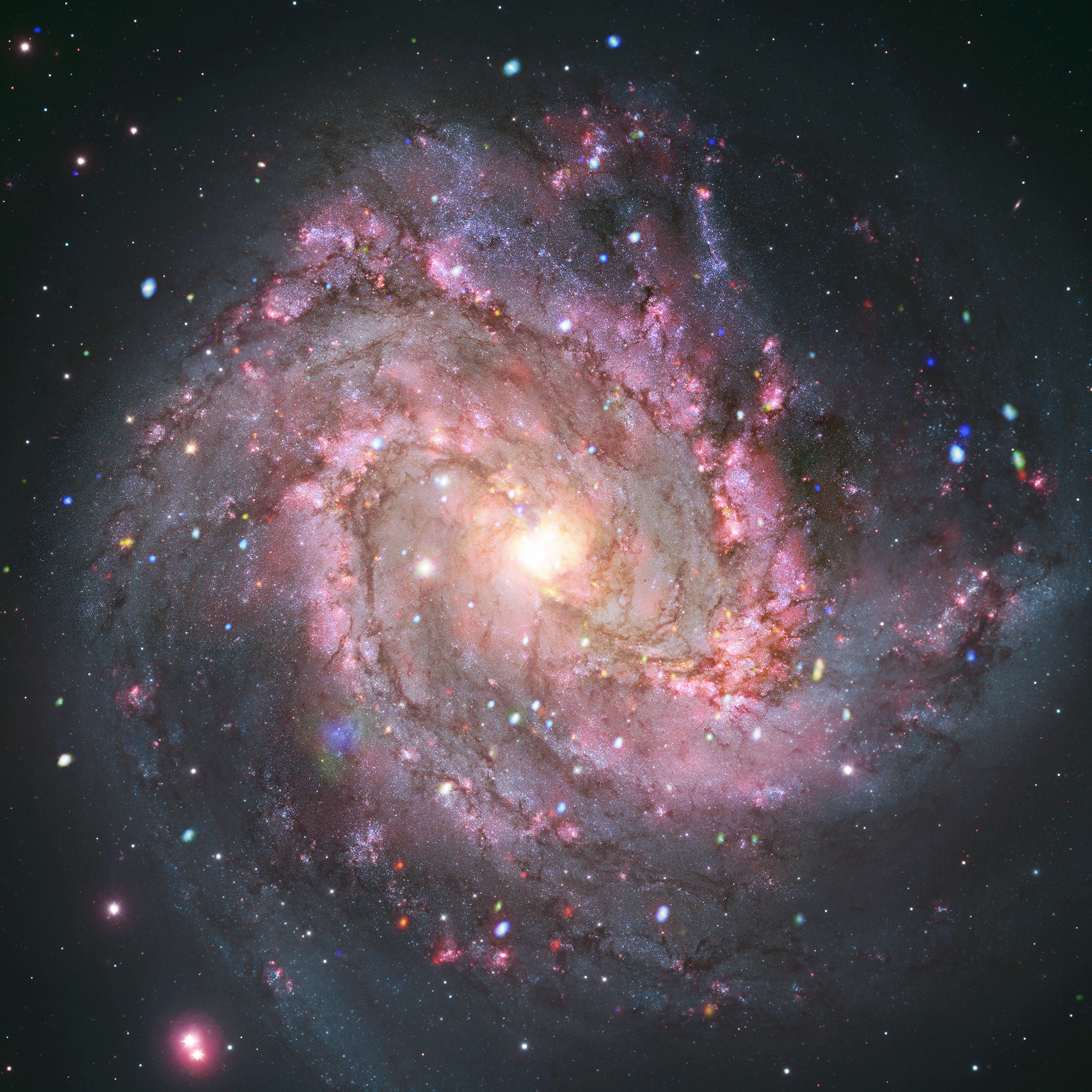
Galaxy M83 in X-ray and Optical Light. Credit: X-ray: NASA/CXC/SAO; Optical: NASA/ESA/AURA/STScI, Hubble Heritage Team, W. Blair (STScI/Johns Hopkins University) and R. O'Connell (University of Virginia); Image Processing: NASA/CXC/SAO/A. Jubett, L. Frattare and P. Edmonds

Chandra detects X-rays produced by infalling material that becomes superheated by the intense gravitational pull of the compact object. Such systems — known as high-mass X-ray binaries (HMXBs) — are among the most variable X-ray sources in the universe and may be the cause of the variations seen in M83’s supernova remnants. At the distance of M83, the supernova remnants appear as point sources even though they are much larger than the HMXBs they contain, implying that the two sources of X-rays cannot be separated in images.

Astronomers have known about HMXBs for decades, but the difference with this group in M83 is their connection to supernova remnants. Previously only a handful of supernova remnants associated with HMXBs were known across observations of all galaxies and so it is unprecedented to find more than twenty strong candidates in just one galaxy.

Galaxy M51 in X-ray and Optical Light. This is a composite image of the galaxy M51 combining data from NASA's Chandra X-ray Observatory (purple) with optical data (red, green and blue) taken with ground-based telescopes by a team of astrophotographers. A surprisingly high number of X-ray sources associated with supernova remnants in M51 show large changes in brightness, similar to the behavior seen in M83. Credit: Chandra X-ray Data: NASA/CXC/SAO; Astrobin/Optical Groundbased: C.Björk, T.Bähnck, S.Donoso, J.Gentillon, A. and D.Grelin, S.Guberski, R. Hall, T.Heuberger, J.Jacks, P.Kent, Br.Meyers, W.Ostling, N.Puig, T.Schaeffer, F.Schöfbänker, M.Vasilev

There is another possible explanation for the variability seen in the Chandra sources in M83. Rather than feeding off a companion star, the black hole or neutron star may be recapturing some of the material blasted outward in the original explosion. In a possible example of cosmic recycling, debris from the explosion falls back onto the very object the supernova created. The researchers suggest that both explanations could be happening in M83 with different sources in our sample having different origins.

These results were presented at the 248th meeting of the American Astronomical Society meeting in Pasadena, CA. In addition, a paper describing these results, led by Andrea Prestwich (Catholic University, Washington, DC), has been published in The Astrophysical Journal.

NASA's Marshall Space Flight Center in Huntsville, Alabama, manages the Chandra program. The Smithsonian Astrophysical Observatory's Chandra X-ray Center controls science operations from Cambridge, Massachusetts, and flight operations from Burlington, Massachusetts.

Quick Look: NASA's Chandra Finds Unexpected Fireworks in Aftermath of Stellar Explosions


Visual Description:

This release features a composite image of the nearby galaxy Messier 83, and short timelapse videos of two curious supernova remnants hidden inside.

In the composite image, Messier 83, or M83, is shown to have a spiral structure, viewed straight on. At the center is a brilliant white and yellow pool of light. From that light, spiral arms of hot pink cloud corkscrew out in wide, sweeping arches. The galaxy is covered in a faint grey haze, and flecked with red, green, blue, white, and yellow dots.

In an annotated version of the composite image, two tiny dots to our lower right of center are highlighted by white circles. These are two of the supernova remnants being considered by researchers. Each is examined further in a separate timelapse video.

Over a 14-year period from 2000 to 2014, astronomers pointed NASA’s X-ray observatory at the M83 galaxy. They discovered that about half of the X-ray sources believed to be supernova remnants, the aftermath of stellar explosions, were exhibiting dramatic changes in brightness. This result was entirely unexpected.

Those changes in brightness are highlighted in the timelapse videos. In each video, a series of static images flashes by, focused on one of the two X-ray sources once believed to be supernova remnants. In the videos, the X-ray sources appear as bright blue blobs with glowing cores. But in each image, taken months or years apart, the shapes change, as does the intensity of the blue color, and the brightness of the core. By presenting the substantively different images of the same objects one after another in quick succession, short timelapse videos are created.

The most likely explanation for the changes in brightness is that the team has uncovered a population of stellar survivors, stars that lived through an orbiting partner’s destruction in a supernova explosion. Material is being pulled from the surviving star onto the black hole or neutron star that formed in the supernova, a process known to cause rapid changes in X-ray brightness.


Fast Facts for M83:

Credit: X-ray: NASA/CXC/SAO; Optical: NASA/ESA/AURA/STScI, Hubble Heritage Team, W. Blair (STScI/Johns Hopkins University) and R. O'Connell (University of Virginia); Image Processing: NASA/CXC/SAO/A. Jubett, L. Frattare and P. Edmonds
Release Date: June 15, 2026
Scale: Image is about 9.5 arcmin (41,000 light-years) across.
Category:
Normal Galaxies & Starburst Galaxies, Supernovas & Supernova Remnants
Coordinates (J2000): RA 13h 37m 00.80s | Dec -29° 51´ 58.60"
Constellation:
Hydra
Observation Dates: 13 pointings between April 2000 and June 2014
Observation Time: 228 hours 2 minutes (9 days 12 hours 2 minutes)
Obs. ID: 793, 2064, 12992-12996, 13202, 13241, 13248, 14332, 14342, 16024
Instrument:
ACIS
Also Known As: NGC 5236
References: Prestwich, A. et al., 2026,
ApJ, 1004, 154.
Color Code: X-ray: red, green, blue; Optical: red, green, blue


Friday, November 14, 2025

Unique shape of star’s explosion revealed just a day after detection

PR Image eso2520a
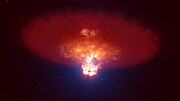
Artist’s impression of the initial shape of a supernova explosion

PR Image eso2520b
The supernova SN 2024ggi in the NGC 3621 galaxy

PR Image eso2520c
NGC 3621 in the constellation of Hydra

PR Image eso2520d
A galaxy full of surprises — the spiral galaxy NGC 3621


Videos

What’s the true shape of a supernova? | ESO News
PR Video eso2520a
What’s the true shape of a supernova? | ESO News

Artist’s animation of a supernova explosion
PR Video eso2520b
Artist’s animation of a supernova explosion


Swift observations with the European Southern Observatory’s Very Large Telescope (ESO’s VLT) have revealed the explosive death of a star just as the blast was breaking through the star’s surface. For the first time, astronomers unveiled the shape of the explosion at its earliest, fleeting stage. This brief initial phase wouldn’t have been observable a day later and helps address a whole set of questions about how massive stars go supernova.

When the supernova explosion SN 2024ggi was first detected on the night of 10 April 2024 local time, Yi Yang, an assistant professor at Tsinghua University in Beijing, China, and the lead author of the new study, had just landed in San Francisco after a long-haul flight. He knew he had to act quickly. Twelve hours later, he had sent an observing proposal to ESO, which, after a very quick approval process, pointed its VLT telescope in Chile at the supernova on 11 April, just 26 hours after the initial detection.

SN 2024ggi is located in the galaxy NGC 3621 in the direction of the constellation Hydra ‘only’ 22 million light-years away, close by in astronomical terms. With a large telescope and the right instrument, the international team knew they had a rare opportunity to unravel the shape of the explosion shortly after it happened. “The first VLT observations captured the phase during which matter accelerated by the explosion near the centre of the star shot through the star’s surface. For a few hours, the geometry of the star and its explosion could be, and were, observed together,” says Dietrich Baade, an ESO astronomer in Germany, and co-author of the study published today in Science Advances.

“The geometry of a supernova explosion provides fundamental information on stellar evolution and the physical processes leading to these cosmic fireworks,” Yang explains. The exact mechanisms behind supernova explosions of massive stars, those with more than eight times the mass of the Sun, are still debated and are one of the fundamental questions scientists want to address. This supernova’s progenitor was a red supergiant star, with a mass 12 to 15 times that of the Sun and a radius 500 times larger, making SN 2024ggi a classical example of a massive-star explosion.

We know that during its life a typical star keeps its spherical shape as a result of a very precise equilibrium of the gravitational force that wants to squeeze it and the pressure of its nuclear engine that wants to expand it. When it runs out of its last source of fuel, the nuclear engine starts sputtering. For massive stars this marks the beginning of a supernova: the core of the dying star collapses, the mass shells around fall onto it and bounce off. This rebound shock then propagates outward, disrupting the star.

Once the shock breaks through the surface, it unleashes immense amounts of energy — the supernova then brightens dramatically and becomes observable. During a short-lived phase, the supernova’s initial ‘breakout’ shape can be studied before the explosion interacts with the material surrounding the dying star.

This is what astronomers have now achieved for the very first time with ESO's VLT, using a technique called ‘spectropolarimetry’. “Spectropolarimetry delivers information about the geometry of the explosion that other types of observation cannot provide because the angular scales are too tiny,” says Lifan Wang, co-author and professor at the Texas A&M University in the US, who was a student at ESO at the start of his astronomy career. Even though the exploding star appears as a single point, the polarisation of its light carries hidden clues about its geometry, which the team were able to unravel. [1]

The only facility in the southern hemisphere capable of capturing the shape of a supernova through such a measurement is the FORS2 instrument installed on the VLT. With the FORS2 data, the astronomers found that the initial blast of material was shaped like an olive. As the explosion spread outwards and collided with the matter around the star, the shape flattened but the axis of symmetry of the ejecta remained the same. "These findings suggest a common physical mechanism that drives the explosion of many massive stars, which manifests a well-defined axial symmetry and acts on large scales,” according to Yang.

With this knowledge astronomers can already rule out some of the current supernova models and add new information to improve other ones, providing insights into the powerful deaths of massive stars. "This discovery not only reshapes our understanding of stellar explosions, but also demonstrates what can be achieved when science transcends borders,” says co-author and ESO astronomer Ferdinando Patat. “It’s a powerful reminder that curiosity, collaboration, and swift action can unlock profound insights into the physics shaping our Universe."


Notes

[1] Light particles (photons) have a property called polarisation. In a sphere, the shape of most stars, the polarisation of the individual photons cancels out so that the net polarisation of the object is zero. When astronomers measure a non-zero net polarisation, they can use that measurement to infer the shape of the object — a star or a supernova — emitting the observed light.


More information

This research was presented in a paper to appear in Science Advances (doi: 10.1126/sciadv.adx2925).

The team is composed of Y. Yang (Department of Physics, Tsinghua University, China [Tsinghua University]), X. Wen (School of Physics and Astronomy, Beijing Normal University, China [Beijing Normal University] and Tsinghua University), L. Wang (Department of Physics and Astronomy, Texas A&M University, USA [Texas A&M University] and George P. and Cynthia Woods Mitchell Institute for Fundamental Physics & Astronomy Texas A&M University, USA [IFPA Texas A&M University]), D. Baade (European Organisation for Astronomical Research in the Southern Hemisphere, Germany [ESO]), J. C. Wheeler (University of Texas at Austin, USA), A. V. Filippenko (Department of Astronomy, University of California, Berkeley, USA [UC Berkeley] and Hagler Institute for Advanced Study, Texas A&M University, USA), A. Gal-Yam (Department of Particle Physics and Astrophysics, Weizmann Institute of Science, Israel), J. Maund (Department of Physics, Royal Holloway, University of London, United Kingdom), S. Schulze (Center for Interdisciplinary Exploration and Research in Astrophysics, Northwestern University, USA), X. Wang (Tsinghua University), C. Ashall (Department of Physics, Virginia Tech, USA and Institute for Astronomy, University of Hawai’i at Manoa, USA), M. Bulla (Department of Physics and Earth Science, University of Ferrara, Italy and INFN, Sezione di Ferrara, Italy and INAF, Osservatorio Astronomico d’Abruzzo, Italy), A. Cikota (Gemini Observatory/NSF NOIRLab, Chile), H. Gao (Beijing Normal University and Institute for Frontier in Astronomy and Astrophysics, Beijing Normal University, China), P. Hoeflich (Department of Physics, Florida State University, USA), G. Li (Tsinghua University), D. Mishra (Texas A&M University and IFPA Texas A&M University), Ferdinando Patat (ESO), K. C. Patra (California and Department of Astronomy & Astrophysics, University of California, Santa Cruz, USA), S. S. Vasylyev (UC Berkeley), S. Yan (Tsinghua University).

The European Southern Observatory (ESO) enables scientists worldwide to discover the secrets of the Universe for the benefit of all. We design, build and operate world-class observatories on the ground — which astronomers use to tackle exciting questions and spread the fascination of astronomy — and promote international collaboration for astronomy. Established as an intergovernmental organisation in 1962, today ESO is supported by 16 Member States (Austria, Belgium, Czechia, Denmark, France, Finland, Germany, Ireland, Italy, the Netherlands, Poland, Portugal, Spain, Sweden, Switzerland and the United Kingdom), along with the host state of Chile and with Australia as a Strategic Partner. ESO’s headquarters and its visitor centre and planetarium, the ESO Supernova, are located close to Munich in Germany, while the Chilean Atacama Desert, a marvellous place with unique conditions to observe the sky, hosts our telescopes. ESO operates three observing sites: La Silla, Paranal and Chajnantor. At Paranal, ESO operates the Very Large Telescope and its Very Large Telescope Interferometer, as well as survey telescopes such as VISTA. Also at Paranal, ESO will host and operate the south array of the Cherenkov Telescope Array Observatory, the world’s largest and most sensitive gamma-ray observatory. Together with international partners, ESO operates ALMA on Chajnantor, a facility that observes the skies in the millimetre and submillimetre range. At Cerro Armazones, near Paranal, we are building “the world’s biggest eye on the sky” — ESO’s Extremely Large Telescope. From our offices in Santiago, Chile we support our operations in the country and engage with Chilean partners and society.


Links


Contacts:

Yi Yang
Department of Physics, Tsinghua University,
Beijing, China
Tel: +86 13581896137
Email:
yi_yang@mail.tsinghua.edu.cn, yiyangtamu@gmail.com

Dietrich Baade
European Southern Observatory
Garching bei München, Germany
Tel: +49 89 6096 295
Email:
dbaade@eso.org

Lifan Wang
Department of Physics & Astronomy, College of Arts & Sciences, Texas A&M University
College Station, Texas, United States
Email:
lifan@tamu.edu

Ferdinando Patat
European Southern Observatory
Garching bei München, Germany
Tel: +49 89 3200 6744
Email:
fpatat@eso.org

Bárbara Ferreira
ESO Media Manager
Garching bei München, Germany
Tel: +49 89 3200 6670
Cell: +49 151 241 664 00
Email
: press@eso.org


Friday, August 22, 2025

Noteworthy nearby spiral

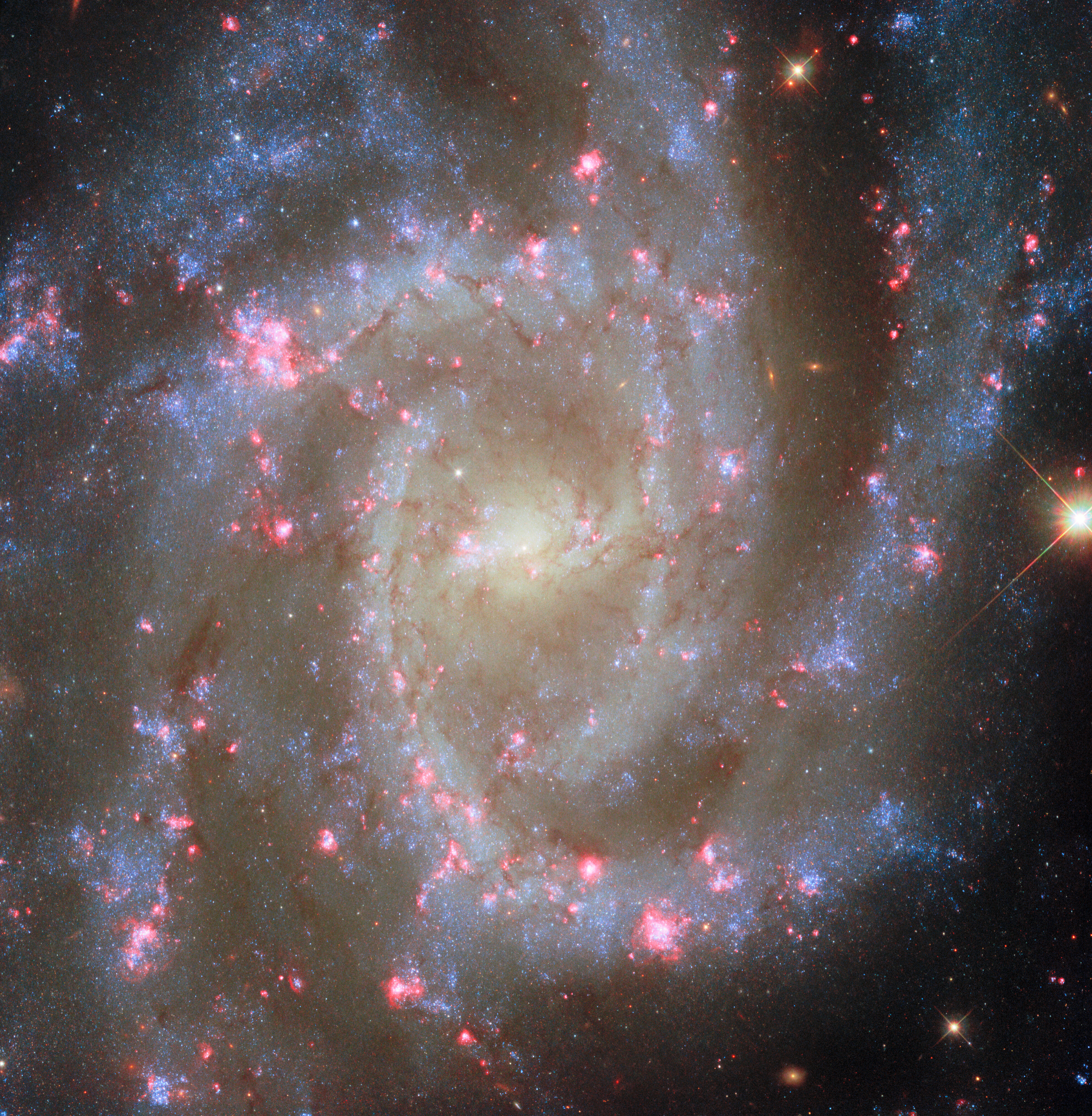
A spiral galaxy seen face-on. Its centre is a bright glowing yellow. The galaxy’s spiral arms contain sparkling blue stars, pink spots of star formation, and dark threads of dust that follow the arms. Credit: ESA/Hubble & NASA, R. Chandar, J. Lee and the PHANGS-HST team

Today’s NASA/ESA Hubble Space Telescope Picture of the Week offers a closeup of a nearby spiral galaxy. The subject is NGC 2835, which lies 35 million light-years away in the constellation Hydra (The Water Snake).

A previous Hubble image of this galaxy was released in 2020, and the NASA/ESA/CSA James Webb Space Telescope turned its gaze toward NGC 2835 in recent years as well. Do you see anything different between today’s image of NGC 2835 and the previously released versions? Overall, NGC 2835 looks quite similar in all of these images, with spiral arms dotted with young blue stars sweeping around an oval-shaped centre, where older stars reside.

This image differs from previously released images because it incorporates new data from Hubble that captures a specific wavelength of red light called H-alpha. The regions that are bright in H-alpha emission can be seen along NGC 2835’s spiral arms, where dozens of bright pink nebulae appear like flowers in bloom. Astronomers are interested in H-alpha light because it signals the presence of several different types of nebulae that arise during different stages of a star’s life. Newborn massive stars create nebulae called H II regions that are particularly brilliant sources of H-alpha light, while dying stars can leave behind supernova remnants or planetary nebulae that can also be identified by their H-alpha emission.

By using Hubble’s sensitive instruments to survey 19 nearby galaxies, researchers aim to identify more than 50 000 nebulae. These observations will help to explain how stars affect their birth neighbourhoods through intense starlight and winds.


Tuesday, April 19, 2022

Celebrating Hubble's 32nd Birthday with an Eclectic Galaxy Grouping

Hickson Compact Group 40
NASA is celebrating the Hubble Space Telescope's 32nd birthday with a stunning look at an unusual close-knit collection of five galaxies, called The Hickson Compact Group 40. This menagerie includes three spiral-shaped galaxies, an elliptical galaxy, and a lenticular (lens-like) galaxy. Somehow, these different galaxies crossed paths in their evolution to create an exceptionally crowded and eclectic galaxy sampler. Caught in a leisurely gravitational dance, the whole group is so crowded that it could fit within a region of space that is less than twice the diameter of our Milky Way's stellar disk.

Though such cozy galaxy groupings can be found in the heart of huge galaxy clusters, these galaxies are notably isolated in their own small patch of the universe, in the direction of the constellation Hydra. One possible explanation is that there's a lot of dark matter (an unknown and invisible form of matter) associated with these galaxies. If they come close together, then the dark matter can form a big cloud within which the galaxies are orbiting. As the galaxies plow through the dark matter, they feel a resistive force due to its gravitational effects. This slows their motion and makes the galaxies lose energy, so they fall together. Therefore, this snapshot catches the galaxies at a very special moment in their lifetimes. In about 1 billion years they will eventually collide and merge to form a giant elliptical galaxy.

Astronomers have studied this compact galaxy group not only in visible light, but also in radio, infrared, and X-ray wavelengths. Almost all of them have a compact radio source in their cores, which could be evidence for the presence of supermassive black holes. X-ray observations show that the galaxies have been gravitationally interacting due to the presence of a lot of hot gas among the galaxies. Infrared observations reveal clues to the rate of new star formation.

Though over 100 such compact galaxy groups have been cataloged in sky surveys going back several decades, Hickson Compact Group 40 is one of the most densely packed. Observations suggest that such tight groups may have been more abundant in the early universe and provided fuel for powering black holes, known as quasars, whose light from superheated infalling material blazed across space. Studying the details of galaxies in nearby groups like this help astronomers sort out when and where galaxies assembled themselves, and what they are assembled from.

Hubble was deployed into orbit around Earth by NASA astronauts aboard the space shuttle Discovery, on April 25, 1990. The telescope has taken 1.5 million observations of approximately 50,000 celestial targets to date. This treasure trove of knowledge about the universe is stored for public access in the Mikulski Archive for Space Telescopes, at the Space Telescope Science Institute in Baltimore, Maryland.

Hubble's unique capabilities in observing visible and ultraviolet light are a critical scientific complement to the infrared-light observations of the recently launched Webb Space Telescope, which will begin science observations this summer. Credits: Science: NASA, ESA, STScI. Image Processing: Alyssa Pagan (STScI)


NASA is celebrating the Hubble Space Telescope's 32nd birthday with a stunning look at an unusual close-knit collection of five galaxies, called The Hickson Compact Group 40.

This menagerie includes three spiral-shaped galaxies, an elliptical galaxy, and a lenticular (lens-like) galaxy. Somehow, these different galaxies crossed paths in their evolution to create an exceptionally crowded and eclectic galaxy sampler.

Caught in a leisurely gravitational dance, the whole group is so crowded that it could fit within a region of space that is less than twice the diameter of our Milky Way's stellar disk.

Though such cozy galaxy groupings can be found in the heart of huge galaxy clusters, these galaxies are notably isolated in their own small patch of the universe, in the direction of the constellation Hydra.

One possible explanation is that there's a lot of dark matter (an unknown and invisible form of matter) associated with these galaxies. If they come close together, then the dark matter can form a big cloud within which the galaxies are orbiting. As the galaxies plow through the dark matter they feel a resistive force due to its gravitational effects. This slows their motion and makes the galaxies lose energy, so they fall together.

Therefore, this snapshot catches the galaxies at a very special moment in their lifetimes. In about 1 billion years they will eventually collide and merge to form a giant elliptical galaxy.

Astronomers have studied this compact galaxy group not only in visible light, but also in radio, infrared, and X-ray wavelengths. Almost all of them have a compact radio source in their cores, which could be evidence for the presence of supermassive black holes. X-ray observations show that the galaxies have been gravitationally interacting due to the presence of a lot of hot gas among the galaxies. Infrared observations reveal clues to the rate of new star formation.

Though over 100 such compact galaxy groups have been cataloged in sky surveys going back several decades, Hickson Compact Group 40 is one of the most densely packed. Observations suggest that such tight groups may have been more abundant in the early universe and provided fuel for powering black holes, known as quasars, whose light from superheated infalling material blazed across space. Studying the details of galaxies in nearby groups like this help astronomers sort out when and where galaxies assembled themselves, and what they are assembled from.

"I remember seeing this on a sky survey and saying, 'wow look at that!'" said Paul Hickson of the University of British Columbia, Vancouver, Canada. "All that I was using at the time was a big plastic ruler and a magnifying glass while looking over sky survey prints." He re-discovered the group by browsing through a collection of peculiar galaxies first published by Halton Arp in 1966.

Hubble was deployed into orbit around Earth by NASA astronauts aboard the space shuttle Discovery, on April 25, 1990. The telescope has taken 1.5 million observations of approximately 50,000 celestial targets to date. This treasure trove of knowledge about the universe is stored for public access in the Mikulski Archive for Space Telescopes, at the Space Telescope Science Institute in Baltimore, Maryland.

Hubble's unique capabilities in observing visible and ultraviolet light are a critical scientific complement to the infrared-light observations of the recently launched Webb Space Telescope, which will begin science observations this summer.

The Hubble Space Telescope is a project of international cooperation between NASA and ESA (European Space Agency). NASA's Goddard Space Flight Center in Greenbelt, Maryland, manages the telescope. The Space Telescope Science Institute (STScI) in Baltimore, Maryland, conducts Hubble science operations. STScI is operated for NASA by the Association of Universities for Research in Astronomy, in Washington, D.C.


Credits:

Release: NASA, ESA, STScI

Media Contact: Ann Jenkins
Space Telescope Science Institute, Baltimore, Maryland

Ray Villard
Space Telescope Science Institute, Baltimore, Maryland

 
Permissions: Content Use Policy

Contact Us: Direct inquiries to the News Team.

Related Links and Documents: