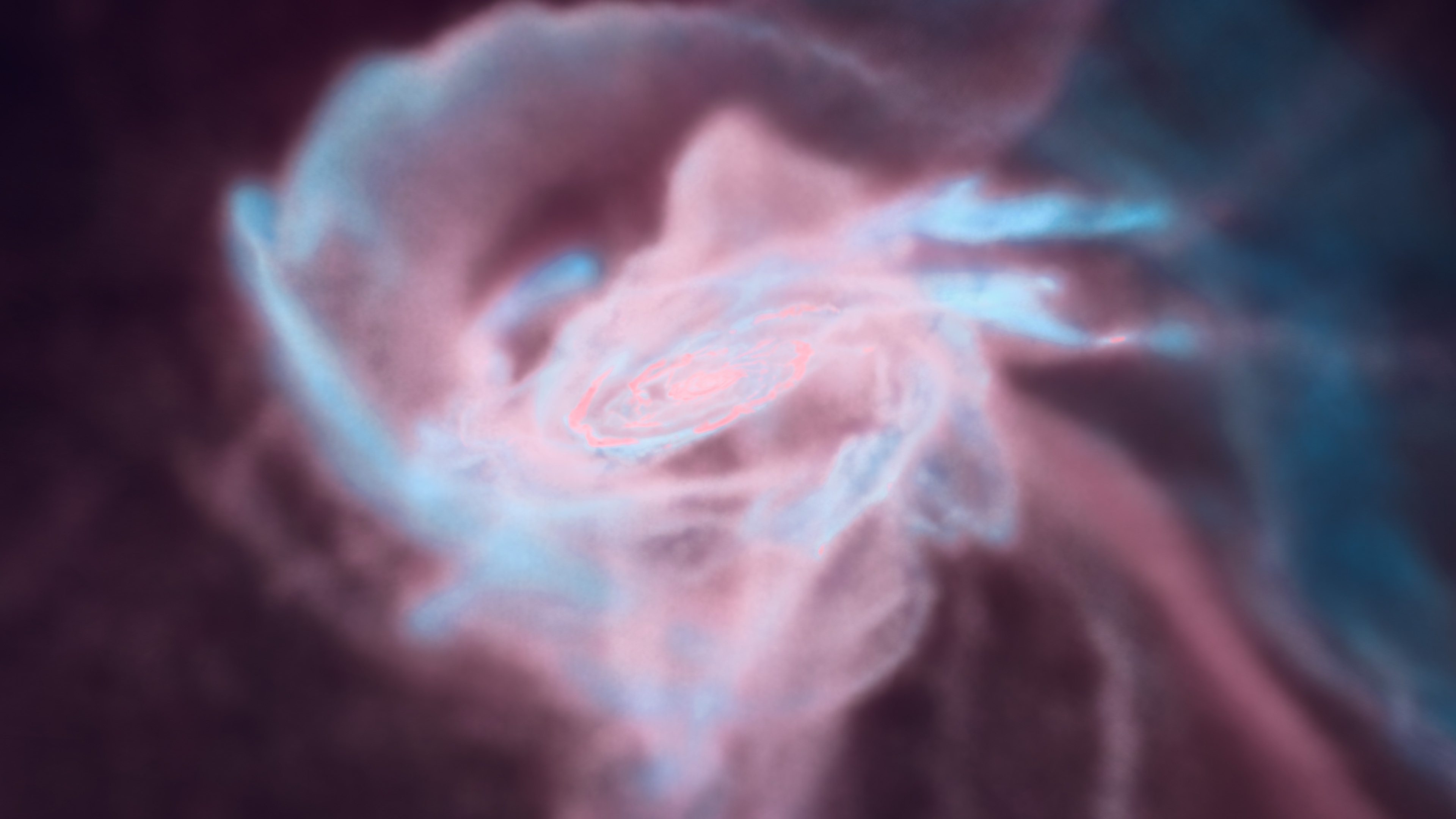
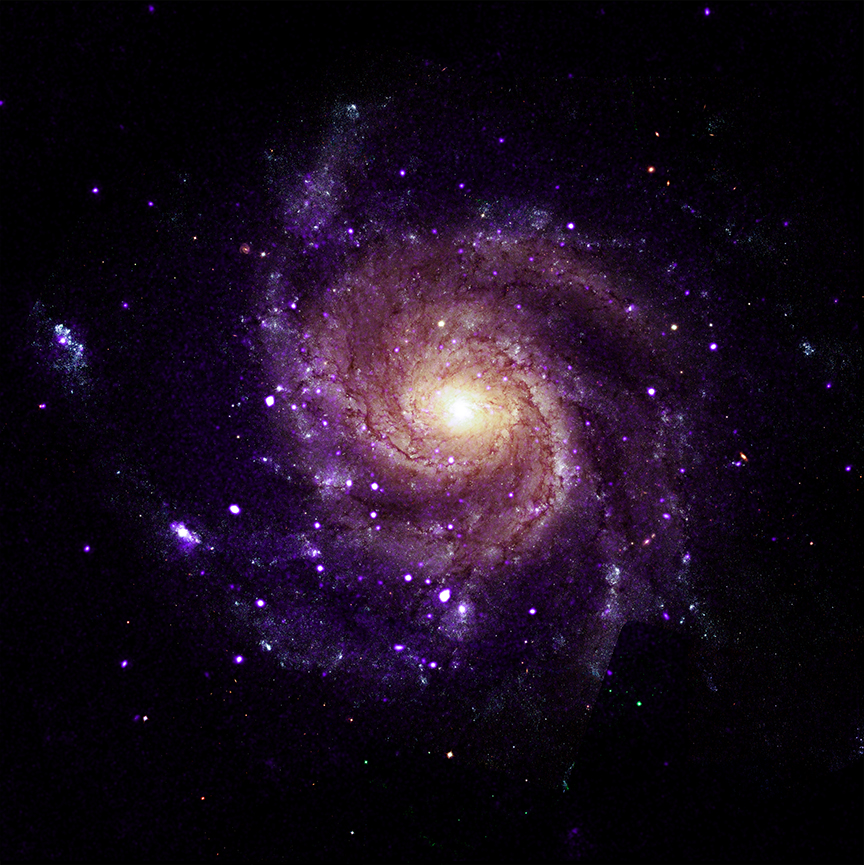
A still image simulation of the kinds of imagery and video that the ngEHT will make possible.
Credit: Smithsonian Astrophysical Observatory/S. Doeleman & N. Conroy
The funding will support expansions to the telescope collaboration that will enable the first full-color, high-definition movies of black holes
Cambridge, MA (September 17, 2026) — The Smithsonian Astrophysical Observatory (SAO), part of the Center for Astrophysics, has been awarded $3,597,771 from the Gordon and Betty Moore Foundation (GBMF) to enable the first full-color, high-definition movies of black holes.
The three-year award will advance the next-generation Event Horizon Telescope (ngEHT) by supporting construction of the new Tenerife Event-horizon Antenna, site preparation at three additional locations, and the design of a pathfinder telescope for Mount Kilimanjaro.
“This award marks an exciting turning point for the ngEHT,” said Sheperd Doeleman, astrophysicist at SAO and the project’s principal investigator. “We’re moving from successful prototypes and designs to building the instruments and sites that will make high-definition, full-color movies of black holes possible.”
By tracking the motion of matter and light near the edge of the black hole in our neighboring M87 galaxy , the project will help scientists investigate some of the most fundamental questions in physics, including: Does Einstein’s theory of gravity hold under the black hole’s extreme conditions? How do they accrete matter and grow over cosmic time? How do spinning black holes power jets that can pierce entire galaxies?

<
Diagram of the dish structure for construction of new radio dishes for the Next Generation Event Horizon Telescope.
Credit: ngEHT
“This Gordon and Betty Moore Foundation funding continues their generous commitment to the cutting edge of astronomy,” said Lisa Kewley, director of the Center for Astrophysics | Harvard & Smithsonian and the Smithsonian Astrophysical Observatory. “We are proud to receive their support, which will help advance the ngEHT and bring its quest to understand black holes closer to reality.”
Completing the Tenerife Event-horizon Antenna: A major focus of the award is the completion of the Tenerife Event-horizon Antenna, or TEA, in the Canary Islands. The project team will develop and engineer a new digital system at the TEA capable of processing the unprecedented data output of the ngEHT. The upgrade will increase the antenna’s bandwidth and frequency coverage, as well as improving its ability to compensate for atmospheric turbulence. It will also establish a model for future ngEHT telescope sites.
Preparing the Global Array for Expansion: The grant will also fund the development of three future ngEHT telescope sites. It will support assessments to evaluate both engineering design plans and environmental and cultural impact of telescope sites in San Pedro Mártir, Mexico; Las Campanas, Chile; and Mt. Jelm, Wyoming. This work will include infrastructure planning, site assessments, architectural layouts, and environmental reviews.
Designing a Kilimanjaro Pathfinder Telescope: The award will further support a collaboration of SAO with the Open University of Tanzania to design a mobile, transportable pathfinder dish for near Mt. Kilimanjaro in Tanzania.This small, mobile radio telescope will test whether the Kilimanjaro Saddle area is suitable for a full-scale ngEHT facility. This design will contribute to a broad international feasibility study, and any future development would proceed through close engagement with local communities, educational institutions, government agencies, environmental organizations, and local cultural groups.
Earlier support from the Gordon and Betty Moore Foundation helped advance the ngEHT’s key telescope systems, including its state-of-the-art digital backend, its high-frequency data receivers, and a new 13-meter antenna. The project’s international partners are working toward a distributed array capable of producing increasingly detailed and dynamic images of black holes in the early 2030s.
“This support brings us closer to seeing how black holes change in real time and to answering some of the biggest questions in modern physics,” said Doeleman.
The award, titled “The Next-Generation Event Horizon Telescope: Site Development Phase II,” supports work from July 1, 2026, through June 30, 2029.
This project is funded by the Gordon and Betty Moore Foundation, Grant GBMF14361.
About the Gordon and Betty Moore Foundation:
Gordon and Betty Moore established the foundation to create positive outcomes for future generations. In pursuit of that vision, we advance scientific discovery, environmental conservation, and the special character of the San Francisco Bay Area. Visit Moore.org and follow @MooreFound.
About the Next Generation Event Horizon Telescope:
The next generation Event Horizon Telescope (ngEHT) will capture the sharpest images and videos of black holes. Building on the success of the original Event Horizon Telescope (EHT) and its release in 2019 of the first black hole picture, the ngEHT develops state-of-the-art technology to modernize existing instrumentation and realize new capabilities while expanding the geographical footprint of the array with new dishes at optimized locations around the world. By achieving the highest angular resolution possible from the surface of the Earth, the ngEHT will produce full-color, high-definition black hole “cinema” to test Einstein’s theory of gravity, and the fundamental nature of supermassive black holes.
About the Smithsonian Astrophysical Observatory:
The Smithsonian Astrophysical Observatory is a research center of the Smithsonian Institution and part of the Center for Astrophysics, the largest astrophysics research center in the world. The Observatory has been a pioneer in space exploration and discovery since its founding in 1890. Today, in addition to performing groundbreaking astronomical research, SAO operates multiple satellites, including NASA's Chandra X-ray Observatory, and runs the Minor Planet Center that tracks all known asteroids in the solar system.
About the Center for Astrophysics | Harvard & Smithsonian
The Center for Astrophysics | Harvard & Smithsonian is a collaboration between the Smithsonian Astrophysical Observatory and the Harvard College Observatory designed to ask, and ultimately answer, humanity’s greatest unresolved questions about the universe.