Showing posts with label M77. Show all posts

Sunday, August 02, 2026

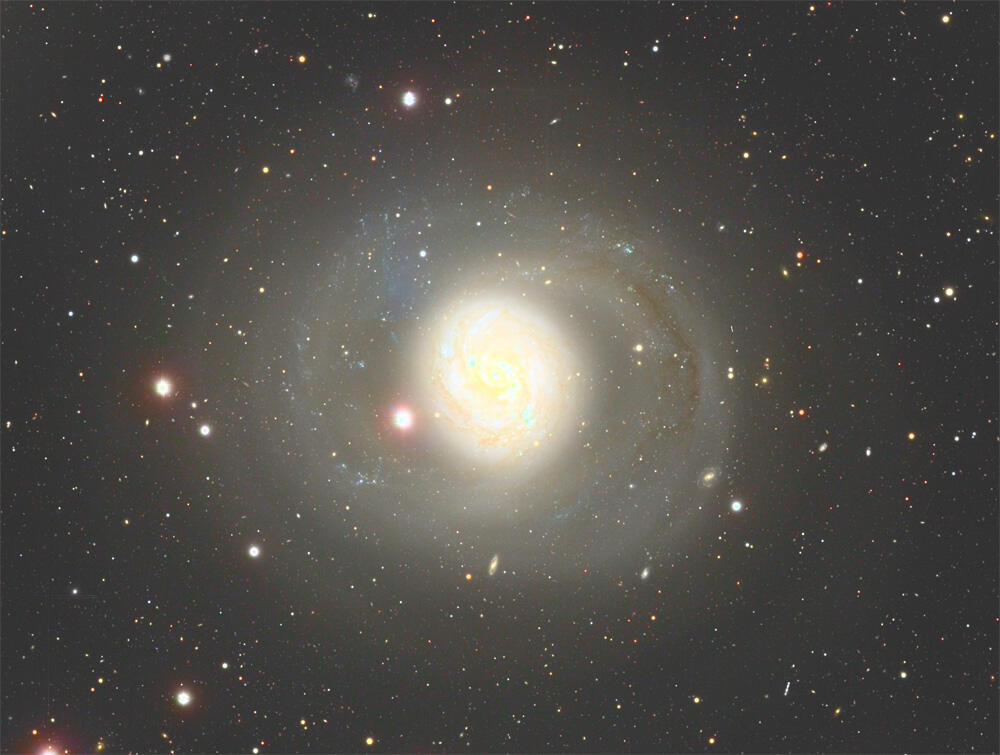
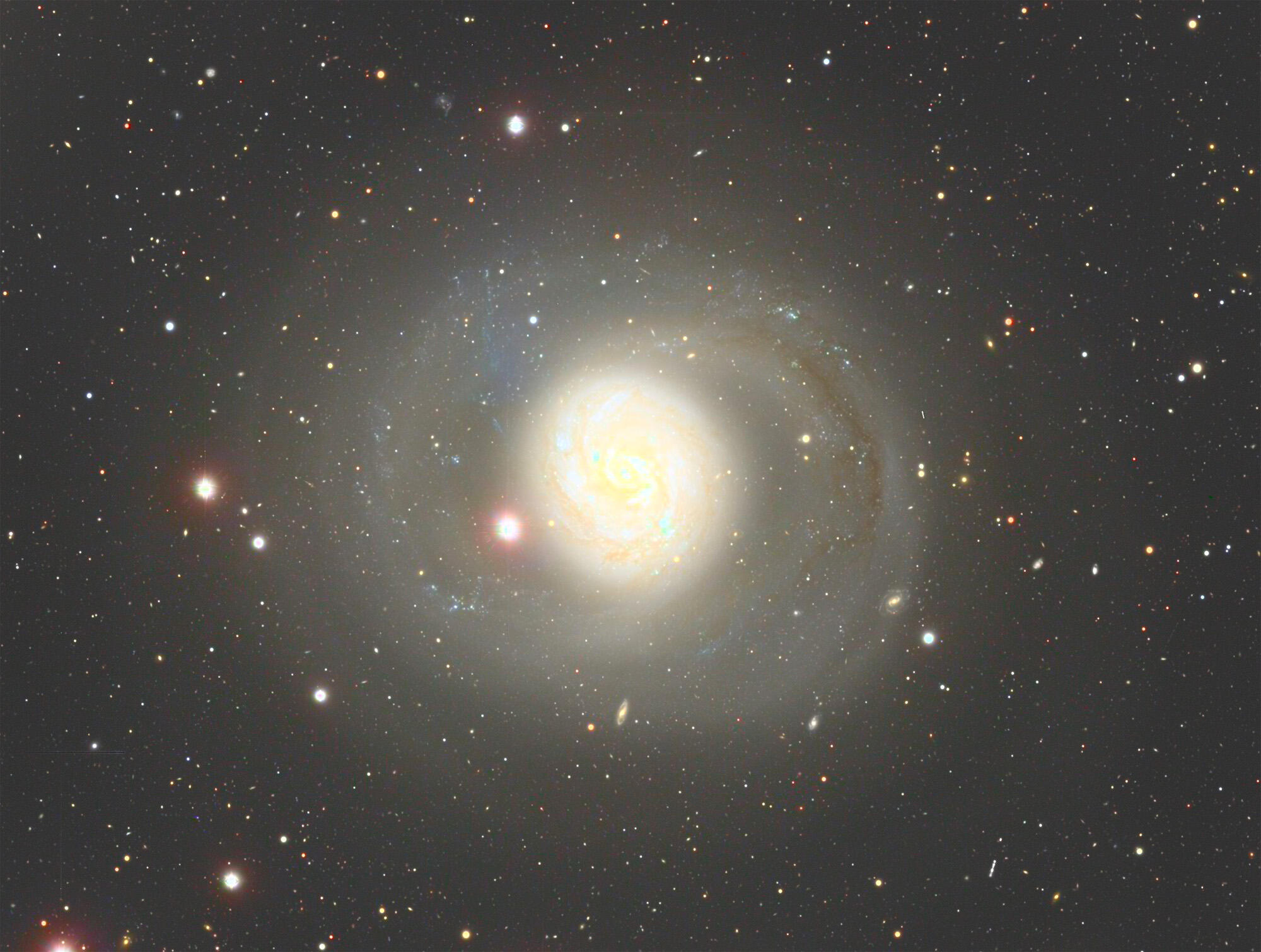
Active Galaxy M77


M77 (NGC 1068) is a spiral galaxy located relatively close to our Milky Way. At its center lies a supermassive black hole about 10 million times the mass of the Sun. As enormous amounts of energy are released around the black hole, M77 is known as an active galaxy.

Because of its proximity, M77 has been extensively studied across the electromagnetic spectrum, from X-rays to radio waves, using various telescopes, including the Subaru Telescope and ALMA. Recently, observations with the Subaru Telescope's Hyper Suprime-Cam (HSC) have revealed evidence that M77 experienced a previously hidden minor merger with a low-mass satellite galaxy billions of years ago. Credit: NAOJ/SDSS/David Hogg/Michael Blanton. Image Processing: Ichi Tanaka)

Distance from Earth: 48 million light-years
Instrument: Hyper Suprime-Cam (HSC)

Relevant Links


Tuesday, December 10, 2019

How to Shape a Spiral Galaxy

Magnetic fields in NGC 1086, or M77, are shown as streamlines over a visible light and X-ray composite image of the galaxy from the Hubble Space Telescope, the Nuclear Spectroscopic Array, and the Sloan Digital Sky Survey. The magnetic fields align along the entire length of the massive spiral arms — 24,000 light years across (0.8 kiloparsecs) — implying that the gravitational forces that created the galaxy’s shape are also compressing the its magnetic field. This supports the leading theory of how the spiral arms are forced into their iconic shape known as “density wave theory.” SOFIA studied the galaxy using far-infrared light (89 microns) to reveal facets of its magnetic fields that previous observations using visible and radio telescopes could not detect. Credits: NASA/SOFIA; NASA/JPL-Caltech/Roma Tre Univ. Hi-res image

Our Milky Way galaxy has an elegant spiral shape with long arms filled with stars, but exactly how it took this form has long puzzled scientists. New observations of another galaxy are shedding light on how spiral-shaped galaxies like our own get their iconic shape.

Magnetic fields play a strong role in shaping these galaxies, according to research from the Stratospheric Observatory for Infrared Astronomy, or SOFIA. Scientists measured magnetic fields along the spiral arms of the galaxy called NGC 1068, or M77. The fields are shown as streamlines that closely follow the circling arms.

“Magnetic fields are invisible, but they may influence the evolution of a galaxy,” said Enrique Lopez-Rodriguez, a Universities Space Research Association scientist at the SOFIA Science Center at NASA’s Ames Research Center in California’s Silicon Valley. “We have a pretty good understanding of how gravity affects galactic structures, but we’re just starting to learn the role magnetic fields play.”

The M77 galaxy is located 47 million light years away in the constellation Cetus. It has a supermassive active black hole at its center that is twice as massive as the black hole at the heart of our Milky Way galaxy. The swirling arms are filled with dust, gas and areas of intense star formation called starbursts.

SOFIA’s infrared observations reveal what human eyes cannot: magnetic fields that closely follow the newborn-star-filled spiral arms. This supports the leading theory of how these arms are forced into their iconic shape known as “density wave theory.” It states that dust, gas and stars in the arms are not fixed in place like blades on a fan. Instead, the material moves along the arms as gravity compresses it, like items on a conveyor belt.

The magnetic field alignment stretches across the entire length of the massive, arms — approximately 24,000 light years across. This implies that the gravitational forces that created the galaxy’s spiral shape are also compressing its magnetic field, supporting the density wave theory. The results are published in the Astrophysical Journal

“This is the first time we’ve seen magnetic fields aligned at such large scales with current star birth in the spiral arms,” said Lopez-Rodriquez. “It’s always exciting to have observational evidence that supports theories.”

Celestial magnetic fields are notoriously difficult to observe. SOFIA’s newest instrument, the High-resolution Airborne Wideband Camera-Plus, or HAWC+, uses far-infrared light to observe celestial dust grains, which align perpendicular to magnetic field lines. From these results, astronomers can infer the shape and direction of the otherwise invisible magnetic field. Far-infrared light provides key information about magnetic fields because the signal is not contaminated by emission from other mechanisms, such as scattered visible light and radiation from high-energy particles. SOFIA’s ability to study the galaxy with far infrared light, specifically at the wavelength of 89 microns, revealed previously unknown facets of its magnetic fields.

Further observations are necessary to understand how magnetic fields influence the formation and evolution of other types of galaxies, such as those with irregular shapes.

SOFIA, the Stratospheric Observatory for Infrared Astronomy, is a Boeing 747SP jetliner modified to carry a 106-inch diameter telescope. It is a joint project of NASA and the German Aerospace Center, DLR. NASA’s Ames Research Center in California’s Silicon Valley manages the SOFIA program, science and mission operations in cooperation with the Universities Space Research Association headquartered in Columbia, Maryland, and the German SOFIA Institute (DSI) at the University of Stuttgart. The aircraft is maintained and operated from NASA’s Armstrong Flight Research Center Building 703, in Palmdale, California. The HAWC+ instrument was developed and delivered to NASA by a multi-institution team led by the Jet Propulsion Laboratory in Pasadena, California.


Media Contact


Felicia Chou
NASA Headquarters, Washington
202-358-0257

felicia.chou@nasa.gov

Editor: Kassandra Bell

Source: NASA/SOFIA


Sunday, November 05, 2017

Minor Merger Kicks Supermassive Black Hole into High Gear

Figure 1:  The deep image of Messier 77 taken with the Hyper Suprime-Cam (HSC) mounted at the Subaru Telescope. The picture is created by adding the color information from the Sloan Digital Sky Survey (Note 1) to the monochromatic image acquired by the HSC. (Credit: NAOJ/SDSS/David Hogg/Michael Blanton. Image Processing: Ichi Tanaka)

The galaxy Messier 77 (M77) is famous for its super-active nucleus that releases enormous energy across the electromagnetic spectrum, ranging from x-ray to radio wavelengths. Yet, despite its highly active core, the galaxy looks like any normal quiet spiral. There's no visual sign of what is causing its central region to radiate so extensively. It has long been a mystery why only the center of M77 is so active. Astronomers suspect a long-ago event involving a sinking black hole, which could have kicked the core into high gear.

To test their ideas about why the central region of M77 beams massive amounts of radiation, a team of researchers at the National Astronomical Observatory of Japan and the Open University of Japan used the Subaru Telescope to study M77. The unprecedented deep image of the galaxy reveals evidence of a hidden minor merger billions of years ago. The discovery gives crucial evidence for the minor merger origin of active galactic nuclei.

The Mystery of Seyfert Galaxies

The galaxy Messier 77 (NGC 1068) is famous for harboring an active nucleus at its core that releases an enormous amount of energy. The existence of such active galaxies in the nearby universe was first noted by the American astronomer Carl Seyfert more than 70 years ago. Nowadays they are called the Seyfert galaxies (Note 2). Astronomers think that the source of such powerful activity is the gravitational energy released from superheated matter falling onto a supermassive black hole (SMBH) that resides in the center of the host galaxy. The estimated mass of such a SMBH for M77 is about 10 million times that of the Sun.

It takes a massive amount of gas dumped on the galaxy's central black hole to create such strong energies. That may sound like an easy task, but it's actually very difficult. The gas in the galactic disk will circulate faster and faster as it spirals into the vicinity of the SMBH. Then, at some point the "centrifugal force" balances with the gravitational pull of the SMBH. That actually prevents the gas from falling into the center. The situation is similar to water draining out of a bathtub. Due to the centrifugal force, the rapidly rotating water will not drain out rapidly. So, how can the angular momentum be removed from the gas circling near an active galactic nucleus? Finding the answer to that question is one of the big challenges for researchers today.

A Prediction Posed 18 Years Ago

In 1999, Professor Yoshiaki Taniguchi (currently at the Open University of Japan), the team leader of the current Subaru study, published a paper about the driving mechanism of the active nucleus of Seyfert galaxies such as M 77. He pointed out that a past event – a "minor merger" where the host galaxy ate up its "satellite" galaxy (a small low-mass galaxy orbiting it) – would be the key to activating the Seyfert nucleus (Note 3).

Usually, a minor merger event simply breaks up a low-mass satellite galaxy. The resulting debris is absorbed into the disk of the more massive host galaxy before it approaches the center. Therefore, it was not considered as the main driver of the nuclear activity. "However, the situation could be totally different if the satellite galaxy has a (smaller) SMBH in its center (Note 4)," Professor Taniguchi suggests, "because the black hole can never be broken apart. If it exists, it should eventually sink into the center of the host galaxy."

The sinking SMBH from the satellite galaxy would eventually create a disturbance in the rotating gas disk around the main galaxy's SMBH. Then, the disturbed gas would eventually rush into the central SMBH while releasing enormous gravitational energy. "This must be the main ignition mechanism of the active Seyfert nuclei," Taniguchi argued. "The idea can naturally explain the mystery about the morphology of the Seyfert galaxies," said Professor Taniguchi, pointing out the advantage of the model of normal-looking galaxies also being very active at their cores. (Note 5).

Probing the Theory Using the Subaru Telescope

Recent advances in observational technique allow the detection of the extremely faint structure around galaxies, such as loops or debris that are likely made by dynamical interactions with satellite galaxies.. The outermost parts of galaxies are often considered as relatively "quiet" with a longer dynamical timescale than anywhere inside. Simulations show that the faint signature of a past minor merger can remain several billion years after the event. "Such a signature can be a key test for our minor merger hypothesis for Seyfert galaxies. Now it is time to revisit M77," said Taniguchi.

The team's choice to look for 'the past case' was, of course, the Subaru Telescope and its powerful imaging camera, Hyper Suprime-Cam. The observing proposal was accepted and executed on Christmas night 2016. "The data was just amazing," said Dr. Ichi Tanaka, the primary investigator of the project. "Luckily, we could also retrieve the other data that was taken in the past and just released from the Subaru Telescope's data archive. Thus, the combined data we got finally is unprecedentedly deep."

Figure 2: (Left) The newly-discovered, extremely diffuse structures around M77. The innermost color part of the picture shows the bright part of the galaxy (from SDSS: see the center of Figure 1). The middle part in red-brown is the contrast-enhanced expression of the faint one-arm structure (labeled as "Banana") to the right, as well as the ripple structure (labeled as "Ripple") to the left. All the fore/background objects unrelated to M77 are removed during the process. The outermost monochrome part shows the faint ultra-diffuse structures in yellow circles (labelled as "UDO-SE", "UDO-NE", "UDO-SW"). A deep look at them indicates the latter two ("UDO-NE", "UDO-SW") constitute a part of the large loop-like structure. (Credit: NAOJ)

(Right) Artist's impression of M77. The illustration in the right is created and copyrighted by Mr. Akihiro Ikeshita. (Credit: Akihiro Ikeshita

Subaru's great photon-collecting power and the superb performance of the Hyper Suprime-Cam were crucial in the discovery of the extremely faint structures in M77. Their discovery reveals the normal-looking galaxy's hidden violent past.. "Though people may sometimes make a lie, galaxies never do. The important thing is to listen to their small voices to understand the galaxies," said Professor Taniguchi.

The team will expand its study to more Seyfert galaxies using the Subaru Telescope. Dr. Masafumi Yagi, who leads the next phase of the project said, "We will discover more and more evidences of the satellite merger around Seyfert host galaxies. We expect that the project can provide a critical piece for the unified picture for the triggering mechanism for active galactic nuclei."

The result is going to be published in the Volume 69 Issue 6 of the Publications of the Astronomical Society of Japan (I. Tanaka, M.Yagi & Y. Taniguchi 2017, "Morphological evidence for a past minor merger in the Seyfert galaxy NGC 1068"). The research is financially supported by the Basic Research A grant JP16H02166 by the Grant-in-Aid for Scientific Research progrram.


Notes

Note1: The color image by the Sloan Digital Sky Survey used for Figure 1 is under the copyright of David W. Hogg and Michael R. Blanton.

Note 2: Seyfert galaxies are actually a subclass of the active galactic nuclei. There are even more powerful active galactic nuclei called quasar in the universe. Usually quasars are found much farther away than M77.

Note 3: Satellite galaxies are common for large galaxies. For example, there are two bright satellite galaxies called Large and Small Magellanic Clouds associated with our Milky Way. The Andromeda galaxy, our nearest neighbor, also has two bright satellites called Messier 32 and NGC 205.

Note 4: Astronomers believe that most galaxies have an SMBH in their central regions, with its mass mysteriously scaled to the mass of the host galaxy. It is also known that some satellite galaxies also have smaller SMBH. For example, Messier 32 (satellite of the Andromeda galaxy) is likely to have a SMBH much heavier than a million times the mass of our Sun. It is however not easy to directly prove the existence of the SMBH for satellite galaxies due to its light weight.
Note 5: Y. Taniguchi 1999, ApJ, 524, 65, for the reference.

The research team:

  • Ichi Tanaka: Subaru Telescope, National Astronomical Observatory of Japan
  • Masafumi Yagi: National Astronomical Observatory of Japan
  • Yoshiaki Taniguchi: The Open University of Japan

Tuesday, September 20, 2016

Black Hole Hidden Within Its Own Exhaust

Artist impression of the heart of galaxy NGC 1068, which harbors an actively feeding supermassive black hole. Arising from the black hole's outer accretion disk, ALMA discovered clouds of cold molecular gas and dust. This material is being accelerated by magnetic fields in the disk, reaching speeds of about 400 to 800 kilometers per second. This material gets expelled from the disk and goes on to hide the region around the black hole from optical telescopes on Earth. Essentially, the black hole is cloaking itself behind a veil of its own exhaust. Credit: NRAO/AUI/NSF; D. Berry / Skyworks

ALMA image of the central region of galaxy NGC 1068. The torus of material harboring the supermassive black hole is highlighted in the pullout box. This region, which is approximately 40 light-years across, is the result of material flung out of the black hole's accretion disk. The colors in this image represent the motion of the gas: blue is material moving toward us, red moving away. The areas in green are low velocity and consistent with rotation around a black hole. The white in the central region means the gas is moving both toward and away at very high speed, the conditions illustrated in the artist impression. The outer ring area is unrelated to the black hole and is more tied to the structure of the central 1,000 light-years of the host galaxy. Credit: Gallimore et al.; ALMA (ESO/NAOJ/NRAO); B. Saxton (NRAO/AUI/NSF)


Supermassive black holes, millions to billions of times the mass of our Sun, are found at the centers of galaxies. Many of these galactic behemoths are hidden within a thick doughnut-shape ring of dust and gas known as a torus. Previous observations suggest these cloaking, tire-like structures are formed from the native material found near the center of a galaxy.

New data from the Atacama Large Millimeter/submillimeter Array (ALMA), however, reveal that the black hole at the center of a galaxy named NGC 1068 is actually the source of its own dusty torus of dust and gas, forged from material flung out of the black hole’s accretion disk.

This newly discovered cosmic fountain of cold gas and dust could reshape our understanding of how black holes impact their host galaxy and potentially the intergalactic medium.

"Think of a black hole as an engine. It's fueled by material falling in on it from a flattened disk of dust and gas,” said Jack Gallimore, an astronomer at Bucknell University in Lewisburg, Pennsylvania, and lead author on a paper published in Astrophysical Journal Letters. "But like any engine, a black hole can also emit exhaust." That exhaust, astronomers discovered, is the likely source of the torus of material that effectively obscures the region around the galaxy's supermassive black hole from optical telescopes.

NGC 1068 (also known as Messier 77) is a barred spiral galaxy approximately 47 million light-years from Earth in the direction of the constellation Cetus. At its center is an active galactic nucleus, a supermassive black hole that is being fed by a thin, rotating disk of gas and dust known as an accretion disk. As material in the disk spirals toward the central black hole, it becomes superheated and blazes bright with ultraviolet radiation. The outer reaches of the disk, however, are considerably cooler and glow more appreciably in infrared light and the millimeter-wavelength light that ALMA can detect.

Using ALMA, an international team of astronomers peered deep into this region and discovered a sprinkling of cool clouds of carbon monoxide lifting off the outer portion of the accretion disk. The energy from the hot inner disk partially ionizes these clouds, enabling them to adhere to powerful magnetic field lines that wrap around the disk.

Like water being flung out of a rapidly rotating garden sprinkler, the clouds rising above the accretion disk get accelerated centrifugally along the magnetic field lines to very high speeds -- approximately 400 to 800 kilometers per second (nearly 2 million miles per hour). This is up to nearly three times faster than the rotational speed of the outer accretion disk, fast enough to send the clouds hurtling further out into the galaxy.

"These clouds are traveling so fast that they reach 'escape velocity' and are jettisoned in a cone-like spray from both sides of the disk," said Gallimore. "With ALMA, we can for the first time see that it is the gas that is thrown out that hides the black hole, not the gas falling in." This suggests that the general theory of an active black hole is oversimplified, he concludes.

With future ALMA observations, the astronomers hope to work out a fuel budget for this black hole engine: how much mass per year goes into the black hole and how much is ejected as exhaust.

"These are fundamental quantities for understanding black holes that we really don't have a good handle on at this time," concludes Gallimore.

The National Radio Astronomy Observatory is a facility of the National Science Foundation, operated under cooperative agreement by Associated Universities,


Reference:

This research is presented in the paper titled “High-velocity bipolar molecular emission from an AGN torus,” by J. Gallimore et al., published in Astrophysical Journal Letters on 15 September 2016. 


Contact:

Charles Blue
NRAO Public Information Officer
+1 434.296.0314; cblue@nrao.edu


The team is composed of Jack Gallimore (Bucknell University, Lewisburg, Pennsylvania), Moshe Elitzur (University of California, Berkeley), Roberto Maiolino (University of Cambridge, U.K.), Alessandro Marconi (University of Firenze, Italy), Christopher P. O’Dea (University of Manitoba, Winnipeg, Canada), Dieter Lutz (Max Planck Institute for Extraterrestrial Physics, Garching, Germany), Stefi A. Baum, University of Manitoba, Winnipeg, Canada), Robert Nikutta (Catholic University of Chile, Santiago), C.M.V. Impellizzeri (Joint ALMA Observatory, Santiago, Chile), Richard Davies (Max Planck Institute for Extraterrestrial Physics, Garching, Germany), Amy E. Kimball (National Radio Astronomy Observatory, Socorro, New Mexico), Eleonora Sani (European Southern Observatory, Santiago, Chile). The Atacama Large Millimeter/submillimeter Array (ALMA), an international astronomy facility, is a partnership of the European Organisation for Astronomical Research in the Southern Hemisphere (ESO), the U.S. National Science Foundation (NSF) and the National Institutes of Natural Sciences (NINS) of Japan in cooperation with the Republic of Chile. ALMA is funded by ESO on behalf of its Member States, by NSF in cooperation with the National Research Council of Canada (NRC) and the National Science Council of Taiwan (NSC) and by NINS in cooperation with the Academia Sinica (AS) in Taiwan and the Korea Astronomy and Space Science Institute (KASI).

ALMA construction and operations are led by ESO on behalf of its Member States; by the National Radio Astronomy Observatory (NRAO), managed by Associated Universities, Inc. (AUI), on behalf of North America; and by the National Astronomical Observatory of Japan (NAOJ) on behalf of East Asia. The Joint ALMA Observatory (JAO) provides the unified leadership and management of the construction, commissioning and operation of ALMA.


Tuesday, March 03, 2015

Pockets of Calm Protect Molecules around a Supermassive Black Hole

The central part of the galaxy M77, also known as NGC 1068, observed by ALMA and the NASA/ESA Hubble Space Telescope. Yellow: cyanoacetylene (HC3N), Red: carbon monosulfide (CS), Blue: carbon monoxide (CO), which are observed with ALMA. While HC3N is abundant in the central part of the galaxy (CND), CO is mainly distributed in the starburst ring. CS is distributed both in the CND and the starburst ring. Credit: ALMA(ESO/NAOJ/NRAO), S. Takano et al., NASA/ESA Hubble Space Telescope and A. van der Hoeven


Researchers using the Atacama Large Millimeter/submillimeter Array (ALMA) have discovered regions where certain organic molecules somehow endure the intense radiation near the supermassive black hole at the center of galaxy NGC 1068, also known to amateur stargazers as M77.

Such complex carbon-based molecules are thought to be easily obliterated by the strong X-rays and ultraviolet (UV) photons that permeate the environment surrounding supermassive black holes. The new ALMA data indicate, however, that pockets of calm exist even in this tumultuous region, most likely due to dense areas of dust and gas that shield molecules from otherwise lethal radiation.

Molecules Reveal Clues to Galactic Environments

Interstellar gas contains a wide variety of molecules, which differ wildly depending on the environment. For example, high-temperature, active star forming regions produce different molecules than would be found in colder interstellar regions. This enables scientists to probe the temperature and density of certain regions by studying their chemical composition.

Astronomers have long been studying the molecular signatures around supermassive black holes: both nearby starburst regions and surrounding rings of dust and gas known as a circumnuclear disks (CND) that spiral-in to feed an active black hole. These regions are important for understanding the evolution of galaxies. However, weak radio emission from the molecules there often makes observations difficult. 

ALMA Observations Trace Molecules

To better understand the complex and energetic environs around a supermassive black hole, the research team -- led by Shuro Takano at the National Astronomical Observatory of Japan (NAOJ) and Taku Nakajima at Nagoya University -- observed the spiral galaxy M77, which is located about 47 million light-years from Earth in the direction of the constellation Cetus (the Whale).

This galaxy is known to have an actively feeding central black hole, which indicates it has a substantial circumnuclear disk. That disk, in turn, is surrounded by a 3,500 light-year wide starburst ring. To probe these areas, the research team added ALMA’s extreme sensitivity and high-fidelity imaging capabilities to earlier observations conducted by the 45-meter radio telescope at the Nobeyama Radio Observatory of the National Astronomical Observatory of Japan (NAOJ).

The new ALMA observations clearly reveal the distributions of nine types of molecules in the surrounding disk and starburst ring.

“In this observation, we used only 16 antennas, which are about one-fourth of the complete number of ALMA antennas, but it was really surprising that we could get so many molecular distribution maps in less than two hours. We have never obtained such a quantity of maps in one observation,” said Takano, the leader of the research team.

The results clearly show that the molecular distribution varies according to the type of molecule. While carbon monoxide (CO) is distributed mainly in the starburst ring, five types of molecules, including complex organic molecules such as cyanoacetylene (HC3N) and acetonitrile (CH3CN), are concentrated primarily in the CND. In addition, carbon monosulfide (CS) and methanol (CH3OH) are distributed both in the starburst ring and the CND.

Shielding Complex Organics around a Black Hole

As the supermassive black hole devours the surrounding material, this disk is heated to such extreme temperatures that it emits intense X-rays and UV photons. When complex organic molecules are exposed to these photons, their atomic bonds are broken and the molecules are destroyed. Astronomers assumed that such regions would therefore be devoid of such complex organics. The ALMA observations, however, proved the contrary: Complex organic molecules are abundant in the CND, though not so in the broader starburst region. 

"It was quite unexpected that complex molecules with a large number of atoms like acetonitrile and cyanoacetylene are concentrated around the black hole's disk," said Nakajima.

The research team speculates that organic molecules remain intact in the CND due to the large amount of gas there, which acts as a barrier for the X-rays and UV photons, while organic molecules cannot survive the exposure to the strong UV photons in the starburst region where the gas density is comparatively lower.

The researchers point out that these results are a significant first step in understanding the structure, temperature, and density of gas surrounding the active black hole in M77. “We expect that future observations with wider bandwidth and higher resolution will show us the whole picture of this region," said Takano.

“ALMA has launched an entirely new era in astrochemistry,” said Eric Herbst of the University of Virginia in Charlottesville and a member of the research team. “Detecting and tracing molecules throughout the cosmos enables us to learn so much more about otherwise hidden areas, like the regions surrounding the black hole in M77.”

These results were published by Takano et al. as “Distributions of molecules in the circumnuclear disk and surrounding starburst ring in the Seyfert galaxy NGC 1068 observed with ALMA” (in the astronomical journal Publications of the Astronomical Society of Japan (PASJ), issued in August 2014) and by Nakajima et al. “A Multi-Transition Study of Molecules toward NGC 1068 based on High-Resolution Imaging Observations with ALMA” (in PASJ issued in February 2015).

# # # # # # # # # # # # # # # # # # # # 

Contacts:

Charles Blue, 
NRAO Public Information Officer
(434) 296-0314;
cblue@nrao.edu

Masaaki Hiramatsu, 
PhD, Public Outreach Officer at NAOJ
+81-422-34-3630;
hiramatsu.masaaki@nao.ac.jp
 

This research was conducted by: 

• Shuro TAKANO (NAOJ Nobeyama Radio Observatory/SOKENDAI)
• Taku NAKAJIMA (Solar-Terrestrial Environment Laboratory, Nagoya University)
• Kotaro KOHNO (Institute of Astronomy/Research Center for the Early Universe, The University of Tokyo)
• Nanase HARADA (Academia Sinica Institute of Astronomy and Astrophysics [At the time of writing: Max Planck Institute for Radio Astronomy])
• Eric HERBST (University of Virginia)
• Yoichi TAMURA (Institute of Astronomy, The University of Tokyo)
• Takuma IZUMI (Institute of Astronomy, The University of Tokyo)
• Akio TANIGUCHI (Institute of Astronomy, The University of Tokyo)
• Tomoka TOSAKI (Joetsu University of Education)

Eric Herbst gratefully acknowledges the support of the National Science Foundation for his astrochemistry program. He also acknowledges support from the NASA Exo-biology and Evolutionary Biology program through a subcontract from Rensselaer Polytechnic Institute.

The Atacama Large Millimeter/submillimeter Array (ALMA), an international astronomy facility, is a partnership of the European Organisation for Astronomical Research in the Southern Hemisphere (ESO), the U.S. National Science Foundation (NSF) and the National Institutes of Natural Sciences (NINS) of Japan in cooperation with the Republic of Chile. ALMA is funded by ESO on behalf of its Member States, by NSF in cooperation with the National Research Council of Canada (NRC) and the National Science Council of Taiwan (NSC) and by NINS in cooperation with the Academia Sinica (AS) in Taiwan and the Korea Astronomy and Space Science Institute (KASI). ALMA construction and operations are led by ESO on behalf of its Member States; by the National Radio Astronomy Observatory (NRAO), managed by Associated Universities, Inc. (AUI), on behalf of North America; and by the National Astronomical Observatory of Japan (NAOJ) on behalf of East Asia. The Joint ALMA Observatory (JAO) provides the unified leadership and management of the construction, commissioning and operation of ALMA.