Showing posts with label Virgo Cluster. Show all posts

Monday, September 29, 2025

Dwarf galaxies linked by massive intergalactic gas bridge

An image of the diffuse hydrogen emission seen by ASKAP overlaid with an optical image of the region.
Credit: ICRAR, N. Deg, Legacy Surveys (D.Lang / Perimeter Institute).

CSIRO’s ASKAP radio telescope on Wajarri Yamaji Country.
Credit: Alex Cherney/CSIRO

Left: Radio image of neutral hydrogen in and around NGC 4532 / DDO 137 using ASKAP. Right: an optical image of the galaxy from the Legacy Surveys. Credit: ICRAR and D.Lang (Perimeter Institute).


Astronomers have made a groundbreaking discovery of a colossal bridge of neutral hydrogen gas linking two dwarf galaxies.

Researchers from The University of Western Australia node at the International Centre for Radio Astronomy Research (ICRAR) have uncovered an immense structure, which spans an astonishing 185,000 light-years between galaxies NGC 4532 and DDO 137, located 53 million light-years from Earth.

The study, published overnight in the Monthly Notices of the Royal Astronomical Society, also revealed that a vast tail of gas accompanied the bridge, extending 1.6 million light-years, making it the longest-ever observed.

Lead author, ICRAR UWA astronomer Professor Lister Staveley-Smith, said the discovery marked a significant step forward in understanding how galaxies interact.

“Our modelling showed that the tidal forces acting between these galaxies, alongside their proximity to the massive Virgo cluster of galaxies, played a crucial role in the gas dynamics we observed,” Professor Staveley-Smith said.

“As the galaxies rotated around each other and moved toward the hot gas cloud surrounding the Virgo cluster, which was 200 times hotter than the Sun’s surface, they experienced what is known as ram pressure, which stripped and heated the gas from the galaxies.

“The process is akin to atmospheric burn-up when a satellite re-enters the Earth’s upper atmosphere, but has extended over a period of a billion years.

“The density of electrons and the speed at which galaxies are falling into the hot gas cloud are enough to explain why so much gas has been pulled away from the galaxies and into the bridge and surrounding areas.”

The observations were part of the Widefield ASKAP L-band Legacy All-sky Survey (WALLABY). This large-scale project maps the sky and studies the distribution of hydrogen gas in galaxies, using the ASKAP radio telescope, owned and operated by CSIRO, Australia’s national science agency.

Co-author and ICRAR UWA astrophysicist Professor Kenji Bekki said researchers discovered the colossal gas formations by using high-resolution observations of neutral hydrogen.

Neutral hydrogen plays a crucial role in the formation of stars, making this finding fundamental to understanding how galaxies interact and evolve, particularly in dense environments,” Professor Bekki said.

Professor Staveley-Smith said the system had strong similarities with our own Milky Way and Magellanic System, providing a unique opportunity to study such interactions in detail.

“Understanding these gas bridges and their dynamics provides critical insights into how galaxies evolve over time, how galactic gas is redistributed, and the varying conditions under which galaxies may or may not form stars,” he said.

“This contributes to our broader understanding of the most massive structures in the Universe and their life cycles, which helps us grasp more about their vast complexities and history of star formation.”


Publication:

WALLABY Pilot Survey: the extensive interaction of NGC 4532 and DDO 137 with the Virgo cluster

Multimedia: Download

Media Support:

For interview requests, please contact:

Charlene D’Monte
ICRAR Media Contact |
charlene.dmonte@icrar.org | +61 468 579 311| +61 8 6488 7758

Interviews

Professor Lister Staveley-Smith | ICRAR/UWA

Professor Kenji Bekki | ICRAR/UWA


Monday, July 29, 2024

Galaxies in miniature

A relatively small, oval-shaped galaxy, tilted diagonally. It glows brightly at the centre and dims gradually to its edge. At the centre it is crossed by some wisps of dark dust, and a few small, blue, glowing spots are visible, where stars are forming. The galaxy is on a dark background in which many background galaxies and foreground stars can be seen. Credit: ESA/Hubble & NASA, M. Sun

The Hubble Picture of the Week this week reveals the subtle glow of the galaxy named IC 3430, located 45 million light-years from Earth in the constellation Virgo. It is part of the Virgo cluster, a rich collection of galaxies both large and small, many of which are very similar in type to this diminutive galaxy.

IC 3430 is a dwarf galaxy, a fact well reflected by this view from Hubble, but it is more precisely known as a dwarf elliptical or dE galaxy. Like its larger cousins, this galaxy has a smooth, oval shape lacking any recognisable features like arms or bars, and it is bereft of gas to form very many new stars. Interestingly, IC 3430 does feature a core of hot, massive blue stars, an uncommon sight in elliptical galaxies that indicates recent star-forming activity. It’s believed that ram pressure from the galaxy ploughing through gas within the Virgo cluster has ignited what gas does remain in IC 3430’s core to form some new stars.

Dwarf galaxies are really just galaxies with not many stars, usually fewer than a billion, but that is often enough for them to reproduce in miniature the same forms as larger galaxies. There are dwarf elliptical galaxies like IC 3430, dwarf irregular galaxies, dwarf spheroidal galaxies and even dwarf spiral galaxies! The so-called Magellanic spiral is a distinct type of dwarf galaxy, too, the best example being the well-known dwarf galaxies that are the Magellanic Clouds.


Wednesday, May 01, 2024

A giant galactic explosion catches galaxy pollution in the act

Gas (in red, top and bottom) is ejected from the nearby galaxy NGC 4383
Credit: Watts et al, 2024
. Full Size Picture

Astronomers have produced the first high-resolution map of a massive explosion in the nearby galaxy NGC 4383, providing important clues on how the space between galaxies is polluted with chemical elements.

A team of international researchers studied the galaxy NGC 4383, in the nearby Virgo cluster, revealing a gas outflow so large that it would take 20,000 years for light to travel from one side to the other.

This gas outflow is the result of extremely powerful stellar explosions in the central regions of the galaxy that can eject enormous amounts of hydrogen and heavier elements. The mass of gas ejected is equivalent to over 50 million Suns.


Lead author Dr Adam Watts, from the University of Western Australia node at the International Centre for Radio Astronomy Research (ICRAR), said very little is known about the physics of outflows and their properties because outflows are very hard to detect.

“The ejected gas is quite rich in heavy elements giving us a unique view of the complex process of mixing between hydrogen and metals in the outflowing gas. In this particular case, we can detect oxygen, nitrogen, sulphur and many other chemical elements”.

Gas outflows are crucial to regulate how fast and for how long galaxies can keep forming stars. The gas ejected by these explosions pollutes the space between stars within a galaxy, and even between galaxies, and can float in the intergalactic medium forever.


The high-resolution map was produced with data from the MAUVE survey. The survey used the MUSE Integral Field Spectrograph on the European Southern Observatoryʼs Very Large Telescope, located in northern Chile.

ICRAR researchers Professors Barbara Catinella and Luca Cortese, co-authors of the study and co-leaders of MAUVE, said “We designed MAUVE to investigate how physical processes such as gas outflows help stop star formation in galaxies.”

“NGC 4383 was our first target, as we suspected something very interesting was happening, but the data exceeded all our expectations.”

In the future, MAUVE observations promise to reveal the importance of gas outflows in the local Universe with exquisite detail.

The discovery was published today in the journal Monthly Notices of the Royal Astronomical Society.

An intricate network of pipes surrounding the 24 spectrographs of the MUSE instrument on the VLT.

The MUSE instrument, attached to the Very Large Telescope (VLT) in Chile
Credit: A. Tudorica/ESO

Publication


Saturday, March 16, 2024

An unlikely spiral

A distorted dwarf galaxy, obscured by dust and by bright outbursts caused by star formation, floats roughly in the centre. A few distant galaxies are visible in the background around it, many as little spirals, and also including a prominent elliptical galaxy. A bright star hangs above the galaxy in the foreground, marked by cross-shaped diffraction spikes. Credit: ESA/Hubble & NASA, M. Sun

This image shows LEDA 42160, a galaxy about 52 million light-years from Earth in the constellation Virgo. The dwarf galaxy is one of many forcing its way through the comparatively dense gas in the Virgo cluster, a massive cluster of galaxies. The pressure exerted by this intergalactic gas, known as ram pressure, has dramatic effects on star formation in LEDA 42160, which are presently being studied using the Hubble Space Telescope.

LEDA 42160 falls into the category of ‘Magellanic spiral galaxy’, or type Sm for short, under the de Vaucouleurs galaxy classification system. Magellanic spiral galaxies can be further sub-categorised as barred (SBm), unbarred (SAm) and weakly barred (SABm), where a ‘bar’ is an elongated bar-shape at a galaxy’s core. Generally speaking, Magellanic spiral galaxies are dwarf galaxies with only one single spiral arm. They are named after their prototype, the Large Magellanic Cloud, which is an SBm galaxy. Magellanic spiral galaxies are an interesting example of how galaxy categorisation is actually more nuanced than simply ‘spiral’, ‘elliptical’ or ‘irregular’.


Wednesday, November 03, 2021

A Cosmic Whodunit: ALMA Study Confirms What’s Robbing Galaxies of Their Star-Forming Gas


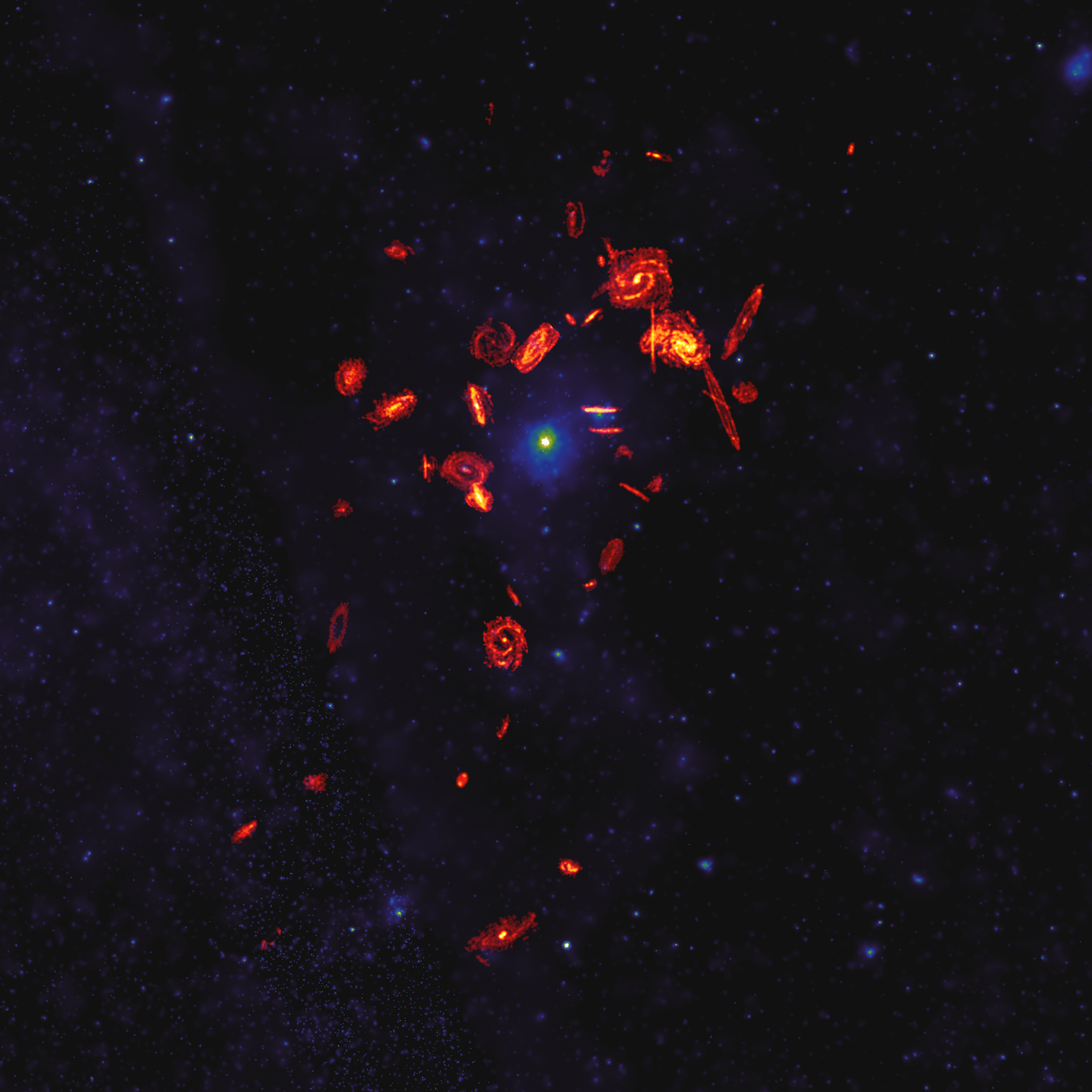
The VERTICO—Virgo Environment Traced in Carbon Monoxide—Survey observed the gas reservoirs in 51 galaxies in the nearby Virgo Cluster and found that the extreme environment in the cluster was killing galaxies by robbing them of their star-forming fuel. In this composite image, ALMA’s radio wavelength observations of the VERTICO galaxies’ molecular gas disks are magnified by a factor of 20. They are overlaid on the X-ray image of the hot plasma within the Virgo Cluster.
Hi-Res File


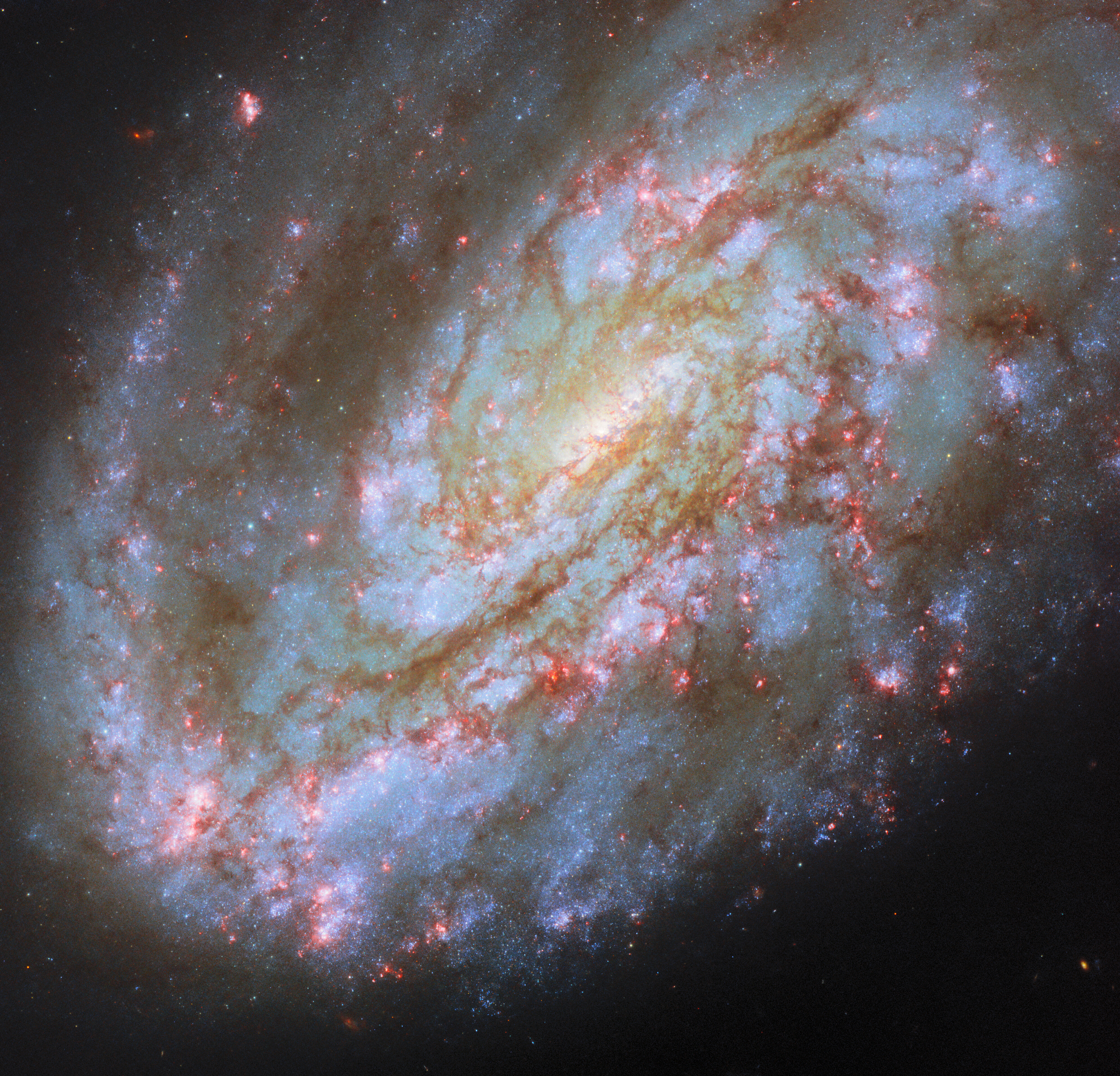

NGC 4567 and NGC 4568 are two of the thousands of galaxies in the Virgo Cluster, located roughly 65 million light-years from Earth. Observed by the VERTICO—Virgo Environment Traced in Carbon Monoxide—Survey, the two galaxies are among those in the galaxy cluster impacted by extreme physical processes that can lead to the death of galaxies. The galaxies are shown here in composite radio data from ALMA with molecular gas in red/orange and optical data from Hubble Space Telescope with stars in white/blue. Credit: ALMA (ESO/NAOJ/NRAO)/S. Dagnello (NRAO).
Hi-Res File


Spiral galaxy NGC 4254 is among the thousands of galaxies living and dying by the extreme physical processes in the Virgo Cluster. The galaxy is seen here in radio from ALMA with molecular gas in red/orange and optical from Hubble Space Telescope with stars in white/blue. Credit: ALMA (ESO/NAOJ/NRAO)/S. Dagnello (NRAO).
Hi-Res File


VERTICO Survey unmasks violent environments as culprit in mass galaxy quenching mystery


Astronomers examining the nearby Universe with the help of the Atacama Large Millimeter/submillimeter Array (ALMA) have just completed the largest high-resolution survey of star-forming fuel ever conducted in galaxy clusters. But more importantly, they’re tackling a long-standing mystery in astrophysics: what’s killing galaxies? The research, which provides the clearest evidence to date that extreme environments in space have severe impacts on the galaxies within them, will be published in an upcoming edition of The Astrophysical Journal Supplement Series.

The Virgo Environment Traced in Carbon Monoxide Survey—VERTICO—set out to better understand star formation and the role of galaxies in the Universe. “We know that galaxies are being killed by their environments, and we want to know why,” said Toby Brown, Plaskett Fellow at the National Research Council of Canada and lead author on the paper. “What VERTICO reveals better than ever before is which physical processes affect molecular gas and how they dictate the life and death of the galaxy.”

Galaxies are large collections of stars, and their births, evolutions, and deaths are influenced by where they live in the Universe and how they interact with their surroundings. Galaxy clusters, in particular, are some of the most extreme environments in the Universe, making them of particular interest to scientists studying the evolution of galaxies.

Home to thousands of galaxies the Virgo Cluster is the nearest massive cluster of galaxies to the Local Group, where the Milky Way resides. The extreme size and proximity make the cluster easy to study, but it also has other features that make it ripe for observation. “The Virgo Cluster is a bit unusual in that it has a relatively large population of galaxies that are still forming stars,” said Christine Wilson, Distinguished University Professor at McMaster University and co-principal investigator on the VERTICO project. “Many galaxy clusters in the Universe are dominated by red galaxies with little gas and star formation.”

The VERTICO project observed the gas reservoirs of 51 galaxies in the Virgo Cluster in high-resolution, revealing an environment so extreme and inhospitable that it can stop entire galaxies from forming stars in a process known as galaxy quenching. “The Virgo Cluster is the most extreme region of the local Universe, filled with million-degree plasma, extreme galaxy speeds, violent interactions between galaxies and their surroundings, a galaxy retirement village, and accordingly, a galaxy graveyard,” said Brown, adding that the project revealed how gas stripping can stunt, or shut down, one of the most important physical processes in the Universe: star formation. “Gas stripping is one of the most spectacular and violent external mechanisms that can shut down star formation in galaxies,” said Brown. “Gas stripping occurs when galaxies are moving so fast through hot plasma in the cluster that vast quantities of cold molecular gas are stripped away from the galaxy, as though the gas is being swept away by a huge cosmic broom. The exquisite quality of VERTICO’s observations allows us to better see and understand such mechanisms.”

The project was aided by ALMA’s Band 6 receiver—developed at the National Radio Astronomy Observatory’s Central Development Laboratory (CDL)—which provides high sensitivity and high resolution while minimizing required observing time. That, in turn, led to the collection of a significant amount of data, which may contain the clues needed to solve the remaining mysteries of how environments impact galaxies, and accordingly, how galaxies die. Wilson said, “There have been a lot of questions over the years on whether and how the cluster environment affects the molecular gas in galaxies, and how exactly those environments may contribute to their deaths. We still have work to do, but I’m confident VERTICO will allow us to answer these questions once and for all.”


The new paper is the first from VERTICO, with additional research expected to publish in the near future.


Resources 

“VERTICO: The Virgo Environment Traced In CO Survey,” Brown et. al. (2021), The Astrophysical Journal Supplement Series, preprint: https://arxiv.org/abs/2111.00937

About ALMA

The Atacama Large Millimeter/submillimeter Array (ALMA), an international astronomy facility, is a partnership of the European Organisation for Astronomical Research in the Southern Hemisphere (ESO), the U.S. National Science Foundation (NSF) and the National Institutes of Natural Sciences (NINS) of Japan in cooperation with the Republic of Chile. ALMA is funded by ESO on behalf of its Member States, by NSF in cooperation with the National Research Council of Canada (NRC) and the Ministry of Science and Technology (MOST) and by NINS in cooperation with the Academia Sinica (AS) in Taiwan and the Korea Astronomy and Space Science Institute (KASI).

ALMA construction and operations are led by ESO on behalf of its Member States; by the National Radio Astronomy Observatory (NRAO), managed by Associated Universities, Inc. (AUI), on behalf of North America; and by the National Astronomical Observatory of Japan (NAOJ) on behalf of East Asia. The Joint ALMA Observatory (JAO) provides the unified leadership and management of the construction, commissioning and operation of ALMA.


Media Contact: 

Amy C. Oliver
Public Information Officer, ALMA
Public Information & News Manager, NRAO
+1 434 242 9584

aoliver@nrao.edu


Friday, December 09, 2016

A transformation in Virgo

Credit: ESA/Hubble & NASA


The constellation of Virgo (The Virgin) is especially rich in galaxies, due in part to the presence of a massive and gravitationally-bound collection of over 1300 galaxies called the Virgo Cluster. One particular member of this cosmic community, NGC 4388, is captured in this image, as seen by the NASA/ESA Hubble Space Telescope’s Wide Field Camera 3 (WFC3). 

Located some 60 million light-years away, NGC 4388 is experiencing some of the less desirable effects that come with belonging to such a massive galaxy cluster. It is undergoing a transformation, and has taken on a somewhat confused identity. 

While the galaxy’s outskirts appear smooth and featureless, a classic feature of an elliptical galaxy, its centre displays remarkable dust lanes constrained within two symmetric spiral arms, which emerge from the galaxy’s glowing core — one of the obvious features of a spiral galaxy. Within the arms, speckles of bright blue mark the locations of young stars, indicating that NGC 4388 has hosted recent bursts of star formation. 

Despite the mixed messages, NGC 4388 is classified as a spiral galaxy. Its unusual combination of features are thought to have been caused by interactions between NGC 4388 and the Virgo Cluster.

Gravitational interactions — from glancing blows to head-on collisions, tidal influencing, mergers, and galactic cannibalism — can be devastating to galaxies. While some may be lucky enough to simply suffer a distorted spiral arm or newly-triggered wave of star formation, others see their structure and contents completely and irrevocably altered.


Tuesday, February 09, 2016

A galaxy in distress: the spectacular tails of ionized gas in NGC 4569, the most massive spiral galaxy in the Virgo cluster

The colour image of the galaxy NGC 4569 in the Virgo cluster, obtained with MegaCam at the CFHT. The red filaments at the right of the galaxy show the ionised gas removed by ram pressure. This is about 95% of the gas reservoir of the galaxy needed to feed the formation of new stars (image ©2015 CFHT/Coelum).


An international team led by researchers from the Laboratoire d'Astrophysique de Marseille (LAM) has used MegaCam on CFHT to observe NGC 4569, the most massive spiral galaxy in the Virgo cluster. They observed, for the first time, spectacular tails of ionized gas that extend for over 300,000 light years, five times larger than NGC 4569 itself! This observation confirms that ram pressure stripping due to the intracluster medium is depriving NGC 4569 of its gas reservoir. This important constraint must be taken into account in any cosmological model striving to incorporate the effect of environment on the evolution of galaxies. The result also shows that MegaCam at CFHT is now a second-to-none world-class facility to study gas stripping and opens up a promising new avenue for understanding the role of environment in the evolution of galaxies.

Galaxies are not distributed uniformly throughout the universe. Some are found in dense clusters that can contain hundred to thousands of galaxies. Astrophysicists suspect that living in a cluster environment can have a strong influence in the way galaxies evolve. The tell-tail signs have long been recognized: for instance, compared to less dense regions, clusters contain proportionally more elliptical galaxies (spheroidal systems with little to no gas and dust) and fewer spirals (gas rich disky systems in which new stars are continuously formed from the gas in the interstellar medium). And even the few spiral galaxies found in clusters generally contain less gas and have an older population of stars than isolated spiral galaxies.

Several mechanisms have been proposed to explain the difference observed between galaxies in different environments. First, when two galaxies interact, tidal forces tend to rip apart and disrupt the outermost, less gravitationally bound and most diffuse parts. A second mechanism is the "dynamical pressure" exerted on the interstellar medium of a galaxy as it travels through the hot, diffuse medium that permeates the space in between galaxies, a process known as `ram pressure stripping’ (a biker travelling at high speed would experience a similar kind of pressure from the ambient air!). These two processes are able to lift gas from the disks of spiral galaxies, and therefore inhibit the formation of new stars. There is also a third mechanism that is thought to affect mostly the most massive galaxies: these galaxies host very massive black holes at their centres, and the energy liberated by the accretion onto these black holes, injected into the surrounding medium, can unbind the gas.

Identifying which of these processes is dominant is critical to constrain cosmological simulations that follow the evolution of galaxies. Observationally, however, observing the low density gas as it is being stripped is a tremendous challenge. The MegaCam Camera on the Canada France Hawaii Telescope (CFHT) has recently been equipped with a new, high efficient narrow-band filter that isolates the H-alpha emission line from the ionized gas, allowing it to be detected with high efficiency.

An international team led by researchers from the Laboratoire d'Astrophysique de Marseille (LAM) has used this instrument to observe NGC 4569, the most massive spiral galaxy in the Virgo cluster (at 45 million light years, the massive cluster of galaxies closest to the Milky Way). The Virgo cluster is still evolving, and therefore offers the opportunity to observe the transformation of galaxies as it takes place. NGC 4569 is moving through the cluster at a staggering 1200 km/s. The H-alpha image obtained with MegaCam at CFHT shows for the first time spectacular tails of ionized gas that extend for over 300,000 light years, five times larger than NGC 4569 itself ! This observation confirms that ram pressure stripping due to the intracluster medium is depriving NGC 4569 of its gas reservoir. An estimate of the mass of gas in these tails shows that 95% of the interstellar medium has already been removed from the disk of the galaxy, greatly limiting its ability to form new stars.

For a galaxy as massive as NGC 4569, it is perhaps surprising that internal gravitational forces are not strong enough to hold the gas together, counteracting the action of ram pressure stripping. Indeed, in cosmological models, it is hypothesised that in such massive galaxies, it is the activity related to the central supermassive black hole to cause the gas to be lost. The new observations show instead that the dominant effect is ram pressure: this important constraint must be taken into account in any cosmological model striving to incorporate the effect of environment on the evolution of galaxies.

The result also shows that MegaCam at CFHT is now a second-to-none world-class facility to study gas stripping and opens up a promising new avenue for understanding the role of environment in the evolution of galaxies.


Additional information: Scientific article

Information/Maiin contact:

Alessandro Boselli
Laboratoire d'Astrophysique de Marseille
38, rue Joliot-Curie
F-13388 Marseille cedex 13 -  France
alessandro.boselli@lam.fr


Tuesday, October 27, 2015

Suzaku Finds Common Chemical Makeup at Largest Cosmic Scales


A new survey of hot, X-ray-emitting gas in the Virgo galaxy cluster shows that the elements needed to make stars, planets and people were evenly distributed across millions of light-years early in cosmic history, more than 10 billion years ago.

The Virgo cluster, located about 54 million light-years away, is the nearest galaxy cluster and the second brightest in X-rays. The cluster is home to more than 2,000 galaxies, and the space between them is filled with a diffuse gas so hot it glows in X-rays. 

Using Japan's Suzaku X-ray satellite, a team led by Aurora Simionescu, an astrophysicist at the Japan Aerospace Exploration Agency (JAXA) in Sagamihara, acquired observations of the cluster along four arms extending up to 5 million light-years from its center.

"Heavier chemical elements from carbon on up are produced and distributed into interstellar space by stars that explode as supernovae at the ends of their lifetimes," Simionescu said. This chemical dispersal continues at progressively larger scales through other mechanisms, such as galactic outflows, interactions and mergers with neighboring galaxies, and stripping caused by a galaxy's motion through the hot gas filling galaxy clusters.
Supernovae fall into two broad classes. Stars born with more than about eight times the sun's mass collapse under their own weight and explode as core-collapse supernovae. White dwarf stars may become unstable due to interactions with a nearby star and explode as so-called Type Ia supernovae.

These different classes of supernovae produce different chemical compositions. Core-collapse supernovae mostly scatter elements ranging from oxygen to silicon, while white dwarf explosions release predominantly heavier elements, such as iron and nickel. Surveying the distribution of these elements over a vast volume of space, such as a galaxy cluster, helps astronomers reconstruct how, when, and where they were produced. Once the chemical elements made by supernovae are scattered and mixed into interstellar space, they become incorporated into later generations of stars. 

The overall composition of a large volume of space depends on the mix of supernova types contributing to it. For example, accounting for the overall chemical makeup of the sun and solar system requires a mix of roughly one Type Ia supernova for every five core-collapse explosions. 
"One way to think about this is that we're looking for the supernova recipe that produced the chemical makeup we see on much larger scales, and comparing it with the recipe for our own sun," said co-author Norbert Werner, a researcher at the Kavli Institute for Particle Astrophysics and Cosmology (KIPAC) at Stanford University in California.

In an earlier study led by Werner, Suzaku data showed that iron was distributed uniformly throughout the Perseus Galaxy Cluster, but information about lighter elements mainly produced by core-collapse supernovae was unavailable. The Virgo Cluster observations supply the missing ingredients. Reporting their findings in the Oct. 1 issue of The Astrophysical Journal, Simionescu and her colleagues show they detect iron, magnesium, silicon and sulfur all the way across a galaxy cluster for the first time. The elemental ratios are constant throughout the entire volume of the cluster and roughly consistent with the composition of the sun and most of the stars in our own galaxy.

Because galaxy clusters cover enormous volumes of space, astronomers can use one example to extrapolate the average chemical content of the universe. The study shows that the chemical elements in the cosmos are well mixed, showing little variation on the largest scales. The same ratio of supernova types -- the same recipe -- thought to be responsible for the solar system's makeup was at work throughout the universe. This likely happened when the universe was between 2 and 4 billion years old, a period when stars were being formed at the fastest rate in cosmic history.

"This means that elements so important to life on Earth are available, on average, in similar relative proportions throughout the bulk of the universe," explained Simionescu. "In other words, the chemical requirements for life are common throughout the cosmos."

Launched on July 10, 2005, Suzaku was developed at the Institute of Space and Astronautical Science (ISAS) in Japan, which is part of JAXA, in collaboration with NASA and other Japanese and U.S. institutions. NASA's Goddard Space Flight Center in Greenbelt, Maryland, supplied Suzaku's X-ray telescopes and data-processing software, and operated a facility supporting U.S. astronomers who used the satellite.

Suzaku operated for 10 years -- five times its target lifespan -- to become the longest-functioning Japanese X-ray observatory. On Aug. 26, JAXA announced the end of the mission due to the deteriorating health of the spacecraft.
"Suzaku provided us with a decade of revolutionary measurements," said Robert Petre, chief of Goddard's X-ray Astrophysics Laboratory. "We're building on that legacy right now with its successor, ASTRO-H, Japan's sixth X-ray astronomy satellite, and we're working toward its launch in 2016."


Wednesday, May 27, 2015

Faint Galaxies found Hiding in the Virgo Cluster

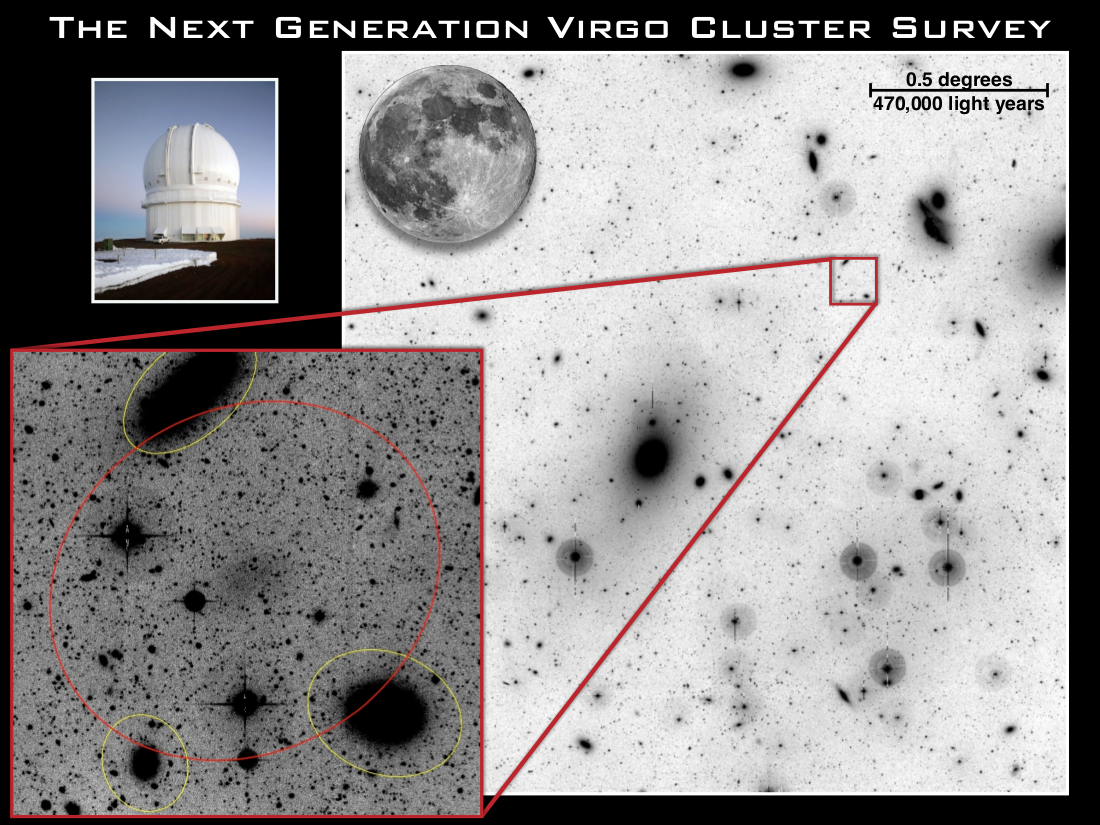
Example of a Low Surface Brightness Galaxy in the Virgo cluster. 
These galaxies are very hard to detect and the LSB mode on MegaCam enabled the possibility of such detections.  


A recent survey using the Canada-France-Hawaii Telescope has discovered hundreds of new galaxies in the Virgo Cluster, the nearest large cluster of galaxies. Most are extremely faint "dwarf" galaxies, objects hundreds of thousands of times less massive than our own galaxy, the Milky Way, and amongst the faintest galaxies known in the Universe. The Virgo cluster appears to be home to far more of such faint systems than the “Local Group” of galaxies to which the Milky Way belongs, suggesting that galaxy formation on small scales may be more complicated than previously thought, and that our Local Group may not be a typical corner of the universe.

The discovery has been announced by the “Next Generation Virgo Cluster Survey” (NGVS) team and is based on data collected, over the course of 6 years, with Megacam, a 340 Megapixel camera operating at the Canada France Hawaii Telescope and capable of observing, in a single shot, a one square degree field of view (equivalent to 4 full moons). Taking advantage of MegaCam’s wide angle coverage, the NGVS team was able to observe the Virgo cluster in its entirety, covering an area of the sky equivalent to over 400 full moons, at a depth and resolution that significantly exceed those of any existing surveys of the cluster. The resulting mosaic, comprising nearly 40 billion pixels, is the deepest, widest contiguous field ever seen is such detail.

To exploit the full power of the data, Laura Ferrarese, Lauren McArthur and Patrick Cote of the National Research Council of Canada developed a sophisticated data analysis technique that allowed them to discover many times more galaxies than were known previously, including some of the faintest and most diffuse objects ever detected.

Virgo is the nearest large cluster of galaxies, roughly 50 Million light-years away from us. Whereas the Milky Way forms part of a relatively small group of galaxies, the "Local Group", spread over the nearest few million light-years, Virgo contains dozens of bright galaxies and thousands of fainter ones. In the Local Group, the current theories of galaxy formation suggest there should be hundreds or thousands of dwarf galaxies, but fewer than 100 have been detected. Clusters such as Virgo were known to be richer hunting grounds for dwarfs, but only recently has the NGVS made it possible to set firm constraints on their numbers.

To understand the implications of these new discoveries, Jonathan Grossauer and James Taylor at the University of Waterloo ran computer simulations of clusters like Virgo, to see how many bound concentrations of dark matter they should contain at the present day. Comparing the numbers and masses of dark matter clumps to the population of galaxies discovered by the NGVS, they find a very simple pattern, where the ratio of stellar to dark matter mass changes slowly going from the smallest to the largest galaxies. It seems that in Virgo, there could be a simple relationship between dark matter mass and galaxy brightness, valid over a factor of 100,000 in stellar mass.

This is not the case in the Local Group: the low mass dark matter clumps that would be occupied by galaxies in Virgo, do not seem to have been capable of forming galaxies in the Local Group. So why are the two environments so different? A follow-up study with higher-resolution simulations by the NGVS survey team will explore how galaxies are spatially distributed throughout the cluster, to seek more clues to the mystery of dwarf galaxy formation. 


Science Contact information

James Taylor
University of Waterloo
taylor@uwaterloo.ca

Dr. Laura Ferrarese
NGVS Principal Investigator
laura.ferrarese@nrc-cnrc.gc.ca

Media Contact information

Leslie Sage
CASCA Press Officer
cascapressofficer@gmail.com

Mary Beth Laychak
CFHT Outreach Program Manager
mary@cfht.hawaii.edu


Thursday, March 26, 2015

Measuring Galaxy Evolution with Globular Clusters

The galaxy NGC 4365 in the Virgo supercluster of galaxies, showing its many globular clusters (most of the more than one hundred dots in this image are actually globular star clusters). A new study of over seven thousand globular clusters around ten Virgo galaxies finds that they are often gathered into distinct groupings whose shapes reflect the formation of the clusters and the histories of the galaxies. Credit: NASA/HST and ESO VLT

Globular clusters are gravitationally bound ensembles of stars, as many as a million stars in some cases, grouped in roughly spherical clusters with diameters as small as only tens of light-years. Globular clusters are typically located in the outer regions (the halos) of galaxies; the Milky Way galaxy has about two hundred globular clusters orbiting it. Astronomers are interested in globular clusters in part because they are home to many of the oldest known stars, but also because of their locations in the halos. Collisions between galaxies are commonplace, and globular clusters may provide fossil evidence of these encounters because they are strongly affected by such interactions. During a collision, a galaxy can grow by absorbing or merging with its neighbor, and some models predict that clusters form during these interactions. Moreover, it is possible that in a merger large numbers of globular clusters originally belonging to a smaller galaxy may be captured by the larger galaxy. In any case, the distribution of globular clusters around a galaxy holds clues to their origins and the history of its host galaxy.

The Virgo Cluster of galaxies, containing between one and two thousand galaxies, is located about fifty-four million light-years away in the direction of the constellation of Virgo. The ten brightest galaxies of the Virgo Cluster alone contain 7053 detected globular clusters. CfA astronomers Raffaele D'Abrusco, Pepi Fabbiano, and Andreas Zezas carefully examined this set of globular clusters looking for information about the history of these galaxies. In a new paper, they report discovering distinctive structures among the globular cluster systems, meaning that the globular clusters around these galaxies are not distributed symmetrically. Their configurations often take shapes ranging from roughly linear to circular, with some more complex shapes as well. The scientists found 229 such structures in this subsample, forty-two of them classified as being medium or large and stretching over as much as seventy-five thousand light-years. The elongated structures tend to be aligned with an axis of the host galaxy, as would be expected if a merger were responsible.

The scientists argue that these structures are indeed the remnants of galaxies that were accreted in the past, and among other things they estimate limits on the masses of these parent galaxies. Computer simulations provide some rough level of agreement. The authors note that with more detailed computations, these structures offer a powerful new tool to advance the study of galaxy evolution.

Reference(s):

"Spatial Structures in the Globular Cluster Distribution of the Ten Brightest Virgo Galaxies," R. D'Abrusco, G. Fabbiano, A. Zezas, ApJ 2015 (in press)


Tuesday, December 02, 2014

Staying Warm: The Hot Gas in Clusters of Galaxies

A false-color X-ray image of the core of the Virgo cluster of galaxies. The emission comes from very hot gas between the galaxies. This gas should cool off, but doesn’t, and a new paper presents a very plausible solution to this long-time mystery. The scale mark corresponds to a physical scale of 50 light-years. Credit: NASA/Chandra X-ray Observatory

Most galaxies lie in clusters, groupings of a few to many thousands of galaxies. Our Milky Way galaxy itself is a member of the "Local Group," a band of about fifty galaxies whose other large member is the Andromeda Galaxy about 2.3 million light-years away. The closest large cluster of galaxies to us is the Virgo Cluster, about 50 million light-years away, with about 2000 members.

The space between the galaxies in clusters is filled with very hot gas – its temperature is of order ten million kelvin, or even higher. Most of the matter in the so-called intracluster medium is in the form of this very hot gas. Hot gas should cool off, and one of the major puzzles about galaxy clusters is that the hot intracluster gas does not seem to cool. In fact, calculations based on the energy radiated indicate that the gas should cool about ten times faster than is observed. X-ray observations of the hot gas also suggest that it might be turbulent, perhaps driven by mechanical flows of matter pouring outward from the supermassive black holes at the centers of the clusters’ galaxies, perhaps creating inflating bubbles of fast-moving charged particles that stir and heat the gas. Unfortunately, current X-ray observatories do not have the ability to measure the supposed gas velocities to test this proposed solution.

A team of astronomers including CfA scientists Bill Forman and Alexey Vikhlinin have pioneered a new method to evaluate the turbulence of the hot intracluster gas. They took advantage of the superb spatial resolution and sensitive images from the Chandra X-Ray Observatory to probe small clumps distributed through two clusters, Perseus and Virgo. They analyze the structures as resulting from turbulence, and then inferred the turbulent velocities needed, deriving values up to about 145 kilometers per second. These velocities are indeed adequate to heat the gas over all the scales observed over the cluster, and could readily be produced by black hole jets. The results are very encouraging, though not definitive, and imply that no mysterious mechanisms needed to be invoked to explain the enduring hot gas.

Reference(s): 
"Turbulent Heating in Galaxy Clusters Brightest in X-rays," I. Zhuravleva, E. Churazov, A. A. Schekochihin, S. W. Allen, P. Arévalo, A. C. Fabian, W. R. Forman, J. S. Sanders, A. Simionescu, R. Sunyaev, A. Vikhlinin, & N. Werner, Nature, 515, 85, 2014.


Friday, October 31, 2014

A galaxy on the edge

Credit:  ESA/Hubble & NASA
 
This spectacular image was captured by the NASA/ESA Hubble Space Telescope's Advanced Camera for Surveys (ACS). The bright streak slicing across the frame is an edge-on view of galaxy NGC 4762, and a number of other distant galaxies can be seen scattered in the background.

NGC 4762 lies about 58 million light-years away in the constellation of Virgo (The Virgin). It is part of the Virgo Cluster, hence its alternative designation of VCC 2095 for Virgo Cluster Catalogue entry. This catalogue is a listing of just over 2000 galaxies in the area of the Virgo Cluster. The Virgo Cluster is actually prominently situated, and lies at the centre of the larger Virgo supercluster, of which our galaxy group, the Local Group, is a member.

Previously thought to be a barred spiral galaxy, NGC 4762 has since been found to be a lenticular galaxy, a kind of intermediate step between an elliptical and a spiral. The edge-on view that we have of this particular galaxy makes it difficult to determine its true shape, but astronomers have found the galaxy to consist of four main components — a central bulge, a bar, a thick disc and an outer ring.

The galaxy's disc is asymmetric and warped, which could potentially be explained by NGC 4762 violently cannibalising a smaller galaxy in the past. The remains of this former companion may then have settled within NGC 4762's disc, redistributing the gas and stars and so changing the disc's morphology.

NGC 4762 also contains a Liner-type Active Galactic Nucleus, a highly energetic central region. This nucleus is detectable due to its particular spectral line emission, which acts as a type of "atomic fingerprint", allowing astronomers to measure the composition of the region.


Source:  ESA/Hubble - Space Telescope

Tuesday, October 28, 2014

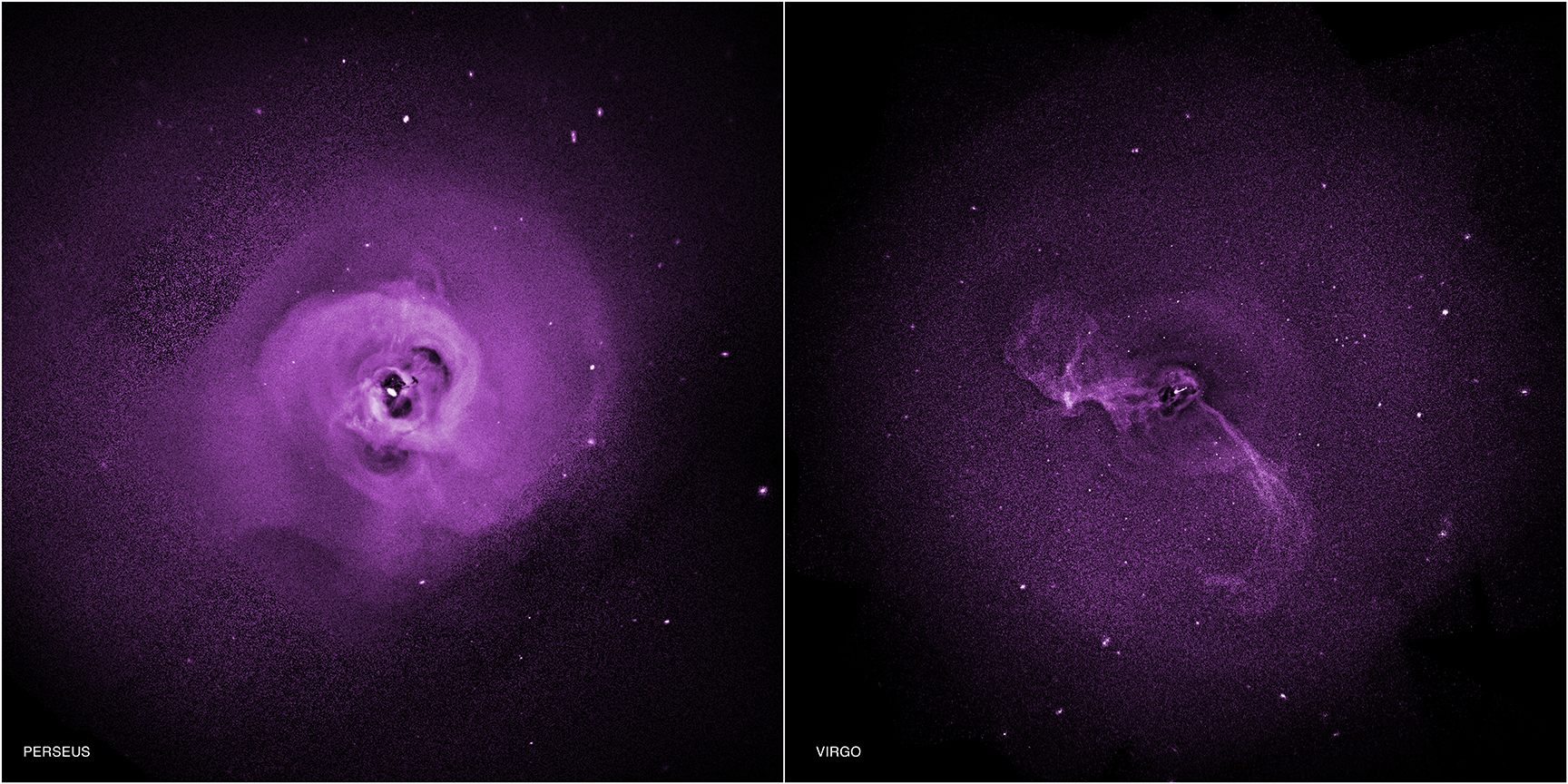
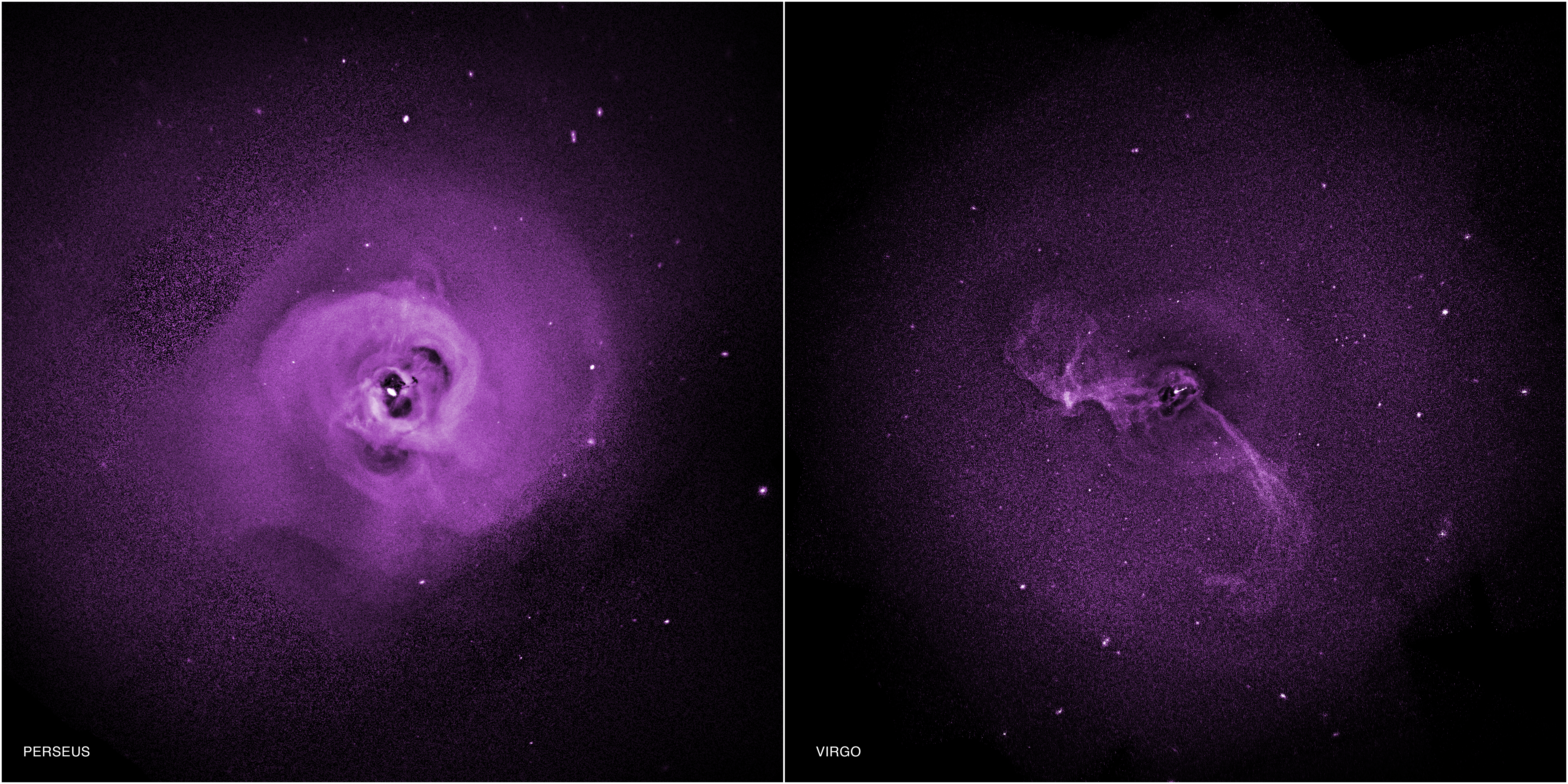
Perseus Cluster and Virgo Cluster: NASA's Chandra Observatory Identifies Impact of Cosmic Chaos on Star Birth

 Galaxy Clusters - Perseus e Virgo Cluster
Credit: NASA/CXC/Stanford/I.Zhuravleva et al


animation


These two Chandra images of galaxy clusters - known as Perseus and Virgo - have provided direct evidence that turbulence is helping to prevent stars from forming. These new results could answer a long-standing question about how these galaxy clusters keep their enormous reservoirs of hot gas from cooling down to form stars, as discussed in our latest press release [link to PR].

Galaxy clusters are the largest objects in the Universe held together by gravity. They contain hundreds or thousands of individual galaxies that are immersed in gas with temperatures of millions of degrees. This hot gas, which is the heftiest component of the galaxy clusters aside from dark matter, glows brightly in X-ray light. Over time in the centers of clusters, this gas should cool enough so that stars form at prodigious rates. This, however, is not what astronomers have observed in many galaxy clusters.

A team of researchers have found evidence that the heat is generated by turbulent motions, which they identified from signatures in the Chandra data. Previously, other scientists have shown the key role of supermassive black holes in the centers of large galaxies in the middle of galaxy clusters. These black holes pump vast quantities of energy into the volumes around them through powerful jets of energetic particles. Chandra and other X-ray telescopes have detected giant cavities created in the hot cluster gas by the jets.

The latest research provides insight into just how energy can be transferred from the cavities to the surrounding gas. The interaction of the cavities with the gas may be generating turbulence, or chaotic motion similar to that on a bumpy airplane ride, which then dissipates to keep the gas hot for billions of years.

The scientists targeted Perseus and Virgo because they are both extremely large and relatively bright, thus providing an opportunity to see details that would be very difficult to detect in other clusters. The evidence for turbulence can be seen most clearly in the ripple-like structures in the Chandra image of Perseus. When combined with careful analysis of the data with theoretical models, this new result provides the clearest evidence to date that turbulence is the mechanism that prevents the hot gas in these clusters from cooling.

The paper describing these results is available online.

These results appeared online in the journal Nature on October 26, 2014. The authors were Irina Zhuravleva (Stanford University), Eugene Churazov (Max Planck Institute for Astrophysics), Alexander Schekochinhin (University of Oxford), Steve Allen (Stanford), Patricia Arevalo (Pontificia Universidad Catolica de Chile), Andy Fabian (University of Cambridge), William Forman (Harvard-Smithsonian Center for Astrophysics), Jeremy Sanders (Max Planck Institute for Extraterrestrial Physics), Aurora Simionescu (JAXA), Rasheed Sunayev (Max Planck Institute for Astrophysics), Alexey Vikhlinin (Harvard-Smithsonian Center for Astrophysics), and Norbert Werner (Stanford).

NASA's Marshall Space Flight Center in Huntsville, Alabama, manages the Chandra program for NASA's Science Mission Directorate in Washington, DC. The Smithsonian Astrophysical Observatory in Cambridge, Massachusetts, controls Chandra's science and flight operations.


Fast Facts for Perseus Cluster: 


Release: Date October 27, 2014
Scale: Image is 20 arcmin across (about 1.5 million light years).
Category: Groups & Clusters of Galaxies
Coordinates (J2000): RA 03h 19m 47.60s | Dec +41° 30' 37.00"
Constellation: Perseus
Observation Dates: 25 pointings between Sep 1999 and Dec 2009
Observation Time: 416 hours 32 min (17 days 8 hours 32 min)
Obs. IDs: 502, 503, 1513, 3209, 3404, 4289, 4946-4953, 6139, 6145, 6146, 11713-11716, 12025, 12033, 12036, 12037
Instrument: ACIS
Also Known As: Abell 426
References: Zhuravleva, I. et al, 2014, Nature (in press); arXiv:1410.6485
Color Code: X-ray: Purple X-ray
Distance Estimate: About 250 million light years


Fast Facts for Virgo Cluster:


Release Date: October 27, 2014  
Scale: Image is 22 arcmin across (about 320,000 light years).  
Category: Groups & Clusters of Galaxies  
Coordinates (J2000): RA 12h 30m 49.40s | Dec +12° 23' 28.00"  
Constellation: Virgo
Observation Dates: 2 pointings in Jul 2002, and 7 between Jan and Nov 2005 
Observation Time: 159 hours (6 days 15 hours) 
Obs. IDs: 2707, 3717, 5826-5828, 6186, 7210-7212 
Instrument: ACIS  
References: Zhuravleva, I. et al, 2014, Nature (in press); arXiv:1410.6485 
Color Code: X-ray: Purple
Distance Estimate: About 55 million light years 


Monday, August 11, 2014

Astronomers find stream of gas – 2.6 million light years long

The bridge of gas (shown in green) stretches from the large galaxy at the bottom left to the group of galaxies at the top. A third nearby galaxy to the right also has a shorter stream of gas attached to it. The three insets show expanded views of the different galaxies and the green circle indicates the Arecibo telescope beam. Credit: Rhys Taylor/Arecibo Galaxy Environment Survey/The Sloan Digital Sky Survey Collaboration.

Astronomers and students have found a bridge of atomic hydrogen gas 2.6 million light years long between galaxies 500 million light years away. They detected the gas using the William E. Gordon Telescope at the Arecibo Observatory, a radio astronomy facility of the US National Science Foundation sited in Puerto Rico. The team publish their results today in a paper in Monthly Notices of the Royal Astronomical Society.

The stream of atomic hydrogen gas is the largest known, a million light years longer than a gas tail found in the Virgo Cluster by another Arecibo project a few years ago. Dr Rhys Taylor, a researcher at the Czech Academy of Sciences and lead author of the paper, said "This was totally unexpected. We frequently see gas streams in galaxy clusters, where there are lots of galaxies close together, but to find something this long and not in a cluster is unprecedented." 

It is not just the length of the stream that is surprising but also the amount of gas found in it. Roberto Rodriguez, a 2014 graduate from the University of Puerto Rico in Humacao who worked on the project as an undergraduate, explained "We normally find gas inside galaxies, but here half of the gas – 15 billion times the mass of the Sun – is in the bridge. That’s far more than in the Milky Way and Andromeda galaxies combined!"

The team is still investigating the origin of the stream. One notion surmises that the large galaxy at one end of the stream passed close to the group of smaller galaxies at the other end in the past, and that the gas bridge was drawn out as they moved apart. A second notion suggests that the large galaxy plowed straight through the middle of the group, pushing gas out of it. The team plan to use computer simulations to find out which of these ideas can best match the shape of the bridge that is seen with the Arecibo Telescope.

The project involved three undergraduate researchers: Roberto Rodriguez and Clarissa Vazquez from UPR Humacao, and Hanna Herbst, now a graduate student at the University of Florida. Dr Robert Minchin, a staff astronomer at Arecibo Observatory and the principal investigator on the project, said "Student involvement is very important to us. We are proud to be inspiring the next generation of astronomers, and particularly proud of the involvement of Puerto Rican students."

The bridge was found in data taken between 2008 and 2011 for the Arecibo Galaxy Environment Survey (AGES), which is using the power of the Arecibo Telescope to survey a large area of sky with a high level of sensitivity.

Media contacts

Ruth E. Torres Hernández
Public Relations Officer
Arecibo Observatory
Puerto Rico
Tel: +1 787 878 2612 x615

rutorres@suagm.edu

Yvonne Guadalupe Negrón
Director- Public Relations Office
Universidad Metropolitana
Puerto Rico
Tel: +1 787 766 1717 x6405, +1 787 242 0806


Erin Carver
Media and Communications Manager
Universities Space Research Association
United States
Tel: +1 410 227 7078

ecarver@usra.edu

Dr Robert Massey
Royal Astronomical Society
Tel: +44 (0)20 7734 3307 / 4582
Mob: +44 (0)794 124 8035

rm@ras.org.uk

Science contacts

Dr Rhys Taylor
Czech Academy of Sciences

rhysyt@gmail.com

Dr Robert Minchin
Arecibo Observatory
Puerto Rico

rminchin@naic.edu

Image and caption

An image is available to accompany this release.
Caption: The bridge of gas (shown in green) stretches from the large galaxy at the bottom left to the group of galaxies at the top. A third nearby galaxy to the right also has a shorter stream of gas attached to it. Credit: Rhys Taylor / Arecibo Galaxy Environment Survey / The Sloan Digital Sky Survey Collaboration


Further information

The new work appears in R. Taylor et al., 2014, "The Arecibo Galaxy Environment Survey VII : A Dense Filament With Extremely Long HI Streams", Monthly Notices of the Royal Astronomical Society, vol. 443, pp. 2634-2649, published by Oxford University Press. A pre-print of the paper can be found on the arXiv.

Notes for editors

The Arecibo Observatory is operated by SRI International under a cooperative agreement with the National Science Foundation (AST-1100968), and in alliance with Ana G. Méndez-Universidad Metropolitana, and the Universities Space Research Association. The Arecibo Planetary Radar program is supported by NASA's Near Earth Object Observation program. For more information see the Observatory's Facebook page and follow its Twitter feed.

The Royal Astronomical Society (RAS), founded in 1820, encourages and promotes the study of astronomy, solar-system science, geophysics and closely related branches of science. The RAS organises scientific meetings, publishes international research and review journals, recognizes outstanding achievements by the award of medals and prizes, maintains an extensive library, supports education through grants and outreach activities and represents UK astronomy nationally and internationally. Its more than 3800 members (Fellows), a third based overseas, include scientific researchers in universities, observatories and laboratories as well as historians of astronomy and others. Follow the RAS on Twitter.