Showing posts with label ESA/HUBBLE. Show all posts

Thursday, September 10, 2026

A superbubble scene

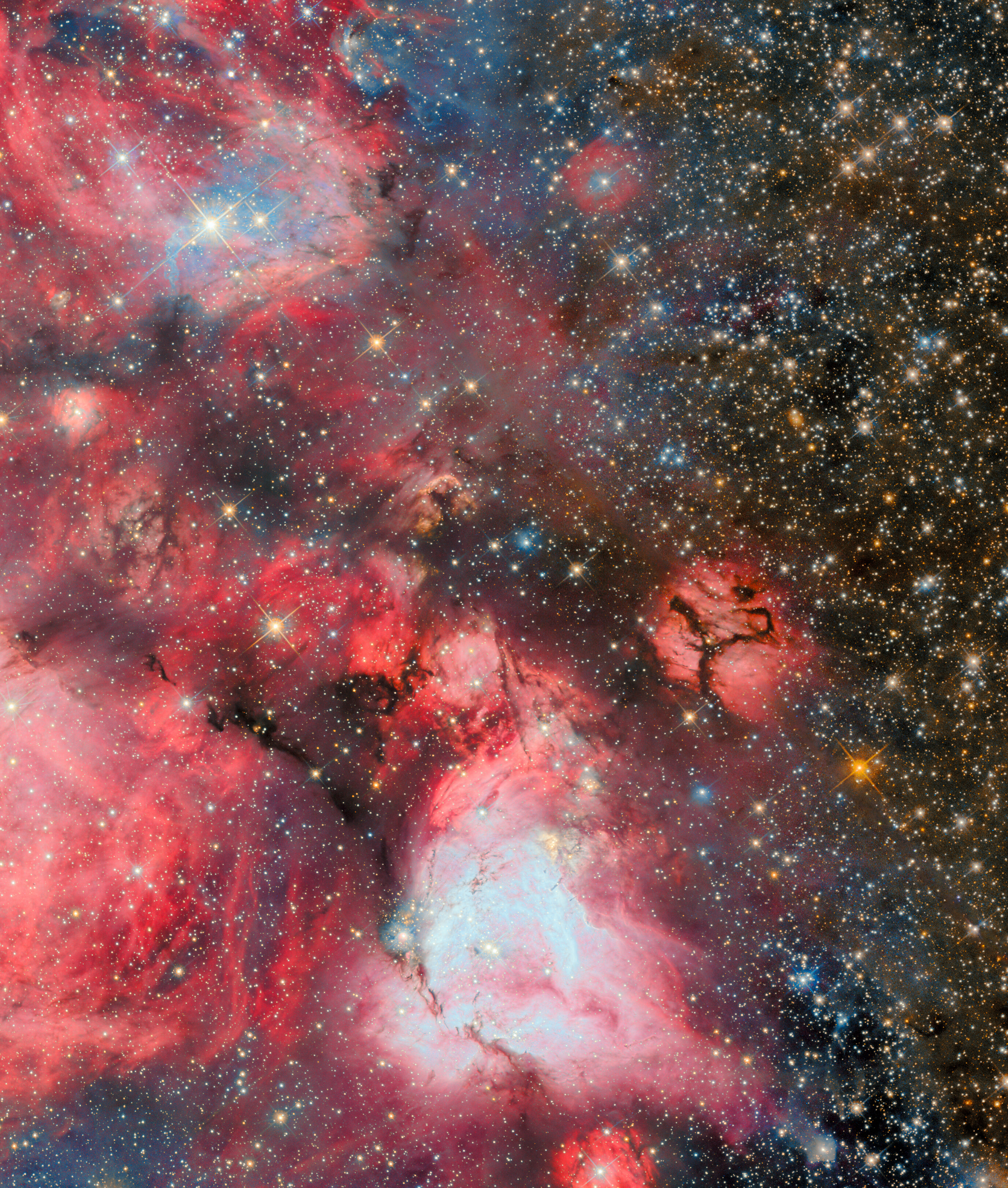
TA dense field of stars fills the image, surrounded by wispy clouds of gas and dust. Pale blue and grey nebulosity forms an intricate web across the scene, with darker clouds of dust concentrated towards the lower right. Numerous bright stars appear in shades of blue, white and orange. Credit: ESA/Hubble & NASA, D. Gouliermis.


This sprawling cosmic vista and subject of today’s ESA/Hubble Picture of the Month comes from the Large Magellanic Cloud, or LMC. The LMC is the largest of the small galaxies that orbit our Milky Way galaxy. At just 160 000 light-years away, the LMC offers a close look at highly active stellar birthsites like the nebula shown here. This nebula is named LHA 120-N44, or N44 for short, and it’s located in the constellation Dorado.
The appearance of this photogenic nebula is dominated by two features: a vast central void and a shell of dense, dusty gas. The central void is a ‘superbubble’ spanning roughly 210 by 140 light-years. The glittering stars at the centre of the void are responsible for its creation; through their powerful stellar winds and explosive supernovae, these stars have expelled much of the gas from which they were born.

When the stars of N44’s central star cluster swept away this gas, the expelled gas formed a shell around the superbubble. New stars are forming in this compressed gas shell, making N44 an interesting target for researchers studying the process of star formation. In particular, astronomers have turned to this nebula as an ideal place to time this process from start to finish. Their goal is to understand how long it takes from the collapse of cold gas clouds into dense knots to the moment nuclear fusion ignites in the heart of a newborn star.
Researchers used Hubble to survey N44 and take a census of its stars, cataloguing nearly half a million stars within the cluster as well as interlopers drifting in front of it. Of the stars surveyed, nearly 30 000 are what astronomers call pre-main-sequence stars, which have yet to begin fusing hydrogen into helium in their cores. This treasure trove of baby stars was discoverable thanks to the high sensitivity and fine spatial resolution of Hubble’s instruments that can pick out faint objects in crowded clusters.
The gas shell surrounding the superbubble is energised by ultraviolet radiation from massive stars, causing it to glow and highlighting several distinct features. Each feature within the broader N44 star-forming complex was catalogued by astronomer Karl Henize in the 1950s. One feature is a smaller bubble, catalogued as N44F, that is located near the upper-right corner of this image. N44F is an interstellar bubble blown by the intense stellar winds of a single hot and massive star. As this previously released Hubble closeup shows, the star’s furious winds and radiation have sculpted the surrounding bubble and created pillars of dusty gas.

The data used to create this image come from an observing programme (#14689; PI: Gouliermis) that aimed to probe stars in the N44 complex that have not yet begun fusing hydrogen into heavier elements in their cores. These data help to determine how long the process of star formation takes, as well as what masses newborn stars typically have. Hubble's sensitive observations of the lowest-mass stars in this region open a new window onto star formation in regions that, like the LMC or the galaxies of the early Universe, are poor in elements heavier than helium.


Links


Friday, August 28, 2026

One-sided spiral

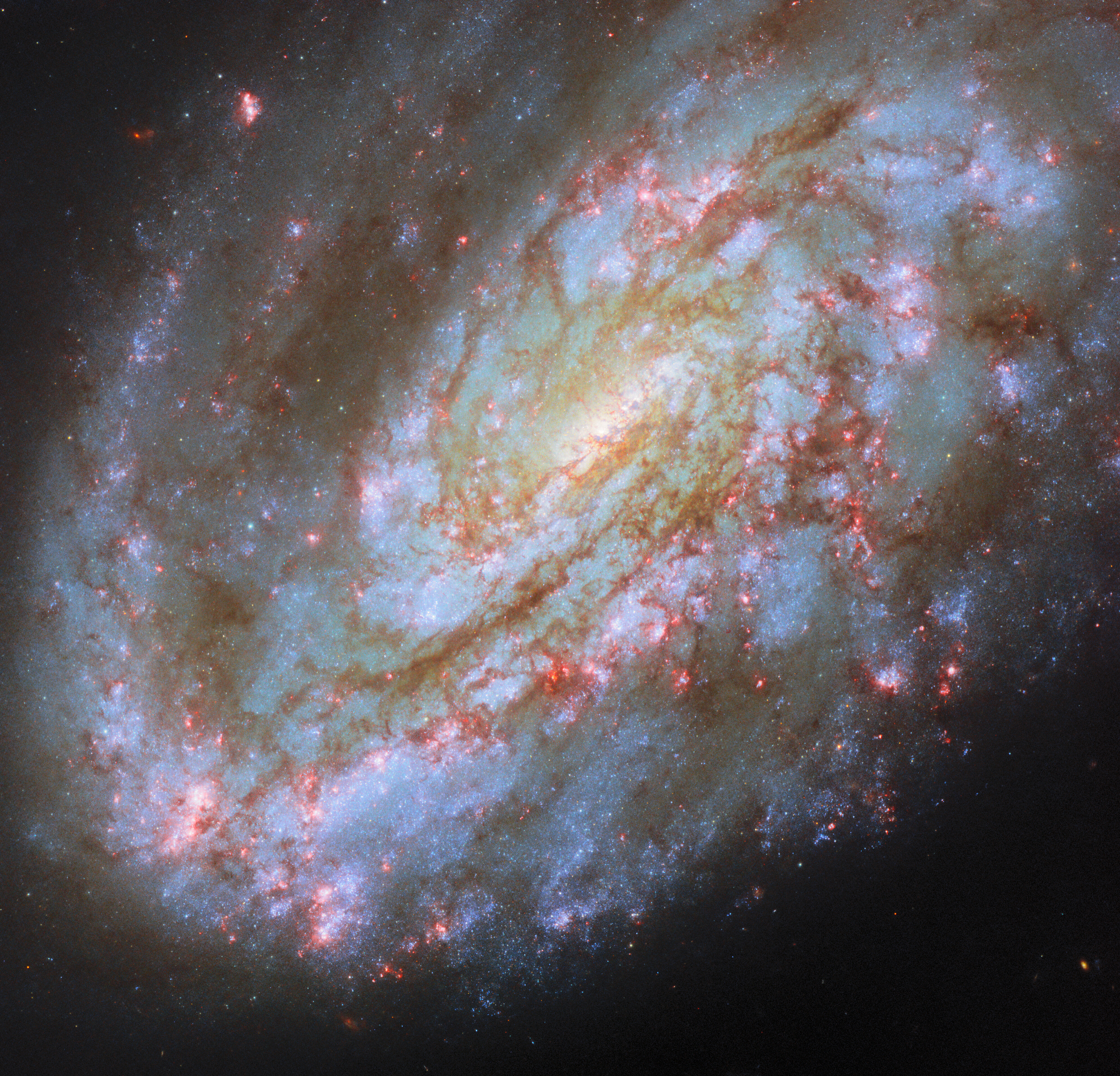
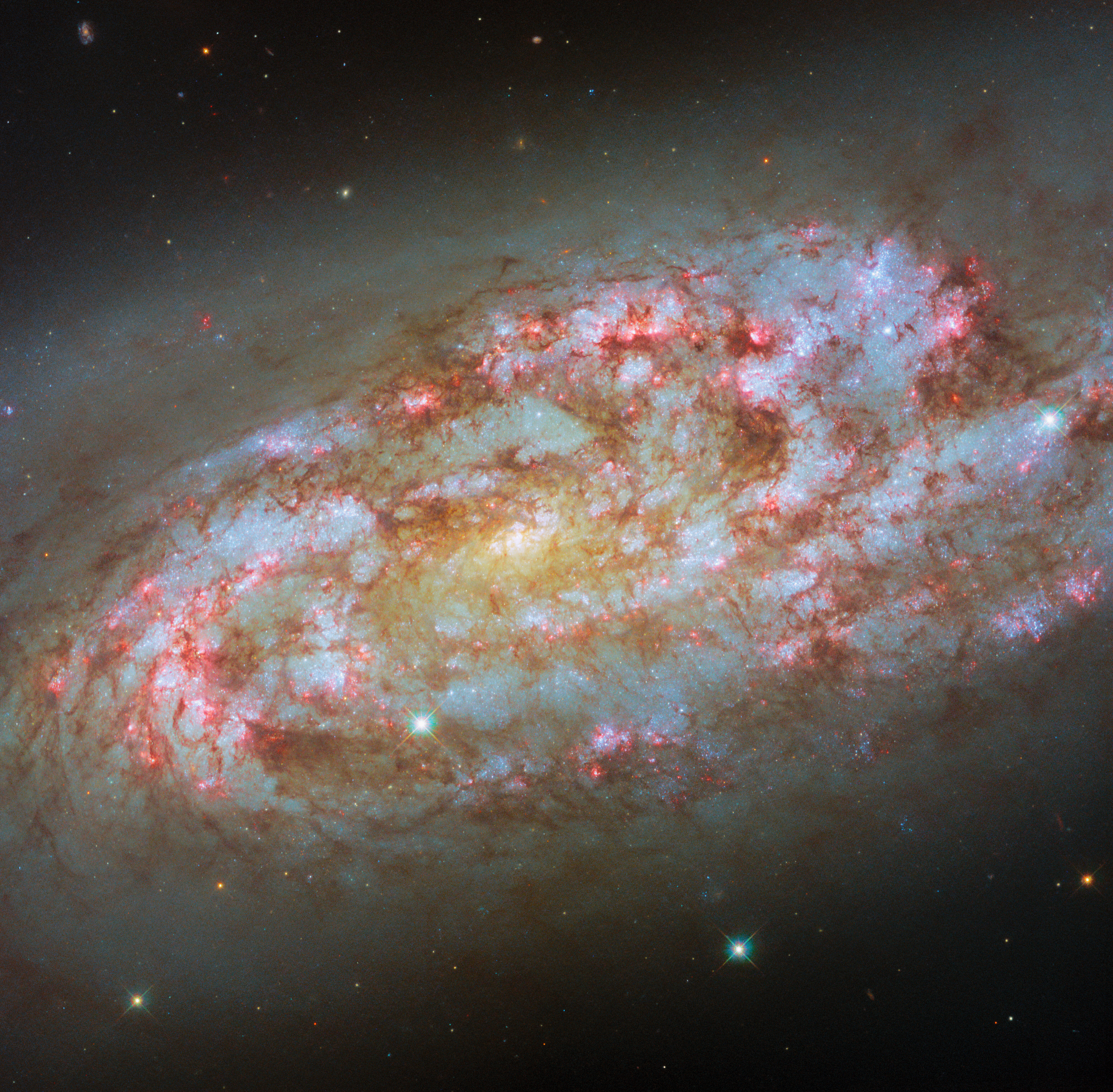
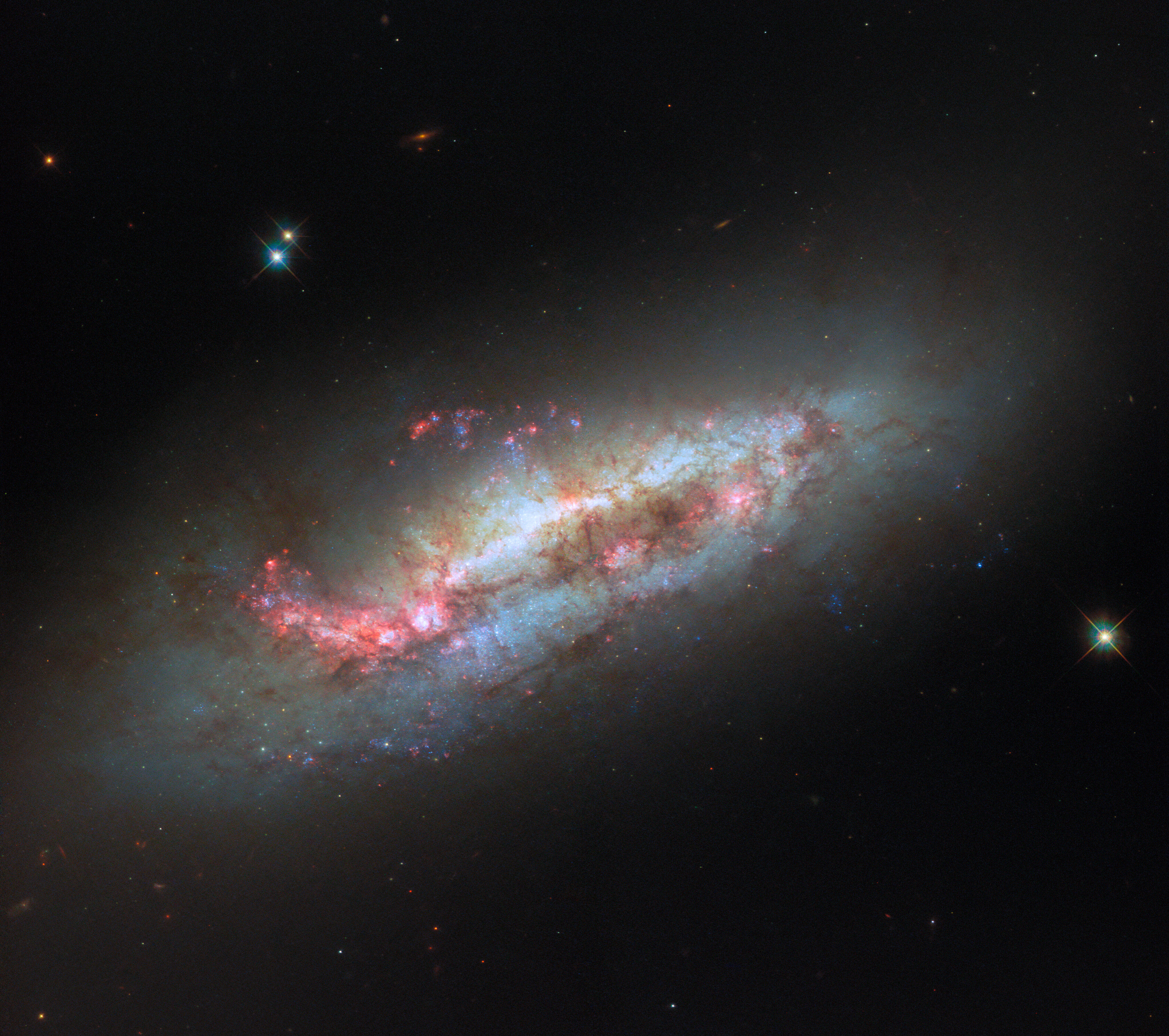
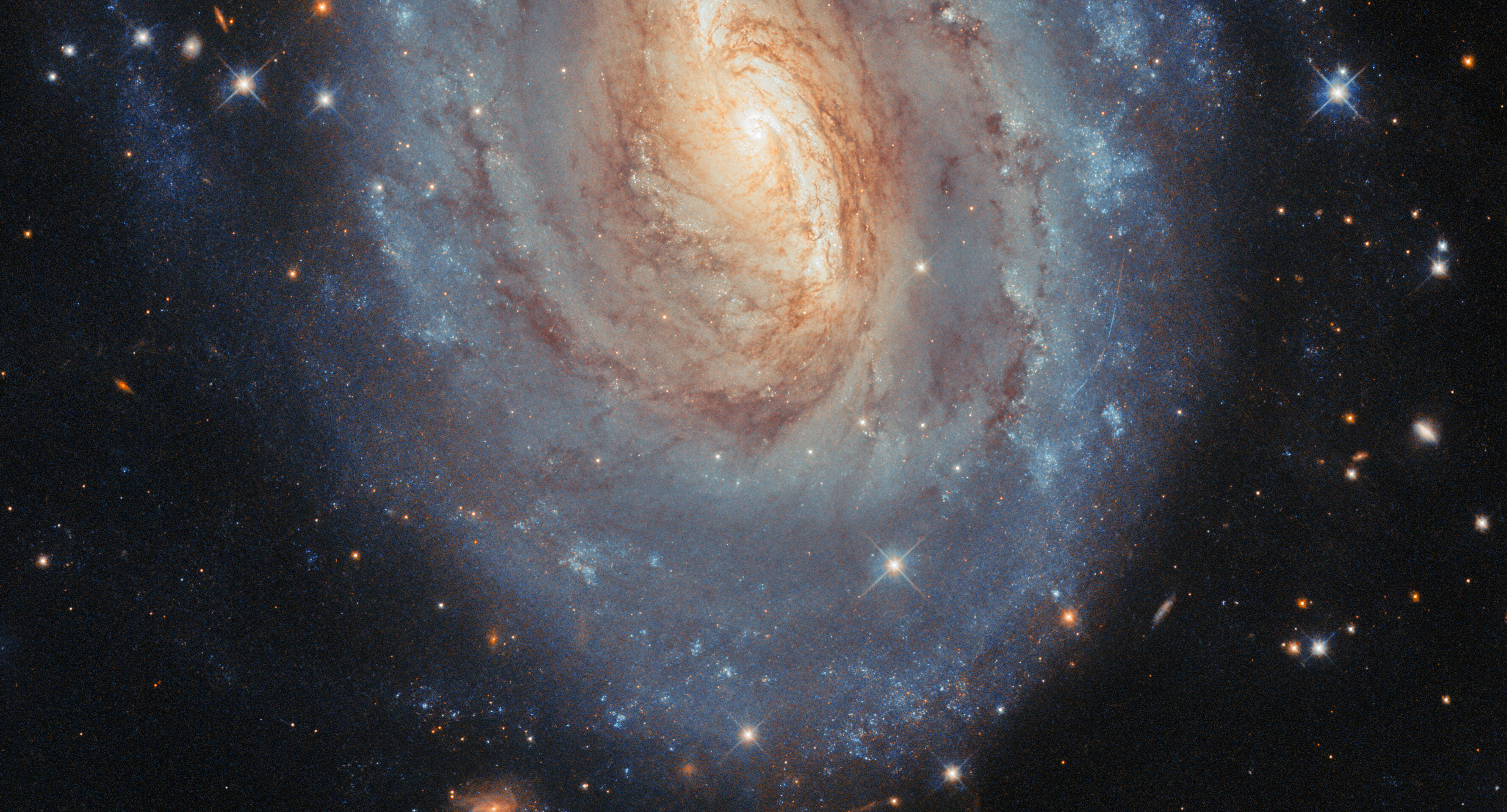
A spiral galaxy. It has a prominent spiral arm on one side (lower left) and a wide, glowing core. Dark brown filaments of dust swirl through its disc, while blue clusters of stars are found mostly going out to its arm. On the opposite side to the arm (upper right), gas trails off from the disc, out of the view in this image. A matching spiral arm is not visible on this side. The galaxy lies on a dark background. Credit: ESA/Hubble & NASA, D. Thilker, J. Lee and the PHANGS-HST Team


The subject of this ESA/Hubble Picture of the Month is a spiral galaxy struggling against some of the titanic forces that appear on galactic scales in space. This is NGC 4654, an intermediate spiral galaxy in the constellation Virgo (the Maiden). “Intermediate” means that it lies between the spiral galaxies that have a bar across the centre and those that don’t, with a weak bar structure in its centre. It is situated 72 million light-years from Earth in the Virgo Cluster, a particularly massive and populous galaxy cluster.

NGC 4654 is particularly asymmetric, with a rounded and clearly-defined edge on one side and a long tail of gas stretching out from the opposite side — beyond Hubble’s view in this image. The cause of this gaseous tail is the same as for many of the other galaxies jostling in the crowded Virgo Cluster: namely, ram pressure stripping. NGC 4654 moves with such high velocity through space that it sweeps up and rams through the intracluster medium, the hot, rarefied gas filling the space between the Virgo Cluster’s galaxies. The intracluster medium in turn exerts a “ram pressure” on the galaxy, compressing the galaxy’s leading edge and tugging at its gas, creating the elongated tail.

It’s not just the galaxy’s gas that is unevenly distributed: its stars are too, and this is more unusual for a spiral galaxy. While the spiral arm on its leading edge is rich with stars and gas, the opposite arm noticeably lacks stars, influencing the galaxy’s lopsided spiral shape. It’s thought that ram pressure alone is unlikely to have had this effect. Rather, NGC 4654 has also been subjected to the gravitational force of the fellow Virgo Cluster galaxy NGC 4639. While the two galaxies are far apart now, it’s thought that a fly-by interaction between them around 500 million years ago ripped away NGC 4654’s gas along one side, limiting star formation there and creating the asymmetry in its shape.

Many galaxies that undergo ram pressure stripping suffer reduced star formation rates as the cold gas that collapses to form their stars is pulled away and lost. NGC 4654, however, is still forming nearly two Suns’ worth of stars every year, a rate comparable to other galaxies of similar size. The active star formation can be seen in the latest Hubble data used in this image, which picks up on a wavelength of red light that’s emitted by the clouds of energised gas where newborn stars lurk. The bright pink bubbles appear all across NGC 4654, from its forward spiral arm, to around its weak bar, and out to the edge of its disc.

The data used for this image come from two observing programmes (#15654, #17502) that have the aim of linking gas in galaxies with star formation. By observing many prominent galaxies in the vicinity of our own, researchers hope to better understand how gas moves around in galaxies, where and when it collapses to form stars and star clusters, and what effect those new stars have on the gas around them.


Links


Tuesday, June 09, 2026

Journey to the centre of a galaxy cluster

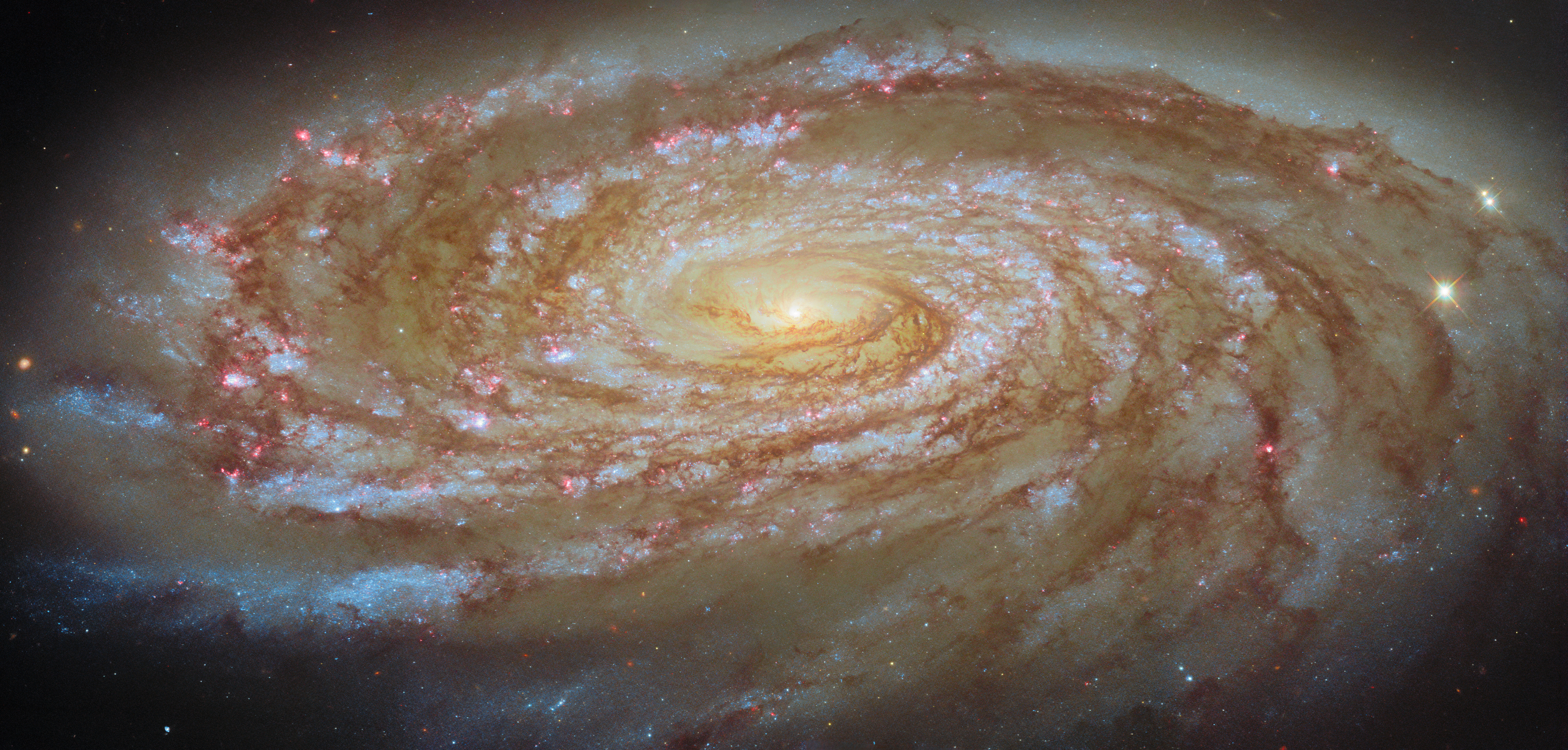
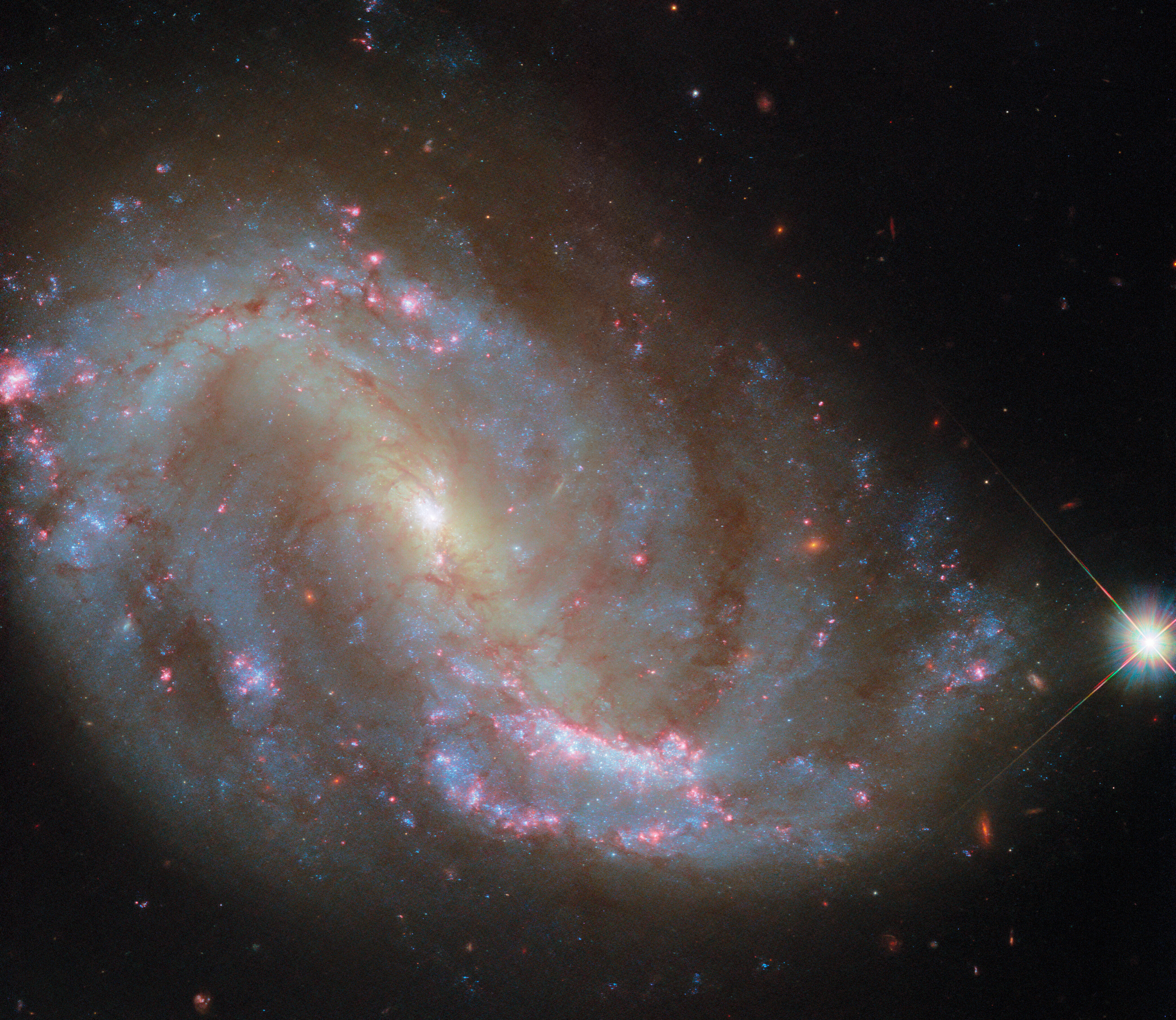
A large spiral galaxy. It is seen tilted at an angle, so that it is foreshortened and appears very wide. Its tightly-wound, blue spiral arms swirl out from its glowing centre, spreading apart at the tips. They are followed by strands and clumps of dark red dust, and spotted with pink dots where stars are forming in clouds of gas. The galaxy is surrounded by a slight glow and lies on a dark background. Credit: ESA/Hubble & NASA, D. Thilker and the MAUVE-HST Team


The focus of today’s ESA/Hubble Picture of the Month is an active spiral galaxy on a journey lasting hundreds of millions of years. The galaxy Messier 88 (M88), which is also known as NGC 4501, is located about 63 million light-years away in the constellation Coma Berenices (Berenice’s Hair).

M88 is an active galaxy, which means that its centre harbours a supermassive black hole that is snacking on gas and dust. This black hole is estimated to be around 100 million times as massive as the Sun, and it appears to be powering outflows of gas from the galaxy’s centre.

Around this black hole is a population of old, reddish stars that give M88 its warmly glowing heart. Spreading out from the centre are several tightly wound, symmetrical spiral arms, each outlined by sparkling pink and blue star clusters and knotted clouds of dust. We see M88 from an angle so that it appears elongated, and its spiral arms delicately fan out before it.

M88 is a member of the Virgo Cluster, a collection of more than a thousand galaxies held together by gravity — and therefore linked by fate. As this massive group of galaxies moves through space, the galaxies themselves are in constant motion as they orbit the cluster’s centre of gravity. M88 itself is on a long and somewhat perilous cosmic journey that will bring it to the innermost reaches of the cluster.

As is the case with any epic journey, M88 will be fundamentally changed by its trek to the centre of the Virgo Cluster, about 2 million light-years from where it is today. In 200–300 million years, M88 will make its closest approach to Messier 87, the massive elliptical galaxy that anchors the entire cluster. As it draws close to this gravitational behemoth, M88 will experience intense ram pressure stripping. Ram pressure stripping is a process through which a galaxy’s gas is swept away as it pushes through the ever-present gas between the galaxies in a cluster.

Researchers have already seen this process at work in M88. The galaxy’s swirling disc of gas is truncated, and it appears to have been compressed on the leading edge of the galaxy, piling up like snow before a plough. In fact, M88 appears to have considerably less cold gas — the raw fuel for star formation — than expected for a galaxy of its size, especially in its outer regions. This is a clear sign that M88 will be altered by its journey, which will affect its ability to form stars and alter the course of its evolution.

Astronomers observed M88 with Hubble as part of an observing programme (#18103; PI: D. Thilker) dedicated to understanding the lives of spiral galaxies in crowded environments. This programme uses Hubble’s highly capable Wide Field Camera 3, which can finely resolve individual star clusters and nebulae in galaxies tens of millions of light-years away. By studying galaxies on these scales, astronomers can understand how a journey through a cluster impacts galaxies’ evolution and ability to form new stars.


Links


Saturday, April 04, 2026

Where spiral arms and star formation meet

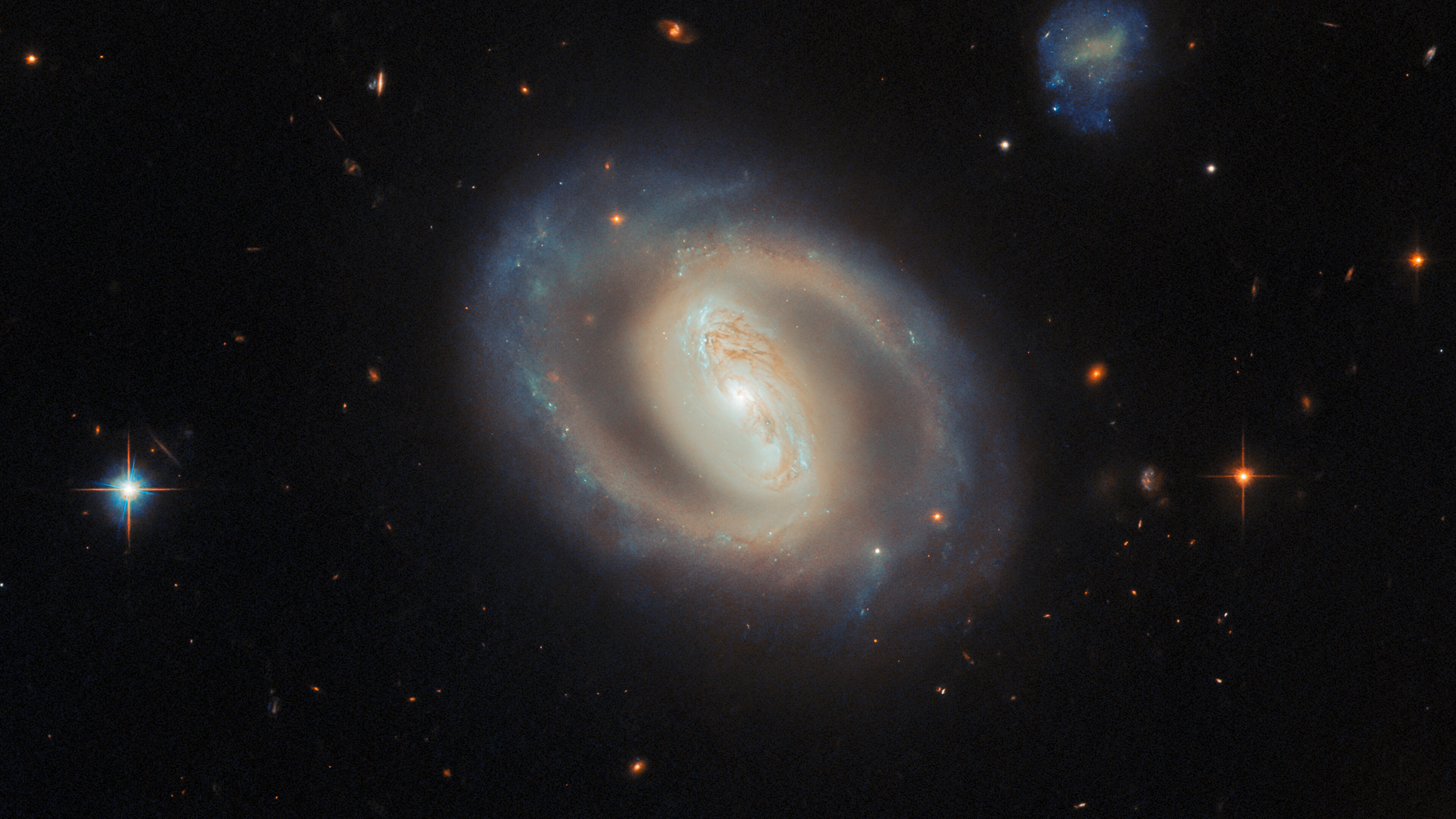
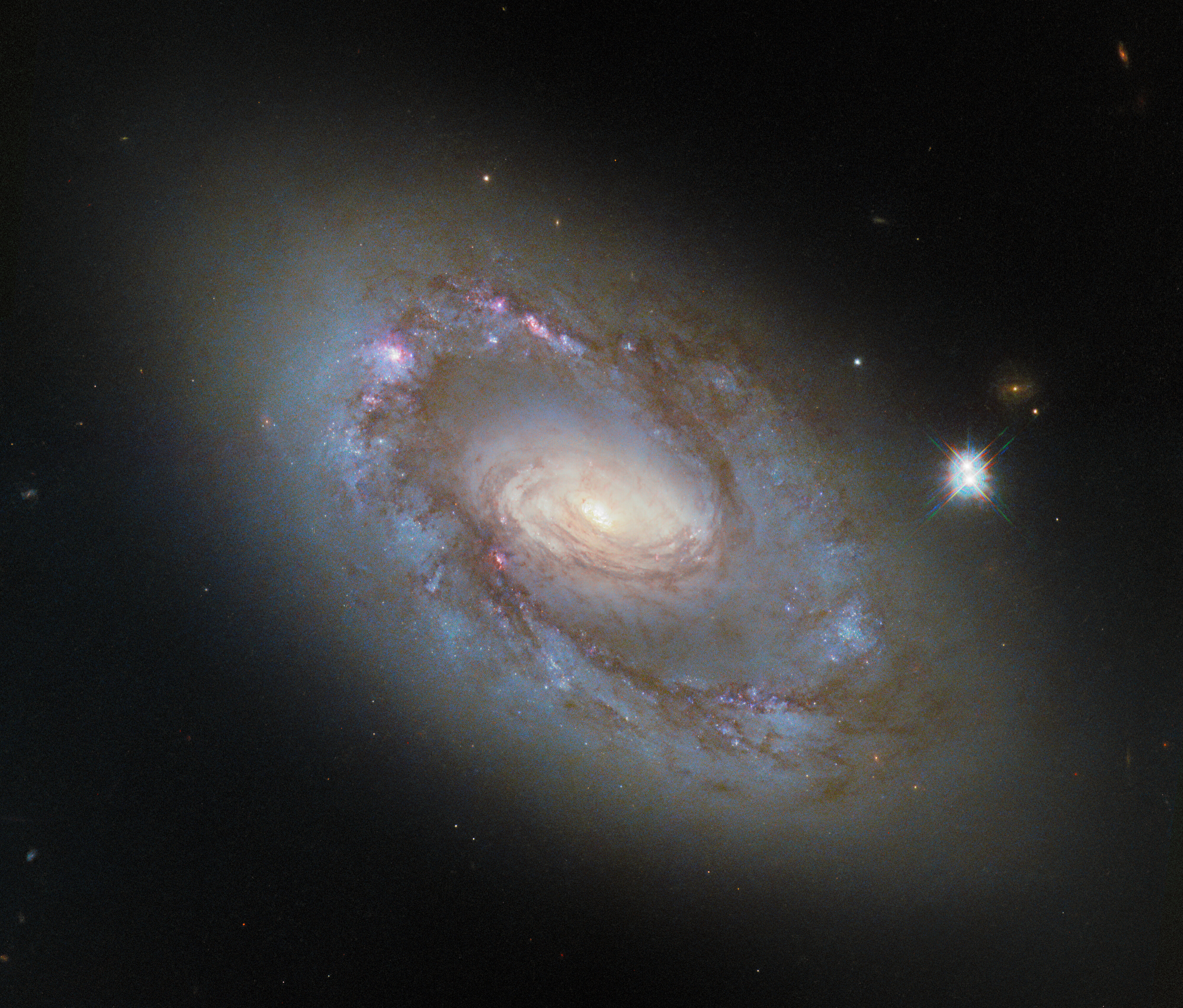
A face-on view of the barred spiral galaxy IC 486, showing a bright, elongated central bar and softly curving, ring-like spiral arms with subtle blue star-forming regions and dark dust lanes, set against a black background dotted with distant galaxies and a few foreground stars.


A luminous swirl set against the deep black of space, the barred spiral galaxy IC 486 glows with a soft, ethereal light in this new ESA/Hubble Picture of the Month image.

IC 486 lies right on the edge of the constellation Gemini (the Twins), around 380 million light-years from Earth. Classified as a barred spiral galaxy, it features a bright central bar-shaped structure from which its spiral arms unfurl, wrapping around the core in a smooth, almost ring-like pattern.

Hubble’s keen eye reveals subtle variations in colour across the galaxy. The pale, luminous centre is dominated by older stars, while faint bluish regions in the surrounding disc trace pockets of more recent star formation. Wisps of dust thread through the galaxy’s structure, gently obscuring light and tracing regions of increased molecular gas where new stars are likely to form.

At the galaxy’s centre a noticeable white glow outshines the starlight around it. This is light given off by IC 486’s active galactic nucleus (AGN), powered by a supermassive black hole more than 100 million times the mass of the Sun. Every sufficiently large galaxy hosts a supermassive black hole at its centre, but some of these black holes are particularly ravenous, marshalling vast amounts of gas and dust into swirling accretion discs from which they feed. The intense heat generated by the orbiting disc of material generates intense radiation up to and including X-rays, which can outshine the entire rest of the galaxy. In these cases, the galaxy is known as an active galaxy, with an AGN at its centre.

The data used to make this image comes from two separate observing programmes — #17310 (PI: M. J. Koss) and #15444 (PI: A. J. Barth) — with similar aims: to survey nearby active galaxies like IC 486 and record detailed, high-quality images of their central black holes and the stars near the core of the galaxy. By combining Hubble’s sharp imaging with large comprehensive samples, these programmes are enabling detailed comparisons of how stars, gas, dust, and black holes interact in galaxy centres.

A key goal of this work is to understand how galaxies grow by linking their large-scale structures, such as bars and spiral arms, to activity in their nuclei. To achieve this, the research teams are leveraging both expert classifications and citizen science through Galaxy Zoo, with datasets that will ultimately be released to the public. In parallel, the same images are being used to test how well large language models and other machine learning techniques can reproduce or extend human classifications, offering a new way to scale galaxy morphology studies to the largest surveys that are currently being performed with the Euclid telescope.

Beyond IC 486 itself, the image is peppered with distant background galaxies and foreground stars. Some stars appear with characteristic diffraction spikes, while the more diffuse, reddish smudges are far more distant galaxies scattered across the cosmos.

Though it may appear calm and orderly, IC 486 is a dynamic system shaped by gravity and stellar evolution. Over millions of years, its structure will continue to evolve as stars are born, age, and fade, contributing to the ongoing story of galactic life in the Universe.


Links


Sunday, March 29, 2026

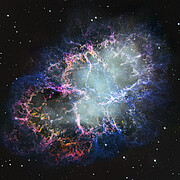
NASA’s Hubble Revisits Crab Nebula to Track 25 Years of Expansion

PR Image heic2607a
Crab Nebula (2024 Hubble image)

PR Image heic2607b
Crab Nebula (new image from 1999/2000 data)

PR Image heic2607c
Crab Nebula (2024 Hubble image, annotated)

PR Image heic2607d
Crab Nebula (new image from 1999/2000 data, annotated)


Videos

The Crab Nebula
PR Video heic2607a
The Crab Nebula

Pan Video: The Crab Nebula (2024 Hubble image)
PR Video heic2607b
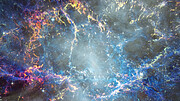
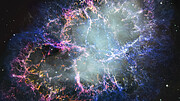
Pan Video: The Crab Nebula (2024 Hubble image)

Pan Video: The Crab Nebula (new Hubble image from 1999/2000 data)
PR Video heic2607c
Pan Video: The Crab Nebula (new Hubble image from 1999/2000 data)


Nearly a millennium ago, astronomers witnessed a brilliant new star blazing in the sky — a supernova so bright it was visible in daylight for weeks. Today, its expanding remnant, the Crab Nebula, continues to evolve 6,500 light-years away. First linked to historical records by Edwin Hubble, the nebula has since been studied in exquisite detail by the NASA/ESA Hubble Space Telescope, which has now revisited this ancient explosion to trace its ongoing expansion and transformation.

A quarter-century after its first observations of the full Crab Nebula, the Hubble Space Telescope has taken a fresh look at the supernova remnant. The Crab Nebula is the aftermath of SN 1054, located 6,500 light-years from Earth in the constellation Taurus.

The result is an unparalleled, detailed look at the aftermath of a supernova and how it has evolved over Hubble’s long lifetime. A paper detailing the new Hubble observation is published in The Astrophysical Journal.

The supernova remnant was discovered in the mid-18th century, and in the 1950s Edwin Hubble was among several astronomers who noted the close correlation between Chinese astronomical records of a supernova and the position of the Crab Nebula. The discovery that the heart of the Crab contained a pulsar — a rapidly rotating neutron star — that was powering the nebula’s expansion finally aligned modern observations and ancient records.

In its new image of the nebula, Hubble has captured extraordinary details of its filamentary structure, as well as the considerable outward movement of those filaments over 25 years, at a pace of 5.5 million kilometres per hour. Hubble is the only telescope with the combination of longevity and resolution capable of capturing these detailed changes.

For better comparison with the new image, Hubble’s 1999 image of the Crab was re-processed. The variation of colors in both of the Hubble images shows a combination of changes in local temperature and density of the gas as well as its chemical omposition.

The science team has noted that the filaments around the periphery of the nebula appear to have moved more compared to those in the centre and that rather than stretching out over time, they appear to have simply moved outward. This is due to the nature of the Crab as a pulsar wind nebula powered by synchrotron radiation, which is created by the interaction between the pulsar’s magnetic field and the nebula’s material. In other well-known supernova remnants, the expansion is instead driven by shockwaves from the initial explosion, eroding surrounding shells of gas that the dying star previously cast off.

The new, higher-resolution Hubble observations are also providing additional insights into the 3D structure of the Crab Nebula, which can be difficult to determine from a 2D image. Shadows of some of the filaments can be seen cast onto the haze of synchrotron radiation in the nebula’s interior. Counterintuitively, some of the brighter filaments in the latest Hubble images show no shadows, indicating they must be located on the far side of the nebula.

According to the science team, the real value of Hubble’s Crab Nebula observations is still to come. The Hubble data can be paired with recent data from other telescopes that are observing the Crab in different wavelengths of light. The NASA/ESA/CSA James Webb Space Telescope released its infrared-light observations of the Crab Nebula in 2024. Comparison of the Hubble image with other contemporary multiwavelength observations will help scientists put together a more complete picture of the supernova’s continuing aftermath, centuries after astronomers first wondered at a new little star twinkling in the sky.


More information

The Hubble Space Telescope is a project of international cooperation between ESA and NASA.

Image Credit: NASA, ESA, STScI, W. Blair (JHU). Image Processing: J. DePasquale (STScI)


Links


Contacts

Bethany Downer
ESA/Hubble Chief Science Communications Officer
Email:
Bethany.Downer@esahubble.org


Tuesday, March 10, 2026

Two observatories, one cosmic eye

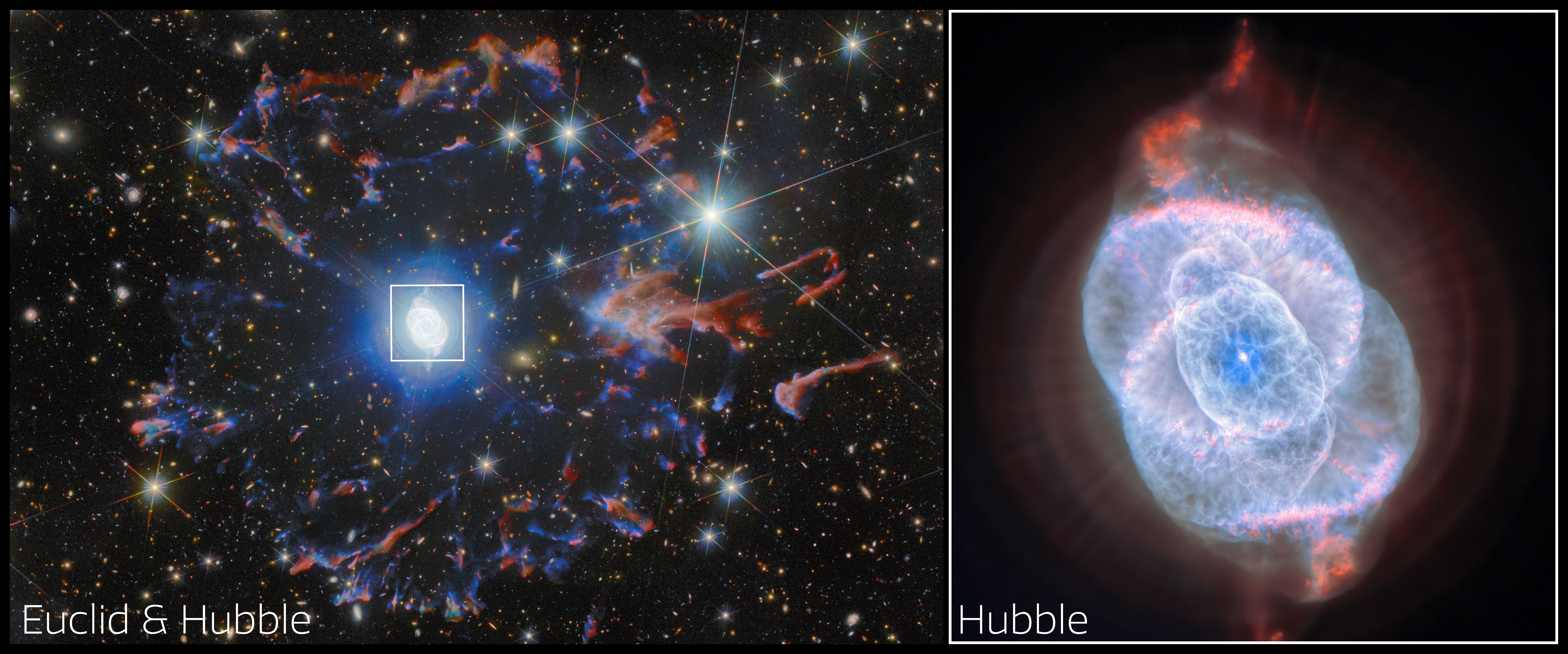
Image Description: Two images of a planetary nebula in space. The image to the left, labelled “Euclid & Hubble”, shows the whole nebula and its surroundings. A star in the very centre is surrounded by white bubbles and loops of gas, all shining with a powerful blue light. Farther away a broke.n ring of red and blue gas clouds surrounds the nebula. The background shows many stars and distant galaxies. A white box indic,brates the centre of the nebula and this region is the image to the right, labelled “Hubble”. It shows the multi-layered bubbles, poin.ted jets and circular shells of gas that make up the nebula, as well as the central star, in greater detail. Credit: ESA/Hubble ,hr& NASA, ESA Euclid/Euclid Consortium/NASA/Q1-2025, J.-C. Cuillandre & E. Bertin (CEA Paris-Saclay), Z. Tsvetanov


For this month’s ESA/Hubble Picture of the Month, we turn our gaze to one of the most visually intricate remnants of a dying star: the Cat’s Eye Nebula, also known as NGC 6543. This extraordinary planetary nebula lies in the constellation Draco and has captivated astronomers for decades with its elaborate and multilayered structure. Observations with ESA’s Gaia mission place the nebula at a distance of 4 400 light years away.

Planetary nebulae, so-called because of their round shape when viewed through early telescopes, are in fact expanding gas thrown off by stars in their final stages of evolution. It was the Cat’s Eye Nebula itself where this fact was first discovered in 1864 —examining the spectrum of its light reveals the emission from individual molecules that’s characteristic of a gas, distinguishing planetary nebulae from stars and galaxies.

The NASA/ESA Hubble Space Telescope also revolutionised our understanding of planetary nebulae; its detailed images showed that the simple, circular appearance of a planetary nebula seen from the ground belies a very complex morphology. This was particularly true of the Cat’s Eye Nebula, where Hubble’s images in 1995 revealed never-before-seen structures that broadened our understanding of how planetary nebulae come to be.

This time, Hubble is joined by ESA’s Euclid space telescope to create a new image of NGC 6543. The nebula is showcased through the combined eyes of Hubble and Euclid, revealing the remarkable complexity of stellar death in this object. Though primarily designed to map the distant Universe, Euclid captures the Cat’s Eye Nebula as part of its deep imaging surveys. In Euclid’s wide, near-infrared and visible light view, the arcs and filaments of the nebula’s bright central region are situated within a halo of colourful fragments of gas zooming away from the star. This ring was ejected from the star at an earlier stage, before the main nebula at the centre formed. The whole nebula stands out against a backdrop teeming with distant galaxies, demonstrating how local astrophysical beauty and the farthest reaches of the cosmos can be seen together with Euclid.

Within this broad view of the nebula and its surroundings, Hubble captures the very core of the billowing gas with high-resolution visible-light images, adding extra detail in the centre of this image. The data reveal a tapestry of concentric shells, jets of high-speed gas and dense knots sculpted by shock interactions, features that appear almost surreal in their intricacy. These structures are believed to record episodic mass loss from the dying star at the nbula’s centre, creating a kind of cosmic “fossil record” of its final evolutionary stages.

Combining the focused view of Hubble with Euclid’s deep field observations not only highlights the nebula’s exquisite structure, but also places it within the broader context of the Universe that both space telescopes explore. Together, these missions provide a rich and complementary view of NGC 6543 — revealing the delicate interplay between stellar end-of-life processes and the vast cosmic tapestry beyond.


Links


Monday, January 05, 2026

A neighbouring vista of stellar birth

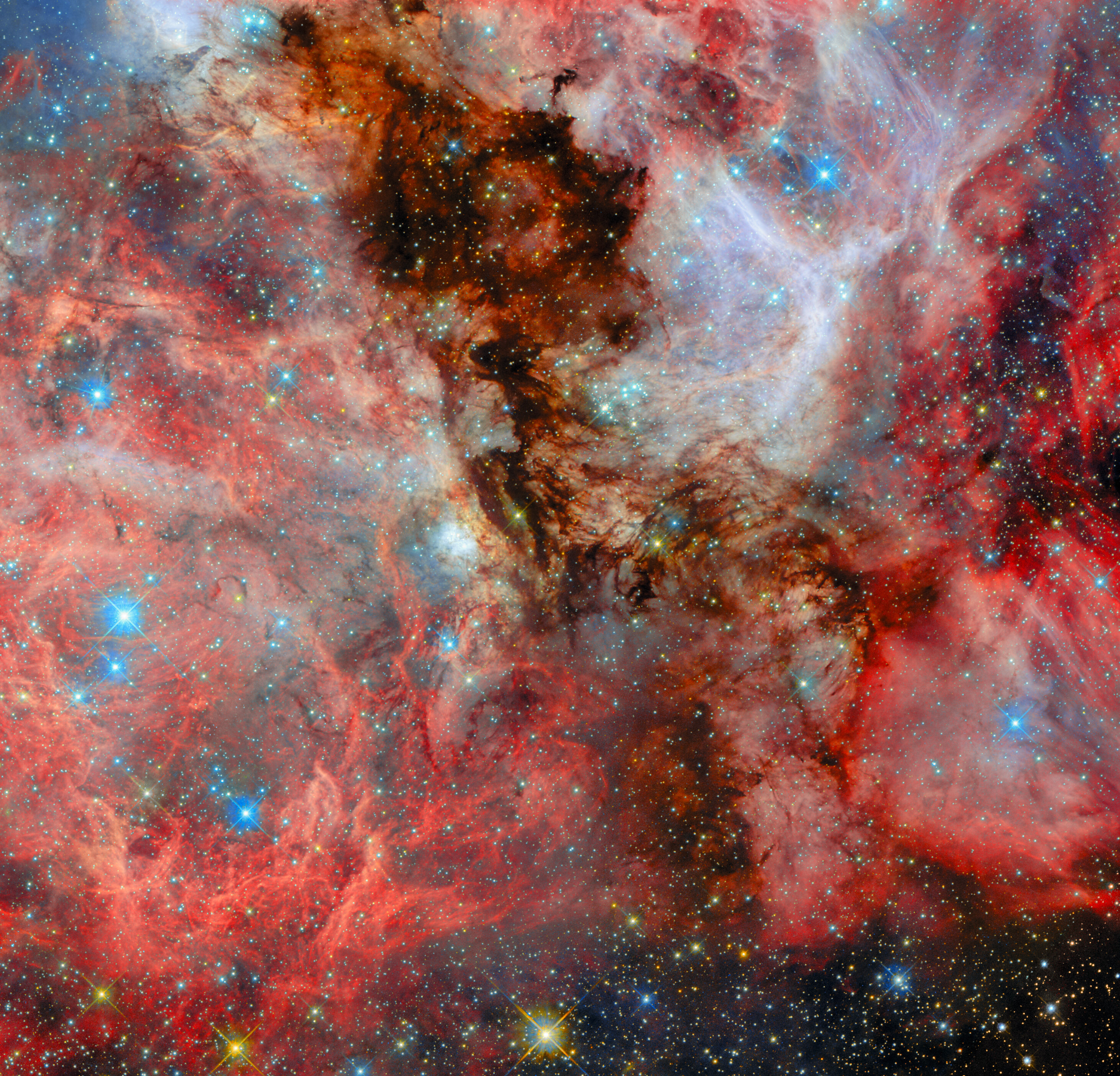
A field filled with stars and covered by clouds of gas and dust. In the centre, a thick column of dark black dust blocks light from stars that light it up from behind. More clouds behind those stars are illuminated in pale colours. Complex, layered filaments of red dust lie to the left and right. Blue, white and gold stars in various sizes can be seen around, within and through the colourful layers of dust. Credit: ESA/Hubble & NASA, R. Indebetouw

Today’s ESA/Hubble Picture of the Week highlights another view of a distant stellar birthplace. Captured in a parallel field to a recently released image, this scene reveals a neighbouring region of the N159 star-forming complex in the Large Magellanic Cloud, approximately 160 000 light-years away.

Thick clouds of cold hydrogen gas dominate the scene, forming a complex network of ridges, cavities, and glowing filaments. Embedded within these dense clouds, newly formed stars begin to shine, their intense radiation causing the surrounding hydrogen to glow in deep red tones.

The brightest regions mark the presence of hot, massive young stars whose powerful stellar winds and energetic light reshape their environment. These forces carve out bubble-like structures and hollowed cavities in the gas, clear signatures of stellar feedback in action. Dark clouds in the foreground are lit from behind by new stars. Together, the glowing clouds and sculpted bubbles reveal a dynamic interplay between star formation and the material from which stars are born, capturing the ongoing cycle of creation and transformation within this neighbouring galactic system.

N159 is one of the most massive star-forming clouds in the Large Magellanic Cloud, a dwarf galaxy that is the largest of the small galaxies that orbit the Milky Way. This image shows just a portion of this expansive star-forming complex, as the entire complex stretches over 150 light-years across.

Links


Tuesday, December 30, 2025

Hubble sees asteroids colliding at nearby star for first time

PR Image heic2512a
Fomalhaut cs1 and cs2 (annotated)

PR Image heic2512b
Fomalhaut cs1 and cs2 (clean image)

PR Image heic2512c
Fomalhaut cs2 (artist’s concept)


Videos

Fomalhaut cs2 (artist’s concept animation)
PR Video heic2512a
Fomalhaut cs2 (artist’s concept animation)

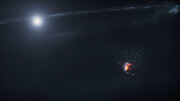
Space Sparks episode 21: Hubble sees asteroids colliding at nearby star for first time
PR Video heic2512b
Space Sparks episode 21: Hubble sees asteroids colliding at nearby star for first time


In a historical milestone, catastrophic collisions in a nearby planetary system were witnessed for the first time by astronomers using the NASA/ESA Hubble Space Telescope. As they observed the bright star Fomalhaut, the scientists saw the impact of massive objects around the star. The Fomalhaut system appears to be in a dynamical upheaval, similar to what our solar system experienced in its first few hundred million years after formation.

“This is certainly the first time I’ve ever seen a point of light appear out of nowhere in an exoplanetary system,” said principal investigator Paul Kalas of the University of California, Berkeley. “It’s absent in all of our previous Hubble images, which means that we just witnessed a violent collision between two massive objects and a huge debris cloud unlike anything in our own solar system today. Amazing!"

Just 25 light-years from Earth, Fomalhaut is one of the brightest stars in the night sky. Located in the constellation Piscis Austrinus, also known as the Southern Fish, it is more massive and brighter than the Sun and is encircled by several belts of dusty debris.

In 2008, scientists used Hubble to discover a candidate planet around Fomalhaut, making it the first stellar system with a possible planet found using visible light. That object, called Fomalhaut b, now appears to be a dust cloud masquerading as a planet – the result of colliding planetesimals. While searching for Fomalhaut b in recent Hubble observations, scientists were surprised to find a second point of light at a similar location around the star. They call this object “circumstellar source 2” or “cs2” while the first object is now known as “cs1.”

Tackling mysteries of colliding planetesimals

Why astronomers are seeing both of these debris clouds so physically close to each other is a mystery. If the collisions between asteroids and planetesimals were random, cs1 and cs2 should appear by chance at unrelated locations. Yet, they are positioned intriguingly near each other along the inner portion of Fomalhaut’s outer debris disk.

Another mystery is why scientists have witnessed these two events within such a short timeframe. “Previous theory suggested that there should be one collision every 100,000 years, or longer. Here, in 20 years, we've seen two,” explained Kalas. “If you had a movie of the last 3,000 years, and it was sped up so that every year was a fraction of a second, imagine how many flashes you'd see over that time. Fomalhaut’s planetary system would be sparkling with these collisions.”

Collisions are fundamental to the evolution of planetary systems, but they are rare and difficult to study.

“The exciting aspect of this observation is that it allows researchers to estimate both the size of the colliding bodies and how many of them there are in the disk, information which is almost impossible to get by any other means,” said co-author Mark Wyatt at the University of Cambridge in England. “Our estimates put the planetesimals that were destroyed to create cs1 and cs2 at just 30 kilometres in size, and we infer that there are 300 million such objects orbiting in the Fomalhaut system.”

“The system is a natural laboratory to probe how planetesimals behave when undergoing collisions, which in turn tells us about what they are made of and how they formed,” explained Wyatt.

Cautionary tale

The transient nature of Fomalhaut cs1 and cs2 poses challenges for future space missions aiming to directly image exoplanets. Such telescopes may mistake dust clouds like cs1 and cs2 for actual planets.

“Fomalhaut cs2 looks exactly like an extrasolar planet reflecting starlight,” said Kalas. “What we learned from studying cs1 is that a large dust cloud can masquerade as a planet for many years. This is a cautionary note for future missions that aim to detect extrasolar planets in reflected light."

Looking to the future

Kalas and his team have been granted Hubble time to monitor cs2 over the next three years. They want to see how it evolves -- does it fade, or does it get brighter? Being closer to the dust belt than cs1, the expanding cs2 cloud is more likely to start encountering other material in the belt. This could lead to a sudden avalanche of more dust in the system, which could cause the whole surrounding area to get brighter.

“We will be tracing cs2 for any changes in its shape, brightness, and orbit over time,” said Kalas, “It’s possible that cs2 will start becoming more oval or cometary in shape as the dust grains are pushed outward by the pressure of starlight.” The team also will use the NIRCam (Near-Infrared Camera) instrument on the NASA/ESA/CSA James Webb Space Telescope to observe cs2. Webb’s NIRCam has the ability to provide color information that can reveal the size of the cloud’s dust grains and their composition. It can even determine if the cloud contains water ice.

Hubble and Webb are the only observatories capable of this kind of imaging. While Hubble primarily sees in visible wavelengths, Webb could view cs2 in the infrared. These different, complementary wavelengths are needed to provide a broad multi-spectral investigation and a more complete picture of the mysterious Fomalhaut system and its rapid evolution.

This research appears today in the December 18 issue of Science.


More information

The Hubble Space Telescope is a project of international cooperation between ESA and NASA.

Image Credit: NASA, ESA, P. Kalas (UC Berkeley), J. DePasquale (STScI)


Links


Contacts:

Bethany Downer
ESA/Hubble Chief Science Communications Officer
Email:
Bethany.Downer@esahubble.org


Monday, December 29, 2025

A neighbouring vista of stellar birth

A field filled with stars and covered by clouds of gas and dust. In the centre, a thick column of dark black dust blocks light from stars that light it up from behind. More clouds behind those stars are illuminated in pale colours. Complex, layered filaments of red dust lie to the left and right. Blue, white and gold stars in various sizes can be seen around, within and through the colourful layers of dust. Credit: ESA/Hubble & NASA, R. Indebetouw

Today’s ESA/Hubble Picture of the Week highlights another view of a distant stellar birthplace. Captured in a parallel field to a recently released image, this scene reveals a neighbouring region of the N159 star-forming complex in the Large Magellanic Cloud, approximately 160 000 light-years away.

Thick clouds of cold hydrogen gas dominate the scene, forming a complex network of ridges, cavities, and glowing filaments. Embedded within these dense clouds, newly formed stars begin to shine, their intense radiation causing the surrounding hydrogen to glow in deep red tones.

The brightest regions mark the presence of hot, massive young stars whose powerful stellar winds and energetic light reshape their environment. These forces carve out bubble-like structures and hollowed cavities in the gas, clear signatures of stellar feedback in action. Dark clouds in the foreground are lit from behind by new stars. Together, the glowing clouds and sculpted bubbles reveal a dynamic interplay between star formation and the material from which stars are born, capturing the ongoing cycle of creation and transformation within this neighbouring galactic system.

N159 is one of the most massive star-forming clouds in the Large Magellanic Cloud, a dwarf galaxy that is the largest of the small galaxies that orbit the Milky Way. This image shows just a portion of this expansive star-forming complex, as the entire complex stretches over 150 light-years across.

Links


Monday, December 22, 2025

Long-distance relationship

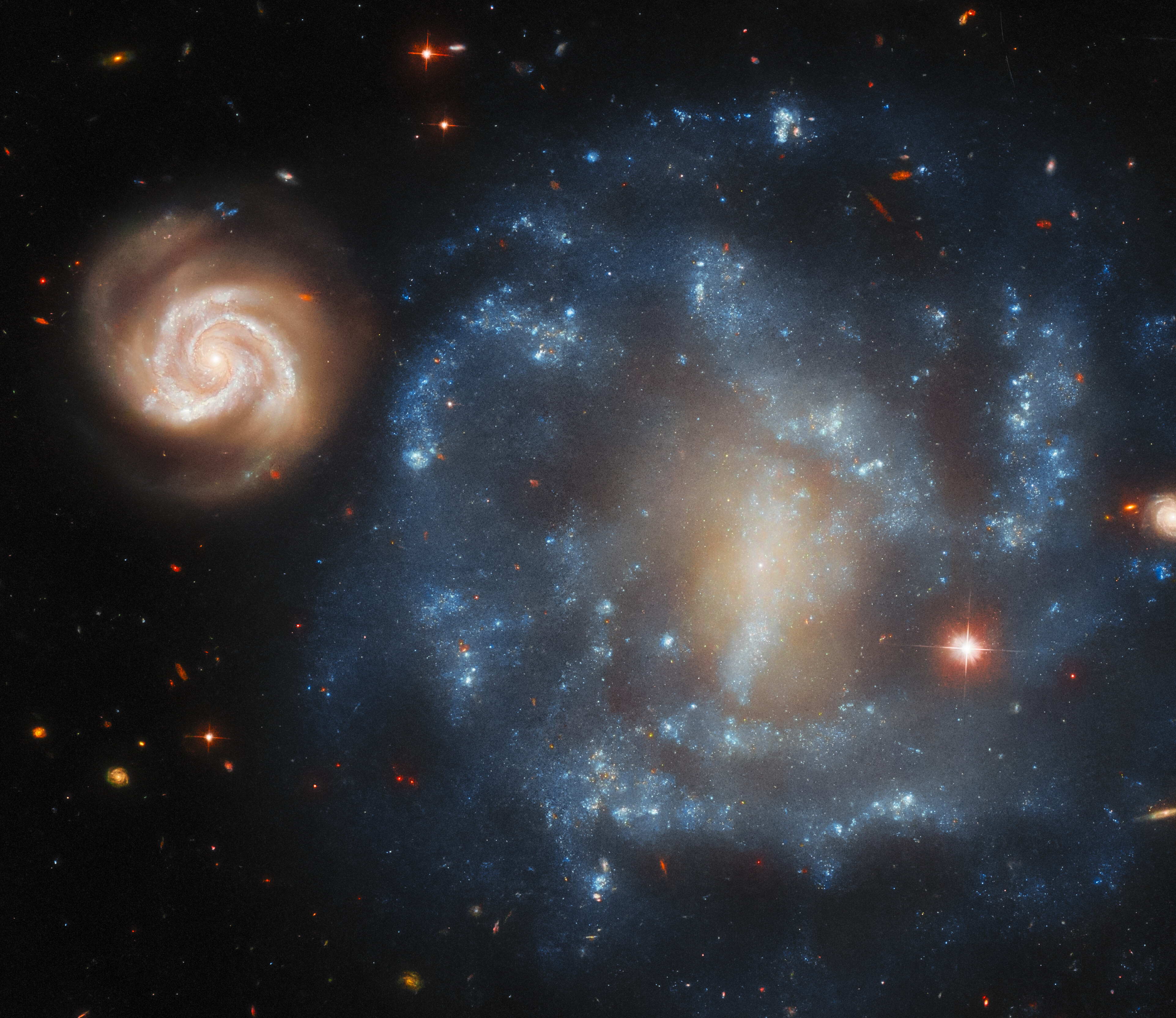
This image shows two galaxies side by side. The galaxy on the top left is smaller in size, and appears as a bright glowing spiral with clearly-defined arms. A larger blue galaxy dominates the full right field of the image. This galaxy is more irregularly shaped, with a glowing central bar, and varying regions of concentrated hues of blue. The background is black with various stars and galaxies in the distance. Credit: ESA/Hubble & NASA, J. Dalcanton, Dark Energy Survey/DOE/FNAL/DECam/CTIO/NOIRLab/NSF/AURA

These galaxies look to be close companions — a small, bright spiral galaxy flitting around the edge of a much larger spiral with a dark and disturbed countenance. But looks can be deceiving — how close are they really? The celestial pair featured in this week’s Hubble Picture of the Week is known by the name Arp 4, and lies in the constellation Cetus (the Whale).

The designation Arp 4 comes from the Atlas of Peculiar Galaxies, compiled in the 1960s by astronomer Halton Arp. “Unusual galaxies” were selected and photographed to provide examples of weird and non-standard shapes, the better to study how galaxies evolve into these forms. Throughout its mission the Hubble Space Telescope has revolutionised the study of galaxies and shown us some fantastically unusual examples from Arp’s atlas. In that catalogue, the first few galaxies like Arp 4 are “low surface brightness” galaxies, a type of galaxy that is unexpectedly faint and hard to detect. The large galaxy here — also catalogued as MCG-02-05-050 — fits this description well, with its fragmentary arms and dim disc. Its smaller companion, MCG-02-05-050a, is a much more bright and active spiral.

The trick is that these galaxies are not actually very close. The large blue galaxy MCG-02-05-050 is located 65 million light-years from Earth; its brighter smaller companion MCG-02-05-050a, at 675 million light-years away, is over ten times the distance! Owing to this, MCG-02-05-050a is likely the larger galaxy of the two, and MCG-02-05-050 comparatively small. Their pairing in this image is simply an unlikely visual coincidence. Despite this lack of a physical relation between them, our point of view on Earth allows us to enjoy the sight of Arp 4 as an odd couple in the sky.

Links


Tuesday, December 09, 2025

Massive stars make their mark

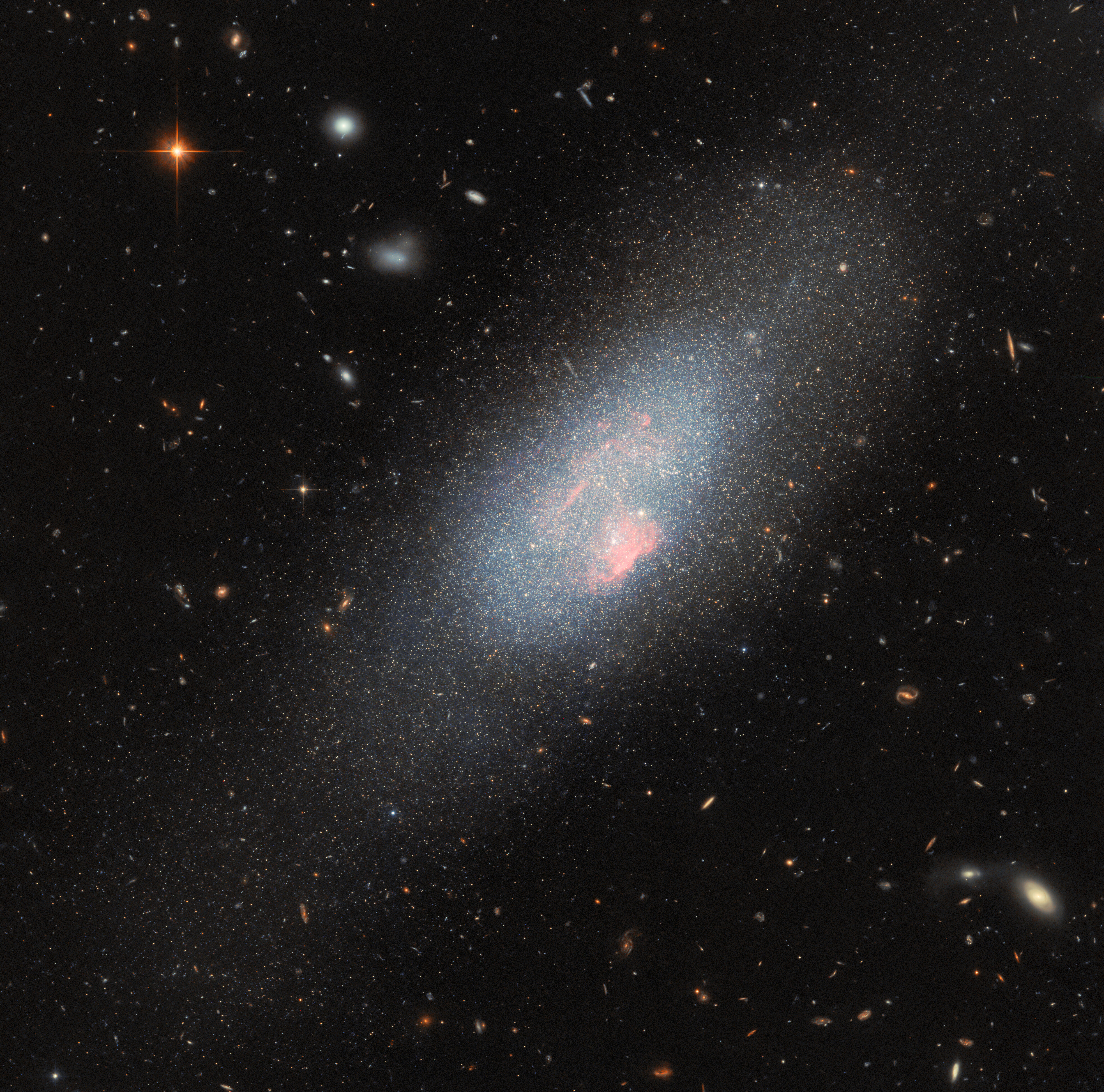
A pale blue dwarf galaxy seen on the black backdrop of space with some faraway galaxies. The galaxy itself resembles a fuzzy cloud of tightly-packed stars, with a broad halo of stars dispersed around it. Several small, glowing patches of gas are spread across the galaxy’s core, where very hot stars are concentrated. Credit: ESA/Hubble & NASA, F. Annibali, S. Hong

This glittering blue galaxy and subject of today’s ESA/Hubble Picture of the Week is a blue compact dwarf galaxy called Markarian 178 (Mrk 178). This galaxy, which is substantially smaller than our own Milky Way, lies 13 million light-years away in the constellation Ursa Major (The Great Bear).

Mrk 178 is one of more than 1500 Markarian galaxies. These galaxies get their name from the Armenian astrophysicist Benjamin Markarian, who compiled a list of galaxies that were surprisingly bright in ultraviolet light.

While the bulk of the galaxy is blue owing to an abundance of young, hot stars with little dust shrouding them, Mrk 178 gets a red hue from a collection of massive stars, which are especially concentrated in the brightest, reddish region near the galaxy’s edge. This azure cloud is home to a large number of rare objects called Wolf–Rayet stars. Wolf–Rayet stars are massive stars that are casting off their atmospheres through powerful winds. Because Mrk 178 contains so many Wolf–Rayet stars, the bright emission lines from these stars’ hot stellar winds are etched upon the galaxy’s spectrum. Particularly ionised hydrogen and oxygen appear as a red colour to Mrk 178 in this photo, observed using some of Hubble’s specialised light filters.

Massive stars enter the Wolf–Rayet phase just before they collapse into black holes or neutron stars. Because Wolf–Rayet stars last for only a few million years, researchers know that something must have triggered a recent burst of star formation in Mrk 178. At first glance, it’s not clear what could be the cause — Mrk 178 doesn’t seem to have any close galactic neighbours that could have stirred up its gas to form new stars. Astronomers believe that it was triggered by the interaction with a smaller satellite, as revealed by the presence of low surface brightness tidal features detected around Mrk178 in deep imaging acquired with the Large Binocular Telescope. Future high resolution Hubble data will be crucial to study the detailed star formation history of Mrk 178.


Wednesday, December 03, 2025

A storm of new stars

A spiral galaxy, seen partly from the side, with a messy, turbulent appearance. Its disc is made of multiple patchy arms that contain numerous sparkling blue and glowing red regions — star clusters and star-forming nebulae. Thick clumps of dark reddish dust swirl through the disc. The glow of the disc extends out into the dark background, where both distant and nearby stars can be seen. Credit: ESA/Hubble & NASA, D. Thilker, F. Belfiore, J. Lee and the PHANGS-HST Team

The subject of the latest Hubble Picture of the Week is a stormy and highly active spiral galaxy named NGC 1792. Located over 50 million light-years from Earth in the constellation Columba (the Dove), the bright glow of the galaxy’s centre is offset by the flocculent and sparkling spiral arms swirling around it.

NGC 1792 is just as fascinating to astronomers as its chaotic look might imply. Classified as a starburst galaxy, it is a powerhouse of star formation, with spiral arms rich in star-forming regions. In fact, it is surprisingly luminous for its mass. The galaxy is close to a larger neighbour, NGC 1808, and the strong gravitational interaction between the two is believed to be what has stirred up the reserves of gas in this galaxy. The result is a torrent of star formation, concentrated on the side where gravity has a stronger effect. It’s a perfect target for astronomers seeking to understand the complex interactions between gas, star clusters and supernovae in galaxies.

Hubble has shown off this galaxy before, in 2020. This week’s new image includes additional data collected throughout 2025, providing a deeper view of the tumultuous astrophysical activity taking place in the galaxy. Blossoming red lights in the arms mark out so-called H-alpha emission from dense clouds of hydrogen molecules. Stars form within these clouds and shine powerfully with ultraviolet radiation. They ionise the gas around them, causing the gas to emit a very particular red wavelength of light — a tell-tale sign of new stars.


Tuesday, November 25, 2025

Baby stars blowing bubbles

A field filled with stars and covered by clouds of gas and dust. The centre and left side are totally blanketed with billowing, bright red clouds. They are opaque some places — showing clusters of stars forming within — and transparent others. Small patches are dark black in colour, while a large cloud below the centre is mostly pale blue. The right side of the view, mostly gas-free, glitters with stars near and far. Credit: ESA/Hubble & NASA, R. Indebetouw

Today’s ESA/Hubble Picture of the Week brings a distant stellar birthplace into focus. This gigantic cloud of cold hydrogen gas is called N159, and it’s located about 160 000 light-years away in the constellation Dorado. N159 is one of the most massive star-forming clouds in the Large Magellanic Cloud, a dwarf galaxy that is the largest of the small galaxies that orbit the Milky Way.

This image shows just a portion of the N159 star-forming complex. The entire complex stretches over 150 light-years across. To put that into perspective, 150 light-years is nearly 10 million times the distance between Earth and the Sun!

In the subzero interior of this gas cloud, subjected to the crushing pressure of gravity, young stars begin to gleam in the darkness. Particularly hot and high-mass stars illuminate their birthplaces with red light. This red glow is characteristic of excited hydrogen atoms, to which Hubble is exquisitely sensitive.

Though some of the bright stars in the cloud appear to be blanketed with reddish gas, others seem to lie at the centre of a reddish bubble, through which the dark backdrop of space is visible. These bubbles are evidence of stellar feedback, in which young stars fry their habitats with high-energy radiation and blow bubbles with their intense stellar winds.

A previous Hubble image of the full N159 star-forming cloud was released in 2016. This version incorporates an additional wavelength of light to highlight the hot gas that surrounds newborn stars.


Tuesday, November 18, 2025

Finding star clusters in the Lost Galaxy

A close-in view of a spiral galaxy that faces the viewer. Brightly lit spiral arms swing outwards through the galaxy’s disc, starting from an elliptical region in the centre. Thick strands of dark reddish dust are spread across the disc, mostly following the spiral arms. The arms also contain many glowing pink-red spots where stars form. The galaxy is a bit fainter beyond the arms, but speckled with blue stars. Credit: ESA/Hubble & NASA, F. Belfiore, J. Lee and the PHANGS-HST Team

Today’s ESA/Hubble Picture of the Week features the spiral galaxy NGC 4535, which is situated about 50 million light-years away in the constellation Virgo (The Maiden). This galaxy has been nicknamed the ‘Lost Galaxy’ because it’s extremely faint when viewed through a small telescope. With a mirror spanning 2.4 metres across, Hubble is well equipped to observe dim galaxies like NGC 4535 and pick out features like its massive spiral arms and central bar of stars.

On full display in this Hubble image are NGC 4535’s young star clusters, which dot the galaxy’s spiral arms. Many of the groupings of bright blue stars are enclosed by glowing pink clouds. These clouds, called H II (‘H-two’) regions, are a sign that the galaxy is home to especially young, hot, and massive stars that are blazing with high-energy radiation. By heating the clouds in which they were born, shooting out powerful stellar winds, and eventually exploding as supernovae, massive stars certainly shake up their surroundings.

This Hubble image incorporates data from an observing programme that will catesa/alogue roughly 50 000 H II regions in nearby star-forming galaxies like NGC 4535. A previous image of NGC 4535 was released in 2021. Both the 2021 image and today’s image incorporate observations from the PHANGS programme, which seeks to understand the connections between young stars and cold gas. Today’s image adds a new dimension to our understanding of NGC 4535 by capturing the brilliant red glow of the nebulae that encircle massive stars in their first few million years of life.


Tuesday, November 11, 2025

A disruptive neighbour

A spiral galaxy, tilted away so that it is seen mostly from the edge. The disc of the galaxy glows blue from its centre, due to younger stars in the spiral arms. There are large and small patches of gas, glowing in red and pink colours, where new stars are forming. Webs of dark dust are spread over the disc. The glow of the disc fades into a dark background, with a couple of stars. Credit: ESA/Hubble & NASA, D. Thilker

Though interesting to look at, NGC 1511 is one galaxy you might not want for a neighbour. Seen in this ESA/Hubble Picture of the Week, NGC 1511 is a peculiar spiral galaxy located roughly 50 million light-years away in the constellation Hydrus.

Like many galaxies, NGC 1511 doesn’t travel through space alone. Instead, it does so with a pair of small galactic companions called NGC 1511A and NGC 1511B, both of which lie outside the frame of this Hubble image. NGC 1511B is situated closest to NGC 1511, and the two galaxies have apparently clashed in the past; a narrow strand of hydrogen gas connects them, and NGC 1511B has been stretched and distorted by the encounter. Researchers have even found evidence that NGC 1511 once had another small companion galaxy that it has disrupted entirely!

These disruptions have an impact on NGC 1511, too. The galaxy is experiencing a burst of star formation, and its disc features strange loops and plumes that could point to past interactions with its neighbouring galaxies. Researchers will use Hubble’s keen observations of NGC 1511 to study star clusters embedded within its dusty gas, seeking to understand how matter is cycled from interstellar clouds to stars and back to clouds once again.


Tuesday, November 04, 2025

Revisiting an unusual spiral

A spiral galaxy. The inner region immediately around the bright centre is golden in colour. A gap separates this region from a bright ring, itself surrounded by a glowing halo. Strands of dark brown dust swirl around the centre and the outer ring, joined in one spot by a curved arm. Bright, blue and pink specks of light dot the ring, showing where stars are concentrated or have recently formed. Credit: ESA/Hubble & NASA, G. Fabbiano

>What lies at the heart of this unusual-looking spiral galaxy? The galaxy NGC 4102, featured in this ESA/Hubble Picture of the Week, is home to what astronomers call an active galactic nucleus. Active galactic nuclei are luminous galactic centres powered by supermassive black holes that contain millions to billion times the mass of our Sun. As these black holes ensnare gas from their surroundings and draw it close with their intense gravitational pull, the gas becomes so hot that it begins to glow and emits light from X-ray to radio wavelengths.

At a distance of just 56 million light-years away in the constellation Ursa Major (The Great Bear), NGC 4102 provides an ideal opportunity to study the ways in which active galactic nuclei interact with their home galaxies. Active galactic nuclei come in many different flavours, from extremely powerful types that consume massive amounts of matter and shoot out jets of charged particles, to calmer types that sip gas from their surroundings and glow more faintly.

NGC 4102 likely falls into the latter category. It’s classified as Compton-thick — a way of saying that its nucleus is obscured by a thick layer of gas — and a LINER, or low-ionisation nuclear emission-line region. LINER galaxies are identified by emission lines from certain weakly ionised elements, and they can be powered by a supermassive black hole that is lazily collecting gas from around it.

A previous image of this galaxy, made from data taken with Hubble’s Wide Field Planetary Camera 2 (WFPC2), was released in 2014. This new version presents an upgraded view of the galaxy, using data from the Wide Field Camera 3, which replaced WFPC2 in 2009 and improved upon its resolution and field of view. The new observations come from a programme that will combine visible-light images from Hubble with X-ray information from the Chandra X-ray Observatory to study the relationship between NGC 4102 and its active galactic nucleus.


Monday, October 20, 2025

Focusing on NGC 3370

A spiral galaxy occupies most of the image. It is a slightly tilted disc of stars, yellow-white in the centre and blue in the outskirts, showing light from different stars in the galaxy. Its spiral arms c.url outwards from the centre, speckled with blue star clusters. Dark reddish threads of dust swirl around the galaxy’s centre. Th,bre backdrop is two medium-sized and many small, distant galaxies on a black background. Credit: ESA/Hubble & NASA, A. Riess, K. Nol

Today’s ESA/Hubble Picture of the Week features a galaxy that Hubble has captured multiple times over more than 20 years. The galaxy is called NGC 3370, and it is a spiral galaxy located nearly 90 million light-years away in the constellation Leo (The Lion).

What is it about this galaxy that makes it a popular target for researchers? NGC 3370 is home to two kinds of objects that astronomers prize for their usefulness in determining distances to faraway galaxies: Cepheid variable stars and Type Ia supernovae.

Cepheid variable stars change in both size and temperature as they pulsate. As a result, the luminosity of these stars varies over a period of days to months. It does so in a way that reveals something important: the more luminous a Cepheid variable star is, the more slowly it pulsates. By measuring how long a Cepheid variable’s brightness takes to complete one cycle, astronomers can determine how bright the star actually is. Paired with how bright the star appears from Earth, this information gives the distance to the star and its home galaxy.

Type Ia supernovae provide a way to measure distances in a single explosive burst rather than through regular brightness variations. Type Ia supernovae happen when the dead core of a star ignites in a sudden flare of nuclear fusion. These explosions peak at very similar luminosities, and much like for a Cepheid variable star, knowing the intrinsic brightness of a supernova explosion allows for its distance to be measured. Observations of Cepheid variable stars and Type Ia supernovae are both critical for precisely measuring how fast our Universe is expanding.

A previous Hubble image of NGC 3370 was released in 2003. The image released today zooms in on the galaxy, presenting a richly detailed view that incorporates wavelengths of light that were not included in the previous version. NGC 3370 is a member of the NGC 3370 group of galaxies along with other Hubble targets NGC 3447 and NGC 3455.

Links


Monday, October 13, 2025

A well-studied spiral

A spiral galaxy featuring a bright, glowing core that is crossed by a horizontal bar of yellowish light. Spiral arms emerge from each end of this bar and wrap around it, creating a disc that is stretched out to the right. Some areas, mostly along the arms, glow pink where stars are forming in nebulae. Webs of dark reddish dust also follow the arms. A star in our galaxy shines prominently, off to the right. Credit: ESA/Hubble & NASA, R. Chandar, J. Lee and the PHANGS-HST team

The celestial object that is displayed in this NASA/ESA Hubble Space Telescope Picture of the Week is NGC 7496, a galaxy located over 24 million light-years away in the constellation Grus (The Crane). NGC 7496 is a dusty spiral galaxy with a bar of stars stretching across its centre. Adding to its intrigue is an active galactic nucleus: a supermassive black hole that feasts on gas at the very heart of the galaxy. Astronomers have observed NGC 7496 at wavelengths from radio to ultraviolet in order to study the galaxy’s active galactic nucleus, dust clouds, and star formation. Hubble first observed this galaxy as part of the Physics at High Angular resolution in Nearby GalaxieS (PHANGS) programme. This programme has enlisted the abilities of several powerful astronomical observatories, including the Atacama Large Millimetre/submillimetre Array (ALMA), the Very Large Telescope, and the NASA/ESA/CSA James Webb Space Telescope, in addition to Hubble. NGC 7496 was the first galaxy in the PHANGS sample that Webb observed.

Each of these observatories offers a different perspective on this well-studied galaxy. With its unique ultraviolet capabilities and fine resolution, Hubble’s view reveals young star clusters bursting with high-energy radiation. Hubble’s observations of NGC 7496 help to reveal the ages and masses of these young stars, as well as the extent to which their starlight is blocked by dust.

A previous Hubble image of NGC 7496 was released in 2022. Today’s image incorporates new data that highlight the galaxy’s star clusters, which are surrounded by glowing red clouds of hydrogen gas. Astronomers collected these data in order to study nebulae like those that massive stars leave behind when they explode as supernovae and those from which newborn stars are made.


Wednesday, October 08, 2025

Starbursting centre

A spiral galaxy with large, open arms. A bar of yellow light, where old stars are gathered, crosses the middle of the disk. The very centre is a white point surrounded by a small, shining ring of star clusters. Thin lanes of dust swirl around this ring, reaching out to follow the spiral arms; also visible across the arms are red, glowing spots where stars are forming. To the right a star shines large and bright. Credit: ESA/Hubble & NASA, L. C. Ho, G. Brammer, A. Filippenko, C. Kilpatrick

The glittering galaxy in this NASA/ESA Hubble Space Telescope Picture of the Week is NGC 6951, which resides about 70 million light-years away in the constellation Cepheus.

As this Hubble image shows, NGC 6951 is a spiral galaxy with plenty of intriguing structures. Most eye-catching are its spiral arms, which are dotted with brilliant red nebulae, bright blue stars and filamentary dust clouds. The spiral arms loop around the galactic centre, which has a golden glow that comes from a population of older stars. The centre of the galaxy is also distinctly elongated, revealing the presence of a slowly rotating bar of stars.

NGC 6951’s bar may be responsible for another remarkable feature: a white-blue ring that encloses the very heart of the galaxy. This is called a circumnuclear starburst ring — essentially, a circle of enhanced star formation around the nucleus of a galaxy. The bar funnels gas toward the centre of the galaxy, where it collects in a ring about 3800 light-years across. Two dark dust lanes that run parallel to the bar mark the points where gas from the bar enters the ring.

The dense gas of a circumnuclear starburst ring is the perfect environment to churn out an impressive number of stars. Using data from Hubble, astronomers have identified more than 80 potential star clusters within NGC 6951’s ring. Many of the stars formed less than 100 million years ago, but the ring itself is longer-lived, potentially having existed for 1–1.5 billion years.

Astronomers have imaged NGC 6951 with Hubble for a wide variety of reasons, including mapping the dust in nearby galaxies, studying the centres of disc galaxies and keeping tabs on recent supernovae (of which NGC 6951 has hosted five or six).


Wednesday, October 01, 2025

Yellow and blue, old and new

An oval-shaped spiral galaxy, of which only the centre and lower half is in frame. Its centre is mainly golden in colour with a white glowing core, while its thick spiral arms are mostly blue, particularly at the outskirts; the colours merge in between. Dark lanes of dust swirl through the centre, blocking some of its light. Stars and distant galaxies can be seen around the edges on a black background.Credit: ESA/Hubble & NASA, A. Filippenko - Acknowledgement: M. H. Özsaraç

Stars of all ages are on display in today’s NASA/ESA Hubble Space Telescope Picture of the Week. This sparkling spiral galaxy is called NGC 6000 and it is located 102 million light-years away in the constellation Scorpius.

This galaxy has a glowing yellow centre and glittering blue outskirts. The colours reflect differences in the average ages, masses and temperatures of the galaxy’s stars. In the heart of the galaxy, the stars tend to be older and smaller. Less massive stars are cooler than more massive stars, and somewhat counterintuitively, cooler stars are redder, while hotter stars are bluer. Farther out along NGC 6000’s spiral arms, brilliant star clusters host young, massive stars that appear distinctly blue.

Hubble collected the data for this image while surveying the sites of recent supernova explosions in nearby galaxies. NGC 6000 has hosted two recent supernovae: SN 2007ch in 2007 and SN 2010as in 2010. Using Hubble’s sensitive detectors, researchers are able to discern the faint glow of supernovae years after the initial explosion. These observations help to constrain the masses of supernova progenitor stars and can indicate if they had any stellar companions.

By zooming in to the right side of the galaxy’s disc in this image, you may see something else yellow and blue: a set of four thin lines. These are an asteroid in our Solar System, which was drifting across Hubble’s field of view as it gazed at NGC 6000. The four streaks are due to different exposures that were recorded one after another with slight pauses in between. These were combined to create this final image. The colours appear this way because each exposure used a filter to collect only very specific wavelengths of light, in this case around red and blue. Having these separate exposures is important to study and compare stars by their colours — but it also makes asteroid interlopers very obvious!