Showing posts with label intergalactic medium. Show all posts

Monday, September 07, 2026

Hitchhiking PAHs Caught Catching a Ride on Galactic Winds

JWST's view of the spiral galaxy IC 5332. JWST's infrared instruments are sensitive to emission from molecules called polycyclic aromatic hydrocarbons.Credit: NASA, ESA, CSA, STScI, PHANGS Team, Janice Lee (STScI), Thomas Williams (Oxford), Rupali Chandar (UToledo)

Title: JWST Discovery of Warm Dust in the Circumgalactic Medium of the Makani Galaxy
Authors: Sylvain Veilleux et al.
First Author’s Institution: University of Maryland
Status: Published in ApJ


The Windy Galaxy

Billions of light-years away lies Makani, a record-breaking galaxy discovered in 2019 by researchers at the Keck Observatory atop Maunakea, Hawaiʻi. The galaxy shows evidence of a large merger event, where two galaxies collided to form a larger galaxy. This event triggered starburst activity, or several waves of intense star formation, that changed the makeup of not just Makani, but the region around it.

There are several processes that can create galactic winds. An active supermassive black hole at the center of the galaxy can slingshot particles out of the galaxy at close to the speed of light, or supernovae leftover from previous starburst activity can help to expel material from the galaxy. Makani, whose name in Hawaiian just so happens to mean “wind,” has both factors contributing to its galactic winds: massive amounts of star formation and a very active black hole in its center.

This contributes to some of the strongest galactic winds discovered to date, stretching approximately 100 kiloparsecs (330,000 light-years) beyond the galaxy, roughly ten times the extent of a typical galactic wind. These galactic winds remove gas from the galaxy and help to enrich the circumgalactic medium around the galaxy. There is still much to discover about how galactic winds change the makeup of such galaxies, and what exactly they take with them on their way out.

Figure 1: Makani’s spectrum overlaid on top of the JWST filters. The peaks in the spectrum are PAH features that neatly overlap with JWST’s observing bands. Credit: Veilleux et al. 2025

PAHs Gone Extragalactic

Using JWST, the authors scrutinized Makani for any signs of PAHs. They found that not only did PAHs exist within the galaxy, these molecules were found up to 30 kpc (~100,000 light-years) outside the galaxy. Makani’s strong galactic winds were ejecting the dust grains from the galaxy over an estimated timescale of a billion years.

Previously, astronomers had not expected to find high quantities of dust grains outside the protection of a galaxy. The journey across a galaxy is long and hot, with temperatures in the millions of degrees. A dust grain would likely not survive the trip, as it would be destroyed by high-energy photons. This suggests that the PAHs were somehow shielded from the hotter parts of the interstellar medium and circumgalactic medium in large enough volumes to make it beyond the edge of Makani.

This answered questions about how galaxies enrich the circumgalactic medium, but it also added several more. Since today’s authors were limited by the sensitivity and range of their instruments, they were unable to confirm if there were PAHs along Makani’s entire wind structure, or just the first 35 kpc (114,000 light-years) of it. They also would like to turn their sights towards the intergalactic medium to see if PAHs could make it even farther beyond the reach of their host galaxy.

Earth’s Favorite Carcinogen: Polycyclic Aromatic Hydrocarbons

Polycyclic aromatic hydrocarbons (PAHs, pronounced P-A-Hs or “paws”) are small flat dust grains scattered into every corner of the universe, from the atmosphere of Earth in the form of exhaust and wildfire smoke to the circumgalactic medium (the mostly empty space between galaxies). These PAHs contribute to regulating the temperature of the interstellar medium, but astronomers have long wondered how they migrate across galaxies.

Even though they are smaller than a human hair, PAHs are still easily observable even in very distant galaxies. These dust grains emit infrared light, and if there are enough PAHs in a region, they are bright enough to be observed with modern telescopes, such as JWST. By combining multiple observations across multiple filters, astronomers can calculate ratios that reveal information about the PAHs’ size, temperature, and charge, allowing reserachers to further discern properties about the regions in which these PAHs reside.

With redshifted galaxies like Makani, the light from PAHs is stretched beyond its usual wavelength, but fortunately for today’s authors, the light was stretched just enough to land known PAH features well within JWST filters, as seen in Figure 1. The authors were then able to use this information to track the distribution of these PAHs across Makani.

Original astrobite edited by Chloe Klare.


About the author, Natalie Price:

As a first-year master’s student at Wesleyan University, I study how stellar winds interact with the local interstellar medium. Outside of the observatory, you can find me dancing, with my nose in a book, or running at non-relativistic speeds.


Editor’s Note: Astrobites is a graduate-student-run organization that digests astrophysical literature for undergraduate students. As part of the partnership between the AAS and astrobites, we occasionally repost astrobites content here at AAS Nova. We hope you enjoy this post from astrobites; the original can be viewed at  astrobites.org.


Tuesday, September 23, 2025

Are Quasars Growing in Secret?

An artist’s illustration of a distant lumin.ous quasar
Credit:
NASA, ESA and J. Olmsted (STScI)

Title: Quasar Lifetime Measurements from Extended Lyα Nebulae at z∼6
Authors: Dominika Ďurovčíková et al.
First Author’s Institution: MIT Kavli Institute for Astrophysics and Space Research
Status: Published in ApJ

Observations have shown that galaxies, from our own Milky Way to far out into the distant universe, often host supermassive black holes at their centres. While the exact growth history of supermassive black holes is still uncertain, astronomers think that they likely begin as much less massive black holes, which grow primarily by eating up gas in a process known as accretion. As gas falls into the black hole, it releases a huge amount of energy, allowing astronomers to observe accreting black holes even when they’re billions of light-years away from us. The most luminous accreting supermassive black holes are known as quasars.

A supermassive black hole pulls gas in towards itself due to the force of gravity, but light emitted by the gas simultaneously exerts an outward pressure known as radiation pressure. The faster gas is being pulled into the black hole, the more light is emitted by the gas, and the stronger the pressure becomes. Eventually, the pressure will win out over gravity, preventing the black hole from accreting more gas. The theoretical maximum rate at which a black hole could accrete gas, without the gas being blown out by radiation pressure, is known as the Eddington rate.

If you took a black hole that initially weighed about 100 times the mass of our Sun and consistently fed it at the Eddington rate, it would take about 1 billion years to grow to the size of a supermassive black hole. However, measurements of quasar lifetimes suggest that black holes don’t continuously accrete at the Eddington rate, and instead, black holes go through phases of accretion. As a result, we should not expect to find supermassive black holes within the first billion years of the universe’s history.

But the universe loves to throw astronomers curveballs. Indeed, we have observed quasars less than 1 billion years after the Big Bang, suggesting that this simple picture of supermassive black hole growth is not quite right. Many mechanisms have been proposed as ways to speed up black hole growth, including accretion rates higher than the Eddington rate, mergers between two black holes, and phases of obscured growth during which the black hole accretes at the Eddington rate, but most of the light released in this process is hidden from view.

Today’s authors tackle the question of whether black holes have substantial phases of obscured growth by measuring the lifetimes of early universe quasars. Previous measurements have suggested that these quasars have only been active for less than 1 million years. However, the method that was previously used could be underestimating quasar lifetimes if there was a period of obscured growth. To determine whether this is the case, today’s authors use a different, independent method of measuring the quasar’s lifetime; if there’s a significant mismatch between the two age estimates, then it’s likely that the quasar has had significant periods of obscured growth.

The key to the methods used by today’s authors is that they probe different lines of sight to the quasar. Previous methods quantified the effect of a quasar’s light on the intergalactic medium (the diffuse gas in between galaxies) along the line of sight from the quasar to us. The method used in today’s article measures the size of a nebula of ionised gas, in the plane of the sky, at a right angle to the line of sight. While light from the quasar may have been obscured along our line of sight, it’s unlikely to have also been obscured at a different angle at the exact same time.

A quasar emits a lot of photons capable of ionising hydrogen, and as a result, a quasar can carve out bubbles of ionised gas in the otherwise neutral circumgalactic medium. The size of the ionised gas bubble, or nebula, grows at the speed of light, so if you know the size of the nebula, you can estimate the time since quasar activity began. Today’s authors looked for ionised gas in the circumgalactic medium of six early universe quasars, all of which are estimated to have very short lifetimes based on line-of-sight measurements.

To observe ionised nebulae in the circumgalactic medium, today’s authors use observations from the Very Large Telescope’s Multi-Unit Spectroscopic Explorer (MUSE). The first three panels of Figure 1 show you (left to right) the quasar; the point-spread function (PSF), or a model of how the quasar’s light diffracts as it’s observed by MUSE; and the image of the region surrounding the quasar once you subtract the PSF from the image. Each pixel is colour-coded by brightness. The last two panels also show the PSF-subtracted image, but are instead colour-coded by the ratio of signal to noise in each pixel. In the last panel, the signal has been smoothed out, and you can see the structure of a nebula (outlined in red) emerge from the image.

Figure 1: To observe the nebula (red outlined region in the rightmost panel), you have to subtract out the light coming from the quasar (leftmost panel). Adapted from Ďurovčíková et al. 2025

Figure 2: The age estimates derived by today’s authors (y-axis) are similar to the line-of-sight age estimates (x-axis), and generally follow a one-to-one relationship, suggesting that line-of-sight obscuration effects are not leading astronomers to underestimate the age of a quasar. Adapted from Ďurovčíková et al. 2025


Only three of the six quasars have a detected nebula. In the case of the non-detections, the authors argue that this is likely because the nebulae are just too small to be resolved by the telescope, rather than the nebulae being too faint. In fact, the nebulae could have been ten times fainter than the ones observed, and they still would have been detected. As a result, the authors can only estimate the ages of three of the quasars and place upper limits on the ages of the other three.

Figure 2 shows the agreement between the ages implied by nebula sizes (y-axis) and the pre-existing line-of-sight age estimates (x-axis). The grey shaded region indicates that ages below about 7,600 years could not have been detected. The black dotted line shows the one-to-one agreement between the two age estimates, and individual measurements are shown by the red squares with error bars.

Age estimates from the two methods are broadly pretty consistent, suggesting that obscuration effects are not causing one method to be severely underestimating the lifetime of a quasar. Therefore, for these six quasars, it seems unlikely that their growth can be primarily explained by phases of obscured growth. Instead, some other mechanism must have allowed these black holes to grow rapidly during the early universe and reach their supermassive sizes.

The mystery of how supermassive black holes can grow so quickly is still to be solved, but today’s article shows us that we haven’t been missing phases of obscured growth. The results of today’s article provide an independent measurement of quasar lifetimes, which models of supermassive black hole growth should be able to explain.

Original astrobite edited by Cesily King.


About the author, Nathalie Korhonen Cuestas:

Nathalie Korhonen Cuestas is a second-year PhD student at Northwestern University, where her research focuses on the chemical evolution of galaxies.


Editor’s Note: Astrobites is a graduate-student-run organization that digests astrophysical literature for undergraduate students. As part of the partnership between the AAS and astrobites, we occasionally repost astrobites content here at AAS Nova. We hope you enjoy this post from astrobites; the original can be viewed at astrobites.org.


Tuesday, March 10, 2020

Astronomers Use Slime Mould to Map the Universe’s Largest Structures

Map of the Cosmic Web Generated from Slime Mould Algorithm

The Cosmic Web (Artist’s Impression)


Videos
       
Zooming Through the Cosmic Web (Artist’s Impression)


The behaviour of one of nature’s humblest creatures and archival data from the NASA/ESA Hubble Space Telescope are helping astronomers probe the largest structures in the Universe.

The single-cell organism known as slime mould (Physarum polycephalum) builds complex web-like filamentary networks in search of food, always finding near-optimal pathways to connect different locations.

In shaping the Universe, gravity builds a vast cobweb-like structure of filaments tying galaxies and clusters of galaxies together along invisible bridges of gas and dark matter hundreds of millions of light-years long. There is an uncanny resemblance between the two networks, one crafted by biological evolution, the other by the primordial force of gravity.

The cosmic web is the large-scale backbone of the cosmos, consisting primarily of dark matter and laced with gas, upon which galaxies are built. Even though dark matter cannot be seen, it makes up the bulk of the Universe’s material. Astronomers have had a difficult time finding these elusive strands, because the gas within them is too dim to be detected.

The existence of a web-like structure to the Universe was first hinted at in galaxy surveys in the 1980s. Since those studies, the grand scale of this filamentary structure has been revealed by subsequent sky surveys. The filaments form the boundaries between large voids in the Universe. Now a team of researchers has turned to slime mould to help them build a map of the filaments in the local Universe (within 100 million light-years of Earth) and find the gas within them.

They designed a computer algorithm, inspired by the behaviour of slime mould, and tested it against a computer simulation of the growth of dark matter filaments in the Universe. A computer algorithm is essentially a recipe that tells a computer precisely what steps to take to solve a problem.

The researchers then applied the slime mould algorithm to data containing the locations of over 37 000 galaxies mapped by the Sloan Digital Sky Survey. The algorithm produced a three-dimensional map of the underlying cosmic web structure.

They then analysed the light from 350 faraway quasars catalogued in the Hubble Spectroscopic Legacy Archive. These distant cosmic flashlights are the brilliant black-hole-powered cores of active galaxies, whose light shines across space and through the foreground cosmic web. Imprinted on that light was the telltale signature of otherwise invisible hydrogen gas that the team analysed at specific points along the filaments. These target locations are far from the galaxies, which allowed the research team to link the gas to the Universe’s large-scale structure.

“It’s really fascinating that one of the simplest forms of life actually enables insights into the very largest-scale structures in the Universe,” said lead researcher Joseph Burchett of the University of California (UC), U.S.A. “By using the slime mould simulation to find the location of the cosmic web filaments, including those far from galaxies, we could then use the Hubble Space Telescope’s archival data to detect and determine the density of the cool gas on the very outskirts of those invisible filaments. Scientists have detected signatures of this gas for over half a century, and we have now proven the theoretical expectation that this gas comprises the cosmic web.”

The survey further validates research that indicates intergalactic gas is organised into filaments and also reveals how far away gas is detected from the galaxies. Team members were surprised to find gas associated with the cosmic web filaments more than 10 million light-years away from the galaxies.

But that wasn’t the only surprise. They also discovered that the ultraviolet signature of the gas gets stronger in the filaments’ denser regions, but then disappears. “We think this discovery is telling us about the violent interactions that galaxies have in dense pockets of the intergalactic medium, where the gas becomes too hot to detect,” Burchett said.

The researchers turned to slime mould simulations when they were searching for a way to visualise the theorised connection between the cosmic web structure and the cool gas, detected in previous Hubble spectroscopic studies.

Then team member Oskar Elek, a computer scientist at UC Santa Cruz, discovered online the work of Sage Jenson, a Berlin-based media artist. Among Jenson’s works were mesmerizing artistic visualisations showing the growth of a slime mould’s tentacle-like network of structures moving from one food source to another. Jenson’s art was based on scientific work from 2010 by Jeff Jones of the University of the West of England in Bristol, which detailed an algorithm for simulating the growth of slime mould.

The research team was inspired by how the slime mould builds complex filaments to capture new food, and how this mapping could be applied to how gravity shapes the Universe, as the cosmic web constructs the strands between galaxies and galaxy clusters. Based on the simulation outlined in Jones’s paper, Elek developed a three-dimensional computer model of the buildup of slime mould to estimate the location of the cosmic web’s filamentary structure.

This analysis of the cosmic web in the local Universe also dovetails with observations published last autumn in the journal Science of the Universe’s filamentary structure much farther away, about 12 billion light-years from Earth, near the Universe’s beginning. In that study, astronomers analysed the energetic light from a young galaxy cluster illuminating the filaments of hydrogen gas connecting it.

The team’s paper will appear in the Astrophysical Journal Letters.


More information

The Hubble Space Telescope is a project of international cooperation between ESA and NASA.

The international team of astronomers in this study consists of J. Burchett, O. Elek, N. Tejos, J. X. Prochaska, T. M. Tripp, R. Bordoloi, and A. G. Forbes

Image Credit: NASA, ESA, and J. Burchett and O. Elek (UC Santa Cruz)


Links


Contacts

Joseph N. Burchett
University of California
Santa Cruz, USA
Email: burchett@ucolick.org

Oskar Elek
University of California
Santa Cruz, USA
Email: oelek@ucsc.edu

Bethany Downer
ESA/Hubble, Public Information Officer
Garching, Germany
Email: bethany.downer@partner.eso.org


Wednesday, October 26, 2016

ESO’s VLT Detects Unexpected Giant Glowing Halos around Distant Quasars

Bright halos around distant quasars

Videos

Bright halos around distant quasars

3D animation of quasar halo


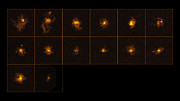
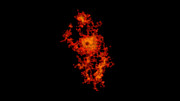
An international team of astronomers has discovered glowing gas clouds surrounding distant quasars. This new survey by the MUSE instrument on ESO’s Very Large Telescope indicates that halos around quasars are far more common than expected. The properties of the halos in this surprising find are also in striking disagreement with currently accepted theories of galaxy formation in the early Universe.

An international collaboration of astronomers, led by a group at the Swiss Federal Institute of Technology (ETH) in Zurich, Switzerland, has used the unrivalled observing power of MUSE on the Very Large Telescope (VLT) at ESO’s Paranal Observatory to study gas around distant active galaxies, less than two billion years after the Big Bang. These active galaxies, called quasars, contain supermassive black holes in their centres, which consume stars, gas, and other material at an extremely high rate. This, in turn, causes the galaxy centre to emit huge amounts of radiation, making quasars the most luminous and active objects in the Universe.

The study involved 19 quasars, selected from among the brightest that are observable with MUSE. Previous studies have shown that around 10% of all quasars examined were surrounded by halos, made from gas known as the intergalactic medium. These halos extend up to 300 000 light-years away from the centres of the quasars. This new study, however, has thrown up a surprise, with the detection of large halos around all 19 quasars observed  — far more than the two halos that were expected statistically. The team suspects this is due to the vast increase in the observing power of MUSE over previous similar instruments, but further observations are needed to determine whether this is the case.

It is still too early to say if this is due to our new observational technique or if there is something peculiar about the quasars in our sample. So there is still a lot to learn; we are just at the beginning of a new era of discoveries”, says lead author Elena Borisova, from the ETH Zurich.

The original goal of the study was to analyse the gaseous components of the Universe on the largest scales; a structure sometimes referred to as the cosmic web, in which quasars form bright nodes [1]. The gaseous components of this web are normally extremely difficult to detect, so the illuminated halos of gas surrounding the quasars deliver an almost unique opportunity to study the gas within this large-scale cosmic structure.

The 19 newly-detected halos also revealed another surprise: they consist of relatively cold intergalactic gas — approximately 10 000 degrees Celsius. This revelation is in strong disagreement with currently accepted models of the structure and formation of galaxies, which suggest that gas in such close proximity to galaxies should have temperatures upwards of a million degrees.

The discovery shows the potential of MUSE for observing this type of object [2]. Co-author Sebastiano Cantalupo is very excited about the new instrument and the opportunities it provides: “We have exploited the unique capabilities of MUSE in this study, which will pave the way for future surveys. Combined with a new generation of theoretical and numerical models, this approach will continue to provide a new window on cosmic structure formation and galaxy evolution.”


Notes

[1] The cosmic web is the structure of the Universe at the largest scale. It is comprised of spindly filaments of primordial material (mostly hydrogen and helium gas) and dark matter which connect galaxies and span the chasms between them. The material in this web can feed along the filaments into galaxies and drive their growth and evolution.

[2] MUSE is an integral field spectrograph and combines spectrographic and imaging capabilities. It can observe large astronomical objects in their entirety in one go, and for each pixel measure the intensity of the light as a function of its colour, or wavelength.


More Information

This research was presented in the paper "Ubiquitous giant Lyα nebulae around the brightest quasars at z ~ 3.5 revealed with MUSE", to appear in the Astrophysical Journal.


The team is composed of Elena Borisova, Sebastiano Cantalupo, Simon J. Lilly, Raffaella A. Marino and Sofia G. Gallego (Institute for Astronomy, ETH Zurich, Switzerland), Roland Bacon and Jeremy Blaizot (University of Lyon, Centre de Recherche Astrophysique de Lyon, Saint-Genis-Laval, France), Nicolas Bouché (Institut de Recherche en Astrophysique et Planétologie, Toulouse, France), Jarle Brinchmann (Leiden Observatory, Leiden, The Netherlands; Instituto de Astrofísica e Ciências do Espaço, Porto, Portugal), C Marcella Carollo (Institute for Astronomy, ETH Zurich, Switzerland), Joseph Caruana (Department of Physics, University of Malta, Msida, Malta; Institute of Space Sciences & Astronomy, University of Malta, Malta), Hayley Finley (Institut de Recherche en Astrophysique et Planétologie, Toulouse, France), Edmund C. Herenz (Leibniz-Institut für Astrophysik Potsdam, Potsdam, Germany), Johan Richard (Univ Lyon, Centre de Recherche Astrophysique de Lyon, Saint-Genis-Laval, France), Joop Schaye and Lorrie A. Straka (Leiden Observatory, Leiden, The Netherlands), Monica L. Turner (MIT-Kavli Center for Astrophysics and Space Research, Massachusetts Institute of Technology, Cambridge, Massachusetts, USA), Tanya Urrutia (Leibniz-Institut für Astrophysik Potsdam, Potsdam, Germany), Anne Verhamme (University of Lyon, Centre de Recherche Astrophysique de Lyon, Saint-Genis-Laval, France), Lutz Wisotzki (Leibniz-Institut für Astrophysik Potsdam, Potsdam, Germany).


ESO is the foremost intergovernmental astronomy organisation in Europe and the world’s most productive ground-based astronomical observatory by far. It is supported by 16 countries: Austria, Belgium, Brazil, the Czech Republic, Denmark, France, Finland, Germany, Italy, the Netherlands, Poland, Portugal, Spain, Sweden, Switzerland and the United Kingdom, along with the host state of Chile. ESO carries out an ambitious programme focused on the design, construction and operation of powerful ground-based observing facilities enabling astronomers to make important scientific discoveries. ESO also plays a leading role in promoting and organising cooperation in astronomical research. ESO operates three unique world-class observing sites in Chile: La Silla, Paranal and Chajnantor. At Paranal, ESO operates the Very Large Telescope, the world’s most advanced visible-light astronomical observatory and two survey telescopes. VISTA works in the infrared and is the world’s largest survey telescope and the VLT Survey Telescope is the largest telescope designed to exclusively survey the skies in visible light. ESO is a major partner in ALMA, the largest astronomical project in existence. And on Cerro Armazones, close to Paranal, ESO is building the 39-metre European Extremely Large Telescope, the E-ELT, which will become “the world’s biggest eye on the sky”.


Links


Contacts 

Elena Borisova
ETH Zurich
Switzerland
Tel: +41 44 633 77 09

Sebastiano Cantalupo
ETH Zurich
Switzerland
Tel: +41 44 633 70 57

Mathias Jäger
Public Information Officer
Garching bei München, Germany
Tel: +49 176 62397500


Source: ESO