Wednesday, August 24, 2016

Cosmic Neighbors Inhibit Star Formation, Even in the Early-Universe

Massive galaxy cluster MACS J0416 seen in X-rays (blue), visible light (red, green, and blue), and radio light (pink). 
Credit: NASA/CXC/SAO/G.Ogrean/STScI/NRAO/AUI/NSF

Color images of the central regions of z > 1.35 SpARCS clusters. 
Cluster members are marked with white squares. 
Credit: Nantais, et al.


MAUNAKEA, Hawaii — The international University of California, Riverside-led SpARCS collaboration has discovered four of the most distant clusters of galaxies ever found, as they appeared when the Universe was only four billion years old. Clusters are rare regions of the Universe consisting of hundreds of galaxies containing trillions of stars, as well as hot gas and mysterious Dark Matter. Spectroscopic observations from the W. M. Keck Observatory on Maunakea, Hawaii and the Very Large Telescope in Chile confirmed the four candidates to be massive clusters. This sample is now providing the best measurement yet of when and how fast galaxy clusters stop forming stars in the early Universe.

“We looked at how the properties of galaxies in these clusters differed from galaxies found in more typical environments with fewer close neighbors,” said lead author Julie Nantais, an assistant professor at the Andres Bello University in Chile. “It has long been known that when a galaxy falls into a cluster, interactions with other cluster galaxies and with hot gas accelerate the shut off of its star formation relative to that of a similar galaxy in the field, in a process known as environmental quenching. The SpARCS team have developed new techniques using Spitzer Space Telescope infrared observations to identify hundreds of previously-undiscovered clusters of galaxies in the distant Universe.”

As anticipated, the team did indeed find that many more galaxies in the clusters had stopped forming stars compared to galaxies of the same mass in the field. Gillian Wilson, professor of physics and astronomy at UC Riverside, added, “Fascinatingly, however, the study found that the percentage of galaxies which had stopped forming stars in those young, distant clusters, was much lower than the percentage found in much older, nearby clusters. While it had been fully expected that the percentage of cluster galaxies which had stopped forming stars would increase as the Universe aged, this latest work quantifies the effect.”

The paper concludes that about 30 percent of the galaxies which would normally be forming stars have been quenched in the distant clusters, compared to the much higher value of about 50 percent found in nearby clusters.

Several possible physical processes could be responsible for causing environmental quenching. For example, the hot, harsh cluster environment might prevent the galaxy from continuing to accrete cold gas and form new stars; a process astronomers have named “starvation”. Alternatively, the quenching could be caused by interactions with other galaxies in the cluster. These galaxies might “harass” (undergo frequent, high speed, gravitationally-disturbing encounters), tidally strip (pull material from a smaller galaxy to a larger one) or merge (two or more galaxies joining together) with the first galaxy to stop its star formation.

While the current study does not answer the question of which process is primarily responsible, it is nonetheless hugely important because it provides the most accurate measurement yet of how much environmental quenching has occurred in the early Universe. Moreover, the study provides an all-important early-Universe benchmark by which to judge upcoming predictions from competing computational numerical simulations which make different assumptions about the relative importance of the many different environmental quenching processes which have been suggested, and the timescales upon which they operate.

The W. M. Keck Observatory findings were obtained as the result of a collaboration amongst UC faculty members Gillian Wilson (UCR) and Michael Cooper (UCI), and graduate students Andrew DeGroot (UCR) and Ryan Foltz (UCR). Other authors involved in the study are Remco van der Burg (Université Paris Diderot), Chris Lidman (Australian Astronomical Observatory), Ricardo Demarco (WUniversidad de Concepción, Chile), Allison Noble (University of Toronto, Canada) and Adam Muzzin (University of Cambridge).

The W. M. Keck Observatory operates the largest, most scientifically productive telescopes on Earth. The two, 10-meter optical/infrared telescopes near the summit of Maunakea on the Island of Hawaii feature a suite of advanced instruments including imagers, multi-object spectrographs, high-resolution spectrographs, integral-field spectrographs and world-leading laser guide star adaptive optics systems.

MOSFIRE (Multi-Object Spectrograph for Infrared Exploration) is a highly-efficient instrument that can take images or up to 46 simultaneous spectra. Using a sensitive state-of-the-art detector and electronics system, MOSFIRE obtains observations fainter than any other near infrared spectrograph. MOSFIRE is an excellent tool for studying complex star or galaxy fields, including distant galaxies in the early Universe, as well as star clusters in our own Galaxy. MOSFIRE was made possible by funding provided by the National Science Foundation and astronomy benefactors Gordon and Betty Moore.

Keck Observatory is a private 501(c) 3 non-profit organization and a scientific partnership of the California Institute of Technology, the University of California and NASA.


Media Contact:

Steve Jefferson
W. M. Keck Observatory
(808) 881-3827

sjefferson@keck.hawaii.edu


Tuesday, August 23, 2016

Planck’s flame-filled view of the Polaris Flare

Planck’s flame-filled view of the Polaris Flare
Copyright: ESA and the Planck Collaboration


This image from ESA’s Planck satellite appears to show something quite ethereal and fantastical: a sprite-like figure emerging from scorching flames and walking towards the left of the frame, its silhouette a blaze of warm-hued colours.

This fiery illusion is actually a celestial feature named the Polaris Flare. This name is somewhat misleading; despite its moniker, the Polaris Flare is not a flare but a 10 light-year-wide bundle of dusty filaments in the constellation of Ursa Minor (The Little Bear), some 500 light-years away.

The Polaris Flare is located near the North Celestial Pole, a perceived point in the sky aligned with Earth’s spin axis. Extended into the skies of the northern and southern hemispheres, this imaginary line points to the two celestial poles. To find the North Celestial Pole, an observer need only locate the nearby Polaris (otherwise known as the North Star or Pole Star), the brightest star in the constellation of Ursa Minor.

Some of the secrets of the Polaris Flare were uncovered when it was observed by ESA’s Herschel some years ago. Using a combination of such Herschel observations and a computer simulation, scientists think that the Polaris Flare filaments could have been formed as a result of slow shockwaves pushing their way through a dense interstellar cloud, an accumulation of cold cosmic dust and gas sitting between the stars of our Galaxy.

These shockwaves, reminiscent of the sonic booms formed by fast sound waves here on Earth, would have been themselves triggered by nearby exploding stars that disrupted their surroundings as they died, triggering cloud-wide waves of turbulence.

These shockwaves, reminiscent of the sonic booms formed by fast sound waves here on Earth, were themselves triggered by nearby exploding stars that disrupted their surroundings as they died, triggering cloud-wide waves of turbulence. These waves swept up the gas and dust in their path, sculpting the material into the snaking filaments we see.

This image is not a true-colour view, nor is it an artistic impression of the Flare, rather it comprises observations from Planck, which operated between 2009 and 2013. Planck scanned and mapped the entire sky, including the plane of the Milky Way, looking for signs of ancient light (known as the cosmic microwave background) and cosmic dust emission. This dust emission allowed Planck to create this unique map of the sky – a magnetic map.

The relief lines laced across this image show the average direction of our Galaxy’s magnetic field in the region containing the Polaris Flare. This was created using the observed emission from cosmic dust, which was polarised (constrained to one direction). Dust grains in and around the Milky Way are affected by and interlaced with the Galaxy’s magnetic field, causing them to align preferentially in space. This carries through to the dust’s emission, which also displays a preferential orientation that Planck could detect.

The emission from dust is computed from a combination of Planck observations at 353, 545 and 857 GHz, whereas the direction of the magnetic field is based on Planck polarisation data at 353 GHz.

This frame has an area of 30 x 30º on the sky, and the colours represent the intensity of dust emission.


Monday, August 22, 2016

Could Gravitational Wave Events Flash in Visible Light?

Figure 1. Spectra of PS15dpn from the combined GMOS, PESSTO and SNIFS campaign. The vertical dashed green lines refer to He I and He II lines, while the blue (only shown on left) refer to Hα and Hβ. Right panel refers to restframe days after peak. 

Figure 2. Artist's conception of gravitational wave event showing possible emmission of visible light. 
Image Credit: LIGO.


Gemini explores the possibility of short-lived optical emission (visible light) from the violent events that produce gravitational waves.

Even before the announcement of the first gravitational wave detection by the Laser Interferometer Gravitational-Wave Observatory (LIGO) in February of this year, theorists wondered if the extreme energy required to produce strong gravitational waves might also produce a detectable optical flash.
Currently the most widely accepted explanation for gravitational wave events is the collision of black holes. The impact would send gravitational waves rippling through space at the speed of light. Thanks to LIGO the existence of gravitational waves is now confirmed, but unknown is the extent to which they might be accompanied by the emission of optical light or radiation at higher energies such as x-ray or gamma-rays.

A recent study headed by Stephen Smartt at Queen’s University in Belfast and Ken Chambers from University of Hawai‘i could help answer this question. “We were looking for the perverbial needle in the haystack,” says Chambers. “The area of sky was about 290 square degrees, and while we found several potential sources, in the end none could be associated with the LIGO discovery source.”

Smartt adds that the coordination of observations between wide-field telescopes like Pan-STARRS1 and deep spectroscopic follow-ups with Gemini were critical to the research which ultimately proved the concept for future gravitational wave events. “With this effort we’ve demonstrated that we can tile out the big sky area that LIGO thinks the source originated, find anything that is transient or variable to quite deep limits and then trigger a range of other powerful facilities like Gemini,” said Smartt. “It’s a big team project and I’m very excited about it’s potential. We have the tools to discover the sources in the next couple of years.”

The paper, titled: “A Search for an Optical Counterpart to the Gravitational Wave Event GW151226” has been accepted for publication in The Astrophysical Journal Letters and is also on astro-ph.

The Gemini Observatory followup observations – to provide spectroscopic classifications of transient sources – were made with the Gemini Multi-Object Spectrograph (GMOS) on the Gemini North telescope on Maunakea in Hawai‘i. One interesting source is a supernova that occurred at roughly the same time as (within a few days of) the gravitational wave source, but it is too distant to be the counterpart. Data were also provided by Pan-STARRS1, the University of Hawai‘i’s 2.2-meter telescope, the ATLAS survey telescope, the Public ESO Spectroscopic Survey of Transient Objects (PESSTO), and an additional observation using the Hubble Space Telescope.

Paper Abstract

We present a search for an electromagnetic counterpart of the gravitational wave source GW151226. Using the Pan-STARRS1 telescope we mapped out 290 square degrees in the optical iP1 filter starting 11.5hr after the LIGO information release and lasting for a further 28 days. The first observations started 49.5hr after the time of the GW151226 detection. We typically reached sensitivity limits of iP1 = 20.3 ± 20.8 and covered 26.5% of the LIGO probability skymap. We supplemented this with ATLAS survey data, reaching 31% of the probability region to shallower depths of m≅19. We found 49 extragalactic transients (that are not obviously AGN), including a faint transient in a galaxy at 7Mpc (a luminous blue variable outburst) plus a rapidly decaying M-dwarf flare. Spectral classification of 20 other transient events showed them all to be supernovae. We found an unusual transient, PS15dpn, with an explosion date temporally coincident with GW151226 which evolved into a type Ibn supernova. The redshift of the transient is secure at z=0.1747 ± 0.0001 and we find it unlikely to be linked, since the luminosity distance has a negligible probability of being consistent with that of GW151226. In the 290 square degrees surveyed we therefore do not find a likely counterpart. However we show that our survey strategy would be sensitive to NS-NS mergers producing kilonovae at D ≤ 100 Mpc which is promising for future LIGO/Virgo searches.


Sunday, August 21, 2016

Venus-like Exoplanet Might Have Oxygen Atmosphere, But Not Life

This artist's conception shows the rocky exoplanet GJ 1132b, located 39 light-years from Earth. New research shows that it might possess a thin, oxygen atmosphere - but no life due to its extreme heat. Dana Berry / Skyworks Digital / CfA.  High Resolution (jpg) - Low Resolution (jpg)

Cambridge, MA -The distant planet GJ 1132b intrigued astronomers when it was discovered last year. Located just 39 light-years from Earth, it might have an atmosphere despite being baked to a temperature of around 450 degrees Fahrenheit. But would that atmosphere be thick and soupy or thin and wispy? New research suggests the latter is much more likely.

Harvard astronomer Laura Schaefer (Harvard-Smithsonian Center for Astrophysics, or CfA) and her colleagues examined the question of what would happen to GJ 1132b over time if it began with a steamy, water-rich atmosphere.

Orbiting so close to its star, at a distance of just 1.4 million miles, the planet is flooded with ultraviolet or UV light. UV light breaks apart water molecules into hydrogen and oxygen, both of which then can be lost into space. However, since hydrogen is lighter it escapes more readily, while oxygen lingers behind.

"On cooler planets, oxygen could be a sign of alien life and habitability. But on a hot planet like GJ 1132b, it's a sign of the exact opposite - a planet that's being baked and sterilized," said Schaefer.

Since water vapor is a greenhouse gas, the planet would have a strong greenhouse effect, amplifying the star's already intense heat. As a result, its surface could stay molten for millions of years.

A "magma ocean" would interact with the atmosphere, absorbing some of the oxygen, but how much? Only about one-tenth, according to the model created by Schaefer and her colleagues. Most of the remaining 90 percent of leftover oxygen streams off into space, however some might linger.

"This planet might be the first time we detect oxygen on a rocky planet outside the solar system," said co-author Robin Wordsworth (Harvard Paulson School of Engineering and Applied Sciences).

If any oxygen does still cling to GJ 1132b, next-generation telescopes like the Giant Magellan Telescope and James Webb Space Telescope may be able to detect and analyze it.

The magma ocean-atmosphere model could help scientists solve the puzzle of how Venus evolved over time. Venus probably began with Earthlike amounts of water, which would have been broken apart by sunlight. Yet it shows few signs of lingering oxygen. The missing oxygen problem continues to baffle astronomers.

Schaefer predicts that their model also will provide insights into other, similar exoplanets. For example, the system TRAPPIST-1 contains three planets that may lie in the habitable zone. Since they are cooler than GJ 1132b, they have a better chance of retaining an atmosphere.

This work has been accepted for publication in The Astrophysical Journal and is available online. 

The journal paper is authored by Laura Schaefer , Robin Wordsworth, Zachory Berta-Thompson (University of Colorado, Boulder), and Dimitar Sasselov (CfA).

Headquartered in Cambridge, Mass., the Harvard-Smithsonian Center for Astrophysics (CfA) is a joint collaboration between the Smithsonian Astrophysical Observatory and the Harvard College Observatory. CfA scientists, organized into six research divisions, study the origin, evolution and ultimate fate of the universe.


For more information, contact:

Christine Pulliam
Media Relations Manager
Harvard-Smithsonian Center for Astrophysics
617-495-7463

cpulliam@cfa.harvard.edu


Saturday, August 20, 2016

“Kitchen Smoke” Molecules in Nebula Offer Clues to the Building Blocks of Life

Combination of three color images of NGC 7023 from SOFIA (red & green) and Spitzer (blue) show different populations of PAH molecules. Credits: NASA/DLR/SOFIA/B. Croiset, Leiden Observatory, and O. Berné, CNRS; NASA/JPL-Caltech/Spitzer.

Using data collected by NASA’s Stratospheric Observatory for Infrared Astronomy (SOFIA) and other observatories, an international team of researchers has studied how a particular type of organic molecules, the raw materials for life – could develop in space. This information could help scientists better understand how life could have developed on Earth.

Bavo Croiset of Leiden University in the Netherlands and his collaborators focused on a type of molecule called polycyclic aromatic hydrocarbons (PAHs), which are flat molecules consisting of carbon atoms arranged in a honeycomb pattern, surrounded by hydrogen. PAHs make up about 10 percent of the carbon in the universe, and are found on the Earth where they are released upon the burning of organic material such as meat, sugarcane, wood etc.  Croiset’s team determined that when PAHs in the nebula NGC 7023, also known as the Iris Nebula, are hit by ultraviolet radiation from the nebula’s central star, they evolve into larger, more complex molecules. Scientists hypothesize that the growth of complex organic molecules like PAHs is one of the steps leading to the emergence of life.

Some existing models predicted that the radiation from a newborn, nearby massive star would tend to break down large organic molecules into smaller ones, rather than build them up. To test these models, researchers wanted to estimate the size of the molecules at various locations relative to the central star.

Croiset’s team used SOFIA to observe Nebula NGC 7023 with two instruments, the FLITECAM near-infrared camera and the FORCAST mid-infrared camera. SOFIA’s instruments are sensitive to two wavelengths that are produced by these particular molecules, which can be used to estimate their size. The team analyzed the SOFIA images in combination with data previously obtained by the Spitzer infrared space observatory, the Hubble Space Telescope and the Canada-France-Hawaii Telescope on the Big Island of Hawaii.

The analysis indicates that the size of the PAH molecules in this nebula vary by location in a clear pattern. The average size of the molecules in the nebula’s central cavity, surrounding the illuminating star, is larger than on the surface of the cloud at the outer edge of the cavity.

In a paper published in Astronomy and Astrophysics, The team concluded that this molecular size variation is due both to some of the smallest molecules being destroyed by the harsh ultraviolet radiation field of the star, and to medium-sized molecules being irradiated so they combine into larger molecules. Researchers were surprised to find that the radiation resulted in net growth, rather than destruction.

“The success of these observations depended on both SOFIA’s ability to observe wavelengths inaccessible from the ground, and the large size of its telescope, which provided a more detailed map than would have been possible with smaller telescopes,” said Olivier Berné at CNRS, the National Center for Scientific Research in Toulouse, France, one of the published paper’s co-authors.


For more information on SOFIA, go to: www.nasa.gov/sofia

For more information SOFIA Science, go to: https://www.sofia.usra.edu/


Dr. Dana Backman
SOFIA Science Center, NASA Ames Research Center, Moffett Field, California

Kassandra Bell
SOFIA Science Center, NASA Ames Research Center, Moffett Field, California


Editor: Kassandra Bell


Source: NASA/SOFIA

Friday, August 19, 2016

Stellar shrapnel

Credit: ESA/Hubble & NASA, Y. Chu


Several thousand years ago, a star some 160 000 light-years away from us exploded, scattering stellar shrapnel across the sky. The aftermath of this energetic detonation is shown here in this striking image from the NASA/ESA Hubble Space Telescope’s Wide Field Camera 3.

The exploding star was a white dwarf located in the Large Magellanic Cloud, one of our nearest neighbouring galaxies. Around 97% of stars within the Milky Way that are between a tenth and eight times the mass of the Sun are expected to end up as white dwarfs. These stars can face a number of different fates, one of which is to explode as supernovae, some of the brightest events ever observed in the Universe. If a white dwarf is part of a binary star system, it can siphon material from a close companion. After gobbling up more than it can handle — and swelling to approximately one and a half times the size of the Sun — the star becomes unstable and ignites as a Type Ia supernova.

This was the case for the supernova remnant pictured here, which is known as DEM L71. It formed when a white dwarf reached the end of its life and ripped itself apart, ejecting a superheated cloud of debris in the process. Slamming into the surrounding interstellar gas, this stellar shrapnel gradually diffused into the separate fiery filaments of material seen scattered across this skyscape.

Source: ESA/Images

Thursday, August 18, 2016

G11.2-0.3: Supernova Ejected from the Pages of History

G11.2-0.3
 Credit X-ray: NASA/CXC/NCSU/K.Borkowski et al; Optical: DSS


Tour of G11.2-0.3

animation


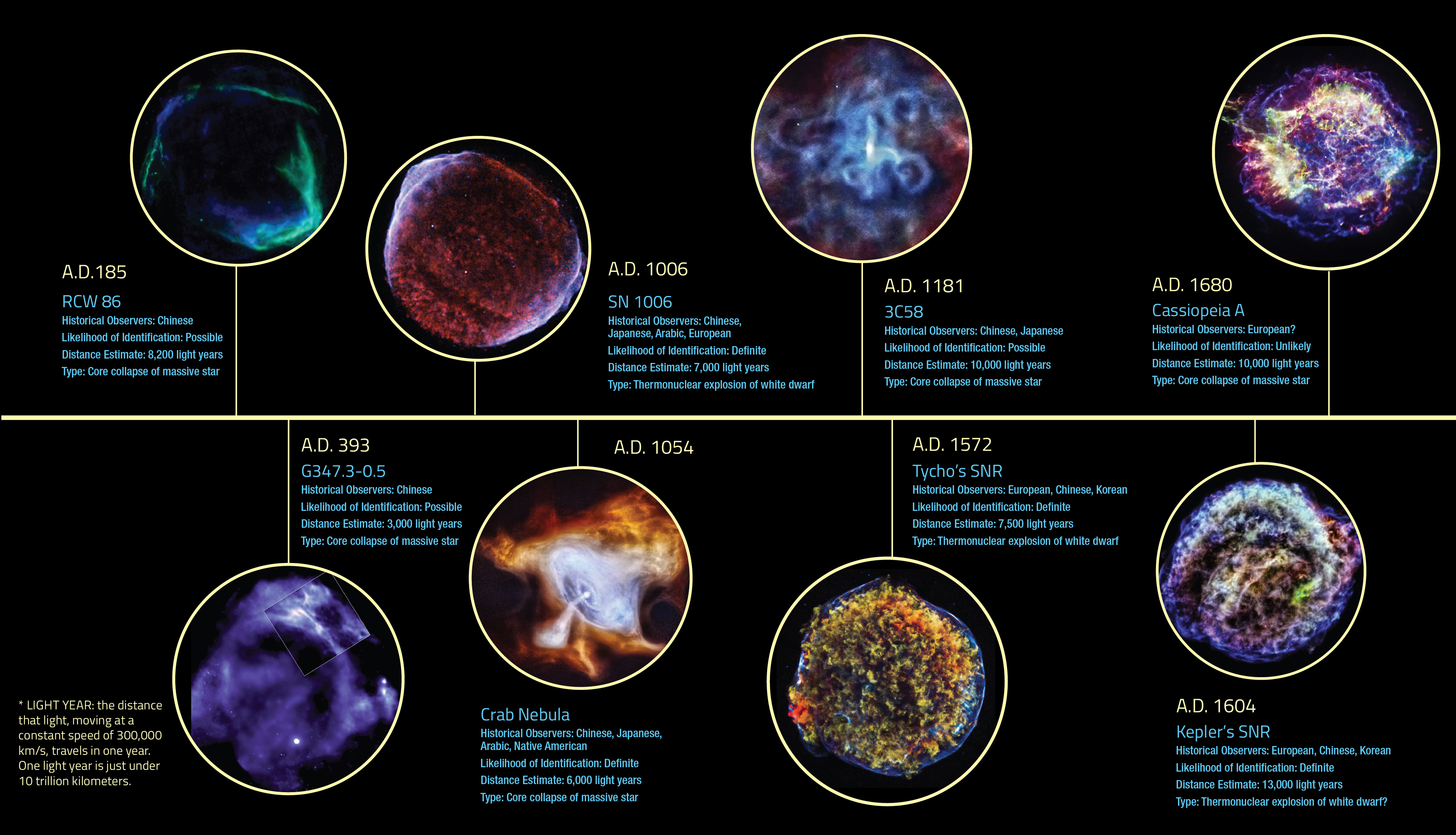
A new look at the debris from an exploded star in our galaxy has astronomers re-examining when the supernova actually happened. Recent observations of the supernova remnant called G11.2-0.3 with NASA's Chandra X-ray Observatory have stripped away its connection to an event recorded by the Chinese in 386 CE.

Historical supernovas and their remnants can be tied to both current astronomical observations as well as historical records of the event. Since it can be difficult to determine from present observations of their remnant exactly when a supernova occurred, historical supernovas provide important information on stellar timelines. Stellar debris can tell us a great deal about the nature of the exploded star, but the interpretation is much more straightforward given a known age.

New Chandra data on G11.2-0.3 show that dense clouds of gas lie along the line of sight from the supernova remnant to Earth. Infrared observations with the Palomar 5-meter Hale Telescope had previously indicated that parts of the remnant were heavily obscured by dust. This means that the supernova responsible for this object would simply have appeared too faint to be seen with the naked eye in 386 CE. This leaves the nature of the observed 386 CE event a mystery.

A new image of G11.2-0.3 is being released in conjunction with this week's workshop titled "Chandra Science for the Next Decade" being held in Cambridge, Massachusetts. While the workshop will focus on the innovative and exciting science Chandra can do in the next ten years, G11.2-0.3 is an example of how this "Great Observatory" helps us better understand the complex history of the Universe and the objects within it.

Credit NASA/CXC/SAO

Taking advantage of Chandra's successful operations since its launch into space in 1999, astronomers were able to compare observations of G11.2-0.3 from 2000 to those taken in 2003 and more recently in 2013. This long baseline allowed scientists to measure how fast the remnant is expanding. Using this data to extrapolate backwards, they determined that the star that created G11.2-0.3 exploded between 1,400 and 2,400 years ago as seen from Earth.

Previous data from other observatories had shown this remnant is the product of a "core-collapse" supernova, one that is created from the collapse and explosion of a massive star. The revised timeframe for the explosion based on the recent Chandra data suggests that G11.2-0.3 is one of the youngest such supernovas in the Milky Way. The youngest, Cassiopeia A, also has an age determined from the expansion of its remnant, and like G11.2-0.3 was not seen at its estimated explosion date of 1680 CE due to dust obscuration. So far, the Crab nebula, the remnant of a supernova seen in 1054 CE, remains the only firmly identified historical remnant of a massive star explosion in our galaxy.
This latest image of G11.2-0.3 shows low-energy X-rays in red, the medium range in green, and the high-energy X-rays detected by Chandra in blue. The X-ray data have been overlaid on an optical field from the Digitized Sky Survey, showing stars in the foreground.

Although the Chandra image appears to show the remnant has a very circular, symmetrical shape, the details of the data indicate that the gas that the remnant is expanding into is uneven. Because of this, researchers propose that the exploded star had lost almost all of its outer regions, either in an asymmetric wind of gas blowing away from the star, or in an interaction with a companion star. They think the smaller star left behind would then have blown gas outwards at an even faster rate, sweeping up gas that was previously lost in the wind, forming the dense shell. The star would then have exploded, producing the G11.2-0.3 supernova remnant seen today.

The supernova explosion also produced a pulsar - a rapidly rotating neutron star - and a pulsar wind nebula, shown by the blue X-ray emission in the center of the remnant. The combination of the pulsar's rapid rotation and strong magnetic field generates an intense electromagnetic field that creates jets of matter and anti-matter moving away from the north and south poles of the pulsar, and an intense wind flowing out along its equator.

A paper describing this result appeared in the March 9th, 2016 issue of The Astrophysical Journal and is available online. The authors are Kazimierz Borkowski and Stephen Reynolds, both of North Carolina State University, as well as Mallory Roberts from New York University. NASA's Marshall Space Flight Center in Huntsville, Alabama, manages the Chandra program for NASA's Science Mission Directorate in Washington. The Smithsonian Astrophysical Observatory in Cambridge, Massachusetts, controls Chandra's science and flight operations.


Fast Facts for G11.2-0.3:

Scale: Image is 9 arcmin across (about 43 light years)
Coordinates (J2000): RA 18h 11m 33.00s | Dec -19° 26' 00.00''
Constellation: Sagittarius
Observation Date: 12 pointings between Aug 2000 and Sep 2013
Observation Time: 111 hours 7 min (4 days 15 hours 7 min).
Obs. ID: 780, 781, 2322, 3909-3912, 14830-14832, 15652, 16323
Instrument: ACIS
References: Borkowski, K. et al, 2016, ApJ, 819, 160; arXiv:1602.03531
Color Code: X-ray (Red, Green, Blue), Optical (Orange, Cyan)
Distance Estimate: About 16,000 light years


Wednesday, August 17, 2016

Turbulent border

Messier 42, M42, Orion Nebula
Credit: ESO/Goicoechea et al.


These images show the edge of the vast molecular cloud that lies behind the Orion Nebula, 1400 light-years from Earth. The image of the left shows a wide-field view of the region, as seen with the HAWK-I instrument, installed at the Very Large Telescope. A small region is highlighted with a white rectangle, and the rightmost image shows that region in stunning fiery detail, observed with the Atacama Large Millimeter/submillimeter Array (ALMA).

As well as producing beautiful images, molecular clouds are of great interest to astronomers. The clouds are stellar nurseries and at their edge atoms react and form molecules by key astrochemical processes. With the ALMA observations scientists were able to resolve this transition from atomic to molecular gas at the border of the Orion molecular cloud. As Orion is the nearest massive star-forming region it is the ideal target to find out more about these astrochemical processes, and it also offers the possibility to study the interactions of newly formed stars with their surroundings in detail.

Both observations show that this fascinating astrochemical transition from atomic to molecular gas happens in a highly dynamic environment. ALMA’s view of the nebula particularly resembles the dark clouds of a huge upcoming storm in Earth’s atmosphere.

Link 

 Source: ESO/images
 

Tuesday, August 16, 2016

Hubble’s fireball

Hubble’s fireball
Copyright ESA/Hubble & NASA Acknowledgement: J. Schmidt (geckzilla.com)


This dramatic burst of colour shows a cosmic object with an equally dramatic history. Enveloped within striking, billowing clouds of gas and dust that form a nebula known as M1-67, sits a bright star named Hen 2-427 (otherwise known as WR 124).

This star is just as intense as the scene unfolding around it. It is a Wolf-Rayet star, a rare type of star known to have very high surface temperatures – well over 25 000ºC, next to the Sun’s comparatively cool 5500ºC – and enormous mass, which ranges over 5–20 times our Sun’s. Such stars are constantly losing vast amounts of mass via thick winds that continuously pour from their surfaces out into space.

Hen 2-427 is responsible for creating the entire scene shown here, which has been captured in beautiful detail by the NASA/ESA Hubble Space Telescope. The star, thought to be a massive one in the later stages of its evolution, blasted the material comprising M1-67 out into space some 10 millennia ago – perhaps in multiple outbursts – to form an expanding ring of ejecta.

Since then, the star has continued to flood the nebula with massive clumps of gas and intense ionising radiation via its fierce stellar winds, shaping and sculpting its evolution. M1-67 is roughly ring-shaped but lacks a clear structure – it is essentially a collection of large, massive, superheated knots of gas all clustered around a central star.

Hen 2-427 and M1-67 lie 15 000 light-years away in the constellation of Sagitta (The Arrow). This image uses visible-light data gathered by Hubble’s Wide Field Planetary Camera 2, and was released in 2015 (the same data were previously processed and released in 1998).


Monday, August 15, 2016

NASA's Fermi Mission Expands its Search for Dark Matter


Dark matter, the mysterious substance that constitutes most of the material universe, remains as elusive as ever. Although experiments on the ground and in space have yet to find a trace of dark matter, the results are helping scientists rule out some of the many theoretical possibilities. Three studies published earlier this year, using six or more years of data from NASA's Fermi Gamma-ray Space Telescope, have broadened the mission's dark matter hunt using some novel approaches.

“We've looked for the usual suspects in the usual places and found no solid signals, so we've started searching in some creative new ways," said Julie McEnery, Fermi project scientist at NASA's Goddard Space Flight Center in Greenbelt, Maryland. "With these results, Fermi has excluded more candidates, has shown that dark matter can contribute to only a small part of the gamma-ray background beyond our galaxy, the Milky Way, and has produced strong limits for dark matter particles in the second-largest galaxy orbiting it."

Dark matter neither emits nor absorbs light, primarily interacts with the rest of the universe through gravity, yet accounts for about 80 percent of the matter in the universe. Astronomers see its effects throughout the cosmos -- in the rotation of galaxies, in the distortion of light passing through galaxy clusters, and in simulations of the early universe, which require the presence of dark matter to form galaxies at all.

The leading candidates for dark matter are different classes of hypothetical particles. Scientists think gamma rays, the highest-energy form of light, can help reveal the presence of some of types of proposed dark matter particles. Previously, Fermi has searched for tell-tale gamma-ray signals associated with dark matter in the center of our galaxy and in small dwarf galaxies orbiting our own.

Although no convincing signals were found, these results eliminated candidates within a specific range of masses and interaction rates, further limiting the possible characteristics of dark matter particles.

Among the new studies, the most exotic scenario investigated was the possibility that dark matter might consist of hypothetical particles called axions or other particles with similar properties. An intriguing aspect of axion-like particles is their ability to convert into gamma rays and back again when they interact with strong magnetic fields. These conversions would leave behind characteristic traces, like gaps or steps, in the spectrum of a bright gamma-ray source.

Manuel Meyer at Stockholm University led a study to search for these effects in the gamma rays from NGC 1275, the central galaxy of the Perseus galaxy cluster, located about 240 million light-years away. High-energy emissions from NGC 1275 are thought to be associated with a supermassive black hole at its center. Like all galaxy clusters, the Perseus cluster is filled with hot gas threaded with magnetic fields, which would enable the switch between gamma rays and axion-like particles. This means some of the gamma rays coming from NGC 1275 could convert into axions -- and potentially back again -- as they make their way to us.

"While we don't yet know what dark matter is, our results show we can probe axion-like models and provide the strongest constraints to date for certain masses," Meyer said. "Remarkably, we reached a sensitivity we thought would only be possible in a dedicated laboratory experiment, which is quite a testament to Fermi."

Another broad class of dark matter candidates are called Weakly Interacting Massive Particles (WIMPs). In some versions, colliding WIMPs either mutually annihilate or produce an intermediate, quickly decaying particle. Both scenarios result in gamma rays that can be detected by the LAT.

Regina Caputo at the University of California, Santa Cruz, sought these signals from the Small Magellanic Cloud (SMC), which is located about 200,000 light-years away and is the second-largest of the small satellite galaxies orbiting the Milky Way. Part of the SMC's appeal for a dark matter search is that it lies comparatively close to us and its gamma-ray emission from conventional sources, like star formation and pulsars, is well understood. Most importantly, astronomers have high-precision measurements of the SMC's rotation curve, which shows how its rotational speed changes with distance from its center and indicates how much dark matter is present. In a paper published in Physical Review D on March 22, Caputo and her colleagues modeled the dark matter content of the SMC, showing it possessed enough to produce detectable signals for two WIMP types.

The Small Magellanic Cloud (SMC), at center, is the second-largest satellite galaxy orbiting our own. This image superimposes a photograph of the SMC with one half of a model of its dark matter (right of center). Lighter colors indicate greater density and show a strong concentration toward the galaxy's center. Ninety-five percent of the dark matter is contained within a circle tracing the outer edge of the model shown. In six years of data, Fermi finds no indication of gamma rays from the SMC's dark matter. Credits: Dark matter, R. Caputo et al. 2016; background, Axel Mellinger, Central Michigan University


"The LAT definitely sees gamma rays from the SMC, but we can explain them all through conventional sources," Caputo said. "No signal from dark matter annihilation was found to be statistically significant."

In the third study, researchers led by Marco Ajello at Clemson University in South Carolina and Mattia Di Mauro at SLAC National Accelerator Laboratory in California took the search in a different direction. Instead of looking at specific astronomical targets, the team used more than 6.5 years of LAT data to analyze the background glow of gamma rays seen all over the sky.

The nature of this light, called the extragalactic gamma-ray background (EGB) has been debated since it was first measured by NASA's Small Astronomy Satellite 2 in the early 1970s. Fermi has shown that much of this light arises from unresolved gamma-ray sources, particularly galaxies called blazars, which are powered by material falling toward gigantic black holes. Blazars constitute more than half of the total gamma-ray sources seen by Fermi, and they make up an even greater share in a new LAT catalog of the highest-energy gamma rays.

This animation switches between two images of the gamma-ray sky as seen by Fermi's Large Area Telescope (LAT), one using the first three months of LAT data, the other showing a cumulative exposure of seven years. The blue color, representing the fewest gamma rays, includes the extragalactic gamma-ray background. Blazars make up most of the bright sources shown (colored red to white). With increasing exposure, Fermi reveals more of them. A new study shows blazars are almost completely responsible for the background glow.Credits: NASA/DOE/Fermi LAT Collaboration


Some models predict that EGB gamma rays could arise from distant interactions of dark matter particles, such as the annihilation or decay of WIMPs. In a detailed analysis of high-energy EGB gamma rays, published April 14 in Physical Review Letters, Ajello and his team show that blazars and other discrete sources can account for nearly all of this emission.

"There is very little room left for signals from exotic sources in the extragalactic gamma-ray background, which in turn means that any contribution from these sources must be quite small," Ajello said. "This information may help us place limits on how often WIMP particles collide or decay."

Although these latest studies have come up empty-handed, the quest to find dark matter continues both in space and in ground-based experiments. Fermi is joined in its search by NASA's Alpha Magnetic Spectrometer, a particle detector on the International Space Station.

NASA's Fermi Gamma-ray Space Telescope is an astrophysics and particle physics partnership, developed in collaboration with the U.S. Department of Energy and with important contributions from academic institutions and partners in France, Germany, Italy, Japan, Sweden and the United States.

For more information about NASA's Fermi Gamma-ray Space Telescope, visit:  www.nasa.gov/fermi


By Francis Reddy
NASA's Goddard Space Flight Center, Greenbelt, Md.

Editor: Ashley Morrow


Saturday, August 13, 2016

Kepler Watches Stellar Dancers in the Pleiades Cluster


Like cosmic ballet dancers, the stars of the Pleiades cluster are spinning. But these celestial dancers are all twirling at different speeds. Astronomers have long wondered what determines the rotation rates of these stars.

By watching these stellar dancers, NASA's Kepler space telescope during its K2 mission has helped amass the most complete catalog of rotation periods for stars in a cluster. This information can help astronomers gain insight into where and how planets form around these stars, and how such stars evolve.    

"We hope that by comparing our results to other star clusters, we will learn more about the relationship between a star’s mass, its age, and even the history of its solar system," said Luisa Rebull, a research scientist at the Infrared Processing and Analysis Center at Caltech in Pasadena, California. She is the lead author of two new papers and a co-author on a third paper about these findings, all being published in the Astronomical Journal.

The Pleiades star cluster is one of the closest and most easily seen star clusters, residing just 445 light-years away from Earth, on average. At about 125 million years old, these stars -- known individually as Pleiads -- have reached stellar "young adulthood." In this stage of their lives, the stars are likely spinning the fastest they ever will.

As a typical star moves further along into adulthood, it loses some zip due to the copious emission of charged particles known as a stellar wind (in our solar system, we call this the solar wind). The charged particles are carried along the star’s magnetic fields, which overall exerts a braking effect on the rotation rate of the star.

Rebull and colleagues sought to delve deeper into these dynamics of stellar spin with Kepler. Given its field of view on the sky, Kepler observed approximately 1,000 stellar members of the Pleiades over the course of 72 days. The telescope measured the rotation rates of more than 750 stars in the Pleiades, including about 500 of the lowest-mass, tiniest, and dimmest cluster members, whose rotations could not previously be detected from ground-based instruments.

Kepler measurements of starlight infer the spin rate of a star by picking up small changes in its brightness. These changes result from "starspots" which, like the more-familiar sunspots on our sun, form when magnetic field concentrations prevent the normal release of energy at a star’s surface. The affected regions become cooler than their surroundings and appear dark in comparison.

As stars rotate, their starspots come in and out of Kepler’s view, offering a way to determine spin rate. Unlike the tiny, sunspot blemishes on our middle-aged sun, starspots can be gargantuan in stars as young as those in the Pleiades because stellar youth is associated with greater turbulence and magnetic activity. These starspots trigger larger brightness decreases, and make spin rate measurements easier to obtain.

During its observations of the Pleiades, a clear pattern emerged in the data: More massive stars tended to rotate slowly, while less massive stars tended to rotate rapidly. The big-and-slow stars' periods ranged from one to as many as 11 Earth-days. Many low-mass stars, however, took less than a day to complete a pirouette. (For comparison, our sedate sun revolves fully just once every 26 days.) The population of slow-rotating stars includes some ranging from a bit larger, hotter and more massive than our sun, down to other stars that are somewhat smaller, cooler and less massive. On the far end, the fast-rotating, fleet-footed, lowest-mass stars possess as little as a tenth of our sun’s mass. 

"In the 'ballet' of the Pleiades, we see that slow rotators tend to be more massive, whereas the fastest rotators tend to be very light stars," said Rebull.  

The main source of these differing spin rates is the internal structure of the stars, Rebull and colleagues suggest. Larger stars have a huge core enveloped in a thin layer of stellar material undergoing a process called convection, familiar to us from the circular motion of boiling water.
Small stars, on the other hand, consist almost entirely of convective, roiling regions. As stars mature, the braking mechanism from magnetic fields more easily slows the spin rate of the thin, outermost layer of big stars than the comparatively thick, turbulent bulk of small stars.

Thanks to the Pleiades’ proximity, researchers think it should be possible to untangle the complex relationships between stars’ spin rates and other stellar properties. Those stellar properties, in turn, can influence the climates and habitability of a star’s hosted exoplanets. For instance, as spinning slows, so too does starspot generation, and the solar storms associated with starspots. Fewer solar storms means less intense, harmful radiation blasting into space and irradiating nearby planets and their potentially emerging biospheres.    

"The Pleiades star cluster provides an anchor for theoretical models of stellar rotation going both directions, younger and older," said Rebull. "We still have a lot we want to learn about how, when and why stars slow their spin rates and hang up their 'dance shoes,' so to speak."

Rebull and colleagues are now analyzing K2 mission data from an older star cluster, Praesepe, popularly known as the Beehive Cluster, to further explore this phenomenon in stellar structure and evolution.

"We’re really excited that K2 data of star clusters, such as the Pleiades, have provided astronomers with a bounty of new information and helped advance our knowledge of how stars rotate throughout their lives," said Steve Howell, project scientist for the K2 mission at NASA’s Ames Research Center in Moffett Field, California.

The K2 mission’s approach to studying stars employs the Kepler spacecraft's ability to precisely observe miniscule changes in starlight. Kepler’s primary mission ended in 2013, but more exoplanet and astrophysics observations continue with the K2 mission, which began in 2014.

Ames manages the Kepler and K2 missions for NASA's Science Mission Directorate. NASA's Jet Propulsion Laboratory in Pasadena, California, managed Kepler mission development. Ball Aerospace & Technologies Corporation operates the flight system with support from the Laboratory for Atmospheric and Space Physics at the University of Colorado at Boulder.


Elizabeth Landau
Jet Propulsion Laboratory, Pasadena, Calif.
818-354-6425

elizabeth.landau@jpl.nasa.gov

Michele Johnson
Ames Research Center, Moffett Field, Calif.

650-604-6982

michele.johnson@nasa.gov


Written by Adam Hadhazy


Editor: Tony Greicius


Friday, August 12, 2016

A lopsided lynx

Credit: ESA/Hubble & NASA


This galaxy, known as NGC 2337, resides 25 million light-years away in the constellation of Lynx. NGC 2337 is an irregular galaxy, meaning that it — along with a quarter of all galaxies in the Universe — lacks a distinct, regular appearance. The galaxy  was discovered in 1877 by the French astronomer Édouard Stephan who, in the same year, discovered the galactic group Stephan’s Quintet (heic0910i).

Although irregular galaxies may never win a beauty prize when competing with their more symmetrical spiral and elliptical peers, astronomers consider them to be very important. Some irregular galaxies may have once fallen into one of the regular classes of the Hubble sequence, but were warped and deformed by a passing cosmic companion. As such, irregular galaxies provide astronomers with a valuable opportunity to learn more about galactic evolution and interaction.

Despite the disruption, gravitational interactions between galaxies can kickstart star formation activity within the affected galaxies, which may explain the pockets of blue light scattered throughout NGC 2337. These patches and knots of blue signal the presence of young, newly formed, hot stars.


Thursday, August 11, 2016

Hubble Uncovers a Galaxy Pair Coming in from the Wilderness

Pisces A and B
Credit: NASA, ESA, and E. Tollerud (STScI)


NASA's Hubble Space Telescope has uncovered two tiny dwarf galaxies that have wandered from a vast cosmic wilderness into a nearby "big city" packed with galaxies. After being quiescent for billions of years, they are ready for partying by starting a firestorm of star birth.

"These Hubble images may be snapshots of what present-day dwarf galaxies may have been like at earlier epochs," said lead researcher Erik Tollerud of the Space Telescope Science Institute in Baltimore, Maryland. "Studying these and other similar galaxies can provide further clues to dwarf galaxy formation and evolution."

The Hubble observations suggest that the galaxies, called Pisces A and B, are late bloomers because they have spent most of their existence in the Local Void, a region of the universe sparsely populated with galaxies. The Local Void is roughly 150 million light-years across.

Under the steady pull of gravity from the galactic big city, the loner dwarf galaxies have at last entered a crowded region that is denser in intergalactic gas. In this gas-rich environment, star birth may have been triggered by gas raining down on the galaxies as they plow through the denser region. Another idea is that the duo may have encountered a gaseous filament, which compresses gas in the galaxies and stokes star birth. Based on the galaxies' locations, Tollerud's team determined that the objects are at the edge of a nearby filament of dense gas. Each galaxy contains about 10 million stars.

Dwarf galaxies are the building blocks from which larger galaxies were formed billions of years ago in the early universe. Inhabiting a sparse desert of largely empty space for most of the universe's history, these two galaxies avoided that busy construction period.

"These galaxies may have spent most of their history in the void," Tollerud explained. "If this is true, the void environment would have slowed their evolution. Evidence for the galaxies' void address is that their hydrogen content is somewhat high relative to similar galaxies. In the past, galaxies contained higher concentrations of hydrogen, the fuel needed to make stars. But these galaxies seem to retain that more primitive composition, rather than the enriched composition of contemporary galaxies, due to a less vigorous history of star formation. The galaxies also are quite compact relative to the typical star-forming galaxies in our galactic neighborhood."

The dwarf galaxies are small and faint, so finding them is extremely difficult. Astronomers spotted them by using radio telescopes in a unique survey to measure the hydrogen content in our Milky Way. The observations captured thousands of small blobs of dense hydrogen gas. Most of them are gas clouds within our galaxy, but astronomers identified 30 to 50 of those blobs as possible galaxies. The researchers used the WIYN telescope in Arizona to study 15 of the most promising candidates in visible light. Based on those observations, Tollerud's team selected the two that were the most likely candidates to be nearby galaxies and analyzed them with Hubble's Advanced Camera for Surveys. Hubble's sharp vision helped the astronomers confirm that both of them, Pisces A and B, are dwarf galaxies.

The Hubble telescope is aptly suited to study nearby, dim dwarf galaxies because its sharp vision can resolve individual stars and help astronomers estimate the galaxies' distances. Distance is important for determining a galaxy's brightness, and, in these Hubble observations, for calculating how far away the galaxies are from nearby voids. Pisces A is about 19 million light-years from Earth and Pisces B roughly 30 million light-years away.

An analysis of the stars' colors allowed the astronomers to trace the star formation history of both galaxies.

Each galaxy contains about 20 to 30 bright blue stars, a sign that they are very young, less than 100 million years old. Tollerud's team estimates that less than 100 million years ago, the galaxies doubled their star-formation rate. Eventually, the star formation may slow down again if the galaxies become satellites of a much larger galaxy.

"The galaxies could even probably stop forming stars all together, because they will stop getting new gas to make stars," Tollerud said. "So they will use up their existing gas. But it's hard to tell right now exactly when that would happen, so it's a reasonable guess that the star formation will ramp up at least for a while."
Tollerud's team hopes to observe other similar galaxies with Hubble. He also plans to scour the Panoramic Survey Telescope & Rapid Response System (Pan-STARRS) survey for potential dwarf galaxies. Future wide-survey telescopes, such as the Large Synoptic Survey Telescope (LSST) in Chile and the large radio telescope in China, should be able to find many of these puny galactic neighbors.

The team's results will appear in the Aug. 11 issue of The Astrophysical Journal.


Contacts:

Donna Weaver / Ray Villard
Space Telescope Science Institute, Baltimore, Maryland
410-338-4493 / 410-338-4514

dweaver@stsci.edu / villard@stsci.edu

Erik Tollerud
Space Telescope Science Institute, Baltimore, Maryland

etollerud@stsci.edu


Source: HubbleSite

IC 2497: A Black Hole Story Told by a Cosmic Blob and Bubble

IC 2497
Credit X-ray: NASA/CXC/ETH Zurich/L.Sartori et al, Optical: NASA/STScI


Two cosmic structures show evidence for a remarkable change in behavior of a supermassive black hole in a distant galaxy. Using data from NASA’s Chandra X-ray Observatory and other telescopes, astronomers are piecing together clues from a cosmic “blob” and a gas bubble that could be a new way to probe the past activity of a giant black hole and its effect on its host galaxy.

The Green Blob, a renowned cosmic structure also called “Hanny’s Voorwerp” (which means “Hanny’s object” in Dutch), is located about 680 million light years from Earth. This object was discovered in 2007 by Hanny van Arkel, at the time a school teacher, as part of the citizen science project called Galaxy Zoo.

Astronomers think that a blast of ultraviolet and X-radiation produced by a supermassive black hole at the center of the galaxy IC 2497 (only 200,000 light years away) excited the oxygen atoms in a gas cloud, giving the Green Blob its emerald glow. At present the black hole is growing slowly and not producing nearly enough radiation to cause such a glow.

However, the distance of the Green Blob from IC 2497 is large enough that we may be observing a delayed response, or an echo of past activity, from a rapidly growing black hole. Such a black hole would produce copious amounts of radiation from infalling material, categorizing it as a “quasar.”

If the black hole was growing at a much higher rate in the past and then slowed down dramatically in the past 200,000 years, the glow of the Green Blob could be consistent with the present low activity of the black hole. In this scenario, the blob would become much dimmer in the distant future, as reduced ultraviolet and X-radiation levels from the faded quasar finally reach the cloud.

In this new composite image of IC 2497 (top object) and the Green Blob (bottom), X-rays from Chandra are purple and optical data from the Hubble Space Telescope are red, green, and blue.

New observations with Chandra show that the black hole is still producing large amounts of energy even though it is no longer generating intense radiation as a quasar. The evidence for this change in the black hole’s activity comes from hot gas in the center of IC 2497 detected in a long exposure by Chandra. The center of the X-ray emission shows cooler gas, which astronomers interpret as a large bubble in the gas.

Astronomers suspect this bubble may have been created when a pair of jets from the black hole blew away the hot gas. In this scenario, the energy produced by the supermassive black hole has changed from that of a quasar, when energy is radiated in a broad beam, to more concentrated output in the form of collimated jets of particles and consistent with the observed radio emission in this source.

Such changes in behavior from strong radiation to strong outflow are seen in stellar-mass black holes that weigh about ten times that of the Sun, taking place over only a few weeks. The much higher mass of the black hole in IC 2497 results in much slower changes over many thousands of years.

The citizen and professional scientists of the Galaxy Zoo project have continued to hunt for objects like the Green Blob. Many smaller versions of the Green Blob have been found (dubbed “Voorwerpjes” or “little objects” in Dutch.) These latest results from Chandra suggest that fading quasars identified as Voorwerpjes are good places to search for examples of supermassive black holes affecting their surroundings.

A paper on these results recently appeared in Monthly Notices of the Royal Astronomical Society and is available online [http://arxiv.org/abs/1601.07550]. The authors of the paper are Lia Sartori (ETH Zurich), Kevin Schawinski (ETH Zurich), Michael Koss (ETH Zurich), Ezequiel Treister (University of Concepcion, Chile), Peter Maksym (Harvard-Smithsonian Center for Astrophysics), William Keel (University of Alabama, Tuscaloosa), C. Megan Urry (Yale University), Chris Lintott (Oxford University), and O. Ivy Wong (University of Western Australia).

NASA’s Marshall Space Flight Center in Huntsville, Alabama, manages the Chandra program for NASA’s Science Mission Directorate in Washington. The Smithsonian Astrophysical Observatory in Cambridge, Massachusetts, controls Chandra’s science and flight operations. 


Fast Facts for IC 2497:

Scale: Main image is 51 arcsec across (about 160,000 light years);
Category: Quasars & Active Galaxies
Coordinates (J2000): RA 09h 41m 04.10s | Dec +34° 43’ 57.70"
Constellation: Leo Minor
Observation Date: 08 and 11 Jan 2012
Observation Time: 42 hours 18 min (1 day 18 hours 18 min).
Obs. ID: 13966, 14381
Instrument: ACIS
References: Sartori, L. et al, 2016, MNRAS, 457, 3629; arXiv:1601.07550
Color Code: X-ray (Purple), Optical (Red, Green, Blue)
Distance Estimate: About 680 million light years