Showing posts with label white dwarf. Show all posts

Sunday, June 07, 2026

Is this Be star isolated?

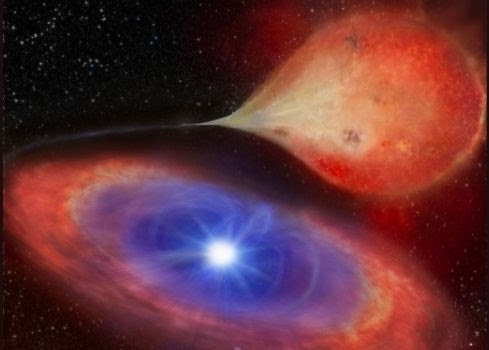
Artists impression of “edge-on” view of a Be star with ioniozed gas disk.
Credit: NASA/ESA/G. Bacon (STScI)

Download Image

During the past week, NuSTAR observed CL Pismis 17 3, hitherto known as an isolated Be star, that shows suspiciously strong X-ray emission above 3 keV. This is part of a campaign to probe such anomalously X-ray bright Be stars for hidden accreting companions, like a neutron star, or possibly a white dwarf. The NuSTAR data is crucial to determine if the system is undergoing active mass transfer, as the hard X-ray spectrum is a reliable probe for Comptonised emission, as expected from an accreting neutron star. In such a case, the system would join a growing list of Be X-ray binaries, that are known to be accreting persistently at a stable lower luminosity, instead of being punctuated by very luminous outbursts as they typically exhibit. This not only allows us to sharpen constraints on the X-ray luminosity function of High Mass X-ray Binaries, which are crucial to understand our Galactic star formation history, but also provides us with a test case to study persistent but tenuous accretion mechanisms.

Author: Aafia Ansar Mohideen (Research Scientist, Dr. Karl Remeis Sternwarte Astronomical Institute, Germany)


Wednesday, July 23, 2025

Swirling spiral in Hydra

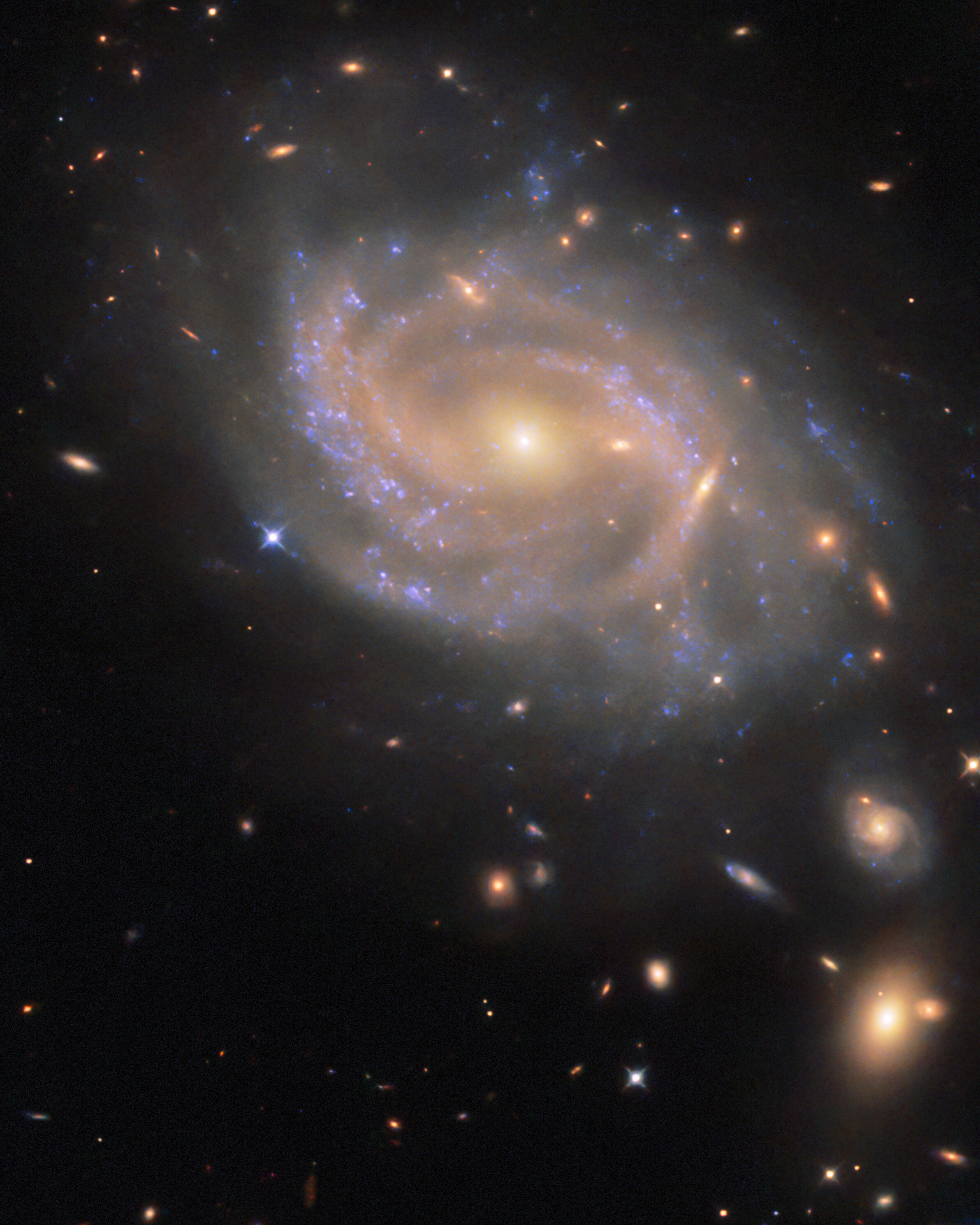
A spiral galaxy with a disc made up of several swirling arms. Patchy blue clouds of gas are speckled over the disc, where stars are forming and lighting up the gas around them. The core of the galaxy is large and shines brightly gold, while the spiral arms are a paler and faint reddish colour. Neighbouring galaxies - from small, elongated spots to larger swirling spirals - can be seen across the black background. Credit: ESA/Hubble & NASA, R. J. Foley (UC Santa Cruz)

The swirling spiral galaxy in this NASA/ESA Hubble Space Telescope Picture of the Week is NGC 3285B, which resides 137 million light-years away in the constellation Hydra (The Water Snake). Hydra has the largest area of the 88 constellations that cover the entire sky in a celestial patchwork. It’s also the longest constellation, stretching 100 degrees across the sky. It would take nearly 200 full Moons, placed side by side, to reach from one side of the constellation to the other.

NGC 3285B is a member of the Hydra I cluster, one of the largest galaxy clusters in the nearby Universe. Galaxy clusters are collections of hundreds to thousands of galaxies that are bound to one another by gravity. The Hydra I cluster is anchored by two giant elliptical galaxies at its centre. Each of these galaxies is about 150,000 light-years across, making them about 50% larger than our home galaxy, the Milky Way.

NGC 3285B sits on the outskirts of its home cluster, far from the massive galaxies at the centre. This galaxy drew Hubble’s attention because it hosted a Type Ia supernova in 2023. Type Ia supernovae happen when a type of condensed stellar core called a white dwarf detonates, igniting a sudden burst of nuclear fusion that briefly shines about 5 billion times brighter than the Sun. The supernova, named SN 2023xqm, is visible here as a blue-ish dot on the left edge of the galaxy’s disc.

Hubble observed NGC 3285B as part of an observing programme that targeted 100 Type Ia supernovae. By viewing each of these supernovae in ultraviolet, optical, and near-infrared light, researchers aim to disentangle the effects of distance and dust, both of which can make a supernova appear redder than it actually is. This programme will help refine cosmic distance measurements that rely on observations of Type Ia supernovae.


Wednesday, April 24, 2024

Hubble Celebrates 34th Anniversary with a Look at the Little Dumbbell Nebula

Little Dumbbell Nebula (WFC3 Image)
Credits: Image: NASA, ESA, STScI


In celebration of the 34th anniversary of the launch of NASA's legendary Hubble Space Telescope on April 24, astronomers took a snapshot of the Little Dumbbell Nebula (also known as Messier 76, M76, or NGC 650/651) located 3,400 light-years away in the northern circumpolar constellation Perseus. The photogenic nebula is a favorite target of amateur astronomers.

M76 is classified as a planetary nebula, an expanding shell of glowing gases that were ejected from a dying red giant star. The star eventually collapses to an ultra-dense and hot white dwarf. A planetary nebula is unrelated to planets, but have that name because astronomers in the 1700s using low-power telescopes thought this type of object resembled a planet.

M76 is composed of a ring, seen edge-on as the central bar structure, and two lobes on either opening of the ring. Before the star burned out, it ejected the ring of gas and dust. The ring was probably sculpted by the effects of the star that once had a binary companion star. This sloughed off material created a thick disk of dust and gas along the plane of the companion's orbit. The hypothetical companion star isn't seen in the Hubble image, and so it could have been later swallowed by the central star. The disk would be forensic evidence for that stellar cannibalism.

The primary star is collapsing to form a white dwarf. It is one of the hottest stellar remnants known at a scorching 250,000 degrees Fahrenheit, 24 times our Sun's surface temperature. The sizzling white dwarf can be seen as a pinpoint in the center of the nebula. A star visible in projection beneath it is not part of the nebula.

Pinched off by the disk, two lobes of hot gas are escaping from the top and bottom of the "belt," along the star's rotation axis that is perpendicular to the disk. They are being propelled by the hurricane-like outflow of material from the dying star, tearing across space at two million miles per hour. That's fast enough to travel from Earth to the Moon in a little over seven minutes! This torrential "stellar wind" is plowing into cooler, slower-moving gas that was ejected at an earlier stage in the star's life, when it was a red giant. Ferocious ultraviolet radiation from the super-hot star is causing the gases to glow. The red color is from nitrogen, and blue is from oxygen.

Given our solar system is 4.6 billion years old, the entire nebula is a flash in the pan by cosmological timekeeping. It will vanish in about 15,000 years.

HUBBLE'S STAR TREKKING

Since its launch in 1990 Hubble has made 1.6 million observations of over 53,000 astronomical objects. To date, the Mikulski Archive for Space Telescopes at the Space Telescope Science Institute in Baltimore, Maryland holds 184 terabytes of processed data that is science-ready for astronomers around the world to use for research and analysis. Since 1990, 44,000 science papers have been published from Hubble observations. The space telescope is the most scientifically productive space astrophysics mission in NASA history. The demand for using Hubble is so high it is currently oversubscribed by a factor of six-to-one.

Most of Hubble's discoveries were not anticipated before launch, such as supermassive black holes, the atmospheres of exoplanets, gravitational lensing by dark matter, the presence of dark energy, and the abundance of planet formation among stars.

Hubble will continue research in those domains and capitalize on its unique ultraviolet-light capability on such topics as solar system phenomena, supernovae outbursts, composition of exoplanet atmospheres, and dynamic emission from galaxies. And Hubble investigations continue to benefit from its long baseline of observations of solar system objects, stellar variable phenomena and other exotic astrophysics of the cosmos.

NASA's James Webb Space Telescope was designed to be meant to be complementary to Hubble, and not a substitute. Future Hubble research also will take advantage of the opportunity for synergies with Webb, which observes the universe in infrared light. The combined wavelength coverage of the two space telescopes expands on groundbreaking research in such areas as protostellar disks, exoplanet composition, unusual supernovae, cores of galaxies and chemistry of the distant universe.

The Hubble Space Telescope has been operating for over three decades and continues to make ground-breaking discoveries that shape our fundamental understanding of the universe. Hubble is a project of international cooperation between NASA and ESA (European Space Agency). NASA's Goddard Space Flight Center in Greenbelt, Maryland, manages the telescope and mission operations. Lockheed Martin Space, based in Denver, Colorado, also supports mission operations at Goddard. The Space Telescope Science Institute in Baltimore, Maryland, which is operated by the Association of Universities for Research in Astronomy, conducts Hubble science operations for NASA.


About This Release

Credits:

Release: NASA, ESA, STScI

Media Contact:

Ray Villard
Space Telescope Science Institute, Baltimore, Maryland

Permissions: Content Use Policy

Contact Us: Direct inquiries to the News Team.

Related Links and Documents


Thursday, October 21, 2021

Astronomers see white dwarf switch on and off


An artist’s impression example of a white dwarf – in this image the white dwarf MV Lyrae – accreting as it draws in material from a companion star. Credit: Helena Uthas

White dwarfs are what most stars become after burning off the hydrogen that fuels them. Now our astronomers have seen one of these galactic objects switching on and off for the first time.

Researchers used a planet-hunting satellite to observe the unique phenomenon in a white dwarf about 1,400 light years from Earth.

This particular white dwarf is known to be accreting, or feeding, from an orbiting companion star.

Our astronomers saw it lose brightness in 30 minutes, a process only previously seen in accreting white dwarfs over a period of several days to months.

Accreting white dwarf

The brightness of an accreting white dwarf is affected by the amount of surrounding material it feeds on so the researchers say something is interfering with its food supply.

They believe what they’re witnessing could be changes to the white dwarf’s surface magnetic field.

During the “on” mode, when the brightness is high, the white dwarf feeds off the accretion disc as it normally would.

Suddenly and abruptly the system turns “off” and its brightness plummets.

Magnetic gating

The researchers say that when this happens the magnetic field is spinning so rapidly it creates a barrier disrupting the amount of food the white dwarf can receive – a process called magnetic gating.

This leads to semi-regular small increases in brightness seen by the astronomers. After some time, the system sporadically turns “on” again, and the brightness increases back to its original level.

They hope their discovery will teach us more about the physics behind accretion – where objects like black holes, white dwarfs and neutron stars feed on surrounding material from neighbouring stars.

Find out more


Saturday, August 22, 2020

100 Cool Worlds Found Near The Sun

Artist’s impression of one of this study’s superlative discoveries, the oldest known wide-separation white dwarf plus cold brown dwarf pair. the small white orb represents the white dwarf (the remnant of a long-dead sun-like star), while the brown/orange foreground object is the newly discovered brown dwarf companion. this faint brown dwarf was previously overlooked until it was spotted by citizen scientists because it lies right within the plane of the milky way. Credit: NOIRLab/NSF/AURA/P. Marenfeld; Acknowledgement: William Pendrill

Maunakea, Hawaii –  How complete is our census of the Sun’s closest neighbors? Astronomers and a team of data-sleuthing volunteers participating in Backyard Worlds: Planet 9, a citizen science project, have discovered roughly 100 cool worlds near the Sun — objects more massive than planets but lighter than stars, known as brown dwarfs.

With the help of W. M. Keck Observatory on Maunakea in Hawaii, the research team found several of these newly discovered worlds are among the very coolest known, with a few approaching the temperature of Earth — cool enough to harbor water clouds.

The study will be published in the August 20, 2020 issue of The Astrophysical Journal and is available in preprint format on arXiv.org.

Discovering and characterizing astronomical objects near the Sun is fundamental to our understanding of our place in, and the history of, the universe. Yet astronomers are still unearthing new residents of the solar neighborhood. The new Backyard Worlds discovery bridges a previously empty gap in the range of low-temperature brown dwarfs, identifying a long-sought missing link within the brown dwarf population.

“These cool worlds offer the opportunity for new insights into the formation and atmospheres of planets beyond the solar system,” said lead author Aaron Meisner from the National Science Foundation’s NOIRLab. “This collection of cool brown dwarfs also allows us to accurately estimate the number of free-floating worlds roaming interstellar space near the Sun.

To identify several of the faintest and coolest of the newly discovered brown dwarfs, UC San Diego’s Professor of Physics Adam Burgasser and researchers from the Cool Star Lab used Keck Observatory’s sensitive Near-Infrared Echellette Spectrometer, or NIRES, instrument.

“We used the NIRES spectra to measure the temperature and gases present in their atmospheres. Each spectrum is essentially a fingerprint that allows us to distinguish a cool brown dwarf from other kinds of stars,” said Burgasser, a co-author of the study.

Artist’s impression of the oldest known wide-separation white dwarf plus cold brown dwarf pair. The small white orb represents the white dwarf (the remnant of a long-dead Sun-like star), while the brown/orange foreground object is the newly discovered brown dwarf companion. This faint brown dwarf was previously overlooked until it was spotted by citizen scientists, because it lies right within the plane of the Milky Way. Credit: NOIRLab/NSF/AURA/P. Marenfeld 

Follow-up observations using NASA’s Spitzer Space Telescope, Mont Mégantic Observatory, and Las Campanas Observatory also contributed to the brown dwarf temperature estimates.

Brown dwarfs lie somewhere between the most massive planets and the smallest stars. Lacking the mass needed to sustain nuclear reactions in their core, brown dwarfs are sometimes referred to as “failed stars.” Their low mass, low temperature, and lack of internal nuclear reactions make them extremely faint — and therefore extremely difficult to detect. Because of this, when searching for the very coolest brown dwarfs, astronomers can only hope to detect such objects relatively close to the Sun.

To help find our Sun’s coldest, nearest neighbors, astronomers with the Backyard Worlds project turned to a worldwide network of more than 100,000 citizen scientists. These volunteers diligently inspect trillions of pixels of telescope images to identify the subtle movements of nearby brown dwarfs and planets. Despite the advances of machine learning and supercomputers, there’s still no substitute for the human eye when it comes to finding faint, moving objects.

Backyard Worlds volunteers have already discovered more than 1,500 stars and brown dwarfs near the Sun; this new discovery represents about 100 of the coldest in that sample. Meisner says this is a record for any citizen science program, and 20 of the citizen scientists are listed as co-authors of the study.

The availability of decades of astronomical catalogs through NOIRLab’s Astro Data Lab helped make the discoveries possible.

“The technical burden of downloading billion-object astronomical catalogs is typically insurmountable for individual investigators—including most professional astronomers,” said Meisner. “Thankfully, the Astro Data Lab’s open and accessible web portal allowed Backyard Worlds citizen scientists to easily query massive catalogs for brown dwarf candidates.”

Data sets from NASA’s WISE satellite as well as archival observations from telescopes at Cerro Tololo Inter-American Observatory and Kitt Peak National Observatory were also key to these brown dwarf discoveries.

“It’s exciting these could be spotted first by a citizen scientist,” said Meisner. “The Backyard Worlds discoveries show that members of the public can play an important role in reshaping our scientific understanding of our solar neighborhood.”

Source: W. M. Keck Observatory


About NIRES

The Near Infrared Echellette Spectrograph (NIRES) is a prism cross-dispersed near-infrared spectrograph built at the California Institute of Technology by a team led by Chief Instrument Scientist Keith Matthews and Prof. Tom Soifer. Commissioned in 2018, NIRES covers a large wavelength range at moderate spectral resolution for use on the Keck II telescope and observes extremely faint red objects found with the Spitzer and WISE infrared space telescopes, as well as brown dwarfs, high-redshift galaxies, and quasars. Support for this technology was generously provided by the Mt. Cuba Astronomical Foundation.

About W. M. Keck Observatory

The W. M. Keck Observatory telescopes are among the most scientifically productive on Earth. The two 10-meter optical/infrared telescopes on the summit of Maunakea on the Island of Hawaii feature a suite of advanced instruments including imagers, multi-object spectrographs, high-resolution spectrographs, integral-field spectrometers, and world-leading laser guide star adaptive optics systems.

Some of the data presented herein were obtained at Keck Observatory, which is a private 501(c) 3 non-profit organization operated as a scientific partnership among the California Institute of Technology, the University of California, and the National Aeronautics and Space Administration. The Observatory was made possible by the generous financial support of the W. M. Keck Foundation. The authors wish to recognize and acknowledge the very significant cultural role and reverence that the summit of Maunakea has always had within the Native Hawaiian community. We are most fortunate to have the opportunity to conduct observations from this mountain.


Friday, April 24, 2020

Star Survives Close Call with a Black Hole

GSN 069
Credit: X-ray: NASA/CXO/CSIC-INTA/G.Miniutti et al.; Illustration: NASA/CXC/M. Weiss;


 A Tour of a Star Survives Close Call with a Black Hole - More Animations


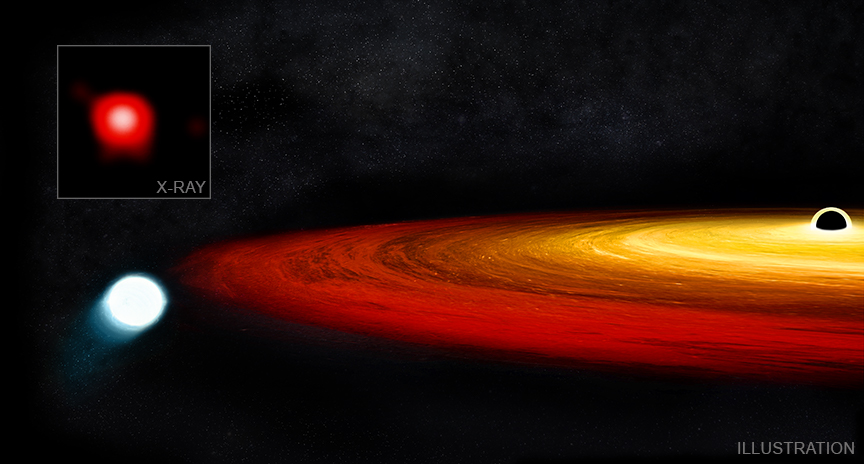
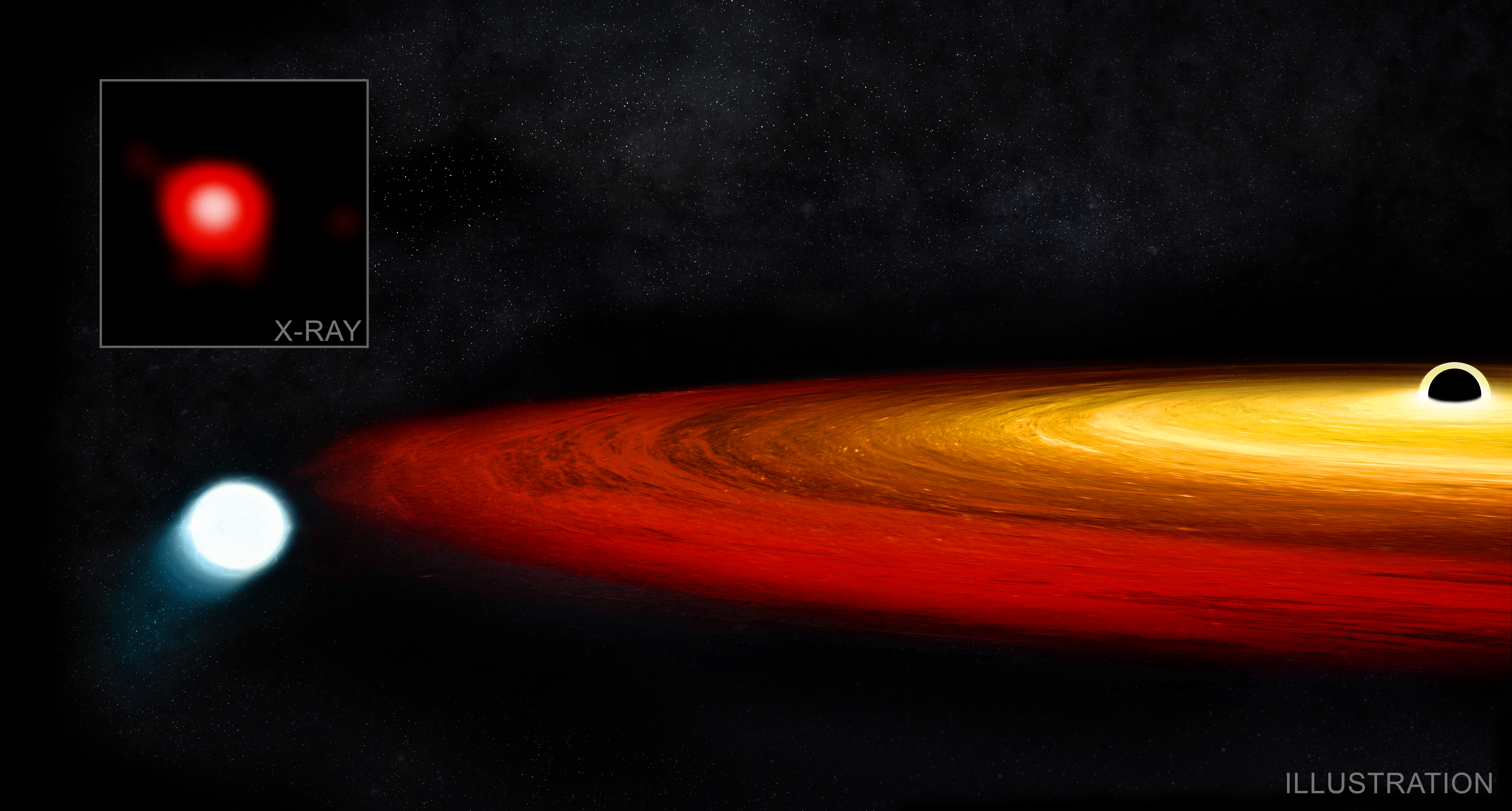
Data from NASA's Chandra X-ray Observatory and ESA's XMM-Newton indicate that a star survived a close call with a black hole, as described in our latest press release. As a red giant star approached a supermassive black hole in the galaxy GSN 069, it was caught in the black hole's gravity. Once captured, the outer layers of the red giant containing hydrogen were stripped off and careened toward the black hole, leaving the core of the star — known as a white dwarf — behind. 

The white dwarf is now in a highly elliptical orbit that completes one cycle about once every 9 hours. As its nearest point in its oval-shaped path, the white dwarf is no more than 15 times the radius of the event horizon — the point of no return — away from the black hole. This artist's illustration shows the white dwarf (on the left) when it is nearing the point of closest approach, and is being stretched by the strong gravity of the black hole (on the far right). The white dwarf should be travelling at a noticeable fraction of the speed of light at this point. At closest approach the black hole pulls material from the white dwarf into an encircling disk. This transfer releases a burst of X-rays that Chandra and XMM-Newton can detect every 9 hours. The inset is a time-lapse of Chandra data taken over a period of about 20 hours on February 14 and 15, 2019, centered on the X-ray source in the middle of GSN 069. The sequence loops to show that the X-ray brightness of the source changes regularly and dramatically over the Chandra observation. The black hole and white dwarf pair should also emit gravitational waves, especially at their nearest point.

Because the white dwarf is so close to the black hole, effects from the Theory of General Relativity mean that the direction of the orbit's axis should rotate with time, or "precess", so that multiple orbits make a rosette-shaped pattern. This rotation should repeat every two days and may be detectable with sufficiently long observations.

Schematic Showing White Dwarf Orbit
Credit: NASA/CXC/M. Weiss

What would be the future of the star and its orbit? The combined effect of gravitational waves and an increase in the star's size as it loses mass should cause the orbit to become more circular and grow in size over time. In this case, the rate of mass loss steadily slows down, and the white dwarf slowly spirals away from the black hole. About a trillion years in the future, the white dwarf could lose enough mass to become a planet with a mass similar to Jupiter.

Astronomers have found many stars that have been completely torn apart by encounters with black holes (so-called tidal disruption events), but there are very few reported cases of near misses, where the star likely survived. Grazing encounters like this should be more common than direct collisions given the statistics of cosmic traffic patterns, but they could easily be missed for a couple of reasons. First, it can take a more massive, surviving star too long to complete an orbit around a black hole for astronomers to see repeated bursts. Another issue is that supermassive black holes that are much more massive than the one in GSN 069 may directly swallow a star rather than the star falling into orbits where they periodically lose mass. In these cases, astronomers wouldn't observe anything.

A paper describing these results by Andrew King (University of Leicester, United Kingdom) appears in the March 2020 issue of the Monthly Notices of the Royal Astronomical Society, and is available online. NASA's Marshall Space Flight Center manages the Chandra program. The Smithsonian Astrophysical Observatory's Chandra X-ray Center controls science and flight operations from Cambridge and Burlington, Massachusetts.

What would be the future of the star and its orbit? The combined effect of gravitational waves and an increase in the star's size as it loses mass should cause the orbit to become more circular and grow in size over time. In this case, the rate of mass loss steadily slows down, and the white dwarf slowly spirals away from the black hole. About a trillion years in the future, the white dwarf could lose enough mass to become a planet with a mass similar to Jupiter.

Astronomers have found many stars that have been completely torn apart by encounters with black holes (so-called tidal disruption events), but there are very few reported cases of near misses, where the star likely survived. Grazing encounters like this should be more common than direct collisions given the statistics of cosmic traffic patterns, but they could easily be missed for a couple of reasons. First, it can take a more massive, surviving star too long to complete an orbit around a black hole for astronomers to see repeated bursts. Another issue is that supermassive black holes that are much more massive than the one in GSN 069 may directly swallow a star rather than the star falling into orbits where they periodically lose mass. In these cases, astronomers wouldn't observe anything.

A paper describing these results by Andrew King (University of Leicester, United Kingdom) appears in the March 2020 issue of the Monthly Notices of the Royal Astronomical Society, and is available online. NASA's Marshall Space Flight Center manages the Chandra program. The Smithsonian Astrophysical Observatory's Chandra X-ray Center controls science and flight operations from Cambridge and Burlington, Massachusetts.

A Quick Look at a Star Survives Close Call with a Black Hole


Source: NASA’s Chandra X-ray Observatory


Fast Facts for GSN 069:

Scale: X-ray image is about 11 arcsec (13,000 light years) across.
Category: Quasars & Active Galaxies, Black Holes
Coordinates (J2000): RA 1h 19m 08.67s | Dec -34° 11´ 30.1"
Constellation: Sculptor
Observation Date: Feb 14, 2019
Observation Time: 16 hours 33 minutes
Obs. ID: 22096
Instrument: ACIS
References: King, A., 2020, MNRAS, 493, L120; arXiv:2002.00970
Color Code: X-ray: red
Distance Estimate: About 250 million light years


Wednesday, April 15, 2020

NASA Missions Help Reveal the Power of Shock Waves in a Nova Explosion

A GIF cycles between an image of V906 Carinae taken on April 7, 2018, about 18 days after the nova's discovery and near its peak brightness, and one showing its faded appearance on May 4, 2019. Credit: Copyright 2018 by W. Paech + F. Hofmann, Team Chamaeleon, Chamaeleon and Onjala Observatory, Namibia, used with permission.​

Unprecedented observations of a nova outburst in 2018 by a trio of satellites, including two NASA missions, have captured the first direct evidence that most of the explosion’s visible light arose from shock waves — abrupt changes of pressure and temperature formed in the explosion debris.

A nova is a sudden, short-lived brightening of an otherwise inconspicuous star. It occurs when a stream of hydrogen from a companion star flows onto the surface of a white dwarf, a compact stellar cinder not much larger than Earth. NASA’s Fermi and NuSTAR space telescopes, together with the Canadian BRITE-Toronto satellite and several ground-based facilities, studied the nova.

NASA’s Fermi and NuSTAR space telescopes, together with another satellite named BRITE-Toronto, are providing new insights into a nova explosion that erupted in 2018. Detailed measurements of bright flares in the explosion clearly show that shock waves power most of the nova's visible light. Credits: NASA’s Goddard Space Flight Center.  Download high-resolution video and images from NASA’s Scientific Visualization Studio

“Thanks to an especially bright nova and a lucky break, we were able to gather the best-ever visible and gamma-ray observations of a nova to date,” said Elias Aydi, an astronomer at Michigan State University in East Lansing who led an international team from 40 institutions. “The exceptional quality of our data allowed us to distinguish simultaneous flares in both optical and gamma-ray light, which provides smoking-gun evidence that shock waves play a major role in powering some stellar explosions.”

The 2018 outburst originated from a star system later dubbed V906 Carinae, which lies about 13,000 light-years away in the constellation Carina. Over time — perhaps tens of thousands of years for a so-called classical nova like V906 Carinae — the white dwarf’s deepening hydrogen layer reaches critical temperatures and pressures. It then erupts in a runaway reaction that blows off all of the accumulated material.

Each nova explosion releases a total of 10,000 to 100,000 times the annual energy output of our Sun. Astronomers discover about 10 novae each year in our galaxy.

Fermi detected its first nova in 2010 and has observed 14 to date. Although X-ray and radio studies had shown the presence of shock waves in nova debris in the weeks after the explosions reached peak brightness, the Fermi discovery came as a surprise.

Gamma rays — the highest-energy form of light — require processes that accelerate subatomic particles to extreme energies. When these particles interact with each other and with other matter, they produce gamma rays. But astronomers hadn’t expected novae to be powerful enough to produce the required degree of acceleration.

Because the gamma rays appear at about the same time as the peak in visible light, astronomers concluded that shock waves play a more fundamental role in the explosion and its aftermath.

In 2015, a paper led by Brian Metzger at Columbia University in New York showed how comparing Fermi gamma-ray data with optical observations would allow scientists to learn more about nova shock waves. In 2017, a study led by Kwon-Lok Li at Michigan State found that the overall gamma-ray and visible emissions rose and fell in step in a nova known as V5856 Sagittarii. This implied shock waves produced more of the eruption’s light than the white dwarf itself.

The new observations from V906 Carinae, presented in a paper led by Aydi and published on Monday, April 13, in Nature Astronomy, spectacularly confirm this conclusion.

On March 20, 2018, the All-Sky Automated Survey for Supernovae, a set of two dozen robotic telescopes distributed around the globe and operated by Ohio State University, discovered the nova. 
By month’s end, V906 Carinae was dimly visible to the naked eye.

Fortuitously, a satellite called BRITE-Toronto was already studying the nova’s patch of sky. This miniature spacecraft is one of five 7.9-inch (20 centimeter) cubic nanosatellites comprising the Bright Target Explorer (BRITE) Constellation. Operated by a consortium of universities from Canada, Austria and Poland, the BRITE satellites study the structure and evolution of bright stars and observe how they interact with their environments.

BRITE-Toronto was monitoring a red giant star called HD 92063, whose image overlapped the nova’s location. The satellite observed the star for 16 minutes out of every 98-minute orbit, returning about 600 measurements each day and capturing the nova’s changing brightness in unparalleled detail.

“BRITE-Toronto revealed eight brief flares that fired up around the time the nova reached its peak, each one nearly doubling the nova’s brightness,” said Kirill Sokolovsky at Michigan State. “We’ve seen hints of this behavior in ground-based measurements, but never so clearly. Usually we monitor novae from the ground with many fewer observations and often with large gaps, which has the effect of hiding short-term changes.”

Fermi, on the other hand, almost missed the show. Normally its Large Area Telescope maps gamma rays across the entire sky every three hours. But when the nova appeared, the Fermi team was busy troubleshooting the spacecraft’s first hardware problem in nearly 10 years of orbital operations — a drive on one of its solar panels stopped moving in one direction. Fermi returned to work just in time to catch the nova’s last three flares.

In fact, V906 Carinae was at least twice as bright at billion-electron-volt, or GeV, energies as any other nova Fermi has observed. For comparison, the energy of visible light ranges from about 2 to 3 electron volts.

“When we compare the Fermi and BRITE data, we see flares in both at about the same time, so they must share the same source — shock waves in the fast-moving debris,” said Koji Mukai, an astrophysicist at the University of Maryland Baltimore County and NASA’s Goddard Space Flight Center in Greenbelt, Maryland. “When we look more closely, there is an indication that the flares in gamma rays may lead the flares in the visible. The natural interpretation is that the gamma-ray flares drove the optical changes.”

V906 Carinae (circled) shines near peak brightness in this image taken on March 23, 2018, three days after the nova was discovered. The beautiful cloud of gas and dust dominating the picture is part of the Carina Nebula. Credits: Copyright 2018 by A. Maury and J. Fabrega, used with permission

The team also observed the eruption’s final flare using NASA’s NuSTAR space telescope, which is only the second time the spacecraft has detected X-rays during a nova’s optical and gamma-ray emission. The nova’s GeV gamma-ray output far exceeded the NuSTAR X-ray emission, likely because the nova ejecta absorbed most of the X-rays. High-energy light from the shock waves was repeatedly absorbed and reradiated at lower energies within the nova debris, ultimately only escaping at visible wavelengths.

Putting all of the observations together, Aydi and his colleagues describe what they think happened when V906 Carinae erupted. During the outburst’s first few days, the orbital motion of the stars swept a thick debris cloud made of multiple shells of gas into a doughnut shape that appeared roughly edge-on from our perspective. The cloud expanded outward at less than about 1.3 million mph (2.2 million kph), comparable to the average speed of the solar wind flowing out from the Sun.

Next, an outflow moving about twice as fast slammed into denser structures within the doughnut, creating shock waves that emitted gamma rays and visible light, including the first four optical flares.

Finally, about 20 days after the explosion, an even faster outflow crashed into all of the slower debris at around 5.6 million mph (9 million kph). This collision created new shock waves and another round of gamma-ray and optical flares. The nova outflows likely arose from residual nuclear fusion reactions on the white dwarf’s surface.

Astronomers have proposed shock waves as a way to explain the power radiated by various kinds of short-lived events, such as stellar mergers, supernovae — the much bigger blasts associated with the destruction of stars — and tidal disruption events, where black holes shred passing stars. The BRITE, Fermi and NuSTAR observations of V906 Carinae provide a dramatic record of such a process.   Further studies of nearby novae will serve as laboratories for better understanding the roles shock waves play in other more powerful and more distant events.

The Fermi Gamma-ray Space Telescope is an astrophysics and particle physics partnership managed by NASA's Goddard Space Flight Center in Greenbelt, Maryland. Fermi was developed in collaboration with the U.S. Department of Energy, with important contributions from academic institutions and partners in France, Germany, Italy, Japan, Sweden and the United States.

NuSTAR is a Small Explorer mission led by Caltech and managed by JPL for NASA's Science Mission Directorate in Washington. NuSTAR was developed in partnership with the Danish Technical University and the Italian Space Agency (ASI). The spacecraft was built by Orbital Sciences Corp. in Dulles, Virginia. NuSTAR's mission operations center is at the University of California Berkeley, and the official data archive is at NASA's High Energy Astrophysics Science Archive Research Center. ASI provides the mission's ground station and a mirror archive. Caltech manages JPL for NASA.

By Francis Reddy
NASA’s Goddard Space Flight Center, Greenbelt, Md.

Media contact:

Claire Andreoli
NASA’s Goddard Space Flight Center, Greenbelt, Md.
(301) 286-1940

 Editor: Francis Reddy


Wednesday, February 05, 2020

ALMA catches beautiful outcome of stellar fight

ALMA image of HD101584 

Location of HD101584 in the constellation of Centaurus 

Wide-field view of the region of the sky where HD101584 is located


Videos
 
ESOcast 216 Light: ALMA Catches Beautiful Outcome of Stellar Fight

Zooming into HD101584


Astronomers using the Atacama Large Millimeter/submillimeter Array (ALMA), in which ESO is a partner, have spotted a peculiar gas cloud that resulted from a confrontation between two stars. One star grew so large it engulfed the other which, in turn, spiralled towards its partner provoking it into shedding its outer layers.

Like humans, stars change with age and ultimately die. For the Sun and stars like it, this change will take it through a phase where, having burned all the hydrogen in its core, it swells up into a large and bright red-giant star. Eventually, the dying Sun will lose its outer layers, leaving behind its core: a hot and dense star called a white dwarf.

“The star system HD101584 is special in the sense that this ‘death process’ was terminated prematurely and dramatically as a nearby low-mass companion star was engulfed by the giant,” said Hans Olofsson of the Chalmers University of Technology, Sweden, who led a recent study, published in Astronomy & Astrophysics, of this intriguing object.

Thanks to new observations with ALMA, complemented by data from the ESO-operated Atacama Pathfinder EXperiment (APEX), Olofsson and his team now know that what happened in the double-star system HD101584 was akin to a stellar fight. As the main star puffed up into a red giant, it grew large enough to swallow its lower-mass partner. In response, the smaller star spiralled in towards the giant’s core but didn’t collide with it. Rather, this manoeuvre triggered the larger star into an outburst, leaving its gas layers dramatically scattered and its core exposed.

The team says the complex structure of the gas in the HD101584 nebula is due to the smaller star’s spiralling towards the red giant, as well as to the jets of gas that formed in this process. As a deadly blow to the already defeated gas layers, these jets blasted through the previously ejected material, forming the rings of gas and the bright bluish and reddish blobs seen in the nebula.

A silver lining of a stellar fight is that it helps astronomers to better understand the final evolution of stars like the Sun. “Currently, we can describe the death processes common to many Sun-like stars, but we cannot explain why or exactly how they happen. HD101584 gives us important clues to solve this puzzle since it is currently in a short transitional phase between better studied evolutionary stages. With detailed images of the environment of HD101584 we can make the connection between the giant star it was before, and the stellar remnant it will soon become,” says co-author Sofia Ramstedt from Uppsala University, Sweden.

Co-author Elizabeth Humphreys from ESO in Chile highlighted that ALMA and APEX, located in the country’s Atacama region, were crucial to enabling the team to probe “both the physics and chemistry in action” in the gas cloud. She added: “This stunning image of the circumstellar environment of HD101584 would not have been possible without the exquisite sensitivity and angular resolution provided by ALMA.”

While current telescopes allow astronomers to study the gas around the binary, the two stars at the centre of the complex nebula are too close together and too far away to be resolved. ESO’s Extremely Large Telescope, under construction in Chile’s Atacama Desert, “will provide information on the ‘heart’ of the object,” says Olofsson, allowing astronomers a closer look at the fighting pair.


More Information

This research was presented in a paper published in Astronomy & Astrophysics.

The team is composed of H. Olofsson (Department of Space, Earth and Environment, Chalmers University of Technology, Onsala Space Observatory, Sweden [Chalmers]), T. Khouri (Chalmers), M. Maercker (Chalmers), P. Bergman (Chalmers), L. Doan (Department of Physics and Astronomy, Uppsala University, Sweden [Uppsala]), D. Tafoya (National Astronomical Observatory of Japan), W. H. T. Vlemmings (Chalmers), E. M. L. Humphreys (European Southern Observatory [ESO], Garching, Germany), M. Lindqvist (Chalmers), L. Nyman (ESO, Santiago, Chile), and S. Ramstedt (Uppsala).

The Atacama Large Millimeter/submillimeter Array (ALMA), an international astronomy facility, is a partnership of ESO, the U.S. National Science Foundation (NSF) and the National Institutes of Natural Sciences (NINS) of Japan in cooperation with the Republic of Chile. ALMA is funded by ESO on behalf of its Member States, by NSF in cooperation with the National Research Council of Canada (NRC) and the National Science Council of Taiwan (NSC) and by NINS in cooperation with the Academia Sinica (AS) in Taiwan and the Korea Astronomy and Space Science Institute (KASI). ALMA construction and operations are led by ESO on behalf of its Member States; by the National Radio Astronomy Observatory (NRAO), managed by Associated Universities, Inc. (AUI), on behalf of North America; and by the National Astronomical Observatory of Japan (NAOJ) on behalf of East Asia. The Joint ALMA Observatory (JAO) provides the unified leadership and management of the construction, commissioning and operation of ALMA.

ESO is the foremost intergovernmental astronomy organisation in Europe and the world’s most productive ground-based astronomical observatory by far. It has 16 Member States: Austria, Belgium, the Czech Republic, Denmark, France, Finland, Germany, Ireland, Italy, the Netherlands, Poland, Portugal, Spain, Sweden, Switzerland and the United Kingdom, along with the host state of Chile and with Australia as a Strategic Partner. ESO carries out an ambitious programme focused on the design, construction and operation of powerful ground-based observing facilities enabling astronomers to make important scientific discoveries. ESO also plays a leading role in promoting and organising cooperation in astronomical research. ESO operates three unique world-class observing sites in Chile: La Silla, Paranal and Chajnantor. At Paranal, ESO operates the Very Large Telescope and its world-leading Very Large Telescope Interferometer as well as two survey telescopes, VISTA working in the infrared and the visible-light VLT Survey Telescope. Also at Paranal ESO will host and operate the Cherenkov Telescope Array South, the world’s largest and most sensitive gamma-ray observatory. ESO is also a major partner in two facilities on Chajnantor, APEX and ALMA, the largest astronomical project in existence. And on Cerro Armazones, close to Paranal, ESO is building the 39-metre Extremely Large Telescope, the ELT, which will become “the world’s biggest eye on the sky”.


Links 


Contacts

Hans Olofsson
Chalmers University of Technology
Onsala, Sweden
Tel: +46 31 772 5535
Email: hans.olofsson@chalmers.se

Elizabeth Humphreys
European Southern Observatory (ESO)
Santiago, Chile
Tel: +56 2 2463 6912
Email: ehumphre@eso.org

Sofia Ramstedt
Uppsala University
Uppsala, Sweden
Tel: +46 18 471 5970
Email: sofia.ramstedt@physics.uu.se

Bárbara Ferreira
ESO Public Information Officer
Garching bei München, Germany
Tel: +49 89 3200 6670
Cell: +49 151 241 664 00
Email: pio@eso.org

Source: ESO/News


Tuesday, October 22, 2019

The Clumpy and Lumpy Death of a Star

Tycho supernova remnant
Credit: X-ray: NASA/CXC/RIKEN & GSFC/T. Sato et al; Optical: DSS

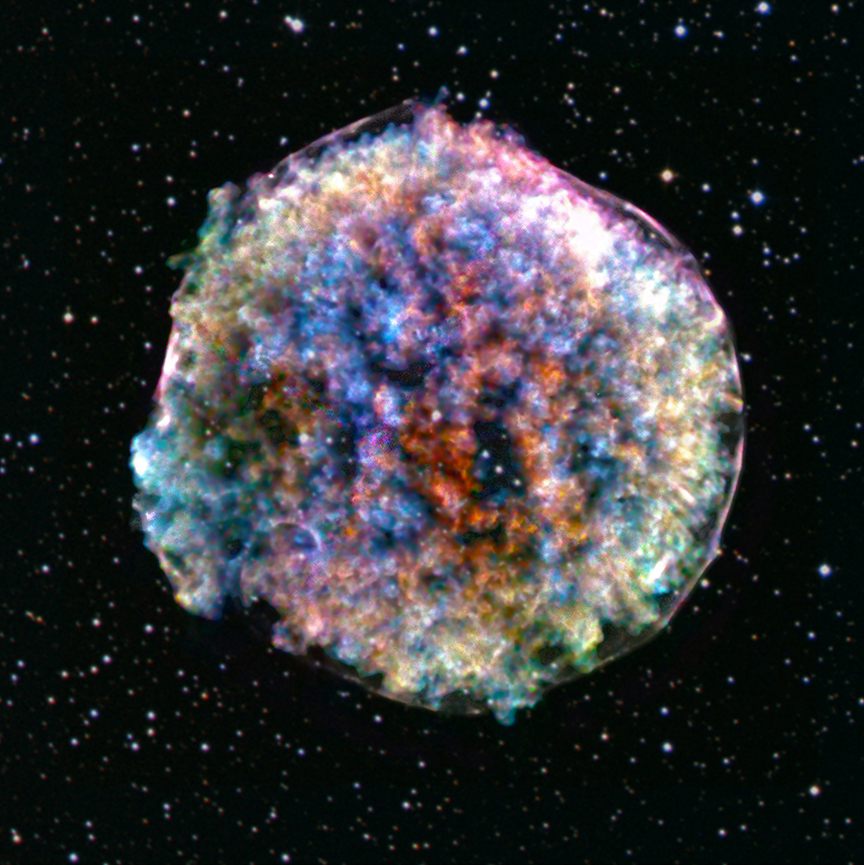
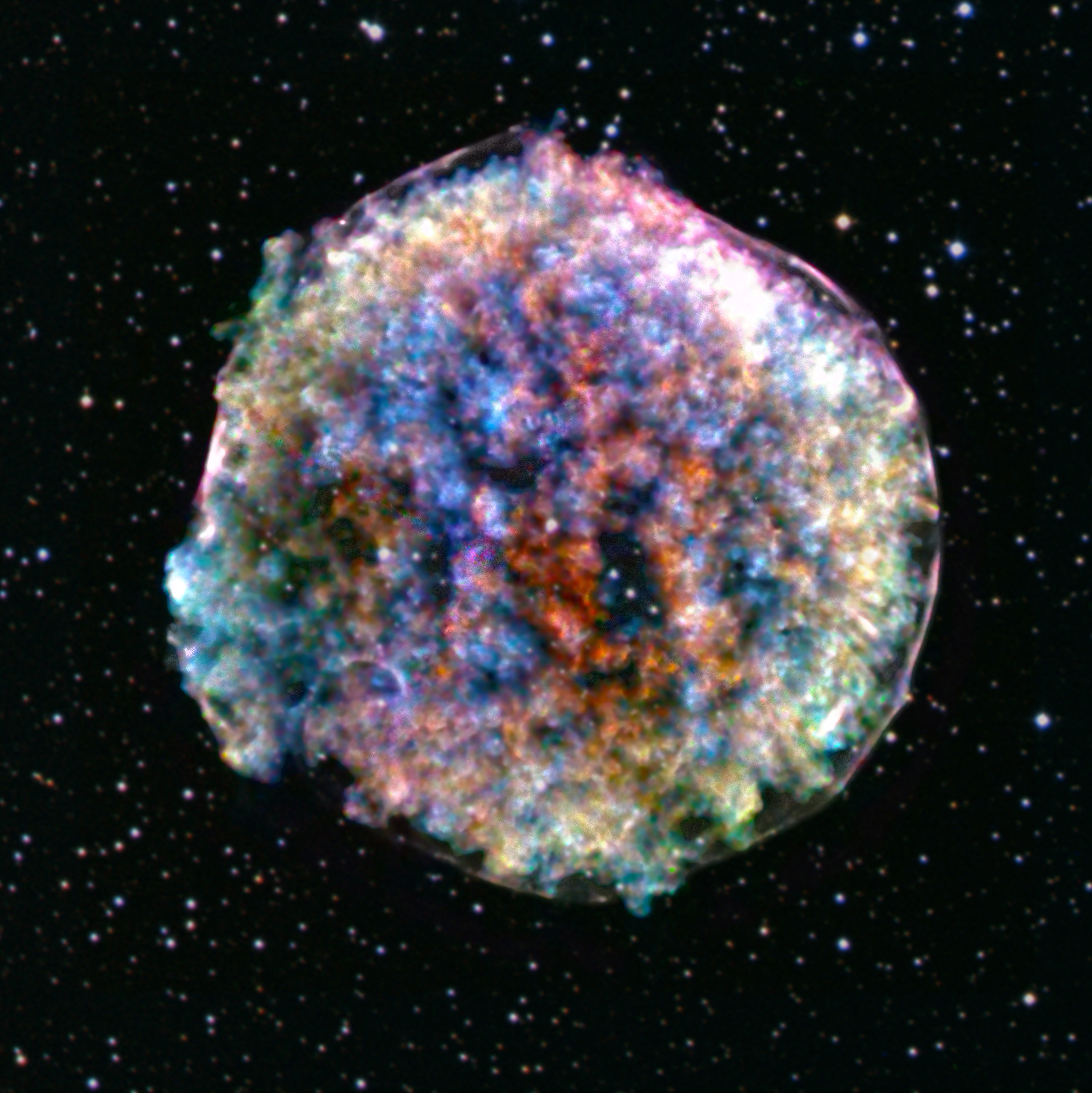
Astronomers now know that Tycho's new star was not new at all. Rather it signaled the death of a star in a supernova, an explosion so bright that it can outshine the light from an entire galaxy. This particular supernova was a Type Ia, which occurs when a white dwarf star pulls material from, or merges with, a nearby companion star until a violent explosion is triggered. The white dwarf star is obliterated, sending its debris hurtling into space.

As with many supernova remnants, the Tycho supernova remnant, as it's known today (or "Tycho," for short), glows brightly in X-ray light because shock waves — similar to sonic booms from supersonic aircraft — generated by the stellar explosion heat the stellar debris up to millions of degrees. In its two decades of operation, NASA's Chandra X-ray Observatory has captured unparalleled X-ray images of many supernova remnants. 

Chandra reveals an intriguing pattern of bright clumps and fainter areas in Tycho. What caused this thicket of knots in the aftermath of this explosion? Did the explosion itself cause this clumpiness, or was it something that happened afterward? 

This latest image of Tycho from Chandra is providing clues. To emphasize the clumps in the image and the three-dimensional nature of Tycho, scientists selected two narrow ranges of X-ray energies to isolate material (silicon, colored red) moving away from Earth, and moving towards us (also silicon, colored blue). The other colors in the image (yellow, green, blue-green, orange and purple) show a broad range of different energies and elements, and a mixture of directions of motion. In this new composite image, Chandra's X-ray data have been combined with an optical image of the stars in the same field of view from the Digitized Sky Survey.

By comparing the Chandra image of Tycho to two different computer simulations, researchers were able to test their ideas against actual data. One of the simulations began with clumpy debris from the explosion. The other started with smooth debris from the explosion and then the clumpiness appeared afterwards as the supernova remnant evolved and tiny irregularities were magnified.

A statistical analysis using a technique that is sensitive to the number and size of clumps and holes in images was then used. Comparing results for the Chandra and simulated images, scientists found that the Tycho supernova remnant strongly resembles a scenario in which the clumps came from the explosion itself. While scientists are not sure how, one possibility is that star's explosion had multiple ignition points, like dynamite sticks being set off simultaneously in different locations. 

Understanding the details of how these stars explode is important because it may improve the reliability of the use of Type Ia supernovas "standard candles" — that is, objects with known inherent brightness, which scientists can use to determine their distance. This is very important for studying the expansion of the universe. These supernovae also sprinkle elements such as iron and silicon, that are essential for life as we know it, into the next generation of stars and planets. 

A paper describing these results appeared in the July 10th, 2019 issue of The Astrophysical Journal and is available online. The authors are Toshiki Sato (RIKEN in Saitama, Japan, and NASA's Goddard Space Flight Center in Greenbelt, Maryland), John (Jack) Hughes (Rutgers University in Piscataway, New Jersey), Brian Williams, (NASA's Goddard Space Flight Center), and Mikio Morii (The Institute of Statistical Mathematics in Tokyo, Japan).

3D printed model of Tycho's Supernova Remnant
Credit: RIKEN/G. Ferrand, et al & NASA/CXC/SAO/A. Jubett, N. Wolk & K. Arcand

Another team of astronomers, led by Gilles Ferrand of RIKEN in Saitama, Japan, has constructed their own three-dimensional computer models of a Type Ia supernova remnant as it changes with time. Their work shows that initial asymmetries in the simulated supernova explosion are required so that the model of the ensuing supernova remnant closely resembles the Chandra image of Tycho, at a similar age. This conclusion is similar to that made by Sato and his team. 

A paper describing the results by Ferrand and co-authors appeared in the June 1st, 2019 issue of The Astrophysical Journal and is available online. 

NASA's Marshall Space Flight Center manages the  Chandra program. The Smithsonian Astrophysical Observatory's Chandra X-ray Center controls science and flight operations from Cambridge, Massachusetts.


Fast Facts for Tycho's Supernova Remnant:

Scale: Image is about 12 arcmin (45 light years) across.
Category: Supernovas & Supernova Remnants
Coordinates (J2000):  RA 00h 25m 17s | Dec +64° 08' 37"
Constellation:  Cassiopeia
Observation Date: 14 pointings between Oct 1, 2001 & April 22, 2016
Observation Time: 336 hours 2 minutes (14 days 0 hours 2 minutes)
Obs. ID: 115, 3837, 7539, 8551, 10093-10097; 10902-10904; 10906, 15998
Instrument: ACIS
Also Known As:  G120.1+01.4, SN 1572
References: Sato, T. et al. 2019, ApJ, 879, 64; arXiv:1903.00764
Color Code: X-ray Broadband: Red: 0.3-1.2 keV, Yellow: 1.2-1.6 keV, Cyan: 1.6-2.26 keV, Navy: 2.2-4.1 keV, Purple: 4.4-6.1 keV; X-ray Motion Shift Orange: 1.7666-1.7812 keV, Blue: 1.9564-1.971 keV; Optical: Red, Blue
Distance Estimate:  About 13,000 light years


Tuesday, September 17, 2019

Most Massive Neutron Star Ever Detected, Almost too Massive to Exist

Artist impression of the pulse from a massive neutron star being delayed by the passage of a white dwarf star between the neutron star and Earth. Credit: BSaxton, NRAO/AUI/NSF

Astronomers using the GBT have discovered the most massive neutron star to date, a rapidly spinning pulsar approximately 4,600 light-years from Earth. This record-breaking object is teetering on the edge of existence, approaching the theoretical maximum mass possible for a neutron star.

Neutron stars – the compressed remains of massive stars gone supernova – are the densest “normal” objects in the known universe. (Black holes are technically denser, but far from normal.) Just a single sugar-cube worth of neutron-star material would weigh 100 million tons here on Earth, or about the same as the entire human population. Though astronomers and physicists have studied and marveled at these objects for decades, many mysteries remain about the nature of their interiors: Do crushed neutrons become “superfluid” and flow freely? Do they breakdown into a soup of subatomic quarks or other exotic particles? What is the tipping point when gravity wins out over matter and forms a black hole?

A team of astronomers using the National Science Foundation’s (NSF) Green Bank Telescope (GBT) has brought us closer to finding the answers.

The researchers, members of the NANOGrav Physics Frontiers Center, discovered that a rapidly rotating millisecond pulsar, called J0740+6620, is the most massive neutron star ever measured, packing 2.17 times the mass of our Sun into a sphere only 30 kilometers across. This measurement approaches the limits of how massive and compact a single object can become without crushing itself down into a black hole. Recent work involving gravitational waves observed from colliding neutron stars by LIGO suggests that 2.17 solar masses might be very near that limit.

“Neutron stars are as mysterious as they are fascinating,” said Thankful Cromartie, a graduate student at the University of Virginia and Grote Reber pre-doctoral fellow at the National Radio Astronomy Observatory in Charlottesville, Virginia. “These city-sized objects are essentially ginormous atomic nuclei. They are so massive that their interiors take on weird properties. Finding the maximum mass that physics and nature will allow can teach us a great deal about this otherwise inaccessible realm in astrophysics.”

Pulsars get their name because of the twin beams of radio waves they emit from their magnetic poles. These beams sweep across space in a lighthouse-like fashion. Some rotate hundreds of times each second. Since pulsars spin with such phenomenal speed and regularity, astronomers can use them as the cosmic equivalent of atomic clocks. Such precise timekeeping helps astronomers study the nature of spacetime, measure the masses of stellar objects, and improve their understanding of general relativity.

In the case of this binary system, which is nearly edge-on in relation to Earth, this cosmic precision provided a pathway for astronomers to calculate the mass of the two stars.

Artist impression and animation of the Shapiro Delay. As the neutron star sends a steady pulse towards the Earth, the passage of its companion white dwarf star warps the space surrounding it, creating the subtle delay in the pulse signal. Animation: BSaxton, NRAO/AUI/NSF

As the ticking pulsar passes behind its white dwarf companion, there is a subtle (on the order of 10 millionths of a second) delay in the arrival time of the signals. This phenomenon is known as “Shapiro Delay.” In essence, gravity from the white dwarf star slightly warps the space surrounding it, in accordance with Einstein’s general theory of relativity. This warping means the pulses from the rotating neutron star have to travel just a little bit farther as they wend their way around the distortions of spacetime caused by the white dwarf.

Astronomers can use the amount of that delay to calculate the mass of the white dwarf. Once the mass of one of the co-orbiting bodies is known, it is a relatively straightforward process to accurately determine the mass of the other.

Cromartie is the principal author on a paper accepted for publication in Nature Astronomy. The GBT observations were research related to her doctoral thesis, which proposed observing this system at two special points in their mutual orbits to accurately calculate the mass of the neutron star.

“The orientation of this binary star system created a fantastic cosmic laboratory,” said Scott Ransom, an astronomer at NRAO and coauthor on the paper. “Neutron stars have this tipping point where their interior densities get so extreme that the force of gravity overwhelms even the ability of neutrons to resist further collapse. Each “most massive” neutron star we find brings us closer to identifying that tipping point and helping us to understand the physics of matter at these mindboggling densities.”

These observation were also part of a larger observing campaign known as NANOGrav, short for the North American Nanohertz Observatory for Gravitational Waves, which is a Physics Frontiers Center funded by the NSF.

The National Radio Astronomy Observatory is a facility of the National Science Foundation, operated under cooperative agreement by Associated Universities, Inc.

The Green Bank Observatory is supported by the National Science Foundation, and is operated under cooperative agreement by Associated Universities, Inc. Any opinions, findings and conclusions or recommendations expressed in this material do not necessarily reflect the views of the National Science Foundation.


Media Contact

Jill Malusky
Public Relations Specialist
Green Bank Observatory
304-456-2236


Scientific Contacts

Karen O’Neill
Site Director
Green Bank Observatory
304-456-2130

Ryan Lynch
Staff Scientist
Green Bank Observatory
304-456-2357


Friday, April 19, 2019

Hubble Celebrates its 29th Birthday with Unrivaled View of the Southern Crab Nebula

The Crab of the Southern Sky

Southern Crab Nebula

Formation of the Southern Crab Nebula (artist's impression)


Videos

Hubblecast 119: Hubble’s 29th anniversary

Zooming in on the Southern Crab Nebula

Formation of the Southern Crab Nebula


This incredible image of the hourglass-shaped Southern Crab Nebula was taken to mark the NASA/ESA Hubble Space Telescope’s 29th anniversary in space. The nebula, created by a binary star system, is one of the many objects that Hubble has demystified throughout its productive life. This new image adds to our understanding of the nebula and demonstrates the telescope’s continued capabilities.

On 24 April 1990, the NASA/ESA Hubble Space Telescope was launched on the space shuttle Discovery. It has since revolutionised how astronomers and the general public see the Universe. The images it provides are spectacular from both a scientific and a purely aesthetic point of view.

Each year the telescope dedicates a small portion of its precious observing time to take a special anniversary image, focused on capturing particularly beautiful and meaningful objects. This year’s image is the Southern Crab Nebula, and it is no exception [1].

This peculiar nebula, which exhibits nested hourglass-shaped structures, has been created by the interaction between a pair of stars at its centre. The unequal pair consists of a red giant and a white dwarf. The red giant is shedding its outer layers in the last phase of its life before it too lives out its final years as a white dwarf. Some of the red giant’s ejected material is attracted by the gravity of its companion.

When enough of this cast-off material is pulled onto the white dwarf, it too ejects the material outwards in an eruption, creating the structures we see in the nebula. Eventually, the red giant will finish throwing off its outer layers, and stop feeding its white dwarf companion. Prior to this, there may also be more eruptions, creating even more intricate structures
Astronomers did not always know this, however. The object was first written about in 1967, but was assumed to be an ordinary star until 1989, when it was observed using telescopes at the European Southern Observatory’s La Silla Observatory. The resulting image showed a roughly crab-shaped extended nebula, formed by symmetrical bubbles of gas and dust.

These observations only showed the outer hourglass emanating from a bright central region that could not be resolved. It was not until Hubble observed the Southern Crab in 1999 that the entire structure came into view. This image revealed the inner nested structures, suggesting that the phenomenon that created the outer bubbles had occurred twice in the (astronomically) recent past.

It is fitting that Hubble has returned to this object twenty years after its first observation. This new image adds to the story of an active and evolving object and contributes to the story of Hubble’s role in our evolving understanding of the Universe.


Notes

[1] The Southern Crab Nebula is so named to distinguish it from the better-known Crab Nebula, a supernova remnant visible in the constellation of Taurus.


More Information

  • The Hubble Space Telescope is a project of international cooperation between ESA and NASA.
  • Image credit: NASA, ESA, and STScI


Links


Contacts

Bethany Downer
ESA/Hubble, Public Information Officer
Garching, Germany
Email: bethany.downer@partner.eso.org


Tuesday, December 04, 2018

Double Trouble: A White Dwarf Surprises Astronomers

ASASSN-16oh
Illustration Credit NASA/CXC/M.Weiss


Astronomers have detected a bright X-ray outburst from a star in the Small Magellanic Cloud, a nearby galaxy almost 200,000 light years from Earth. A combination of X-ray and optical data indicate that the source of this radiation is a white dwarf star that may be the fastest-growing white dwarf ever observed.

In several billion years, our Sun will run out of most of its nuclear fuel and shrink down to a much smaller, fainter "white dwarf" star about the size of Earth. Because a mass equivalent to that of the Sun is packed into such a small volume, the gravity on the surface of a white dwarf is several hundred thousand times that of Earth.

Unlike our Sun, most stars including white dwarfs, do not exist in isolation, but instead are part of pairs called "binary systems." If the stars are close enough, the gravity of the white dwarf can pull matter away from its companion. 

A new study based on observations with NASA's Chandra X-ray Observatory and Neil Gehrels Swift Observatory has reported the discovery of distinctive X-ray emission from a binary system containing a white dwarf called ASASSN-16oh. The discovery involves the detection of low-energy — what astronomers refer to as "soft" — X-rays, produced by gas at temperatures of several hundred thousand degrees. In contrast, higher-energy X-rays reveal phenomena at temperatures of tens of millions of degrees. The X-ray emission from ASASSN-16oh is much brighter than the soft X-rays produced by the atmospheres of normal stars, placing it in the special category of a supersoft X-ray source. 

For years, astronomers have thought that supersoft X-ray emission from white dwarf stars is produced by nuclear fusion in a hot, dense layer of hydrogen and helium nuclei. This volatile material accumulated from the infall of matter from the companion star onto the surface of the white dwarf, and led to a nuclear fusion explosion much like a hydrogen bomb. 

However, ASASSN-16oh shows there is more to the story. This binary was first discovered by the All-Sky Automated Survey for Supernovae (ASASSN), a collection of about 20 optical telescopes distributed around the globe to automatically survey the entire sky every night for supernovas and other transient events. Astronomers then used Chandra and Swift to detect the supersoft X-ray emission. 

"In the past, the supersoft sources have all been associated with nuclear fusion on the surface of white dwarfs," said lead author Tom Maccarone, a professor in the Texas Tech Department of Physics & Astronomy who led the new paper that appears in the December 3rd issue of Nature Astronomy.

If nuclear fusion is the cause of the supersoft X-rays from ASASSN-16oh then it should begin with an explosion and the emission should come from the entire surface of the white dwarf. However, the optical light does not increase quickly enough to be caused by an explosion and the Chandra data show that the emission is coming from a region smaller than the surface of the white dwarf. The source is also a hundred times fainter in optical light than white dwarfs known to be undergoing fusion on their surface. These observations, plus the lack of evidence for gas flowing away from the white dwarf, provide strong arguments against fusion having taken place on the white dwarf.

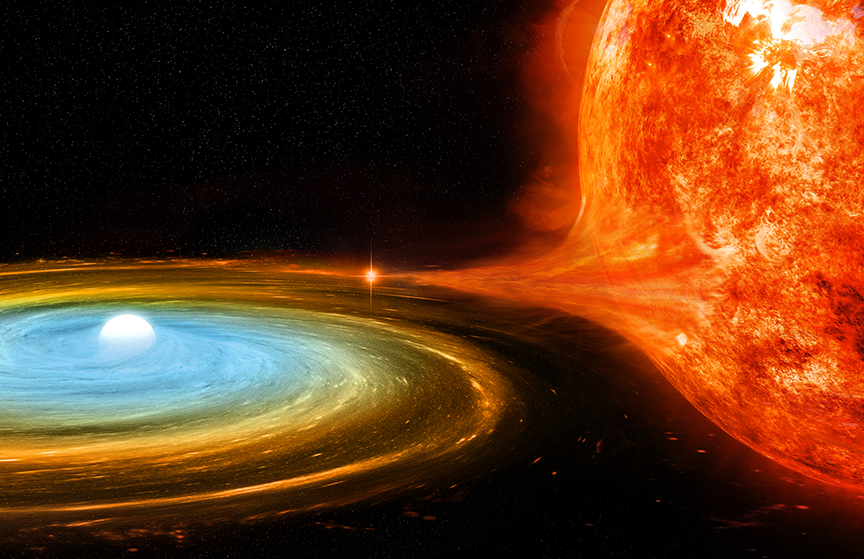
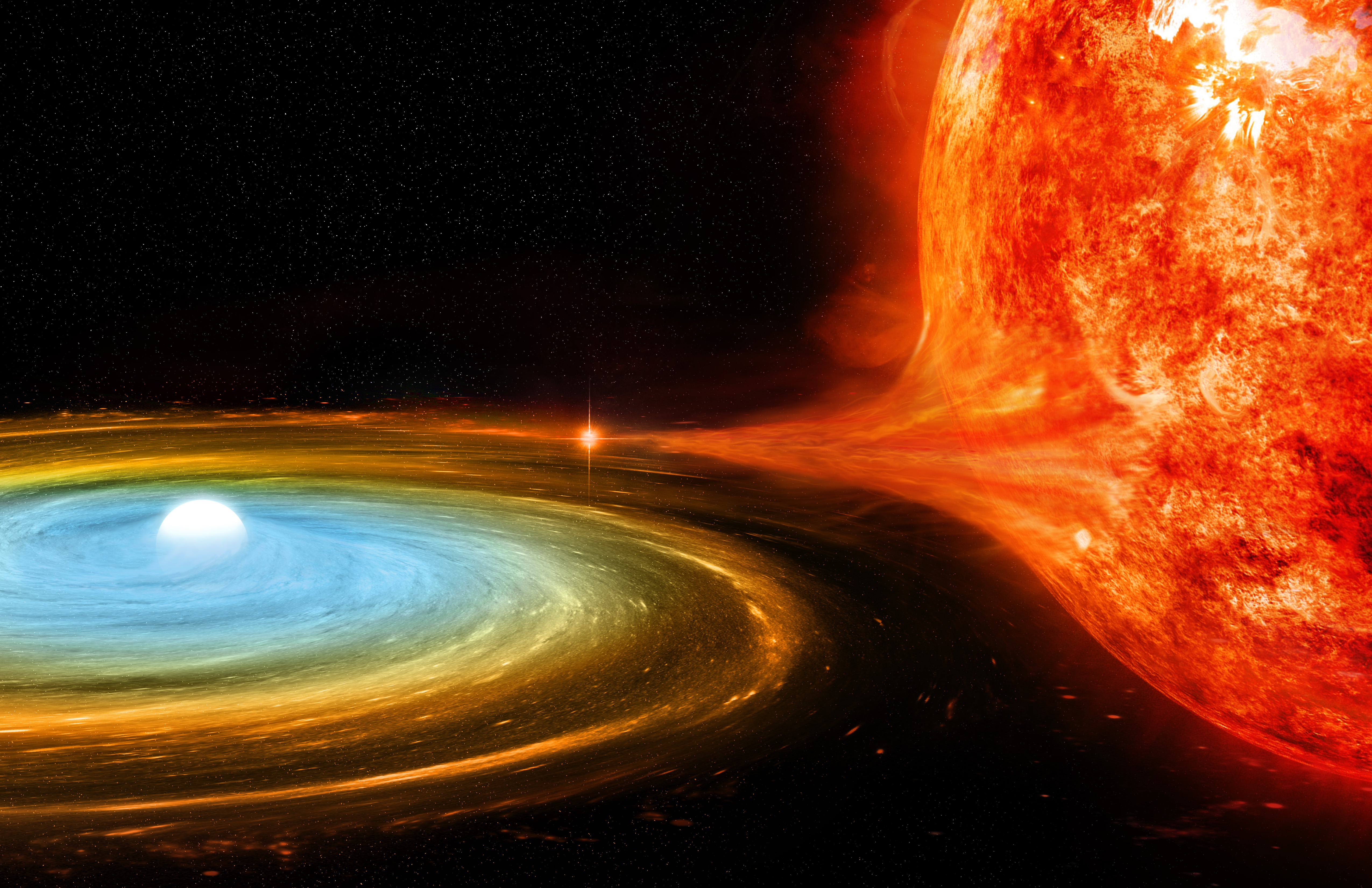
Because none of the signs of nuclear fusion are present, the authors present a different scenario. As with the fusion explanation the white dwarf is pulling gas away from a companion star, a red giant. In a process called accretion, the gas is pulled onto a large disk surrounding the white dwarf and becomes hotter as it spirals toward the white dwarf, as shown in our illustration. The gas then falls onto the white dwarf, producing X-rays along a belt where the disk meets the star. The rate of inflow of matter through the disk varies by a large amount. When the material starts flowing more quickly, the X-ray brightness of the system becomes much higher.

"The transfer of mass is happening at a higher rate than in any system we've caught in the past," added Maccarone.

If the white dwarf keeps gaining mass it may reach a mass limit and destroy itself in a Type Ia supernova explosion, a type of event used to discover that the expansion of the universe is accelerating. The team's analysis suggests that the white dwarf is already unusually massive so ASASSN-16oh may be relatively close — in astronomical terms — to exploding as a supernova.

"Our result contradicts a decades-long consensus about how supersoft X-ray emission from white dwarfs is produced," said co-author Thomas Nelson from the University of Pittsburgh. "We now know that the X-ray emission can be made in two different ways: by nuclear fusion or by the accretion of matter from a companion."

Also involved in the study were scientists from Texas A&M University, NASA Goddard Space Flight Center, University of Southampton, University of the Free State in the Republic of South Africa, the South African Astronomical Observatory, Michigan State University, State University of New Jersey, Warsaw University Observatory, Ohio State University and the University of Warwick.

NASA's Marshall Space Flight Center in Huntsville, Alabama, manages the Chandra program for NASA's Science Mission Directorate in Washington. The Smithsonian Astrophysical Observatory in Cambridge, Massachusetts, controls Chandra's science and flight operations.


Fast Facts for ASASSN-16oh:

Category: White Dwarfs & Planetary Nebulas
Coordinates (J2000): RA 1h 57m 43s | Dec -73° 37´ 32.5"
Constellation: Tucana
Observation Date: December 28, 2016
Observation Time: 13 hours 36 minutes
Obs. ID: 19983
Instrument: HRC
References: Maccarone, T et al, 2018, Nature Astronomy (published Dec 3rd)
Distance Estimate: About 200,000 light years