Showing posts with label Supernova Remnant. Show all posts

Monday, August 10, 2026

Hunting for the Source of Superfast Electrons with NuSTAR

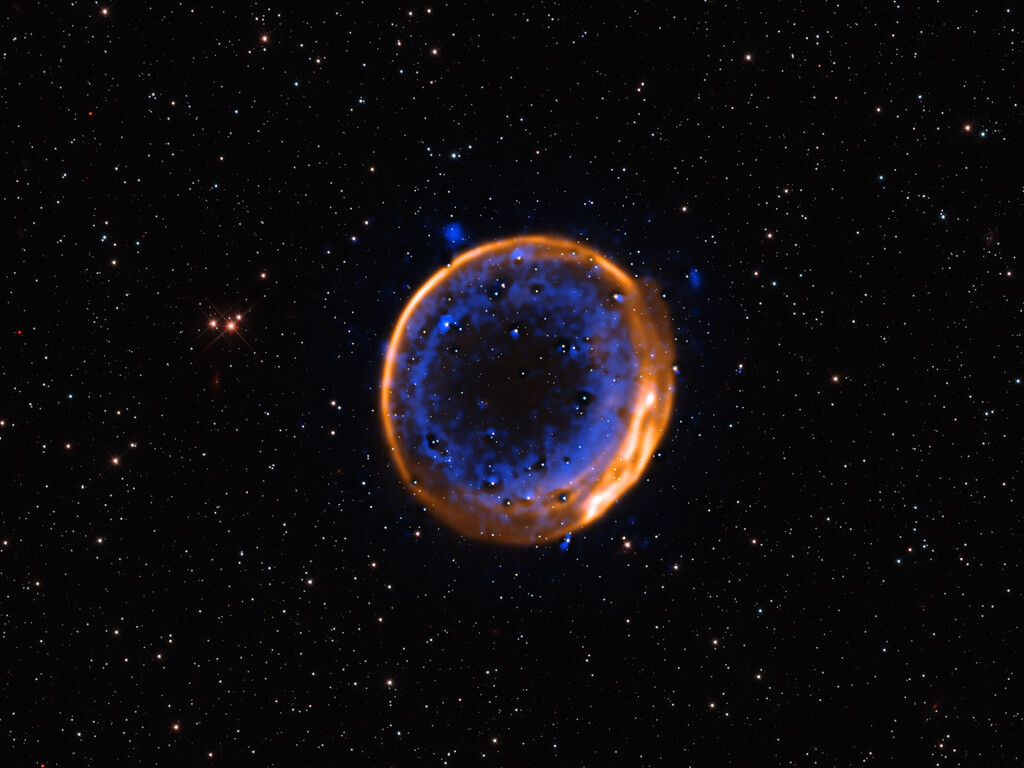
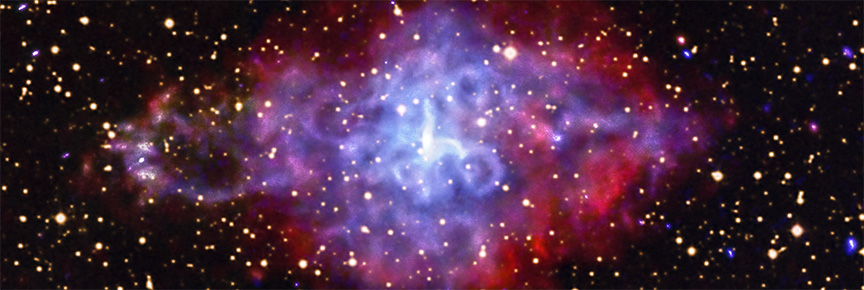
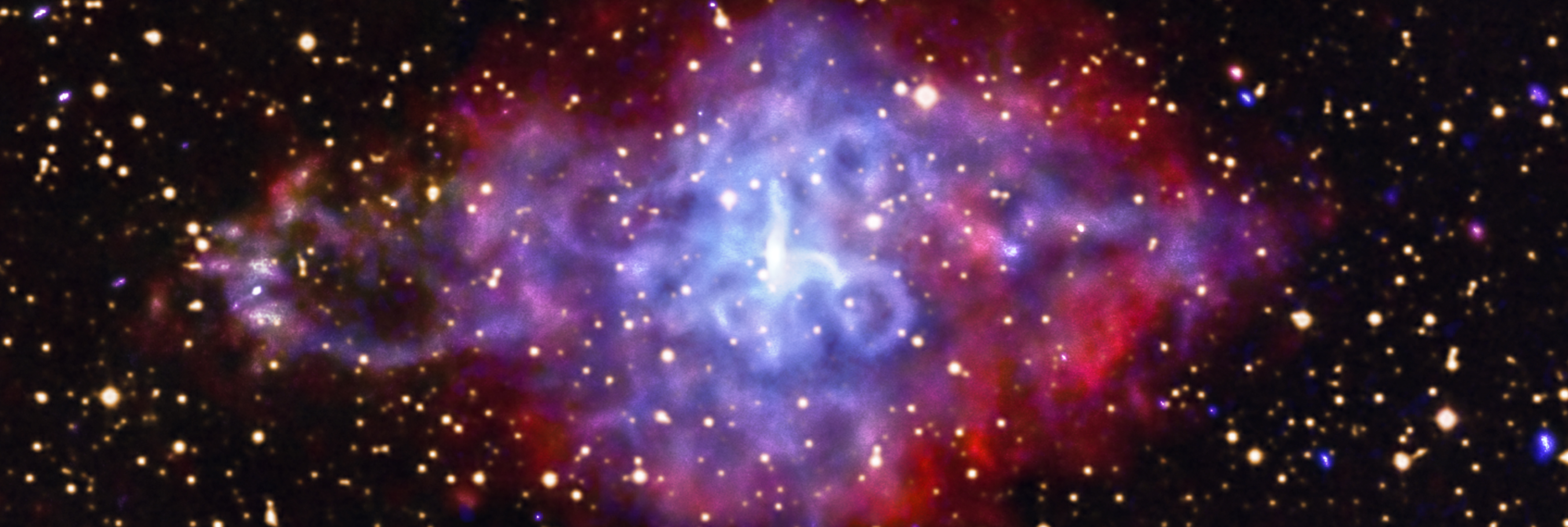
A multi-wavelength image of the supernova remnant shell of PWN G0.9+0.1, combining high-energy X-ray data from NuSTAR (green), low-energy X-ray data from XMM-Newton (blue), and radio data from MeeRKAT (red). The pulsar remnant of the supernova explosion is the compact X-ray source at the center of the image, while the brighter compact X-ray source to the lower right is unrelated. The radio data shows the shape of the nebula, as well as the fainter outer shell of the supernova remnant. Image credit: Brunelli et al. (2026)/MeerKAT (Heywood et al. 2022)/H. Earnshaw. Download Image


Earth is continuously bombarded with cosmic rays—particles such as protons and electrons flying through space incredibly fast. The faster a particle travels, the more energy it has, and a small fraction of these cosmic rays have energies greater than a petaelectronvolt, or PeV. This is about the energy of a buzzing housefly, which might not seem like a lot, but it's all contained in one single, incredibly energetic electron moving at mind-blowing, relativistic speed. Accelerating electrons to such extreme speeds takes a cosmic-scale particle accelerator, which astronomers have nicknamed a 'PeVatron'. But what kind of astronomical source could be capable of such a feat?

Pulsar wind nebulae are some of the most fascinating objects in our Galaxy. They are created in the aftermath of a supernova, the explosion of a massive star at the end of its life when it has exhausted its fuel supply. Supernovae usually leave behind a compact remnant, either a black hole or a neutron star, and a rapidly spinning neutron star can appear to pulse, almost like a light house. This inspired the term “pulsar” to describe such remnants. A rapidly spinning pulsar will illuminate the extended bubble of outflowing material from the explosion, producing highly energetic particles accelerated by the strong magnetic field of the nebula. Pulsar wind nebulae can be detected at X-ray and even gamma-ray energies, making these cosmic powerhouses ideal candidates in the hunt for PeVatrons.

Dr. Kaya Mori of Columbia University is leading a large program with NASA’s NuSTAR X-ray satellite to hunt for PeVatrons in pulsar wind nebulae in our Galaxy. NuSTAR is the first satellite to focus high-energy X-ray photons, making it the most sensitive instrument for studying the Universe at X-ray energies above 10 keV, roughly the energy of X-ray machines you'd find at a hospital. One of the nebulae studied is this program is G0.9+0.1, a young supernova remnant in the Galactic Center. In a recent paper published in the Astrophysical Journal led by PhD student Giulia Brunelli at INAF Bologna, high-energy X-ray data from NuSTAR is combined with multiwavelength data from radio and gamma-ray observatories. Modeling these observations, the team determined that this pulsar wind nebula is very young—about 2,200 years old—and capable of accelerating electrons up to 2 PeV. This makes G0.9+0.1 a compelling PeVatron candidate, meaning that it—and perhaps other pulsar wind nebulae churning away in the Galactic Center—may be one of the objects responsible for some of the highest-energy particles arriving at Earth.


Friday, June 19, 2026

Hunting for the Source of Superfast Electrons with NuSTAR

A multi-wavelength image of the supernova remnant shell of PWN G0.9+0.1, combining high-energy X-ray data from NuSTAR (green), low-energy X-ray data from XMM-Newton (blue), and radio data from MeeRKAT (red). The pulsar remnant of the supernova explosion is the compact X-ray source at the center of the image, while the brighter cnewsompact X-ray source to the lower right is unrelated. The radio data shows the shape of the nebula, as well as the fainter outer shell of the supernova remnant. Image credit: Brunelli et al. (2026)/MeerKAT (Heywood et al. 2022)/H. Earnshaw.
Download Image


Earth is continuously bombarded with cosmic rays—particles such as protons and electrons flying through space incredibly fast. The faster a particle travels, the more energy it has, and a small fraction of these cosmic rays have energies greater than a petaelectronvolt, or PeV. This is about the energy of a buzzing housefly, which might not seem like a lot, but it's all contained in one single, incredibly energetic electron moving at mind-blowing, relativistic speed. Accelerating electrons to such extreme speeds takes a cosmic-scale particle accelerator, which astronomers have nicknamed a 'PeVatron'. But what kind of astronomical source could be capable of such a feat?

Pulsar wind nebulae are some of the most fascinating objects in our Galaxy. They are created in the aftermath of a supernova, the explosion of a massive star at the end of its life when it has exhausted its fuel supply. Supernovae usually leave behind a compact remnant, either a black hole or a neutron star, and a rapidly spinning neutron star can appear to pulse, almost like a light house. This inspired the term “pulsar” to describe such remnants. A rapidly spinning pulsar will illuminate the extended bubble of outflowing material from the explosion, producing highly energetic particles accelerated by the strong magnetic field of the nebula. Pulsar wind nebulae can be detected at X-ray and even gamma-ray energies, making these cosmic powerhouses ideal candidates in the hunt for PeVatrons.

Dr. Kaya Mori of Columbia University is leading a large program with NASA’s NuSTAR X-ray satellite to hunt for PeVatrons in pulsar wind nebulae in our Galaxy. NuSTAR is the first satellite to focus high-energy X-ray photons, making it the most sensitive instrument for studying the Universe at X-ray energies above 10 keV, roughly the energy of X-ray machines you'd find at a hospital. One of the nebulae studied is this program is G0.9+0.1, a young supernova remnant in the Galactic Center. In a recent paper published in the Astrophysical Journal led by PhD student Giulia Brunelli at INAF Bologna, high-energy X-ray data from NuSTAR is combined with multiwavelength data from radio and gamma-ray observatories. Modeling these observations, the team determined that this pulsar wind nebula is very young—about 2,200 years old—and capable of accelerating electrons up to 2 PeV. This makes G0.9+0.1 a compelling PeVatron candidate, meaning that it—and perhaps other pulsar wind nebulae churning away in the Galactic Center—may be one of the objects responsible for some of the highest-energy particles arriving at Earth.


Friday, April 03, 2026

NASA's IXPE and Chandra Take a New Look at an Old Supernova

RCW 86
Credit: X-ray: Chandra: NASA/CXC/SAO, XMM: ESA/XMM-NEWTON, IXPE:NASA/MSFC;
Optical: NSF/NOIRLab; Image Processing: NASA/CXC/SAO/J. Schmidt


JPEG (278.7 kb) - Large JPEG (4.2 MB) - Tiff (21.4 MB) - More Images

Tour: NASA's Chandra Rings in New Year With Champagne Cluster (Video)


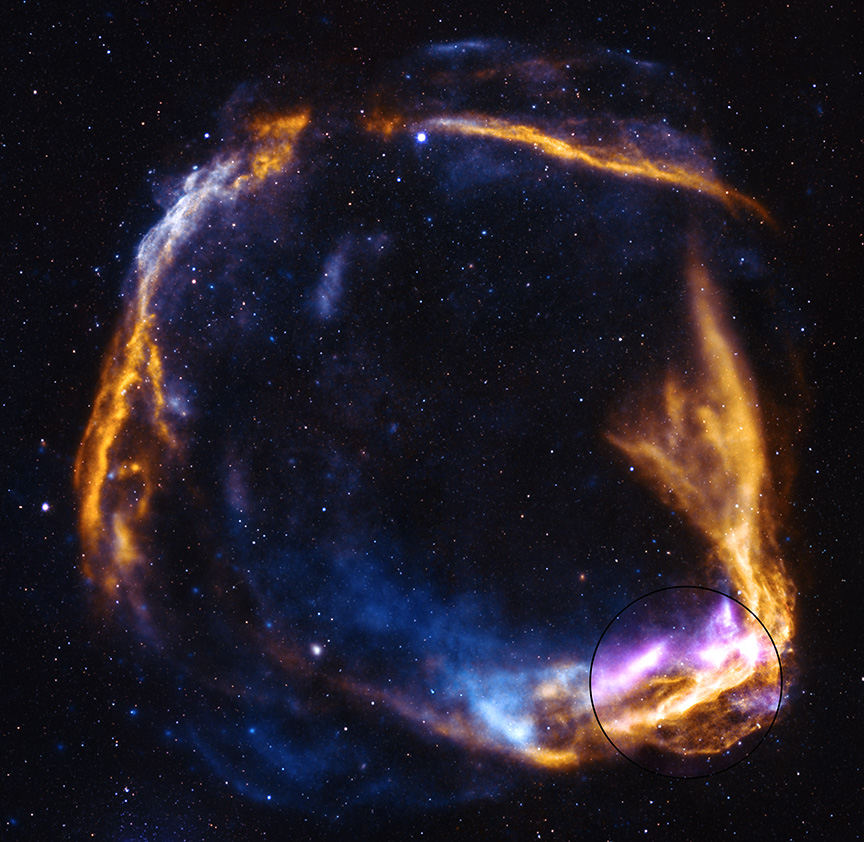
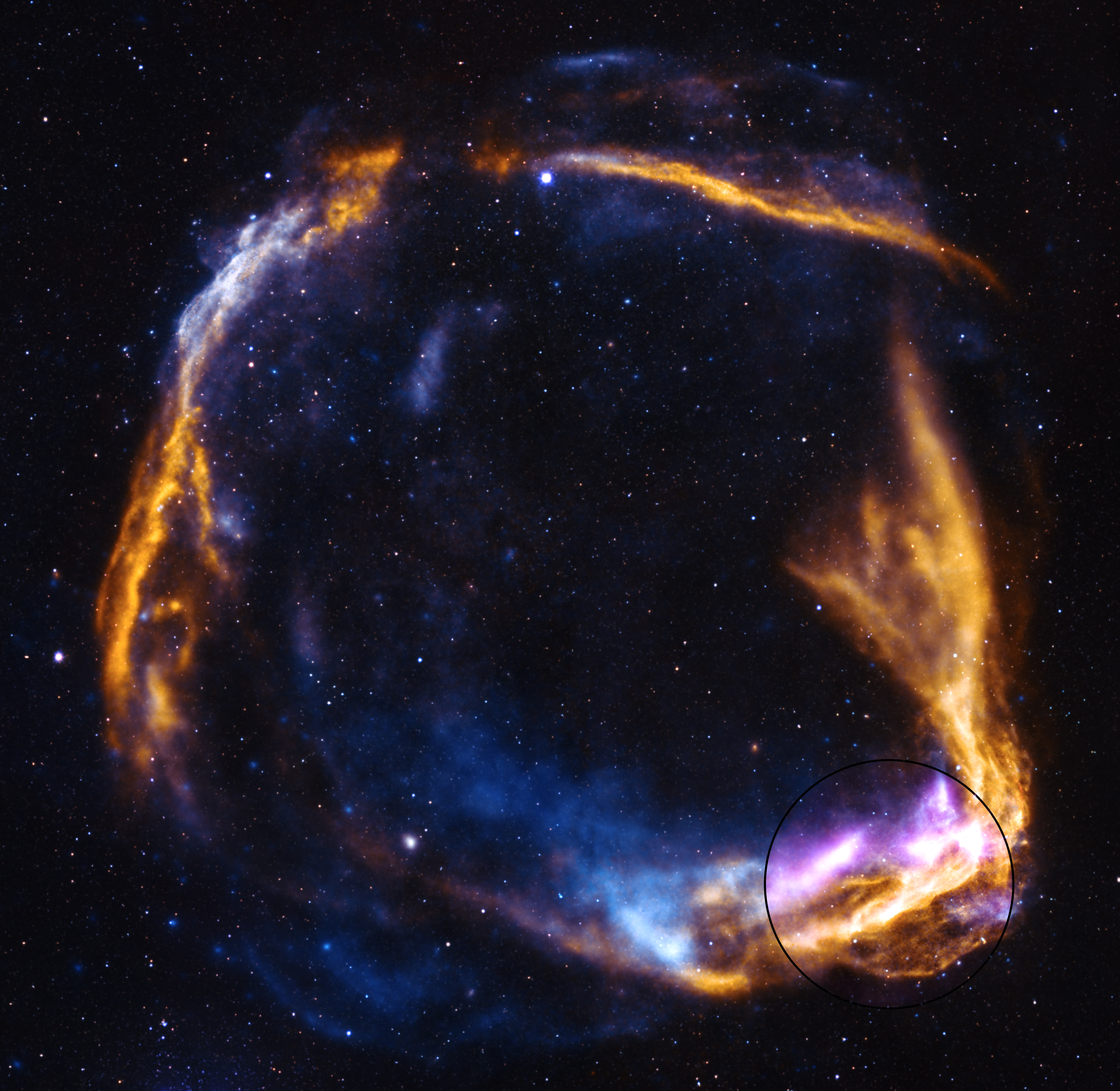
RCW 86 is approximately 8,000 light-years from Earth in the Southern constellation of Circinus, occupying a region of the sky slightly larger than the full moon. In the year 185 AD, Chinese astronomers recorded witnessing a “guest star” in this area of the night sky that remained visible for 8 months.

NASA’s IXPE observed the outer rim of the supernova remnant highlighted in purple at the lower right. When NASA’s Chandra X-ray Observatory targeted RCW 86, they discovered that a large “cavity” region around the system led the supernova to expand larger in a shorter amount of time than expected. The low-density cavity region could have led to RCW 86’s unique shape as well.

The full image puts IXPE’s data into context with legacy observations from two other X-ray telescopes: Chandra and the European Space Agency’s XMM-Newton. The yellow represents low-energy X-rays, while blue shows high-energy X-rays detected by Chandra and XMM-Newton. The starfield in the image comes from the National Science Foundation’s National Optical-Infrared Astronomy Research Laboratory (NOIRlab).

NASA's Marshall Space Flight Center in Huntsville, Alabama, manages the Chandra program. The Smithsonian Astrophysical Observatory's Chandra X-ray Center controls science operations from Cambridge, Massachusetts, and flight operations from Burlington, Massachusetts.


Visual Description:

This is an X-ray and optical image of supernova remnant RCW 86, which appears to be two slightly mismatched halves of a broken rough circle. The colors in the image are predominantly blue and gold with a spot of bright purple in the lower right corner. The texture of RCW 86 resembles that of nebulous and patchy fingers, and swirls of gas. This image combines data from four different telescopes to create a multi-wavelength view of the remains of an exploded star. X-ray images from NASA's Chandra X-ray Observatory and the ESA's XMM-Newton are combined to form the blue and gold colors in the image. The X-rays show the interstellar gas that has been heated to millions of degrees by the passage of the shock wave from the supernova. Additional X-ray data from NASA's IXPE are shown in purple, confined to a small circle in the lower right where IXPE observed. A faint starfield, a sprinkling of white stars across the image, from NSF's NOIRlab is also included.


Fast Facts for RCW 86:

Credit: X-ray: Chandra: NASA/CXC/SAO, XMM: ESA/XMM-NEWTON, IXPE:NASA/MSFC; Optical: NSF/NOIRLab; Image Processing: NASA/CXC/SAO/J. Schmid
Release Date: March 25, 2026
Scale: Image is about 43.5 arcmin (101 light-years) across.
Category: Supernovas & Supernova Remnants
Coordinates (J2000): RA 14h 43m 20.6s | Dec -62° 29´ 52.8"
Constellation: Circinus
Observation Dates: 16 observations from Feb 2001–Jan 2021
Observation Time: 164 hours 10 minutes (6 days 20 hours 10 minutes)
Obs. ID: 1993, 2805, 4611, 7642, 10699, 13748, 14890, 15608-15611, 16952, 23597, 24330, 24331, 24931
Instrument: ACIS
Also Known As: G315.4-2.1
References: Silvestri, S. et al, 2026, ApJ, 988, 172.
Color Code: X-ray: (Chandra and XMM) blue and orange, (IXPE) purple; Optical: red, green, blue
Distance Estimate: About 8,000 light-years from Earth.


Friday, September 05, 2025

NASA's Chandra Reveals Star's Inner Conflict Before Explosion

X-ray Image of Cassiopeia A
Credit: X-ray: NASA/CXC/Meiji Univ./T. Sato et al.; Image Processing: NASA/CXC/SAO/N. Wolk


JPEG (218 kb) -Large JPEG (3.6 MB) - Tiff (12 MB) - More Images

A Tour of Cassiopeia A - More Videos


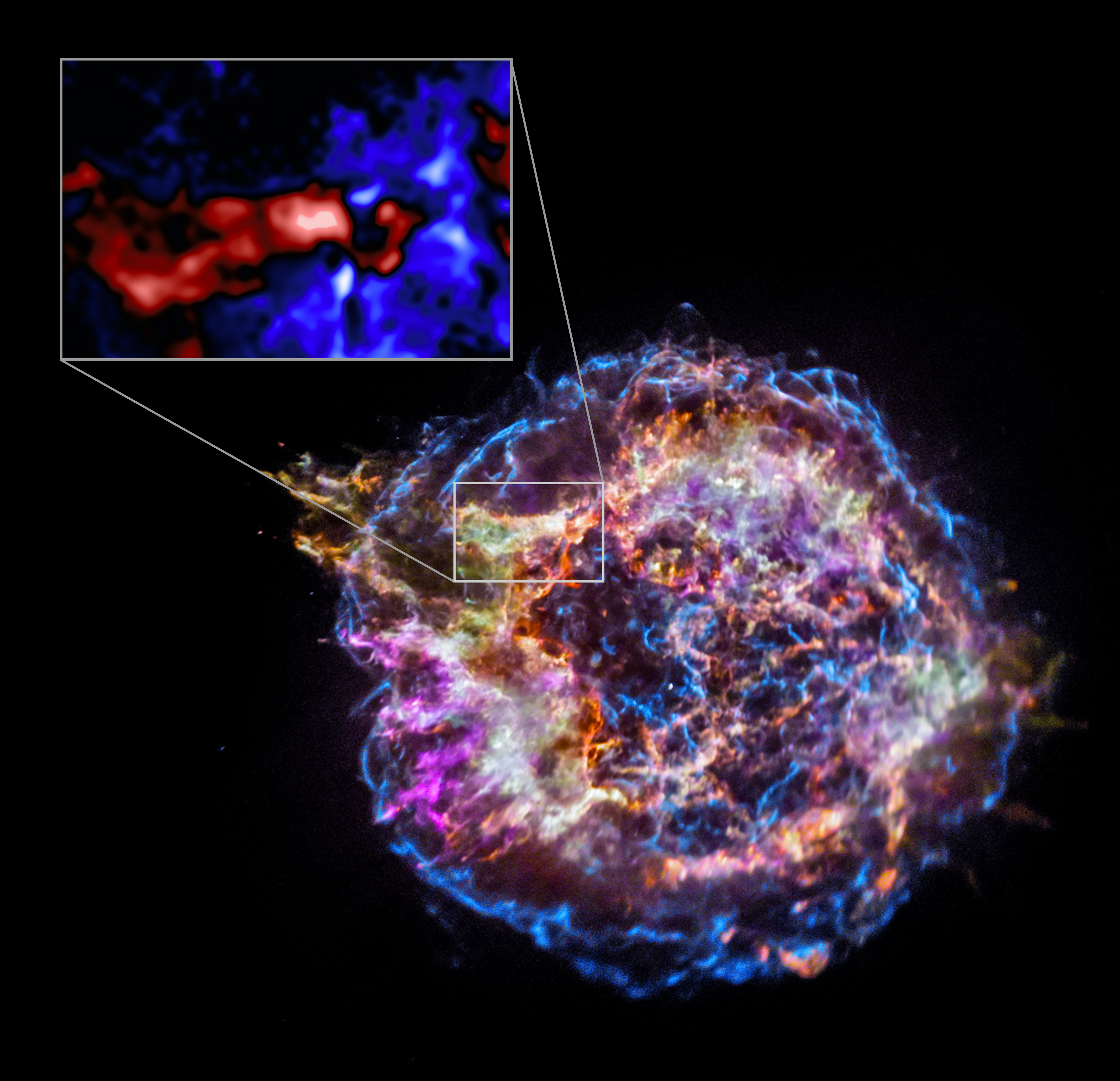
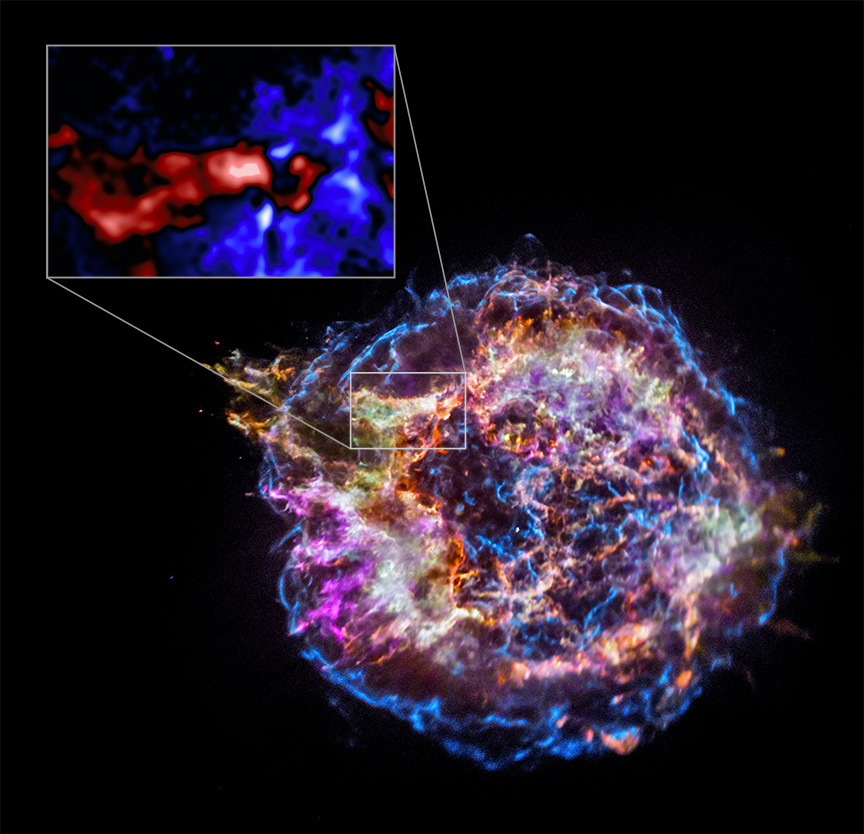
This graphic features data from NASA’s Chandra X-ray Observatory of the Cassiopeia A (Cas A) supernova remnant, a frequent target of the telescope for more than a quarter century. New Chandra data continues to reveal fresh insight into this debris field from an exploded star. In the latest result, astronomers have now used Chandra to learn that the star’s interior violently rearranged itself mere hours before it exploded, as outlined in our press release. This discovery helps scientists better understand how massive stars explode and what happens to their remains afterward.

The main panel of this graphic is Chandra data that has been selected to show the location of different elements in the remains of the explosion: silicon (red), sulfur (yellow), calcium (green) and iron (purple). The blue color reveals the highest-energy X-ray emission detected by Chandra in Cas A, with the blue outer ring highlighting the expanding blast wave from the original explosion hundreds of years ago.

The inset to the upper left zooms in a smaller region of Cas A. This reveals data collected by Chandra that picks up relative amounts of silicon and neon. Areas with large amounts of silicon but smaller amounts of neon are labeled as Silicon-rich and Neon-poor, respectively, and are colored red. Alternatively, areas where Chandra detects the opposite — large amounts of neon but smaller amounts of silicon (Neon-rich and Silicon-poor) — are blue.

Cassiopeia A: A labeled version of the main image showing the relative abundances of silicon and neon in the inset. Credit: X-ray: NASA/CXC/Meiji Univ./T. Sato et al.; Image Processing: NASA/CXC/SAO/N. Wolk

These different regions provide crucial information about the supernova's progenitor, the star that exploded to form Cas A. They give evidence that just a few hours before it exploded, the progenitor's onion-like layers of elements in its interior were disrupted. The researchers think that part of an inner layer with large amounts of silicon traveled outwards and broke into a neighboring layer with lots of neon. This upheaval not only caused material rich in silicon to travel outwards, it also forced material rich in neon to travel inwards. Clear traces of these outward silicon flows and inward neon flows in Cas A are shown in the inset image, corresponding to the Silicon-rich and Neon-poor regions, and the Neon-rich and Silicon-poor regions, respectively.

Cassiopeia A: Schematic Illustration
This illustrated figure shows a cross-section of a massive star similar to the one that created the Cas A supernova remnant. The onion-like layers are dominated by heavier and heavier elements, beginning with hydrogen, and extending to helium, carbon, oxygen, silicon and iron in the center of the star. The cross-section is shown a few hours before the star's explosion as a supernova. Silicon-rich material made in nuclear reactions involving oxygen (in the narrow "O-burning shell"), are buoyant and push outwards in silicon-rich plumes, forcing neon-rich material further out to flow inwards. The motion of these silicon-rich and neon-rich materials disrupt the narrow shell where carbon and neon are undergoing nuclear reactions (the narrow "C-/Ne-burning shell"). Credit: NASA/CXC/Meiji Univ./T. Sato et al.

Because Chandra observes the elements are not smoothly mixed in the remnant now, it suggests there was not complete mixing of the silicon and neon with other elements immediately before or after the explosion.

These results have been published in the latest issue of The Astrophysical Journal and are available online. The authors of the study are Toshiki Sato (Meiji University in Japan), Kai Matsunga (Kyoto University in Japan), Hiroyuki Uchida (Kyoto), Satoru Katsuda (Saitama University in Japan), Koh Takahashi (National Astronomical Observatory of Japan), Hideyuki Umeda (University of Toyko in Japan), Tomoya Takiwaki (NAOJ), Ryo Sawada (University of Toyko), Takashi Yoshida (Kyoto), Ko Nakamura (Fukuoka University in Japan), Yui Kuboike (Meiji), Paul Plucinsky (Center for Astrophysics | Harvard & Smithsonian), and Jack Hughes (Rutgers University).

NASA's Marshall Space Flight Center in Huntsville, Alabama, manages the Chandra program. The Smithsonian Astrophysical Observatory's Chandra X-ray Center controls science operations from Cambridge, Massachusetts, and flight operations from Burlington, Massachusetts.


Visual Description:

This release features a composite image of Cassiopeia A, a donut-shaped supernova remnant located about 11,000 light-years from Earth. Included in the image is an inset closeup, which highlights a region with relative abundances of silicon and neon.

Over three hundred years ago, Cassiopeia A, or Cas A, was a star on the brink of self-destruction. In composition it resembled an onion with layers rich in different elements such as hydrogen, helium, carbon, silicon, sulfur, calcium, and neon, wrapped around an iron core. When that iron core grew beyond a certain mass, the star could no longer support its own weight. The outer layers fell into the collapsing core, then rebounded as a supernova. This explosion created the donut-like shape shown in the composite image. The shape is somewhat irregular, with the thinner quadrant of the donut to the upper left of the off-center hole.

In the body of the donut, the remains of the star's elements create a mottled cloud of colors, marbled with red and blue veins. Here, sulfur is represented by yellow, calcium by green, and iron by purple. The red veins are silicon, and the blue veins, which also line the outer edge of the donut-shape, are the highest energy X-rays detected by Chandra and show the explosion's blast wave.

The inset uses a different color code and highlights a colorful, mottled region at the thinner, upper left quadrant of Cas A. Here, rich pockets of silicon and neon are identified in the red and blue veins, respectively. New evidence from Chandra indicates that in the hours before the star's collapse, part of a silicon-rich layer traveled outwards, and broke into a neighboring neon-rich layer. This violent breakdown of layers created strong turbulent flows and may have promoted the development of the supernova's blast wave, facilitating the star's explosion. Additionally, upheaval in the interior of the star may have produced a lopsided explosion, resulting in the irregular shape, with an off-center hole (and a thinner bite of donut!) at our upper left.


Fast Facts for Cassiopeia A:

Scale: Image is about 12.2 arcmin (39 light-years) across.
Category: Supernovas & Supernova Remnants
Coordinates (J2000): RA 23h 23m 26.7s | Dec +58° 49´ 03.00"
Constellation: Cassiopeia
Observation Dates: Nine observations in 2004: Feb 8, Apr 14, 18, 20, 22, 25 28, May 01, 05
Observation Time: 278 hours (11 days 14 hours)
Obs. ID: 4634-4639, 5196, 5319-5320
Instrument: ACIS
Also Known As: Cas A
References: Sato, T. et al, 2025, Accepted; arXiv:2507.07563.
Color Code: X-ray: red, green, blue; Inset: red, white, blue
Distance Estimate: About 11,000 light-years


Saturday, July 05, 2025

Double detonation: new image shows remains of star destroyed by pair of explosions

PR Image eso2511a
VLT image of a double-detonation supernova

PR Image eso2511b
Distribution of calcium around the supernova remnant SNR 0509-67.5

PR Image eso2511c
Artist’s impression of a double-detonation supernova

PR Image eso2511d
Location of the supernova remnant SNR 0509-67.5


Videos

First visual proof of a star destroyed by pair of explosions | ESO News
PR Video eso2511a
First visual proof of a star destroyed by pair of explosions | ESO News

Zooming into a star that detonated twice
PR Video eso2511b
Zooming into a star that detonated twice

Animation of a double-detonation supernova
PR Video eso2511c
Animation of a double-detonation supernova


For the first time, astronomers have obtained visual evidence that a star met its end by detonating twice. By studying the centuries-old remains of supernova SNR 0509-67.5 with the European Southern Observatory’s Very Large Telescope (ESO’s VLT), they have found patterns that confirm its star suffered a pair of explosive blasts. Published today, this discovery shows some of the most important explosions in the Universe in a new light.

Most supernovae are the explosive deaths of massive stars, but one important variety comes from an unassuming source. White dwarfs, the small, inactive cores left over after stars like our Sun burn out their nuclear fuel, can produce what astronomers call a Type Ia supernova.

"The explosions of white dwarfs play a crucial role in astronomy,” says Priyam Das, a PhD student at the University of New South Wales Canberra, Australia, who led the study on SNR 0509-67.5 published today in Nature Astronomy. Much of our knowledge of how the Universe expands rests on Type Ia supernovae, and they are also the primary source of iron on our planet, including the iron in our blood. “Yet, despite their importance, the long-standing puzzle of the exact mechanism triggering their explosion remains unsolved," he adds.

All models that explain Type Ia supernovae begin with a white dwarf in a pair of stars. If it orbits close enough to the other star in this pair, the dwarf can steal material from its partner. In the most established theory behind Type Ia supernovae, the white dwarf accumulates matter from its companion until it reaches a critical mass, at which point it undergoes a single explosion. However, recent studies have hinted that at least some Type Ia supernovae could be better explained by a double explosion triggered before the star reached this critical mass.

Now, astronomers have captured a new image that proves their hunch was right: at least some Type Ia supernovae explode through a ‘double-detonation’ mechanism instead. In this alternative model, the white dwarf forms a blanket of stolen helium around itself, which can become unstable and ignite. This first explosion generates a shockwave that travels around the white dwarf and inwards, triggering a second detonation in the core of the star — ultimately creating the supernova.

Until now, there had been no clear, visual evidence of a white dwarf undergoing a double detonation. Recently, astronomers have predicted that this process would create a distinctive pattern or fingerprint in the supernova’s still-glowing remains, visible long after the initial explosion. Research suggests that remnants of such a supernova would contain two separate shells of calcium.

Astronomers have now found this fingerprint in a supernova’s remains. Ivo Seitenzahl, who led the observations and was at Germany’s Heidelberg Institute for Theoretical Studies when the study was conducted, says these results show “a clear indication that white dwarfs can explode well before they reach the famous Chandrasekhar mass limit, and that the ‘double-detonation’ mechanism does indeed occur in nature.” The team were able to detect these calcium layers (in blue in the image) in the supernova remnant SNR 0509-67.5 by observing it with the Multi Unit Spectroscopic Explorer (MUSE) on ESO’s VLT. This provides strong evidence that a Type Ia supernova can occur before its parent white dwarf reaches a critical mass.

Type Ia supernovae are key to our understanding of the Universe. They behave in very consistent ways, and their predictable brightness — no matter how far away they are — helps astronomers to measure distances in space. Using them as a cosmic measuring tape, astronomers discovered the accelerating expansion of the Universe, a discovery that won the Physics Nobel Prize in 2011. Studying how they explode helps us to understand why they have such a predictable brightness.

Das also has another motivation to study these explosions. “This tangible evidence of a double-detonation not only contributes towards solving a long-standing mystery, but also offers a visual spectacle,” he says, describing the “beautifully layered structure” that a supernova creates. For him, “revealing the inner workings of such a spectacular cosmic explosion is incredibly rewarding.”

Source: ESO/News


More information

This research was presented in a paper titled “Calcium in a supernova remnant shows the fingerprint of a sub-Chandrasekhar mass explosion” to appear in Nature Astronomy at https://www.nature.com/articles/s41550-025-02589-5 (doi: 10.1038/s41550-025-02589-5).

The team is composed of P. Das (University of New South Wales, Australia [UNSW] & Heidelberger Institut für Theoretische Studien, Heidelberg, Germany [HITS]), I. R. Seitenzahl (HITS), A. J. Ruiter (UNSW & HITS & OzGrav: The ARC Centre of Excellence for Gravitational Wave Discovery, Hawthorn, Australia & ARC Centre of Excellence for All-Sky Astrophysics in 3 Dimensions), F. K. Röpke (HITS & Institut für Theoretische Astrophysik, Heidelberg, Germany & Astronomisches Recheninstitut, Heidelberg, Germany), R. Pakmor (Max-Planck-Institut für Astrophysik, Garching, Germany [MPA]), F. P. A. Vogt (Federal Office of Meteorology and Climatology – MeteoSwiss, Payerne, Switzerland), C. E. Collins (The University of Dublin, Dublin, Ireland & GSI Helmholtzzentrum für Schwerionenforschung, Darmstadt, Germany), P. Ghavamian (Towson University, Towson, USA), S. A. Sim (Queen’s University Belfast, Belfast, UK), B. J. Williams (X-ray Astrophysics Laboratory NASA/GSFC, Greenbelt, USA), S. Taubenberger (MPA & Technical University Munich, Garching, Germany), J. M. Laming (Naval Research Laboratory, Washington, USA), J. Suherli (University of Manitoba, Winnipeg, Canada), R. Sutherland (Australian National University, Weston Creek, Australia), and N. Rodríguez-Segovia (UNSW).
The European Southern Observatory (ESO) enables scientists worldwide to discover the secrets of the Universe for the benefit of all. We design, build and operate world-class observatories on the ground — which astronomers use to tackle exciting questions and spread the fascination of astronomy — and promote international collaboration for astronomy. Established as an intergovernmental organisation in 1962, today ESO is supported by 16 Member States (Austria, Belgium, Czechia, Denmark, France, Finland, Germany, Ireland, Italy, the Netherlands, Poland, Portugal, Spain, Sweden, Switzerland and the United Kingdom), along with the host state of Chile and with Australia as a Strategic Partner. ESO’s headquarters and its visitor centre and planetarium, the ESO Supernova, are located close to Munich in Germany, while the Chilean Atacama Desert, a marvellous place with unique conditions to observe the sky, hosts our telescopes. ESO operates three observing sites: La Silla, Paranal and Chajnantor. At Paranal, ESO operates the Very Large Telescope and its Very Large Telescope Interferometer, as well as survey telescopes such as VISTA. Also at Paranal ESO will host and operate the Cherenkov Telescope Array South, the world’s largest and most sensitive gamma-ray observatory. Together with international partners, ESO operates ALMA on Chajnantor, a facility that observes the skies in the millimetre and submillimetre range. At Cerro Armazones, near Paranal, we are building “the world’s biggest eye on the sky” — ESO’s Extremely Large Telescope. From our offices in Santiago, Chile we support our operations in the country and engage with Chilean partners and society.


Links


Contacts:

Priyam Das
School of Science (Astrophysics), University of New South Wales at the Australian Defence Force Academy
Canberra, Australia
Email:
priyam.das@unsw.edu.au

Ashley Ruiter
School of Science (Astrophysics), University of New South Wales at the Australian Defence Force Academy
Canberra, Australia
Email:
ashley.ruiter@unsw.edu.au

Ivo Seitenzahl
Heidelberg Institute for Theoretical Studies
Heidelberg, Germany (currently in Canberra, Australia)
Email:
ivoseitenzahl@gmail.com

Friedrich Röpke
Heidelberg Institute for Theoretical Studies
Heidelberg, Germany
Email:
friedrich.roepke@h-its.org
Bárbara Ferreira
ESO Media Manager
Garching bei München, Germany
Tel: +49 89 3200 6670
Cell: +49 151 241 664 00
Email:
press@eso.org


Tuesday, April 15, 2025

The Explosion's Aftermath: Cosmic Rays from the Remnant of a Supernova

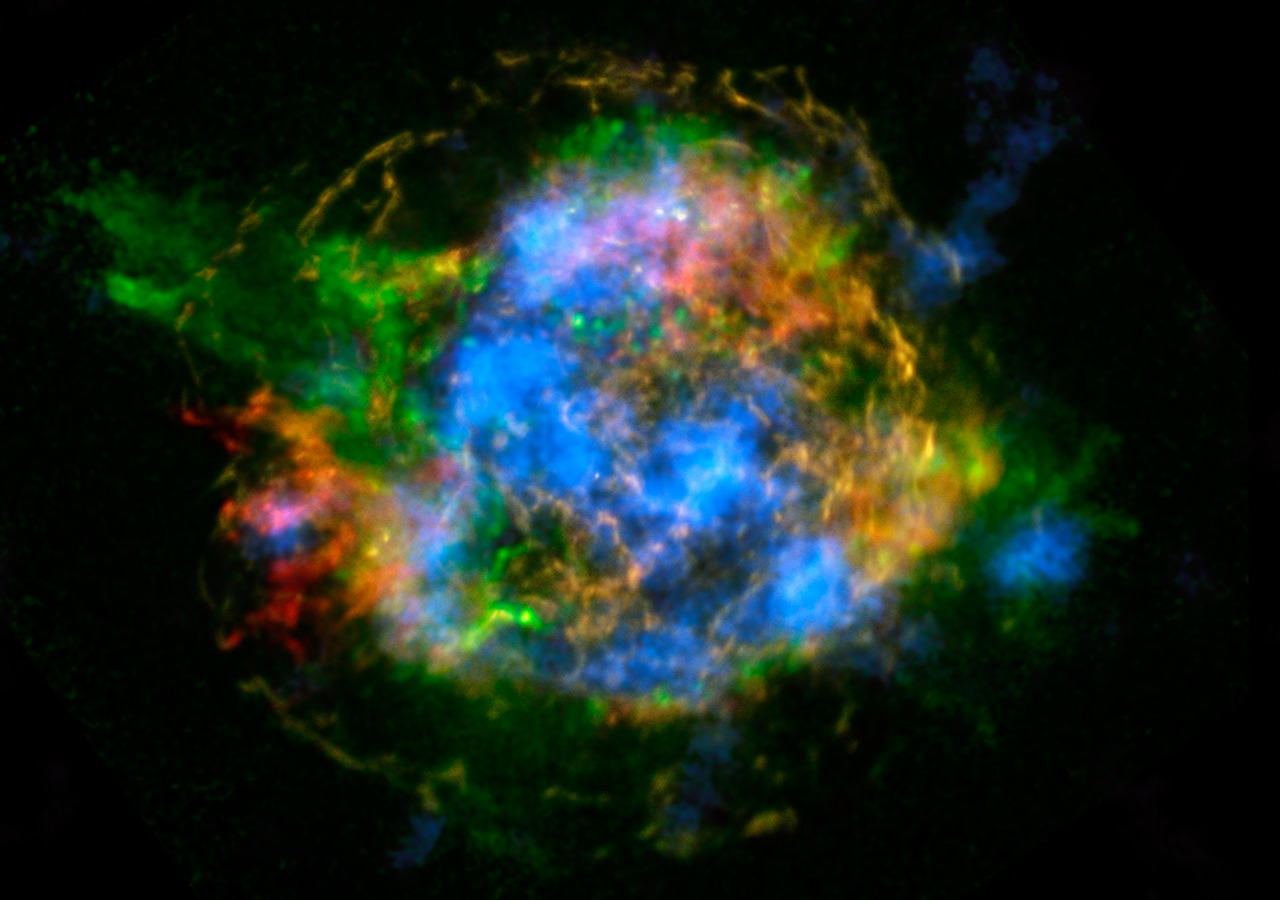
The Cassiopeia A supernova remnant as seen in X-rays during its original observation, with low-energy X-rays detected by Chandra in red, yellow, and green, and high-energy X-rays detected by NuSTAR in blue. Credit: NASA/JPL-Caltech/CXC/SAO.
Download Image

A gigantic explosion may be the end of a massive star's life, but it is by no means the end of its story. Take Cassiopeia A (Cas A for short), the remnants of the most recent known core-collapse supernova in our Galaxy—a stellar explosion about 11,000 light-years away that would have been visible to Earth around 350 years ago. Since then, debris from the explosion has been blasting into the universe as fast-moving material plows into its slow-moving surroundings and creates powerful shockwaves.

These shockwaves heat the gas to millions of degrees, causing it to glow brightly in optical, ultraviolet, and even X-ray light. These shocks can also accelerate particles like electrons to nearly the speed of light, becoming what are known as cosmic rays. These high-energy cosmic rays also emit X-rays, which carry information about the heating and cooling processes happening within the remnant.

Low-energy X-ray observations taken by NASA’s Chandra X-ray Observatory over the past two decades have shown that the Cas A supernova remnant is expanding and slowly cooling down. However, since low-energy X-rays are produced by both hot gas and high-energy cosmic rays, it is difficult to determine which of these light sources contribute the most to these changes.

That's where NASA’s NuSTAR satellite comes in. With its ability to detect the high-energy X-rays that are only produced by the high-energy cosmic rays, NuSTAR can produce maps of the most energetic regions of the supernova remnant and watch how these regions evolve over time.

In a recent paper led by Dr Jooyun Woo, then a graduate student at Columbia University, astronomers used new NuSTAR observations of Cas A and compared them with observations taken ten years ago. If the electrons had been accelerated all at once in the initial shock wave, then we would have expected them to have cooled down and become dimmer. In comparing the two images, Woo and her co-authors found that the X-ray brightness of these shock regions did not decrease as much as expected. This tells us that cosmic ray heating is still taking place, keeping the supernova remnant bright in the latest NuSTAR image. Studying such changes in brightness over time allows astronomers to compare different models of electron acceleration, enabling the remnants of the relatively nearby and recent Cas A supernova to act as a laboratory in which we can test physical theories in environments that we can't reproduce in labs on Earth.

Even with its slower-than-expected rate of dimming, one day Cas A will fade away and become too faint for a telescope like NuSTAR to detect, possibly within a century. It is incredible to think of how many advances in astronomy have taken place over the last 350 years to allow us to see the high-energy emission from this explosion before it vanishes!


Tuesday, February 25, 2025

Lifting the veil

A colourful, glowing nebula that reaches beyond the top and bottom of the image. It is made of translucent clouds of gas: wispy and thin with hard edges in some places, and puffy and opaque in others. Blue, red and yellow colours mix together, showing light emitted by different types of atoms in the hot gas. Bright and pointlike stars are scattered across the nebula. The background is black. Credit: ESA/Hubble & NASA, R. Sankrit

In this NASA/ESA Hubble Space Telescope Picture of the Week, Hubble has once again lifted the veil on a famous — and frequently photographed — supernova remnant: the Veil Nebula. This nebula is the remnant of a star roughly 20 times as massive as the Sun that exploded about 10 000 years ago. Situated about 2400 light-years away in the constellation Cygnus, this photogenic nebula made an appearance as the Picture of the Week previously in 2021.

This view combines images taken in three different filters by Hubble’s Wide Field Camera 3 instrument, highlighting emission from hydrogen, sulphur and oxygen atoms. This image shows just a small fraction of the Veil Nebula; if you could see the entire nebula without the aid of a telescope, it would be as wide as six full Moons placed side by side. Look in the sidebar of this page to see this image superimposed on its location in the sky, and try zooming out to compare the size of the full nebula!

Although this image captures the Veil Nebula at just a single point in time, it will help researchers understand how the supernova remnant has evolved over decades. Combining this snapshot with Hubble observations from 1994 will reveal the motion of individual knots and filaments of gas over that span of time, enhancing our understanding of this stunning nebula.


Tuesday, October 29, 2024

Dandelion Supernova Revealed in 3-D

An artist’s concept of a supernova remnant called Pa 30—the leftover remains of a supernova explosion that was witnessed from Earth in the year 1181. Unusual filaments of sulfur protrude beyond a dusty shell of ejected material. The remains of the original star that exploded, now a hot inflated star which may cool to become a white dwarf, are seen at the center of the remnant. The Keck Cosmic Web Imager (KCWI) at the W. M. Keck Observatory in Hawai‘i has mapped the strange filaments in 3-D and shown that they are flying outward at approximately 1,000 kilometers per second. Credit: W. M. Keck Observatory/Adam Makarenko


New observations probe a sphere of filaments around a dead star

Maunakea, Hawaiʻi – For nearly six months during the year 1181, people looked up to the skies to find a new star glittering in the constellation Cassiopeia. Chinese and Japanese astronomers recorded the rare event, an explosion of a star, or supernova. In the centuries since, astronomers have searched for the remains of the blast, but it was not until 2013 that they were finally found. As part of a citizen scientist project, amateur astronomer Dana Patchick—who had sifted through images taken by the now-retired Wide-field Infrared Survey Explorer, or WISE—found a nebula at the site where the supernova had occurred.

Further observations convinced astronomers that this nebula, called Pa 30, was in fact the leftover ejected material from the 1181 supernova. Later, in 2023, astronomers discovered strange filaments within the supernova remnant, which resemble the wispy tendrils of a dandelion flower.

Now, with the help of the Caltech-built Keck Cosmic Web Imager (KCWI) at the W. M. Keck Observatory on Maunakea, Hawai‘i Island, astronomers have, for the first time, mapped the location of those unusual filaments in three dimensions in addition to the speed at which they are streaming outward from the site of the blast.

“A standard image of the supernova remnant would be like a static photo of a fireworks display,” says Caltech professor of physics Christopher Martin, who led the team that built KCWI. “KCWI gives us something more like a ‘movie’ since we can measure the motion of the explosion’s embers as they streak outward from the central explosion.”

Martin is a co-author of a new paper reporting the findings published today in The Astrophysical Journal Letters. The study is led by Tim Cunningham, a NASA Hubble Fellow at the Center for Astrophysics |Harvard & Smithsonian (CfA), and the co-lead author is Ilaria Caiazzo, a former Caltech postdoctoral scholar who recently became an assistant professor at the Institute of Science and Technology Austria.

In 1181, astronomers in China and Japan recorded a new star in the sky, a rare supernova explosion. The remains of that supernova, called SN 1181, are depicted here in this artist’s animation, which flies around the remnant as it appears today in one moment in time. The corpse of the star that detonated, a hot and inflated “zombie” star, is seen within a dusty shell of ejected material. Beyond the dusty shell, bright radial filaments of sulfur extend three light-years out from their point of origin. The Keck Cosmic Web Imager (KCWI) at the W. M. Keck Observatory has mapped these filaments in 3-D and shown that they are flying outward at approximately 1,000 kilometers per second. Credit: W. M. Keck Observatory/Adam Makarenko

The 1181 supernova is thought to have occurred when a thermonuclear explosion was triggered on a dense dead star called a white dwarf. Typically, the white dwarf would be completely destroyed in this type of explosion, but in this case some of the star survived, leaving behind a sort of “zombie star.” This type of partial explosion is called a Type Iax supernova. “Because this was a failed explosion, it was fainter than normal supernovae, which has been shown to be consistent with the historical records,” Caiazzo says.

Material ejected in the 1181 explosion makes up the Pa 30 nebula that astronomers observe today. While the scientists know that the peculiar filaments, which glow with light from sulfur, were also generated by the supernova, they do not know how and when they formed.

To probe the three-dimensional structure of the supernova remnant, the astronomers turned to KCWI, an instrument that can capture multiwavelength, or spectral, information for every pixel in an image. This is like breaking apart the light captured in every pixel into a rainbow of colors. The spectral information enabled the team to measure the motions of the filaments poking out from the center of the explosion and ultimately create a 3D map of the structure. The filament material that is flying toward us shifted toward the blue higher-energy portion end of the visible spectrum (blue-shifted), while light from material moving away from us shifted toward the red end of the spectrum (red-shifted).

This is analogous to the Doppler shift one can hear as a blaring firetruck races by. As the vehicle moves toward us, the sound waves from its horn become squeezed into higher frequencies; as the truck moves away from us, the sound waves become elongated to lower frequencies.

Specifically, this study used the “red arm” of the KCWI instrument, which was installed at Keck Observatory last summer. KCWI consists of two halves: One captures light wavelengths at the blue end of the visible spectrum, and the other half covers the red end in addition to infrared light. “The addition of the red arm more than doubled the spectral coverage of KCWI and made these observations possible,” says Caltech graduate student and co-author Nikolaus Prusinski. “This 3D map comprises the most sensitive spatial and spectral measurements of Pa 30 to date and holds the current record for the largest contiguous region surveyed with the red channel.”

The results showed that the filament material in the supernova is flying outward from the site of the explosion at approximately 1,000 kilometers per second.

“We find the material in the filaments is expanding ballistically,” says Cunningham. “This means that the material has not been slowed down nor sped up since the explosion. From the measured velocities, looking back in time, you can pinpoint the explosion to almost exactly the year 1181.”

The 3D information also revealed a large cavity inside the spindly, spherical structure in addition to some evidence that the supernova explosion of 1181 occurred asymmetrically.

As to how the filaments formed after the blast, the scientists are still puzzled. “A reverse shock wave may be condensing surrounding dust into filaments, but we don’t know yet,” says Cunningham. “The morphology of this object is very strange and fascinating.”


About KCWI

The Keck Cosmic Web Imager (KCWI) is designed to provide visible band, integral field spectroscopy with moderate to high spectral resolution formats and excellent sky-subtraction. The astronomical seeing and large aperture of the telescope enables studies of the connection between galaxies and the gas in their dark matter halos, stellar relics, star clusters, and lensed galaxies. KCWI covers the blue side of the visible spectrum; the instrument also features the Keck Cosmic Reionization Mapper (KCRM), extending KCWI’s coverage to the red side of the visible spectrum. The combination of KCWI-blue and KCRM provides simultaneous high-efficiency spectral coverage across the entire visible spectrum. Support for KCWI was provided by the National Science Foundation, Heising-Simons Foundation, and Mt. Cuba Astronomical Foundation. Support for KCRM was provided by the National Science Foundation and Mt. Cuba Astronomical Foundation.


About W. M. KECK OBSERVATORY

The W. M. Keck Observatory telescopes are among the most scientifically productive on Earth. The two 10-meter optical/infrared telescopes atop Maunakea on the Island of Hawaii feature a suite of advanced instruments including imagers, multi-object spectrographs, high-resolution spectrographs, integral-field spectrometers, and world-leading laser guide star adaptive optics systems. Some of the data presented herein were obtained at Keck Observatory, which is a private 501(c) 3 non-profit organization operated as a scientific partnership among the California Institute of Technology, the University of California, and the National Aeronautics and Space Administration. The Observatory was made possible by the generous financial support of the W. M. Keck Foundation. The authors wish to recognize and acknowledge the very significant cultural role and reverence that the summit of Maunakea has always had within the Native Hawaiian community. We are most fortunate to have the opportunity to conduct observations from this mountain.


Tuesday, September 03, 2024

Observatory reveals key evidence of cosmic ray acceleration limit in W51 for first time

(a)The UHE gamma-ray emission is clearly observed from the W51 complex, which hosts the supernova remnant W51C and star forming region W51B. (b) The "bending" feature around tens TeV indicates the cosmic-ray acceleration limit in the W51 complex at around 400TeV. Credit: Science China Press


The Large High Altitude Air Shower Observatory (LHAASO) officially released the precise measurements of high-energy gamma radiation from the W51 complex, confirming it as a cosmic-ray accelerator boosting particles up to so-called ultra-high energies (UHE, above 1014 electronvolts). The results also provide key evidence about the cosmic-ray acceleration limit in this complex.

The findings, titled "Evidence for particle acceleration approaching PeV energies in the W51 complex," were recently published online in Science Bulletin. The research was conducted by the LHAASO International Collaboration, led by the Institute of High Energy Physics, Chinese Academy of Sciences.
The W51 complex is one of the largest and the most active stellar factories in the Milky Way and one of the few regions confirmed to host GeV energy cosmic-ray accelerators. It plays a crucial role in unraveling the century-old mystery of the origin of cosmic rays.

Researchers utilized data from the LHAASO experiment to, for the first time, extend the measurements of the energy spectrum of gamma-rays from this region to the UHE range. They clearly observed a bending structure in the gamma-ray spectrum at tens of TeV, indicating the acceleration limit of cosmic rays in this region.
The energy spectrum measured by LHAASO can be smoothly connected with that which was measured by the Fermi-LAT collaboration at lower energies. Spanning six orders of magnitude of gamma-ray energy, the spectrum provides important evidence that the radiation originates from collisions between cosmic rays and molecular clouds. It also indicates that the W51 complex has a cosmic-ray acceleration limit of around 400 TeV.
"The supernova remnant W51C, located in the W51 complex, is the most plausible cosmic-ray accelerator responsible for the wideband gamma-ray emission," Prof. Li Zhe said, one of the co-corresponding authors.

LHAASO is a national major science and technology infrastructure located on Haizi Mountain at an altitude of 4,410 meters in Daocheng, Sichuan province, China. It consists of an array of 5,216 electromagnetic particle detectors and 1,188 muon detectors distributed over 1 km2, a water Cherenkov detector array covering 78,000 m2 and an array of 18 wide-field-of-view Cherenkov telescopes.

LHAASO was completed and began high-quality stable operation in July 2021. It is the most sensitive UHE gamma-ray detection device in the world, characterized by the large field of view and all-weather capability.

by Science China Press


More information: Zhen Cao et al, Evidence for particle acceleration approaching PeV energies in the W51 complex, Science Bulletin (2024). DOI: 10.1016/j.scib.2024.07.017


Explore further


Saturday, June 29, 2024

NASA's Chandra Peers Into Densest and Weirdest Stars

3C 58
Credit: X-ray: NASA/CXC/ICE-CSIC/A. Marino et al.; Optical: SDSS; Image Processing: NASA/CXC/SAO/J. Major


The supernova remnant 3C 58 contains a spinning neutron star, known as PSR J0205+6449, at its center. Astronomers studied this neutron star and others like it to probe the nature of matter inside these very dense objects. A new study, made using NASA’s Chandra X-ray Observatory and ESA’s XMM-Newton, reveals that the interiors of neutron stars may contain a type of ultra-dense matter not found anywhere else in the Universe, as reported in our latest press release.

In this image of 3C 58, low-energy X-rays are colored red, medium-energy X-rays are green, and the high-energy band of X-rays is shown in blue. The X-ray data have been combined with an optical image in yellow from the Digitized Sky Survey. The Chandra data show that the rapidly rotating neutron star (also known as a “pulsar”) at the center is surrounded by a torus of X-ray emission and a jet that extends for several light-years. The optical data shows stars in the field.

The team in this new study analyzed previously released data from neutron stars to determine the so-called equation of state. This refers to the basic properties of the neutron stars including the pressures and temperatures in different parts of their interiors.

The authors used machine learning, a type of artificial intelligence, to compare the data to different equations of state. Their results imply that a significant fraction of the equations of state — the ones that do not include the capability for rapid cooling at higher masses — can be ruled out.

The researchers capitalized on some neutron stars in the study being located in supernova remnants, including 3C 58. Since astronomers have age estimates of the supernova remnants, they also have the ages of the neutron stars that were created during the explosions that created both the remnants and the neutron stars. The astronomers found that the neutron star in 3C 58 and two others were much cooler than the rest of the neutron stars in the study.

Illustration of a Neutron Star
Credit: ICE-CSIC/D. Futselaar/Marino et al.

The team thinks that part of the explanation for the rapid cooling is that these neutron stars are more massive than most of the rest. Because more massive neutron stars have more particles, special processes that cause neutron stars to cool more rapidly might be triggered.

One possibility for what is inside these neutron stars is a type of radioactive decay near their centers where neutrinos — low mass particles that easily travel through matter — carry away much of the energy and heat, causing rapid cooling.

Another possibility is that there are types of exotic matter found in the centers of these more rapidly cooling neutron stars.

The Nature Astronomy paper describing these results is available here. The authors of the paper are Alessio Marino (Institute of Space Sciences (ICE) in Barcelona, Spain), Clara Dehman (ICE), Konstantinos Kovlakas (ICE), Nanda Rea (ICE), J. A. Pons (University of Alicante in Spain), and Daniele Viganò (ICE).

NASA's Marshall Space Flight Center manages the Chandra program. The Smithsonian Astrophysical Observatory's Chandra X-ray Center controls science from Cambridge Massachusetts and flight operations from Burlington, Massachusetts.


Visual Description:

This is an image of the leftovers from an exploded star called 3C 58, shown in X-ray and optical light. At the center of the remnant is a rapidly spinning neutron star, called a pulsar, that presents itself as a bright white object that's somewhat elongated in shape.

Loops and swirls of material, in shades of blue and purple, extend outward from the neutron star in many directions, resembling the shape of an octopus and its arms.

Surrounding the octopus-like structure is a cloud of material in shades of red that is wider horizontally than it is vertically. A ribbon of purple material extends to the left edge of the red cloud, curling upward at its conclusion. Another purple ribbon extends to the right edge of the red cloud, though it is less defined than the one on the other side. Stars of many shapes and sizes dot the entire image.


Fast Facts for 3C 58:

Scale: Image is about 12 arcmin (26 light-years) across.
Category: Neutron Stars/X-ray Binaries, Supernovas & Supernova Remnants
Coordinates (J2000): RA 02h 05m 37.0s | Dec +64° 49´ 48.0"
Constellation: Cassiopeia
Observation Dates: 4 observations from Sep 2000 to Apr 2003
Observation Time: 108 hours 52 minutes (4 days 12 hours 52 minutes)
Obs. ID: 728, 3832, 4382, 4383
Instrument: ACIS
References: Marino, A. et al., 2024, Nature Astronomy;
Color Code: X-ray: red = 0.5-1.2 keV, green = 1.2-2.0 keV, blue = 2.0-7.0 keV; Optical: yellow
Distance Estimate: About 6,500 light-years


Saturday, June 22, 2024

Investigating the Origins of the Crab Nebula With NASA's Webb

Crab Nebula
Credits: Image: NASA, ESA, CSA, STScI, Tea Temim (Princeton University)


A team of scientists used NASA’s James Webb Space Telescope to parse the composition of the Crab Nebula, a supernova remnant located 6,500 light-years away in the constellation Taurus. With the telescope’s MIRI (Mid-Infared Instrument) and NIRCam (Near-Infrared Camera), the team gathered data that is helping to clarify the Crab Nebula’s history.

The Crab Nebula is the result of a core-collapse supernova from the death of a massive star. The supernova explosion itself was seen on Earth in 1054 CE and was bright enough to view during the daytime. The much fainter remnant observed today is an expanding shell of gas and dust, and outflowing wind powered by a pulsar, a rapidly spinning and highly magnetized neutron star.

The Crab Nebula is also highly unusual. Its atypical composition and very low explosion energy previously have been explained by an electron-capture supernova — a rare type of explosion that arises from a star with a less-evolved core made of oxygen, neon, and magnesium, rather than a more typical iron core.

“Now the Webb data widen the possible interpretations,” said Tea Temim, lead author of the study at Princeton University in New Jersey. “The composition of the gas no longer requires an electron-capture explosion, but could also be explained by a weak iron core-collapse supernova.”

Studying the Present to Understand the Past

Past research efforts have calculated the total kinetic energy of the explosion based on the quantity and velocities of the present-day ejecta. Astronomers deduced that the nature of the explosion was one of relatively low energy (less than one-tenth that of a normal supernova), and the progenitor star’s mass was in the range of eight to 10 solar masses — teetering on the thin line between stars that experience a violent supernova death and those that do not.

However, inconsistencies exist between the electron-capture supernova theory and observations of the Crab, particularly the observed rapid motion of the pulsar. In recent years, astronomers have also improved their understanding of iron core-collapse supernovae and now think that this type can also produce low-energy explosions, providing that the stellar mass is adequately low.

Webb Measurements Reconcile Historic Results

To lower the level of uncertainty surrounding the Crab’s progenitor star and nature of the explosion, the team led by Temim used Webb’s spectroscopic capabilities to hone in on two areas located within the Crab’s inner filaments.

Theories predict that because of the different chemical composition of the core in an electron-capture supernova, the nickel to iron (Ni/Fe) abundance ratio should be much higher than the ratio measured in our Sun (which contains these elements from previous generations of stars). Studies in the late 1980s and early 1990s measured the Ni/Fe ratio within the Crab using optical and near-infrared data and noted a high Ni/Fe abundance ratio that seemed to favor the electron-capture supernova scenario.

The Webb telescope, with its sensitive infrared capabilities, is now advancing Crab Nebula research. The team used MIRI’s spectroscopic abilities to measure the nickel and iron emission lines, resulting in a more reliable estimate of the Ni/Fe abundance ratio. They found that the ratio was still elevated compared to the Sun, but only modestly and much lower in comparison to prior estimates.

The revised values are consistent with electron-capture, but do not rule out an iron core-collapse explosion from a similarly low-mass star. (Higher-energy explosions from higher-mass stars are expected to produce ratios closer to solar abundances.) Further observational and theoretical work will be needed to distinguish between these two possibilities.

“At present, the spectral data from Webb covers two small regions of the Crab, so it’s important to study much more of the remnant and identify any spatial variations,” said Martin Laming of the Naval Research Laboratory in Washington and a co-author of the paper. “It would be interesting to see if we could identify emission lines from other elements, like cobalt or germanium.”

Mapping the Crab’s Current State

Besides pulling spectral data from two small regions of the Crab Nebula’s interior to measure the abundance ratio, the telescope also observed the remnant’s broader environment to understand details of the synchrotron emission and the dust distribution.

The images and data collected by MIRI enabled the team to isolate the dust emission within the Crab and map it in high resolution for the first time. By mapping the warm dust emission with Webb, and even combining it with the Herschel Space Observatory’s data on cooler dust grains, the team created a well-rounded picture of the dust distribution: The outermost filaments contain relatively warmer dust, while cooler grains are prevalent near the center.

“Where dust is seen in the Crab is interesting because it differs from other supernova remnants, like Cassiopeia A and Supernova 1987A," said Nathan Smith of the Steward Observatory at the University of Arizona and a co-author of the paper. “In those objects, the dust is in the very center. In the Crab, the dust is found in the dense filaments of the outer shell. The Crab Nebula lives up to a tradition in astronomy: The nearest, brightest, and best-studied objects tend to be bizarre.”

These findings have been accepted for publication in The Astrophysical Journal Letters.

The observations were taken as part of General Observer program 1714.

The James Webb Space Telescope is the world’s premier space science observatory. Webb is solving mysteries in our solar system, looking beyond to distant worlds around other stars, and probing the mysterious structures and origins of our universe and our place in it. Webb is an international program led by NASA with its partners, ESA (European Space Agency) and CSA (Canadian Space Agency).


About This Release

Credits:

Media Contact:

Abigail Major
Space Telescope Science Institute, Baltimore, Maryland

Christine Pulliam
Space Telescope Science Institute, Baltimore, Maryland

Science: Tea Temim (Princeton University)

Permissions: Content Use Policy

Contact Us: Direct inquiries to the News Team.


Wednesday, April 10, 2024

SNR 1181: Stunning Echo of 800-year-old Explosion

SNR 1181 / Pa 30
Credit: X-ray: (Chandra) NASA/CXC/U. Manitoba/C. Treyturik, (XMM-Newton) ESA/C. Treyturik; Optical: (Pan-STARRS) NOIRLab/MDM/Dartmouth/R. Fesen; Infrared: (WISE) NASA/JPL/Caltech/; Image Processing: Univ. of Manitoba/Gilles Ferrand and Jayanne English


In the year 1181 a rare supernova explosion appeared in the night sky, staying visible for 185 consecutive days. Historical records show that the supernova looked like a temporary ‘star’ in the constellation Cassiopeia shining as bright as Saturn.

Ever since, scientists have tried to find the supernova’s remnant. At first it was thought that this could be the nebula around the pulsar — the dense core of a collapse star — named 3C 58. However closer investigations revealed that the pulsar is older than supernova 1181.

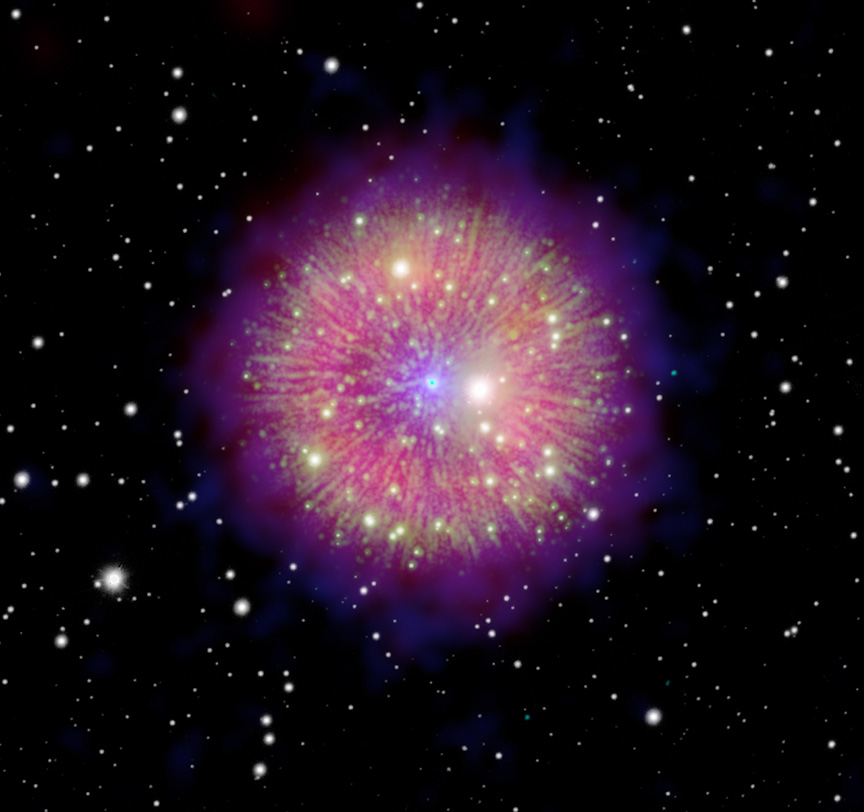
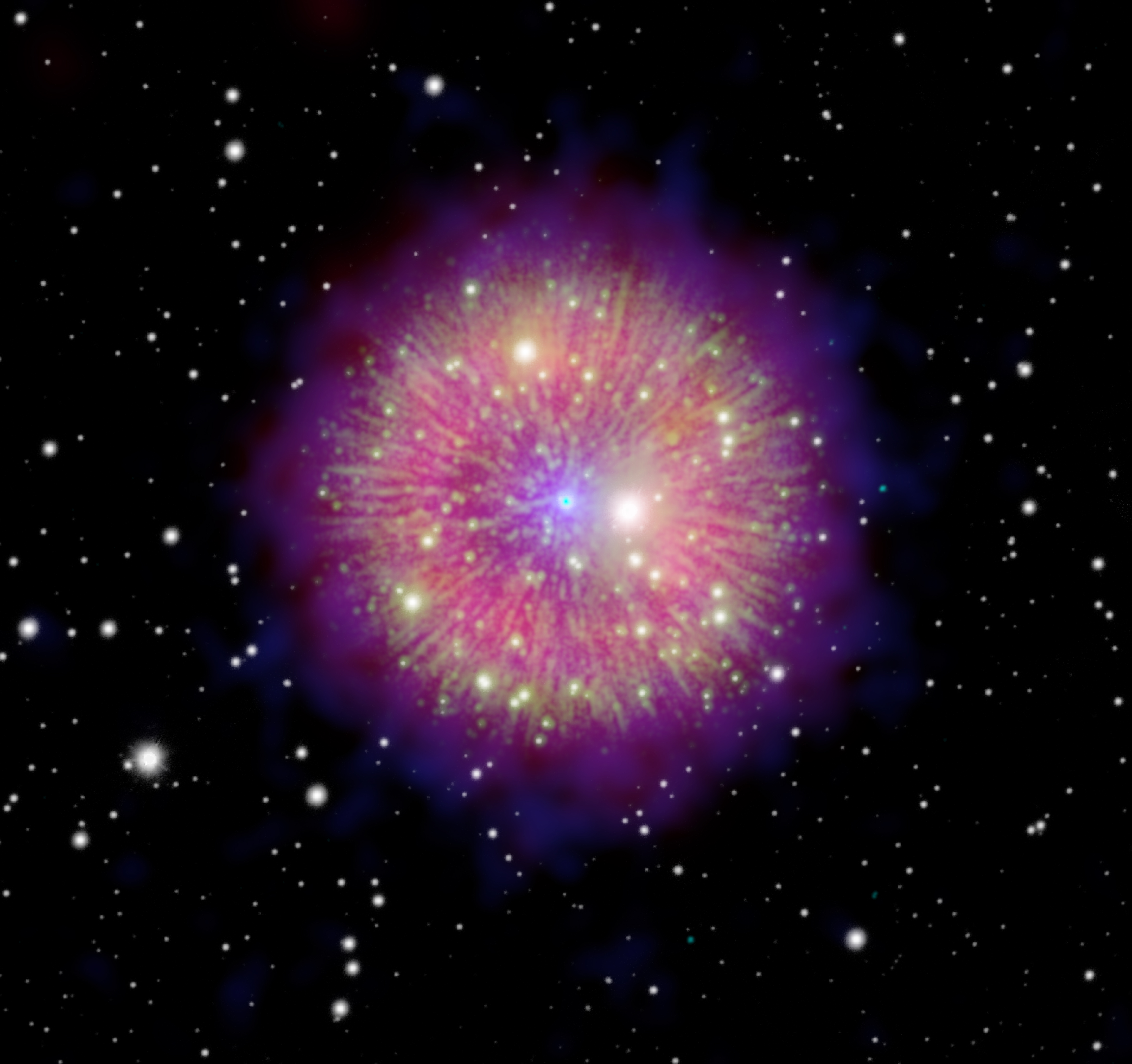
In the last decade, another contender was discovered; Pa 30 is a nearly circular nebula with a central star in the constellation Cassiopeia. It is pictured here combining images from several telescopes. This composite image uses data across the electromagnetic spectrum and shows a spectacular new view of the supernova remnant. This allows us to marvel at the same object that appeared in our ancestors’ night sky more than 800 years ago.

X-ray observations by ESA’s XMM-Newton (blue) show the full extent of the nebula and NASA’s Chandra X-ray Observatory (cyan) pinpoints its central source. The nebula is barely visible in optical light but shines bright in infrared light, collected by NASA’s Wide-field Infrared Space Explorer (red and pink). Interestingly, the radial structure in the image consists of heated sulfur that glows in visible light, observed with the ground-based Hiltner 2.4 m telescope at the MDM Observatory (green) in Arizona, USA, as do the stars in the background by Pan-STARRS (white) in Hawaii, USA.

Studies of the composition of the different parts of the remnant have led scientists to believe that it was formed in a thermonuclear explosion, and more precisely a special kind of supernova called a sub-luminous Type Iax event. During this event two white dwarf stars merged, and typically no remnant is expected for this kind of explosion. But incomplete explosions can leave a kind of ‘zombie’ star, such as the massive white dwarf star in this system. This very hot star, one of the hottest stars in the Milky Way (about 200 000 degrees Celsius), has a fast stellar wind with speeds up to 16,000 km/s. The combination of the star and the nebula makes it a unique opportunity for studying such rare explosions.

The Smithsonian Astrophysical Observatory's Chandra X-ray Center controls science operations from Cambridge, Massachusetts, and flight operations from Burlington, Massachusetts.


Visual Description:

This is a composite image of SNR 1181, the remains of an explosion hundreds of years ago caused by the merger of two stars.

A bright, multi-colored, spherical nebula sits in the middle of the canvas surrounded by a field of stars that appear as white dots. In the center of the nebula is a small point of aqua-colored light. This is the hot white dwarf star that was left behind after the likely merger of two smaller white dwarfs caused an explosion. From this single point of aqua light, several spectacular rays expand outward, resembling a single firework bursting in celebration in the night sky.


Fast Facts for SNR 1181 / Pa 30:

Scale: Image is about 5.6 arcmin (16 light-years) across.
Category: Supernovas & Supernova Remnants
Coordinates (J2000): RA 00h 53m 11.2s | Dec +67° 30´ 02.4"
Constellation: Cassiopeia
Observation Dates: 6 observations from May 12, 2021 to Dec 15, 2021
Observation Time: 39 hours 55 minutes (1 day 15 hours 55 minutes)
Obs. ID: 23419, 24342-24345, 25045
Instrument: ACIS
Color Code: X-ray: blue (XMM) and cyan (Chandra); Optical: green (MDM), white (Pan-STARRS); Infrared: red and pink
Distance Estimate: About 10,100 light-years


Thursday, March 14, 2024

Ghostly Stellar Tendrils Captured in Largest DECam Image Ever Released

PR Image noirlab2406a
Ghostly Stellar Tendrils of the Vela Supernova Remnant

PR Image noirlab2406b
Vela Supernova Remnant Excerpts

PR Image noirlab2406c
Open Star Cluster [FSR2007] 1410

PR Image noirlab2406d
Planetary Nebula PNG 262.4-01.9

PR Image noirlab2406e
Globular Star Cluster CI Ferrero 54

PR Image noirlab2406f
Supernova Remnant Puppis A

PR Image noirlab2406g
Dark Nebula TGU H1674

PR Image noirlab2406h
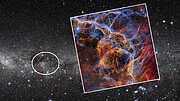
Background Galaxy Found in Image of Vela Supernova Remnant


Videos

Cosmoview Episode 77: Ghostly Stellar Tendrils Captured in Largest DECam Image Ever Released 
 PR Video noirlab2406a
Cosmoview Episode 77: Ghostly Stellar Tendrils Captured in Largest DECam Image Ever Released

Cosmoview Episodio 77: Filamentos estelares fantasmales capturados con la imagen de DECam más grande jamás publicada  
PR Video noirlab2406b
Cosmoview Episodio 77: 
Filamentos estelares fantasmales capturados con la imagen de DECam más grande jamás publicada

Pan on the Vela Supernova Remnant  
PR Video noirlab2406c
Pan on the Vela Supernova Remnant

Zooming into the Vela Supernova Remnant  
PR Video noirlab2406d
Zooming into the Vela Supernova Remnant


Dark Energy Camera captures remains of a massive star that exploded nearly 11,000 years ago in huge gigapixel image

With the powerful, 570-megapixel Department of Energy-fabricated Dark Energy Camera (DECam), astronomers have constructed a massive 1.3-gigapixel image showcasing the central part of the Vela Supernova Remnant, the cosmic corpse of a gigantic star that exploded as a supernova. DECam is one of the highest-performing wide-field imaging instruments in the world and is mounted on the US National Science Foundation's Víctor M. Blanco 4-meter Telescope at Cerro Tololo Inter-American Observatory, a Program of NSF’s NOIRLab.

This colorful web of wispy gas filaments is the Vela Supernova Remnant, an expanding nebula of cosmic debris left over from a massive star that exploded about 11,000 years ago. Located around 800 light-years away in the constellation Vela (the Sails), this nebula is one of the nearest supernova remnants to Earth. Though the unnamed star ended its life thousands of years ago, the shockwave its death produced is still propagating into the interstellar medium, carrying glowing tendrils of gas with it.

This image is one of the biggest ever made of this object and was taken with the state-of-the-art wide-field Dark Energy Camera (DECam), built by the Department of Energy and mounted on the US National Science Foundation's Víctor M. Blanco 4-meter Telescope at Cerro Tololo Inter-American Observatory in Chile, a Program of NSF’s NOIRLab. The striking reds, yellows, and blues in this image were achieved through the use of three DECam filters that each collect a specific color of light. Separate images were taken in each filter and then stacked on top of each other to produce this high-resolution color image that showcases the intricate web-like filaments snaking throughout the expanding cloud of gas. This is also the largest DECam image ever released publicly, containing an astounding 1.3 gigapixels [1].

The Vela Supernova Remnant is merely the ghost of a massive star that once was. When the star exploded 11,000 years ago, its outer layers were violently stripped away and flung into the surrounding region, driving the shockwave that is still visible today. As the shockwave expands into the surrounding region, the hot, energized gas flies away from the point of detonation, compressing and interacting with the interstellar medium to produce the stringy blue and yellow filaments seen in the image. The Vela Supernova Remnant is a gigantic structure, spanning almost 100 light-years and extending to twenty times the diameter of the full Moon in the night sky.

Despite the dramatics of the star’s final moments, it wasn’t entirely wiped from existence. After shedding its outer layers, the core of the star collapsed into a neutron star — an ultra-dense ball consisting of protons and electrons that have been smashed together to form neutrons. The neutron star, named the Vela Pulsar, is now an ultra-condensed object with the mass of a star like the Sun contained in a sphere just a few kilometers across. Located in the lower left region of this image, the Vela Pulsar is a relatively dim star that is indistinguishable from its thousands of celestial neighbors. Still reeling from its explosive death, the Vela Pulsar spins rapidly on its own axis and possesses a powerful magnetic field. These properties result in twin beams of radiation that sweep the sky 11 times per second, just like the consistent blips of a rotating lighthouse bulb.

This high-quality image demonstrates the incredible deep and wide capabilities of DECam. From its vantage point in the Chilean Andes, the Blanco telescope receives light that has traveled across the Universe. After entering the telescope’s tube, the light is reflected by a mirror 4-meters (13-feet) wide — a massive, aluminum-coated and precisely shaped piece of glass roughly the weight of a semi-truck. The light is then guided into the optical innards of DECam, passing through a corrective lens nearly a meter (3.3 feet) across before falling on a grid of 62 charge-coupled devices (CCDs), which act like the ‘eyes’ of the camera. The incoming light is then converted into electrical signals which are read out as pixels.

A single image taken with DECam has 570 megapixels, so with multiple exposures stacked on top of one another, the amount of detail that can be captured is truly remarkable. Owing to DECam’s large mosaic of CCDs, astronomers are able to create mesmerizing images of faint astronomical objects, such as the Vela Supernova Remnant, that offer a limitless starscape to explore.


Notes

[1] For comparison, the pixel count of an image taken with the camera in a standard smartphone can range from 12 to 48 megapixels. This image contains a total of 35786 x 35881 pixels, or 1.28 gigapixels.


More information

NSF’s NOIRLab (National Optical-Infrared Astronomy Research Laboratory), the US center for ground-based optical-infrared astronomy, operates the international Gemini Observatory (a facility of NSF, NRC–Canada, ANID–Chile, MCTIC–Brazil, MINCyT–Argentina, and KASI–Republic of Korea), Kitt Peak National Observatory (KPNO), Cerro Tololo Inter-American Observatory (CTIO), the Community Science and Data Center (CSDC), and Vera C. Rubin Observatory (in cooperation with DOE’s SLAC National Accelerator Laboratory). It is managed by the Association of Universities for Research in Astronomy (AURA) under a cooperative agreement with NSF and is headquartered in Tucson, Arizona. The astronomical community is honored to have the opportunity to conduct astronomical research on Iolkam Du’ag (Kitt Peak) in Arizona, on Maunakea in Hawai‘i, and on Cerro Tololo and Cerro Pachón in Chile. We recognize and acknowledge the very significant cultural role and reverence that these sites have to the Tohono O'odham Nation, to the Native Hawaiian community, and to the local communities in Chile, respectively.


Links


Contacts:

Josie Fenske
Jr. Public Information Officer
NSF’s NOIRLab
Email:
josie.fenske@noirlab.edu