Showing posts with label anti-matter. Show all posts

Friday, October 19, 2018

Kes 75: Milky Way's Youngest Pulsar Exposes Secrets of Star's Demise


Kes 75
Credit X-ray: NASA/CXC/NCSU/S. Reynolds; 
Optical: PanSTARRS Release Date October 18, 2018


Scientists have confirmed the identity of the youngest known pulsar in the Milky Way galaxy using data from NASA's Chandra X-ray Observatory. This result could provide astronomers new information about how some stars end their lives.

After some massive stars run out of nuclear fuel, then collapse and explode as supernovas, they leave behind dense stellar nuggets called "neutron stars". Rapidly rotating and highly magnetized neutron stars produce a lighthouse-like beam of radiation that astronomers detect as pulses as the pulsar's rotation sweeps the beam across the sky.

Since Jocelyn Bell Burnell, Antony Hewish, and their colleagues first discovered pulsars through their radio emission in the 1960s, over 2,000 of these exotic objects have been identified. However, many mysteries about pulsars remain, including their diverse range of behaviors and the nature of stars that form them.

New data from Chandra are helping address some of those questions. A team of astronomers has confirmed that the supernova remnant Kes 75, located about 19,000 light years from Earth, contains the youngest known pulsar in the Milky Way galaxy.

The rapid rotation and strong magnetic field of the pulsar have generated a wind of energetic matter and antimatter particles that flow away from the pulsar at near the speed of light . This pulsar wind has created a large, magnetized bubble of high-energy particles called a pulsar wind nebula, seen as the blue region surrounding the pulsar.

In this composite image of Kes 75, high-energy X-rays observed by Chandra are colored blue and highlight the pulsar wind nebula surrounding the pulsar, while lower-energy X-rays appear purple and show the debris from the explosion. A Sloan Digital Sky Survey optical image reveals stars in the field.

The Chandra data taken in 2000, 2006, 2009, and 2016 show changes in the pulsar wind nebula with time. Between 2000 and 2016, the Chandra observations reveal that the outer edge of the pulsar wind nebula is expanding at a remarkable 1 million meters per second, or over 2 million miles per hour.

This high speed may be due to the pulsar wind nebula expanding into a relatively low-density environment. Specifically, astronomers suggest it is expanding into a gaseous bubble blown by radioactive nickel formed in the explosion and ejected as the star exploded. This nickel also powered the supernova light, as it decayed into diffuse iron gas that filled the bubble. If so, this gives astronomers insight into the very heart of the exploding star and the elements it created.

The expansion rate also tells astronomers that Kes 75 exploded about five centuries ago as seen from Earth. (The object is some 19,000 light years away, but astronomers refer to when its light would have arrived at Earth.) Unlike other supernova remnants from this era such as Tycho and Kepler, there is no known evidence from historical records that the explosion that created Kes 75 was observed.

Why wasn't Kes 75 seen from Earth? The Chandra observations along with previous ones from other telescopes indicate that the interstellar dust and gas that fill our Galaxy are very dense in the direction of the doomed star. This would have rendered it too dim to be seen from Earth several centuries ago.

The brightness of the pulsar wind nebula has decreased by 10% from 2000 to 2016, mainly concentrated in the northern area, with a 30% decrease in a bright knot. The rapid changes observed in the Kes 75 pulsar wind nebula, as well as its unusual structure, point to the need for more sophisticated models of the evolution of pulsar wind nebulas.

A paper describing these results appeared in The Astrophysical Journal and is available online. The authors are Stephen Reynolds, Kazimierz Borokowski, and Peter Gwynne from North Carolina State University. NASA's Marshall Space Flight Center in Huntsville, Alabama, manages the Chandra program for NASA's Science Mission Directorate in Washington. The Smithsonian Astrophysical Observatory in Cambridge, Massachusetts, controls Chandra's science and flight operations.


Fast Facts for Kes 75:


Category: Supernovas & Supernova Remnants
Coordinates (J2000): RA 18h 46m 25.0s | Dec -02° 58' 30.3"
Constellation: Aquila
Observation Date: 4 pointings between 05/06/2006 - 12/06/2006 and 2 pointings 06/08/16-06/11/16
Observation Time: 83 hours 31 min (3 days 11 hours 31 min)
Obs. ID: 6686, 7337, 7338, 7339, 18030, 18866
Instrument: ACIS
References: Reynolds, S. et al, 2018, ApJ,856,133; arXiv:1803.09128
Color Code: X-ray: Pink & Purple: 0.5 keV-2.1keV Cyan: 1.6keV-2.1keV; Optical: Red/Green/Blue
Distance Estimate: About 19,000 light years 


Thursday, August 18, 2016

G11.2-0.3: Supernova Ejected from the Pages of History

G11.2-0.3
 Credit X-ray: NASA/CXC/NCSU/K.Borkowski et al; Optical: DSS


Tour of G11.2-0.3

animation


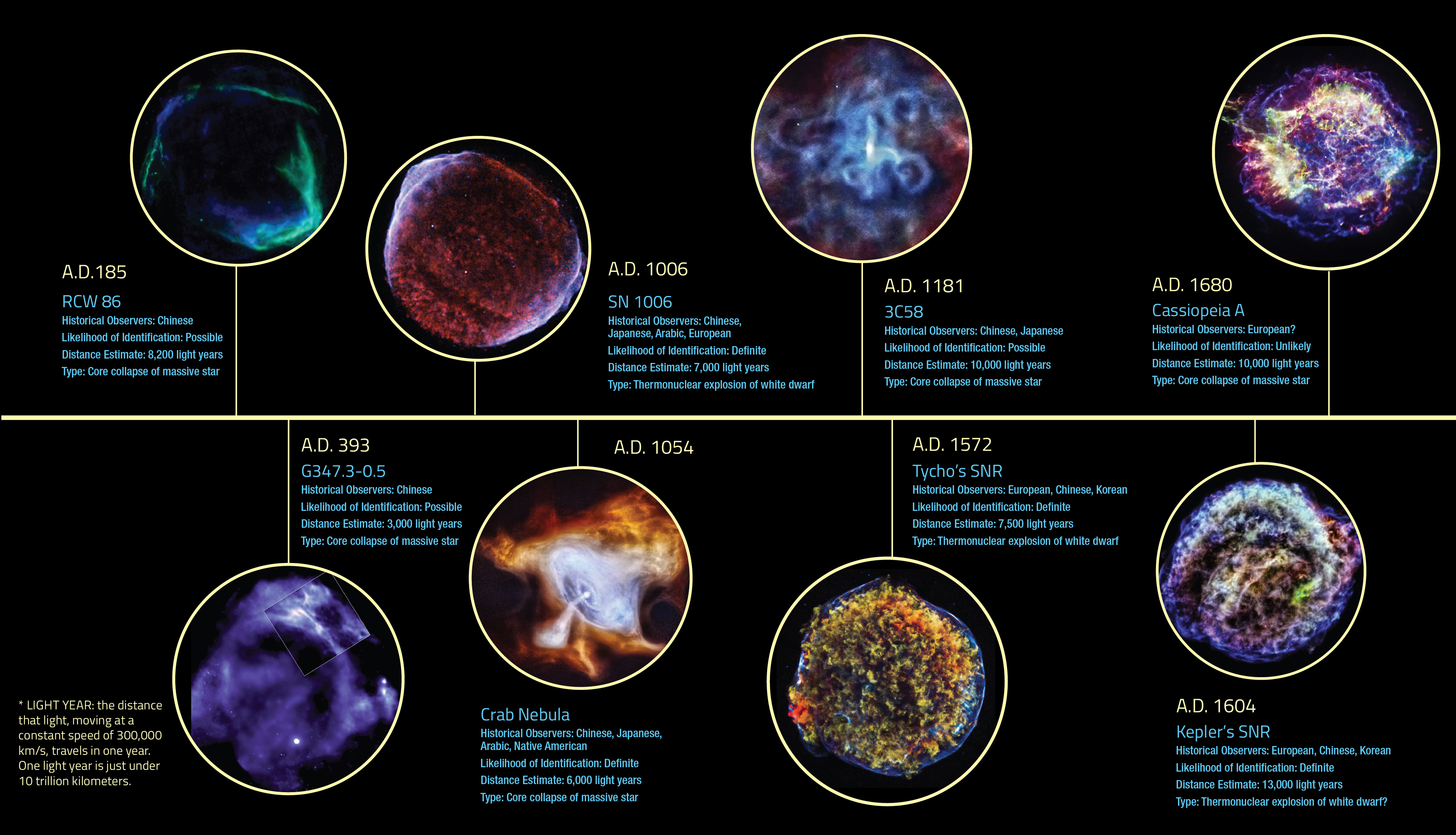
A new look at the debris from an exploded star in our galaxy has astronomers re-examining when the supernova actually happened. Recent observations of the supernova remnant called G11.2-0.3 with NASA's Chandra X-ray Observatory have stripped away its connection to an event recorded by the Chinese in 386 CE.

Historical supernovas and their remnants can be tied to both current astronomical observations as well as historical records of the event. Since it can be difficult to determine from present observations of their remnant exactly when a supernova occurred, historical supernovas provide important information on stellar timelines. Stellar debris can tell us a great deal about the nature of the exploded star, but the interpretation is much more straightforward given a known age.

New Chandra data on G11.2-0.3 show that dense clouds of gas lie along the line of sight from the supernova remnant to Earth. Infrared observations with the Palomar 5-meter Hale Telescope had previously indicated that parts of the remnant were heavily obscured by dust. This means that the supernova responsible for this object would simply have appeared too faint to be seen with the naked eye in 386 CE. This leaves the nature of the observed 386 CE event a mystery.

A new image of G11.2-0.3 is being released in conjunction with this week's workshop titled "Chandra Science for the Next Decade" being held in Cambridge, Massachusetts. While the workshop will focus on the innovative and exciting science Chandra can do in the next ten years, G11.2-0.3 is an example of how this "Great Observatory" helps us better understand the complex history of the Universe and the objects within it.

Credit NASA/CXC/SAO

Taking advantage of Chandra's successful operations since its launch into space in 1999, astronomers were able to compare observations of G11.2-0.3 from 2000 to those taken in 2003 and more recently in 2013. This long baseline allowed scientists to measure how fast the remnant is expanding. Using this data to extrapolate backwards, they determined that the star that created G11.2-0.3 exploded between 1,400 and 2,400 years ago as seen from Earth.

Previous data from other observatories had shown this remnant is the product of a "core-collapse" supernova, one that is created from the collapse and explosion of a massive star. The revised timeframe for the explosion based on the recent Chandra data suggests that G11.2-0.3 is one of the youngest such supernovas in the Milky Way. The youngest, Cassiopeia A, also has an age determined from the expansion of its remnant, and like G11.2-0.3 was not seen at its estimated explosion date of 1680 CE due to dust obscuration. So far, the Crab nebula, the remnant of a supernova seen in 1054 CE, remains the only firmly identified historical remnant of a massive star explosion in our galaxy.
This latest image of G11.2-0.3 shows low-energy X-rays in red, the medium range in green, and the high-energy X-rays detected by Chandra in blue. The X-ray data have been overlaid on an optical field from the Digitized Sky Survey, showing stars in the foreground.

Although the Chandra image appears to show the remnant has a very circular, symmetrical shape, the details of the data indicate that the gas that the remnant is expanding into is uneven. Because of this, researchers propose that the exploded star had lost almost all of its outer regions, either in an asymmetric wind of gas blowing away from the star, or in an interaction with a companion star. They think the smaller star left behind would then have blown gas outwards at an even faster rate, sweeping up gas that was previously lost in the wind, forming the dense shell. The star would then have exploded, producing the G11.2-0.3 supernova remnant seen today.

The supernova explosion also produced a pulsar - a rapidly rotating neutron star - and a pulsar wind nebula, shown by the blue X-ray emission in the center of the remnant. The combination of the pulsar's rapid rotation and strong magnetic field generates an intense electromagnetic field that creates jets of matter and anti-matter moving away from the north and south poles of the pulsar, and an intense wind flowing out along its equator.

A paper describing this result appeared in the March 9th, 2016 issue of The Astrophysical Journal and is available online. The authors are Kazimierz Borkowski and Stephen Reynolds, both of North Carolina State University, as well as Mallory Roberts from New York University. NASA's Marshall Space Flight Center in Huntsville, Alabama, manages the Chandra program for NASA's Science Mission Directorate in Washington. The Smithsonian Astrophysical Observatory in Cambridge, Massachusetts, controls Chandra's science and flight operations.


Fast Facts for G11.2-0.3:

Scale: Image is 9 arcmin across (about 43 light years)
Coordinates (J2000): RA 18h 11m 33.00s | Dec -19° 26' 00.00''
Constellation: Sagittarius
Observation Date: 12 pointings between Aug 2000 and Sep 2013
Observation Time: 111 hours 7 min (4 days 15 hours 7 min).
Obs. ID: 780, 781, 2322, 3909-3912, 14830-14832, 15652, 16323
Instrument: ACIS
References: Borkowski, K. et al, 2016, ApJ, 819, 160; arXiv:1602.03531
Color Code: X-ray (Red, Green, Blue), Optical (Orange, Cyan)
Distance Estimate: About 16,000 light years