Releases from NASA, HubbleSite, Spitzer, ESO, ESA, NASA’s Chandra X-ray Observatory, Royal Astronomical Society, Harvard-Smithsonian Center For Astrophysics, Max Planck Institute, Gemini Observatory, Subaru Telescope, W. M. Keck Observatory, JPL-Caltech, ICRAR, Webb Space Telescope, etc
Featured Image: A Pulsar in a Nebula in a Supernova Remnant
When a massive star collapses, the subsequent supernova can leave
behind the star’s condensed core in the form of a neutron star. Some
neutron stars are also pulsars, which rotate at incredible speeds, emit
beamed radio emission, and expel winds of charged particles. A pulsar’s
relativistic charged-particle winds billow around the pulsar as it
travels through space — often at a few hundreds of kilometers per second
or faster, having received a “kick” when its progenitor star exploded.
When these winds interact with the surrounding supernova ejecta or the
interstellar medium, the interaction creates a detectable pulsar wind nebula.
The image above combines data from the Australian Square Kilometre
Array Pathfinder (orange) and Wide-field Infrared Survey Explorer (cyan)
to show a pulsar wind nebula, indicated with a white rectangle, within a
larger supernova remnant. Sanja Lazarević (Western Sydney University)
and collaborators discovered this pulsar wind nebula, which they’ve
named “Thunder” in a nod to the supernova remnant’s moniker, “Nimbus.”
The cometary shape of the pulsar wind nebula suggests that the pulsar is
moving quickly, traveling outward from the center of the explosion that
occurred some 30,000–45,000 years ago. To learn more about the
discovery and characterizati,bron of this pulsar wind nebula, check out the
article linked below.
Citation
“EMU Discovery of Thunder: A Bow-Shock PWN Powered by PSR J1631–4722
Escaping the Nimbus SNR (G336.7+0.5),” S. Lazarević et al 2026 ApJ1007 159. doi:10.3847/1538-4357/ae7f11
Scientists using NASA’s IXPE (Imaging X-ray Polarimetry Explorer) directly measured the magnetic fields of PSR J1101−6101, a pulsar located within what is often referred to as the “Lighthouse” Nebula, for the first time.
A pulsar is a type of neutron star — the dense core leftover when a massive star collapses — with a strong magnetic field that spins incredibly fast. The pulsar at the center of
the Lighthouse nebula is rotating at 16 times per second.
Astronomers studied two narrow offshoots extending from the Lighthouse pulsar to better understand how electrons at nearly the speed of light interact with the surrounding environment. When high-energy particles from the pulsar collide with the gas of interstellar space, they form a bow shock similar to the bow wave formed at the front of a speeding boat. Most particles become trapped behind this bow shock, forming the turbulent tail behind the pulsar. Previously, NASA’s Chandra X-ray Observatory captured this tail that extends for over 37 light-years, the longest jet from an object seen in the Milky Way at the time.
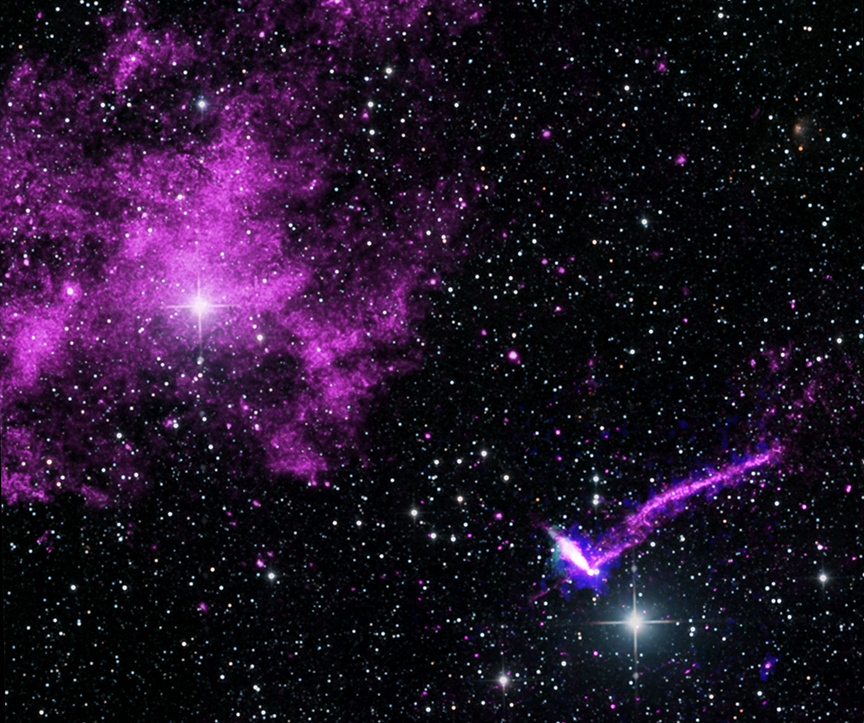
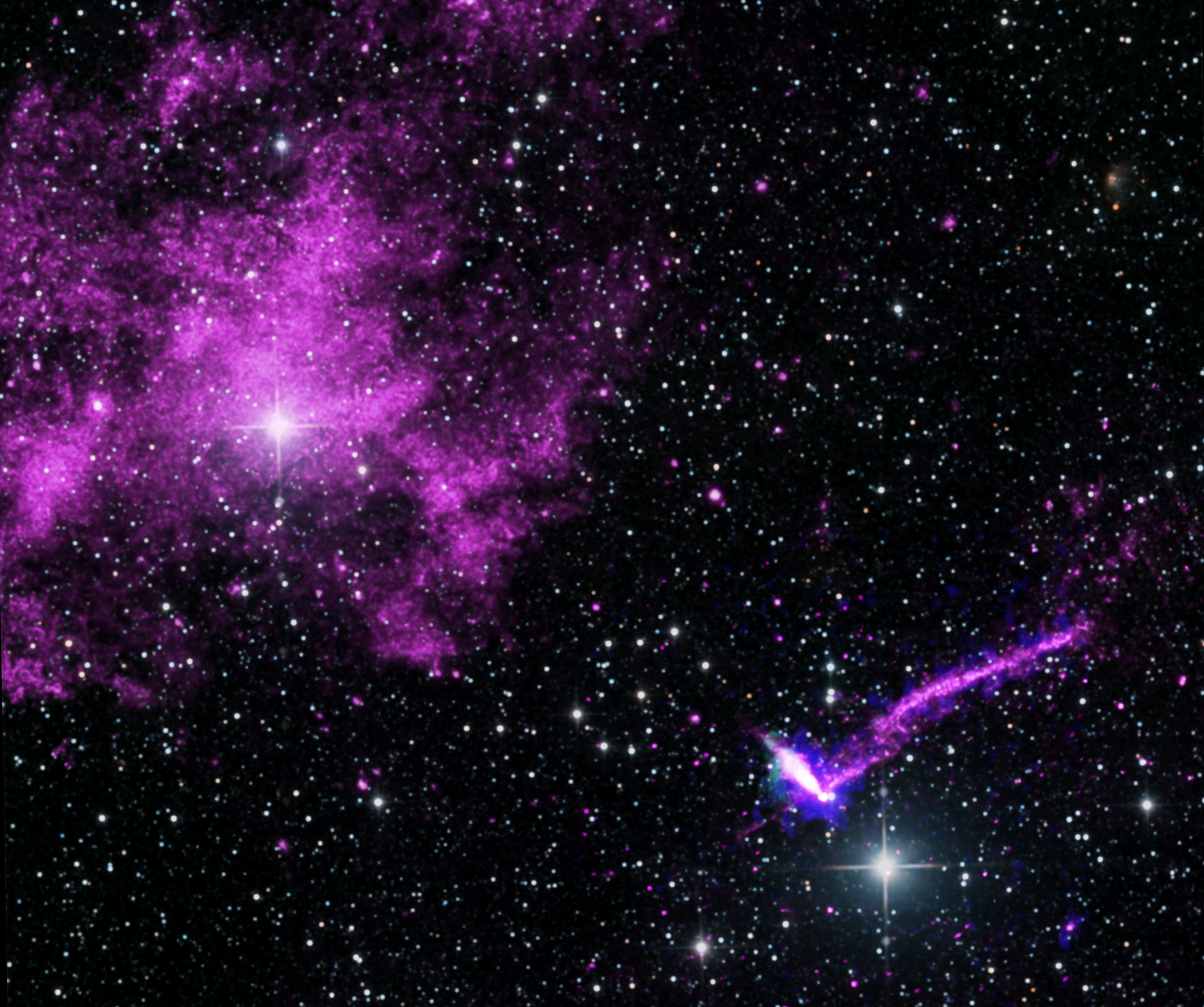
This graphic contains data from different telescopes that shows the region around the Lighthouse pulsar and its wake. In this composite image, X-ray data from NASA’s Chandra X-ray Observatory are purple, X-rays from NASA's IXPE are in blue, with radio emission captured by the Australia Compact Telescope Array in green. Optical light data from the 2MASS telescope shows the stars visible in this field of view.
A paper about the results recently published in the Astrophysical Journal. The IXPE mission, which continues to provide unprecedented data enabling groundbreaking discoveries about celestial objects across the universe, is a joint NASA and Italian Space Agency mission with partners and science collaborators in 12 countries. It is led by NASA’s Marshall Space Flight Center in Huntsville, Alabama. BAE Systems, Inc., headquartered in Falls Church, Virginia, manages spacecraft operations together with the University of Colorado’s Laboratory for Atmospheric and Space Physics in Boulder.
NASA's Marshall Space Flight Center manages the Chandra program. The Smithsonian Astrophysical Observatory's Chandra X-ray Center controls science operations from Cambridge, Massachusetts, and flight operations from Burlington, Massachusetts.
This composite multiwavelength image captures the turbulent environment surrounding the Lighthouse pulsar, set against a vast, black background speckled with twinkling white and faint green stars. In the upper-left quadrant, a massive, cloud-like nebula glows in a textured, vibrant purple hue, anchored by a prominent four-pointed star shining brightly near its center. Moving toward the lower-right quadrant, the pulsar itself is located at the lower tip of a concentrated, brilliant whitish-blue elongated point of light. Extending outward from its core is a long, narrow, and slightly curved jet of purple and blue emission that streaks upward and to the right. This jet represents a massive 37-light-year tail of high-energy particles trailing behind the rapidly
spinning star as it plow through interstellar space. This composite image contains X-ray data from NASA's Chandra X-ray Observatory in purple, additional X-ray from NASA's IXPE in blue, and radio data from CSIRO in green. The starfield is optical data from the 2MASS survey.
A combined optical, H-alpha, and X-ray image of NGC 7793, indicating the position of the remarkably bright X-ray source P13. Image credit: NASA/CXC/ESO/VLT/NOAO/AURA/NSF/Univ of Strasbourg/M. Pakull et al.Download Image
Last week, NuSTAR performed the first of two planned observations of the ultraluminous X-ray source NGC 7793 P13. Like its fellow ultraluminous source M82 X-2, P13 is a pulsar, meaning that its extraordinary luminosity comes from extreme levels of accretion onto a tiny neutron star, and its spin period decreases over time as the accreting material spins it up by adding angular momentum. Every now and again, P13 appears to fade dramatically in brightness but, unusually for this class of objects, when it returns to its usual luminosity again its rate of spin has increased further rather than slowing down, suggesting that it doesn't stop spinning up even when it is in a faint state. Additionally, this binary system has an orbital period a little over 60 days long, with a variation in the ultraviolet emission that is very slightly out of sync with it, which might indicate some unusual interaction between different parts of the accreting system. These NuSTAR observations will continue to track its changing period over time, helping to piece together the shape of this system and the reasons for its strange behavior.
An international team led by Tim Sprenger of the Max Planck Institute for Radio Astronomy (MPIfR) observed the flickering of a pulsar’s radio radiation with two of the world’s most powerful radio telescopes.
The shape of the distorted image allows us to conclude that the thin gas between us and the stellar remnant is not randomly distributed, but rather exists in structures with a preferred orientation.
The observational technique allows for the capture of high-resolution images without the need to link telescopes around the globe in a data- and computation-intensive manner.
Fluctuations in brightness and the elongated appearance of a stellar remnant indicate that its radiation is being scattered within an unidentified interstellar cloud located 430 light-years from Earth.
The twinkling stars in the night sky are not just beautiful to look at. Their flickering reveals something about the varying temperatures and densities in the layers of Earth’s atmosphere, which refract the light as it travels toward us. Certain stellar remnants that emit radio waves can exhibit a very similar effect. Although their radio waves—which have longer wavelengths than visible light—can penetrate Earth’s atmosphere almost undisturbed, they are scattered by the thin gas between the stars. Their twinkling—known as scintillation—thus provides unique insights into interstellar space.
An international team led by Tim Sprenger from the Max Planck Institute for Radio Astronomy (MPIfR) measured the flickering radio radiation from an object using an innovative observation technique. The results are published in the current issue of the journal Astronomy & Astrophysics.
Flickering Stellar Remnants
Scintillation occurs only in point sources, which is why distant stars twinkle but planets do not. In the radio spectrum, flickering can be observed in pulsars—the remnants of massive stars. They are among the most compact objects in the universe: the mass of an entire star is compressed into a sphere with the diameter of a major city. The radio signals emitted by pulsars fluctuate in brightness due to scintillation, and their position in the sky appears smeared. The pulsar observed in the current study is only the second one in which the distortion caused by scintillation could be directly imaged.
Unexpectedly straight
The research team led by Tim Sprenger observed the pulsar designated PSR B1508+55, located about 7,000 light-years away in the constellation Draco. In the long-exposure image, the pulsar appears distorted into a line. “Usually, one imagines that the pulsar is distorted into a blurred disk by random density fluctuations. Instead, the interstellar medium here seems to form ordered structures with a preferred orientation,” explains lead author Tim Sprenger. These could be, for example, parallel filaments or thin, folded layers.
Exactly what the structures look like in this case is not yet clear. This is partly because the observed scattering they cause is very small on an astronomical scale and difficult to observe. Of particular interest are small irregularities in the otherwise straight scattered line. “Observing the contrast between the primary linear image and its complex deviations is fascinating. It makes us wonder: what are the microscopic structures that created them—structures that elude our current picture of the interstellar medium?", adds co-author Xun Shi from Yunnan University in China. Using model calculations, it is at least possible to determine that the interstellar cloud is located about 430 light-years from Earth.
Groundbreaking Observation Technique
The scintillation of a pulsar causes such small positional changes that they cannot be spatially resolved with individual telescopes. The researchers therefore used a sophisticated observational technique and two of the world’s most powerful radio telescopes: The 100-meter Effelsberg radio telescope in Germany and the Five-hundred-meter Aperture Spherical radio Telescope (FAST) in China. Due to Earth's motion, when both telescopes are pointed simultaneously at PSR B1508+55, their positions change significantly over time.
This means that, over the course of a day, sometimes one telescope and sometimes the other sees the same flickering first, depending on whether Germany or China is currently pointing more in the direction of the Earth’s motion. From this, an image can be calculated. Co-author Olaf Wucknitz adds: “Taking advantage of the large distance between the two radio telescopes and of the Earth’s motion relative to the observed structures, we were able to achieve a resolution that is not possible with any other technique in the observed frequency range.”
At higher frequencies, comparable resolutions can be achieved by combining many telescopes around the world into a virtual telescope. This is technically complex, and the resulting data must be correlated in a time-consuming process. “The observation technique we used does not place high demands on the infrastructure. It works with locally processed data sets that we were able to merge using our standard laptops,” reports Tim Sprenger. Following this success, observations of additional pulsars are planned. These should then reveal more about the invisible structures of the interstellar medium. Michael Kramer, Executive Director of the MPIfR, points out that FAST is currently the most sensitive telescope in the world, emphasising: “This beautiful work demonstrates what’s possible when two of the most powerful instruments in the world are working together. Both telescopes are great, but their rare combination is even far better!”
A hand-drawn artist's impression of the current state of the Her X-1 system, showing gas being pulled from the companion star onto the accretion disk surrounding the neutron star. Its magnetic field lines and rotation axis are marked in black and misaligned with each other, which is what causes pulsations to be seen. Image credit: R. Staubert.Download Image
During the last two months, NuSTAR has responded to the unusual behavior of Hercules X-1, one the most enigmatic binary X-ray pulsars, through a series of short observations. High-energy, all-sky monitoring instruments, including NASA's Swift and JAXA's MAXI missions, had observed the X-ray flux of Her X-1 decrease to a very low level, indicating the source had entered a so-called "anomalous low" state. Such a behavior has been observed only a few times previously, with durations ranging from 70 to 602 days. In response, a small group of Her X-1 enthusiasts succeeded in organizing a coordinated observing campaign, triggering proposed Target of Opportunity observations and obtaining Director's Discretionary Time using several satellites, including NASA's NuSTAR, JAXA's XRISM, and ESA's XMM-Newton observatories. The goal is to understand in detail what is physically happening in Her X-1, and initial analysis of the data indicates that the X-ray source has not actually turned off. The accretion of material from the companion star onto the highly magnetized neutron star continues, but the low X-ray energy radiation is now substantially absorbed by the accretion disk itself, not just at certain phases of the generally observed 35-day modulation, but continuously. It may be possible that precessing accretion disk has either changed its inclination with respect to the binary orbital plane, or has swelled up to a substantially larger thickness. Less certain is whether the rotation of the neutron star itself precesses freely with a period very close to that of the accretion disk, though analysis of the NuSTAR data shows that the neutron star pulsation period of 1.24 seconds appears normal. It is possible that the neutron star and accretion precessional movements are generally locked to each other by physical interactions, which might change at times or even temporarily break down. Monitoring of Her X-1 will continue into the next month.
Author: Ruediger Staubert (Professor of Astrophysics, University of Tuebingen, Germany)
This artist’s concept shows what the exoplanet called PSR J2322-2650b (left) may look like as it orbits a rapidly spinning neutron star called a pulsar (right). Gravitational forces from the much heavier pulsar are pulling the Jupiter-mass world into a bizarre lemon shape. Illustration: NASA, ESA, CSA, Ralf Crawford (STScI)
This artist’s concept shows what the exoplanet PSR J2322-2650b may look like. Gravitational forces from the much heavier pulsar it orbits are pulling the Jupiter-mass world into this bizarre lemon shape. Illustration: NASA, ESA, CSA, Ralf Crawford (STScI)
This animation shows an exotic exoplanet orbiting a distant pulsar, or rapidly rotating neutron star with radio pulses. The planet, which orbits about 1 million miles away from the pulsar, is stretched into a lemon shape by the pulsar’s strong gravitational tides. Animation: NASA, ESA, CSA, Ralf Crawford (STScI)
Scientists using NASA’s James Webb Space Telescope have observed a rare type of exoplanet, or planet outside our solar system, whose atmospheric composition challenges our understanding of how it formed.
Officially named PSR J2322-2650b, this Jupiter-mass object appears to have an exotic helium-and-carbon-dominated atmosphere unlike any ever seen before. Soot clouds likely float through the air, and deep within the planet, these carbon clouds can condense and form diamonds. How the planet came to be is a mystery. The paper appears Tuesday in The Astrophysical Journal Letters.
“This was an absolute surprise,” said study co-author Peter Gao of the Carnegie Earth and Planets Laboratory in Washington. “I remember after we got the data down, our collective reaction was ‘What the heck is this?’ It's extremely different from what we expected.”
his planet-mass object was known to orbit a pulsar, a rapidly spinning neutron star. A pulsar emits beams of electromagnetic radiation at regular intervals typically ranging from milliseconds to seconds. These pulsing beams can only be seen when they are pointing directly toward Earth, much like beams from a lighthouse.
This millisecond pulsar is expected to be emitting mostly gamma rays and other high energy particles, which are invisible to Webb’s infrared vision. Without a bright star in the way, scientists can study the planet in intricate detail across its whole orbit.
“This system is unique because we are able to view the planet illuminated by its host star, but not see the host star at all,” said Maya Beleznay, a third-year PhD candidate at Stanford University in California who worked on modeling the shape of the planet and the geometry of its orbit. “So we get a really pristine spectrum. And we can study this system in more detail than normal exoplanets.”
“The planet orbits a star that's completely bizarre — the mass of the Sun, but the size of a city,” said the University of Chicago’s Michael Zhang, the principal investigator on this study. “This is a new type of planet atmosphere that nobody has ever seen before. Instead of finding the normal molecules we expect to see on an exoplanet — like water, methane, and carbon dioxide — we saw molecular carbon, specifically C3 and C2.”
Molecular carbon is very unusual because at these temperatures, if there are any other types of atoms in the atmosphere, carbon will bind to them. (Temperatures on the planet range from 1,200 degrees Fahrenheit at the coldest points of the night side to 3,700 degrees Fahrenheit at the hottest points of the day side.) Molecular carbon is only dominant if there's almost no oxygen or nitrogen. Out of the approximately 150 planets that astronomers have studied inside and outside the solar system, no others have any detectable molecular carbon.
PSR J2322-2650b is extraordinarily close to its star, just 1 million miles away. In contrast, Earth’s distance from the Sun is about 100 million miles. Because of its extremely tight orbit, the exoplanet’s entire year — the time it takes to go around its star — is just 7.8 hours. Gravitational forces from the much heavier pulsar are pulling the Jupiter-mass planet into a bizarre lemon shape.
Together, the star and exoplanet may be considered a “black widow” system, though not a typical example. Black widow systems are a rare type of double system where a rapidly spinning pulsar is paired with a small, low-mass stellar companion. In the past, material from the companion streamed onto the pulsar, causing the pulsar to spin faster over time, which powers a strong wind. That wind and radiation then bombard and evaporate the smaller and less massive companion. Like the spider for which it is named, the pulsar slowly consumes its unfortunate partner.
But in this case, the companion is officially considered an exoplanet, not a star. The International Astronomical Union defines an exoplanet as a celestial body below 13 Jupiter masses that orbits a star, brown dwarf, or stellar remnant, such as a pulsar.
Of the 6,000 known exoplanets, this is the only one reminiscent of a gas giant (with mass, radius, and temperature similar to a hot Jupiter) orbiting a pulsar. Only a handful of pulsars are known to have planets.
“Did this thing form like a normal planet? No, because the composition is entirely different,” said Zhang. “Did it form by stripping the outside of a star, like ‘normal’ black widow systems are formed? Probably not, because nuclear physics does not make pure carbon. It's very hard to imagine how you get this extremely carbon-enriched composition. It seems to rule out every known formation mechanism.”
Study co-author Roger Romani, of Stanford University and the Kavli Institute for Particle Astrophysics and Cosmology Institute, proposes one evocative phenomenon that could occur in the unique atmosphere. “As the companion cools down, the mixture of carbon and oxygen in the interior starts to crystallize,” said Romani. “Pure carbon crystals float to the top and get mixed into the helium, and that's what we see. But then something has to happen to keep the oxygen and nitrogen away. And that's where the mystery come in.
“But it's nice to not know everything,” said Romani. “I'm looking forward to learning more about the weirdness of this atmosphere. It's great to have a puzzle to go after.”
With its infrared vision and exquisite sensitivity, this is a discovery only the Webb telescope could make. Its perch a million miles from Earth and its huge sunshield keep the instruments very cold, which is necessary for these observations. It is not possible to conduct this study from the ground.
The James Webb Space Telescope is the world’s premier space science observatory. Webb is solving mysteries in our solar system, looking beyond to distant worlds around other stars, and probing the mysterious structures and origins of our universe and our place in it. Webb is an international program led by NASA with its partners, ESA (European Space Agency) and CSA (Canadian Space Agency).
Credit: X-ray: NASA/CXC/Univ. of Hong Kong/S. Zhang et al.; Radio: ATNF/CSIRO/ATCA; H-alpha: UK STFC/Royal Observatory Edinburgh; Image Processing: NASA/CXC/SAO/N. Wolk
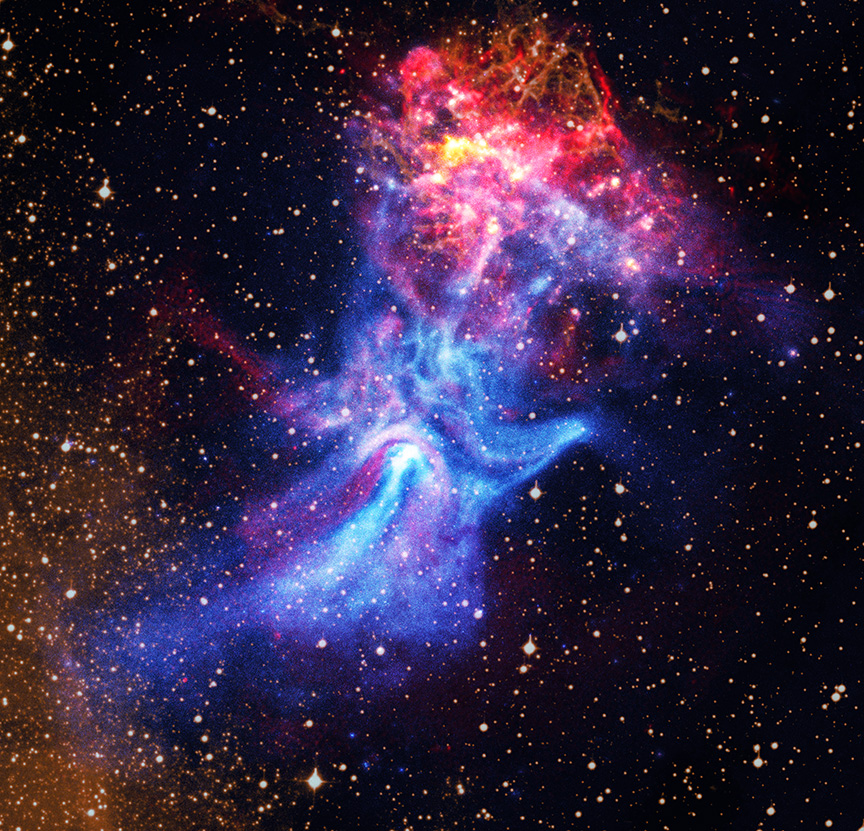
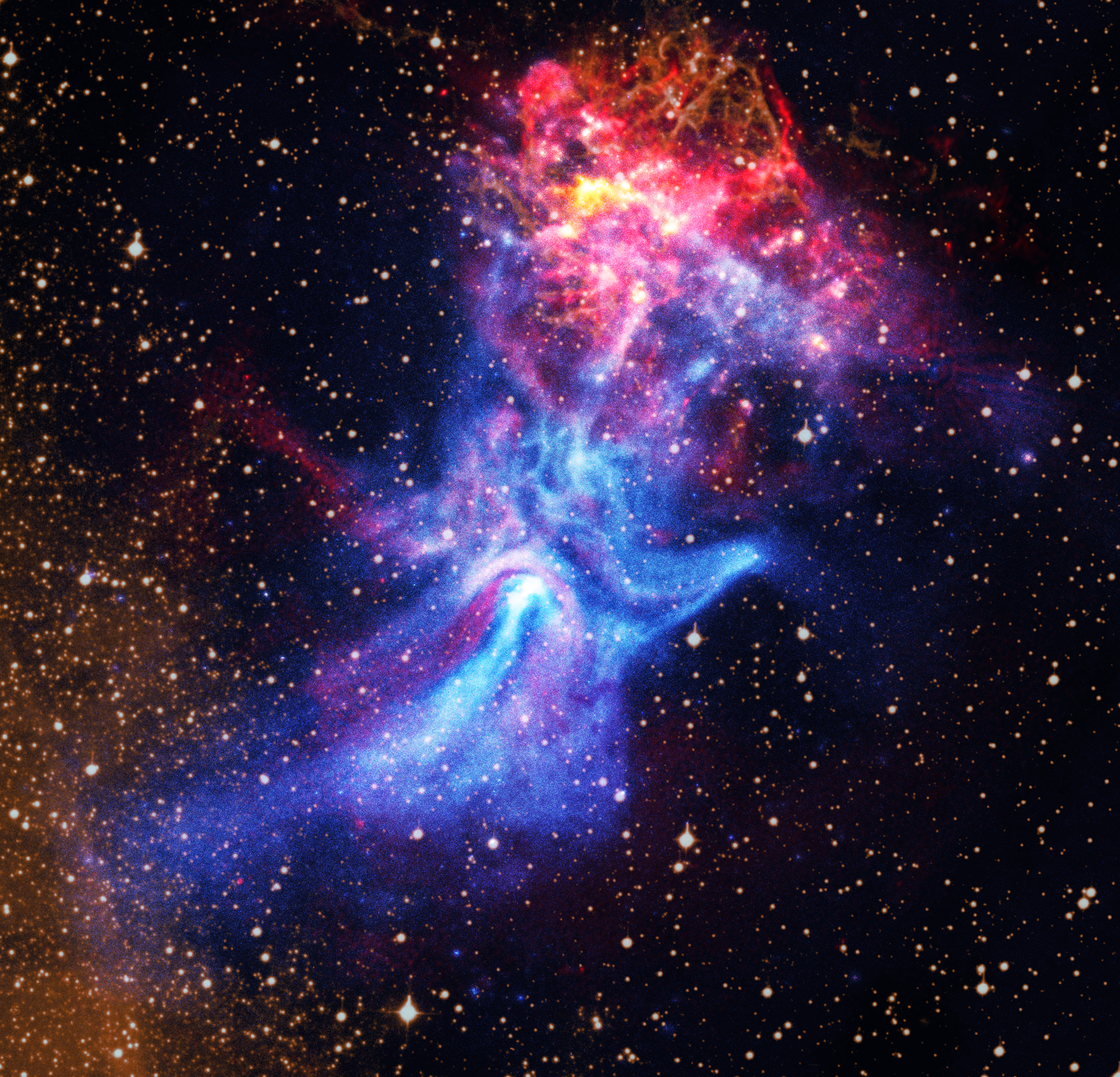
In 2009, NASA’s Chandra X-ray Observatory released a captivating image: a pulsar and its surrounding nebula that is shaped like a hand.
Since then, astronomers have used Chandra and other telescopes to
continue to observe this object. Now, new radio data from the Australia
Telescope Compact Array (ATCA), has been combined with Chandra’s X-ray
data to provide a fresh view of this exploded star and its environment,
to help understand its peculiar properties and shape.
At the center of this new image lies the pulsar B1509-58, a rapidly
spinning neutron star that is only about 12 miles in diameter. This tiny
object is responsible for producing an intricate nebula (called MSH
15-52) that spans over 150 light-years, or about 900 trillion miles. The
nebula, which is produced by energetic particles, resembles a human
hand with a palm and extended fingers pointing to the upper right in
X-rays.
Labeled Version of the Image
Credit: X-ray: NASA/CXC/Univ. of Hong Kong/S. Zhang et al.; Radio: ATNF/CSIRO/ATCA; H-alpha: UK STFC/Royal Observatory Edinburgh; Image Processing: NASA/CXC/SAO/N. Wolk
The collapse of a massive star created the pulsar when much of the
star crashed inward once it burned through its sustainable nuclear fuel.
An ensuing explosion sent the star’s outer layers outward into space as
a supernova.
The pulsar spins around almost seven times every second and has a
strong magnetic field, about 15 trillion times stronger than the
Earth’s. The rapid rotation and strong magnetic field make B1509-58 one
of the most powerful electromagnetic generators in the Galaxy, enabling
it to drive an energetic wind of electrons and other particles away from
the pulsar, creating the nebula.
In this new composite image, the ATCA radio data (represented in red)
has been combined with X-rays from Chandra (shown in blue, orange and
yellow), along with an optical image of hydrogen gas (gold). The areas
of overlap between the X-ray and radio data in MSH 15-52 show as purple.
The optical image shows stars in the field of view along with parts of
the supernova’s debris, the supernova remnant RCW 89. A labeled version
of the figure shows the main features of the image.
Radio data from ATCA now reveals complex filaments that are aligned
with the directions of the nebula’s magnetic field, shown by the short,
straight, white lines in a supplementary image. These filaments could
result from the collision of the pulsar’s particle wind with the
supernova’s debris.
Complex Filaments Aligned with the Directions of the Nebula’s Magnetic Field
Credit: X-ray: NASA/CXC/Univ. of Hong Kong/S. Zhang et al.; Radio: ATNF/CSIRO/ATCA; H-alpha: UK STFC/Royal Observatory Edinburgh; Image Processing: NASA/CXC/SAO/N. Wolk
By comparing the radio and X-ray data, researchers identified key
differences between the sources of the two types of light. In
particular, some prominent X-ray features, including the jet towards the
bottom of the image and the inner parts of the three “fingers” towards
the top, are not detected in radio waves. This suggests that highly
energetic particles are leaking out from a shock wave — similar to a
supersonic plane’s sonic boom — near the pulsar and moving along
magnetic field lines to create the fingers.
The radio data also shows that RCW 89’s structure is different from
typical young supernova remnants. Much of the radio emission is patchy
and closely matches clumps of X-ray and optical emission. It also
extends well beyond the X-ray emission. All of these characteristics
support the idea that RCW 89 is colliding with a dense cloud of nearby
hydrogen gas.
However, the researchers do not fully understand all that the data is
showing them. One area that is perplexing is the sharp boundary of
X-ray emission in the upper right of the image that seems to be the
blast wave from the supernova — see the labeled feature. Supernova blast
waves are usually bright in radio waves for young supernova remnants
like RCW 89, so it is surprising to researchers that there is no radio
signal at the X-ray boundary.
MSH 15–52 and RCW 89 show many unique features not found in other
young sources. There are, however, still many open questions regarding
the formation and evolution of these structures. Further work is needed
to provide better understanding of the complex interplay between the
pulsar wind and the supernova debris.
A paper describing this work, led by Shumeng Zhang of the University
of Hong Kong, with co-authors Stephen C.Y. Ng of the University of Hong
Kong and Niccolo' Bucciantini of the Italian National Institute for
Astrophysics, has been published in The Astrophysical Journal and is
available at https://iopscience.iop.org/article/10.3847/1538-4357/adf333.
NASA's Marshall Space Flight Center in Huntsville, Alabama, manages
the Chandra program. The Smithsonian Astrophysical Observatory's Chandra
X-ray Center controls science operations from Cambridge, Massachusetts,
and flight operations from Burlington, Massachusetts.
This release features a composite image of a nebula and pulsar that strongly resembles a cosmic hand reaching for a neon red cloud.
The neon red cloud sits near the top of the image, just to our right of center. Breaks in the cloud reveal interwoven strands of gold resembling spiderwebs, or a latticework substructure. This cloud is the remains of the supernova that formed the pulsar at the heart of the image. The pulsar, a rapidly spinning neutron star only 12 miles in diameter, is far too small to be seen in this image, which represents a region of space over 150 light-years across.
The bottom half of the image is dominated by a massive blue hand reaching up toward the pulsar and supernova cloud. This is an intricate nebula called MSH 15-52, an energetic wind of electrons and other particles driven away from the pulsar. The resemblance to a hand is undeniable. Inside the nebula, streaks and swirls of blue range from pale to navy, evoking a medical X-ray, or the yearning hand of a giant, cosmic ghost.
The hand and nebula are set against the blackness of space, surrounded by scores of gleaming golden specks. At our lower left, a golden hydrogen gas cloud extends beyond the edges of the image. In this composite, gold represents optical data; red represents ATCA radio data; and blue, orange, and yellow represent X-ray data from Chandra. Where the blue hand of the nebula overlaps with the radio data in red, the fingers appear hazy and purple.
Fast Facts for MSH 15-52:
Scale: Image is about 22 arcmin (110 light-years) across. Category:Supernovas & Supernova Remnants,Neutron Stars/X-ray Binaries Coordinates (J2000): RA 15h 13m 55.5s | Dec -59° 8´ 8.8" Constellation:Circinus Observation Dates: 20 observations from Aug 14, 2000 to Sep 23, 2022 Observation Time: 185 hours (7 days 17 hours)
Astronomers have discovered a likely explanation for a fracture in a huge cosmic “bone” in the Milky Way galaxy, using NASA’s Chandra X-ray Observatory and radio telescopes.
The bone appears to have been struck by a fast-moving, rapidly spinning neutron star, or pulsar. Neutron stars are the densest known stars and form from the collapse and explosion of massive stars. They often receive a powerful kick from these explosions, sending them away from the explosion’s
location at high speeds.
Enormous structures resembling bones or snakes are found near the center of the galaxy. These elongated formations are seen in radio waves and are threaded by magnetic fieldsnrunning parallel to them. The radio waves are caused by energized particles spiraling along the magnetic fields.
This new image shows one of these cosmic “bones” called G359.13142-0.20005 (G359.13 for short), with X-ray data from Chandra (colored blue) and radio data from the MeerKAT radio array
in South Africa (colored gray). Researchers also refer to G359.13 as the Snake.
Examining this image closely reveals the presence of a break, or
fracture, in the otherwise continuous length of G359.13 seen in the
image. The combined X-ray and radio data provides clues to the cause of
this fracture.
Astronomers have now discovered an X-ray and radio source at the
location of the fracture, using the data from Chandra and MeerKAT and
the National Science Foundation’s Very Large Array. A likely pulsar responsible for these radio and X-ray signals is labeled. A possible extra source
of X-rays located near the pulsar may come from electrons and positrons
(the anti-matter counterparts to electrons) that have been accelerated
to high energies.
The researchers think the pulsar likely caused the fracture by
smashing into G359.13 at a speed between one million and two million
miles per hour. This collision distorted the magnetic field in the bone,
causing the radio signal to also become warped.
At about 230 light-years long,
G359.13 is one of the longest and brightest of these structures in the
Milky Way. To put this into context, there are more than 800 stars
within that distance from Earth. G359.13 is located about 26,000
light-years from Earth, near the center of the Milky Way.
A paper describing these results appeared in the May 2024 issue of the Monthly Notices of the Royal Astronomical Society and is available here.
The authors of the study are Farhad Yusuf-Zadeh (Northwestern
University), Jun-Hui Zhao (Center for Astrophysics | Harvard &
Smithsonian), Rick Arendt (University of Maryland, Baltimore County),
Mark Wardle (Macquarie University, Australia), Craig Heinke (University
of Alberta), Marc Royster (College of the Sequoias, California),
Cornelia Lang (University of Iowa), and Joseph Michail (Northwestern).
NASA’s Marshall Space Flight Center in Huntsville, Alabama, manages
the Chandra program. The Smithsonian Astrophysical Observatory’s Chandra
X-ray Center controls science operations from Cambridge, Massachusetts,
and flight operations from Burlington, Massachusetts
This release features two composite images of a long, thin, cosmic
structure. With the structure’s vertical orientation, seemingly fragile
dimensions, and pale grey color against the blackness of space, the
images resemble medical X-rays of a long, thin, bone. The main image
shows the structure in its entirety. The inset image is an annotated
close-up highlighting an apparent fracture in the bone-like structure.
The structure, called G359.13, or “The Snake”, is a Galactic Center
Filament. These filament formations are threaded by parallel magnetic
fields, and spiraling, energized particles. The particles cause radio
waves, which can be detected by radio arrays, in this case by the
MeerKAT array in South Africa.
In the first composite image, the largely straight filament stretches
from the top to the bottom of the vertical frame. At each end of the
grey filament is a hazy grey cloud. The only color in the image is neon
blue, found in a few specks which dot the blackness surrounding the
structure. The blue represents X-rays seen by NASA’s Chandra X-ray
Observatory.
In the annotated close-up, one such speck appears to be interacting
with the structure itself. This is a fast-moving, rapidly spinning
neutron star, otherwise known as a pulsar. Astronomers believe that this
pulsar has struck the filament halfway down its length, distorting the
magnetic field and radio signal.
In both images, this distortion resembles a small break, or spur, in the bone-like filament.
Researchers recently discovered an object with regular radio pulses
less frequent than those of a pulsar but more frequent than those of a
long-period radio transient. What do current observations tell us about what this object might be?
Between Two Extremes
The sky at radio wavelengths is inhabited by many objects that
brighten, fade, and emit pulses. The most rapidly and regularly varying
radio emission comes from pulsars: rotating remnant cores of massive
stars that emit beams of radio waves along their magnetic poles. As the
beamed emission from a pulsar sweeps across our field of view, it
creates the characteristic pulses that give pulsars their name.
Pulsars have pulse periods from milliseconds to a few seconds. Over
the past few years, astronomers have discovered a small but growing
number of objects with radio pulses with periods of minutes to hours.
Though these long-period radio transients (LPRTs) share some
properties with pulsars, it’s not yet clear what powers them. One path
to uncovering their identity is discovering objects in the period gap
between them and pulsars — a region typically missed in searches for
pulsars or LPRTs.
Light curve of PSR J0311+1402 from MeerKAT observations
Credit: Wang et al. 2025
Serendipitous Discovery
In a recent publication, Yuanming Wang (王远明; Swinburne University of Technology and ARC Centre of Excellence for Gravitational Wave Discovery) and collaborators reported their discovery of an object that lies within this gap, PSR J0311+1402./
The discovery was serendipitous, with three of the object’s pulses
appearing in two minutes of test observations made with the Australian
Square Kilometre Array Pathfinder (ASKAP)’s newly installed Commensal
Realtime ASKAP Fast Transient Coherent (CRACO) system. CRACO is
sensitive to pulse periods within the gap between pulsars and LPRTs.
The team followed up on this detection with observations from ASKAP,
Murriyang, MeerKAT, and the Green Bank Telescope. These observations
paint a coherent picture of an object with 0.5-second-long pulses every
41 seconds, placing it squarely in the gap between pulsars and LPRTs.
Change in spin period over time versus spin period for various pulsars and LPRTs. PSR J0311+1402 is shown as a star outlined in red. The dotted, dashed, and solid black lines indicate the death lines for various magnetic field models. PSR J0311+1402 falls below all death lines except for the extreme case of a twisted multipole configuration. Credit: Wang et al. 2025
Pulsar or Long-Period Radio Transient?
Could PSR J0311+1402 be a pulsar with an unusually long spin period?
The shape of PSR J0311+1402’s pulses and the spectral index (related to
how the pulses vary as a function of frequency) resemble those of
typical pulsars. However, the spin-down rate of this object, measured
from the minuscule change in pulse period over time, potentially places
PSR J0311+1402 below the “death line.” Objects below the death line are
theorized to be unable to produce radio emission through
electron–positron pair production.
Is PSR J0311+1402 more likely to be an LPRT with a surprisingly short
period? Isolated LPRTs have strongly polarized radio emission and are
located at low galactic latitudes, while PSR J0311+1402 has weakly
polarized radio emission and is located at a moderate galactic latitude.
While LPRTs in binary systems have also been found, and have different
properties, no companion has been detected for PSR J0311+1402.
Together, these factors suggest that PSR J0311+1402 is more likely to
be a slowly rotating pulsar than a short-period LPRT, though further
observations to refine the calculation of its spin-down rate are needed.
And where there’s one object, there are usually more, suggesting that
future searches attuned to periods within the gap between pulsars and
LPRTs may find more of these in-between objects and help to illuminate
their properties.
Credit/X-ray: NASA/CXC/Stanford Univ./M. de Vries et al.; Optical: (Hubble) NASA/ESA/STScI and (Palomar) Hale Telescope/Palomar/CalTech; Image Processing: NASA/CXC/SAO/L. Frattare
Normally found only in heavy metal bands or certain post-apocalyptic
films, a “flame-throwing guitar” has now been spotted moving through
space. Astronomers have captured movies of this extreme cosmic object
using NASA’s Chandra X-ray Observatory and Hubble Space Telescope.
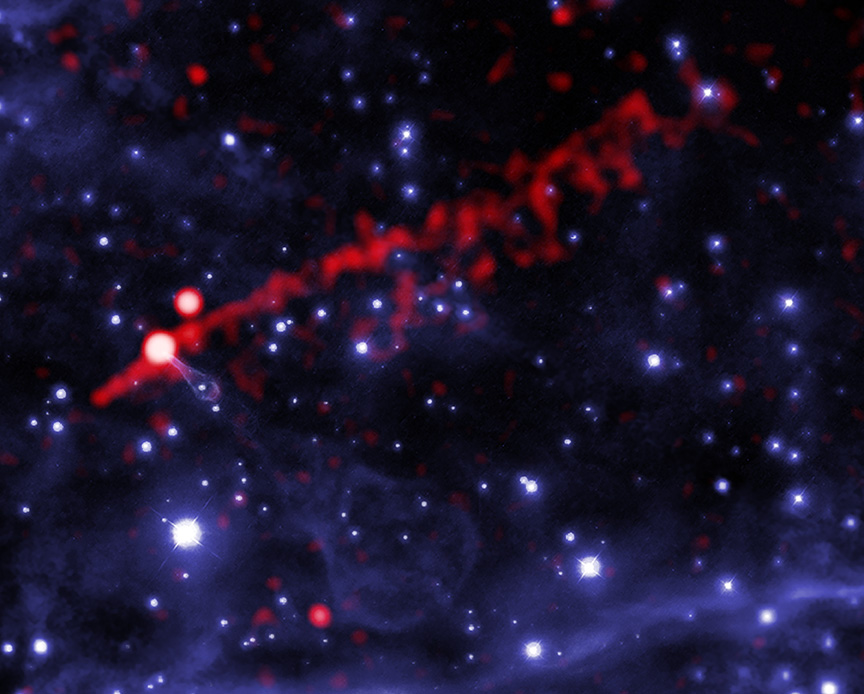
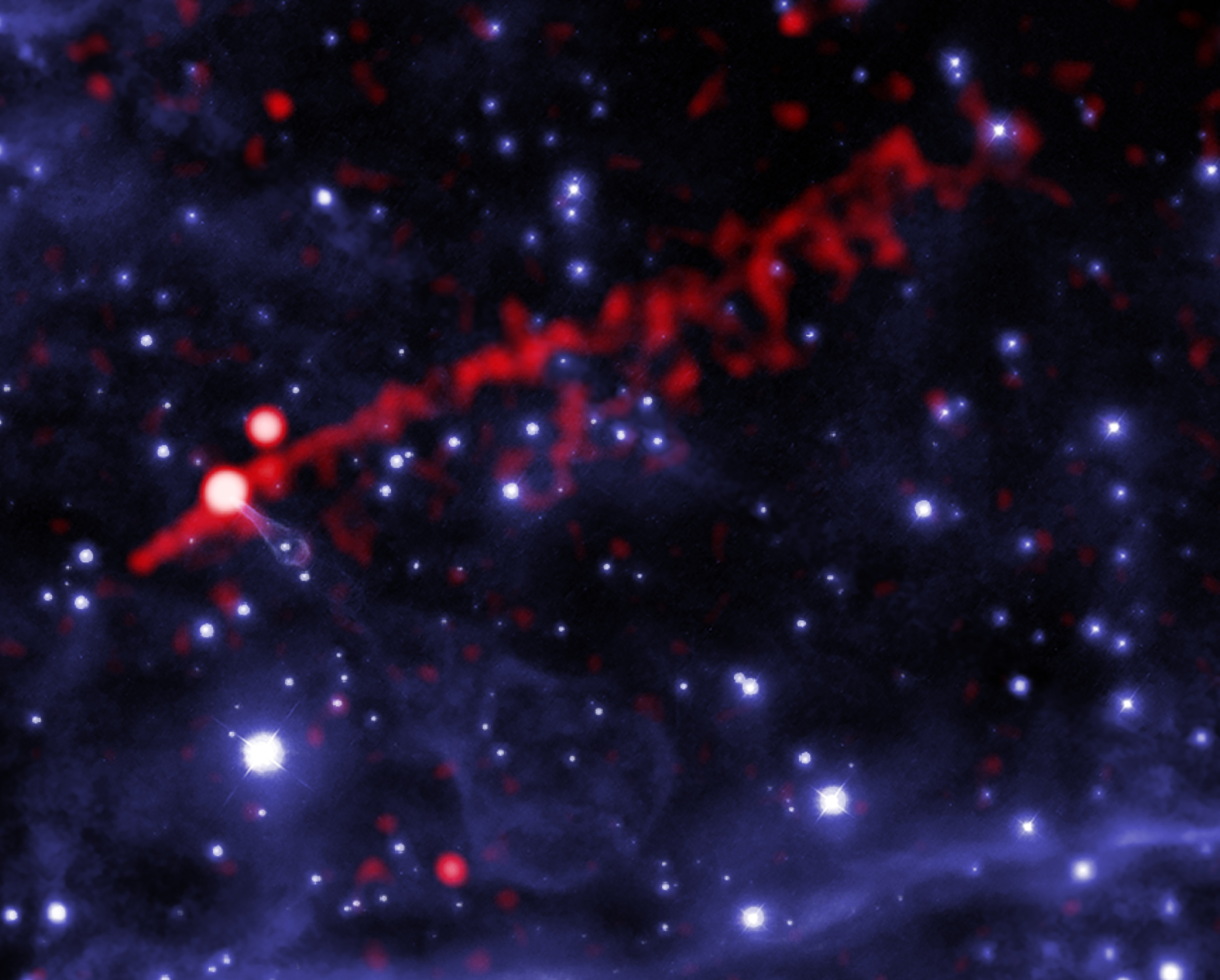
The new movie of Chandra (red) and Palomar (blue) data helps break down what is playing out in the Guitar Nebula. X-rays from Chandra show a filament of energetic matter and antimatter particles, about two light-years or 12 trillion miles long, blasting away from the pulsar (seen as the bright white dot connected to the filament).
Astronomers have nicknamed the structure connected to the pulsar PSR
B2224+65 as the “Guitar Nebula” because of its distinct resemblance to
the instrument in glowing hydrogen light. The guitar shape comes from
bubbles blown by particles ejected from the pulsar through a steady
wind. Because the pulsar is moving from the lower right to the upper
left, most of the bubbles were created in the past as the pulsar moved
through a medium with variations in density.
Outline of the guitar shape in the X-ray and optical image. Credit: X-ray: NASA/CXC/Stanford Univ./M. de Vries et al.; Optical:
(Hubble) NASA/ESA/STScI and (Palomar) Hale Telescope/Palomar/CalTech;
Illustrated outline: NASA/CXC/K. DiVona; Image Processing:
NASA/CXC/SAO/L. Frattare)
At the tip of the guitar is the pulsar, a rapidly rotating neutron star
left behind after the collapse of a massive star. As it hurtles through
space it is pumping out a flame-like filament of particles and X-ray
light that astronomers have captured with Chandra.
How does space produce something so bizarre? The combination of two extremes — fast rotation and high magnetic fields of pulsars — leads to particle acceleration and high-energy radiation
that creates matter and antimatter particles, as electron and positron
pairs. In this situation, the usual process of converting mass into
energy, famously determined by Albert Einstein's E = mc2 equation, is reversed. Here, energy is being converted into mass to produce the particles.
Particles spiraling along magnetic field lines around the pulsar
create the X-rays that Chandra detects. As the pulsar and its
surrounding nebula of energetic particles have flown through space, they
have collided with denser regions of gas. This allows the most
energetic particles to escape the confines of the Guitar Nebula and fly
to the right of the pulsar, creating the filament of X-rays. When those
particles escape, they spiral around and flow along magnetic field lines
in the interstellar medium, that is, the space in between stars.
The new movie shows the pulsar and the filament flying towards the upper left of the image through Chandra data taken in 2000, 2006, 2012 and 2021.
The movie has the same optical image in each frame, so it does not show
changes in parts of the “guitar.” A separate movie obtained with data
from NASA’s Hubble Space Telescope (obtained in 1994, 2001, 2006, and
2021) shows the motion of the pulsar and the smaller structures around
it.
Hubble Space Telescope data: 1994, 2001, 2006, and 2021
Credit: Optical: (Hubble) NASA/ESA/STScI and (Palomar) Hale Telescope/Palomar/CalTech)
A study of this data has concluded that the variations that drive the
formation of bubbles in the hydrogen nebula, which forms the outline of
the guitar, also control changes in how many particles escape to the
right of the pulsar, causing subtle brightening and fading of the X-ray
filament, like a cosmic blow torch shooting from the tip of the guitar.
The structure of the filament teaches astronomers about how electrons
and positrons travel through the interstellar medium. It also provides
an example of how this process is injecting electrons and positrons into
the interstellar medium.
A paper describing these results was published in The Astrophysical Journal and is available here.
NASA's Marshall Space Flight Center manages the Chandra program. The
Smithsonian Astrophysical Observatory's Chandra X-ray Center controls
science operations from Cambridge, Massachusetts, and flight operations
from Burlington, Massachusetts.
This release features two short videos and a labeled composite image,
all featuring what can be described as a giant flame-throwing guitar
floating in space.
In both the six second multiwavelength Guitar Nebula timelapse video
and the composite image, the guitar shape appears at our lower left,
with the neck of the instrument pointing toward our upper left. The
guitar shape is ghostly and translucent, resembling a wispy cloud on a
dark night. At the end of the neck, the guitar’s headstock comes to a
sharp point that lands on a bright white dot. This dot is a pulsar, and
the guitar shape is a hydrogen nebula. The nebula was formed when
particles being ejected by the pulsar produced a cloud of bubbles. The
bubbles were then blown into a curvy guitar shape by a steady wind. The
guitar shape is undeniable, and is traced by a thin white line in the
labeled composite image.
The pulsar, known as PSR B2224+65, has also released a long filament
of energetic matter and antimatter particles approximately 12 trillion
miles long. In both the composite image and the six second video, this
energetic, X-ray blast shoots from the bright white dot at the tip of
the guitar’s headstock, all the way out to our upper righthand corner.
In the still image, the blast resembles a streak of red dots, most of
which fall in a straight, densely packed line. The six second video
features four separate images of the phenomenon, created with Chandra
data gathered in 2000, 2006, 2012, and 2021. When shown in sequence, the
density of the X-ray blast filament appears to fluctuate.
A 12 second video is also included in this release. It features four
images that focus on the headstock of the guitar shape. These images
were captured by the Hubble Space Telescope in 1994, 2001, 2006, and
2021. When played in sequence, the images show the headstock shape
expanding. A study of this data has concluded that the variations that
drive the formation of bubbles in the hydrogen nebula also control
changes in the pulsar’s blast filament. Meaning the same phenomenon that
created the cosmic guitar also created the cosmic blowtorch shooting
from the headstock.
Fast Facts for Guitar Nebula:
Scale: Image is about 2.6 arcmin (2 light-years) across. Category: Neutron Stars/X-ray Binaries Coordinates (J2000): RA 22h 25m 52.36s | Dec +65° 35´ 33.79" Constellation: Cepheus Observation Dates: 21 pointings between Oct 2000 and Feb 2022 Observation Time: 147 hours 56 minutes (6 days 3 hours 56 minutes) Obs. ID: 755, 6691, 7400, 13771, 14353, 14467, 24426-24437, 24992, 26336 Instrument:ACIS References: de Vries, M. et al., 2022,ApJ, 939, 70. Color Code: X-ray: red; Optical: blue Distance Estimate: About 2,700 light-years
Credit: B. Saxton U.S. National Science Foundation/NSF National Radio Astronomy Observatory
A team of astronomers has found a new tool to discover pulsars. Pulsars are rapidly rotating neutron stars that blast out pulses of radiation at regular intervals ranging from seconds to milliseconds. These pulses help scientists learn more about the Universe, to test the curve of space time around black holes, detect gravitational waves, and probe the interstellar medium.
This search combined observations from the U.S. National Science Foundation (NSF) Karl G. Jansky Very Large Array, the VLA Low-band Ionosphere and Transient Experiment (VLITE), and archival data from the NSF Robert C. Byrd Green Bank Telescope. The U.S. Naval Research Laboratory (NRL) and the NSF National Radio Astronomy Observatory (NRAO) collaborated to develop VLITE. This experiment allows researchers to continually monitor the sky at low radio frequencies by piggybacking VLITE observations on nearly all observations using the VLA’s higher frequency receivers.
“It was exciting so early in my career to see a speculative project work out so successfully,” said Amaris McCarver, an undergraduate student at Texas Tech University, who will be the lead author on a paper submitted to the Astrophysical Journal, reporting these results.
“We used the VLITE data to search for candidate pulsars. After identifying the best candidate, GLIMPSE-C01, we reprocessed archival GBT pulsar data with new algorithms to confirm the discovery of a millisecond pulsar. After that, we followed up with new VLA observations to confirm its location and properties,” shares Tracy E. Clarke, an astronomer who coordinates VLITE for the Naval Research Laboratory (NRL). You can read the NRL press release on this science HERE.
“Tracy and I had been talking about doing this project for many years. Amaris started working with me during the academic year, doing similar searches on some all-sky surveys at higher radio frequency, and she immediately distinguished herself as an excellent research student, so I referred her to the NRL internship program, where she then conducted this work,” said Tom Maccarone, a professor at Texas Tech University.
By cross-matching existing all-sky catalogs at different wavelengths—rather than spending hours of costly observing that might not even find a pulsar—astronomers were able to identify strong pulsar candidates, one of which was confirmed by re-processing archival data using modern software. “Time and time again, new discoveries are being made from archival data. The value of these astronomical data archives couldn’t be more important,” adds Scott Ransom, an NRAO scientist who focuses on pulsar research. Since pulsar search data is so voluminous, the Green Bank staff did not archive those types of data for at least the first 15 years of GBT operations. This particular observation was saved on a raw hard-disk drive by Scott Ransom and stored on a shelf in his office. In recent years, the huge improvements in storage capacity have enabled the Green Bank Observatory to archive essentially all of the potentially priceless data from the GBT, and make them available to all researchers.
“This research shows we can use measures of radio brightness at different frequencies to find new pulsars efficiently, and that available sky surveys combined with VLITE mean those measurements are essentially always available. This opens the door to a new era of searches for highly dispersed and highly accelerated pulsars,” adds Clarke.
Pulsar searches are inherently less sensitive to the most exotic types of pulsars. These can be the fastest ones, the ones deepest in the Galactic Plane, and the ones in the shortest period binaries. The capabilities of VLITE, and improved algorithms, will allow “old” data to yield new discoveries. “We can revisit previous searches with better tools to discover these hard-to-find gems in the pulsar population,” adds Clarke.
The National Radio Astronomy Observatory (NRAO) and the Green Bank Observatory (GBO) are facilities of theU.S. National Science Foundation, operated under cooperative agreement by Associated Universities, Inc.
Construction and installation of VLITE was supported by the NRL Sustainment Restoration and Maintenance fund.
Media Contacts:
Corrina Jaramillo Feldman,
Public Information Officer – New Mexico, cfeldman@nrao.edu 505-366-7267
Jill Malusky,
NRAO/GBO News & Public Information Manager, jmalusky@nrao.edu 304-460-5608
The supernova remnant 3C 58 contains a spinning neutron star,
known as PSR J0205+6449, at its center. Astronomers studied this
neutron star and others like it to probe the nature of matter inside
these very dense objects. A new study, made using NASA’s Chandra X-ray Observatory
and ESA’s XMM-Newton, reveals that the interiors of neutron stars may
contain a type of ultra-dense matter not found anywhere else in the
Universe, as reported in our latest press release.
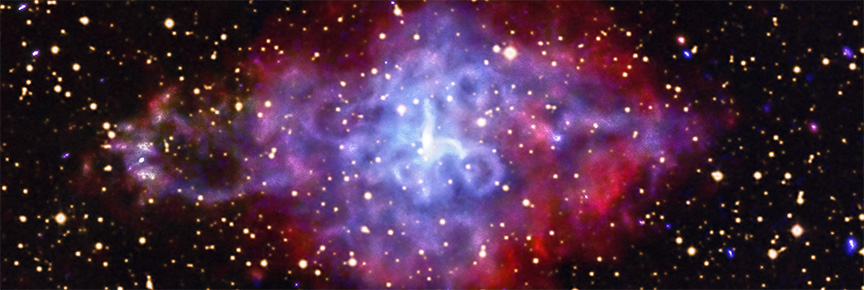
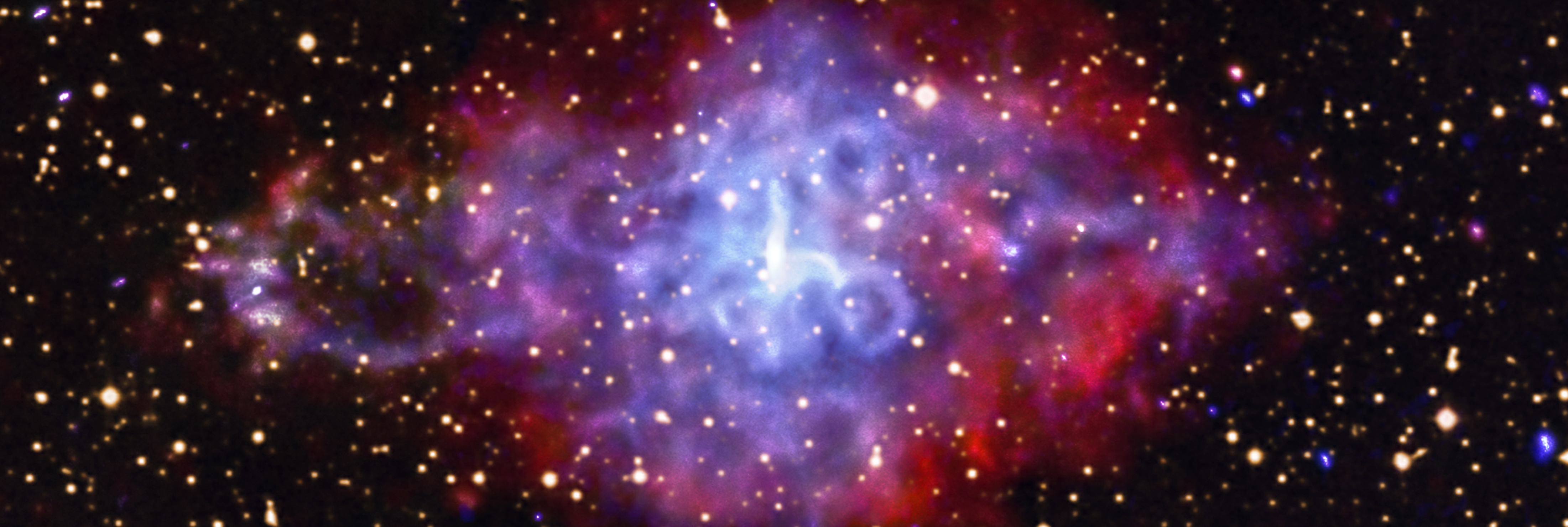
In this image of 3C 58, low-energy X-rays
are colored red, medium-energy X-rays are green, and the high-energy
band of X-rays is shown in blue. The X-ray data have been combined with
an optical
image in yellow from the Digitized Sky Survey. The Chandra data show
that the rapidly rotating neutron star (also known as a “pulsar”) at the
center is surrounded by a torus of X-ray emission and a jet that
extends for several light-years. The optical data shows stars in the field.
The team in this new study analyzed previously released data from
neutron stars to determine the so-called equation of state. This refers
to the basic properties of the neutron stars including the pressures and
temperatures in different parts of their interiors.
The authors used machine learning, a type of artificial intelligence,
to compare the data to different equations of state. Their results
imply that a significant fraction of the equations of state — the ones
that do not include the capability for rapid cooling at higher masses —
can be ruled out.
The researchers capitalized on some neutron stars in the study being
located in supernova remnants, including 3C 58. Since astronomers have
age estimates of the supernova remnants, they also have the ages of the
neutron stars that were created during the explosions that created both
the remnants and the neutron stars. The astronomers found that the
neutron star in 3C 58 and two others were much cooler than the rest of
the neutron stars in the study.
Illustration of a Neutron Star
Credit: ICE-CSIC/D. Futselaar/Marino et al.
The team thinks that part of the explanation for the rapid cooling is
that these neutron stars are more massive than most of the rest.
Because more massive neutron stars have more particles, special
processes that cause neutron stars to cool more rapidly might be
triggered.
One possibility for what is inside these neutron stars is a type of radioactive decay near their centers where neutrinos — low mass particles that easily travel through matter — carry away much of the energy and heat, causing rapid cooling.
Another possibility is that there are types of exotic matter found in the centers of these more rapidly cooling neutron stars.
The Nature Astronomy paper describing these results is available here.
The authors of the paper are Alessio Marino (Institute of Space
Sciences (ICE) in Barcelona, Spain), Clara Dehman (ICE), Konstantinos
Kovlakas (ICE), Nanda Rea (ICE), J. A. Pons (University of Alicante in
Spain), and Daniele Viganò (ICE).
NASA's Marshall Space Flight Center manages the Chandra program. The
Smithsonian Astrophysical Observatory's Chandra X-ray Center controls
science from Cambridge Massachusetts and flight operations from
Burlington, Massachusetts.
This is an image of the leftovers from an exploded star called 3C 58, shown in X-ray and optical light. At the center of the remnant is a rapidly spinning neutron star, called a pulsar, that presents itself as a bright white object that's somewhat elongated in shape.
Loops and swirls of material, in shades of blue and purple, extend outward from the neutron star in many directions, resembling the shape of an octopus and its arms.
Surrounding the octopus-like structure is a cloud of material in shades of red that is wider horizontally than it is vertically. A ribbon of purple material extends to the left edge of the red cloud, curling upward at its conclusion. Another purple ribbon extends to the right edge of the red cloud, though it is less defined than the one on the other side. Stars of many shapes and sizes dot the entire image.
Fast Facts for 3C 58:
Scale: Image is about 12 arcmin (26 light-years) across. Category:Neutron Stars/X-ray Binaries,Supernovas & Supernova Remnants Coordinates (J2000): RA 02h 05m 37.0s | Dec +64° 49´ 48.0" Constellation: Cassiopeia Observation Dates: 4 observations from Sep 2000 to Apr 2003 Observation Time: 108 hours 52 minutes (4 days 12 hours 52 minutes) Obs. ID: 728, 3832, 4382, 4383 Instrument: ACIS References: Marino, A. et al., 2024, Nature Astronomy; Color Code: X-ray: red = 0.5-1.2 keV, green = 1.2-2.0 keV, blue = 2.0-7.0 keV; Optical: yellow Distance Estimate: About 6,500 light-years