Showing posts with label NASA's Kepler mission. Show all posts

Tuesday, June 20, 2017

NASA Releases Kepler Survey Catalog with Hundreds of New Planet Candidates

NASA’s Kepler space telescope team has identified 219 new planet candidates, 10 of which are near-Earth size and in the habitable zone of their star.Credits: NASA/JPL-Caltech


NASA’s Kepler space telescope team has released a mission catalog of planet candidates that introduces 219 new planet candidates, 10 of which are near-Earth size and orbiting in their star's habitable zone, which is the range of distance from a star where liquid water could pool on the surface of a rocky planet.

This is the most comprehensive and detailed catalog release of candidate exoplanets, which are planets outside our solar system, from Kepler’s first four years of data. It’s also the final catalog from the spacecraft’s view of the patch of sky in the Cygnus constellation.

With the release of this catalog, derived from data publicly available on the NASA Exoplanet Archive, there are now 4,034 planet candidates identified by Kepler. Of which, 2,335 have been verified as exoplanets. Of roughly 50 near-Earth size habitable zone candidates detected by Kepler, more than 30 have been verified.

Additionally, results using Kepler data suggest two distinct size groupings of small planets. Both results have significant implications for the search for life. The final Kepler catalog will serve as the foundation for more study to determine the prevalence and demographics of planets in the galaxy, while the discovery of the two distinct planetary populations shows that about half the planets we know of in the galaxy either have no surface, or lie beneath a deep, crushing atmosphere – an environment unlikely to host life.

The findings were presented at a news conference Monday at NASA's Ames Research Center in California's Silicon Valley.

“The Kepler data set is unique, as it is the only one containing a population of these near Earth-analogs – planets with roughly the same size and orbit as Earth,” said Mario Perez, Kepler program scientist in the Astrophysics Division of NASA’s Science Mission Directorate. “Understanding their frequency in the galaxy will help inform the design of future NASA missions to directly image another Earth.”

The Kepler space telescope hunts for planets by detecting the minuscule drop in a star’s brightness that occurs when a planet crosses in front of it, called a transit.

This is the eighth release of the Kepler candidate catalog, gathered by reprocessing the entire set of data from Kepler’s observations during the first four years of its primary mission. This data will enable scientists to determine what planetary populations – from rocky bodies the size of Earth, to gas giants the size of Jupiter – make up the galaxy’s planetary demographics.

To ensure a lot of planets weren't missed, the team introduced their own simulated planet transit signals into the data set and determined how many were correctly identified as planets. Then, they added data that appear to come from a planet, but were actually false signals, and checked how often the analysis mistook these for planet candidates. This work told them which types of planets were overcounted and which were undercounted by the Kepler team’s data processing methods.

“This carefully-measured catalog is the foundation for directly answering one of astronomy’s most compelling questions – how many planets like our Earth are in the galaxy?” said Susan Thompson, Kepler research scientist for the SETI Institute in Mountain View, California, and lead author of the catalog study.

One research group took advantage of the Kepler data to make precise measurements of thousands of planets, revealing two distinct groups of small planets. The team found a clean division in the sizes of rocky, Earth-size planets and gaseous planets smaller than Neptune. Few planets were found between those groupings.

Using the W. M. Keck Observatory in Hawaii, the group measured the sizes of 1,300 stars in the Kepler field of view to determine the radii of 2,000 Kepler planets with exquisite precision.

“We like to think of this study as classifying planets in the same way that biologists identify new species of animals,” said Benjamin Fulton, doctoral candidate at the University of Hawaii in Manoa, and lead author of the second study. “Finding two distinct groups of exoplanets is like discovering mammals and lizards make up distinct branches of a family tree.”

It seems that nature commonly makes rocky planets up to about 75 percent bigger than Earth. For reasons scientists don't yet understand, about half of those planets take on a small amount of hydrogen and helium that dramatically swells their size, allowing them to "jump the gap" and join the population closer to Neptune’s size.

The Kepler spacecraft continues to make observations in new patches of sky in its extended mission, searching for planets and studying a variety of interesting astronomical objects, from distant star clusters to objects such as the TRAPPIST-1 system of seven Earth-size planets, closer to home.

Ames manages the Kepler missions for NASA’s Science Mission Directorate. NASA's Jet Propulsion Laboratory in Pasadena, California, managed Kepler mission development. Ball Aerospace & Technologies Corporation operates the flight system with support from the Laboratory for Atmospheric and Space Physics at the University of Colorado in Boulder.


For more information about the Kepler mission, visit:  https://www.nasa.gov/kepler


Felicia Chou
Headquarters, Washington
202-358-0257

felicia.chou@nasa.gov

Michele Johnson
Ames Research Center, California’s Silicon Valley
650-604-6882

michele.johnson@nasa.gov

Elizabeth Landau
Jet Propulsion Laboratory, Pasadena, Calif.
818-354-6425

elizabeth.landau@jpl.nasa.gov


Editor: Karen Northon


Thursday, November 17, 2016

Kepler Mission Manager Update: K2 Marching On With Campaign 11

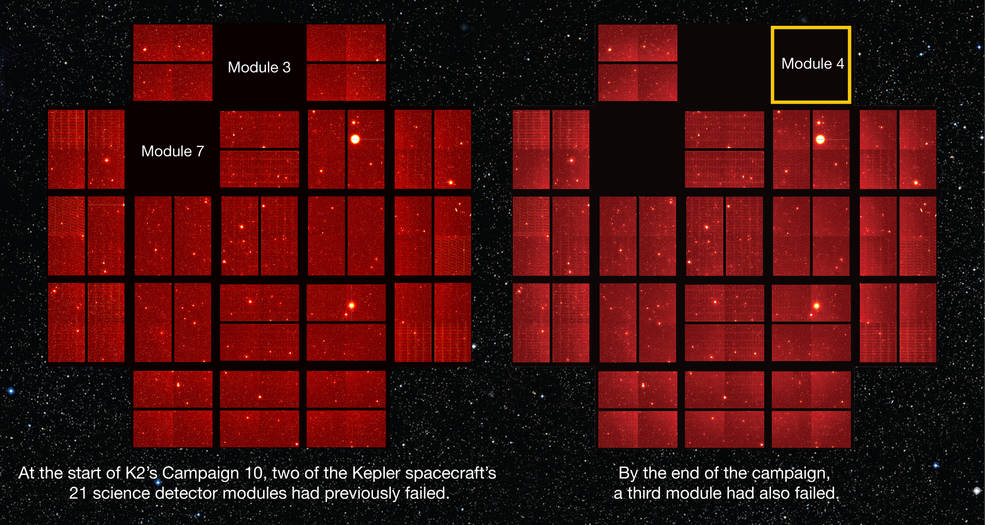
The comparison of two full frame images from the Kepler spacecraft show two black squares (Modules 3 and 7) and 19 red squares on the left. On the right, there are three black squares (Modules 3, 4 and 7) and 18 red squares. A red square indicates that data is being collected by the photometer and a black square indicates no data is being collected and that the module is no longer functional. Eighteen of the 21 science detector modules remain fully operational. Credits: NASA Ames/W. Stenzel


Kepler’s K2 mission is now in the midst of its eleventh campaign, observing a patch of sky in the direction of the constellation Sagittarius. During this campaign, it will observe 14,250 new targets, including the Galactic Center and Saturn's moons Titan and Enceladus.

Campaign 11 began on Sept. 24, but was interrupted for three days (Oct. 18-20) to make a small pointing correction to accommodate the imbalance that was created by broadcasting data from a different antenna on the other side of the spacecraft. Although the spacecraft is as big and heavy as an SUV, it actually turns slightly when we change the broadcasting antenna. This is like having your car begin to turn from the force of the blinking of your turn signal. Yes, the spacecraft is that delicately balanced! Data collection for Campaign 11 will continue until Dec. 7.

Since my last update, our investigation into the cause of the spacecraft's photometer—the onboard camera—being powered off in July during Campaign 10, confirms that that science detector Module 4 failed. The likely cause was a random part failure that resulted in a high electric current in the circuitry, which blew the protection fuse, disabling the detector but preventing the problem from propagating to other detectors. As part of the fault protection response, the photometer was powered off.

Eighteen of the 21 science detector modules remain fully operational. Two science modules had failed previously: Module 7 in January 2014 and Module 3 in January 2010. These are not unexpected events as the spacecraft ages in the harsh environment of space.

In September, the spacecraft had a unique opportunity to provide a 'wide-angle' view of comet 67P/Churyumov–Gerasimenko, making observations of its core and tail. These observations complement the close-in study of the comet provided by the European Space Agency's Rosetta spacecraft during the final month of its mission. These and the remainder of Campaign 10 data have been downlinked to the ground and are being processed for release at the public archive later this month.
 
We've also made changes with the Kepler and K2 project scientist personnel. On Aug. 15, Natalie Batalha was appointed as the project scientist for the Kepler mission. Since 1999, Natalie has served in numerous leadership roles throughout the mission including deputy principal investigator and science team lead. In addition to her responsibilities with the Kepler mission, Natalie is a co-lead of NASA's Nexus for Exoplanet System Science Coalition, and serves on the James Webb Space Telescope Advisory Committee. She also serves as a member of the NASA Advisory Council's Astrophysics Subcommittee, and, in 2013, participated on the task force to define NASA's 30-year Astrophysics Roadmap- Enduring Quests, Daring Visions: NASA Astrophysics in the Next Three Decades.

On Sept. 6, Jessie Dotson assumed the role of project scientist for the K2 mission. Dr. Dotson was formerly the deputy science office director for Kepler and, in 2011, established the Kepler Guest Observer Office. Most recently, she served as astrophysics branch chief in the Space Science and Astrobiology Division at NASA Ames. In 2014, Jessie helped formulate the Asteroid Threat Assessment Project (ATAP) at NASA Ames to quantify the risk to Earth of an asteroid impact. She currently leads the ATAP asteroid characterization team. In 2016, Jessie was awarded a NASA Outstanding Leadership Medal for her work as the astrophysics branch chief at Ames.

Together, Natalie and Jessie replace Steve Howell who served as Kepler project scientist since 2010 and K2 project scientist since mission conception in 2013. In that role, Steve oversaw Kepler science operations through the end of its prime mission, the recovery from the reaction wheel failure that nearly ended the mission, and the development and implementation of the K2 mission that gave Kepler a new lease on life. We commend Steve for his work as the Kepler/K2 project scientist, with notable leadership in catalyzing the science community to support Kepler's extended mission called K2.

In August, the team gathered for the annual year-in-review of spacecraft operations with Ball Aerospace, the designer, manufacturer and flight controller of Kepler. A topic of high interest is the on-board fuel reserve, which is expected to last into the spring of 2018.

At last count, Kepler has identified more than 5,100 planet candidates. Of these, more than 2,500 have been verified as bona fide planets. NASA’s next planet-hunting mission, the Transiting Exoplanet Survey Satellite (TESS), is scheduled to launch no later than June 2018. TESS will build upon Kepler’s success and search for exoplanets around the stars closest to the own solar system.

Regards,


Charlie Sobeck​
Kepler and K2 mission manager
NASA's Ames Research Center 


Editor: Michele Johnson
 
 
Source: NASA/Kepler and K2 

Saturday, August 13, 2016

Kepler Watches Stellar Dancers in the Pleiades Cluster


Like cosmic ballet dancers, the stars of the Pleiades cluster are spinning. But these celestial dancers are all twirling at different speeds. Astronomers have long wondered what determines the rotation rates of these stars.

By watching these stellar dancers, NASA's Kepler space telescope during its K2 mission has helped amass the most complete catalog of rotation periods for stars in a cluster. This information can help astronomers gain insight into where and how planets form around these stars, and how such stars evolve.    

"We hope that by comparing our results to other star clusters, we will learn more about the relationship between a star’s mass, its age, and even the history of its solar system," said Luisa Rebull, a research scientist at the Infrared Processing and Analysis Center at Caltech in Pasadena, California. She is the lead author of two new papers and a co-author on a third paper about these findings, all being published in the Astronomical Journal.

The Pleiades star cluster is one of the closest and most easily seen star clusters, residing just 445 light-years away from Earth, on average. At about 125 million years old, these stars -- known individually as Pleiads -- have reached stellar "young adulthood." In this stage of their lives, the stars are likely spinning the fastest they ever will.

As a typical star moves further along into adulthood, it loses some zip due to the copious emission of charged particles known as a stellar wind (in our solar system, we call this the solar wind). The charged particles are carried along the star’s magnetic fields, which overall exerts a braking effect on the rotation rate of the star.

Rebull and colleagues sought to delve deeper into these dynamics of stellar spin with Kepler. Given its field of view on the sky, Kepler observed approximately 1,000 stellar members of the Pleiades over the course of 72 days. The telescope measured the rotation rates of more than 750 stars in the Pleiades, including about 500 of the lowest-mass, tiniest, and dimmest cluster members, whose rotations could not previously be detected from ground-based instruments.

Kepler measurements of starlight infer the spin rate of a star by picking up small changes in its brightness. These changes result from "starspots" which, like the more-familiar sunspots on our sun, form when magnetic field concentrations prevent the normal release of energy at a star’s surface. The affected regions become cooler than their surroundings and appear dark in comparison.

As stars rotate, their starspots come in and out of Kepler’s view, offering a way to determine spin rate. Unlike the tiny, sunspot blemishes on our middle-aged sun, starspots can be gargantuan in stars as young as those in the Pleiades because stellar youth is associated with greater turbulence and magnetic activity. These starspots trigger larger brightness decreases, and make spin rate measurements easier to obtain.

During its observations of the Pleiades, a clear pattern emerged in the data: More massive stars tended to rotate slowly, while less massive stars tended to rotate rapidly. The big-and-slow stars' periods ranged from one to as many as 11 Earth-days. Many low-mass stars, however, took less than a day to complete a pirouette. (For comparison, our sedate sun revolves fully just once every 26 days.) The population of slow-rotating stars includes some ranging from a bit larger, hotter and more massive than our sun, down to other stars that are somewhat smaller, cooler and less massive. On the far end, the fast-rotating, fleet-footed, lowest-mass stars possess as little as a tenth of our sun’s mass. 

"In the 'ballet' of the Pleiades, we see that slow rotators tend to be more massive, whereas the fastest rotators tend to be very light stars," said Rebull.  

The main source of these differing spin rates is the internal structure of the stars, Rebull and colleagues suggest. Larger stars have a huge core enveloped in a thin layer of stellar material undergoing a process called convection, familiar to us from the circular motion of boiling water.
Small stars, on the other hand, consist almost entirely of convective, roiling regions. As stars mature, the braking mechanism from magnetic fields more easily slows the spin rate of the thin, outermost layer of big stars than the comparatively thick, turbulent bulk of small stars.

Thanks to the Pleiades’ proximity, researchers think it should be possible to untangle the complex relationships between stars’ spin rates and other stellar properties. Those stellar properties, in turn, can influence the climates and habitability of a star’s hosted exoplanets. For instance, as spinning slows, so too does starspot generation, and the solar storms associated with starspots. Fewer solar storms means less intense, harmful radiation blasting into space and irradiating nearby planets and their potentially emerging biospheres.    

"The Pleiades star cluster provides an anchor for theoretical models of stellar rotation going both directions, younger and older," said Rebull. "We still have a lot we want to learn about how, when and why stars slow their spin rates and hang up their 'dance shoes,' so to speak."

Rebull and colleagues are now analyzing K2 mission data from an older star cluster, Praesepe, popularly known as the Beehive Cluster, to further explore this phenomenon in stellar structure and evolution.

"We’re really excited that K2 data of star clusters, such as the Pleiades, have provided astronomers with a bounty of new information and helped advance our knowledge of how stars rotate throughout their lives," said Steve Howell, project scientist for the K2 mission at NASA’s Ames Research Center in Moffett Field, California.

The K2 mission’s approach to studying stars employs the Kepler spacecraft's ability to precisely observe miniscule changes in starlight. Kepler’s primary mission ended in 2013, but more exoplanet and astrophysics observations continue with the K2 mission, which began in 2014.

Ames manages the Kepler and K2 missions for NASA's Science Mission Directorate. NASA's Jet Propulsion Laboratory in Pasadena, California, managed Kepler mission development. Ball Aerospace & Technologies Corporation operates the flight system with support from the Laboratory for Atmospheric and Space Physics at the University of Colorado at Boulder.


Elizabeth Landau
Jet Propulsion Laboratory, Pasadena, Calif.
818-354-6425

elizabeth.landau@jpl.nasa.gov

Michele Johnson
Ames Research Center, Moffett Field, Calif.

650-604-6982

michele.johnson@nasa.gov


Written by Adam Hadhazy


Editor: Tony Greicius


Friday, August 05, 2016

Astronomers Catalog Planets That May Be Earthlike

The artistic concept of Kepler-186f is the result of scientists and artists collaborating to imagine the appearance of these distant worlds. 
Image credit: NASA Ames/SETI Institute/JPL-Caltech.  › Full image and caption


Using public data collected by NASA's Kepler mission, astronomers have catalogued the planet candidates that may be similar to our third rock from the sun. The tabulation of candidates will help astronomers focus their research efforts in the search for life.

The analysis, led by Stephen Kane, an associate professor of physics and astronomy at San Francisco State University in California, highlights 20 candidates in the Kepler trove that are less than twice the size of Earth and orbit their star in the conservative habitable zone -- the range of distances where liquid water could pool on the surface of an orbiting planet. Of these 20 candidates, nine have been previously investigated and determined to be verified planets, including notables like Kepler-62f, Kepler-186f, Kepler-283c, Kepler-296f and Kepler-442b.

The results are presented in a paper accepted by the Astrophysical Journal. For a listing of the candidates and their properties, the paper can be reviewed at: http://arxiv.org/abs/1608.00620.

NASA's Ames Research Center in California's Silicon Valley manages the Kepler and K2 missions for NASA's Science Mission Directorate. NASA's Jet Propulsion Laboratory in Pasadena, California, managed Kepler mission development. Ball Aerospace & Technologies Corporation operates the flight system with support from the Laboratory for Atmospheric and Space Physics at the University of Colorado at Boulder.


News Media Contact

Elizabeth Landau
Jet Propulsion Laboratory, Pasadena, Calif.
818-354-6425

elizabeth.landau@jpl.nasa.gov

Michele Johnson
Ames Research Center, Moffett Field, Calif.
650-604-6982

michele.johnson@nasa.gov

Written by Michele Johnson


Source: JPL-Caltech

Thursday, May 12, 2016

2007 OR10: Largest Unnamed World in the Solar System

New K2 results peg 2007 OR10 as the largest unnamed body in our solar system and the third largest of the current roster of about half a dozen dwarf planets. The revised measurement of 2007 OR10's diameter, 955 miles (1,535 kilometers), is about 60 miles (100 kilometers) greater than the next largest dwarf planet, Makemake, or about one-third smaller than Pluto. Another dwarf planet, named Haumea, has an oblong shape that is wider on its long axis than 2007 OR10, but its overall volume is smaller Credits: Konkoly Observatory/András Pál, Hungarian Astronomical Association/Iván Éder, NASA/JHUAPL/SwRI. Hi-res image


Dwarf planets tend to be a mysterious bunch. With the exception of Ceres, which resides in the main asteroid belt between Mars and Jupiter, all members of this class of minor planets in our solar system lurk in the depths beyond Neptune. They are far from Earth – small and cold – which makes them difficult to observe, even with large telescopes. So it's little wonder astronomers only discovered most of them in the past decade or so.

Pluto is a prime example of this elusiveness. Before NASA's New Horizons spacecraft visited it in 2015, the largest of the dwarf planets had appeared as little more than a fuzzy blob, even to the keen-eyed Hubble Space Telescope. Given the inherent challenges in trying to observe these far-flung worlds, astronomers often need to combine data from a variety of sources in order to tease out basic details about their properties.

Recently, a group of astronomers did just that by combining data from two space observatories to reveal something surprising: a dwarf planet named 2007 OR10 is significantly larger than previously thought.

The results peg 2007 OR10 as the largest unnamed world in our solar system and the third largest of the current roster of about half a dozen dwarf planets. The study also found that the object is quite dark and rotating more slowly than almost any other body orbiting our sun, taking close to 45 hours to complete its daily spin.

For their research, the scientists used NASA's repurposed planet-hunting Kepler space telescope -- its mission now known as K2 -- along with the archival data from the infrared Herschel Space Observatory. Herschel was a mission of the European Space Agency (ESA) with NASA participation.

The research paper reporting these results is published in The Astronomical Journal.

"K2 has made yet another important contribution in revising the size estimate of 2007 OR10. But what's really powerful is how combining K2 and Herschel data yields such a wealth of information about the object's physical properties," said Geert Barentsen, Kepler/K2 research scientist at NASA's Ames Research Center in California's Silicon Valley.

The revised measurement of the planet's diameter, 955 miles (1,535 kilometers), is about 60 miles (100 kilometers) greater than the next largest dwarf planet, Makemake, or about one-third smaller than Pluto. Another dwarf planet, named Haumea, has an oblong shape that is wider on its long axis than 2007 OR10, but its overall volume is smaller.

Like its predecessor mission, K2 searches for the change in brightness of distant objects. The tiny, telltale dip in the brightness of a star can be the signature of a planet passing or transiting in front.

But, closer to home, K2 also looks out into our solar system to observe small bodies such as comets, asteroids, moons and dwarf planets. Because of its exquisite sensitivity to small changes in brightness, the Kepler spacecraft is an excellent instrument for observing the brightness of distant solar system objects and how that changes as they rotate.

Figuring out the size of small, faint objects far from Earth is tricky business. Since they appear as mere points of light, it can be a challenge to determine whether the light they emit represents a smaller, brighter object, or a larger, darker one. This is what makes it so difficult to observe 2007 OR10 -- although its elliptical orbit brings it nearly as close to the sun as Neptune, it is currently twice as far from the sun as Pluto.

Enter the dynamic duo of Kepler and Herschel.

Previous estimates based on Herschel data alone suggested a diameter of roughly 795 miles (1,280 kilometers) for 2007 OR10. However, without a handle on the object's rotation period, those studies were limited in their ability to estimate its overall brightness, and hence its size. The discovery of the very slow rotation by K2 was essential for the team to construct more detailed models that revealed the peculiarities of this dwarf planet. The rotation measurements even included hints of variations in brightness across its surface.

Together, the two space telescopes allowed the team to measure the fraction of sunlight reflected by 2007 OR10 (using Kepler) and the fraction absorbed and later radiated back as heat (using Herschel). Putting these two data sets together provided an unambiguous estimation of the dwarf planet's size and how reflective it is.

According to the new measurements, the diameter of 2007 OR10 is some 155 miles (250 kilometers) larger than previously thought. The larger size also implies higher gravity and a very dark surface -- the latter because the same amount of light is being reflected by a larger body. This dark nature is different from most dwarf planets, which are much brighter. Previous ground-based observations found 2007 OR10 has a characteristic red color, and other researchers have suggested this might be due to methane ices on its surface.

"Our revised larger size for 2007 OR10 makes it increasingly likely the planet is covered in volatile ices of methane, carbon monoxide and nitrogen, which would be easily lost to space by a smaller object," said András Pál at Konkoly Observatory in Budapest, Hungary, who led the research. "It's thrilling to tease out details like this about a distant, new world -- especially since it has such an exceptionally dark and reddish surface for its size."

As for when 2007 OR10 will finally get a name, that honor belongs to the object's discoverers. Astronomers Meg Schwamb, Mike Brown and David Rabinowitz spotted it in 2007 as part of a survey to search for distant solar system bodies using the Samuel Oschin Telescope at Palomar Observatory near San Diego, California.

"The names of Pluto-sized bodies each tell a story about the characteristics of their respective objects. In the past, we haven't known enough about 2007 OR10 to give it a name that would do it justice," said Schwamb. "I think we're coming to a point where we can give 2007 OR10 its rightful name."
Ames manages the Kepler and K2 missions for NASA's Science Mission Directorate. NASA's Jet Propulsion Laboratory in Pasadena, California, managed Kepler mission development. Ball Aerospace & Technologies Corporation operates the flight system with support from the Laboratory for Atmospheric and Space Physics at the University of Colorado in Boulder.

For more information about the Kepler and K2 missions, visit: http://www.nasa.gov/kepler

More information about Herschel is online at: http://www.nasa.gov/herschel


2007 OR10, the largest unnamed body in the solar system, was visible during the K2 mission's campaign three for 19 days in late 2014. K2 is the new mission of Kepler spacecraft. The apparent movement of the faint dwarf planet (indicated with the arrow) among the stars is caused by the changing position of Kepler as it orbits around the sun. The diffuse light sweeping across is a reflection from the much brighter planet Mars passing nearby. Credits: Konkoly Observatory/László Molnár and András Pál. Youtube


Media Contact:

Michele Johnson
Ames Research Center, Moffett Field, Calif.
650-604-6982
michele.johnson@nasa.gov

Written by Preston Dyches
Last Updated: May 11, 2016
Editor: Michele Johnson


Wednesday, May 11, 2016

NASA's Kepler Mission Announces Largest Collection of Planets Ever Discovered

This artist's concept depicts select planetary discoveries made to date by NASA's Kepler space telescope
Credits: NASA/W. Stenzel 


NASA's Kepler mission has verified 1,284 new planets – the single largest finding of planets to date.

“This announcement more than doubles the number of confirmed planets from Kepler,” said Ellen Stofan, chief scientist at NASA Headquarters in Washington. “This gives us hope that somewhere out there, around a star much like ours, we can eventually discover another Earth.”

Analysis was performed on the Kepler space telescope’s July 2015 planet candidate catalog, which identified 4,302 potential planets. For 1,284 of the candidates, the probability of being a planet is greater than 99 percent – the minimum required to earn the status of “planet.” An additional 1,327 candidates are more likely than not to be actual planets, but they do not meet the 99 percent threshold and will require additional study. The remaining 707 are more likely to be some other astrophysical phenomena. This analysis also validated 984 candidates previously verified by other techniques.

"Before the Kepler space telescope launched, we did not know whether exoplanets were rare or common in the galaxy. Thanks to Kepler and the research community, we now know there could be more planets than stars,” said Paul Hertz, Astrophysics Division director at NASA Headquarters. "This knowledge informs the future missions that are needed to take us ever-closer to finding out whether we are alone in the universe."

Kepler captures the discrete signals of distant planets – decreases in brightness that occur when planets pass in front of, or transit, their stars – much like the May 9 Mercury transit of our sun. Since the discovery of the first planets outside our solar system more than two decades ago, researchers have resorted to a laborious, one-by-one process of verifying suspected planets.

This latest announcement, however, is based on a statistical analysis method that can be applied to many planet candidates simultaneously. Timothy Morton, associate research scholar at Princeton University in New Jersey and lead author of the scientific paper published in The Astrophysical Journal, employed a technique to assign each Kepler candidate a planet-hood probability percentage – the first such automated computation on this scale, as previous statistical techniques focused only on sub-groups within the greater list of planet candidates identified by Kepler.

"Planet candidates can be thought of like bread crumbs,” said Morton. “If you drop a few large crumbs on the floor, you can pick them up one by one. But, if you spill a whole bag of tiny crumbs, you're going to need a broom. This statistical analysis is our broom."

In the newly-validated batch of planets, nearly 550 could be rocky planets like Earth, based on their size. 

Nine of these orbit in their sun's habitable zone, which is the distance from a star where orbiting planets can have surface temperatures that allow liquid water to pool. With the addition of these nine, 21 exoplanets now are known to be members of this exclusive group.

"They say not to count our chickens before they're hatched, but that's exactly what these results allow us to do based on probabilities that each egg (candidate) will hatch into a chick (bona fide planet)," said Natalie Batalha, co-author of the paper and the Kepler mission scientist at NASA's Ames Research Center in Moffett Field, California. “This work will help Kepler reach its full potential by yielding a deeper understanding of the number of stars that harbor potentially habitable, Earth-size planets -- a number that's needed to design future missions to search for habitable environments and living worlds.”

Of the nearly 5,000 total planet candidates found to date, more than 3,200 now have been verified, and 2,325 of these were discovered by Kepler. Launched in March 2009, Kepler is the first NASA mission to find potentially habitable Earth-size planets. For four years, Kepler monitored 150,000 stars in a single patch of sky, measuring the tiny, telltale dip in the brightness of a star that can be produced by a transiting planet. In 2018, NASA’s Transiting Exoplanet Survey Satellite will use the same method to monitor 200,000 bright nearby stars and search for planets, focusing on Earth and Super-Earth-sized.

Ames manages the Kepler missions for NASA’s Science Mission Directorate in Washington. The agency’s Jet Propulsion Laboratory in Pasadena, California, managed Kepler mission development. Ball Aerospace & Technologies Corporation operates the flight system, with support from the Laboratory for Atmospheric and Space Physics at the University of Colorado in Boulder.

For more information about the Kepler mission, visit: http://www.nasa.gov/kepler

For briefing materials from Tuesday’s media teleconference where the new group of planets was announced, visit:   http://www.nasa.gov/feature/ames/kepler/briefingmaterials160510


Felicia Chou
Headquarters, Washington
202-358-0257
felicia.chou@nasa.gov

Michele Johnson
Ames Research Center, Moffett Field, Calif.
650-604-6982
michele.johnson@nasa.gov


Editor: Karen Northon


Thursday, March 24, 2016

Caught For The First Time: The Early Flash Of An Exploding Star

The brilliant flash of an exploding star’s shockwave—what astronomers call the “shock breakout” -- is illustrated in this video animation. The cartoon video begins with a view of a red supergiant star that is 500 hundred times bigger and 20,000 brighter than our sun. When the star’s internal furnace can no longer sustain nuclear fusion its core to collapses under gravity. A shockwave from the implosion rushes upward through the star’s layers. The shockwave initially breaks through the star’s visible surface as a series of finger-like plasma jets. Only 20 minute later the full fury of the shockwave reaches the surface and the doomed star blasts apart as a supernova explosion. This animation is based on photometric observations made by NASA’s Kepler space telescope. By closely monitoring the star KSN 2011d, located 1.2 billion light-years away, Kepler caught the onset of the early flash and subsequent explosion. Credits: Credit: NASA Ames, STScI/G. Bacon.  Youtube

The diagram illustrates the brightness of a supernova event relative to the sun as it unfolds. For the first time, a supernova shockwave has been observed in the optical wavelength or visible light as it reaches the surface of the star. This early flash of light is called a shock breakout. The explosive death of this star, called KSN 2011d, as it reaches its maximum brightness takes 14 days. The shock breakout itself lasts only about 20 minutes, so catching the flash of energy is an investigative milestone for astronomers. The unceasing gaze of NASA's Kepler space telescope allowed astronomers to see, at last, this early moment as the star blows itself to bits. Supernovae like these — known as Type II — begin when the internal furnace of a star runs out of nuclear fuel causing its core to collapse as gravity takes over. This type of star is called a red supergiant star and it is 20,000 times brighter than our sun. As the supergiant star goes supernova, the energy traveling from the core reaches the surfaces with a burst of light that is 130,000,000 times brighter than the sun. The star continues to explode and grow reaching maximum brightness that is about 1,000,000,000 times brighter than the sun. Credits: NASA Ames/W. Stenzel


The brilliant flash of an exploding star’s shockwave—what astronomers call the “shock breakout”—has been captured for the first time in the optical wavelength or visible light by NASA's planet-hunter, the Kepler space telescope. 

An international science team led by Peter Garnavich, an astrophysics professor at the University of Notre Dame in Indiana, analyzed light captured by Kepler every 30 minutes over a three-year period from 500 distant galaxies, searching some 50 trillion stars. They were hunting for signs of massive stellar death explosions known as supernovae.

In 2011, two of these massive stars, called red supergiants, exploded while in Kepler’s view. The first behemoth, KSN 2011a, is nearly 300 times the size of our sun and a mere 700 million light years from Earth. The second, KSN 2011d, is roughly 500 times the size of our sun and around 1.2 billion light years away.
“To put their size into perspective, Earth's orbit about our sun would fit comfortably within these colossal stars,” said Garnavich.

Whether it’s a plane crash, car wreck or supernova, capturing images of sudden, catastrophic events is extremely difficult but tremendously helpful in understanding root cause. Just as widespread deployment of mobile cameras has made forensic videos more common, the steady gaze of Kepler allowed astronomers to see, at last, a supernova shockwave as it reached the surface of a star. The shock breakout itself lasts only about 20 minutes, so catching the flash of energy is an investigative milestone for astronomers.

“In order to see something that happens on timescales of minutes, like a shock breakout, you want to have a camera continuously monitoring the sky,” said Garnavich. “You don’t know when a supernova is going to go off, and Kepler's vigilance allowed us to be a witness as the explosion began.”

Supernovae like these — known as Type II — begin when the internal furnace of a star runs out of nuclear fuel causing its core to collapse as gravity takes over.

The two supernovae matched up well with mathematical models of Type II explosions reinforcing existing theories. But they also revealed what could turn out to be an unexpected variety in the individual details of these cataclysmic stellar events.

While both explosions delivered a similar energetic punch, no shock breakout was seen in the smaller of the supergiants. Scientists think that is likely due to the smaller star being surrounded by gas, perhaps enough to mask the shockwave when it reached the star's surface.

“That is the puzzle of these results,” said Garnavich. “You look at two supernovae and see two different things. That’s maximum diversity.”

Understanding the physics of these violent events allows scientists to better understand how the seeds of chemical complexity and life itself have been scattered in space and time in our Milky Way galaxy

"All heavy elements in the universe come from supernova explosions. For example, all the silver, nickel, and copper in the earth and even in our bodies came from the explosive death throes of stars," said Steve Howell, project scientist for NASA's Kepler and K2 missions at NASA’s Ames Research Center in California's Silicon Valley. "Life exists because of supernovae."

Garnavich is part of a research team known as the Kepler Extragalactic Survey or KEGS. The team is nearly finished mining data from Kepler’s primary mission, which ended in 2013 with the failure of reaction wheels that helped keep the spacecraft steady. However, with the reboot of the Kepler spacecraft as NASA's K2 mission, the team is now combing through more data hunting for supernova events in even more galaxies far, far away.

"While Kepler cracked the door open on observing the development of these spectacular events, K2 will push it wide open observing dozens more supernovae," said Tom Barclay, senior research scientist and director of the Kepler and K2 guest observer office at Ames. "These results are a tantalizing preamble to what's to come from K2!"

In addition to Notre Dame, the KEGS team also includes researchers from the University of Maryland in College Park; the Australian National University in Canberra, Australia; the Space Telescope Science Institute in Baltimore, Maryland; and the University of California, Berkeley.

The research paper reporting this discovery has been accepted for publication in the Astrophysical Journal.

Ames manages the Kepler and K2 missions for NASA’s Science Mission Directorate. NASA's Jet Propulsion Laboratory in Pasadena, California, managed Kepler mission development. Ball Aerospace & Technologies Corporation operates the flight system with support from the Laboratory for Atmospheric and Space Physics at the University of Colorado in Boulder.

Authored by H. Pat Brennan/JPL and Michele Johnson/Ames

 Media contact: 

Michele Johnson
Ames Research Center, Moffett Field, Calif.
650-604-6982

michele.johnson@nasa.gov


Saturday, July 25, 2015

This artist's concept compares Earth (left) to the new planet, called Kepler-452b, which is about 60 percent larger in diameter.


There are 4,696 planet candidates now known with the release of the seventh Kepler planet candidate catalog - an increase of 521 since the release of the previous catalog in January 2015. Credits: NASA/W. Stenzel. Hi-res image -  Read more

Since Kepler launched in 2009, twelve planets less than twice the size of Earth have been discovered in the habitable zones of their stars. 
Credits: NASA/N. Batalha and W. Stenzel.  Read more

This artist's concept depicts one possible appearance of the planet Kepler-452b, the first  near-Earth-size world to be found in the habitable zone of star that is similar to our sun.Credits: NASA/JPL-Caltech/T. Pyle.  Hi-res image - Read more


NASA's Kepler mission has confirmed the first near-Earth-size planet in the “habitable zone” around a sun-like star. This discovery and the introduction of 11 other new small habitable zone candidate planets mark another milestone in the journey to finding another “Earth.” 

The newly discovered Kepler-452b is the smallest planet to date discovered orbiting in the habitable zone -- the area around a star where liquid water could pool on the surface of an orbiting planet -- of a G2-type star, like our sun. The confirmation of Kepler-452b brings the total number of confirmed planets to 1,030.

"On the 20th anniversary year of the discovery that proved other suns host planets, the Kepler exoplanet explorer has discovered a planet and star which most closely resemble the Earth and our Sun," said John Grunsfeld, associate administrator of NASA’s Science Mission Directorate at the agency’s headquarters in Washington. “This exciting result brings us one step closer to finding an Earth 2.0."

Kepler-452b is 60 percent larger in diameter than Earth and is considered a super-Earth-size planet. While its mass and composition are not yet determined, previous research suggests that planets the size of Kepler-452b have a good chance of being rocky.

While Kepler-452b is larger than Earth, its 385-day orbit is only 5 percent longer. The planet is 5 percent farther from its parent star Kepler-452 than Earth is from the Sun. Kepler-452 is 6 billion years old, 1.5 billion years older than our sun, has the same temperature, and is 20 percent brighter and has a diameter 10 percent larger.

“We can think of Kepler-452b as an older, bigger cousin to Earth, providing an opportunity to understand and reflect upon Earth’s evolving environment," said Jon Jenkins, Kepler data analysis lead at NASA's Ames Research Center in Moffett Field, California, who led the team that discovered Kepler-452b. "It’s awe-inspiring to consider that this planet has spent 6 billion years in the habitable zone of its star; longer than Earth. That’s substantial opportunity for life to arise, should all the necessary ingredients and conditions for life exist on this planet.”

To help confirm the finding and better determine the properties of the Kepler-452 system, the team conducted ground-based observations at the University of Texas at Austin's McDonald Observatory, the Fred Lawrence Whipple Observatory on Mt. Hopkins, Arizona, and the W. M. Keck Observatory atop Mauna Kea in Hawaii. These measurements were key for the researchers to confirm the planetary nature of Kepler-452b, to refine the size and brightness of its host star and to better pin down the size of the planet and its orbit.

The Kepler-452 system is located 1,400 light-years away in the constellation Cygnus. The research paper reporting this finding has been accepted for publication in The Astronomical Journal.

In addition to confirming Kepler-452b, the Kepler team has increased the number of new exoplanet candidates by 521 from their analysis of observations conducted from May 2009 to May 2013, raising the number of planet candidates detected by the Kepler mission to 4,696. Candidates require follow-up observations and analysis to verify they are actual planets.

Twelve of the new planet candidates have diameters between one to two times that of Earth, and orbit in their star's habitable zone. Of these, nine orbit stars that are similar to our sun in size and temperature.

“We've been able to fully automate our process of identifying planet candidates, which means we can finally assess every transit signal in the entire Kepler dataset quickly and uniformly,” said Jeff Coughlin, Kepler scientist at the SETI Institute in Mountain View, California, who led the analysis of a new candidate catalog. “This gives astronomers a statistically sound population of planet candidates to accurately determine the number of small, possibly rocky planets like Earth in our Milky Way galaxy.”

These findings, presented in the seventh Kepler Candidate Catalog, will be submitted for publication in the Astrophysical Journal. These findings are derived from data publicly available on the NASA Exoplanet Archive.

Scientists now are producing the last catalog based on the original Kepler mission’s four-year data set. The final analysis will be conducted using sophisticated software that is increasingly sensitive to the tiny telltale signatures of Earth-size planets.

Ames manages the Kepler and K2 missions for NASA’s Science Mission Directorate. NASA's Jet Propulsion Laboratory in Pasadena, California, managed Kepler mission development. Ball Aerospace & Technologies Corporation operates the flight system with support from the Laboratory for Atmospheric and Space Physics at the University of Colorado in Boulder.

For more information about the Kepler mission, visit: http://www.nasa.gov/kepler

A related feature story about other potentially habitable planets is online at: http://www.nasa.gov/jpl/finding-another-earth


Tuesday, June 30, 2015

Precise ages of largest number of stars hosting planets ever measured

Credit: IAC

New study lead by Aarhus astronomer Víctor Silva Aguirre to be published in MNRAS: 33 Kepler stars have been selected for their solar like oscillations and a set of basic parameters have been determined with high precision showing that even stars older than 11 billion years have Earth-like planets.

A new study of 33 Kepler stars with solar-like oscillations to be published in Monthly Notices of the Royal Astronomical Society. According to lead author of the article Víctor Silva Aguirre from the Stellar Astrophysics Centre at Aarhus University, Denmark: " Our team has determined ages for individual host stars before with similar levels of accuracy, but this constitutes the best characterised set of exoplanet host stars currently available." 

Measuring the ages of stars is one of the very tough problems that contemporary astronomers are faced with. Up to now only the age of the Sun has been determined with high precision (it is 4.57 billion years, with a precision of 10 million years to each side). The international group of astronomers have determined ages, diameters, densities, masses and distances for 33 stars better than ever before. As an extra, all of these stars have earth-like planets, giving us a clear indication that such planets have formed in our Milky Way Galaxy long before the Earth and are still being formed out there. 

The 33 stars have been carefully selected from the more than 1 200 stars with planets around them that have been observed with the highly successful Kepler satellite. The stars have to be sufficiently bright to give a good statistical basis for the results, and they have to show some of the same characteristics similar to the Sun to make them comparable. 

Stars pulsate, vibrate and resonate just like sound waves in a musical instrument. The advanced technique of measuring these starry tunes is called asteroseismology - a method quite similar to the one used by geologists to sound out the composition of the interior of the Earth by means of earthquakes. 

The NASA-launched Kepler satellite has constantly measured tiny variations in the light from some 145 000 stars over a period of a little more than four years. Analyzing these variations over time gives the periods of the many simultaneous pulsations in each star, and from that the scientists can derive the important basic properties of the individual stars. 


Why is it important
 
Knowing the ages, sizes and other basic parameters of the stars, apart from being interesting in itself, is important if one wants to study the large scale development of our galaxy and the Universe as a whole - a relatively new discipline named "galactic archeology". We all wish to know where we came from! On a more practical level the stars function in largely the same way as a fusion reactor. Precise knowledge of the internal machines in stars might help in future energy production here on Earth. 

It is not the first time that precise ages of individual stars have been determined. But using a large sample and studying them with the same instrument - the Kepler satellite - and the same theoretical and statistical methods gives us a much higher confidence in the precision of the results. Comparing the stars may also reveal unusual and so far unknown stellar properties. 

With a large, and hopefully growing, set of well-studied stars it will be possible to expand our knowledge even to stars which are too faint to obtain asteroseismological values for. The precise knowledge especially of stellar ages can be related to the properties of the light; the spectra, from the same stars. This gives us a set of well-known calibration stars and thus it enables us to work backwards from spectroscopy of faint stars to their ages. 


How is it done
 
The 33 stars selected for the study are not all similar to the Sun, but they behave in much the same way as the Sun does. They are what technically is called "solar-like oscillators". Víctor Silva Aguirre explains: "The term solar-like oscillators means that the stars exhibit pulsations excited by the same mechanism as in the Sun: gas bubbles moving up and down. These bubbles produce sound waves that travel across the interior of stars, bouncing back and forth between the deep interior and the surface producing tiny variations in the stellar brightness." 


How precise?
 
The new study gives us values for the selected stars with uprecedented precision. On the average stellar properties are better than the percentages below. If a star e.g. has a calculated age of 5 billion years, the 14% means that it's  true age lies between 4.3 and 5.7 billion years:
1.2% (radius),
1.7% (density),
3.3% (mass),
4.4% (distance),
and 14% (age). 


Are they representative?
 
All the stars studied by the Kepler satellite lie in a small area of the sky, close to the constellation of Cygnus. The 33 stars in this study span distances between 100 and 1600 light-years from the Sun. With such a small area of the Milky Way Galaxy studied over such relatively short time, one could wonder if the stars selected for the study are at all representative for the more than 300 billion stars in our galaxy. The answer is a qualified "yes". Certainly the astronomers would like to study many more stars for much longer time, but for the time being and compared to what was previously known this is a large first step. In the future we will be able to study larger samples of stars, selected from a larger area of sky with the current Kepler2 project and from 2017 on hopefully from all over the sky with the TESS-satellite. Even better results are expected from the PLATO-satellite due to be launched by the European Space Agency in the mid-2020'ies. 


What about those planets
 
The Kepler satellite is able to provide two very different types of results with the same sort of measurements. From the small variations in the intensity of starlight, one can both deduce asteroseismic values of the stars and also discover any exoplanets circling the stars. Determining the exact properties of these exoplanets is only possible if we also know the basics of the host stars, and these come from asteroseismology. The two fields of astronomy are closely connected. Assistant Professor Silva Aguirre sums up: 

"One of the biggest questions in astrophysics is: does life exists beyond earth? To even begin answering this, we need to know how many planets like ours exist out there, and when they formed. However determining ages of stars (and thus of their orbiting planets) is extremely difficult; precise ages are only available for a handful of host stars thanks to asteroseismic observations made with the Kepler satellite. 

Our study provides the first sample of homogeneously determined ages for tens of exoplanet host stars with a high level of precision. The stars we studied harbour exoplanets of size comparable to earth (between 0.3 and 15 earth radii), and our results reveal a wide range of ages for these host stars, both younger (down to half the solar age) and older (up to 2.5 times the solar age) than the Sun. This is regardless of the size of the exoplanets in the system or multiplicity, showing that formation of exoplanets similar in size to earth has occurred throughout the history of our Galaxy (and is still taking place!). Actually some of these planets were of the same age as the Earth is now, at the time when the Earth itself formed. This in itself is a remarkable finding." 

The title of the study is: "Ages and fundamental properties of Kepler exoplanet host stars from asteroseismology". The full article can be found in arXiv here. 


Contact:
 
Víctor Silva Aguirre
0045 87155635

Public/media, Staff, Students

Monday, February 16, 2015

NOAO: NASA Solicits Proposals for a World-class Precision Doppler Spectrometer at Kitt Peak National Observatory

Figure 1: Very high velocity precision is needed to measure the mass of low mass planets through the subtle motion, the “wobble”, that a planet induces in its host star. The extreme precision radial velocity spectrometer (EPDS) destined for Kitt Peak will measure stellar motions with a precision of 0.1 - 0.5 m/s (or 0.2 - 1 mph), velocities comparable to the running speed of a desert tortoise or gila monster. With such high precision, the spectrometer will be able to detect and characterize Jupiter- and Neptune-sized gas giant planets as well as super-Earth and Earth-sized rocky planets.


Kitt Peak National Observatory is the future home of a state-of-the-art instrument that will be used to detect and characterize other worlds. The new instrument, an extreme precision radial velocity spectrometer, will measure the subtle motion of stars produced by their orbiting planets. The spectrometer, funded by NASA, will be deployed on an existing telescope at Kitt Peak, the 3.5-meter WIYN telescope. The National Optical Astronomy Observatory (NOAO), which is funded by NSF, is a partner in the telescope and operates Kitt Peak. 

The spectrometer is the cornerstone of a newly established partnership between NSF and NASA focused on exoplanet research (NASA-NSF Exoplanet Observational Research; NN-EXPLORE), which aims to advance exoplanet science through the use of the NOAO share of the WIYN telescope. 

As an initial step in the partnership, NASA announced on 2015 January 22 a request for proposals to build an Extreme Precision Doppler Spectrometer (EPDS) for use by the astronomical community. The spectrometer will measure stellar radial velocities with a precision sufficient to characterize Jupiter- and Neptune-sized gas giant planets as well as super-Earth and Earth-sized rocky planets. 

The new spectrometer will be a world-class precision radial velocity instrument, with a minimum velocity precision of better than 0.5 m/s (1 mph) and a goal of 0.1 m/s (0.2 mph). For context, the leisurely speed of 0.2 mph is close to the top speed of a desert tortoise; and 1 mph is similar to the sprint speed of a gila monster. 

Such extreme precision is needed to measure the mass of an orbiting planet through the slight motion that the planet induces in the star. As a planet orbits a star, it causes the star to move, or “wobble”, as both objects orbit their gravitational center of mass. Lower mass planets induce subtler motions in the star, and correspondingly higher velocity precision is needed to characterize them. Jupiter causes a 13 m/s (29 mph) amplitude wobble in the Sun, whereas the Earth induces a much smaller wobble (about 0.1 m/s). As a result, extreme precision is needed to characterize rocky Earth-sized planets. 

The new spectrometer is expected to play a critical role in characterizing high-priority exoplanet targets identified by current and future NASA missions, in particular Kepler, K2, and TESS. The Kepler mission has found more than 1000 confirmed exoplanets and more than 3000 unconfirmed planet candidates to date. K2, Kepler’s extended mission survey of selected fields in the ecliptic plane, is currently underway. The future Transiting Exoplanet Survey Satellite (TESS) will conduct an all-sky survey of transiting exoplanet systems around relatively bright and nearby stars. 

Achieving the scientific potential of these missions requires supporting ground-based observations.

High-resolution imaging and spectroscopy are used to rule out astronomical false positives. Precise radial velocity measurements are needed to confirm the planetary nature of the companions and to measure their masses. As Kitt Peak Director Lori Allen explains, “Once we measure a planet’s mass, we can use what we know about the planet’s size, as measured by Kepler and TESS, to infer whether the planet is rocky like the Earth or gaseous like Jupiter.” 

NASA has established an aggressive development schedule for the new spectrometer in order to make the instrument available for use by the astronomical community on a timescale relevant to the availability of data from the TESS mission (mid-FY18). 

“NASA and the NSF are excited to team up to advance humankind’s understanding of planets around other stars,” said Doug Hudgins, Program Scientist for NASA’s Exoplanet Exploration Program. “The new EPDS spectrometer will give the US science community access to a world-class instrument for years to come.”

Although the new spectrometer is its cornerstone, the NSF-NASA partnership will be launched much in advance of its arrival. Beginning this year, the partnership will establish an exoplanet-related Guest Observer research program on the WIYN telescope using existing WIYN instrumentation. The new spectrometer will be included in the Guest Observer program beginning in 2018.

The National Optical Astronomy Observatory is operated by Association of Universities for Research in Astronomy Inc. under a cooperative agreement with the National Science Foundation.


Media Contact:

Dr. Joan Najita
National Optical Astronomy Observatory
950 N Cherry Ave
Tucson AZ 85719 USA
+1 520-318-8416
E-mail:
najita@noao.edu


Thursday, December 18, 2014

Kepler Proves It Can Still Find Planets

This artist's conception portrays the first planet discovered by the Kepler spacecraft during its K2 mission. A transit of the planet was teased out of K2's noisier data using ingenious computer algorithms developed by a CfA researcher. The newfound planet, HIP 116454b, has a diameter of 20,000 miles (two and a half times the size of Earth) and weighs 12 times as much. It orbits its star once every 9.1 days. Credit: David A. Aguilar (CfA). High Resolution (jpg) - Low Resolution (jpg)

"Like a phoenix rising from the ashes, Kepler has been reborn and is continuing to make discoveries. Even better, the planet it found is ripe for follow-up studies," says lead author Andrew Vanderburg of the Harvard-Smithsonian Center for Astrophysics (CfA).

NASA's Kepler spacecraft detects planets by looking for transits, when a star dims slightly as a planet crosses in front of it. The smaller the planet, the weaker the dimming, so brightness measurements must be exquisitely precise. To enable that precision, the spacecraft must maintain a steady pointing.

Kepler's primary mission came to an end when the second of four reaction wheels used to stabilize the spacecraft failed. Without at least three functioning reaction wheels, Kepler couldn't be pointed accurately.

Rather than giving up on the plucky spacecraft, a team of scientists and engineers developed an ingenious strategy to use pressure from sunlight as a virtual reaction wheel to help control the spacecraft. The resulting second mission, K2, promises to not only continue Kepler's search for other worlds, but also introduce new opportunities to observe star clusters, active galaxies, and supernovae.

Due to Kepler's reduced pointing capabilities, extracting useful data requires sophisticated computer analysis. Vanderburg and his colleagues developed specialized software to correct for spacecraft movements, achieving about half the photometric precision of the original Kepler mission.

Kepler's new life began with a 9-day test in February 2014. When Vanderburg and his colleagues analyzed that data, they found that Kepler had detected a single planetary transit.

They confirmed the discovery with radial velocity measurements from the HARPS-North spectrograph on the Telescopio Nazionale Galileo in the Canary Islands. Additional transits were weakly detected by the Microvariability and Oscillations of STars (MOST) satellite.

The newfound planet, HIP 116454b, has a diameter of 20,000 miles, two and a half times the size of Earth. HARPS-N showed that it weighs almost 12 times as much as Earth. This makes HIP 116454b a super-Earth, a class of planets that doesn't exist in our solar system. The average density suggests that this planet is either a water world (composed of about three-fourths water and one-fourth rock) or a mini-Neptune with an extended, gaseous atmosphere.

This close-in planet circles its star once every 9.1 days at a distance of 8.4 million miles. Its host star is a type K orange dwarf slightly smaller and cooler than our sun. The system is 180 light-years from Earth in the constellation Pisces.

Since the host star is relatively bright and nearby, follow-up studies will be easier to conduct than for many Kepler planets orbiting fainter, more distant stars.

"HIP 116454b will be a top target for telescopes on the ground and in space," says Harvard astronomer and co-author John Johnson of the CfA.

The research paper reporting this discovery has been accepted for publication in The Astrophysical Journal.

Headquartered in Cambridge, Mass., the Harvard-Smithsonian Center for Astrophysics (CfA) is a joint collaboration between the Smithsonian Astrophysical Observatory and the Harvard College Observatory. CfA scientists, organized into six research divisions, study the origin, evolution and ultimate fate of the universe.


For more information, contact:

David A. Aguilar
Director of Public Affairs
Harvard-Smithsonian Center for Astrophysics
617-495-7462

daguilar@cfa.harvard.edu

Christine Pulliam
Public Affairs Specialist
Harvard-Smithsonian Center for Astrophysics
617-495-7463

cpulliam@cfa.harvard.edu