Showing posts with label binary star system. Show all posts

Wednesday, October 22, 2025

Astronomers Spot Magnetically-Guided Streamer Funneling Star-Building Material into Newborn System in Perseus

Credit: NSF/AUI/NSF NRAO/P.Vosteen

Scientific Paper


New ALMA observations reveal spiral-shaped gas streamer guided by magnetic fields in a star-forming nursery

A team of astronomers led by Paulo Cortes, a scientist with the U.S. National Science Foundation National Radio Astronomy Observatory and the Joint ALMA Observatory, have made a groundbreaking discovery about how young star systems grow. Using the powerful Atacama Large Millimeter/submillimeter Array (ALMA), their team observed— for the first time ever— a narrow, spiral-shaped streamer of gas guided by magnetic fields, channeling matter from the surrounding cloud of a star-forming region in Perseus, directly onto a newborn binary star system.

Stars are born from clouds of gas and dust, but recent observations show star birth is far more dynamic than previously thought. The team’s data captured both the dust and molecules swirling around the newborn binary star system, known as SVS13A, revealing that magnetic fields don’t just thread through these stellar nurseries— they actively steer the flow of material, providing a preferred route for gas to travel onto the disk where new stars and planets form.

Imagine a garden hose, but instead of water it’s smoothly delivering star-building material through a winding path carved by invisible forces. That’s the picture emerging from the ALMA observations: a channel of gas, dubbed a “sub-Alfvénic streamer,” regulated by spiral magnetic field lines. “This new data gives us a new window into star formation,” shares Cortes, “This streamer shows how magnetic fields can regulate star formation by shaping the infall of material, like a dedicated highway for the cars to move along.”

The ALMA images and data reveal two spiral arms of dust encircling the stars, with a streamer of gas that closely follows the same path. This remarkable alignment suggests gas in the streamer moves slowly compared to what was previously believed, supporting the idea of a magnetized channel rather than a turbulently collapsing cloud. The fact that such a streamer exists and connects the cloud to the disk— feeding material in a controlled way— means that gravity and magnetism both play crucial roles in building stars and shaping the planets that may eventually form around them.

This pioneering result, accepted for publication in Astrophysical Journal Letters, marks the first time astronomers have directly mapped both the streamer and its guided magnetic field in a single observation.


About NRAO

The National Radio Astronomy Observatory (NRAO) is a facility of the U.S. National Science Foundation, operated under cooperative agreement by Associated Universities, Inc.

About ALMA

The Atacama Large Millimeter/submillimeter Array (ALMA), an international astronomy facility, is a partnership of the European Southern Observatory (ESO), the U.S. National Science Foundation (NSF) and the National Institutes of Natural Sciences (NINS) of Japan in cooperation with the Republic of Chile. ALMA is funded by ESO on behalf of its Member States, by NSF in cooperation with the National Research Council of Canada (NRC) and the National Science and Technology Council (NSTC) in Taiwan and by NINS in cooperation with the Academia Sinica (AS) in Taiwan and the Korea Astronomy and Space Science Institute (KASI).

ALMA construction and operations are led by ESO on behalf of its Member States; by the National Radio Astronomy Observatory (NRAO), managed by Associated Universities, Inc. (AUI), on behalf of North America; and by the National Astronomical Observatory of Japan (NAOJ) on behalf of East Asia. The Joint ALMA Observatory (JAO) provides the unified leadership and management of the construction, commissioning and operation of ALMA.


Sunday, March 09, 2025

Runaway Stars Reveal Hidden Black Hole In Milky Way’s Nearest Neighbor

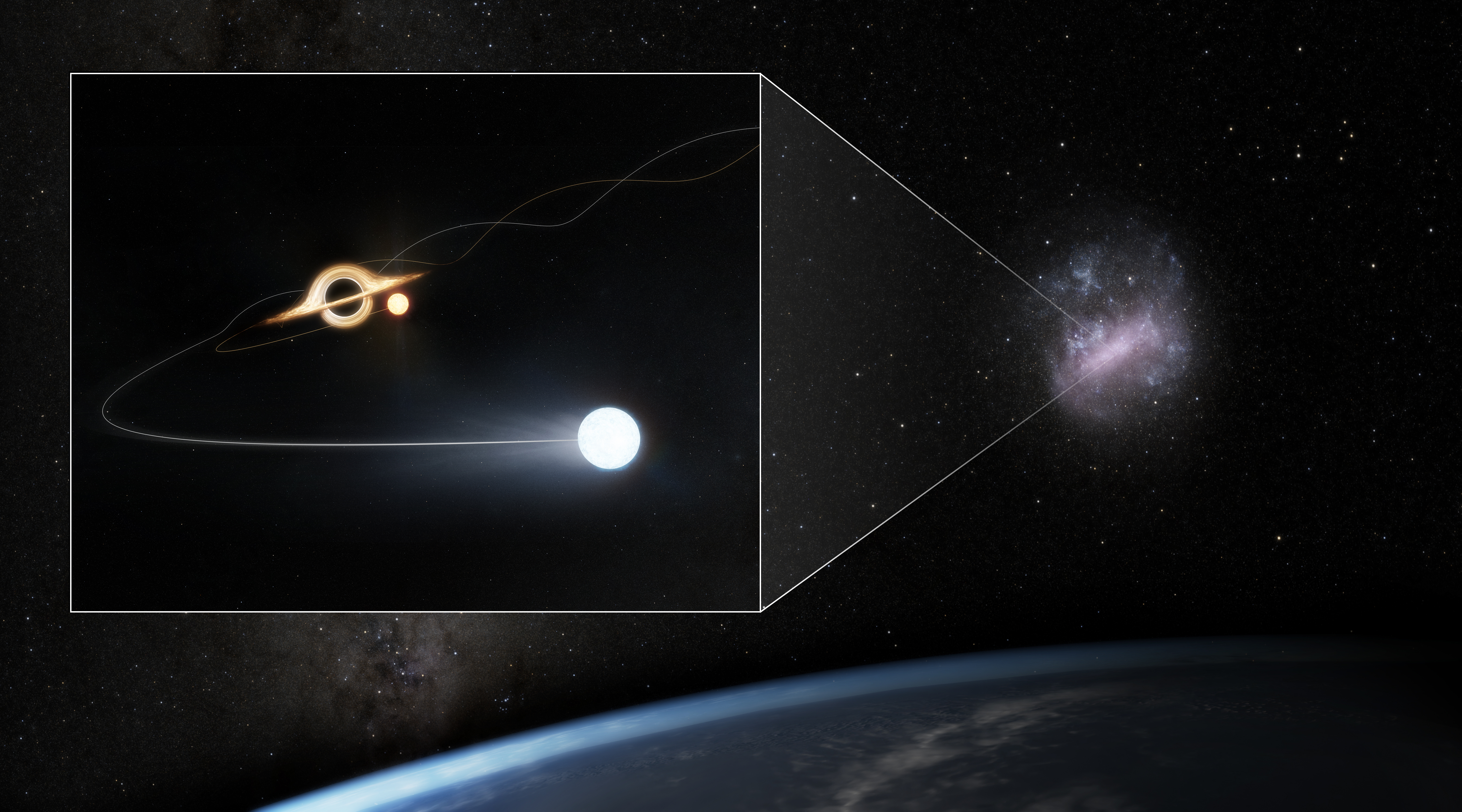
Artist’s impression of a hypervelocity star ejected from the Large Magellanic Cloud (shown on right). When a binary star system ventures too close to a supermassive black hole, the intense gravitational forces tear the pair apart. One star is captured into a tight orbit around the black hole, while the other is flung outward at extreme velocities—often exceeding millions of miles per hour—becoming a hypervelocity star. The inset illustration depicts this process: the original binary’s orbital path is shown as interwoven lines, with one star being captured by the black hole (near center of inset) while the other is ejected into space (lower right). Credit: CfA/Melissa Weiss.
  High Resolution Image

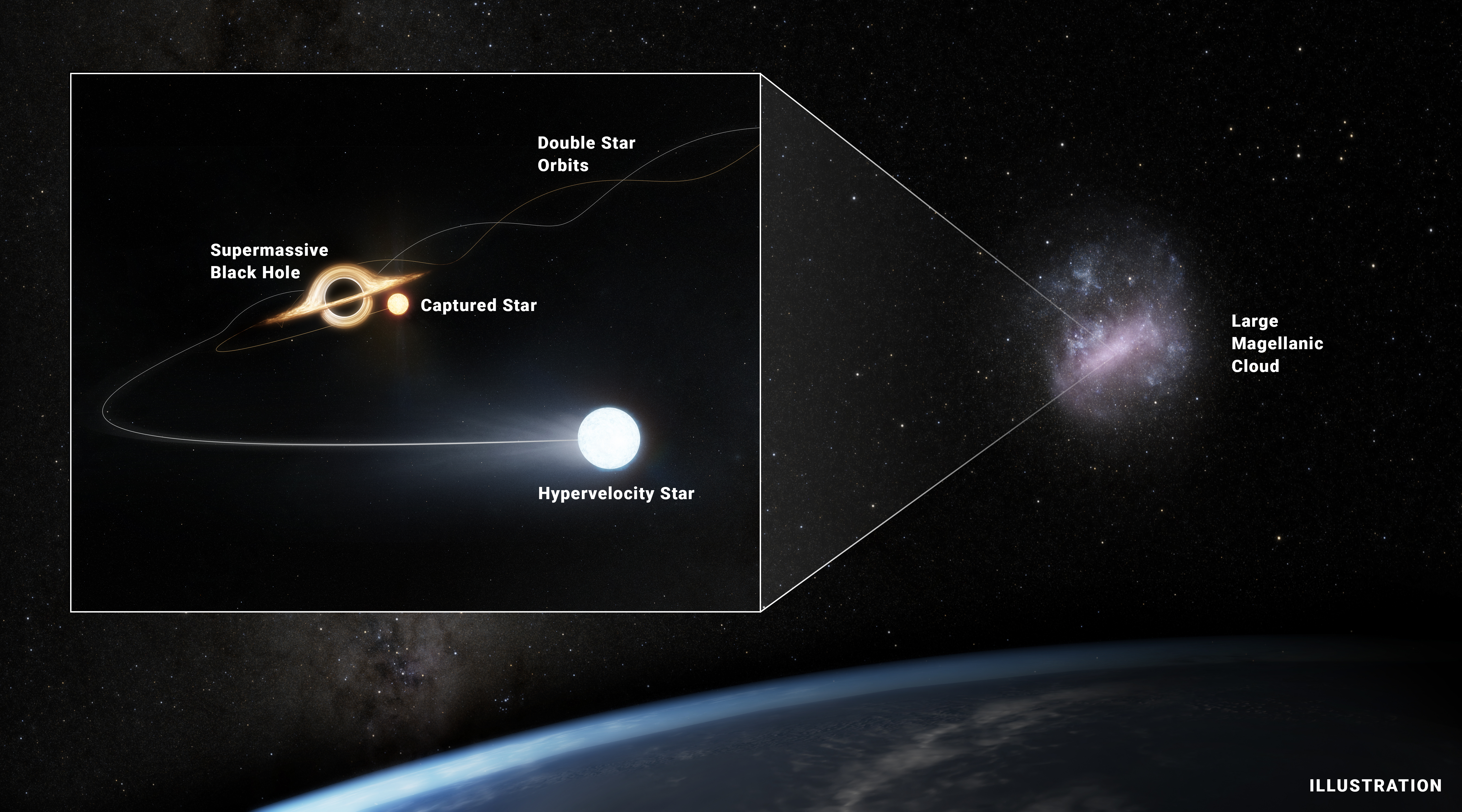
Labeled artist’s impression of a hypervelocity star ejected from the Large Magellanic Cloud (shown on right). When a binary star system ventures too close to a supermassive black hole, the intense gravitational forces tear the pair apart. One star is captured into a tight orbit around the black hole, while the other is flung outward at extreme velocities—often exceeding millions of miles per hour—becoming a hypervelocity star. The inset illustration depicts this process: the original binary’s orbital path is shown as interwoven lines, with one star being captured by the black hole (near center of inset) while the other is ejected into space (lower right). Credit: CfA/Melissa Weiss.
  High Resolution Image

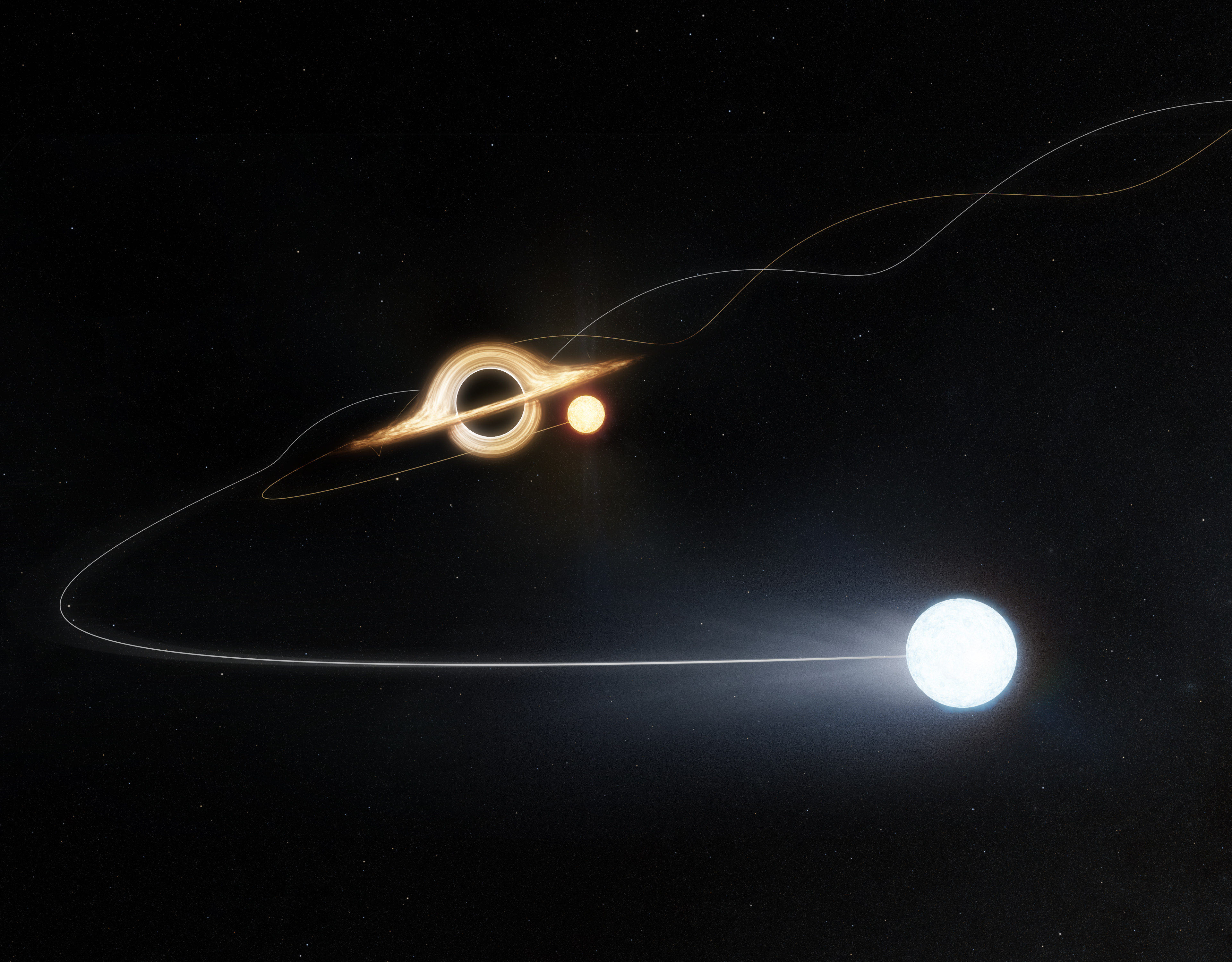
Artist’s impression of a hypervelocity star ejected from the Large Magellanic Cloud. When a binary star system ventures too close to a supermassive black hole, the intense gravitational forces tear the pair apart. One star is captured into a tight orbit around the black hole, while the other is flung outward at extreme velocities—often exceeding millions of miles per hour—becoming a hypervelocity star. This illustration depicts this process: the original binary’s orbital path is shown as interwoven lines, with one star being captured by the black hole (near center) while the other is ejected into space (lower right). Credit: CfA/Melissa Weiss.
  High Resolution Image

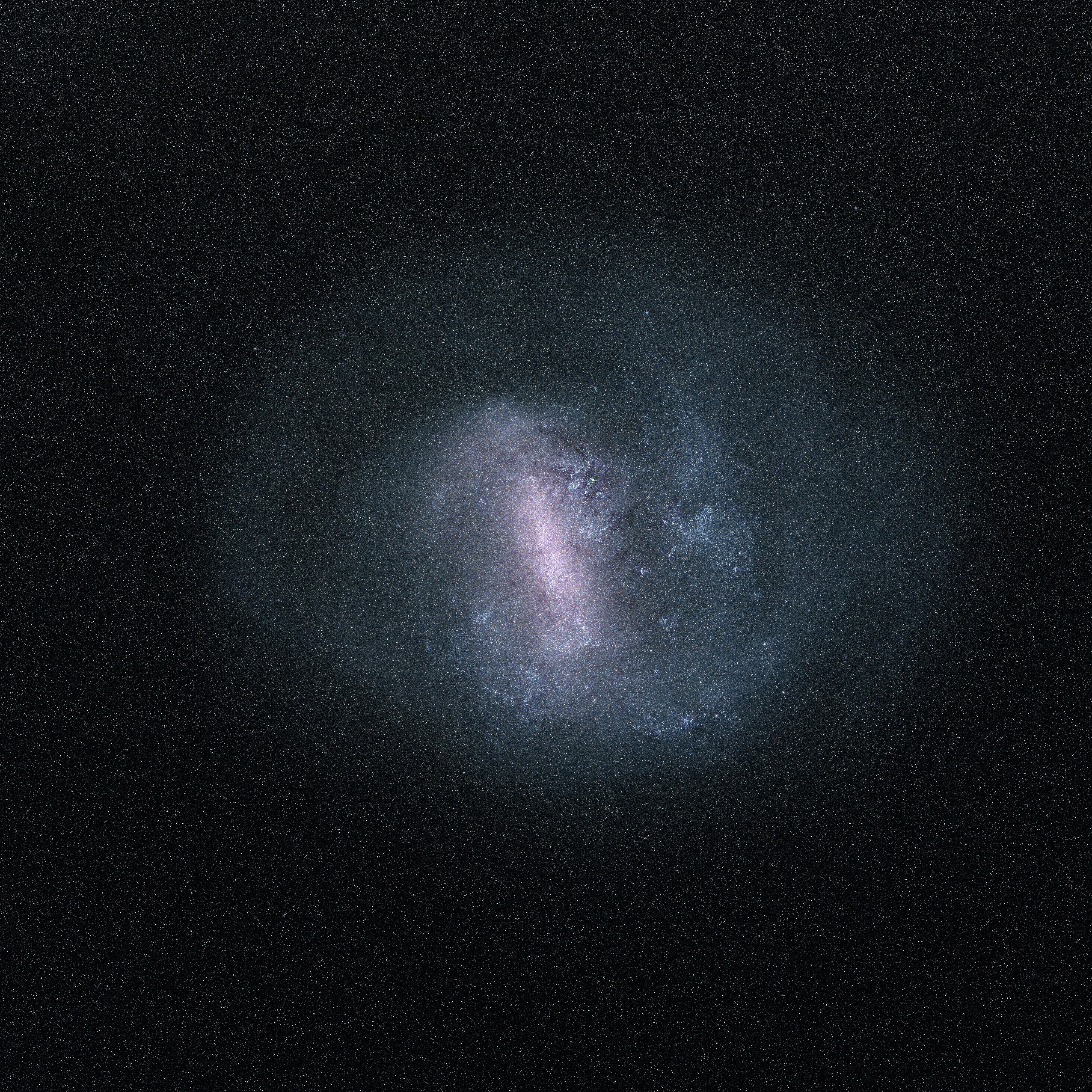
This is an image of the Large Magellanic Cloud (LMC), one of the nearest galaxies to our Milky Way, as viewed by ESA’s Gaia satellite using information from the mission’s second data release. This view has been compiled by mapping the total amount of radiation detected by Gaia in each pixel, combined with measurements of the radiation taken through different filters on the spacecraft to generate color information. Astronomers have announced the discovery strong evidence for a supermassive black hole in the LMC, which would be the closest to Earth outside of the Milky Way galaxy. Credit: ESA/Gaia/DPAC.
High Resolution Image


CfA astronomers have found strong evidence for a supermassive black hole in the Large Magellanic Cloud, a satellite galaxy to the Milky Way

Cambridge, MA - Astronomers have discovered strong evidence for the closest supermassive black hole outside of the Milky Way galaxy. This giant black hole is located in the Large Magellanic Cloud, one of the nearest galactic neighbors to our own.

To make this discovery, researchers traced the paths with ultra-fine precision of 21 stars on the outskirts of the Milky Way. These stars are traveling so fast that they will escape the gravitational clutches of the Milky Way or any nearby galaxy. Astronomers refer to these as "hypervelocity" stars.

Similar to how forensic experts recreate the origin of a bullet based on its trajectory, researchers determined where these hypervelocity stars come from. They found that about half are linked to the supermassive black hole at the center of the Milky Way. However, the other half originated from somewhere else: a previously-unknown giant black hole in the Large Magellanic Cloud (LMC).

"It is astounding to realize that we have another supermassive black hole just down the block, cosmically speaking," said Jesse Han of the Center for Astrophysics | Harvard & Smithsonian (CfA), who led the new study. "Black holes are so stealthy that this one has been practically under our noses this whole time."

The researchers found this secretive black hole by using data from the European Space Agency’s Gaia mission, a satellite that has tracked more than a billion stars throughout the Milky Way with unprecedented accuracy. They also used an improved understanding of the LMC’s orbit around the Milky Way recently obtained by other researchers.

"We knew that these hypervelocity stars had existed for a while, but Gaia has given us the data we need to figure out where they actually come from," said co-author Kareem El-Badry of Caltech in Pasadena, California. "By combining these data with our new theoretical models for how these stars travel, we made this remarkable discovery."

Hypervelocity stars are created when a double-star system ventures too close to a supermassive black hole. The intense gravitational pull from the black hole rips the two stars apart, capturing one star into a close orbit around it. Meanwhile, the other orphaned star is jettisoned away at speeds exceeding several million miles per hour -- and a hypervelocity star is born.

A significant piece of the team’s research was a prediction by their theoretical model that a supermassive black hole in the LMC would create a cluster of hypervelocity stars in one corner of the Milky Way because of how the LMC moves around the Milky Way. The stars ejected along the direction of the LMC’s motion should receive an extra boost in speed. Indeed, their data revealed the existence of such a cluster.

The team found that the properties of the hypervelocity stars cannot be explained by other mechanisms, such as stars being ejected when their companions undergo a supernova explosion, or stars being ejected by a mechanism like that described above for a double star system, but without a supermassive black hole being involved.

"The only explanation we can come up with for this data is the existence of a monster black hole in our galaxy next door," said co-author Scott Lucchini, also of CfA. "So in our cosmic neighborhood it’s not just the Milky Way’s supermassive black hole evicting stars from its galaxy."

Using the speeds of the stars and the relative number of ones ejected by the LMC and Milky Way supermassive black holes, the team determined that the mass of the LMC black hole is about 600,000 times the mass of the Sun. For comparison, the supermassive black hole in the Milky Way has about 4 million solar masses. Elsewhere in the Universe, there are supermassive black holes with billions of times more mass than the Sun.

A paper describing these results has been accepted for publication in The Astrophysical Journal and is available here.


About the Center for Astrophysics | Harvard & Smithsonian

The Center for Astrophysics | Harvard & Smithsonian is a collaboration between Harvard and the Smithsonian designed to ask—and ultimately answer—humanity's greatest unresolved questions about the nature of the universe. The Center for Astrophysics is headquartered in Cambridge, MA, with research facilities across the U.S. and around the world.


Media Contact:

Peter Edmonds
Interim CfA Public Affairs Officer
Center for Astrophysics | Harvard & Smithsonian
617-571-7279

pedmonds@cfa.harvard.edu


Tuesday, October 01, 2024

NASA's Hubble Finds that a Black Hole Beam Promotes Stellar Eruptions

This is an artist's concept looking down into the core of the giant elliptical galaxy M87. A supermassive black hole ejects a 3,000-light-year-long jet of plasma, traveling at nearly the speed of light. In the foreground, to the right is a binary star system. The system is far from the black hole, but in the vicinity of the jet. In the system an aging, swelled-up, normal star spills hydrogen onto a burned-out white dwarf companion star. As the hydrogen accumulates on the surface of the dwarf, it reaches a tipping point where it explodes like a hydrogen bomb. Novae frequently pop-off throughout the giant galaxy of 1 trillion stars, but those near the jet seem to explode more frequently. So far, it's anybody's guess why black hole jets enhance the rate of nova eruptions. Credits: Artwork: NASA, ESA, Joseph Olmsted (STScI) 

A Hubble Space Telescope image of the giant galaxy M87 shows a 3,000-light-year-long jet of plasma blasting from the galaxy's 6.5-billion-solar-mass central black hole. The blowtorch-like jet seems to cause stars to erupt along its trajectory. These novae are not caught inside the jet, but are apparently in a dangerous neighborhood nearby. During a recent 9-month survey, astronomers using Hubble found twice as many of these novae going off near the jet as elsewhere in the galaxy. The galaxy is the home of several trillion stars and thousands of star-like globular star clusters. Credits: Science: NASA, ESA, STScI, Alec Lessing (Stanford University), Mike Shara (AMNH) Acknowledgment: Edward Baltz (Stanford University) - Image Processing: Joseph DePasquale (STScI)


In a surprise finding, astronomers using NASA's Hubble Space Telescope have discovered that the blowtorch-like jet from a supermassive black hole at the core of a huge galaxy seems to cause stars to erupt along its trajectory. The stars, called novae, are not caught inside the jet, but apparently in a dangerous neighborhood nearby.

The finding is confounding researchers searching for an explanation. "We don't know what's going on, but it's just a very exciting finding," said Alec Lessing of Stanford University, lead author of the paper accepted for publication in The Astrophysical Journal. "This means there's something missing from our understanding of how black hole jets interact with their surroundings."

A nova erupts in a double-star system where an aging, swelled-up, normal star spills hydrogen onto a burned-out white dwarf companion star. When the dwarf has tanked up a mile-deep surface layer of hydrogen that layer explodes like a giant nuclear bomb. The white dwarf isn't destroyed by the nova eruption, which ejects its surface layer and then goes back to siphoning fuel from its companion, and the nova-outburst cycle starts over again.

Hubble found twice as many novae going off near the jet as elsewhere in the giant galaxy during the surveyed time period. The jet is launched by a 6.5-billion-solar-mass central black hole surrounded by a disk of swirling matter. The black hole, engorged with infalling matter, launches a 3,000-light-year-long jet of plasma blazing through space at nearly the speed of light. Anything caught in the energetic beam would be sizzled. But being near its blistering outflow is apparently also risky, according to the new Hubble findings.

The finding of twice as many novae near the jet implies that there are twice as many nova-forming double-star systems near the jet or that these systems erupt twice as often as similar systems elsewhere in the galaxy.

"There's something that the jet is doing to the star systems that wander into the surrounding neighborhood. Maybe the jet somehow snowplows hydrogen fuel onto the white dwarfs, causing them to erupt more frequently," said Lessing. "But it's not clear that it's a physical pushing. It could be the effect of the pressure of the light emanating from the jet. When you deliver hydrogen faster, you get eruptions faster. Something might be doubling the mass transfer rate onto the white dwarfs near the jet." Another idea the researchers considered is that the jet is heating the dwarf's companion star, causing it to overflow further and dump more hydrogen onto the dwarf. However, the researchers calculated that this heating is not nearly large enough to have this effect.

"We're not the first people who've said that it looks like there's more activity going on around the M87 jet," said co-investigator Michael Shara of the American Museum of Natural History in New York City. "But Hubble has shown this enhanced activity with far more examples and statistical significance than we ever had before."

Shortly after Hubble's launch in 1990, astronomers used its first-generation Faint Object Camera (FOC) to peer into the center of M87 where the monster black hole lurks. They noted that unusual things were happening around the black hole. Almost every time Hubble looked, astronomers saw bluish "transient events" that could be evidence for novae popping off like camera flashes from nearby paparazzi. But the FOC's view was so narrow that Hubble astronomers couldn't look away from the jet to compare with the near-jet region. For over two decades, the results remained mysteriously tantalizing.

Compelling evidence for the jet's influence on the stars of the host galaxy was collected over a nine-month interval of Hubble observing with newer, wider-view cameras to count the erupting novae. This was a challenge for the telescope's observing schedule because it required revisiting M87 precisely every five days for another snapshot. Adding up all of the M87 images led to the deepest images of M87 that have ever been taken.

Hubble found 94 novae in the one-third of M87 that its camera can encompass. "The jet was not the only thing that we were looking at — we were looking at the entire inner galaxy. Once you plotted all known novae on top of M87 you didn't need statistics to convince yourself that there is an excess of novae along the jet. This is not rocket science. We made the discovery simply by looking at the images. And while we were really surprised, our statistical analyses of the data confirmed what we clearly saw," said Shara.

This accomplishment is entirely due to Hubble's unique capabilities. Ground-based telescope images do not have the clarity to see novae deep inside M87. They cannot resolve stars or stellar eruptions close to the galaxy's core because the black hole's surroundings are far too bright. Only Hubble can detect novae against the bright M87 background.

Novae are remarkably common in the universe. One nova erupts somewhere in M87 every day. But since there are at least 100 billion galaxies throughout the visible universe, around 1 million novae erupt every second somewhere out there.

The Hubble Space Telescope has been operating for over three decades and continues to make ground-breaking discoveries that shape our fundamental understanding of the universe. Hubble is a project of international cooperation between NASA and ESA (European Space Agency). NASA's Goddard Space Flight Center in Greenbelt, Maryland, manages the telescope and mission operations. Lockheed Martin Space, based in Denver, Colorado, also supports mission operations at Goddard. The Space Telescope Science Institute in Baltimore, Maryland, which is operated by the Association of Universities for Research in Astronomy, conducts Hubble science operations for NASA.


About This Release

Credits:

Media Contact:

Ray Villard Space Telescope Science Institute, Baltimore, Maryland

Science Contact:

Alec Lessing
Stanford University, Stanford, California

Michael Shara
American Museum of Natural History, New York, New York

Permissions:
Content Use Policy

Contact Us: Direct inquiries to the News Team.

Related Links and Documents


Tuesday, June 18, 2024

NASA's Hubble Finds Surprises Around a Star That Erupted 40 Years Ago

Nova in Binary Star System HM Sagittae (Artist's Concept)
Credits: Artwork: NASA, ESA, Leah Hustak (STScI)

Symbiotic Star Mira HM Sge
Credits: Science: NASA, ESA, Ravi Sankrit (STScI), Steven Goldman (STScI)
Image Processing: Joseph DePasquale (STScI)


Astronomers have used new data from NASA's Hubble Space Telescope and the retired SOFIA (Stratospheric Observatory for Infrared Astronomy) as well as archival data from other missions to revisit one of the strangest binary star systems in our galaxy – 40 years after it burst onto the scene as a bright and long-lived nova. A nova is a star that suddenly increases its brightness tremendously and then fades away to its former obscurity, usually in a few months or years.

Between April and September 1975, the binary system HM Sagittae (HM Sge) grew 250 times brighter. Even more unusual, it did not rapidly fade away as novae commonly do, but has maintained its luminosity for decades. Recently, observations show that the system has gotten hotter, but paradoxically faded a little.

HM Sge is a particular kind of symbiotic star where a white dwarf and a bloated, dust-producing giant companion star are in an eccentric orbit around each other, and the white dwarf ingests gas flowing from the giant star. That gas forms a blazing hot disk around the white dwarf, which can unpredictably undergo a spontaneous thermonuclear explosion as the infall of hydrogen from the giant grows denser on the surface until it reaches a tipping point. These fireworks between companion stars fascinate astronomers by yielding insights into the physics and dynamics of stellar evolution in binary systems.

"In 1975 HM Sge went from being a nondescript star to something all astronomers in the field were looking at, and at some point that flurry of activity slowed down," said Ravi Sankrit of the Space Telescope Science Institute (STScI) in Baltimore. In 2021, Steven Goldman of STScI, Sankrit and collaborators used instruments on Hubble and SOFIA to see what had changed with HM Sge in the last 30 years at wavelengths of light from the infrared to the ultraviolet (UV).

The 2021 ultraviolet data from Hubble showed a strong emission line of highly ionized magnesium that was not present in earlier published spectra from 1990. Its presence shows that the estimated temperature of the white dwarf and accretion disk increased from less than 400,000 degrees Fahrenheit in 1989 to greater than 450,000 degrees Fahrenheit now. The highly ionized magnesium line is one of many seen in the UV spectrum, which analyzed together will reveal the energetics of the system, and how it has changed in the last three decades.

"When I first saw the new data," Sankrit said, "I went – 'wow this is what Hubble UV spectroscopy can do!' – I mean it's spectacular, really spectacular."

With data from NASA's flying telescope SOFIA, which retired in 2022, the team was able to detect the water, gas, and dust flowing in and around the system. Infrared spectral data shows that the giant star, which produces copious amounts of dust, returned to its normal behavior within only a couple years of the explosion, but also that it has dimmed in recent years, which is another puzzle to be explained.

With SOFIA astronomers were able to see water moving at around 18 miles per second, which they suspect is the speed of the sizzling accretion disk around the white dwarf. The bridge of gas connecting the giant star to the white dwarf must presently span about 2 billion miles.

The team has also been working with the AAVSO (American Association of Variable Star Observers), to collaborate with amateur astronomers from around the world who help keep telescopic eyes on HM Sge; their continued monitoring reveals changes that haven't been seen since its outburst 40 years ago.

"Symbiotic stars like HM Sge are rare in our galaxy, and witnessing a nova-like explosion is even rarer. This unique event is a treasure for astrophysicists spanning decades," said Goldman.

The initial results from the team's research were published in The The Astrophysical Journal , and Sankrit is presenting research focused on the UV spectroscopy at the 244th meeting of the American Astronomical Societyin Madison, Wisconsin.

The Hubble Space Telescope has been operating for over three decades and continues to make ground-breaking discoveries that shape our fundamental understanding of the universe. Hubble is a project of international cooperation between NASA and ESA (European Space Agency). NASA's Goddard Space Flight Center in Greenbelt, Maryland, manages the telescope and mission operations. Lockheed Martin Space, based in Denver, Colorado, also supports mission operations at Goddard. The Space Telescope Science Institute in Baltimore, Maryland, which is operated by the Association of Universities for Research in Astronomy, conducts Hubble science operations for NASA.


About This Release

Credits:

Media Contact:

Ray Villard
Space Telescope Science Institute, Baltimore, Maryland

Science Contact:

Ravi Sankrit
Space Telescope Science Institute, Baltimore, Maryland

Steven Goldman
Space Telescope Science Institute, Baltimore, Maryland

Permissions: Content Use Policy

Contact Us: Direct inquiries to the News Team.

Related Links and Documents


Friday, May 03, 2024

Gemini South Reveals Origin of Unexpected Differences in Giant Binary Stars

PR Image noirlab2410a
Artist’s Impression of a Giant-Giant Binary


Videos

Cosmoview Episode 80: Gemini South Reveals Origin of Unexpected Differences in Giant Binary Stars
PR Video noirlab2410a
Cosmoview Episode 80: Gemini South Reveals Origin of Unexpected Differences in Giant Binary Stars

Cosmoview Episodio 80: Desde Chile descubren causas de la diversidad estelar en estrellas binarias
PR Video noirlab2410b
Cosmoview Episodio 80: Desde Chile descubren causas de la diversidad estelar en estrellas binarias


Astronomers confirm that differences in the chemical composition of binary stars can be traced back to the earliest stages of their formation

Using the Gemini South telescope a team of astronomers have confirmed for the first time that differences in binary stars’ composition can originate from chemical variations in the cloud of stellar material from which they formed. The results help explain why stars born from the same molecular cloud can possess different chemical composition and host different planetary systems, as well as pose challenges to current stellar and planet formation models.

It is estimated that up to 85% of stars exist in binary star systems, some even in systems with three or more stars. These stellar pairs are born together out of the same molecular cloud from a shared abundance of chemical building blocks, so astronomers would expect to find that they have nearly identical compositions and planetary systems. However, for many binaries that isn’t the case. While some proposed explanations attribute these dissimilarities to events occurring after the stars evolved, a team of astronomers have confirmed for the first time that they can actually originate from before the stars even began to form.

Led by Carlos Saffe of the Institute of Astronomical, Earth and Space Sciences (ICATE-CONICET) in Argentina, the team used the Gemini South telescope in Chile, one half of the International Gemini Observatory, supported in part by the U.S. National Science Foundation and operated by NSF NOIRLab. With the new, precise Gemini High Resolution Optical SpecTrograph (GHOST) the team studied the different wavelengths of light, or spectra, given off by a pair of giant stars, which revealed significant differences in their chemical make-up. “GHOST’s extremely high-quality spectra offered unprecedented resolution,” said Saffe, “allowing us to measure the stars’ stellar parameters and chemical abundances with the highest possible precision.” These measurements revealed that one star had higher abundances of heavy elements than the other. To disentangle the origin of this discrepancy, the team used a unique approach.

Previous studies have proposed three possible explanations for observed chemical differences between binary stars. Two of them involve processes that would occur well into the stars’ evolution: atomic diffusion, or the settling of chemical elements into gradient layers depending on each star’s temperature and surface gravity; and the engulfment of a small, rocky planet, which would introduce chemical variations in a star’s composition.

The third possible explanation looks back at the beginning of the stars’ formation, suggesting that the differences originate from primordial, or pre-existing, areas of nonuniformity within the molecular cloud. In simpler terms, if the molecular cloud has an uneven distribution of chemical elements, then stars born within that cloud will have different compositions depending on which elements were available at the location where each formed.

So far, studies have concluded that all three explanations are probable; however, these studies focused solely on main-sequence binaries. The ‘main-sequence’ is the stage where a star spends most of its existence, and the majority of stars in the Universe are main-sequence stars, including our Sun. Instead, Saffe and his team observed a binary consisting of two giant stars. These stars possess extremely deep and strongly turbulent external layers, or convective zones. Owing to the properties of these thick convective zones, the team was able to rule out two of the three possible explanations.

The continuous swirling of fluid within the convective zone would make it difficult for material to settle into layers, meaning giant stars are less sensitive to the effects of atomic diffusion — ruling out the first explanation. The thick external layer also means that a planetary engulfment would not change a star’s composition much since the ingested material would rapidly be diluted — ruling out the second explanation. This leaves primordial inhomogeneities within the molecular cloud as the confirmed explanation. “This is the first time astronomers have been able to confirm that differences between binary stars begin at the earliest stages of their formation,” said Saffe.

“Using the precision-measurement capabilities provided by the GHOST instrument, Gemini South is now collecting observations of stars at the end of their lives to reveal the environment in which they were born,” says Martin Still, NSF program director for the International Gemini Observatory. “This gives us the ability to explore how the conditions in which stars form can influence their entire existence over millions or billions of years.”

Three consequences of this study are of particular significance. First, these results offer an explanation for why astronomers see binary stars with such different planetary systems. “Different planetary systems could mean very different planets — rocky, Earth-like, ice giants, gas giants — that orbit their host stars at different distances and where the potential to support life might be very different,” said Saffe.

Second, these results pose a crucial challenge to the concept of chemical tagging — using chemical composition to identify stars that came from the same environment or stellar nursery — by showing that stars with different chemical compositions can still have the same origin.

Finally, observed differences previously attributed to planetary impacts on a star’s surface will need to be reviewed, as they might now be seen as having been there from the very beginning of the star’s life.

“By showing for the first time that primordial differences really are present and responsible for differences between twin stars, we show that star and planet formation could be more complex than initially thought,” said Saffe. “The Universe loves diversity!”


More information

This research was presented in a paper accepted in Astronomy & Astrophysics Letters. DOI: 10.1051/0004-6361/202449263

The team is composed of C. Saffe (ICATE-CONICET/UNSJ, Argentina), P. Miquelarena (ICATE-CONICET/UNSJ, Argentina), J. Alacoria (ICATE-CONICET, Argentina), E. Martioli (LNA/MCTI, Brasil), M. Flores (ICATE-CONICET/UNSJ, Argentina), M. Jaque Arancibia (Universidad de La Serena, Chile), R. Angeloni (International Gemini Observatory/NSF NOIRLab, Chile), E. Jofré (OAC/CONICET, Argentina), J. Yana Galarza (Carnegie Institution for Science, CA), E. González (UNSJ, Argentina), and A. Collado (ICATE-CONICET/UNSJ, Argentina).

NSF NOIRLab (U.S. National Science Foundation National Optical-Infrared Astronomy Research Laboratory), the U.S. center for ground-based optical-infrared astronomy, operates the International Gemini Observatory (a facility of NSF, NRC–Canada, ANID–Chile, MCTIC–Brazil, MINCyT–Argentina, and KASI–Republic of Korea), Kitt Peak National Observatory (KPNO), Cerro Tololo Inter-American Observatory (CTIO), the Community Science and Data Center (CSDC), and Vera C. Rubin Observatory (operated in cooperation with the Department of Energy’s SLAC National Accelerator Laboratory). It is managed by the Association of Universities for Research in Astronomy (AURA) under a cooperative agreement with NSF and is headquartered in Tucson, Arizona. The astronomical community is honored to have the opportunity to conduct astronomical research on I’oligam Du’ag (Kitt Peak) in Arizona, on Maunakea in Hawai‘i, and on Cerro Tololo and Cerro Pachón in Chile. We recognize and acknowledge the very significant cultural role and reverence that these sites have to the Tohono O’odham Nation, to the Native Hawaiian community, and to the local communities in Chile, respectively.


Links


Contacts:

Carlos Saffe
Institute of Astronomical, Earth and Space Sciences, Argentina
Email:
saffe.carlos@gmail.com

Josie Fenske
Jr. Public Information Officer
NSF NOIRLab
Email:
josie.fenske@noirlab.edu


Wednesday, May 03, 2023

Superflare with Massive, High-Velocity Prominence Eruption


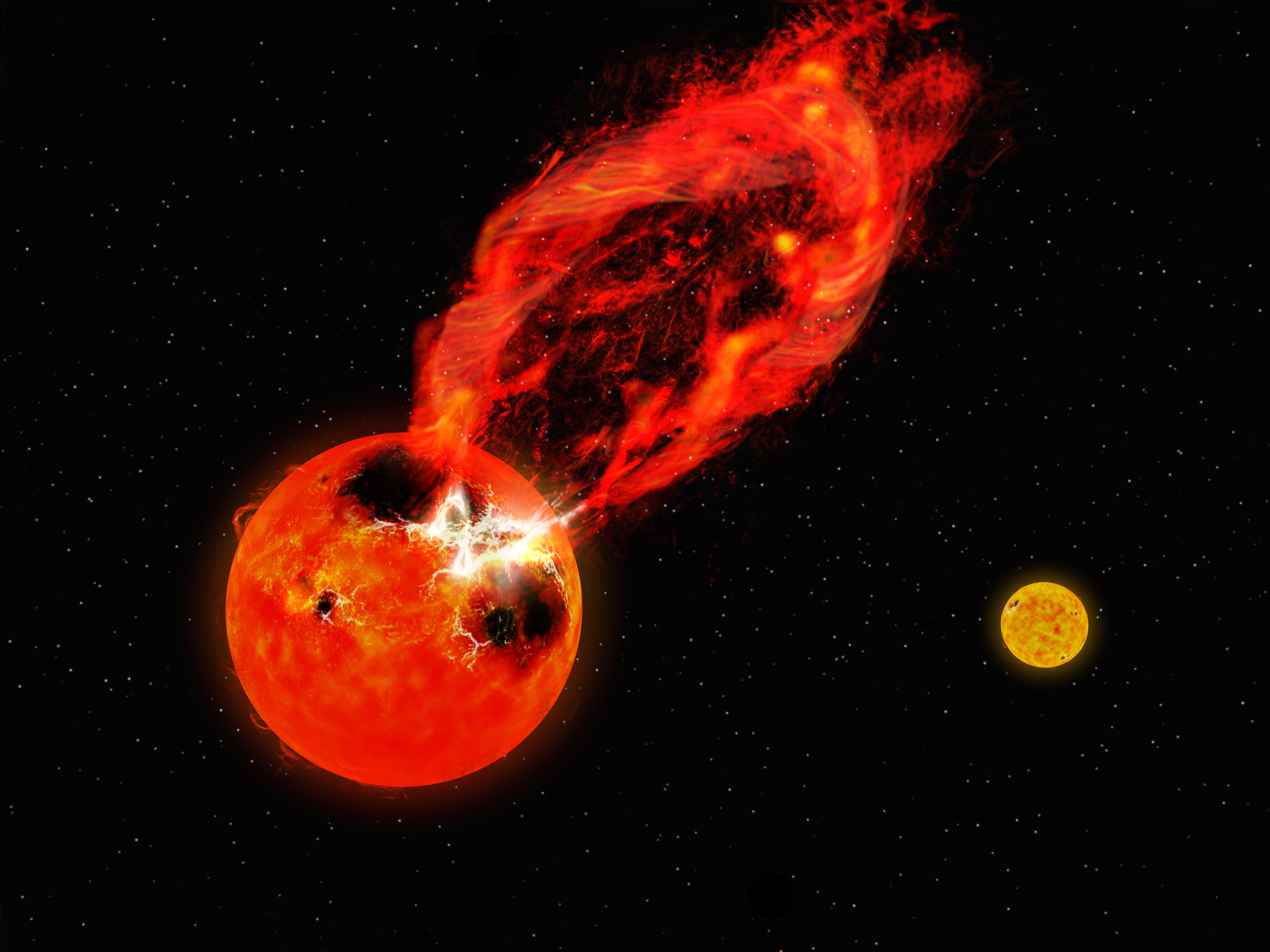
Artist’s impression of the superflare observed on one of the stars in the V1355 Orionis binary star system. The binary companion star is visible in the background on the right. (Credit: NAOJ). Original size (2.2MB)

A team of Japanese astronomers used simultaneous ground-based and space-based observations to capture a more complete picture of a superflare on a star. The observed flare started with a very massive, high-velocity prominence eruption. These results give us a better idea of how superflares and stellar prominence eruptions occur.

Some stars have been seen releasing superflares over 10 times larger than the largest solar flare ever seen on the Sun. The hot ionized gas released by solar flares can influence the environment around the Earth, referred to as space weather. More powerful superflares must have an even greater impact on the evolution of any planets forming around the star, or the evolution of any life forming on those planets. But the details of how superflares and prominence eruptions on stars occur have been unclear.

A team led by Shun Inoue at Kyoto University used the 3.8-m Seimei Telescope in Japan and the Transiting Exoplanet Survey Satellite (TESS) to monitor the binary star system V1355 Orionis which is known to frequently release large-scale superflares. V1355 Orionis is located 400 light years away in the constellation Orion.

The team succeeded in capturing a superflare with continuous, high temporal resolution observations. Data analysis shows that the superflare originated with a phenomenon known as a prominence eruption. Calculating the velocity of the eruption requires making some assumptions about aspects that aren’t directly observably, but even the most conservative estimates far exceed the escape velocity of the star (347 km/s), indicating that the prominence eruption was capable of breaking free of the star’s gravity and developing into Coronal Mass Ejections (CMEs). The prominence eruption was also one of the most massive ever observed, carrying trillions of tons of material.

These results appeared as Inoue et al. “Detection of a high-velocity prominence eruption leading to a CME associated with a superflare on the RS CVn-type star V1355 Orionis” in The Astrophysical Journal on April 27, 2023.


Wednesday, June 09, 2021

Scientists identify a rare magnetic propeller in a binary star system

An illustration of a fast-spinning, magnetic white dwarf rejecting the donor gas in the cataclysmic variable known as J0240
Credit: Dr. Mark Garlick

Researchers at the University of Notre Dame have identified the first eclipsing magnetic propeller in a cataclysmic variable star system, according to research forthcoming in the Astrophysical Journal.

The star system, referred to as J0240, is only the second of its kind on record. It was identified in 2020 as an unusual cataclysmic variable — a binary system consisting of a white dwarf star and a mass-donating red star. Normally, the compact white dwarf star collects the donated gas and grows in mass. In J0240, however, the fast-spinning, magnetic white dwarf rejects the donor’s gas and propels it out of the binary system.

“It takes a rapidly spinning dwarf with a strong magnetic field in order to create a propeller,” said Peter Garnavich, professor of astrophysics and cosmology physics and chair of the Department of Physics at Notre Dame, and lead author of the study that presented evidence of the propeller system. “Normally, gas coming off of the donor star will land on the white dwarf. That’s as common as sand on a beach. But in a magnetic propeller, the gas is ejected from the binary in a wide spiral pattern — like a lawn sprinkler watering your yard.”

White dwarfs are the dense remnants of low-mass stars like our sun, which scientists say will evolve into a white dwarf in another five billion years or so. Without a companion star, however, the sun will never be part of a cataclysmic variable system.

The only other cataclysmic variable similar to J0240 is AE Aquarii, a binary star system known since the 1950s and believed to also be a magnetic propeller system. Conversely, J0240 is observed close to the binary orbital plane, meaning that the gas ejected from the system is seen silhouetted against the light of the stars. This is the first direct evidence that a magnetic propeller ejects the red star’s donated gas.

“What’s unique about the system is that we actually can see blobs of gas as they’re ejected by the propeller,” Garnavich said. “That gas is blocking some of the light from both stars and we can directly see that absorption in our data.”

Garnavich’s team began observations at the Large Binocular Telescope in Safford, Arizona, where the researchers were able to record the occurrence of flares and eclipses that illustrated the rapid spinning of the white dwarf star, and the pull of the magnetic field — which expels incoming gases that would otherwise be added to the star but instead creates a spiral of gas expanding away from the two stars.

“The more we observed the star, the more exciting it appeared,” said Garnavich. The team gathered observations in September, October and November of 2020. Data gathered in September captured the first half of J0240’s orbit. In October, the team captured the second half.

“The flares we see are mini-explosions that blow off gas at 6 million miles per hour, or 1 percent of the speed of light,” he said.

The flaring disappears when the red companion gets in the way during an eclipse. From the timing of the eclipses, the team was able to pinpoint the location of the flares. “The flaring is coming from very close to the compact companion, likely from the whack the gas receives as it approaches the rapidly spinning magnetic field,” Garnavich said.

Garnavich hopes to learn a lot more from the J0240 binary from further observations. One of the big unknowns is the white dwarf spin period, which the team was unable to detect. “The energy of the propeller is coming from the spinning white dwarf, so we expect the spin rate to be slowing over time. When it runs down, the propeller will stop and the system will look like a ordinary cataclysmic variable,” said Garnavich.

“The biggest question is exactly how do you get into this state,” he said. “It’s a very short-lived phase where you have a magnetic white dwarf spinning about as fast as it can spin without actually flying apart. Spinning so fast with a strong magnetic field — seems like it can’t be just coincidence.”

Co-authors on the study include Colin Littlefield, also at Notre Dame; Mark Wagner at Ohio State University and the Large Binocular Telescope Observatory; Jan van Roestel and Amruta Jaodand at the California Institute of Technology; Paula Szkody at the University of Washington; and John Thorstensen at Dartmouth College.

A preprint of the study is available here.

by Jessica Sieff

Contact:

Jessica Sieff
Assistant director of media relations
574-631-3933

jsieff@nd.edu


Thursday, August 29, 2019

Exoplanets Can’t Hide Their Secrets from Innovative New Instrument

Artist's conception of the Kepler-13AB binary star system as revealed by observations including the new Gemini Observatory data. The two stars (A and B) are large, massive bluish stars (center) with the transiting "hot Jupiter" (Kepler-13b) in the foreground (left corner). Star B and its low mass red dwarf companion star are seen in the background to the right.  Credit: Gemini Observatory/NSF/AURA/Artwork by Joy Pollard. Download JPG 4.4MB | TIFF 9.3MB

In an unprecedented feat, an American research team discovered hidden secrets of an elusive exoplanet using a powerful new instrument at the 8-meter Gemini North telescope on Maunakea in Hawai‘i. The findings not only classify a Jupiter-sized exoplanet in a close binary star system, but also conclusively demonstrate, for the first time, which star the planet orbits.

The breakthrough occurred when Steve B. Howell of the NASA Ames Research Center and his team used a high-resolution imaging instrument of their design — named ‘Alopeke (a contemporary Hawaiian word for Fox). The team observed exoplanet Kepler-13b as it passed in front of (transited) one of the stars in the Kepler-13AB binary star system some 2,000 light years distant. Prior to this attempt, the true nature of the exoplanet was a mystery.

“There was confusion over Kepler-13b: was it a low-mass star or a hot Jupiter-like world? So we devised an experiment using the sly instrument ‘Alopeke,” Howell said. The research was recently published in the Astronomical Journal. "We monitored both stars, Kepler A and Kepler B, simultaneously while looking for any changes in brightness during the planet’s transit,” Howell explained. “To our pleasure, we not only solved the mystery, but also opened a window into a new era of exoplanet research.”

“This dual win has elevated the importance of instruments like ‘Alopeke in exoplanet research,” said Chris Davis of the National Science Foundation, one of Gemini’s sponsoring agencies. “The exquisite seeing and telescope abilities of Gemini Observatory, as well as the innovative ‘Alopeke instrument made this discovery possible in merely four hours of observations."

‘Alopeke performs “speckle imaging,” collecting a thousand 60-millisecond exposures every minute. After processing this large amount of data, the final images are free of the adverse effects of atmospheric turbulence — which can bloat, blur, and distort star images.

“About one half of all exoplanets orbit a star residing in a binary system, yet, until now, we were at a loss to robustly determine which star hosts the planet,” said Howell.

The team’s analysis revealed a clear drop in the light from Kepler A, proving that the planet orbits the brighter of the two stars. Moreover, ‘Alopeke simultaneously provides data at both red and blue wavelengths, an unusual capability for speckle imagers. Comparing the red and blue data, the researchers were surprised to discover that the dip in the star’s blue light was about twice as deep as the dip seen in red light. This can be explained by a hot exoplanet with a very extended atmosphere, which more effectively blocks the light at blue wavelengths. Thus, these multi-color speckle observations give a tantalizing glimpse into the appearance of this distant world.

Early observations once pointed to the transiting object being either a low-mass star or a brown dwarf (an object somewhere between the heaviest planets and the lightest stars). But Howell and his team’s research almost certainly shows the object to be a Jupiter-like gas-giant exoplanet with a “puffed up” atmosphere due to exposure to the tremendous radiation from its host star.

'Alopeke has an identical twin at the Gemini South telescope in Chile, named Zorro, which is the word for fox in Spanish. Like 'Alopeke, Zorro is capable of speckle imaging in both blue and red wavelengths. The presence of these instruments in both hemispheres allows Gemini Observatory to resolve the thousands of exoplanets known to be in multiple star systems.

"Speckle imaging is experiencing a renaissance with technology like fast, low noise detectors becoming more easily available," said team member and ‘Alopeke instrument scientist Andrew Stephens at the Gemini North telescope. "Combined with Gemini's large primary mirror, ‘Alopeke has real potential to make even more significant exoplanet discoveries by adding another dimension to the search."

First proposed by French astronomer Antoine Labeyrie in 1970, speckle imaging is based on the idea that atmospheric turbulence can be “frozen” when obtaining very short exposures. In these short exposures, stars look like collections of little spots, or speckles, where each of these speckles has the size of the telescope’s optimal limit of resolution. When taking many exposures, and using a clever mathematical approach, these speckles can be reconstructed to form the true image of the source, removing the effect of atmospheric turbulence. The result is the highest-quality image that a telescope can produce, effectively obtaining space-based resolution from the ground — making these instruments superb probes of extrasolar environments that may harbor planets.

The discovery of planets orbiting other stars has changed the view of our place in the Universe. Space missions like NASA’s Kepler/K2 Space Telescope and the Transiting Exoplanet Survey Satellite (TESS) have revealed that there are twice as many planets orbiting stars in the sky than there are stars visible to the unaided eyes; to date the total discovery count hovers around 4,000. While these telescopes detect exoplanets by looking for tiny dips in the brightness of a star when a planet crosses in front of it, they have their limits.

“These missions observe large fields of view containing hundreds of thousands of stars, so they don’t have the fine spatial resolution necessary to probe deeper,” Howell said. “One of the major discoveries of exoplanet research is that about one-half of all exoplanets orbit stars that reside in binary systems. Making sense of these complex systems requires technologies that can conduct time sensitive observations and investigate the finer details with exceptional clarity.”

“Our work with Kepler-13b stands as a model for future research of exoplanets in multiple star systems,” Howell continued. “The observations highlight the ability of high-resolution imaging with powerful telescopes like Gemini to not only assess which stars with planets are in binaries, but also robustly determine which of the stars the exoplanet orbits.”


Media Contacts:

Peter Michaud
Public Information and Outreach Manager
Gemini Observatory, Hilo, HI
email: pmichaud@gemini.edu
Desk: (808) 974-2510
Cell: (808) 936-6643

Alyssa Grace
Public Information and Outreach Assistant
Gemini Observatory, Hilo, HI
email: agrace@gemini.edu
Desk: (808) 974-2531

Science Contacts:

Steve B. Howell
Space Science and Astrobiology Division
NASA Ames Research Center, Moffett Field, CA
email: steve.b.howell@nasa.gov
Desk: (650) 604-4238
Cell: (520) 461-6925

Andrew Stephens
Instrument Scientist
Gemini Observatory, Hilo, HI
email: astephens@gemini.edu
Desk: (808) 974-2611


Friday, November 09, 2018

Tiny Old Star Has Huge Impact

The newly discovered star system orbits the galaxy on a circular orbit that, like the orbit of the Sun, never gets too far from the plane of the galaxy. On the other hand, most ultra metal-poor stars have orbits that take them across the galaxy and far from its plane. Credit: Kevin Schlaufman.

The new discovery is only 14% the size of the Sun and is the new record holder for the star with the smallest complement of heavy elements. It has about the same heavy element proportion as Mercury, the smallest planet in our solar system. Credit: Kevin Schlaufman. Full resolution JPG

Astronomers use the Gemini Observatory to investigate a tiny star that is likely the oldest known star in the disk of our galaxy. The diminutive star could have a disproportionate impact on our understanding of the age and history of our Milky Way Galaxy. It also provides a unique glimpse into the conditions present in the young Universe shortly after the Big Bang.

A tiny star found in our galactic neighborhood is presenting astronomers with a compelling glimpse into the history of our galaxy and the early Universe. The star has some very interesting characteristics: it’s small, it’s old, and most significantly it’s made of material very similar to that spewed by the Big Bang. To host a star like this suggests that the disk of our galaxy could be up to three billion years older than previously thought.

“Our Sun likely descended from thousands of generations of short-lived massive stars that have lived and died since the Big Bang,” said Kevin Schlaufman of Johns Hopkins University, leader of this study published in the November 5th issue of The Astrophysical Journal. “However, what’s most interesting about this star is that it had perhaps only one ancestor separating it and the beginnings of everything,” Schlaufman adds.

The Big Bang theory dates our Universe at about 13.7 billion years and suggests that the first stars were made almost exclusively of hydrogen and helium. As stars die and gradually recycle their materials into new stars, heavier elements formed. Astronomers refer to stars which lack heavier elements as low metallicity stars. “But this one has such low metallicity,” said Schlaufman, “it’s known as an ultra metal poor star – this star may be one in ten million.

” The star, which goes by the designation 2MASS J18082002-5104378 B, also challenges the assumption that the first stars in the Universe were large, exclusively high-mass and short-lived stars. In addition, its location within the usually active and crowded disk of our galaxy is unexpected.

2MASS J18082002–5104378 B is a part of a binary star system. It is the smaller companion to a larger low-metallicity star observed in 2014 and 2015 by the European Southern Observatory's Very Large Telescope UT2. Before the discovery of the tiny star, astronomers mistakenly believed that this binary system might contain a black hole or neutron star. From April 2016 to July 2017, Schlaufman and his team used both the Gemini Multi-Object Spectrograph (GMOS) on the Gemini South telescope in Chile and the Magellan Clay Telescope at Las Campanas Observatory to dissect the star system’s light and measure the object’s relative motions, thus discovering the tiny star by detecting its gravitational tug on its partner.

"Gemini was critical to this discovery, as its flexible observing modes enabled weekly check-ins on the system over six months," Schlaufman confirms.

“Understanding the history of our own galaxy is critical for humanity to understand the broader history of the entire Universe,” said Chris Davis of the United State’s National Science Foundation (NSF). NSF funds the Gemini Observatory on behalf of the United States, additional international partners are listed at the end of this release.

2MASS J18082002–5104378 B has only about 14% the mass of our Sun making it a red dwarf star. While average-sized stars like our Sun live for approximately 10 billion years before extinguishing their nuclear fuel, low-mass stars can burn for trillions of years.

“Diminutive stars like these tend to shine for a very long time,” said Schlaufman. “This star has aged well. It looks exactly the same today as it did when it formed 13.5 billion years ago.”

The discovery of 2MASS J18082002–5104378 B gives astronomers hope for finding more of these old stars which provide a glimpse at the very early Universe. Only about 30 ultra metal poor stars have been identified. “Observations such as these are paving the way to perhaps one day finding that ever elusive first generation star,” concludes Schlaufman.


Johns Hopkins University news release

Media Contacts:

Peter Michaud
Public Information and Outreach manager
Gemini Observatory
Email: pmichaud@gemini.edu
Phone: 808-974-2510
Cell: 808-936-6643

Jill Rosen
Senior Media Relations Representative
Johns Hopkins University
Email: jrosen@jhu.edu
Desk: 443-997-9906
Cell: 443-547-8805

Science Contact:

Kevin Schlaufman
Assistant Professor of Physics and Astronomy
Johns Hopkins University
Email: kschlaufman@jhu.edu
Office Phone: 410-516-3295
Cell Phone: 814-490-9177


Monday, March 19, 2018

‘Oumuamua likely came from a binary star system

Credit: ESO / M. Kornmesser


New research finds that 'Oumuamua, the rocky object identified as the first confirmed interstellar asteroid, very likely came from a binary star system.

A binary star system, unlike our Sun, is one with two stars orbiting a common centre.

For the new study, published in the journal Monthly Notices of the Royal Astronomical Society, Jackson and his co-authors set about testing how efficient binary star systems are at ejecting objects. They also looked at how common these star systems are in the Galaxy.

They found that rocky objects like 'Oumuamua are far more likely to come from binary than single star systems. They were also able to determine that rocky objects are ejected from binary systems in comparable numbers to icy objects.

"It's really odd that the first object we would see from outside our system would be an asteroid, because a comet would be a lot easier to spot and the Solar System ejects many more comets than asteroids," says Jackson, who specializes in planet and solar system formation.

Once they determined that binary systems are very efficient at ejecting rocky objects, and that a sufficient number of them exist, they were satisfied that 'Oumuamua very likely came from a binary system. They also concluded that it probably came from a system with a relatively hot, high mass star since such a system would have a greater number of rocky objects closer in.

The team suggest that the asteroid was very likely to have been ejected from its binary system sometime during the formation of planets.

'Oumuamua, which is Hawaiian for 'scout', was first spotted by the Haleakala Observatory in Hawaii on 19 October 2017. With a radius of 200 metres and travelling at a blistering speed of 30 kilometres per second, at its closest it was about 33,000,000 km from Earth.

When it was first discovered researchers initially assumed the object was a comet, one of countless icy objects that release gas when they warm up on approaching the Sun. But it didn't show any comet-like activity as it neared the Sun, and was quickly reclassified as an asteroid, meaning it was rocky.

Researchers were also fairly sure it was from outside our Solar System, based on its trajectory and speed. An eccentricity of 1.2 – which classifies its path as an open-ended hyperbolic orbit – and such a high speed meant it was not bound by the gravity of the Sun.

In fact, as Jackson points out, 'Oumuamua's orbit has the highest eccentricity ever observed in an object passing through our Solar System.

Major questions about ‘Oumuamua remain. For planetary scientists like Jackson, being able to observe objects like these may yield important clues about how planet formation works in other star systems.

“The same way we use comets to better understand planet formation in our own Solar System, maybe this curious object can tell us more about how planets form in other systems.”


Media Contact

Dr Robert Massey
Royal Astronomical Society
Tel: +44 (0)20 7292 3979
Mob: +44 (0)7802 877 699
press@ras.ac.uk

Dr Morgan Hollis
Royal Astronomical Society
Tel: +44 (0)20 7292 3977
Mob: +44 (0)7802 877 700
press@ras.ac.uk


Science Contact

Dr Alan Jackson
CPS Postdoctoral Fellow
Centre for Planetary Sciences
University of Toronto
Tel: +1 416 208 5099 (4 hours behind GMT)
ajackson@cita.utoronto.ca
http://www.alanjacksonastronomy.com/


Further Information


The new work appears in: “Ejection of rocky and icy material from binary star systems: Implications for the origin and composition of 1I/`Oumuamua", A. Jackson, D. Tamayo, N. Hammond, M. Ali-Dib, H. Rein, Monthly Notices of the Royal Astronomical Society (2018), in press (DOI: 10.1093/mnras/sly033).

A copy of the paper is available here.


Notes for Editors

The Royal Astronomical Society (RAS), founded in 1820, encourages and promotes the study of astronomy, solar-system science, geophysics and closely related branches of science. The RAS organizes scientific meetings, publishes international research and review journals, recognizes outstanding achievements by the award of medals and prizes, maintains an extensive library, supports education through grants and outreach activities and represents UK astronomy nationally and internationally. Its more than 4,000 members (Fellows), a third based overseas, include scientific researchers in universities, observatories and laboratories as well as historians of astronomy and others.

The RAS accepts papers for its journals based on the principle of peer review, in which fellow experts on the editorial boards accept the paper as worth considering. The Society issues press releases based on a similar principle, but the organisations and scientists concerned have overall responsibility for their content.

Follow the RAS on Twitter, Facebook and Instagram

Monday, September 18, 2017

V745 Sco: Two Stars, Three Dimensions, and Oodles of Energy

V745 Sco
Credit: 3D Model: INAF-Osservatorio Astro. di Palermo/S.Orlando; 
Illustrated model: NASA/CXC/M.Weiss

JPEG (458.9 kb) - Large JPEG (4.4 MB) - Tiff (29.3 MB) - More Images 


of V745 Sco

animation

More Animations


For decades, astronomers have known about irregular outbursts from the double star system V745 Sco, which is located about 25,000 light years from Earth. Astronomers were caught by surprise when previous outbursts from this system were seen in 1937 and 1989. When the system erupted on February 6, 2014, however, scientists were ready to observe the event with a suite of telescopes including NASA’s Chandra X-ray Observatory.

V745 Sco is a binary star system that consists of a red giant star and a white dwarf locked together by gravity. These two stellar objects orbit so closely around one another that the outer layers of the red giant are pulled away by the intense gravitational force of the white dwarf. This material gradually falls onto the surface of the white dwarf. Over time, enough material may accumulate on the white dwarf to trigger a colossal thermonuclear explosion, causing a dramatic brightening of the binary called a nova. Astronomers saw V745 Sco fade by a factor of a thousand in optical light over the course of about 9 days.

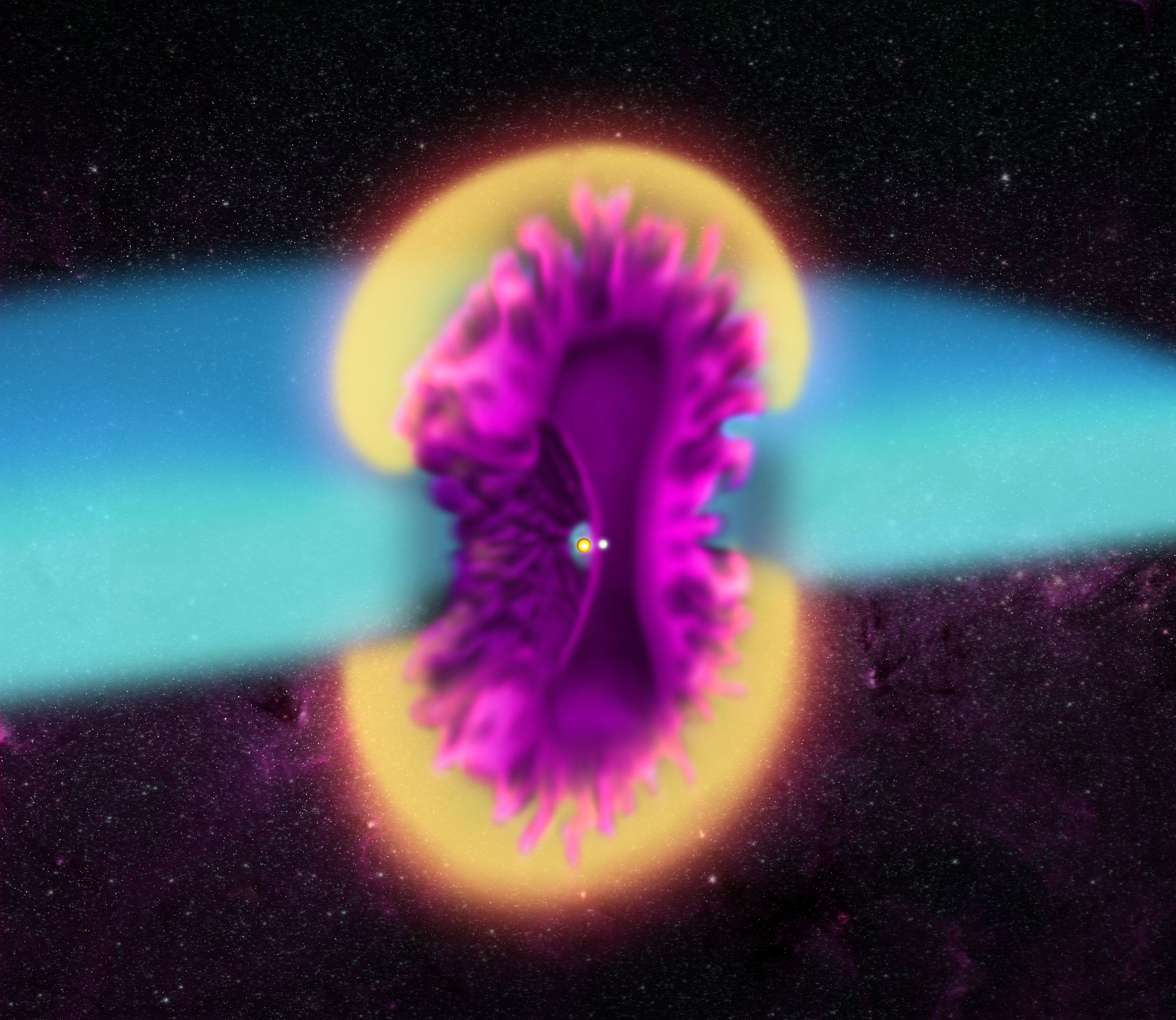
Astronomers observed V745 Sco with Chandra a little over two weeks after the 2014 outburst. Their key finding was it appeared that most of the material ejected by the explosion was moving towards us. To explain this, a team of scientists from the INAF-Osservatorio Astronomico di Palermo, the University of Palermo, and the Harvard-Smithsonian Center for Astrophysics constructed a three-dimensional (3D) computer model of the explosion, and adjusted the model until it explained the observations. In this model they included a large disk of cool gas around the equator of the binary caused by the white dwarf pulling on a wind of gas streaming away from the red giant.

The computer calculations showed that the nova explosion’s blast wave and ejected material were likely concentrated along the north and south poles of the binary system. This shape was caused by the blast wave slamming into the disk of cool gas around the binary. This interaction caused the blast wave and ejected material to slow down along the direction of this disk and produce an expanding ring of hot, X-ray emitting gas. X-rays from the material moving away from us were mostly absorbed and blocked by the material moving towards Earth, explaining why it appeared that most of the material was moving towards us.

In the figure (pictured above) showing the new 3D model of the explosion, the blast wave is yellow, the mass ejected by the explosion is purple, and the disk of cooler material, which is mostly untouched by the effects of the blast wave, is blue. The cavity visible on the left side of the ejected material (see the labeled version) is the result of the debris from the white dwarf's surface being slowed down as it strikes the red giant. Below is an optical image from Siding Springs Observatory in Australia.

Optical Image of V745 Sco 
This image of V745 Sco (also known as Nova 1937) was taken on February 6, 2014 by S. O'Conner (OCN, St. Georges, Bermuda). Scale: 16 arcmin x 16 arcmin. (Credit: S. O'Connor (OCN, St. Georges, Bermuda)

An extraordinary amount of energy was released during the explosion, equivalent to about 10 million trillion hydrogen bombs. The authors estimate that material weighing about one tenth of the Earth’s mass was ejected.

While this stellar-sized belch was impressive, the amount of mass ejected was still far smaller than the amount what scientists calculate is needed to trigger the explosion. This means that despite the recurrent explosions, a substantial amount of material is accumulating on the surface of the white dwarf. If enough material accumulates, the white dwarf could undergo a thermonuclear explosion and be completely destroyed. Astronomers use these so-called Type Ia supernovas as cosmic distance markers to measure the expansion of the Universe.

The scientists were also able to determine the chemical composition of the material expelled by the nova. Their analysis of this data implies that the white dwarf is mainly composed of carbon and oxygen.

A 3D print of the model was also created (pictured below). This 3D print was simplified and printed in two parts, the blast wave (shown here in grey) and the ejected material (shown here in yellow).


A paper describing these results was published in the February 1st, 2017 issue of the Monthly Notices of the Royal Astronomical Society and is available online. The authors are Salvatore Orlando from the INAF-Osservatorio Astronomico di Palermo in Italy, Jeremy Drake from the Harvard-Smithsonian Center for Astrophysics in Cambridge, MA and Marco Miceli from the University of Palermo.

NASA's Marshall Space Flight Center in Huntsville, Alabama, manages the Chandra program for NASA's Science Mission Directorate in Washington. The Smithsonian Astrophysical Observatory in Cambridge, Massachusetts, controls Chandra's science and flight operations.


Fast Facts for V745 Sco:

Coordinates (J2000): RA 17h 55m 22.2s | Dec -33° 14´ 58.6"
Constellation: Scorpius
Instrument: ACIS
References: Orlando, S. et al., 2017, MNRAS, 464, 5003; arXiv:1610.05692
Distance Estimate: About 25,000 light years


Source: NASA’s Chandra X-ray Observatory