Showing posts with label NGC 1275. Show all posts

Friday, August 20, 2021

Cold Horseshoes in Fast


Composite image of the active galaxy NGC 1275, which lies at the center of the Perseus cluster. Credits: [X-ray: NASA/CXC/IoA/A.Fabian et al.; Radio: NRAO/VLA/G. Taylor; Optical: NASA/ESA/Hubble Heritage (STScI/AURA) & Univ. of Cambridge/IoA/A. Fabian


In this annotated image of NGC 1275, outlines and insets identify two filamentary structures: the blue loop (dotted outline and bottom left inset) and the horseshoe filament (dashed outline and top right inset). These two strikingly shaped filaments may both have been created during the same outburst. Annotations: Yu Qiu

The dynamic environments around active galaxies often exhibit delicate filaments of cold gas. In a new study, scientists have explored how these fragile structures are able to form and survive within their hot, fast-moving surroundings.

Curious Structures

The Perseus cluster, located more than 200 million light-years away, is a collection of thousands of galaxies embedded in a cloud of hot gas. At the cluster’s heart lies NGC 1275, an active galaxy that’s rapidly forming stars and contains an accreting supermassive black hole — two factors that result in outbursts of hot, fast outflows that are spewed into the intracluster medium.

In the midst of all this action, there’s a conundrum: we also see cold, outflowing gas that forms slender, elongated filamentary structures extending tens of thousands of light-years. Where does this cold gas come from, and how is it not heated or destroyed by the fast, hot outflows of the active galaxy?

Sweeping Up Old or Forming New?

Two explanations have been proposed for these cold outflows:

1. The hot winds flowing from the active galaxy sweep up existing cold gas and carry it along, drawing it out into filaments. This idea has a challenge: long before the cold gas manages to reach the speeds we observe — more than 100 km/s! — it would likely be destroyed by shocks, preventing the formation of filaments

2. The cold gas forms within the hot outflows as these winds slow, cool, and fragment into filaments. This idea shows promise! In a new study, a team of scientists led by Yu Qiu (邱宇; Peking University, China) has explored this possibility further using a set of detailed simulations of an outbursting active galaxy


The shape and speed of cold gas that forms within the outflows in two of the authors’ simulations (top and bottom) at three different times (left, middle, and right). The two simulations, which had different starting conditions, produce very different shapes of filaments: the top is long and threadlike, whereas the bottom is a perpendicular ring structure. Credits: Qiu et al. 2021, Hi-res image

Threads, Loops, and Horseshoes

Qiu and collaborators’ 3D hydrodynamic simulations model a hot, radial outflow erupting from the center of a cluster similar to Perseus. From these simulations, the authors show how gravity and pressure from the surroundings cause the hot outflow to slow and cool. They confirm that this process eventually leads to fragmentation, forming filaments of cold gas that move at high speeds consistent with what we observe.

One especially interesting result of the authors’ work: the shapes of the resulting filaments depend strongly on the starting conditions of the outflow. This could explain some particularly striking shapes that we observe in Perseus — there are not only radial threads, but also a loop and a horseshoe at opposite sides of the central galaxy.

The authors show that a bipolar outburst with specific physical conditions can create two perpendicular rings of cold gas instead of long filaments — which could easily reproduce the loop and horseshoe we see in Perseus.

Qiu and collaborators demonstrate how we can use the morphology and locations of the filaments to probe the history of the active galaxy’s outbursts, inferring their energetics and properties. Further study of these delicate threads, loops, and horseshoes is sure to provide a wealth of new information about distant, active galaxies and clusters.

Citation

“Dynamics and Morphology of Cold Gas in Fast, Radiatively Cooling Outflows: Constraining AGN Energetics with Horseshoes,” Yu Qiu et al 2021 ApJL 917 L7. doi:10.3847/2041-8213/ac16d9


Tuesday, April 20, 2021

A Bent Radio Jet in a Galaxy Cluster


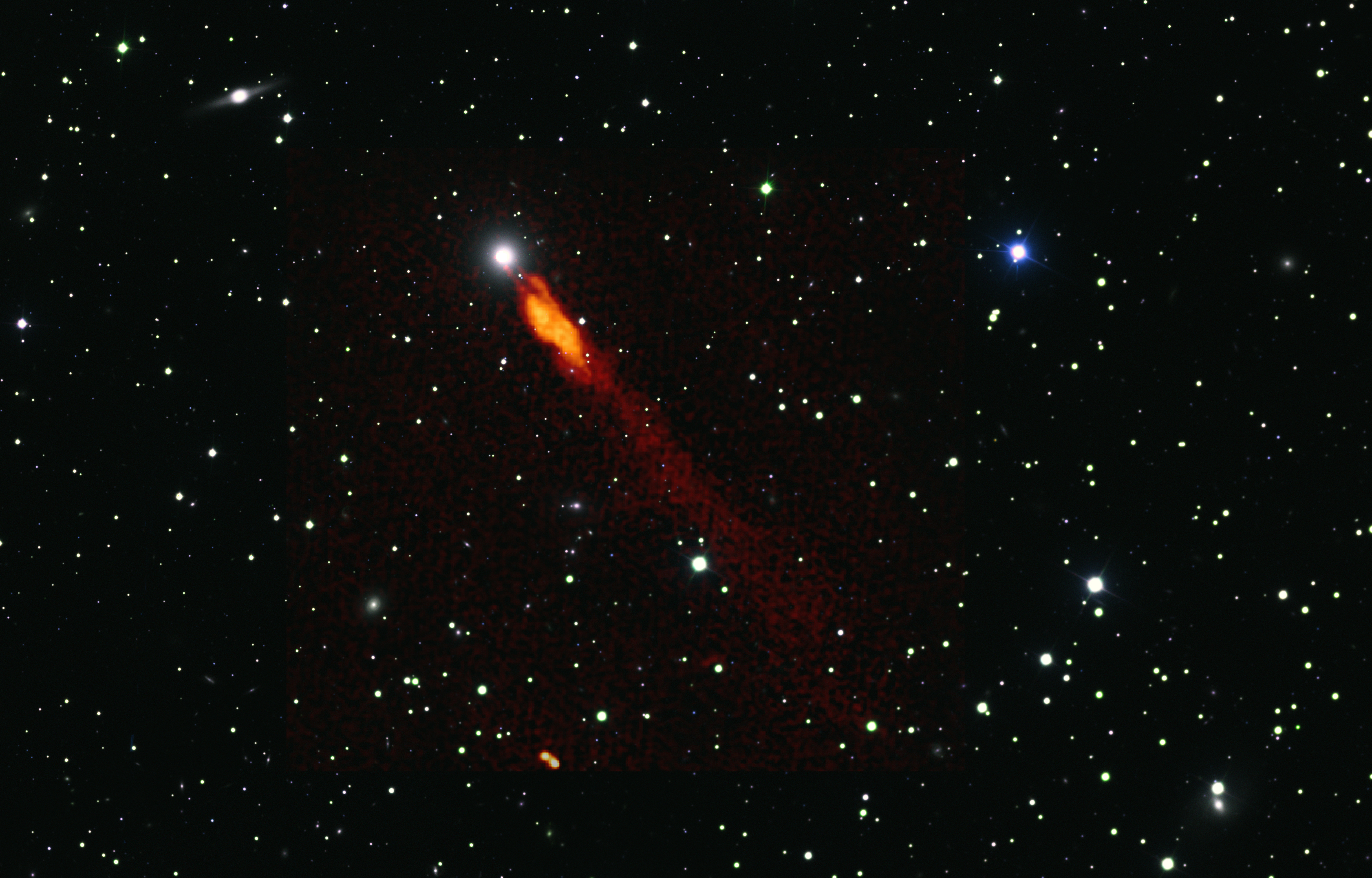
This stunning composite image (click for the full view!) reveals the radio emission (shown in red) from a bent jet that was launched from the galaxy NGC 1272, the bright source just to the right of the image center. The 12’ x 12’ image of the Perseus galaxy cluster is captured by the Sloan Digital Sky Survey; the brightest central galaxy of the cluster, NGC 1275, can be seen to NGC 1272’s left. A new publication led by Marie-Lou Gendron-Marsolais (European Southern Observatory) presents high-resolution Very Large Array images of the detailed radio structures in the Perseus cluster. The authors use these new data to study how the galaxy’s movement as it falls into the cluster, as well as the bulk motions of the intracluster gas, shape the powerful radio jet into the dramatic shapes we see here. For more information, check out the original article below. Hi-res Image

Citation

“VLA Resolves Unexpected Radio Structures in the Perseus Cluster of Galaxies,” M.-L. Gendron-Marsolais et al 2021 ApJ 911 56. doi:10.3847/1538-4357/abddbb

By


Friday, November 13, 2020

Galaxies in the Perseus Cluster

NGC 1275, NGC 1265 and IC 310
Credit: M. Gendron-Marsolais et al.; S. Dagnello, NRAO/AUI/NSF; Sloan Digital Sky Survey.
Hi-res image

The giant galaxy NGC 1275, at the core of the cluster, is seen in new detail, including a newly-revealed wealth of complex, filamentary structure in its radio lobes. Credit: CREDIT: M. Gendron-Marsolais et al.; S. Dagnello, NRAO/AUI/NSF; Sloan Digital Sky Survey.
Hi-res image

The galaxy NGC 1265 shows the effects of its motion through the tenuous material between the galaxies. Its radio jets are bent backward by that interaction, then merge into a single, broad "tail." The tail then is further bent, possibly by motions within the intergalactic material. Credit:  M. Gendron-Marsolais et al.; S. Dagnello, NRAO/AUI/NSF; Sloan Digital Sky Survey.
Hi-res image

The jets of the galaxy IC 310 are bent backward, similarly to NGC 1265, but appear closer because of the viewing angle from Earth. That angle also allows astronomers to directly observe energetic gamma rays generated near the supermassive black hole at the galaxy's core. Credit: M. Gendron-Marsolais et al.; S. Dagnello, NRAO/AUI/NSF; SDSS.
Hi-res image
 
For galaxies, as for people, living in a crowd is different from living alone. Recently, astronomers used the National Science Foundation’s Karl G. Jansky Very Large Array (VLA) to learn how a crowded environment affects galaxies in the Perseus Cluster, a collection of thousands of galaxies some 240 million light-years from Earth.

Left: The giant galaxy NGC 1275, at the core of the cluster, is seen in new detail, including a newly-revealed wealth of complex, filamentary structure in its radio lobes.

Center: The galaxy NGC 1265 shows the effects of its motion through the tenuous material between the galaxies. Its radio jets are bent backward by that interaction, then merge into a single, broad “tail.” The tail then is further bent, possibly by motions within the intergalactic material.

Right: The jets of the galaxy IC 310 are bent backward, similarly to NGC 1265, but appear closer because of the viewing angle from Earth. That angle also allows astronomers to directly observe energetic gamma rays generated near the supermassive black hole at the galaxy’s core.

Such images can help astronomers better understand the complex environment of galaxy clusters, which are the largest gravitationally-bound structures in the universe, and which harbor a variety of still poorly-understood phenomena.

“These images show us previously-unseen structures and details and that helps our effort to determine the nature of these objects,” said Marie-Lou Gendron-Marsolais, an ESO/ALMA Fellow in Santiago, Chile. She and a number of international collaborators are announcing their results in the Monthly Notices of the Royal Astronomical Society.

The National Radio Astronomy Observatory is a facility of the National Science Foundation, operated under cooperative agreement by Associated Universities, Inc.

Media Contact:

Dave Finley, Public Information Officer
(575) 835-7302

dfinley@nrao.edu


Tuesday, May 15, 2018

Revealing the complexity of the nebula in NGC 1275 with SITELLE

Hα filamentary structure around NGC 1275.
Credits: Marie-Lou Gendron-Marsolais, Julie Hlavacek-Larrondo, Laurent Drissen and Maxime Pivin-Lapointe.  
Hi-res image

Movie showing how the filamentary structure of NGC 1275 varies with wavelength. 
Credits: Marie-Lou Gendron-Marsolais, Julie Hlavacek-Larrondo, Laurent Drissen and Maxime Pivin-Lapointe.

Ph.D. student Marie-Lou Gendron-Marsolais and professor Julie Hlavacek-Larrondo, from the Centre for Research in Astrophysics of Québec (CRAQ) and Université de Montréal, have joined the developers of SITELLE, Laurent Drissen and Thomas Martin from Université Laval, an instrument recently installed at the Canada-France-Hawaii telescope (CFHT), to reveal for the first time the intricate dynamic around the galaxy NGC 1275. 

Located 250 million light-years from earth, NGC 1275 is not an ordinary galaxy. It sits in the middle of the Perseus galaxy cluster, a gigantic cluster harboring thousands of galaxies in the constellation of the same name. NGC 1275 rests at the center of a hot and diffuse intracluster gas with an average temperature of tens of millions of degrees. This complex gas constitutes a large part of the luminous mass of galaxy clusters: the hot gas tends to cool and fall toward the galaxy while the central supermassive black hole releases powerful jets of energetic particles. These particles blow gigantic bubbles in the hot gas, preventing it from cooling. Astronomers generally dectect these bubbles by using radio radio telescopes. However, a spectacular network of thin intricate filaments surrounding the galaxy NGC 1275 is visible at specific optical wavelengths. "These types of filaments are often visible around galaxies that lie in similar environments... but their origin is a real mystery", declares Marie-Lou Gendron-Marsolais, lead author on the paper.

Extending over 250 000 light-years, two to three times the size of our own galaxy, the link between this large network of filaments and its environment is still unclear. Two theories are in conflict: the filaments could be condensing from the hot intracluster gas and sinking toward the center of the galaxy or being lifted by the bubbles created by the central supermassive black hole jets and dragged outward of the galaxy.

In order to unravel the mystery of these filaments, the international team of researchers have used SITELLE, an instrument at the Canada-France-Hawaii Telescope that enables the imaging of the galaxy at several different wavelengths at the same time. "This way we obtain a spectrum for each pixel of the image" declares Julie Hlavacek-Larrondo, a coauthor on the paper. "But what is unique about SITELLE is its incredibly large field of view, covering NGC 1275 in its entirety for the first time since the discovery of the nebula, 60 years ago", she adds.

Installed at the top of Maunakea on the Big Island in 2015, SITELLE is the product of the expertise of a team led by the astrophysicist Laurent Drissen as well as the optical design specialist Simon Thibault, both professors at the Faculté des sciences et de génie of Université Laval, as well as the knowledge of CFHT and the high-performance technology business ABB.

With a spectra for each pixel, it is now possible to obtain the radial velocity of each filament, revealing their dynamics at an unprecedented level. "The motion of this network of filaments seems to be very complex. It does not seem to be from a uniform motion, rather it is extremely chaotic", declares Marie-Lou Gendron-Marsolais. The team is convinced that such observations will help illuminate the mysteries of these structures. Understanding the filaments' dynamics aids astronmers in the understanding the processes of heating and cooling of the gas feeding the central black hole. Unlocking this process constitutes a key element in the study of galaxy evolution and, at larger scale, of environment such as clusters of galaxies.

The results from the work led by Marie-Lou Gendron-Marsolais, Julie Hlavacek-Larrondo, Laurent Drissen, Thomas Martin and their international collaborators are published in a letter of the latest issue of the Monthly Notices of the Royal Astronomical Society.


Additional information:

Preprint (No login required)


Contact Information:

Media contacts

Mary Beth Laychak
Outreach manager
Canada-France-Hawaii Telescope
mary@cfht.hawaii.edu

Robert Lamontagne
Public Outreach
Centre de recherche en astrophysique du Québec
Phone : (438) 495-3482
lamont@astro.umontreal.ca


Science contacts:

Marie-Lou Gendron-Marsolais
Centre de recherche en astrophysique du Québec
Université de Montréal
marie-lou@astro.umontreal.ca

Professor Julie Hlavacek-Larrondo
Centre de recherche en astrophysique du Québec
Université de Montréal
juliehl@astro.umontreal.ca

Professor Laurent Drissen
Centre recherche en astrophysique du Québec
Université Laval
ldrissen@phy.ulaval.ca


Monday, August 15, 2016

NASA's Fermi Mission Expands its Search for Dark Matter


Dark matter, the mysterious substance that constitutes most of the material universe, remains as elusive as ever. Although experiments on the ground and in space have yet to find a trace of dark matter, the results are helping scientists rule out some of the many theoretical possibilities. Three studies published earlier this year, using six or more years of data from NASA's Fermi Gamma-ray Space Telescope, have broadened the mission's dark matter hunt using some novel approaches.

“We've looked for the usual suspects in the usual places and found no solid signals, so we've started searching in some creative new ways," said Julie McEnery, Fermi project scientist at NASA's Goddard Space Flight Center in Greenbelt, Maryland. "With these results, Fermi has excluded more candidates, has shown that dark matter can contribute to only a small part of the gamma-ray background beyond our galaxy, the Milky Way, and has produced strong limits for dark matter particles in the second-largest galaxy orbiting it."

Dark matter neither emits nor absorbs light, primarily interacts with the rest of the universe through gravity, yet accounts for about 80 percent of the matter in the universe. Astronomers see its effects throughout the cosmos -- in the rotation of galaxies, in the distortion of light passing through galaxy clusters, and in simulations of the early universe, which require the presence of dark matter to form galaxies at all.

The leading candidates for dark matter are different classes of hypothetical particles. Scientists think gamma rays, the highest-energy form of light, can help reveal the presence of some of types of proposed dark matter particles. Previously, Fermi has searched for tell-tale gamma-ray signals associated with dark matter in the center of our galaxy and in small dwarf galaxies orbiting our own.

Although no convincing signals were found, these results eliminated candidates within a specific range of masses and interaction rates, further limiting the possible characteristics of dark matter particles.

Among the new studies, the most exotic scenario investigated was the possibility that dark matter might consist of hypothetical particles called axions or other particles with similar properties. An intriguing aspect of axion-like particles is their ability to convert into gamma rays and back again when they interact with strong magnetic fields. These conversions would leave behind characteristic traces, like gaps or steps, in the spectrum of a bright gamma-ray source.

Manuel Meyer at Stockholm University led a study to search for these effects in the gamma rays from NGC 1275, the central galaxy of the Perseus galaxy cluster, located about 240 million light-years away. High-energy emissions from NGC 1275 are thought to be associated with a supermassive black hole at its center. Like all galaxy clusters, the Perseus cluster is filled with hot gas threaded with magnetic fields, which would enable the switch between gamma rays and axion-like particles. This means some of the gamma rays coming from NGC 1275 could convert into axions -- and potentially back again -- as they make their way to us.

"While we don't yet know what dark matter is, our results show we can probe axion-like models and provide the strongest constraints to date for certain masses," Meyer said. "Remarkably, we reached a sensitivity we thought would only be possible in a dedicated laboratory experiment, which is quite a testament to Fermi."

Another broad class of dark matter candidates are called Weakly Interacting Massive Particles (WIMPs). In some versions, colliding WIMPs either mutually annihilate or produce an intermediate, quickly decaying particle. Both scenarios result in gamma rays that can be detected by the LAT.

Regina Caputo at the University of California, Santa Cruz, sought these signals from the Small Magellanic Cloud (SMC), which is located about 200,000 light-years away and is the second-largest of the small satellite galaxies orbiting the Milky Way. Part of the SMC's appeal for a dark matter search is that it lies comparatively close to us and its gamma-ray emission from conventional sources, like star formation and pulsars, is well understood. Most importantly, astronomers have high-precision measurements of the SMC's rotation curve, which shows how its rotational speed changes with distance from its center and indicates how much dark matter is present. In a paper published in Physical Review D on March 22, Caputo and her colleagues modeled the dark matter content of the SMC, showing it possessed enough to produce detectable signals for two WIMP types.

The Small Magellanic Cloud (SMC), at center, is the second-largest satellite galaxy orbiting our own. This image superimposes a photograph of the SMC with one half of a model of its dark matter (right of center). Lighter colors indicate greater density and show a strong concentration toward the galaxy's center. Ninety-five percent of the dark matter is contained within a circle tracing the outer edge of the model shown. In six years of data, Fermi finds no indication of gamma rays from the SMC's dark matter. Credits: Dark matter, R. Caputo et al. 2016; background, Axel Mellinger, Central Michigan University


"The LAT definitely sees gamma rays from the SMC, but we can explain them all through conventional sources," Caputo said. "No signal from dark matter annihilation was found to be statistically significant."

In the third study, researchers led by Marco Ajello at Clemson University in South Carolina and Mattia Di Mauro at SLAC National Accelerator Laboratory in California took the search in a different direction. Instead of looking at specific astronomical targets, the team used more than 6.5 years of LAT data to analyze the background glow of gamma rays seen all over the sky.

The nature of this light, called the extragalactic gamma-ray background (EGB) has been debated since it was first measured by NASA's Small Astronomy Satellite 2 in the early 1970s. Fermi has shown that much of this light arises from unresolved gamma-ray sources, particularly galaxies called blazars, which are powered by material falling toward gigantic black holes. Blazars constitute more than half of the total gamma-ray sources seen by Fermi, and they make up an even greater share in a new LAT catalog of the highest-energy gamma rays.

This animation switches between two images of the gamma-ray sky as seen by Fermi's Large Area Telescope (LAT), one using the first three months of LAT data, the other showing a cumulative exposure of seven years. The blue color, representing the fewest gamma rays, includes the extragalactic gamma-ray background. Blazars make up most of the bright sources shown (colored red to white). With increasing exposure, Fermi reveals more of them. A new study shows blazars are almost completely responsible for the background glow.Credits: NASA/DOE/Fermi LAT Collaboration


Some models predict that EGB gamma rays could arise from distant interactions of dark matter particles, such as the annihilation or decay of WIMPs. In a detailed analysis of high-energy EGB gamma rays, published April 14 in Physical Review Letters, Ajello and his team show that blazars and other discrete sources can account for nearly all of this emission.

"There is very little room left for signals from exotic sources in the extragalactic gamma-ray background, which in turn means that any contribution from these sources must be quite small," Ajello said. "This information may help us place limits on how often WIMP particles collide or decay."

Although these latest studies have come up empty-handed, the quest to find dark matter continues both in space and in ground-based experiments. Fermi is joined in its search by NASA's Alpha Magnetic Spectrometer, a particle detector on the International Space Station.

NASA's Fermi Gamma-ray Space Telescope is an astrophysics and particle physics partnership, developed in collaboration with the U.S. Department of Energy and with important contributions from academic institutions and partners in France, Germany, Italy, Japan, Sweden and the United States.

For more information about NASA's Fermi Gamma-ray Space Telescope, visit:  www.nasa.gov/fermi


By Francis Reddy
NASA's Goddard Space Flight Center, Greenbelt, Md.

Editor: Ashley Morrow


Wednesday, July 06, 2016

Hitomi Mission Charts Hot Winds of a Galaxy Cluster for the First Time

Measurements of unprecedented detail returned by Japan's Hitomi satellite have allowed scientists to track the motion of X-ray-emitting gas at the heart of the Perseus cluster of galaxies for the first time. The results showcase the long-awaited premiere of a next-generation X-ray instrument whose key components were developed at NASA's Goddard Space Flight Center in Greenbelt, Maryland.

A revolutionary instrument aboard the ill-fated Hitomi satellite returned the most detailed measurements yet made of the million-degree atmosphere at the core of a galaxy cluster. Watch the video to learn more. Credits: NASA's Goddard Space Flight Center. Download the video in HD at NASA's Scientific Visualization Studio

Led by the Japan Aerospace Exploration Agency (JAXA), Hitomi was launched on Feb. 17. Following the successful activation of the observatory and instruments, Hitomi suffered a mission-ending spacecraft anomaly on March 26.

Before its demise, though, Hitomi was able to peer into the Perseus cluster of galaxies, an assemblage of thousands of galaxies bound together by gravity. Located about 240 million light-years away and named for its host constellation, the Perseus galaxy cluster contains a vast amount of extremely hot gas. At temperatures averaging 90 million degrees Fahrenheit (50 million degrees Celsius), the gas glows brightly in X-rays. Prior to Hitomi's launch, astronomers lacked the capability to measure the detailed dynamics of this gas, particularly its relationship to bubbles of gas expelled by an active supermassive black hole in the cluster's core galaxy, NGC 1275.

"For the first time, we have mapped the motion of the X-ray-emitting gas in a cluster of galaxies and determined its velocity structure over a wide range of spatial scales," said Goddard's Richard Kelley, the U.S. principal investigator for the Hitomi collaboration. "Although this gas is continually stirred by fast outflows from the central black hole, its velocities are small on astronomical scales and show evidence for only minor levels of turbulence."

The Perseus galaxy cluster is filled with hot X-ray-emitting gas, as seen in this image from NASA's Chandra X-ray Observatory. Astronomers using the Soft X-ray Spectrometer aboard the Hitomi satellite have, for the first time, mapped the motion of this gas and determined its velocity structure across a large part of the cluster. The square overlay, which spans about 195,000 light-years at the cluster's distance, shows the area observed by Hitomi. Colors correspond to the detected gas speeds, with bluer colors indicating faster motion toward Earth and redder colors showing greater velocities in the opposite direction. Credits: NASA Goddard and NASA/CXC/SAO/E. Bulbul, et al. Download additional visuals at NASA's Scientific Visualization Studio


Hitomi's revolutionary Soft X-ray Spectrometer (SXS), developed and built by Goddard scientists working closely with colleagues from several institutions in the United States, Japan, and the Netherlands, spent more than two and a half days observing a wide area in the cluster's core. The resulting X-ray spectrum, which provides 30 times the detail of the best previous observation, unveiled a rich landscape of X-ray emission lines from iron, nickel, chromium, and manganese -- metals forged in billions of massive stars in the cluster's galaxies and dispersed when they exploded as supernovae.

The SXS studied a square patch of the sky measuring about 195,000 light-years on a side at the cluster's distance. The total range of gas velocities directed toward or away from Earth within this square was found to be about 365,000 miles an hour (590,000 kilometers per hour) -- enormous by human standards but surprisingly modest on cosmic scales. The observed velocity range indicates that turbulence is responsible for only about 4 percent of the total gas pressure. This result is of particular interest to astrophysicists. Turbulent pressure was a previously unmeasured quantity that could significantly impact estimates of the cluster's mass. The SXS measurements show that only minor corrections are needed.

"I'm surprised the hot gas is absorbing the power output of the black hole so quickly, so efficiently. The gas is relatively stable and isn’t getting pushed around as much as we thought," said team member Brian McNamara, a professor of physics and astronomy at the University of Waterloo in Ontario. "Hitomi's Perseus observation tells us that we can probably weigh distant galaxy clusters to greater accuracy than we can weigh our own Milky Way galaxy."

In visible light, the core of the Perseus galaxy cluster looks completely different. The cluster gas so prominent at X-ray wavelengths gives way to a clutch of fuzzy galaxies viewed through a scrim of faint stars in our own. This image shows the same sky area as the Chandra image above. The bizarre object at the center is NGC 1275, the cluster's central galaxy and itself a prominent source of X-ray and radio emission. At the galaxy's core lies a supermassive black hole activated by infalling matter. Glowing filaments extending from the galaxy trace bubbles of gas blown violently outward by the black hole. Despite this activity, Hitomi measurements show that hot cluster gas in the vicinity is moving at cosmically modest speeds. Credits: R. Jay GaBany. Copyright © 2008 by R. Jay GaBany, used with permission

The Hitomi spacecraft, then known as ASTRO-H, as it appeared on Nov. 27, 2015, at Tsukuba Space Center in Japan. The open compartment visible at the spacecraft's lower left houses the Soft X-ray Spectrometer.Credits: JAXA


A paper from the Hitomi collaboration details these findings in the July 7 edition of the journal Nature.

To determine motion at cosmic scales, astronomers typically disperse light into a rainbow-like spectrum. Discrete bright or dark lines in the spectrum correspond to wavelengths characteristically emitted or absorbed by specific chemical elements. For gas moving away from or toward Earth, these lines will be displaced toward the red or blue end of the spectrum, respectively, by an amount depending on the gas speed. Gas motion may also blur or broaden these lines, providing another clue to the cluster's environment.

Hitomi's SXS employed a revolutionary approach for measuring X-ray "colors" called microcalorimetry. The technique produces unprecedented spectral resolution without blurring the spectrum when looking at sources occupying a relatively large part of the sky, which occurs with traditional methods. The SXS microcalorimeter measured heat produced when individual particles of light, called photons, struck the detector. This resulted in a tiny temperature increase that precisely determined the energy of the incident X-ray light.

During the SXS check-out phase, a door in its line of sight remained closed to protect the microcalorimeter from potential contaminants as materials aboard the spacecraft emitted residual gas into the vacuum of space. This door was designed to transmit X-rays at a reduced level, but it necessarily absorbed some lower-energy X-rays before they could reach the detector.

"The SXS, a technological marvel, worked spectacularly well, exceeding its performance goal despite being partially obstructed," said co-author Robert Petre, chief of Goddard's X-ray Astrophysics Laboratory and the U.S. project scientist for Hitomi.

The Perseus observation provides a tantalizing glimpse of the tremendous advance that X-ray microcalorimetry will bring to astrophysics. U.S. researchers pioneered development of the technology in the 1980s, but Hitomi's all-too-brief run represents its most successful space application to date.

"This is the first time we've looked at a galaxy cluster with an instrument capable of resolving the components of various atomic emission lines, and we immediately saw contradictions with current models," said team member Maxim Markevitch at Goddard. "This is a long-awaited tool for diagnosing the conditions in cosmic plasmas that we can finally apply to galaxy clusters, and there will be a number of papers to come based on these data."

Hitomi, which translates to "pupil of the eye," was known before launch as ASTRO-H. The mission was developed by the Institute of Space and Astronautical Science, a division of JAXA. It was built jointly by an international collaboration led by JAXA, with contributions from NASA Goddard and other institutions in the U.S., Japan, Canada and Europe.


By Francis Reddy
NASA's Goddard Space Flight Center, Greenbelt, Md.
Editor: Ashley Morrow

Source:  NASA/Hitomi


Thursday, March 05, 2015

Why isn’t the universe as bright as it should be?

This Hubble Space Telescope image of galaxy NGC 1275 reveals the fine, thread-like filamentary structures in the gas surrounding the galaxy. The red filaments are composed of cool gas being suspended by a magnetic field, and are surrounded by the 100-million-degree Fahrenheit gas in the center of the Perseus galaxy cluster. The filaments are dramatic markers of the feedback process through which energy is transferred from the central massive black hole to the surrounding gas. Courtesy of NASA (edited by Jose-Luis Olivares/MIT)


Study explains why galaxies don’t churn out as many stars as they should

A handful of new stars are born each year in the Milky Way, while many more blink on across the universe. But astronomers have observed that galaxies should be churning out millions more stars, based on the amount of interstellar gas available.

Now researchers from MIT, Columbia University, and Michigan State University have pieced together a theory describing how clusters of galaxies may regulate star formation. They describe their framework this week in the journal Nature.

When intracluster gas cools rapidly, it condenses, then collapses to form new stars. Scientists have long thought that something must be keeping the gas from cooling enough to generate more stars — but exactly what has remained a mystery.

For some galaxy clusters, the researchers say, the intracluster gas may simply be too hot — on the order of hundreds of millions of degrees Celsius. Even if one region experiences some cooling, the intensity of the surrounding heat would keep that region from cooling further — an effect known as conduction.

“It would be like putting an ice cube in a boiling pot of water — the average temperature is pretty much still boiling,” says Michael McDonald, a Hubble Fellow in MIT’s Kavli Institute for Astrophysics and Space Research. “At super-high temperatures, conduction smooths out the temperature distribution so you don’t get any of these cold clouds that should form stars.”

For so-called “cool core” galaxy clusters, the gas near the center may be cool enough to form some stars. However, a portion of this cooled gas may rain down into a central black hole, which then spews out hot material that serves to reheat the surroundings, preventing many stars from forming — an effect the team terms “precipitation-driven feedback.”

“Some stars will form, but before it gets too out of hand, the black hole will heat everything back up — it’s like a thermostat for the cluster,” McDonald says. “The combination of conduction and precipitation-driven feedback provides a simple, clear picture of how star formation is governed in galaxy clusters.”

Crossing a galactic threshold

Throughout the universe, there exist two main classes of galaxy clusters: cool core clusters — those that are rapidly cooling and forming stars — and non-cool core clusters — those have not had sufficient time to cool.

The Coma cluster, a non-cool cluster, is filled with gas at a scorching 100 million degrees Celsius. To form any stars, this gas would have to cool for several billion years. In contrast, the nearby Perseus cluster is a cool core cluster whose intracluster gas is a relatively mild several million degrees Celsius. New stars occasionally emerge from the cooling of this gas in the Perseus cluster, though not as many as scientists would predict.

“The amount of fuel for star formation outpaces the amount of stars 10 times, so these clusters should be really star-rich,” McDonald says. “You really need some mechanism to prevent gas from cooling, otherwise the universe would have 10 times as many stars.”

McDonald and his colleagues worked out a theoretical framework that relies on two anti-cooling mechanisms.

The group calculated the behavior of intracluster gas based on a galaxy cluster’s radius, mass, density, and temperature. The researchers found that there is a critical temperature threshold below which the cooling of gas accelerates significantly, causing gas to cool rapidly enough to form stars.

According to the group’s theory, two different mechanisms regulate star formation, depending on whether a galaxy cluster is above or below the temperature threshold. For clusters that are significantly above the threshold, conduction puts a damper on star formation: The surrounding hot gas overwhelms any pockets of cold gas that may form, keeping everything in the cluster at high temperatures.

“For these hotter clusters, they’re stuck in this hot state, and will never cool and form stars,” McDonald says. “Once you get into this very high-temperature regime, cooling is really inefficient, and they’re stuck there forever.”

For gas at temperatures closer to the lower threshold, it’s much easier to cool to form stars. However, in these clusters, precipitation-driven feedback starts to kick in to regulate star formation: While cooling gas can quickly condense into clouds of droplets that can form stars, these droplets can also rain down into a central black hole — in which case the black hole may emit hot jets of material back into the cluster, heating the surrounding gas back up to prevent further stars from forming.

“In the Perseus cluster, we see these jets acting on hot gas, with all these bubbles and ripples and shockwaves,” McDonald says. “Now we have a good sense of what triggered those jets, which was precipitating gas falling onto the black hole.”

On track

McDonald and his colleagues compared their theoretical framework to observations of distant galaxy clusters, and found that their theory matched the observed differences between clusters. The team collected data from the Chandra X-ray Observatory and the South Pole Telescope — an observatory in Antarctica that searches for far-off massive galaxy clusters.

The researchers compared their theoretical framework with the gas cooling times of every known galaxy cluster, and found that clusters filtered into two populations — very slowly cooling clusters, and clusters that are cooling rapidly, closer to the rate predicted by the group as a critical threshold.

By using the theoretical framework, McDonald says researchers may be able to predict the evolution of galaxy clusters, and the stars they produce.

“We’ve built a track that clusters follow,” McDonald says. “The nice, simple thing about this framework is that you’re stuck in one of two modes, for a very long time, until something very catastrophic bumps you out, like a head-on collision with another cluster.”

The researchers hope to look deeper into the theory to see whether the mechanisms regulating star formation in clusters also apply to individual galaxies. Preliminary evidence, he says, suggests that is the case.

“If we can use all this information to understand why or why not stars form around us, then we’ve made a big step forward,” McDonald says.

“[These results] look very promising,” says Paul Nulsen, an astronomer at the Harvard-Smithsonian Center for Astrophysics who was not involved in this research. “More work will be needed to show conclusively that precipitation is the main source of the gas that powers feedback. Other processes in the feedback cycle also need to be understood. For example, there is still no consensus on how the gas falling into a massive black hole produces energetic jets, or how they inhibit cooling in the remaining gas. This is not the end of the story, but it is an important insight into a problem that has proved a lot more difficult than anyone ever anticipated.”

This research was funded in part by the National Science Foundation and NASA.

Jennifer Chu | MIT News Office


Thursday, March 24, 2011

Suzaku Shows Clearest Picture Yet of Perseus Galaxy Cluster

X-ray observations made by the Suzaku observatory provide the clearest picture to date of the size, mass and chemical content of a nearby cluster of galaxies. The study also provides the first direct evidence that million-degree gas clouds are tightly gathered in the cluster's outskirts.

Suzaku explored faint X-ray emission of hot gas across two swaths of the Perseus Galaxy Cluster. The images, which record X-rays with energies between 700 and 7,000 electron volts in a combined exposure of three days, are shown in two false-color strips. Bluer colors indicate less intense X-ray emission. The dashed circle is 11.6 million light-years across and marks the so-called virial radius, where cold gas is now entering the cluster. Red circles indicate X-ray sources not associated with the cluster. Inset: An image of the cluster's bright central region taken by NASA's Chandra X-ray Observatory is shown to scale. (Credits: NASA/ISAS/DSS/A. Simionescu et al.; inset: NASA/CXC/A. Fabian et al.) › Larger image. › Larger image (unlabeled)

Suzaku is sponsored by the Japan Aerospace Exploration Agency (JAXA) with contributions from NASA and participation by the international scientific community. The findings will appear in the March 25 issue of the journal Science.

Galaxy clusters are millions of light-years across, and most of their normal matter comes in the form of hot X-ray-emitting gas that fills the space between the galaxies.

"Understanding the content of normal matter in galaxy clusters is a key element for using these objects to study the evolution of the universe," explained Adam Mantz, a co-author of the paper at NASA's Goddard Space Flight Center in Greenbelt, Md.

Clusters provide independent checks on cosmological values established by other means, such as galaxy surveys, exploding stars and the cosmic microwave background, which is the remnant glow of the Big Bang. The cluster data and the other values didn't agree.

NASA's Wilkinson Microwave Anisotropy Probe (WMAP) explored the cosmic microwave background and established that baryons -- what physicists call normal matter -- make up only about 4.6 percent of the universe. Yet previous studies showed that galaxy clusters seemed to hold even fewer baryons than this amount.

Suzaku images of faint gas at the fringes of a nearby galaxy cluster have allowed astronomers to resolve this discrepancy for the first time.

The satellite's ideal target for this study was the Perseus Galaxy Cluster, which is located about 250 million light-years away and named for the constellation in which it resides. It is the brightest extended X-ray source beyond our own galaxy, and also the brightest and closest cluster in which Suzaku has attempted to map outlying gas.

"Before Suzaku, our knowledge of the properties of this gas was limited to the innermost parts of clusters, where the X-ray emission is brightest, but this left a huge volume essentially unexplored," said Aurora Simionescu, the study's lead researcher at the Kavli Institute for Particle Astrophysics and Cosmology (KIPAC) at Stanford University.

This Hubble Space Telescope image shows NGC 1275, the galaxy located in the center of the Perseus Galaxy Cluster. The red threadlike filaments are composed of cool gas suspended by a magnetic field. (Credit: NASA/ESA/Hubble Heritage (STScI/AURA)-ESA/Hubble Collaboration). › Larger image

In late 2009, Suzaku's X-ray telescopes repeatedly observed the cluster by progressively imaging areas farther east and northwest of the center. Each set of images probed sky regions two degrees across -- equivalent to four times the apparent width of the full moon or about 9 million light-years at the cluster's distance. Staring at the cluster for about three days, the satellite mapped X-rays with energies hundreds of times greater than that of visible light.

From the data, researchers measured the density and temperature of the faint X-ray gas, which let them infer many other important quantities. One is the so-called virial radius, which essentially marks the edge of the cluster. Based on this measurement, the cluster is 11.6 million light-years across and contains more than 660 trillion times the mass of the sun. That's nearly a thousand times the mass of our Milky Way galaxy.

The researchers also determined the ratio of the cluster's gas mass to its total mass, including dark matter -- the mysterious substance that makes up about 23 percent of the universe, according to WMAP. By virtue of their enormous size, galaxy clusters should contain a representative sample of cosmic matter, with normal-to-dark-matter ratios similar to WMAP's. Yet the outer parts of the Perseus cluster seemed to contain too many baryons, the opposite of earlier studies, but still in conflict with WMAP.

To solve the problem, researchers had to understand the distribution of hot gas in the cluster, the researchers say. In the central regions, the gas is repeatedly whipped up and smoothed out by passing galaxies. But computer simulations show that fresh infalling gas at the cluster edge tends to form irregular clumps.

Not accounting for the clumping overestimates the density of the gas. This is what led to the apparent disagreement with the fraction of normal matter found in the cosmic microwave background.

"The distribution of these clumps and the fact that they are not immediately destroyed as they enter the cluster are important clues in understanding the physical processes that take place in these previously unexplored regions," said Steve Allen at KIPAC, the principal investigator of the Suzaku observations.

Goddard supplied Suzaku's X-ray telescopes and data-processing software, and it continues to operate a facility that supports U.S. astronomers who use the spacecraft.

Suzaku ( Japanese for "red bird of the south") is the fifth Japanese X-ray astronomy satellite. It was launched as Astro-E2 on July 10, 2005, and renamed in orbit. The observatory was developed at JAXA's Institute of Space and Astronautical Science in collaboration with NASA and other Japanese and U.S. institutions.

Text issued as NASA Headquarters Release No. 11-087

Thursday, December 30, 2010

Sparkle

NGC 1275
Image Credit: NASA, ESA, and the Hubble Heritage (STScI/AURA)-ESA/Hubble Collaboration; Acknowledgment: A. Fabian (Institute of Astronomy, University of Cambridge, UK)

This Hubble Space Telescope image of galaxy NGC 1275 reveals the fine, thread-like filamentary structures in the gas surrounding the galaxy. The red filaments are composed of cool gas being suspended by a magnetic field, and are surrounded by the 100-million-degree Fahrenheit hot gas in the center of the Perseus galaxy cluster.

The filaments are dramatic markers of the feedback process through which energy is transferred from the central massive black hole to the surrounding gas. The filaments originate when cool gas is transported from the center of the galaxy by radio bubbles that rise in the hot interstellar gas.

At a distance of 230 million light-years, NGC 1275 is one of the closest giant elliptical galaxies and lies at the center of the Perseus cluster of galaxies.

The galaxy was photographed in July and August 2006 with Hubble's Advanced Camera for Surveys.

Monday, April 12, 2010

Black holes and galaxy death


Image Caption: The image is a multi-wavelength image of the galaxy NGC 1275 which is a local equivalent to many of the distant massive galaxies studied by Asa Bluck and the other members of the Nottingham / University College London team. It shows the phenomenal power of supermassive Black Holes to rearrange the gas of a galaxy, and represents a window onto a violent past to the lives of galaxies. Over the history of the Universe at least 1/3 of all galaxies went through a phase of development similar to this one. Credit: A. Fabian (Cambridge) / STScI / NASA. Full Size version

Black holes are thought to reside at the centre of almost every galaxy, with some growing to more than a billion times the mass of the Sun. Now a team of UK astronomers believe that these supermassive black holes are commonplace, release more than enough energy to strip their host galaxies apart and in the process shut down these galaxies' star formation for good. On Friday 16th April, team member Asa Bluck of the University of Nottingham, who led this research, will explain the dramatic impact of these monster black holes in his talk at the RAS National Astronomy Meeting (NAM 2010) in Glasgow.

For many years black holes have fascinated scientists and the public alike, with their peculiar ability to warp space and time and their almost sinister tendency to devour everything they encounter. Before it falls in, as matter swirls around the black hole it forms an "accretion disk", where it heats up and radiates energy. The supermassive black holes have such a strong gravitational field that the infalling matter releases a vast amount of energy, making each accretion disk far brighter than the combined output of the hundreds of billions of stars in the galaxy around it.

One of the consequences of this outpouring of energy is that it drives away cool gas and dust, the raw ingredients of new stars. This permanently shuts down star formation in the surrounding galaxy, dooming it to a slow death, where the remaining stars age, grow red, end their lives and are never replaced.

The new study considered the role of supermassive black holes in the development of galaxies. To search for them, the team used the Hubble Space Telescope and the Chandra X-ray Observatory to image the Universe to unprecedented depth and resolution in optical, near infra-red and X-ray light. In particular, the astronomers looked for galaxies which have a very high emission of X-rays, a classic signature of black holes devouring gas and dust.

From the space telescopes' data Asa and the other team members find that at least 1/3 of all the massive galaxies in the Universe not only contain supermassive black holes, but that at some point in their histories the emission from the holes' accretion disks far outshines their host galaxies. The energy output of regions around the black holes is high enough to strip apart every massive galaxy in the cosmos 25 times over, whilst the X-ray emission from them turns out to dwarf that from every other source in the Universe put together.

Asa sums up the new results: "We are left with a startling picture of the formation history of massive galaxies, where dramatic violence in the form of the torrent of radiation from matter falling into black holes leads to the death of galaxies they inhabit."

CONTACTS

Asa Bluck University of Nottingham
Tel: +44 (0)115 951 5154
Mob: 44 (0)770 8822 644
E-mail:
ppxab3@nottingham.ac.uk

NAM 2010 Press Office (12th - 16th April only)
Room G358
Gilbert Scott Building
University of Glasgow
Tel: +44 (0)141 330 7409, +44 (0)141 330 7410, +44 (0)141 330 7411

Dr Robert Massey
Press and Policy Officer
Royal Astronomical Society
Mob: +44 (0)794 124 8035
E-mail:
rm@ras.org.uk

Anita Heward
Press Officer
Royal Astronomical Society
Mob: +44 (0)7756 034 243
E-mail:
anitaheward@btopenworld.com

NOTES FOR EDITORS

The RAS National Astronomy Meeting 2010 will take place from 12-16th April at the University of Glasgow. The conference is held in conjunction with the UK Solar Physics (UKSP) and Magnetosphere Ionosphere and Solar-Terrestrial Physics (MIST) meetings. NAM2010 (www.astro.gla.ac.uk/nam2010/) is principally sponsored by the Royal Astronomical Society (RAS) and the University of Glasgow.”