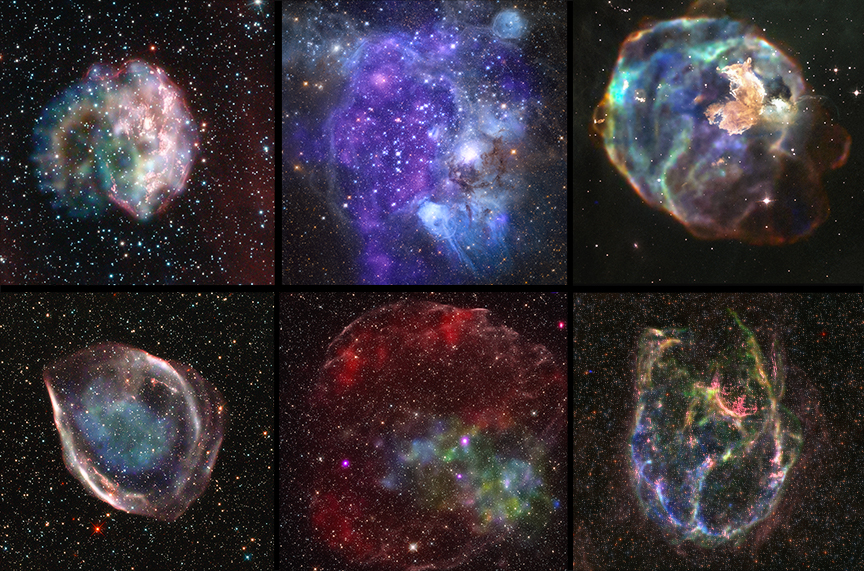
N103B, LHA 120-N 44, LMC N63A, DEM L71, SNR J0534.2-7033 (DEM L238), N132D
Credit: Enhanced Image by Judy Schmidt (CC BY-NC-SA) based on images provided courtesy of NASA/CXC/SAO & NASA/STScI (all images)

N103B
When a thermonuclear explosion destroyed a white dwarf star (the dense
final stage in the evolution of a Sun-like star) in a double star system
and produced a supernova, it left behind this glowing debris field,
called a supernova remnant. The Chandra X-ray data (most clearly visible
on the left side of the remnant in red, green and blue) shows
multimillion-degree gas that has been heated by a shock wave produced by
the explosion that destroyed the star. An optical light image from the
Hubble Space Telescope is brightest on the right side of the image,
where the overlap with X-rays is mostly in pink and white.

This region of star formation features a giant bubble that is blowing
out from the middle of this image due to winds flowing off young stars.
Chandra data (purple and pink) show this superbubble of hot gas, while
Hubble data (orange and light blue) reveals the gas and dust in the
system.

After a massive star exploded, it left behind this supernova remnant
observed by Chandra and Hubble. The Chandra data (red, green and blue)
show multimillion-degree gas and the blast wave from the supernova. The
light brown region in the upper right of the remnant is a dense cloud of
gas and dust that reflects optical light detected by Hubble.

The Chandra image of this supernova remnant (also known as SNR
0505.7-6752) reveals an inner cloud of glowing iron and silicon (green
and blue) surrounded by an outer blast wave (red). The outer blast wave,
created during the destruction of the white dwarf star, is also seen in
optical data from Hubble (red and white).

Another supernova remnant resulting from the explosion of a white dwarf
star is revealed in this image of DEM L238, also known as SNR
J0534.2-7033. The Chandra image (yellow, green and bright red) shows
multimillion-degree gas and the Hubble image shows cooler gas in the
system, near the outer border of the remnant in red.

N132D
This is the brightest supernova remnant in either the LMC or its
galactic cousin, the Small Magellanic Cloud. N132D also stands out
because it belongs to a rare class of supernova remnants that have
relatively high levels of oxygen. Scientists think most of the oxygen we
breathe came from explosions similar to this one. Here, Chandra data
are shown in purple and green and Hubble data are shown in red.
NASA's Marshall Space Flight Center manages the Chandra program. The
Smithsonian Astrophysical Observatory's Chandra X-ray Center controls
science and flight operations from Cambridge, Massachusetts.
Source: NASA’s Chandra X-ray Observatory