Carl Knox, OzGrav/Swinburne
To the point
- New method: For the first time, the LIGO-Virgo-KAGRA collaboration has demonstrated a new method to improve the sensitivity of its international network of gravitational-wave detectors.
- Gravitational-wave auto-tuning: The new method called “astrophysical calibration” resembles auto-tune used in music production. It helps to find and correct “off-key” calibrations of the highly precise laser instruments, which can bias the astrophysical interpretation of the measured signals.
- Successful demonstration: A new publication in Physical Review Letters successfully demonstrates the method using two loud gravitational-wave signals from binary black hole coalescences.
- Testing Einstein’s theory: Researchers at the AEI have made crucial contributions to the effort by understanding the interplay between imperfect detector calibration and finding potential deviations from Einstein’s general theory of relativity.
Crucial contributions by AEI researchers: How “off-key” detector calibration can bias signal-based tests of Einstein’s general theory of relativity.
Calibrating the instruments
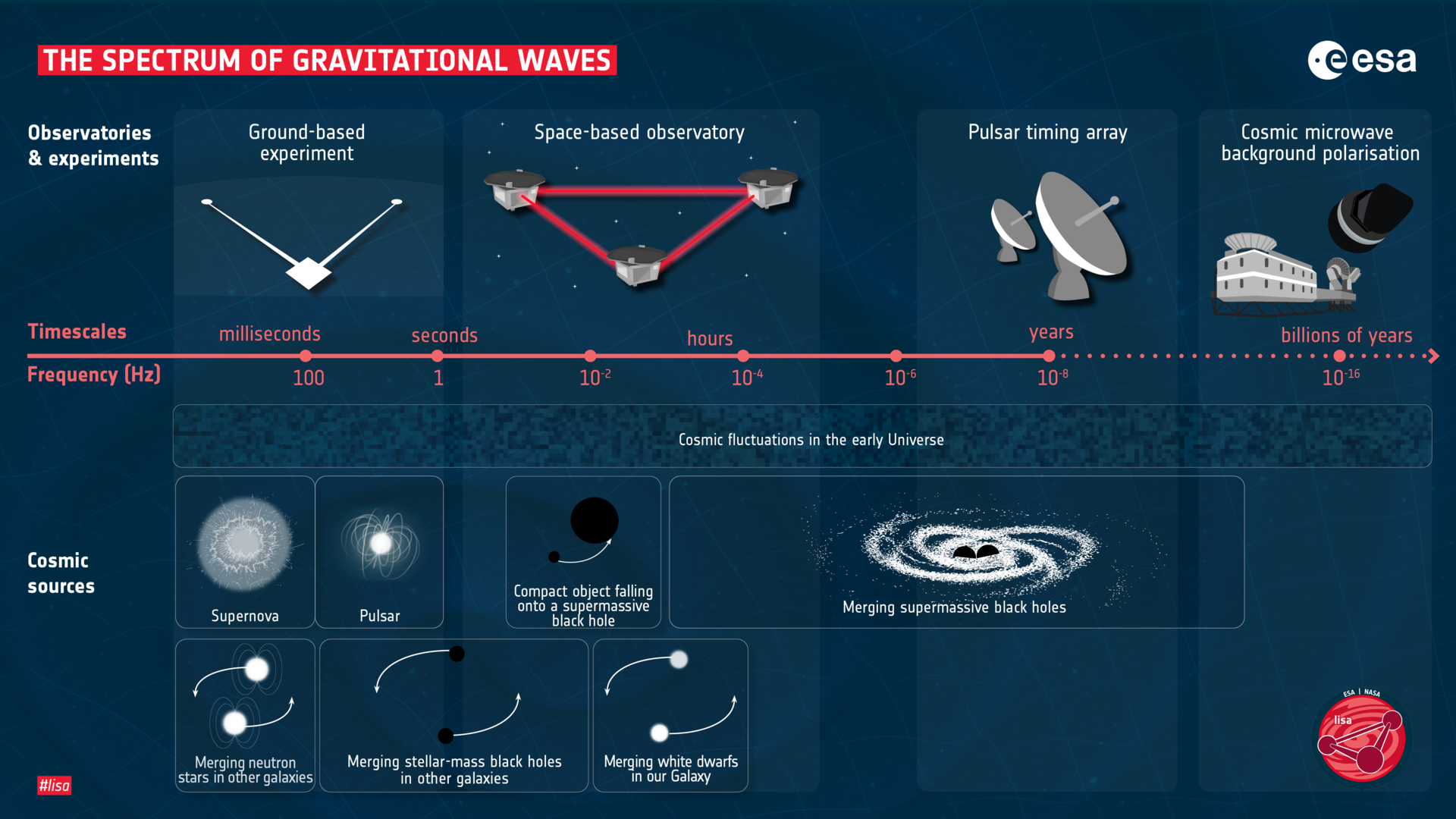
The LIGO-Virgo-KAGRA (LVK) collaboration’s international network of gravitational-wave detectors consists of five kilometer-sized instruments. All of them reflect ultra-pure laser light back and forth between mirrors to measure the minute length changes – less than a billionth of a billionth of a meter – caused by passing gravitational waves.
To be sensitive to such tiny changes, the detectors must be carefully calibrated in real time. At the heart of this calibration is a precise model of how the detector reacts to gravitational waves. An imperfect detector calibration can compromise how the signal is received and as a consequence also bias the interpretation of the cosmic phenomenon that generated it.

Graphics: Shanika Galaudage
Auto-tune for gravitational waves
Now, the LVK reports the first successful demonstration of a new method called “astrophysical calibration” to identify and correct an imperfect detector calibration retrospectively – after the measurement was done. This is similar to how a music production software such as Auto-Tune can correct a singer’s errant pitch after a song was recorded.
If a gravitational-wave signal is observed loud and clear, i.e., when it stands out from the detector’s background noise, the researchers can compare the signal to predictions from general relativity and to observations of the same signal in other well-tuned detectors. This way “off-key” measurements from a mis-tuned detector can be corrected retrospectively. The LVK scientists use the predictions from general relativity to know how the signal should sound like, similar to how musicians use musical scores to know a singer’s pitch.
If a gravitational-wave signal is observed loud and clear, i.e., when it stands out from the detector’s background noise, the researchers can compare the signal to predictions from general relativity and to observations of the same signal in other well-tuned detectors. This way “off-key” measurements from a mis-tuned detector can be corrected retrospectively. The LVK scientists use the predictions from general relativity to know how the signal should sound like, similar to how musicians use musical scores to know a singer’s pitch.
Two loud gravitational-wave signals
In an article accepted in Physical Review Letters, LVK demonstrate how this technique has been applied to two particularly loud gravitational-wave signals, called GW240925 and GW250207, respectively.
At the times when both these signals were observed – on 25 September 2024 and 7 February 2025, respectively –, the calibration of the LIGO Hanford detector was not optimal. This made the interpretation of its data particularly difficult. By comparing LIGO Hanford data with theoretical predictions and observations of the same signals by the LIGO Livingston detector and the Virgo detector, the researchers were able precisely determine how the “off-key” LIGO Hanford instrument distorted the collected data.
The signal GW240925 served as an acid test for the new method. The astrophysical calibration passed it with flying colors. It confirmed the known calibration errors measured on-site at LIGO Hanford.
In the case of GW250207, however, it was essential to resort to astrophysical calibration to make full use of the data, because no reliable on-site calibration measurements were available for the LIGO Hanford detector. Using the astrophysically corrected calibration for the LIGO Hanford detector, LVK researchers could take calibration uncertainties properly into account, and avoid a biased interpretation of the astrophysical origin of the signal.
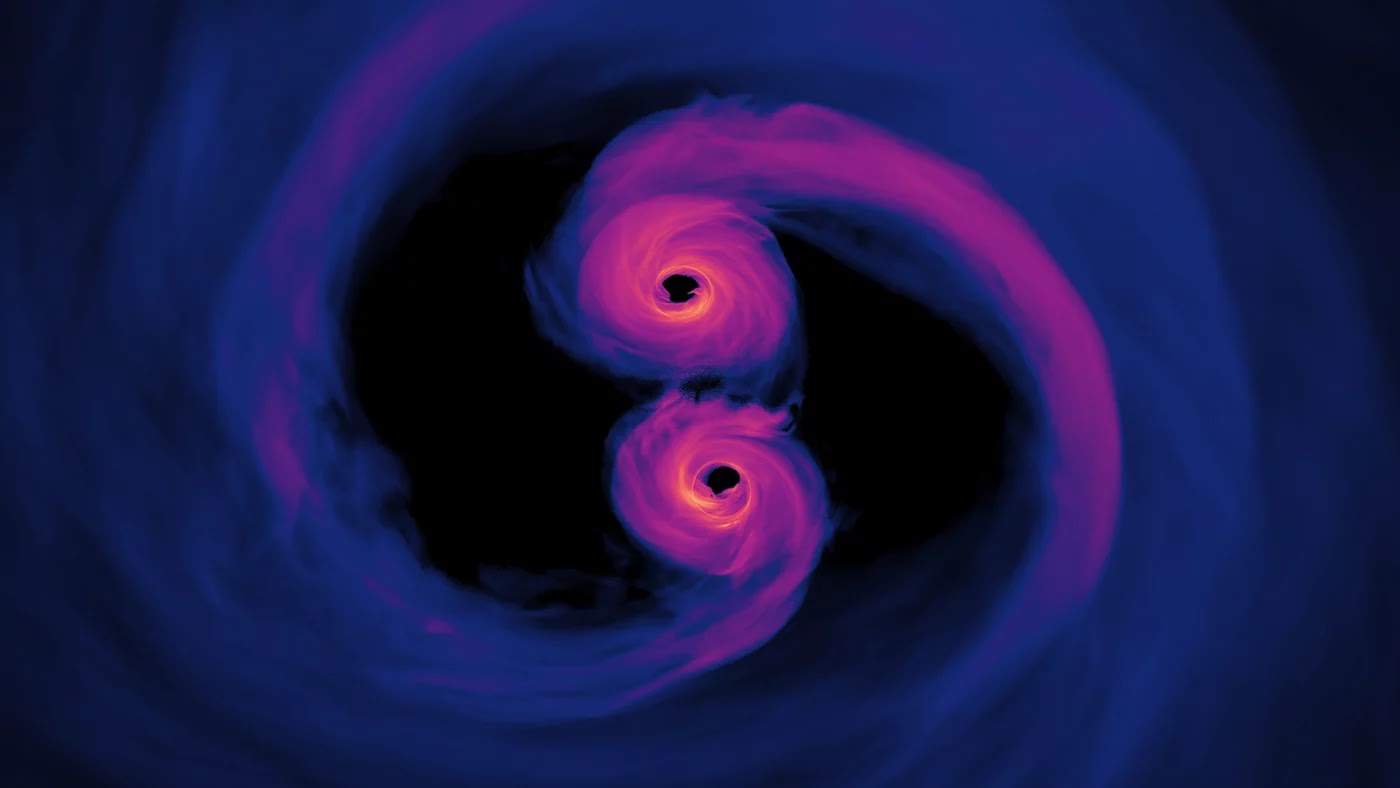
In their publication, the LVK astrophysicists report that GW240925 came from a coalescence of two black holes. They weighed 9 and 7 times, respectively, as much as our Sun and their gravitational waves traveled for about 1.0 billion years before reaching the LVK detectors. GW250207 was caused by the coalescence two more massive black holes weighing 35 and 31 times, respectively, as much as our Sun. The waves from this second merger traveled through the Universe for ca. 570 million years before reaching Earth.
At the times when both these signals were observed – on 25 September 2024 and 7 February 2025, respectively –, the calibration of the LIGO Hanford detector was not optimal. This made the interpretation of its data particularly difficult. By comparing LIGO Hanford data with theoretical predictions and observations of the same signals by the LIGO Livingston detector and the Virgo detector, the researchers were able precisely determine how the “off-key” LIGO Hanford instrument distorted the collected data.
The signal GW240925 served as an acid test for the new method. The astrophysical calibration passed it with flying colors. It confirmed the known calibration errors measured on-site at LIGO Hanford.
In the case of GW250207, however, it was essential to resort to astrophysical calibration to make full use of the data, because no reliable on-site calibration measurements were available for the LIGO Hanford detector. Using the astrophysically corrected calibration for the LIGO Hanford detector, LVK researchers could take calibration uncertainties properly into account, and avoid a biased interpretation of the astrophysical origin of the signal.
In their publication, the LVK astrophysicists report that GW240925 came from a coalescence of two black holes. They weighed 9 and 7 times, respectively, as much as our Sun and their gravitational waves traveled for about 1.0 billion years before reaching the LVK detectors. GW250207 was caused by the coalescence two more massive black holes weighing 35 and 31 times, respectively, as much as our Sun. The waves from this second merger traveled through the Universe for ca. 570 million years before reaching Earth.
Key contributions from AEI Potsdam
Researchers from the Astrophysical and Cosmological Relativity department at the AEI in the Potsdam Science Park showed that taking into account the calibration of the detectors is essential when using gravitational-wave signals for tests of general relativity.
“We found that neglecting imperfect detector calibration can potentially mimic or obscure deviations from Einstein’s theory which may be observed in different parts of black hole coalescence signals,” says Lorenzo Pompili, former member of the department and now a research fellow at the University of Nottingham.
“We used the signal GW250207 to obtain some of the most stringent tests of general relativity yet,” says Elise Sänger, a PhD student in the department. “We got lucky with GW250207, because it was observed so loud and clear and because the Universe gifted us a signal with properties very well suited for these tests.”
“This is the first LVK publication to use an improved waveform model, which we developed at the AEI. Our improvements are important to make increasingly accurate predictions for the gravitational-wave signals, which are key for carrying out these analyses,” says Héctor Estellés Estrella, a former postdoc of the department, now a Postdoctoral Fellow at the Institute of Space Sciences in Barcelona. “The next version of the Gravitational-wave Transient Catalog soon to be published will also make use of this waveform model.”
“We call the phase in which the black hole settles into its final state directly after the merger the ‘ringdown’. In it, the black hole emits a characteristic spectrum of gravitational-wave tones,” explains Elisa Maggio, a former postdoc at AEI Potsdam and now researcher at the Italian Institute for Nuclear Physics. “GW250207 was only the second signal ever in which we constrained one of the higher tones and could measure its properties.”
“We found that neglecting imperfect detector calibration can potentially mimic or obscure deviations from Einstein’s theory which may be observed in different parts of black hole coalescence signals,” says Lorenzo Pompili, former member of the department and now a research fellow at the University of Nottingham.
“We used the signal GW250207 to obtain some of the most stringent tests of general relativity yet,” says Elise Sänger, a PhD student in the department. “We got lucky with GW250207, because it was observed so loud and clear and because the Universe gifted us a signal with properties very well suited for these tests.”
“This is the first LVK publication to use an improved waveform model, which we developed at the AEI. Our improvements are important to make increasingly accurate predictions for the gravitational-wave signals, which are key for carrying out these analyses,” says Héctor Estellés Estrella, a former postdoc of the department, now a Postdoctoral Fellow at the Institute of Space Sciences in Barcelona. “The next version of the Gravitational-wave Transient Catalog soon to be published will also make use of this waveform model.”
“We call the phase in which the black hole settles into its final state directly after the merger the ‘ringdown’. In it, the black hole emits a characteristic spectrum of gravitational-wave tones,” explains Elisa Maggio, a former postdoc at AEI Potsdam and now researcher at the Italian Institute for Nuclear Physics. “GW250207 was only the second signal ever in which we constrained one of the higher tones and could measure its properties.”
Media contacts:
Dr. Benjamin Knispel
Press Officer AEI Hannover
Tel: +49 511 762-19104
Email: benjamin.knispel@aei.mpg.de
Dr. Elke Müller
Press Officer AEI Potsdam, Scientific Coordinator
Tel: +49 331 567-7303
Email:elke.mueller@aei.mpg.de
Scientific contacts:
Prof. Dr. Alessandra Buonanno
Director | LSC Principal Investigator
Tel: +49 331 567-7220
Fax: +49 331 567-7298
Email: alessandra.buonanno@aei.mpg.de
Homepage of Alessandra Buonanno
Prof. Dr. Dr. h.c. Karsten Danzmann
Director Emeritus | LSC Principal Investigator
Tel: +49 511 762-2356
Fax: +49 511 762-5861
Email: karsten.danzmann@aei.mpg.de
Homepage of Karsten Danzmann
Dr. Frank Ohme
Research Group Leader | LSC Principal Investigator
Tel: +49 511 762-17171
Fax: +49 511 762-2784
Email: frank.ohme@aei.mpg.de
Homepage of Frank Ohme
Dr. Héctor Estellés
Research Scientist
Email: hestelles@ice.csic.es
Institute of Space Sciences, Barcelona
Dr. Elisa Maggio
INFN Researcher
Email: elisa.maggio@aei.mpg.de
Istituto Nazionale di Fisica Nucleare, Rome
Dr. Lorenzo Pompili
Research Fellow
Email: Lorenzo.Pompili@nottingham.ac.uk
University of Nottingham, School of Mathematical Sciences
Elise Sänger
PhD Student
Email: elise.saenger@aei.mpg.de
Publication
The LIGO Scientific Collaboration; the Virgo Collaboration; the KAGRA Collaboration
GW240925 and GW250207: Astrophysical Calibration of Gravitational-wave Detectors
Physical Review Letters (2026)
Source | DOI