Showing posts with label Messier 42. Show all posts

Wednesday, January 04, 2017

Hidden Secrets of Orion’s Clouds

The Orion A molecular cloud from VISTA

Highlights from VISTA image of Orion A


Videos
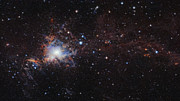
ESOcast 90 Light – Orion’s Cloudy Secrets 4K UHD
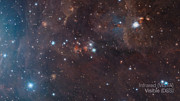

Visible/infrared comparison of views of the Orion A molecular cloud
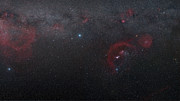

Zooming in on a new VISTA image of the Orion A molecular cloud
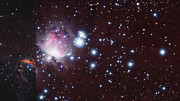

Slider comparison of visible and infrared views of the Orion A molecular cloud


VISTA survey gives most detailed view of Orion A molecular cloud in the near-infrared

This spectacular new image is one of the largest near-infrared high-resolution mosaics of the Orion A molecular cloud, the nearest known massive star factory, lying about 1350 light-years from Earth. It was taken using the VISTA infrared survey telescope at ESO’s Paranal Observatory in northern Chile and reveals many young stars and other objects normally buried deep inside the dusty clouds.

The new image from the VISION survey (VIenna Survey In Orion) is a montage of images taken in the near-infrared part of the spectrum [1] by the VISTA survey telescope at ESO’s Paranal Observatory in Chile. It covers the whole of the Orion A molecular cloud, one of the two giant molecular clouds in the Orion molecular cloud complex (OMC). Orion A extends for approximately eight degrees to the south of the familiar part of Orion known as the sword [2].

VISTA is the world’s largest dedicated survey telescope, and has a large field of view imaged with very sensitive infrared detectors, characteristics that made it ideal for obtaining the deep, high-quality infrared images required by this ambitious survey.

The VISION survey has resulted in a catalogue containing almost 800 000 individually identified stars, young stellar objects and distant galaxies, This represents better depth and coverage than any other survey of this region to date [3].

VISTA can see light that the human eye cannot, allowing astronomers to identify many otherwise hidden objects in the stellar nursery. Very young stars that cannot be seen in visible-light images are revealed when observed at longer infrared wavelengths, where the dust that shrouds them is more transparent.

The new image represents a step towards a complete picture of the star formation processes in Orion A, for both low and high mass stars. The most spectacular object is the glorious Orion Nebula, also called Messier 42 [4] seen towards the left of the image. This region forms part of the sword of the famous bright constellation of Orion (The Hunter). The VISTA catalogue covers both familiar objects and new discoveries. These include five new young stellar object candidates and ten candidate galaxy clusters.

Elsewhere in the image, we can look into Orion A’s dark molecular clouds and spot many hidden treasures, including discs of material that could give birth to new stars (pre-stellar discs), nebulosity associated with newly-born stars (Herbig-Haro objects), smaller star clusters and even galaxy clusters lying far beyond the Milky Way. The VISION survey allows the earliest evolutionary phases of young stars within nearby molecular clouds to be systematically studied.

This impressively detailed image of Orion A establishes a new observational foundation for further studies of star and cluster formation and once again highlights the power of the VISTA telescope to image wide areas of sky quickly and deeply in the near-infrared part of the spectrum [5].


Notes


[1] The VISION survey covers approximately 18.3 square degrees at a scale of about one-third of an arcsecond per pixel.

[2] The other giant molecular cloud in the Orion Molecular Cloud is Orion B, which lies east of Orion’s Belt.

[3] The complete VISION survey includes an even larger region than is shown in this picture, which covers 39 578 x 23 069 pixels.

[4] The Orion nebula was first described in the early seventeenth century although the identity of the discoverer is uncertain. The French comet-hunter Messier made an accurate sketch of its main features in the mid-eighteenth century and gave it the number 42 in his famous catalogue. He also allocated the number 43 to the smaller detached region just north of the main part of the nebula. Later William Herschel speculated that the nebula might be “the chaotic material of future suns” and astronomers have since discovered that the mist is indeed gas glowing in the fierce ultraviolet light from young hot stars that have recently formed there.

[5] The successful VISION survey of Orion will be followed by a new, bigger public survey of other star-forming regions with VISTA, called VISIONS, which will start in April 2017.


More Information

This research is presented in a paper entitled “VISION - Vienna survey in Orion I. VISTA Orion A Survey”, by S. Meingast et al., published in the journal Astronomy & Astrophysics.

The team is composed of: Stefan Meingast (University of Vienna, Vienna, Austria), João Alves (University of Vienna, Vienna, Austria), Diego Mardones (Universidad de Chile, Santiago, Chile) , Paula Teixeira (University of Vienna, Vienna, Austria), Marco Lombardi (University of Milan, Milan, Italy), Josefa Großschedl (University of Vienna, Vienna, Austria), Joana Ascenso (CENTRA, Universidade de Lisboa, Lisbon, Portugal; Universidade do Porto, Porto, Portugal), Herve Bouy (Centro de Astrobiología, Madrid, Spain), Jan Forbrich (University of Vienna, Vienna, Austria), Alyssa Goodman (Harvard-Smithsonian Center for Astrophysics, Cambridge MA, USA), Alvaro Hacar (University of Vienna, Vienna, Austria), Birgit Hasenberger (University of Vienna, Vienna, Austria), Jouni Kainulainen (Max-Planck-Institute for Astronomy, Heidelberg, Germany), Karolina Kubiak (University of Vienna, Vienna, Austria), Charles Lada (Harvard-Smithsonian Center for Astrophysics, Cambridge, USA), Elizabeth Lada (University of Florida, Gainesville, USA), André Moitinho (SIM/CENTRA, Universidade de Lisboa, Lisbon, Portugal), Monika Petr-Gotzens (ESO, Garching, Germany), Lara Rodrigues (Universidad de Chile, Santiago, Chile) and Carlos G. Román-Zúñiga (UNAM, Ensenada, Baja California, Mexico).

ESO is the foremost intergovernmental astronomy organisation in Europe and the world’s most productive ground-based astronomical observatory by far. It is supported by 16 countries: Austria, Belgium, Brazil, the Czech Republic, Denmark, France, Finland, Germany, Italy, the Netherlands, Poland, Portugal, Spain, Sweden, Switzerland and the United Kingdom, along with the host state of Chile. ESO carries out an ambitious programme focused on the design, construction and operation of powerful ground-based observing facilities enabling astronomers to make important scientific discoveries. ESO also plays a leading role in promoting and organising cooperation in astronomical research. ESO operates three unique world-class observing sites in Chile: La Silla, Paranal and Chajnantor. At Paranal, ESO operates the Very Large Telescope, the world’s most advanced visible-light astronomical observatory and two survey telescopes. VISTA works in the infrared and is the world’s largest survey telescope and the VLT Survey Telescope is the largest telescope designed to exclusively survey the skies in visible light. ESO is a major partner in ALMA, the largest astronomical project in existence. And on Cerro Armazones, close to Paranal, ESO is building the 39-metre European Extremely Large Telescope, the E-ELT, which will become “the world’s biggest eye on the sky”.


Links


Contacts

Richard Hook
ESO Public Information Officer
Garching bei München, Germany
Tel: +49 89 3200 6655
Email:
rhook@eso.org

Source: ESO 

Wednesday, August 17, 2016

Turbulent border

Messier 42, M42, Orion Nebula
Credit: ESO/Goicoechea et al.


These images show the edge of the vast molecular cloud that lies behind the Orion Nebula, 1400 light-years from Earth. The image of the left shows a wide-field view of the region, as seen with the HAWK-I instrument, installed at the Very Large Telescope. A small region is highlighted with a white rectangle, and the rightmost image shows that region in stunning fiery detail, observed with the Atacama Large Millimeter/submillimeter Array (ALMA).

As well as producing beautiful images, molecular clouds are of great interest to astronomers. The clouds are stellar nurseries and at their edge atoms react and form molecules by key astrochemical processes. With the ALMA observations scientists were able to resolve this transition from atomic to molecular gas at the border of the Orion molecular cloud. As Orion is the nearest massive star-forming region it is the ideal target to find out more about these astrochemical processes, and it also offers the possibility to study the interactions of newly formed stars with their surroundings in detail.

Both observations show that this fascinating astrochemical transition from atomic to molecular gas happens in a highly dynamic environment. ALMA’s view of the nebula particularly resembles the dark clouds of a huge upcoming storm in Earth’s atmosphere.

Link 

 Source: ESO/images
 

Tuesday, July 12, 2016

Deepest Ever Look into Orion

 PR Image eso1625a
A deep infrared view of the Orion Nebula from HAWK-I

Highlights from a new infrared image of the Orion Nebula


PR Image eso1625c
The jewel in Orion’s sword


Videos

Panning across a deep infrared image of the Orion Nebula

Zooming into a deep infrared image of the Orion Nebula

Cross-fade between visible and infrared light images of the Orion Nebula


VLT infrared images reveal unexpected horde of low-mass objects 

ESO’s HAWK-I infrared instrument on the Very Large Telescope (VLT) in Chile has been used to peer deeper into the heart of Orion Nebula than ever before. The spectacular picture reveals about ten times as many brown dwarfs and isolated planetary-mass objects than were previously known. This discovery poses challenges for the widely accepted scenario for Orion’s star formation history.

An international team has made use of the power of the HAWK-I infrared instrument on ESO’s Very Large Telescope (VLT) to produce the deepest and most comprehensive view of the Orion Nebula [1] to date. Not only has this led to an image of spectacular beauty, but it has revealed a great abundance of faint brown dwarfs and isolated planetary-mass objects. The very presence of these low-mass bodies provides an exciting insight into the history of star formation within the nebula itself.

The famous Orion Nebula spans about 24 light-years within the constellation of Orion, and is visible from Earth with the naked eye, as a fuzzy patch in Orion’s sword. Some nebulae, like Orion, are strongly illuminated by ultraviolet radiation from the many hot stars born within them, such that the gas is ionised and glows brightly.

The relative proximity of the Orion Nebula [2] makes it an ideal testbed to better understand the process and history of star formation, and to determine how many stars of different masses form.

Amelia Bayo (Universidad de Valparaíso, Valparaíso, Chile; Max-Planck Institut für Astronomie, Königstuhl, Germany), a co-author of the new paper and member of the research team, explains why this is important: "Understanding how many low-mass objects are found in the Orion Nebula is very important to constrain current theories of star formation. We now realise that the way these very low-mass objects form depends on their environment."

This new image has caused excitement because it reveals a unexpected wealth of very-low-mass objects, which in turn suggests that the Orion Nebula may be forming proportionally far more low-mass objects than closer and less active star formation regions.

Astronomers count up how many objects of different masses form in regions like the Orion Nebula to try to understand the star-formation process [3]. Before this research the greatest number of objects were found with masses of about one quarter that of our Sun. The discovery of a plethora of new objects with masses far lower than this in the Orion Nebula has now created a second maximum at a much lower mass in the distribution of star counts.

These observations also hint tantalisingly that the number of planet-sized objects might be far greater than previously thought. Whilst the technology to readily observe these objects does not exist yet, ESO’s future European Extremely Large Telescope (E-ELT), scheduled to begin operations in 2024, is designed to pursue this as one of its goals.

Lead scientist Holger Drass (Astronomisches Institut, Ruhr-Universität Bochum, Bochum, Germany; Pontificia Universidad Católica de Chile, Santiago, Chile) enthuses: “Our result feels to me like a glimpse into a new era of planet and star formation science. The huge number of free-floating planets at our current observational limit is giving me hope that we will discover a wealth of smaller Earth-sized planets with the E-ELT.”


Notes

[1] Nebulae such as the famous one in Orion are also known as H II regions to indicate that they contain ionised hydrogen. These immense clouds of interstellar gas are sites of star formation throughout the Universe.

[2] The Orion Nebula is estimated to lie about 1350 light-years from Earth.

[3] This information is used to create something called the Initial Mass Function (IMF) — a way of describing how many stars of different masses make up a stellar population at its birth. This provides an insight into the stellar population’s origins. In other words, determining an accurate IMF, and having a solid theory to explain the origin of the IMF is of fundamental importance in the study of star formation.


More Information

This research was presented in a paper entitled “The bimodal initial mass function in the Orion Nebula Cloud”, by H. Drass et al., published in Monthly Notices of the Royal Astronomical Society.

The team is composed of H. Drass (Astronomisches Institut, Ruhr-Universität Bochum, Bochum, Germany; Pontificia Universidad Católica de Chile, Santiago, Chile), M. Haas (Astronomisches Institut, Ruhr-Universität Bochum, Bochum, Germany), R. Chini (Astronomisches Institut, Ruhr-Universität Bochum, Bochum, Germany; Universidad Católica del Norte, Antofagasta, Chile), A. Bayo (Universidad de Valparaíso, Valparaíso, Chile; Max-Planck Institut für Astronomie, Königstuhl, Germany) , M. Hackstein (Astronomisches Institut, Ruhr-Universität Bochum, Bochum, Germany), V. Hoffmeister (Astronomisches Institut, Ruhr-Universität Bochum, Bochum, Germany), N. Godoy (Universidad de Valparaíso, Valparaíso, Chile) and N. Vogt (Universidad de Valparaíso, Valparaíso, Chile).

ESO is the foremost intergovernmental astronomy organisation in Europe and the world’s most productive ground-based astronomical observatory by far. It is supported by 16 countries: Austria, Belgium, Brazil, the Czech Republic, Denmark, France, Finland, Germany, Italy, the Netherlands, Poland, Portugal, Spain, Sweden, Switzerland and the United Kingdom, along with the host state of Chile. ESO carries out an ambitious programme focused on the design, construction and operation of powerful ground-based observing facilities enabling astronomers to make important scientific discoveries. ESO also plays a leading role in promoting and organising cooperation in astronomical research. ESO operates three unique world-class observing sites in Chile: La Silla, Paranal and Chajnantor. At Paranal, ESO operates the Very Large Telescope, the world’s most advanced visible-light astronomical observatory and two survey telescopes. VISTA works in the infrared and is the world’s largest survey telescope and the VLT Survey Telescope is the largest telescope designed to exclusively survey the skies in visible light. ESO is a major partner in ALMA, the largest astronomical project in existence. And on Cerro Armazones, close to Paranal, ESO is building the 39-metre European Extremely Large Telescope, the E-ELT, which will become “the world’s biggest eye on the sky”.


Links


Contacts

Holger Drass
Pontificia Universidad Católica de Chile / Astronomisches Institut, Ruhr-Universität Bochum
Santiago / Bochum, Chile / Germany
Cell: +491714890578
Email: hdrass@aiuc.puc.cl

Amelia Bayo
Universidad de Valparaíso / Max-Planck Institut für Astronomie
Valparaíso / Königstuhl, Chile / Germany
Cell: +56 981381715
Email: amelia.bayo@uv.cl

Richard Hook
ESO Public Information Officer
Garching bei München, Germany
Tel: +49 89 3200 6655
Cell: +49 151 1537 3591
Email: rhook@eso.org

Source: ESO

Wednesday, July 03, 2013

Magnetic Winds from a Young Star

A false-color image of the Orion Nebula as seen in the combined optical and infrared with the Hubble and Spitzer Space Telescopes. A new study of a very young, massive star embedded in the region finds evidence for magnetic fields that have shaped and helped collimate the bipolar jets.  Credit: NASA; Hubble and Spitzer.  Low Resolution Image (jpg)

The Orion Nebula, one of the most famous sights in the night sky, contains several clusters of hot young stars, whose intense ultraviolet radiation prompts the gas and dust to glow brightly. The nebula is about 1360 light-years away, making it the closest nursery of massive stars and one of the best-studied such regions. But despite its fame, brightness, and proximity, astronomers still do not understand it very well. It contains dramatic outflows of material, for example, that may be driven by a single star or perhaps by a cluster of stars -- astronomers are not sure. The reason for this ignorance is in part because the nebula is so crowded with stars, and in part because its dust obscures many regions from optical view. 

The brightest object in the nebula shines with as much light as 100,000 suns. In the past decade astronomers found that this source was itself comprised of several smaller ones, including an intense radio source called "Source I." It is enigmatic, to put it mildly. Its motions suggest that it may have been ejected from another system just a few hundred years ago; other evidence suggests it is surrounded by a circumstellar disk of material containing natural masers (radio wavelength analogues of lasers). Such masers typically signal dense material around young stars. 

CfA astronomer Lincoln Greenhill and four of his colleagues have been tracking the motions of the gas near Source I for over nine years using the Very Large Array radio telescopes. The facility is capable of resolving distances at Orion of only about twenty astronomical units (AU) - smaller than our solar system (the average distance of Uranus from the Sun is 19 AU). The goal of their research was to unravel the relative roles of the three principal processes driving massive star formation: gravity, radiation pressure, and magnetism. The effects these processes are somewhat mysterious because it is so difficult to study the densely packed regions of activity near the surface of the star where stellar winds are launched and collimated (not to mention that the region is heavily obscured by dust). 

The astronomers report finding a dynamically active, bipolar flow in the source, with strong shocks, motions of over 45,000 miles per hour, a mass loss rate equivalent to about one Earth-mass per year, and (perhaps most significantly) evidence for the influence of magnetic fields in the collimation and rotation of the material over a scale between about 10-1000 AU. The results add an important link to the chain of evidence for the role of magnetic fields in influencing the properties of massive young stars. 


Wednesday, January 19, 2011

The Orion Nebula: Still Full of Surprises

PR Image eso1103a
The Orion Nebula

The jewel in Orion’s sword

PR Video eso1103a
Zooming in on the Orion Nebula

PR Video eso1103b
Panning across the Orion Nebula

This ethereal-looking image of the Orion Nebula was captured using the Wide Field Imager on the MPG/ESO 2.2-metre telescope at the La Silla Observatory, Chile. This nebula is much more than just a pretty face, offering astronomers a close-up view of a massive star-forming region to help advance our understanding of stellar birth and evolution. The data used for this image were selected by Igor Chekalin (Russia), who participated in ESO’s Hidden Treasures 2010 astrophotography competition. Igor’s composition of the Orion Nebula was the seventh highest ranked entry in the competition, although another of Igor’s images was the eventual overall winner.

The Orion Nebula, also known as Messier 42, is one of the most easily recognisable and best-studied celestial objects. It is a huge complex of gas and dust where massive stars are forming and is the closest such region to the Earth. The glowing gas is so bright that it can be seen with the unaided eye and is a fascinating sight through a telescope. Despite its familiarity and closeness there is still much to learn about this stellar nursery. It was only in 2007, for instance, that the nebula was shown to be closer to us than previously thought: 1350 light-years, rather than about 1500 light-years.

Astronomers have used the Wide Field Imager on the MPG/ESO 2.2-metre telescope at ESO’s La Silla Observatory in Chile to observe the stars within Messier 42. They found that the faint red dwarfs in the star cluster associated with the glowing gas radiate much more light than had previously been thought, giving us further insights into this famous object and the stars that it hosts. The data collected for this science project, with no original intention to make a colour image, have now been reused to create the richly detailed picture of Messier 42 shown here.

The image is a composite of several exposures taken through a total of five different filters. Light that passed through a red filter as well as light from a filter that shows the glowing hydrogen gas, were coloured red. Light in the yellow–green part of the spectrum is coloured green, blue light is coloured blue and light that passed through an ultraviolet filter has been coloured purple. The exposure times were about 52 minutes through each filter.

This image was processed by ESO using the observational data found by Igor Chekalin (Russia) [1], who participated in ESO’s Hidden Treasures 2010 astrophotography competition [2], organised by ESO in October–November 2010, for everyone who enjoys making beautiful images of the night sky using real astronomical data.

Notes

[1] Igor searched through ESO’s archive and identified datasets that he used to compose his image of Messier 42, which was the seventh highest ranked entry in the competition, out of almost 100 entries. His original work can be seen here. Igor Chekalin was awarded the first prize of the competition for his composition of Messier 78, and he also submitted an image of NGC3169, NGC3166 and SN 2003cg, which was ranked second highest.

[2] ESO’s Hidden Treasures 2010 competition gave amateur astronomers the opportunity to search through ESO’s vast archives of astronomical data, hoping to find a well-hidden gem that needed polishing by the entrants. Participants submitted nearly 100 entries and ten skilled people were awarded some extremely attractive prizes, including an all expenses paid trip for the overall winner to ESO's Very Large Telescope (VLT) on Cerro Paranal, in Chile, the world’s most advanced optical telescope. The ten winners submitted a total of 20 images that were ranked as the highest entries in the competition out of the near 100 images.

More information

ESO, the European Southern Observatory, is the foremost intergovernmental astronomy organisation in Europe and the world’s most productive astronomical observatory. It is supported by 15 countries: Austria, Belgium, Brazil, the Czech Republic, Denmark, France, Finland, Germany, Italy, the Netherlands, Portugal, Spain, Sweden, Switzerland and the United Kingdom. ESO carries out an ambitious programme focused on the design, construction and operation of powerful ground-based observing facilities enabling astronomers to make important scientific discoveries. ESO also plays a leading role in promoting and organising cooperation in astronomical research. ESO operates three unique world-class observing sites in Chile: La Silla, Paranal and Chajnantor. At Paranal, ESO operates the Very Large Telescope, the world’s most advanced visible-light astronomical observatory and VISTA, the world’s largest survey telescope. ESO is the European partner of a revolutionary astronomical telescope ALMA, the largest astronomical project in existence. ESO is currently planning a 42-metre European Extremely Large optical/near-infrared Telescope, the E-ELT, which will become “the world’s biggest eye on the sky”.

Links
ESO’s Hidden Treasures 2010 competition

Research papers:
http://adsabs.harvard.edu/abs/2009ApJS..183..261D
http://iopscience.iop.org/0004-637X/722/2/1092
Photos of La Silla Observatory

Contacts

Richard Hook
ESO, La Silla, Paranal, E-ELT and Survey Telescopes Public Information Officer
Garching bei München, Germany
Tel: +49 89 3200 6655
Cell: +49 151 1537 3591
Email: rhook@eso.org