Showing posts with label molecular cloud. Show all posts

Tuesday, June 02, 2026

Simulations Explain Baby Carriage Wheels Around Baby Stars

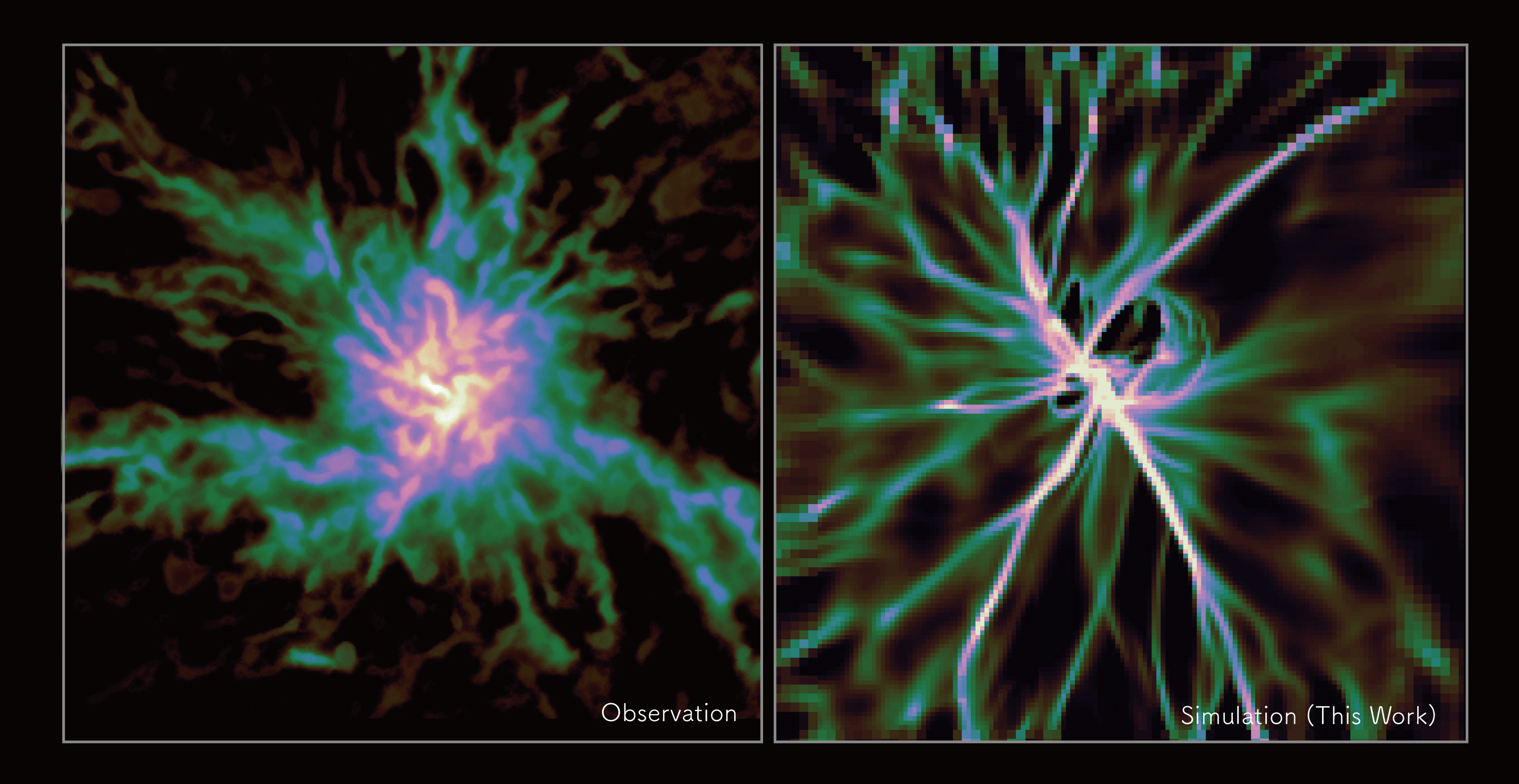
Left: Observations of a star-forming region with a hub-and-spoke shape like a baby carriage wheel. Right: A similar shape produced by a simulation using the ATERUI III supercomputer. (Credit: M. S. N. Kumar, ESA/Herschel, NASA/JPL-Caltech (Spitzer), S. Nozaki, S. Inutsuka) Image (716KB)

After an interstellar shock wave passes through a molecular cloud, multiple filaments characteristic of a hub–filament system develop radially toward the center. The left panels show the cloud viewed perpendicular to the propagation direction of the interstellar shock wave, while the right panels show the view parallel to the direction from which the shock wave approaches. The numbers in the upper left indicate the elapsed time since the start of the simulation. Note that the right panels are displayed using a different density range than the left panels in order to make the higher-density gas easier to distinguish. (Credit: Shingo Nozaki (Kyushu University))


Research using multiple supercomputers, including ATERUI III at the National Astronomical Observatory of Japan, has found a possible explanation for the hub-and-spoke pattern seen in some molecular clouds where baby stars are forming. According to the new numerical simulations, if an external shock interacts with magnetic fields which have been warped by the motion of the clouds, gas can be channeled into a shape resembling the spokes on the wheels of a baby carriage.

When parts of molecular clouds become dense enough, they can collapse under self-gravity. As a result of this collapse, the gas in the clouds condenses into protostars which will grow into stars. For this reason, molecular clouds are nicknamed “stellar cradles.” But some of these sites of star formation are more like baby carriages than cradles because they have filaments of gas extending toward a central hub, forming a shape like a spoked wheel.

Researchers from Kyushu University and Nagoya University investigated the possibility that magnetic fields within the clouds might play a role in forming this distinct shape. Using ATERUI III, a dedicated-astronomy supercomputer operated by the National Astronomical Observatory of Japan, they modeled how gas and magnetic fields evolve together over time. The results show that as the cloud collapses under self-gravity, it pulls the magnetic field lines inward, bending them into an hourglass shape. The team then simulated the effects of a disturbance like a shock wave from a nearby supernova remnant or from expanding gas around a massive star. The team found that if this shock hits the curved magnetic field at certain angles, it strengthens parts of the magnetic field, forming invisible channels that guide compressed gas into long, narrow filaments converging toward the center.

The team now plans to conduct more simulations to test whether this mechanism can explain more asymmetric and complex shapes. This will help clarify how the diversity of observed hub-filament systems reflects differences in cloud environments and how such environments shape the formation of massive stars and clusters.


Detailed Article(s)

Simulations Explain Baby Carriage Wheels Around Baby Stars
Center for Computational Astrophysics

Release Information

Researcher(s) Involved in this Release

Shingo Nozaki (Kyushu University)
Shu-ichiro Inutsuka (Nagoya University)

Coordinated Release Organization(s)

Kyushu University
Nagoya University
National Astronomical Observatory of Japan, NINS

Paper(s)

Shingo Nozaki and Shu-ichiro Inutsuka “An Origin of Radially Aligned Filaments in Hub-filament Systems”, in Astrophysical Journal Letters,
DOI: 10.3847/2041-8213/ae4c84

Related Link(s)

Scientists show how baby stars' cradles get their radial shape (Kyushu University)


Tuesday, January 27, 2026

New insights into the origins of the chemistry of life

In the heart of our Galaxy, scientists discovered the first sulfur-bearing six-membered ring molecule hiding in an interstellar cloud. © MPE/ NASA/JPL-Caltech

This is a state-of-the-art self-developed laboratory spectrometer. MPE scientists Christian Endres and Mitsunori Araki (right) orchestrate the experiment: one drives the production of a new molecule, while the other captures its signatures through precision spectroscopy. At the center of the photo stands a massive vacuum chamber—the arena where a new molecule is born and immediately put under measurement. © MPE


Astrophysicists Discover Largest Sulfur-Containing Molecular Compound in Space

• For the first time, a complex, ring-shaped molecule containing 13 atoms—including sulfur—has been detected in interstellar space, based on laboratory measurements.

• The discovery closes a critical gap by linking simple chemistry in space with the complex organic building blocks found in comets and meteorites.

• This represents a major step toward explaining the cosmic origins of the chemistry of life

Researchers at the Max Planck Institute for Extraterrestrial Physics (MPE), in collaboration with astrophysicists from the Centro de Astrobiología (CAB), CSIC-INTA, have identified the largest sulfur-bearing molecule ever found in space: 2,5-cyclohexadiene-1-thione (C₆H₆S). They made this breakthrough by combining laboratory experiments with astronomical observations. The molecule resides in the molecular cloud G+0.693–0.027, about 27,000 light-years from Earth near the center of the Milky Way. With a stable six-membered ring and a total of 13 atoms, it far exceeds the size of all previously detected sulfur-containing compounds in space.

“This is the first unambiguous detection of a complex, ring-shaped sulfur-containing molecule in interstellar space—and a crucial step toward understanding the chemical link between space and the building blocks of life.”
— Dr. Mitsunori Araki, scientist at MPE and lead author of the study

Until now, astronomers had only detected small sulfur compounds—mostly with six atoms or fewer—in interstellar space. Large, complex sulfur-containing molecules were expected, particularly due to sulfur’s essential role in proteins and enzymes, yet these larger molecules had remained elusive. This gap between interstellar chemistry and the organic inventory found in comets and meteorites had been a central mystery in astrochemistry.

The newly discovered C₆H₆S is structurally related to molecules found in extraterrestrial samples—and is the first of its kind definitively detected in space. It establishes a direct chemical “bridge” between the interstellar medium and our own solar system. The team synthesized the molecule in the lab by applying a 1,000-volt electrical discharge to the evil smelling liquid thiophenol (C₆H₅SH). Using a self-developed spectrometer, they precisely measured the radio emission frequencies of C₆H₆S, producing a unique “radio fingerprint” with more than seven significant digits. This signature was then matched to astronomical data from a large observational survey led by CAB, collected with the IRAM 30m and the Yebes 40-meter radio telescopes in Spain.

“Our results show that a 13-atom molecule structurally similar to those in comets already exists in a young, starless molecular cloud. This proves that the chemical groundwork for life begins long before stars form.”
— Dr. Valerio Lattanzi, Scientist at MPE

The discovery suggests that many more complex sulfur-bearing molecules likely remain undetected—and that the fundamental ingredients of life may have formed in the depths of interstellar space, long before Earth came into existence.


Contacts:

Dr. Mitsunori Araki
Postdoc at Center for Astrochemical Studies
Tel:
+49 89 30000-3314
araki@mpe.mpg.de
Max Planck Institute for Extraterrestrial Physics

Dr. Valerio Lattanzi
Scientist at Center for Astrochemical Studies
Tel:
+49 89 30000-3808
lattanzi@mpe.mpg.de

Prof. Dr. Paola Caselli
Director of the CAS group at MPE
Tel:
+49 89 30000-3400
Fax: +49 89 30000-3399
caselli@mpe.mpg.de
Max Planck Institute for Extraterrestrial Physics, Garching


Publication

M. Araki, M. Sanz-Novo, C. P. Endres, P. Caselli, V. M. Rivilla, I. Jiménez-Serra, L. Colzi, S. Zeng, A. Megías, A. López-Gallifa, A. Martínez-Henares, D. San Andrés, S. Martín, M. A. Requena-Torres, J. García de la Concepción, V. Lattanzi
Sulfur-Bearing Cyclic Hydrocarbons in Space
Nature Astronomy Issue 1 Nr. 10 2026


Source


Wednesday, December 03, 2025

Sagittarius B2 Molecular Cloud

Credit: NASA, ESA, CSA, STScI, Adam Ginsburg (University of Florida), Nazar Budaiev (University of Florida), Taehwa Yoo (University of Florida); Image Processing: Alyssa Pagan (STScI)

The Mid-Infrared Instrument (MIRI) on NASA’s James Webb Space Telescope captured glowing cosmic dust heated by very young massive stars in unprecedented detail in this image of the Sagittarius B2 (Sgr B2) molecular cloud released on Sept. 24, 2025.

Sgr B2 is the most massive, and active star-forming region in our galaxy, located only a few hundred light years from our central supermassive black hole. While Sgr B2 has only 10% of the galactic center’s gas, it produces 50% of its stars. Astronomers want to figure out why it is so much more active than the rest of the galactic center.

MIRI has both a camera and a spectrograph that sees light in the mid-infrared region of the electromagnetic spectrum. MIRI’s view reveals colorful stars punctuated occasionally by bright clouds of gas and dust. Further research into these stars will reveal details of their masses and ages, which will help astronomers better understand the process of star formation in this dense, active galactic center region.


Saturday, September 27, 2025

NASA’s Webb Explores Largest Star-Forming Cloud in Milky Way

Stars, gas and cosmic dust in the Sagittarius B2 molecular cloud glow in near-infrared light, captured by Stars, gas and cosmic dust in the Sagittarius B2 molecular cloud glow in near-infrared light, captured by Webb’s NIRCam instrument. The darkest areas of the image are not empty space but are areas where stars are still forming inside dense clouds that block their light. Image: NASA, ESA, CSA, STScI, Adam Ginsburg (University of Florida), Nazar Budaiev (University of Florida), Taehwa Yoo (University of Florida); Image Processing: Alyssa Pagan (STScI)

Webb’s MIRI instrument shows the Sagittarius B2 region in mid-infrared light, with warm dust glowing brightly. Only the brightest stars emit strongly enough to appear through the dense clouds as blue pinpoints. Image: NASA, ESA, CSA, STScI, Adam Ginsburg (University of Florida), Nazar Budaiev (University of Florida), Taehwa Yoo (University of Florida); Image Processing: Alyssa Pagan (STScI)


NASA’s James Webb Space Telescope has revealed a colorful array of massive stars and glowing cosmic dust in the Sagittarius B2 molecular cloud, the most massive and active star-forming region in our Milky Way galaxy.

“Webb’s powerful infrared instruments provide detail we’ve never been able to see before, which will help us to understand some of the still-elusive mysteries of massive star formation and why Sagittarius B2 is so much more active than the rest of the galactic center,” said astronomer Adam Ginsburg of the University of Florida, principal investigator of the program.

The difference longer wavelengths of light make, even within the infrared spectrum, are stark when comparing the images from Webb’s MIRI and NIRCam (Near-Infrared Camera) instruments. Glowing gas and dust appear dramatically in mid-infrared light, while all but the brightest stars disappear from view.

In contrast to MIRI, colorful stars steal the show in Webb’s NIRCam image, punctuated occasionally by bright clouds of gas and dust. Further research into these stars will reveal details of their masses and ages, which will help astronomers better understand the process of star formation in this dense, active galactic center region. Has it been going on for millions of years? Or has some unknown process triggered it only recently?

Astronomers hope Webb will shed light on why star formation in the galactic center is so disproportionately low. Though the region is stocked with plenty of gaseous raw material, on the whole it is not nearly as productive as Sagittarius B2. While Sagittarius B2 has only 10 percent of the galactic center’s gas, it produces 50 percent of its stars.

“Humans have been studying the stars for thousands of years, and there is still a lot to understand,” said Nazar Budaiev, a graduate student at the University of Florida and the co-principal investigator of the study. “For everything new Webb is showing us, there are also new mysteries to explore, and it’s exciting to be a part of that ongoing discovery.”

The James Webb Space Telescope is the world’s premier space science observatory. Webb is solving mysteries in our solar system, looking beyond to distant worlds around other stars, and probing the mysterious structures and origins of our universe and our place in it. Webb is an international program led by NASA with its partners, ESA (European Space Agency) and CSA (Canadian Space Agency).


Related Information

Read more: NASA’s Webb Reveals New Features in Heart of Milky Way

Explore: ViewSpace interactive image tour of the center of the Milky Way

Explore: ViewSpace interactive views of the Eagle Nebula in different forms of light

Read more: Webb’s Star Formation Discoveries

Read more: Star formation in the Cat’s Paw Nebula

More Webb News

More Webb Images

Webb Science Themes

Webb Mission Page


Related For Kids

What is the Webb Telescope?

SpacePlace for Kids


En Español

Ciencia de la NASA

NASA en español

Space Place para niños


Sunday, July 13, 2025

NASA's Webb Scratches Beyond Surface of Cat's Paw for 3rd Anniversary

Cat's Paw Nebula (NIRCam Image)
Credits/Image: NASA, ESA, CSA, STScI

Cat's Paw (NIRCam) Compass Image
Credits/Image: NASA, ESA, CSA, STScI


It’s the cat’s meow! To celebrate its third year of revealing stunning scenes of the cosmos in infrared light, NASA’s James Webb Space Telescope has “clawed” back the thick, dusty layers of a section within the Cat’s Paw Nebula (NGC 6334). Focusing Webb’s NIRCam (Near-Infrared Camera) on a single “toe bean” within this active star-forming region revealed a subset of mini toe beans, which appear to contain young stars shaping the surrounding gas and dust.

Webb’s look at this particular area of the Cat’s Paw Nebula just scratches the surface of the telescope’s three years of groundbreaking science.

“Three years into its mission, Webb continues to deliver on its design – revealing previously hidden aspects of the universe, from the star formation process to some of the earliest galaxies,” said Shawn Domagal-Goldman, acting director of the Astrophysics Division at NASA Headquarters in Washington. “As it repeatedly breaks its own records, Webb is also uncovering unknowns for new generations of flagship missions to tackle. Whether it’s following up on the mysteries of dark matter with NASA’s nearly complete Nancy Grace Roman Space Telescope, or narrowing our search for life to Earth-like planets with the Habitable Worlds Observatory, the questions Webb has raised are just as exciting as the answers it’s giving us.”

Star Formation Flex

The progression from a large molecular cloud to massive stars entails multiple steps, some of which are still not well understood by astronomers. Located approximately 4,000 light-years away in the constellation Scorpius, the Cat’s Paw Nebula offers scientists the opportunity to study the turbulent cloud-to-star process in great detail. Webb’s observation of the nebula in near-infrared light builds upon previous studies by NASA’s Hubble and retired Spitzer Space Telescope in visible- and infrared-light, respectively.

With its sharp resolution, Webb shows never-before-seen structural details and features: Massive young stars are carving away at nearby gas and dust, while their bright starlight is producing a bright nebulous glow represented in blue. It’s a temporary scene where the disruptive young stars, with their relatively short lives and luminosity, have a brief but important role in the region’s larger story. As a consequence of these massive stars’ lively behavior, the local star formation process will eventually come to a stop.

Opera House’s Intricate Structure

Start with the toe bean at top center, which is nicknamed the “Opera House” for its circular, tiered-like structure. The primary drivers for the area’s cloudy blue glow are most likely toward its bottom: either the light from the bright yellowish stars or from a nearby source still hidden behind the dense, dark brown dust.

Just below the orange-brown tiers of dust is a bright yellow star with diffraction spikes. While this massive star has carved away at its immediate surroundings, it has been unable to push the gas and dust away to greater distances, creating a compact shell of surrounding material.

Look closely to notice small patches, like the tuning fork-shaped area to the Opera House’s immediate left, that contain fewer stars. These seemingly vacant zones indicate the presence of dense foreground filaments of dust that are home to still-forming stars and block the light of stars in the background.

Spotlight on Stars

Toward the image’s center are small, fiery red clumps scattered amongst the brown dust. These glowing red sources mark regions where massive star formation is underway, albeit in an obscured manner.

Some massive blue-white stars, like the one in the lower left toe bean, seem to be more sharply resolved than others. This is because any intervening material between the star and the telescope has been dissipated by stellar radiation.

Near the bottom of that toe bean are small, dense filaments of dust. These tiny clumps of dust have managed to remain despite the intense radiation, suggesting that they are dense enough to form protostars. A small section of yellow at the right notes the location of a still-enshrouded massive star that has managed to shine through intervening material.

Across this entire scene are many small yellow stars with diffraction spikes. Bright blue-white stars are in the foreground of this Webb image, but some may be a part of the more expansive Cat’s Paw Nebula area.

One eye-catching aspect of this Webb image is the bright, red-orange oval at top right. Its low count of background stars implies it is a dense area just beginning its star-formation process. A couple of visible and still-veiled stars are scattered throughout this region, which are contributing to the illumination of the material in the middle. Some still-enveloped stars leave hints of their presence, like a bow shock at the bottom left, which indicates an energetic ejection of gas and dust from a bright source.

Further explore this subset of toe beans by embarking on a narrated tour or getting closer to the image. We also invite you to reminisce about Webb’s three years of science observations.

The James Webb Space Telescope is the world’s premier space science observatory. Webb is solving mysteries in our solar system, looking beyond to distant worlds around other stars, and probing the mysterious structures and origins of our universe and our place in it. Webb is an international program led by NASA with its partners, ESA (European Space Agency) and CSA (Canadian Space Agency).


About This Release

Credits:

Media Contact

Abigail Major
Space Telescope Science Institute, Baltimore

Hannah Braun
Space Telescope Science Institute, Baltimore

Permissions: Content Use Policy

Contact us: Direct inquiries to the News Team.


Tuesday, April 08, 2025

How stars stay young and spin slowly

Growth of density (top row) and magnetic field strength (bottom row) as a function of time in the collision between two stars of 0.7 and 0.6 solar masses. After the first contact at t = 0 h (not shown), the two stars pass each other (t = 5 h) and get disrupted (t = 12 h). The magnetic fields begin to grow due to instabilities and compression.© MPA

Computer simulations suggest that the amplification of magnetic fields in stellar collisions may play an important role in the formation of a particular subset of stars in clusters. Blue straggler stars in clusters appear not only bluer, but also younger than other cluster members. One proposed explanation for their apparently different ages is that they are the result of stellar collisions. However, this would require the resulting star to spin down efficiently without losing too much mass. Scientists at the Max Planck Institute for Astrophysics have now shown, using sophisticated 3D simulations, that the energy of the magnetic field is greatly amplified in the collisions of low-mass stars, providing a potentially efficient spin-down mechanism.

Clusters of stars, containing hundreds of thousands of stars that formed around the same time and from the same molecular cloud, provide astronomers with an excellent laboratory for studying how stars of similar age, composition and mass evolve over time. However, one particular subset, the 'blue stragglers', pose a challenge: they appear bluer and brighter than the other cluster members, and therefore appear to be younger. Why don't they age like typical cluster stars?

The answer could be that they actually formed later than the other stars in stellar collisions and thus gained mass. However, since most collisions between two low-mass stars are off-axis (rather than perfectly head-on), the resulting massive star would rotate rapidly and lose most of its mass during the spin-down to a stable state – unless the spin-down is efficient. While many proposed spin-down mechanisms require magnetic fields, it has remained unclear for more than two decades whether they actually exist and whether they have the strength to play a significant role.

A team at the Max Planck Institute for Astrophysics (MPA) has now presented sophisticated 3D moving-mesh magnetohydrodynamical simulations of collisions between low-mass main-sequence stars, which show that the magnetic field energy is amplified by a factor of up to 10 billion during collisions. At the core of the merged star, the magnetic field can reach 100 million Gauss (for comparison, the magnetic field in sunspots can reach up to 5000 Gauss). "Our simulations showed that the magnetic field in stellar collisions can be amplified, which is a promising sign for an effective spin-down mechanism," says MPA postdoctoral researcher Taeho Ryu, who led the study. "This amplification is independent of collision parameters, so it could happen every time two stars collide in a cluster."

The simulations also show a flattened, rotating gas structure around the collision, which could indicate the formation of a disk. Magnetic braking and an effect called "disk locking" could further facilitate the spin-down. "Our next step will be to actually follow the long-term evolution after the collision to see how these stars evolve over millions or billions of years and whether they really end up as the blue straggler stars that we observe," adds Ryu.

This animation shows the same simulation as the figure above. The left panel shows the evolution of the density, the right panel the evolution of the magnetic field strength as two stars of 0.7 and 0.6 solar masses collide.


Contact:

Taeho Ryu
Postdoc
2358

tryu@mpa-garching.mpg.de


Original publication

Ryu, Taeho; Sills, Alison; Pakmor, Ruediger; de Mink, Selma; Mathieu, Robert
Magnetic Field Amplification during Stellar Collisions between Low-mass Stars
ApJ, Volume 980, Issue 2, id.L38, 11 pp.


Source | DOI


Wednesday, September 18, 2024

The light of knowledge

A spiral galaxy, tilted at an angle, with irregularly-shaped arms. It appears large and close-up. The centre glows in a yellowish colour, while the disc around it is a bluer colour, due to light from older and newer stars. Dark reddish threads of dust cover the galaxy, and there are many large, shining pink spots in the disc, where stars are forming. Credit: ESA/Hubble & NASA, F. Belfiore, W. Yuan, J. Lee and the PHANGS-HST Team, A. Riess, K. Takáts, D. de Martin & M. Zamani (ESA/Hubble)

The magnificent galaxy featured in this Hubble Picture of the Week is NGC 1559. It is a barred spiral galaxy located in the constellation Reticulum near the Large Magellanic Cloud, but much more distant at approximately 35 million light-years from Earth. Hubble last visited this object in 2018. The brilliant light captured in this image offers a wealth of information, which thanks to Hubble can be put to use by both scientists and the public.

This picture is composed of a whopping ten different images taken by the Hubble Space Telescope, each filtered to collect light from a specific wavelength or range of wavelengths. It spans Hubble’s sensitivity to light, from ultraviolet around 275 nanometres through blue, green and red to near-infrared at 1600 nanometres. This allows information about many different astrophysical processes in the galaxy to be recorded: a notable example is the red 656-nanometre filter used here. Hydrogen atoms which get ionised can emit light at this particular wavelength, called H-alpha emission. New stars forming in a molecular cloud, made mostly of hydrogen gas, emit copious amounts of ultraviolet light which is absorbed by the cloud, but which ionises it and causes it to glow with this H-alpha light. Therefore, filtering to detect only this light provides a reliable means to detect areas of star formation (called H II regions), shown in this image by the bright red and pink colours of the blossoming patches filling NGC 1559’s spiral arms.

These ten images come from six different observing programmes with Hubble, running from 2009 all the way up to the present year. These programmes were led by teams of astronomers from around the world with a variety of scientific goals, ranging from studying ionised gas and star formation, to following up on a supernova, to tracking variable stars as a contribution to calculating the Hubble constant. The data from all of these observations live on in the Hubble archive, available for anyone to use — not only for new science, but also to create spectacular images like this one! This image of NGC 1559, then, is a reminder of the incredible opportunities that the Hubble Space Telescope has provided and continues to provide.

Besides Hubble’s observations, astronomers are using the NASA/ESA/CSA James Webb Space Telescope to research this galaxy in even greater depth. This Webb image from February showcases the galaxy in near- and mid-infrared light.


Thursday, August 01, 2024

Unveiling the Secrets of our Galaxy’s Supermassive Black Hole

By monitoring the high-energy X-ray emission from the center of our Galaxy, NuSTAR probes the current and past activity of Sagittarius A*, the supermassive at the center of the Milky Way. These images capture a flare observed in July 2012 over a 2-day period. In the middle panel, the black hole was consuming and heating matter to temperatures up to 180 million degrees Fahrenheit (100 million degrees Celsius). Image Credit: NASA/JPL-Caltech.

Black holes are notoriously difficult to study, in part because not even light can escape their immense gravity. Researchers typically infer their properties by observing the gravitational influence of a black hole on nearby stars, gas, energetic plasmas, and other related phenomena. Astronomers also learn both about the environment around the black hole and its past activity by observing echoes reflected off nearby structures (with the caveat that astronomers might have a different understanding of "nearby" than other people). Using X-ray data from NuSTAR, researchers at Michigan State University (MSU) have made groundbreaking discoveries about Sagittarius A*, the supermassive black hole at the center of our Milky Way galaxy. These findings were presented at the 244th meeting of the American Astronomical Society, held in Madison, Wisconsin in June.

Galactic fireworks

Grace Sanger-Johnson, a postbaccalaureate researcher at MSU, analyzed 10 years of NuSTAR data looking for X-ray flares from Sagittarius A*. In doing so, she discovered nine flares that had previously gone unnoticed. These flares are dramatic bursts of high-energy light that provide a unique opportunity to study the environment around the black hole. This region is typically invisible due to the dense gas and dust that blocks most light, but not the penetrating, high-energy X-rays observed by NuSTAR. Sagittarius A* is the closest supermassive black hole to Earth. Data from Sagittarius A*, and its flares, are one of the only ways currently known to study the physics and physical environment of a black hole. Sanger-Johnson meticulously sifted through a decade's worth of X-ray data collected between 2015 and 2024 by NuSTAR. Each of the nine newly-discovered flares provides unique insight into the black hole's environment and activities.

"We are sitting in the front row to observe these unique cosmic fireworks at the center of our own Milky Way galaxy," said Prof. Shuo Zhang, Sanger-Johnson's advisor. "Flares light up the darkness and help us observe things we wouldn't normally be able to." Analyzing the properties of these X-ray flares will help astronomers infer the physical conditions of the extreme environment around the supermassive black hole.

`Echoes' of a black hole

While Sanger-Johnson focused on the brilliant flares from Sagittarius A*, Jack Uteg, an undergraduate researcher, examined the black hole's activity using a technique akin to listening to echoes. Uteg analyzed more than 20 years of data targeting a giant molecular cloud known as "the Bridge" near Sagittarius A*. This monitoring began before Uteg was born.

Unlike the central black hole, clouds of gas and dust in interstellar space cannot generate their own X-rays. So, when X-ray telescopes detected photons from the Bridge, the emission was inferred to be delayed reflection of past X-ray outbursts by Sagittarius A*. The X-ray luminosity of the Bridge first began to increase around 2008 and then increased over the next 12 years until it hit peak brightness in 2020. This "echo" light from the black hole traveled for hundreds of years from Sgr A* to the molecular cloud, and then traveled another roughly 26,000 years before reaching Earth.

By analyzing these X-ray echoes, Uteg was able to reconstruct a timeline of our black hole's past activity, offering insights that would not be possible through direct observations alone. Uteg's analysis used data from NuSTAR as well as from the European Space Agency's XMM-Newton satellite, which studies the universe in lower energy X-rays.

"One of the main reasons we care about this cloud getting brighter is that it lets us constrain how bright Sagittarius A* was in the past," Uteg said. Based on these data, the team determined that, about 200 years ago, the black hole at the center of the Milky Way was about 10,000 times brighter in X-rays compared to how we see it today. As the United States was celebrating its first July 4th, Sagittarius A* was feasting on nearby material, heating it up, and producing copious amounts of X-rays. Today, the black hole just nibbles. "The black hole at the center of our Galaxy was producing fireworks just 200 years ago, but today it is merely a sparkler," said Dr. Brian Grefenstette, a NuSTAR staff scientist at the California Institute of Technology.

This is the first long-term X-ray variability study of a molecular cloud surrounding Sagittarius A* to detect its peak X-ray luminosity. "This allows us to tell the past activity of Sgr A*, and we will continue this astro-archaeological study to further unravel the mysteries of the Milky Way's center," Zhang said.

While the exact mechanisms triggering X-ray flares and the life cycles of black holes remain mysteries and areas of active study, NuSTAR is helping spark further investigations and improve our understanding of these enigmatic objects.


Thursday, June 20, 2024

It’s Twins! Astronomers Discover Parallel Disks and Jets Erupting From a Pair of Young Stars

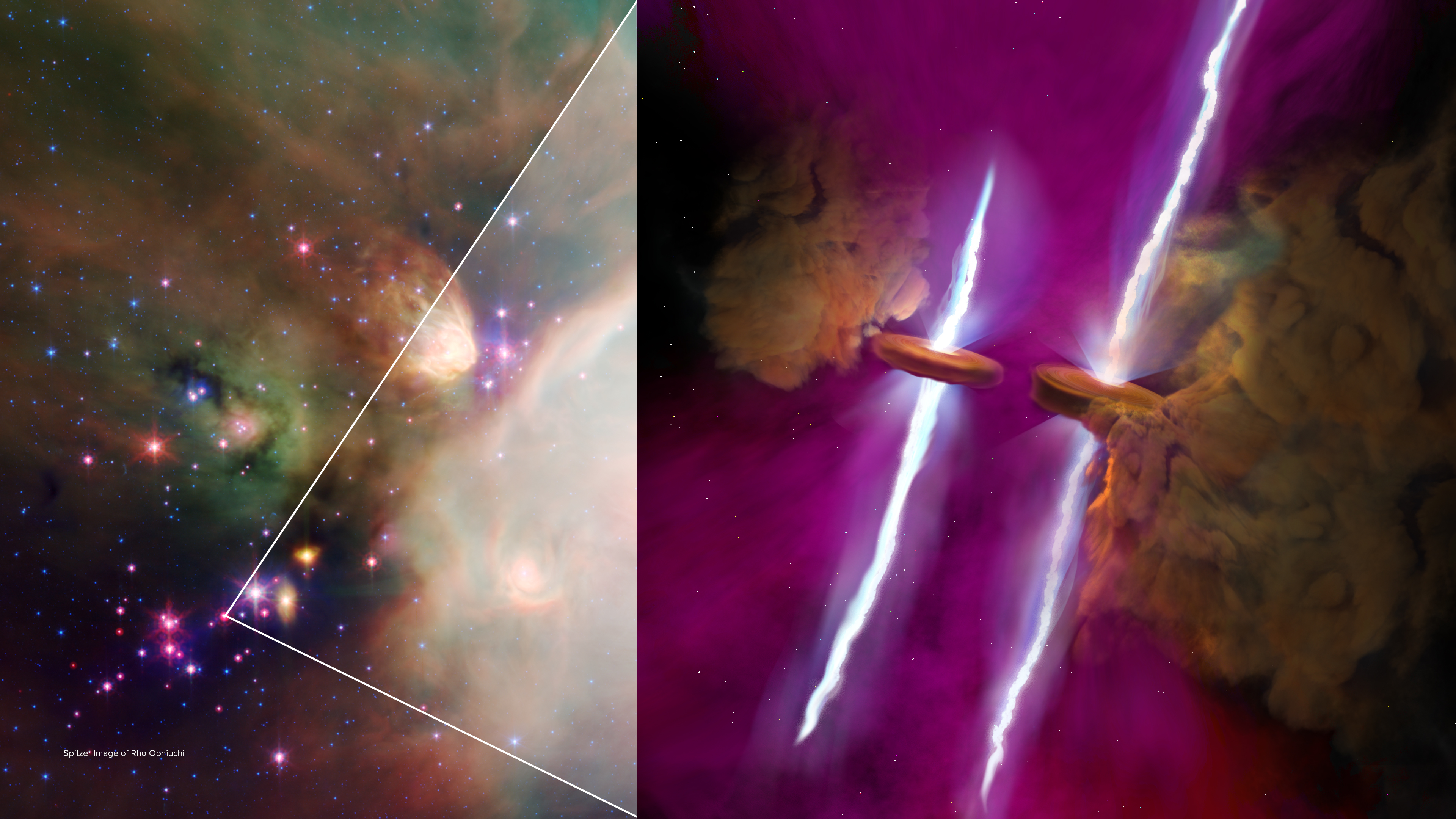
At left, a mid-infrared image of the rho Ophiuchi molecular cloud complex by NASA’s Spitzer Space Telescope, the focus pointing to star system WL20. At right, WL20 expands to reveal an artist’s impression of this new discovery. Astronomers couldn't believe their luck when observations across multiple radio and infrared wavelengths from ALMA and JWST revealed twin disks and jets erupting from a pair of young binary stars in WL20. Credit: U.S. NSF/ NSF NRAO/B. Saxton.; NASA/JPL-Caltech/Harvard-Smithsonian CfA. Hi-Res File

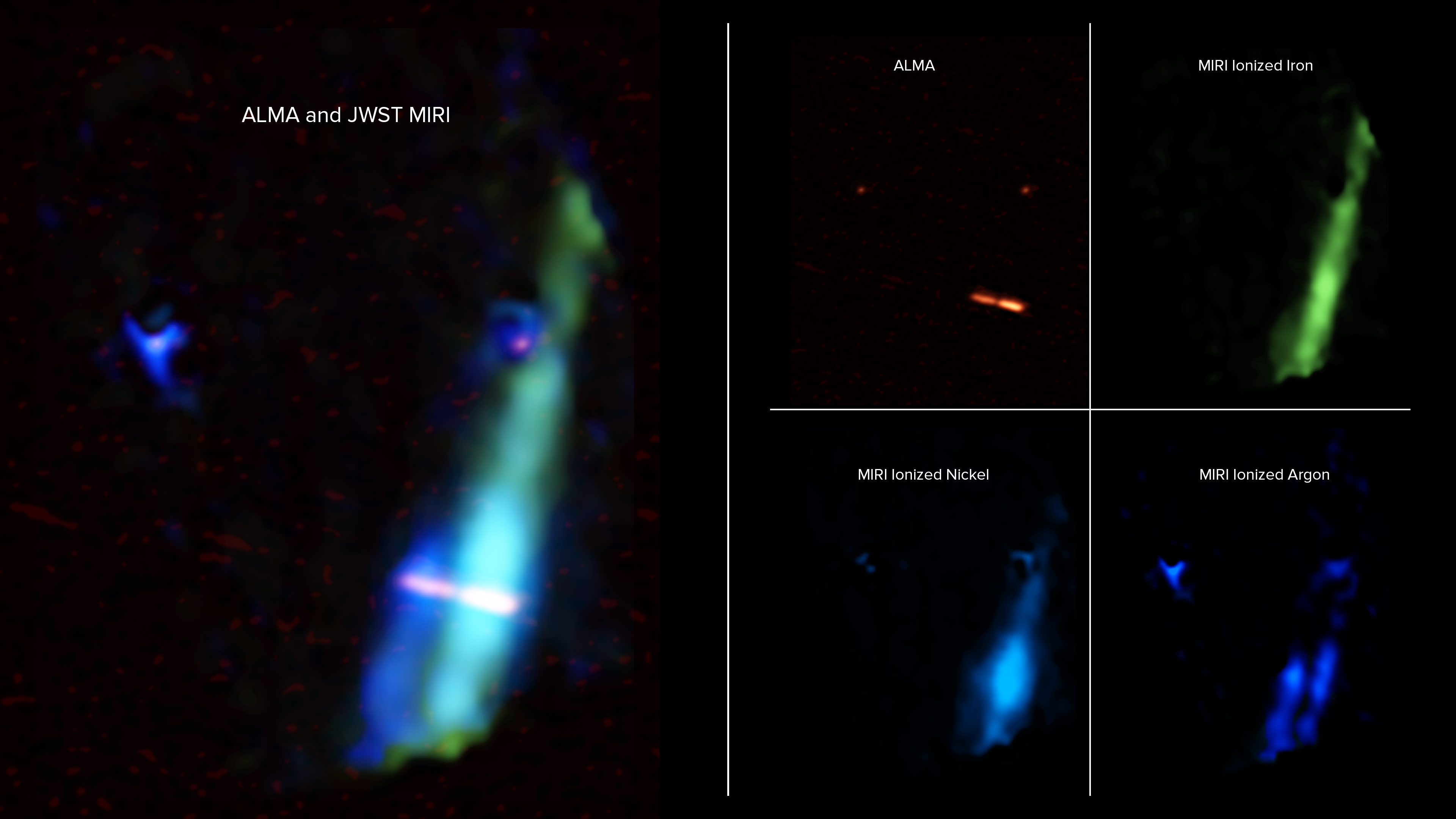
These brightly colored shapes represent astronomical data collected by NRAO's ALMA and NASA's JWST telescopes. At left, a composite image overlaps ALMA and JWST data revealing the discs and parallel jets emitting from the pair of binary stars in WL20. At right, the breakdown of the separate ALMA data, and JWST data representing various chemical compositions, is shown. Credit: U.S. NSF/ NSF NRAO/ ALMA(ESO/NAOJ/NRAO)/ NASA/ JPL-Caltech/ JWST/ B. Saxton. Hi-Res File


Telescopes from the U.S. National Science Foundation’s National Radio Astronomy Observatory and NASA’s Jet Propulsion Laboratory discover dynamic duo

Most of the Universe is invisible to the human eye. The building blocks of stars are only revealed in wavelengths that are outside of the visible spectrum. Astronomers recently used two very different, and very powerful, telescopes to discover twin disks—and twin parallel jets—erupting from young stars in a multiple star system. This discovery was unexpected, and unprecedented, given the age, size, and chemical makeup of the stars, disks, and jets. Their location in a known, well-studied part of the Universe adds to the thrill.

Observations from the U.S. National Science Foundation’s (NSF) National Radio Astronomy Observatory’s (NRAO) Atacama Large Millimeter/submillimeter Array (ALMA) and NASA’s James Webb Space Telescope’s (JWST) Mid-Infrared Instrument (MIRI) were combined for this research.

ALMA and JWST’s MIRI observe very different parts of the electromagnetic spectrum. Using them together allowed astronomers to discover these twins, hidden in radio and infrared wavelengths in star system WL20, located in the nearby rho Ophiuchi molecular cloud complex, over 400 light years away from the Earth’s Solar System.

“What we discovered was absolutely wild,” shares astronomer Mary Barsony, “We’ve known about star system WL20 for a long time. But what caught our attention is that one of the stars in the system appeared much younger than the rest. Using MIRI and ALMA together, we actually saw that this ONE star was TWO stars right next to each other. Each of these stars was surrounded by a disk, and each disc was emitting jets parallel to the other.”

ALMA spotted the discs, while MIRI found the jets. Co-author Valentin J.M. Le Gouellec of NASA-ARC retrieved and reduced ALMA archival data to reveal the discs’ composition, while Lukasz Tychoniec of Leiden Observatory provided high-resolution images, revealing the discs massive size, approximately 100 times the distance between the Earth and the Sun. Another co-author, Martijn L. van Gelder, provided resources to process the data collected by MIRI, revealing the chemical makeup of the jets.

Adds Barsony, “So if it weren’t for MIRI, we wouldn’t even know that these jets existed, which is amazing.” ALMA’s high resolution observations of the disks surrounding the two newly observed stars revealed the disks’ structure, as Barsony explains,“Someone looking at this ALMA data not knowing there were twin jets would think, oh, it’s a large edge on disk with a central hole, instead of two edge on disks and two jets. That’s pretty remarkable.”

Another remarkable thing about this discovery is that it may never have had the opportunity to happen. Explains JPL scientist Michael Ressler, “A lot of the research about binary protostars focuses on a few nearby star forming regions. I had been awarded some observing time of my own with JWST, and I chose to split it into a few small projects. For one project, I decided to study binaries in the Perseus star forming region. However, I had been studying WL20, which is in the rho Ophiuchus region in nearly the opposite part of the sky, for nearly 30 years, and I thought, ‘why not sneak it in? I’m never going to get another chance, even if it doesn’t quite fit with the others.’ We had a very fortunate accident with what we found, and the results are stunning.”

By combining multi-wavelength data from ALMA and JWST, these new findings shed light on the complex processes involved in the formation of multiple star systems. Astronomers plan to utilize ALMA’s future upgraded capabilities, like the Wideband Sensitivity Upgrade, to continue unraveling the mysteries surrounding the birth of stars and planetary systems.


About ALMA & NRAO

The Atacama Large Millimeter/submillimeter Array (ALMA), an international astronomy facility, is a partnership of the European Southern Observatory (ESO), the U.S. National Science Foundation (NSF) and the National Institutes of Natural Sciences (NINS) of Japan in cooperation with the Republic of Chile. ALMA is funded by ESO on behalf of its Member States, by NSF in cooperation with the National Research Council of Canada (NRC) and the National Science and Technology Council (NSTC) in Taiwan and by NINS in cooperation with the Academia Sinica (AS) in Taiwan and the Korea Astronomy and Space Science Institute (KASI).

ALMA construction and operations are led by ESO on behalf of its Member States; by the National Radio Astronomy Observatory (NRAO), managed by Associated Universities, Inc. (AUI), on behalf of North America; and by the National Astronomical Observatory of Japan (NAOJ) on behalf of East Asia. The Joint ALMA Observatory (JAO) provides the unified leadership and management of the construction, commissioning and operation of ALMA.

The NRAO is a facility of the U.S. National Science Foundation, operated under cooperative agreement by Associated Universities, Inc.

About JWST

The James Webb Space Telescope is the world’s premier space science observatory. Webb is solving mysteries in our solar system, looking beyond to distant worlds around other stars, and probing the mysterious structures and origins of our universe and our place in it. Webb is an international program led by NASA with its partners, ESA (European Space Agency) and CSA (Canadian Space Agency).


Friday, May 03, 2024

Gemini South Reveals Origin of Unexpected Differences in Giant Binary Stars

PR Image noirlab2410a
Artist’s Impression of a Giant-Giant Binary


Videos

Cosmoview Episode 80: Gemini South Reveals Origin of Unexpected Differences in Giant Binary Stars
PR Video noirlab2410a
Cosmoview Episode 80: Gemini South Reveals Origin of Unexpected Differences in Giant Binary Stars

Cosmoview Episodio 80: Desde Chile descubren causas de la diversidad estelar en estrellas binarias
PR Video noirlab2410b
Cosmoview Episodio 80: Desde Chile descubren causas de la diversidad estelar en estrellas binarias


Astronomers confirm that differences in the chemical composition of binary stars can be traced back to the earliest stages of their formation

Using the Gemini South telescope a team of astronomers have confirmed for the first time that differences in binary stars’ composition can originate from chemical variations in the cloud of stellar material from which they formed. The results help explain why stars born from the same molecular cloud can possess different chemical composition and host different planetary systems, as well as pose challenges to current stellar and planet formation models.

It is estimated that up to 85% of stars exist in binary star systems, some even in systems with three or more stars. These stellar pairs are born together out of the same molecular cloud from a shared abundance of chemical building blocks, so astronomers would expect to find that they have nearly identical compositions and planetary systems. However, for many binaries that isn’t the case. While some proposed explanations attribute these dissimilarities to events occurring after the stars evolved, a team of astronomers have confirmed for the first time that they can actually originate from before the stars even began to form.

Led by Carlos Saffe of the Institute of Astronomical, Earth and Space Sciences (ICATE-CONICET) in Argentina, the team used the Gemini South telescope in Chile, one half of the International Gemini Observatory, supported in part by the U.S. National Science Foundation and operated by NSF NOIRLab. With the new, precise Gemini High Resolution Optical SpecTrograph (GHOST) the team studied the different wavelengths of light, or spectra, given off by a pair of giant stars, which revealed significant differences in their chemical make-up. “GHOST’s extremely high-quality spectra offered unprecedented resolution,” said Saffe, “allowing us to measure the stars’ stellar parameters and chemical abundances with the highest possible precision.” These measurements revealed that one star had higher abundances of heavy elements than the other. To disentangle the origin of this discrepancy, the team used a unique approach.

Previous studies have proposed three possible explanations for observed chemical differences between binary stars. Two of them involve processes that would occur well into the stars’ evolution: atomic diffusion, or the settling of chemical elements into gradient layers depending on each star’s temperature and surface gravity; and the engulfment of a small, rocky planet, which would introduce chemical variations in a star’s composition.

The third possible explanation looks back at the beginning of the stars’ formation, suggesting that the differences originate from primordial, or pre-existing, areas of nonuniformity within the molecular cloud. In simpler terms, if the molecular cloud has an uneven distribution of chemical elements, then stars born within that cloud will have different compositions depending on which elements were available at the location where each formed.

So far, studies have concluded that all three explanations are probable; however, these studies focused solely on main-sequence binaries. The ‘main-sequence’ is the stage where a star spends most of its existence, and the majority of stars in the Universe are main-sequence stars, including our Sun. Instead, Saffe and his team observed a binary consisting of two giant stars. These stars possess extremely deep and strongly turbulent external layers, or convective zones. Owing to the properties of these thick convective zones, the team was able to rule out two of the three possible explanations.

The continuous swirling of fluid within the convective zone would make it difficult for material to settle into layers, meaning giant stars are less sensitive to the effects of atomic diffusion — ruling out the first explanation. The thick external layer also means that a planetary engulfment would not change a star’s composition much since the ingested material would rapidly be diluted — ruling out the second explanation. This leaves primordial inhomogeneities within the molecular cloud as the confirmed explanation. “This is the first time astronomers have been able to confirm that differences between binary stars begin at the earliest stages of their formation,” said Saffe.

“Using the precision-measurement capabilities provided by the GHOST instrument, Gemini South is now collecting observations of stars at the end of their lives to reveal the environment in which they were born,” says Martin Still, NSF program director for the International Gemini Observatory. “This gives us the ability to explore how the conditions in which stars form can influence their entire existence over millions or billions of years.”

Three consequences of this study are of particular significance. First, these results offer an explanation for why astronomers see binary stars with such different planetary systems. “Different planetary systems could mean very different planets — rocky, Earth-like, ice giants, gas giants — that orbit their host stars at different distances and where the potential to support life might be very different,” said Saffe.

Second, these results pose a crucial challenge to the concept of chemical tagging — using chemical composition to identify stars that came from the same environment or stellar nursery — by showing that stars with different chemical compositions can still have the same origin.

Finally, observed differences previously attributed to planetary impacts on a star’s surface will need to be reviewed, as they might now be seen as having been there from the very beginning of the star’s life.

“By showing for the first time that primordial differences really are present and responsible for differences between twin stars, we show that star and planet formation could be more complex than initially thought,” said Saffe. “The Universe loves diversity!”


More information

This research was presented in a paper accepted in Astronomy & Astrophysics Letters. DOI: 10.1051/0004-6361/202449263

The team is composed of C. Saffe (ICATE-CONICET/UNSJ, Argentina), P. Miquelarena (ICATE-CONICET/UNSJ, Argentina), J. Alacoria (ICATE-CONICET, Argentina), E. Martioli (LNA/MCTI, Brasil), M. Flores (ICATE-CONICET/UNSJ, Argentina), M. Jaque Arancibia (Universidad de La Serena, Chile), R. Angeloni (International Gemini Observatory/NSF NOIRLab, Chile), E. Jofré (OAC/CONICET, Argentina), J. Yana Galarza (Carnegie Institution for Science, CA), E. González (UNSJ, Argentina), and A. Collado (ICATE-CONICET/UNSJ, Argentina).

NSF NOIRLab (U.S. National Science Foundation National Optical-Infrared Astronomy Research Laboratory), the U.S. center for ground-based optical-infrared astronomy, operates the International Gemini Observatory (a facility of NSF, NRC–Canada, ANID–Chile, MCTIC–Brazil, MINCyT–Argentina, and KASI–Republic of Korea), Kitt Peak National Observatory (KPNO), Cerro Tololo Inter-American Observatory (CTIO), the Community Science and Data Center (CSDC), and Vera C. Rubin Observatory (operated in cooperation with the Department of Energy’s SLAC National Accelerator Laboratory). It is managed by the Association of Universities for Research in Astronomy (AURA) under a cooperative agreement with NSF and is headquartered in Tucson, Arizona. The astronomical community is honored to have the opportunity to conduct astronomical research on I’oligam Du’ag (Kitt Peak) in Arizona, on Maunakea in Hawai‘i, and on Cerro Tololo and Cerro Pachón in Chile. We recognize and acknowledge the very significant cultural role and reverence that these sites have to the Tohono O’odham Nation, to the Native Hawaiian community, and to the local communities in Chile, respectively.


Links


Contacts:

Carlos Saffe
Institute of Astronomical, Earth and Space Sciences, Argentina
Email:
saffe.carlos@gmail.com

Josie Fenske
Jr. Public Information Officer
NSF NOIRLab
Email:
josie.fenske@noirlab.edu


Monday, April 29, 2024

Webb Captures Top of Iconic Horsehead Nebula in Unprecedented Detail

Horsehead Nebula (NIRCam Image)
Credits: Image: NASA, ESA, CSA, Karl Misselt (University of Arizona), Alain Abergel (AIM Paris-Saclay)


Horsehead Nebula (MIRI Image)
Credits: Image: NASA, ESA, CSA, Karl Misselt (University of Arizona), Alain Abergel (AIM Paris-Saclay)


Horsehead Nebula (Euclid, Hubble and Webb images)
Credits: Image: NASA, ESA, CSA, Karl Misselt (University of Arizona), Alain Abergel (AIM Paris-Saclay), Mahdi Zamani The Euclid Consortium, Hubble Heritage Project (STScI, AURA)


A clumpy dome of blueish-gray clouds topped with streaky, translucent red wisps. A large, prominent star is at the top of the image.

NASA’s James Webb Space Telescope has captured the sharpest infrared images to date of a zoomed-in portion of one of the most distinctive objects in our skies, the Horsehead Nebula. These observations show the top of the "horse's mane" or edge of this iconic nebula in a whole new light, capturing the region’s complexity with unprecedented spatial resolution.

Webb’s new images show part of the sky in the constellation Orion (The Hunter), in the western side of a dense region known as the Orion B molecular cloud. Rising from turbulent waves of dust and gas is the Horsehead Nebula, otherwise known as Barnard 33, which resides roughly 1,300 light-years away.

The nebula formed from a collapsing interstellar cloud of material, and glows because it is illuminated by a nearby hot star. The gas clouds surrounding the Horsehead have already dissipated, but the jutting pillar is made of thick clumps of material and therefore is harder to erode. Astronomers estimate that the Horsehead has about five million years left before it too disintegrates. Webb’s new view focuses on the illuminated edge of the top of the nebula’s distinctive dust and gas structure.

The Horsehead Nebula is a well-known photodissociation region, or PDR. In such a region, ultraviolet (UV) light from young, massive stars creates a mostly neutral, warm area of gas and dust between the fully ionized gas surrounding the massive stars and the clouds in which they are born. This UV radiation strongly influences the chemistry of these regions and acts as a significant source of heat.

These regions occur where interstellar gas is dense enough to remain mostly neutral, but not dense enough to prevent the penetration of UV light from massive stars. The light emitted from such PDRs provides a unique tool to study the physical and chemical processes that drive the evolution of interstellar matter in our galaxy, and throughout the universe from the early era of vigorous star formation to the present day.

Due to its proximity and its nearly edge-on geometry, the Horsehead Nebula is an ideal target for astronomers to study the physical structures of PDRs and the molecular evolution of the gas and dust within their respective environments, and the transition regions between them. It is considered one of the best regions in the sky to study how radiation interacts with interstellar matter.

Thanks to Webb’s MIRI and NIRCam instruments, an international team of astronomers has revealed for the first time the small-scale structures of the illuminated edge of the Horsehead. As UV light evaporates the dust cloud, dust particles are swept out away from the cloud, carried with the heated gas. Webb has detected a network of thin features tracing this movement. The observations have also allowed astronomers to investigate how the dust blocks and emits light, and to better understand the multidimensional shape of the nebula.

Next, astronomers intend to study the spectroscopic data that have been obtained to gain insights into the evolution of the physical and chemical properties of the material observed across the nebula.

These observations were taken for the Webb GTO program 1192 and the results were published today in Astronomy & Astrophysics.

The James Webb Space Telescope is the world's premier space science observatory. Webb is solving mysteries in our solar system, looking beyond to distant worlds around other stars, and probing the mysterious structures and origins of our universe and our place in it. Webb is an international program led by NASA with its partners, ESA (European Space Agency) and the Canadian Space Agency.


About This Release

Credits:

Media Contact:

Bethany Downer
ESA/Webb, Baltimore, Maryland

Christine Pulliam
Space Telescope Science Institute, Baltimore, Maryland

Permissions: Content Use Policy

Contact Us: Direct inquiries to the News Team.

Related Links and Documents


Wednesday, January 10, 2024

Mystery of Star Formation Revealed by Hearts of Molecular Clouds


Research on the far edge of galaxy M83 reveals unusual star formation in an extreme environment. This area, outlined in yellow, is shown in data from several different instruments. From left to right: optical image from CTIO, ultraviolet image from GALEX, HI 21cm image from VLA and GBT, and CO(3-2) image from ALMA. In this last image, the star-forming “hearts” of molecular clouds, circled with white, are shown. Credit: J. Koda et al. Large Image


Data from the world's largest radio telescopes holds clues

An international team of astronomers has revealed mysterious star formation at the far edge of the galaxy M83. This research was presented today in a press conference at the 243rd American Astronomical Society (AAS) meeting in New Orleans, Louisiana.

The research used several instruments, including the Atacama Large Millimeter/submillimeter Array (ALMA), the Karl G. Jansky Very Large Array (VLA) and the Green Bank Telescope (GBT) from NRAO, along with the National Astronomical Observatory of Japan's (NAOJ) Subaru Telescope and the NASA Galaxy Evolution Explorer (GALEX).

Commonly, new stars form due to diffuse atomic gas shrinking into concentrations of molecular gas, called molecular clouds, whose high-density cores at their center trigger star formation. This process is expected in the inner part of galaxies but becomes increasingly rare toward galaxy outskirts.

Mónica Rubio, astronomer from Universidad de Chile and part of the research team, finds it "exciting to discover this small molecular cloud so far from the optical edge of M83 and exposed to a high field of ultraviolet radiation." She further explains that "ALMA's unprecedented sensitivity and resolving power made this discovery possible. It shows that these molecular clouds are not resolved at 6 pc resolution. They are even smaller! This is great."

A surprising number of very young stars exist at the far edges of many galaxies, but scientists could not understand how and why these stars were made because they could not pinpoint their formation sites. This research discovered 23 molecular clouds that showed a different type of star formation. The large bodies of these clouds were not visible like "normal" molecular clouds—only their star-forming dense cores, the "hearts" of the clouds, were observed. This discovery provides an essential clue to understanding the physical processes that generally lead to star formation.

"The star formation at galaxy edges has been a nagging mystery since their discovery by the NASA GALEX satellite 18 years ago," said astronomer Jin Koda of Stony Brook University, who led this research, "Previous searches for molecular clouds in this environment turned out unsuccessful." David Thilker of Johns Hopkins University, who originally discovered the star formation activity occurring in the outskirts of M83 and other galaxies, commented, "It has been gratifying to see the search for dense clouds associated with the outer disk finally come to fruition, revealing a characteristically different observational fingerprint for the molecular clouds."

The revelation of these molecular clouds uncovered a link to an extensive reservoir of diffuse atomic gas, another discovery of this research. Typically, atomic gas condenses into dense molecular clouds, where even denser cores develop and form stars. This process is in operation even at galaxy edges, but the conversion of this atomic gas to molecular clouds was not evident for reasons that are yet unresolved.

Amanda Lee, an undergraduate student on Koda's research team, processed GBT & VLA data for these findings. Through this, she discovered the atomic gas reservoir at the galaxy's edge. "We still do not understand why this atomic gas does not efficiently become dense molecular clouds and form stars." As is often the case in astronomy, pursuing answers to one mystery can lead to another. "That's why research in astronomy is exciting," adds Lee, who is now pursuing her Ph.D. in astronomy at UMass Amherst.

Thilker added, "I am excited to see this new opportunity leveraged more broadly in the outer disk environment in order to gain a deeper insight for physical processes central to the inside-out growth of galaxies still happening in the current cosmic epoch.'

"When I started, I didn't know what role my work would play. It was very exciting to see it contribute to the big picture of star formation," said Lee.


Additional Information

Watch the press conference here.

The National Radio Astronomy Observatory (NRAO), an ALMA partner on behalf of North America, published the original press release.

The Atacama Large Millimeter/submillimeter Array (ALMA), an international astronomy facility, is a partnership of the European Organisation for Astronomical Research in the Southern Hemisphere (ESO), the U.S. National Science Foundation (NSF) and the National Institutes of Natural Sciences (NINS) of Japan in cooperation with the Republic of Chile. ALMA is funded by ESO on behalf of its Member States, by NSF in cooperation with the National Research Council of Canada (NRC) and the Ministry of Science and Technology (MOST), and by NINS in cooperation with the Academia Sinica (AS) in Taiwan and the Korea Astronomy and Space Science Institute (KASI).

ALMA construction and operations are led by ESO on behalf of its Member States; by the National Radio Astronomy Observatory (NRAO), managed by Associated Universities, Inc. (AUI), on behalf of North America; and by the National Astronomical Observatory of Japan (NAOJ) on behalf of East Asia. The Joint ALMA Observatory (JAO) provides the unified leadership and management of the construction, commissioning, and operation of ALMA.


Contacts:

Nicolás Lira
Education and Public Outreach Coordinator
Joint ALMA Observatory, Santiago - Chile
Phone:
+56 2 2467 6519
Cel: +56 9 9445 7726
Email: nicolas.lira@alma.cl

Jill Malusky
Public Information Officer
NRAO
Phone:
+1 304-456-2236
Email: jmalusky@nrao.edu

Naoko Inoue
EPO officer, ALMA Project
National Astronomical Observatory of Japan (NAOJ)
Email:
naoko.inoue@nao.ac.jp

Bárbara Ferreira
ESO Media Manager
Garching bei München, Germany
Phone: +49 89 3200 6670
Email:
press@eso.org


Thursday, June 10, 2021

Cosmic cartographers map nearby Universe revealing the diversity of star-forming galaxies


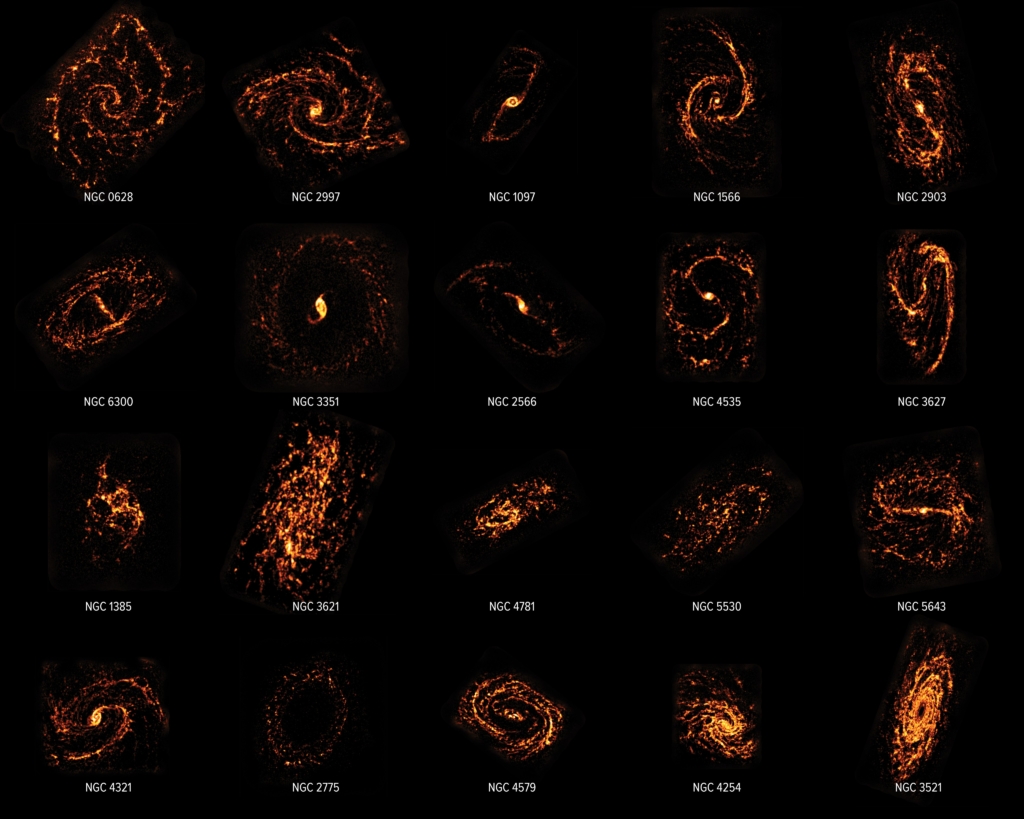
Using the Atacama Large Millimeter/submillimeter Array (ALMA), scientists completed a census of nearly 100 galaxies in the nearby Universe, showcasing their behaviors and appearances. The scientists compared ALMA data to that of the Hubble Space Telescope, shown in composite here. The survey concluded that contrary to popular scientific opinion, stellar nurseries do not all look and act the same. In fact, as shown here, they are as different as the neighborhoods, cities, regions, and countries that make up our own world. Credit: ALMA (ESO/NAOJ/NRAO)/PHANGS, S. Dagnello (NRAO).
Hi-Res File

NGC4254
Shown here as an ALMA (orange/red) composite with Hubble Space Telescope (HST) data, NGC4254 was among the nearly 100 galaxies included in the recent PHANGS project census of galaxies in the nearby Universe. The survey found that stellar nurseries within these galaxies vary widely in appearance and behavior, and that these characteristics heavily depend on where the stellar nurseries are located. NGC4254 is an example of a galaxy featuring M type morphology. Credit: ALMA (ESO/NAOJ/NRAO)/PHANGS, S. Dagnello (NRAO). Hi-Res File

NGC4535
NGC4535 is a galaxy in the nearby Universe featuring grand-design spiral plus stellar bar morphology. It was catalogued along with nearly 100 other galaxies during a recent census by the PHANGS project. The census revealed that contrary to commonly accepted scientific theory, not all stellar nurseries look or act the same way. In fact, they’re quite diverse. NGC4535 is shown here as an ALMA (orange/red) composite with Hubble Space Telescope (HST) data. Credit: ALMA (ESO/NAOJ/NRAO)/PHANGS, S. Dagnello (NRAO). Hi-Res File

Study reveals that the makeup and life cycle of star-forming clouds is dependent on location

A team of astronomers using the Atacama Large Millimeter/submillimeter Array (ALMA) has completed the first census of molecular clouds in the nearby Universe, revealing that contrary to previous scientific opinion, these stellar nurseries do not all look and act the same. In fact, they’re as diverse as the people, homes, neighborhoods, and regions that make up our own world.

Stars are formed out of clouds of dust and gas called molecular clouds, or stellar nurseries. Each stellar nursery in the Universe can form thousands or even tens of thousands of new stars during its lifetime. Between 2013 and 2019, astronomers on the PHANGS— Physics at High Angular Resolution in Nearby GalaxieS— project conducted the first systematic survey of 100,000 stellar nurseries across 90 galaxies in the nearby Universe to get a better understanding of how they connect back to their parent galaxies.

“We used to think that all stellar nurseries across every galaxy must look more or less the same, but this survey has revealed that this is not the case, and stellar nurseries change from place to place,” said Adam Leroy, Associate Professor of Astronomy at Ohio State University (OSU), and lead author of the paper presenting the PHANGS ALMA survey. “This is the first time that we have ever taken millimeter-wave images of many nearby galaxies that have the same sharpness and quality as optical pictures. And while optical pictures show us light from stars, these ground-breaking new images show us the molecular clouds that form those stars.”

The scientists compared these changes to the way that people, houses, neighborhoods, and cities exhibit like-characteristics but change from region to region and country to country.

“To understand how stars form, we need to link the birth of a single star back to its place in the Universe. It’s like linking a person to their home, neighborhood, city, and region. If a galaxy represents a city, then the neighborhood is the spiral arm, the house the star-forming unit, and nearby galaxies are neighboring cities in the region,” said Eva Schinnerer, an astronomer at the Max Planck Institute for Astronomy (MPIA) and principal investigator for the PHANGS collaboration “These observations have taught us that the “neighborhood” has small but pronounced effects on where and how many stars are born.”

To better understand star formation in different types of galaxies, the team observed similarities and differences in the molecular gas properties and star formation processes of galaxy disks, stellar bars, spiral arms, and galaxy centers. They confirmed that the location, or neighborhood, plays a critical role in star formation.

“By mapping different types of galaxies and the diverse range of environments that exist within galaxies, we are tracing the whole range of conditions under which star-forming clouds of gas live in the present-day Universe. This allows us to measure the impact that many different variables have on the way star formation happens,” said Guillermo Blanc, an astronomer at the Carnegie Institution for Science, and a co-author on the paper.

“How stars form, and how their galaxy affects that process, are fundamental aspects of astrophysics,” said Joseph Pesce, National Science Foundation’s program officer for NRAO/ALMA. “The PHANGS project utilizes the exquisite observational power of the ALMA observatory and has provided remarkable insight into the story of star formation in a new and different way.”

Annie Hughes, an astronomer at L’Institut de Recherche en Astrophysique et Planétologie (IRAP), added that this is the first time scientists have a snapshot of what star-forming clouds are really like across such a broad range of different galaxies. “We found that the properties of star-forming clouds depend on where they are located: clouds in the dense central regions of galaxies tend to be more massive, denser, and more turbulent than clouds that reside in the quiet outskirts of a galaxy. The lifecycle of clouds also depends on their environment. How fast a cloud forms stars and the process that ultimately destroys the cloud both seem to depend on where the cloud lives.”

This is not the first time that stellar nurseries have been observed in other galaxies using ALMA, but nearly all previous studies focused on individual galaxies or part of one. Over a five-year period, PHANGS assembled a full view of the nearby population of galaxies. “The PHANGS project is a new form of cosmic cartography that allows us to see the diversity of galaxies in a new light, literally. We are finally seeing the diversity of star-forming gas across many galaxies and are able to understand how they are changing over time. It was impossible to make these detailed maps before ALMA,” said Erik Rosolowsky, Associate Professor of Physics at the University of Alberta, and a co-author on the research. “This new atlas contains 90 of the best maps ever made that reveal where the next generation of stars is going to form.”

For the team, the new atlas doesn’t mean the end of the road. While the survey has answered questions about what and where, it has raised others. “This is the first time we have gotten a clear view of the population of stellar nurseries across the whole nearby Universe. In that sense, it’s a big step towards understanding where we come from,” said Leroy. “While we now know that stellar nurseries vary from place to place, we still do not know why or how these variations affect the stars and planets formed. These are questions that we hope to answer in the near future.”

Ten papers detailing the outcomes of the PHANGS survey are presented this week at the 238th meeting of the American Astronomical Society.


Resource
PHANGS-ALMA: Arcsecond CO(2-1) Imaging of Nearby Star-Forming Galaxies, Leroy et al. ApJS accepted, preview [https://arxiv.org/abs/2104.07739]

About ALMA

The Atacama Large Millimeter/submillimeter Array (ALMA), an international astronomy facility, is a partnership of the European Organisation for Astronomical Research in the Southern Hemisphere (ESO), the U.S. National Science Foundation (NSF) and the National Institutes of Natural Sciences (NINS) of Japan in cooperation with the Republic of Chile. ALMA is funded by ESO on behalf of its Member States, by NSF in cooperation with the National Research Council of Canada (NRC) and the Ministry of Science and Technology (MOST) and by NINS in cooperation with the Academia Sinica (AS) in Taiwan and the Korea Astronomy and Space Science Institute (KASI).

ALMA construction and operations are led by ESO on behalf of its Member States; by the National Radio Astronomy Observatory (NRAO), managed by Associated Universities, Inc. (AUI), on behalf of North America; and by the National Astronomical Observatory of Japan (NAOJ) on behalf of East Asia. The Joint ALMA Observatory (JAO) provides the unified leadership and management of the construction, commissioning and operation of ALMA.

Media Contact:

Amy C. Oliver
Public Information Officer, ALMA
Public Information & News Manager, NRAO
+1 434 242 9584

aoliver@nrao.edu