Releases from NASA, HubbleSite, Spitzer, ESO, ESA, NASA’s Chandra X-ray Observatory, Royal Astronomical Society, Harvard-Smithsonian Center For Astrophysics, Max Planck Institute, Gemini Observatory, Subaru Telescope, W. M. Keck Observatory, JPL-Caltech, ICRAR, Webb Space Telescope, etc
Showing posts with label Type Ia supernova. Show all posts
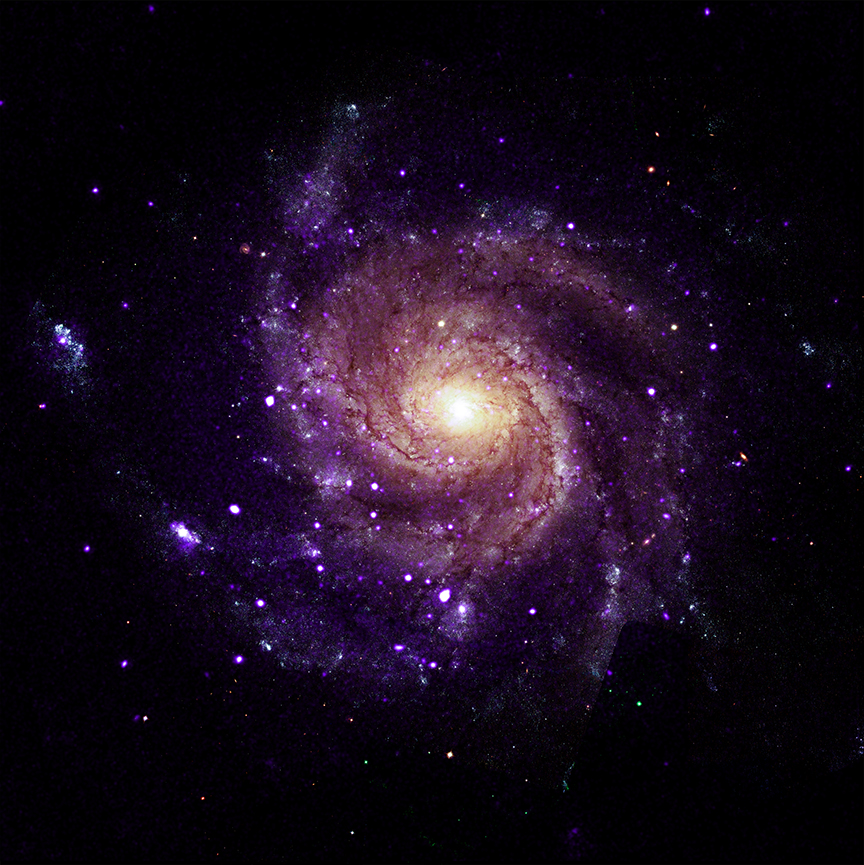
Fast Facts for M101 The Pinwheel Galaxy)
Credit: X-ray: NASA/CXC/Univ. of Alabama/M. Muhibullah et al.; Optical: NASA/ESA/STScI;
Image Processing: NASA/CXC/SAO/N. Wolk
Astronomers found a new class of objects using NASA’s Chandra X-ray Observatory.
They dubbed these “hypersoft X-ray sources” (HSS) because they give off very low-energy X-rays that are difficult to detect.
Despite their stealth output, HSS may be emitting large amounts of ultraviolet radiation.
This discovery may help scientists unravel mysteries around Type Ia supernovas and the intergalactic medium.
Astronomers have discovered a new class of objects in multiple galaxies. This result, made possible by NASA’s Chandra X-ray Observatory and outlined in our latest press release, may help scientists solve two outstanding mysteries in astrophysics.
The face-on spiral galaxy M101, also known as the Pinwheel, is one of the galaxies where the new type of object was found. This new M101 composite image contains X-ray data from Chandra (purple) that have been combined with an optical image from the Hubble Space Telescope (red, green, and blue). Circles in an annotated version of the image show the location of the seven newly-discovered objects in M101.
M101 with illustrated circles calling out seven of the newly-discovered objects. (Labeked)
Credit: X-ray: NASA/CXC/Univ. of Alabama/M. Muhibullah et al.; Optical: NASA/ESA/STScI;
Image Processing: NASA/CXC/SAO/N. Wolk
Researchers found a total of 84 of these mysterious objects in M101, Messier 31, and four elliptical galaxies. The objects were named “hypersoft X-ray sources” because they give off very low-energy X-rays that Chandra was only able to detect after long exposures. Because low-energy X-rays border energetic ultraviolet radiation on the electromagnetic spectrum, the team determined that these sources are likely producing large amounts of energetic ultraviolet radiation.
Astronomers are trying to determine what type — or types — of objects are responsible for these low-energy X-rays and intense ultraviolet radiation outputs. The most likely explanation, according to the team, is that these systems involve a black hole, neutron star or white dwarf pulling material from a companion star. The material pulled from the companion star is heated up to produce X-rays before falling onto the white dwarf or neutron star, or into the black hole. While scientists have discovered many binary systems over the years, astronomers have never seen any behaving like this before.
The discovery of this new class of sources suggests that astronomers have missed large populations of binary systems with energetic ultraviolet radiation until now. One idea is that these binary systems are the precursors to Type Ia supernova explosions, which astronomers used to discover the acceleration of the universe’s expansion.
Another open question that these hypersoft X-ray sources could help answer involves the stripping of electrons from gas in between galaxies. Scientists know this phenomenon plays an important role in the lifecycle of the stars, but they still need to accurately account for all of the energy sources that contribute to this process. This newly-discovered class of objects may play a significant role in this stripping.
These hypersoft X-ray sources were not found until now because in addition to the low-energy X-ray output that requires large amounts of observing time from a telescope like Chandra, the high-energy ultraviolet radiation is readily absorbed by helium and hydrogen gas that fills the space in between the stars. This creates a “nearly impenetrable barrier” to look through.
A paper describing this result appears in the most recent issue of Nature Astronomy and is available here. The authors of this paper are Mustafa Muhibullah (University of Alabama), Jimmy Irwin (University of Alabama), and Rosanne DiStefano (Center for Astrophysics | Harvard & Smithsonian).
NASA's Marshall Space Flight Center manages the Chandra program. The Smithsonian Astrophysical Observatory's Chandra X-ray Center controls science operations from Cambridge, Massachusetts, and flight operations from Burlington, Massachusetts.
Credit: X-ray: NASA/CXC/Univ. of Alabama/M. Muhibullah et al.; Optical: NASA/ESA/STScI; Image Processing: NASA/CXC/SAO/N. Wolk
Release Date: September 9, 2026 Scale: Image is about 14 arcmin (86,000 light-years) across. Category:Normal Galaxies & Starburst Galaxies Coordinates (J2000): RA 14h 03m 12.5s | Dec +54° 20´ 56.2" Constellation:Ursa Major Observation Dates: 25 observations from March 2000 to January 2005 Observation Time: 274 hours (11 days 10 hours) Obs. ID: 934, 3095, 4731-4737, 5296, 5297, 5300, 5309, 5322, 5323, 5337-5340, 6114, 6115, 6118, 6152, 6169, 6170, 6175 Instrument:ACIS Also Known As: NGC 5457, The Pinwheel Galaxy References: Muhibullah, M., Irwin, J.A., and Di Stefano, R., 2026, Nature Astronomy (available here) Color Code: X-ray: purple; Optical: red, green, and blue Distance Estimate: About 21 million light-years from Earth
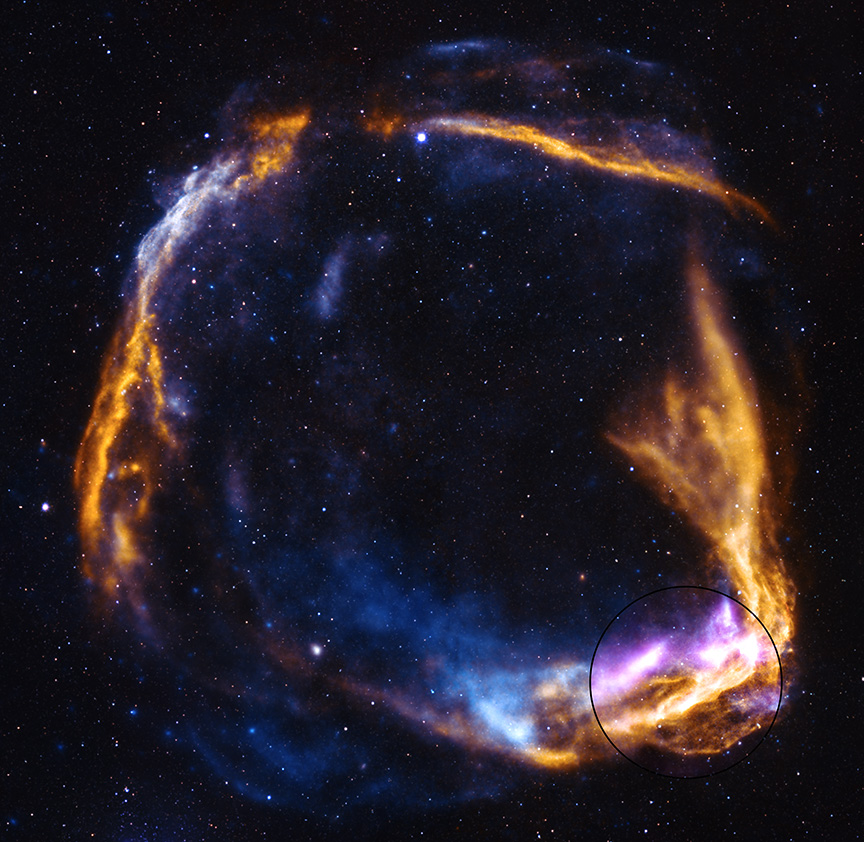
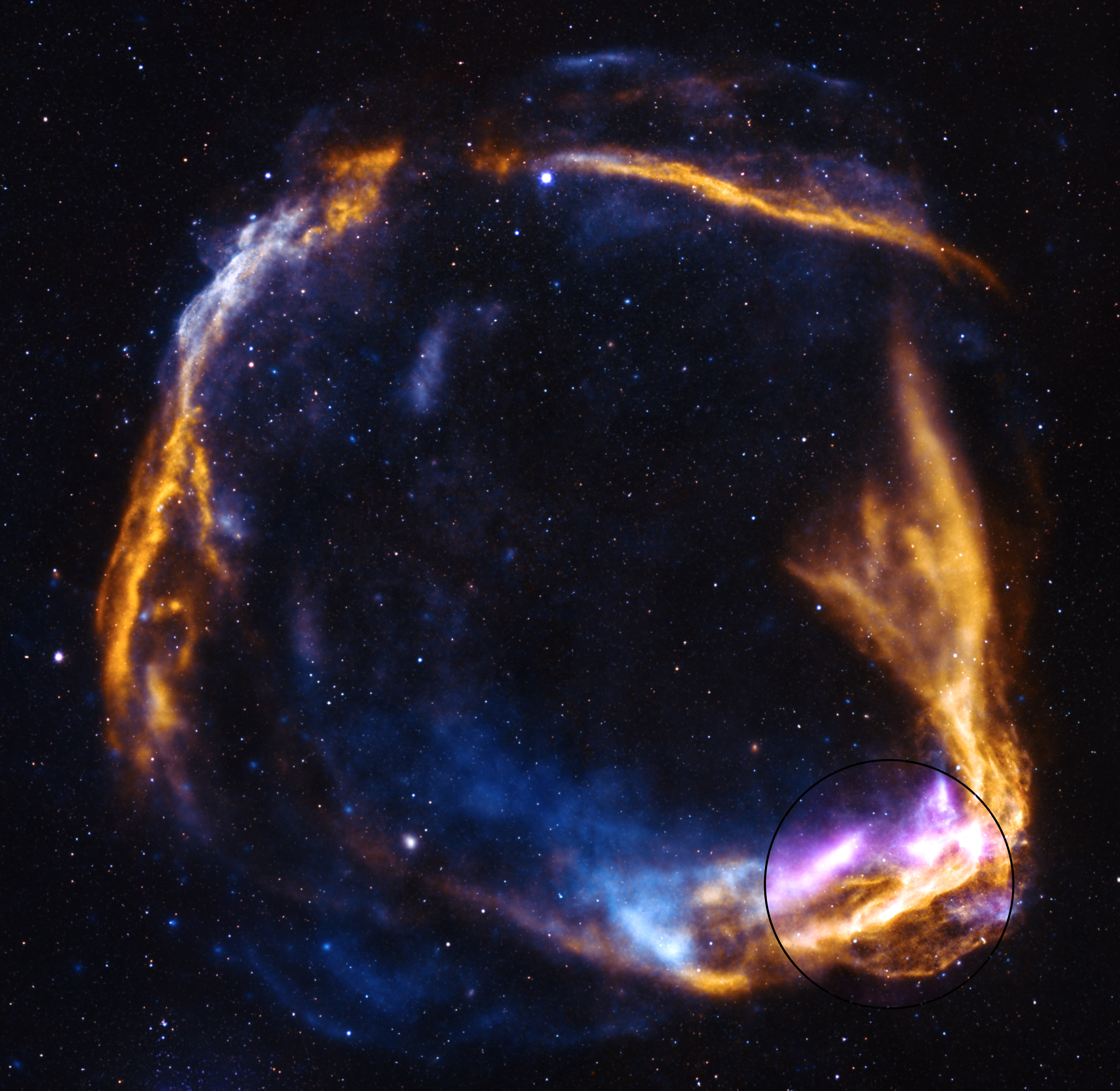
RCW 86 is approximately 8,000 light-years from Earth in the Southern constellation of Circinus, occupying a region of the sky slightly larger than the full moon. In the year 185 AD, Chinese astronomers recorded witnessing a “guest star” in this area of the night sky that remained visible for 8 months.
NASA’s IXPE observed the outer rim of the supernova remnant highlighted in purple at the lower right. When NASA’s Chandra X-ray Observatory targeted RCW 86, they discovered that a large “cavity” region around the system led the supernova to expand larger in a shorter amount of time than expected. The low-density cavity region could have led to RCW 86’s unique shape as well.
The full image puts IXPE’s data into context with legacy observations from two other X-ray telescopes: Chandra and the European Space Agency’s XMM-Newton. The yellow represents low-energy X-rays, while blue shows high-energy X-rays detected by Chandra and XMM-Newton. The starfield in the image comes from the National Science Foundation’s National Optical-Infrared Astronomy Research Laboratory (NOIRlab).
NASA's Marshall Space Flight Center in Huntsville, Alabama, manages the Chandra program. The Smithsonian Astrophysical Observatory's Chandra X-ray Center controls science operations from Cambridge, Massachusetts, and flight operations from Burlington, Massachusetts.
This is an X-ray and optical image of supernova remnant RCW 86, which appears to be two slightly mismatched halves of a broken rough circle. The colors in the image are predominantly blue and gold with a spot of bright purple in the lower right corner. The texture of RCW 86 resembles that of nebulous and patchy fingers, and swirls of gas. This image combines data from four different telescopes to create a multi-wavelength view of the remains of an exploded star. X-ray images from NASA's Chandra X-ray Observatory and the ESA's XMM-Newton are combined to form the blue and gold colors in the image. The X-rays show the interstellar gas that has been heated to millions of degrees by the passage of the shock wave from the supernova. Additional X-ray data from NASA's IXPE are shown in purple, confined to a small circle in the lower right where IXPE observed. A faint starfield, a sprinkling of white stars across the image, from NSF's NOIRlab is also included.
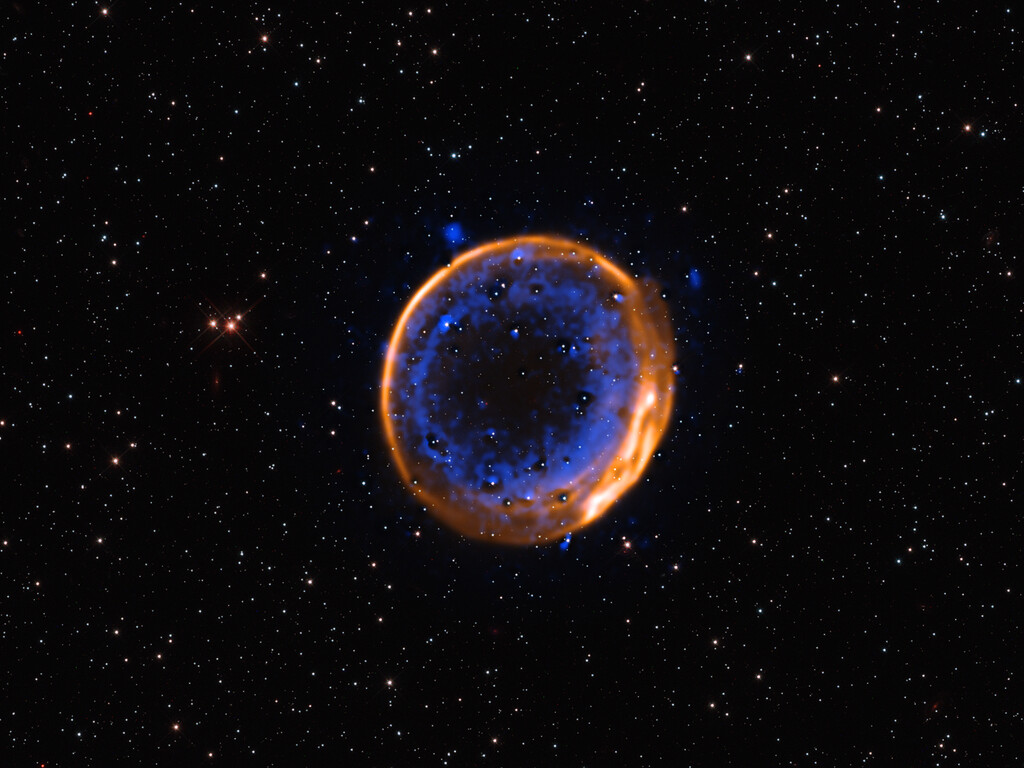
For the first time, astronomers have obtained visual evidence that a star met its end by detonating twice. By studying the centuries-old remains of supernova SNR 0509-67.5 with the European Southern Observatory’s Very Large Telescope (ESO’s VLT), they have found patterns that confirm its star suffered a pair of explosive blasts. Published today, this discovery shows some of the most important explosions in the Universe in a new light.
Most supernovae are the explosive deaths of massive stars, but one important variety comes from an unassuming source. White dwarfs, the small, inactive cores left over after stars like our Sun burn out their nuclear fuel, can produce what astronomers call a Type Ia supernova.
"The explosions of white dwarfs play a crucial role in astronomy,” says Priyam Das, a PhD student at the University of New South Wales Canberra, Australia, who led the study on SNR 0509-67.5 published today in Nature Astronomy. Much of our knowledge of how the Universe expands rests on Type Ia supernovae, and they are also the primary source of iron on our planet, including the iron in our blood. “Yet, despite their importance, the long-standing puzzle of the exact mechanism triggering their explosion remains unsolved," he adds.
All models that explain Type Ia supernovae begin with a white dwarf in a pair of stars. If it orbits close enough to the other star in this pair, the dwarf can steal material from its partner. In the most established theory behind Type Ia supernovae, the white dwarf accumulates matter from its companion until it reaches a critical mass, at which point it undergoes a single explosion. However, recent studies have hinted that at least some Type Ia supernovae could be better explained by a double explosion triggered before the star reached this critical mass.
Now, astronomers have captured a new image that proves their hunch was right: at least some Type Ia supernovae explode through a ‘double-detonation’ mechanism instead. In this alternative model, the white dwarf forms a blanket of stolen helium around itself, which can become unstable and ignite. This first explosion generates a shockwave that travels around the white dwarf and inwards, triggering a second detonation in the core of the star — ultimately creating the supernova.
Until now, there had been no clear, visual evidence of a white dwarf undergoing a double detonation. Recently, astronomers have predicted that this process would create a distinctive pattern or fingerprint in the supernova’s still-glowing remains, visible long after the initial explosion. Research suggests that remnants of such a supernova would contain two separate shells of calcium.
Astronomers have now found this fingerprint in a supernova’s remains. Ivo Seitenzahl, who led the observations and was at Germany’s Heidelberg Institute for Theoretical Studies when the study was conducted, says these results show “a clear indication that white dwarfs can explode well before they reach the famous Chandrasekhar mass limit, and that the ‘double-detonation’ mechanism does indeed occur in nature.” The team were able to detect these calcium layers (in blue in the image) in the supernova remnant SNR 0509-67.5 by observing it with the Multi Unit Spectroscopic Explorer (MUSE) on ESO’s VLT. This provides strong evidence that a Type Ia supernova can occur before its parent white dwarf reaches a critical mass.
Type Ia supernovae are key to our understanding of the Universe. They behave in very consistent ways, and their predictable brightness — no matter how far away they are — helps astronomers to measure distances in space. Using them as a cosmic measuring tape, astronomers discovered the accelerating expansion of the Universe, a discovery that won the Physics Nobel Prize in 2011. Studying how they explode helps us to understand why they have such a predictable brightness.
Das also has another motivation to study these explosions. “This tangible evidence of a double-detonation not only contributes towards solving a long-standing mystery, but also offers a visual spectacle,” he says, describing the “beautifully layered structure” that a supernova creates. For him, “revealing the inner workings of such a spectacular cosmic explosion is incredibly rewarding.”
This research was presented in a paper titled “Calcium in a supernova remnant shows the fingerprint of a sub-Chandrasekhar mass explosion” to appear in Nature Astronomy athttps://www.nature.com/articles/s41550-025-02589-5(doi: 10.1038/s41550-025-02589-5).
The team is composed of P. Das (University of New South Wales, Australia [UNSW] & Heidelberger Institut für Theoretische Studien, Heidelberg, Germany [HITS]), I. R. Seitenzahl (HITS), A. J. Ruiter (UNSW & HITS & OzGrav: The ARC Centre of Excellence for Gravitational Wave Discovery, Hawthorn, Australia & ARC Centre of Excellence for All-Sky Astrophysics in 3 Dimensions), F. K. Röpke (HITS & Institut für Theoretische Astrophysik, Heidelberg, Germany & Astronomisches Recheninstitut, Heidelberg, Germany), R. Pakmor (Max-Planck-Institut für Astrophysik, Garching, Germany [MPA]), F. P. A. Vogt (Federal Office of Meteorology and Climatology – MeteoSwiss, Payerne, Switzerland), C. E. Collins (The University of Dublin, Dublin, Ireland & GSI Helmholtzzentrum für Schwerionenforschung, Darmstadt, Germany), P. Ghavamian (Towson University, Towson, USA), S. A. Sim (Queen’s University Belfast, Belfast, UK), B. J. Williams (X-ray Astrophysics Laboratory NASA/GSFC, Greenbelt, USA), S. Taubenberger (MPA & Technical University Munich, Garching, Germany), J. M. Laming (Naval Research Laboratory, Washington, USA), J. Suherli (University of Manitoba, Winnipeg, Canada), R. Sutherland (Australian National University, Weston Creek, Australia), and N. Rodríguez-Segovia (UNSW).
The European Southern Observatory (ESO) enables scientists worldwide to discover the secrets of the Universe for the benefit of all. We design, build and operate world-class observatories on the ground — which astronomers use to tackle exciting questions and spread the fascination of astronomy — and promote international collaboration for astronomy. Established as an intergovernmental organisation in 1962, today ESO is supported by 16 Member States (Austria, Belgium, Czechia, Denmark, France, Finland, Germany, Ireland, Italy, the Netherlands, Poland, Portugal, Spain, Sweden, Switzerland and the United Kingdom), along with the host state of Chile and with Australia as a Strategic Partner. ESO’s headquarters and its visitor centre and planetarium, the ESO Supernova, are located close to Munich in Germany, while the Chilean Atacama Desert, a marvellous place with unique conditions to observe the sky, hosts our telescopes. ESO operates three observing sites: La Silla, Paranal and Chajnantor. At Paranal, ESO operates the Very Large Telescope and its Very Large Telescope Interferometer, as well as survey telescopes such as VISTA. Also at Paranal ESO will host and operate the Cherenkov Telescope Array South, the world’s largest and most sensitive gamma-ray observatory. Together with international partners, ESO operates ALMA on Chajnantor, a facility that observes the skies in the millimetre and submillimetre range. At Cerro Armazones, near Paranal, we are building “the world’s biggest eye on the sky” — ESO’s Extremely Large Telescope. From our offices in Santiago, Chile we support our operations in the country and engage with Chilean partners and society.
Priyam Das
School of Science (Astrophysics), University of New South Wales at the Australian Defence Force Academy
Canberra, Australia
Email:priyam.das@unsw.edu.au
Ashley Ruiter
School of Science (Astrophysics), University of New South Wales at the Australian Defence Force Academy
Canberra, Australia
Email:ashley.ruiter@unsw.edu.au
Ivo Seitenzahl
Heidelberg Institute for Theoretical Studies
Heidelberg, Germany (currently in Canberra, Australia)
Email:ivoseitenzahl@gmail.com
Friedrich Röpke
Heidelberg Institute for Theoretical Studies
Heidelberg, Germany
Email:friedrich.roepke@h-its.org Bárbara Ferreira
ESO Media Manager
Garching bei München, Germany
Tel: +49 89 3200 6670
Cell: +49 151 241 664 00
Email:press@eso.org
Kepler's Supernova, the remnant of which is shown here in X-ray
observations from the Chandra X-ray Observatory, is the most recent
known Type Ia supernova in the Milky Way. It was discovered in 1604. Credit:NASA/CXC/Univ of Texas at Arlington/M. Millard et al.
Figure 1: Example of a “Branch classification” diagram for Type Ia
supernovae. This figure compares the width of two silicon lines in Type
Ia supernovae. Four groups are shown: shallow silicons (SS), broad lines
(BL), cools (CL), and core normals (CN). Event SN 1991T is a member of
the shallow silicons group (green triangles), indicating that the widths
of the minor and major silicon lines are smaller than normal Type Ia
supernovae (core normals). Credit:Burrow et al. 2020
Figure 2: A plot showing the fraction of intermediate-mass elements (IME) as a function of the ionization ratio of the authors’ simulations. Moving to the right on the bottom axis indicates higher ionization states, whereas moving up on the left axis indicates more intermediate-mass elements for a given total ejecta mass. The break between blue stars (normal Type Ia supernovae) and orange stars (1991T-like supernovae) is called the “turnover.” Because the turnover is fairly smooth, it suggests that the progenitor, or stellar origin, of 1991T-like events might be similar to normal events. Credit: O’Brien et al. 2024
Famously, Type Ia supernovae have been used to measure the local Hubble constant, or the rate at which our universe expands. These objects earned the nickname “standard candles” since their near-constant intrinsic luminosities
allow us to measure distances in space. Slowly but surely, however,
we’ve learned that some of our standard candles aren’t that “standard”
after all…
Historically, Type Ia supernovae were proposed to develop from the
transfer of mass between two stars, where the star receiving the mass
was a carbon–oxygen white dwarf
— the core of a low-mass to intermediate-mass star that’s reached the
end of its life. After the white dwarf accretes a certain amount of
mass, it explodes as a Type Ia supernova. Spectroscopic studies of these
supernovae over the decades have shown a wide range of absorption features,
one major absorption line being silicon, a key element produced in the
explosion. In fact, a subclassification scheme of Type Ia supernovae —
often referred to as the Branch classification
— emerged based on the relative strengths of particular absorption
features commonly identified in the spectra of these events (see Figure
1). One of these subclassifications is “shallow silicon,” which
signifies a lack of silicon produced in the explosion. This
subclassification (compared to other subclassifications in Figure 1)
shows how Type Ia supernovae are like snowflakes: they have very similar
structures yet vary in detail.
The supernova SN 1991T was the first observed event of its kind. What was so special about it? This event was considered over-luminous,
or more luminous than the typical “near-intrinsic luminosity” of the
average Type Ia supernova. Later, as observations improved, more events
like SN 1991T were detected, contributing to the growing class of aptly
named “1991T-like” events. The spectra of these events have shallow
silicon lines compared to the normal range of Type Ia supernovae. The
peculiarity of these absorption lines hints at something unique about
these events, and the answer lies in studying the ejecta, or the ejected
material in which chemical elements are produced. This article is a
step toward understanding what differentiates these events from the norm
and what we can infer about their origins.
Outside of this work, recent hydrodynamic
simulations of various progenitor models, or stellar origins, have
successfully recreated some of the observable signatures of Type Ia
supernovae, including synthetic, or computed, optical spectra of
theoretical events. Except, as previously mentioned, the observable
signatures of Type Ia supernovae can vary quite a bit amongst all these
subtypes and classifications! Instead of hydrodynamic simulations, the
authors of this article chose to reconstruct the supernova ejecta using Bayesian inference and active learning
conducted on early-time (within a few days after explosion) optical
spectra of already observed normal and 1991T-like events.
This is the time when 1991T-like events show their features! After training the
model on this data, the authors developed a model to link the optical
spectra and the ejecta properties corresponding to normal and 1991T-like
events. The team’s emulator successfully recreated both normal and 1991T-like events, at least with 68% confidence (think one sigma!).
Furthermore, the authors discovered that the variety in the parameters
used in their model illuminates some differences between these
1991T-like events and normal Type Ia supernovae. Remember those silicon
features? They recreated those pesky absorption lines, particularly the
major iron and silicon features experts look for. Their model
successfully recreated silicon absorption features that were suppressed,
or not as deep. This indicates a low fraction of intermediate-mass
elements, which range from lithium to iron, produced in the explosion
compared to the total mass. They also matched the deep, major iron line
seen in 1991T-like events. Fewer intermediate-mass elements in
1991T-like supernovae suggest that these elements exist at higher ionization states
than in normal Type Ia supernovae (see Figure 2). This suggests that
there isn’t just a single mechanism that produces a 1991T-like
supernova; it’s likely a combination of different physical processes.
The question now becomes: what can we learn about 1991T-like origins
from this? Can a single progenitor model lead to different pathways? Or
do we need different progenitor models to explain these differences in
spectroscopic features? The authors believe fewer intermediate-mass
elements and higher ionization states hint at normal and 1991T-like
events sharing similar progenitor systems. In other words, 1991T-like
events might just be an extension, or extreme, of the normal population. Perhaps the candle just burned a bit too bright!
Aside from this work, in addition to these over-luminous 1991T-like events, there also exists another interesting class of Type Ia supernovae dubbed “super-luminous,”
which are roughly one, maybe two, magnitudes brighter than normal Type
Ia supernovae. (Only in astronomy could the words over-luminous and super-luminous mean different things, right?) Because of this, researchers advocate for Type Ia supernovae to be called “standardizable” candles instead because, as you now know, their intrinsic luminosities really aren’t that uniform after all.
Original astrobite edited by Ansh Gupta and Dee Dunne.
I’m a grad student at the University of Chicago. Most of my research focuses on simulations of Type Ia supernovae and galaxy formation and evolution.
Editor’s Note:Astrobitesis a graduate-student-run organization that digests astrophysical literature for undergraduate students. As part of thepartnershipbetween the AAS and astrobites, we occasionally repost astrobites
content here at AAS Nova. We hope you enjoy this post from astrobites;
the original can be viewed atastrobites.org.
A spiral galaxy seen almost face-on. Large spiral arms whirl out from
its centre, filling the scene. They glow faintly blue from the stars
within, with some small bright patches of blue and pink marking areas of
star formation. They are overlaid with thin filaments of dark reddish
dust that block light. The galaxy’s centre shines brightly white. Credit: ESA/Hubble & NASA, D. Sand, R. J. Foley
Measuring the distance to truly remote objects like galaxies, quasars and galaxy clusters is a crucial task in astrophysics, particularly
when it comes to studying the early Universe, but it’s a difficult one.
Only in the case of a few nearby objects like the Sun, planets
and some nearby stars can we measure their distances directly. Beyond
that, various indirect methods need to be used; one of the most
important is by examining Type Ia supernovae, and this is where the
NASA/ESA Hubble Space Telescope comes in.
NGC 3810, the galaxy featured in this image, was the host of a Type Ia supernova
in 2022. In early 2023 Hubble focused on this and a number of other
galaxies to closely examine recent Type Ia supernovae. This kind of
supernova results from a white dwarf
exploding, and they all have a very consistent brightness. That allows
them to be used to measure distances: we know how bright a Type Ia
supernova should be, so we can tell how far away it must be from how dim
it appears. One uncertainty in this method is that intergalactic dust
in between Earth and a supernova blocks some of its light. How do you
know how much of the reduction in light is caused by distance, and how
much by dust? With the help of Hubble, there’s a clever workaround: take
images of the same Type Ia supernovae in ultraviolet light, which is
almost completely blocked by dust, and in infrared light, which passes
through dust almost unaffected. By carefully noting how much light comes
through at each wavelength, the relationship between supernova
brightness and distance can be calibrated to account for dust. Hubble
can observe both these wavelengths of light in great detail with the
same instrument. That makes it the perfect tool for this experiment, and
indeed, some of the data used to make this beautiful image of NGC 3810
were focused on its 2022 supernova. You can see it as a point of light
just below the galactic nucleus, or in the annotated image here.
There are many ways to measure cosmic distances; because Type Ia
supernovae are so bright, they are one of the most useful and accurate
tools, when they’re spotted. Many other methods must be used as well,
either as an independent check against other distance measurements or to
measure at much closer or farther distances. One such method that also
works for galaxies is comparing their rotation speed to their
brightness; based on that method, NGC 3810 is found to be 50 million
light-years from Earth.
Artist's rendition of SN 2020eyj, a white dwarf star that went supernova after pulling material from a helium companion star. Credit: W. M. Keck Observatory/Adam Makarenko
Maunakea, Hawaiʻi – A team of astronomers led by Stockholm University has discovered an unusual Type Ia supernova – or thermonuclear supernova – called SN 2020eyj. Not only did they make the first detection of such a supernova in radio waves, follow-up observations from W. M. Keck Observatory on Maunakea, Hawaiʻi Island also showed strong emission lines of helium.
This marks the first confirmed Type Ia supernova triggered by a white dwarf star that pulled material from a companion star with an outer layer consisting primarily of helium; normally, in the rare cases where the material stripped from the outer layers of the donor star could be detected in spectra, this was mostly hydrogen.
Type Ia supernovae are important for astronomers since they are used to measure the expansion of the universe. However, the origin of these explosions has remained an open question. While it is established that the explosion is caused by a compact white dwarf star that somehow accretes too much matter from a companion star, the exact process and the nature of the progenitor is not known.
The new discovery of supernova SN 2020eyj is evidence the companion star was a helium star that had lost much of its material just prior to the explosion of the white dwarf.
Artist’s impression of SN2020eyj, a double star system with a compact white dwarf star accreting matter from a helium-rich donor companion, surrounded by dense and dusty circumstellar material. It was the interaction of the exploded star and the material left over from this companion that gave rise to the strong radio signal and the conspicuous helium lines in the optical spectra of SN 2020eyj. Credit: W. M. Keck Observatory/Adam Makarenko
“Once we saw the signatures of strong interaction with the material from the companion, we tried to also detect it in radio emission,” says Erik Kool, a postdoc at Stockholm University’s Department of Astronomy and lead author of the paper. “The detection in radio is the first one of a Type Ia supernova – something astronomers have tried to do for decades.”
Supernova 2020eyj was first spotted by the Zwicky Transient Facility at Palomar Observatory near San Diego where the Oskar Klein Centre at Stockholm University are members.
“The Nordic Optical Telescope on La Palma was fundamental for following up this supernova,” says Jesper Sollerman, a professor at Stockholm University’s Department of Astronomy and co-author of the paper. “As were spectra from the large Keck telescope in Hawaiʻi that immediately revealed the very unusual helium-dominated material around the exploded star.”
“This is clearly a very unusual Type Ia supernova, but still related to the ones we use to measure the expansion of the universe,” adds co-author Joel Johansson from the Department of Physics at Stockholm University. “While normal Type Ia supernovae appear to always explode with the same brightness, this supernova tells us that there are many different pathways to a white dwarf star explosion.”
The Low Resolution Imaging Spectrometer (LRIS) is a very versatile and ultra-sensitive visible-wavelength imager and spectrograph built at the California Institute of Technology by a team led by Prof. Bev Oke and Prof. Judy Cohen and commissioned in 1993. Since then it has seen two major upgrades to further enhance its capabilities: the addition of a second, blue arm optimized for shorter wavelengths of light and the installation of detectors that are much more sensitive at the longest (red) wavelengths. Each arm is optimized for the wavelengths it covers. This large range of wavelength coverage, combined with the instrument’s high sensitivity, allows the study of everything from comets (which have interesting features in the ultraviolet part of the spectrum), to the blue light from star formation, to the red light of very distant objects. LRIS also records the spectra of up to 50 objects simultaneously, especially useful for studies of clusters of galaxies in the most distant reaches, and earliest times, of the universe. LRIS was used in observing distant supernovae by astronomers who received the Nobel Prize in Physics in 2011 for research determining that the universe was speeding up in its expansion.
About W. M. Keck Observatory
The W. M. Keck Observatory telescopes are among the most scientifically productive on Earth. The two 10-meter optical/infrared telescopes atop Maunakea on the Island of Hawaii feature a suite of advanced instruments including imagers, multi-object spectrographs, high-resolution spectrographs, integral-field spectrometers, and world-leading laser guide star adaptive optics systems. Some of the data presented herein were obtained at Keck Observatory, which is a private 501(c) 3 non-profit organization operated as a scientific partnership among the California Institute of Technology, the University of California, and the National Aeronautics and Space Administration. The Observatory was made possible by the generous financial support of the W. M. Keck Foundation. The authors wish to recognize and acknowledge the very significant cultural role and reverence that the summit of Maunakea has always had within the Native Hawaiian community. We are most fortunate to have the opportunity to conduct observations from this mountain.
While astronomers have seen the debris from scores of exploded stars
in the Milky Way and nearby galaxies, it is often difficult to determine
the timeline of the star’s demise. By studying the spectacular remains of a supernova in a neighboring galaxy using NASA telescopes, a team of astronomers has found enough clues to help wind back the clock.
The supernova remnant called SNR 0519-69.0 (SNR 0519 for short) is the debris from an explosion of a white dwarf star.
After reaching a critical mass, either by pulling matter from a
companion star or merging with another white dwarf, the star underwent a
thermonuclear explosion and was destroyed. Scientists use this type of
supernova, called a Type Ia,
for a wide range of scientific studies ranging from studies of
thermonuclear explosions to measuring distances to galaxies across
billions of light-years.
SNR 0519 is located in the Large Magellanic Cloud, a small galaxy 160,000 light-years from Earth. This composite image shows X-ray data from NASA’s Chandra X-ray Observatory and optical data
from NASA’s Hubble Space Telescope. X-rays from SNR 0519 with low,
medium and high energies are shown in green, blue, and purple
respectively, with some of these colors overlapping to appear white.
Optical data shows the perimeter of the remnant in red and stars around
the remnant in white.
Astronomers combined the data from Chandra and Hubble with data from NASA’s retired Spitzer Space telescope
to determine how long ago the star in SNR 0519 exploded and learn about
the environment the supernova occurred in. This data provides
scientists a chance to “rewind” the movie of the stellar evolution that
has played out since and figure out when it got started.
The researchers compared Hubble images from 2010, 2011, and 2020 to
measure the speeds of material in the blast wave from the explosion,
which range from about 3.8 million to 5.5 million miles (9 million
kilometers) per hour. If the speed was toward the upper end of those
estimated speeds, the astronomers determined that light from the
explosion would have reached Earth about 670 years ago, or during the
Hundred Years’ War between England and France and the height of the Ming
dynasty in China.
However, it’s likely that the material has slowed down since the
initial explosion and that the explosion happened more recently than 670
years ago. The Chandra and Spitzer data provide clues that this is the
case. Astronomers found the brightest regions in X-rays of the remnant
are where the slowest-moving material is located, and no X-ray emission
is associated with the fastest-moving material.
These results imply that some of the blast wave has crashed into
dense gas around the remnant, causing it to slow down as it traveled.
Astronomers may use additional observations with Hubble to determine
more precisely when the time of the star’s demise should truly be set.
A paper describing these results was published in the August issue of The Astrophysical Journal, and a preprint is available here.
The authors of the paper are Brian Williams (NASA’s Goddard Space
Flight Center (GSFC) in Greenbelt, Maryland); Parviz Ghavamian (Towson
University, Towson, Maryland); Ivo Seitenzahl (University of New South
Wales, Australian Defence Force Academy, Canberra, Australia); Stephen
Reynolds (North Carolina State University (NCSU), Raleigh, NC);
Kazimierz Borkowski (North Carolina State University, Raleigh, NC) and
Robert Petre (GSFC). NASA's Marshall Space Flight Center manages the
Chandra program. The Smithsonian Astrophysical Observatory's Chandra
X-ray Center controls science operations from Cambridge, Massachusetts,
and flight operations from Burlington, Massachusetts.
White dwarfs are among the most stable of stars.
Left on their own, these stars that have exhausted most of their
nuclear fuel — while still typically as massive as the Sun — and shrunk
to a relatively small size can last for billions or even trillions of
years.
However, a white dwarf with a nearby companion star can become a
cosmic powder keg. If the companion's orbit brings it too close, the
white dwarf can pull material from it until the white dwarf grows so
much that it becomes unstable and explodes. This kind of stellar blast
is called a Type Ia supernova.
While it is generally accepted by astronomers that such encounters
between white dwarfs and "normal" companion stars are one likely source
of Type Ia supernova explosions, many details of the process are not
well understood. One way to investigate the explosion mechanism is to
look at the elements left behind by the supernova in its debris or
ejecta.
This new composite image shows G344.7-0.1, a supernova remnant created by a Type Ia supernova, through the eyes of different telescopes. X-rays from NASA's Chandra X-ray Observatory (blue) have been combined with infrared data from NASA's Spitzer Space Telescope (yellow and green) as well as radio
data from the NSF's Very Large Array and the Commonwealth Scientific
and Industrial Research Organisation's Australia Telescope Compact Array
(red).
Chandra is one of the best tools available for scientists to study
supernova remnants and measure the composition and distribution of
"heavy" elements — that is, anything other than hydrogen and helium —
they contain.
Astronomers estimate that G344.7-0.1 is about 3,000 to 6,000 years old in Earth's time frame. On the other hand, the most well-known and widely-observed Type Ia remnants, including Kepler, Tycho, and SN 1006,
have all exploded within the last millennium or so as seen from Earth.
Therefore, this deep look at G344.7-0.1 with Chandra gives astronomers a
window into an important phase later in the evolution of a Type Ia
supernova remnant.
Both the expanding blast wave and the stellar debris produce X-rays
in supernova remnants. As the debris moves outward from the initial
explosion, it encounters resistance from surrounding gas and slows down,
creating a reverse shock wave that travels back toward the center of
the explosion. This process is analogous to a traffic jam on a highway,
where as times passes an increasing number of cars will stop or slow
down behind the accident, causing the traffic jam to travel backwards.
The reverse shock heats the debris to millions of degrees, causing it to
glow in X-rays.
Type Ia remnants like Kepler, Tycho and SN 1006 are too young for the
reverse shock to have time to plausibly travel backwards to heat all of
the debris in the remnant's center. However, the relatively advanced
age of G344.7-0.1 means that the reverse shock has moved back through
the entire debris field.
A separate color version of only the Chandra data shows X-ray
emission from iron (blue) and silicon (red) respectively, and X-rays
produced by the acceleration of electrons as they are deflected by the
nuclei of atoms that are positively charged (green). The region with the
highest density of iron and the arc-like structures of silicon are
labeled.
G344.7-0.13
3 Color X-Ray Composite (Labeled)
The Chandra image of G344.7-0.1 shows that the region with the
highest density of iron (blue) is surrounded by arc-like structures
(green) containing silicon. Similar arc-like structures are found for
sulfur, argon, and calcium. The Chandra data also suggests that the
region with the highest density iron has been heated by the reverse
shock more recently than the elements in the arc-like structures,
implying that it is located near the true center of the stellar
explosion. These results support the predictions of models for Type Ia
supernova explosions, which show that heavier elements are produced in
the interior of an exploding white dwarf.
This three-color Chandra image also shows that the densest iron is
located to the right of the supernova remnant's geometric center. This
asymmetry is likely caused by gas surrounding the remnant being denser
on the right than it is on the left.
A paper describing these results was published in the July 1st, 2020 issue of The Astrophysical Journal and is available online.
The authors of the study are Kotaro Fukushima (Tokyo University of
Science, Japan), Hiroya Yamaguchi (JAXA), Patrick Slane (Center for
Astrophysics | Harvard & Smithsonian), Sangwook Park (University of
Texas, Austin), Satoru Katsuda (Saitama University, Japan), Hidetoshi
Sano (Nagoya University, Japan), Laura Lopez (The Ohio State University,
Columbus), Paul Plucinsky (Center for Astrophysics), Shogo Kobayashi
(Tokyo University of Science), and Kyoko Matsushita (Tokyo University of
Science). The radio data were provided by Elsa Giacani from the
Institute of Astronomy and Space Physics, who led a study of G344.7-0.1
published in 2011 in the journal Astronomy and Astrophysics.
NASA's Marshall Space Flight Center manages the Chandra program. The
Smithsonian Astrophysical Observatory's Chandra X-ray Center controls
science from Cambridge Massachusetts and flight operations from
Burlington, Massachusetts.
The quasar 3C 273 with its jet, as seen by the Chandra X-ray Observatory. Astronomers have found that the X-ray and ultraviolet luminosities of quasars are so tightly correlated, even for quasars at large cosmological distances, that quasars can be used as new "standard candles" to help determine cosmic distances and probe other fundamental cosmological parameters. Credit: Chandra X-ray Observatory
In 1929, Edwin Hubble published observations that galaxies' distances and velocities are correlated, with the distances determined using their Cepheid stars. Harvard astronomer Henrietta Swan Leavitt had discovered that a Cepheid star varies periodically with a period that is related to its intrinsic luminosity. She calibrated the effect, and when Hubble compared those calculated values with his observed luminosities he was able to determine their distances. But even today only Cepheid stars in relatively nearby galaxies can be studied in this way.In order to extend the distance scale back to earlier times in cosmic history, astronomers have used supernovae (SN) - the explosive deaths of massive stars – which can be seen to much greater distances. By comparing the observed brightness of a SN with its intrinsic brightness, based on its classification, astronomers are able to determine its distance; comparing that with the host galaxy's velocity (its redshift, measured spectroscopically) yields the "Hubble relation" relating the galaxy's velocity to its distance. The most reliable supernovae for this purpose, because of their cosmic uniformity, are so-called "Type Ia" supernovae, which are thought to be "standard candles," all having the same intrinsic brightness. However even SN become harder to study in this way as they lie farther away; to date the most distant Type Ia SN with a reliable velocity determination dates from an epoch about 3 billion years after the big bang.
CfA astronomers Susanna Bisogni, Francesca Civano, Martin Elvis and Pepi Fabbiano and their colleagues propose using quasars as a new standard candle. The most distant known quasars have been spotted from an era only about seven hundred million years after the big bang, dramatically extending the range of standard candle redshifts. Another advantage of quasars is that hundreds of thousands of them have been discovered in the past few years. Not least, the physical processes in quasars are different from those in SN, providing completely independent measures of cosmological parameters.
The new scheme proposed by the astronomers relies on their discovery that the X-ray and ultraviolet emission in quasars are tightly correlated. At the heart of a quasar is a supermassive black hole surrounded by a very hot disk of accreting material that emits in the ultraviolet. The disk in turn is surrounded by hot gas with electrons moving at speeds close to that of light, and when ultraviolet photons encounter these electrons their energy is boosted into the X-rays. The team, building on their previous methods, analyzed X-ray measurements of 2332 distant quasars in the new Chandra Source Catalog and compared them to ultraviolet results from the Sloan Digital Sky Survey. They found that the tight correlation already known to exist between the ultraviolet and X-ray luminosity of local quasars continues in distant quasars, back over 85% of the age of the Universe, becoming even tighter at earlier times. The implication is that these two quantities can determine the distance of each quasar, and those distances can then be used to test cosmological models. If the results are confirmed, they will provide astronomers with a dramatic new tool with which to measure the properties of the evolving universe.
Reference:
The Chandra view of the relation between X-ray and UV emission in quasars,” S. Bisogni, E. Lusso, F. Civano, E. Nardini, G. Risaliti, M. Elvis, and G. Fabbiano, Astronomy & Astrophysics, in press, 2021.
Artist’s impression of the HD265435 system at around 30 million years from now, with the smaller white dwarf distorting the hot subdwarf into a distinct ‘teardrop’ shape.
Credit: University of Warwick/Mark Garlick
Astronomers have made the rare sighting of two stars spiralling to their doom by spotting the tell-tale signs of a teardrop-shaped star. The tragic shape is caused by a massive nearby white dwarf distorting the star with its intense gravity, which will also be the catalyst for an eventual supernova that will consume both. Found by an international team of astronomers and astrophysicists led by the University of Warwick, it is one of only very small number of star systems that has been discovered that will one day see a white dwarf star reignite its core. Astrophycists at MPA confirmed the ultimate fate of the star with theoretical modelling.
The system called HD265435 is located roughly 1,500 light years away and comprises a hot subdwarf star and a white dwarf star orbiting each other closely at a rate of around 100 minutes. White dwarfs are ‘dead’ stars that have burnt out all their fuel and collapsed in on themselves, making them small but extremely dense.
A type Ia supernova is generally thought to occur when a white dwarf star’s core reignites, leading to a thermonuclear explosion. There are two scenarios where this can happen. In the first, the white dwarf gains enough mass to reach 1.4 times the mass of our Sun, known as the Chandrasekhar limit. HD265435 fits in the second scenario, in which the total mass of a close stellar system of multiple stars is near or above this limit. Only a handful of other star systems have been discovered that will reach this threshold and result in a Type Ia supernova.
Using data from NASA’s Transiting Exoplanet Survey Satellite (TESS), the team were able to observe the hot subdwarf, which is much brighter than the white dwarf, which was not directly observed. However, that brightness varies over time, which suggested the star was being distorted into a teardrop shape by a nearby massive object. Using radial velocity and rotational velocity measurements from the Palomar Observatory and the W. M. Keck Observatory, and by modelling the massive object’s effect on the hot subdwarf, the astronomers could confirm that the hidden white dwarf is as heavy as our Sun, but just slightly smaller than the Earth’s radius.
Theoretical models produced by researchers based at MPA reveal that the subdwarf star is currently about halfway through its expected lifetime, at the end of which it will collapse to become a white dwarf as well. In around 70 million years, this will lead to a supernova when it finally merges with the other white dwarf, as both stars combined have the mass needed to cause a Type Ia supernova. (The total mass of the system is found to be 1.65±0.25M⊙.) On the way to becoming a white dwarf itself, mass transfer from the subdwarf star will lead to a series of nova outbursts – less energetic cousins of the cataclysmic supernovae – as a precursor to the eventual explosive fate of the binary star.
Type Ia supernovae are important for cosmology as ‘standard candles’. Their brightness is constant and of a specific type of light, which means astronomers can compare what luminosity they should be with what we observe on Earth, and from that work out how distant they are with a good degree of accuracy. By observing supernovae in distant galaxies, astronomers combine what they know of how fast this galaxy is moving with our distance from the supernova and calculate the expansion of the universe. As the theoretical predictions show, this system impressively demonstrates that binary systems of a white dwarf with a subdwarf have to be taken into account in the hunt for the – still elusive – progenitor of Type Ia supernovae.
NASA’s upcoming Nancy Grace Roman Space Telescope
will see thousands of exploding stars called supernovae across vast
stretches of time and space. Using these observations, astronomers aim
to shine a light on several cosmic mysteries, providing a window onto
the universe’s distant past and hazy present.Credits: NASA's Goddard Space Flight Center/CI Labs.Download high-resolution video and images from NASA’s Scientific Visualization Studio
NASA’s upcoming Nancy Grace Roman Space Telescope will see thousands
of exploding stars called supernovae across vast stretches of time and
space. Using these observations, astronomers aim to shine a light on
several cosmic mysteries, providing a window onto the universe’s distant
past and hazy present.
Roman’s supernova survey will help clear up clashing measurements of
how fast the universe is currently expanding, and even provide a new way
to probe the distribution of dark matter, which is detectable only
through its gravitational effects. One of the mission’s primary science
goals involves using supernovae to help pin down the nature of dark energy – the unexplained cosmic pressure that’s speeding up the expansion of the universe.
Space’s biggest mystery
“Dark energy makes up the majority of the cosmos, but we don’t
actually know what it is,” said Jason Rhodes, a senior research
scientist at NASA’s Jet Propulsion Laboratory in Southern California.
“By narrowing down possible explanations, Roman could revolutionize our
understanding of the universe – and dark energy is just one of the many
topics the mission will explore!”
Roman will use multiple methods to investigate dark energy. One
involves surveying the sky for a special type of exploding star, called a
type Ia supernova.
Many supernovae occur when massive stars run out of fuel, rapidly
collapse under their own weight, and then explode because of strong
shock waves that propel out of their interiors. These supernovae occur
about once every 50 years in our Milky Way galaxy. But evidence shows
that type Ia supernovae originate from some binary star systems that
contain at least one white dwarf – the small, hot core remnant of a
Sun-like star. Type Ia supernovae are much rarer, happening roughly once
every 500 years in the Milky Way.
In some cases, the dwarf may siphon material from its companion. This
ultimately triggers a runaway reaction that detonates the thief once it
reaches a specific point where it has gained so much mass that it
becomes unstable. Astronomers have also found evidence supporting
another scenario, involving two white dwarfs that spiral toward each
other until they merge. If their combined mass is high enough that it
leads to instability, they, too, may produce a type Ia supernova.
These explosions peak at a similar, known intrinsic brightness,
making type Ia supernovae so-called standard candles – objects or events
that emit a specific amount of light, allowing scientists to find their
distance with a straightforward formula. Because of this, astronomers
can determine how far away the supernovae are by simply measuring how
bright they appear.
Astronomers will also use Roman to study the light of these
supernovae to find out how quickly they appear to be moving away from
us. By comparing how fast they’re receding at different distances,
scientists will trace cosmic expansion over time. This will help us
understand whether and how dark energy has changed throughout the
history of the universe.
“In the late 1990s, scientists discovered that the expansion of the
universe was speeding up using dozens of type Ia supernovae,” said
Daniel Scolnic, an assistant professor of physics at Duke University in
Durham, North Carolina, who is helping design Roman’s supernova survey.
“Roman will find them by the thousands, and much farther away than the
majority of those we’ve seen so far.”
Previous type Ia supernova surveys have concentrated on the
relatively nearby universe, largely due to instrument limitations.
Roman’s infrared vision, gigantic field of view, and exquisite
sensitivity will dramatically extend the search, pulling the cosmic
curtains far enough aside to allow astronomers to spot thousands of
distant type Ia supernovae.
The mission will study dark energy’s influence in detail over more
than half of the universe’s history, when it was between about four and
12 billion years old. Exploring this relatively unprobed region will
help scientists add crucial pieces to the dark energy puzzle.
“Type Ia supernovae are among the most important cosmological probes
we have, but they’re hard to see when they’re far away,” Scolnic said.
“We need extremely precise measurements and an incredibly stable
instrument, which is exactly what Roman will provide.”
Hubble constant hubbub
In addition to providing a cross-check with the mission’s other dark
energy surveys, Roman’s type Ia supernova observations could help
astronomers examine another mystery. Discrepancies keep popping up in measurements of the Hubble constant, which describes how fast the universe is currently expanding.
Predictions based on early universe data, from about 380,000 years
after the big bang, indicate that the cosmos should currently expand at
about 42 miles per second (67 kilometers per second) for every
megaparsec of distance (a megaparsec is about 3.26 million light-years).
But measurements of the modern universe indicate faster expansion,
between roughly 43 to 47 miles per second (70 to 76 kilometers per
second) per megaparsec.
Roman will help by exploring different potential sources of these
discrepancies. Some methods to determine how fast the universe is now
expanding rely on type Ia supernovae. While these explosions are
remarkably similar, which is why they’re valuable tools for gauging
distances, small variations do exist. Roman’s extensive survey could
improve their use as standard candles by helping us understand what causes the variations.
The mission should reveal how the properties of type Ia supernovae
change with age, since it will view them across such a vast sweep of
cosmic history. Roman will also spot these explosions in various
locations in their host galaxies, which could offer clues to how a
supernova’s environment alters its explosion.
Illuminating dark matter
In a 2020 paper,
a team led by Zhongxu Zhai, a postdoctoral research associate at
Caltech/IPAC in Pasadena, California, showed that astronomers will be
able to glean even more cosmic information from Roman’s supernova
observations.
“Roman will have to look through enormous stretches of the universe
to see distant supernovae,” said Yun Wang, a senior research scientist
at Caltech/IPAC and a co-author of the study. “A lot can happen to light
on such long journeys across space. We’ve shown that we can learn a lot
about the structure of the universe by analyzing how light from type Ia
supernovae has been bent as it traveled past intervening matter.”
Anything with mass warps the fabric of space-time. Light travels in a
straight line, but if space-time is bent – which happens near massive
objects – light follows the curve. When we look at distant type Ia
supernovae, the warped space-time around intervening matter – such as
individual galaxies or clumps of dark matter – can magnify the light
from the more distant explosion.
By studying this magnified light, scientists will have a new way to
probe how dark matter is clustered throughout the universe. Learning
more about the matter that makes up the cosmos will help scientists
refine their theoretical model of how the universe evolves.
By charting dark energy’s behavior across cosmic history, homing in
on how the universe is expanding today, and providing more information
on mysterious dark matter, the Roman mission will deliver an avalanche
of data to astronomers seeking to solve these and other longstanding
problems. With its ability to help solve so many cosmic mysteries, Roman
will be one of the most important tools for studying the universe we’ve
ever built.
The Nancy Grace Roman Space Telescope is managed at NASA’s Goddard
Space Flight Center in Greenbelt, Maryland, with participation by NASA's
Jet Propulsion Laboratory and Caltech/IPAC in Southern California, the
Space Telescope Science Institute in Baltimore, and science teams
comprising scientists from various research institutions.