Showing posts with label magnetic fields. Show all posts

Saturday, July 25, 2026

First observational signature of ambipolar diffusion in prestellar core L1544

llustration of ion-neutral drift in the L1544 prestellar core. The blue lines represent the magnetic field lines, which are bent due to the gravitational contraction of the core. The red and green dots depict the ion and neutral molecular species, respectively, and the arrows trace their inflow motion towards the core center (the faster they travel the longer the arrows). While in the outer part of the core both the ions and neutrals are attached to the magnetic field lines, within the inner part of the core the neutrals decouple from the magnetic field lines and infall faster compared to the ions, which remain attached to the field lines. This ion-neutral decoupling known as ambipolar diffusion is required for the onset of the gravitational collapse of the prestellar core, which will produce a protostar in its center and ultimately a stellar system similar to our own Solar System. Credit: Y. Nakamura & D. Arzoumanian/Kyushu University


To the Point
  • An international team, including MPE researchers, has found the first observational signature of ambipolar diffusion in a prestellar core.

  • The result is based on high-resolution spectral observations of the dense core L1544 with the IRAM 30-meter telescope.

  • The team detected a small but systematic velocity offset between an ion and a neutral molecule that traces nearly the same gas.

  • The finding offers a new way to test theories of how magnetic fields regulate the earliest stages of star formation.

  • Future observations could test whether similar signatures appear in other prestellar cores and help constrain magnetic fields, geometry, chemistry, and dust growth.


An international team with major contributions from the Max Planck Institute for Extraterrestrial Physics (MPE) has found the first observational signature consistent with ambipolar diffusion in a prestellar core. Using high spectral resolution observations with the IRAM 30-meter telescope, the researchers detected a small but systematic velocity difference between ionized and neutral gas in L1544, a prototypical dense core in the Taurus molecular cloud.

The result addresses one of the central questions in star-formation research: how gravity and magnetic fields interact in the earliest phases of collapse. In dense molecular gas, ions remain coupled to magnetic fields, while neutral molecules can move more freely. Ambipolar diffusion describes the gradual decoupling of these components, allowing neutral gas to drift inward while charged particles remain coupled to the magnetic field. Until now, this process had been predicted by theory and simulations but had not been directly identified in a prestellar core.

“L1544 gives us a rare opportunity to study the interplay between magnetic fields and collapsing gas at a very early stage,” says Tommaso Grassi of MPE. “The data reveal a small but systematic relative motion between ions and neutrals — exactly the kind of signature expected if ambipolar diffusion is at work.” How the team detected the effect

L1544 is a prototypical prestellar core: cold, dense, gravitationally bound, and still without a protostar. That makes it an ideal laboratory for studying the physical conditions just before star birth. At such low temperatures, however, many common molecular tracers freeze onto dust grains, making them difficult to observe. The team therefore selected two molecules that probe similar dense regions of the core: the molecular ion N2D+ and the neutral molecule para-NH2D.

“This is a powerful example of what becomes possible when the right target is observed with very high spectral resolution and carefully matched tracers,” says Silvia Spezzano, Max Planck Research Group Leader at MPE. “It provides a direct observational probe of a process that has long been central to star-formation theory.”

What the observations reveal

The observations reveal a mean ion-neutral velocity offset of about 0.05 km/s. In a cold, slowly evolving prestellar core, this is a very small number — but one that is physically meaningful and consistent with the drift expected when ions and neutrals begin to decouple during gravitational collapse. The analysis also shows that the two tracers have similar spatial distributions, strengthening the case that they sample nearly the same gas and that the measured velocity difference reflects a real physical effect rather than a difference in the layers being traced.

At the same time, the authors are careful not to overstate the result. Geometry, projection effects, and the internal structure of the core all influence what can be seen along the line of sight. The study also does not detect a significant difference in linewidth between the ion and neutral species. For that reason, the result should be seen as strong evidence for ambipolar diffusion, not as final proof.

What comes next

Future observations with higher spatial and spectral resolution could test whether similar signatures appear in other prestellar cores and how they vary across a core’s structure. They could also help disentangle the roles of ambipolar diffusion, geometry, chemistry, and dust growth in shaping the collapse process. If ion-neutral drift velocities can be measured more broadly, they may become a new diagnostic for magnetic field strength and the physical conditions that regulate star formation.

For MPE, the study highlights the institute’s role in precision astrophysics at the frontier of star-formation research. For the field more broadly, it provides one of the clearest observational tests of a process that has shaped theory for decades but has been difficult to capture directly.

“This study highlights the remarkable synergy between astronomy, astrochemistry, and laboratory spectroscopy," says Paola Caselli, Director at the Max Planck Institute for Extraterrestrial Physics. "Detecting velocity differences of only a few tens of meters per second is possible only because laboratory measurements have established molecular transition frequencies with extraordinary precision. These advances now allow us to probe subtle physical processes, such as ambipolar diffusion, that govern the earliest stages of star formation, just before a new star is born.”


Contacts:

Dr. Silvia Spezzano
Max Planck Research Group Leader - CAS
Tel:
+49 89 30000-3513
Email: spezzano@mpe.mpg.de
Max Planck Institute for Extraterrestrial Physics, Garching

Dr. Tommaso Grassi
Scientist
Tel:
+49 89 30000-3639
Email: tgrassi@mpe.mpg.de
Center for Astrochemical Studies

Prof. Dr. Paola Caselli
Director of the Center for Astrochemical Studies (CAS)
Tel:
+49 89 30000-3400
Fax: +49 89 30000-3399
Email: caselli@mpe.mpg.de
Max Planck Institute for Extraterrestrial Physics, Garching


Original Publication

1. Arzoumanian, D., S. Spezzano, T. Grassi, P.Caselli, Y. Tsukamoto, H. Fukihara, Y. Misugi, F. Alves, J. Pineda, S.Jensen, E. Redaelli, and A. Ivlev

Probing the ion-neutral drift velocity towards the L1544
prestellar core: Detection of ambipolar diffusion using N2D+ and para-NH2D
A & A


Source | DOI

2. Grassi, T. , J.E. Pineda, S. Spezzano, D. Arzoumanian, F. Lique, Y. Misugi, E. Redaelli, S. S. Jensen, P. Caselli
A differentiable and optimizable 3D model for interpretation of observed spectral data cubes
A & A


Source | DOI


Further Information


Recreating the Cosmos: Modeling Sulfur Chemistry in Interstellar Ice Analogues

May 12, 2026
In a new study led by the Center for Astrochemical Studies (CAS) and conducted in collaboration with the Centro de Astrobiología in Madrid, MPE scientists combined laboratory experiments and advanced computer modeling to investigate how sulfur-bearing molecules evolve on icy grains in interstellar space.


A chemically rich outflow from a young Sun-like star: A new laboratory for shock chemistry

March 13, 2026


Conditions suitable for life on distant moons

March 11, 2026
Even in the darkness of space, life could be possible: A team of researchers from the ORIGINS Cluster has shown that moons of free-floating planets can keep their oceans liquid for billions of years.


Friday, May 22, 2026

Astronomers Uncover Why Some Solar Eruptions Die

Full Sun views from different NASA solar cameras of a failed solar eruption from data collected in March 2024.
Credit: Tingyu Gou - - High Resolution Image

Close-up combined views from different NASA solar cameras that each see different temperatures of hot gas (shown in cyan, yellow, and red) of a failed solar eruption from data collected in March 2024. The panels show the same eruption from different angles, as seen on the Sun’s face by the Solar Orbiter spacecraft. Credit: Tingyu Gou


New multi-telescope observations show why a powerful blast never became a true mass ejection.

Cambridge, MA (May, 20, 2026) — A team of scientists has recorded one of the most detailed views ever of a failed solar eruption, a powerful blast from the Sun that never broke free.

In March 2024, the Sun produced an intense solar flare from a large, magnetically complex active region. A prominence, or an ejection of relatively cool, dense gas, rose above the Sun’s surface, carried by the Sun’s twisting magnetic fields that can drive material outward as a coronal mass ejection (CME). Instead, the prominence suddenly slowed, halted, and fell back.

“This strong flare should have produced a big eruption,” said lead author Tingyu Gou, astronomer at the Smithsonian Astrophysical Observatory (SAO), part of the Center for Astrophysics | Harvard & Smithsonian. “Instead, we saw that the eruption stalled and collapsed shortly after its initiation.”

Failed eruptions are not a new discovery; astronomers have observed them, but how and why they occur remains largely a mystery. The team took advantage of a rare observing opportunity to help answer these questions, using data from multiple spacecraft viewing the same event from different angles, and at many wavelengths of light.

NASA’s Solar Dynamics Observatory and the Hinode satellite saw the event from near Earth, while the European Space Agency’s (ESA) Solar Orbiter viewed it from the side. Further radio and ultraviolet observations came from ground-based telescopes and NASA’s IRIS mission.

These combined views, often called multi-messenger observations, allowed the team to track both the hot, X-ray–emitting plasma and the cooler prominence material, and to connect what they saw to a map of the Sun’s underlying magnetic field.

They found that the breaking and rejoining of magnetic field lines was happening at more than one site at the same time. Below the rising magnetic structure, a reconnection of swirling magnetic fields helped push the eruption upward, as is usual in solar flares.

Above it, however, a second reconnection process cut into the top of the erupting magnetic structure itself.

“That upper reconnection weakened the forces that were driving the eruption, which helped to shut it down,” explained Katharine Reeves, astronomer at SAO and coauthor on the paper.

At the same time, very strong overlying magnetic fields acted like a magnetic cage. The scientists’ data showed that these outer fields decayed too slowly to allow the eruption to become unstable and escape. So, the combination of erosion from above and confinement from outside ultimately stopped the eruption in its tracks.

The results help explain a long-standing puzzle in stellar astronomy: why we see many flares on other Sun-like stars, but far fewer clear signs of stellar CMEs. If complex magnetic fields frequently cause eruptions to fail, then some stellar CMEs may die close to the star, and therefore remain hidden from our telescopes, the scientists suggest.

“By watching this failed eruption on our own Sun in detail, we gain a window into how flares and eruptions may work throughout the galaxy,” said Gou. “This work can, in turn, help us understand the physical mechanisms of successful eruptions and space weather environments of distant stars and planets.”

Link to paper: Tingyu Gou, Katharine K. Reeves, Peter R. Young, Astrid M. Veronig, Xingyao Chen, Sijie Yu, Bin Chen & Bin Zhuang (2026) Multi-viewpoint observation of a failed prominence eruption on the Sun, Nature


Sunday, April 12, 2026

How Jupiter Cultivated More Large Moons than Saturn — A magnetospheric cavity explains the difference

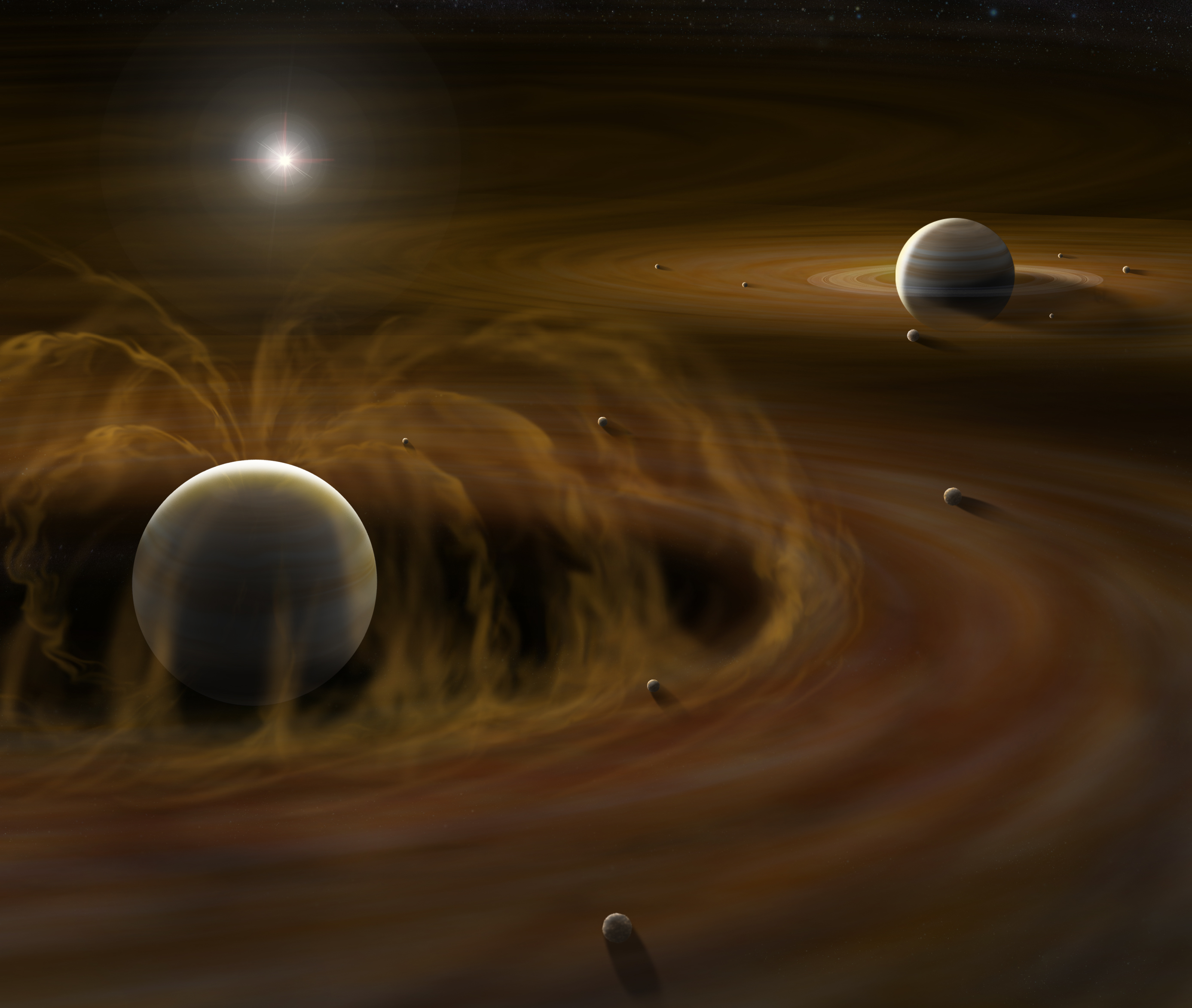
Artist’s impression of the simulations conducted in this research. Jupiter (lower left) has a strong magnetic field which creates a cavity in its circumplanetary disk. Saturn (upper right) lacks a strong magnetic field so its circumplanetary disk evolves without a cavity. Credit: Yuri I. Fujii/L-INSIGHT [Kyoto University], Shinichiro Kinoshita.  Image (5.0MB)

The Solar System’s two largest gas giant planets, Jupiter and Saturn, have extensive but very different families of moons orbiting them. New simulations conducted on the PC cluster at the Center for Computational Astrophysics (CfCA), National Astronomical Observatory of Japan (NAOJ) showed that the planet’s magnetic field plays a role in creating an environment where the new moons can survive and grow, thus shaping the evolution of the system.

Jupiter has more than 100 reported moons, including four large ones (Ganymede, Callisto, Io, and Europa). Saturn has more than 280 reported moons, but only one large one (Titan). So it is a puzzle why Saturn managed to cultivate more moons, but fewer large moons than Jupiter.

A team led by Kyoto University, including researchers from institutes in Japan and China, used the PC cluster at CfCA, NAOJ, to simulate the formation of the moon systems around Jupiter and Saturn. This simulation recreated the planets’ internal structure to calculate the thermal evolution of Jupiter and Saturn and how their magnetic fields have varied over time.

Moons form from material in a “circumplanetary disk” of gas and dust orbiting the young planet. The disk nurtures the young moons, but interactions with the disk may cause them to fall into the planet. The simulations showed that young Jupiter generated a strong planetary magnetic field that created a safe “cavity” around the planet where its young large moons were prevented from migrating too close to their host planet. Young Saturn lacked a strong magnetic field, so only one large moon managed to survive.

“Testing planet formation theory is somewhat difficult because we have only our Solar System for reference, but there are multiple satellite systems close to us whose detailed characteristics we can observe,” says Yuri I. Fujii, primary author of the report announcing these findings. Next, the team is interested in expanding their theory to other moons and potential exomoon systems.


Detailed Article(s)

How Jupiter Cultivated More Large Moons than Saturn —— A magnetospheric cavity explains the difference

Center for Computational Astrophysics

Release Information

Researcher(s) Involved in this Release

  • Yuri Fujii (Graduate School of Human and Environmental Studies, Kyoto University)
  • Masahiro Ogihara (Tsung-Dao Lee Institute, Shanghai Jiao Tong University)
  • Yasunori Hori (Okayama University)

Coordinated Release Organization(s)
  • Kyoto University
  • Okayama University
  • National Astronomical Observatory of Japan, NINS
  • Fujii et al. “Different architecture of Jupiter and Saturn satellite systems from magnetospheric cavity formation” in Nature Astronomy, DOI: 10.1038/s41550-026-02820-x

Related Link(s)

Thursday, March 05, 2026

Proto-stellar disks in their natural habitat

Figure 1: Young disks observed with ALMA at a wavelength of 3 mm. These disks clearly display substructure and the early presence of companion stars. from: Maureira et al., 2025, A&A, 705, A96

Figure 2: Zoom simulations of proto-stellar disk formation inside a molecular cloud (large image). The colour scale indicates the the gas column densities. The insets show multiple zoom regions, in which several dense cores have formed. Six cores (labels and orange borders) were studied in more detail. © MPA

Figure 3: High resolution views of the resulting proto-stellar disks for various simulations of Core 1: the ‘control’ case without magnetic fields called ‘hydro’ (left), the absence of a disk with ‘ideal’ MHD (middle), and the disk forming in the most realistic ‘non-ideal’ MHD simulation (right), including ambipolar diffusion. © MPA


Sun-like stars form within turbulent molecular clouds, encircled by disks of gas and dust - the birthplaces of planets. While the earliest phases of the disk assembly process are obscured by the surrounding dense gas, ALMA can observe proto-stellar disks shortly after their formation. In a project supported by the Excellence Cluster ORIGINS, researchers from MPA, MPE, Harvard, and the University of Cologne performed high-resolution non-ideal magneto-hydrodynamical simulations that self-consistently follow proto-stellar disk formation from their parental turbulent molecular clouds down to stellar scales, spanning over 10 orders of magnitude. The study uncovers the complex paths by which disks assemble and demonstrates that magnetic fields play a central role in their formation and early evolution.

The interstellar medium (ISM), the site of star formation in galaxies, is a very complex environment. Diffuse hot regions (with temperatures of several million Kelvin) often exist in close proximity to cold, dense molecular clouds (with temperatures below a few hundred Kelvin). ‘Stellar feedback’, e.g. the explosion of massive stars as supernovae, creates the hot gas and drives turbulent gas motion in the ISM. This turbulence also causes cooling and can lead to gravitational collapse in certain regions, which form molecular clouds. Stars and their proto-stellar disks form in these molecular clouds from dense cores.

This process covers a large range of spatial scales: using the distance between earth and sun, an ‘astronomical unit’ or AU, as a ruler, the scales range from several 10 million AU for the size of molecular clouds, to a million AU large ‘bubbles’ created by supernovae, to regions smaller than a per cent of an AU for a newly forming proto-star. Specific numerical techniques are required to simulate such a system, as using equally high resolution everywhere would overwhelm even supercomputers. Most previous studies of disk formation simplify the problem and focus on the final disk formation phase after the collapse of dense cloud cores with uniform densities and turbulent velocities imposed by hand. This, however, misses the self-consistent formation of the cloud core structure, kinematics, and magnetic fields from its the large-scale environment.

How important are magnetic fields in this picture? It is well established observationally that clouds cores are strongly magnetized, which impacts their evolution. ‘Ideal’ magneto-hydrodynamical (MHD) models assume that magnetic fields are carried along with the gas. They back-react on the gas through the Lorentz force and provide support against gravitational collapse. The Lorentz force also works against the rotational twisting of magnetic field lines - a situation encountered where a rotating disk surrounds a young star. This resistance slows down gas so much that it falls onto the star, while fast-rotating material leaves the system in a proto-stellar wind - leaving no disks behind. However, extended proto-stellar disks are regularly observed around young stars (Figure 1) – inconsistent with ‘ideal’ MHD models.

This problem can be solved with more realistic ‘non-ideal’ MHD models where neutral and ionized particles move differently (ambipolar diffusion).

With this process, magnetic fields in collapsing cores are reduced and proto-stellar disks are able to form. Numerical simulations of this process are expensive but essential to understand proto-stellar disk formation.

In a project supported by the DFG Excellence Cluster ‘ORIGINS’ researchers from the Max Planck Institute for Astrophysics (MPA,), the Max Planck Institute for Extraterrestrial Physics (MPE,), Harvard, and the University of Cologne performed high-resolution non-ideal MHD ‘zoom’ simulations to self-consistently follow proto-stellar disk formation from their parent turbulent, multi-phase molecular clouds down to stellar sub-AU scales. The unprecedented ‘non-ideal’ MHD simulations span over 10 orders of magnitude in spatial scales.

In this setup with a realistic large-scale turbulent environment (Figure 2), no extended proto-stellar disks can form with ‘ideal’ MHD, while ‘non-ideal’ MHD allows for the early formation of a disk, similar to what is seen in the ‘hydro’ model without any magnetic field (Figure 3). However, the substructures of the disks formed in these different models are clearly distinct from each other. The study indicates that magnetic fields, along with non-ideal MHD effects, and the large-scale, multi-phase and turbulent environment play a central role for proto-stellar disk formation.

Ongoing work building on this study will focus on the evolution of these disks formed in realistic environments over a longer time-span. This will also allow the researchers to study how early stellar companions form.


Authors:

Alexander Mayer
PhD student
Tel:
2042
amayer@mpa-garching.mpg.de

Thorsten Naab
Scientific Staff
tnaab@mpa-garching.mpg.de


Original publication

Mayer, Alexander C.; Naab, Thorsten; Caselli, Paola; et al.
Protostellar discs in their natural habitat ─ the formation of protostars and their accretion discs in the turbulent and magnetized interstellar medium
Monthly Notices of the Royal Astronomical Society, Volume 543, Issue 4, pp. 3321-3344, 24 pp.

DOI


Saturday, October 25, 2025

Hubble sees white dwarf eating piece of Pluto-like objec

Illustration of a cataclysmic variable system, in which a star donates mass to a closely orbiting white-dwarf.
Credit:
M.Weiss/Center for Astrophysics | Harvard & Smithsonian

Astronomers have discovered the most compact cataclysmic variable system containing a strongly magnetized white dwarf. The extreme closeness of the system suggests that the companion may be a metal-poor star — the first time such a star has been paired with a strongly magnetized white dwarf.

Meet the Cataclysmic Variable

Cataclysmic variables are binary star systems that contain a white dwarf and a companion star in uncomfortably close quarters. In these systems, the companion star transfers gas to the white dwarf, resulting in sudden, irregular, and often repeated outbursts as the stolen gas ignites on the scorching surface of the white dwarf.

These bound-together stars typically orbit one another on orbits ranging from about 80 minutes to 10 hours. Though theorists place the minimum orbital period around 76 minutes, a handful of cataclysmic variable systems have cropped up with periods below this limit. The systems that have limboed under the limit are thought to have stellar companions that are more compact than typical main-sequence stars, allowing the white dwarf to nestle in closer.

Phase-folded light curves for Gaia19bxc from the Caltech HIgh-speed Multi-colour camERA (CHIMERA) on the Hale Telescope. The double-peaked light curve is evidence for cyclotron beaming, which occurs in strongly magnetized white dwarfs. Adapted from Galiullin et al. 2025

Exploring Below the Limit

Discovered in 2019 by the Gaia spacecraft, Gaia19bxc is a cataclysmic variable that fluctuates with a period of 64.42 minutes. If this variability is linked to the orbital period of the system, that would place it well below the theoretical minimum period. Adding to the intrigue, early observations also hinted that Gaia19bxc’s white dwarf is strongly magnetic, making the system what’s called a polar. In polar systems, the white dwarf’s magnetic field diverts the accreted matter toward the white dwarf’s poles as it is collected, rather than into a disk around the white dwarf’s equator.

Now, Ilkham Galiullin (Kazan Federal University) and collaborators have analyzed photometry and spectra of Gaia19bxc from the Zwicky Transient Facility, the Hale Telescope, and the Keck I telescope to investigate the nature of this unusual system.

The team’s analysis confirmed that the stars of Gaia19bxc orbit one another every 64.42 minutes, cementing the system’s place below the period minimum for typical cataclysmic variables. The system’s double-peaked light curves and evidence for an accretion stream — rather than an accretion disk — confirm the system’s polar nature, implying a magnetic field strength greater than 10 million Gauss. This makes Gaia19bxc the most closely orbiting system to contain a strongly magnetized white dwarf.

Gaia19bxc’s orbital period compared to known polar cataclysmic variables (gray) as well as the theorized minimum periods for systems containing a metal-poor (Pop II) companion (cyan) and an evolved companion (blue). Credit: Galiullin et al. 2025

A Sign of Discoveries to Come

These observations illuminate the nature of the white dwarf — but what about the companion star?

Galiullin and coauthors saw no evidence for metal lines in Gaia19bxc’s spectrum, nor did they see spectral features arising from a hot companion star. These findings suggest that the companion is an old, cool, compact, metal-poor star, which would make Gaia19bxc the first known polar to contain a metal-poor star. It’s also one of only a handful of cataclysmic variables to contain a metal-poor star and be below the theoretical period minimum.

Though Gaia19bxc is currently in a class of its own, it may not be for long; with the start of the Vera C. Rubin Observatory’s Legacy Survey of Space and Time rapidly approaching, many more cataclysmic variable systems as faint as or fainter than Gaia19bxc may soon be discovered.

By Kerry Hensley

Citation

“Optical Spectroscopy of the Most Compact Accreting Binary Harboring a Magnetic White Dwarf and a Hydrogen-Rich Donor,” Ilkham Galiullin et al 2025 ApJL 990 L57. doi:10.3847/2041-8213/adff82


Wednesday, October 22, 2025

Astronomers Spot Magnetically-Guided Streamer Funneling Star-Building Material into Newborn System in Perseus

Credit: NSF/AUI/NSF NRAO/P.Vosteen

Scientific Paper


New ALMA observations reveal spiral-shaped gas streamer guided by magnetic fields in a star-forming nursery

A team of astronomers led by Paulo Cortes, a scientist with the U.S. National Science Foundation National Radio Astronomy Observatory and the Joint ALMA Observatory, have made a groundbreaking discovery about how young star systems grow. Using the powerful Atacama Large Millimeter/submillimeter Array (ALMA), their team observed— for the first time ever— a narrow, spiral-shaped streamer of gas guided by magnetic fields, channeling matter from the surrounding cloud of a star-forming region in Perseus, directly onto a newborn binary star system.

Stars are born from clouds of gas and dust, but recent observations show star birth is far more dynamic than previously thought. The team’s data captured both the dust and molecules swirling around the newborn binary star system, known as SVS13A, revealing that magnetic fields don’t just thread through these stellar nurseries— they actively steer the flow of material, providing a preferred route for gas to travel onto the disk where new stars and planets form.

Imagine a garden hose, but instead of water it’s smoothly delivering star-building material through a winding path carved by invisible forces. That’s the picture emerging from the ALMA observations: a channel of gas, dubbed a “sub-Alfvénic streamer,” regulated by spiral magnetic field lines. “This new data gives us a new window into star formation,” shares Cortes, “This streamer shows how magnetic fields can regulate star formation by shaping the infall of material, like a dedicated highway for the cars to move along.”

The ALMA images and data reveal two spiral arms of dust encircling the stars, with a streamer of gas that closely follows the same path. This remarkable alignment suggests gas in the streamer moves slowly compared to what was previously believed, supporting the idea of a magnetized channel rather than a turbulently collapsing cloud. The fact that such a streamer exists and connects the cloud to the disk— feeding material in a controlled way— means that gravity and magnetism both play crucial roles in building stars and shaping the planets that may eventually form around them.

This pioneering result, accepted for publication in Astrophysical Journal Letters, marks the first time astronomers have directly mapped both the streamer and its guided magnetic field in a single observation.


About NRAO

The National Radio Astronomy Observatory (NRAO) is a facility of the U.S. National Science Foundation, operated under cooperative agreement by Associated Universities, Inc.

About ALMA

The Atacama Large Millimeter/submillimeter Array (ALMA), an international astronomy facility, is a partnership of the European Southern Observatory (ESO), the U.S. National Science Foundation (NSF) and the National Institutes of Natural Sciences (NINS) of Japan in cooperation with the Republic of Chile. ALMA is funded by ESO on behalf of its Member States, by NSF in cooperation with the National Research Council of Canada (NRC) and the National Science and Technology Council (NSTC) in Taiwan and by NINS in cooperation with the Academia Sinica (AS) in Taiwan and the Korea Astronomy and Space Science Institute (KASI).

ALMA construction and operations are led by ESO on behalf of its Member States; by the National Radio Astronomy Observatory (NRAO), managed by Associated Universities, Inc. (AUI), on behalf of North America; and by the National Astronomical Observatory of Japan (NAOJ) on behalf of East Asia. The Joint ALMA Observatory (JAO) provides the unified leadership and management of the construction, commissioning and operation of ALMA.


Thursday, October 09, 2025

Cosmic Tug-of-War: Gravity Reshapes Magnetic Fields in Star Clusters

This image from NASA’s Spitzer Space Telescope shows a star formation region in molecular cloud NGC 6334, also known as the Cat's Paw Nebula. The colors correspond with emission at 3.6 microns (blue), 4.5 microns (green), and 8 microns (red). This cloud is actively forming massive stars, and is located in the constellation Scorpius, between 4,200 to 5,500 light-years from Earth. ALMA data overlaid on the image shows details of four specific areas that were observed (NGC 6334I, NGC 6334I(N), NGC 6334IV and NGC 6334V), revealing invisible forces of magnetism and gravity as they wrestle and shape the formation of stars deep within the giant molecular cloud. The color scale in the ALMA images represents the intensity of the dust emission at 1.3mm and the drapery lines represent the orientation of the magnetic field. Credit: Credit for composite image: background, NASA/JPL-Caltech; overlay: ESO/NAOJ/NSF NRAO; image created by NSF/AUI/NSF NRAO/M. Weiss.


A record-breaking ALMA survey delivers the first statistical evidence that collapsing gas clouds realign their magnetic fields, tipping the cosmic balance in favor of gravity

Astronomers have captured the clearest picture yet of how massive stars are born, revealing a dramatic interplay between gravity and magnetic fields in some of our galaxy’s most dynamic star forming regions. A team led by Dr. Qizhou Zhang from the Center for Astrophysics | Harvard & Smithsonian used the Atacama Large Millimeter/submillimeter Array (ALMA) to conduct the largest and most detailed survey to date of magnetic fields in 17 regions where clusters of massive stars are forming. These observations, reaching down to just a few thousand astronomical units (about 10 times the distance from the Sun to Pluto) offer the first statistical insight into how the invisible forces of magnetism and gravity wrestle and shape the formation of stars deep within giant molecular clouds.

Star formation requires gas in space to be squeezed to densities more than ten trillion times greater than what’s typically found in interstellar clouds. But this epic collapse isn’t driven by gravity alone—magnetic fields and turbulence both push back, resisting the pull. For decades, astronomers have debated which force dominates as gas clouds shrink and stars ignite.

New ALMA observations by Zhang’s team have provided crucial answers. By measuring how the directions of magnetic fields change at different distances from young protostars, the researchers found that as gas becomes denser, gravity begins to win this cosmic tug-of-war. Magnetic fields, which start out mainly resisting gravity, are gradually pulled into alignment with infalling gas, showing a clear sign that gravity takes over as the leading force shaping the collapsing cloud.

This study marks the first time astronomers have statistically traced how magnetic fields behave as gravity pulls a star-forming cloud inward at precise measurements, in thousands of astronomical units, across a large sample of massive cluster-forming regions. The findings revealed a surprising pattern: the magnetic field orientations do not just occur randomly. Instead, they show two preferences: sometimes lining up with the direction of gravity, or sometimes perpendicular—evidence for a complex and evolving relationship between these two cosmic forces.

“With ALMA’s extraordinary sensitivity and resolution, we can now probe these cosmic birthplaces in unprecedented detail,” said Zhang. “We see that gravity actually reorients the magnetic field as clouds collapse, offering new clues about how massive stars—and the clusters they inhabit—emerge from the interstellar medium.”

Understanding how stars form is fundamental to almost every field of astronomy, shaping everything from the origins of our own Sun to the evolution of galaxies. This work not only settles long-standing debates about the relative importance of magnetic fields and gravity in massive star formation, but also gives scientists powerful new tools to test and refine theories about the life cycles of stars, planets, and cosmic clouds.

As the largest ALMA polarimetric study of its kind, this project sets a new standard for understanding both the visible and invisible components of our galaxy. The results reveal that while magnetic fields shape star-forming clouds, gravity ultimately takes the lead in birthing the most massive stars—an insight made possible by ALMA’s cutting-edge technology.

Link


About NRAO

The National Radio Astronomy Observatory (NRAO) is a facility of the U.S. National Science Foundation, operated under cooperative agreement by Associated Universities, Inc.

About ALMA

The Atacama Large Millimeter/submillimeter Array (ALMA), an international astronomy facility, is a partnership of the European Southern Observatory (ESO), the U.S. National Science Foundation (NSF) and the National Institutes of Natural Sciences (NINS) of Japan in cooperation with the Republic of Chile. ALMA is funded by ESO on behalf of its Member States, by NSF in cooperation with the National Research Council of Canada (NRC) and the National Science and Technology Council (NSTC) in Taiwan and by NINS in cooperation with the Academia Sinica (AS) in Taiwan and the Korea Astronomy and Space Science Institute (KASI).

ALMA construction and operations are led by ESO on behalf of its Member States; by the National Radio Astronomy Observatory (NRAO), managed by Associated Universities, Inc. (AUI), on behalf of North America; and by the National Astronomical Observatory of Japan (NAOJ) on behalf of East Asia. The Joint ALMA Observatory (JAO) provides the unified leadership and management of the construction, commissioning and operation of ALMA.


Friday, September 19, 2025

ALMA Captures the Birthplace of a Magnetized Protostellar Jet for the First Time

Fig.1: HH 211 Jet and Outflow Observed by JWST and ALMA. (a) The JWST composite image (in color, Ray et al. 2023) reveals the jet and outflow traced by H₂ and CO emission lines in the near-infrared. However, thick dust around the protostar blocks JWST’s view of the jet structures within about 1,000 astronomical units. (b) In contrast, ALMA’s CO image in the submillimeter band (shown in grayscale) penetrates this obscured region, clearly unveiling the jet being launched from the accretion disk (green). Credit: Lee et al.

Fig.2: HH 211 Jet and Outflow Observed by JWST and ALMA. The JWST composite image (in color, Ray et al. 2023) reveals the jet and outflow traced by H₂ and CO emission lines in the near-infrared. However, thick dust around the protostar blocks JWST’s view of the jet structures within about 1,000 astronomical units. In contrast, ALMA’s CO image in the submillimeter band (shown in grayscale) penetrates this obscured region, clearly unveiling the jet being launched from the accretion disk (green). Credit: Lee et al.


In the universe, stars and planets don’t form suddenly. Their formation resembles a lengthy construction process. Near a young star, there is often a surrounding disk of gas and dust called an accretion disk. Material in this disk keeps rotating, gathering together, and eventually falling onto the star, helping it grow over time. However, this process faces a major challenge: if the material in the accretion disk spins too quickly, it becomes hard for it to fall inward.

Astronomers have long believed that jets — streams of gas ejected at high speeds from near the star — can carry away the excess rotational energy, thereby easing the inward movement of material. However, the launching points of these jets are extremely close to the star, only tens of times closer than Earth is to the Sun, and previous observations have not been sufficient to resolve their details or clearly determine their origins.

An international research team led by Chin-Fei Lee at the Academia Sinica Institute of Astronomy and Astrophysics (ASIAA) used the Atacama Large Millimeter/submillimeter Array (ALMA) in Chile to observe an extremely young protostar system called HH 211. This protostar is only about 35,000 years old, has just 6% of the Sun’s mass, and is located approximately 1,000 light-years away. It features a bright bipolar jet, and notably, this jet is one of the few known examples where a magnetic field has been detected, providing a rare opportunity to test models of magnetic-field–driven ejection.

The observations reveal that the jet moves at over 100 kilometers per second but rotates very slowly, with a specific angular momentum of only 4 au·km/s. Using conservation of angular momentum and energy, the team determined that the jet originates from the innermost edge of the accretion disk, just 0.02 astronomical units from the star — in excellent agreement with the theoretical X-wind model. This model explains how a magnetic field can act like a slingshot to propel gas outward, and it predicts a magnetic field strength consistent with previous measurements.

This discovery marks the first time the launch point of a magnetized jet has been identified with such high precision, directly confirming that jets are truly the “plumbers” of star formation—removing the last bits of angular momentum from the accretion disk so material can fall smoothly onto the star. In the future, these observations will not only help solve the mystery of how stars form but also enhance our understanding of the early stages of planet formation, since planets develop within these same disks.

Scientific Paper


Additional Information

This research was presented in a paper, “A magnetized protostellar jet launched from the innermost disk at the truncation radius,” by Lee et al., which appeared in Scientific Reports.

This release is adapted from the original
Science Highlight issued by the Academia Sinica Institute of Astronomy and Astrophysics (ASIAA) in Taiwan.

The Atacama Large Millimeter/submillimeter Array (ALMA), an international astronomy facility, is a partnership of the European Southern Observatory (ESO), the U.S. National Science Foundation (NSF), and the National Institutes of Natural Sciences (NINS) of Japan in cooperation with the Republic of Chile. ALMA is funded by ESO on behalf of its Member States, by NSF in cooperation with the National Research Council of Canada (NRC) and the National Science and Technology Council (NSTC) in Taiwan, and by NINS in cooperation with the Academia Sinica (AS) in Taiwan and the Korea Astronomy and Space Science Institute (KASI).

ALMA construction and operations are led by ESO on behalf of its Member States; by the National Radio Astronomy Observatory (NRAO), managed by Associated Universities, Inc. (AUI), on behalf of North America; and by the National Astronomical Observatory of Japan (NAOJ) on behalf of East Asia. The Joint ALMA Observatory (JAO) provides the unified leadership and management of ALMA's construction, commissioning, and operation.


Contacts:

Nicolás Lira
Education and Public Outreach Officer
Joint ALMA Observatory, Santiago - Chile
Phone:
+56 2 2467 6519
Cel: +56 9 9445 7726
Email: nicolas.lira@alma.cl

Dr. Mei-Yin Chou
Institute of Astrophysics and Astronomy
Academia Sinica
Phone:
+886-2-2366-5389
Email: cmy@asiaa.sinica.edu.tw


Tuesday, September 16, 2025

Astronomers Reveal Planet Building’s Secret Ingredient: Magnetism

T
his artist's impression of magnetic fields threading TW Hydrae’s protoplanetary disk shows a change in morphology as they encounter gaps and structures in the disk, suggesting a direct link between magnetic fields and the sculpting of planet-forming regions. Credit: NSF/AUI/NSF NRAO/M. Weiss.
Hi-Res File


New ALMA observations show invisible magnetic “threads” stitching together TW Hya’s young solar system

Astronomers have created a detailed map revealing the magnetic fields weaving through TW Hydrae, one of the closest known stars with a planet-forming disk, using the Atacama Large Millimeter/submillimeter Array (ALMA). Led by Dr. Richard Teague at MIT, this new research sheds light on the invisible forces shaping new planets, like those that formed our own solar system over 4.5 billion years ago.

Planets originate in swirling disks of gas and dust that encircle young stars. While telescopes have revealed the shapes and gaps in these disks, scientists have struggled to measure magnetic fields, the unseen agents that guide and sculpt planet-forming material. Magnetic fields are widely thought to play a crucial role in how disks evolve and create planets, but until now, no one had been able to unambiguously map their presence and structure directly in a disk like TW Hya’s.

Previous searches looked for magnetic fields by detecting specific patterns of polarized light, but those signals are exceedingly faint and easily lost amid other effects. Teague and colleagues examined the broadening of specific radio signals—the fingerprints of molecules swirling in the disk—measured by ALMA. By decoding subtle changes in light from the CN molecule, the team could spot the signature widening caused by magnetic field interactions, a phenomenon known as the Zeeman Effect.

The scientists’ analysis revealed magnetic fields as strong as 10 milligauss—a thousand times weaker than a refrigerator magnet, but immense on planet-forming scales—threading the disk between 60 and 120 astronomical units (AU) from the star (one AU is the distance from Earth to the Sun). Intriguingly, the field’s structure changes at a location where a prominent gap slices through the disk, suggesting a direct link between magnetic activity and the sculpting of planet-forming regions.

“The presence and pattern of these fields look remarkably like the kind that may have threaded the solar nebula as our own planets were forming,” said Teague, “This is the best look we’ve ever had at the invisible hand shaping the birthplaces of new worlds.”

This approach opens a new window onto questions that have puzzled scientists for decades: how do magnetic fields drive the evolution of disks? How do they influence which planets form and where? As telescopes and instruments grow more sensitive, astronomers hope to apply these techniques to many more disks. “We are entering an era where we can finally see the magnetic blueprints that help build new planetary systems,” adds Teague. Improvements to ALMA, like the upcoming Wideband Sensitivity Upgrade, have been designed to do exactly this, “Our findings show that what has been promised with the upgrade will be possible on a grand scale.”

This research is a major leap toward understanding not just how planets form around other stars, but how our own cosmic neighborhood came to be.


About NRAO

The National Radio Astronomy Observatory (NRAO) is a facility of the U.S. National Science Foundation, operated under cooperative agreement by Associated Universities, Inc.

About ALMA

The Atacama Large Millimeter/submillimeter Array (ALMA), an international astronomy facility, is a partnership of the European Southern Observatory (ESO), the U.S. National Science Foundation (NSF) and the National Institutes of Natural Sciences (NINS) of Japan in cooperation with the Republic of Chile. ALMA is funded by ESO on behalf of its Member States, by NSF in cooperation with the National Research Council of Canada (NRC) and the National Science and Technology Council (NSTC) in Taiwan and by NINS in cooperation with the Academia Sinica (AS) in Taiwan and the Korea Astronomy and Space Science Institute (KASI).

ALMA construction and operations are led by ESO on behalf of its Member States; by the National Radio Astronomy Observatory (NRAO), managed by Associated Universities, Inc. (AUI), on behalf of North America; and by the National Astronomical Observatory of Japan (NAOJ) on behalf of East Asia. The Joint ALMA Observatory (JAO) provides the unified leadership and management of the construction, commissioning and operation of ALMA.


Wednesday, August 27, 2025

Braided Magnetic Flux Ropes Are Found at Both Human and Light Year Scales

Four braided structures. (a) astrophysical jet M-87, 3000 light years long; (b) Double Helix Nebula, 70 light years long; (c) solar prominence, 3000 kilometers long; (d) solar loop manufactured in Bellan lab at Caltech, 3 centimeters long. Credit: (a) Passeto et al., Sophia Dagnello, NRAO/AUI/NSF; (b) NASA/JPL-Caltech/M. Morris (UCLA); (c) High Altitude Observatory Archives; (d) Yang Zhang, Caltech Bellan Plasma Lab

Four braided structures. (a) astrophysical jet M-87, 3000 light years long; (b) Double Helix Nebula, 70 light years long; (c) solar prominence, 3000 kilometers long; (d) solar loop manufactured in Bellan lab at Caltech, 3 centimeters long. Credit: (a) Passeto et al., Sophia Dagnello, NRAO/AUI/NSF; (b) NASA/JPL-Caltech/M. Morris (UCLA); (c) High Altitude Observatory Archives; (d) Yang Zhang, Caltech Bellan Plasma Lab


Investigating solar corona structures has led Paul Bellan, Caltech professor of applied physics, and his former graduate student Yang Zhang (PhD '24) to discover a new equilibrium state of the magnetic field and its associated plasma. The solar corona, the outermost part of the Sun's atmosphere, is much less dense than the Sun's surface but is a million times hotter. The corona is composed of strong magnetic fields confining plasma, a gaseous soup of charged particles (electrons and ions). The new equilibrium, called a double helix, applies not only to the solar corona but also to much larger astrophysical configurations such as the Double Helix Nebula located near the center of the Milky Way galaxy.

Solar corona structures such as flares often have the form of magnetic flux ropes: twisted tubes of plasma-containing magnetic fields. Such a rope can be visualized as a plasma-filled garden hose with a stripe wrapped around it in a helical pattern. An electric current flows along the length of the hose, and the helical stripe corresponds to the twisted magnetic field. Because it is charged, plasma conducts electric currents and is attached, or "frozen," into magnetic fields.

Magnetic flux ropes occur in a variety of situations ranging from the human scale—say, a laboratory experiment—to the absolutely huge: solar flares that are few hundred thousand kilometers long. Astrophysical structures with magnetic flux ropes can also span hundreds or even thousands of light-years.

In a large laboratory vacuum chamber, Bellan and Zhang (now a NASA Jack Eddy postdoctoral fellow at Princeton) produced solar flare replicas measuring between 10 and 50 centimeters long. "We have two electrodes inside the vacuum chamber, which has coils producing a magnetic field spanning the electrodes. Then we apply high voltage across the electrodes to ionize initially neutral gas to form a plasma," Yang explains. "The resulting magnetized plasma configuration automatically forms a braided structure."

This braided structure consists of two flux ropes that wrap around one another to form a double helix structure. In the experiments, this double helix was observed to be in a stable equilibrium—in other words, it holds its structure without tending to twist tighter or untwist. In a new paper, Zhang and Bellan demonstrate that the stable equilibrium of these double-helix flux ropes can be understood, analyzed, and predicted accurately in mathematical terms.

Though the properties of single flux ropes are well known, braided flux ropes were not well understood—especially those configurations in which the electric currents flow in the same direction along both of the braided strands. Scientists have modeled the other possible situation—where currents flow in one direction in one flux rope and in the opposite direction in the other—but this scenario is thought to be unlikely in nature.

The same-current configuration is especially important because it would be susceptible to kinking and expansion driven by hoop forces—phenomena observed both in braided solar structures and in laboratory experiments. Such kinking and expansion should not occur when current flows in opposite directions in the braided strands (a "no-net-current" state).

Previously, scientists assumed that braided flux ropes where the strands have current flowing in the same direction would always merge, because parallel currents magnetically attract each another. However, in 2010, researchers at Los Alamos National Laboratory found that such flux ropes instead bounce off one another as they come closer together.

"There was clearly something more complicated going on when the flux ropes are braided, and now we have shown what that is," Bellan says. "If you have electrical currents flowing along two helical wires that wrap around each other to form a braided structure, as seen in our lab, the components of the two currents flowing along the length of the two wires are parallel and attract, but the components of the two currents flowing in the wrapping direction are anti-parallel and repel. This combination of both attractive and repulsive forces means there will be a critical helical angle at which these opposing forces balance, producing an equilibrium. If the helical flux ropes twist tighter, there will be too much magnetic repulsion; if they twist more loosely, there will be too much magnetic attraction. At the critical angle of twist, the helical structure arrives at its lowest energy state, or equilibrium."

The next task was to create a mathematical model of this behavior—something not previously done. Using what Bellan describes as "brute force mathematics," Zhang created a set of equations that could apply to multiple flux tubes in various configurations, including braided ropes, and showed there is indeed a state at which the attractive and repulsive forces balance each other, creating an equilibrium. "And as an unexpected bonus, Yang can calculate the magnetic fields inside and outside the flux ropes, and the current and pressure inside them," Bellan says, "giving us a full picture of the behavior of these braided structures."

Zhang tested his mathematical model against the Double Helix Nebula, an astrophysical plasma formation located 25,000 light-years from Earth that covers a 70 light-year swath of space, to see if the equations could describe a large model as well as it did the structures he and Bellan created in the lab. "What was rather amazing about this calculation is that Yang didn't really need to know much about the nebula," Bellan says. "Just knowing the diameter of the strands and the periodicity of the twist, numbers that can be observed astronomically, Yang was able to predict the angle of twist that yielded an equilibrium structure, and that was consistent with observations of this nebula. One of the most exciting aspects of this research is that magnetohydrodynamics, the theory of magnetized plasmas, turns out to be fantastically scalable. When I first started looking into this, I thought the phenomena of magnetic structures at different scales were qualitatively similar, but because their sizes are so different, they couldn't be described by the same equations. It turns out that this is not so. What we see in lab experiments and in solar and astrophysical observations are governed by the same equations."

The paper, titled "Magnetic Double Helix," was published in Physical Review Letters. The work was funded by the National Science Foundation.

Source: Caltech/News


Contact:

Caltech Media Relations

mr@caltech.edu


Friday, July 11, 2025

Galactic Mystery: How “Ice Cubes” Survive in the Milky Way’s Blazing Bubbles

An artist's interpretation of the highest-latitude neutral hydrogen clouds ever detected within the Fermi Bubbles in the center of our Milky Way Galaxy. The cold clouds reside more than 13,000 light-years above the Galactic center, in a region where frigid materials like this were never expected to be discovered. Credit: NSF/AUI/NSF NRAO/P.Vosteen


Astronomers discover fragile hydrogen clouds surviving inside the superheated Fermi Bubbles, revealing the Milky Way’s most extreme outflows are younger and more complex than ever imagined

clouds of cold, neutral hydrogen gas—akin to “ice cubes”—surviving deep inside the Fermi Bubbles, two enormous lobes of superheated plasma erupting from the center of our Milky Way Galaxy. These cold clouds reside more than 13,000 light-years above the Galactic center, in a region where frigid materials like this were never expected to be discovered.

The Fermi Bubbles are among the most violent environments in our Galaxy, filled with plasma at temperatures over a million degrees Kelvin. In such a harsh setting, cold gas should quickly evaporate or be torn apart—much like ice cubes tossed into an active volcano. Yet, these clouds remain structured, dynamic, and surprisingly long-lived, with lifetimes estimated at several million years. This resilience matches independent estimates of the Fermi Bubbles’ age and challenges existing models, which often predict much longer formation times for the Bubbles themselves.

“These findings change our previous assumptions, showing that cold gas can persist in the hot, turbulent Fermi Bubbles,” explained Rongmon Bordoloi, the lead scientist of this research and an associate professor North Carolina State University, “We didn’t know that cold gas can survive in these extreme outflows. This challenges our understanding of how galaxies recycle and expel matter.”

To find these cold clouds, the research team conducted the deepest-ever 21 cm radio survey of the Fermi Bubbles, using the NSF GBT’s unmatched sensitivity and resolution. They identified eleven cold hydrogen clouds at unprecedented heights, making these the highest-latitude neutral hydrogen clouds ever detected within the Bubbles. The NSF GBT’s unique capabilities were essential for this breakthrough—no other instruments can match its sensitivity and sky coverage for this type of observation.

“We believe that these cold clouds were swept up from the Milky Way’s center and carried aloft by the very hot wind that formed the Fermi bubbles”, said Jay Lockman an astronomer at the Green Bank Observatory and coauthor of the paper. “Just as you can’t see the motion of the wind on Earth unless there are clouds to track it, we can’t see the hot wind from the Milky Way but can detect radio emission from the cold clouds it has entrained.”

These findings also challenge the previously understood age of the Fermi Bubbles, which are now likely believed to have been formed more recently. The survival of these fragile, cold clouds suggests that the Fermi Bubbles may be only a few million years old—pointing to a dramatic outburst from the Milky Way’s central black hole, rather than star formation, as their likely origin. “If the Bubbles were older, these clouds would have long since vanished,” adds Bordoloi.

Scientists wonder how these clouds formed or survived. Did they condense out of the hot plasma, were they swept up from the galaxy’s disk, or are they remnants of pre-existing structures? What physical processes—such as magnetic fields or pressure confinement—are allowing them to resist destruction in such an extreme environment.

“Finding these cold clouds so high up in the Fermi Bubbles was unexpected”, adds co-author Andrew Fox, ESA-AURA Astronomer at the Space Telescope Science Institute in Baltimore, MD. “It challenges our understanding of where they came from and what their ultimate fate will be.”

This discovery pushes the boundaries of what scientists thought possible in our Galaxy’s most extreme environments. It opens new avenues for research into how galaxies evolve, how matter cycles through the cosmos, and what physical mechanisms allow fragile structures to persist amid cosmic violence. Future studies will focus on unraveling the origins and survival mechanisms of these clouds, providing critical tests for models of galactic feedback and outflows.


About GBO

The Green Bank Observatory, part of the National Radio Astronomy Observatory, is a facility of the U.S. National Science Foundation, operated under cooperative agreement by Associated Universities, Inc.


Tuesday, April 08, 2025

How stars stay young and spin slowly

Growth of density (top row) and magnetic field strength (bottom row) as a function of time in the collision between two stars of 0.7 and 0.6 solar masses. After the first contact at t = 0 h (not shown), the two stars pass each other (t = 5 h) and get disrupted (t = 12 h). The magnetic fields begin to grow due to instabilities and compression.© MPA

Computer simulations suggest that the amplification of magnetic fields in stellar collisions may play an important role in the formation of a particular subset of stars in clusters. Blue straggler stars in clusters appear not only bluer, but also younger than other cluster members. One proposed explanation for their apparently different ages is that they are the result of stellar collisions. However, this would require the resulting star to spin down efficiently without losing too much mass. Scientists at the Max Planck Institute for Astrophysics have now shown, using sophisticated 3D simulations, that the energy of the magnetic field is greatly amplified in the collisions of low-mass stars, providing a potentially efficient spin-down mechanism.

Clusters of stars, containing hundreds of thousands of stars that formed around the same time and from the same molecular cloud, provide astronomers with an excellent laboratory for studying how stars of similar age, composition and mass evolve over time. However, one particular subset, the 'blue stragglers', pose a challenge: they appear bluer and brighter than the other cluster members, and therefore appear to be younger. Why don't they age like typical cluster stars?

The answer could be that they actually formed later than the other stars in stellar collisions and thus gained mass. However, since most collisions between two low-mass stars are off-axis (rather than perfectly head-on), the resulting massive star would rotate rapidly and lose most of its mass during the spin-down to a stable state – unless the spin-down is efficient. While many proposed spin-down mechanisms require magnetic fields, it has remained unclear for more than two decades whether they actually exist and whether they have the strength to play a significant role.

A team at the Max Planck Institute for Astrophysics (MPA) has now presented sophisticated 3D moving-mesh magnetohydrodynamical simulations of collisions between low-mass main-sequence stars, which show that the magnetic field energy is amplified by a factor of up to 10 billion during collisions. At the core of the merged star, the magnetic field can reach 100 million Gauss (for comparison, the magnetic field in sunspots can reach up to 5000 Gauss). "Our simulations showed that the magnetic field in stellar collisions can be amplified, which is a promising sign for an effective spin-down mechanism," says MPA postdoctoral researcher Taeho Ryu, who led the study. "This amplification is independent of collision parameters, so it could happen every time two stars collide in a cluster."

The simulations also show a flattened, rotating gas structure around the collision, which could indicate the formation of a disk. Magnetic braking and an effect called "disk locking" could further facilitate the spin-down. "Our next step will be to actually follow the long-term evolution after the collision to see how these stars evolve over millions or billions of years and whether they really end up as the blue straggler stars that we observe," adds Ryu.

This animation shows the same simulation as the figure above. The left panel shows the evolution of the density, the right panel the evolution of the magnetic field strength as two stars of 0.7 and 0.6 solar masses collide.


Contact:

Taeho Ryu
Postdoc
2358

tryu@mpa-garching.mpg.de


Original publication

Ryu, Taeho; Sills, Alison; Pakmor, Ruediger; de Mink, Selma; Mathieu, Robert
Magnetic Field Amplification during Stellar Collisions between Low-mass Stars
ApJ, Volume 980, Issue 2, id.L38, 11 pp.


Source | DOI


Thursday, March 27, 2025

NASA's Webb Captures Neptune's Auroras For First Time

Credits/Image: NASA, ESA, CSA, STScI, Heidi Hammel (AURA), Henrik Melin (Northumbria University), Leigh Fletcher (University of Leicester), Stefanie Milam (NASA-GSFC)


For the first time, NASA’s James Webb Space Telescope has captured bright auroral activity on Neptune. Auroras occur when energetic particles, often originating from the Sun, become trapped in a planet’s magnetic field and eventually strike the upper atmosphere. The energy released during these collisions creates the signature glow.

In the past, astronomers have seen tantalizing hints of auroral activity on Neptune, for example, in the flyby of NASA’s Voyager 2 in 1989. However, imaging and confirming the auroras on Neptune has long evaded astronomers despite successful detections on Jupiter, Saturn, and Uranus. Neptune was the missing piece of the puzzle when it came to detecting auroras on the giant planets of our solar system.

“Turns out, actually imaging the auroral activity on Neptune was only possible with Webb’s near-infrared sensitivity,” said lead author Henrik Melin of Northumbria University, who conducted the research while at the University of Leicester. “It was so stunning to not just see the auroras, but the detail and clarity of the signature really shocked me.”

The data was obtained in June 2023 using Webb’s Near-Infrared Spectrograph. In addition to the image of the planet, astronomers obtained a spectrum to characterize the composition and measure the temperature of the planet’s upper atmosphere (the ionosphere). For the first time, they found an extremely prominent emission line signifying the presence of the trihydrogen cation (H3+), which can be created in auroras. In the Webb images of Neptune, the glowing aurora appears as splotches represented in cyan.

“H3+ has a been a clear signifier on all the gas giants — Jupiter, Saturn, and Uranus — of auroral activity, and we expected to see the same on Neptune as we investigated the planet over the years with the best ground-based facilities available,” explained Heidi Hammel of the Association of Universities for Research in Astronomy, Webb interdisciplinary scientist and leader of the Guaranteed Time Observation program in which the data were obtained. “Only with a machine like Webb have we finally gotten that confirmation.”

The auroral activity seen on Neptune is also noticeably different from what we are accustomed to seeing here on Earth, or even Jupiter or Saturn. Instead of being confined to the planet’s northern and southern poles, Neptune’s auroras are located at the planet’s geographic mid-latitudes — think where South America is located on Earth.

This is due to the strange nature of Neptune’s magnetic field, originally discovered by Voyager 2 in 1989, which is tilted by 47 degrees from the planet’s rotation axis. Since auroral activity is based where the magnetic fields converge into the planet’s atmosphere, Neptune’s auroras are far from its rotational poles.

The ground-breaking detection of Neptune’s auroras will help us understand how Neptune’s magnetic field interacts with particles that stream out from the Sun to the distant reaches of our solar system, a totally new window in ice giant atmospheric science.

From the Webb observations, the team also measured the temperature of the top of Neptune’s atmosphere for the first time since Voyager 2’s flyby. The results hint at why Neptune’s auroras remained hidden from astronomers for so long.

“I was astonished — Neptune’s upper atmosphere has cooled by several hundreds of degrees,” Melin said. “In fact, the temperature in 2023 was just over half of that in 1989.”

Through the years, astronomers have predicted the intensity of Neptune’s auroras based on the temperature recorded by Voyager 2. A substantially colder temperature would result in much fainter auroras. This cold temperature is likely the reason that Neptune’s auroras have remained undetected for so long. The dramatic cooling also suggests that this region of the atmosphere can change greatly even though the planet sits over 30 times farther from the Sun compared to Earth.

Equipped with these new findings, astronomers now hope to study Neptune with Webb over a full solar cycle, an 11-year period of activity driven by the Sun’s magnetic field. Results could provide insights into the origin of Neptune’s bizarre magnetic field, and even explain why it’s so tilted.

“As we look ahead and dream of future missions to Uranus and Neptune, we now know how important it will be to have instruments tuned to the wavelengths of infrared light to continue to study the auroras,” added Leigh Fletcher of Leicester University, co-author on the paper. “This observatory has finally opened the window onto this last, previously hidden ionosphere of the giant planets.”

These observations, led by Fletcher, were taken as part of Hammel’s Guaranteed Time Observation program 1249. The team’s results have been published in Nature Astronomy.

The James Webb Space Telescope is the world's premier space science observatory. Webb is solving mysteries in our solar system, looking beyond to distant worlds around other stars, and probing the mysterious structures and origins of our universe and our place in it. Webb is an international program led by NASA with its partners, ESA (European Space Agency) and CSA (Canadian Space Agency).


About This Release

Credits:

Media Contact:

Hannah Braun
Space Telescope Science Institute, Baltimore, Maryland

Christine Pulliam
Space Telescope Science Institute, Baltimore, Maryland

Science: Henrik Melin (Northumbria University)

Permissions: Content Use Policy

Contact Us: Direct inquiries to the News Team.

Related Links and Documents