Showing posts with label protostellar disks. Show all posts

Thursday, March 05, 2026

Proto-stellar disks in their natural habitat

Figure 1: Young disks observed with ALMA at a wavelength of 3 mm. These disks clearly display substructure and the early presence of companion stars. from: Maureira et al., 2025, A&A, 705, A96

Figure 2: Zoom simulations of proto-stellar disk formation inside a molecular cloud (large image). The colour scale indicates the the gas column densities. The insets show multiple zoom regions, in which several dense cores have formed. Six cores (labels and orange borders) were studied in more detail. © MPA

Figure 3: High resolution views of the resulting proto-stellar disks for various simulations of Core 1: the ‘control’ case without magnetic fields called ‘hydro’ (left), the absence of a disk with ‘ideal’ MHD (middle), and the disk forming in the most realistic ‘non-ideal’ MHD simulation (right), including ambipolar diffusion. © MPA


Sun-like stars form within turbulent molecular clouds, encircled by disks of gas and dust - the birthplaces of planets. While the earliest phases of the disk assembly process are obscured by the surrounding dense gas, ALMA can observe proto-stellar disks shortly after their formation. In a project supported by the Excellence Cluster ORIGINS, researchers from MPA, MPE, Harvard, and the University of Cologne performed high-resolution non-ideal magneto-hydrodynamical simulations that self-consistently follow proto-stellar disk formation from their parental turbulent molecular clouds down to stellar scales, spanning over 10 orders of magnitude. The study uncovers the complex paths by which disks assemble and demonstrates that magnetic fields play a central role in their formation and early evolution.

The interstellar medium (ISM), the site of star formation in galaxies, is a very complex environment. Diffuse hot regions (with temperatures of several million Kelvin) often exist in close proximity to cold, dense molecular clouds (with temperatures below a few hundred Kelvin). ‘Stellar feedback’, e.g. the explosion of massive stars as supernovae, creates the hot gas and drives turbulent gas motion in the ISM. This turbulence also causes cooling and can lead to gravitational collapse in certain regions, which form molecular clouds. Stars and their proto-stellar disks form in these molecular clouds from dense cores.

This process covers a large range of spatial scales: using the distance between earth and sun, an ‘astronomical unit’ or AU, as a ruler, the scales range from several 10 million AU for the size of molecular clouds, to a million AU large ‘bubbles’ created by supernovae, to regions smaller than a per cent of an AU for a newly forming proto-star. Specific numerical techniques are required to simulate such a system, as using equally high resolution everywhere would overwhelm even supercomputers. Most previous studies of disk formation simplify the problem and focus on the final disk formation phase after the collapse of dense cloud cores with uniform densities and turbulent velocities imposed by hand. This, however, misses the self-consistent formation of the cloud core structure, kinematics, and magnetic fields from its the large-scale environment.

How important are magnetic fields in this picture? It is well established observationally that clouds cores are strongly magnetized, which impacts their evolution. ‘Ideal’ magneto-hydrodynamical (MHD) models assume that magnetic fields are carried along with the gas. They back-react on the gas through the Lorentz force and provide support against gravitational collapse. The Lorentz force also works against the rotational twisting of magnetic field lines - a situation encountered where a rotating disk surrounds a young star. This resistance slows down gas so much that it falls onto the star, while fast-rotating material leaves the system in a proto-stellar wind - leaving no disks behind. However, extended proto-stellar disks are regularly observed around young stars (Figure 1) – inconsistent with ‘ideal’ MHD models.

This problem can be solved with more realistic ‘non-ideal’ MHD models where neutral and ionized particles move differently (ambipolar diffusion).

With this process, magnetic fields in collapsing cores are reduced and proto-stellar disks are able to form. Numerical simulations of this process are expensive but essential to understand proto-stellar disk formation.

In a project supported by the DFG Excellence Cluster ‘ORIGINS’ researchers from the Max Planck Institute for Astrophysics (MPA,), the Max Planck Institute for Extraterrestrial Physics (MPE,), Harvard, and the University of Cologne performed high-resolution non-ideal MHD ‘zoom’ simulations to self-consistently follow proto-stellar disk formation from their parent turbulent, multi-phase molecular clouds down to stellar sub-AU scales. The unprecedented ‘non-ideal’ MHD simulations span over 10 orders of magnitude in spatial scales.

In this setup with a realistic large-scale turbulent environment (Figure 2), no extended proto-stellar disks can form with ‘ideal’ MHD, while ‘non-ideal’ MHD allows for the early formation of a disk, similar to what is seen in the ‘hydro’ model without any magnetic field (Figure 3). However, the substructures of the disks formed in these different models are clearly distinct from each other. The study indicates that magnetic fields, along with non-ideal MHD effects, and the large-scale, multi-phase and turbulent environment play a central role for proto-stellar disk formation.

Ongoing work building on this study will focus on the evolution of these disks formed in realistic environments over a longer time-span. This will also allow the researchers to study how early stellar companions form.


Authors:

Alexander Mayer
PhD student
Tel:
2042
amayer@mpa-garching.mpg.de

Thorsten Naab
Scientific Staff
tnaab@mpa-garching.mpg.de


Original publication

Mayer, Alexander C.; Naab, Thorsten; Caselli, Paola; et al.
Protostellar discs in their natural habitat ─ the formation of protostars and their accretion discs in the turbulent and magnetized interstellar medium
Monthly Notices of the Royal Astronomical Society, Volume 543, Issue 4, pp. 3321-3344, 24 pp.

DOI


Thursday, June 12, 2025

From Stardust to Stone: Windswept Grains Hold Clues to Planet’s Beginnings

Large dust grains observed surrounding outflows of young protostellar binary system L1551 IRS5.
Credit: B. Saxton U.S. National Science Foundation/NSF National Radio Astronomy Observatory

Astronomers discover that stellar winds help dust grains grow into planet-building pebbles, offering fresh insight into the origins of rocky planets like Earth

The Atacama Large Millimeter/submillimeter Array (ALMA) has uncovered a key piece of the puzzle in how rocky planets, such as Earth, form around young stars. For decades, scientists have struggled to explain how dust grains in the disks around newborn stars grow from tiny dust grains to planet-building “pebbles” without either spiraling into the star or shattering in collisions—a challenge known as the “meter-size barrier.”

A team of more than 50 astronomers and chemists from the world’s leading scientific institutes used ALMA for this large program of research, known as the “Fifty AU STudy of the chemistry in the disk/envelope systems of Solar-like protostars” or FAUST. The team studies the chemistry of the dense molecular gas in the envelopes of a representative sample of Solar-like protostars, and now, for the first time ever, have directly observed millimeter-sized dust grains—about 10,000 times larger than typical interstellar dust—embedded in the walls of a protostellar outflow cavity. These grains appear to have been lifted from the dense inner protostellar disk by winds and then deposited farther out, away from where they can fall back onto the disk, and continue growing. This process gives the grains more time and space to stick together, potentially overcoming a long-standing barrier to planet formation.

Astronomers directly observed these millimeter-sized dust grains in the walls of the protostellar outflow cavity of the young L1551 IRS5 binary system, showing these grains can grow much larger than previously thought in the early stages of planet formation. These findings offer new insight into the processes that may have led to the formation of our own Solar System and highlight a previously underestimated pathway for planet formation.

“This discovery not only provides a new mechanism for building planets but also offers a glimpse into how our own Solar System may have formed,” said Giovanni Sabatini, a scientist with the National Institute for Astrophysics (INAF) at the Arcetri Astrophysical Observatory in Florence, and leader of this research. “The findings open exciting new questions about the diversity of planetary systems in our galaxy and bring us closer to understanding our cosmic origins,” adds Claire Chandler, NSF NRAO scientist and a co-PI of the FAUST collaboration.


About NRAO

TThe National Radio Astronomy Observatory (NRAO) is a facility of the U.S. National Science Foundation, operated under cooperative agreement by Associated Universities, Inc.

About ALMA

TThe Atacama Large Millimeter/submillimeter Array (ALMA), an international astronomy facility, is a partnership of the European Southern Observatory (ESO), the U.S. National Science Foundation (NSF) and the National Institutes of Natural Sciences (NINS) of Japan in cooperation with the Republic of Chile. ALMA is funded by ESO on behalf of its Member States, by NSF in cooperation with the National Research Council of Canada (NRC) and the National Science and Technology Council (NSTC) in Taiwan and by NINS in cooperation with the Academia Sinica (AS) in Taiwan and the Korea Astronomy and Space Science Institute (KASI).

ALMA construction and operations are led by ESO on behalf of its Member States; by the National Radio Astronomy Observatory (NRAO), managed by Associated Universities, Inc. (AUI), on behalf of North America; and by the National Astronomical Observatory of Japan (NAOJ) on behalf of East Asia. The Joint ALMA Observatory (JAO) provides the unified leadership and management of the construction, commissioning and operation of ALMA.


Monday, April 22, 2024

Twinkle Twinkle Baby Star, ‘Sneezes’ Tell us How You Are

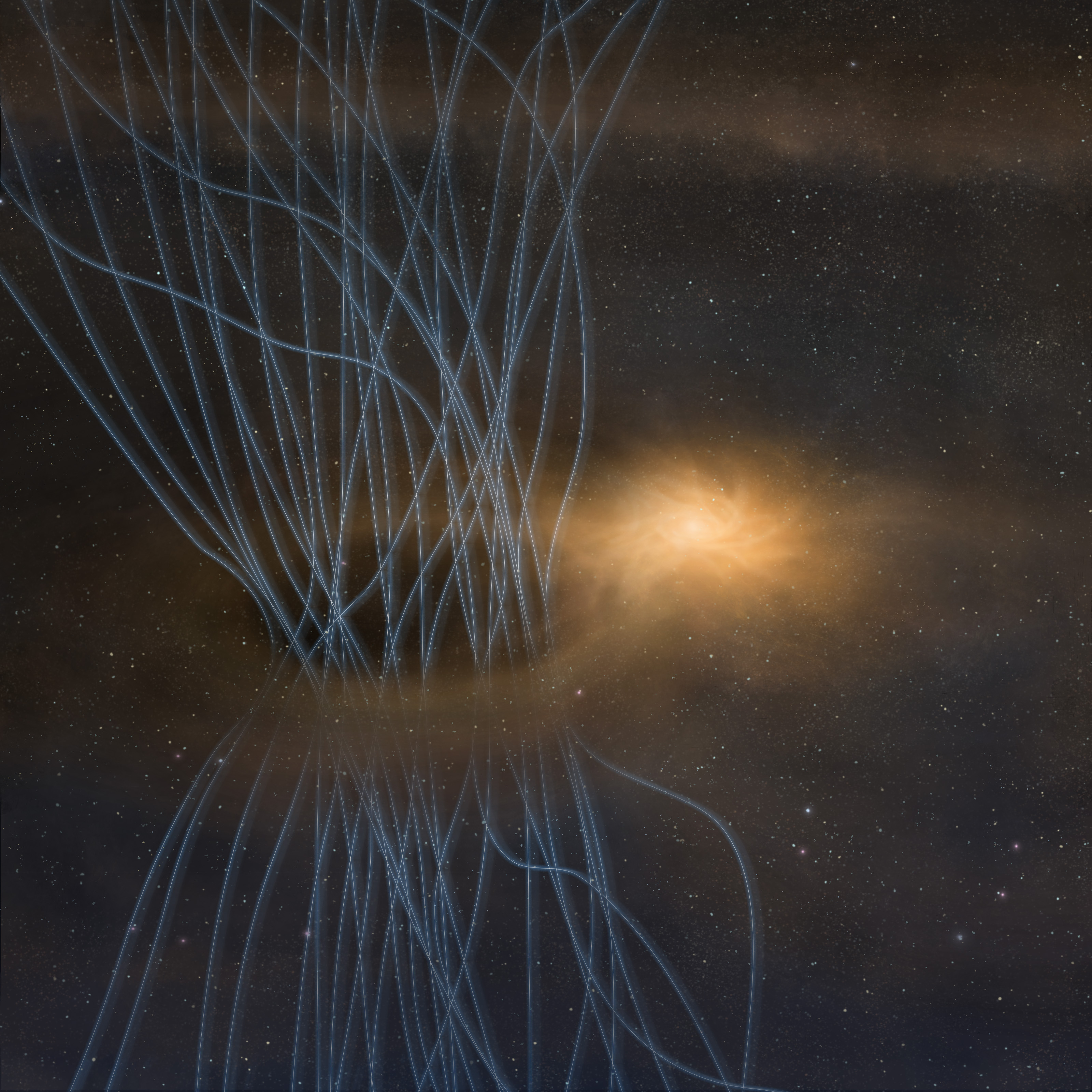
Artist’s conception of a ‘sneeze’ of magnetic field lines, dust, and gas ejected from a baby star.
Credit: ALMA (ESO/NAOJ/NRAO)).
Download image (1.6MB)


Astronomers have discovered the remnants of powerful ‘sneezes’ expelling gas, dust, and electromagnetic energy around stars in the process of forming. The team believes these sneezes help the baby star expel excess magnetic flux, and as such may play a vital role in enabling the star to form.

A star forms from a cloud of gas and dust. Interstellar magnetic field lines pass through these clouds. As the cloud contracts to form the star, the magnetic field lines get pulled along. But observations of young stars show that most of this magnetic energy is lost during the formation process. The question is, where does it go?

Looking for the answer to this question, a team led by Kazuki Tokuda, an astronomer affiliated with NAOJ and Kyushu University, used ALMA (Atacama Large Millimeter/submillimeter Array) to study one of the clouds with a baby star, known as Taurus Dense Core MC 27. This stellar nursery is located approximately 450 light-years from Earth in the direction of the constellation Taurus.

One of the leading theories was that the magnetic field gradually weakened over time as the baby star grew. But as Tokuda explains, “As we analyzed our data, we found something quite unexpected. There were these ‘spike-like’ structures extending a few astronomical units from the protostellar disk. As we dug in deeper, we found that these were spikes of expelled magnetic flux, dust, and gas.”

Tokuda continues, “This is a phenomenon called ‘interchange instability’ where instabilities in the magnetic field react with the different densities of the gases in the protostellar disk, resulting in an outward expelling of magnetic flux. We dubbed this a baby star’s ‘sneeze’ as it reminded us of when we expel dust and air at high speeds.”

Additionally, other spikes were observed several thousands of astronomical units away from the protostellar disk. The team hypothesizes that these were indications of past ‘sneezes.’ And similar spike-like structures have been observed in other young stars, indicating that they may be ubiquitous. These sneezes could help explain how baby stars shed excess magnetic energy and might be a vital part of the star formation process.


Detailed Article(s)


Kyushu University


Release Information

Researcher(s) Involved in this Release

Kazuki Tokuda (Department of Earth and Planetary Science, Faculty of Science, Kyushu University / National Astronomical Observatory of Japan)


Coordinated Release Organization(s)

Kyushu University
National Astronomical Observatory of Japan


Paper(s)

Kazuki Tokuda et al. “Discovery of Asymmetric Spike-like Structures of the 10 au Disk around the Very Low-luminosity Protostar Embedded in the Taurus Dense Core MC 27/L1521F with ALMA”, in The Astrophysical Journal, DOI: 10.3847/1538-4357/ad2f9a


Related Link(s)


Monday, October 16, 2023

Protostars feed from beyond their envelopes


The B5 complex (red and green; radio images taken with the VLA and GBT) seen within its neighborhood, embedded in dust (blue) as seen with ESA’s Herschel Space Observatory, in infrared light. Credit: B. Saxton (NRAO/AUI/NSF); ESA


This diagram shows the gas flow in the Barnard 5 region at the different scales investigated in this work. At the left, fresh gas moves inside the filaments toward condensations (black contours) and the protostar (yellow star) in the direction indicated by the light green arrows. The yellow curve shows the streamer transporting material towards the protostellar disk. The right images zoom into the streamer (yellow), as well as the two outflows (red and blue) and the protostellar disk (brown). The top right schematics shows the front view; the bottom right schematics is rotated by 90° to observe the streamer unobstructed by the outflow cone. © MPE


This plot shows the central velocities for two components, where gas is falling towards the protostar (black star). The two colourbars to the right indicate the velocities of the blueshifted and redshifted clusters, respectively. While a streamline model confirmed that the blueshifted cluster is indeed a streamer transporting gas to the protostar, the classification of the red component as a “streamer" is tentative for now. © MPE


A recent study led by researchers at the Max Planck Institute for Extraterrestrial Physics challenges conventional notions of star formation by revealing the intricate connection between streamers and filaments. Focusing on the star-forming region Barnard 5, the study traces the journey of material from larger scales to protostellar disks, uncovering a remarkable relationship between elongated filaments and gas streamers. In particular, the team discovered a sizeable streamer, which suggests that young stars can receive additional material even after the so-believed main accretion phase.

Traditionally, star formation has been associated with the gradual accumulation of material within natal envelopes, cool and dense regions in the larger molecular cloud. Once the core density reaches a certain limit, it will collapse and form a proto-star. While the protostar continues to accrete material from the newly formed circumstellar disk around it, the classical picture considers this core region as an isolated unit. In recent years, however, there has been an explosion in the discovery of streamers, channels that can surpass the limits of the envelope, with lengths up to 10 000 AU (approximately 0.15 light years). These streamers nourish the disk with fresh gas, but it is still uncertain where they originate. For the first time, researchers at the Max Planck Institute for Extraterrestrial Physics (MPE) have now found clues of a connection between streamers and filaments in star-forming regions, offering a new perspective on the birth of stars.

The team focused on the Barnard 5 region (B5), a dense molecular cloud in the constellation of Perseus. In Barnard 5, two filaments harbour a lonely protostar – but not for long: there are three other condensations that will become a bounded multiple star system in the future. With the combination of three powerful instruments, ALMA in the Chilean desert, NOEMA in the French Alps and the IRAM 30m telescope in Pico Veleta, Spain, the researchers at MPE followed the flow of gas across various scales. “Our aim was to trace the journey of gas from outside of the filament that contains the protostar to the protostellar disks, bridging the gap between different scales of star formation,” says Teresa Valdivia-Mena, PhD student in the Center for Astrochemical Studies at MPE and lead-author of the study.

On larger scales, the researchers found that chemically fresh gas, untainted by the star-formation process, enters the filaments from the bigger Barnard 5 region. The velocity of the gas traced by NOEMA and the 30m IRAM telescope is consistent with infall from outside the two filaments. When the gas reaches the filaments’ spines, it flows in the direction of the three condensations and the protostar. Zooming in with ALMA, the team found a streamer feeding the protostellar disk. What is striking about these observations is that – despite different resolutions – the speed of the chemically fresh gas coming from outside the filaments matches the speed of the streamer. Both the location and the speed along the streamer were reproduced using a theoretical model of free-falling material, and seem to be connected to the flow on larger scales. This means that the chemically unprocessed gas from beyond the filaments can reach the protostar, giving it access to a larger reservoir of material to grow even after the main accretion phase.

“These results are very exciting, because they show that the star-formation process is a multiscale process,” emphasises Jaime Pineda, second author on the Barnard 5 study. “Accretion flows and streamers connect the young stellar objects with the parental cloud. This dynamic process of feeding the young star might even affect the whole disk and planet formation process, although we need future observations to confirm this.” In addition, these observations imply that pristine material from the interstellar cloud can be an important ingredient for the future planetary system. The composition of new-born planets as well as their atmospheres might therefore be influenced by a much larger region than previously assumed.

In essence, this study already paints a vivid picture of the complex dance of gas flows from streamers to filaments and ultimately to protostellar scales. “Our research emphasises how interconnected various scales in the star formation process are, highlighting the profound impact of these flows on the evolution of nascent stars,” concludes Valdivia-Mena.


Contacts:

Maria Teresa Valdivia Mena
phd student
tel: +49 89 30000-3546
tel: +49 89 30000-3950

mvaldivi@mpe.mpg.de

Jaime Pineda Fornerod
scientist
tel: +49 89 30000-3610
tel: +49 173 3517084
tel: +49 89 30000-3950

jpineda@mpe.mpg.de

Hannelore Hämmerle
press officer
tel> +49 89 30000-3980
tel: +49 89 30000-3569

hanneh@mpe.mpg.de

Original publication

M. T. Valdivia-Mena, J. E. Pineda, D. M. Segura-Cox, P. Caselli, A. Schmiedeke, S. Choudhury, S. S. R. Offner, R. Neri, A. Goodman, G. A. Fuller
Flow of gas detected from beyond the filaments to protostellar scales in Barnard 5
A&A, 677, A92 (2023


Source


Friday, June 24, 2022

Close Encounter More Than 10,000 Years Ago Stirred Up Spirals in an Accretion Disk


The three plots starting from the bottom left are snapshots from the numerical simulation, capturing the system right at the flyby event, 4,000 years after, and 8,000 years after, respectively. The top right image is from the ALMA observations, showing the disk with spirals and the two objects around it, corresponding to the system at 12,000 years after the flyby event. Image credit: Lu et al.

An international research team from China, the U.S., and Germany has used high-resolution observational data from ALMA and discovered a massive accretion disk with two spiral arms surrounding a 32 solar mass protostar in the Galactic Center. This disk could be perturbed by a close encounter with a flyby object, thus leading to the formation of the spiral arms. This finding demonstrates that the formation of massive stars may be similar to that of lower-mass stars through accretion disks and flybys.

Accretion disks around protostars, also known as 'protostellar disks,' are essential components in star formation because they continuously feed gas into protostars from the environment. In this sense, they are stellar cradles where stars are born and raised. Accretion disks surrounding solar-like low-mass protostars have been extensively studied in the last few decades, leading to a wealth of observational and theoretical achievements. For massive protostars, especially early O-type ones of more than 30 solar masses, it is still unclear whether and how accretion disks play a role in their formation. These massive stars are far more luminous than the Sun, with intrinsic luminosities up to several hundreds of thousands of times the solar value, which strongly impact the environment of the entire Galaxy. Therefore, understanding the formation of massive stars is of great importance.

At a distance of about 26,000 light-years away from us, the Galactic Center is a unique and important star-forming environment. The most well-known object here would undoubtedly be the supermassive black hole Sgr A*. Besides that, there is a massive reservoir of dense molecular gas, mainly in the form of molecular hydrogen (H2), which is the raw material for star formation. The gas will start to form stars once gravitational collapse is initiated. However, direct observations of star-forming regions around the Galactic Center are challenging, given the considerable distance and the contamination from foreground gas between the Galactic Center and us. A very high resolution, combined with high sensitivity, is necessary to resolve details of star formation in this region.

The research team used the long-baseline observations of ALMA to achieve a resolution of 40 milliarcseconds. Wecan easily spot a baseball hidden in Osaka from Tokyo at such a resolution. With these high-resolution,high-sensitivityALMA observations,the team has discovered an accretion disk around the Galactic Center. The disk has a diameter of about 4,000 astronomical units and is surrounding a forming early O-type star of 32 solar mass. “This system is among the most massive protostars with accretion disks and represents the first direct imaging of a protostellar accretion disk in the Galactic Center,” said Qizhou Zhang, a co-author and an astrophysicist at the Center for Astrophysics. This discovery suggests that the formation of massive early O-type stars does go through a phase with accretion disks involved, and such a conclusion is valid for the Galactic Center.

What is more interesting is that the disk clearly displays two spiral arms. Such spiral arms resemble those found in spiral galaxies but are rarely seen in protostellar disks. Spiral arms could emerge in accretion disks due to fragmentation induced by gravitational instabilities. However, the disk discovered in this study is hot and turbulent, thus able to balance its gravity. The team detected an object of about three solar masses at about 8,000 astronomical units away from the disk. Through a combined analysis of analytic solutions and numerical simulations, they reproduce a scenario where an object flew by the disk more than 10,000 years ago and perturbed the disk, leading to the formation of spiral arms. "The numerical simulation matches perfectly with the ALMA observations. We conclude that the spiral arms in the disk are relics of the flyby of the intruding object," said Xing Lu, the lead author and an associate researcher at the Shanghai Astronomical Observatory of the Chinese Academy of Sciences.

This finding demonstrates that accretion disks at the early evolutionary stages of star formation are subject to frequent dynamic processes such as flybys, which would substantially influence the formation of stars and planets. It is interesting to note that flybys have also happened in our Solar System. A binary stellar system known as Scholz's Star flew by the solar system about 70,000 years ago, probably penetrating through the Oort cloud and sending comets to the inner solar system. This study suggests that for more massive stars, especially in the high stellar density environment around the Galactic Center, such flybys should also be frequent. "The formation of stars should be a dynamical process, with many mysteries still unresolved," said Xing Lu. "With more upcoming high-resolution ALMA observations, we expect to disentangle these mysteries in star formation."

Scientific Paper


Additional Informaton

These research results were published by X. Lu et al. as "A massive Keplerian protostellar disk with flyby-induced spirals in the Central Molecular Zone" in Nature Astronomy (DOI:10.1038/s41550-022-01681-4).
 
This research was supported by the initial funding of scientific research for high-level talents at Shanghai Astronomical Observatory, JSPS KAKENHI Grant Number JP20K14528, and the National Natural Science Foundation of China grants W820301904 and 12033005.

The original image release was published by the National Astronomical Observatory of Japan (NAOJ)  an ALMA partner on behalf of East Asia.

El Atacama Large Millimeter/submillimeter Array (ALMA), una instalación astronómica internacional, es una asociación entre el Observatorio Europeo Austral (ESO), la Fundación Nacional de Ciencia de EE. UU. (NSF) y los Institutos Nacionales de Ciencias Naturales de Japón (NINS) en cooperación con la República de Chile. ALMA es financiado por ESO en representación de sus estados miembros, por NSF en cooperación con el Consejo Nacional de Investigaciones de Canadá (NRC) y el Ministerio de Ciencia y Tecnología de Taiwán (MOST), y por NINS en cooperación con la Academia Sinica (AS) de Taiwán y el Instituto de Ciencias Astronómicas y Espaciales de Corea del Sur (KASI).

La construcción y las operaciones de ALMA son conducidas por ESO en nombre de sus estados miembros; por el Observatorio Radioastronómico Nacional (NRAO), gestionado por Associated Universities, Inc. (AUI), en representación de Norteamérica; y por el Observatorio Astronómico Nacional de Japón (NAOJ) en nombre de Asia del Este. El Joint ALMA Observatory (JAO) tiene a su cargo la dirección general y la gestión de la construcción, así como la puesta en marcha y las operaciones de ALMA.


Contacts

Nicolás Lira
Education and Public Outreach Coordinator
Joint ALMA Observatory, Santiago - Chile
Phone: +56 2 2467 6519
Cell phone: +56 9 9445 7726
Email: nicolas.lira@alma.cl

Junko Ueda
Public Information Officer
NAOJ
Email: junko.ueda@nao.ac.jp

Bárbara Ferreira
ESO Public Information Officer
Garching bei München, Germany
Phone::+49 89 3200 6670
Email: pio@eso.org

Amy C. Oliver
Public Information News Manager
National Radio Astronomical Observatory (NRAO), USA
Phone: +1 434 242 9584
Email:
aoliver@nrao.edu