Showing posts with label computer simulations. Show all posts

Sunday, April 05, 2026

New Leibniz ScienceCampus SCALES advances innovative modelling approaches in astrophysics and climate physics

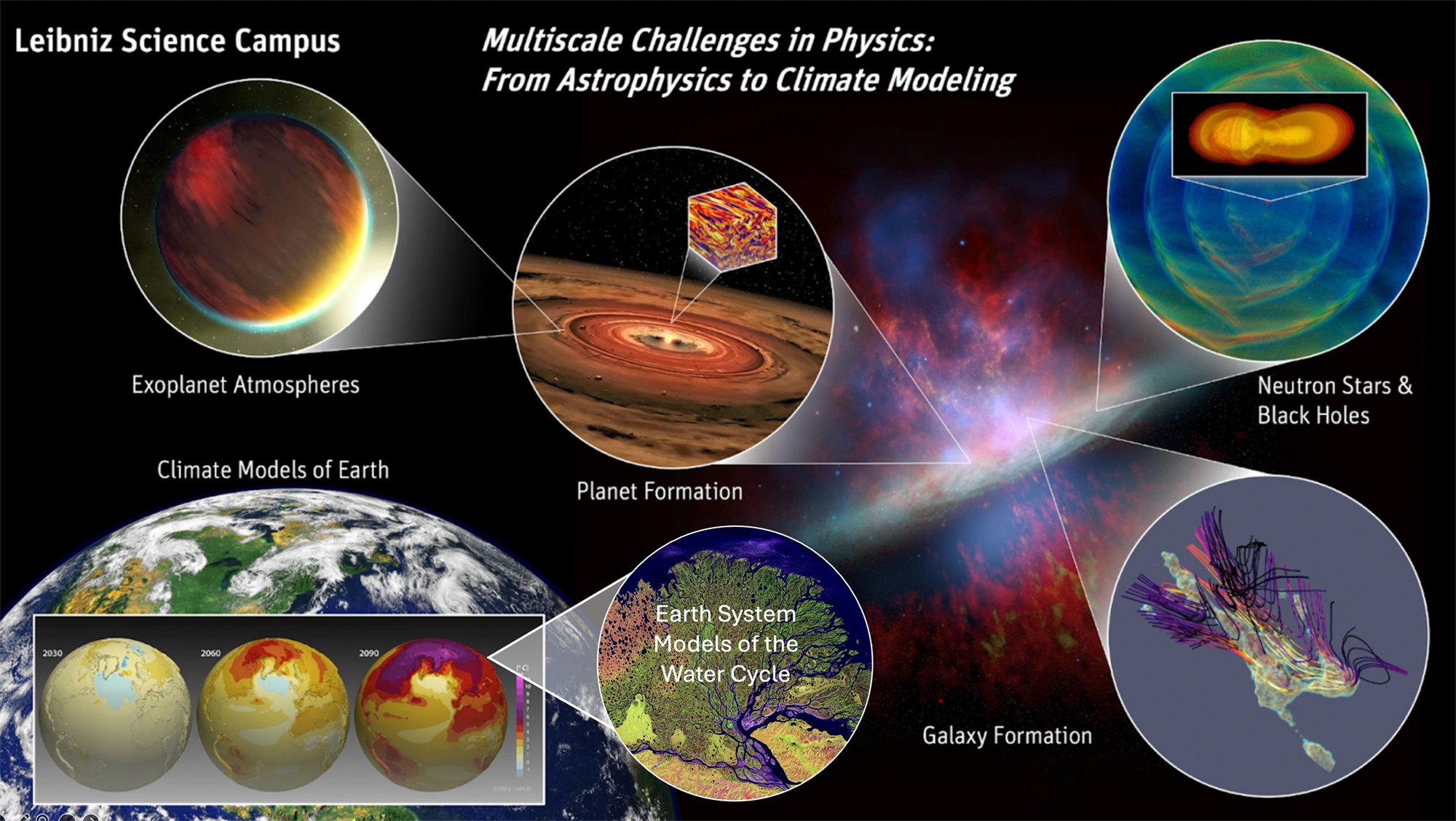
>Overview of the physical systems studied within the Leibniz ScienceCampus SCALES focusing on astrophysical topics and topics related to climate physics and Earth system modelling.

Downloads: Small screen size [600 x 338, 320 KB] - Big screen size [1000 x 564, 820 KB] - Original size [2000 x 1128, 2.8 MB]


March 25, 2026 // With the approval of the new Leibniz ScienceCampus “Multiscale Challenges: from Astrophysics to Climate Models,” the Leibniz Association is launching an ambitious initiative to bring together leading expertise from astrophysics, climate science, and applied mathematics. At the same time, the funding marks a milestone for Brandenburg: emerging from the successful initiative of the Leibniz Institute for Astrophysics Potsdam (AIP), this establishes the first ever Leibniz ScienceCampus in the state.

The Senate of the Leibniz Association approved funding for a new Leibniz ScienceCampus, “Multiscale Challenges: from Astrophysics to Climate Models” on March 24, 2026. The Campus will be jointly funded by the participating Leibniz institutes, the Leibniz Association, the University of Potsdam, and the state of Brandenburg, with a total budget of 4.12 million euros.

Under the leadership of the AIP, the Campus is being established in close collaboration with the University of Potsdam as well as the participating Leibniz institutes — the Potsdam Institute for Climate Impact Research and the Weierstrass Institute for Applied Analysis and Stochastics. Additional partners include the Deutsche Elektronen-Synchrotron DESY, the Max Planck Institute for Gravitational Physics, and the German Center for Astrophysics. The initiative will be coordinated by Prof. Dr. Christoph Pfrommer (AIP), who serves as a spokesman together with Prof. Dr. Tim Dietrich from University of Potsdam.

Brandenburg's Minister of Science, Dr. Manja Schüle, offers her congratulations: “A milestone for Brandenburg’s scientific community: we are establishing our first Leibniz ScienceCampus. This is a substantive win, as the interdisciplinary research approach integrates state-of-the-art simulation techniques across both small and large scales. This enables researchers to better understand and predict complex phenomena – from galaxy formation to climate change – by bringing together expertise in astrophysics, climate science, and applied mathematics. It’s also a structural win for our state, as the AIP, the University of Potsdam, and the Potsdam Institute for Climate Impact Research will be able to pool their expertise. Strengthening collaboration will be a central pillar of our forthcoming research strategy – and the Leibniz ScienceCampus ‘Multiscale Challenges: from Astrophysics to Climate Models’ is already anticipating this direction and putting it into practice. This is what a forward-looking research ecosystem ‘made in Brandenburg’ looks like.”

“Many of the most pressing scientific questions arise from the interplay of processes operating across vastly different spatial and temporal scales. Whether in galaxies or here on Earth, small-scale processes shape large-scale behavior. The ScienceCampus brings together expertise from astrophysics and Earth system science to develop new computational and data-driven approaches that model these interactions more consistently and precisely across all scales, ultimately enabling better predictions,” says Prof. Dr. Christoph Pfrommer.

At its core are next-generation simulation techniques, hybrid modelling strategies, and the use of artificial intelligence, particularly neural networks that learn physical laws. The goal is to significantly improve the representation of subscale processes in both astrophysical and climate models. In climate research, this will enable more precise projections and more robust strategies for the mitigation of and adaptation to climate change. In astrophysics, the Campus will advance our understanding of key phenomena such as galaxy formation, neutron star mergers, and exoplanet atmospheres, thereby bridging the gap to climate physics.

“The new ScienceCampus provides a unique platform to integrate methods and perspectives from different disciplines and to advance truly interdisciplinary research. By combining observational data, theoretical modelling, and state-of-the-art computational techniques, we can generate new insights into complex systems. This collaborative approach will not only strengthen the Potsdam–Berlin research region but also enhance international visibility and contribute to tackling urgent societal issues like climate change,” says Prof. Dr. Tim Dietrich.

Leibniz ScienceCampuses promote strategic, thematically focused collaboration between Leibniz institutes, universities, and external partners within a regional context. They strengthen interdisciplinarity, pool scientific excellence, and create internationally visible research centers. Through this program, the Leibniz Association deepens long-term cooperation among its member institutions and their partners, enhances regional networking, and further expands its international scientific visibility.

Source: Leibniz Institute for Astrophysics Potsdam (AIP)/News


The Leibniz Institute for Astrophysics Potsdam (AIP) is dedicated to astrophysical questions ranging from the study of our sun to the evolution of the cosmos. The key areas of research focus on stellar, solar and exoplanetary physics as well as extragalactic astrophysics. A considerable part of the institute's efforts aims at the development of research technology in the fields of spectroscopy, robotic telescopes, and e-science. The AIP is the successor of the Berlin Observatory founded in 1700 and of the Astrophysical Observatory of Potsdam founded in 1874. The latter was the world’s first observatory to emphasize explicitly the research area of astrophysics. The AIP has been a member of the Leibniz Association since 1992.


Prof. Dr.
Christoph Pfrommer
Science contact
Phone: +49 331 7499 513

cpfrommer@aip.de

Tilo Bergemann
Media contact
Phone: +49 331 7499 803

presse@aip.de


Leibniz Institute for Astrophysics Potsdam (AIP)
An der Sternwarte 16
14482 Potsdam, Germany
Phone: +49 (0) 331 74 99 0
Fax: +49 (0) 331 74 99 209

info@aip.de
[Contact]


Thursday, February 05, 2026

An old puzzle solved: astronomers discover the world is flat

The average distribution of dark matter for a large number of computer simulations, each of which was required to form a Milky Way and an Andromeda Nebula (the two bright blobs at the centre) with the observed position and velocity, and also to match the observed velocity at the position of 31 nearby galaxies (cyan dots). The box size is 20 times the Milky Way-Andromeda separation with a depth of one-half this separation. Colour represents the amount of dark matter at each point, while arrows show its velocity relative to a uniformly expanding universe. The left image is looking down onto the Local Mass Sheet, while the right one views it from the side. Notice that velocities relative to a uniform Hubble flow are small in both panels in the region occupied by the cyan dots, implying that these galaxies appear to match Hubble’s Law almost perfectly in the simulated universes. © MPA


A pan-European group of astronomers has used newly developed computer technology to solve a 100 year-old puzzle. While most galaxies in our neighborhood move away from us almost as expected for an unperturbed cosmic expansion, our nearest giant neighbour is approaching at high speed. Systematic numerical experimentation demonstrates this rapid approach is due to massive dark matter haloes surrounding both Andromeda and our own Milky Way, but this mass does not slow down somewhat more distant galaxies because its effects are counteracted by more distant dark matter which lies in a vast flattened sheet out to distances well beyond the neighboring galaxies considered.

Why is the Andromeda Nebula heading straight for us, while other nearby galaxies are receding?

It is nearly a century since the American astronomer Edwin Hubble discovered the expansion of the Universe. Distant galaxies similar to our own Milky Way move away from us at speeds that increase in proportion to their distance, reflecting the origin of the Universe in a Big Bang, an enormous explosion 14 billion years ago. Hubble already knew, however, that this is not true for our nearest giant neighbour, the Andromeda Nebula, which is 2.5 million light-years away and coming towards us at 100 kilometers per second. In 1959, two European astronomers, Franz Kahn and Lodewijk Woltjer, calculated that in order for the gravity of the two galaxies to have reversed the initial expansion, their total mass must be more than 1000 billion times the mass of the Sun – much more than the mass of all their stars put together. This was the first detection of unseen Dark Matter around our Milky Way and its neighbour.

In the 1970s and 1980s, accurate distances began to be measured for somewhat more distant galaxies. It became clear that not only are they are mostly moving away from us but that their speeds are close to those predicted by the overall cosmic expansion – starting in a “Big Bang” 14 billion years ago. Studies of galaxies at distances from 1.5 to 4 times the Milky Way-Andromeda separation found the deviations to be actually quite small – the total amount of matter required to account for these deviations out to the most distant galaxy cannot be larger than that already needed to explain the approach speed of the Milky Way and Andromeda. However, there are several other large galaxies in this region, which should contribute additional mass. Why then does the cosmic expansion around us appear so weakly perturbed?

A pan-European group of astronomers has recently used newly developed computer technology to find the solution to this puzzle. They set the machine the following task: Find representative regions of the early Universe with small deviations from uniformity that are statistically similar to the Cosmic Microwave Background, but that evolve to produce galaxies similar to the Milky Way and Andromeda, with the appropriate positions and velocities. At the same time, other nearby galaxies should show motions and positions matching those of observed nearby galaxies.

Apparently, the puzzle was not hard for the computer: it was able to find hundreds of examples satisfying all the given conditions. The average mass distribution for a large number of these is shown in the figure. In the region containing the local galaxies, motions relative to a uniform expansion are indeed small – the Hubble flow is almost unperturbed – while at larger distances material is actually moving away from the Milky Way faster than the Hubble flow.

Max Planck Institute for Astrophysics How the computer solved the puzzle can be seen in the right image of the figure, which shows a view of the same box rotated by 90 degrees. The mass is concentrated to a flattened sheet extending well beyond the region occupied by the local galaxies considered. All the galaxies are inside the sheet and even at larger distances most known galaxies are still found in a flattened distribution known as the Local Supercluster. The computer has inferred this larger structure even though it was not told about its existence. The large low-density regions above and below the sheet are also seen in the galaxy distribution and are known as the Local Voids. However, the large velocities predicted there are not observable, because in the real universe there are no galaxies there to be measured.

Thus, there are two reasons why the local Hubble flow seems so weakly perturbed despite the large combined mass of the Milky Way and Andromeda. Mass at larger distances is counteracting the gravity of the central galaxies by pulling material outwards. In addition, there are no galaxies where the predicted infall effects are large, so inflow onto the Local Sheet is hidden.

The solution to the puzzle is that the total mass distribution in our environment is at least as sheet-like as the distribution of galaxies. The world around our Local Group of galaxies is indeed flat out to distances of tens of millions of light-years.


Author:

Simon White
Emeritus Director
Tel:
2211
Tel: +49 170 248 1178
swhite@mpa-garching.mpg.de


Original publication

E. Wempe et al. The mass distribution in and around the Local Group
Nature Astronomy, 27 January 2026

Source


Weitere Informationen

L’anomalie d’Andromède résolue : une feuille cosmique explique son mouvement et l’expansion locale
CNRS Press Release
(in French)

Een ‘platte’ omgeving van de Melkweg verklaart de beweging van nabije sterrenstelsels
Dutch press release

Gammal gåta löst: astronomer upptäcker att vårt kosmiska närområde är platt
University Stockholm press release


Tuesday, April 08, 2025

How stars stay young and spin slowly

Growth of density (top row) and magnetic field strength (bottom row) as a function of time in the collision between two stars of 0.7 and 0.6 solar masses. After the first contact at t = 0 h (not shown), the two stars pass each other (t = 5 h) and get disrupted (t = 12 h). The magnetic fields begin to grow due to instabilities and compression.© MPA

Computer simulations suggest that the amplification of magnetic fields in stellar collisions may play an important role in the formation of a particular subset of stars in clusters. Blue straggler stars in clusters appear not only bluer, but also younger than other cluster members. One proposed explanation for their apparently different ages is that they are the result of stellar collisions. However, this would require the resulting star to spin down efficiently without losing too much mass. Scientists at the Max Planck Institute for Astrophysics have now shown, using sophisticated 3D simulations, that the energy of the magnetic field is greatly amplified in the collisions of low-mass stars, providing a potentially efficient spin-down mechanism.

Clusters of stars, containing hundreds of thousands of stars that formed around the same time and from the same molecular cloud, provide astronomers with an excellent laboratory for studying how stars of similar age, composition and mass evolve over time. However, one particular subset, the 'blue stragglers', pose a challenge: they appear bluer and brighter than the other cluster members, and therefore appear to be younger. Why don't they age like typical cluster stars?

The answer could be that they actually formed later than the other stars in stellar collisions and thus gained mass. However, since most collisions between two low-mass stars are off-axis (rather than perfectly head-on), the resulting massive star would rotate rapidly and lose most of its mass during the spin-down to a stable state – unless the spin-down is efficient. While many proposed spin-down mechanisms require magnetic fields, it has remained unclear for more than two decades whether they actually exist and whether they have the strength to play a significant role.

A team at the Max Planck Institute for Astrophysics (MPA) has now presented sophisticated 3D moving-mesh magnetohydrodynamical simulations of collisions between low-mass main-sequence stars, which show that the magnetic field energy is amplified by a factor of up to 10 billion during collisions. At the core of the merged star, the magnetic field can reach 100 million Gauss (for comparison, the magnetic field in sunspots can reach up to 5000 Gauss). "Our simulations showed that the magnetic field in stellar collisions can be amplified, which is a promising sign for an effective spin-down mechanism," says MPA postdoctoral researcher Taeho Ryu, who led the study. "This amplification is independent of collision parameters, so it could happen every time two stars collide in a cluster."

The simulations also show a flattened, rotating gas structure around the collision, which could indicate the formation of a disk. Magnetic braking and an effect called "disk locking" could further facilitate the spin-down. "Our next step will be to actually follow the long-term evolution after the collision to see how these stars evolve over millions or billions of years and whether they really end up as the blue straggler stars that we observe," adds Ryu.

This animation shows the same simulation as the figure above. The left panel shows the evolution of the density, the right panel the evolution of the magnetic field strength as two stars of 0.7 and 0.6 solar masses collide.


Contact:

Taeho Ryu
Postdoc
2358

tryu@mpa-garching.mpg.de


Original publication

Ryu, Taeho; Sills, Alison; Pakmor, Ruediger; de Mink, Selma; Mathieu, Robert
Magnetic Field Amplification during Stellar Collisions between Low-mass Stars
ApJ, Volume 980, Issue 2, id.L38, 11 pp.


Source | DOI


Wednesday, August 28, 2024

EHT scientists make highest-resolution observations yet from the surface of Earth

PR Image eso2411a
Illustration of the highest-resolution detections ever made from the surface of Earth

PR Image eso2411b
Location of the observatories used in an EHT pilot experiment

PR Image eso2411c
Computer simulation illustrating how a black hole looks like at different wavelengths


Videos

Sharpest ground observations ever | ESO Chasing Starlight
PR Video eso2411a
Sharpest ground observations ever | ESO Chasing Starlight

Animation of the highest-resolution detections ever made from the surface of Earth
PR Video eso2411b
Animation of the highest-resolution detections ever made from the surface of Earth


The Event Horizon Telescope (EHT) Collaboration has conducted test observations, using the Atacama Large Millimeter/submillimeter Array (ALMA) and other facilities, that achieved the highest resolution ever obtained from the surface of Earth [1]. They managed this feat by detecting light from distant galaxies at a frequency of around 345 GHz, equivalent to a wavelength of 0.87 mm. The Collaboration estimates that in future they will be able to make black hole images that are 50% more detailed than was possible before, bringing the region immediately outside the boundary of nearby supermassive black holes into sharper focus. They will also be able to image more black holes than they have done so far. The new detections, part of a pilot experiment, were published today in The Astronomical Journal.

The EHT Collaboration released images of M87*, the supermassive black hole at the centre of the M87 galaxy, in 2019, and of Sgr A*, the black hole at the heart of our Milky Way galaxy, in 2022. These images were obtained by linking together multiple radio observatories across the planet, using a technique called very long baseline interferometry (VLBI), to form a single ‘Earth-sized’ virtual telescope.

To get higher-resolution images, astronomers typically rely on bigger telescopes — or a larger separation between observatories working as part of an interferometer. But since the EHT was already the size of Earth, increasing the resolution of their ground-based observations called for a different approach. Another way to increase the resolution of a telescope is to observe light of a shorter wavelength — and that’s what the EHT Collaboration has now done.

With the EHT, we saw the first images of black holes using the 1.3-mm wavelength observations, but the bright ring we saw, formed by light bending in the black hole’s gravity, still looked blurry because we were at the absolute limits of how sharp we could make the images,” said the study's co-lead Alexander Raymond, previously a postdoctoral scholar at the Center for Astrophysics | Harvard & Smithsonian (CfA), and now at the Jet Propulsion Laboratory, both in the United States. “At 0.87 mm, our images will be sharper and more detailed, which in turn will likely reveal new properties, both those that were previously predicted and maybe some that weren’t.

To show that they could make detections at 0.87 mm, the Collaboration conducted test observations of distant, bright galaxies at this wavelength [2]. Rather than using the full EHT array, they employed two smaller subarrays, both of which included ALMA and the Atacama Pathfinder EXperiment (APEX) in the Atacama Desert in Chile. The European Southern Observatory (ESO) is a partner in ALMA and co-hosts and co-operates APEX. Other facilities used include the IRAM 30-meter telescope in Spain and the NOrthern Extended Millimeter Array (NOEMA) in France, as well as the Greenland Telescope and the Submillimeter Array in Hawaiʻi.

In this pilot experiment, the Collaboration achieved observations with detail as fine as 19 microarcseconds, meaning they observed at the highest-ever resolution from the surface of Earth. They have not been able to obtain images yet, though: while they made robust detections of light from several distant galaxies, not enough antennas were used to be able to accurately reconstruct an image from the data.

This technical test has opened up a new window to study black holes. With the full array, the EHT could see details as small as 13 microarcseconds, equivalent to seeing a bottle cap on the Moon from Earth. This means that, at 0.87 mm, they will be able to get images with a resolution about 50% higher than that of previously released M87* and SgrA* [3] 1.3-mm images. In addition, there’s potential to observe more distant, smaller and fainter black holes than the two the Collaboration has imaged thus far.

EHT Founding Director Sheperd “Shep” Doeleman, an astrophysicist at the CfA and study co-lead, says: “Looking at changes in the surrounding gas at different wavelengths will help us solve the mystery of how black holes attract and accrete matter, and how they can launch powerful jets that stream over galactic distances.

This is the first time that the VLBI technique has been successfully used at the 0.87 mm wavelength. While the ability to observe the night sky at 0.87 mm existed before the new detections, using the VLBI technique at this wavelength has always presented challenges that took time and technological advances to overcome. For example, water vapour in the atmosphere absorbs waves at 0.87 mm much more than it does at 1.3 mm, making it more difficult for radio telescopes to receive signals from black holes at the shorter wavelength. Combined with increasingly pronounced atmospheric turbulence and noise buildup at shorter wavelengths, and an inability to control global weather conditions during atmospherically sensitive observations, progress to shorter wavelengths for VLBI — especially those that cross the barrier into the submillimetre regime — has been slow. But with these new detections, that’s all changed.

"These VLBI signal detections at 0.87 mm are groundbreaking since they open a new observing window for the study of supermassive black holes", states Thomas Krichbaum, a co-author of the study from the Max Planck Institute for Radio Astronomy in Germany, an institution that operates the APEX telescope together with ESO. He adds: "In the future, the combination of the IRAM telescopes in Spain (IRAM-30m) and France (NOEMA) with ALMA and APEX will enable imaging of even smaller and fainter emission than has been possible thus far at two wavelengths, 1.3 mm and 0.87 mm, simultaneously."

Source: ESO/News


Notes

[1] There have been astronomical observations with higher resolution, but these were obtained by combining signals from telescopes on the ground with a telescope in space: https://www.mpifr-bonn.mpg.de/pressreleases/2022/2. The new observations released today are the highest-resolution ones ever obtained using only ground-based telescopes.

[2] To test their observations, the EHT Collaboration pointed the antennas to very distant ‘active’ galaxies, which are powered by supermassive black holes at their cores and are very bright. These types of sources help to calibrate the observations before pointing the EHT to fainter sources, like nearby black holes.

[3] The GRAVITY instrument on ESO’s Very Large Telescope Interferometer has also obtained
extremely detailed observations of Sgr A*, pinpointing the exact location of the black hole and the material orbiting it with an accuracy of a few tenths of microarcseconds.


More information

This EHT Collaboration research was presented in a paper by A. W. Raymond et al. published today in The Astronomical Journal (doi: 10.3847/1538-3881/ad5bdb).

The EHT Collaboration involves more than 400 researchers from Africa, Asia, Europe, North and South America, with around 270 participating in this paper. The international collaboration aims to capture the most detailed black hole images ever obtained by creating a virtual Earth-sized telescope. Supported by considerable international efforts, the EHT links existing telescopes using novel techniques — creating a fundamentally new instrument with the highest angular resolving power that has yet been achieved.

The EHT consortium consists of 13 stakeholder institutes; the Academia Sinica Institute of Astronomy and Astrophysics, the University of Arizona, the Center for Astrophysics | Harvard & Smithsonian, the University of Chicago, the East Asian Observatory, Goethe University Frankfurt, Institut de Radioastronomie Millimétrique, Large Millimeter Telescope, Max Planck Institute for Radio Astronomy, MIT Haystack Observatory, National Astronomical Observatory of Japan, Perimeter Institute for Theoretical Physics, and Radboud University.

The Atacama Large Millimeter/submillimeter Array (ALMA), an international astronomy facility, is a partnership of ESO, the U.S. National Science Foundation (NSF) and the National Institutes of Natural Sciences (NINS) of Japan in cooperation with the Republic of Chile. ALMA is funded by ESO on behalf of its Member States, by NSF in cooperation with the National Research Council of Canada (NRC) and the Ministry of Science and Technology (MOST) and by NINS in cooperation with the Academia Sinica (AS) in Taiwan and the Korea Astronomy and Space Science Institute (KASI). ALMA construction and operations are led by ESO on behalf of its Member States; by the National Radio Astronomy Observatory (NRAO), managed by Associated Universities, Inc. (AUI), on behalf of North America; and by the National Astronomical Observatory of Japan (NAOJ) on behalf of East Asia. The Joint ALMA Observatory (JAO) provides the unified leadership and management of the construction, commissioning and operation of ALMA.

The Atacama Pathfinder EXperiment (APEX) is a 12-metre-diameter telescope, operating at millimetre and submillimetre wavelengths — between infrared light and radio waves. ESO operates APEX at one of the highest observatory sites on Earth, at an elevation of 5100 metres, high on the Chajnantor plateau in Chile’s Atacama region. APEX is a project of the Max Planck Institute for Radio Astronomy (MPIfR), hosted and operated by ESO on behalf of the MPIfR.

The European Southern Observatory (ESO) enables scientists worldwide to discover the secrets of the Universe for the benefit of all. We design, build and operate world-class observatories on the ground — which astronomers use to tackle exciting questions and spread the fascination of astronomy — and promote international collaboration for astronomy. Established as an intergovernmental organisation in 1962, today ESO is supported by 16 Member States (Austria, Belgium, Czechia, Denmark, France, Finland, Germany, Ireland, Italy, the Netherlands, Poland, Portugal, Spain, Sweden, Switzerland and the United Kingdom), along with the host state of Chile and with Australia as a Strategic Partner. ESO’s headquarters and its visitor centre and planetarium, the ESO Supernova, are located close to Munich in Germany, while the Chilean Atacama Desert, a marvellous place with unique conditions to observe the sky, hosts our telescopes. ESO operates three observing sites: La Silla, Paranal and Chajnantor. At Paranal, ESO operates the Very Large Telescope and its Very Large Telescope Interferometer, as well as survey telescopes such as VISTA. Also at Paranal ESO will host and operate the Cherenkov Telescope Array South, the world’s largest and most sensitive gamma-ray observatory. Together with international partners, ESO operates ALMA on Chajnantor, a facility that observes the skies in the millimetre and submillimetre range. At Cerro Armazones, near Paranal, we are building “the world’s biggest eye on the sky” — ESO’s Extremely Large Telescope. From our offices in Santiago, Chile we support our operations in the country and engage with Chilean partners and society.


Links


Contacts:

Shep Doeleman
Center for Astrophysics | Harvard & Smithsonian
Cambridge, MA, United States
Tel: +1-617-496-7762
Email:
sdoeleman@cfa.harvard.edu

Thomas Krichbaum
Max Planck Institute for Radio Astronomy
Bonn, Germany
Tel: +49 228 525 295
Email:
tkrichbaum@mpifr-bonn.mpg.de

Bárbara Ferreira
ESO Media Manager
Garching bei München, Germany
Tel: +49 89 3200 6670
Cell: +49 151 241 664 00
Email:
press@eso.org


Thursday, July 04, 2024

Explaining the density profiles of dark matter halos with neural networks

Figure 1 | A neural network is trained to discover the underlying degrees of freedom in halo density profiles within a low-dimensional latent representation, when presented with the full 3D density structure of a halo at the present-day time (z=0). We physically interpret the discovered representation in terms of the halo’s evolution history by measuring the mutual information (MI) between the latent parameters and the assembly history of the halos.

Figure 2 | The MI between the latent parameters and the halo mass as a function of time (top row), and that between the latent parameters and the rate of change in mass as a function of time (bottom row). The inner shape latent and the NFW concentration carry memory of the early-time mass assembly history, as well as the later-time mass accretion rate. The outer shape latent carries information about the halos' most recent mass accretion rate over the past dynamical time (indicated by the arrow).


Can machine learning make new discoveries in astrophysics? An ‘explainable’ neural network is employed to get insights into the origin of dark matter halo density profiles. The network discovers that the shape of the profile in the halo outskirts is described by a single parameter related to the most recent accretion of mass. This is done without prior knowledge of the halo’s evolution history being provided during training.

Artificial intelligence (AI) has rapidly emerged as a powerful tool in astrophysics and cosmology. Typical uses of machine learning in cosmology include emulating the output of computationally expensive cosmological simulations, or accelerating the estimation of cosmological parameters from data. These approaches effectively treat machine learning models as “black boxes”: humans cannot understand the inner workings of these complex deep learning algorithms involving often millions of parameters. However, only by understanding how machine learning models reach their predictions can scientists trust AI tools in scientific applications.

MPA research fellow Luisa Lucie-Smith's research has focused on developing explainable machine learning frameworks for cosmological structure formation. In these frameworks, the machine learning results can be interpreted and explained in terms of the physics they represent. Luisa Lucie-Smith and her international colleagues designed a neural network, denoted an interpretable variational encoder (IVE), that generates a low-dimensional, compressed ‘latent’ representation of the input data. This latent representation captures all the relevant information about the final output of interest, and can be physically interpreted using the information-theoretic metric of mutual information (MI).

The team first applied the IVE method to discover the building blocks of the density profiles of dark matter halos. Halo density profiles are not only key ingredients of the galaxy-halo connection in cosmological analyses and of direct and indirect dark matter searches; they are also powerful observational testbeds of fundamental physics. This is because their shape, from the inner core to the outskirts, is sensitive to the nature of dark matter and modifications to gravity. However, on the theoretical side, models of halo density profiles still rely solely on empirically found fitting functions. Observationally, it has recently become possible to measure weak lensing and 3D density profiles through a combination of multi-wavelength data; our ability to make use of these measurements requires a more complete understanding of the physical effects that control the shape of the density profiles and their origin.

Given the 3D density structure of a dark matter halo at the present-day time (z=0), the IVE discovered that a three-dimensional latent space is required and sufficient to describe the density profiles of halos out to their outskirts, beyond the radial range of validity of traditional fitting functions such as Navarro-Frenk-White (NFW) profile (Fig. 1). The three-dimensional latent space is disentangled, meaning that each latent parameter captures an independent factor of variation in the halo density profile. Two latent parameters consist of a normalization and an inner shape parameter similar to the two parameters of the NFW profile; the third, additional latent describes the shape of the profile in the halo outskirts.    The team then exploits the latent space beyond its original training task, to connect the evolutionary history of dark matter halos with their density profiles. Without any prior knowledge of the halos' evolution being provided during training, the network recovers the known relation between early formation time and the shape of the inner profile. It additionally discovers that the outer profile, which can be described by a single degree of freedom, is sensitive to the halo's most recent mass accretion rate (Fig. 2).

The results of this study represent progress towards enabling new machine-assisted scientific discoveries, going beyond artificial rediscovery of known physical laws as presented so far in the literature. The IVE approach towards this goal consists of compressing the information within a dataset into a set of minimal ingredients which disentangles the independent factors of variation in the output (interpretability), and can be explained in terms of the physics it represents through MI (explainability).


Author:

Luisa Lucie-Smith

Postdoc
2215

luisals@mpa-garching.mpg.de


Original publication

1. Lucie-Smith L.; Peiris H.V.; Pontzen A.

Explaining dark matter halo density profiles with neural networks
Physical Review Letters 132,    031001, January 2024.


DOI

2. Lucie-Smith L.; Peiris H.V.; Pontzen A.; Nord B.; Thiyagalingam J.; Piras, D.

Discovering the building blocks of dark matter halo density profiles with neural networks
Physical Review D, Volume 105, Issue 10, May 2022.


DOI


Sunday, February 11, 2024

New research finds that young planets are flattened structures rather than spherical

Simulated young planet as viewed from the top (left) and from the side (right)
Credit: arXiv (2024). DOI: 10.48550/arxiv.2402.01432


Astrophysicists from the University of Central Lancashire (UCLan) have found that planets have flattened shapes like smarties just after they form rather than being spherical as previously thought.

The research, accepted for publication in Astronomy & Astrophysics Letters, shows that protoplanets, which are very young planets recently formed around stars, are flattened structures called oblate spheroids. The paper can currently be accessed on the arXiv preprint server.

The team, from UCLan's Jeremiah Horrocks Institute for Mathematics, Physics and Astronomy, used computer simulations to model the formation of planets according to the theory of disk-instability, which suggests that protoplanets form in short timescales from the breaking up of large rotating disks of dense gas orbiting around young stars.

The team, from UCLan's Jeremiah Horrocks Institute for Mathematics, Physics and Astronomy, used computer simulations to model the formation of planets according to the theory of disk-instability, which suggests that protoplanets form in short timescales from the breaking up of large rotating disks of dense gas orbiting around young stars.

Taking this approach, the team determined planet properties, compared them with observations and examined the formation mechanism of gas giant planets. They focused on investigating the shapes of young planets and on how these planets may grow to become large gas giant planets, even larger than Jupiter. They also examined the properties of planets forming in a variety of physical conditions, such as ambient temperature and gas density.

Dr. Adam Fenton, a recently graduated Ph.D. student, led the research. He said, "Many exoplanets, which are planets that orbit stars in other solar systems outside of our own, have been discovered in the last three decades. Despite observing many thousands of them, how they form remains unexplained.

"It is believed that they either form through 'core accretion,' which is a gradual growth of dust particles that stick together to form progressively larger and larger objects on long timescales, or directly by the breaking up of large rotating protostellar disks around young stars in short timescales, which is what we call the theory of disk-instability.

"This theory is appealing due to the fact that large planets can form very quickly at large distances from their host star, explaining some exoplanet observations.

"It was an extremely demanding computational project requiring half a million CPU hours on the UK's DiRAC High Performance Computing Facility. But the results were amazing and worth the effort."

Computer simulation of planets forming in a protostellar disc
Credit: arXiv (2024). DOI: 10.48550/arxiv.2402.01432

Dr. Dimitris Stamatellos, Reader in Astrophysics at UCLan and co-investigator, said, "We have been studying planet formation for a long time but never before had we thought to check the shape of the planets as they form in the simulations. We had always assumed that they were spherical.

"We were very surprised that they turned out to be oblate spheroids, pretty similar to smarties."

Observational confirmation of the flattened shape of young planets may answer the critical question about how planets form, pointing towards the currently less-favored disk-instability model rather than the standard planet formation theory of core accretion.

The researchers also discovered that new planets grow as material falls onto them, predominately from their poles rather than their equators.

These findings have important implications for observations of young planets as they suggest that the way planets appear through a telescope depends on the viewing angle. Such observations of young planets are important in order to understand the planet formation mechanism.

The researchers are following up this discovery with improved computational models to examine how the shape of these planets is affected by the environment in which they form, and to determine their chemical composition to compare with future observations from the James Webb Space Telescope (JWST).

Observations of young planets have become possible in the last few years with observing facilities such as the Atacama Large Millimeter Array (ALMA) and the Very Large Telescope (VLT)

Provided by Astronomy & Astrophysics

Source: PHys.org


More information: Adam Fenton et al, The 3D structure of disc-instability protoplanets, arXiv (2024).
DOI: 10.48550/arxiv.2402.01432


Tuesday, November 14, 2023

Astronomers carry out largest ever cosmological computer simulation


The background image shows the present-day distribution of matter in a slice through the largest FLAMINGO simulation, which is a cubic volume of 2.8 Gpc (9.1 billion light years) on a side. The luminosity of the background image gives the present-day distribution of dark matter, while the colour encodes the distribution of neutrinos. The insets show three consecutive zooms centred on the most massive cluster of galaxies; in order, these show the gas temperature, the dark matter density, and a virtual X-ray observation (from Figure 1 from Schaye et al. 2023).Credit:Josh Borrow, the FLAMINGO team and the Virgo Consortium.
https://ras.ac.uk/media/1463

Licence type: Attribution (CC BY 4.0)


An international team of astronomers has carried out what is believed to be the largest ever cosmological computer simulation, tracking not only dark but also ordinary matter (such as planets, stars and galaxies), giving us a glimpse into how our Universe may have evolved. The FLAMINGO simulations calculate the evolution of all components of the universe - ordinary matter, dark matter, and dark energy - according to the laws of physics. As the simulation progresses, virtual galaxies and clusters of galaxies emerge. Three papers have been published in Monthly Notices of the Royal Astronomical Society: one describing the methods, another presenting the simulations and the third examining how well the simulations reproduce the large-scale structure of the Universe.

Facilities such as the Euclid Space Telescope recently launched by the European Space Agency (ESA) and NASA’s JWST collect impressive amounts of data on galaxies, quasars, and stars. Simulations such as FLAMINGO play a key role in the scientific interpretation of the data by connecting predictions from theories of our universe to the observed data.

According to the theory, the properties of our entire universe are set by a few numbers called 'cosmological parameters' (six of them in the simplest version of the theory). The values of these parameters can be measured very precisely in various ways. One of these methods relies on the properties of the cosmic microwave background (CMB), a faint background glow left over from the early Universe. However, these values do not match those measured by other techniques that rely on the way in which the gravitational force of galaxies bends light (lensing). These ‘tensions’ could signal the demise of the standard model of cosmology – the cold dark matter model.

The computer simulations may be able to reveal the cause of these tensions because they can inform scientists about possible biases (systematic errors) in the measurements. If none of these prove sufficient to explain away the tensions, the theory will be in real trouble.

So far, the computer simulations used to compare to the observations only track cold dark matter. “Although the dark matter dominates gravity, the contribution of ordinary matter can no longer be neglected,” says research leader Joop Schaye (Leiden University), “since that contribution could be similar to the deviations between the models and the observations.”

The first results show that both neutrinos and ordinary matter are essential for making accurate predictions, but do not eliminate the tensions between the different cosmological observations.

Simulations that also track ordinary, baryonic matter (also known as baryonic matter) are much more challenging and require much more computing power. This is because ordinary matter - which makes up only sixteen per cent of all matter in the universe - feels not only gravity but also gas pressure, which can cause matter to be blown out of galaxies by active black holes and supernovae far into intergalactic space. The strength of these intergalactic winds depends on explosions in the interstellar medium and is very difficult to predict. On top of this, the contribution of neutrinos, subatomic particles of very small but not precisely known mass, is also important but their motion has not been simulated so far.

The astronomers have completed a series of computer simulations tracking structure formation in dark matter, ordinary matter, and neutrinos. PhD student Roi Kugel (Leiden University) explains: “The effect of galactic winds was calibrated using machine learning, by comparing the predictions of lots of different simulations of relatively small volumes with the observed masses of galaxies and the distribution of gas in clusters of galaxies.”

The researchers simulated the model that best describes the calibration observations with a supercomputer in different cosmic volumes and at different resolutions. In addition, they varied the parameters of the model, including the strength of galactic winds, the mass of neutrinos, and the cosmological parameters in simulations of slightly smaller but still large volumes.

The largest simulation uses 300 billion resolution elements (particles with the mass of a small galaxy) in a cubic volume with edges of ten billion light years. This is believed to be the largest cosmological computer simulation with ordinary matter ever completed. Matthieu Schaller (Leiden University): “To make this simulation possible, we developed a new code, SWIFT, which efficiently distributes the computational work over 30 thousand CPUs.”

The FLAMINGO simulations open a new virtual window on the universe that will help make the most of cosmological observations. In addition, the large amount of (virtual) data creates opportunities to make new theoretical discoveries and to test new data analysis techniques, including machine learning. Using machine learning, astronomers can then make predictions for random virtual universes. By comparing these with large-scale structure observations, they can measure the values of cosmological parameters. Moreover, they can measure the corresponding uncertainties by comparing with observations that constrain the effect of galactic winds.

Submitted by Robert Masse


Media contacts:

Leighton Kitson
Communications and Engagement Manager (External)
Durham University
Tel: +44(0)191 334 8623

leighton.kitson@durham.ac.uk

Marieke Baan
Head of Communications
Netherlands Research School for Astronomy NOVA
Mob: +31614322627

H.M.Baan@uva.nl

Dr Robert Massey
Royal Astronomical Society
Mob: +44 (0)7802 877699

press@ras.ac.uk


Science contacts:

Prof. Dr Joop Schaye, Leiden Observatory, Leiden University

schaye@strw.leidenuniv.nl

Roi Kugel, PhD candidate at Leiden Observatory, Leiden University
kugel@strw.leidenuniv.nl

Dr Matthieu Schaller, Assistant Professor at Leiden Observatory, Leiden University
schaller@strw.leidenuniv.nl

Prof. Dr Ian McCarthy, Liverpool John Moores University
I.G.McCarthy@ljmu.ac.uk


Further information

FLAMINGO is a project of the VIRGO consortium for cosmological supercomputer simulations. The acronym stands for Full-hydro Large-scale structure simulations with All-sky Mapping for the Interpretation of Next Generation Observations. The FLAMINGO team is led by Joop Schaye (Leiden University) and within the team, scientists mainly from the Netherlands and the UK collaborate. The computer simulations were carried out with the DiRAC COSMA8 computer in Durham, UK.

FLAMINGO project website with images, videos, and interactive visualisations.

The FLAMINGO project: cosmological hydrodynamical simulations for large-scale structure and galaxy cluster surveys”, J. Schaye et al., Monthly Notices of the Royal Astronomical Society, 2023.

FLAMINGO: Calibrating large cosmological hydrodynamical simulations with machine learning”, R. Kugel et al, Monthly Notices of the Royal Astronomical Society, 2023.

The FLAMINGO project: revisiting the S8 tension and the role of baryonic physics”, I. McCarthy et al., Monthly Notices of the Royal Astronomical Society, 2023.


Notes for editors

The Royal Astronomical Society (RAS), founded in 1820, encourages and promotes the study of astronomy, solar-system science, geophysics and closely related branches of science. The RAS organises scientific meetings, publishes international research and review journals, recognises outstanding achievements by the award of medals and prizes, maintains an extensive library, supports education through grants and outreach activities and represents UK astronomy nationally and internationally. Its more than 4,000 members (Fellows), a third based overseas, include scientific researchers in universities, observatories and laboratories as well as historians of astronomy and others.

The RAS accepts papers for its journals based on the principle of peer review, in which fellow experts on the editorial boards accept the paper as worth considering. The Society issues press releases based on a similar principle, but the organisations and scientists concerned have overall responsibility for their content.


Tuesday, December 20, 2022

LOFAR detects gigantic radio sources in the universe


Artistic representation of the large-scale structure of the Universe above the core of the LOFAR telescope. The inset shows a zoom into a galaxy cluster where a megahalo is observed (orange emission, from LOFAR observations).

An international research team, led by the Observatory of Universität Hamburg has, using LOFAR, discovered four radio sources of up to ten million light years in size: megahalos.

Seen from a great distance, the universe is not evenly distributed; it actually resembles a net-like structure, somewhat similar to the way neurons are connected to one another in the brain. At the nodes of this so-called cosmic web hundreds, sometimes even thousands of galaxies are crowded together into galaxy clusters. Sometimes, two galaxy clusters collide with each other and merge into a single cluster. In the process, they release enormous amounts of energy, so large that they are the most powerful events happening in our Universe after the Big Bang. During these collisions, tiny, charged particles are accelerated to near-lightspeed, emitting radio waves that can be detected with radio telescopes.

Using the Low Frequency Array (LOFAR), scientists have now discovered four galaxy clusters where a faint radio emission envelopes the entire clusters even reaching their outskirts. Dr. Virginia Cuciti led the international research team: “Megahalos extend up to ten million light years) in size, which means that they cover a volume that is about 30 times larger than the volume of the radio sources known so far in galaxy clusters. This implies that with megahalos we can now observe the peripheral regions of galaxy clusters which were previously almost inaccessible.”


Computer simulation of the large-scale structure of the Universe. The inset shows a zoom into a galaxy cluster where a megahalo is observed (orange emission, from LOFAR observations).

Cuciti’s team used LOFAR Two-metre Sky Survey (LoTSS) observations of these four galaxy clusters. While analysing the data of one of the clusters, she and her teammates saw some significant hints of radio emission on exceptionally large scales, Cuciti says. “So, we decided to re-inspect all the images of a sample of 310 clusters that we were studying with the aim of looking for similar emission. When we discovered that three other clusters of this sample showed emission on similar scales and with similar characteristics, it became clear that we discovered a new type of cosmic phenomenon that opens the possibility to explore the external region of galaxy clusters through radio observations.”

This discovery could not have been made without LOFAR, Cuciti says. “It is not by chance that megahalos have been discovered with LOFAR. They are very large, and their emission is very faint. Moreover, the synchrotron spectrum of megahalos is steep, which basically means that they are brighter at low radio frequency, therefore a sensitive radio telescope operating at low radio frequency, such as LOFAR, is the ideal instrument to detect them.”

But even then, it was not easy, co-author and astronomer at ASTRON Timothy Shimwell says: “Even in the very sensitive and wide area LOFAR surveys dataset these objects were very hard to find because they are so faint and a very careful analysis of large quantities of data was required to identify them.”

LOFAR 2.0
A region of the LOFAR core seen from above. The two antenna types of LOFAR are visible.

With LOFAR currently undergoing an upgrade to LOFAR2.0, making it an even more sensitive instrument, even more valuable information can be found about megahalos. Cuciti: “With more sensitive observations we could be able to detect megahalos in a much larger number of clusters. This is actually one of the most interesting aspects of this work, because it means that, if megahalos are present in a large fraction of clusters, if not all of them, we are opening a new field of research, a new way to systematically explore the periphery of galaxy clusters with radio observations. The LOFAR 2.0 upgrade will increase the sensitivity of LOFAR, especially in the LBA (at 50 MHz), and will therefore allow us to answer to the question: how many clusters host megahalos?"


The Nature-article Galaxy clusters enveloped by vast volumes of relativistic electrons can be found here.


Friday, November 18, 2022

Gold-rich Stars Came from Ancient Galaxies

Distribution of stars and gas in a galaxy simulation. Yellow dots represent stars, and light blue dots depict gas.
Credit: Yutaka Hirai -
Original size (1.6MB)

Recently, hundreds of gold-rich stars have been detected by state-of-the-art telescopes worldwide. New simulations of galaxy formation, with the highest resolution in both time and mass, show that these gold-rich stars formed in progenitor galaxies, small galaxies which merged to create the Milky Way.

Stars are thermonuclear chemical factories that produced most of the elements incorporated into planets. Most elements heavier than iron, including precious metals such as gold and platinum, came about from the rapid neutron-capture process (r-process). When they die, stars release the heavy elements they’ve created into interstellar space where the elements can be reincorporated into the next generation of objects. Like planets, new stars also incorporate the heavy elements released by previous generations. By studying the chemical composition of stars, we should be able to deduce the kind of environment where the stars formed. But so far, a theoretical framework to explain the observed chemical diversity has been missing.

Now, an international research team, led by Yutaka Hirai from Tohoku University and the University of Notre Dame, tracked the formation of a virtual Milky-Way-like galaxy from the Big Bang to the present with a numerical simulation. This simulation has the highest time and mass resolutions to date, allowing the team to investigate the cycle of new materials released by old stars and absorbed into new ones.

Using the supercomputer ATERUI II in the Center for Computational Astrophysics at the National Astronomical Observatory of Japan, the team successfully ran the simulation over the course of several months, making it possible for the first time to analyze the formation of gold-rich stars in the Milky Way.

According to the research, most gold-rich stars formed over 10 billion years ago in small, building-block galaxies―known as progenitor galaxies. Some but not all progenitor galaxies experience a neutron star merger, where large amounts of heavy r-process elements are produced and released, enriching that particular small galaxy. The predicted abundance of gold-enriched stars in the final Milky-Way-sized galaxy matches what is actually observed.

“The study’s findings open a new avenue for extracting the fossil records of stars,” says Hirai. “The gold-rich stars today tell us the history of the Milky Way.”

Looking ahead, Hirai and his team plan to simulate the Milky Way’s formation and clarify the origins of individual stars with the help of the new Fugaku supercomputer.

These findings were published as Hirai et al. “Origin of highly r-process-enhanced stars in a cosmological zoom-in simulation of a Milky Way-like galaxy” in the Monthly Notices of the Royal Astronomical Society on November 14, 2022.

Related Links

Source: National Astronomical Observatory of Japan (NAOJ)/News


Saturday, October 15, 2022

Searching for Intermediate-Mass Black Holes Through Simulations of Tidal Disruption Events

A star being tidally disrupted by a black hole.
Credit: NASA/CXC/M. Weiss


Tucked away in the deep corners of the universe may lie intermediate-mass black holes: the missing link between supermassive black holes, which sit at the centers of most galaxies, and stellar-mass black holes, which result from supernovae. Could white dwarfs help us find these elusive enigmas?

Tidal Tale Signs of an Intermediate Black Hole
 
Though intermediate-mass black holes have been challenging to find, they may reveal themselves when they rip apart a white dwarf and cause a burst of nucleosynthesis, the process that transforms light elements into heavier elements. Modeling the interaction of intermediate-mass black holes with white dwarfs can give us clues to what the electromagnetic signature of these events looks like, which we can then search for with telescopes.

However, the 3D simulations we’d ideally use for this work are computationally expensive. Modeling these interactions requires looking at timescales from microseconds to hours to capture detailed nuclear physics and massive accretion flows. We also need to model length scales from tens of meters to thousands of kilometers to study hotspots of nuclear ignition as well as track the white dwarf throughout its orbit. Though 3D simulations might capture the physics most accurately, working in 2D reduces the computational cost and eliminates factors that may not be vital to understanding the system as a whole. A team led by Peter Anninos (Lawrence Livermore National Laboratory) simulated these tidally disrupted white dwarfs in 2D to test how well these simulations stack up against their 3D counterparts.


The gas density over time for the 0.15 solar mass helium white dwarf with a fairly strong tidal force. The top panel is at a time of 1.25 seconds, the middle at 1.36 seconds, and the bottom at 1.45 seconds. The color bar represents the density of the gas in g/cm-3. The x and y axes plot distances, which are given in terms of 104 km. Credit: Anninos et al. 2022


Only Time Will Tell

The team simulated the interaction of a 0.15-solar-mass helium white dwarf and a 0.6-solar-mass carbon–oxygen white dwarf with intermediate-mass black holes at various distances — which correspond to various tidal strengths — and observed the conditions that triggered nucleosynthesis in both helium and carbon–oxygen white dwarf encounters.

After setting the initial conditions at a wide range of spatial scales, the authors ran time forward to see when specific elements were formed and when detonation (the start of nucleosynthesis) occurred. In the various scenarios, helium burned to carbon before detonation occurred, and the rising gas temperature triggered a detonation wave that burned carbon, oxygen, and their byproducts into nickel and iron.


Line profiles of the density of the helium (black), carbon (magenta), oxygen (green), calcium (blue), and nickel (red). The top panel shows densities just before the detonation and the bottom shows after. Credit: Anninos et al. 2022


Compression Conclusion

Anninos and collaborators found slight differences between the processes that trigger nucleosynthesis in the different strength interactions. Overall, they concluded that detonation of nucleosynthesis is mainly triggered by adiabatic compression — compression without a change in heat. Their tests between helium and carbon–oxygen white dwarfs showed very little difference in their behavior.

The authors’ work reveals that 2D simulations are comparable to those in 3D, specifically for the modeled density and temperature profiles. Understanding the onset of nucleosynthesis in the tidal disruption events of white dwarfs allows us to predict the signature of an intermediate-mass black hole, which may finally lead to the detection of these mysterious objects.

Citation

“Resolution Study of Thermonuclear Initiation in White Dwarf Tidal Disruption Events,” Peter Anninos et al 2022 ApJ 934 157. doi:10.3847/1538-4357/ac7b87

By Haley Wahl


Monday, November 15, 2021

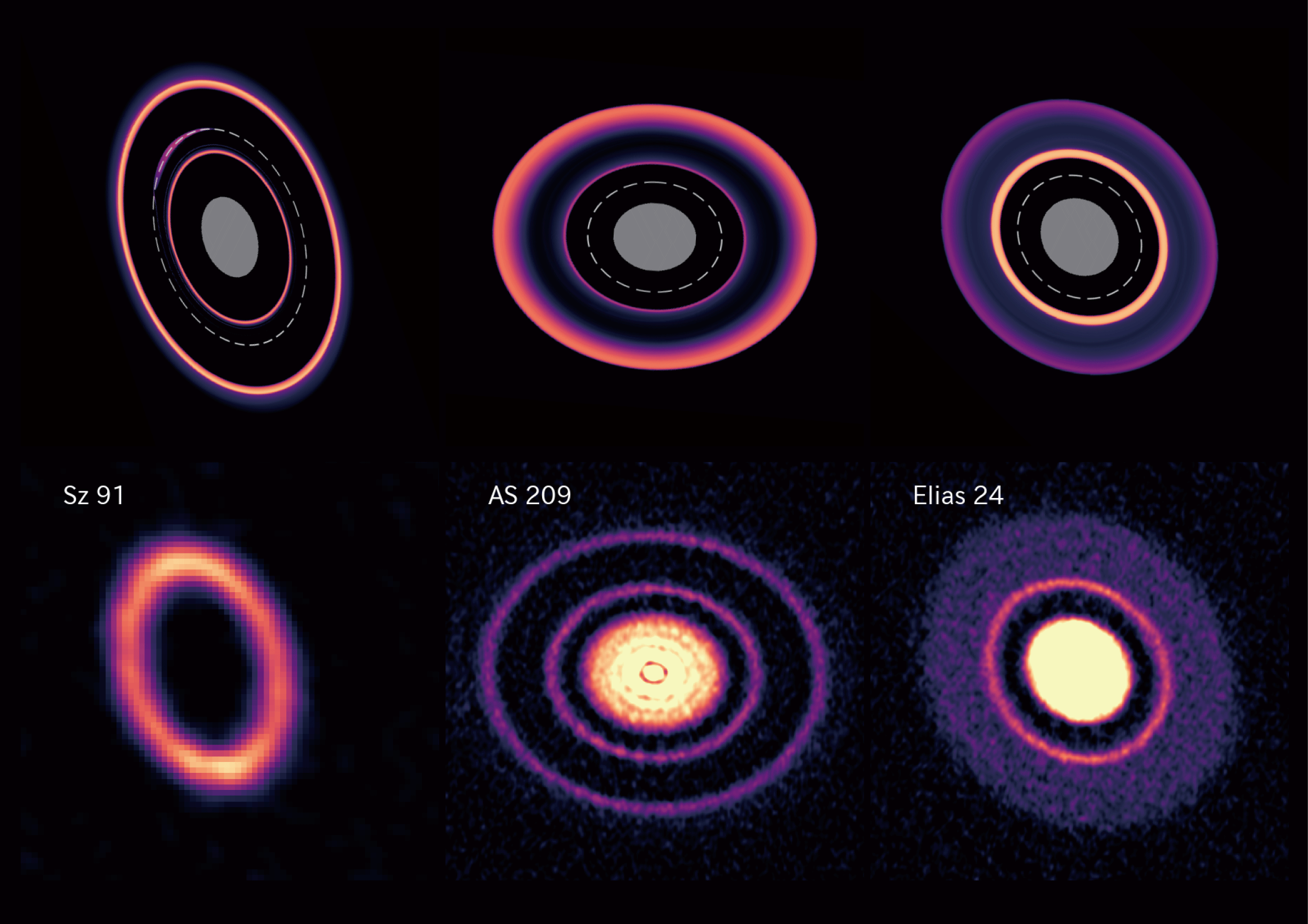
Simulations Provide Clue to Missing Planets Mystery


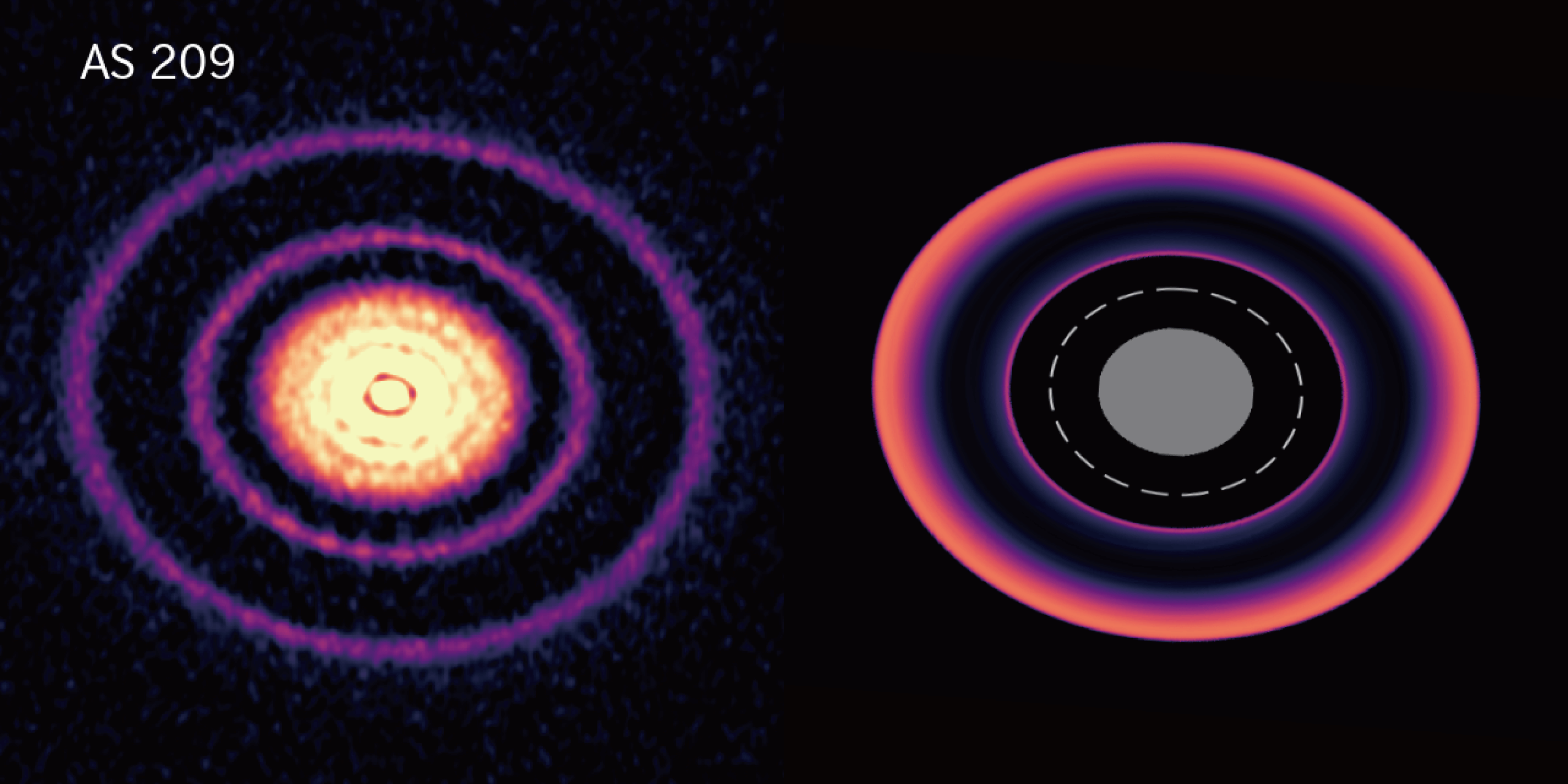
A protoplanetary disk as observed by ALMA (left), and a protoplanetary disk during planetary migration, as obtained from the ATERUI II simulation (right). The dashed line in the simulation represents the orbit of a planet, and the gray area indicates a region not covered by the computational domain of the simulation. (Credit: Kazuhiro D. Kanagawa, ALMA(ESO/NAOJ/NRAO))
Original size (704KB)


A comparison of the three phases of ring formation and deformation found in these simulations by ATERUI II (top) with real examples observed by ALMA (bottom). The dotted lines in the simulation represent the orbits of the planets, and the gray areas indicate regions not covered by the computational domain of the simulation. In the upper row, the simulated protoplanetary disks are shown from left to right at the start of planetary migration (Phase I), during planetary migration (Phase II), and at the end of planetary migration (Phase III). (Credit: Kazuhiro D. Kanagawa, ALMA(ESO/NAOJ/NRAO))
Original size (703KB)

Forming planets are one possible explanation for the rings and gaps observed in disks of gas and dust around young stars. But this theory has trouble explaining why it is rare to find planets associated with rings. New supercomputer simulations show that after creating a ring, a planet can move away and leave the ring behind. Not only does this bolster the planet theory for ring formation, the simulations show that a migrating planet can produce a variety of patterns matching those actually observed in disks.

Young stars are encircled by protoplanetary disks of gas and dust. One of the world’s most powerful radio telescope arrays, ALMA (Atacama Large Millimeter/submillimeter Array), has observed a variety of patterns of denser and less dense rings and gaps in these protoplanetary disks. Gravitational effects from planets forming in the disk are one theory to explain these structures, but follow-up observations looking for planets near the rings have largely been unsuccessful.

In this research a team from Ibaraki University, Kogakuin University, and Tohoku University in Japan used the world’s most powerful supercomputer dedicated to astronomy, ATERUI II at the National Astronomical Observatory of Japan, to simulate the case of a planet moving away from its initial formation site. Their results showed that in a low viscosity disk, a ring formed at the initial location of a planet doesn’t move as the planet migrates inwards. The team identified three distinct phases. In Phase I, the initial ring remains intact as the planet moves inwards. In Phase II, the initial ring begins to deform and a second ring starts forming at the new location of the planet. In Phase III, the initial ring disappears and only the latter ring remains.

These results help explain why planets are rarely observed near the outer rings, and the three phases identified in the simulations match well with the patterns observed in actual rings. Higher resolution observations from next-generation telescopes, which will be better able to search for planets close to the central star, will help determine how well these simulations match reality.

These results appeared as Kazuhiro D. Kanagawa et al. “Dust rings as a footprint of planet formation in a protoplanetary disk”in The Astrophysical Journal on November 12, 2021.


Related Link


Tuesday, June 01, 2021

Help astronomers find rare cosmic jellyfish galaxies in this new Zooniverse citizen science project!


Eight examples for jellyfish galaxies. Images like these are presented to the participants of the new Zooniverse project for classification. IllustrisTNG collaboration

A rare kind of galaxy is at the heart of a new citizen science project that is being unveiled today: "Cosmological Jellyfish" is part of the Zooniverse platform, where volunteers can contribute to genuine scientific research projects. In the new project, participants look at the results of a cosmological simulation and identify galaxies that look somewhat like jellyfish. The jellyfish-like appearance is an indicator that the galaxy in question has interacted with gas in a galaxy cluster – which is what the creators of the project, the group of Annalisa Pillepich at the Max Planck Institute for Astronomy, want to study further.

Galaxies like our own Milky Way galaxy, consisting of millions, billions or even hundreds of billions of stars, are large-scale building blocks of our universe. While astronomers are confident they now have a reliable overall picture of how galaxies have formed over the past 13.8 billion years, after the hot Big Bang phase of the universe, many details are still in need of further research – and whenever new observations and powerful simulations become available, there are opportunities of adding pieces to the puzzle.

One region of the puzzle that is badly in need of more pieces is the case of so-called jellyfish galaxies. Such galaxies can be found in galaxy clusters, alongside with thousands of other galaxies. Such clusters not only contain the galaxies themselves, but also thin, hot intergalactic gas. As thin as that gas is, it is enough to make galaxies that are moving at high velocities through the cluster feel a "headwind".

The missing details of jellyfish formation

Imagine someone on a motor bike, with their hair, or maybe their shawl, streaming behind as they move through the surrounding air. Galaxies moving quickly through a cluster feel a similar headwind, or "ram pressure". The stars in such a galaxy are virtually unaffected, but in extreme cases, the gas that is contained in the galaxy can be driven out, streaming behind the galaxy. The result is a galaxy that looks similar to a jellyfish: a body (made up of the galaxy's stars) with tentacles (gas) streaming behind.

We have yet to understand how this works in detail, though: Do such jellyfish galaxies form only in the most massive clusters, or can they form even around our own Milky Way? Where and how quickly do the tails form and how long do they last? What happens to the gas in these tails? How does the stripping process affect the galaxies themselves?

Computer simulations to the rescue

Since the processes in question occur over hundreds of millions or even billions of years, it is impossible for us to observe them happening in the Universe in real time. But we can turn to computer simulations to find out more! Cosmological simulations create a virtual universe following the same laws of physics as our own cosmos. In that model universe, virtual stars and galaxies form, interact, and evolve – and for each galaxy, one can reconstruct its history!

A key problem here are the hugely disparate scales. The physics of how stars evolve takes place on scales of thousands of kilometers. A half-way representative volume of cosmic space is hundreds of millions of light-years across, a factor of one quintillion (one with 18 zeros) larger! No computer simulation has yet managed to simulate individual stars in such a cosmological volume. But for a few years now, there have been simulations that manage to model galaxies in sufficient detail for the simulation to capture ram-pressure in clusters, and the way it can turn galaxies into jellyfish galaxies.

Tracking jellyfish in IllustrisTNG

The first simulations that have managed to capture jellyfish creation are part of a suite called IllustrisTNG. There are three different versions of the IllustrisTNG simulation, each with a different size of the cosmic volume, a different resolution, and containing thousands to hundreds of thousands of galaxies. The two higher-resolution versions of the simulation, known as TNG50 and TNG100, are sufficiently detailed to allow for the formation of jellyfish galaxies.

But in order to study those simulated jellyfish galaxies, the researchers need to determine which of the tens of thousands of galaxies in their virtual universe are jellyfish galaxies in the first place! This requires a process that is still very difficult for computers to do automatically – but comparatively simple for human brains, with their excellent pattern recognition skills. That is why, as a first step, the researchers set out to learn which of their simulated galaxies look like jellyfish to a human observer, with a body made of stars trailing a tail made of gas.

Crowdsourcing jellyfish-galaxy identification

In a pilot study, led by Kiyun Yun, one of the group's PhD students, the team members themselves identified by eye 800 jellyfish galaxies among 2600 pre-selected candidates. But that is only a fraction of the available data – and looking at all the data in this fashion is more than a small team of scientists can handle.

This is where the Zooniverse comes in: the world’s largest and most popular platform for people-powered research, which specializes in exactly this kind of citizen science: projects where human volunteers and their pattern-recognition-savvy brains can contribute to cutting-edge scientific research. Parsing through 38,000 images in search of rare galaxies is a considerable task, but not that difficult if thousands of volunteers take it on.

Building on work by Yun and another group member Elad Zinger, now at the Hebrew University of Jerusalem, post-doctoral researcher Gandhali Joshi transformed the problem of jellyfish galaxy identification into the Zooniverse project that is now being revealed: Cosmological Jellyfish.

Kickstarting jellyfish galaxy research

In the project, participants study pictures, each of which shows a galaxy in the middle of the image. Each picture was created from the TNG50 and TNG100 simulations, and shows a particular galaxy viewed from a random angle, along with any other gas and galaxies contained in that region Participants then need to decide: Does that particular galaxy look like a jellyfish or not?

While the project provides a tutorial, as well as classification feedback for some of the images, nature is messy – even faithfully simulated nature. There will always be cases where it is difficult to decide whether or not a specific galaxy resembles a jellyfish. But in the end, it's OK to be uncertain: During the project, each galaxy will be classified by at least twenty different participants. In the end, researchers will be able to distinguish galaxies that clearly are, or are not, jellyfish galaxies from more ambiguous specimens (where some participants saw jellyfish, others not).

Once the jellyfish galaxies are identified, the researchers know which galaxies in their simulated universe they will need to look at more closely. The simulation provides the complete formation history for each galaxy, so at that stage, the scientists should be able to find out how these galaxies were formed, how they evolved to look like jellyfish in the first place – and what went differently for the galaxies that do not look like jellyfish!

Links The Cosmological Jellyfish project is available in English, in German and in Hebrew at https://www.zooniverse.org/projects/apillepich/cosmological-jellyfish

Contact

Markus Pössel
Head of press and public relations