Showing posts with label giant molecular clouds (GMCs). Show all posts

Thursday, October 09, 2025

Cosmic Tug-of-War: Gravity Reshapes Magnetic Fields in Star Clusters

This image from NASA’s Spitzer Space Telescope shows a star formation region in molecular cloud NGC 6334, also known as the Cat's Paw Nebula. The colors correspond with emission at 3.6 microns (blue), 4.5 microns (green), and 8 microns (red). This cloud is actively forming massive stars, and is located in the constellation Scorpius, between 4,200 to 5,500 light-years from Earth. ALMA data overlaid on the image shows details of four specific areas that were observed (NGC 6334I, NGC 6334I(N), NGC 6334IV and NGC 6334V), revealing invisible forces of magnetism and gravity as they wrestle and shape the formation of stars deep within the giant molecular cloud. The color scale in the ALMA images represents the intensity of the dust emission at 1.3mm and the drapery lines represent the orientation of the magnetic field. Credit: Credit for composite image: background, NASA/JPL-Caltech; overlay: ESO/NAOJ/NSF NRAO; image created by NSF/AUI/NSF NRAO/M. Weiss.


A record-breaking ALMA survey delivers the first statistical evidence that collapsing gas clouds realign their magnetic fields, tipping the cosmic balance in favor of gravity

Astronomers have captured the clearest picture yet of how massive stars are born, revealing a dramatic interplay between gravity and magnetic fields in some of our galaxy’s most dynamic star forming regions. A team led by Dr. Qizhou Zhang from the Center for Astrophysics | Harvard & Smithsonian used the Atacama Large Millimeter/submillimeter Array (ALMA) to conduct the largest and most detailed survey to date of magnetic fields in 17 regions where clusters of massive stars are forming. These observations, reaching down to just a few thousand astronomical units (about 10 times the distance from the Sun to Pluto) offer the first statistical insight into how the invisible forces of magnetism and gravity wrestle and shape the formation of stars deep within giant molecular clouds.

Star formation requires gas in space to be squeezed to densities more than ten trillion times greater than what’s typically found in interstellar clouds. But this epic collapse isn’t driven by gravity alone—magnetic fields and turbulence both push back, resisting the pull. For decades, astronomers have debated which force dominates as gas clouds shrink and stars ignite.

New ALMA observations by Zhang’s team have provided crucial answers. By measuring how the directions of magnetic fields change at different distances from young protostars, the researchers found that as gas becomes denser, gravity begins to win this cosmic tug-of-war. Magnetic fields, which start out mainly resisting gravity, are gradually pulled into alignment with infalling gas, showing a clear sign that gravity takes over as the leading force shaping the collapsing cloud.

This study marks the first time astronomers have statistically traced how magnetic fields behave as gravity pulls a star-forming cloud inward at precise measurements, in thousands of astronomical units, across a large sample of massive cluster-forming regions. The findings revealed a surprising pattern: the magnetic field orientations do not just occur randomly. Instead, they show two preferences: sometimes lining up with the direction of gravity, or sometimes perpendicular—evidence for a complex and evolving relationship between these two cosmic forces.

“With ALMA’s extraordinary sensitivity and resolution, we can now probe these cosmic birthplaces in unprecedented detail,” said Zhang. “We see that gravity actually reorients the magnetic field as clouds collapse, offering new clues about how massive stars—and the clusters they inhabit—emerge from the interstellar medium.”

Understanding how stars form is fundamental to almost every field of astronomy, shaping everything from the origins of our own Sun to the evolution of galaxies. This work not only settles long-standing debates about the relative importance of magnetic fields and gravity in massive star formation, but also gives scientists powerful new tools to test and refine theories about the life cycles of stars, planets, and cosmic clouds.

As the largest ALMA polarimetric study of its kind, this project sets a new standard for understanding both the visible and invisible components of our galaxy. The results reveal that while magnetic fields shape star-forming clouds, gravity ultimately takes the lead in birthing the most massive stars—an insight made possible by ALMA’s cutting-edge technology.

Link


About NRAO

The National Radio Astronomy Observatory (NRAO) is a facility of the U.S. National Science Foundation, operated under cooperative agreement by Associated Universities, Inc.

About ALMA

The Atacama Large Millimeter/submillimeter Array (ALMA), an international astronomy facility, is a partnership of the European Southern Observatory (ESO), the U.S. National Science Foundation (NSF) and the National Institutes of Natural Sciences (NINS) of Japan in cooperation with the Republic of Chile. ALMA is funded by ESO on behalf of its Member States, by NSF in cooperation with the National Research Council of Canada (NRC) and the National Science and Technology Council (NSTC) in Taiwan and by NINS in cooperation with the Academia Sinica (AS) in Taiwan and the Korea Astronomy and Space Science Institute (KASI).

ALMA construction and operations are led by ESO on behalf of its Member States; by the National Radio Astronomy Observatory (NRAO), managed by Associated Universities, Inc. (AUI), on behalf of North America; and by the National Astronomical Observatory of Japan (NAOJ) on behalf of East Asia. The Joint ALMA Observatory (JAO) provides the unified leadership and management of the construction, commissioning and operation of ALMA.


Wednesday, May 05, 2021

New Look at a Bright Stellar Nursery


Radio-infrared overlay of W49A molecular cloud.
Credit: DePree, et al.; Sophia Dagnello, NRAO/AUI/NSF; Spitzer/NASA. Hi-res image 
 

High-resolution VLA radio image of W49A molecular cloud, with closeups of individual regions where hydrogen gas is ionized by intense ultraviolet radiation from young stars. Credit: DePree, et al.; Sophia Dagnello, NRAO/AUI/NSF.
  Hi-res image
 

High-resolution VLA radio image of W49A molecular cloud, with closeups of individual regions where hydrogen gas is ionized by intense ultraviolet radiation from young stars. In this image, these regions are labelled in both the overall view and in the close-up views. Credit: DePree, et al.; Sophia Dagnello, NRAO/AUI/NSF.
Hi-res image

This overlay shows radio (orange) and infrared images of a giant molecular cloud called W49A, where new stars are being formed. A team of astronomers led by Chris DePree of Agnes Scott College used the National Science Foundation’s Karl G. Jansky Very Large Array (VLA) to make new, high-resolution radio images of this cluster of still-forming, massive stars. W49A, 36,000 light-years from Earth, has been studied for many decades, and the new radio images revealed some tantalizing changes that have occurred since an earlier set of VLA observations in 1994 and 1995.

The VLA radio images show the shape and movement of giant clouds of ionized hydrogen gas formed by the intense ultraviolet radiation from young stars. Comparing old and new VLA images of these ionized regions has shown changes indicating new activity in some of the regions. This new activity includes a narrow, fast-moving jet in one region, supersonic gas motions in three others, and an unexpected reduction in the radio brightness in another.

The astronomers, who reported their findings in the Astronomical Journal, plan to continue observing this region regularly to track changes that will reveal new details about the complex processes of star formation and interactions of the outflows from young stars.

The National Radio Astronomy Observatory is a facility of the National Science Foundation, operated under cooperative agreement by Associated Universities, Inc.

* * *

Media Contact:

Dave Finley, Public Information Officer
(575) 835-7302

dfinley@nrao.edu

Scientific Paper

Source: National Radio Astronomy Observatory (NRAO)/News


Monday, September 04, 2017

Probing molecular clouds with supermassive black hole X-ray flares


Figure 1. Schematic geometry of the problem. The reflected emission from a Sgr A* outburst reaches the observer with a delay caused by the light propagating from the source to the cloud and then to us (dashed arrows). The two thin lines show the locus (?) of illuminated molecular gas 110 years after a 4-year outburst.© MPA


The centre of the Milky Way is a very special place, harboring many exotic objects, such as the supermassive black hole Sagittarius A* and giant molecular clouds. Some of these clouds, despite being cold, are sources of high energy photons. It is believed that the clouds are not producing these photons themselves, but rather scatter the X-ray radiation coming from outside.  Even though Sgr A* is currently very faint in X-rays, it is considered as the main culprit of this radiation, in the form of short but intense flares, which happened over the past few hundred years. The time delay caused by light propagation from Sgr A* to the clouds and then to us, allows one to study Sgr A*’s past activity. At the same time, flares serve as an extremely powerful probe of molecular gas properties. In particular, the full 3D structure of molecular clouds and their density distribution on small scales can be reconstructed.

Although our Galaxy’s supermassive black hole Sgr A*, which has 4 million times the mass of our Sun, is currently very dim, there are indications that it experienced powerful flares in the not very distant past. In particular, reflection of Sgr A*’s X-ray emission on molecular clouds surrounding it provides evidence for such recent flares.

In reconstructing this history, there are two effects that have to be taken into account. First, the reflected emission is proportional to both the intensity of the illuminating radiation and the density of the gas. Second, the time delay attained during light propagation from the primary source (i.e. Sgr A*) to a reflector (i.e. a molecular cloud), and then from the reflector to an observer amounts to hundreds of years. From this, the history record of Sgr A* activity can be reconstructed, provided that the relative positions of the source and the reflector are known with sufficient precision. This is informally known as X-ray archaeology (see, e.g. Highlight: Neutral iron Kalpha diagnostic -- X-ray archaeology). Unfortunately, the line-of-sight distances are poorly known, so one has to look for some additional ways to break down degeneracies associated with the simple time-delay arguments.

A series of recent papers has shown that exploring spatial and temporal variations of the reflected emission can lift these degeneracies. Indeed, data collected by the space telescopes Chandra and XMM-Newton over more than 15 years show that the reflected X-ray emission is variable on timescales on the order of years and on spatial scales of less than one parsec (see Fig.2).

Figure 2. Chandra maps of the reflected emission from one of the molecular complexes in the vicinity of Sgr A* taken in 2000-2008 (left) and 2009-2015 (right). The changes in the image morphology reflect propagation of the illuminating front through the cloud. To make comparison easier, the contours of the earlier image (left) are repeated at the same positions in the later image (right). © MPA


The observed variability implies that the original flare itself must have been shorter than few years. With this in mind, one may take a more rigorous look at the statistical properties of the variability in time and space, which should be closely related to each other. Indeed, in the short flare scenario, variations in the space domain simply reflect density fluctuations in a thin slice of the reflecting medium projected on the picture plane (Fig. 1). On the other hand, variations in the time domain (at a given sky position) arise from similar density fluctuations but sampled along the line-of-sight, i.e. with slightly different time delays. If the statistical properties of the underlying density field are isotropic on small scales, there is a straightforward transformation connecting the two variability patterns. The parameters of this transformation are being determined by the relative 3D positions of the primary source and the reflector.

If one compares the X-ray flux variability in the time and space domains, these variability patterns match each other if one assumes that the light front propagates along the line of sight with a of velocity 0.7 the speed of light. This value immediately gives the position of the cloud with respect to Sgr A* and the age of the flare as about 110 years. Most likely the flare lasted less than one year, and is now reflected by the molecular cloud known as the 'Bridge complex' some 30 pc away from Sgr A*.

Using data on the emission of the same region in various molecular lines, the average density of reflecting the gas can be estimated and from this, the integrated X-ray flux provided by the flare can be inferred. Such an analysis suggests that the flare might have been the result of a tidal disruption of a planet (or the partial disruption of a star) being careless enough to come too close to the supermassive black hole.

Figure 3. Reconstructed 3D map (viewed at two different angles) of the molecular gas density distribution in vicinity of Sgr A*. This map is based on 15 years of XMM-Newton observations, leading to a thickness of the probed region of about 3.5 parsec. The characteristic “saucer” shape of the region is driven by the condition of a constant time delay after the flare. The “holes” in the map correspond to excised regions contaminated by bright compact sources. © MPA


Knowing the age of the outburst, it is straightforward to reconstruct the 3D density distribution of the molecular gas (see Fig. 3). So far, using the data of 15 years of monitoring, only a thin ~3.5 parsec slice can be reconstructed. This is certainly not the end of the story, since the molecular complex, being bright at the moment, will eventually fade away when the illumination front will have completely passed through it. At the same time other molecular clouds in the Central Molecular Zone might come into the spotlight, with ‘X-ray echoes’ of a single flare being potentially observable over several hundred years, the light-crossing-time of the entire Central Molecular Zone (CMZ). A movie illustrating the possible evolution of the CMZ X-ray map over the next 500 years is shown below.

Interestingly enough, not only studies of Sgr A* activity do benefit from the observations of its ‘X-ray echoes’. The properties of the gas density field can be studied in detail, without being hindered by projection effects or by the sensitivity to the chemical abundance of a particular molecular species as is commonly the case for molecular emission lines data. 

Figure 4. Reconstructed probability distribution function of the molecular gas density. It follows a Log-normal distribution, in line with the theoretical models of supersonic turbulence. However, further observations are needed to extend the dynamic range over which the distribution is reliably measured. © MPA

In the short flare scenario, the illuminated region is just a thin slice of molecular gas and the intensity of the reflected X-ray emission is simply proportional to the number density of the gas (in the optically thin limit). The probability distribution function of the gas density measured in this way appears to be well described by a log-normal shape (see Fig. 4), in line with the theoretical and numerical predictions for supersonic turbulence, which is believed to shape the structure of molecular gas on the scales probed.

However, a number of effects could mimic such a shape of the distribution function, namely high opacity even for X-rays for the high end or low count statistics on the low end. These issues can partly be addressed with sufficiently deep Chandra observations complemented by realistic simulations of the molecular clouds. In principle, with the angular resolution provided by Chandra, it is possible to study scales down to 0.05 pc, where self-gravity starts to become dominant and which effectively seed the star formation process.

Thus, X-raying molecular clouds might become useful for solving the long-standing problem of suppressed star-formation efficiency in the Central Molecular Zone. Next generation of X-ray observatories equipped with micro-calorimeters, like ATHENA and Lynx, will be capable of probing also the velocity field in the reflecting gas. The full picture of the turbulent inner life of the Galactic Center molecular clouds could then be reconstructed. Equally important are future X-ray polarimetric observations that will provide solid proof that the source of illuminating photons is indeed Sgr A* by measuring the polarization angle, while the degree of polarization will provide an independent way of measuring the line-of-sight position of the cloud.


E.Churazov, I.Khabibullin, R.Sunyaev


Authors

Churazov, Eugene
Scientific Staff
Phone: 2219
Email: echurazov@mpa-garching.mpg.de
Links: personal homepage (the institute is not responsible for the contents of personal homepages)

Khabibullin, Ildar
Postdoc
Phone: 2233
Email: ildar@mpa-garching.mpg.de

Sunyaev, Rashid
Director
Phone: 2244
Email: rsunyaev@mpa-garching.mpg.de


Original Publications

1. Churazov, E., Khabibullin, I., Sunyaev, R., Ponti, G.
Not that long time ago in the nearest galaxy: 3D slice of molecular gas revealed by a 110 yr old flare of Sgr A*
MNRAS 2017, 465, 45-53
Source / DOI

2. Churazov, E., Khabibullin, I., Ponti, G., Sunyaev, R.
Polarization and long-term variability of Sgr A* X-ray echo.
MNRAS 2017, 468, 165-179
Source / DOI

3. Churazov, E., Khabibullin, I., Sunyaev, R., Ponti, G.
Can Sgr A* flares reveal the molecular gas density PDF?”,
MNRAS 2017, 471, 3293–3304
Source / DOI


Tuesday, January 19, 2016

Herschel reveals filaments in the Serpens Core

Herschel reveals filaments in the Serpens Core
Copyright: ESA/Herschel/PACS/SPIRE/V. Roccatagliata (U. München, Germany)


The interstellar medium fills the ‘empty’ space between the stars in our galaxy. It is a mix of molecular clouds, cold and warm gases, regions of electrically charged hydrogen, and more.

Molecular clouds are the densest part of the interstellar medium, holding most of its mass in the form of hydrogen gas. ESA’s Herschel space observatory has revealed that many are built around filaments, with dense threads snaking throughout each cloud. These filaments potentially transport material, and, when massive enough, are known to form new stars.

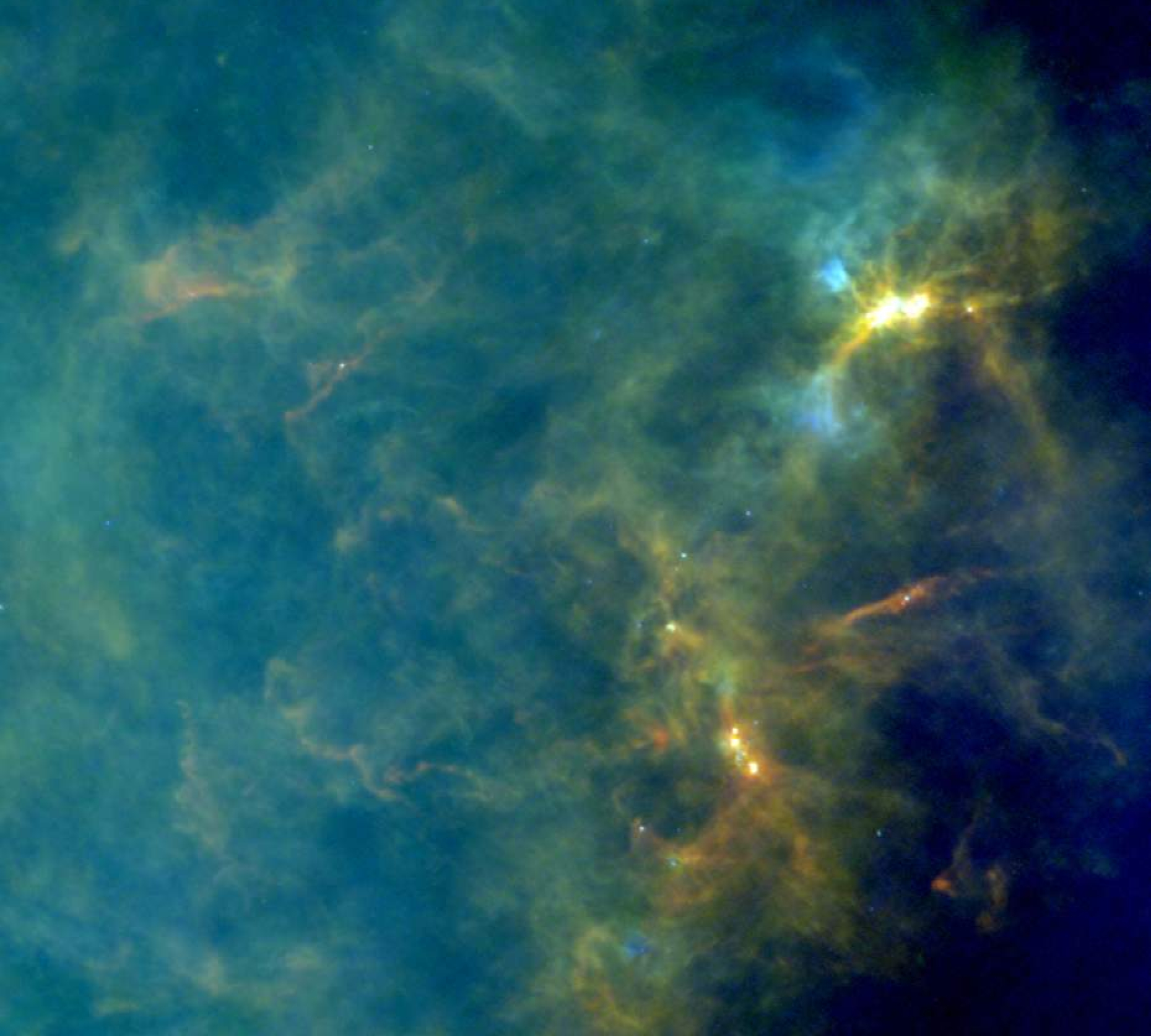
This Herschel image shows the Serpens Core, the heart of a giant molecular cloud. The Core is the bright clump towards the upper right, with a more diffuse secondary cluster, named Ser G3-G6, shown at the bottom right. Also visible as a faint yellow glow towards the upper left of the frame is a region known as LDN 583 that shines brightly in the far-infrared.

Giant molecular clouds contain up to 10 million times the mass of the Sun, and can stretch for hundreds of light-years. Compared to the rest of space they are dense, holding up to a thousand atoms per cubic centimetre – and even more in star-forming regions. However, these properties are relative: even at their densest, these clouds are more than 10 times emptier than the best laboratory vacuums we can produce on Earth.

These giant clouds are complex formations, most often made up of filaments mixed with clumpy and irregular folds, sheets and bubble-like structures. A typical spiral galaxy like the Milky Way can contain thousands of them, accompanied by many of their smaller relatives.

Serpens is an ideal target for scientists wanting to know more about giant molecular clouds, because it lies just 1400 light-years from us. Scientists compared Herschel’s observations of this cloud to a state-of-the-art simulation to find out more about the cloud’s properties, and to test the accuracy of their model.

They discovered a radial network of filaments stretching throughout the Serpens Core, filaments that are predicted to break and fragment to form the cores of new stars. These filaments resemble the spokes of a wheel, with the Core forming the hub.

This three-colour image is made from observations with Herschel’s PACS camera (blue and green) and SPIRE camera (red). The size of the region shown is 1.7x1.9º on the sky, where 1º corresponds to about 25 light-years.


Monday, May 25, 2015

ALMA Reveals the Cradles of Dense Cores: the Birthplace of Massive Stars

Figure 1: An overview of a massive stellar cluster-forming molecular cloud from numerical hydrodynamical simulations (courtesy from James Dale [5]), and the context of the scale of the ALMA observations for the deeply embedded central few light-years region. Credit: ALMA(ESO/NAOJ/NRAO), H. B. Liu, J. Dale. | Download Image

Figure 2: The central part of the OB cluster-forming region G33.92+0.11, observed by ALMA. Left: Dust continuum image taken at 1.3 mm. Right: False color image showing the integrated emission of three molecules: CH3CN in yellow, 13CS in green, and DCN in magenta, respectively. The CH3CN emission mainly traces the hot molecular cores, which harbor massive stars. The 13CS emission traces warm dense gas and shocks. The DCN emission appears to follow the bulk of dense gas traced by the dust continuum emission. Credit: ALMA(ESO/NAOJ/NRAO), H. B. Liu et al. | Download Image


A Taiwanese research team used the Atacama Large Millimeter/submillimeter Array (ALMA) to observe a large molecular gas clump [1] named G33.92+0.11, where a cluster with massive stars is forming. The excellent imaging power of ALMA allowed to reveal with unprecedented detail, the fine structure of the molecular gas at the center of the region, where two surprisingly large molecular gas arms, with sizes of ~ 3.2 light years [2], appear to be spiraling around two massive molecular cores. These results showed that the large molecular arms are indeed the cradles of dense cores, which are current or future birthplaces of massive stars. This is a crucial step forward in the understanding of how mass distributes to form both massive cores and massive stars.

How the gravitationally bound stellar clusters, for example, the young massive clusters (YMCs) and globular clusters (GCs) come to the existence, remains a fundamental problem in astrophysics. To form such complex systems, it is required that massive amounts of gas can be converted with little losses, into stars, before they start to disperse the gas by the action of their winds —the so called stellar feedback—, and such process is far from trivial. Current models propose that in order to quench the action of stellar feedback, the global collapse of the parent molecular cloud has to be very rapid.

However, this global collapse of giant [3] molecular clouds (GMC) represents an observational challenge for astronomers, because they cannot measure distances along their line of sight (data is projected in two dimensions) and because it is near impossible to measure gas velocities in the transverse directions. Nevertheless, the amplified effects of the initial rotation (angular momentum) of the clouds may translate into the formation of massive molecular clumps that are supported by centrifugal forces at the center of the collapsing GMC.

The identification of rotating structures at scales larger than the cores, may serve as evidence of such an outcome of global collapse. Also, because the massive molecular clumps are the densest regions in a collapsing GMC, they are likely the sites where the most massive stars of stellar clusters can form. To resolve the details of the morphology and kinematics of these systems will be key to understand how mass distributes in the sites of star cluster formation, such that it can form both massive and not massive stars.

A research team led by Hauyu Baobab Liu at the Academia Sinica Institute of Astronomy and Astrophysics (ASIAA) observed with ALMA the luminous OB cluster-forming region G33.92+0.11, located at a distance of about 23.000 lightyears. This source is at a beginning phase of forming an OB association, which has a contained luminosity of 250 thousand times the luminosity of the Sun. Most of this light is provided by a few embedded massive stars. The research team used the archival Herschel 350 μm, which were combined with another 350 μm image from the Caltech Submillimeter Observatory (CSO) with a higher angular resolution.

"The Herschel Space Telescope archive images provided a high quality map of the 350 μm thermal emission of the external dusty gas structures around G33.92+0.11. We completed the missing small-scale pixels of this map with data from the Caltech Submillimeter Observatory. The final map revealed two molecular arms twisted in opposite directions, north and south of the cluster, converging at the central molecular clumps, indicating that perhaps the gas is being transported toward the central cluster along these spiral arms from distances as large as 20 light years," says co-author Román-Zúñiga, from the Astronomy Institute of the Universidad Nacional Autónoma de México.

The unprecedented high angular resolution and high imaging fidelity of ALMA allowed the astronomers to reveal in G33.92+0.11 A two centrally located massive molecular cores (~100-300 solar masses), connected by several spiraling dense molecular gas arms. This kind of morphology resembles the previous ALMA images of molecular gas arms surrounding the low-mass protostellar binary L1551 NE [4], however, but linearly scaled-up by a factor between 100 and 1000 (Figure 1). In addition, the observed gas arms in G33.92+0.11 A appear to be fragmenting, which results in the formation of multiple satellite cores orbiting the central two highest mass cores. Comparing the simultaneously observed molecular gas tracers including CH3CN, 13CS, and DCN shows that the gas excitation conditions in these molecular arms and cores far from being uniform across the system (Figure 2). For instance, the two highest mass cores at the center already harbor massive stars and present bright CH3CN emission. The molecular arms embedded with satellite cores in the north may be relatively cool, indicated by the good correlation between the DCN line and the 1.3 mm dust continuum emission. Finally the molecular arms connecting the central massive molecular cores from the west may contain gas that is shocked to a higher temperature or are subject to stellar heating and show stronger 13CS emission.

This team propose that the central ~1 pc scale region of G33.92+0.11 A is a flattened, massive molecular clump that is currently accreting material, which is being fed by the exterior gas filaments, and is marginally supported by centrifugal forces. At all spatial scales, the regions of higher density, that contain larger amounts of mass, form at the center of the system. Accretion may be prohibited by the angular momentum, but might be alleviated by fragmentation. The authors further propose that in the dense eccentric accretion flows, the formation of spiraling arm-like structures may be essential to the process. The subsequent fragmentation of the dense molecular arms may lead to the formation of the second generation high-mass stars.

"Gas structures similar to spiral arms should be common in many systems at many different scales, as long as they are unstable to gravity and have non-negligible rotation. The superb images made with ALMA are starting to show this,"says co-author Galván-Madrid.


Notes

[1] In our nomenclature, massive molecular clumps refer to dense molecular gas structures with sizes of ∼0.5-1 pc, massive molecular cores refer to the ⟨ 0.1 pc size overdensities embedded within a clump, and condensations refer to the distinct molecular substructures within a core. Fragmentation refers to the dynamical process that produces or enhances the formation of multiple objects.

[2] 1 parsec (pc) ~ 3.2 light years ~ 3.086×10¹⁶ meters.

[3] The typical spatial scales of stellar cluster-forming molecular clouds are 101-2 pc.

[4] More in the press release Dec 04, 2014: Astronomers Identify Gas Spirals as a Nursery of Twin Stars through ALMA Observation 

[5] For details, please see Dale, J. E., Ngoumou, J., Ercolano, B., Bonnell, I. A., 2014, MNRAS, 442, 694


More information

These observational results were published in the Astrophysical Journal (ApJ, 804, 37) by Liu et al. as "ALMA resolves the spiraling accretion flow in the luminous OB cluster forming region G33.92+0.11".
This research was conducted by Hauyu Baobab Liu (Academia Sinica Institute of Astronomy and Astrophysics); Roberto Galván-Madrid (Centro de Radioastronomía y Astrofísica, Universidad Nacional Autónoma de México); Izaskun Jiménez-Serra (Department of Physics and Astronomy, University College London and European Southern Observatory, Garching Germany); Carlos Román-Zúñiga (Instituto de Astronomía, Universidad Nacional Autónoma de México); Qizhou Zhang (Harvard-Smithsonian Center for Astrophysics); Zhiyun Li (Department of Astronomy, University of Virginia); Huei-Ru Chen (Institute of Astronomy and Department of Physics, National Tsing Hua University).

The Atacama Large Millimeter/submillimeter Array (ALMA), an international astronomy facility, is a partnership of the European Organization for Astronomical Research in the Southern Hemisphere (ESO), the U.S. National Science Foundation (NSF) and the National Institutes of Natural Sciences (NINS) of Japan in cooperation with the Republic of Chile. ALMA is funded by ESO on behalf of its Member States, by NSF in cooperation with the National Research Council of Canada (NRC) and the National Science Council of Taiwan (NSC) and by NINS in cooperation with the Academia Sinica (AS) in Taiwan and the Korea Astronomy and Space Science Institute (KASI). ALMA construction and operations are led by ESO on behalf of its Member States; by the National Radio Astronomy Observatory (NRAO), managed by Associated Universities, Inc. (AUI), on behalf of North America; and by the National Astronomical Observatory of Japan (NAOJ) on behalf of East Asia.

The Joint ALMA Observatory (JAO) provides the unified leadership and management of the construction, commissioning and operation of ALMA.


Contact:

Valeria Foncea
Education and Public Outreach Officer
Joint ALMA Observatory
Santiago, Chile
Tel: +56 2 467 6258
Cell: +56 9 75871963
Email: vfoncea@alma.cl 

Masaaki Hiramatsu 

Education and Public Outreach Officer, NAOJ Chile
Observatory Tokyo, Japan
Tel: +81 422 34 3630
E-mail: hiramatsu.masaaki@nao.ac.jp

Charles E. Blue

Public Information Officer
National Radio Astronomy Observatory
Charlottesville, Virginia, USA
Tel: +1 434 296 0314
Cell: +1 434.242.9559
E-mail: cblue@nrao.edu

Richard Hook 

Public Information Officer, ESO
Garching bei München, Germany
Tel: +49 89 3200 6655
Cell: +49 151 1537 3591
Email: rhook@eso.org


Sunday, March 01, 2015

Astronomers find newborn stars at the edge of the Galaxy

Negative WISE W1 image of the newly found cluster Camargo 438 and 439. The cluster is about 16,000 light years away, so the image is about 24 light years across. The black dots in the image are individual stars. Credit: D. Camargo/NASA/WISE


Brazilian astronomers have made a remarkable discovery: a cluster of stars forming on the very edge of the Galaxy. The team, led by Denilso Camargo of the Federal University of Rio Grande do Sul in Porto Alegre, Brazil, publish their results in the journal Monthly Notices of the Royal Astronomical Society.

The Milky Way, the Galaxy we live in, has a barred spiral shape, with arms of stars, gas and dust winding out from a central bar. Viewed from the side, the Galaxy would appear relatively flat, with most of the material in a disc and the central regions.

Stars form inside massive and dense clumps of gas in so-called giant molecular clouds (GMCs) that are mainly located in the inner part of the galactic disc. With many clumps in a single GMC, most (if not all) stars are born together in clusters.

Denilso’s team looked at data from NASA’s orbiting Wide-Field Infrared Survey Explorer (WISE) observatory. They not only found GMCs thousands of light years above and below the galactic disc, but that one of them unexpectedly contained two clusters of stars. This is the first time astronomers have found stars being born in such a remote location.

The new clusters, named Camargo 438 and 439, are within the molecular cloud HRK 81.4-77.8. This cloud is thought to be about 2 million years old and is around 16000 light years beneath the galactic disk, an enormous distance away from the usual regions of star formation, in the direction of the constellation of Cetus.

Denilso believes there are two possible explanations. In the first case, the 'chimney model', violent events such as supernova explosions eject dust and gas out of the galactic disk. The material then falls back, in the process merging to form GMCs.

The other idea is that the interaction between our Galaxy and its satellites, the Magellanic Clouds, may have disturbed gas that falls into the Galaxy, again leading to the creation of GMCs and stars.
Denilso commented: "Our work shows that the space around the Galaxy is a lot less empty that we thought. The new clusters of stars are truly exotic. In a few million years, any inhabitants of planets around the stars will have a grand view of the outside of the Milky Way, something no human being will probably ever experience.

"Now we want to understand how the ingredients for making stars made it to such a distant spot. We need more data and some serious work on computer models to try to answer this question."

The chimney model would need several hundred massive stars to have exploded as supernovae over several generations, creating a 'superwind' that threw HRK 81.4-77.8 into its present position. Over millions of years, the bubbles created by the explosions may then themselves compress material, forming more stars and fuelling the ejection of material in a 'galactic fountain', where the dust and gas eventually rains back on to the disk.

Media contact
Robert Massey
Royal Astronomical Society
Tel: +44 (0)20 7734 3307 x214
Mob: +44 (0)794 124 8035

rm@ras.org.uk

Science contact
Denilso Camargo
Federal University of Rio Grande do Sul
Porto Alegre
Brazil
Tel: +55 51 3308-6513

denilso.camargo@ufrgs.br

Images and captions

Further information
The research was carried out by Dr Denilso Camargo, Dr Eduardo Bica, Dr Charles Bonatto and Gustavo Bonatto (MSc Gustavo SALERNO), of the Federal University of Rio Grande do Sul and Colégio Militar de Porto Alegre - Exército Brasileiro.

It appears in the paper D. Camargo et al., "Discovery of two embedded clusters with WISE in the high Galactic latitude cloud HRK 81.4-77.8", Monthly Notices of the Royal Astronomical Society, vol. 448, pp. 1930-1936, 2015, published by Oxford University Press.

Notes for editors
The Royal Astronomical Society (RAS), founded in 1820, encourages and promotes the study of astronomy, solar-system science, geophysics and closely related branches of science. The RAS organizes scientific meetings, publishes international research and review journals, recognizes outstanding achievements by the award of medals and prizes, maintains an extensive library, supports education through grants and outreach activities and represents UK astronomy nationally and internationally. Its more than 3800 members (Fellows), a third based overseas, include scientific researchers in universities, observatories and laboratories as well as historians of astronomy and others.

Follow the RAS on Twitter