Showing posts with label National Radio Astronomy Observatory (NRAO). Show all posts

Friday, July 17, 2026

Astronomers Detect Magnetic Fingerprint of a Cosmic Explosion for the First Time

This illustration depicts Faraday rotation in the afterglow of a gamma-ray burst. A powerful jet (upper left) sends polarized radio waves outward through the thin wall of a surrounding bubble of magnetized gas called an HII region. As the light passes through this material, its polarization angle is twisted by the magnetic field. Because the effect is stronger at longer wavelengths, the red and blue waves, which represent different radio wavelengths, exit the bubble oscillating in different directions. By measuring this difference, astronomers were able to map the magnetic environment surrounding GRB 260310A for the first time. Credit: NSF/AUI/NSF NRAO/M.Weiss.
Hi-Res File


NSF VLA radio telescope reveals polarized light and a powerful magnetic environment in a gamma-ray burst afterglow

Astronomers have made a series of landmark observations of one of the Universe’s most violent events. Using the U.S. National Science Foundation Very Large Array (NSF VLA) radio telescope, which is operated by the U. S. National Science Foundation National Radio Astronomy Observatory (NSF NRAO), the team detected polarized light from a gamma-ray burst (GRB) afterglow for the first time at radio wavelengths. It also marks the first time scientists have detected Faraday rotation in a GRB, a phenomenon in which magnetic fields cause the polarization of light to twist as it travels through space, revealing how the magnetic environment of these explosions interacts with the light they produce. The findings, led by researchers at the University of Arizona and the University of Utah, offer a new window into the extreme physics driving these titanic explosions.

What Are Gamma-Ray Bursts?

Gamma-ray bursts are the most powerful explosions in the Universe, releasing in a matter of seconds as much energy as the Sun will emit over its entire lifetime. They are thought to launch narrow jets of particles accelerating to nearly the speed of light, and those jets produce a radio “afterglow” that can linger for months. Despite decades of study, the magnetic fields that are believed to accompany these jets and their local environments have remained stubbornly difficult to measure, until now.

GRB 260310A Reveals Polarized Radio Waves

The burst in question, designated GRB 260310A, was relatively nearby Earth, in cosmic standards, making its radio afterglow one of the brightest seen in decades. That brightness gave astronomers an extraordinary opportunity. By pointing the NSF VLA at the fading explosion, the team found that the radio waves were polarized, meaning the light waves were oscillating in a preferred direction, much like sunlight reflecting off the surface of water, which polarized sunglasses are designed to filter out.

Faraday Rotation in a Gamma-ray Burst

This alone would have been an exciting first for the NSF VLA. But the team made an even more extraordinary discovery: the polarization signal changed across different wavelengths, a phenomenon known as Faraday rotation. Never before detected in a gamma-ray burst, this effect acts like a magnetic fingerprint, encoding information about the strength and structure of the fields the light passed through. Just as a prism bends different colors of visible light by different amounts, a magnetized plasma can rotate the polarization angle of radio waves. The faster that rotation changed with wavelength, the stronger the magnetic field the light passed through.

“GRBs are the most powerful explosions in the Universe, and magnetic fields are thought to play a central role in powering them, but probing those fields has been extraordinarily difficult,” said Tanmoy Laskar, assistant professor at the University of Utah. “By detecting polarized radio emission, we can now directly measure the magnetic environment of one of the Universe’s most violent events. Our new GRB observations allow us to use the Universe as our laboratory to test our understanding of how physics operates in such extreme conditions.”

The NSF VLA data revealed a magnetic field along the light’s path that was thousands of times stronger than what could be explained by our own galaxy or the space between galaxies. Instead, it points to an exceptionally dense, magnetized cloud of gas surrounding the star that exploded to produce GRB 260310A.

Clues for GRB Origins

That cloud is what astronomers call an HII region, a bubble of ionized hydrogen gas shaped by powerful ultraviolet radiation and stellar winds from a massive young star. The fact that GRB 260310A appears to have exploded inside such a region is consistent with GRBs arising from the deaths of the most massive stars, and may help scientists understand precisely what kinds of stars and environments are capable of producing these extreme events.

“Previous searches for polarization in GRBs used facilities like the Atacama Large Millimeter/submillimeter Array (ALMA) telescope that measure shorter wavelengths and had to happen early, before the afterglow light faded,” said Collin Christy, a graduate student at the University of Arizona and lead author of the study. “Now, with the NSF VLA, we’ve pushed into the centimeter bands and made the first ever measurement of Faraday rotation in a GRB. Each new observation reveals another layer of the magnetic story these explosions are telling us.”

Why it Matters “Future monitoring of GRB afterglows with the NSF VLA and other radio telescopes will allow scientists to watch magnetic field structures evolve in real time,” said Assistant Professor Dr. Kate Denham Alexander, Christy’s PhD advisor. “This is a capability that could transform our understanding of how relativistic jets form, how they are powered, and how magnetic energy is released in the most extreme environments the Universe has to offer.”


About NRAO

The National Radio Astronomy Observatory (NRAO) is a facility of the U.S. National Science Foundation, operated under cooperative agreement by Associated Universities, Inc.

About ALMA

The Atacama Large Millimeter/submillimeter Array (ALMA), an international astronomy facility, is a partnership of the European Southern Observatory (ESO), the U.S. National Science Foundation (NSF) and the National Institutes of Natural Sciences (NINS) of Japan in cooperation with the Republic of Chile. ALMA is funded by ESO on behalf of its Member States, by NSF in cooperation with the National Research Council of Canada (NRC) and the National Science and Technology Council (NSTC) in Taiwan and by NINS in cooperation with the Academia Sinica (AS) in Taiwan and the Korea Astronomy and Space Science Institute (KASI). ALMA construction and operations are led by ESO on behalf of its Member States; by the National Radio Astronomy Observatory (NRAO), managed by Associated Universities, Inc. (AUI), on behalf of North America; and by the National Astronomical Observatory of Japan (NAOJ) on behalf of East Asia. The Joint ALMA Observatory (JAO) provides the unified leadership and management of the construction, commissioning and operation of ALMA.


VLA Sky Survey Sets New Standard for High-Resolution, Wide-Area Radio Astronomy

Credit: NSF/AUI/NSF NRAO
Hi-Res File

VLASS2.1.se.T28t01.J001924+723000 (0:13:00.8, 72:31:18.7 - Planetary Nebula/Tycho Brahe SN Remnant) (Left) & VLASS2.1.se.T27t08.J122846+673000 (12:33:14.1, 67:07:43.8 - Radio Galaxy) (Right). Credit: NSF/AUI/NSF NRAO/VLASS - Hi-Res File


The U.S. National Science Foundation National Radio Astronomy Observatory (NSF NRAO) has completed observations for the Very Large Array Sky Survey (VLASS), the most detailed radio survey of the sky ever conducted, providing an unprecedented view of the dynamic radio universe.

Scope and Scale of VLASS

Conducted with the U.S. National Science Foundation Very Large Array (NSF VLA), VLASS spans nearly a decade of observations, from September 2017 through February 2026, and represents one of the most ambitious radio surveys ever undertaken. Covering approximately 34,000 square degrees, essentially the entire sky visible to the VLA down to -40 degrees declination, the survey delivers a powerful new resource for astronomers worldwide. The survey produced approximately 0.5 petabytes of raw data, and the total volume of processed data products is expected to reach about 2 petabytes, making it the largest survey the VLA has undertaken in terms of data volume.

“With VLASS, we now have a radio map of the sky that matches the resolution of modern optical and infrared surveys,” said Amy Kimball, VLASS Head of Operations. “This opens the door to truly multiwavelength discoveries at a level of detail that was not previously possible.”

VLASS achieves an angular resolution of about 2.5 arcseconds, making it the highest-resolution full-sky radio survey to date. Observations were carried out across the 2–4 GHz frequency range, enabling astronomers to measure in-band spectral indices, which are key to understanding the physical processes powering radio emission from cosmic sources.

Observing Strategy and Coverage

Over the course of roughly 6,500 observing hours, the NSF VLA repeatedly scanned the sky using an innovative “on-the-fly mosaicking” technique. In this mode, antennas continuously sweep across the sky in a raster pattern while collecting data, maximizing efficiency and uniform coverage. The survey observed the sky three and a half times in total, with half the sky imaged four times and the other half three times, enabling both deep imaging and the detection of variable and transient sources.

VLASS was conducted in full polarization, allowing astronomers to probe cosmic magnetic fields through measurements such as Faraday rotation. These data provide new insights into the structure and evolution of magnetism across the universe. The survey is a cornerstone of NSF NRAO’s Science Ready Data Products initiative, which provides fully calibrated data and high-quality images directly to the scientific community and the public. By lowering technical barriers, VLASS makes cutting-edge radio astronomy accessible to both experts and non-specialists.

VLASS is designed to address four major science themes:
– Hidden Explosions and Transient Events, including supernovae, gamma-ray bursts, and other short-lived phenomena.
– Faraday Tomography of the Magnetic Sky, using polarization data to map magnetic fields across cosmic environments.
– Imaging Galaxies through Time and Space, tracing the evolution of galaxies and active galactic nuclei.
– The New Milky Way, revealing previously unseen structures and sources within our own galaxy.

These themes are described in detail in the survey’s foundational paper (Lacy et al. 2020, PASP, 132, 035001), which outlines the scientific goals and design of VLASS.

A Legacy Dataset for the Future

By combining high resolution, wide sky coverage, spectral information, and time-domain sensitivity, VLASS establishes a new benchmark for radio surveys and provides a legacy dataset that will support discovery for years to come. Processing and imaging of the full dataset will continue over the next several years as these science-ready products are completed and released.

“VLASS is not just a survey, it is a long-term investment in the future of astrophysics,” said Mark Lacy, VLASS Project Director. “Its combination of depth, coverage, and accessibility ensures that it will remain a foundational resource for the community.”

Additional information and access to VLASS data products are available through NRAO here.


About NRAO

The National Radio Astronomy Observatory is a major facility of the U.S. National Science Foundation, operated under cooperative agreement by Associated Universities, Inc.


Saturday, July 11, 2026

NSF VLA Maps a Hidden Hydrogen Shell Around the Orion Nebula

Radio emission from neutral hydrogen atoms in the direction of the Orion Nebula, the most nearby regions of high-mass star formation. The red colors show the 21-cm emission from hydrogen, resolved for the first time at this level of detail by observations from the Neutral Atomic Hydrogen in the Solar Neighborhood (NeAtHood) project, led by Juan Diego Soler from the University of Vienna. The cyan colors show the emission from warm interstellar dust in near-infrared light. Credit: Juan D. Soler, University of Vienna, with data from the NRAO's Jansky VLA and NASA's Wide-field Infrared Survey Explorer (WISE).
Hi-Res File


New view of a familiar nebula
The Orion Nebula is perhaps the best known nebula, yet new discoveries continue to emerge from observations across all wavelengths of the electromagnetic spectrum. Long known to be a region of active star formation, astronomers using the U.S. National Science Foundation Very Large Array (NSF VLA) have resolved the emission from neutral atomic hydrogen that elucidates how the young stars in Orion are shaping their surrounding neighborhood.

A team of astronomers led by Juan D. Soler of the University of Vienna used the NSF VLA, operated by the U.S. National Science Foundation’s National Radio Astronomy Observatories (NSF NRAO), to obtain high-resolution observations of the emission from neutral hydrogen atoms (HI) at 21 centimeters wavelength. Neutral atomic hydrogen, or H I, is traced by faint radio emission at a wavelength of 21 centimeters. Mapping that emission at high angular resolution is challenging, but the NSF VLA’s interferometric design makes it possible to resolve the structure of nearby star-forming regions.The NSF VLA, therefore, proved to be the best possible instrument for the task, Soler explains. “The NSF VLA is a very unique instrument. It is fundamental, offering the best resolution that we can get in HI from the northern hemisphere. We cannot do this with any other instrument.”

Measuring the bubble directly
When Soler and his team looked deep within the Orion Nebula, they focused on a previously identified expanding bubble formed by young stars. These past observations used tracers such as CII as a proxy for the hydrogen and offered an estimate of the mass associated with star formation. Because Soler’s team was able to observe the HI directly, their data provided a more direct estimate of the bubble’s mass,improving measurements by a factor of ten. “Measuring mass is fundamental,” Soler says, “because it tells us how efficiently these newly formed stars shape their environment with wind and radiation.”

Furthermore, the data obtained by Soler’s team also map the neutral atomic hydrogen in the vast molecular clouds within the Orion Nebula. Soler describes this interrelationship: “Talking about molecular clouds without talking about HI, is like talking about islands without ever mentioning the sea. It turns out that as we’re resolving the sea, we’re finding phenomena like this bubble that are shaping and connecting those molecular clouds. We imagine them as separate objects, not as if they were islands, completely isolated; in fairness, they’re more like archipelagos.”

First result from NeAtHood
These results, published in Astronomy & Astrophysics, are the first within a larger project called Neutral Atomic Hydrogen in the Solar System Neighborhood (NeAtHood), which aims to continue observing other nearby molecular clouds within star-forming regions visible from the northern hemisphere to produce arcminute-resolution HI maps. Soler looks to the possibility of future observations both within this program and beyond, saying, “[The bubble] is the kind of thing that should be there, but we were not expecting to see this so clearly. So now I wonder, what other surprises are hiding in the data? And in the future, the Next-Generation VLA (ngVLA) is going to target even more distant regions in the Milky Way.”


Links: Scientific Paper


Press Contacts:

Corrina Jaramillo Feldman
Sr. Public Information Officer

Email | Phone


About NRAO

The National Radio Astronomy Observatory is a major facility of the U.S. National Science Foundation, operated under cooperative agreement by Associated Universities, Inc.)


Hidden Jet from a “Missing-Link” Black Hole Lights Up the Radio Sky

Artist's conception illustrating the aftermath of an intermediate-mass black hole tearing apart a passing star, resulting in an accretion disk and narrow relativistic jet (top left). The dotted line indicates our line of sight from Earth. The jet's off-axis afterglow only became visible once the expanding radio emission (bottom right) had grown wide enough to sweep into our line of sight, causing that emission to brighten dramatically years after the initial event. Credit: NSF/AUI/NSF NRAO/M.Weiss
. Hi-Res File


Astronomers using the U.S. National Science Foundation Very Large Array (NSF VLA) have detected an extraordinary burst of radio light from a rare cosmic event in which an intermediate-mass black hole tears apart a star, revealing what appears to be the off-axis afterglow of a powerful jet.

Unusual Observations of AT2019ijn
The event, known as AT2019ijn, first appeared as a bright blue flash in optical surveys, rising to peak brightness in just a few days before fading much more slowly than similar transients usually do. When astronomers later examined radio observations, they found something even more unusual: the radio emission kept brightening for nearly two years and reached a luminosity far beyond that seen in typical stellar explosions at similar phases, followed by a slow decay over at least four years.

The researchers concluded that the most likely explanation is a tidal disruption event, which happens when a star strays too close to a black hole and is pulled apart by gravity. In this case, the fast rise in the optical brightness indicates an intermediate-mass black hole, a long-sought class that falls between stellar-mass black holes formed by collapsing stars and the supermassive black holes found in the centers of galaxies. These middleweight black holes have been difficult to find, and astronomers have been eager for new ways to identify them.

AT2019ijn offers one such path: if an intermediate-mass black hole launches a jet that is not aimed directly at Earth, the event may look modest at first, then become dramatically brighter in radio light later as the jet slows and its afterglow emission spreads into view. That delayed brightening is one of the most striking features of this discovery. At 3 gigahertz, the radio signal reached a luminosity more than 100 times brighter than radio emission seen from known fast blue optical transients or supernovae at similar stages.

Multi-Facility Observations and Modeling
To piece together the event, the team combined optical survey data with radio observations from the NSF VLA, including the Very Large Array Sky Survey, and additional measurements from ASKAP in Australia and the upgraded Giant Metrewave Radio Telescope in India. That broad radio coverage let the researchers track how the signal changed over time and test models for an expanding outflow powered by a tidal disruption event. Their modeling suggests the radio emission came from material moving at a significant fraction of the speed of light. The data are best explained by a narrow relativistic jet viewed from well off to the side, rather than head-on, which naturally accounts for why the radio flare appeared so late.

Scientific Significance
This discovery is especially significant because it expands the way astronomers can search for hidden black holes and the extreme jets they launch. It also suggests that some unusual optical transients may be part of a broader family of black-hole-powered events that have been missed because their radio peaks arrive long after the initial flash. As new sky surveys repeatedly scan the heavens in both visible light and radio waves, astronomers expect to find more events like AT2019ijn. Each new detection could help reveal how intermediate-mass black holes form, how often they tear apart stars, and under what conditions they produce powerful jets.

The results are reported in a paper accepted for publication in The Astrophysical Journal Letters. You can read the full publication at the included link.


Links: Scientific Paper


Press Contacts:

Corrina Jaramillo Feldman
Sr. Public Information Officer

Email | Phone


About NRAO

The National Radio Astronomy Observatory is a major facility of the U.S. National Science Foundation, operated under cooperative agreement by Associated Universities, Inc.)


Monday, June 22, 2026

Radar Echoes From Europa Reveal Secrets Beneath the Ice

This artist's impression shows radar waves from the NASA Goldstone Solar System Radar pinging one of Jupiter’s moons, Europa. The radar waves penetrate Europa’s icy surface before bouncing back to be collected by the NSF Green Bank Telescope on Earth. Credit: NSF/AUI/NSF NRAO/P.Vosteen. Hi-Res File


Ateam of scientists has used NASA’s Goldstone Solar System Radar and the U.S. National Science Foundation Green Bank Telescope (NSF GBT) to carry out the most extensive radar study to date of Europa, the ocean world orbiting Jupiter. By repeatedly “pinging” Europa with 3.5‑centimeter radio waves between 2011 and 2024, the team measured how the moon reflects radar signals and confirmed that its icy surface scatters radio energy in an unusually strong and complex way not seen on rocky worlds.

Three of Jupiter’s big moons, Europa, Ganymede, and Callisto, are especially interesting to scientists because they have icy outer shells and are thought to hide oceans of liquid water underneath. Of these three, Europa is a prime target in the search for habitable environments beyond Earth. Geologic features provide clues to how the ice shell and underlying ocean interact, but these features only reveal what is happening at or near the surface. Explains Tunhui (Tina) Xie, a graduate student working with Professor Jean-Luc Margot at the University of California Los Angeles, “Radar delves below what is easily seen, because radio waves can penetrate into the ice, and carry information about its internal structure and purity.”

These new observations show that Europa’s radar “albedo”—a measure of how bright it appears to radar—is much higher than that of typical planets and asteroids. The returning radar signal is dominated by the same circular polarization as the transmitted beam, a hallmark of multiple scattering inside clean, porous ice. These properties strongly support an explanation known as the “coherent backscatter opposition effect,” in which radio waves bounce around within the ice before returning back to the telescope, dramatically boosting the echo.

Because the team observed Europa in a bistatic configuration—with Goldstone transmitting and both Goldstone and the NSF GBT receiving—they could also test how the coherent backscatter effect changes with the angle between transmitter, moon, and receiver. They found that Europa’s radar brightness stayed roughly constant even when the angle increased, implying that the bright backscatter “peak” must be broader than the range of angles they sampled, placing a limit on the depth that the radio waves diffused before being absorbed. This depth limit offers a new constraint on how transparent Europa’s ice is, and will help scientists interpret upcoming ice‑penetrating radar data from spacecraft now en route to study this moon in more detail.

These new ground‑based results fill a three‑decade gap since the last major radar study of Europa in the late 1980s and early 1990s. The researchers find strong agreement between their measurements and those earlier results, reinforcing the picture of Europa as an object with very high radar reflectivity and strongly “diffuse” scattering, rather than the mirror‑like reflections seen from many rocky surfaces. This consistency increases confidence that Europa’s radar properties are stable over time and that Earth‑based and spacecraft radar measurements can be interpreted within a unified physical framework.

Because the observing campaign spanned many years and viewing geometries, the team asked whether Europa’s radar brightness changed from one hemisphere to another, or with longitude. They found that Europa’s disk‑integrated radar properties are statistically consistent with remaining nearly constant as the moon rotates, which agreed with earlier observations.

However, when the authors divided the data into leading and trailing hemispheres and performed statistical tests, they saw a hint—though not statistically conclusive—that the trailing hemisphere could be slightly brighter in one polarization state. If confirmed with future data, that subtle difference could be related to how charged particles from Jupiter’s magnetosphere modify the ice or affect the formation of small‑scale surface structures that absorb or scatter radio waves. “Future planetary science and space flight missions, like NASA’s Europa Clipper, could benefit from this type of radar science,” shares Will Armentrout, a scientist with the NSF NRAO who supports radar projects. “As the Green Bank Telescope’s radar capabilities evolve, with new technologies currently under development, we’re looking forward to providing even more radar capabilities for the scientific community.”

This news is featured in a press conference at the American Astronomical Society’s 248th meeting on Tuesday, June 16th at 10:15am PDT. Find a recording from this presentation on the AAS Press Office YouTube channel.


About NRAO

The National Radio Astronomy Observatory (NRAO) is a major facility of the U.S. National Science Foundation, operated under cooperative agreement by Associated Universities, Inc.


This research was supported by the following grants:

Radio scattering properties of the icy Galilean satellites, NASA FINESST program, PI J.~L. Margot, 80NSSC26K0201, 2025–2028.

High-Precision Measurements of Planetary Rotation. NSF Astronomy and Astrophysics Research Grants, PI J.~L. Margot, 2408493, 2024–2027.

High-Precision Measurements of Planetary Rotation. NASA Solar System Observations Program, PI J.~L. Margot, 80NSSC19K0870, 2019–2022.

High-Precision Measurements of Planetary Rotation. NASA Planetary Astronomy Program, PI J.~L. Margot, NNX12AG34G, 2012–2016.


Press Contacts:

Jill Malusky
Sr. Public Information Group Manager and Public Information Officer

Email | Phone


Wednesday, May 27, 2026

Double Boomerang


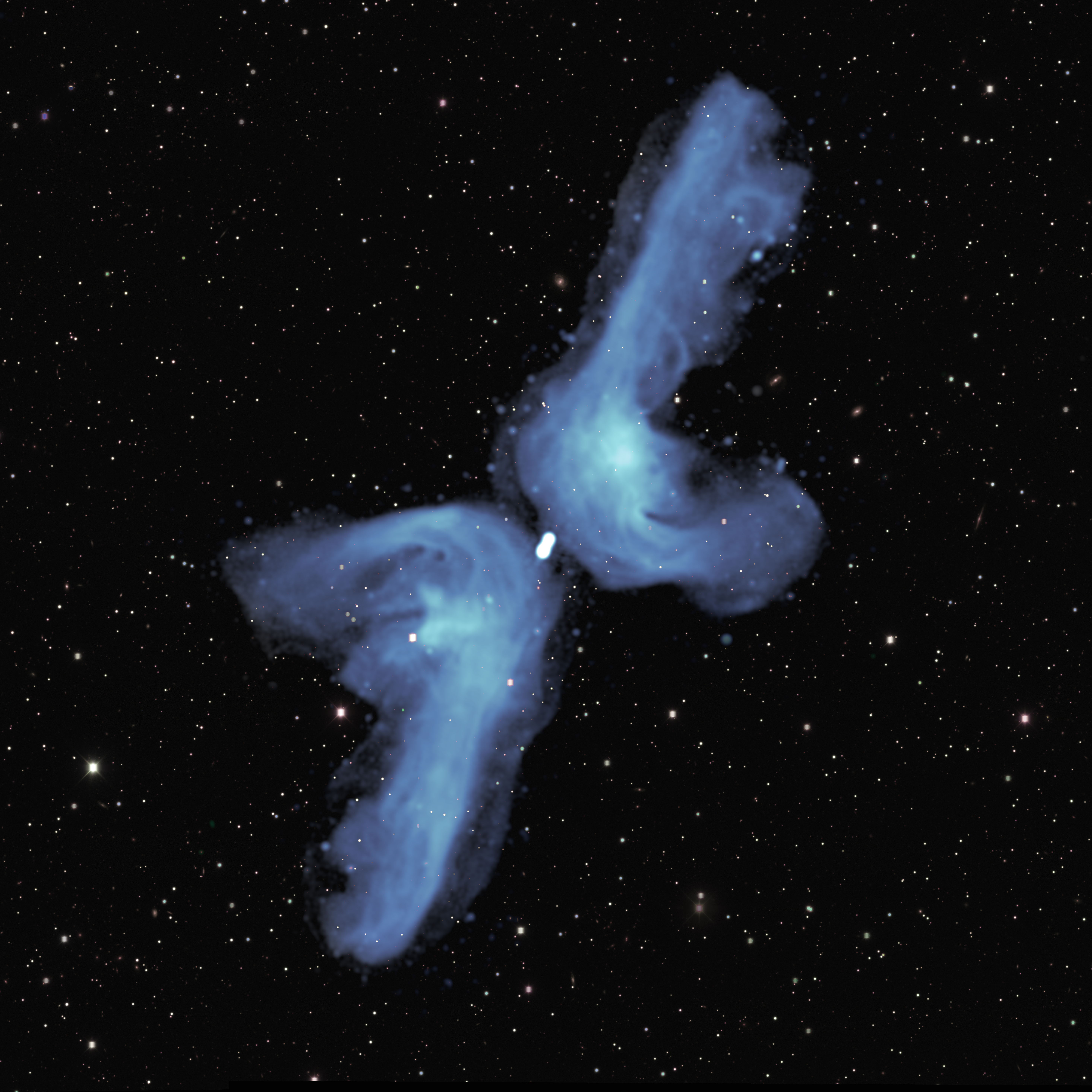
This image of galaxy PKS 2014-55, located 800 million light years from Earth, was made by NRAO scientist William Cotton with the South African Radio Astronomy Observatory (SARAO) MeerKAT telescope. It shows for the first time how the galaxy’s X-shape is actually a ‘double boomerang’. Two powerful jets of radio waves, indicated in blue color, originate from a massive black hole at the center of the galaxy. They each extend 2.5 million light years into space (comparable to the distance between the Milky Way and the Andromeda galaxy, our nearest major neighbour). Eventually, the jets are ‘turned back’ by the pressure of tenuous intergalactic gas. As they flow back towards the central galaxy, they are deflected by its relatively high gas pressure into the shorter, horizontal arms of the boomerang. The background image shows visible light from myriad galaxies in the distant universe. Credit: NRAO/AUI/NSF, S. Dagnello & W. Cotton; SARAO; DES

Hi-Res Full-Size 5861 x 5861 13 MB

Technical Details

Telescope: MeerKAT

Center: RA: 20:18:01.3, Dec: -55:39:31.5

Field of View: 24.53 x 24.53 arcminutes


Friday, May 01, 2026

ALMA Witnesses Star Birth Beyond the Milky Way

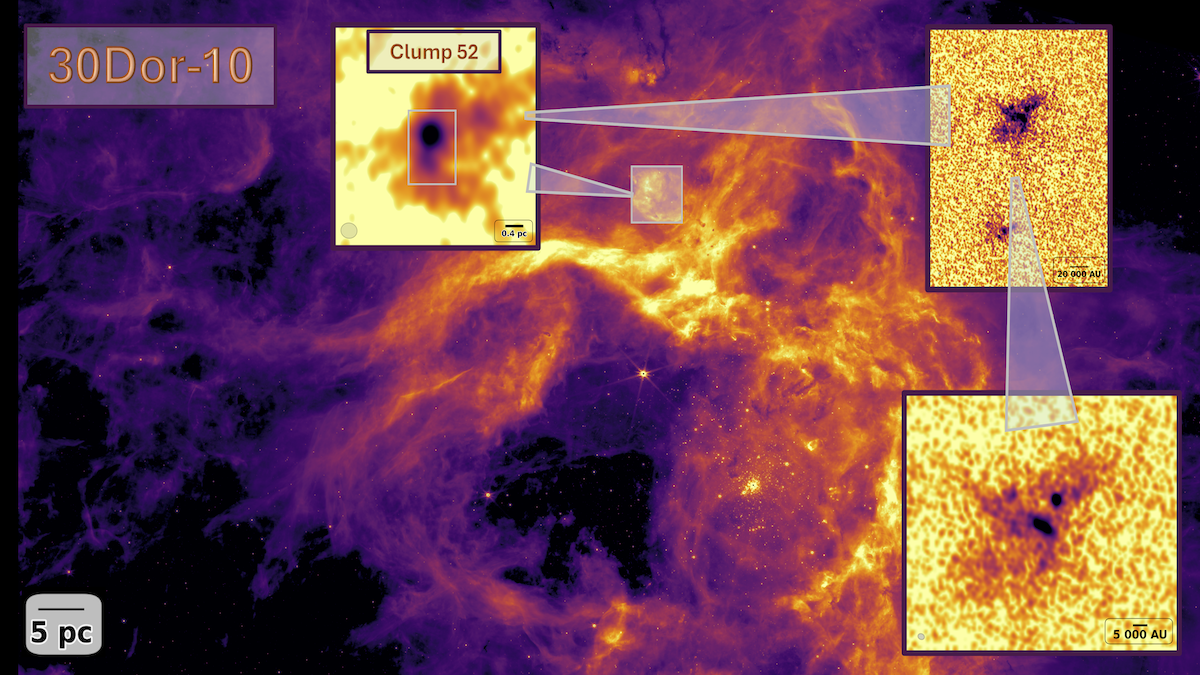
The image shows the 30Dor-10 region in the Large Magellanic Cloud, as seen by the James Webb Space Telescope through a filter that highlights emission from ionized gas. The box on the left represents one of the two clusters considered in this study, "Clump 52," as seen by ALMA before these new results, at a resolution of approximately 20,000 astronomical units. The box on the right shows the stunning new images at 2,000 astronomical units, where the cluster can be seen separating into tworio protoclusters. The brightest and most massive one is in the bottom-right box. Credit: A. Traficante et al. Original Image


Highlights
.
  • ALMA has enabled the first measurement of the core mass function in a galaxy beyond the Milky Way

  • Observations of the Large Magellanic Cloud show that star-forming cores follow similar patterns to those in our Galaxy

  • The results suggest that the earliest stages of star formation may be universal across different galactic environments


Astronomers have used the Atacama Large Millimeter/submillimeter Array (ALMA) to map, for the first time, the mass distribution of the gas and dust clumps from which new stars are born—the so-called core mass function (CMF)—in a star-forming region outside the Milky Way.

The study, led by the Italian National Institute for Astrophysics and published in Nature Communications, focuses on the 30 Dor-10 region in the Large Magellanic Cloud, a nearby galaxy located about 160,000 light-years from Earth. ALMA's combination of high sensitivity and angular resolution enables the resolution of the small-scale structure of star-forming regions even in nearby galaxies, opening a new window for studying the earliest stages of star formation beyond the Milky Way.

To achieve this result, the research team pushed ALMA to the limits of its capabilities for this type of study, reaching an angular resolution of 0.05 arcseconds—equivalent to distinguishing a one-euro coin from 100 kilometers away. This precision allowed them to resolve structures as small as 2,000 astronomical units, identifying 70 dense cores embedded within four protoclusters at a distance of 160,000 light-years. To confirm the nature of these structures and exclude contamination from ionized gas—a particular challenge in such active regions—the team combined ALMA observations with data from the Hubble Space Telescope and the James Webb Space Telescope, which also confirmed that the detected cores are still in an early phase of their evolution.

"We are truly excited about the results achieved with this study. Thanks to ALMA, studying core masses in our Galaxy is becoming almost 'routine,' suggesting in particular that the mass of our cores seems to evolve, especially in high-mass regions," says Alessio Traficante, lead author of the study. "Until now, no one had attempted to push this type of research into extra-galactic regions, which require significantly higher resolution and sensitivity than studies conducted within the Milky Way. The identification of more than 70 cores in 30Dor-10 was by no means guaranteed, considering we were observing an environment with an interstellar medium whose characteristics are profoundly different from those found in the main massive star-forming regions of our Galaxy. We had no idea what to expect before seeing the highly detailed images obtained by ALMA."

By comparing the mass distribution of these cores with those observed in the Milky Way, the researchers found that both follow a similar trend consistent with Salpeter's Law—a notable result given the markedly different conditions in the Large Magellanic Cloud, including lower metallicity, different turbulence regimes, and a more strongly ionized interstellar medium. Crucially, while the initial mass function of stars in such extreme environments can show an excess of massive stars, the earliest phase of core formation appears to follow the same patterns seen in our Galaxy, suggesting that these young cores continue to accrete mass over time regardless of their surroundings.

The findings suggest that the initial fragmentation of molecular clouds—the process that leads to the formation of dense cores—may be largely independent of the surrounding galactic environment. This work, connected to ALMA Large Programs such as ALMA-IMF and ALMAGAL, opens the door to a systematic study of star formation in other galaxies using techniques previously applied only within the Milky Way, and allows astronomers to begin testing whether the physical laws governing the birth of stars hold constant across the universe.


Additional Information

This research appears in Nature Communications as "The fragmentation properties of massive star-forming regions in 30Dor-10 at 2000 au resolution" by A. Traficante et al.

This article is an adaptation of the original press release by the Italian National Institute of Astrophysics (INAF).

The Atacama Large Millimeter/submillimeter Array (ALMA), an international astronomy facility, is a partnership of the European Southern Observatory (ESO), the U.S. National Science Foundation (NSF), and the National Institutes of Natural Sciences (NINS) of Japan in cooperation with the Republic of Chile. ALMA is funded by ESO on behalf of its Member States, by NSF in cooperation with the National Research Council of Canada (NRC) and the National Science and Technology Council (NSTC) in Taiwan, and by NINS in cooperation with the Academia Sinica (AS) in Taiwan and the Korea Astronomy and Space Science Institute (KASI).

ALMA construction and operations are led by ESO on behalf of its Member States; by the National Radio Astronomy Observatory (NRAO), managed by Associated Universities, Inc. (AUI), on behalf of North America; and by the National Astronomical Observatory of Japan (NAOJ) on behalf of East Asia. The Joint ALMA Observatory (JAO) provides the unified leadership and management of ALMA's construction, commissioning, and operation
.


Contacts:

Nicolás Lira
Education and Public Outreach Officer
oint ALMA Observatory, Santiago - Chile
Phone:
+56 2 2467 6519
Cel: +56 9 9445 7726
Email: nicolas.lira@alma.cl

Bárbara Ferreira
ESO Media Manager
Garching bei München, Germany
Phone:
+49 89 3200 6670
Email: press@eso.org

Jill Malusky
Public Information Officer
NRAO
Phone:
+1 304-456-2236
Email: jmalusky@nrao.edu

Seiichiro Naito
NAOJ EPO Lead
Email:
naito.seiichiro@nao.ac.jp


Wednesday, April 29, 2026

Unraveling the Mass Mystery of Orion’s Young Stars

Artist’s impression of two young stars orbiting each other inside the dusty Orion star-forming complex. Because clouds of gas and dust hide these systems at visible and infrared wavelengths, astronomers used the NSF Very Long Baseline Array to observe them in radio light and measure their orbital motion and masses directly. Credit: NRAO/AUI/NSF. Hi-Res File

Artist’s impression of two young stars orbiting each other inside the dusty Orion star-forming complex. Because clouds of gas and dust hide these systems at visible and infrared wavelengths, astronomers used the NSF Very Long Baseline Array to observe them in radio light and measure their orbital motion and masses directly. Credit: NRAO/AUI/NSF - Youtube Vieeo


A star’s mass determines its entire life story, from how it shines to how it dies. For young stars…

A star’s mass determines its entire life story, from how it shines to how it dies. For young stars shrouded in dust, getting an accurate mass has long been difficult…but new radio measurements are beginning to change that. Astronomers are helping unravel the mass mystery of young stars in the Orion star-forming complex by measuring their masses with unprecedented precision.

Lightweight Sun-like stars burn steadily for 10 billion years, while massive ones blaze briefly before exploding as supernovae in mere millions of years. Mass also determines what heavy elements they forge, such as carbon, oxygen, and iron, which form the building blocks of planets and life. In addition, it influences what types of planets can form around them.

Using the U.S. National Science Foundation Very Long Baseline Array (NSF VLBA), a network of radio telescopes spread across the United States that work together as one giant instrument, the team tracked the orbital motions of a sample of young binary star systems in Orion. Binary stars are pairs that orbit a shared center of mass, like dance partners spinning each other around. By watching these “dances” with extraordinary precision at radio wavelengths, researchers were able to calculate the stars’ true masses without relying on theoretical models. As lead researcher Dr. Sergio Abraham Dzib Quijano, from the Max Planck Institute for Radio Astronomy explains, “Stellar mass is the most fundamental property of a star, yet it is notoriously difficult to measure for young, embedded systems.”​

Young stars in Orion are shrouded in dense clouds of gas and dust, blocking visible and even infrared light from reaching most telescopes. The NSF VLBA overcomes this by observing at radio wavelengths (5 GHz), where dust is transparent and the array’s extreme resolution (sub-milliarcsecond) resolves tight binaries that blur together at other wavelengths.

The NSF VLBA can also detect motions on the sky smaller than the width of a human hair seen from thousands of kilometers away, showcasing the remarkable technical achievement behind these mass measurements. In practice, this means measuring tiny shifts in a star’s apparent position on the sky over months and years, using repeated observations to trace out its path. Each NSF VLBA radio telescope in the array records the incoming radio waves with exquisite timing. By combining the signals from antennas spread across the country from Hawaii to the Virgin Islands, astronomers can pinpoint a star’s position with milliarcsecond accuracy, far finer than what is possible with a single dish. By comparing how that position changes from epoch to epoch, they can see the subtle orbital motion caused by the gravity of a companion star and use that motion to infer the mass of each star in the system.

In the systems where the measured masses could be compared with standard models of young-star evolution, the results were mixed: some were reproduced well, while at least one showed a clear mismatch, suggesting that the models may still need refinement. The observations also uncovered previously hidden close companions and evidence that strong magnetic activity can persist in relatively massive young stars.

Young stars in Orion are the building blocks of future planetary systems, much like our own Solar System. “These accurate mass measurements now turn Orion into a precision laboratory for testing how young stars form and evolve,” says Dr. Jazmin Ordonez-Toro, postdoctoral Orquídeas fellow at the Astronomical Observatory at the University of Nariño, who co-led the study, “These measurements vastly expand our understanding of how stellar neighborhoods like our own are built.”


Press Contacts:

Melissa Weiss
Public Information and Multimedia Officer

Email | Phone


About NRAO

The National Radio Astronomy Observatory is a major facility of the U.S. National Science Foundation, operated under cooperative agreement by Associated Universities, Inc.


Thursday, April 16, 2026

Most Close Pairs of Stars Are Born as Cosmic Twins

An artist's rendition of pair of twin stars being born in the HOPS-312 system in Orion.
Credit: NSF/AUI/NSF NRAO/B. Saxton.
Hi-Res File


New research from ALMA suggests disk fragmentation may form close-companion protostellar systems

A new study of infant stars in the Perseus and Orion star-forming regions suggests that most close pairs of stars are born as twins in the same disk, rather than drifting together later from larger distances. By watching powerful streams of gas blasting away from baby stars, a team of researchers has shown that most close pairs of stars likely form side‑by‑side in the same spinning disk of gas and dust.

Many stars in our galaxy don’t live alone like the Sun. Roughly half of Sun-like stars are part of a pair or even a small family of stars that orbit each other. Young stars are even more likely to have companions, which tells astronomers that forming in multiples is a normal part of how stars are born.

What hasn’t been clear is how close pairs of stars—separated by only a few times the width of our solar system—actually come together. Do they form together in the same disk of gas and dust, or do they start far apart and slowly move closer over time?

This new research, led by undergraduate student Ryan Sponzilli of the University of Illinois Urbana-Champaign, tests two leading ideas for how close-companion protostars form:

1. A single, massive disk of gas and dust around a newborn star becomes unstable and breaks into two or more clumps, each collapsing to form a star. This disk fragmentation tends to produce close pairs in an organized, aligned configuration.

2. Turbulence in a larger cloud core causes it to break into widely separated clumps that form stars far apart, which are later pulled inward through complex gravitational interactions. This process of turbulent fragmentation and migration should leave stellar spins and orbits in more random orientations.

“Figuring out which process is more common in the formation of these ‘twins’ will help us understand more about not only stars, but also what kinds of planetary systems might form around them,” shares Sponzilli.

To test these ideas, the research team studied 51 very young protostellar star systems that host close companion stars in the Perseus and Orion molecular clouds, some of the nearest stellar nurseries to Earth. ALMA observations mapped both the dust surrounding the stars and jets of molecular gas blasting away from them.

In 38 of the systems, fast, narrow streams of outflowing gas were clearly observed. These outflows show which way the system is spinning. The outflows usually shoot out at right angles to the disk of material around each star, so their direction is a good guide to how the system is oriented in space.

The researchers compared the direction of each outflow to the line connecting the two stars in a pair. This let them work out whether the system looked organized, as expected if the stars formed together in a disk, or more random, as expected if they formed separately and later moved closer.

The team also built simple computer models of what they should see in the sky for each of the two formation scenarios. When they compared these models to their 42 outflow measurements, the real data matched best with a picture where the outflows tend to line up at right angles to the line between the stars, which is expected if the stars formed together in a single disk.

“The results point to disk fragmentation as the main way that close pairs of baby stars form, at least in the young regions studied here,” adds co-author Leslie Looney, Sponzilli’s professor at the University of Illinois Urbana-Champaign.

By showing that many close stellar twins are likely born together in a single spinning disk, this study strengthens the link between the earliest stages of star formation and the later evolution of planetary systems around multiple stars. Understanding these early alignments will help astronomers predict how common aligned planetary orbits might be in binary systems and how stable those planetary systems can become over time.


About NRAO

The National Radio Astronomy Observatory (NRAO) is a facility of the U.S. National Science Foundation, operated under cooperative agreement by Associated Universities, Inc.

About ALMA

The Atacama Large Millimeter/submillimeter Array (ALMA), an international astronomy facility, is a partnership of the European Southern Observatory (ESO), the U.S. National Science Foundation (NSF) and the National Institutes of Natural Sciences (NINS) of Japan in cooperation with the Republic of Chile. ALMA is funded by ESO on behalf of its Member States, by NSF in cooperation with the National Research Council of Canada (NRC) and the National Science and Technology Council (NSTC) in Taiwan and by NINS in cooperation with the Academia Sinica (AS) in Taiwan and the Korea Astronomy and Space Science Institute (KASI).

ALMA construction and operations are led by ESO on behalf of its Member States; by the National Radio Astronomy Observatory (NRAO), managed by Associated Universities, Inc. (AUI), on behalf of North America; and by the National Astronomical Observatory of Japan (NAOJ) on behalf of East Asia. The Joint ALMA Observatory (JAO) provides the unified leadership and management of the construction, commissioning and operation of ALMA.


Friday, March 13, 2026

ALMA Detects Extremely Abundant Alcohol in Interstellar Comet 3I/ATLAS

An artist's impression of 3I/ATLAS is shown as it passes near the Sun, illuminating one side of the comet. On the side of the comet closer to the sun, the methanol gas is shown in blue, with icy dust grains still present in the gas. On the dark side of the comet, the hydrogen cyanide is shown in orange. Credit: NSF/AUI/NSF NRAO/M.Weiss


Astronomers capture a chemical snapshot of planet formation beyond our solar system

Comet 3I/ATLAS continues to make astonishing headlines, thanks to new findings from astronomers using the Atacama Large Millimeter/submillimeter Array (ALMA), of which the U.S. National Science Foundation National Radio Astronomy Observatory (NSF NRAO) is a partner. This new research reveals that 3I/ATLAS is packed with an unusually large amount of the organic molecule methanol – more than almost all known comets in our own solar system.

“Observing 3I/ATLAS is like taking a fingerprint from another solar system,” shares Nathan Roth, lead author on this research, and a professor with American University, “The details reveal what it’s made of, and it’s bursting with methanol in a way we just don’t usually see in comets in our own solar system.”

Using ALMA’s Atacama Compact Array in Chile, on multiple dates in late 2025, the team observed 3I/ATLAS as it approached our Sun. As sunlight warmed its icy surface, 3I/ATLAS released gas and dust, forming a glowing halo (or coma) around its core. By analyzing this coma, astronomers revealed the chemical fingerprints of the material it is composed of, allowing them to study how objects might be made in another planet,ary system, without leaving our own.

The team focused on the faint submillimeter fingerprints of two molecules: methanol (CH₃OH), a type of alcohol, and hydrogen cyanide (HCN), a nitrogen-bearing organic molecule commonly seen in comets. The ALMA data reveal that 3I/ATLAS is heavily enriched in methanol compared to hydrogen cyanide, far beyond what is typically seen in comets born in our own solar system. On two observing dates, the team measured methanol‑to‑HCN ratios of about 70 and 120, placing 3I/ATLAS among the most methanol‑rich solar system comets ever studied.

These measurements imply that the icy material from 3I/ATLAS was formed by (or experienced) very different conditions than those that shape most comets in our own solar system. Previous work with the James Webb Space Telescope has shown that 3I/ATLAS had a coma dominated by carbon dioxide when it was far from the Sun, and these new ALMA results add methanol as another unusual detail in its chemical inventory.

ALMA’s high resolution for imaging also allowed the team to see how different molecules move away from the comet, revealing surprising differences between methanol and hydrogen cyanide. Hydrogen cyanide appears to come, for the most part, directly from the comet’s core, or nucleus, which is typical for comets in our solar system. Methanol, on the other hand, appears to come from both the nucleus AND from ice particles in the coma. These tiny, icy grains act like mini-comets: as the object moves closer to the Sun, where ice turns into gas, they also release methanol. Similar behavior has been observed in some solar system comets, but this is the first time the physics of such detailed outgassing has been traced in an interstellar object.

​Comet 3I/ATLAS is only the third confirmed object ever seen passing through our solar system from interstellar space, after 1I/‘Oumuamua and 2I/Borisov. Observations of these objects also revealed unusual properties. As astronomers continue to discover and study more interstellar objects, our understanding of planet formation in other planetary systems continues to grow more interesting.


Press Contacts:

Jill Malusky
Sr. Public Information Group Manager and Public Information Officer

Email | Phone


About NRAO

The National Radio Astronomy Observatory (NRAO) is a facility of the U.S. National Science Foundation, operated under cooperative agreement by Associated Universities, Inc.

About ALMA

The Atacama Large Millimeter/submillimeter Array (ALMA), an international astronomy facility, is a partnership of the European Southern Observatory (ESO), the U.S. National Science Foundation (NSF) and the National Institutes of Natural Sciences (NINS) of Japan in cooperation with the Republic of Chile. ALMA is funded by ESO on behalf of its Member States, by NSF in cooperation with the National Research Council of Canada (NRC) and the National Science and Technology Council (NSTC) in Taiwan and by NINS in cooperation with the Academia Sinica (AS) in Taiwan and the Korea Astronomy and Space Science Institute (KASI).

ALMA construction and operations are led by ESO on behalf of its Member States; by the National Radio Astronomy Observatory (NRAO), managed by Associated Universities, Inc. (AUI), on behalf of North America; and by the National Astronomical Observatory of Japan (NAOJ) on behalf of East Asia. The Joint ALMA Observatory (JAO) provides the unified leadership and management of the construction, commissioning and operation of ALMA.


Thursday, February 26, 2026

A Quintillion-to-One: Giant Stars, Tiny Dust

Artist’s impression of WR 112, a binary system containing a massive, evolved Wolf-Rayet star and an OB-type companion. As their stellar winds collide, dust forms and spirals outward, consisting mostly of extremely tiny, nanometer-sized grains along with a secondary population about 100 times larger. Credit: NSF/AUI/NSF NRAO/M. Weiss. Hi-Res File


ALMA and JWST reveal nanometer-scale carbon dust grains emanating from a massive binary star system

Telescope (JWST) have discovered that some of the most massive stars in our galaxy are emitting unbelievably tiny grains of carbon dust—dust that one day could form future stars and planets. Both powerful telescopes were required for this research, to reveal all of the dust being produced by these stars.

This new research focused on WR 112, a binary star system that contains a very rare, massive, intensely hot, and dying Wolf–Rayet star orbiting another star companion. Together, these stars blast out powerful stellar winds that collide and create dense, cooling regions where dust forms, before this dust is scattered into interstellar space by intense starlight.

While previous mid-infrared images from JWST revealed bright spiral arcs of dust in WR 112, researchers were surprised when they saw no dust at all in ALMA’s sensitive millimeter observations. Only warm, tiny dust grains could hide from ALMA’s view, one of the most powerful millimeter telescopes on Earth. Combined data from JWST and ALMA suggested that the dust grains in the extended spiral structures are largely smaller than one micrometer, and most of them should be only a few nanometers (or billionths of a meter) across.

“It’s amazing to know that some of the most massive stars in the Universe produce some of the tiniest dust particles before they die. The difference in size between the star and the dust it produces is about a quintillion to one,” shared Donglin Wu, an undergraduate at Yale University and the lead author of this new research.

The team also found evidence that the dust is not evenly made up of a range of sizes, but instead comes in two distinct sizes: a larger group of nanometer-sized grains, and a smaller group of grains about 0.1 micrometer across. This discovery reconciled decades of conflicting measurements of similar binary systems: some revealed only very tiny grains, while others only saw larger ones. Now, it is understood that this type of binary system can have both. The team explored several physical processes that can, in principle, break up or evaporate dust grains near the harsh radiation field of the stars, finding that these processes have a tendency to destroy grains that were in between these sizes under certain conditions.

Because WR 112 is one of the most prolific dust producers of its kind—producing as much as three Moons’ worth of dust every year—the new grain-size measurements have big implications for how much carbon dust massive binaries can contribute to the broader galaxy. By revealing that some of the Universe’s biggest stars are factories for some of its smallest solid particles, this study provides an important missing piece in the life cycle of cosmic dust.


Press Contacts:

Jill Malusky
Sr. Public Information Group Manager and Public Information Officer
Email | Phone


About NRAO

The National Radio Astronomy Observatory (NRAO) is a facility of the U.S. National Science Foundation, operated under cooperative agreement by Associated Universities, Inc.

About ALMA

The Atacama Large Millimeter/submillimeter Array (ALMA), an international astronomy facility, is a partnership of the European Southern Observatory (ESO), the U.S. National Science Foundation (NSF) and the National Institutes of Natural Sciences (NINS) of Japan in cooperation with the Republic of Chile. ALMA is funded by ESO on behalf of its Member States, by NSF in cooperation with the National Research Council of Canada (NRC) and the National Science and Technology Council (NSTC) in Taiwan and by NINS in cooperation with the Academia Sinica (AS) in Taiwan and the Korea Astronomy and Space Science Institute (KASI).

ALMA construction and operations are led by ESO on behalf of its Member States; by the National Radio Astronomy Observatory (NRAO), managed by Associated Universities, Inc. (AUI), on behalf of North America; and by the National Astronomical Observatory of Japan (NAOJ) on behalf of East Asia. The Joint ALMA Observatory (JAO) provides the unified leadership and management of the construction, commissioning and operation of ALMA.


Saturday, February 14, 2026

VLITE Marks 11 Years of Capturing the Dynamic Radio Sky

VLITE 11 year sky coverage map
Credit: NRL.
Hi-Res File


A collaboration between the U.S. Naval Research Laborato,hrry and the National Radio Astronomy Observatory celebrates over a decade of commensal observing with the VLA

The U.S. National Science Foundation National Radio Astronomy Observatory (NSF NRAO) and the U.S. Naval Research Laboratory (NRL) are celebrating the 11th anniversary of the VLA Low-band Ionosphere and Transient Experiment (VLITE), a pioneering program that has opened new windows into the low-frequency radio universe.

Launched in late 2014, VLITE operates commensally with the U.S. National Science Foundation Very Large Array (NSF VLA), continuously recording low-frequency data while the NSF VLA conducts its regular science observations. This innovative model has enabled VLITE to build an unprecedented dataset of the dynamic radio sky, without interrupting or altering the array’s primary research projects.

“VLITE was envisioned as an opportunistic experiment, but it has evolved into a powerhouse dataset for studying the ionosphere, transients, and cosmic radio emission,” said NSF VLA Director Dr. Trish Henning. “Its success demonstrates how strategic collaborations can multiply the scientific return of existing infrastructure.”

As of its 11th anniversary, VLITE has amassed a remarkable record of continuous operation and scientific impact:

Sky coverage:

98% of the sky north of –40° declination observed to 49 minutes

50% of the sky north of –40° declination observed to 190 minutes

1% of that same sky observed to 132 hours


Data production:

More than 3.8 million META files processed

66,846 hours of data collected (representing 69% of wall-clock time)

759,760 archived images


Scientific impact:

93 peer-reviewed papers using or referencing VLITE data

6,256 total citations

75,429 combined reads across those publications


Additionally, seven high-impact papers have been published in Nature, Nature Astronomy, and Science.

“The sustained productivity and science reach of VLITE highlight the value of commensal observing,” said a scientist from NRL’s Remote Sensing Division. “By listening to the low-band universe alongside the VLA, we’ve captured both expected and surprising phenomena—from ionospheric structure to astrophysical transients.”

VLITE’s success provides a crucial foundation for future low-frequency efforts at the VLA, including technology pathfinding for the next-generation VLA (ngVLA) and potential extensions of the VLITE model to expanded frequency coverage or continuous transient monitoring.

“The collaboration between NRL and NSF NRAO continues to showcase what’s possible when innovative engineering, operations, and science intersect,” said Director Trish Henning. “As we look ahead, VLITE remains a testament to what long-term vision and cooperation can achieve.”


Press Contacts:

Corrina Jaramillo Feldman
Sr. Public Information Officer

cfeldman@nrao.edu | Tel: +15056408189


About VLITE

The VLA Low-band Ionosphere and Transient Experiment (VLITE) is a collaborative program between the U.S. Naval Research Laboratory and the U.S. National Science Foundation National Radio Astronomy Observatory. VLITE operates commensally with the NSF VLA, recording data in the 320–384 MHz frequency range during regular NSF VLA observations to study astrophysical and geophysical phenomena.

About NRAO

The National Radio Astronomy Observatory is a facility of the U.S. National Science Foundation, operated under cooperative agreement by Associated Universities, Inc.

About the U.S. Naval Research Laboratory

NRL is a scientific and engineering command dedicated to research that drives innovative advances for the U.S. Navy and Marine Corps from the seafloor to space and in the information domain. NRL, located in Washington, D.C. with major field sites in Stennis Space Center, Mississippi; Key West, Florida; Monterey, California, and employs approximately 3,000 civilian scientists, engineers and support personnel.

NRL offers several mechanisms for collaborating with the broader scientific community, within and outside of the Federal government. These include Cooperative Research and Development Agreements (CRADAs), LP-CRADAs, Educational Partnership Agreements, agreements under the authority of 10 USC 4892, licensing agreements, FAR contracts, and other applicable agreements.


Thursday, January 22, 2026

ALMA Reveals Teenage Years of New Worlds

This ARKS gallery of faint debris disks reveals details about their shape: belts with multiple rings, wide smooth halos, sharp edges, and unexpected arcs and clumps, which hint at the presence of planets shaping these disks; and chemical make-up: the amber colors highlight the location and abundance of the dust in the 24 disks surveyed, while the blue their carbon monoxide gas location and abundance in the six gas-rich disks. Credit: Sebastian Marino, Sorcha Mac Manamon, and the ARKS collaboration. Hi-Res File


New astronomical survey captures previously unknown growing pains in the lives of planets

Astronomers have, for the first time, captured a detailed snapshot of planetary systems in an era long shrouded in mystery. The ALMA survey to Resolve exoKuiper belt Substructures (ARKS), using the Atacama Large Millimeter/submillimeter Array (ALMA), has produced the sharpest images ever of 24 debris disks, the dusty belts left after planets finish forming. These disks are the cosmic equivalent of the teenage years for planetary systems—somewhat more mature than newborn, planet-forming disks, but not yet settled into adulthood.

A Missing Link in Planetary Family Albums

“We’ve often seen the ‘baby pictures’ of planets forming, but until now, the ‘teenage years’ have been a missing link,” says Meredith Hughes, an Associate Professor of Astronomy at Wesleyan University and co-PI of this study.

Our own Solar System’s counterpart to this phase is the Kuiper Belt, a ring of icy debris beyond Neptune that preserves a record of massive collisions and planetary migrations from billions of years ago. By studying 24 exoplanetary debris belts, the ARKS team has opened a window into what our Solar System went through as the Moon was forming and as planets jostled for their final places, and sometimes trading orbits!

Teenage Disks: Hard to “Photograph,” Impossible to Ignore

Debris disks are faint, hundreds or even thousands of times dimmer than the bright, gas-rich disks where planets are born. The ARKS team overcame these challenges and produced images of these disks in unprecedented detail. Like teenagers dodging the camera, these faint disks have managed to hide from astronomers for years. But, thanks to ALMA, astronomers can now see their complex structures: belts with multiple rings, wide smooth halos, sharp edges, and even unexpected arcs and clumps.

“We’re seeing real diversity—not just simple rings, but multi-ringed belts, halos, and strong asymmetries, revealing a dynamic and violent chapter in planetary histories,” adds Sebastián Marino, program lead for ARKS, and an Associate Professor at the University of Exeter.

Highlights and Firsts from ARKS
  • A New Benchmark: ARKS is the largest, highest-resolution survey of debris disks, akin to a ‘DSHARP-for-debris-disks’, setting a new gold standard.

  • A Dynamic, Violent Youth: About one-third of observed disks show clear substructures (multiple rings or distinct gaps) suggesting legacy features left from earlier, planet-building stages or sculpted by planets over much longer timescales.

  • Unexpected Diversity: While some disks inherit intricate structures from their earlier years, others mellow out and spread into broad belts, similar to how we expect the Solar System to have developed.

  • Clues to Planetary ‘Stirring’: Many disks show evidence for zones of calm and chaos, with vertically “puffed-up” regions, akin to our Solar System’s own mix of serene classical Kuiper Belt objects and those scattered by Neptune’s long-ago migration.

  • Surprising Gas Survivors: Several disks retain gas much longer than expected. In some systems, lingering gas may shape the chemistry of growing planets, or even push dust into wide halos.

  • Asymmetries and Arcs: Many disks are lopsided, with bright arcs or eccentric shapes, hinting at gravitational shoves from unseen planets, leftover birth scars from planetary migration, or interactions between the gas and dust.

  • Public Data Release: All ARKS observations and processed data are being made freely available to astronomers worldwide, enabling further discoveries.

Implications: Your Solar System Was Once a Wild Ride

The ARKS results show this teenage phase is a time of transition and turmoil. “These disks record a period when planetary orbits were being scrambled and huge impacts, like the one that forged Earth’s Moon, were shaping young solar systems,” says Luca Matrà, a co-PI on the survey, and Associate Professor at Trinity College Dublin.

By looking at dozens of disks around stars of different ages and types, ARKS helped decode whether chaotic features are inherited, sculpted by planets, or arise from other cosmic forces. Answering these questions could reveal whether our Solar System’s history was unique, or the norm.

Looking Ahead: Hunting for Planetary Architects

The ARKS survey’s findings are a treasure trove for astronomers hunting for young planets and seeking to understand how planet families, like our own, are built and rearranged.

“This project gives us a new lens for interpreting the craters on the Moon, the dynamics of the Kuiper Belt, and the growth of planets big and small. It’s like adding the missing pages to the Solar System’s family album,” adds Hughes.

The ARKS survey is the work of an international team of approximately 60 scientists, led by the University of Exeter, Trinity College Dublin, and Wesleyan University. For more information, visit https://arkslp.org/.


About ALMA

The Atacama Large Millimeter/submillimeter Array (ALMA), an international astronomy facility, is a partnership of the European Southern Observatory (ESO), the U.S. National Science Foundation (NSF) and the National Institutes of Natural Sciences (NINS) of Japan in cooperation with the Republic of Chile. ALMA is funded by ESO on behalf of its Member States, by NSF in cooperation with the National Research Council of Canada (NRC) and the National Science and Technology Council (NSTC) in Taiwan and by NINS in cooperation with the Academia Sinica (AS) in Taiwan and the Korea Astronomy and Space Science Institute (KASI). ALMA construction and operations are led by ESO on behalf of its Member States; by the National Radio Astronomy Observatory (NRAO), managed by Associated Universities, Inc. (AUI), on behalf of North America; and by the National Astronomical Observatory of Japan (NAOJ) on behalf of East Asia. The Joint ALMA Observatory (JAO) provides the unified leadership and management of the construction, commissioning and operation of ALMA.


About NRAO

The National Radio Astronomy Observatory (NRAO) is a facility of the U.S. National Science Foundation, operated under cooperative agreement by Associated Universities, Inc.


Leadership Team

S. Marino (University of Exeter), A. M. Hughes (Wesleyan University), and L. Matrà (Trinity College Dublin)


Collaboration Members

Y. Han (Caltech), B. Zawadzki (Wesleyan University), S. Mac Manamon (Trinity College Dublin), J. Milli (IPAG), J. B. Lovell (Center for Astrophysics, Harvard & Smithsonian), A. Brennan (Trinity College Dublin), P. Weber (Usach, Núcleo Milenio YEMS), M. R. Jankovic (University of Belgrade), M. C. Wyatt (University of Cambridge), T. Löhne (Friedrich-Schiller-Universität Jena), P. Ábrahám (Konkoly Observatory), M. Bonduelle (IPAG), A. S. Hales (NRAO), M. Booth (UKATC), C. del Burgo (Universidad de La Laguna; Instituto de Astrofísica de Canarias), J. M. Carpenter (ALMA), G. Cataldi (NAOJ), E. Chiang (Berkeley), E. Choquet (LAM), S. Ertel (University of Arizona), A. Fehr (Center for Astrophysics, Harvard & Smithsonian), J. Olofsson (ESO), Th. Henning (MPIA), J. Jennings (Flatiron Institute), G. M. Kennedy (Victoria University), Á. Kóspál (Konkoly Observatory), A. V. Krivov (Friedrich-Schiller-Universität Jena), P. Luppe (Trinity College Dublin), M. A. MacGregor (Johns Hopkins University), E. Mansell (Wesleyan University), J. P. Marshall (ASIAA), B. C. Matthews (University of Victoria), A. Moór (Konkoly Observatory), K. Öberg (Center for Astrophysics, Harvard & Smithsonian), N. Pawellek (University of Vienna), T. D. Pearce (University of Warwick), S. Pérez (Usach, Núcleo Milenio YEMS), A. A. Sefilian (University of Arizona), A. G. Sepulveda (UT Law), D. J. Wilner (Center for Astrophysics, Harvard & Smithsonian), C. Baruteau (IRAP), R. Bendahan-West (University of Exeter), A. Bayo (ESO), R. Booth (University of Leeds), F. Castillo (Usach, Núcleo Milenio YEMS), A. Cheruiyot (Wesleyan University), J. Ehrhardt (ESO), Th. M. Esposito (Berkeley), V. Gupta (University of Exeter), J. Hom (University of Arizona), A. Higuchi (Musashino University), C. Hou (Wesleyan University), J. Kittling (KIPAC), Hiroshi Kobayashi (Nagoya University), J. Lee (Wesleyan University), Y. Mpofu (Wesleyan University), R. Nakatani (UNIMI), A. Nurmohamed (Wesleyan University), M. Pan (Center for Astrophysics, Harvard & Smithsonian), V. Squicciarini (University of Exeter), J. Zander (Friedrich-Schiller-Universität Jena).

Funding Acknowledgement

ARKS would not have been possible without the support of ALMA and its partners—the European Southern Observatory representing its member states, the United States National Science Foundation, and the National Institutes of Natural Sciences of Japan, together with the National Research Council of Canada, the Ministry of Science and Technology of Taiwan and the Academia Sinica Institute of Astronomy and Astrophysics, and the Korea Astronomy and Space Science Institute, in cooperation with the Republic of Chile; the Beatriz Galindo grant program; the Brinson Foundation; the Canadian Advanced Network for Astronomy Research supported by the National Research Council of Canada, the Canadian Space Agency, CANARIE, the Canadian Foundation for Innovation, and the Digital Research Alliance of Canada; the Chilean National Agency for Research and Development including the FONDECYT programme and the Millennium Science Initiative Program; the Consejería de Economía, Conocimiento y Empleo of the Government of the Canary Islands; the European Research Council (grants FEED and E-BEANS, numbers 101162711 and 100117693 ); the French National Planetology Program; the French National Research Agency; the Gates Cambridge Trust; the Heising–Simons Foundation; the Hungarian Ministry of Culture and Innovation through the National Research, Development and Innovation Fund; the Irish Research Council; the Institute of Physics Belgrade; Marie Skłodowska-Curie Actions; the NASA Connecticut Space Grant Consortium; the NASA Exoplanet Research Program; the North American ALMA Science Center; the Opticon–RadioNet Pilot funded by the European Union’s Horizon 2020 research and innovation programme; the Royal Society; the Smithsonian Institution; the Simons Foundation; the Space Telescope Science Institute; the Spanish Ministry of Science, Innovation and Universities and the European Regional Development Fund; the United Kingdom node of the European ALMA Regional Centre; United Kingdom Research and Innovation; the United States National Science Foundation; the University of La Laguna; the Warwick Prize Fellowship; the Ministry of Science, Technological Development and Innovations of the Republic of Serbia; and the National Science and Technology Council of Taiwan.


Saturday, January 10, 2026

The NSF Very Large Array Helps Reveal Record-Breaking Stream of Super-Heated Gas from Nearby Galaxy

T
his artist’s rendering illustrates a precessing jet erupting from the supermassive black hole at the center of galaxy VV 340a. Optical observations from the W. M. Keck Observatory revealed extended, cooler gas pushed outward over thousands of light-years, while infrared data from NASA’s James Webb Space Telescope captured the super-heated coronal gas near the galaxy’s core. Credit: W. M. Keck Observatory / Adam Makarenko
. Hi-Res File


Astronomers using the U.S. National Science Foundation Very Large Array (NSF VLA), together with the NASA James Webb Space Telescope and other observatories, have identified an enormous, galaxy-scale stream of super-heated gas erupting from the nearby galaxy VV 340a. New radio images from the NSF VLA trace a pair of powerful plasma jets launched by the galaxy’s central supermassive black hole, which appear to be driving hot coronal gas out of the galaxy and shutting down future star formation.

VV 340a lies relatively close in cosmic terms, giving astronomers an unprecedented, multiwavelength look at how radio jets from a feeding black hole can carve through a galaxy’s disk, stir up its gas, and limit its ability to grow new stars. In VV 340a, the jets extend on kiloparsec scales and follow a helical path, clear evidence that they slowly change direction over time in a process known as jet precession. This is the first time astronomers have seen a precessing, kiloparsec-scale radio jet in a disk galaxy driving such a massive, coherent outflow of coronal gas.

Operated by the U.S. National Science Foundation National Radio Astronomy Observatory (NSF NRAO) the NSF VLA is one of the world’s most versatile and powerful radio observatories and was essential for revealing the structure and impact of VV 340a’s jets. This result was presented on Thursday, January 8, 2026 at the 247th American Astronomical Society Conference. You can read the full press release HERE.


About NRAO

The National Radio Astronomy Observatory is a facility of the U.S. National Science Foundation, operated under cooperative agreement by Associated Universities, Inc.


Media Contact:

Corrina C. Jaramillo Feldman
Sr. Public Information Officer
VLA, VLBA, ngVLA

cfeldman@nrao.edu
(505) 366-7267