Showing posts with label circumplanetary disk. Show all posts

Sunday, April 12, 2026

How Jupiter Cultivated More Large Moons than Saturn — A magnetospheric cavity explains the difference

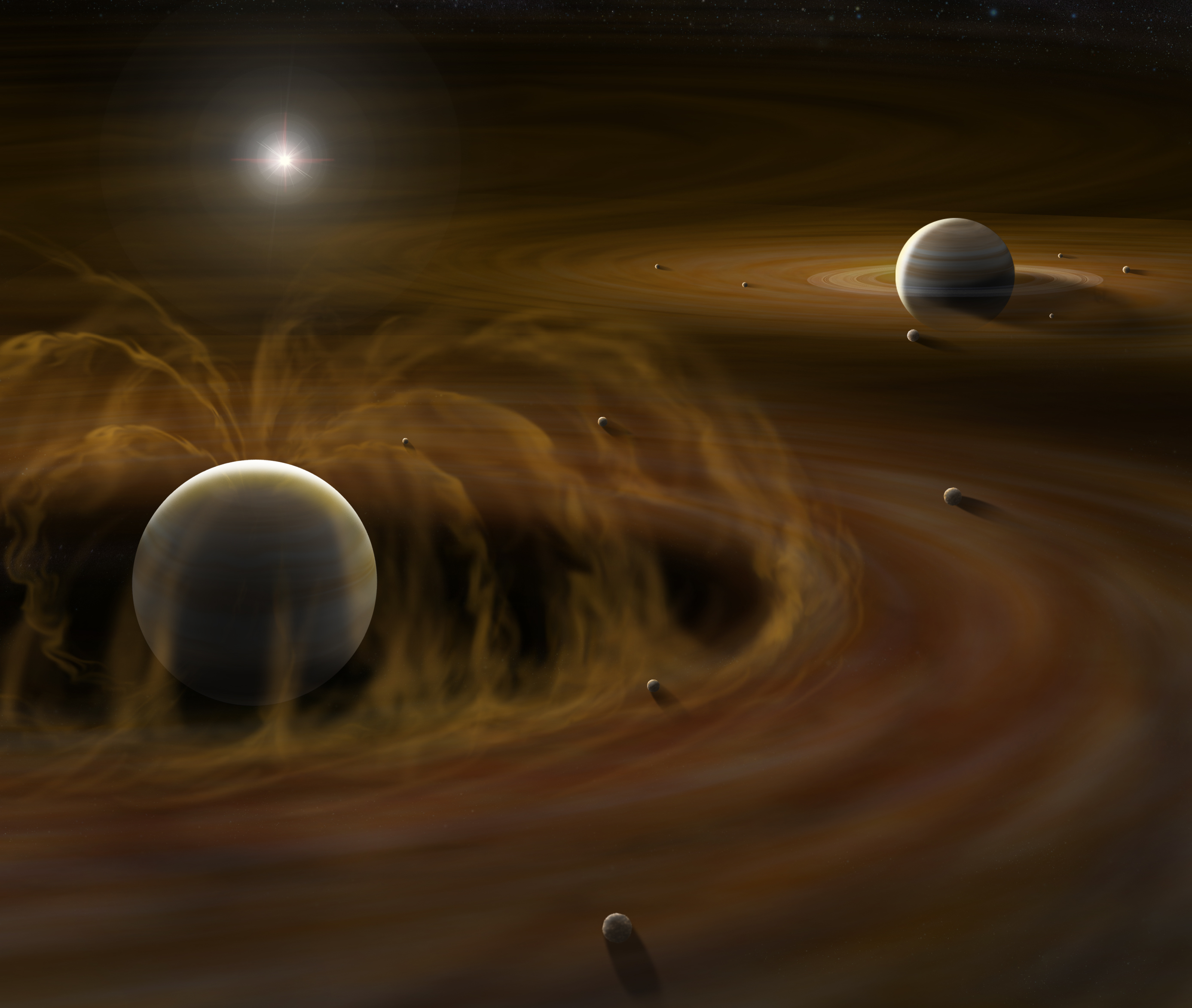
Artist’s impression of the simulations conducted in this research. Jupiter (lower left) has a strong magnetic field which creates a cavity in its circumplanetary disk. Saturn (upper right) lacks a strong magnetic field so its circumplanetary disk evolves without a cavity. Credit: Yuri I. Fujii/L-INSIGHT [Kyoto University], Shinichiro Kinoshita.  Image (5.0MB)

The Solar System’s two largest gas giant planets, Jupiter and Saturn, have extensive but very different families of moons orbiting them. New simulations conducted on the PC cluster at the Center for Computational Astrophysics (CfCA), National Astronomical Observatory of Japan (NAOJ) showed that the planet’s magnetic field plays a role in creating an environment where the new moons can survive and grow, thus shaping the evolution of the system.

Jupiter has more than 100 reported moons, including four large ones (Ganymede, Callisto, Io, and Europa). Saturn has more than 280 reported moons, but only one large one (Titan). So it is a puzzle why Saturn managed to cultivate more moons, but fewer large moons than Jupiter.

A team led by Kyoto University, including researchers from institutes in Japan and China, used the PC cluster at CfCA, NAOJ, to simulate the formation of the moon systems around Jupiter and Saturn. This simulation recreated the planets’ internal structure to calculate the thermal evolution of Jupiter and Saturn and how their magnetic fields have varied over time.

Moons form from material in a “circumplanetary disk” of gas and dust orbiting the young planet. The disk nurtures the young moons, but interactions with the disk may cause them to fall into the planet. The simulations showed that young Jupiter generated a strong planetary magnetic field that created a safe “cavity” around the planet where its young large moons were prevented from migrating too close to their host planet. Young Saturn lacked a strong magnetic field, so only one large moon managed to survive.

“Testing planet formation theory is somewhat difficult because we have only our Solar System for reference, but there are multiple satellite systems close to us whose detailed characteristics we can observe,” says Yuri I. Fujii, primary author of the report announcing these findings. Next, the team is interested in expanding their theory to other moons and potential exomoon systems.


Detailed Article(s)

How Jupiter Cultivated More Large Moons than Saturn —— A magnetospheric cavity explains the difference

Center for Computational Astrophysics

Release Information

Researcher(s) Involved in this Release

  • Yuri Fujii (Graduate School of Human and Environmental Studies, Kyoto University)
  • Masahiro Ogihara (Tsung-Dao Lee Institute, Shanghai Jiao Tong University)
  • Yasunori Hori (Okayama University)

Coordinated Release Organization(s)
  • Kyoto University
  • Okayama University
  • National Astronomical Observatory of Japan, NINS
  • Fujii et al. “Different architecture of Jupiter and Saturn satellite systems from magnetospheric cavity formation” in Nature Astronomy, DOI: 10.1038/s41550-026-02820-x

Related Link(s)

Wednesday, January 28, 2026

Massive Cloud With Metallic Winds Discovered Orbiting Mystery Object

PR Image noirlab2602a
Artist’s Illustration of Cloudy Disk Orbiting Distant Star

PR Image iotw2223a
Starry Night, Laser Light


Videos

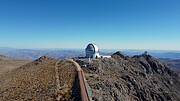
Gemini South at Cerro Pachón
PR Video pachon_drone_10
Gemini South at Cerro Pachón


Astronomers using the Gemini South telescope achieve unprecedented detection of vaporized metals within a dusty, gaseous cloud during rare stellar occultation

Sweeping winds of vaporized metals have been found in a massive cloud that dimmed the light of a star for nearly nine months. This discovery, made with the Gemini South telescope in Chile, one half of the International Gemini Observatory, partly funded by the U.S. National Science Foundation and operated by NSF NOIRLab, offers a rare glimpse into the chaotic and dynamic processes still shaping planetary systems long after their formation.

In September 2024, a star 3000 light-years away suddenly became 40 times dimmer than usual, and remained so until May 2025. The star, J0705+0612, is similar to our Sun, so its stark dip in brightness caught the attention of Nadia Zakamska, professor of astrophysics at Johns Hopkins University. “Stars like the Sun don’t just stop shining for no reason,” she says, “so dramatic dimming events like this are very rare.”

Recognizing the opportunity to study such an event over many months, Zakamska and her team initiated observations with the Gemini South telescope, located on Cerro Pachón in Chile, as well as the Apache Point Observatory 3.5-meter telescope and the 6.5 meter Magellan Telescopes. The findings are published in a paper appearing in The Astronomical Journal.

By combining their observations with archival data on J0705+0612 [1], the team determined the star had been occulted, or temporarily obscured by, a vast, slow-moving, cloud of gas and dust. They estimate the cloud is about two billion kilometers (1.2 billion miles) from its host star and roughly 200 million kilometers (120 million miles) in diameter.

The data indicate that this cloud is gravitationally bound to a secondary object that itself orbits the star in the outer reaches of its planetary system. While the nature of this object remains unknown, it must be massive enough to hold the cloud together. Observations constrain it to be at least a few times the mass of Jupiter, though it could be larger. Possibilities range from a planet to a brown dwarf to an extremely low-mass star.

If the mystery object is a star, the cloud would be classified as a circumsecondary disk — a debris disk orbiting the less massive member of a binary system. If the object is a planet, it would be a circumplanetary disk. In either case, directly observing a star being occulted by a disk surrounding a secondary object is exceptionally rare, with only a handful of known examples.

To investigate the cloud’s composition, the team used Gemini South’s cutting-edge instrument, the Gemini High-resolution Optical SpecTrograph (GHOST). In March 2025, GHOST observed the occultation for just over two hours, dispersing the light from the star into a spectrum that reveals the chemical elements present in the intervening material.

“When I started observing the occultation with spectroscopy, I was hoping to unveil something about the chemical composition of the cloud, as no such measurements had been done before. But the result exceeded all my expectations,” says Zakamska.

The GHOST data revealed multiple metals — elements heavier than helium — within the cloud. More remarkably, the high precision of the spectra allowed the team to directly measure how the gas is moving in three dimensions. This marks the first time astronomers have measured the internal gas motions of a disk orbiting a secondary object such as a planet or low-mass star. The observations show a dynamic environment with winds of gaseous metals, including iron and calcium.

“The sensitivity of GHOST allowed us to not only detect the gas in this cloud, but to actually measure how it is moving,” says Zakamska. “That’s something we’ve never been able to do before in a system like this.”

“This study illustrates the considerable power of Gemini’s newest facility instrument, GHOST,” notes Chris Davis, NSF Program Director for NOIRLab, “and further highlights one of Gemini’s great strengths — rapidly responding to transient events like this occultation.”

The precise measurements of the speed and direction of the wind show that the cloud is moving separate from its host star. This, combined with how long the occultation lasted, further confirm that the occulter is a disk around a secondary object and that it orbits in the outer reaches of its host star’s stellar system.

The source shows infrared excess, typically associated with disks around young stars. However, J0705+0612 is more than two billion years old, meaning the disk is unlikely to be leftover debris from the system’s early planet formation stage. So how did it form?

Zakamska proposes that it originated after two planets collided with each other in the outer reaches of this star’s planetary system, ejecting dust, rocks, and debris and forming the massive cloud now seen passing in front of the star.

The discovery highlights how new technology enables new insights into the Universe. GHOST has opened a new window into studying hidden phenomena in distant star systems, and the findings provide valuable clues about the long-term evolution of planetary systems and how disks can form around old stars.

“This event shows us that even in mature planetary systems, dramatic, large-scale collisions can still occur,” says Zakamska. “It’s a vivid reminder that the Universe is far from static — it’s an ongoing story of creation, destruction, and transformation.”


Notes

[1] A study using archival data from Harvard found that J0705+0612 underwent two other similar dimming events in 1937 and 1981, establishing a 44-year period.


More information

This research was presented in a paper titled “ASASSN-24fw: Candidate Gas-rich Circumsecondary Disk Occultation of a Main-sequence Star” appearing in The Astronomical Journal. DOI: 10.3847/1538-3881/ae1fd9

The team is composed of Nadia L. Zakamska (Johns Hopkins University, Institute for Advanced Study), Gautham A. Pallathadka (Johns Hopkins University), Dmitry Bizyaev (New Mexico State University, Moscow State University), Jaroslav Merc (Charles University, Institute of Astrophysics of the Canary Islands), James E. Owen (Imperial College London), Henrique Reggiani (Gemini Observatory/NSF NOIRLab), Kevin C. Schlaufman (Johns Hopkins University), Karolina Bąkowska (Nicolaus Copernicus University in Toruń), Sławomir Bednarz (Silesian University of Technology), Krzysztof Bernacki (Silesian University of Technology), Agnieszka Gurgul (Nicolaus Copernicus University in Toruń), Kirsten R. Hall (Center for Astrophysics | Harvard & Smithsonian), Franz-Josef Hambsch (Association for Astronomy, Meteorology, Geophysics and Related Sciences, German Association for Variable Stars), Barbara Joachimczyk (Nicolaus Copernicus University in Toruń), Krzysztof Kotysz (University of Warsaw, University of Wrocław), Sebastian Kurowski (Jagiellonian University), Alexios Liakos (National Observatory of Athens), Przemysław J. Mikołajczyk (University of Warsaw, National Centre for Nuclear Research, University of Wrocław), Erika Pakštienė (Vilnius University), Grzegorz Pojmański (University of Warsaw), Adam Popowicz (Silesian University of Technology), Daniel E. Reichart (University of North Carolina at Chapel Hill), Łukasz Wyrzykowski (University of Warsaw, National Centre for Nuclear Research), Justas Zdanavičius (Vilnius University), Michał Żejmo (University of Zielona Gora), Paweł Zieliński (Nicolaus Copernicus University in Toruń), and Staszek Zola (Jagiellonian University).

NSF NOIRLab, the U.S. National Science Foundation center for ground-based optical-infrared astronomy, operates the International Gemini Observatory (a facility of NSF, NRC–Canada, ANID–Chile, MCTIC–Brazil, MINCyT–Argentina, and KASI–Republic of Korea), NSF Kitt Peak National Observatory (KPNO), NSF Cerro Tololo Inter-American Observatory (CTIO), the Community Science and Data Center (CSDC), and NSF–DOE Vera C. Rubin Observatory (in cooperation with DOE’s SLAC National Accelerator Laboratory). It is managed by the Association of Universities for Research in Astronomy (AURA) under a cooperative agreement with NSF and is headquartered in Tucson, Arizona.

The scientific community is honored to have the opportunity to conduct astronomical research on I’oligam Du’ag (Kitt Peak) in Arizona, on Maunakea in Hawai‘i, and on Cerro Tololo and Cerro Pachón in Chile. We recognize and acknowledge the very significant cultural role and reverence of I’oligam Du’ag to the Tohono O’odham Nation, and Maunakea to the Kanaka Maoli (Native Hawaiians) community.


Links


Contacts:

Nadia Zakamska
Johns Hopkins University
Email:
zakamska@jhu.edu

Josie Fenske
Public Information Officer
NSF NOIRLab
Email:
josie.fenske@noirlab.edu


Thursday, October 02, 2025

ALMA pinpoints the radio signature of planetary growth

Multi-frequency imaging of PDS 70 with .a zoom on the forming protoplanet PDS 70c. From left to right are the ALMA bands 4, 7, and 9. PDS70c shines in Bands 4 and 7, ,brbut not in Band 9, which can be attributed to ionized gas emission. Credit: O. Domínguez et al. – N. Lira – ALMA (ESO/NAOJ/NRAO)


New multi-frequency observations reveal that the growing giant planet PDS 70c shines in radio waves not from dust, but from ionized gas in its environment.

Highlights

  • Unprecedented multi-frequency radio observation of a forming planet: ALMA observed PDS 70c in Bands 3, 4, 7, and 9, revealing new details about its environment.
  • Not dusty, but gaseous: The radio signal originates from ionized gas, not from the dusty disk astronomers anticipated.
  • Likely origin in a circumplanetary disk: The emission most likely comes from the surface of a small disk surrounding the planet, where mass from the environment is deposited.
  • Clues to planet and moon formation: These findings present the first radio spectral fingerprint of a circumplanetary environment, offering insights into how giant planets develop and how moons may form.

Astronomers using the Atacama Large Millimeter/submillimeter Array (ALMA) have obtained an unprecedented multi-frequency view of a forming planet in the nearby star system PDS 70. The new study, led by postgraduate student MsOriana Domínguez-Jamett (Universidad de Chile) and published in Astronomy & Astrophysics, shows that the planet PDS 70c emits radio signals produced by ionized gas rather than the dusty disk expected around such a young world.

PDS 70, a young star 370 light-years away in the constellation Centaurus, is famous for hosting two directly imaged protoplanets. Among them, PDS 70c is thought to be surrounded by a circumplanetary disk — a disk of gas and dust feeding the planet and possibly forming moons. Until now, the exact origin of its radio emission remained a mystery.

Using new ALMA observations in Bands 4 (145 GHz), 7 (343.5 GHz), and 9 (671 GHz), together with archival Band 3 data (97.5 GHz), the team detected a compact source at the position of PDS 70c in three of the bands. Intriguingly, they found no signal in the highest frequencies (Band 9). This “drop” in brightness challenges the idea that the emission originates solely from thermal dust. Instead, the results are best explained by partially optically thick free-free emission — radio light generated by the collisions of electrons and ions. In simple terms, the radio light from PDS 70c mainly comes from the surface of a small disk surrounding the planet. This gaseous disk shines because its surface is ionized by the impact of infalling material, making it appear as a faint, glowing veil around the young planet.

“Our observations suggest that a standard dusty disk does not surround PDS 70c,” says lead author Oriana Domínguez-Jamett. “Instead, the signal points to ionized gas, possibly heated in shocks as material falls onto the planet’s disk. This means the planet is depleted of dust by at least a factor of a thousand compared to expectations.”

By comparing the spectrum with simple models, the researchers demonstrate that a very low ionization fraction can explain the observed turnover in emission. This marks the first time the radio emission mechanism in a circumplanetary environment has been identified.

“This is a breakthrough in our ability to study how gas giant planets grow and how their moons may form,” adds advisor Simon Casassus (Universidad de Chile). “ALMA can now not only detect circumplanetary disks but also determine what powers their emission.”

“These results highlight ALMA’s unique ability to probe the environment of forming planets,” says John Carpenter, ALMA Observatory Scientist. “By distinguishing between dust and gas emission, we gain a direct view of how young planets gather material and how future moon systems begin to form.”

The findings provide key new constraints on the density, temperature, and ionization state of the material around forming gas giants. They also highlight the unique potential of ALMA to explore the final stages of planet growth.

Additional Information

The results of this study appear in the Astronomy & Astrophysics as "Multi-frequency observations of PDS70c: Radio emission mechanisms in the circumplanetary environment" by O. Domínguez et al.

The Atacama Large Millimeter/submillimeter Array (ALMA), an international astronomy facility, is a partnership of the European Southern Observatory (ESO), the U.S. National Science Foundation (NSF), and the National Institutes of Natural Sciences (NINS) of Japan in cooperation with the Republic of Chile. ALMA is funded by ESO on behalf of its Member States, by NSF in cooperation with the National Research Council of Canada (NRC) and the National Science and Technology Council (NSTC) in Taiwan, and by NINS in cooperation with the Academia Sinica (AS) in Taiwan and the Korea Astronomy and Space Science Institute (KASI).

ALMA construction and operations are led by ESO on behalf of its Member States; by the National Radio Astronomy Observatory (NRAO), managed by Associated Universities, Inc. (AUI), on behalf of North America; and by the National Astronomical Observatory of Japan (NAOJ) on behalf of East Asia. The Joint ALMA Observatory (JAO) provides the unified leadership and management of ALMA's construction, commissioning, and operation.

Scientific Paper


Contacts:

Nicolá Lira
Education and Public Outreach Officer
Joint ALMA Observatory, Santiago - Chile
Phone:
+56 2 2467 6519
Cel: +56 9 9445 7726
Email: nicolas.lira@alma.cl

Jill Malusky
Public Information Officer
NRAO
Phone:
+1 304-456-2236
Email: jmalusky@nrao.edu

Bárbara Ferreira
ESO Media Manager
Garching bei München, Germany
Phone:
+49 89 3200 6670
Email: press@eso.org

Yuichi Matsuda
Education and Public Outreach Officer
NAOJ
Email:
yuichi.matsuda@nao.ac.jp


Thursday, September 11, 2025

NASA’s Webb Telescope Studies Moon-Forming Disk Around Massive Planet

An artistic rendering of a dust and gas disk encircling the young exoplanet, CT Cha b, 625 light-years from Earth. Spectroscopic data from NASA’s James Webb Space Telescope suggests the disk contains the raw materials for moon formation: diacetylene, hydrogen cyanide, propyne, acetylene, ethane, carbon dioxide, and benzene. The planet appears at lower right, while its host star and surrounding circumstellar disk are visible in the background. Illustration: NASA, ESA, CSA, STScI, Gabriele Cugno (University of Zu00fcrich, NCCR PlanetS), Sierra Grant (Carnegie Institution for Science), Joseph Olmsted (STScI), Leah Hustak (STScI)


NASA’s James Webb Space Telescope has provided the first direct measurements of the chemical and physical properties of a potential moon-forming disk encircling a large exoplanet. The carbon-rich disk surrounding the world called CT Cha b, which is located 625 light-years away from Earth, is a possible construction yard for moons, although no moons are detected in the Webb data.

The results published today in The Astrophysical Journal Letters.

The young star the planet orbits is only 2 million years old and still accreting circumstellar material. However, the circumplanetary disk discovered by Webb is not part of the larger accretion disk around the central star. The two objects are 46 billion miles apart.

Observing planet and moon formation is fundamental to understanding the evolution of planetary systems across our galaxy. Moons likely outnumber planets, and some might be habitats for life as we know it. But we are only now entering an era where we can witness their formation.

This discovery fosters a better understanding of planet and moon formation, say researchers. Webb’s data is invaluable for making comparisons to our solar system's birth over 4 billion years ago.

“We can see evidence of the disk around the companion, and we can study the chemistry for the first time. We're not just witnessing moon formation — we're also witnessing this planet’s formation,” said co-lead author Sierra Grant of the Carnegie Institution for Science in Washington.

“We are seeing what material is accreting to build the planet and moons,” added main lead author Gabriele Cugno of the University of Zürich and member of the National Center of Competence in Research PlanetS.

Dissecting starlight

Infrared observations of CT Cha b were made with Webb’s MIRI (Mid-Infrared Instrument) using its medium resolution spectrograph. An initial look into Webb’s archival data revealed signs of molecules within the circumplanetary disk, which motivated a deeper dive into the data. Because the planet’s faint signal is buried in the glare of the host star, the researchers had to disentangle the light of the star from the planet using high-contrast methods.

“We saw molecules at the location of the planet, and so we knew that there was stuff in there worth digging for and spending a year trying to tease out of the data. It really took a lot of perseverance,” said Grant.

Ultimately, the team discovered seven carbon-bearing molecules within the planet’s disk, including acetylene (C2H2) and benzene (C6H6). This carbon-rich chemistry is in stark contrast to the chemistry seen in the disk around the host star, where the researchers found water but no carbon. The difference between the two disks offers evidence for their rapid chemical evolution over only 2 million years.

Genesis of moons

A circumplanetary disk has long been hypothesized as the birthplace of Jupiter’s four major moons. These Galilean satellites must have condensed out of such a flattened disk billions of years ago, as evident in their co-planar orbits about Jupiter. The two outermost Galilean moons, Ganymede and Callisto, are 50% water ice. But they presumably have rocky cores, perhaps either of carbon or silicon.

“We want to learn more about how our solar system formed moons. This means that we need to look at other systems that are still under construction. We’re trying to understand how it all works,” said Cugno. “How do these moons come to be? What are their ingredients? What physical processes are at play, and over what timescales? Webb allows us to witness the drama of moon formation and investigate these questions observationally for the first time.” Agency) and CSA (Canadian Space Agency).

In the coming year, the team will use Webb to perform a comprehensive survey of similar objects, to better understand the diversity of physical and chemical properties in the disks around young planets.

The James Webb Space Telescope is the world’s premier space science observatory. Webb is solving mysteries in our solar system, looking beyond to distant worlds around other stars, and probing the mysterious structures and origins of our universe and our place in it. Webb is an international program led by NASA with its partners, ESA (European Space Agency) and CSA (Canadian Space Agency).


Related Information

Read more: NASA’s Webb Finds Planet-Forming Disks Lived Longer in Early Universe

Explore more: ViewSpace Detecting Other Worlds: Direct Imaging

Explore more: How to Study Exoplanets: Webb and Challenges

Read more: Webb’s Star Formation Discoveries

More Webb News

More Webb Images

Webb Science Themes

Webb Mission Page

Related For Kids

What is the Webb Telescope?

SpacePlace for Kids


Tuesday, August 09, 2022

ALMA Makes First-Ever Detection of Gas in a Circumplanetary Disk


Scientists studying the young star AS 209 have detected gas in a circumplanetary disk for the first time, which suggests the star system may be harboring a very young Jupiter-mass planet. Science images from the research show (right) blob-like emissions of light coming from otherwise empty gaps in the highly-structured, seven-ring disk (left). Credit: ALMA (ESO/NAOJ/NRAO), J. Bae (U. Florida)

1. First Detection of Gas in Circumplanetary Disk Builds on Prior Research and Reveals New Secrets

Scientists using the Atacama Large Millimeter/submillimeter Array (ALMA)— in which the National Radio Astronomy Observatory (NRAO) is a partner— to study planet formation have made the first-ever detection of gas in a circumplanetary disk. What’s more, the detection also suggests the presence of a very young exoplanet. The results of the research are published in The Astrophysical Journal Letters.

Circumplanetary disks are an amassing of gas, dust, and debris around young planets. These disks give rise to moons and other small, rocky objects, and control the growth of young, giant planets. Studying these disks in their earliest stages may help shed light on the formation of our own Solar System, including that of Jupiter’s Galilean moons, which scientists believe formed in a circumplanetary disk of Jupiter around 4.5 billion years ago.

While studying AS 209— a young star located roughly 395 light-years from Earth in the constellation Ophiuchus— scientists observed a blob of emitted light in the middle of an otherwise empty gap in the gas surrounding the star. That led to the detection of the circumplanetary disk surrounding a potential Jupiter-mass planet. Scientists are watching the system closely, both because of the planet’s distance from its star and the star’s age. The exoplanet is located more than 200 astronomical units, or 18.59 billion miles, away from the host star, challenging currently accepted theories of planet formation. And if the host star’s estimated age of just 1.6 million years holds true, this exoplanet could be one of the youngest ever detected. Further study is needed, and scientists hope that upcoming observations with the James Webb Space Telescope will confirm the planet’s presence.

“The best way to study planet formation is to observe planets while they’re forming. We are living in a very exciting time when this happens thanks to powerful telescopes, such as ALMA and JWST,” said Jaehan Bae, a professor of astronomy at the University of Florida and the lead author of the paper.

Resources

“Molecules with ALMA at Planet-forming Scales (MAPS). A Circumplanetary Disk Candidate in Molecular Line Emission in the AS 209 Disk,” Bae et al (2022), The Astrophysical Journal Letters, doi: 10.3847/2041-8213/ac7fa3

Noticias en español
 

AS 209 is a young star in the Ophiuchus constellation that scientists have now determined is host to what may be one of the youngest exoplanets ever. Credit: ALMA (ESO/NAOJ/NRAO), A. Sierra (U. Chile)


2. What is AS 209?

AS 209 is a young star located roughly 395 light-years from Earth in the constellation Ophiuchus. The star system has been of interest to scientists working in the ALMA MAPS— Molecules with ALMA at Planet-forming Scales— collaboration for more than five years due to the presence of seven nested rings, which scientists believed to be associated with ongoing planet formation. The new results provide further evidence of planet formation around the young star.


Artist impression of the circumplanetary disk discovered in 2021 around a young planet in the PDS 70 star system. Credit: ALMA (ESO/NAOJ/NRAO), S. Dagnello (NRAO/AUI/NSF)

3. The Discovery at AS 209 is Only the Third Confirmed Detection Ever of a Circumplanetary Disk

Scientists have long suspected the presence of circumplanetary disks around exoplanets, but until recently were unable to prove it. In 2019, ALMA scientists made the first-ever detection of a circumplanetary, moon-forming disk while observing the young exoplanet PDS 70c, and confirmed the find in 2021. The new observations of gas in a circumplanetary disk at AS 209 may shed further light on the development of planetary atmospheres and the processes by which moons are formed.


About NRAO

The National Radio Astronomy Observatory is a facility of the National Science Foundation, operated under cooperative agreement by Associated Universities, Inc.

About ALMA

The Atacama Large Millimeter/submillimeter Array (ALMA), an international astronomy facility, is a partnership of the European Organisation for Astronomical Research in the Southern Hemisphere (ESO), the U.S. National Science Foundation (NSF) and the National Institutes of Natural Sciences (NINS) of Japan in cooperation with the Republic of Chile. ALMA is funded by ESO on behalf of its Member States, by NSF in cooperation with the National Research Council of Canada (NRC) and the Ministry of Science and Technology (MOST) and by NINS in cooperation with the Academia Sinica (AS) in Taiwan and the Korea Astronomy and Space Science Institute (KASI).

ALMA construction and operations are led by ESO on behalf of its Member States; by the National Radio Astronomy Observatory (NRAO), managed by Associated Universities, Inc. (AUI), on behalf of North America; and by the National Astronomical Observatory of Japan (NAOJ) on behalf of East Asia. The Joint ALMA Observatory (JAO) provides the unified leadership and management of the construction, commissioning and operation of ALMA.

Media Contact:

Amy C. Oliver
Public Information and News Manager, NRAO
Public Information Officer, ALMA-North America
Tel: +1 434-296-0314

aoliver@nrao.edu


Friday, July 12, 2019

‘Moon-forming’ Circumplanetary Disk Discovered in Distant Star System

Artist impression of the circumplanetary disk recently discovered around a young planet in the PDS 70 star system. Credit: NRAO/AUI/NSF, S. Dagnello. Hi-Res File

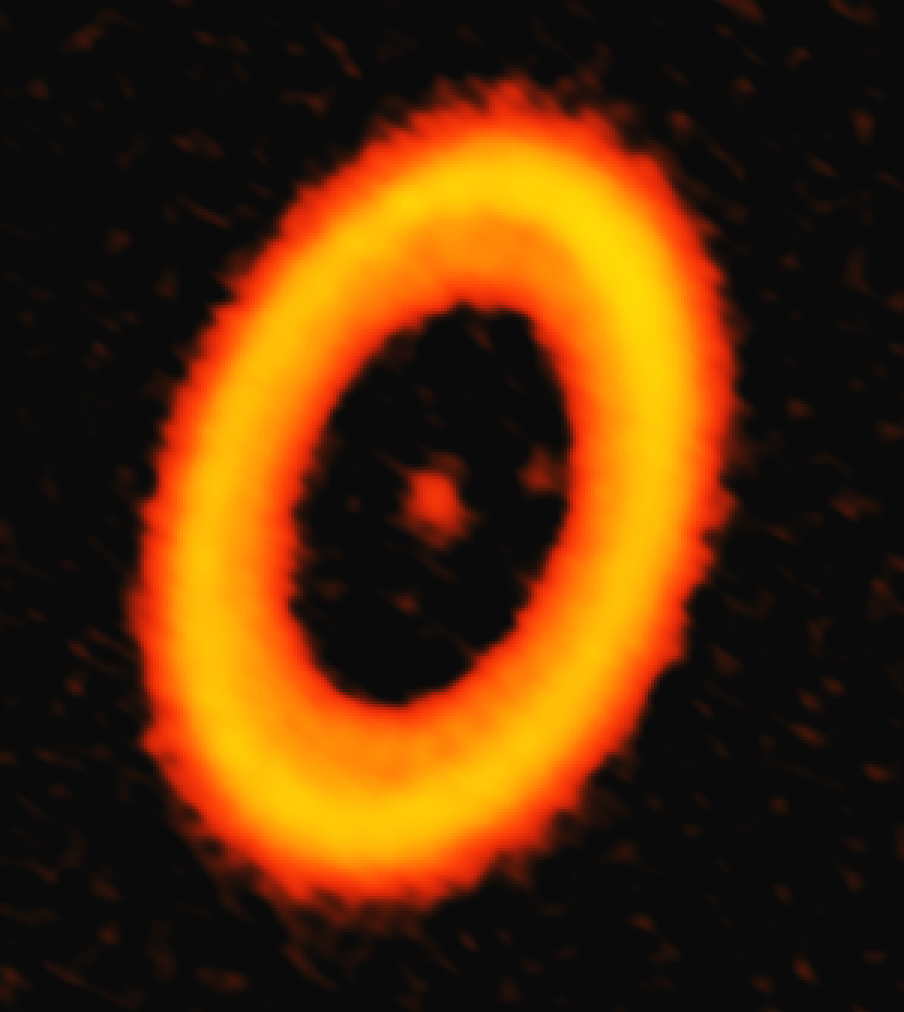
ALMA image of the dust in PDS 70, a star system located approximately 370 light-years from Earth. Two faint smudges in the gap region of this disk are associated with newly formed planets. One such concentration of dust is a circumplanetary disk, the first such feature ever detected around a distant star. Credit: ALMA (ESO/NAOJ/NRAO); A. Isella. Hi-Res File

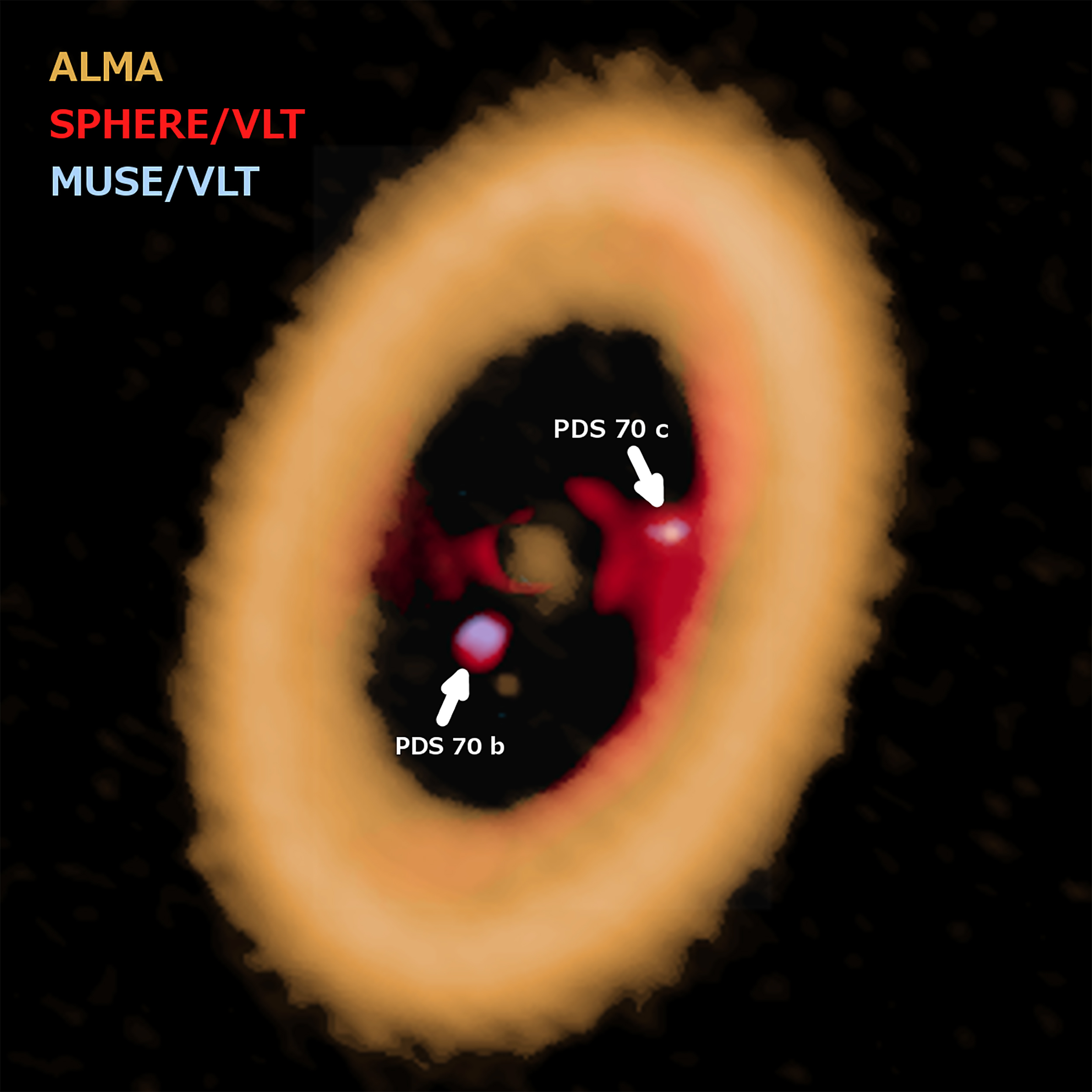
Composite image of PDS 70. Comparing new ALMA data to earlier VLT observations, astronomers determined that the young planet designated PDS 70 c has a circumplanetary disk, a feature that is strongly theorized to be the birthplace of moons. Credit: ALMA (ESO/NAOJ/NRAO) A. Isella; ESO. Hi-Res File


Astronomers using the Atacama Large Millimeter/submillimeter Array (ALMA) have made the first-ever observations of a circumplanetary disk, the planet-girding belt of dust and gas that astronomers strongly theorize controls the formation of planets and gives rise to an entire system of moons, like those found around Jupiter.

Atacama Large Millimeter/submillimeter Array (ALMA)Funded by the U.S. National Science Foundation and its international partners (NRAO/ESO/NAOJ), ALMA is among the most complex and powerful astronomical observatories on Earth or in space. The telescope is an array of 66 high-precision dish antennas in northern Chile.

This never-before-seen feature was discovered around one of the planets in PDS 70, a young star located approximately 370 light-years from Earth. Recently, astronomers confirmed the presence of two massive, Jupiter-like planets there. This earlier discovery was made with the European Southern Observatory’s Very Large Telescope (VLT), which detected the warm glow naturally emitted by hydrogen gas accreting onto the planets.

The new ALMA observations instead image the faint radio waves given off by the tiny (about one tenth of a millimeter across) particles of dust around the star.

The ALMA data, combined with the earlier optical and infrared VLT observations, provide compelling evidence that a dusty disk capable of forming multiple moons surrounds the outermost known planet in the system.

“For the first time, we can conclusively see the telltale signs of a circumplanetary disk, which helps to support many of the current theories of planet formation,” said Andrea Isella, an astronomer at Rice University in Houston, Texas, and lead author on a paper published in the Astrophysical Journal, Letters.

“By comparing our observations to the high-resolution infrared and optical images, we can clearly see that an otherwise enigmatic concentration of tiny dust particles is actually a planet-girding disk of dust, the first such feature ever conclusively observed,” he said. According to the researchers, this also is the first time that a planet has been clearly seen in these three distinct bands of light.

Unlike the icy rings of Saturn, which likely formed by the crashing together of comets and rocky bodies relatively recently in the history of our solar system, a circumplanetary disk is the lingering remains of the planet-formation process.

The ALMA data also revealed two distinct differences between the two newly discovered planets. The closer in of the two, PDS 70 b, which is about the same distance from its star as Uranus is from the Sun, has a trailing mass of dust behind it resembling a tail. “What this is and what it means for this planetary system is not yet known,” said Isella. “The only conclusive thing we can say is that it is far enough from the planet to be an independent feature.”

The second planet, PDS 70 c, resides in the exact same location as a clear knot of dust seen in the ALMA data. Since this planet is shining so brightly in the infrared and hydrogen bands of light, the astronomers can convincingly say that a fully formed planet is already in orbit there and that nearby gas continues to be syphoned onto the planet’s surface, finishing its adolescent growth spurt.

This outer planet is located approximately 5.3 billion kilometers from the host star, about the same distance as Neptune from our Sun. Astronomers estimate that this planet is approximately 1 to 10 times the mass of Jupiter. “If the planet is on the larger end of that estimate, it’s quite possible there might be planet-size moons in formation around it,” noted Isella.

The ALMA data also add one more important element to these observations.

Optical studies of planetary systems are notoriously challenging. Since the star is so much brighter than the planets, it is difficult to filter out the glare, much like trying to spot a firefly next to a search light. ALMA observations, however, don’t have that limitation since stars emit comparatively little light at millimeter and submillimeter wavelengths.

“This means we’ll be able to come back to this system at different time periods and more easily map the orbit of the planets and the concentration of dust in the system,” concluded Isella. “This will give us unique insights into the orbital properties of solar systems in their very earliest stages of development.”

The National Radio Astronomy Observatory is a facility of the National Science Foundation, operated under cooperative agreement by Associated Universities, Inc.


Contact:

Charles E. Blue: Public Information Officer
cblue@nrao.edu;
434-296-0314


Reference: 

“Detection of continuum submillimeter emission associated with candidate protoplanets,” A. Isella, et al., the Astrophysical Journal Letters: apjl.aas.org; Preprint: https://arxiv.org/abs/1906.06308

The Atacama Large Millimeter/submillimeter Array (ALMA), an international astronomy facility, is a partnership of the European Organisation for Astronomical Research in the Southern Hemisphere (ESO), the U.S. National Science Foundation (NSF) and the National Institutes of Natural Sciences (NINS) of Japan in cooperation with the Republic of Chile. ALMA is funded by ESO on behalf of its Member States, by NSF in cooperation with the National Research Council of Canada (NRC) and the Ministry of Science and Technology (MOST) and by NINS in cooperation with the Academia Sinica (AS) in Taiwan and the Korea Astronomy and Space Science Institute (KASI).

ALMA construction and operations are led by ESO on behalf of its Member States; by the National Radio Astronomy Observatory (NRAO), managed by Associated Universities, Inc. (AUI), on behalf of North America; and by the National Astronomical Observatory of Japan (NAOJ) on behalf of East Asia. The Joint ALMA Observatory (JAO) provides the unified leadership and management of the construction, commissioning and operation of ALMA.


Saturday, October 29, 2016

How planets like Jupiter form

Core accretion: A 10 Jupiter-mass planet is formed and is placed at 50 AU from the star. 
The planet has opened a gap in the circumstellar disk. 
Image: J. Szulagyi, JUPITER code

Gravitational instability simulation: Two snapshots in the early and late stage of the simulation at 780 years and 1942 years. 
The second snapshot shows only 4 clumps remaining among those initially formed. 
Image: Lucio Mayer & T. Quinn, ChaNGa code


Animation by J. Szulagyi, L. Mayer, T. Quinn and C. Gheller/ETH Zurich/University of Zurich/CSCS.


Young giant planets are born from gas and dust. Researchers of ETH Zürich and the Universities of Zürich and Bern simulated different scenarios relying on the computing power of the Swiss National Supercomputing Centre (CSCS) to find out how they exactly form and evolve. They compared their results with observations and were able to show amongst others a big difference between the postulated formation mechanisms.

Astronomers set up two theories explaining how gaseous giant planets like Jupiter or Saturn could be born. A bottom-up formation mechanism states that first, a solid core is aggregated of roughly ten times the size of the Earth. «Then, this core is massive enough to attract a significant amount of gas and keep it,» explains Judit Szulágyi, post-doctoral fellow at the ETH Zürich and member of the Swiss NCCR PlanetS. The second theory is a top-down formation scenario: Here the gaseous disk around the young star is so massive, that due to self-gravity of the gas-dust, spiral arms are forming with clumps inside. Then, these clumps collapse via their own gravity directly into a gaseous planet, similar to how stars form. The first mechanism is called «core-accretion», the second one «disk instability». In both cases, a disk forms around the gas-giants, called the circumplanetary disk, which will serve as a birth-nest for satellites to form.

To find out which mechanism actually takes place in the Universe, Judit Szulágyi and Lucio Mayer, Professor at the University of Zürich, simulated the scenarios on Piz Daint supercomputer at the Swiss National Supercomputing Centre (CSCS) in Lugano. «We pushed our simulations to the limits in terms of the complexity of the physics added to the models,» explains Judit Szulágyi: «And we achieved higher resolution than anybody before.» In their studies published in the «Monthly Notices of the Royal Astronomical Society» the researchers found a big difference between the two formation mechanisms: In the disk instability scenario the gas in the planet’s vicinity remained very cold, around 50 Kelvins, whereas in the core accretion case the circumplanetary disk was heated to several hundreds of Kelvins. «The disk instability simulations are the first that can resolve the circumplanetary disk around multiple protoplanets, using tens of millions of resolution elements in the computational domain. We exploited Piz Daint to accelerate the calculations using Graphics Processing Units (GPUs)” adds Mayer.

This huge temperature difference is easily observable. «When astronomers look into new forming planetary systems, just measuring the temperatures in the planet’s vicinity will be enough to tell which formation mechanism built the given planet,» explains Judit Szulágyi. A first comparison of the calculated and observed data seems to favour the core accretion theory. Another difference that was expected didn’t show up in the computer simulation. Before, astrophysics thought that the circumplanetary disk significantly differs in mass in the two formation scenarios. «We showed that this is not true,» says the PlanetS member.

Luminous shock front detected

Regarding the size of the new born planet, observations can be misleading as the astrophysicist found in a second study together with Christoph Mordasini, Professor at the University of Bern. In the core accretion model the researchers had a closer look at the disk around planets with masses three to ten times bigger than Jupiter’s. The computer simulations showed that gas falling on the disk from the outside heats up and creates a very luminous shock front on the disk’s upper layer. This significantly alters the observational appearance of young, forming planets.

«When we see a luminous spot inside a circumplanetary disk, we cannot be sure whether we see the planet luminosity, or also the surrounding disk luminosity,» says Judit Szulágyi. This may lead to an overestimation of the planet’s mass of up to four times. «So maybe an observed planet has only the same mass as Saturn instead of some Jupiter masses,» concludes the scientist.

In their simulations the astrophysicists mimicked the formation processes by using the basic physical laws such as gravity or the hydrodynamical equations of the gas. Because of the complexity of the physical models the simulations were very time consuming, even on Europe’s fastest supercomputer at CSCS: «On the order of nine months running time on hundreds to several thousands of computing cores» estimates Judit Szulágyi: «This means that on one computing core it would have taken longer than my entire lifetime.»

Yet there are still challenges ahead. Simulations of disk instability still do not cover a long timescale. It is possible that after the protoplanet has collapsed to the density of Jupiter its disk will heat up more like in core-accretion. Likewise, the hotter gas found in the core-accretion case would be partially ionized, a favourable environment for effects of magnetic fields, completely neglected so far. Running even more expensive simulations with a richer description of the physics will be the next step. (bva)


Publications:

Szulagyi; L. Mayer; T. Quinn: Circumplanetary disks around young giant planets: a comparison between core-accretion and disk instability, Monthly Notices of the Royal Astronomical Society 2016;

Szulagyi; C. Mordasini: Thermodynamics of Giant Planet Formation: Shocking Hot Surfaces on Circumplanetary Disks, Monthly Notices of the Royal Astronomical Society: Letters 2016;


Contact:

Dr. Judit Szulágyi
ETH Zürich, Switzerland
Phone +41 44 633 76 75
judit.szulagyi@phys.ethz.ch