Showing posts with label HH 211. Show all posts

Friday, September 19, 2025

ALMA Captures the Birthplace of a Magnetized Protostellar Jet for the First Time

Fig.1: HH 211 Jet and Outflow Observed by JWST and ALMA. (a) The JWST composite image (in color, Ray et al. 2023) reveals the jet and outflow traced by H₂ and CO emission lines in the near-infrared. However, thick dust around the protostar blocks JWST’s view of the jet structures within about 1,000 astronomical units. (b) In contrast, ALMA’s CO image in the submillimeter band (shown in grayscale) penetrates this obscured region, clearly unveiling the jet being launched from the accretion disk (green). Credit: Lee et al.

Fig.2: HH 211 Jet and Outflow Observed by JWST and ALMA. The JWST composite image (in color, Ray et al. 2023) reveals the jet and outflow traced by H₂ and CO emission lines in the near-infrared. However, thick dust around the protostar blocks JWST’s view of the jet structures within about 1,000 astronomical units. In contrast, ALMA’s CO image in the submillimeter band (shown in grayscale) penetrates this obscured region, clearly unveiling the jet being launched from the accretion disk (green). Credit: Lee et al.


In the universe, stars and planets don’t form suddenly. Their formation resembles a lengthy construction process. Near a young star, there is often a surrounding disk of gas and dust called an accretion disk. Material in this disk keeps rotating, gathering together, and eventually falling onto the star, helping it grow over time. However, this process faces a major challenge: if the material in the accretion disk spins too quickly, it becomes hard for it to fall inward.

Astronomers have long believed that jets — streams of gas ejected at high speeds from near the star — can carry away the excess rotational energy, thereby easing the inward movement of material. However, the launching points of these jets are extremely close to the star, only tens of times closer than Earth is to the Sun, and previous observations have not been sufficient to resolve their details or clearly determine their origins.

An international research team led by Chin-Fei Lee at the Academia Sinica Institute of Astronomy and Astrophysics (ASIAA) used the Atacama Large Millimeter/submillimeter Array (ALMA) in Chile to observe an extremely young protostar system called HH 211. This protostar is only about 35,000 years old, has just 6% of the Sun’s mass, and is located approximately 1,000 light-years away. It features a bright bipolar jet, and notably, this jet is one of the few known examples where a magnetic field has been detected, providing a rare opportunity to test models of magnetic-field–driven ejection.

The observations reveal that the jet moves at over 100 kilometers per second but rotates very slowly, with a specific angular momentum of only 4 au·km/s. Using conservation of angular momentum and energy, the team determined that the jet originates from the innermost edge of the accretion disk, just 0.02 astronomical units from the star — in excellent agreement with the theoretical X-wind model. This model explains how a magnetic field can act like a slingshot to propel gas outward, and it predicts a magnetic field strength consistent with previous measurements.

This discovery marks the first time the launch point of a magnetized jet has been identified with such high precision, directly confirming that jets are truly the “plumbers” of star formation—removing the last bits of angular momentum from the accretion disk so material can fall smoothly onto the star. In the future, these observations will not only help solve the mystery of how stars form but also enhance our understanding of the early stages of planet formation, since planets develop within these same disks.

Scientific Paper


Additional Information

This research was presented in a paper, “A magnetized protostellar jet launched from the innermost disk at the truncation radius,” by Lee et al., which appeared in Scientific Reports.

This release is adapted from the original
Science Highlight issued by the Academia Sinica Institute of Astronomy and Astrophysics (ASIAA) in Taiwan.

The Atacama Large Millimeter/submillimeter Array (ALMA), an international astronomy facility, is a partnership of the European Southern Observatory (ESO), the U.S. National Science Foundation (NSF), and the National Institutes of Natural Sciences (NINS) of Japan in cooperation with the Republic of Chile. ALMA is funded by ESO on behalf of its Member States, by NSF in cooperation with the National Research Council of Canada (NRC) and the National Science and Technology Council (NSTC) in Taiwan, and by NINS in cooperation with the Academia Sinica (AS) in Taiwan and the Korea Astronomy and Space Science Institute (KASI).

ALMA construction and operations are led by ESO on behalf of its Member States; by the National Radio Astronomy Observatory (NRAO), managed by Associated Universities, Inc. (AUI), on behalf of North America; and by the National Astronomical Observatory of Japan (NAOJ) on behalf of East Asia. The Joint ALMA Observatory (JAO) provides the unified leadership and management of ALMA's construction, commissioning, and operation.


Contacts:

Nicolás Lira
Education and Public Outreach Officer
Joint ALMA Observatory, Santiago - Chile
Phone:
+56 2 2467 6519
Cel: +56 9 9445 7726
Email: nicolas.lira@alma.cl

Dr. Mei-Yin Chou
Institute of Astrophysics and Astronomy
Academia Sinica
Phone:
+886-2-2366-5389
Email: cmy@asiaa.sinica.edu.tw


Friday, September 15, 2023

NASA's Webb Snaps Supersonic Outflow of Young Star

HH 211 (NIRCam Image)
Credits: Image: ESA/Webb, NASA, CSA, Tom Ray (Dublin)


Herbig-Haro (HH) objects are luminous regions surrounding newborn stars, formed when stellar winds or jets of gas spewing from these newborn stars form shock waves colliding with nearby gas and dust at high speeds. This image of HH 211 from NASA’s James Webb Space Telescope reveals an outflow from a Class 0 protostar, an infantile analog of our Sun when it was no more than a few tens of thousands of years old and with a mass only 8% of the present-day Sun. (It will eventually grow into a star like the Sun.)

Infrared imaging is powerful in studying newborn stars and their outflows, because such stars are invariably still embedded within the gas from the molecular cloud in which they formed. The infrared emission of the star’s outflows penetrates the obscuring gas and dust, making a Herbig-Haro object like HH 211 ideal for observation with Webb’s sensitive infrared instruments. Molecules excited by the turbulent conditions, including molecular hydrogen, carbon monoxide, and silicon monoxide, emit infrared light that Webb can collect to map out the structure of the outflows.

The image showcases a series of bow shocks to the southeast (lower-left) and northwest (upper-right) as well as the narrow bipolar jet that powers them. Webb reveals this scene in unprecedented detail — roughly 5 to 10 times higher spatial resolution than any previous images of HH 211. The inner jet is seen to “wiggle” with mirror symmetry on either side of the central protostar. This is in agreement with observations on smaller scales and suggests that the protostar may in fact be an unresolved binary star.

Earlier observations of HH 211 with ground-based telescopes revealed giant bow shocks moving away from us (northwest) and moving towards us (southeast) and cavity-like structures in shocked hydrogen and carbon monoxide respectively, as well as a knotty and wiggling bipolar jet in silicon monoxide. Researchers have used Webb’s new observations to determine that the object’s outflow is relatively slow in comparison to more evolved protostars with similar types of outflows.

The team measured the velocities of the innermost outflow structures to be roughly 48-60 miles per second (80 to 100 kilometers per second). However, the difference in velocity between these sections of the outflow and the leading material they’re colliding with — the shock wave — is much smaller. The researchers concluded that outflows from the youngest stars, like that in the center of HH 211, are mostly made up of molecules, because the comparatively low shock wave velocities are not energetic enough to break the molecules apart into simpler atoms and ions.

The James Webb Space Telescope is the world's premier space science observatory. Webb is solving mysteries in our solar system, looking beyond to distant worlds around other stars, and probing the mysterious structures and origins of our universe and our place in it. Webb is an international program led by NASA with its partners, ESA (European Space Agency) and the Canadian Space Agency


About This Release

Credits:

Media Contact:

Bethany Downer
ESA/Webb, Baltimore, Maryland

Hannah Braun
Space Telescope Science Institute, Baltimore, Maryland

Science: Tom Ray (Dublin)

Permissions: Content Use Policy

Contact Us: Direct inquiries to the News Team.

Related Links and Documents

Thursday, November 29, 2018

Magnetic fields found in a Jet from a Baby Star

Figure 1: ALMA detection of SiO line polarization in the HH 211 jet. (Top) A composite image showing the HH 211 jet and the outflow around it. The blue and red images show respectively the approaching (blueshifted) side and the receding (redshifted) side of the jet in SiO (adopted from Lee et al. 2009). Gray image shows the outflow in H2 (adopted from Hirano et al. 2006). (Bottom) A zoom-in to the innermost part of the jet within 700 au of the central protostar. Orange image shows the accretion disk recently detected with ALMA (Lee et al. 2018). Blue and red images show the blueshifted and redshifted sides of the innermost jet coming out from the disk, obtained in our observation. Yellow line segments show the orientations of the SiO line polarization in the jet. A size scale of our solar system is shown in the lower right corner for size comparison. In the two panels, asterisks mark the possible position of the central protostar. Credit: ALMA (ESO/NAOJ/NRAO)/Lee et al.

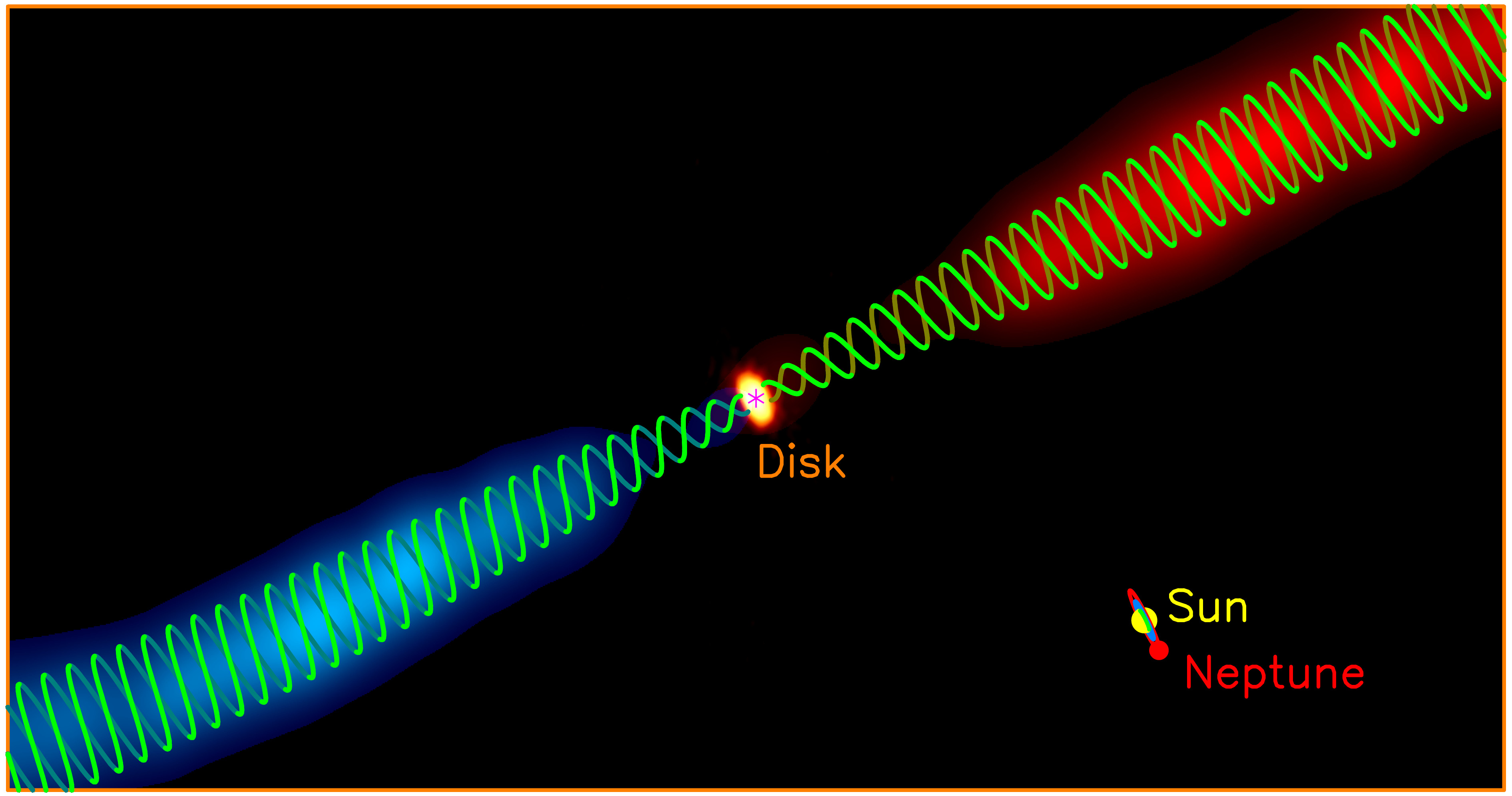
Figure 2: Possible helical magnetic fields in the HH 211 jet. Blue and red images show the blueshifted and redshifted sides of the jet coming out from the disk, as shown in the bottom panel of Figure 1. The greenish helical lines show the possible magnetic field morphology in the jet. The asterisk marks the possible position of the central protostar. A size scale of our solar system is shown in the lower right corner for size comparison. Credit: ALMA (ESO/NAOJ/NRAO)/Lee et al. 

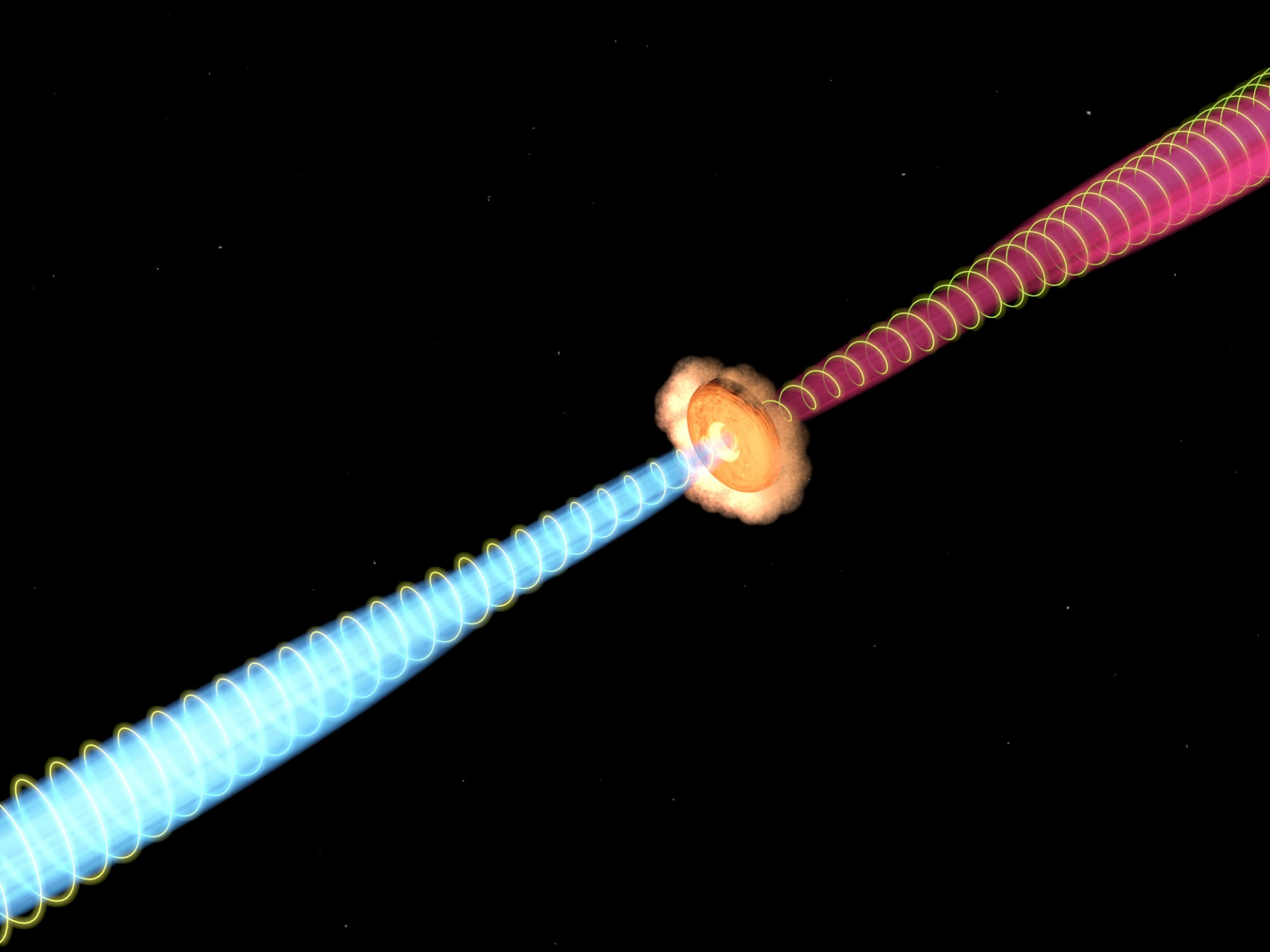
Figure 3: Artist’s conception of the helical magnetic field in the jet coming from the accretion disk. Credit: Yin-Chih Tsai


An international research team led by Chin-Fei Lee in the Academia Sinica Institute of Astronomy and Astrophysics (ASIAA) has made a breakthrough observation with the Atacama Large Millimeter/submillimeter Array (ALMA), confirming the presence of magnetic fields in a jet from a protostar (baby star). The jet is believed to play an important role in star formation, enabling the protostar to accrete mass from an accretion disk by carrying away angular momentum from the disk. It is highly supersonic and collimated, and predicted, in theory, to be launched and collimated by magnetic fields. The finding supports the theoretical prediction and confirms the role of the jet in star formation.

“Although it has been long predicted that protostellar jet is threaded with magnetic fields, no one is really sure about it. Thanks to the high-sensitivity of ALMA, we have finally confirmed the presence of magnetic fields in a protostellar jet with molecular line polarization detection. More interestingly, the magnetic fields in the jet could be helical, as seen in the jet from an active galactic nucleus (AGN). Perhaps, the same mechanism is at work to launch and collimate the jets from both protostar and AGN,” says Chin-Fei Lee at ASIAA.

“The detected polarization comes from a silicon monoxide (SiO) molecular line in the presence of magnetic fields”, says Hsiang-Chih Hwang, who was a former National Taiwan University (NTU) undergraduate student of Chin-Fei Lee modeling the polarization. “The polarized emission in the jet is so faint that we failed to detect it with the Submillimeter Array (SMA, Mauna Kea, Hawai). We are so excited to have finally detected it with ALMA.”

HH 211 is a well-defined jet from one of the youngest protostellar systems in Perseus at a distance of about 1,000 light-years. The central powering protostar has an age of only about 10,000 years (which is about 2 millionths of the age of our Sun) and a mass of about 0.05 solar mass. The jet is rich in SiO molecular gas and drives a spectacular molecular outflow around it (see the top panel in Figure 1).

With ALMA, we zoomed in to the innermost part of the jet within 700 au of the central protostar, where the emission is the brightest in SiO. We detected SiO line polarization toward the approaching (blueshifted) side of the jet (see the bottom panel in Figure 1). The polarization has a fraction of about 1.5% and an orientation roughly aligned with the jet axis. This line polarization is due to the Goldreich-Kylafis effect, confirming the presence of magnetic fields in the jet. The orientation of the magnetic fields could be either toroidal or poloidal. According to the current jet launching models, the magnetic fields are expected to be helical and should be mainly toroidal there where the polarization is detected, in order to collimate the jet. Deeper observations will be proposed to detect the line polarization in the receding (redshifted) side of the jet and check for consistent morphology of the polarization. Furthermore, additional SiO lines will be observed in order to confirm the field morphology.

The observation opens up an exciting possibility of directly detecting and characterizing magnetic fields in protostellar jets through high-resolution and high-sensitivity imaging with ALMA, which can improve the theories of jet formation and thus our understanding for the feeding process in the innermost region of star formation.

Additional Information

This research was presented in a paper titled “Unveiling a Magnetized Jet from a Low-Mass Protostar” by Lee et al. published in the Nature Communications 2018 November issue.

The team is composed of Chin-Fei Lee (ASIAA, Taiwan; National Taiwan University, Taiwan), Hsiang-Chih Hwang (National Taiwan University, Taiwan; Johns Hopkins University, USA), Tao-Chung Ching (National Tsing Hua University, Taiwan), Naomi Hirano (ASIAA, Taiwan), Shih-Ping Lai (National Tsing Hua University, Taiwan), Ramprasad Rao (ASIAA, Taiwan), and Paul T.P. Ho (ASIAA, Taiwan; East Asia Observatory)

The Atacama Large Millimeter/submillimeter Array (ALMA), an international astronomy facility, is a partnership of the European Organisation for Astronomical Research in the Southern Hemisphere (ESO), the U.S. National Science Foundation (NSF) and the National Institutes of Natural Sciences (NINS) of Japan in cooperation with the Republic of Chile. ALMA is funded by ESO on behalf of its Member States, by NSF in cooperation with the National Research Council of Canada (NRC) and the National Science Council of Taiwan (NSC) and by NINS in cooperation with the Academia Sinica (AS) in Taiwan and the Korea Astronomy and Space Science Institute (KASI).

ALMA construction and operations are led by ESO on behalf of its Member States; by the National Radio Astronomy Observatory (NRAO), managed by Associated Universities, Inc. (AUI), on behalf of North America; and by the National Astronomical Observatory of Japan (NAOJ) on behalf of East Asia. The Joint ALMA Observatory (JAO) provides the unified leadership and management of the construction, commissioning and operation of ALMA


Contacts

Nicolás Lira
Education and Public Outreach Coordinator
Joint ALMA Observatory, Santiago - Chile
Phone: +56 2 2467 6519
Cell phone: +56 9 9445 7726
Email: nicolas.lira@alma.cl

Masaaki Hiramatsu
Education and Public Outreach Officer, NAOJ Chile Observatory
, Tokyo - Japan
Phone: +81 422 34 3630
Email: hiramatsu.masaaki@nao.ac.jp

Calum Turner
ESO Assistant Public Information Officer
Garching bei München, Germany
Phone: +49 89 3200 6670
Email: calum.turner@eso.org

Charles E. Blue
Public Information Officer
National Radio Astronomy Observatory Charlottesville, Virginia - USA
Phone: +1 434 296 0314
Cell phone: +1 202 236 6324
Email: cblue@nrao.edu