Showing posts with label TW Hydrae (TW Hya). Show all posts

Tuesday, September 16, 2025

Astronomers Reveal Planet Building’s Secret Ingredient: Magnetism

T
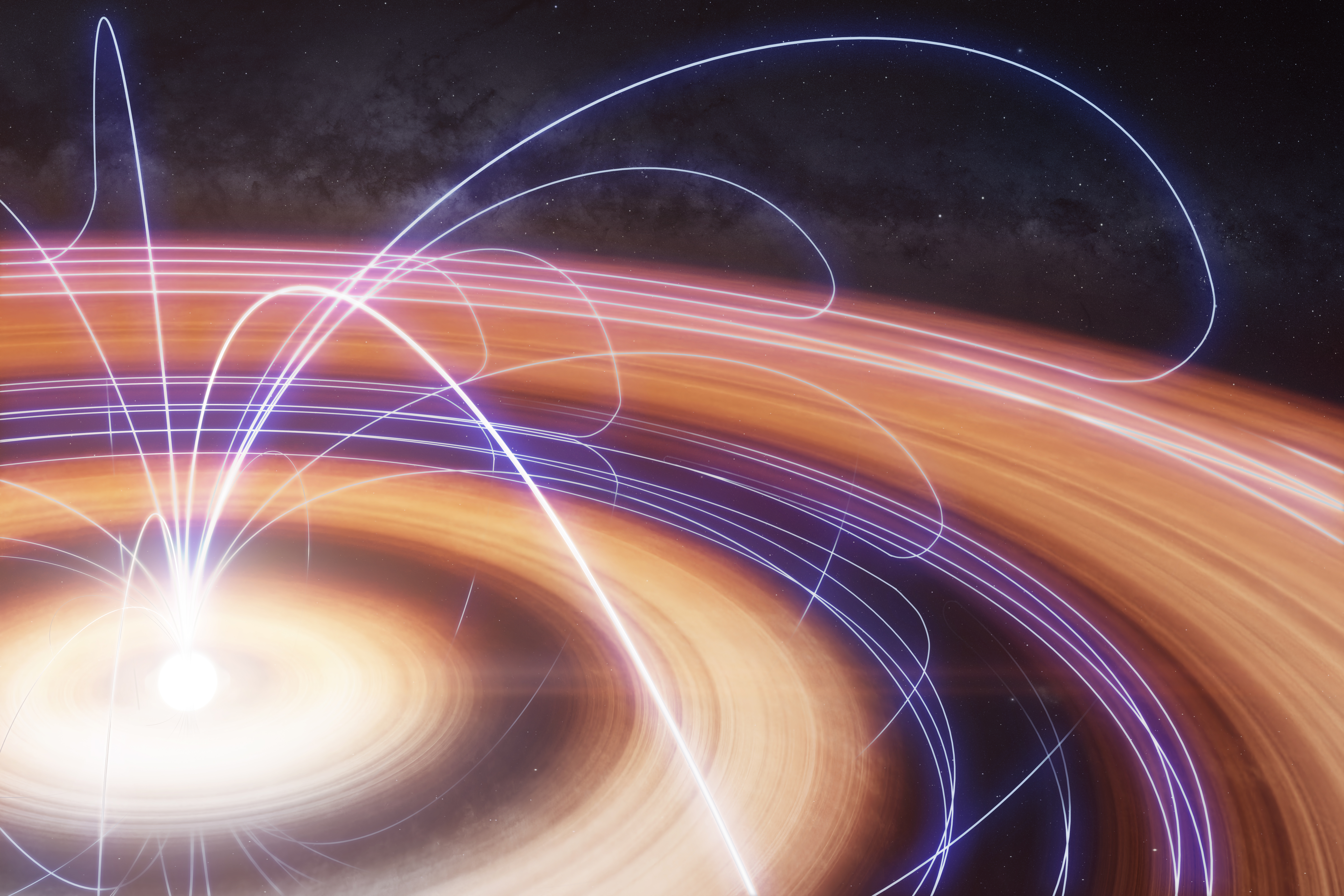
his artist's impression of magnetic fields threading TW Hydrae’s protoplanetary disk shows a change in morphology as they encounter gaps and structures in the disk, suggesting a direct link between magnetic fields and the sculpting of planet-forming regions. Credit: NSF/AUI/NSF NRAO/M. Weiss.
Hi-Res File


New ALMA observations show invisible magnetic “threads” stitching together TW Hya’s young solar system

Astronomers have created a detailed map revealing the magnetic fields weaving through TW Hydrae, one of the closest known stars with a planet-forming disk, using the Atacama Large Millimeter/submillimeter Array (ALMA). Led by Dr. Richard Teague at MIT, this new research sheds light on the invisible forces shaping new planets, like those that formed our own solar system over 4.5 billion years ago.

Planets originate in swirling disks of gas and dust that encircle young stars. While telescopes have revealed the shapes and gaps in these disks, scientists have struggled to measure magnetic fields, the unseen agents that guide and sculpt planet-forming material. Magnetic fields are widely thought to play a crucial role in how disks evolve and create planets, but until now, no one had been able to unambiguously map their presence and structure directly in a disk like TW Hya’s.

Previous searches looked for magnetic fields by detecting specific patterns of polarized light, but those signals are exceedingly faint and easily lost amid other effects. Teague and colleagues examined the broadening of specific radio signals—the fingerprints of molecules swirling in the disk—measured by ALMA. By decoding subtle changes in light from the CN molecule, the team could spot the signature widening caused by magnetic field interactions, a phenomenon known as the Zeeman Effect.

The scientists’ analysis revealed magnetic fields as strong as 10 milligauss—a thousand times weaker than a refrigerator magnet, but immense on planet-forming scales—threading the disk between 60 and 120 astronomical units (AU) from the star (one AU is the distance from Earth to the Sun). Intriguingly, the field’s structure changes at a location where a prominent gap slices through the disk, suggesting a direct link between magnetic activity and the sculpting of planet-forming regions.

“The presence and pattern of these fields look remarkably like the kind that may have threaded the solar nebula as our own planets were forming,” said Teague, “This is the best look we’ve ever had at the invisible hand shaping the birthplaces of new worlds.”

This approach opens a new window onto questions that have puzzled scientists for decades: how do magnetic fields drive the evolution of disks? How do they influence which planets form and where? As telescopes and instruments grow more sensitive, astronomers hope to apply these techniques to many more disks. “We are entering an era where we can finally see the magnetic blueprints that help build new planetary systems,” adds Teague. Improvements to ALMA, like the upcoming Wideband Sensitivity Upgrade, have been designed to do exactly this, “Our findings show that what has been promised with the upgrade will be possible on a grand scale.”

This research is a major leap toward understanding not just how planets form around other stars, but how our own cosmic neighborhood came to be.


About NRAO

The National Radio Astronomy Observatory (NRAO) is a facility of the U.S. National Science Foundation, operated under cooperative agreement by Associated Universities, Inc.

About ALMA

The Atacama Large Millimeter/submillimeter Array (ALMA), an international astronomy facility, is a partnership of the European Southern Observatory (ESO), the U.S. National Science Foundation (NSF) and the National Institutes of Natural Sciences (NINS) of Japan in cooperation with the Republic of Chile. ALMA is funded by ESO on behalf of its Member States, by NSF in cooperation with the National Research Council of Canada (NRC) and the National Science and Technology Council (NSTC) in Taiwan and by NINS in cooperation with the Academia Sinica (AS) in Taiwan and the Korea Astronomy and Space Science Institute (KASI).

ALMA construction and operations are led by ESO on behalf of its Member States; by the National Radio Astronomy Observatory (NRAO), managed by Associated Universities, Inc. (AUI), on behalf of North America; and by the National Astronomical Observatory of Japan (NAOJ) on behalf of East Asia. The Joint ALMA Observatory (JAO) provides the unified leadership and management of the construction, commissioning and operation of ALMA.


Wednesday, May 10, 2023

Hubble Follows Shadow Play Around Planet-Forming Disk

Concentric Gas-and-Dust Disks Around Star TW Hydrae (Artist's Concept)
Credits: Artwork: NASA, AURA/STScI for ESA, Leah Hustak (STScI)

TW Hydrae Disk
Credits: Image: NASA, ESA, STScI, John Debes (AURA/STScI for ESA)
Image Processing: Joseph DePasquale (STScI)


The young star TW Hydrae is playing "shadow puppets" with scientists observing it with NASA's Hubble Space Telescope.

In 2017, astronomers reported discovering a shadow sweeping across the face of a vast pancake-shaped gas-and-dust disk surrounding the red dwarf star. The shadow isn't from a planet, but from an inner disk slightly inclined relative to the much larger outer disk – causing it to cast a shadow. One explanation is that an unseen planet's gravity is pulling dust and gas into the planet's inclined orbit.

Now, a second shadow – playing a game of peek-a-boo – has emerged in just a few years between observations stored in Hubble's MAST archive. This could be from yet another disk nestled inside the system. The two disks are likely evidence of a pair of planets under construction.

TW Hydrae is less than 10 million years old and resides about 200 light-years away. In its infancy, our solar system may have resembled the TW Hydrae system, some 4.6 billion years ago. Because the TW Hydrae system is tilted nearly face-on to our view from Earth, it is an optimum target for getting a bull's-eye-view of a planetary construction yard.

The second shadow was discovered in observations obtained on June 6, 2021, as part of a multi-year program designed to track the shadows in circumstellar disks. John Debes of AURA/STScI for the European Space Agency at the Space Telescope Science Institute in Baltimore, Maryland, compared the TW Hydrae disk to Hubble observations made several years ago.

"We found out that the shadow had done something completely different," said Debes, who is principal investigator and lead author of the study published in The Astrophysical Journal. "When I first looked at the data, I thought something had gone wrong with the observation because it wasn't what I was expecting. I was flummoxed at first, and all my collaborators were like: what is going on? We really had to scratch our heads and it took us a while to actually figure out an explanation."

The best solution the team came up with is that there are two misaligned disks casting shadows. They were so close to each other in the earlier observation they were missed. Over time they've now separated and split into two shadows. "We've never really seen this before on a protoplanetary disk. It makes the system much more complex than we originally thought," he said.

The simplest explanation is that the misaligned disks are likely caused by the gravitational pull of two planets in slightly different orbital planes. Hubble is piecing together a holistic view of the architecture of the system.

The disks may be proxies for planets that are lapping each other as they whirl around the star. It's sort of like spinning two vinyl phonograph records at slightly different speeds. Sometimes labels will match up but then one gets ahead of the other.

"It does suggest that the two planets have to be fairly close to each other. If one was moving much faster than the other, this would have been noticed in earlier observations. It's like two race cars that are close to each other, but one slowly overtakes and laps the other," said Debes.

The suspected planets are located in a region roughly the distance of Jupiter from our Sun. And, the shadows complete one rotation around the star about every 15 years – the orbital period that would be expected at that distance from the star.

Also, these two inner disks are inclined about five to seven degrees relative to the plane of the outer disk. This is comparable to the range of orbital inclinations inside our solar system. "This is right in line with typical solar system style architecture," said Debes.

The outer disk that the shadows are falling on may extend as far as several times the radius of our solar system's Kuiper belt. This larger disk has a curious gap at twice Pluto's average distance from the Sun. This might be evidence for a third planet in the system.

Any inner planets would be difficult to detect because their light would be lost in the glare of the star. Also, dust in the system would dim their reflected light. ESA's Gaia space observatory may be able to measure a wobble in the star if Jupiter-mass planets are tugging on it, but this would take years given the long orbital periods.

The TW Hydrae data are from Hubble's Space Telescope Imaging Spectrograph. The James Webb Space Telescope's infrared vision may also be able to show the shadows in more detail.

The Hubble Space Telescope is a project of international cooperation between NASA and ESA. NASA's Goddard Space Flight Center in Greenbelt, Maryland, manages the telescope. The Space Telescope Science Institute (STScI) in Baltimore conducts Hubble science operations. STScI is operated for NASA by the Association of Universities for Research in Astronomy, in Washington, D.C.


About This Release

Credits

Media Contact:

Ray Villard
Space Telescope Science Institute, Baltimore, Maryland

Science Contact:Contact: John Debes
AURA/STScI for the European Space Agency, Baltimore, Maryland


Permissions: Content Use Policy

Contact Us: Direct inquiries to the News Team.

Related Links and Documents:


Friday, January 13, 2023

Model-Independent Method to Weigh Protoplanetary Disks


Observational image of the protoplanetary disk around TW Hydrae showing the distributions of solid particles (red), carbon monoxide (blue), and dense gas (white). Credit: T. Yoshida, T. Tsukagoshi et al. - ALMA (ESO/NAOJ/NRAO).
Original size (158KB)

Astronomers have found a way to directly measure the amount of gas in protoplanetary disks without needing to make assumptions about the relative amounts of different types of gas, making this method more accurate and robust than previous methods.

Planets form in protoplanetary disks of gas and dust around young stars. Scientists study protoplanetary disks by looking at their spectra, the wavelengths of radio waves emitted by components of the disk. Hydrogen gas is the main constituent of protoplanetary disks, but it is difficult to measure directly because it doesn’t emit radio waves efficiently. Carbon monoxide is often used as a proxy, but the ratio of hydrogen to carbon monoxide can differ depending on the environment, leading to large uncertainties in estimates of the total mass.

A team led by Tomohiro Yoshida, a graduate student at the Graduate University for Advanced Studies in Japan, searched the Atacama Large Millimeter/submillimeter Array (ALMA) archival data for observations of the nearest protoplanetary disk, around the star TW Hydrae. From this, they produced a radio image 15 times more sensitive than previous studies, allowing them to examine not only the wavelengths of the spectral lines, but also their shapes.

From the shape of the carbon monoxide lines, the team was able to measure the gas pressure near the center of the disk. This pressure reveals the total mass of gas near the center, without needing to make any assumptions about the ratio of hydrogen to carbon monoxide. The team found that despite being near the end of the planet formation process, there is still enough gas in the inner region of the TW Hydrae system to make a Jupiter sized planet.

Yoshida, the lead author of this study, says “We would like to apply this novel technique to other disks and investigate the amount of gas in planet-forming disks with various characteristics and at various ages to clarify the gas dissipation process and the formation process of planetary systems.”

These results appeared as Yoshida et al. “Discovery of Line Pressure Broadening and Direct Constraint on Gas Surface Density in a Protoplanetary Disk” in The Astrophysical Journal Letters on September 22, 2022.

Related Links


Sunday, January 08, 2017

Hubble Captures 'Shadow Play' Caused by Possible Planet

TW Hydrae
Credits: NASA, ESA, and J. Debes (STScI)

Searching for planets around other stars is a tricky business. They're so small and faint that it's hard to spot them. But a possible planet in a nearby stellar system may be betraying its presence in a unique way: by a shadow that is sweeping across the face of a vast pancake-shaped gas-and-dust disk surrounding a young star.

The planet itself is not casting the shadow. But it is doing some heavy lifting by gravitationally pulling on material near the star and warping the inner part of the disk. The twisted, misaligned inner disk is casting its shadow across the surface of the outer disk.

A team of astronomers led by John Debes of the Space Telescope Science Institute in Baltimore, Maryland, say this scenario is the most plausible explanation for the shadow they spotted in the stellar system TW Hydrae, located 192 light-years away in the constellation Hydra, also known as the Female Water Snake. The star is roughly 8 million years old and slightly less massive than our sun. The researchers uncovered the phenomenon while analyzing 18 years' worth of archival observations taken by NASA's Hubble Space Telescope.

"This is the very first disk where we have so many images over such a long period of time, therefore allowing us to see this interesting effect," Debes said. "That gives us hope that this shadow phenomenon may be fairly common in young stellar systems."

Debes will present his team's results Jan. 7 at the winter meeting of the American Astronomical Society in Grapevine, Texas.

Debes' first clue to the phenomenon was a brightness in the disk that changed with position. Astronomers using Hubble's Space Telescope Imaging Spectrograph (STIS) first noted this brightness asymmetry in 2005. But they had only one set of observations, and could not make a definitive determination about the nature of the mystery feature.

Searching the archive, Debes' team put together six images from several different epochs. The observations were made by STIS and by Hubble's Near Infrared Camera and Multi-Object Spectrometer (NICMOS).

STIS is equipped with a coronagraph that blocks starlight to within about 1 billion miles from the star, allowing Hubble to look as close to the star as Saturn is to our sun. Over time, the structure appeared to move in counterclockwise fashion around the disk, until, in 2016, it was in the same position as it was in images taken in 2000.

This 16-year period puzzled the researchers. They originally thought the feature was part of the disk, but the short period meant that the feature was moving way too fast to be physically in the disk.

Under the laws of gravity, disks rotate at glacial speeds. The outermost parts of the TW Hydrae disk would take centuries to complete one rotation.

"The fact that I saw the same motion over 10 billion miles from the star was pretty significant, and told me that I was seeing something that was imprinted on the outer disk rather than something that was happening directly in the disk itself," Debes said. "The best explanation is that the feature is a shadow moving across the surface of the disk."

The research team concluded that whatever was making the shadow must be deep inside the 41-billion-mile-wide disk, so close to the star it cannot be imaged by Hubble or any other present-day telescope. The most likely way to create a shadow is to have an inner disk that is tilted relative to the outer disk. In fact, submillimeter observations of TW Hydrae by the Atacama Large Millimeter Array (ALMA) in Chile suggested a possible warp in the inner disk.

But what causes disks to warp? "The most plausible scenario is the gravitational influence of an unseen planet, which is pulling material out of the plane of the disk and twisting the inner disk," Debes explained. "The misaligned disk is inside the planet's orbit."

Given the relatively short 16-year period of the clocklike moving shadow, the planet is estimated to be about 100 million miles from the star — about as close as Earth is from the sun. The planet would be roughly the size of Jupiter to have enough gravity to pull the material up out of the plane of the main disk. The planet's gravitational pull causes the disk to wobble, or precess, around the star, giving the shadow its 16-year rotational period.

Recent observations of TW Hydrae by ALMA in Chile add credence to the presence of a planet. ALMA revealed a gap in the disk roughly 9 million miles from TW Hydrae. A gap is significant, because it could be the signature of an unseen planet clearing away a path in the disk.

This new Hubble study offers a unique way to look for planets hiding in the inner part of the disk and probe what is happening very close to the star, which is not reachable in direct imaging by current telescopes. "What is surprising is that we can learn something about an unseen part of the disk by studying the disk's outer region and by measuring the motion, location, and behavior of a shadow," Debes said. "This study shows us that even these large disks, whose inner regions are unobservable, are still dynamic, or changing in detectable ways which we didn't imagine."

The Hubble Space Telescope is a project of international cooperation between NASA and the European Space Agency. NASA's Goddard Space Flight Center in Greenbelt, Maryland, manages the telescope. The Space Telescope Science Institute (STScI) in Baltimore, Maryland, conducts Hubble science operations. STScI is operated for NASA by the Association of Universities for Research in Astronomy in Washington, D.C.


Contact

Felicia Chou
NASA Headquarters, Washington, D.C.
202-358-0257

felicia.chou@nasa.gov

Donna Weaver / Ray Villard
Space Telescope Science Institute, Baltimore, Maryland
410-338-4493 / 410-338-4514

dweaver@stsci.edu / villard@stsci.edu

John Debes
Space Telescope Science Institute, Baltimore, Maryland
410-338-4782

debes@stsci.edu


Source: HubbleSite

Thursday, March 31, 2016

ALMA’s Most Detailed Image of a Protoplanetary Disc

ALMA image of the disc around the young star TW Hydrae

ALMA image of the planet-forming disc around the young, Sun-like star TW Hydrae
Inner region of the TW Hydrae protoplanetary disc as imaged by ALMA


Videos
 
ALMA image of the disc around the young star TW Hydrae


Evidence for planet formation in Earth-like orbit around young star

This new image from the Atacama Large Millimeter/submillimeter Array (ALMA) shows the finest detail ever seen in the planet-forming disc around the nearby Sun-like star TW Hydrae. It reveals a tantalising gap at the same distance from the star as the Earth is from the Sun, which may mean that an infant version of our home planet, or possibly a more massive super-Earth, is beginning to form there.

The star TW Hydrae is a popular target of study for astronomers because of its proximity to Earth (only about 175 light-years away) and its status as an infant star (about 10 million years old). It also has a face-on orientation as seen from Earth. This gives astronomers a rare, undistorted view of the complete protoplanetary disc around the star.

"Previous studies with optical and radio telescopes confirm that TW Hydrae hosts a prominent disc with features that strongly suggest planets are beginning to coalesce," said Sean Andrews with the Harvard-Smithsonian Center for Astrophysics in Cambridge, Massachusetts, USA and lead author on a paper published today in the Astrophysical Journal Letters. "The new ALMA images show the disc in unprecedented detail, revealing a series of concentric dusty bright rings and dark gaps, including intriguing features that may indicate that a planet with an Earth-like orbit is forming there."

Other pronounced gaps that show up in the new images are located three billion and six billion kilometres from the central star, similar to the average distances from the Sun to Uranus and Pluto in the Solar System. 

They too are likely to be the results of particles that came together to form planets, which then swept their orbits clear of dust and gas and shepherded the remaining material into well-defined bands.

For the new TW Hydrae observations, astronomers imaged the faint radio emission from millimetre-sized dust grains in the disc, revealing details on the order of the distance between the Earth and the Sun (about 150 million kilometres). These detailed observations were made possible with ALMA’s high-resolution, long-baseline configuration. When ALMA's dishes are at their maximum separation, up to 15 kilometres apart, the telescope is able to resolve finer details. "This is the highest spatial resolution image ever of a protoplanetary disc from ALMA, and that won't be easily beaten in the future!" said Andrews [1].

"TW Hydrae is quite special. It is the nearest known protoplanetary disc to Earth and it may closely resemble the Solar System when it was only 10 million years old," adds co-author David Wilner, also with the Harvard-Smithsonian Center for Astrophysics.

Earlier ALMA observations of another system, HL Tauri, show that even younger protoplanetary discs — a mere 1 million years old — can display similar signatures of planet formation. By studying the older TW Hydrae disc, astronomers hope to better understand the evolution of our own planet and the prospects for similar systems throughout the Milky Way.

The astronomers now want to find out how common these kinds of features are in discs around other young stars and how they might change with time or environment.


Notes

[1] The angular resolution of the images of HL Tauri was similar to these new observations, but as TW Hydrae is much closer to Earth, finer details can be seen.


More Information

This research was presented in a paper "Ringed Substructure and a Gap at 1 AU in the Nearest Protoplanetary Disk", by S.M. Andrews et al., appearing in the Astrophysical Journal Letters.

The team is composed of Sean M. Andrews (Harvard-Smithsonian Center for Astrophysics, Cambridge, Massachusetts, USA), David J. Wilner (Harvard-Smithsonian Center for Astrophysics, Cambridge, Massachusetts, USA) , Zhaohuan Zhu (Princeton University, Princeton, New Jersey, USA), Tilman Birnstiel (Max-Planck-Institut für Astronomie, Heidelberg, Germany), John M. Carpenter (Joint ALMA Observatory, Santiago, Chile), Laura M. Peréz (Max-Planck-Institut für Radioastronomie, Bonn, Germany), Xue-Ning Bai (Harvard-Smithsonian Center for Astrophysics, Cambridge, Massachusetts, USA), Karin I. Öberg (Harvard-Smithsonian Center for Astrophysics, Cambridge, Massachusetts, USA), A. Meredith Hughes (Wesleyan University, Van Vleck Observatory, Middletown, USA), Andrea Isella (Rice University, Houston, Texas, USA) and Luca Ricci (Harvard-Smithsonian Center for Astrophysics, Cambridge, Massachusetts, USA).

The Atacama Large Millimeter/submillimeter Array (ALMA), an international astronomy facility, is a partnership of ESO, the U.S. National Science Foundation (NSF) and the National Institutes of Natural Sciences (NINS) of Japan in cooperation with the Republic of Chile. ALMA is funded by ESO on behalf of its Member States, by NSF in cooperation with the National Research Council of Canada (NRC) and the National Science Council of Taiwan (NSC) and by NINS in cooperation with the Academia Sinica (AS) in Taiwan and the Korea Astronomy and Space Science Institute (KASI).

ALMA construction and operations are led by ESO on behalf of its Member States; by the National Radio Astronomy Observatory (NRAO), managed by Associated Universities, Inc. (AUI), on behalf of North America; and by the National Astronomical Observatory of Japan (NAOJ) on behalf of East Asia. The Joint ALMA Observatory (JAO) provides the unified leadership and management of the construction, commissioning and operation of ALMA.

ESO is the foremost intergovernmental astronomy organisation in Europe and the world’s most productive ground-based astronomical observatory by far. It is supported by 16 countries: Austria, Belgium, Brazil, the Czech Republic, Denmark, France, Finland, Germany, Italy, the Netherlands, Poland, Portugal, Spain, Sweden, Switzerland and the United Kingdom, along with the host state of Chile. ESO carries out an ambitious programme focused on the design, construction and operation of powerful ground-based observing facilities enabling astronomers to make important scientific discoveries. ESO also plays a leading role in promoting and organising cooperation in astronomical research. ESO operates three unique world-class observing sites in Chile: La Silla, Paranal and Chajnantor. At Paranal, ESO operates the Very Large Telescope, the world’s most advanced visible-light astronomical observatory and two survey telescopes. VISTA works in the infrared and is the world’s largest survey telescope and the VLT Survey Telescope is the largest telescope designed to exclusively survey the skies in visible light. ESO is a major partner in ALMA, the largest astronomical project in existence. And on Cerro Armazones, close to Paranal, ESO is building the 39-metre European Extremely Large Telescope, the E-ELT, which will become “the world’s biggest eye on the sky”.


Links


Contacts

Sean M. Andrews
Harvard-Smithsonian Center for Astrophysics
Cambridge, Massachusetts, USA
Email:
sandrews@cfa.harvard.edu

Charles Blue
NRAO Public Information Officer
Tel: +1 434 296-0314
Email:
cblue@nrao.edu

Richard Hook
ESO Public Information Officer
Garching bei München, Germany
Tel: +49 89 3200 6655
Cell: +49 151 1537 3591
Email:
rhook@eso.org

Source: ESO

Wednesday, December 23, 2015

Gap in Dusty Disk is Likely Embryonic Sub-Jupiter Mass Planet

Left: GPI J band (top) and K1 band (bottom) polarized intensity (Qr) images of the TW Hya disk. Right: Qr(i; j) scaled by r2(i; j), where r(i; j) is the distance (in pixels) of pixel position (i; j) from the central star, corrected for projection effects. All images are shown on a linear scale. The coronagraph is represented by the black filled circles and images are oriented with north up and east to the left.


TW Hydrae (TW Hya) is one of the best-studied young stars in the galaxy.At just 180 light years from Earth and a ripe young age of roughly 8 million years, this nearly solar-mass star and its orbiting, circumstellar disk of dust and gas are prime targets to better understand the processes involved in star and planet formation. The most sensitive telescope systems available, accessing wavelengths from radio to X-ray, have observed the TW Hya system. Astronomers have now used the Gemini Planet Imager (GPI) on Gemini South to image infrared light from TW Hya that is scattered off dust grains in its surrounding disk. The new GPI images confirm the presence of a darkened ring or gap in the disk at 23 AU (i.e., 23 times the earth-Sun distance) -- and GPI brings this gap into the sharpest focus yet. Comparison with detailed numerical simulations of planets forming in circumstellar disks indicates that the 5-AU-wide gap's observed structure could be generated by a sub-Jupiter-mass planet orbiting within the disk at a position roughly equivalent to that of Uranus in our solar system. "These GPI data reveal tell-tale disk structure in the giant-planet-forming region around TW Hya at higher resolution than any other measurements to date," says Dr. Valerie Rapson of Rochester Institute of Technology, who led the research team. “The results will help us piece together the story of how giant planets form around sun-like stars.” 

The paper is published in The Astrophysical Journal.


Paper Abstract: 

We present Gemini Planet Imager (GPI) adaptive optics near-infrared images of the giant-planet-forming regions of the protoplanetary disk orbiting the nearby (D = 54 pc), pre-main-sequence (classical T Tauri) star TW Hydrae. The GPI images, which were obtained in coronagraphic/polarimetric mode, exploit starlight scattered off small dust grains to elucidate the surface density structure of the TW Hya disk from ~80 AU to within ~10 AU of the star at ~1.5 AU resolution. The GPI polarized intensity images unambiguously confirm the presence of a gap in the radial surface brightness distribution of the inner disk. The gap is centered near ~23 AU, with a width of ~5 AU and a depth of ~50%. In the context of recent simulations of giant-planet formation in gaseous, dusty disks orbiting pre-main-sequence stars, these results indicate that at least one young planet with a mass ~0.2 MJ could be present in the TW Hya disk at an orbital semimajor axis similar to that of Uranus. If this (proto)planet is actively accreting gas from the disk, it may be readily detectable by GPI or a similarly sensitive, high-resolution infrared imaging system.