Showing posts with label Stellar Collision. Show all posts

Tuesday, April 08, 2025

How stars stay young and spin slowly

Growth of density (top row) and magnetic field strength (bottom row) as a function of time in the collision between two stars of 0.7 and 0.6 solar masses. After the first contact at t = 0 h (not shown), the two stars pass each other (t = 5 h) and get disrupted (t = 12 h). The magnetic fields begin to grow due to instabilities and compression.© MPA

Computer simulations suggest that the amplification of magnetic fields in stellar collisions may play an important role in the formation of a particular subset of stars in clusters. Blue straggler stars in clusters appear not only bluer, but also younger than other cluster members. One proposed explanation for their apparently different ages is that they are the result of stellar collisions. However, this would require the resulting star to spin down efficiently without losing too much mass. Scientists at the Max Planck Institute for Astrophysics have now shown, using sophisticated 3D simulations, that the energy of the magnetic field is greatly amplified in the collisions of low-mass stars, providing a potentially efficient spin-down mechanism.

Clusters of stars, containing hundreds of thousands of stars that formed around the same time and from the same molecular cloud, provide astronomers with an excellent laboratory for studying how stars of similar age, composition and mass evolve over time. However, one particular subset, the 'blue stragglers', pose a challenge: they appear bluer and brighter than the other cluster members, and therefore appear to be younger. Why don't they age like typical cluster stars?

The answer could be that they actually formed later than the other stars in stellar collisions and thus gained mass. However, since most collisions between two low-mass stars are off-axis (rather than perfectly head-on), the resulting massive star would rotate rapidly and lose most of its mass during the spin-down to a stable state – unless the spin-down is efficient. While many proposed spin-down mechanisms require magnetic fields, it has remained unclear for more than two decades whether they actually exist and whether they have the strength to play a significant role.

A team at the Max Planck Institute for Astrophysics (MPA) has now presented sophisticated 3D moving-mesh magnetohydrodynamical simulations of collisions between low-mass main-sequence stars, which show that the magnetic field energy is amplified by a factor of up to 10 billion during collisions. At the core of the merged star, the magnetic field can reach 100 million Gauss (for comparison, the magnetic field in sunspots can reach up to 5000 Gauss). "Our simulations showed that the magnetic field in stellar collisions can be amplified, which is a promising sign for an effective spin-down mechanism," says MPA postdoctoral researcher Taeho Ryu, who led the study. "This amplification is independent of collision parameters, so it could happen every time two stars collide in a cluster."

The simulations also show a flattened, rotating gas structure around the collision, which could indicate the formation of a disk. Magnetic braking and an effect called "disk locking" could further facilitate the spin-down. "Our next step will be to actually follow the long-term evolution after the collision to see how these stars evolve over millions or billions of years and whether they really end up as the blue straggler stars that we observe," adds Ryu.

This animation shows the same simulation as the figure above. The left panel shows the evolution of the density, the right panel the evolution of the magnetic field strength as two stars of 0.7 and 0.6 solar masses collide.


Contact:

Taeho Ryu
Postdoc
2358

tryu@mpa-garching.mpg.de


Original publication

Ryu, Taeho; Sills, Alison; Pakmor, Ruediger; de Mink, Selma; Mathieu, Robert
Magnetic Field Amplification during Stellar Collisions between Low-mass Stars
ApJ, Volume 980, Issue 2, id.L38, 11 pp.


Source | DOI


Monday, September 04, 2023

Most energetic stellar collisions in the Universe


These plots show various parameters of the nearly head-on collision between two red giant stars, shortly before collision (left column), at the collision moment (second column), 1 day and 30 days after collision (two right columns). The top row shows the density, the middle row shows the temperature and the bottom row the speed of the gas with the arrows indicating the direction of gas motion. The red dots in each panel indicate the location of the cores. Initially the two stars start to move towards each other with 10 000 km/s. At collision, strong shocks are created when the incoming gas collides with the pressure barrier. The gas bounces off and expands quasi-spherically at supersonic speeds. © MPA


In dense stellar environments, stars can collide. If there is a massive black hole nearby – at the centre of galaxies – these collisions can be so energetic that the two stars are completely destroyed upon collision, leaving behind an expanding gas cloud. While the collision itself can generate a very luminous flare for several days, there might be an even brighter flare that can last up to many months, as the gas cloud is captured by the nearby black hole. A research team led by MPA has estimated the observables of such powerful events for the first time using the two state-of-the-art codes AREPO and MESA, developed at MPA.

What are the most energetic collisions between stars in the Universe? Such collisions would happen if the stars move at high relative velocities. In the deep potential well of the massive black hole at the centre of a galaxy, stars can reach a few percent of the speed of light (up to 10 000km/s). The collision of two such fast-moving stars would be fascinating to observe, because the resulting flare could be at least as luminous as various types of electromagnetic transients, such as tidal disruption events or supernovae.

Because we did not understand their observational signatures, however, not much effort has been spent searching for these high-velocity collisions. A research team led by an MPA fellow has now made quantitative predictions how such black hole-driven destructive collisions between giant stars could be observed. For their analysis, the team used the state-of-the-art simulation codes AREPO and MESA.

Collision of fast red giants 

This animation shows the collision of two red giant stars with large relative velocity. The time starts about one day before the event and runs until 30 days after. The colour scale shows the density of the material, the two red dots indicate the locations of the cores. Note the changing length scale (depicted as solar radii), which first decreases and then increases.

In particular, the team analysed two red giant stars, colliding at velocities much greater than the escape velocity of the colliding stars. This means that the two stars are entirely destroyed. Very powerful shocks convert a large fraction of the initial kinetic energy into heat, driving the resulting gas cloud to expand quasi-spherically.

The maximum expansion speed of the cloud is larger than the initial relative velocity of the stars, and the parameters of the gas cloud depend rather strongly on the collision velocity. A collision between larger stars colliding at a higher speed tends to result in greater conversion efficiency. As the heat energy escapes from the cloud, a prompt flare with a peak luminosity comparable to that of a supernova explosion (1041 - 1044 erg/s) can be generated. Because of the rapid expansion of the cloud, the prompt flare becomes very faint in days or a week.

However, the expanding gas cloud interacts with the nearby black hole. The accretion of the gravitationally captured gas creates a second flare that could even be brighter and lasting much longer than the first flare. This heightened luminosity can be sustained for up to ten years.

These unique features of the electromagnetic radiation make such events a promising probe for the existence of dormant black holes. In addition, the growth of black holes through the accretion of the collision products would be another venue for the growth mechanism for seed black holes at high redshifts.


Author:

Taeho Ruy
Postdoc
tel:2358

tryu@mpa-garching.mpg.de

Original publication:

Taeho Ryu et al.
Collisions of red giants in galactic nuclei
Submitted to MNRAS

Source


Wednesday, September 08, 2021

Stellar Collision Triggers Supernova Explosion


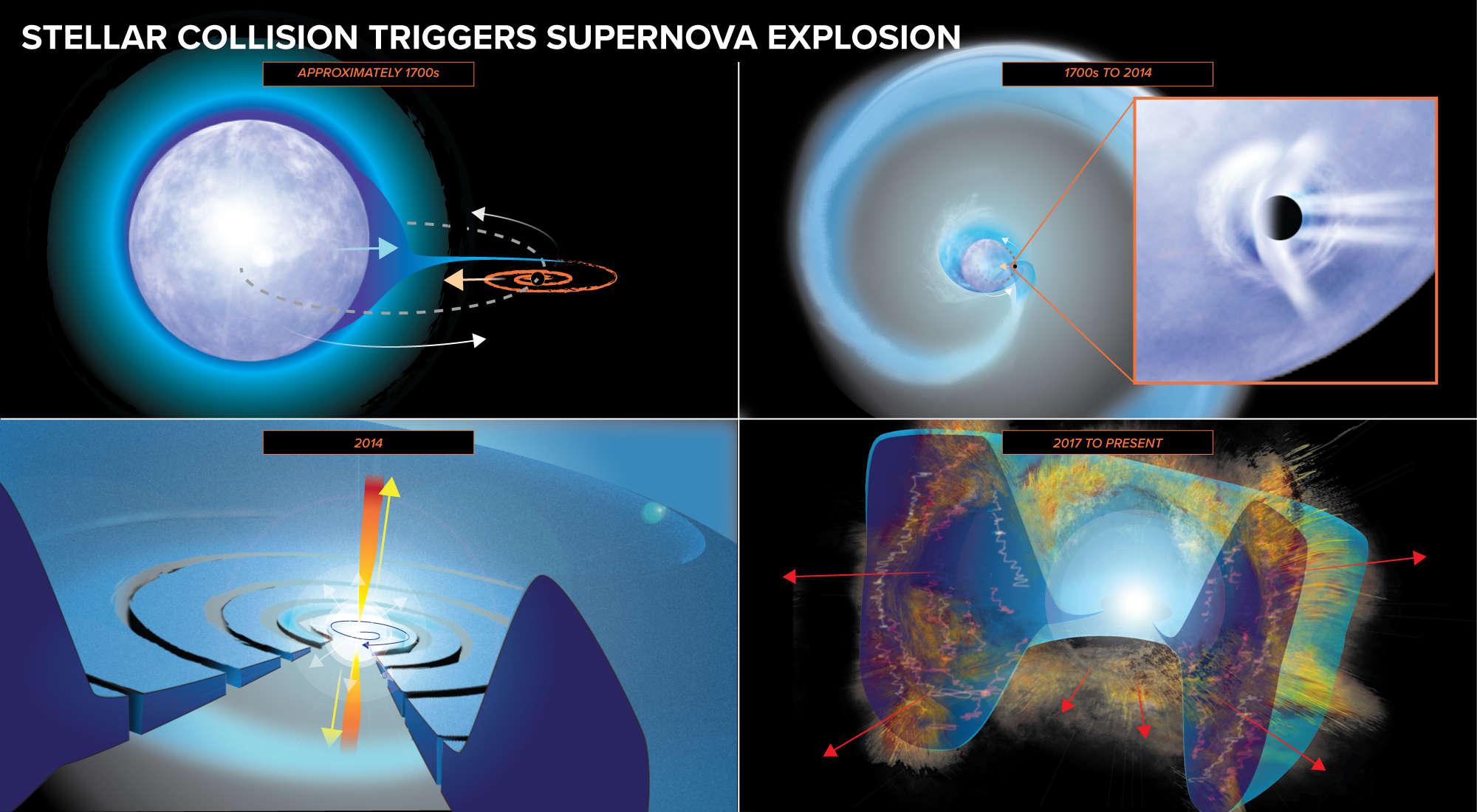
The Sequence of Events -- Clockwise, from top left: (1.) A neutron star or black hole orbits a "normal" companion star (light blue), growing closer over thousands of years. (2.) The neutron star or black hole enters its companion's atmosphere, throwing gas outward in an expanding spiral. (3.) When the intruder reaches the companion's core, material briefly forms a disk that propels a superfast jet outward, poking its way out of the star. The nuclear fusion that held the companion's core up against its own gravity is disrupted, triggering a collapse and subsequent supernova explosion. (4.) The material blasted out by the supernova explosion catches up to the material thrown out by the earlier interaction, causing strong shock waves that produce the radio waves observed with the VLA. Credit: Bill Saxton, NRAO/AUI/NSF.Hi-res File


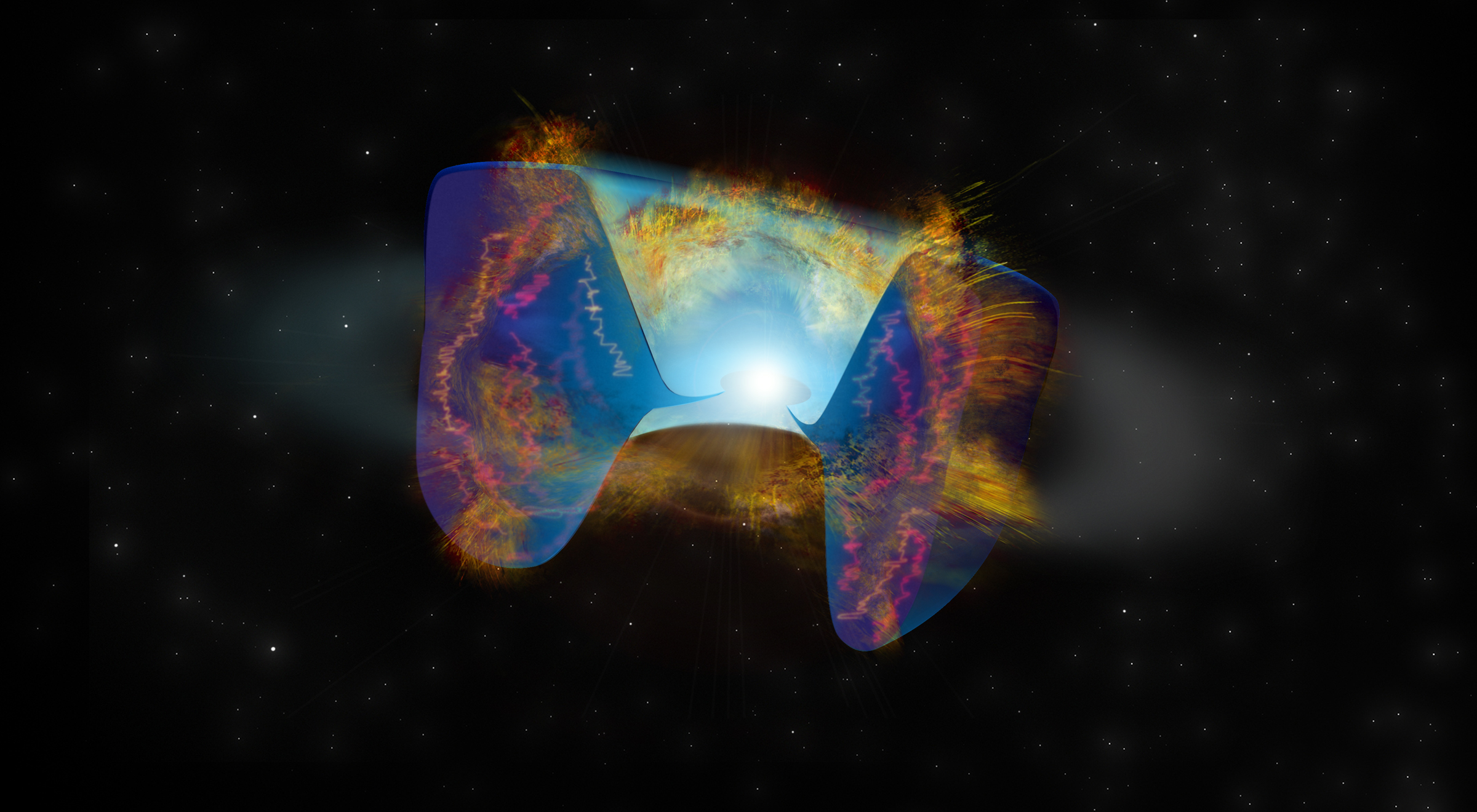
Fast-moving debris from a supernova explosion triggered by a stellar collision crashes into gas thrown out earlier, and the shocks cause bright radio emission seen by the VLA. Credit: Bill Saxton, NRAO/AUI/NSF.Hi-res File

Astronomers have found dramatic evidence that a black hole or neutron star spiraled its way into the core of a companion star and caused that companion to explode as a supernova. The astronomers were tipped off by data from the Very Large Array Sky Survey (VLASS), a multi-year project using the National Science Foundation’s Karl G. Jansky Very Large Array (VLA).

“Theorists had predicted that this could happen, but this is the first time we’ve actually seen such an event,” said Dillon Dong, a graduate student at Caltech and lead author on a paper reporting the discovery in the journal Science.

The first clue came when the scientists examined images from VLASS, which began observations in 2017, and found an object brightly emitting radio waves but which had not appeared in an earlier VLA sky survey, called Faint Images of the Radio Sky at Twenty centimeters (FIRST). They made subsequent observations of the object, designated VT 1210+4956, using the VLA and the Keck telescope in Hawaii. They determined that the bright radio emission was coming from the outskirts of a dwarf, star-forming galaxy some 480 million light-years from Earth. They later found that an instrument aboard the International Space Station had detected a burst of X-rays coming from the object in 2014.

The data from all these observations allowed the astronomers to piece together the fascinating history of a centuries-long death dance between two massive stars. Like most stars that are much more massive than our Sun, these two were born as a binary pair, closely orbiting each other. One of them was more massive than the other and evolved through its normal, nuclear fusion-powered lifetime more quickly and exploded as a supernova, leaving behind either a black hole or a superdense neutron star.

The black hole or neutron star’s orbit grew steadily closer to its companion, and about 300 years ago it entered the companion’s atmosphere, starting the death dance. At this point, the interaction began spraying gas away from the companion into space. The ejected gas, spiraling outward, formed an expanding, donut-shaped ring, called a torus, around the pair.

Eventually, the black hole or neutron star made its way inward to the companion star’s core, disrupting the nuclear fusion producing the energy that kept the core from collapsing of its own gravity. As the core collapsed, it briefly formed a disk of material closely orbiting the intruder and propelled a jet of material outward from the disk at speeds approaching that of light, drilling its way through the star.

“That jet is what produced the X-rays seen by the MAXI instrument aboard the International Space Station, and this confirms the date of this event in 2014,” Dong said.

The collapse of the star’s core caused it to explode as a supernova, following its sibling’s earlier explosion.

“The companion star was going to explode eventually, but this merger accelerated the process,” Dong said.

The material ejected by the 2014 supernova explosion moved much faster than the material thrown off earlier from the companion star, and by the time VLASS observed the object, the supernova blast was colliding with that material, causing powerful shocks that produced the bright radio emission seen by the VLA.

“All the pieces of this puzzle fit together to tell this amazing story,” said Gregg Hallinan of Caltech. “The remnant of a star that exploded a long time ago plunged into its companion, causing it, too, to explode,” he added.

The key to the discovery, Hallinan said, was VLASS, which is imaging the entire sky visible at the VLA’s latitude — about 80 percent of the sky — three times over seven years. One of the objectives of doing VLASS that way is to discover transient objects, such as supernova explosions, that emit brightly at radio wavelengths. This supernova, caused by a stellar merger, however, was a surprise.

“Of all the things we thought we would discover with VLASS, this was not one of them,” Hallinan said.

The National Radio Astronomy Observatory is a facility of the National Science Foundation, operated under cooperative agreement by Associated Universities, Inc.

Media Contact:

Dave Finley, Public Information Officer
(505) 241-9210

dfinley@nrao.edu

Link to Scientific Paper


Source: National Radio Astronomy Observatory (NRAO)/News