Showing posts with label Io. Show all posts

Sunday, April 12, 2026

How Jupiter Cultivated More Large Moons than Saturn — A magnetospheric cavity explains the difference

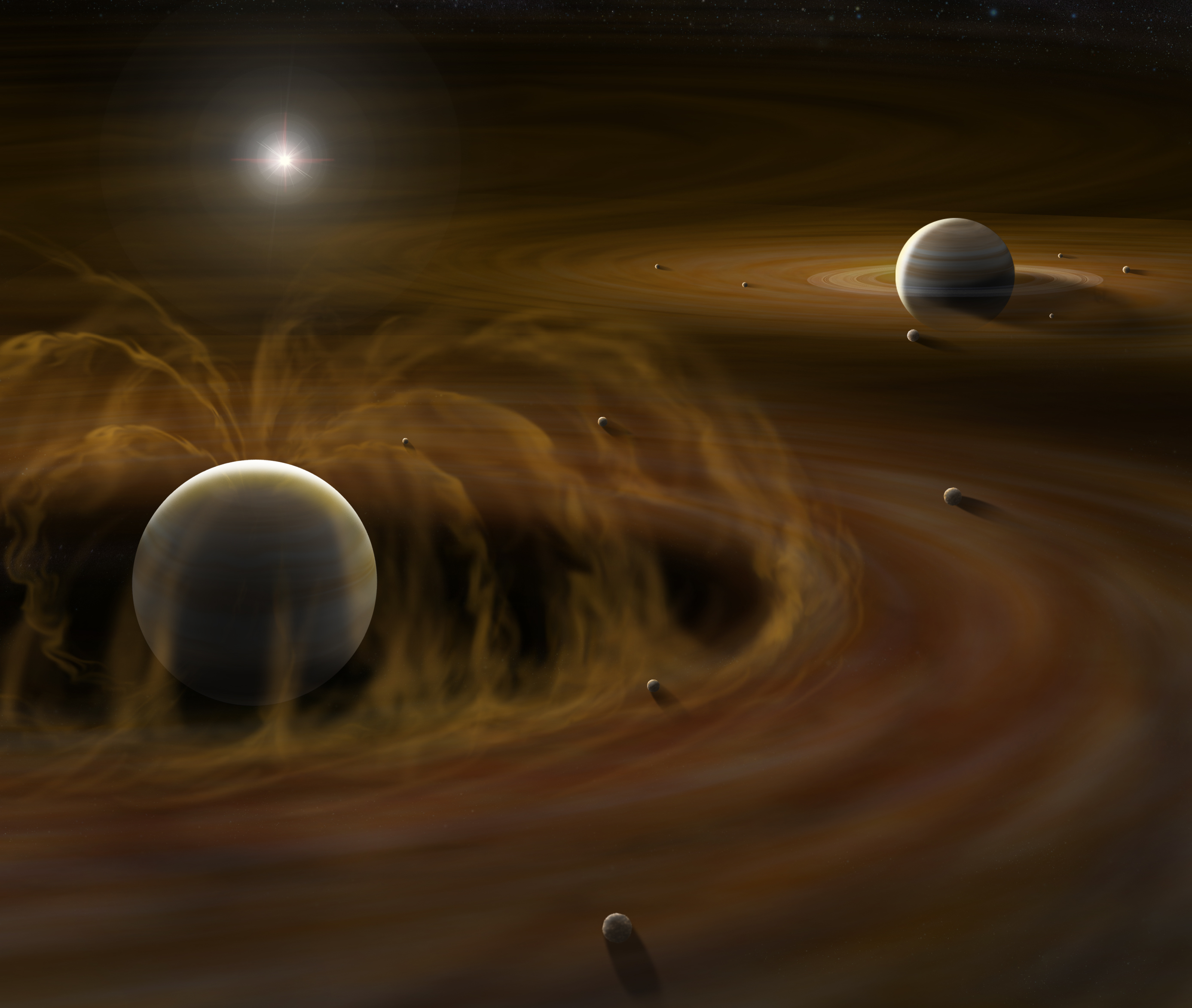
Artist’s impression of the simulations conducted in this research. Jupiter (lower left) has a strong magnetic field which creates a cavity in its circumplanetary disk. Saturn (upper right) lacks a strong magnetic field so its circumplanetary disk evolves without a cavity. Credit: Yuri I. Fujii/L-INSIGHT [Kyoto University], Shinichiro Kinoshita.  Image (5.0MB)

The Solar System’s two largest gas giant planets, Jupiter and Saturn, have extensive but very different families of moons orbiting them. New simulations conducted on the PC cluster at the Center for Computational Astrophysics (CfCA), National Astronomical Observatory of Japan (NAOJ) showed that the planet’s magnetic field plays a role in creating an environment where the new moons can survive and grow, thus shaping the evolution of the system.

Jupiter has more than 100 reported moons, including four large ones (Ganymede, Callisto, Io, and Europa). Saturn has more than 280 reported moons, but only one large one (Titan). So it is a puzzle why Saturn managed to cultivate more moons, but fewer large moons than Jupiter.

A team led by Kyoto University, including researchers from institutes in Japan and China, used the PC cluster at CfCA, NAOJ, to simulate the formation of the moon systems around Jupiter and Saturn. This simulation recreated the planets’ internal structure to calculate the thermal evolution of Jupiter and Saturn and how their magnetic fields have varied over time.

Moons form from material in a “circumplanetary disk” of gas and dust orbiting the young planet. The disk nurtures the young moons, but interactions with the disk may cause them to fall into the planet. The simulations showed that young Jupiter generated a strong planetary magnetic field that created a safe “cavity” around the planet where its young large moons were prevented from migrating too close to their host planet. Young Saturn lacked a strong magnetic field, so only one large moon managed to survive.

“Testing planet formation theory is somewhat difficult because we have only our Solar System for reference, but there are multiple satellite systems close to us whose detailed characteristics we can observe,” says Yuri I. Fujii, primary author of the report announcing these findings. Next, the team is interested in expanding their theory to other moons and potential exomoon systems.


Detailed Article(s)

How Jupiter Cultivated More Large Moons than Saturn —— A magnetospheric cavity explains the difference

Center for Computational Astrophysics

Release Information

Researcher(s) Involved in this Release

  • Yuri Fujii (Graduate School of Human and Environmental Studies, Kyoto University)
  • Masahiro Ogihara (Tsung-Dao Lee Institute, Shanghai Jiao Tong University)
  • Yasunori Hori (Okayama University)

Coordinated Release Organization(s)
  • Kyoto University
  • Okayama University
  • National Astronomical Observatory of Japan, NINS
  • Fujii et al. “Different architecture of Jupiter and Saturn satellite systems from magnetospheric cavity formation” in Nature Astronomy, DOI: 10.1038/s41550-026-02820-x

Related Link(s)

Thursday, October 22, 2020

ALMA Shows Volcanic Impact on Io’s Atmosphere

This video shows images of Jupiter's moon Io in radio (made with ALMA), and optical light (made with Voyager 1 and Galileo missions). The ALMA images were taken when Io passed into Jupiter's shadow in March 2018 (eclipse), and from Jupiter's shadow into sunlight in September 2018. These radio images for the first time show plumes of sulfur dioxide (in yellow) rise up from the volcanoes on Io.Credit: ALMA (ESO/NAOJ/NRAO), I. de Pater et al.; NRAO/AUI NSF, S. Dagnello; NASA
. Download Video
 
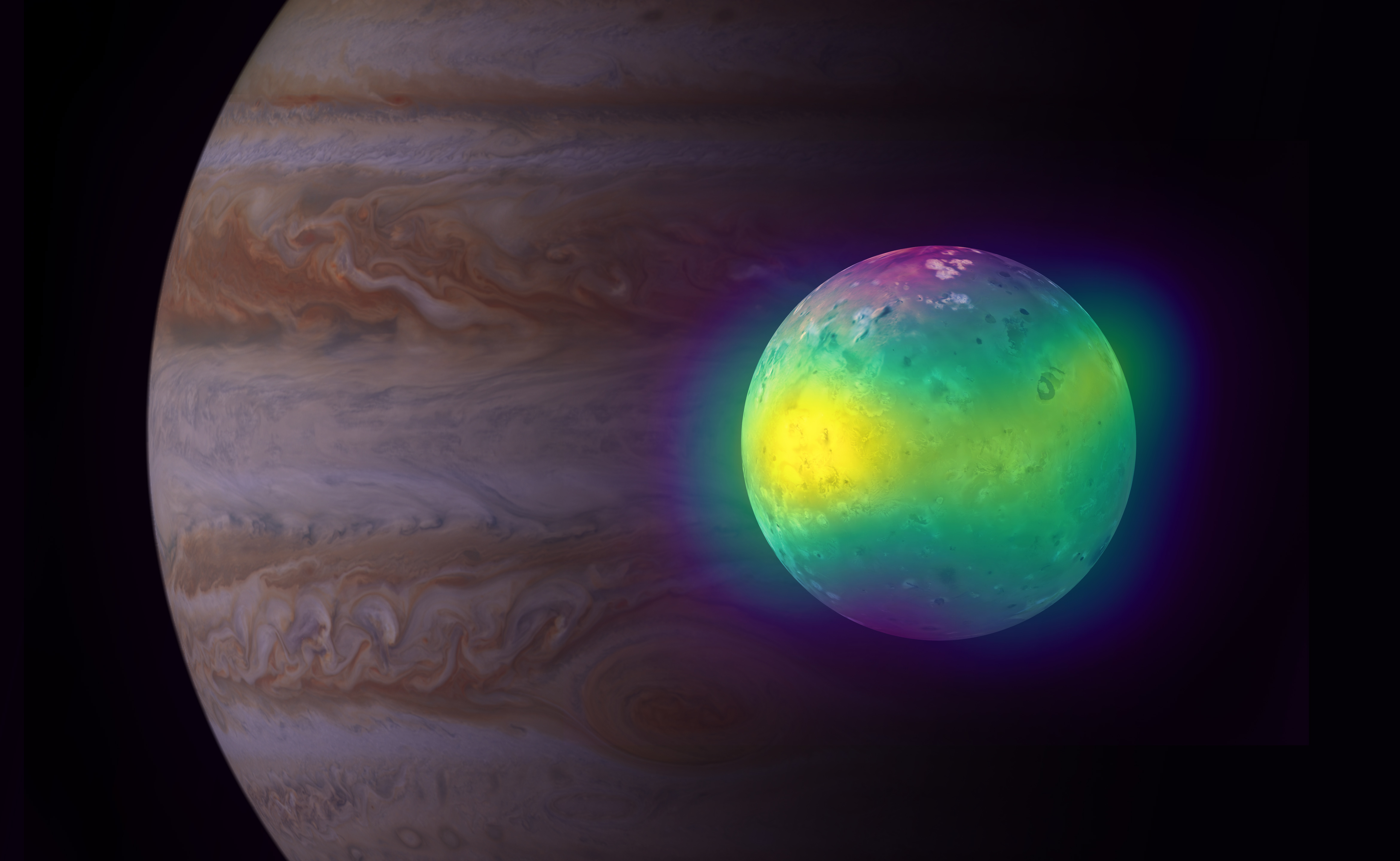
Composite image showing Jupiter's moon Io in radio (ALMA), and optical light (Voyager 1 and Galileo). The ALMA images of Io show for the first time plumes of sulfur dioxide (in yellow) rise up from its volcanoes. Jupiter is visible in the background (Cassini image).Credit: ALMA (ESO/NAOJ/NRAO), I. de Pater et al.; NRAO/AUI NSF, S. Dagnello; NASA/JPL/Space Science Institute.  Hi-Res File 
 
New radio images from the Atacama Large Millimeter/submillimeter Array (ALMA)vf Jupiter’s moon Io.

Io is the most volcanically active moon in our solar system. It hosts more than 400 active volcanoes, spewing out sulfur gases that give Io its yellow-white-orange-red colors when they freeze out on its surface.

Although it is extremely thin – about a billion times thinner than Earth’s atmosphere – Io has an atmosphere that can teach us about Io’s volcanic activity and provide us a window into the exotic moon’s interior and what is happening below its colorful crust.

Previous research has shown that Io’s atmosphere is dominated by sulfur dioxide gas, ultimately sourced from volcanic activity. “However, it is not known which process drives the dynamics in Io’s atmosphere,” said Imke de Pater of the University of California, Berkeley. “Is it volcanic activity, or gas that has sublimated (transitioned from solid to gaseous state) from the icy surface when Io is in sunlight?“

To distinguish between the different processes that give rise to Io’s atmosphere, a team of astronomers used ALMA to make snapshots of the moon when it passed in and out of Jupiter’s shadow (they call this an “eclipse”).

“When Io passes into Jupiter’s shadow, and is out of direct sunlight, it is too cold for sulfur dioxide gas, and it condenses onto Io’s surface. During that time we can only see volcanically-sourced sulfur dioxide. We can therefore see exactly how much of the atmosphere is impacted by volcanic activity,” explained Statia Luszcz-Cook from Columbia University, New York.

Thanks to ALMA’s exquisite resolution and sensitivity, the astronomers could, for the first time, clearly see the plumes of sulfur dioxide (SO2) and sulfur monoxide (SO) rise up from the volcanoes. Based on the snapshots, they calculated that active volcanoes directly produce 30-50 percent of Io’s atmosphere.

The ALMA images also showed a third gas coming out of volcanoes: potassium chloride (KCl). “We see KCl in volcanic regions where we do not see SO2 or SO,” said Luszcz-Cook. “This is strong evidence that the magma reservoirs are different under different volcanoes.”

Io is volcanically active due to a process called tidal heating. Io orbits Jupiter in an orbit that is not quite circular and, like our Moon always faces the same side of Earth, so does the same side of Io always face Jupiter. The gravitational pull of Jupiter’s other moons Europa and Ganymede causes tremendous amounts of internal friction and heat, giving rise to volcanoes such as Loki Patera, which spans more than 200 kilometers (124 miles) across. “By studying Io’s atmosphere and volcanic activity we learn more about not only the volcanoes themselves, but also the tidal heating process and Io’s interior,” added Luszcz-Cook.

A big unknown remains the temperature in Io’s lower atmosphere. In future research, the astronomers hope to measure this with ALMA. “To measure the temperature of Io’s atmosphere, we need to obtain a higher resolution in our observations, which requires that we observe the moon for a longer period of time. We can only do this when Io is in sunlight since it does not spend much time in eclipse,” said de Pater. “During such an observation, Io will rotate by tens of degrees. We will need to apply software that helps us make un-smeared images. We have done this previously with radio images of Jupiter made with ALMA and the Very Large Array (VLA).”

The National Radio Astronomy Observatory is a facility of the National Science Foundation, operated under cooperative agreement by Associated Universities, Inc.

Source: National Radio Astronomy Observatory (NRAO)/News

Media contact:

Iris Nijman
NRAO News and Public Information Manager

inijman@nrao.edu

Imke de Pater and Statia Luszcz-Cook worked with Patricio Rojo of the Universidad de Chile, Erin Redwing of the University of California, Berkeley, Katherine de Kleer of the California Institute of Technology (Caltech), and Arielle Moullet of SOFIA/USRA in California.

This research titled “ALMA Observations of Io Going into and Coming out of Eclipse” has been accepted for publication in The Planetary Science Journal. Preprint: https://arxiv.org/abs/2009.07729

The Atacama Large Millimeter/submillimeter Array (ALMA), an international astronomy facility, is a partnership of the European Organisation for Astronomical Research in the Southern Hemisphere (ESO), the U.S. National Science Foundation (NSF) and the National Institutes of Natural Sciences (NINS) of Japan in cooperation with the Republic of Chile. ALMA is funded by ESO on behalf of its Member States, by NSF in cooperation with the National Research Council of Canada (NRC) and the Ministry of Science and Technology (MOST) and by NINS in cooperation with the Academia Sinica (AS) in Taiwan and the Korea Astronomy and Space Science Institute (KASI).

ALMA construction and operations are led by ESO on behalf of its Member States; by the National Radio Astronomy Observatory (NRAO), managed by Associated Universities, Inc. (AUI), on behalf of North America; and by the National Astronomical Observatory of Japan (NAOJ) on behalf of East Asia. The Joint ALMA Observatory (JAO) provides the unified leadership and management of the construction, commissioning and operation of ALMA.


Saturday, October 22, 2016

Long-term, hi-res tracking of eruptions on Jupiter’s moon, Io

Images of Io at different near-infrared wavelengths show bright spots that are thermal emissions from the moon’s myriad volcanoes. Click on image to see the entire set, with the name of the near-infrared filter indicated in the black box at the start of each section. Note the increasing number of hot spots detected at longer wavelengths, i.e. towards the bottom of the figure. (Katherine de Kleer and Imke de Pater image, from Gemini Observatory/AURA & Keck Observatory).

All hot spots detected are shown on a map of Io. Each circle represents a new detection; the size of the circle corresponds logarithmically to the intensity, and more opaque regions are where a hot spot was detected multiple times. The color and symbol indicate the type of eruption, following the legend. Loki Patera is at 310 West, 10 North and Kurdalagon Patera is at 220 West, 50 South.

Video showing all hot spots detected from August 2013 through December 2015, displayed on a full map of Io and illustrating the approximate length of time they were visible. The size of the circle corresponds logarithmically to the intensity. Loki Patera is at 310 West longitude, 10 North latitude and Kurdalagon Patera is at 220 West longitude, 50 South latitude. (Credit: Katherine de Kleer and Imke de Pater, UC Berkeley). Youtube

High-resolution image of Io, showing hot spots — Loki Patera and Amaterasu Patera — visible from Earth only with adaptive optics on the planet’s largest telescopes, Keck and Gemini.


Press release issued by the University of Berkeley to coincide with presentation at the joint 48th annual meeting of the Division for Planetary Sciences (DPS) of the American Astronomical Society (AAS) and 11th annual European Planetary Science Congress (EPSC).

Jupiter’s moon Io continues to be the most volcanically active body in the solar system, as documented by the longest series of frequent, high-resolution observations of the moon’s thermal emission ever obtained.

Using near-infrared adaptive optics on two of the world’s largest telescopes — the 10-meter Keck II and the 8-meter Gemini North, both located near the summit of the dormant volcano Mauna Kea in Hawaii — University of California, Berkeley, astronomers tracked 48 volcanic hotspots on the surface over a period of 29 months from 2013 through the end of 2015.

Without adaptive optics — a technique that removes the atmospheric blur to sharpen the image — Io is merely a fuzzy ball. Adaptive optics can separate features just a few hundred kilometers apart on Io’s 3,600-kilometer diameter surface.

“On a given night, we may see half a dozen or more different hot spots,” said Katherine de Kleer, a UC Berkeley graduate student who led the observations. “Of Io’s hundreds of active volcanoes, we have been able to track the 50 that were the most powerful over the past few years.”

She and Imke de Pater, a UC Berkeley professor of astronomy and of Earth and planetary science, observed the heat coming off of active eruptions as well as cooling lava flows and were able to determine the temperature and total power output of individual volcanic eruptions, as well as track their evolution over days, weeks and sometimes even years.

Interestingly, some of the eruptions appeared to progress across the surface over time, as if one triggered another 500 kilometers away.

“While it stretches the imagination to devise a mechanism that could operate over distances of 500 kilometers, Io’s volcanism is far more extreme than anything we have on Earth and continues to amaze and baffle us,” de Kleer said.

De Kleer and de Pater will discuss their observations at a media briefing on Oct. 20 during the joint 48th meeting of the American Astronomical Society’s Division for Planetary Sciences and 11th European Planetary Science Congress in Pasadena, California. Papers describing the observations have been accepted for future publication by the journal Icarus.

Tidal Heating

Io’s intense volcanic activity is powered by tidal heating: heating from friction generated in Io’s interior as Jupiter’s intense gravitational pull changes by small amounts along Io’s orbit. Models for how this heating occurs predict that most of Io’s total volcanic power should be emitted either near the poles or near the equator, depending on the model, and that the pattern should be symmetric between the forward- and backward-facing hemispheres in Io’s orbit (that is, at longitudes 0-180 vs. 180-360).

That’s not what they saw. Over the observational period, August 2013 through December 2015, the team obtained images of Io on 100 nights. Though they saw a surprising number of short-lived but intense eruptions that appeared suddenly and subsided in a matter of days, every single one took place on the trailing face of Io (between 180 and 360 degrees longitude) rather than the leading face, and at higher latitudes than more typical eruptions.

“The distribution of the eruptions is a poor match to the model predictions,” de Kleer said, “but future observations will tell us whether this is just because the sample size is too small, or because the models are too simplified. Or, perhaps we’ll learn that local geological factors play a much greater role in determining where and when the volcanoes erupt than the physics of tidal heating do.”

One key target of interest was Io’s most powerful persistent volcano, Loki Patera, which brightens by more than a factor of 10 every 1-2 years. A patera is an irregular crater, usually volcanic.

Many scientists believe that Loki Patera is a massive lava lake, and that these bright episodes represent its overturning crust, like that seen in lava lakes on Earth. In fact, the heat emissions from Loki Patera appear to travel around the lake during each event, as if from a wave moving around a lake triggering the destabilization and sinking of portions of crust. Prior to 2002, this front seemed to travel around the cool island in the center of the lake in a counter-clockwise direction.

After an apparent cessation of brightening events after 2002, de Pater observed renewed activity in 2009.

“With the renewed activity, the waves traveled clockwise around the lava lake,” she noted.

Another volcano, Kurdalagon Patera, produced unusually hot eruptions twice in the spring of 2015, coinciding with the brightening of an extended cloud of neutral material that orbits Jupiter. This provides circumstantial evidence that eruptions on the surface are the source of variability in this neutral cloud, though it’s unclear why other eruptions were not also associated with brightening, de Kleer said.

De Kleer noted that the Keck and Gemini telescopes, both atop the dormant volcano Mauna Kea, complement one another. Gemini North’s queue scheduling allowed more frequent observations — often several a week — while Keck’s instruments are sensitive also to longer wavelengths (5 microns), showing cooler features such as older lava flows that are invisible in the Gemini observations.

The astronomers are continuing their frequent observations of Io, providing a long-term database of high spatial resolution images that not even Galileo, which orbited Jupiter for eight years, was able to achieve.


Media Contacts:
 
Robert Sanders
UCB Media Relations
+1 510-643-6998
rlsanders@berkeley.edu

Anita Heward
EPSC Press Officer
+44 (0)77 5603 4243

anita.heward@europlanet-eu.org

Science Contacts:
 
Katherine de Kleer
kdekleer@berkeley.edu

Imke de Pater
imke@berkeley.edu


References:

* “Time Variability of Io’s Volcanic Activity from Near-IR Adaptive Optics Observations on 100 Nights in 2013-2015” (accepted by Icarus).
* “Spatial Distribution of Io’s Volcanic Activity from Near-IR Adaptive Optics Observations on 100 Nights in 2013-2015” (accepted by Icarus).

Further information:

The joint 48th meeting of the Division for Planetary Sciences (DPS) and 11th European Planetary Science Congress (EPSC) in Pasadena, California, is second time DPS and EPSC have been joined into one meeting. The goal of the joint meeting is to strengthen international scientific collaboration in all areas of planetary science. This is the first time that EPSC, which provides the dissemination platform for the Europlanet 2020 Research Infrastructure, is held outside Europe. For more information, see: https://aas.org/meetings/dps48. Follow: #dpsepsc, @DPSMeeting, @europlanetmedia, and @AAS_Press on Twitter.


Source: Europlanet

Wednesday, August 03, 2016

Gemini Tracks Collapse of Io's Atmosphere During Frigid Eclipses

Artist’s concept of the atmospheric collapse of Jupiter’s volcanic moon Io, which is eclipsed by Jupiter for two hours of each day (1.7 Earth days). The resulting temperature drop freezes sulfur dioxide gas, causing the atmosphere to “deflate,” as seen in the shadowed area on the left. Credits: SwRI/Andrew Blanchard. Full resolution JPEG


Gemini observations show that the thin atmosphere of Jupiter's moon Io undergoes dramatic changes during frequent eclipses with the giant planet. The following press release, issued by the Southwest Research Institute, explains how the dramatic changes in temperature cause the moon's atmosphere to collapse.

San Antonio – Aug. 2, 2016 – A Southwest Research Institute-led team has documented atmospheric changes on Io, Jupiter’s volcanically active satellite, as the giant planet casts its shadow over the moon’s surface during daily eclipses. 

A study led by SwRI’s Constantine Tsang concluded that Io’s thin atmosphere, which consists primarily of sulfur dioxide (SO2) gas emitted from volcanoes, collapses as the SO2 freezes onto the surface as ice when Io is shaded by Jupiter. When the moon moves out of eclipse and ice warms, the atmosphere reforms through sublimation, where ice converts directly to gas. 

“This research is the first time scientists have observed this phenomenon directly, improving our understanding of this geologically active moon,” said Tsang, a senior research scientist in SwRI’s Space Science and Engineering Division. 

The findings were published in a study titled “The Collapse of Io’s Primary Atmosphere in Jupiter Eclipse” in the Journal of Geophysical Research. The team used the eight-meter Gemini North telescope in Hawai'i with the Texas Echelon Cross Echelle Spectrograph (TEXES) for this research. 

Data showed that Io’s atmosphere begins to “deflate” when the temperatures drop from -235 degrees Fahrenheit (-148 ℃) in sunlight to -270 degrees Fahrenheit (-168 ℃) during eclipse. Eclipse occurs 2 hours of every Io day (1.7 Earth days). In full eclipse, the atmosphere effectively collapses as most of the SO2 gas settles as frost on the moon’s surface. The atmosphere redevelops as the surface warms once the moon returns to full sunlight. 

“This confirms that Io’s atmosphere is in a constant state of collapse and repair, and shows that a large fraction of the atmosphere is supported by sublimation of SO2 ice,” said John Spencer, an SwRI scientist who also participated in the study. “Though Io’s hyperactive volcanoes are the ultimate source of the SO2, sunlight controls the atmospheric pressure on a daily basis by controlling the temperature of the ice on the surface. We’ve long suspected this, but can finally watch it happen.” 

Prior to the study, no direct observations of Io’s atmosphere in eclipse had been possible because Io’s atmosphere is difficult to observe in the darkness of Jupiter’s shadow. This breakthrough was possible because TEXES measures the atmosphere using heat radiation, not sunlight, and the giant Gemini telescope can sense the faint heat signature of Io’s collapsing atmosphere. 

Tsang and Spencer’s observations occurred over two nights in November 2013, when Io was more than 420 million miles (676 million km) from Earth. On both occasions, Io was observed moving in and out of Jupiter’s shadow, for a period about 40 minutes before and after eclipse. 

Io is the most volcanically active object in the solar system. Tidal heating, the result of Io’s gravitational interaction with Jupiter, drives the moon’s volcanic activity. Io’s volcanoes emit umbrella-like plumes of SO2 gas extending up to 300 miles (483 km) above the moon’s surface and produce extensive basaltic lava fields that can flow for hundreds of miles. 

This study is also timely given that NASA’s Juno spacecraft entered Jupiter orbit on July 4th. “Io spews out gases that eventually fill the Jupiter system, ultimately seeding some of the auroral features seen at Jupiter’s poles,” Tsang said. “Understanding how these emissions from Io are controlled will help paint a better picture of the Jupiter system.” 

For more information, contact Robert Crowe, (210) 522-4630, Communications Department, Southwest Research Institute, PO Drawer 28510, San Antonio, TX 78228-0510. 

SwRI Space Scientists Observe Io’s Atmospheric Collapse During Eclipse:  http://www.swri.org/9what/releases/2016/io-atmosphere-collapse-eclipse.htm


Thursday, February 05, 2015

Hubble Captures Rare Triple-Moon Conjunction

Jupiter — January 24, 2015
Credit: NASA, ESA, and the Hubble Heritage Team (STScI/AURA)


Firing off a string of snapshots like a sports photographer at a NASCAR race, NASA's Hubble Space Telescope captured a rare look at three of Jupiter's largest moons parading across the banded face of the gas-giant planet: Europa, Callisto, and Io.

These so-called Galilean satellites (named after the 17th century scientist Galileo Galilei, who discovered them with a telescope) complete orbits around Jupiter ranging from 2 days to 17 days in duration. They can commonly be seen transiting the face of Jupiter and casting shadows onto its cloud tops. However, seeing three moons transiting the face of Jupiter at the same time is rare, occurring only once or twice a decade.

The Hubble image on the left (unlabeled at top left, labeled at bottom left) shows the beginning of the event, which took place on January 24, 2015. From left to right the moons Callisto and Io are above Jupiter's cloud tops. The shadows from Europa (not seen in the image), Callisto, and Io are strung out from left to right.

Near the end of the event, approximately 42 minutes later (right-side image), Europa has entered the frame at lower left. Slower-moving Callisto is above and to the right of Europa. Fastest-moving Io is approaching the eastern limb of the planet; its shadow is no longer visible on Jupiter. Europa's shadow is toward the left side of the image, and Callisto's shadow to the right. (The moons' orbital velocities are proportionally slower with increasing distance from the planet.)

Missing from the sequence is the moon Ganymede, which was outside Hubble's field of view and too far from Jupiter in angular separation to be considered part of the conjunction.

The moons in these photos have distinctive colors. The ancient, cratered surface of Callisto is brownish; the smooth icy surface of Europa is yellow-white; and the volcanic, sulfur-dioxide surface of Io is orange. The apparent "fuzziness" of some of the shadows depends on the moons' distances from Jupiter. The farther away a moon is from the planet, the softer the shadow, because the shadow is more spread out across the disk.
The images were taken with Hubble's Wide Field Camera 3 in visible light.

For additional information, contact:

Ray Villard
Space Telescope Science Institute, Baltimore, Md.
410-338-4514
villard@stsci.edu

Zolt Levay
Space Telescope Science Institute, Baltimore, Md.
410-338-4907
levay@stsci.edu

Source: HubbleSite

Monday, August 04, 2014

Observations Reveal Massive Eruptions on Jupiter’s Moon Io

Images of Io obtained at different infrared wavelengths (in microns, μm, or millionths of a meter) with the W. M. Keck Observatory's 10-meter Keck II telescope on Aug. 15, 2013 (a-c) and the Gemini North telescope on Aug. 29, 2013 (d). The bar on the right of each image indicates the intensity of the infrared emission. Note that emissions from the large volcanic outbursts on Aug. 15 at Rarog and Heno Paterae have substantially faded by Aug. 29. A second bright spot is visible to the north of the Rarog and Heno eruptions in c and to the west of the outburst in d. This hot spot was identified as Loki Patera, a lava lake that appeared to be particularly active at the same time. An even brighter outburst is seen to the lower right in panel (d), labeled “201308C” and is one of the most powerful outbursts ever seen on Io. Credit: Imke de Pater and Katherine de Kleer, UC Berkeley.

Mauna Kea, Hawaii — Three massive volcanic eruptions occurred on Jupiter's moon Io within a two-week period, leading astronomers to speculate that these presumed rare "outbursts," which can send material hundreds of miles above the surface, might be much more common than previously thought. The observations were made using the W. M. Keck Observatory and Gemini Observatory, both near the summit of Mauna Kea, Hawaii.

"We typically expect one huge outburst every one or two years, and they're usually not this bright," said Imke de Pater, professor and chair of astronomy at the University of California, Berkeley, and lead author of one of two papers describing the eruptions. "Here we had three extremely bright outbursts, which suggest that if we looked more frequently we might see many more of them on Io."

Io, the innermost of Jupiter's four large "Galilean" moons, is about 2,300 miles across, and, aside from Earth, is the only known place in the solar system with volcanoes erupting extremely hot lava like that seen on Earth. Because of Io's low gravity, large volcanic eruptions produce an umbrella of debris that rises high into space.

De Pater's long-time colleague and coauthor Ashley Davies, a volcanologist with NASA's Jet Propulsion Laboratory at the California Institute of Technology in Pasadena, Calif., said that the recent eruptions resemble past events that spewed tens of cubic miles of lava over hundreds of square miles in a short period of time.

"These new events are in a relatively rare class of eruptions on Io because of their size and astonishingly high thermal emission," he said. "The amount of energy being emitted by these eruptions implies lava fountains gushing out of fissures at a very large volume per second, forming lava flows that quickly spread over the surface of Io."

All three events, including the largest, most powerful eruption of the trio on 29 Aug. 2013, were likely characterized by “curtains of fire," as lava blasted out of fissures perhaps several miles long.

The papers, one with lead author Katherine de Kleer, a UC Berkeley graduate student, and coauthored by UC Berkeley research astronomer Máté Ádámkovics, and the other coauthored by Ádámkovics and David R. Ciardi of Caltech's NASA Exoplanet Science Institute, have been accepted for publication in the journal Icarus.

Lava fountains on Io

De Pater discovered the first two massive eruptions on Aug. 15, 2013, using the near-infrared camera (NIRC2) coupled to the adaptive optics system on the Keck II telescope, one of two 10-meter telescopes operated by the W. M. Keck Observatory in Hawaii. The brightest, at a caldera named Rarog Patera, was calculated to have produced a 50 square-mile, 30-foot thick lava flow, while the other, close to another caldera called Heno Patera, produced flows covering 120 square miles. Both were located in Io's southern hemisphere, near its limb, and were nearly gone when imaged five days later.

De Pater discovered a third and even brighter eruption — one of the brightest ever seen on Io — on Aug. 29 at the start of a year-long series of Io observations led by de Kleer, using both the Near-Infrared Imager with adaptive optics on the Gemini North telescope on Mauna Kea, and the SpeX near-infrared spectrometer on NASA's nearby Infrared Telescope Facility (IRTF). De Kleer used the fortuitous detection of this outburst simultaneously at Gemini and the IRTF to show that the eruption temperature is likely much higher than typical eruption temperatures on Earth today, "indicative of a composition of the magma that on Earth only occurred in our planet’s formative years," de Kleer said.

At the time of the observation, the thermal source had an area of up to 32 square miles. The modelled temperature of the lava indicated it had barely had time to cool, suggesting that the event was dominated by lava fountains.

"We are looking at several cubic miles of lava in rapidly emplaced flows," said Davies, who has developed models to predict the volume of magma erupted based on spectroscopic observations. "This will help us understand the processes that helped shape the surfaces of all the terrestrial planets, including Earth, and the moon."

The team tracked the heat of the third outburst for almost two weeks after its discovery to investigate how volcanoes influence Io’s atmosphere and how these eruptions feed a doughnut of ionized gas - the Io plasma torus - that surrounds Jupiter near Io’s orbit. De Kleer timed her Gemini and IRTF observations to coincide with observations of the plasma torus by the Japanese HISAKI (SPRINT-A) spacecraft, which is in orbit around Earth, so she can correlate the different data sets.

A volcanic laboratory

Volcanoes were first noted on Io in 1979, and subsequent studies by the Galileo spacecraft, which first flew by Io in 1996, and ground-based telescopes show that eruptions and lava fountains occur constantly, creating rivers and lakes of lava. But large eruptions, creating vast lava flows in some cases thousands of square miles in area, were thought to be rare. Only 13 were observed between 1978 and 2006, in part because only a handful of astronomers, de Pater among them, regularly scan the moon.

Davies' interest in Io's volcanoes arises from the moon's resemblance to an early Earth when heat from the decay of radioactive elements — much more intense than radiogenic heating today — created exotic, high-temperature lavas. Io remains volcanically active for a different reason — Jupiter and the moons Europa and Ganymede constantly tug on it — but the current eruptions on Io are likely similar to those that shaped the surfaces of inner solar system planets such as Earth and Venus in their youth.

"We are using Io as a volcanic laboratory, where we can look back into the past of the terrestrial planets to get a better understanding of how these large eruptions took place, and how fast and how long they lasted," Davies said.

In a third paper accepted by Icarus, de Pater, Davies and their colleagues summarize a decade of Io observations with the Keck II and Gemini telescopes. Their map of the surface of Io pinpointed more than two dozen hot spots whose spatial distribution changed significantly between 2001 and 2010. In 2010 the hot spots were dominated by two volcanic centers: Loki Patera, an extremely large active lava lake on Io, and Kanehekili Fluctus, an area of continuing pahoehoe lava flows. 

The team hopes that monitoring Io's surface annually will reveal the style of volcanic eruptions on the moon, constrain the composition of the magma, and accurately map the spatial distribution of the heat flow and potential variations over time. This information is essential to get a better understanding of the physical processes involved in the heating and cooling processes on Io, de Pater said.

The work is funded by the National Science Foundation and NASA's Outer Planets Research and Planetary Geology and Geophysics Programs.

The W. M. Keck Observatory operates the largest, most scientifically productive telescopes on Earth. The two, 10-meter optical/infrared telescopes on the summit of Mauna Kea on the Island of Hawaii feature a suite of advanced instruments including imagers, multi-object spectrographs, high-resolution spectrographs, integral-field spectroscopy and world-leading laser guide star adaptive optics systems.

NIRC2 (the Near-Infrared Camera, second generation) works in combination with the Keck II adaptive optics system to obtain very sharp images at near-infrared wavelengths, achieving spatial resolutions comparable to or better than those achieved by the Hubble Space Telescope at optical wavelengths. NIRC2 is probably best known for helping to provide definitive proof of a central massive black hole at the center of our galaxy. Astronomers also use NIRC2 to map surface features of solar system bodies, detect planets orbiting other stars, and study detailed morphology of distant galaxies.

Keck Observatory is a private 501(c) 3 non-profit organization and a scientific partnership of the California Institute of Technology, the University of California and NASA.

Related Information


Media Contact:

Steve Jefferson
Communications Officer
W. M. Keck Observatory
808-881-3827

sjefferson@keck.hawaii.edu

Science Contacts:
Imke de Pater
510-643-7673

mke@berkeley.edu

Ashley Davies
818-393-1775

ashley.davies@jpl.nasa.gov

Katherine de Kleer
kdekleer@astro.berkeley.edu


Monday, October 22, 2012

Adaptive Optics allows Earth-based monitoring of Io’s Fiery show


Quiescent activity of Io observed in 2010 and 2011 showing several quasi-permanent eruptions at 3.8 microns [bottom] and the absence of bright, hotter outbursts at 2.1 microns. 

Kamuela, Hawaii – Watching active volcanic eruptions should be done from a safe distance, and a group of California researchers has figured out how to do it from, ironically, Mauna Kea – one of Earth’s tallest volcanoes – using the W. M. Keck Observatory. Employing an ingenious combination of telescopic surveys and archival data, they have gathered nearly 40 distinct snapshots of effusive (slow) volcanic eruptions and high temperature outbursts on Jupiter’s tiny moon, Io, showing details as small as 100 km (60 miles) on the moon’s surface. 

While space-based telescopes were once required for viewing surface details on Io – similar in size to our Moon, but more than 1,600 times distant – adaptive optics (AO), pioneered at Keck, allows teams like that led by Franck Marchis, a researcher at the Carl Sagan Center of the SETI Institute, to collect fascinating data on the wild show from Earth. Marchis presented results from ground-based telescopic monitoring of Io’s volcanic activity over the past decade this week, at the 2012 Division of Planetary Sciences Meeting of the American Astronomical Society.

Erupting volcanoes on Io cannot be seen well from beneath the Earth’s atmosphere using classical astronomical techniques. Io is a relatively small satellite with a 3,600 km diameter, more than 630 million kilometers away. In 1979, Voyager 1 visited the Jovian system, revealing Io’s dynamic volcanic activity from the first close-up pictures of its surface, capturing bizarre volcanic terrains, active plumes and hot spots. The Galileo spacecraft remained in orbit in the Jovian system from 1995 to 2003 and observed more than 160 active volcanoes and a broad range of eruption styles. Several outstanding questions remained in the post-Galileo era, and the origin and long-term evolution of Io’s volcanic activity is still not fully understood. 

In the meantime, astronomers designed instruments to break the “seeing barrier” and improve the image quality of ground-based telescopes. The blurring (“seeing”) introduced by the constant motion of the Earth’s atmosphere can be measured and corrected in real time using adaptive optics (AO), providing an image with a resolution close to the theoretical “diffraction limit” of the telescope. The W. M. Keck Observatory has used adaptive optics since 1999. 

“Since our first observation of Io in 2001 using the Keck II 10-meter telescope and its AO system from Mauna Kea in Hawaii, our group became very excited about the technology.  We also began using AO at the Very Large Telescope in Chile, and at the Gemini North telescope in Hawaii.  The technology has improved over the years, and the image quality and usefulness of these AO systems have made them part of the essential instrument suite for large telescopes,” said Marchis.

Since 2003, combining their own observing programs with archival data, the team led by Marchis has gathered approximately 40 epochs of observations of Io in the near-infrared. These images show details as small as 100 km (60 miles) on the surface of the satellite. 

Their observations have revealed young and energetic eruptions called outbursts.  These are easily detectable from their immense thermal emission at shorter wavelengths, implying a high eruption temperature. The team observed the awakening of the volcano Tvashtar simultaneously with the New Horizons spacecraft, which flew past Jupiter on its way to Pluto. From a combined survey based on three large telescopes, they reported that the eruption was detectable from April 2006 to September 2007. Older observations from the Galileo spacecraft and the W. M. Keck Observatory show that this volcano previously displayed a similar “fire fountain” eruption which started in November 1999 and lasted for 15 months. Similarly, Pillan, an energetic eruption detected with the Galileo spacecraft from 1996 to 1999, had sporadic activity again in August 2007 that was reported by the team using the Keck II telescope.

“The episodicity of these volcanoes points to a regular recharge of magma storage chambers” said Ashley Davies a volcanologist at the Jet Propulsion Laboratory, California Institute of Technology, and a member of the study.  “This will allow us to model the eruption process and understand how heat is removed from Io’s deep interior by this particular style of volcanic activity.”

Four additional young eruptions were detected during this survey including an extremely active volcano located at a region that had never shown activity in the past. The new activity was seen in May 2004 and had a total output of 10% the average Io thermal output. This was more energetic than Tvashtar in 2001, implying a fire fountain style eruption. Interestingly, the team did not observe any “mega-outburst” during this survey, with an energetic output similar to the eruption on Surt in 2001, the most energetic eruption ever witnessed in the Solar System. They conclude that such outbursts are rare and short-lived, typically lasting only a few days.

The team and several others groups continued to monitor Io’s volcanic activity. They noticed that since September 2010, Io’s volcanic activity has been globally quiescent. A dozen permanent, low temperature eruptions, which represent less dramatic “effusive” activity, are still detected across the surface of Io, but recent observations of the satellite show an absence of young bright eruptions.

“Spacecraft have only been able to capture fleeting glimpses of Io’s volcanoes, Voyager for a few months, Galileo a few years, and New Horizons a few days.  Ground-based observations, on the other hand, can continue to monitor Io’s volcanoes over long time-scales. The more telescopes looking at Io, the better time coverage we can obtain,” said Julie Rathbun from Redlands University, a planetary scientist not directly involved in this study but who has monitored Io for more than 15 years.. “AO observations from 8- to 10-meter class telescopes are a dramatic improvement in spatial resolution over previous ground-based observations.  Soon they will not only be our only way to monitor Io’s volcanoes, but the best way.  We should be making these observations more often.”

The monitoring of Io’s volcanism will continue to build a timeline of activity and thermal emission variability, which will be further complemented by data obtained by other missions to the Jupiter system (such as the ESA mission JUICE, or a future dedicated Europa or Io mission). Until these missions, however, the large, AO-enabled ground-based telescopes will shoulder the task of monitoring Io’s volcanic activity.

The next generation of AO systems will provide even better image quality and open the visible wavelength range to planetary astronomers. These systems are currently under development and will have their first light in the coming years. Colorful surface changes due to volcanic activity, such as plume deposits or lava flow fields, will be detectable from the ground.

 “The understanding and characterization of volcanoes on Io is one of the many very exciting applications of the current Keck AO systems,” said Peter Wizinowich, Optical Systems Manager at W. M Keck Observatory. “Marchis’ simulations of what Keck’s proposed Next Generation AO system (NGAO) could do for the field of solar system astronomy remind us that there is a lot more breakthrough science awaiting the delivery of NGAO.” 

The W. M. Keck Observatory operates two, 10-meter optical/infrared telescopes on the summit of Mauna Kea on the Island of Hawaii. The twin telescopes feature a suite of advanced instruments including imagers, multi-object spectrographs, high-resolution spectrographs, integral-field spectroscopy and a world-leading laser guide star adaptive optics system. The Observatory is a private 501(c) 3 non-profit organization and a scientific partnership of the California Institute of Technology, the University of California and NASA.

Friday, May 13, 2011

Galileo Data Reveal Magma Ocean Under Jupiter Moon

This graphic and animation show the internal structure of Jupiter's moon Io as revealed by data from NASA's Galileo spacecraft. The low-density crust about 30 to 50 kilometers (20 to 30 miles) thick is shown in gray in the cross-section. Image credit: NASA/JPL/University of Michigan/UCLA. Full image and caption | Play animation

PASADENA, Calif. -- New data analysis from NASA's Galileo spacecraft reveals a subsurface ocean of molten or partially molten magma beneath the surface of Jupiter's volcanic moon Io.

The finding heralds the first direct confirmation of this kind of magma layer at Io and explains why the moon is the most volcanic object known in the solar system. The research was conducted by scientists at the University of California, Los Angeles; the University of California, Santa Cruz;, and the University of Michigan, Ann Arbor. The study is published this week in the journal Science.

"Scientists are excited we finally understand where Io's magma is coming from and have an explanation for some of the mysterious signatures we saw in some of the Galileo's magnetic field data," said Krishan Khurana, lead author of the study and former co-investigator on Galileo's magnetometer team at UCLA. "It turns out Io was continually giving off a 'sounding signal' in Jupiter's rotating magnetic field that matched what would be expected from molten or partially molten rocks deep beneath the surface."

Io produces about 100 times more lava each year than all the volcanoes on Earth. While Earth's volcanoes occur in localized hotspots like the "Ring of Fire" around the Pacific Ocean, Io's volcanoes are distributed all over its surface. A global magma ocean about 30 to 50 kilometers (20 to 30 miles) beneath Io's crust helps explain the moon's activity.

"It has been suggested that both the Earth and its moon may have had similar magma oceans billions of years ago at the time of their formation, but they have long since cooled," said Torrence Johnson, a former Galileo project scientist based at NASA's Jet Propulsion Laboratory in Pasadena, Calif. He was not directly involved in the study. "Io's volcanism informs us how volcanoes work and provides a window in time to styles of volcanic activity that may have occurred on the Earth and moon during their earliest history."

NASA's Voyager spacecraft discovered Io's volcanoes in 1979, making that moon the only body in the solar system other than Earth known to have active magma volcanoes. The energy for the volcanic activity comes from the squeezing and stretching of the moon by Jupiter's gravity as Io orbits the largest planet in the solar system.

Galileo was launched in 1989 and began orbiting Jupiter in 1995. Unexplained signatures appeared in magnetic field data from Galileo flybys of Io in October 1999 and February 2000. After a successful mission, the spacecraft was intentionally sent into Jupiter's atmosphere in 2003.

"During the final phase of the Galileo mission, models of the interaction between Io and Jupiter's immense magnetic field, which bathes the moon in charged particles, were not yet sophisticated enough for us to understand what was going on in Io's interior," said Xianzhe Jia, a co-author of the study at the University of Michigan.

Recent work in mineral physics showed that a group of rocks known as "ultramafic" rocks become capable of carrying substantial electrical current when melted. Ultramafic rocks are igneous in origin, or form through the cooling of magma. On Earth, they are believed to originate from the mantle. The finding led Khurana and colleagues to test the hypothesis that the strange signature was produced by current flowing in a molten or partially molten layer of this kind of rock.

Tests showed that the signatures detected by Galileo were consistent with a rock such as lherzolite, an igneous rock rich in silicates of magnesium and iron found in Spitzbergen, Norway. The magma ocean layer on Io appears to be more than 50 kilometers (30 miles thick), making up at least 10 percent of the moon's mantle by volume. The blistering temperature of the magma ocean probably exceeds 1,200 degrees Celsius (2,200 degrees Fahrenheit).

The Galileo mission was managed by JPL for NASA's Science Mission Directorate in Washington. JPL is a division of the California Institute of Technology in Pasadena.

For more information about the Galileo mission and its discoveries, visit: http://solarsystem.nasa.gov/galileo and http://www.jpl.nasa.gov/galileo-legacy .

Contacts

Jia-Rui Cook 818-354-0850
Jet Propulsion Laboratory, Pasadena, Calif.
jccook@jpl.nasa.gov

Dwayne C. Brown 202-358-1726
Headquarters, Washington
dwayne.c.brown@nasa.gov