Showing posts with label L1544. Show all posts

Saturday, July 25, 2026

First observational signature of ambipolar diffusion in prestellar core L1544

llustration of ion-neutral drift in the L1544 prestellar core. The blue lines represent the magnetic field lines, which are bent due to the gravitational contraction of the core. The red and green dots depict the ion and neutral molecular species, respectively, and the arrows trace their inflow motion towards the core center (the faster they travel the longer the arrows). While in the outer part of the core both the ions and neutrals are attached to the magnetic field lines, within the inner part of the core the neutrals decouple from the magnetic field lines and infall faster compared to the ions, which remain attached to the field lines. This ion-neutral decoupling known as ambipolar diffusion is required for the onset of the gravitational collapse of the prestellar core, which will produce a protostar in its center and ultimately a stellar system similar to our own Solar System. Credit: Y. Nakamura & D. Arzoumanian/Kyushu University


To the Point
  • An international team, including MPE researchers, has found the first observational signature of ambipolar diffusion in a prestellar core.

  • The result is based on high-resolution spectral observations of the dense core L1544 with the IRAM 30-meter telescope.

  • The team detected a small but systematic velocity offset between an ion and a neutral molecule that traces nearly the same gas.

  • The finding offers a new way to test theories of how magnetic fields regulate the earliest stages of star formation.

  • Future observations could test whether similar signatures appear in other prestellar cores and help constrain magnetic fields, geometry, chemistry, and dust growth.


An international team with major contributions from the Max Planck Institute for Extraterrestrial Physics (MPE) has found the first observational signature consistent with ambipolar diffusion in a prestellar core. Using high spectral resolution observations with the IRAM 30-meter telescope, the researchers detected a small but systematic velocity difference between ionized and neutral gas in L1544, a prototypical dense core in the Taurus molecular cloud.

The result addresses one of the central questions in star-formation research: how gravity and magnetic fields interact in the earliest phases of collapse. In dense molecular gas, ions remain coupled to magnetic fields, while neutral molecules can move more freely. Ambipolar diffusion describes the gradual decoupling of these components, allowing neutral gas to drift inward while charged particles remain coupled to the magnetic field. Until now, this process had been predicted by theory and simulations but had not been directly identified in a prestellar core.

“L1544 gives us a rare opportunity to study the interplay between magnetic fields and collapsing gas at a very early stage,” says Tommaso Grassi of MPE. “The data reveal a small but systematic relative motion between ions and neutrals — exactly the kind of signature expected if ambipolar diffusion is at work.” How the team detected the effect

L1544 is a prototypical prestellar core: cold, dense, gravitationally bound, and still without a protostar. That makes it an ideal laboratory for studying the physical conditions just before star birth. At such low temperatures, however, many common molecular tracers freeze onto dust grains, making them difficult to observe. The team therefore selected two molecules that probe similar dense regions of the core: the molecular ion N2D+ and the neutral molecule para-NH2D.

“This is a powerful example of what becomes possible when the right target is observed with very high spectral resolution and carefully matched tracers,” says Silvia Spezzano, Max Planck Research Group Leader at MPE. “It provides a direct observational probe of a process that has long been central to star-formation theory.”

What the observations reveal

The observations reveal a mean ion-neutral velocity offset of about 0.05 km/s. In a cold, slowly evolving prestellar core, this is a very small number — but one that is physically meaningful and consistent with the drift expected when ions and neutrals begin to decouple during gravitational collapse. The analysis also shows that the two tracers have similar spatial distributions, strengthening the case that they sample nearly the same gas and that the measured velocity difference reflects a real physical effect rather than a difference in the layers being traced.

At the same time, the authors are careful not to overstate the result. Geometry, projection effects, and the internal structure of the core all influence what can be seen along the line of sight. The study also does not detect a significant difference in linewidth between the ion and neutral species. For that reason, the result should be seen as strong evidence for ambipolar diffusion, not as final proof.

What comes next

Future observations with higher spatial and spectral resolution could test whether similar signatures appear in other prestellar cores and how they vary across a core’s structure. They could also help disentangle the roles of ambipolar diffusion, geometry, chemistry, and dust growth in shaping the collapse process. If ion-neutral drift velocities can be measured more broadly, they may become a new diagnostic for magnetic field strength and the physical conditions that regulate star formation.

For MPE, the study highlights the institute’s role in precision astrophysics at the frontier of star-formation research. For the field more broadly, it provides one of the clearest observational tests of a process that has shaped theory for decades but has been difficult to capture directly.

“This study highlights the remarkable synergy between astronomy, astrochemistry, and laboratory spectroscopy," says Paola Caselli, Director at the Max Planck Institute for Extraterrestrial Physics. "Detecting velocity differences of only a few tens of meters per second is possible only because laboratory measurements have established molecular transition frequencies with extraordinary precision. These advances now allow us to probe subtle physical processes, such as ambipolar diffusion, that govern the earliest stages of star formation, just before a new star is born.”


Contacts:

Dr. Silvia Spezzano
Max Planck Research Group Leader - CAS
Tel:
+49 89 30000-3513
Email: spezzano@mpe.mpg.de
Max Planck Institute for Extraterrestrial Physics, Garching

Dr. Tommaso Grassi
Scientist
Tel:
+49 89 30000-3639
Email: tgrassi@mpe.mpg.de
Center for Astrochemical Studies

Prof. Dr. Paola Caselli
Director of the Center for Astrochemical Studies (CAS)
Tel:
+49 89 30000-3400
Fax: +49 89 30000-3399
Email: caselli@mpe.mpg.de
Max Planck Institute for Extraterrestrial Physics, Garching


Original Publication

1. Arzoumanian, D., S. Spezzano, T. Grassi, P.Caselli, Y. Tsukamoto, H. Fukihara, Y. Misugi, F. Alves, J. Pineda, S.Jensen, E. Redaelli, and A. Ivlev

Probing the ion-neutral drift velocity towards the L1544
prestellar core: Detection of ambipolar diffusion using N2D+ and para-NH2D
A & A


Source | DOI

2. Grassi, T. , J.E. Pineda, S. Spezzano, D. Arzoumanian, F. Lique, Y. Misugi, E. Redaelli, S. S. Jensen, P. Caselli
A differentiable and optimizable 3D model for interpretation of observed spectral data cubes
A & A


Source | DOI


Further Information


Recreating the Cosmos: Modeling Sulfur Chemistry in Interstellar Ice Analogues

May 12, 2026
In a new study led by the Center for Astrochemical Studies (CAS) and conducted in collaboration with the Centro de Astrobiología in Madrid, MPE scientists combined laboratory experiments and advanced computer modeling to investigate how sulfur-bearing molecules evolve on icy grains in interstellar space.


A chemically rich outflow from a young Sun-like star: A new laboratory for shock chemistry

March 13, 2026


Conditions suitable for life on distant moons

March 11, 2026
Even in the darkness of space, life could be possible: A team of researchers from the ORIGINS Cluster has shown that moons of free-floating planets can keep their oceans liquid for billions of years.


Thursday, April 28, 2022

Molecules are stored in ice just before star and planet formation


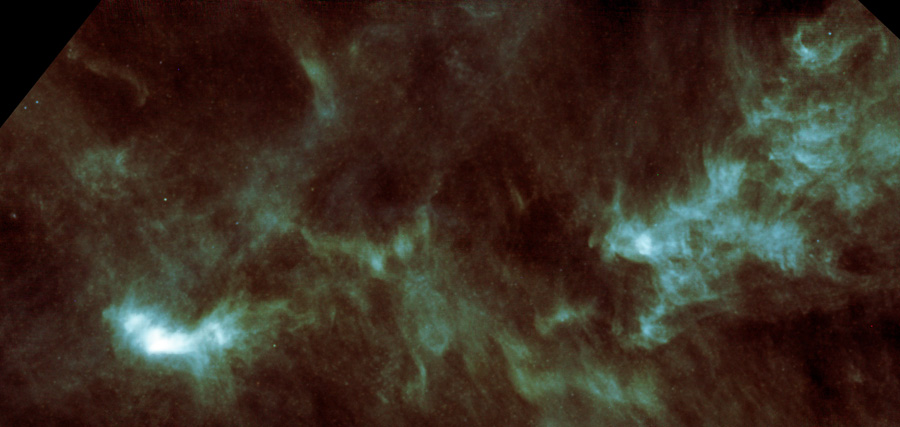
Herschel’s infrared view of part of the Taurus Molecular Cloud, with the bright, cold pre-stellar cloud L1544 at the lower left. The Taurus Molecular Cloud is about 450 light years from Earth and it is one of the nearest large regions of star formation. © ESA/Herschel/SPIRE


This shows the morphology of the NH2D emission, clearly revealing the flattened envelope (also called a pseudo-disk), precursor to the future protoplanetary disk. The ALMA resolution is the small black circle in the bottom left corner and the bar in the bottom right shows the linear scale. In the central 2000 astronomical units, NH2D and all other species heavier than helium reside on the surface of dust grains, the building blocks of future planets. © MPE/ALMA


Astronomers at the Max Planck Institute for Extraterrestrial Physics have found evidence that just before star formation, in the central region of a pre-stellar cloud, practically all heavy molecules freeze out on top of dust grains. The ALMA observations of the L1544 cloud in the constellation Taurus showed not only a central concentration of dust grains, but also revealed that molecules containing nitrogen as well those containing carbon, oxygen and all elements heavier than helium, are stored in thick icy mantles around the dust grains. These icy mantles are rich in water and organic molecules, precursors of pre-biotic molecules. The abundances are similar to those observed in leftover objects from the formation of our Solar System.

How do planets and stars form? This is one of the central questions in modern astrophysics. While the broad strokes are clear – a cold molecular cloud collapses under its own gravity, an accretion disk forms, and at its centre a proto-star – the devil is in the detail. One crucial step is the so-called pre-stellar core phase, when the interstellar gas cloud is contracting while flattening (on its way toward the formation of a protoplanetary disk), but before the gravitational pull produces a central proto-star.

Astronomers at the Max Planck Institute for Extraterrestrial Physics have now observed such a pre-stellar core, called L1544 in the constellation Taurus, in unprecedented resolution with the ALMA radio telescopes. “Studies of pre-stellar cores in nearby clouds have provided clues on their physical and chemical structure, but it was still unclear what happens at the very centre,” points out Paola Caselli, lead author of the paper now published in the Astrophysical Journal. “Now, we can study structures in the central 2000 Astronomical Units (AU), where a future stellar system will form.” For comparison: Neptune, the outermost known planet in our home Solar system, is at a distance of 30 AU from the Sun, while the Kuiper belt and the so-called scattered disk, where short term comets and other icy bodies reside, extend to about 200 AU.

The observations included both continuum emission of dust grains in this pre-stellar core and spectral line observations of deuterated ammonia, i.e., a molecule made up of nitrogen and hydrogen, where one hydrogen atom is substituted by a deuterium atom (NH2D). While the dust continuum emission revealed a compact central region with a mass of about 1/6 the mass of our Sun, the molecular line analysis was the real surprise. For the first time, the observations provided evidence of almost complete freeze-out: practically all (99.99%) molecules and atoms heavier that helium disappear from the gas and condense on top of dust grains in the central 2000 AU.

“This suggests a “complete-depletion zone” in agreement with astrochemical pre-stellar core model predictions,” explains Olli Sipilä, who carried out the theoretical modelling. The state-of-the-art chemical model actually predicts that the freeze-out starts already at 7000 AU and radiative transfer effects cause the emission of some molecules to appear centrally concentrated. “This has prevented the freeze-out to be detected in previous observations, where the centre could not be resolved,” he adds.

The dust grains in such a pre-stellar core thus become surrounded by thick icy mantles, rich in water and organic molecules, which form the building blocks for future planets. A recent study of the comet 67P/CG has indeed shown that it contains molecules with relative abundances similar to pre-stellar cores and young star forming regions.

“We were able to demonstrate that pre-stellar molecules are “stored in ice” before the formation of a stellar system similar to our own,” explains Jaime Pineda, second author of the paper. Some of this pre-stellar ice, especially icy pebbles in the outer part of the disk, may even survive to later stages of planet formation, preserving the chemical signature of these primordial phases just before the switch on of a new star. “Icy bodies now present in the outskirts of our Solar System may indeed contain the “frozen” chemical history of our pre-Solar core, the cloud out of which all we see today in our Solar System (including us) originated”, concludes Paola Caselli. “As some of the icy pebbles in the young Solar System are known to have drifted toward the Terrestrial planet formation zone, the icy grains in the centre of our pre-Solar core may have even contributed to volatile molecules, including water and organics, in our Earth, i.e., they may have provided precious ingredients for the origin of life on our planet.”


Contacts:

Caselli, Paola
acting director
 
+49 (0)89 30000-3400
+49 (0)89 30000-3399
caselli@mpe.mpg.de

Pineda Fornerod, Jaime
scientist

+49 (0)89 30000-3610
+49 173 3517084
+49 (0)89 30000-3950
jpineda@mpe.mpg.de

Sipilä, Olli
postdoc

+49 (0)89 30000-3646
+49 (0)89 30000-3950
osipila@mpe.mpg.de

Original publication

1. The Central 1000 au of a Pre-stellar Core Revealed with ALMA. II. Almost Complete Freeze-out
Paola Caselli, Jaime E. Pineda, Olli Sipilä et al.
ApJ 929 13, 2022


DOI


Tuesday, February 17, 2015

Embryos of Stars

A far-infrared image of the cold pre-stellar cloud L1544 (the cloud is at the lower left, with other clouds of gas and dust nearby). The cloud is about 450 light-years from Earth in the nearest large region of star formation. New studies of the gas motions in the core show that the stellar embryo is slowly collapsing in a manner that agrees well with some models and excludes others. Credit: ESA/Herschel/SPIRE 


Stars like the Sun begin their lives as cold, dense cores of dust and gas that gradually collapse under the influence of gravity until nuclear fusion is ignited. Exactly how the critical collapse process occurs in these embryos, however, is poorly understood, with several competing ideas having been advanced. Material might just freely fall to the center, although in more likely scenarios the infall is inhibited by pressure from warm gas, turbulent motions, magnetic fields, or even perhaps by some combination of them. It might be possible to distinguish between these alternative collapse hypotheses by examining how the core's density varies with radius, but it turns out that (at least for spherical clouds) the predicted density distributions all look about the same. The predicted distributions of velocity for the infalling gas, however, are quite different.

The dust in these cores makes them completely opaque in the optical, and so studying their behaviors requires techniques at other wavelengths. One of the most exciting developments in astronomy over the past decade has been the development of far-infrared and millimeter wavelength tools for the tasks of identifying pre-stellar cores as such, and determining their properties. CfA astronomer Eric Keto and two colleagues used observations of emission lines from water and carbon monoxide at both wavelength regimes to measure the velocity distribution of the gas in a pre-stellar, dense core. Each of these gas molecules traces a sightly different density of gas (the typical value in these clouds is about one hundred thousand particles per cubic centimeter).

The data clearly prefer the scenario in which the gas temperature is nearly constant throughout the cloud with just enough total mass present for gravity to drive slow contraction. Actually, the paper's authors were the first to advocate and describe just such a possibility, and these observations of this particular core bring a satisfying confirmation that no magnetic fields or turbulence is present or needed. The new results highlight the dramatic modern successes in unraveling the earliest stages of stellar birth, and the power of new technology. More cores now need to be measured in order to determine if these particular conclusions have general validity.

Reference(s): 
 
"The Dynamics of Collapsing Cores and Star Formation," Eric Keto, Paola Caselli, and Jonathan Rawlings, MNRAS 446, 3731, 2015.


Tuesday, October 09, 2012

Large water reservoirs at the dawn of stellar birth


Herschel’s infrared view of part of the Taurus Molecular Cloud, within which the bright, cold pre-stellar cloud L1544 can be seen at the lower left. It is surrounded by many other clouds of gas and dust of varying density. The Taurus Molecular Cloud is about 450 light-years from Earth and is the nearest large region of star formation. The image covers a field of view of approximately 1 x 2 arcminutes.  Credits: ESA/Herschel/SPIRE .  HI-RES JPEG (Size: 133 kb)

Close-up of L1544 with the water spectrum seen by Herschel, taken from the centre of the pre-stellar core. The peak of the graph shows an excess in brightness, or emission, while the trough shows a deficit, or absorption. These characteristics are used to indicate the density and motions of the water molecules within the cloud. Emission arises from molecules that are approaching the centre where the new star will form, from the back of the cloud from Herschel’s viewpoint. The amount of emission indicates that these molecules are moving within the densest part of the core, which spans about 1000 Astronomical Units. The absorption signature is due to water molecules in front of the cloud flowing away from the observer towards the centre. These water molecules are in less dense regions much further away from the centre. Together, the emission and absorption signatures indicate that the cloud is undergoing gravitational contraction, that is, it is collapsing to form a new star. Herschel detected enough water vapour in L1544 to fill Earth’s oceans more than 2000 times over.  Credits: ESA/Herschel/SPIRE/HIFI/Caselli et al.  HI-RES JPEG (Size: 356 kb)

ESA’s Herschel space observatory has discovered enough water vapour to fill Earth’s oceans more than 2000 times over, in a gas and dust cloud that is on the verge of collapsing into a new Sun-like star.
 
Stars form within cold, dark clouds of gas and dust – ‘pre-stellar cores’ – that contain all the ingredients to make solar systems like our own.

Water, essential to life on Earth, has previously been detected outside of our Solar System as gas and ice coated onto tiny dust grains near sites of active star formation, and in proto-planetary discs capable of forming alien planetary systems.

The new Herschel observations of a cold pre-stellar core in the constellation of Taurus known as Lynds 1544 are the first detection of water vapour in a molecular cloud on the verge of star formation.

More than 2000 Earth oceans-worth of water vapour were detected, liberated from icy dust grains by high-energy cosmic rays passing through the cloud.
  
“To produce that amount of vapour, there must be a lot of water ice in the cloud, more than three million frozen Earth oceans’ worth,” says Paola Caselli from the University of Leeds, UK, lead author of the paper reporting the results in Astrophysical Journal Letters.

“Before our observations, the understanding was that all the water was frozen onto dust grains because it was too cold to be in the gas phase and so we could not measure it."

“Now we will need to review our understanding of the chemical processes in this dense region and, in particular, the importance of cosmic rays to maintain some amount of water vapour."

The observations also revealed that the water molecules are flowing towards the heart of the cloud where a new star will probably form, indicating that gravitational collapse has just started. 

“There is absolutely no sign of stars in this dark cloud today, but by looking at the water molecules, we can see evidence of motion inside the region that can be understood as collapse of the whole cloud towards the centre,” says Dr Caselli. 

“There is enough material to form a star at least as massive as our Sun, which means it could also be forming a planetary system, possibly one like ours.”

Some of the water vapour detected in L1544 will go into forming the star, but the rest will be incorporated into the surrounding disc, providing a rich water reservoir to feed potential new planets. 

“Thanks to Herschel, we can now follow the ‘water trail’ from a molecular cloud in the interstellar medium, through the star formation process, to a planet like Earth where water is a crucial ingredient for life,” says ESA’s Herschel project scientist, Göran Pilbratt.  
 
Notes for Editors:

“First detection of water vapour in a pre-stellar core,” by P. Caselli et al. has been accepted for publication in Astrophysical Journal Letters.
Herschel studied the dark cloud L1544 as part of the Water in Star-forming regions with Herschel (WISH) key programme using the Heterodyne Instrument for the Far-Infrared spectrometer (HIFI) on Herschel.

 Herschel is an ESA space observatory with science instruments provided by European-led Principal Investigator consortia and with important participation from NASA. HIFI was designed and built by a nationally funded consortium led by SRON Netherlands Institute for Space Research. The consortium includes institutes from France, Germany, USA, Canada, Ireland, Italy, Poland, Russia, Spain, Sweden, Switzerland and Taiwan.
 
For more information, please contact:
 
 Markus Bauer
 ESA Science and Robotic Exploration Communication Officer
 Tel: +31 71 565 6799
 Mob: +31 61 594 3 954
 Email:
markus.bauer@esa.int

 Paola Caselli
 University of Leeds
 Email:
p.caselli@leeds.ac.uk

 Göran Pilbratt
 ESA Herschel Project Scientist
 Tel: +31 71 565 3621
 Email:
gpilbratt@rssd.esa.int