Showing posts with label Callisto. Show all posts

Monday, June 22, 2026

Radar Echoes From Europa Reveal Secrets Beneath the Ice

This artist's impression shows radar waves from the NASA Goldstone Solar System Radar pinging one of Jupiter’s moons, Europa. The radar waves penetrate Europa’s icy surface before bouncing back to be collected by the NSF Green Bank Telescope on Earth. Credit: NSF/AUI/NSF NRAO/P.Vosteen. Hi-Res File


Ateam of scientists has used NASA’s Goldstone Solar System Radar and the U.S. National Science Foundation Green Bank Telescope (NSF GBT) to carry out the most extensive radar study to date of Europa, the ocean world orbiting Jupiter. By repeatedly “pinging” Europa with 3.5‑centimeter radio waves between 2011 and 2024, the team measured how the moon reflects radar signals and confirmed that its icy surface scatters radio energy in an unusually strong and complex way not seen on rocky worlds.

Three of Jupiter’s big moons, Europa, Ganymede, and Callisto, are especially interesting to scientists because they have icy outer shells and are thought to hide oceans of liquid water underneath. Of these three, Europa is a prime target in the search for habitable environments beyond Earth. Geologic features provide clues to how the ice shell and underlying ocean interact, but these features only reveal what is happening at or near the surface. Explains Tunhui (Tina) Xie, a graduate student working with Professor Jean-Luc Margot at the University of California Los Angeles, “Radar delves below what is easily seen, because radio waves can penetrate into the ice, and carry information about its internal structure and purity.”

These new observations show that Europa’s radar “albedo”—a measure of how bright it appears to radar—is much higher than that of typical planets and asteroids. The returning radar signal is dominated by the same circular polarization as the transmitted beam, a hallmark of multiple scattering inside clean, porous ice. These properties strongly support an explanation known as the “coherent backscatter opposition effect,” in which radio waves bounce around within the ice before returning back to the telescope, dramatically boosting the echo.

Because the team observed Europa in a bistatic configuration—with Goldstone transmitting and both Goldstone and the NSF GBT receiving—they could also test how the coherent backscatter effect changes with the angle between transmitter, moon, and receiver. They found that Europa’s radar brightness stayed roughly constant even when the angle increased, implying that the bright backscatter “peak” must be broader than the range of angles they sampled, placing a limit on the depth that the radio waves diffused before being absorbed. This depth limit offers a new constraint on how transparent Europa’s ice is, and will help scientists interpret upcoming ice‑penetrating radar data from spacecraft now en route to study this moon in more detail.

These new ground‑based results fill a three‑decade gap since the last major radar study of Europa in the late 1980s and early 1990s. The researchers find strong agreement between their measurements and those earlier results, reinforcing the picture of Europa as an object with very high radar reflectivity and strongly “diffuse” scattering, rather than the mirror‑like reflections seen from many rocky surfaces. This consistency increases confidence that Europa’s radar properties are stable over time and that Earth‑based and spacecraft radar measurements can be interpreted within a unified physical framework.

Because the observing campaign spanned many years and viewing geometries, the team asked whether Europa’s radar brightness changed from one hemisphere to another, or with longitude. They found that Europa’s disk‑integrated radar properties are statistically consistent with remaining nearly constant as the moon rotates, which agreed with earlier observations.

However, when the authors divided the data into leading and trailing hemispheres and performed statistical tests, they saw a hint—though not statistically conclusive—that the trailing hemisphere could be slightly brighter in one polarization state. If confirmed with future data, that subtle difference could be related to how charged particles from Jupiter’s magnetosphere modify the ice or affect the formation of small‑scale surface structures that absorb or scatter radio waves. “Future planetary science and space flight missions, like NASA’s Europa Clipper, could benefit from this type of radar science,” shares Will Armentrout, a scientist with the NSF NRAO who supports radar projects. “As the Green Bank Telescope’s radar capabilities evolve, with new technologies currently under development, we’re looking forward to providing even more radar capabilities for the scientific community.”

This news is featured in a press conference at the American Astronomical Society’s 248th meeting on Tuesday, June 16th at 10:15am PDT. Find a recording from this presentation on the AAS Press Office YouTube channel.


About NRAO

The National Radio Astronomy Observatory (NRAO) is a major facility of the U.S. National Science Foundation, operated under cooperative agreement by Associated Universities, Inc.


This research was supported by the following grants:

Radio scattering properties of the icy Galilean satellites, NASA FINESST program, PI J.~L. Margot, 80NSSC26K0201, 2025–2028.

High-Precision Measurements of Planetary Rotation. NSF Astronomy and Astrophysics Research Grants, PI J.~L. Margot, 2408493, 2024–2027.

High-Precision Measurements of Planetary Rotation. NASA Solar System Observations Program, PI J.~L. Margot, 80NSSC19K0870, 2019–2022.

High-Precision Measurements of Planetary Rotation. NASA Planetary Astronomy Program, PI J.~L. Margot, NNX12AG34G, 2012–2016.


Press Contacts:

Jill Malusky
Sr. Public Information Group Manager and Public Information Officer

Email | Phone


Sunday, April 12, 2026

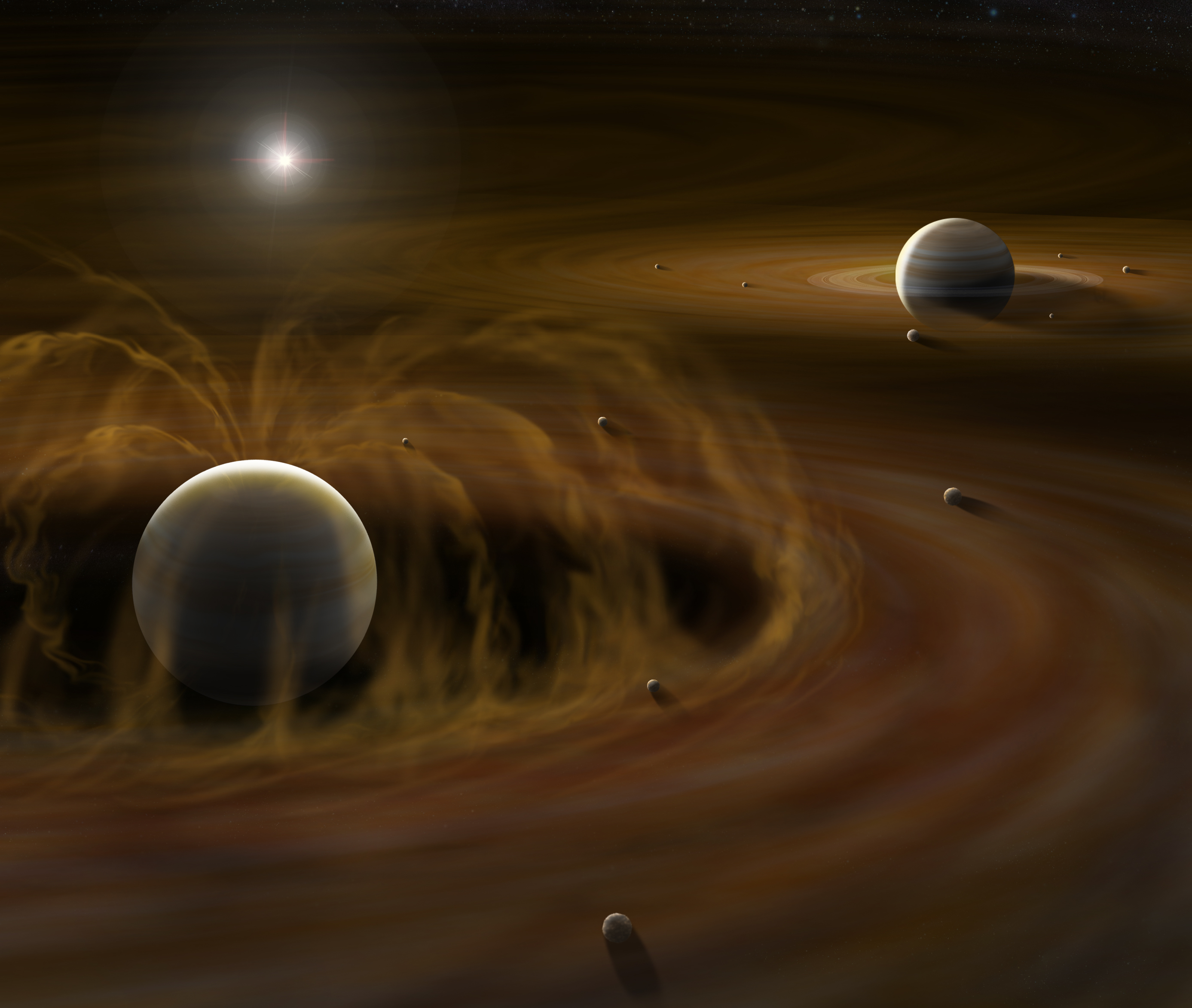
How Jupiter Cultivated More Large Moons than Saturn — A magnetospheric cavity explains the difference

Artist’s impression of the simulations conducted in this research. Jupiter (lower left) has a strong magnetic field which creates a cavity in its circumplanetary disk. Saturn (upper right) lacks a strong magnetic field so its circumplanetary disk evolves without a cavity. Credit: Yuri I. Fujii/L-INSIGHT [Kyoto University], Shinichiro Kinoshita.  Image (5.0MB)

The Solar System’s two largest gas giant planets, Jupiter and Saturn, have extensive but very different families of moons orbiting them. New simulations conducted on the PC cluster at the Center for Computational Astrophysics (CfCA), National Astronomical Observatory of Japan (NAOJ) showed that the planet’s magnetic field plays a role in creating an environment where the new moons can survive and grow, thus shaping the evolution of the system.

Jupiter has more than 100 reported moons, including four large ones (Ganymede, Callisto, Io, and Europa). Saturn has more than 280 reported moons, but only one large one (Titan). So it is a puzzle why Saturn managed to cultivate more moons, but fewer large moons than Jupiter.

A team led by Kyoto University, including researchers from institutes in Japan and China, used the PC cluster at CfCA, NAOJ, to simulate the formation of the moon systems around Jupiter and Saturn. This simulation recreated the planets’ internal structure to calculate the thermal evolution of Jupiter and Saturn and how their magnetic fields have varied over time.

Moons form from material in a “circumplanetary disk” of gas and dust orbiting the young planet. The disk nurtures the young moons, but interactions with the disk may cause them to fall into the planet. The simulations showed that young Jupiter generated a strong planetary magnetic field that created a safe “cavity” around the planet where its young large moons were prevented from migrating too close to their host planet. Young Saturn lacked a strong magnetic field, so only one large moon managed to survive.

“Testing planet formation theory is somewhat difficult because we have only our Solar System for reference, but there are multiple satellite systems close to us whose detailed characteristics we can observe,” says Yuri I. Fujii, primary author of the report announcing these findings. Next, the team is interested in expanding their theory to other moons and potential exomoon systems.


Detailed Article(s)

How Jupiter Cultivated More Large Moons than Saturn —— A magnetospheric cavity explains the difference

Center for Computational Astrophysics

Release Information

Researcher(s) Involved in this Release

  • Yuri Fujii (Graduate School of Human and Environmental Studies, Kyoto University)
  • Masahiro Ogihara (Tsung-Dao Lee Institute, Shanghai Jiao Tong University)
  • Yasunori Hori (Okayama University)

Coordinated Release Organization(s)
  • Kyoto University
  • Okayama University
  • National Astronomical Observatory of Japan, NINS
  • Fujii et al. “Different architecture of Jupiter and Saturn satellite systems from magnetospheric cavity formation” in Nature Astronomy, DOI: 10.1038/s41550-026-02820-x

Related Link(s)

Thursday, February 05, 2015

Hubble Captures Rare Triple-Moon Conjunction

Jupiter — January 24, 2015
Credit: NASA, ESA, and the Hubble Heritage Team (STScI/AURA)


Firing off a string of snapshots like a sports photographer at a NASCAR race, NASA's Hubble Space Telescope captured a rare look at three of Jupiter's largest moons parading across the banded face of the gas-giant planet: Europa, Callisto, and Io.

These so-called Galilean satellites (named after the 17th century scientist Galileo Galilei, who discovered them with a telescope) complete orbits around Jupiter ranging from 2 days to 17 days in duration. They can commonly be seen transiting the face of Jupiter and casting shadows onto its cloud tops. However, seeing three moons transiting the face of Jupiter at the same time is rare, occurring only once or twice a decade.

The Hubble image on the left (unlabeled at top left, labeled at bottom left) shows the beginning of the event, which took place on January 24, 2015. From left to right the moons Callisto and Io are above Jupiter's cloud tops. The shadows from Europa (not seen in the image), Callisto, and Io are strung out from left to right.

Near the end of the event, approximately 42 minutes later (right-side image), Europa has entered the frame at lower left. Slower-moving Callisto is above and to the right of Europa. Fastest-moving Io is approaching the eastern limb of the planet; its shadow is no longer visible on Jupiter. Europa's shadow is toward the left side of the image, and Callisto's shadow to the right. (The moons' orbital velocities are proportionally slower with increasing distance from the planet.)

Missing from the sequence is the moon Ganymede, which was outside Hubble's field of view and too far from Jupiter in angular separation to be considered part of the conjunction.

The moons in these photos have distinctive colors. The ancient, cratered surface of Callisto is brownish; the smooth icy surface of Europa is yellow-white; and the volcanic, sulfur-dioxide surface of Io is orange. The apparent "fuzziness" of some of the shadows depends on the moons' distances from Jupiter. The farther away a moon is from the planet, the softer the shadow, because the shadow is more spread out across the disk.
The images were taken with Hubble's Wide Field Camera 3 in visible light.

For additional information, contact:

Ray Villard
Space Telescope Science Institute, Baltimore, Md.
410-338-4514
villard@stsci.edu

Zolt Levay
Space Telescope Science Institute, Baltimore, Md.
410-338-4907
levay@stsci.edu

Source: HubbleSite

Wednesday, June 25, 2014

Jupiter's Moons Remain Slightly Illuminated, Even in Eclipse

Astronomers using the Subaru Telescope and Hubble Space Telescope have found that Jupiter's Galilean satellites (Io, Europa, Ganymede, and Callisto) remain slightly bright (up to one millionth of their normal state) even when in the Jovian shadow and not directly illuminated by the Sun (Figure 1). The effect is particularly pronounced for Ganymede and Callisto. The finding was made by researchers at Tohoku University, Institute of Space and Astronautical Science/Japan Aerospace Exploration Agency (ISAS/JAXA), National Astronomical Observatory of Japan (NAOJ), and elsewhere.

Figure 1: Images of Ganymede and Callisto while eclipsed by Jupiter obtained during their eclipse. Top left is Ganymede observed through Subaru Telescope, top right is Ganymede through Hubble Space Telescope, bottom left is Callisto from Subaru Telescope, respectively. Each frame is 4 arcsec x 4 arcsec, and the black circle indicates the apparent diameter of the object. A short movie linked here shows the Europa's eclipse as it goes into the shadow of Jupiter. From the top of the video is Europa, Ganymede, and Jupiter, respectively. (Credit: NAOJ/JAXA/Tohoku University)

The mechanism of this phenomenon is still under investigation, but the researchers suggest that indirect forward scattering of sunlight by hazes in the upper Jovian atmosphere could be the reason for the illumination. This effect is similar to the one that causes Earth's moon to look red during a total lunar eclipse.

The type of continuous observations of the Galilean satellites in eclipse made by the Japanese team also provides a much better basis for studying the hazes in Jupiter's atmosphere, which are difficult to study otherwise (Note 1). In addition, this detailed study method for a planetary atmosphere will provide new insights about the atmospheres of exoplanets, which are only beginning to be studied. 

Dr. Kohji Tsumura (FRIS, Tohoku University), the PI on the project, explained that this unexpected finding is really the outcome of attempts to measure diffuse light from the distant universe. "It is a serendipitous discovery made as a by-product of a cosmological study," he said. "It is very interesting that it provides us a new method to investigate the atmosphere of Jupiter and of exoplanets. I will keep studying from nearby space (the solar system and exoplanets) out to the farthest universe through this project."

The research team started its observations using IRCS and AO188 on Subaru Telescope in February of 2012. The idea was to detect the diffuse light from the most distant parts of the universe. To do this, team members planned to use the Galilean satellites in eclipse as "occulters" to block distant background emissions. This would allow an extremely accurate separation of the background light from the very bright foreground radiation from our solar system (known as the zodiacal light).

The team assumed that the Galilean satellites would be "dark" while in Jupiter's shadow, and the difference in brightness[??] between the dark satellite as an occulter and its surrounding sky would allow the team to determine the still-unknown level of background emission from the distant universe. Instead, they found an unexpected surprise: Ganymede and Callisto were still somewhat "bright" (illuminated) even when eclipsed (relative to the expected level of near-zero). Their eclipsed luminosity was one millionth of their un-eclipsed brightness, which is low enough that this phenomenon has been undetected until now (Figure 2).


Figure 2: Schematic drawing of how to measure the background light. By measuring the difference between the light from the eclipsed satellite and the surrounding sky data, one would obtain the background light information, if the eclipsed satellite is completely dark. It turned out that there is still a faint light reflected off from the satellite during the eclipse. (Credit: NAOJ/JAXA/Tohoku University)

To understand why the Galileans remain ever-so-slightly bright even when they're in eclipse, the project team of astronomers and planetary scientists considered several theories based on their multi-band observational data, including data from Spitzer Space Telescope. The most plausible is that the Galilean satellites are still illuminated during eclipse by sunlight that is scattered by hazes in the Jovian upper atmosphere. By comparison, the sunlight refracted in the atmosphere does not contribute to the illumination during the eclipse.
Although Jupiter is a familiar planet, there are many unresolved issues about its atmosphere. One example is the origin of the cloud particles composing Jupiter's banded appearance. The cloud particles are assumed to grow from tiny particles called aerosols or hazes. Researchers expect that those hazes form somewhere in the upper part of Jupiter's atmosphere, which is very difficult to observe (Figure 3). The unexpected discovery of haze-induced brightening of the Galileans provides a new way to study the mysterious part of Jupiter's atmosphere. In addition, since astronomers usually observe the planets in our solar system by reflected sunlight, one of the unique aspects of these new observations at Jupiter is that observers can precisely measure the transmitted sunlight through the planetary atmosphere (Note 2).

Figure 3: A schematic image of the model to show that the Galilean satellites eclipsed in Jovian shadow are illuminated by scattered sunlight by the haze in the Jovian upper atmosphere. The size and the distance of the satellites are not to the scale. This process is similar to one that causes red color of the Earth's Moon during its total eclipse. (Credit: NAOJ/JAXA/Tohoku University/NASA)

This new method of studying the upper atmosphere of Jupiter via transmitted sunlight provides a basis for the study of other planetary systems. Exoplanet discoveries now occur quite regularly and atmospheres around some of them have been investigated using "transit observations" (when the exoplanet passes between us and the host star, resulting in the star becoming slightly dimmer). In such observations, some characteristics of the exoplanet's atmosphere are revealed as host starlight passes through it. This is the same situation seen with Jupiter and its Galilean satellites, and makes studies of transmitted sunlight of the planets in our solar system essential for comparison.

The observations for this project were very challenging because the Galilean satellites (while eclipsed) are extremely faint and they are located next to the incredibly bright disk of Jupiter. In addition, the eclipses only happen at very specific times, and Jupiter and the satellites are continuously in motion during the observations. The complexity of the situation requires the observation procedure to be much more sophisticated. This new discovery required thorough preparations by the project team and conscientious support by the operations staff. (Figure 4)

Figure 4: Three-color (JHK) image of Jupiter and Ganymede obtained by Subaru Telescope. Because Ganymede moves with respect to Jupiter during the observations, it appears as three separately colored dots. Image taken at around 5 am, July 27, 2012 in Hawaii Time. Blue color is for J band (1.3 micrometer), green is for H band (1.6 micrometer), and red is for K band (2.2 micrometer), respectively. (Credit: NAOJ/JAXA/Tohoku University)

The results of this study will be published in The Astrophysical Journal in its July 10, 2014 issue (Tsumura et al. 2014 arXiv: 1405.5280). This research is supported by Japan Society for the Promotion of Science, KAKENHI (#24111717, #26800112), and NASA through a grant from Space Telescope Science Institute and Jet Propulsion Laboratory in U. S. A.

Notes:

  1. Observations of Jupiter's upper atmosphere were conducted by the Galileo spacecraft, and by "occultation" of microwaves from field stars or spacecraft located behind Jupiter. However, opportunities to observe these events are rare and limited, thus the observations of the Galilean satellite eclipses are a unique method to study Jupiter's upper atmosphere.
  2. Transmitted light through the planetary atmosphere was observed by the occultation methods described in (*1) and the Venus transit. However, they are very rare events, too.

Paper information:

To appear in the July 10, 2014 issue of the Astrophysical Journal, Volume 789.
"Near-infrared Brightness of the Galilean Satellites Eclipsed in Jovian Shadow: A New Technique to Investigate Jovian Upper Atmosphere"
K. Tsumura (1,2), K. Arimatsu (2,3), E. Egami (4), Y. Hayano (5), C. Honda (6), J. Kimura (7), K. Kuramoto (8), S. Matsuura (2), Y. Minowa (5), K. Nakajima (9), T. Nakamoto (10), M. Shirahata (2, 11), J. Surace (12), Y. Takahash i(8), and T. Wada (2)

1Frontier Research Institute for Interdisciplinary Science, Tohoku University, Japan
2Department of Space Astronomy and Astrophysics, Institute of Space and Astronoutical Science, Japan Aerospace Exploration Agency, Japan
3Department of Astronomy, Graduate School of Science, The University of Tokyo, Japan
4Department of Astronomy, Arizona University, U. S. A.
5Subaru Telescope, National Astronomical Observatory of Japan, U. S. A.
6Research Center for Advanced Information Science and Technology, Aizu Research Cluster for Space Science, The University of Aizu, Japan
7Earth-Life Science Institute, Tokyo Institute of Technology, Japan
8Department of Cosmosciences, Graduate School of Science, Hokkaido University, Japan
9Department of Earth and Planetary Sciences, Kyushu University, Japan
10Department of Earth and Planetary Sciences, Graduate School of Science and Engineering, Tokyo Institute of Technology, Japan
11National Astronomical Observatory of Japan, Japan
12Spitzer Science Center, California Institute of Technology, U. S. A.