Showing posts with label Ganymede. Show all posts

Monday, June 22, 2026

Radar Echoes From Europa Reveal Secrets Beneath the Ice

This artist's impression shows radar waves from the NASA Goldstone Solar System Radar pinging one of Jupiter’s moons, Europa. The radar waves penetrate Europa’s icy surface before bouncing back to be collected by the NSF Green Bank Telescope on Earth. Credit: NSF/AUI/NSF NRAO/P.Vosteen. Hi-Res File


Ateam of scientists has used NASA’s Goldstone Solar System Radar and the U.S. National Science Foundation Green Bank Telescope (NSF GBT) to carry out the most extensive radar study to date of Europa, the ocean world orbiting Jupiter. By repeatedly “pinging” Europa with 3.5‑centimeter radio waves between 2011 and 2024, the team measured how the moon reflects radar signals and confirmed that its icy surface scatters radio energy in an unusually strong and complex way not seen on rocky worlds.

Three of Jupiter’s big moons, Europa, Ganymede, and Callisto, are especially interesting to scientists because they have icy outer shells and are thought to hide oceans of liquid water underneath. Of these three, Europa is a prime target in the search for habitable environments beyond Earth. Geologic features provide clues to how the ice shell and underlying ocean interact, but these features only reveal what is happening at or near the surface. Explains Tunhui (Tina) Xie, a graduate student working with Professor Jean-Luc Margot at the University of California Los Angeles, “Radar delves below what is easily seen, because radio waves can penetrate into the ice, and carry information about its internal structure and purity.”

These new observations show that Europa’s radar “albedo”—a measure of how bright it appears to radar—is much higher than that of typical planets and asteroids. The returning radar signal is dominated by the same circular polarization as the transmitted beam, a hallmark of multiple scattering inside clean, porous ice. These properties strongly support an explanation known as the “coherent backscatter opposition effect,” in which radio waves bounce around within the ice before returning back to the telescope, dramatically boosting the echo.

Because the team observed Europa in a bistatic configuration—with Goldstone transmitting and both Goldstone and the NSF GBT receiving—they could also test how the coherent backscatter effect changes with the angle between transmitter, moon, and receiver. They found that Europa’s radar brightness stayed roughly constant even when the angle increased, implying that the bright backscatter “peak” must be broader than the range of angles they sampled, placing a limit on the depth that the radio waves diffused before being absorbed. This depth limit offers a new constraint on how transparent Europa’s ice is, and will help scientists interpret upcoming ice‑penetrating radar data from spacecraft now en route to study this moon in more detail.

These new ground‑based results fill a three‑decade gap since the last major radar study of Europa in the late 1980s and early 1990s. The researchers find strong agreement between their measurements and those earlier results, reinforcing the picture of Europa as an object with very high radar reflectivity and strongly “diffuse” scattering, rather than the mirror‑like reflections seen from many rocky surfaces. This consistency increases confidence that Europa’s radar properties are stable over time and that Earth‑based and spacecraft radar measurements can be interpreted within a unified physical framework.

Because the observing campaign spanned many years and viewing geometries, the team asked whether Europa’s radar brightness changed from one hemisphere to another, or with longitude. They found that Europa’s disk‑integrated radar properties are statistically consistent with remaining nearly constant as the moon rotates, which agreed with earlier observations.

However, when the authors divided the data into leading and trailing hemispheres and performed statistical tests, they saw a hint—though not statistically conclusive—that the trailing hemisphere could be slightly brighter in one polarization state. If confirmed with future data, that subtle difference could be related to how charged particles from Jupiter’s magnetosphere modify the ice or affect the formation of small‑scale surface structures that absorb or scatter radio waves. “Future planetary science and space flight missions, like NASA’s Europa Clipper, could benefit from this type of radar science,” shares Will Armentrout, a scientist with the NSF NRAO who supports radar projects. “As the Green Bank Telescope’s radar capabilities evolve, with new technologies currently under development, we’re looking forward to providing even more radar capabilities for the scientific community.”

This news is featured in a press conference at the American Astronomical Society’s 248th meeting on Tuesday, June 16th at 10:15am PDT. Find a recording from this presentation on the AAS Press Office YouTube channel.


About NRAO

The National Radio Astronomy Observatory (NRAO) is a major facility of the U.S. National Science Foundation, operated under cooperative agreement by Associated Universities, Inc.


This research was supported by the following grants:

Radio scattering properties of the icy Galilean satellites, NASA FINESST program, PI J.~L. Margot, 80NSSC26K0201, 2025–2028.

High-Precision Measurements of Planetary Rotation. NSF Astronomy and Astrophysics Research Grants, PI J.~L. Margot, 2408493, 2024–2027.

High-Precision Measurements of Planetary Rotation. NASA Solar System Observations Program, PI J.~L. Margot, 80NSSC19K0870, 2019–2022.

High-Precision Measurements of Planetary Rotation. NASA Planetary Astronomy Program, PI J.~L. Margot, NNX12AG34G, 2012–2016.


Press Contacts:

Jill Malusky
Sr. Public Information Group Manager and Public Information Officer

Email | Phone


Sunday, April 12, 2026

How Jupiter Cultivated More Large Moons than Saturn — A magnetospheric cavity explains the difference

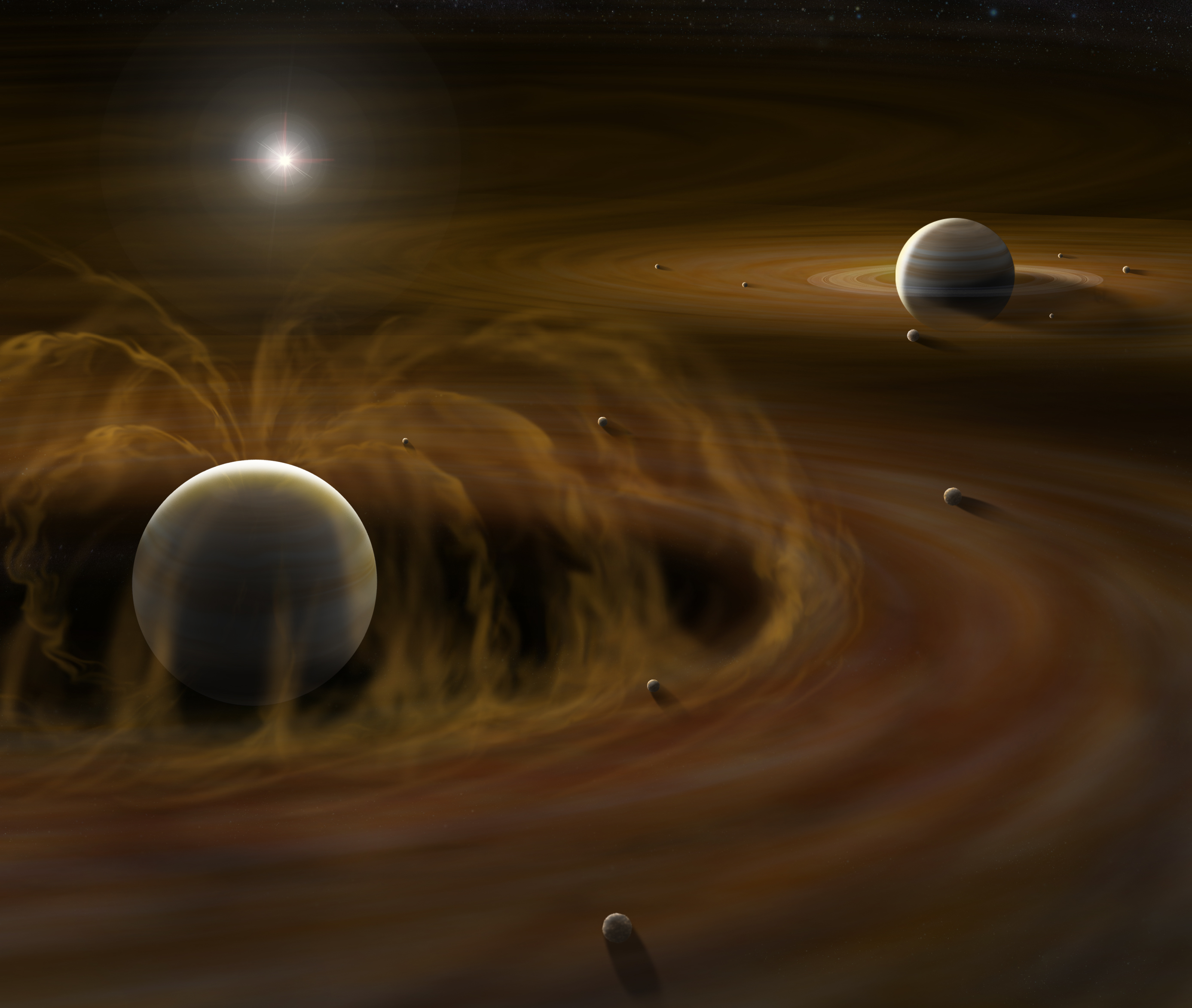
Artist’s impression of the simulations conducted in this research. Jupiter (lower left) has a strong magnetic field which creates a cavity in its circumplanetary disk. Saturn (upper right) lacks a strong magnetic field so its circumplanetary disk evolves without a cavity. Credit: Yuri I. Fujii/L-INSIGHT [Kyoto University], Shinichiro Kinoshita.  Image (5.0MB)

The Solar System’s two largest gas giant planets, Jupiter and Saturn, have extensive but very different families of moons orbiting them. New simulations conducted on the PC cluster at the Center for Computational Astrophysics (CfCA), National Astronomical Observatory of Japan (NAOJ) showed that the planet’s magnetic field plays a role in creating an environment where the new moons can survive and grow, thus shaping the evolution of the system.

Jupiter has more than 100 reported moons, including four large ones (Ganymede, Callisto, Io, and Europa). Saturn has more than 280 reported moons, but only one large one (Titan). So it is a puzzle why Saturn managed to cultivate more moons, but fewer large moons than Jupiter.

A team led by Kyoto University, including researchers from institutes in Japan and China, used the PC cluster at CfCA, NAOJ, to simulate the formation of the moon systems around Jupiter and Saturn. This simulation recreated the planets’ internal structure to calculate the thermal evolution of Jupiter and Saturn and how their magnetic fields have varied over time.

Moons form from material in a “circumplanetary disk” of gas and dust orbiting the young planet. The disk nurtures the young moons, but interactions with the disk may cause them to fall into the planet. The simulations showed that young Jupiter generated a strong planetary magnetic field that created a safe “cavity” around the planet where its young large moons were prevented from migrating too close to their host planet. Young Saturn lacked a strong magnetic field, so only one large moon managed to survive.

“Testing planet formation theory is somewhat difficult because we have only our Solar System for reference, but there are multiple satellite systems close to us whose detailed characteristics we can observe,” says Yuri I. Fujii, primary author of the report announcing these findings. Next, the team is interested in expanding their theory to other moons and potential exomoon systems.


Detailed Article(s)

How Jupiter Cultivated More Large Moons than Saturn —— A magnetospheric cavity explains the difference

Center for Computational Astrophysics

Release Information

Researcher(s) Involved in this Release

  • Yuri Fujii (Graduate School of Human and Environmental Studies, Kyoto University)
  • Masahiro Ogihara (Tsung-Dao Lee Institute, Shanghai Jiao Tong University)
  • Yasunori Hori (Okayama University)

Coordinated Release Organization(s)
  • Kyoto University
  • Okayama University
  • National Astronomical Observatory of Japan, NINS
  • Fujii et al. “Different architecture of Jupiter and Saturn satellite systems from magnetospheric cavity formation” in Nature Astronomy, DOI: 10.1038/s41550-026-02820-x

Related Link(s)

Thursday, October 09, 2025

Finding Avatar’s Pandora: Exomoons with Astrometry

Illustration of a giant planet with a large moon orbiting a distant star.
Credit:
NASA/ESA/L. Hustak


Authors: Kevin Wagner et al.
First Author’s Institution: University of Arizona
Status: Published in ApJL

Six of the eight planets in our solar system host at least one moon; the innermost planets Mercury and Venus are the exceptions. The origins of these moons are widely studied and hotly debated. Earth’s very own moon seems to have formed in the aftermath of a collision between the young Earth and another protoplanet. Mars seems to have captured two asteroids as its moons, Phobos and Deimos, a process thought to have produced many of the irregular satellites orbiting the gas giants as well. Using our solar system as a model, the presence of moons seems like a natural outcome of planet formation.

Why then don’t we observe exomoons, moons orbiting any of the ~6,000 known exoplanets? Well, the largest moon in our solar system, Ganymede, is 2.5% as massive as Earth and has 40% of the radius, making it marginally larger than Mercury but still less massive. You might have heard how difficult it is to find Earth-like exoplanets, and finding exomoons is even harder. A few exomoon candidates have been announced via microlensing and transits, but the authors of today’s article investigate whether a different technique, astrometry, could help find moons.

Astrometry involves precisely tracking the positions of objects like stars or planets on the sky. In a simple star–planet system, the star and planet trace out ellipses around their shared center of mass. With a moon present, there is an additional deviation, as the planet wobbles to and fro due to the gravitational tug of the moon. The authors of today’s article check whether moons can be detected by tracking such wobbles exhibited by directly imaged planets.

To start, the authors consider whether any known planets are promising targets for astrometric moon searches. There just so happens to be a giant planet candidate in Alpha Centauri, and if there were a massive moon orbiting this large planet around this nearby star, it would be as good as it gets. The authors simulate orbits of this system (a Saturn-like planet in a 1.8 au orbit around a Sun-like star at a distance of 4.2 light-years) with a 30-Earth-mass moon injected. They simulate observing such a system with a space-based 6.5-meter telescope (similar to the planned Habitable Worlds Observatory) with realistic noise over a 3-year observing campaign. The simulated and modeled orbits are shown in Figure 1. After the authors subtract the best-fit planet orbit, they are left with what is shown in Figure 2, where a clear periodic perturbation from the moon as it orbits is visible.

Figure 1: Left: The zoomed-out orbit of the hypothetical Alpha Centauri star–planet–moon system. The blue curve shows the Keplerian orbital fit. Right: The zoomed-in orbit. The red points are the simulated observations, showing deviations caused by the moon. Credit: Wagner et al. 2025

Figure 2: Left: Deviations in position of the planet’s orbit over time. The red points show the simulated observations, and the black curve shows the data smoothed. Right: Zoom-in showing the moon’s effect on the planet’s motion. Adapted from Wagner et al. 2025


The authors then repeat this procedure with more realistically sized moons and a more optimistic observing campaign (5-year baseline, 1-hour observing cadence, precision of 0.1 milliarcsecond) looking at the Alpha Centauri giant planet candidate. They use the difference in the chi-squared (χ2) test statistic to determine whether the presence of a moon is statistically preferred. Figure 3 shows the moon-induced deviations for two different moon masses and the resulting χ2 difference. Using their χ2 difference threshold of ~5, the lowest-mass detectable moon is ~0.2 Earth mass. This is much more massive than the Moon, which is around 1% of Earth’s mass. The authors additionally vary the moon’s orbital period and find that periods of 4–30 days are detectable.

Figure 3: Left: Moon-induced planet position deviations over the first 90 observing days. Middle: Deviations from the entire 5-year observing baseline folded around the best-fit moon orbital period. Right: χ2 difference as a function of period, showing a peak in the signal at the moon’s orbital period. Adapted from Wagner et al. 2025


The authors continue to consider more specific observing scenarios: a 39-meter ground-based telescope (similar to the planned European Extremely Large Telescope) and a 3-meter space telescope built specifically to find moons. They find that the ground-based telescope observing once per day could detect an Earth-mass moon around a Saturn-like planet over a 5-year observing campaign. The dedicated space telescope observing once per hour could make the same detection observing over 5 years. While detecting moons astrometrically is neither easy nor fast, it may be feasible to start finding moons around planets orbiting nearby stars in the coming decades.

All of this is great news for fans of the hit movie (and still the highest-grossing movie of all time) Avatar, which features a habitable exomoon in the Alpha Centauri system. Searching for moons will help us understand their properties and formation, probe whether our solar system is unique, and even look for life on rocky moons orbiting gas giants in the habitable zones of their stars.

Original astrobite edited by Ryan White.


About the author, Kylee Carden:

I am a PhD student at Johns Hopkins University, where I am an observer of planets outside the solar system. I’m interested in dynamics, disks, demographics, the Roman Space Telescope. I am a huge fan of my cat Piccadilly, cycling, and visiting underappreciated tourist sites.


Editor’s Note: Astrobites is a graduate-student-run organization that digests astrophysical literature for undergraduate students. As part of the partnership between the AAS and astrobites, we occasionally repost astrobites content here at AAS Nova. We hope you enjoy this post from astrobites; the original can be viewed at astrobites.org.


Saturday, October 16, 2021

Hubble Finds Evidence of Persistent Water Vapour Atmosphere on Europa

Hubble's View of Jupiter and Europa in August 2020 
 
Artist’s Impression of Jupiter and Europa 
 
Artist’s Impression of Jupiter and Europa 
 
Artist’s Impression of a Water Atmosphere on Europa 
 
Galileo Spacecraft’s Image of Europa


Videos

Space Sparks Episode 7


Observations by the NASA/ESA Hubble Space Telescope recently revealed water vapour in the atmosphere of Ganymede, one of Jupiter’s moons. A new analysis of archival images and spectra has now revealed that water vapour is also present in the atmosphere of Jupiter’s icy moon Europa. The analysis found that a water vapour atmosphere is present only on one hemisphere of the moon. This result advances our understanding of the atmospheric structure of icy moons, and helps lay the groundwork for upcoming science missions which will explore Jupiter’s icy moons.

Europa — one of Jupiter’s 79 moons — is both the sixth closest moon to Jupiter and the sixth largest moon in the Solar System. It is an icy orb larger than the dwarf planet Pluto with a smooth, icy surface scarred by cracks and fissures. The surface of the moon is a bleak environment with an average temperature of −170 °C and only a tenuous atmosphere. However, astronomers suspect that Europa harbours a vast ocean underneath its icy surface, which some scientists speculate could host extraterrestrial life [1]. Now, for the first time, an astronomer has discovered evidence for persistent water vapour in the atmosphere of Europa.

Using a technique that recently resulted in the discovery of water vapour in the atmosphere of Jupiter’s moon Ganymede, an astronomer has found evidence of water in Europa’s trailing hemisphere — the portion of the moon that is always opposite to its direction of motion [2]. The asymmetric distribution of water vapour was predicted by previous studies based on computer simulations, but had not previously been detected observationally.

“The observation of water vapour on Ganymede and on the trailing side of Europa advances our understanding of the atmospheres of icy moons,” commented Lorenz Roth of the KTH Royal Institute of Technology in Stockholm, Sweden, the author of this study. “The detection of a stable H2O abundance on Europa is surprising because the surface temperatures are so low.”

To make this discovery, Roth delved into archival Hubble datasets, selecting ultraviolet observations of Europa from 1999, 2012, 2014 and 2015 while the moon was at various orbital positions. These observations were all taken with one of Hubble’s most versatile instruments — the Space Telescope Imaging Spectrograph (STIS). These ultraviolet STIS observations allowed Roth to determine the abundance of oxygen — one of the constituents of water — in Europa’s atmosphere, and by interpreting the strength of emission at different wavelengths he was able to infer the presence of water vapour. 

Previous observations of water vapour on Europa have been associated with transient plumes erupting through the ice, analogous to geysers here on Earth but more than 100 kilometres high. The phenomena seen in these plume studies were apparently transient inhomogeneities or blobs in the atmosphere. The new results, however, show similar amounts of water vapour to be present spread over a larger area in observations spanning from 1999 to 2015. This suggests the long-term presence of a water vapour atmosphere on Europa’s trailing hemisphere. Despite the presence of water vapour on Europa’s trailing hemisphere there is no indication of H2O on the leading hemisphere of Europa.

Space scientists working to understand these icy moons will soon be able to benefit from a close-up view. ESA’s  JUpiter ICy moons Explorer (JUICE) mission is being prepared for a tour of Ganymede, Callisto and Europa, Jupiter’s three largest icy moons. JUICE is the first large-class mission in ESA's Cosmic Vision 2015–2025 programme and is expected to launch in 2022 and arrive at Jupiter in 2031. The probe will carry an advanced suite of instruments — the most powerful remote sensing payload ever flown to the outer Solar System — and will spend at least three years making detailed observations of the Jovian system. Europa will also be visited by a NASA mission, Europa Clipper, which will perform a series of flybys of the moon and investigate its habitability, as well as selecting a landing site for a future mission.

“This result lays the groundwork for future science based on upcoming missions to the Jovian moons,” concluded Roth. “The more we can understand about these icy moons before spacecraft like JUICE and Europa Clipper arrive, the better use we can make of our limited observing time within the Jovian system.”

This discovery and the insights from upcoming missions such as JUICE will improve our understanding of potentially habitable environments in the Solar System. Understanding the formation and evolution of Jupiter and its moons also helps astronomers gain insights into Jupiter-like exoplanets around other stars. Combined with observations from space telescopes such as the upcoming NASA/ESA/CSA James Webb Space Telescope, this could help astronomers determine if life could emerge in Jupiter-like exoplanetary systems elsewhere in the universe.


Notes

[1] Liquid water is a crucial ingredient in the complex chemistry that underpins all known forms of life. Europa’s subsurface ocean is warmed not by sunlight, but rather by the subtle flexing of the moon caused by Jupiter’s immense gravitational field. The presence of liquid water and a source of energy make Europa one of the most likely locations in the Solar System for potential habitability.

[2] Europa is tidally locked, which means that it takes the same amount of time to revolve on its own axis as it does to orbit Jupiter. This means that the same hemisphere of Europa always faces Jupiter, and that the same hemisphere of the moon is always facing away from the direction that Europa is travelling along its orbit. Earth’s Moon is also tidally locked, which is why we always see the same face of the Moon in the night sky.


More Information

The Hubble Space Telescope is a project of international cooperation between ESA and NASA.

The astronomer who carried out this study was Lorenz Roth of the Royal Institute of Technology, Space and Plasma Physics, Sweden.

These results have been published in the journal Geophysical Research Letters.

Image credit: NASA, ESA, A. Simon (Goddard Space Flight Center), and M. H. Wong (University of California, Berkeley) and the OPAL team.


Links

Lorenz Roth
KTH Royal Institute of Technology
Stockholm, Sweden
Email:
lorenzr@kth.se

Bethany Downer
ESA/Hubble Chief Science Communications Officer
Email:
Bethany.Downer@esahubble.org

Source: ESA/Hubble/News


Wednesday, July 28, 2021

Hubble Finds First Evidence of Water Vapour at Jupiter’s Moon Ganymede

Hubble’s View of Ganymede in 1996
 
Hubble’s Ultraviolet Observations of Ganymede in 1998
 
Artist’s Impression of Ganymede
 
Artist’s Impression of Ganymede
 
Artist’s Impression of a Sublimated Water Atmosphere on Ganymede
 
NASA’s Juno Spacecraft Observation of Ganymede in June 2021


Videos

Space Sparks Episode 4
Space Sparks Episode 4 
 
Artist’s Impression of Ganymede


Astronomers have used archival datasets from the NASA/ESA Hubble Space Telescope to reveal the first evidence for water vapour in the atmosphere of Jupiter’s moon Ganymede, the result of the thermal escape of water vapour from the moon’s icy surface.

Jupiter’s moon Ganymede is the largest moon — and the ninth-largest object — in the Solar System. It may hold more water than all of Earth's oceans, but temperatures there are so cold that water on the surface freezes and the ocean lies roughly 160 kilometres below the crust. Nevertheless, where there is water there could be life as we know it. Identifying liquid water on other worlds is crucial in the search for habitable planets beyond Earth. And now, for the first time, evidence has been found for a sublimated water atmosphere on the icy moon Ganymede.

In 1998,  Hubble’s Space Telescope Imaging Spectrograph (STIS) took the first ultraviolet (UV) pictures of Ganymede, which revealed a particular pattern in the observed emissions from the moon’s atmosphere. The moon displays auroral bands that are somewhat similar to the auroral ovals observed on Earth and other planets with magnetic fields. These images were therefore illustrative evidence that Ganymede has a permanent magnetic field. The similarities between the two ultraviolet observations were explained by the presence of molecular oxygen, O2. The differences were explained at the time by the presence of atomic oxygen, O, which produces a signal that affects one UV colour more than the other. 

As part of a large observing programme to support NASA’s Juno mission in 2018, Lorenz Roth, of the KTH Royal Institute of Technology in Stockholm, Sweden, led a team that set out to capture UV spectra of Ganymede with Hubble’s Cosmic Origins Spectrograph (COS) instrument to measure the amount of atomic oxygen. They carried out a  combined analysis of new spectra taken in 2018 with the COS and archival images from the STIS instrument from 1998 and 2010. To their surprise, and in contrast to the original interpretations of the data from 1998, they discovered there was hardly any atomic oxygen in Ganymede's atmosphere. This means there must be another explanation for the apparent differences between the UV aurora images.

The explanation was then uncovered by Roth and his team in the relative distribution of the aurorae in the two images. Ganymede's surface temperature varies strongly throughout the day, and around noon near the equator it may become sufficiently warm that the icy surface releases some small amounts of water molecules. In fact, the perceived differences between the UV images are directly correlated with where water would be expected in the moon’s atmosphere. 

“Initially only the O2 had been observed,” explained Roth. “This is produced when charged particles erode the ice surface. The water vapour that we have now measured originates from ice sublimation caused by the thermal escape of H2O vapour from warm icy regions.”

This finding adds anticipation to ESA’s upcoming JUpiter ICy moons Explorer (JUICE) mission — the first large-class mission in ESA's Cosmic Vision 2015–2025 programme. Planned for launch in 2022 and arrival at Jupiter in 2029, it will spend at least three years making detailed observations of Jupiter and three of its largest moons, with particular emphasis on Ganymede as a planetary body and potential habitable world. Ganymede was identified for detailed investigation because it provides a natural laboratory for the analysis of the nature, evolution and potential habitability of icy worlds in general and the role it plays within the system of Galilean satellites, and its unique magnetic and plasma interactions with Jupiter and its environment (known as the Jovian system).

“Our results can provide the JUICE instrument teams with valuable information that may be used to refine their observation plans to optimise the use of the spacecraft,” added Roth. 

Understanding the Jovian system and unravelling its history, from its origin to the possible emergence of habitable environments, will provide us with a better understanding of how gas giant planets and their satellites form and evolve. In addition, new insights will hopefully be found into the potential for the emergence of life in Jupiter-like exoplanetary systems.


More Information

The Hubble Space Telescope is a project of international cooperation between ESA and NASA.

This image was taken as part of the HST observation programs GO-7939 (PI: H. Moos), GO-12244 (PI: J. Saur), and GO-14634 (PI: D. Grodent).

The results have been published in Nature Astronomy. The international team behind this paper consists of L. Roth (KTH Royal Institute of Technology, Sweden), N. Ivchenko (KTH Royal Institute of Technology, Sweden), G. R. Gladstone (Southwest Research Institute, Texas, USA), J. Saur (Institut für Geophysik und Meteorologie, Germany), D. Grodent (Laboratoire de Physique Atmosphérique et Planétaire, Belgium), B. Bonfond (Laboratoire de Physique Atmosphérique et Planétaire, Belgium), P. M. Molyneux (Southwest Research Institute, Texas, USA), and K. D. Retherford (Southwest Research Institute, Texas, USA).


Links

Lorenz Roth
KTH Royal Institute of Technology
Stockholm, Sweden
Email:
lorenzr@kth.se

Bethany Downer
ESA/Hubble Chief Communications Officer
Email:
Bethany.Downer@esahubble.org

Source:ESA/News


Thursday, March 12, 2015

NASA's Hubble Observations Suggest Underground Ocean on Jupiter's Largest Moon

Artist's Concept of Aurorae and Ganymede
Illustration Credit: NASA, ESA, and G. Bacon (STScI) 
Science Credit: NASA, ESA, and J. Saur (University of Cologne, Germany)

Ganymede Interior
This is an illustration of the interior of Jupiter's largest moon, Ganymede. It is based on theoretical models, in-situ observations by NASA's Galileo orbiter, and Hubble Space Telescope observations of the moon's aurorae, which allows for a probe of the moon's interior. The cake-layering of the moon shows that ices and a saline ocean dominate the outer layers. A denser rock mantle lies deeper in the moon, and finally an iron core beneath that. Credit: NASA, ESA, and A. Feild (STScI)


NASA's Hubble Space Telescope has the best evidence yet for an underground saltwater ocean on Ganymede, Jupiter's largest moon. The subterranean ocean is thought to have more water than all the water on Earth's surface.

Identifying liquid water is crucial in the search for habitable worlds beyond Earth and for the search for life as we know it.

"This discovery marks a significant milestone, highlighting what only Hubble can accomplish," said John Grunsfeld, assistant administrator of NASA's Science Mission Directorate at NASA Headquarters, Washington, D.C. "In its 25 years in orbit, Hubble has made many scientific discoveries in our own solar system. A deep ocean under the icy crust of Ganymede opens up further exciting possibilities for life beyond Earth."

Ganymede is the largest moon in our solar system and the only moon with its own magnetic field. The magnetic field causes aurorae, which are ribbons of glowing, hot electrified gas, in regions circling the north and south poles of the moon. Because Ganymede is close to Jupiter, it is also embedded in Jupiter's magnetic field. When Jupiter's magnetic field changes, the aurorae on Ganymede also change, "rocking" back and forth.

By watching the rocking motion of the two aurorae, scientists were able to determine that a large amount of saltwater exists beneath Ganymede's crust, affecting its magnetic field.

A team of scientists led by Joachim Saur of the University of Cologne in Germany came up with the idea of using Hubble to learn more about the inside of the moon.

"I was always brainstorming how we could use a telescope in other ways," said Saur. "Is there a way you could use a telescope to look inside a planetary body? Then I thought, the aurorae! Because aurorae are controlled by the magnetic field, if you observe the aurorae in an appropriate way, you learn something about the magnetic field. If you know the magnetic field, then you know something about the moon's interior."

If a saltwater ocean were present, Jupiter's magnetic field would create a secondary magnetic field in the ocean that would counter Jupiter's field. This "magnetic friction" would suppress the rocking of the aurorae. This ocean fights Jupiter's magnetic field so strongly that it reduces the rocking of the aurorae to 2 degrees, instead of 6 degrees if the ocean were not present.

Scientists estimate the ocean is 60 miles (100 kilometers) thick — 10 times deeper than Earth's oceans — and is buried under a 95-mile (150-kilometer) crust of mostly ice.

Scientists first suspected an ocean in Ganymede in the 1970s, based on models of the large moon. NASA's Galileo mission measured Ganymede's magnetic field in 2002, providing the first evidence supporting those suspicions. The Galileo spacecraft took brief "snapshot" measurements of the magnetic field in 20-minute intervals, but its observations were too brief to distinctly catch the cyclical rocking of the ocean's secondary magnetic field.

The new observations were done in ultraviolet light and could only be accomplished with a space telescope high above Earth's atmosphere, which blocks most ultraviolet light.

The team’s results will be published online in the Journal of Geophysical Research: Space Physics on March 12.

NASA's Hubble Space Telescope is celebrating 25 years of groundbreaking science on April 24. It has transformed our understanding of our solar system and beyond, and helped us find our place among the stars. To join the conversation about 25 years of Hubble discoveries, use the hashtag #Hubble25.


Contact

Ann Jenkins / Ray Villard
Space Telescope Science Institute, Baltimore, Md.
410-338-4488 / 410-338-4514

jenkins@stsci.edu / villard@stsci.edu

Felicia Chou
NASA Headquarters, Washington, D.C.
202-358-0257

felicia.chou@nasa.gov

Joachim Saur
University of Cologne, Cologne, Germany

jsaur@uni-koein.de

Source: HubbleSite
  

Tuesday, October 28, 2014

Here's Looking At You: Spooky Shadow Play Gives Jupiter a Giant Eye

Jupiter's Great Red Spot and Ganymede's Shadow (Full-Disk, Color)
Image Credit: NASA, ESA, and A. Simon (Goddard Space Flight Center)
Acknowledgment: C. Go and the Hubble Heritage Team (STScI/AURA)

Hubble treats astronomers to gorgeous close-up views of the eerie outer planets. But it's a bit of a trick when it seems like the planet's looking back at you! This happened on April 21, 2014, when Hubble was being used to monitor changes in Jupiter's immense Great Red Spot (GRS) storm. During the exposures, the shadow of the Jovian moon Ganymede swept across the center of the GRS. This gave the giant planet the uncanny appearance of having a pupil in the center of a 10,000-mile-diameter "eye." Momentarily, Jupiter took on the appearance of a Cyclops planet! The shadows from Jupiter's four major satellites routinely cross the face of Jupiter. This natural-color picture was taken with Hubble's Wide Field Camera 3.

Source: HubbleSite


Wednesday, June 25, 2014

Jupiter's Moons Remain Slightly Illuminated, Even in Eclipse

Astronomers using the Subaru Telescope and Hubble Space Telescope have found that Jupiter's Galilean satellites (Io, Europa, Ganymede, and Callisto) remain slightly bright (up to one millionth of their normal state) even when in the Jovian shadow and not directly illuminated by the Sun (Figure 1). The effect is particularly pronounced for Ganymede and Callisto. The finding was made by researchers at Tohoku University, Institute of Space and Astronautical Science/Japan Aerospace Exploration Agency (ISAS/JAXA), National Astronomical Observatory of Japan (NAOJ), and elsewhere.

Figure 1: Images of Ganymede and Callisto while eclipsed by Jupiter obtained during their eclipse. Top left is Ganymede observed through Subaru Telescope, top right is Ganymede through Hubble Space Telescope, bottom left is Callisto from Subaru Telescope, respectively. Each frame is 4 arcsec x 4 arcsec, and the black circle indicates the apparent diameter of the object. A short movie linked here shows the Europa's eclipse as it goes into the shadow of Jupiter. From the top of the video is Europa, Ganymede, and Jupiter, respectively. (Credit: NAOJ/JAXA/Tohoku University)

The mechanism of this phenomenon is still under investigation, but the researchers suggest that indirect forward scattering of sunlight by hazes in the upper Jovian atmosphere could be the reason for the illumination. This effect is similar to the one that causes Earth's moon to look red during a total lunar eclipse.

The type of continuous observations of the Galilean satellites in eclipse made by the Japanese team also provides a much better basis for studying the hazes in Jupiter's atmosphere, which are difficult to study otherwise (Note 1). In addition, this detailed study method for a planetary atmosphere will provide new insights about the atmospheres of exoplanets, which are only beginning to be studied. 

Dr. Kohji Tsumura (FRIS, Tohoku University), the PI on the project, explained that this unexpected finding is really the outcome of attempts to measure diffuse light from the distant universe. "It is a serendipitous discovery made as a by-product of a cosmological study," he said. "It is very interesting that it provides us a new method to investigate the atmosphere of Jupiter and of exoplanets. I will keep studying from nearby space (the solar system and exoplanets) out to the farthest universe through this project."

The research team started its observations using IRCS and AO188 on Subaru Telescope in February of 2012. The idea was to detect the diffuse light from the most distant parts of the universe. To do this, team members planned to use the Galilean satellites in eclipse as "occulters" to block distant background emissions. This would allow an extremely accurate separation of the background light from the very bright foreground radiation from our solar system (known as the zodiacal light).

The team assumed that the Galilean satellites would be "dark" while in Jupiter's shadow, and the difference in brightness[??] between the dark satellite as an occulter and its surrounding sky would allow the team to determine the still-unknown level of background emission from the distant universe. Instead, they found an unexpected surprise: Ganymede and Callisto were still somewhat "bright" (illuminated) even when eclipsed (relative to the expected level of near-zero). Their eclipsed luminosity was one millionth of their un-eclipsed brightness, which is low enough that this phenomenon has been undetected until now (Figure 2).


Figure 2: Schematic drawing of how to measure the background light. By measuring the difference between the light from the eclipsed satellite and the surrounding sky data, one would obtain the background light information, if the eclipsed satellite is completely dark. It turned out that there is still a faint light reflected off from the satellite during the eclipse. (Credit: NAOJ/JAXA/Tohoku University)

To understand why the Galileans remain ever-so-slightly bright even when they're in eclipse, the project team of astronomers and planetary scientists considered several theories based on their multi-band observational data, including data from Spitzer Space Telescope. The most plausible is that the Galilean satellites are still illuminated during eclipse by sunlight that is scattered by hazes in the Jovian upper atmosphere. By comparison, the sunlight refracted in the atmosphere does not contribute to the illumination during the eclipse.
Although Jupiter is a familiar planet, there are many unresolved issues about its atmosphere. One example is the origin of the cloud particles composing Jupiter's banded appearance. The cloud particles are assumed to grow from tiny particles called aerosols or hazes. Researchers expect that those hazes form somewhere in the upper part of Jupiter's atmosphere, which is very difficult to observe (Figure 3). The unexpected discovery of haze-induced brightening of the Galileans provides a new way to study the mysterious part of Jupiter's atmosphere. In addition, since astronomers usually observe the planets in our solar system by reflected sunlight, one of the unique aspects of these new observations at Jupiter is that observers can precisely measure the transmitted sunlight through the planetary atmosphere (Note 2).

Figure 3: A schematic image of the model to show that the Galilean satellites eclipsed in Jovian shadow are illuminated by scattered sunlight by the haze in the Jovian upper atmosphere. The size and the distance of the satellites are not to the scale. This process is similar to one that causes red color of the Earth's Moon during its total eclipse. (Credit: NAOJ/JAXA/Tohoku University/NASA)

This new method of studying the upper atmosphere of Jupiter via transmitted sunlight provides a basis for the study of other planetary systems. Exoplanet discoveries now occur quite regularly and atmospheres around some of them have been investigated using "transit observations" (when the exoplanet passes between us and the host star, resulting in the star becoming slightly dimmer). In such observations, some characteristics of the exoplanet's atmosphere are revealed as host starlight passes through it. This is the same situation seen with Jupiter and its Galilean satellites, and makes studies of transmitted sunlight of the planets in our solar system essential for comparison.

The observations for this project were very challenging because the Galilean satellites (while eclipsed) are extremely faint and they are located next to the incredibly bright disk of Jupiter. In addition, the eclipses only happen at very specific times, and Jupiter and the satellites are continuously in motion during the observations. The complexity of the situation requires the observation procedure to be much more sophisticated. This new discovery required thorough preparations by the project team and conscientious support by the operations staff. (Figure 4)

Figure 4: Three-color (JHK) image of Jupiter and Ganymede obtained by Subaru Telescope. Because Ganymede moves with respect to Jupiter during the observations, it appears as three separately colored dots. Image taken at around 5 am, July 27, 2012 in Hawaii Time. Blue color is for J band (1.3 micrometer), green is for H band (1.6 micrometer), and red is for K band (2.2 micrometer), respectively. (Credit: NAOJ/JAXA/Tohoku University)

The results of this study will be published in The Astrophysical Journal in its July 10, 2014 issue (Tsumura et al. 2014 arXiv: 1405.5280). This research is supported by Japan Society for the Promotion of Science, KAKENHI (#24111717, #26800112), and NASA through a grant from Space Telescope Science Institute and Jet Propulsion Laboratory in U. S. A.

Notes:

  1. Observations of Jupiter's upper atmosphere were conducted by the Galileo spacecraft, and by "occultation" of microwaves from field stars or spacecraft located behind Jupiter. However, opportunities to observe these events are rare and limited, thus the observations of the Galilean satellite eclipses are a unique method to study Jupiter's upper atmosphere.
  2. Transmitted light through the planetary atmosphere was observed by the occultation methods described in (*1) and the Venus transit. However, they are very rare events, too.

Paper information:

To appear in the July 10, 2014 issue of the Astrophysical Journal, Volume 789.
"Near-infrared Brightness of the Galilean Satellites Eclipsed in Jovian Shadow: A New Technique to Investigate Jovian Upper Atmosphere"
K. Tsumura (1,2), K. Arimatsu (2,3), E. Egami (4), Y. Hayano (5), C. Honda (6), J. Kimura (7), K. Kuramoto (8), S. Matsuura (2), Y. Minowa (5), K. Nakajima (9), T. Nakamoto (10), M. Shirahata (2, 11), J. Surace (12), Y. Takahash i(8), and T. Wada (2)

1Frontier Research Institute for Interdisciplinary Science, Tohoku University, Japan
2Department of Space Astronomy and Astrophysics, Institute of Space and Astronoutical Science, Japan Aerospace Exploration Agency, Japan
3Department of Astronomy, Graduate School of Science, The University of Tokyo, Japan
4Department of Astronomy, Arizona University, U. S. A.
5Subaru Telescope, National Astronomical Observatory of Japan, U. S. A.
6Research Center for Advanced Information Science and Technology, Aizu Research Cluster for Space Science, The University of Aizu, Japan
7Earth-Life Science Institute, Tokyo Institute of Technology, Japan
8Department of Cosmosciences, Graduate School of Science, Hokkaido University, Japan
9Department of Earth and Planetary Sciences, Kyushu University, Japan
10Department of Earth and Planetary Sciences, Graduate School of Science and Engineering, Tokyo Institute of Technology, Japan
11National Astronomical Observatory of Japan, Japan
12Spitzer Science Center, California Institute of Technology, U. S. A.


Monday, May 05, 2014

Ganymede May Harbor 'Club Sandwich' of Oceans and Ice

This artist's concept of Jupiter's moon Ganymede, the largest moon in the solar system, illustrates the "club sandwich" model of its interior oceans. Image credit: NASA/JPL-Caltech.  Full image and caption

Jupiter's 'Club Sandwich' Moon
Jupiter's 'Club Sandwich' Moon 

The largest moon in our solar system, a companion to Jupiter named Ganymede, might have ice and oceans stacked up in several layers like a club sandwich, according to new NASA-funded research that models the moon's makeup. 

Previously, the moon was thought to harbor a thick ocean sandwiched between just two layers of ice, one on top and one on bottom. 

"Ganymede's ocean might be organized like a Dagwood sandwich," said Steve Vance of NASA's Jet Propulsion Laboratory in Pasadena, Calif., explaining the moon's resemblance to the "Blondie" cartoon character's multi-tiered sandwiches. The study, led by Vance, provides new theoretical evidence for the team's "club sandwich" model, first proposed last year. The research appears in the journal Planetary and Space Science. 

The results support the idea that primitive life might have possibly arisen on the icy moon. Scientists say that places where water and rock interact are important for the development of life; for example, it's possible life began on Earth in bubbling vents on our sea floor. Prior to the new study, Ganymede's rocky sea bottom was thought to be coated with ice, not liquid -- a problem for the emergence of life. The "club sandwich" findings suggest otherwise: the first layer on top of the rocky core might be salty water.

"This is good news for Ganymede," said Vance. "Its ocean is huge, with enormous pressures, so it was thought that dense ice had to form at the bottom of the ocean. When we added salts to our models, we came up with liquids dense enough to sink to the sea floor." 

NASA scientists first suspected an ocean in Ganymede in the 1970s, based on models of the large moon, which is bigger than Mercury. In the 1990s, NASA's Galileo mission flew by Ganymede, confirming the moon's ocean, and showing it extends to depths of hundreds of miles. The spacecraft also found evidence for salty seas, likely containing the salt magnesium sulfate.

Previous models of Ganymede's oceans assumed that salt didn't change the properties of liquid very much with pressure. Vance and his team showed, through laboratory experiments, how much salt really increases the density of liquids under the extreme conditions inside Ganymede and similar moons. It may seem strange that salt can make the ocean denser, but you can see for yourself how this works by adding plain old table salt to a glass of water. Rather than increasing in volume, the liquid shrinks and becomes denser. This is because the salt ions attract water molecules. 

The models get more complicated when the different forms of ice are taken into account. The ice that floats in your drinks is called "Ice I." It's the least dense form of ice and lighter than water. But at high pressures, like those in crushingly deep oceans like Ganymede's, the ice crystal structures become more compact. "It's like finding a better arrangement of shoes in your luggage -- the ice molecules become packed together more tightly," said Vance. The ice can become so dense that it is heavier than water and falls to the bottom of the sea. The densest and heaviest ice thought to persist in Ganymede is called "Ice VI." 

By modeling these processes using computers, the team came up with an ocean sandwiched between up to three ice layers, in addition to the rocky seafloor. The lightest ice is on top, and the saltiest liquid is heavy enough to sink to the bottom. What's more, the results demonstrate a possible bizarre phenomenon that causes the oceans to "snow upwards." As the oceans churn and cold plumes snake around, ice in the uppermost ocean layer, called "Ice III," could form in the seawater. When ice forms, salts precipitate out. The heavier salts would thus fall downward, and the lighter ice, or "snow," would float upward. This "snow" melts again before reaching the top of the ocean, possibly leaving slush in the middle of the moon sandwich.
"We don't know how long the Dagwood-sandwich structure would exist," said Christophe Sotin of JPL. "This structure represents a stable state, but various factors could mean the moon doesn't reach this stable state. 

Sotin and Vance are both members of the Icy Worlds team at JPL, part of the multi-institutional NASA Astrobiology Institute based at the Ames Research Center in Moffett Field, Calif.

The results can be applied to exoplanets too, planets that circle stars beyond our sun. Some super-Earths, rocky planets more massive than Earth, have been proposed as "water worlds" covered in oceans. Could they have life? Vance and his team think laboratory experiments and more detailed modeling of exotic oceans might help find answers.

Ganymede is one of five moons in our solar system thought to support vast oceans beneath icy crusts. The other moons are Jupiter's Europa and Callisto and Saturn's Titan and Enceladus. The European Space Agency is developing a space mission, called JUpiter ICy moons Explorer or JUICE, to visit Europa, Callisto and Ganymede in the 2030s. NASA and JPL are contributing to three instruments on the mission, which is scheduled to launch in 2022 (see http://www.jpl.nasa.gov/news/news.php?release=2013-069).

Other authors of the study are Mathieu Bouffard of Ecole Normale Supérieure de Lyon, France, and Mathieu Choukroun, also of JPL and the Icy World team of the NASA Astrobiology Institute. JPL is managed by the California Institute of Technology in Pasadena for NASA.

Whitney Clavin
Jet Propulsion Laboratory, Pasadena, Calif.
818-354-4673

whitney.clavin@jpl.nasa.gov