Showing posts with label interstellar medium (ISM). Show all posts

Sunday, May 17, 2026

Astronomers Directly Detect How Turbulence Between Stars Distorts Light

Radio light from quasar TXS 2005+403 travels roughly 10 billion light-years to reach Earth, traversing the Cygnus region, one of the most turbulent and scattering environments in the Milky Way Galaxy. On the left, this artist's conception shows the quasar as it truly appears, with a bright accretion disk and jets blasting into the galaxy like a beacon through the darkness. On the right, we see how turbulent gas distorts scientists' view of the quasar in much the same way heat haze from a fire warps our view of the objects behind it. In a new study led by astronomers from the Center for Astrophysics | Harvard & Smithsonian (CfA), scientists have for the first time directly detected how interstellar turbulence distorts light from a distant quasar, revealing the structure of that turbulence. Credit: Melissa Weiss/CfA


Using a distant quasar as a beacon, researchers identified the tiny, turbulence-driven ripples imprinted on the quasar’s radio signal as it passed through a particularly chaotic region of the Milky Way.

Cambridge, MA (May 13, 2026) — Astronomers led by the Center for Astrophysics | Harvard & Smithsonian (CfA) have made the first direct detection of turbulence distorting light in the interstellar medium. The findings will help scientists achieve clearer imaging of the supermassive black hole at the center of the Milky Way Galaxy.

The article was published today in The Astrophysical Journal Letters.

The space between stars in our galaxy, known as the interstellar medium, is churning with clouds of ionized gas and electrons. When waves of radio light from distant objects pass through this turbulent material, they are bent and distorted in the same way heat haze rising above a fire distorts our view of everything behind it.

That distortion has long allowed astronomers to infer that the turbulence exists, but understanding its structure has remained out of reach until now.

To measure the turbulence, astronomers set their sights on quasar TXS 2005+403, a bright radio source powered by a supermassive black hole that is located roughly 10 billion light-years away from Earth in the constellation Cygnus. As radio light from the quasar travels toward Earth, it passes through the Cygnus region of the galaxy, one of the most turbulent and strongly scattering environments in the Milky Way, causing the radio waves to be deflected and distorted.

“Most of what we see in the radio data isn’t coming from the quasar itself, it’s coming from the scattering caused by the turbulence in this region of the Milky Way,” said Alexander Plavin, an astronomer at the CfA’s Black Hole Initiative and lead author of the new paper.

“That scattering and the distortions that come with it are what allows us to study the turbulence and better understand and infer its structure.”

To get a better look at the effects of turbulence on light from the quasar, scientists analyzed nearly a decade of archival observations from the U.S. National Science Foundation’s Very Long Baseline Array (NSF VLBA). Operated by NSF’s National Radio Astronomy Observatory (NSF NRAO), the NSF VLBA is a network of ten radio telescopes spread across the country.

Scientists expected that when radio light from TXS 2005+403 passed though the Milky Way, it would spread out into a smooth blur and fade away. Instead, they found persistent, distinct patterns, producing structured, patchy distortions in the light that could only have come from turbulence. “The most distant pairs of telescopes should not have seen the quasar image, but to our surprise, they clearly detected its signal, or faint glow,” Plavin said. “It can’t be explained by simple blurring or by the quasar itself, and it behaves the way turbulence is expected to, which is how we know we’re seeing the effects of interstellar turbulence.”

Plavin added that the scattering properties along this line of sight through the galaxy remain persistent over time.

The findings have significant implications for future astronomical research. The turbulence detected here exists at scales roughly the size of our solar system. Understanding it helps explain how energy moves through the galaxy and how gas behaves before collapsing to form new stars.

The findings may also directly inform efforts to sharpen images of black holes. The Event Horizon Telescope's images of Sagittarius A*, the supermassive black hole at the center of the Milky Way, are degraded by this same interstellar scattering. Studying how turbulence scatters radio light over time and different frequencies provides a path toward removing its effects from those images.

The team has begun a follow-up observing campaign with the NSF VLBA running through 2026, with an aim to measure the specific properties of the screen created by this turbulence and track how it changes as the gas moves relative to Earth.


About the Center for Astrophysics | Harvard & Smithsonian

The Center for Astrophysics | Harvard & Smithsonian is a collaboration between Harvard and the Smithsonian designed to ask, and ultimately answer, humanity's greatest unresolved questions about the nature of the universe. The CfA is headquartered in Cambridge, MA, with research facilities across the U.S. and around the world.


Sunday, April 19, 2026

‘Interstellar Glaciers’: NASA’s SPHEREx Maps Vast Galactic Ice Regions

These observations made by NASA’s SPHEREx mission reveal vast frozen complexes in the Cygnus X star-forming region of the Milky Way galaxy. Water ice, shown as bright blue structures at left, exactly overlays the dark lanes of interstellar dust, shown in different wavelengths at right. Credit: NASA/JPL-Caltech/IPAC/Hora et al. Full Image Details


The water, carbon dioxide, and carbon monoxide ices are attached to the surface of tiny dust particles in clouds spanning hundreds of light-years across.

NASA’s SPHEREx (Spectro-Photometer for the History of the Universe, Epoch of Reionization, and Ices Explorer) mission has mapped interstellar ice at an unprecedented scale. Covering regions in our Milky Way galaxy more than 600 light-years across, the ice was found inside giant molecular clouds — vast regions of gas and dust where dense clumps of matter collapse under gravity, giving birth to stars. A study describing these findings published Wednesday in The Astrophysical Journal.

One of SPHEREx’s main goals is to map the chemical signatures of various types of interstellar ice. This ice includes molecules like water, carbon dioxide, and carbon monoxide, which are vital to the chemistry that allows life to develop. Researchers believe these ice reservoirs, attached to the surfaces of tiny dust grains, are where most of the universe’s water is formed and stored. The water in Earth’s oceans — and the ices in comets and on other planets and moons in our galaxy — originates from these regions.

“These vast frozen complexes are like ‘interstellar glaciers’ that could deliver a massive water supply to new solar systems that will be born in the region,” said study coauthor Phil Korngut, the instrument scientist for SPHEREx at Caltech in Pasadena, California. “It’s a profound idea that we are looking at a map of material that could rain on nascent planets and potentially support future life.”

Thanks to its spectral capabilities, SPHEREx can measure the amounts of various ices and molecules, such as polycyclic aromatic hydrocarbons, in and around molecular clouds, helping scientists better understand their composition and environment.

Although space telescopes such as NASA’s James Webb Space Telescope and the agency’s retired Spitzer have detected water, carbon dioxide, carbon monoxide, and other icy molecules throughout our galaxy, the SPHEREx observatory is the first infrared mission specifically designed to find such molecules over the entire sky via the mission’s large-scale spectral survey.

“We expected to detect these ices in front of individual bright stars: The light from a star acts like a spotlight, revealing any ice in the space between us and that star. But this is something different,” said lead author Joseph Hora, an astronomer at the Center for Astrophysics (CfA) at Harvard & Smithsonian in Cambridge, Massachusetts. “When looking along the galactic plane — where most of the stars, gas, and dust of our galaxy are concentrated — there’s a lot of diffuse background light shining through entire dust clouds, and SPHEREx can see the spatial distribution of the ices they contain in incredible detail.”

Managed by NASA’s Jet Propulsion Laboratory in Southern California, the SPHEREx observatory launched March 11, 2025, and has the unique ability to see the sky in 102 colors, each representing a different wavelength of infrared light that offers distinctive information about galaxies, stars, planet-forming regions, and other cosmic features. By late 2025, SPHEREx had completed the first of four all-sky infrared maps of the universe, charting the positions of hundreds of millions of galaxies in 3D to help answer major questions about the cosmos, including those about the origins of water and life.

Icy origins

Using the SPHEREx maps of various icy molecules, the study’s authors were able to look deep into many molecular clouds in the Cygnus X and North American Nebula regions of the Milky Way. In the densest areas, where the amount of dust is greatest, dark filamentary lanes block the visible light from the stars behind. With its infrared eye, the space telescope also revealed where the different ices — which absorb specific wavelengths of infrared light that would pass through the clouds if they consisted only of dust — are at their densest.

This finding supports the hypothesis that interstellar ice forms on the surface of tiny dust particles, which are no larger than particles found in candle smoke, and that the dense regions of dust shield the ices from the intense ultraviolet radiation emitted by newborn stars. However, not all ices are treated the same way in the interstellar medium.

“We can investigate the environmental factors that contribute to different ice formation rates across large areas of interstellar space,” said study coauthor Gary Melnick, also an astronomer at the CfA. “The SPHEREx mission’s ‘big picture’ view provides valuable new information you can’t get when zooming in on a small region.”

Within this broad perspective, adds Melnick, SPHEREx can do something ground-based observatories cannot: detect varying amounts of water and carbon dioxide, two ices that respond differently to environmental factors. For example, the presence of intense ultraviolet light from nearby massive young stars or the heating of these dust grains by that light affects the abundances of different ices in distinct ways.

This is just the beginning for the mission. Observations from SPHEREx will provide scientists with a powerful tool to explore the various components of our galaxy, the physics of the interstellar medium that lead to star and planet formation, and the chemical processes that deliver molecules essential for life to newly formed planets. More about SPHEREx

More about SPHEREx

The mission is managed by JPL for the agency’s Astrophysics Division within the Science Mission Directorate in Washington. The telescope and the spacecraft bus were built by BAE Systems in Boulder, Colorado. The science analysis of the SPHEREx data is being conducted by a team of scientists at 13 institutions across the U.S. and in South Korea and Taiwan, led by Principal Investigator Jamie Bock, who is based at Caltech with a joint JPL appointment, and by JPL Project Scientist Olivier Doré. Data is processed and archived at IPAC at Caltech in Pasadena, which manages JPL for NASA. The SPHEREx dataset is freely available to scientists and the public.

For more information about the SPHEREx mission visit: https://science.nasa.gov/mission/spherex/


News Media Contact:

Ian J. O’Neill
Jet Propulsion Laboratory, Pasadena, Calif.
818-354-2649

ian.j.oneill@jpl.nasa.gov

Alise Fisher
NASA Headquarters, Washington
202-358-2546

alise.m.fisher@nasa.gov

Amy C. Oliver, FRAS
Public Affairs Officer

amy.oliver@cfa.harvard.edu
Smithsonian Astrophysical Observatory


Wednesday, April 08, 2026

JWST Spies Once-hidden Treasures in the W51 Starbirth Crèche

A mid-infrared view of M51 provided by the James Webb Space Telescope's MIRI instrument. Swirls of interstellar gas are being illuminated by massive young newborn stars.Credit: NASA, ESA, CSA, Yoo & Ginsburg (UF). Image processing: A Pagan (STScI)

Star formation is a dramatic and complex process that erupts throughout the Universe. Yet, a lot of that action gets hidden by clouds of gas and dust. That's where observatories such as the James Webb Telescope JWST and the Atacama Large Millimeter Array (ALMA) come in handy. They use infrared light and radio waves respectively, to pierce the veil surrounding the process of starbirth.

A team led by University of Florida doctoral candidate Taehwa Yoo recently used to JWST to make observations of the giant Milky Way starbirth region Westerhout 51 (W51). It lies about 17,000 light-years away from Earth in the direction of the constellation Sagittarius. The images and data they collected revealed many fine details of the star-formation activity going on there. “With optical and ground-based infrared telescopes, we can’t see through the dust to see the young stars,” said Adam Ginsburg, Ph.D., a professor of astronomy at UF. “Now we can.”

An overview of W51A region. The composite image is produced by combining NIRCam F360M (blue), F410M (green), and MIRI F560W (red) on JWST. The north and east directions in ICRS coordinates are marked as arrows at the upper left corner. Courtesy Yoo, et al.

Despite the impressive images and data, some aspects of star birth remain hidden away behind clouds too dense even for JWST to pierce. The team compared their JWST images to observations of the same region made by the ALMA, and found that only a fraction of stars are detectable by both telescopes. The observations that JWST did make, however, showed a lot of detail in the structures it could see. And that provides astronomers with new insights into the starbirth process. "Because of James Webb, we can see those hidden, young massive stars forming in this star-forming region," Yoo said. "By looking at them, we can study their formation mechanisms."

Cutout images of specific regions in W51. (a) A dust filament around W51-E. (b) W51-IRS2 protocluster. (c) Cometary objects around W51-IRS2 (these are globules of dust that look like comets, sculpted by radiation from nearby stars). (d) W51-E protocluster. (e) A bar at the edge of IRS1 H II region. (An HII region is a cloud of mostly hydrogen gas from which stars can form.) (f) W51 IRS1 H II region shell structure. (g) W51b1 H II region. (h) W51b2 H II region and YSOs. (i) W51e7 H II region. (j) W51c1 H II region. (k) and (l) Newly discovered H II regions. Courtesy Yoo, et al.

Digging Into W51's Starbirth Activity

W51 is divided into several regions of enhanced star formation. As part of the observations, JWST zeroed in on the W51A region, the youngest starbirth crèche in the area. Multiple clouds of ionized gas and warm dust exist there, with some of the dust arranged in filaments. The science team also spotted a good example of a cavity around one of the newborn stars, which indicates that the star is "eating away" at its birthplace. They also studied giant gas bubbles of gas, dark dust filaments (which are likely still-hidden crèches), cometary objects, and protostellar jets streaming away from protostellar objects. Each of these are part of the starbirth process.

The team focused on the massive protoclusters called W51-E and W51-IRS2, using the Near Infrared Camera (NIRCAM) and the Mid-infrared Instrument (MIRI). Most of the stars they were able to observe are still accreting material and hadn't yet reached their full masses. Some have only formed in the past million years or so.

Yoo's group estimates there are about 10,000 solar masses of stars in W51A. Many are very young, massive stars, and not a lot is known about their earliest infancy, which is what fascinates astronomers today. In some areas, those remain hidden by too-thick clouds of gas and dust. Luckily, W51A has a lot to offer based on previous studies made by the Atacama Large Millimeter/submillimeter Array (ALMA). That radio array in Chile detected over 200 compact sources referred to as “PPOs (Pre/Protostellar Objects)” in the region. These are places where stars are actively forming or will start to form in the relatively near future. Astronomers want to know what kickstarts the process of star formation in regions like these, and what stages occur as massive young stars begin to form.

Combined observations from JWST and ALMA show the location of protocluster regions where multiple stars are forming. The locations of the matching sources are marked in the upper panel with the background image of F162M, F210M, and F480M filters on JWST. In the lower panels, W51-E and W51-IRS2 protocluster regions are zoomed in with the background image of the JWST NIRCam filters and ALMA 1.3 mm image combined. Courtesy Yoo, et al.

Starbirth Stages

In a general sense, astronomers know the overall process of starbirth: clouds of gas and dust condense and form hot cores called "young stellar objects." These are where the future star will be born. After a period of accretion, the star reaches a point where it begins fusing hydrogen to helium in its core. That's the point where the star is born. Before that, the star begins as that hot core, and also blows material away from itself via a superheated jet. High-mass stars born like this obviously affect their environment, especially in their birth crèches. They interact with neighboring clouds of gas, which affects the formation of sibling stars in the same region. The radiation from those high-mass stars can even go so far as to rip apart the clouds of gas. That chokes off the available material for new stars to form. From the JWST images and data, it's clear that each of those steps is in process in the W51A cloud.

In a recent paper in the Astrophysical Journal (noted below), Yoo and the team point out that several hot cores with rich chemistry associated with massive protostars exist in W51A. These are very likely sites of maser emissions from several varieties of molecules in the gas clouds crèches, including OH (hydroxide), CH3OH (methanol), SiO (silicon monoxide), NH3 (ammonia), and CS (carbon monosulfide). The presence of these masers acts as a tracer for dense molecular clouds where stars are expected to form (if they aren't doing so already).

In addition to the hot cores that indicate the very early stellar birth process, the team also observed at least one "knot" of emission from a protostellar object. It indicates ionized iron and hydrogen within the cloud. They think it's from a jet streaming from a hot young star that's heating up and affecting the nearby interstellar medium.

This latest look at W51 with JWST gives astronomers a much better idea of what different stages of starbirth look like, stages that are normally hidden from optical observations. The quality of the JWST data revealed more information and showed new structures in the area that astronomers can now use to more fully explain the process of starbirth. “They are not the first photos of this region, but they are the best,” said Ginsburg. “They’re so much better that they essentially are brand new photos. Every time we look at these images, we learn something new and unexpected."

By Carolyn Collins Petersen - April 06, 2026 01:04 AM UTC | Stars


For More Information

Researchers Use JWST to Reveal Hidden Details of W51 Star Formation

A JWST NIRCam/MIRI view of the W51A high-mass star-forming region


Carolyn Collins Petersen

Carolyn Collins Petersen is a long-time science writer and former astronomy researcher. She writes about astronomy and space exploration and has written 8 books, countless articles, more than 60 documentaries for planetarium star theaters, and exhibits for Griffith Observatory, NASA/JPL, the California Academy of Sciences, the Shanghai Astronomical Museum, and the Lowell Observatory Dark Sky Planetarium. She is CEO of Loch Ness Productions. You can email Carolyn here.


Thursday, March 05, 2026

Proto-stellar disks in their natural habitat

Figure 1: Young disks observed with ALMA at a wavelength of 3 mm. These disks clearly display substructure and the early presence of companion stars. from: Maureira et al., 2025, A&A, 705, A96

Figure 2: Zoom simulations of proto-stellar disk formation inside a molecular cloud (large image). The colour scale indicates the the gas column densities. The insets show multiple zoom regions, in which several dense cores have formed. Six cores (labels and orange borders) were studied in more detail. © MPA

Figure 3: High resolution views of the resulting proto-stellar disks for various simulations of Core 1: the ‘control’ case without magnetic fields called ‘hydro’ (left), the absence of a disk with ‘ideal’ MHD (middle), and the disk forming in the most realistic ‘non-ideal’ MHD simulation (right), including ambipolar diffusion. © MPA


Sun-like stars form within turbulent molecular clouds, encircled by disks of gas and dust - the birthplaces of planets. While the earliest phases of the disk assembly process are obscured by the surrounding dense gas, ALMA can observe proto-stellar disks shortly after their formation. In a project supported by the Excellence Cluster ORIGINS, researchers from MPA, MPE, Harvard, and the University of Cologne performed high-resolution non-ideal magneto-hydrodynamical simulations that self-consistently follow proto-stellar disk formation from their parental turbulent molecular clouds down to stellar scales, spanning over 10 orders of magnitude. The study uncovers the complex paths by which disks assemble and demonstrates that magnetic fields play a central role in their formation and early evolution.

The interstellar medium (ISM), the site of star formation in galaxies, is a very complex environment. Diffuse hot regions (with temperatures of several million Kelvin) often exist in close proximity to cold, dense molecular clouds (with temperatures below a few hundred Kelvin). ‘Stellar feedback’, e.g. the explosion of massive stars as supernovae, creates the hot gas and drives turbulent gas motion in the ISM. This turbulence also causes cooling and can lead to gravitational collapse in certain regions, which form molecular clouds. Stars and their proto-stellar disks form in these molecular clouds from dense cores.

This process covers a large range of spatial scales: using the distance between earth and sun, an ‘astronomical unit’ or AU, as a ruler, the scales range from several 10 million AU for the size of molecular clouds, to a million AU large ‘bubbles’ created by supernovae, to regions smaller than a per cent of an AU for a newly forming proto-star. Specific numerical techniques are required to simulate such a system, as using equally high resolution everywhere would overwhelm even supercomputers. Most previous studies of disk formation simplify the problem and focus on the final disk formation phase after the collapse of dense cloud cores with uniform densities and turbulent velocities imposed by hand. This, however, misses the self-consistent formation of the cloud core structure, kinematics, and magnetic fields from its the large-scale environment.

How important are magnetic fields in this picture? It is well established observationally that clouds cores are strongly magnetized, which impacts their evolution. ‘Ideal’ magneto-hydrodynamical (MHD) models assume that magnetic fields are carried along with the gas. They back-react on the gas through the Lorentz force and provide support against gravitational collapse. The Lorentz force also works against the rotational twisting of magnetic field lines - a situation encountered where a rotating disk surrounds a young star. This resistance slows down gas so much that it falls onto the star, while fast-rotating material leaves the system in a proto-stellar wind - leaving no disks behind. However, extended proto-stellar disks are regularly observed around young stars (Figure 1) – inconsistent with ‘ideal’ MHD models.

This problem can be solved with more realistic ‘non-ideal’ MHD models where neutral and ionized particles move differently (ambipolar diffusion).

With this process, magnetic fields in collapsing cores are reduced and proto-stellar disks are able to form. Numerical simulations of this process are expensive but essential to understand proto-stellar disk formation.

In a project supported by the DFG Excellence Cluster ‘ORIGINS’ researchers from the Max Planck Institute for Astrophysics (MPA,), the Max Planck Institute for Extraterrestrial Physics (MPE,), Harvard, and the University of Cologne performed high-resolution non-ideal MHD ‘zoom’ simulations to self-consistently follow proto-stellar disk formation from their parent turbulent, multi-phase molecular clouds down to stellar sub-AU scales. The unprecedented ‘non-ideal’ MHD simulations span over 10 orders of magnitude in spatial scales.

In this setup with a realistic large-scale turbulent environment (Figure 2), no extended proto-stellar disks can form with ‘ideal’ MHD, while ‘non-ideal’ MHD allows for the early formation of a disk, similar to what is seen in the ‘hydro’ model without any magnetic field (Figure 3). However, the substructures of the disks formed in these different models are clearly distinct from each other. The study indicates that magnetic fields, along with non-ideal MHD effects, and the large-scale, multi-phase and turbulent environment play a central role for proto-stellar disk formation.

Ongoing work building on this study will focus on the evolution of these disks formed in realistic environments over a longer time-span. This will also allow the researchers to study how early stellar companions form.


Authors:

Alexander Mayer
PhD student
Tel:
2042
amayer@mpa-garching.mpg.de

Thorsten Naab
Scientific Staff
tnaab@mpa-garching.mpg.de


Original publication

Mayer, Alexander C.; Naab, Thorsten; Caselli, Paola; et al.
Protostellar discs in their natural habitat ─ the formation of protostars and their accretion discs in the turbulent and magnetized interstellar medium
Monthly Notices of the Royal Astronomical Society, Volume 543, Issue 4, pp. 3321-3344, 24 pp.

DOI


Thursday, January 08, 2026

Stars That Die Off the Beaten Path

This artist's impression of the M33 galaxy, with data inset from ALMA and the NSF VLA, shows the supernova remnant astronomers believe to be caused by a supernova explosion some 10,000 years ago. This new reserach suggests that the Wolf-Rayet may explode as a supernova in the next 0.5-1 million years. Credit: NSF/AUI/NRAO/B.Saxton. Hi-Res File


By tracking thousands of massive, dying stars in nearby galaxy M33, astronomers have drawn the first large‑scale map of potential supernova blast sites

Astronomers have created a detailed forecast of where they expect to observe future stellar explosions in a nearby galaxy, opening a new window into how exploding stars shape the cosmos. Focusing on M33, a spiral galaxy about 2.7 million light‑years away, this research combined new maps of cold atomic hydrogen gas from the U.S. National Science Foundation Very Large Array (NSF VLA) with millimeter‑wave observations of molecular gas from the Atacama Large Millimeter/submillimeter Array (ALMA).

Massive stars end their lives in titanic supernova explosions. These blasts influence how galaxies grow by stirring gas, driving winds, and seeding space with heavy elements. How much impact a single explosion has depends on where it happens: a blast inside a dense cloud of gas behaves very differently than one in a relatively empty region. Until now, astronomers have had few opportunities to observe this problem, because supernovae are rare, and typically too far away to study in detail.

This new study offers a solution to this problem, by shifting telescopes to observe future supernova sites instead. The team mapped the gas, at various wavelengths, around thousands of evolved, massive stars in M33. These are stars that are expected to explode as core‑collapse supernovae within a few million years. On top of these gas maps, the team overlaid catalogs of three types of objects: red supergiants, Wolf–Rayet stars, and supernova remnants. Red supergiants are bloated, dying massive stars that are known progenitors of most Type II supernovae, while Wolf–Rayet stars are hotter, more massive, and shorter‑lived, and are linked to stripped‑envelope explosions and some gamma‑ray bursts. Supernova remnants mark locations where massive stars have already exploded in the past 10,000–100,000 years.

By shifting their focus, these astronomers have assembled the first large, quantitative census of the environments in which massive stars will eventually end their existence. “What we found was surprising,” shares Sumit Sarbadhicary, of Johns Hopkins University, and lead author of this research. “A large fraction of these future supernovae are expected to explode outside of the dense molecular clouds.” Only about 30–40 percent of red supergiants and a similar fraction of supernova remnants sit in regions where molecular hydrogen is detected, while the remaining majority lie in lower‑density, primarily atomic gas. Even among the youngest, most massive Wolf–Rayet stars, roughly 45 percent show no detectable molecular gas at their exact locations.

At the same time, almost all of these stars do reside somewhere within the broader disk of cold gas: more than 90% are found in regions with detectable atomic hydrogen. This means that many supernovae will not explode inside of dense, star‑forming clouds, but in the surrounding, more diffuse intercloud medium. In those environments, supernova blast waves can travel farther before cooling, changing how and where they inject energy and momentum into the galaxy.

When the team sorted stars by their estimated birth masses, a clear trend emerged: the higher the mass of the star, the denser its surrounding gas. More massive red supergiants, and especially Wolf–Rayet stars, are statistically more likely to be found close to peaks in the molecular gas distribution than their lower‑mass counterparts. This is consistent with the idea that the most massive, shortest‑lived stars explode before they have time to drift far from their birth clouds or before those clouds have fully dispersed.

Still, the study finds that even these massive stars often inhabit complex surroundings. In one detailed zoom using ultra‑high‑resolution ALMA data, a Wolf–Rayet star that appears to sit in a dense cloud at coarse resolution is actually embedded in a small, roughly 10‑light‑year‑wide cavity carved out of the molecular gas. That cavity was likely created by intense radiation, stellar winds, or a previous supernova, and it will strongly influence how the Wolf–Rayet star’s own explosion interacts with nearby gas.

The data used in this research is part of the Local Group L-Band Survey, a radio survey at 1-2 GHz of Local Group galaxies, including Triangulum (referenced here), Andromeda, and four other dwarf galaxies (NGC 6822, WLM, IC 1613 and IC10). Team members essential to gathering and assembling this data include Eric Koch of the NSF NRAO, Adam Leroy of Ohio State University, and Erik Rosolowsky of the University of Alberta, Canada. The maps created in this survey will become the most sensitive maps of atomic hydrogen in these galaxies, with preliminary versions being used in Sarbadhicary’s current paper.

Because large computer simulations of galaxies must approximate where supernovae occur, this new census offers a way to check these projections against reality. Galaxy simulations (including those used in research projects like FIRE, Illustris, TIGRESS, SILCC) are the only way in which astronomers can study millions, and billions, of years of galaxy evolution. However, the simulations must to approximate the physics at the scales of individual stars and molecular clouds. Observations such as these will be vital, and much needed, for these simulations to benchmark the sub-scale (or subgrid) physics from stars, in order to accurately capture how these stars disperse gas, drive winds and regulate the overall star-formation in galaxies. The Local Group L-Band Survey will capture the highest resolution maps of gas around stars to understand this longstanding mystery of how efficiently stars form and disperse the cold gas reservoir in galaxies.

This comparison flagged how simulations treat radiation, winds, clustering, and runaway stars, suggesting they may need refinement to better match observed environments. The team argues that similar comparisons, extended to more galaxies and higher‑resolution gas maps, can help narrow down which feedback models most faithfully reproduce how real supernovae sculpt the interstellar medium.

“As this research continues, we’re aiming to expand this collection by sampling another 80 star-forming galaxies,” adds Sarbadhicary. “We also have upcoming maps of M33 from ALMA, led by team members Eric Koch and Erik Rosolowsky, that will be significantly sharper than the present study, revealing even more detailed, complex environments like the Wolf-Rayet star mentioned earlier.” By treating evolved massive stars and recent remnants as signposts of present and future explosion sites, astronomers continue to grow their understanding of how those explosions will continue to shape galaxies like M33, and our own Milky Way. Sarbadhicary and the nearby galaxy research community are directing their efforts to produce the sharpest maps of interstellar gas with instruments like NSF VLA, ALMA, and NASA’s JWST, and in future with the NSF NRAO’s proposed Next Generation Very Large Array. Stars form from gas, but stars also destroy. These maps are crucial to understand how this curious contradiction, yet vital process, drives the evolution of galaxies.


Links:

Scientific Paper
Local Group L-Band Survey


About ALMA

The Atacama Large Millimeter/submillimeter Array (ALMA), an international astronomy facility, is a partnership of the European Southern Observatory (ESO), the U.S. National Science Foundation (NSF) and the National Institutes of Natural Sciences (NINS) of Japan in cooperation with the Republic of Chile. ALMA is funded by ESO on behalf of its Member States, by NSF in cooperation with the National Research Council of Canada (NRC) and the National Science and Technology Council (NSTC) in Taiwan and by NINS in cooperation with the Academia Sinica (AS) in Taiwan and the Korea Astronomy and Space Science Institute (KASI).

ALMA construction and operations are led by ESO on behalf of its Member States; by the National Radio Astronomy Observatory (NRAO), managed by Associated Universities, Inc. (AUI), on behalf of North America; and by the National Astronomical Observatory of Japan (NAOJ) on behalf of East Asia. The Joint ALMA Observatory (JAO) provides the unified leadership and management of the construction, commissioning and operation of ALMA.

About NRAO

The National Radio Astronomy Observatory (NRAO) is a facility of the U.S. National Science Foundation, operated under cooperative agreement by Associated Universities, Inc.


Wednesday, October 22, 2025

Distant galaxy A1689-zD1 found to have unusually low dust-to-gas ratio

False-color JWST/NIRCam RGB image cutout (blue: F150W; green: F277W; red: F444W), overlaid with [C ii]-158µm emission contours showing 3, 5, 7, 10σ (white solid lines). A scalebar is shown in the image plane. Credit: arXiv (2025). DOI: 10.48550/arxiv.2510.07936


Using the James Webb Space Telescope (JWST) and the Atacama Large Millimeter/sub-millimeter Array (ALMA), an international team of astronomers has carried out comprehensive multiwavelength observations of a distant massive galaxy known as A1689-zD1.

The new observations, detailed in a paper published October 9 on the pre-print server arXiv, yield important insights into the properties of the galaxy, especially regarding dust production in this system.

A1689-zD1 is a bright highly-lensed massive galaxy at a redshift of approximately 7.13. It has a diameter of about 3,000 light years and its stellar mass is estimated to be some 2.6 billion solar masses.

Previous observations of A1689-zD1 have found that it has a metallicity close to the solar value and that it contains a substantial amount of dust—with an estimated mass of 15 million solar masses. Due to this, A1689-zD1 is an excellent place to study the existence of interstellar dust at early cosmic epochs.

That is why a group of astronomers led by Kasper E. Heintz of the University of Copenhagen, Denmark, decided to explore the dust content with JWST and ALMA.

"We revisited this galaxy to gauge the baryonic matter components in the ISM [interstellar medium], with particular focus on constraining the build up of cosmic dust," the researchers explained.

Hintz's team performed the rest-frame ultraviolet to far-infrared modeling of the spectral energy distribution (SED) of A1689-zD1 to determine its stellar mass, dust mass, visual attenuation, and star-formation rate. The ALMA observations were also used to constrain the total dynamical mass of the source, and infer the gas mass using common gas tracers but bounded by the overall dynamics of the system.

The study found that although A1689-zD1 has a substantial dust mass, its dust-to-gas (DTG) and dust-to-metal (DTM) mass ratios are remarkably low—at a level of 0.00051 and 0.061, respectively. The astronomers note that this is due to the high metallicity of A1689-zD1 and its substantial gas mass, which was calculated to be 28 billion solar masses.

Therefore, the DTG and DTM mass ratios for A1689-zD1 are an order of magnitude lower than that found in the Milky Way and the Large Magellanic Cloud (LMC) or the Small Magellanic Cloud (SMC). These ratios also suggest that the bulk neutral atomic hydrogen (HI) gas in the line-of-sight to A1689-zD1 is relatively dust-poor compared to its chemical enrichment.

The authors of the paper conclude that the obtained results point to a potential change in the relative dust abundance or composition of early galaxies.

"We find that this deviation in the DTG and DTM mass ratios appears to be ubiquitous in other metal-rich galaxies at similar redshifts, z ≳ 6. This suggests that the processes that form and destroy dust at later times, or the dust emissivity itself, are drastically different for galaxies in the early universe," the scientists conclude.

by Tomasz Nowakowski, Phys.org
edited by Sadie Harley, reviewed by Robert Egan


Written for you by our author Tomasz Nowakowski, edited by Sadie Harley, and fact-checked and reviewed by Robert Egan—this article is the result of careful human work. We rely on readers like you to keep independent science journalism alive. If this reporting matters to you, please consider a donation (especially monthly). You'll get an ad-free account as a thank-you.


More information: Kasper E. Heintz et al, Inefficient dust production in a massive, metal-rich galaxy at z=7.13 uncovered by JWST and ALMA, arXiv (2025). DOI: 10.48550/arxiv.2510.07936

Journal information: arXiv


Explore further


Thursday, July 03, 2025

ALMA Reveals Hidden Structures in the First Galaxies of the Universe

A family portrait of galaxies from the CRISTAL survey. The image shows the gas traced by ALMA’s [CII] observations. Blue and green represent starlight captured by the Hubble and James Webb Space Telescopes. Credit: ALMA (ESO/NAOJ/NRAO) / HST / JWST / R. Herrera-Camus

A family portrait of galaxies from the CRISTAL survey. Red shows cold gas traced by ALMA’s [CII] observations. Blue and green represent starlight captured by the Hubble and James Webb Space Telescopes. Credit: ALMA (ESO/NAOJ/NRAO) / HST / JWST / R. Herrera-Camus

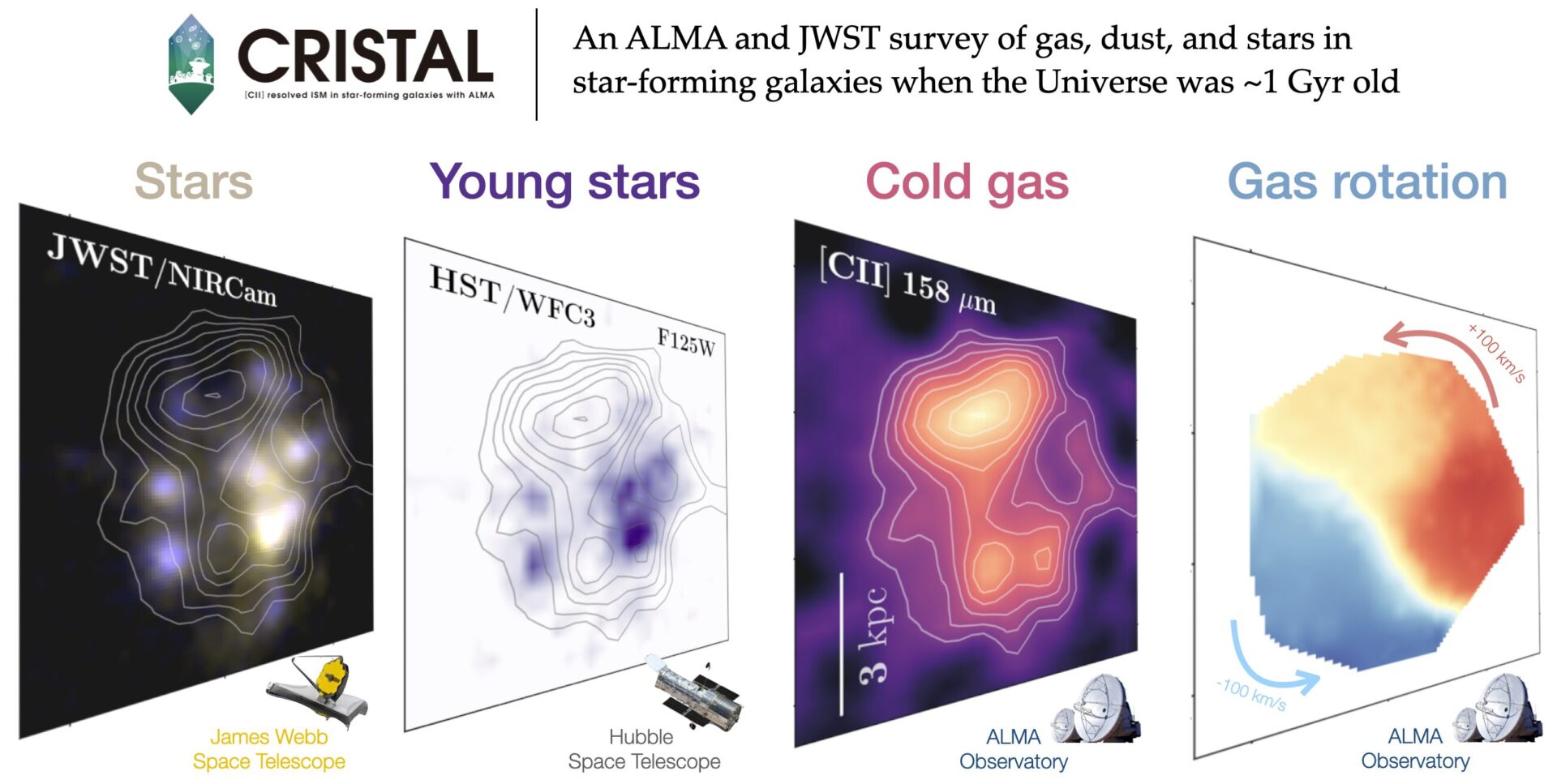
Zoom into the emission from an early galaxy observed in the CRISTAL survey. From left to right, the image shows stellar light captured by the James Webb and Hubble space telescopes, as well as the cold gas and rotation of the galaxy traced by ALMA through ionized carbon emission. Credit: ALMA / HST / JWST / R. Herrera-Camus

Artist’s illustration of CRISTAL-13. Dust-rich regions obscure newborn stars, whose energy is re-emitted at ALMA’s millimeter wavelengths. Right: young star clusters clear the dust and shine visibly in JWST and HST images. Credit: NSF/AUI/NRAO/B. Saxton


CRISTAL survey, led from Chile, traces cold gas, dust, and stellar light in 39 galaxies just 1 billion years after the Big Bang

Astronomers have used the Atacama Large Millimeter/submillimeter Array (ALMA) to peer into the early Universe and uncover the building blocks of galaxies during their formative years. The CRISTAL survey — short for [CII] Resolved ISM in STar-forming galaxies with ALMA — reveals cold gas, dust, and clumpy star formation in galaxies observed as they appeared just one billion years after the Big Bang.

“Thanks to ALMA’s unique sensitivity and resolution, we can resolve the internal structure of these early galaxies in ways never possible before,” said Rodrigo Herrera-Camus, principal investigator of the CRISTAL survey, professor at Universidad de Concepción, and Director of the Millennium Nucleus for Galaxy Formation (MINGAL) in Chile. “CRISTAL is showing us how the first galactic disks formed, how stars emerged in giant clumps, and how gas shaped the galaxies we see today.”

CRISTAL, an ALMA Large Program, observed 39 typical star-forming galaxies selected to represent the main population of galaxies in the early Universe. Using [CII] line emission, a specific type of light emitted by ionized carbon atoms in cold interstellar gas, as a tracer of cold gas and dust, and combining it with near-infrared images from the James Webb and Hubble Space Telescopes, researchers created a detailed map of the interstellar medium in each system. Among the key findings, most galaxies exhibited stellar birth in large clumps, each spanning several thousand light-years, revealing how star-forming regions assemble and evolve. A subset of galaxies showed signs of rotation, indicating the early formation of disk-like structures, which are precursors to modern spiral galaxies. The [CII] emission often extended far beyond the visible stars, indicating the presence of cold gas that may fuel future star formation or be expelled by stellar winds.

“What’s exciting about CRISTAL is that we are seeing early galaxies not just as points of light, but as complex ecosystems,” said Loreto Barcos-Muñoz, co-author of the study, astronomer at the U.S. National Radio Astronomy Observatory (NRAO), and ALMA point of contact for the survey. “This project shows how ALMA can resolve the internal structure of galaxies even in the distant Universe — revealing how they evolve, interact, and form stars.”

Two galaxies in the survey stood out. CRISTAL-13 features massive clouds of cosmic dust that block visible light from newborn stars. This light is reprocessed into millimeter wavelengths detectable by ALMA, revealing structures that are entirely hidden from telescopes observing in optical or infrared wavelengths. CRISTAL-10 presents a puzzling case: its ionized carbon emission is unusually faint relative to its infrared brightness, a trait only seen in rare, heavily obscured galaxies like Arp 220 in the nearby Universe. This suggests extreme physical conditions or an unusual power source in its interstellar medium.

“These observations highlight ALMA’s potential as a time machine, allowing us to peer into the early ages of the Universe,” said Sergio Martín, Head of the Department of Science Operations at ALMA. “Programs like CRISTAL demonstrate the power of ALMA’s Large Programs to drive high-impact science. They allow us to tackle the big questions of cosmic evolution with the unprecedented depth and resolution that only a world-class observatory like ALMA can provide.”

By conducting the first systematic survey of the cold gas in early galaxies and comparing it with their stars and dust, CRISTAL offers a new window into cosmic history. The survey sets the stage for future observations that may uncover how galaxies transition from turbulent early phases to the well-structured systems we see in the local Universe. “CRISTAL provides the kind of multi-wavelength data that allows us to test and refine our theories of galaxy evolution,” said Herrera-Camus. “This is a major step toward understanding how galaxies like our Milky Way came to be.


Additional Information

This research was published as "The ALMA-CRISTAL survey: Gas, dust, and stars in star-forming galaxies when the Universe was ∼1 Gyr old" by Herrera-Camus et al. in Astronomy & Astrophysics.

The Atacama Large Millimeter/submillimeter Array (ALMA), an international astronomy facility, is a partnership of the European Southern Observatory (ESO), the U.S. National Science Foundation (NSF), and the National Institutes of Natural Sciences (NINS) of Japan in cooperation with the Republic of Chile. ALMA is funded by ESO on behalf of its Member States, by NSF in cooperation with the National Research Council of Canada (NRC) and the National Science and Technology Council (NSTC) in Taiwan, and by NINS in cooperation with the Academia Sinica (AS) in Taiwan and the Korea Astronomy and Space Science Institute (KASI).

ALMA construction and operations are led by ESO on behalf of its Member States; by the National Radio Astronomy Observatory (NRAO), managed by Associated Universities, Inc. (AUI), on behalf of North America; and by the National Astronomical Observatory of Japan (NAOJ) on behalf of East Asia. The Joint ALMA Observatory (JAO) provides the unified leadership and management of ALMA's construction, commissioning, and operation.


Contacts:

Nicolás Lira
Education and Public Outreach Coordinator
Joint ALMA Observatory, Santiago - Chile
Phone:
+56 2 2467 6519
Cel: +56 9 9445 7726
Email: nicolas.lira@alma.cl

Jill Malusky
Public Information Officer
NRAO
Phone:
+1 304-456-2236
Email: jmalusky@nrao.edu

Bárbara Ferreira
ESO Media Manager
Garching bei München, Germany
Phone:
+49 89 3200 6670
Email: press@eso.org

Yuichi Matsuda
ALMA EA-ARC Staff Member
NAOJ
Email:
yuichi.matsuda@nao.ac.jp


Sunday, March 16, 2025

Featured Image: A Ribbon Around the Heliosphere

A Ribbon Around the Heliosphere


Maps of energetic neutral atom flux from 2009 to 2022 and from 0.71 keV to 4.29 keV
Credit: Noh et al. 2025


In 2009, a small octagonal spacecraft called the Interstellar Boundary Explorer (IBEX) began mapping the edge of our solar system. IBEX measures the flux of energetic neutral atoms: fast-moving, electrically neutral atoms that form when high-energy positively charged ions from the solar wind steal an electron from neutral atoms of the interstellar medium. In addition to the expected ebb and flow of energetic neutral atoms, IBEX found something completely unexpected: a narrow, curved region where these atoms are especially prevalent, shown in the images above and to the right. This feature, known as the IBEX ribbon, is still something of a mystery, though many researchers have converged on the idea that the ribbon is generated just past the heliopause — the boundary of our solar system — up to a few hundred astronomical units beyond that boundary. To enable detailed studies of the IBEX ribbon, Sung Jun Noh (Los Alamos National Laboratory) and collaborators applied a new statistical technique to the IBEX measurements, allowing them to sharpen images of the ribbon and extract its properties in regions where the signal was previously thought too weak. This results of this new analysis support the idea that the ribbon arises beyond the boundary of our solar system. To learn more about efforts to understand the IBEX ribbon, be sure to check out the original research article linked below.

By Kerry Hensley

Citation

“Characteristics of the IBEX Ribbon and Their Implications for a Source Region Outside the Heliopause,” Sung Jun Noh et al 2025 ApJ 980 8.
doi:10.3847/1538-4357/ada36a


Friday, December 06, 2024

Exploring the Slower Side of Neutron-Star Bow Shocks

This false-color infrared image from the Spitzer Space Telescope shows the arched bow shock generated as blue supergiant Kappa Cassiopeiae hurtles through the interstellar medium. Credit: NASA/JPL-Caltech

Title: Probing the Low-Velocity Regime of Nonradiative Shocks with Neutron Star Bow Shocks
Authors: Stella Koch Ocker and Maren Cosens
First Author’s Institution: California Institute of Technology and Observatories of the Carnegie Institution for Science
Status: Published in ApJL

Neutron stars are fascinating remnants of massive stars that have undergone a supernova explosion. These stellar remnants often move at incredible speeds through space, producing bow shocks, the regions where the fast-moving neutron star collides with interstellar gas. Imagine a cosmic wind so powerful that it creates a shock wave in space, much like a speedboat cutting through water. These powerful shock waves hold clues to study non-radiative shocks, which play an important role in heating plasma and accelerating particles, such as cosmic rays. Today’s article took a closer look at the properties of three neutron-star bow shocks in unprecedented detail, revealing new insights into the hidden physics behind these cosmic collisions.

Figure 1: Image of the LL Orionis bow shock taken with the Hubble Space Telescope.
Credit:
NASA and The Hubble Heritage Team (STScI/AURA); Acknowledgment: C. R. O’Dell (Vanderbilt University)

What Are Bow Shocks?

A bow shock forms when a fast-moving object, like a neutron star, passes through a medium — in this case, the interstellar medium, the gas and dust that fills the space between stars. The interaction between the neutron star’s wind and the interstellar medium causes form a shock wave, which resembles the bow wave that forms at the front of a boat moving through water (for example, see Figure 1).

In the context of neutron stars, the bow shock is non-radiative, meaning it does not emit much in the form of light or heat. However, the shock does produce a particular type of emission called Hα (hydrogen alpha), which occurs when neutral hydrogen atoms in the interstellar medium are excited and emit light at a specific wavelength in the optical wavelength range. Observing this Hα emission is one of the main ways astronomers can study neutron-star bow shocks.

Figure 2: KCWI data of the three neutron-star bow shocks, showing the morphologies of each bow shock at different velocity slices. Credit: Ocker & Cosens 2024

Understanding the Shock’s Velocity and Structure

Today’s authors focused on three known neutron-star bow shocks (see Figure 2): J0742−2822, J1741−2054, and J2225+6535 (also known as the “Guitar Nebula”). Using integral field spectroscopy, a technique that captures both the spatial and spectral information of an object, they were able to observe these bow shocks in detail. For their observations, they used the Keck Cosmic Web Imager (KCWI) on the Keck II Telescope in Hawaii. Unlike traditional spectroscopy, which provides a one-dimensional spectrum of light from a single region, integral field spectroscopy collects spectra across a two-dimensional field, allowing the astronomers to map the shock properties. This allows astronomers to study the shock shape, velocity structure, and Hα emission intensity in exquisite detail, giving a more complete picture of how these shocks behave.

Studying the relative contributions to the Hα emission is crucial to unlocking the detailed shock physics. There are two main components to the Hα emission: a narrow line that represents the ambient gas in the interstellar medium and a broad line produced by the shock itself. The ratio between these two lines, the broad-to-narrow line intensity ratio (Ib/In), provides crucial information about the velocity of the shock and the processes occurring within it, including the electron-ion temperature and the particle energy distribution.

The study revealed that the Ib/In values for all three neutron-star bow shocks indicated low shock velocities, all below 200 kilometers per second. This is notably different from the much higher velocities seen in supernova remnants, where shocks can exceed 1,000 kilometers per second. These results suggest that neutron-star bow shocks operate in a distinct low-velocity regime, and current models, which are designed for higher-velocity shocks, may not fully capture the behavior of these slower shocks. To better understand the temperature ratios between electrons and ions, as well as how particles are accelerated in this regime, new models are needed.

Why Is the Low-Velocity Regime Important?

Understanding the low-velocity regime of non-radiative shocks is important for several reasons:
  • Cosmic-Ray Acceleration: Non-radiative shocks are believed to accelerate particles to very high speeds, contributing to the population of cosmic rays — high-energy charged particles that travel through space. Studying how these shocks operate at different velocities helps scientists understand how cosmic rays are produced and what role neutron stars might play in this process.
  • Energy Transfer in Shocks: Non-radiative shocks are also key to understanding how energy is transferred between different types of particles, such as electrons and protons. In faster shocks, the temperature of electrons and protons can differ significantly, but in slower shocks, like those studied here, the temperatures might be more equal. Understanding this balance provides insight into the physics of shock waves and how they heat and accelerate particles.
  • Astrophysical Modeling: Most models of non-radiative shocks are based on high-velocity shocks in supernova remnants. However, the findings from this study suggest that these models need to be expanded to include slower shocks, which behave differently and require new theoretical approaches.
This study provides critical new insights into the enigmatic nature of neutron-star bow shocks, particularly in the unexplored low-velocity regime. By probing these slow shocks, we unlock a deeper understanding of how astrophysical plasmas are heated and how particles are accelerated to cosmic-ray speeds — shedding light on some of the most powerful processes in the universe. The findings challenge existing models of non-radiative shocks, emphasizing the need for new theory to capture the unique behavior of these slower shocks. As a result, this research not only reshapes our understanding of cosmic rays but also paves the way for exciting new directions in astrophysics, with potential breakthroughs on the horizon.

Original astrobite edited by Megan Masterson.


About the author, Janette Suherli:

Janette is a PhD student at University of Manitoba in Winnipeg, Canada. Her research focuses on the utilization of integral field spectroscopy for the studies of supernova remnants and their compact objects in the optical. She is also the current chair of Graduate Student Committee for the Canadian Astronomical Society (CASCA). She grew up in Indonesia where it is summer all year round! Before pursuing her PhD in astrophysics, Janette worked as a data analyst for a big Indonesian tech company, combating credit card fraud.


Editor’s Note:  Astrobites is a graduate-student-run organization that digests astrophysical literature for undergraduate students. As part of the partnership between the AAS and astrobites, we occasionally repost astrobites content here at AAS Nova. We hope you enjoy this post from astrobites; the original can be viewed at astrobites.org.


Friday, November 22, 2024

New Species of Dwarf Galaxy in the Galaxy Cluster Ecosystem?

This Hubble Space Telescope image shows the spiral galaxy ESO 137-001, which has been transformed into a "jellyfish galaxy" trailing gaseous tentacles. Credit:
NASA, ESA; Acknowledgements: Ming Sun (UAH), and Serge Meunier

Title: Dark-Matter-Free Dwarf Galaxy Formation at the Tips of the Tentacles of Jellyfish Galaxies
Authors: V. Lora et al.
First Author’s Institution: Institute of Nuclear Sciences, Mexico (UNAM)
Status: Published in ApJL

When Jellyfish Fly

Most galaxies are part of a galaxy cluster, which is exactly what it sounds like — a large collection of galaxies that are gravitationally bound to the larger cluster, much like how stars are gravitationally bound to a larger galaxy. In addition to the galaxies themselves, there is also gas between the galaxies in the cluster, referred to as the intracluster medium. When a disk-like galaxy moves through the intracluster medium in a galaxy cluster, some of the gas within the galaxy (the interstellar medium) gets stripped away from the galaxy. This creates long gaseous tails (or, if you will, tentacles), giving the galaxy an uncanny resemblance to a jellyfish!

Jellyfish galaxies, and their tentacles in particular, have been studied for decades. Astronomers have investigated how much of the gas in the tentacles comes from the intracluster medium versus the interstellar medium, as well as where and how star formation occurs within the tentacles. Interestingly, astronomers have found star-forming regions in the tentacles that have similar masses and sizes to ultra-compact dwarf galaxies. Today’s authors look to reproduce those results computationally and better understand how this dwarf galaxy formation channel works.

Hanging On by a Tentacle

The authors use data from the IllustrisTNG50 simulation, a cosmological simulation large enough to form dozens of galaxy clusters with enough resolution to accurately model features such as the arms of spiral galaxies. The authors identify a set of jellyfish galaxies within this simulation, then make additional cuts to:
  • ensure the galaxies have obvious tentacles;
  • find locations of star formation within the tentacles; and
  • eliminate galaxies where tentacle-like features could be due to interactions with other galaxies.
These cuts leave only one galaxy with a mass of ~400 billion solar masses; compare this to the mass of the Milky Way, which is typically reported as ~1 trillion solar masses. (However, a 2023 study found that the Milky Way mass was closer to ~200 billion solar masses.)

The authors identify a star-forming site within one of the tentacles of this galaxy, highlighted in Figure 1. This both supports the observational evidence and suggests that this may be a new type of dwarf galaxy (more on this in a moment). Additionally, by tracking the galaxy’s history prior to the infall, they determine that the galaxy loses gas but not stars. This means that the gas in the tentacle came from the galaxy, but the stars are forming in the tentacle rather than being relocated from the galaxy. This is a consequence of ram-pressure stripping, the primary physical phenomenon that creates the tails of jellyfish galaxies. Another important finding about the dwarf galaxy candidate is that it lies well outside the dark-matter halo of the jellyfish galaxy, which has important ramifications for its status as a dwarf galaxy candidate.

Figure 1: Different visualizations of the selected galaxy. The top panel shows neutral gas (green), dark matter (white), and star formation (rainbow). The bottom panel shows the dark matter (white) and stellar mass (rainbow). The dwarf candidate is circled in magenta in both panels. Credit: Lora et al. 2024


Figure 2: Star formation rate (top panel) and oxygen abundance (proxy for metal concentration, bottom panel) of the ram-pressure-stripped candidate (magenta). Credit: Lora et al. 2024


Dark-Matter-Deficient Dwarfs

The authors perform additional analysis on the dwarf galaxy candidate. First, they determine that the gas and stars are gravitationally bound, meaning that they can be thought of as a single system much like how a galaxy is thought of as a single system. They also look at the dark-matter content of the dwarf galaxy candidate and find that none of it is gravitationally bound, making this a dark-matter-free dwarf galaxy. Furthermore, they estimate the mass and size of the dwarf galaxy candidate to be ~200 million solar masses and ~1–1.5 kiloparsecs. Based on these findings, the authors conclude that this system represents a new kind of dwarf galaxy, which they dub a ram-pressure-stripped dwarf galaxy; additionally, ram-pressure-stripped dwarf galaxies are unique among dwarf galaxies because they lack a dark-matter halo due to their creation via ram pressure stripping.

The authors also analyze the star formation and metallicity of the ram-pressure-stripped dwarf, shown in Figure 2. They find a high star formation rate compared to other star-forming regions created via ram pressure stripping. They also find that the ram-pressure-stripped dwarf is very metal rich compared to other dwarf galaxies of similar size and mass; this is because the jellyfish galaxy is also rich in metals, so the gas stripped into the tentacle to form stars has a higher concentration of metals.

Today’s authors have found evidence of a new type of dwarf galaxy, which they call a ram-pressure-stripped dwarf galaxy. These dwarf galaxies form via ram pressure stripping in the tentacles of jellyfish galaxies and are characterized as being gravitationally self-bound, hosting star formation, and lacking a dark-matter halo. The authors hope to continue studies of ram-pressure-stripped dwarf galaxies, noting that other cosmological simulations that can resolve smaller amounts of mass may lead to more discoveries of ram-pressure-stripped dwarfs with lower masses.

Original astrobite edited by Amaya Sinha


About the author, Brandon Pries:

I am a graduate student in physics at Georgia Institute of Technology (Georgia Tech). I do research in computational astrophysics with John Wise, using machine learning to study the formation and evolution of supermassive black holes in the early universe. I’ve also done extensive research with the IceCube Collaboration as an undergraduate at Michigan State University, studying applications of neural networks to event reconstructions and searching for signals of neutrinos from dark matter annihilation.


Editor’s Note: Astrobites is a graduate-student-run organization that digests astrophysical literature for undergraduate students. As part of the partnership between the AAS and astrobites, we occasionally repost astrobites content here at AAS Nova. We hope you enjoy this post from astrobites; the original can be viewed at astrobites.org.


Tuesday, November 05, 2024

eROSITA unveils asymmetries in temperature and shape of our Local Hot Bubble

3D model of the solar neighbourhood. The colour bar represents the temperature of the LHB as coloured on the LHB surface. The direction of the Galactic Centre (GC) and Galactic North (N) is shown in the bottom right. The link to the interactive version can be found at the bottom of the page. © Michael Yeung / MPE


Our Solar System dwells in a low-density environment called the Local Hot Bubble (LHB), filled by a tenuous, million-degree hot gas emitting dominantly in soft X-rays. A team led by scientists at the Max Planck Institute for Extraterrestrial Physics (MPE) used the eROSITA All-Sky Survey data and found a large-scale temperature gradient in this bubble, possibly linked with past supernova explosions that expanded and reheated the bubble. The wealth of the eROSITA data also allowed the team to create a new 3D model of the hot gas in the solar neighbourhood. The highlight of this work features the discovery of a new interstellar tunnel towards the constellation Centaurus, potentially joining our LHB with a neighbouring superbubble.

The idea of the Local Hot Bubble has been around for about half a century, first developed to explain the ubiquitous X-ray background below 0.2 keV. Photons of such energies cannot travel very far in the interstellar medium before they are absorbed. In conjunction with the observation that there is almost no interstellar dust in our immediate environment, the scenario where a soft X-ray emitting plasma displaces the neutral materials in the solar neighbourhood, forming the ‘Local Hot Bubble’, was put forth.

This understanding of our immediate environment was not without its challenges, especially after the discovery of the solar wind charge exchange process in 1996 — an interaction between the solar wind ions and neutral atoms within the Earth’s geocorona and the heliosphere that emits X-rays at similar energies as the LHB. After years of analysis, the consensus now is that both contribute to the soft X-ray background, and the LHB must exist to explain the observations.

The eROSITA telescope is the first X-ray observatory to observe the sky from an orbit completely external to the Earth’s geocorona, avoiding the latter’s contamination. Also, the timing of the first eROSITA All-Sky Survey (eRASS1) coincided with the solar minimum, significantly reducing the heliospheric solar wind charge exchange contamination. ‘In other words, the eRASS1 data released to the public this year provides the cleanest view of the X-ray sky to date, making it the perfect instrument for studying the LHB, ‘says Michael Yeung from MPE, the lead author of this work.

3D structure of the LHB with colours indicating its temperature. The two surfaces indicate the measurement uncertainty of the LHB extent: the most probable extent most likely lies between the two. The location of the Sun and a sphere of 100 parsec radius are marked for comparison. © Michael Yeung / MPE

eROSITA’s Unparalleled X-ray Observations

The team divided the western Galactic hemisphere into about 2000 regions, and extracted and analysed the spectra from each one. They also leveraged data from ROSAT, the predecessor of eROSITA built also by MPE, which complements the eROSITA spectra at energies lower than 0.2 keV. They found a clear temperature dichotomy in the LHB, with the Galactic South (0.12 keV; 1.4 MK) slightly hotter than the Galactic North (0.10 keV; 1.2 MK). This feature could be explained by the latest numerical simulations of the LHB caused by supernova explosions in the last few million years.

Diffuse X-ray background spectra inform scientists not just of the temperature but also of the 3D structure of the hot gas. Previous work by the same team has established that the density of the LHB is relatively uniform, calibrating the density of the hot gas with sight lines to giant molecular clouds located on the surface of the LHB. Relying on this assumption, they generated a new 3D model of the LHB from the measured intensity of the LHB emission in each sight line. They found the LHB has a larger extent towards the Galactic poles as expected, as the hot gas prefers to expand towards directions of the least resistance, away from the Galactic disc.

‘This is not surprising, as was already found by the ROSAT survey’, pointed out by Michael Freyberg, a core author of this work and was a part of the pioneering work in the ROSAT era three decades ago. ‘What we didn’t know was the existence of an interstellar tunnel towards Centaurus, which carves a gap in the cooler interstellar medium (ISM). This region stands out in stark relief thanks to the much-improved sensitivity of eROSITA and a vastly different surveying strategy compared to ROSAT,’ added Freyberg. The authors of this work suggest the Centaurus tunnel may just be a local example of a wider hot ISM network sustained by stellar feedback across the Galaxy — a popular idea proposed in the 70s that remains difficult to prove.

Temperature map of the LHB in the western Galactic hemisphere in zenithal equal-area projection. The high-latitude region in the northern and southern hemispheres exhibits a clear temperature dichotomy. © Michael Yeung / MPE

A 3D Model of the Solar Neighbourhood

In addition to the 3D LHB model, the team compiled a list of known supernova remnants, superbubbles, and 3D dust information from the literature and created an interactive 3D model of the solar neighbourhood. Some features of the LHB could be easily appreciated from such representation, for instance, the well-known Canis Majoris tunnel on the Galactic disc, possibly connecting the LHB to the Gum nebula or another superbubble (called GSH238+00+09), as well as dense molecular clouds (in orange) lying close to the surface of the LHB in the direction of the Galactic Centre (GC). Recent works found that these clouds possess velocities in the radial direction (away from us). The location and the velocity of the clouds could be explained if they were formed from the condensation of swept-up materials during the early stage of the LHB formation. ‘Another interesting fact is that the Sun must have entered the LHB a few million years ago, a short time compared to the age of the Sun, remarked Gabriele Ponti, a co-author of this work. ‘It is purely coincidental that the Sun seems to occupy a relatively central position in the LHB as we continuously move through the Milky Way.’

3D interactive view of the LHB and the solar neighbourhood


Contacts:

Michael Yeung
PhD Student Highenergy-Group
tel:+49 89 30000-3899

mjf@mpe.mpg.de
Max Planck Institute for Extraterrestrial Physics

Dr. Michael Freyberg
Scientist Highenergy Group
tel:+49 89 30000-3849

myeung@mpe.mpg.de
Max Planck Institute for Extraterrestrial Physics

Dr. Gabriele Ponti
Visiting Scientist Highenergy Group
tel:+49 89 30000-3572

ponti@mpe.mpg.de
Max Planck Institute for Extraterrestrial Physics

Dr. Andrea Merloni
Senior Scientist Highenergy Group; PI eROSITA
tel:+49 89 30000-3893

am@mpe.mpg.de
Max Planck Institute for Extraterrestrial Physics


Original Publication

M. C. H. Yeung, G. Ponti, M. J. Freyberg et al.
The SRG/eROSITA diffuse soft X-ray background. I. The local hot bubble in the western Galactic hemisphere
A&A, 690, A399


Source


Further Information

eROSITA website of the MPE

eROSITA finds hot gas all around the Milky Way – closer than expected

December 14, 2023
A new all-sky map by the eROSITA telescope reveals X-rays emitted by million-degree hot plasma in and around the Milky Way. This discovery sheds light on the shape and size of a large portion of the Milky Way circumgalactic medium, providing a large reservoir of gas to fuel future star formation.

Massive black holes in low-mass galaxies: what happened to the X-ray Corona?

June 11, 2024
Identifying massive black holes in low-mass galaxies is crucial for understanding black hole formation and growth over cosmic time but challenging due to their low accretion luminosities. Astronomers at MPE, led by Riccardo Arcodia, used the eROSITA X-ray telescope's all-sky survey to study massive black hole candidates selected based on variability in other wavelength ranges.

The X-ray sky opens to the world

January 31, 2024
First eROSITA sky-survey data release makes public the largest ever catalogue of high-energy cosmic sources