Showing posts with label Fermi Bubbles. Show all posts

Friday, July 11, 2025

Galactic Mystery: How “Ice Cubes” Survive in the Milky Way’s Blazing Bubbles

An artist's interpretation of the highest-latitude neutral hydrogen clouds ever detected within the Fermi Bubbles in the center of our Milky Way Galaxy. The cold clouds reside more than 13,000 light-years above the Galactic center, in a region where frigid materials like this were never expected to be discovered. Credit: NSF/AUI/NSF NRAO/P.Vosteen


Astronomers discover fragile hydrogen clouds surviving inside the superheated Fermi Bubbles, revealing the Milky Way’s most extreme outflows are younger and more complex than ever imagined

clouds of cold, neutral hydrogen gas—akin to “ice cubes”—surviving deep inside the Fermi Bubbles, two enormous lobes of superheated plasma erupting from the center of our Milky Way Galaxy. These cold clouds reside more than 13,000 light-years above the Galactic center, in a region where frigid materials like this were never expected to be discovered.

The Fermi Bubbles are among the most violent environments in our Galaxy, filled with plasma at temperatures over a million degrees Kelvin. In such a harsh setting, cold gas should quickly evaporate or be torn apart—much like ice cubes tossed into an active volcano. Yet, these clouds remain structured, dynamic, and surprisingly long-lived, with lifetimes estimated at several million years. This resilience matches independent estimates of the Fermi Bubbles’ age and challenges existing models, which often predict much longer formation times for the Bubbles themselves.

“These findings change our previous assumptions, showing that cold gas can persist in the hot, turbulent Fermi Bubbles,” explained Rongmon Bordoloi, the lead scientist of this research and an associate professor North Carolina State University, “We didn’t know that cold gas can survive in these extreme outflows. This challenges our understanding of how galaxies recycle and expel matter.”

To find these cold clouds, the research team conducted the deepest-ever 21 cm radio survey of the Fermi Bubbles, using the NSF GBT’s unmatched sensitivity and resolution. They identified eleven cold hydrogen clouds at unprecedented heights, making these the highest-latitude neutral hydrogen clouds ever detected within the Bubbles. The NSF GBT’s unique capabilities were essential for this breakthrough—no other instruments can match its sensitivity and sky coverage for this type of observation.

“We believe that these cold clouds were swept up from the Milky Way’s center and carried aloft by the very hot wind that formed the Fermi bubbles”, said Jay Lockman an astronomer at the Green Bank Observatory and coauthor of the paper. “Just as you can’t see the motion of the wind on Earth unless there are clouds to track it, we can’t see the hot wind from the Milky Way but can detect radio emission from the cold clouds it has entrained.”

These findings also challenge the previously understood age of the Fermi Bubbles, which are now likely believed to have been formed more recently. The survival of these fragile, cold clouds suggests that the Fermi Bubbles may be only a few million years old—pointing to a dramatic outburst from the Milky Way’s central black hole, rather than star formation, as their likely origin. “If the Bubbles were older, these clouds would have long since vanished,” adds Bordoloi.

Scientists wonder how these clouds formed or survived. Did they condense out of the hot plasma, were they swept up from the galaxy’s disk, or are they remnants of pre-existing structures? What physical processes—such as magnetic fields or pressure confinement—are allowing them to resist destruction in such an extreme environment.

“Finding these cold clouds so high up in the Fermi Bubbles was unexpected”, adds co-author Andrew Fox, ESA-AURA Astronomer at the Space Telescope Science Institute in Baltimore, MD. “It challenges our understanding of where they came from and what their ultimate fate will be.”

This discovery pushes the boundaries of what scientists thought possible in our Galaxy’s most extreme environments. It opens new avenues for research into how galaxies evolve, how matter cycles through the cosmos, and what physical mechanisms allow fragile structures to persist amid cosmic violence. Future studies will focus on unraveling the origins and survival mechanisms of these clouds, providing critical tests for models of galactic feedback and outflows.


About GBO

The Green Bank Observatory, part of the National Radio Astronomy Observatory, is a facility of the U.S. National Science Foundation, operated under cooperative agreement by Associated Universities, Inc.


Friday, March 22, 2019

Giant chimneys vent X-rays from Milky Way's core

XMM-Newton discovers galactic ‘chimneys’
Copyright: ESA/XMM-Newton/G. Ponti et al. 2019; ESA/Gaia/DPAC (Milky Way map), CC BY-SA 3.0 IGO. Hi-res image

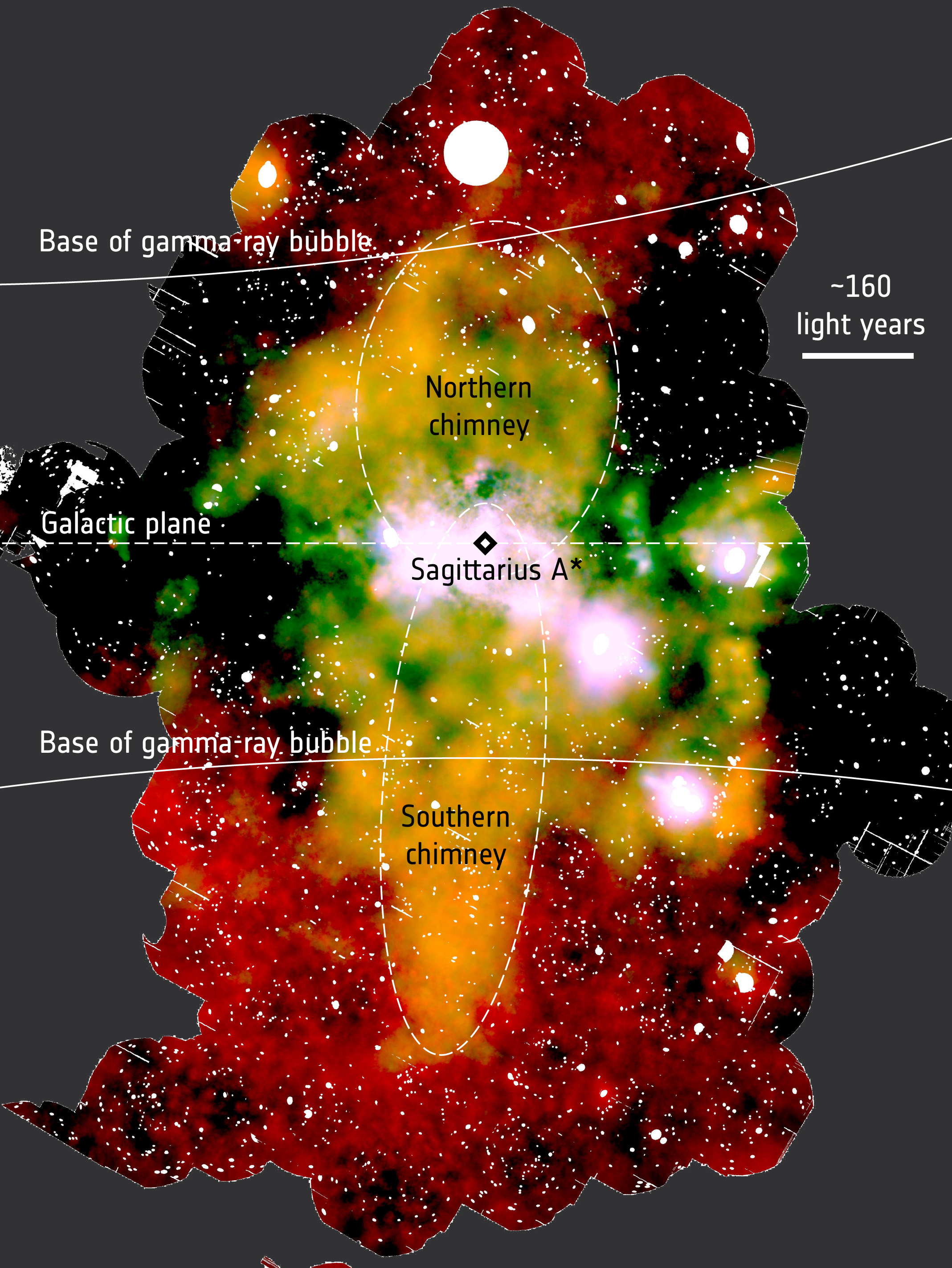
By surveying the centre of our Galaxy, ESA’s XMM-Newton has discovered two colossal ‘chimneys’ funneling material from the vicinity of the Milky Way’s supermassive black hole into two huge cosmic bubbles.

The giant bubbles were discovered in 2010 by NASA’s Fermi Gamma-ray Space Telescope: one stretches above the plane of the Milky Way galaxy and the other below, forming a shape akin to a colossal hourglass that spans about 50 000 light years – around half the diameter of the entire Galaxy. They can be thought of as giant ‘burps’ of material from the central regions of our Milky Way, where its central black hole, known as Sagittarius A*, resides.

Now, XMM-Newton has discovered two channels of hot, X-ray emitting material streaming outwards from Sagittarius A*, finally linking the immediate surroundings of the black hole and the bubbles together.

“We know that outflows and winds of material and energy emanating from a galaxy are crucial in sculpting and altering that galaxy’s shape over time – they are key players in how galaxies and other structures form and evolve throughout the cosmos,” says lead author Gabriele Ponti of the Max Planck Institute for Extraterrestrial Physics in Garching, Germany, and the National Institute for Astrophysics in Italy.

“Luckily, our Galaxy gives us a nearby laboratory to explore this in detail, and probe how material flows out into the space around us. We used data gathered by XMM-Newton between 2016 and 2018 to form the most extensive X-ray map ever made of the Milky Way’s core.”

XMM-Newton’s view of the Galactic centre – annotated
Copyright: ESA/XMM-Newton/G. Ponti et al. 2019, Nature. Hi-res image

This map revealed long channels of super-heated gas, each extending for hundreds of light years, streaming above and below the plane of the Milky Way. 

Scientists think that these act as a set of exhaust pipes through which energy and mass are transported from our Galaxy’s heart out to the base of the bubbles, replenishing them with new material. 

This finding clarifies how the activity occurring at the core of our home Galaxy, both present and past, is connected to the existence of larger structures around it. 

The outflow might be a remnant from our Galaxy’s past, from a period when activity was far more prevalent and powerful, or it may prove that even ‘quiescent’ galaxies – those that host a relatively quiet supermassive black hole and moderate levels of star formation like the Milky Way – can boast huge, energetic outflows of material. 

“The Milky Way is seen as a kind of prototype for a standard spiral galaxy,” says co-author Mark Morris of the University of California, Los Angeles, USA. 

“In a sense, this finding sheds light on how all typical spiral galaxies – and their contents – may behave across the cosmos.”

XMM-Newton discovers galactic ‘chimneys’ – annotated
Copyright: ESA/XMM-Newton/G. Ponti et al. 2019; ESA/Gaia/DPAC (Milky Way map),
CC BY-SA 3.0 IGO. Hi-res image

Despite its categorisation as quiescent on the cosmic scale of galactic activity, previous data from XMM-Newton have revealed that our Galaxy’s core is still quite tumultuous and chaotic. Dying stars explode violently, throwing their material out into space; binary stars whirl around one another; and Sagittarius A*, a black hole as massive as four million Suns, lies in wait for incoming material to devour, later belching out radiation and energetic particles as it does so.

Cosmic behemoths such as Sagittarius A* – and those even more massive – hosted by galaxies across the cosmos will be explored in depth by upcoming X-ray observatories like ESA’s Athena, the Advanced Telescope for High-Energy Astrophysics, scheduled for launch in 2031. Another future ESA mission, Lisa, the Laser Interferometer Space Antenna, will search for gravitational waves released by the merger of supermassive black holes at the core of distant, merging galaxies.

“There’s still a great deal to be done with XMM-Newton – the telescope could scan a significantly larger region of the Milky Way’s core, which would help us to map the bubbles and hot gas surrounding our Galaxy as well as their connections to the other components of the Milky Way, and hopefully figure out how all of this is linked together,” adds Gabriele.

“Of course, we’re also looking forward to Athena and the breakthrough it will enable.”

Athena will combine extremely high-resolution X-ray spectroscopy with excellent imaging capabilities over wide areas of the sky, allowing scientists to probe the nature and movement of hot cosmic gas like never before.

“This outstanding result from XMM-Newton gives us an unprecedented view of what’s really happening at the core of the Milky Way, and presents the most extensive X-ray map ever created of the entire central region,” says ESA XMM-Newton project scientist Norbert Schartel.

“This is especially exciting in the context of our upcoming missions. XMM-Newton is paving the way for the future generation of X-ray observatories, opening up abundant opportunities for these powerful spacecraft to make substantial new discoveries about our Universe.”


Notes for editors
 
An X-ray Chimney extending hundreds of parsecs above and below the Galactic Centre” by G. Ponti et al. is published in the journal Nature.

XMM-Newton data were used in conjunction with archival data from NASA’s Chandra X-Ray Observatory.

The bubbles stretching above and below the Milky Way’s disc are known as Fermi bubbles, and were discovered in gamma-ray data gathered by NASA's Fermi Gamma-ray Space Telescope in 2010.


For more information, please contact:
 
Gabriele Ponti
Max Planck Institute for Extraterrestrial Physics, Germany
and INAF Brera Astronomical Observatory, Italy
Tel: +39 0272320425
Email: gabriele.ponti@inaf.it

Mark Morris
University of California, Los Angeles, USA
Tel:  +1 310 825 3320
Email: morris@astro.ucla.edu

Norbert Schartel
XMM-Newton project scientist
European Space Agency
Email: norbert.schartel@sciops.esa.int

Markus Bauer
ESA Science Programme Communication Officer
Tel: +31 71 565 6799
Mob: +31 61 594 3 954
Email: markus.bauer@esa.int


Friday, March 01, 2019

NGC 3079: Galactic Bubbles Play Cosmic Pinball with Energetic Particles

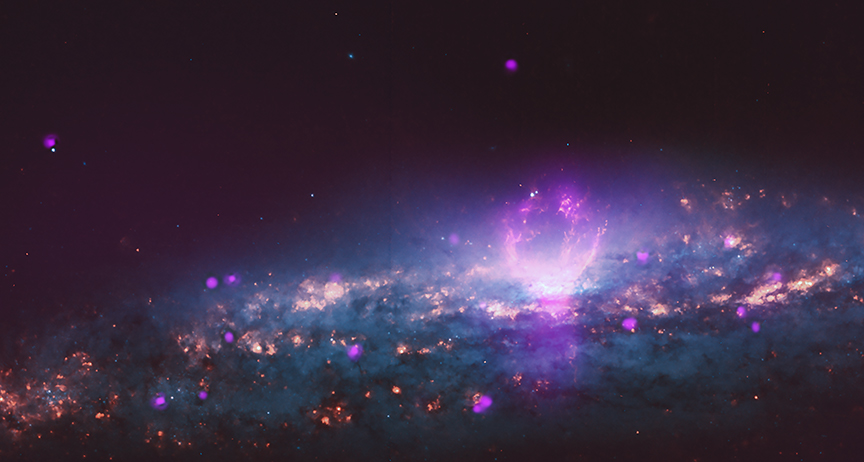
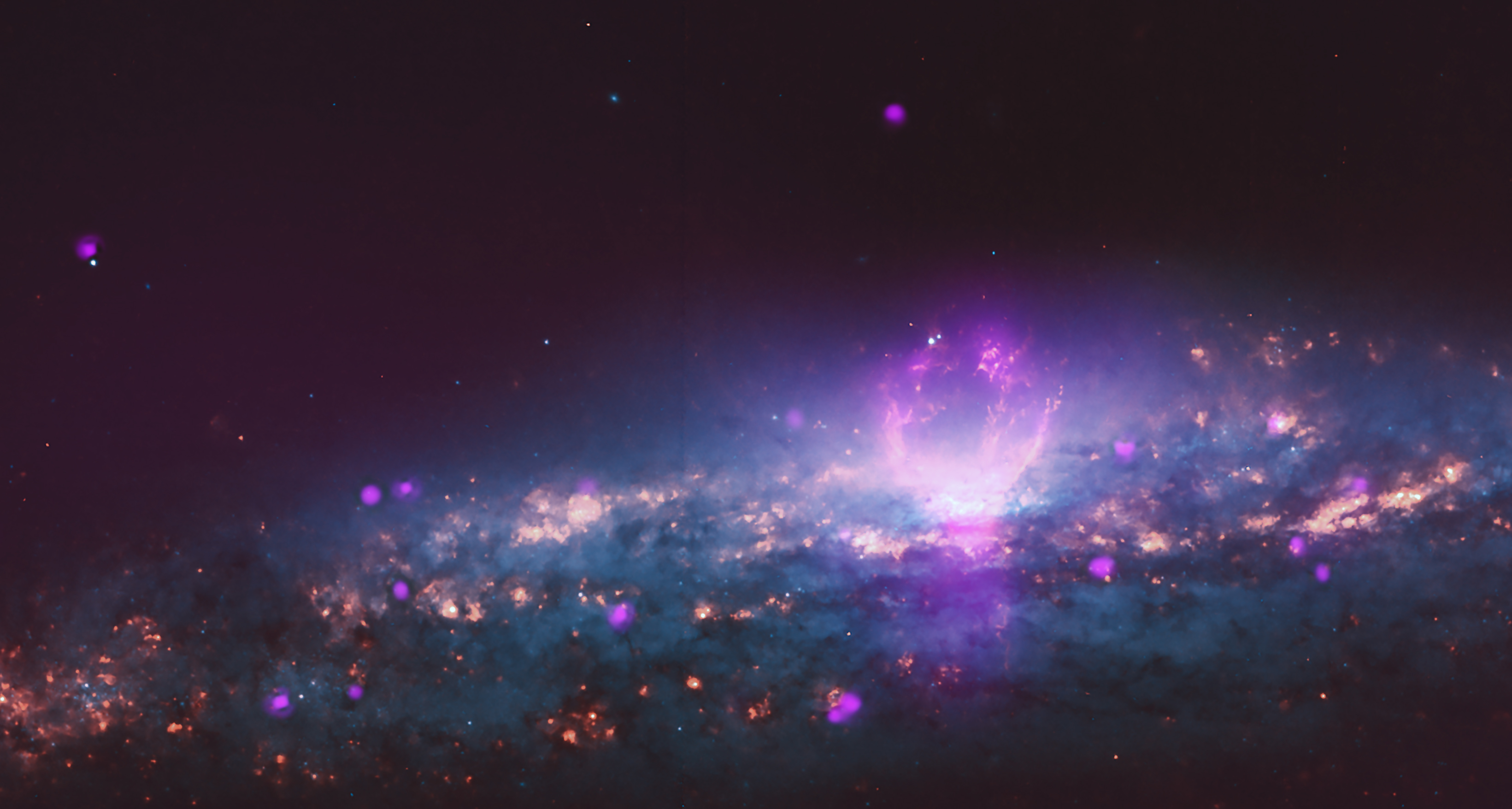
NGC 3079
Credit X-ray: NASA/CXC/University of Michigan/J-T Li et al.; Optical: NASA/STScI 

We all know bubbles from soapy baths or sodas. These bubbles of everyday experience on Earth are up to a few inches across, and consist of a thin film of liquid enclosing a small volume of air or other gas. In space, however, there are very different bubbles — composed of a lighter gas inside a heavier one — and they can be huge.

The galaxy NGC 3079, located about 67 million light years from Earth, contains two "superbubbles" unlike anything here on our planet. A pair of balloon-like regions stretch out on opposite sides of the center of the galaxy: one is 4,900 light years across and the other is only slightly smaller, with a diameter of about 3,600 light years. For context, one light year is about 6 trillion miles, or 9 trillion kilometers.

The superbubbles in NGC 3079 give off light in the form of X-ray, optical and radio emission, making them detectable by NASA telescopes. In this composite image, X-ray data from NASA's Chandra X-ray Observatory are shown in purple and optical data from NASA's Hubble Space Telescope are shown in orange and blue. A labeled version of the X-ray image shows that the upper superbubble is clearly visible, along with hints of fainter emission from the lower superbubble.

 NGC 3079  (Labeled)
Credit: NASA/CXC/University of Michigan/J-T Li et al.

New observations from Chandra show that in NGC 3079 a cosmic particle accelerator is producing ultra-energetic particles in the rims of the superbubbles. These particles can be much more energetic than those created by Europe's Large Hadron Collider (LHC), the world's most powerful human-made particle accelerator.

The superbubbles in NGC 3079 provide evidence that they and structures like them may be the source of high-energy particles called "cosmic rays" that regularly bombard the Earth. Shock waves — akin to sonic booms caused by supersonic planes — associated with exploding stars can accelerate particles up to energies about 100 times larger than those generated in the LHC, but astronomers are uncertain about where even more energetic cosmic rays come from. This new result suggests superbubbles may be one source of these ultra-energetic cosmic rays.

The outer regions of the bubbles generate shock waves as they expand and collide with surrounding gas. Scientists think charged particles scatter or bounce off tangled magnetic fields in these shock waves, much like balls rebounding off bumpers in a pinball machine. When the particles cross the shock front they are accelerated, as if they received a kick from a pinball machine's flipper. These energetic particles can escape and some may eventually strike the Earth's atmosphere in the form of cosmic rays.

The amount of radio waves or X-rays at different wavelengths, or "spectra," of one of the bubbles suggest that the source of the emission is electrons spiraling around magnetic field lines, and radiating by a process called synchrotron radiation. This is the first direct evidence of synchrotron radiation in high energy X-rays from a galaxy-sized superbubble, and it tells scientists about the maximum energies that the electrons have attained. It is not understood why synchrotron emission is detected from only one of the bubbles.

The radio and X-ray spectra, along with the location of the X-ray emission along the rims of the bubbles, imply that the particles responsible for the X-ray emission must have been accelerated in the shock waves there, because they would have lost too much energy while being transported from the center of the galaxy. 

NGC 3079's superbubbles are younger cousins of "Fermi bubbles," first located in the Milky Way galaxy in 2010. Astronomers think such superbubbles may form when processes associated with matter falling into a supermassive black hole in the center of galaxy, which leads to the release of enormous amounts of energy in the form of particles and magnetic fields. Superbubbles may also be sculpted by winds flowing from a large number of young, massive stars.

A paper describing these results was led by Jiangtao Li of the University of Michigan and appears in The Astrophysical Journal. It is also available online. NASA's Marshall Space Flight Center in Huntsville, Alabama, manages the Chandra program for NASA's Science Mission Directorate in Washington. The Smithsonian Astrophysical Observatory in Cambridge, Massachusetts, controls Chandra's science and flight operations.


Fast Facts for NGC 3079:

Scale: Image is 3.2 arcmin (about 62,000 light years) across.
Category: Normal Galaxies & Starburst Galaxies
Coordinates (J2000) : RA 10h 01m 57.8s | Dec +55° 40´ 47.2"
Constellation: Ursa Major
Observation Date: 4 observations: Mar 7, 2001; Dec 27, 2006; Jan 30, 2018; Feb 1, 2018
Observation Time: 35 hours 45 min (1 day 11 hours 45 minutes)
Obs. ID: 2038, 7851, 19307, 20947
Instrument: ACIS
References: Li, J-T. et al, 2019, ApJ, accepted. arXiv:1901.10536
Color Code X-ray: purple & pink; Optical: red & blue
Distance Estimate: About 67 million light years


Thursday, March 09, 2017

Hubble Dates Black Hole’s Last Big Meal

Quasar's Light Yields Clues to Outflow
This illustration shows the light of several distant quasars piercing the northern half of the Fermi Bubbles, an outflow of gas expelled by our Milky Way galaxy's hefty black hole. The Hubble Space Telescope probed the quasars' light for information on the speed of the gas and whether the gas is moving toward or away from Earth. Based on the material's speed, the research team estimated that the bubbles formed from an energetic event between 6 million and 9 million years ago.

The inset diagram at bottom left shows the measurement of gas moving toward and away from Earth, indicating the material is traveling at a high velocity.

Hubble also observed light from quasars that passed outside the northern bubble. The box at upper right reveals that the gas in one such quasar's light path is not moving toward or away from Earth. This gas is in the disk of the Milky Way and does not share the same characteristics as the material probed inside the bubble.  Illustration Credit: NASA, ESA, and Z. Levy (STScI); Science Credit: NASA, ESA, and R. Bordoloi (MIT). Image release


For the supermassive black hole at the center of our Milky Way galaxy, it's been a long time between dinners. NASA's Hubble Space Telescope has found that the black hole ate its last big meal about 6 million years ago, when it consumed a large clump of infalling gas. After the meal, the engorged black hole burped out a colossal bubble of gas weighing the equivalent of millions of suns, which now billows above and below our galaxy's center.

The immense structures, dubbed the Fermi Bubbles, were first discovered in 2010 by NASA's Fermi Gamma-ray Space Telescope. But recent Hubble observations of the northern bubble have helped astronomers determine a more accurate age for the bubbles and how they came to be.

"For the first time, we have traced the motion of cool gas throughout one of the bubbles, which allowed us to map the velocity of the gas and calculate when the bubbles formed," said lead researcher Rongmon Bordoloi of the Massachusetts Institute of Technology in Cambridge. "What we find is that a very strong, energetic event happened 6 million to 9 million years ago. It may have been a cloud of gas flowing into the black hole, which fired off jets of matter, forming the twin lobes of hot gas seen in X-ray and gamma-ray observations. Ever since then, the black hole has just been eating snacks."

The new study is a follow-on to previous Hubble observations that placed the age of the bubbles at 2 million years old.

A black hole is a dense, compact region of space with a gravitational field so intense that neither matter nor light can escape. The supermassive black hole at the center of our galaxy has compressed the mass of 4.5 million sun-like stars into a very small region of space.

Material that gets too close to a black hole is caught in its powerful gravity and swirls around the compact powerhouse until it eventually falls in. Some of the matter, however, gets so hot it escapes along the black hole's spin axis, creating an outflow that extends far above and below the plane of a galaxy.

The team's conclusions are based on observations by Hubble's Cosmic Origins Spectrograph (COS), which analyzed ultraviolet light from 47 distant quasars. Quasars are bright cores of distant active galaxies.

Imprinted on the quasars' light as it passes through the Milky Way bubble is information about the speed, composition, and temperature of the gas inside the expanding bubble.

The COS observations measured the temperature of the gas in the bubble at approximately 17,700 degrees Fahrenheit. Even at those sizzling temperatures, this gas is much cooler than most of the super-hot gas in the outflow, which is 18 million degrees Fahrenheit, seen in gamma rays. The cooler gas seen by COS could be interstellar gas from our galaxy's disk that is being swept up and entrained into the super-hot outflow. COS also identified silicon and carbon as two of the elements being swept up in the gaseous cloud. These common elements are found in most galaxies and represent the fossil remnants of stellar evolution.

The cool gas is racing through the bubble at 2 million miles per hour. By mapping the motion of the gas throughout the structure, the astronomers estimated that the minimum mass of the entrained cool gas in both bubbles is equivalent to 2 million suns. The edge of the northern bubble extends 23,000 light-years above the galaxy.

"We have traced the outflows of other galaxies, but we have never been able to actually map the motion of the gas," Bordoloi said. "The only reason we could do it here is because we are inside the Milky Way. This vantage point gives us a front-row seat to map out the kinematic structure of the Milky Way outflow."

The new COS observations build and expand on the findings of a 2015 Hubble study by the same team, in which astronomers analyzed the light from one quasar that pierced the base of the bubble.

"The Hubble data open a whole new window on the Fermi Bubbles," said study co-author Andrew Fox of the Space Telescope Science Institute in Baltimore, Maryland. "Before, we knew how big they were and how much radiation they emitted; now we know how fast they are moving and which chemical elements they contain. That's an important step forward."

The Hubble study also provides an independent verification of the bubbles and their origin, as detected by X-ray and gamma-ray observations.

"This observation would be almost impossible to do from the ground because you need ultraviolet spectroscopy to detect the fingerprints of these elements, which can only be done from space," Bordoloi said. "Only with COS do you have the wavelength coverage, the sensitivity, and the spectral resolution coverage to make this observation."

The Hubble results appeared in the January 10, 2017, edition of The Astrophysical Journal.

The Hubble Space Telescope is a project of international cooperation between NASA and the European Space Agency. NASA's Goddard Space Flight Center in Greenbelt, Maryland, manages the telescope. The Space Telescope Science Institute (STScI) in Baltimore, Maryland, conducts Hubble science operations. STScI is operated for NASA by the Association of Universities for Research in Astronomy in Washington, D.C.


Related links


Contacts

Felicia Chou
NASA Headquarters, Washington, D.C.

felicia.chou@nasa.gov
202-358-0257

Donna Weaver / Ray Villard
Space Telescope Science Institute, Baltimore, Maryland
410-338-4493 / 410-338-4514

dweaver@stsci.edu / villard@stsci.edu

Rongmon Bordoloi
Massachusetts Institute of Technology, Cambridge, Massachusetts
617-252-1736

bordoloi@mit.edu


Source: Hubble Site

Wednesday, January 02, 2013

Galactic geysers fuelled by star stuff

 A view of the 'galactic geysers' that have been mapped. Credit: ESA Planck Collaboration (Microwave) NASA DOE Fermi LAT, Dobler et al. Su et al. (Gamma Rays).  Click for here resolution

Enormous outflows of charged particles from the centre of our Galaxy, stretching more than halfway across the sky and moving at supersonic speeds, have been detected and mapped with CSIRO’s 64-m Parkes radio telescope.

Corresponding to the “Fermi Bubbles” found in 2010, the recent observations of the phenomenon were made by a team of astronomers from Australia, the USA, Italy and The Netherlands, with the findings reported in today’s issue of Nature.

“There is an incredible amount of energy in the outflows,” said co-author Professor Lister-Staveley-Smith from The University of Western Australia node of the International Centre for Radio Astronomy Research in Perth and Deputy Director of the ARC Centre of Excellence for All-sky Astrophysics (CAASTRO).

“The source of the energy has been somewhat of a mystery, but we know there is a lot there, about a million times as much energy as a supernova explosion (a dying star).” 

From top to bottom the outflows extend 50,000 light-years [five hundred thousand million million kilometres] out of the Galactic Plane.  That’s equal to half the diameter of our Galaxy (which is 100,000 light-years—a million million million kilometres—across). 

“Our Solar System is located approximately 30,000 light-years from the centre of the Milky Way Galaxy, but we’re perfectly safe as the jets are moving in a different direction to us,” said Professor Staveley-Smith. 

Seen from Earth, but invisible to the human eye, the outflows stretch about two-thirds across the sky from horizon to horizon. 

They match previously identified regions of gamma-ray emission detected with NASA’s Fermi Space Telescope (then-called “Fermi Bubbles”) and the “haze” of microwave emission spotted by the Wilkinson Microwave Anisotropy Probe (WMAP) and Planck Space Telescope. 

“Adding observations by the ground-based Parkes radio telescope to those made in the past by space telescopes finally allows us to understand how these enormous outflows are powered,” said Professor Staveley-Smith. 

Previously it was unclear whether it was quasar-like activity of our Galaxy’s central super-massive black hole or star formation that kept injecting energy into the outflows.  

The recent findings, reported in Nature today, show that the phenomenon is driven by many generations of stars forming and exploding in the Galactic Centre over the last hundred million years. 

“We were able to analyse the magnetic energy content of the outflows and conclude that star formation must have happened in several bouts,” said CAASTRO Director Professor Bryan Gaensler. 

Further analyses of the polarisation properties and magnetic fields of the outflows can also help us to answer one of astronomy’s big questions about our Galaxy. 

“We found that the outflows’ radiation is not homogenous but that it actually reveals a high degree of structure – which we suspect is key to how the Galaxy’s overall magnetic field is generated and maintained,” said Professor Gaensler. 

The research was led by Dr Ettore Carretti from the Commonwealth Science and Industrial Research Organisation. 

Further Information: 

Professor Lister Staveley-Smith

Deputy Director
ICRAR The University of Western Australia, and CAASTRO
Mobile:  +61 (0) 425 212 592
Email: lister: staveley-smith@uwa.edu.au 

Kirsten Gottschalk
Media Contact, ICRAR
Mobile: +61 (0) 438 361 876
Email: kirsten.gottschalk@icrar.org 

Dr Wiebke Ebeling
Media Contact, CAASTRO
Mobile: +61 (0) 423 933 444
Email: wiebke.ebeling@curtin.edu.au