Showing posts with label Cat's Eye Nebula. Show all posts

Tuesday, March 10, 2026

Two observatories, one cosmic eye

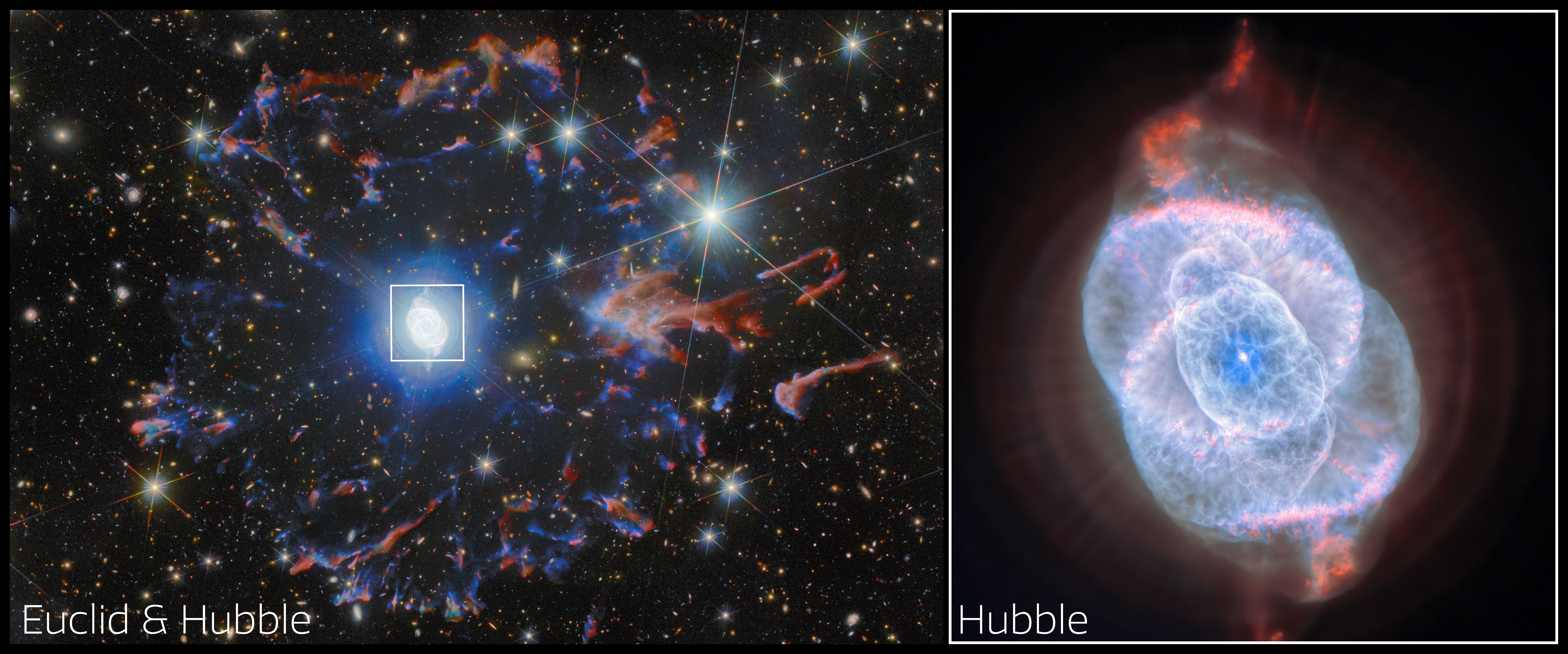
Image Description: Two images of a planetary nebula in space. The image to the left, labelled “Euclid & Hubble”, shows the whole nebula and its surroundings. A star in the very centre is surrounded by white bubbles and loops of gas, all shining with a powerful blue light. Farther away a broke.n ring of red and blue gas clouds surrounds the nebula. The background shows many stars and distant galaxies. A white box indic,brates the centre of the nebula and this region is the image to the right, labelled “Hubble”. It shows the multi-layered bubbles, poin.ted jets and circular shells of gas that make up the nebula, as well as the central star, in greater detail. Credit: ESA/Hubble ,hr& NASA, ESA Euclid/Euclid Consortium/NASA/Q1-2025, J.-C. Cuillandre & E. Bertin (CEA Paris-Saclay), Z. Tsvetanov


For this month’s ESA/Hubble Picture of the Month, we turn our gaze to one of the most visually intricate remnants of a dying star: the Cat’s Eye Nebula, also known as NGC 6543. This extraordinary planetary nebula lies in the constellation Draco and has captivated astronomers for decades with its elaborate and multilayered structure. Observations with ESA’s Gaia mission place the nebula at a distance of 4 400 light years away.

Planetary nebulae, so-called because of their round shape when viewed through early telescopes, are in fact expanding gas thrown off by stars in their final stages of evolution. It was the Cat’s Eye Nebula itself where this fact was first discovered in 1864 —examining the spectrum of its light reveals the emission from individual molecules that’s characteristic of a gas, distinguishing planetary nebulae from stars and galaxies.

The NASA/ESA Hubble Space Telescope also revolutionised our understanding of planetary nebulae; its detailed images showed that the simple, circular appearance of a planetary nebula seen from the ground belies a very complex morphology. This was particularly true of the Cat’s Eye Nebula, where Hubble’s images in 1995 revealed never-before-seen structures that broadened our understanding of how planetary nebulae come to be.

This time, Hubble is joined by ESA’s Euclid space telescope to create a new image of NGC 6543. The nebula is showcased through the combined eyes of Hubble and Euclid, revealing the remarkable complexity of stellar death in this object. Though primarily designed to map the distant Universe, Euclid captures the Cat’s Eye Nebula as part of its deep imaging surveys. In Euclid’s wide, near-infrared and visible light view, the arcs and filaments of the nebula’s bright central region are situated within a halo of colourful fragments of gas zooming away from the star. This ring was ejected from the star at an earlier stage, before the main nebula at the centre formed. The whole nebula stands out against a backdrop teeming with distant galaxies, demonstrating how local astrophysical beauty and the farthest reaches of the cosmos can be seen together with Euclid.

Within this broad view of the nebula and its surroundings, Hubble captures the very core of the billowing gas with high-resolution visible-light images, adding extra detail in the centre of this image. The data reveal a tapestry of concentric shells, jets of high-speed gas and dense knots sculpted by shock interactions, features that appear almost surreal in their intricacy. These structures are believed to record episodic mass loss from the dying star at the nbula’s centre, creating a kind of cosmic “fossil record” of its final evolutionary stages.

Combining the focused view of Hubble with Euclid’s deep field observations not only highlights the nebula’s exquisite structure, but also places it within the broader context of the Universe that both space telescopes explore. Together, these missions provide a rich and complementary view of NGC 6543 — revealing the delicate interplay between stellar end-of-life processes and the vast cosmic tapestry beyond.


Links


Thursday, April 25, 2024

Travel Through Data From Space in New 3D Instagram Experiences

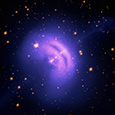
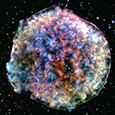
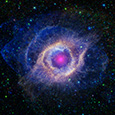
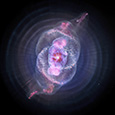
Vela Pulsar - Tycho's Supernova Remnant - Helix Nebula - Cat's Eye Nebula
Credit: Vela Pulsar: X-ray: NASA/CXC/SAO; Optical: NASA/ESA/STScI; Image processing: NASA/CXC/SAO/J. Schmidt, K. Arcand; Tycho's Supernova Remnant: X-ray: NASA/CXC/SAO; Optical: DSS; Image Processing: NASA/CXC/SAO/N. Wolk; Helix Nebula: X-ray: NASA/CXC/SAO; UV: NASA/JPL-Caltech/SSC; Optical: NASA/ STScI/M. Meixner, ESA/NRAO/T.A. Rector; Infrared:NASA/JPL-Caltech/K. Su; Image Processing: NASA/CXC/SAO/N. Wolk and K. Arcand; Cat's Eye Nebula: X-ray: NASA/CXC/SAO; Optical: NASA/ESA/STScI; Image Processing: NASA/CXC/SAO/J. Major, L. Frattare, K. Arcand


These images represent new special 3D “experiences” available on Instagram made with data from NASA’s Chandra X-ray Observatory and other telescopes. By using augmented reality (AR), these experiences allow people to travel virtually through objects in space.

These Chandra Instagram experiences join a space-themed collection in Instagram from recent years, that includes NASA mission control, the International Space Station, and the Perseverance Rover on Mars. The objects in the new Chandra Instagram collection include the Tycho supernova remnant, the Vela Pulsar, the Helix Nebula, the Cat’s Eye, and the Chandra spacecraft.

The new Instagram experiences are created from 3D models based on data collected by Chandra and other telescopes along with computer models. Traditionally, it has been very difficult to gather 3D data of objects in space due to their two-dimensional projection on the sky. New instruments and techniques, however, have allowed astronomers in recent years to construct data-driven models of what these distant objects look like in three dimensions.

These advancements in astronomy have paralleled the explosion of opportunities in virtual, extended, and augmented reality. Such technologies provide virtual digital experiences, which now extend beyond Earth and into the cosmos.


Tycho's Supernova Remnant Effect [More Effects]
Video Credit: Smithsonian/NASA/SAO/CXC;
Sonification: NASA/CXC/SAO/K.Arcand, SYSTEM Sounds (M. Russo, A. Santaguida)

This new set of Chandra Instagram experiences was made possible by a collaboration including NASA and the Smithsonian Institution, as well as students and researchers at Brown University. The 3D models of Tycho, Vela and Helix were done in conjunction with Sal Orlando, an astrophysicist at Italy’s National Institute for Astrophysics in Palermo. The Cat’s Eye Nebula was created with data from Ryan Clairmont, physics researcher and undergraduate at Stanford University. Kim Arcand from SAO oversaw the project and worked with Brown University’s Tom Sgouros and his team, research assistant Alexander Dupuis and undergraduate Healey Koch, on the Chandra Instagram filters.


Vela Pulsar

Vela Pulsar: The Vela Pulsar is the aftermath of a star that collapsed, followed by an explosion that sent a remarkable storm of particles and energy into space. The Chandra X-ray Observatory and other telescopes captured this storm, seen here as a 3D model. At the center of Vela is a pulsar, a rapidly spinning dense star that sends beams of light out into space like a cosmic lighthouse.

Tycho's Supernova Remnant

Tycho's Supernova Remnant: Massive stars die in giant explosions called supernovas that can outshine an entire galaxy. After a supernova explosion, the remains of the star can become a spectacular and evolving cosmic monument to the now-deceased star. These remnants glow in X-ray light, which NASA’s Chandra X-ray Observatory can detect such as in this image of Tycho’s Supernova Remnant.

Helix Nebula

Helix Nebula:In about 5 billion years, our Sun will run out of fuel and expand, possibly engulfing Earth. These end stages of a star’s life can be utterly beautiful as is the case with this planetary nebula called the Helix Nebula. Astronomers study these objects by looking at all kinds of light, including X-rays that the Chandra X-ray Observatory sees.

Cat's Eye Nebula

Cat's Eye Nebula:Eventually, our Sun will run out of fuel and die (though not for about another 5 billion years). As it does, it will become like the object seen here, the Cat’s Eye Nebula, which is a planetary nebula. A fast wind from the remaining stellar core rams into the ejected atmosphere and pushes it outward, creating wispy structures seen in X-rays by Chandra and optical light by the Hubble Space Telescope.

Chandra Spacecraft

Chandra Spacecraft: A quarter of a century ago, scientists began a quest to answer some of the biggest questions in the Universe. They have discovered many truths — and uncovered even more mysteries. Since it was launched into space in July 1999, NASA’s Chandra X-ray Observatory has changed our view of the Universe. With this telescope, we continue to see what is otherwise invisible. We are still learning, exploring, and expanding humanity’s grasp of what the Universe has to offer. Our X-ray legacy continues.


Visual Description:

This image contains four separate images presented in a 2 by 2 grid. Top left, Vela pulsar. Top right, Tycho's Supernova Remnant. Bottom left, Helix Nebula. Bottom right, Cat's Eye Nebula.

The Vela Pulsar, the aftermath of a collapsed and exploded star sending a jet of particles into space. The pulsar resembles a soft, pillowy, lavender bean in a pocket of blue gas. A faint stream of gas, the X-ray jet, appears to shoot from the pocket, heading into the distance at our upper right. Purple markings in the lavender bean shape strongly resemble narrow eyes and an open mouth, giving the pulsar a squinting happy face. In this image, X-ray light detected by Chandra is shown in blues and purples.

The Tycho supernova remnant is a spherical cloud of reds, greens, and blues set against a starry sky. The cloud is ejected material still propagating from a star that exploded in 1572, as seen from Earth. Here, the supernova resembles a fluffy pink cotton ball. The dense, translucent cloud is streaked with hazy veins, and mottled with red and blue. The edges of the cloud appear to be highlighted in soft white. Upon close inspection, a thin red-violet line can be discerned around the outer edge of the multicolored cloud. The red-violet line shows where electrons have been accelerated to high energies, producing X-rays detected by Chandra. This provides evidence that supernova remnants are a major source of energetic particles, including electrons and protons, which continually hit Earth's atmosphere.

The Helix Nebula is a planetary nebula, the end phases of the life of a Sun-like star. Helix resembles a creature's eye, both in shape and in detail. At the center of the nebula, where the pupil would reside, an orb shaped cloud glows in dark pink. Surrounding the orb, where the colored iris of an eye would be, is a dramatic mix of color in blues, browns, and golds that appear somewhat striated, very similar to a human eye. These striations extend to the left and right of the otherwise circular iris structure, as though they had been gently pulled from the two o'clock and seven o'clock positions until the material formed faint wisps. Surrounding the iris structure are roughly spherical puffs of blue haze. The entire canvas is dotted with stars in red, green, and blue.

The Cat's Eye Nebula is an image of an ethereal shape surrounded by concentric circles. The shape is a huge cloud of gas and dust blown off of a dying star. The concentric circles are bubbles expelled by the star over time. The dust cloud resembles a translucent pastry pulled to golden yellow points near our upper right and lower left, with a blob of bright purple jelly inside the bulbous pale blue core. The jelly-like center represents X-ray data from Chandra. The outer cloud and translucent circles represent visible light data from the Hubble Space Telescope.


Fast Facts for Vela Pulsar:

Credit: X-ray: NASA/CXC/SAO; Optical: NASA/ESA/STScI; Image processing: NASA/CXC/SAO/J. Schmidt, K. Arcand
Scale: Image is about 4.8 arcmin (1.4 light-years) across
Category: Neutron Stars & X-ray Binaries
Coordinates (J2000): RA 08h 35m 20.60s | -45° 10' 35.00"
Constellation: Vela
Observation Date(s): 8 pointings between June and September 2010
Observation Time: 89 hours (3 days 17 hours)
Obs. IDs: 10135-10139, 12073-12075
Instrument: ACIS
Color Code: X-ray: purple (Chandra), light blue (IXPE); Optical: yellow (Hubble)
Distance Estimate: About 1,000 light-years


Fast Facts for Tycho's Supernova Remnant:

Credit: X-ray: NASA/CXC/SAO; Optical: DSS; Image Processing: NASA/CXC/SAO/N. Wolk
Scale: Image is about 12 arcmin (45 light-years) across
Category: Supernovas & Supernova Remnants
Coordinates (J2000): RA 00h 25m 17s | Dec 64° 08' 37"
Constellation: Cassiopeia
Observation Date(s): 14 pointings between Oct 1, 2001 and April 22, 2016
Observation Time: 336 hours (14 days 0 hours 2 min)
Obs. IDs: 115, 3837, 7539, 8551, 10093-10097, 10902-10904, 10906, 15998
Instrument: ACIS
Color Code: X-ray Broadband: red: 0.3-1.2 keV, yellow: 1.2-1.6 keV, cyan: 1.6-2.26 keV, navy: 2.2-4.1 keV, purple: 4.4-6.1 keV; X-ray Motion Shift: orange: 1.7666-1.7812 keV, blue: 1.9564-1.971 keV; Optical: red and blue
Distance Estimate: About 13,000 light-years


Facts for Helix Nebula:

Credit: X-ray: NASA/CXC/SAO; UV: NASA/JPL-Caltech/SSC; Optical: NASA/ STScI/M. Meixner, ESA/NRAO/T.A. Rector; Infrared:NASA/JPL-Caltech/K. Su; Image Processing: NASA/CXC/SAO/N. Wolk and K. Arcand
Scale: Image is about 30 arcmin (5.6 light-years) across
Category: White Dwarfs & Planetary Nebulas
Coordinates (J2000): RA 22h 29m 38.55s | Dec -20° 50' 13.6"
Constellation: Aquarius
Observation Date(s): 2 pointings Nov 17 & 18, 1999
Observation Time: 13 hours and 26 minutes
Obs. IDs: 631, 1480
Instrument: ACIS
Color Code: X-ray: purple; UV: light blue; Optical: red, green, and blue; IR: aqua and red
Distance Estimate: About 650 light-years


Facts for Cat's Eye Nebula:

Credit: X-ray: NASA/CXC/SAO; Optical: NASA/ESA/STScI; Image Processing: NASA/CXC/SAO/J. Major, L. Frattare, K. Arcand
Scale: Image is about 1.7 arcmin (1.5 light-years) across
Category: White Dwarfs & Planetary Nebulas
Coordinates (J2000): RA 17h 58m 33.5s | Dec +66° 37' 59.5"
Constellation: Draco
Observation Date(s): May 10, 2000
Observation Time: 12 hours 48 minutes
Obs. IDs: 630
Instrument: ACIS
Color Code: X-ray: magenta; Optical: red, green, and blue;
Distance Estimate: About 3,000 light-years


Monday, January 24, 2011

The Cat's Eye Nebula

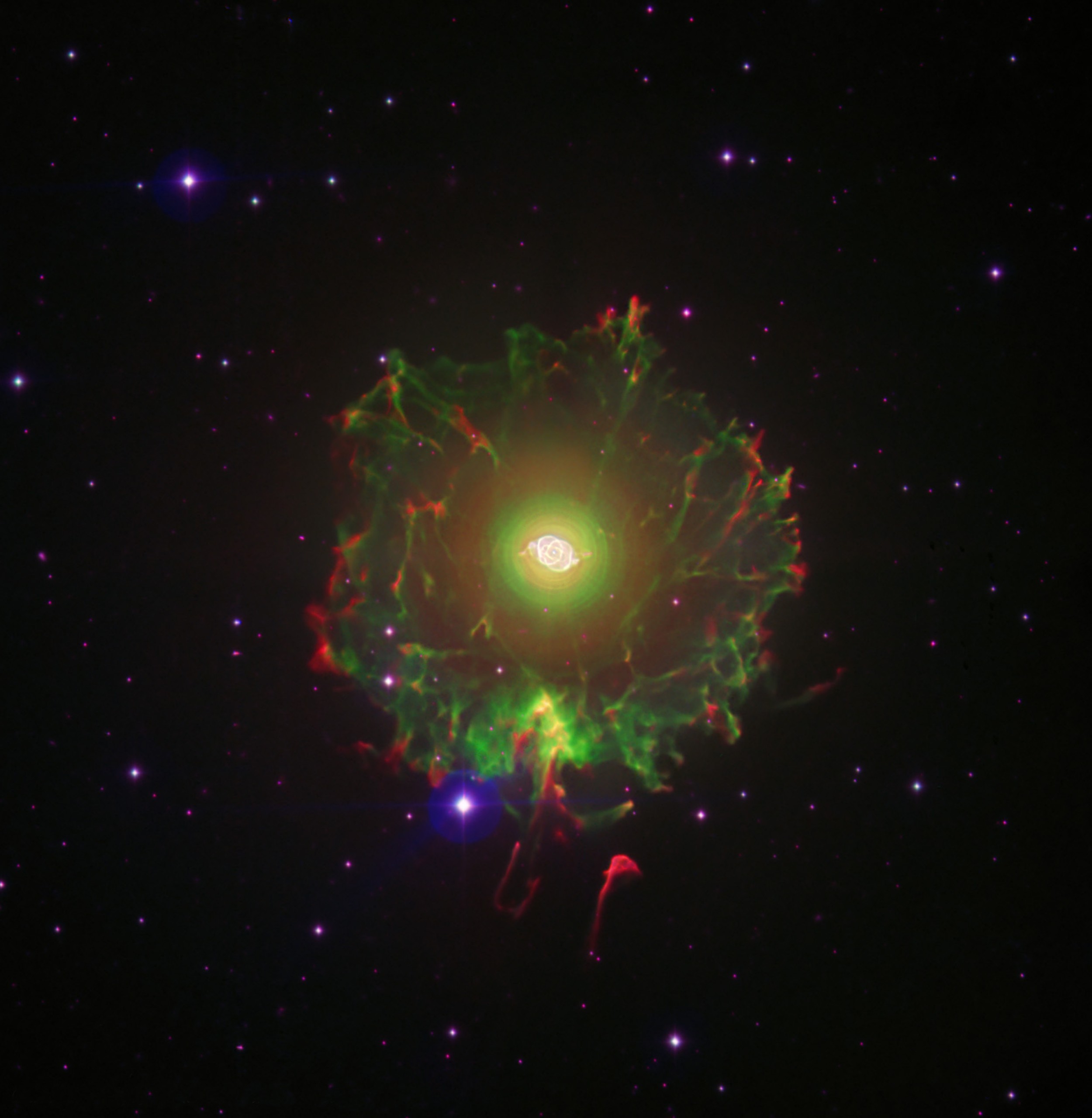
This image of the Cat's Eye Nebula or NGC 6543 was obtained using the Wide Field Camera on the Isaac Newton Telescope. It is a three-colour composite made from data collected using filters to isolate the light emitted by hydrogen alpha (H-alpha), doubly ionised oxygen (OIII) and ionised sulfur (SII) atoms, and coded in the image as red, green and blue respectively. Credit: D. López and R. Barrena (IAC) [ JPEG | TIFF | PDF (with text) ]

NGC 6543, nicknamed the Cat's Eye Nebula, is one of the most complex of the planetary class nebula, stars that throw of spheres of gas at the end of their lives. It is located in the constellation Draco and is thought to have been created 1000 years ago by two stars orbiting each other.

This image was obtained and processed by members of the IAC astrophotography group (A. Oscoz, D. López, P. Rodríguez-Gil and L. Chinarro).

More information:

NGC 6543 - Monthly IAC Astrophoto
IAC Astronomical Picture of the Month

Javier Méndez
Public Relations Officer